
A complete issue · 20 pages · 1899
Life — February 2, 1899
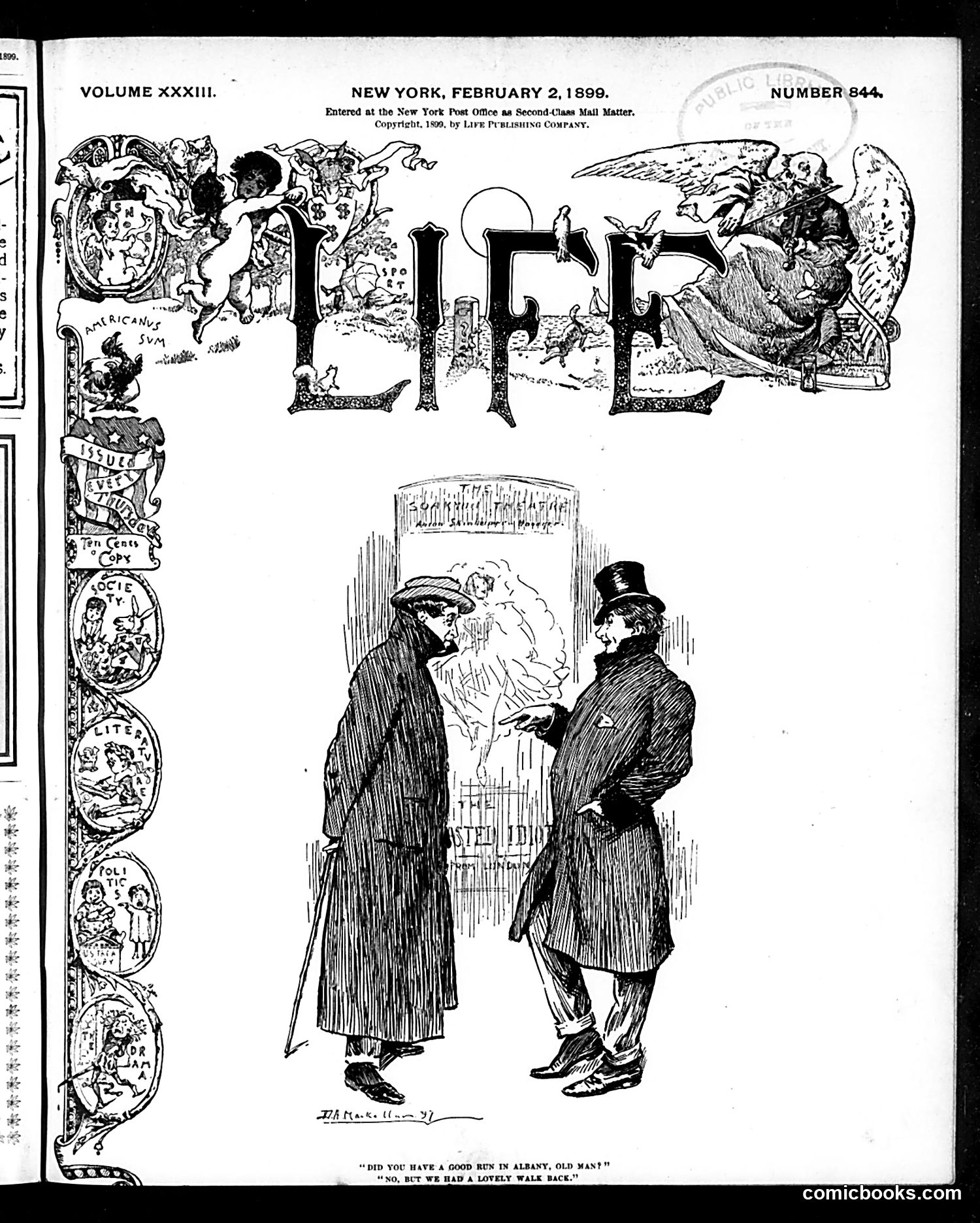
The main cartoon depicts two well-dressed men in winter coats outside what appears to be a charity or public institution. One man asks, "Did you have a good run in Albany, old man?" The other replies, "No, but we had a lovely walk back." This likely references New York State politics and Albany's legislative session. The "run" and "walk back" suggest an unsuccessful political campaign or legislative effort—possibly involving corruption or backroom dealings that forced a humiliating retreat. The men's genteel appearance contrasts with the implication of political failure or scandal. The ornate decorative borders and title treatment are typical of Life's satirical style mocking the wealthy and politically connected.
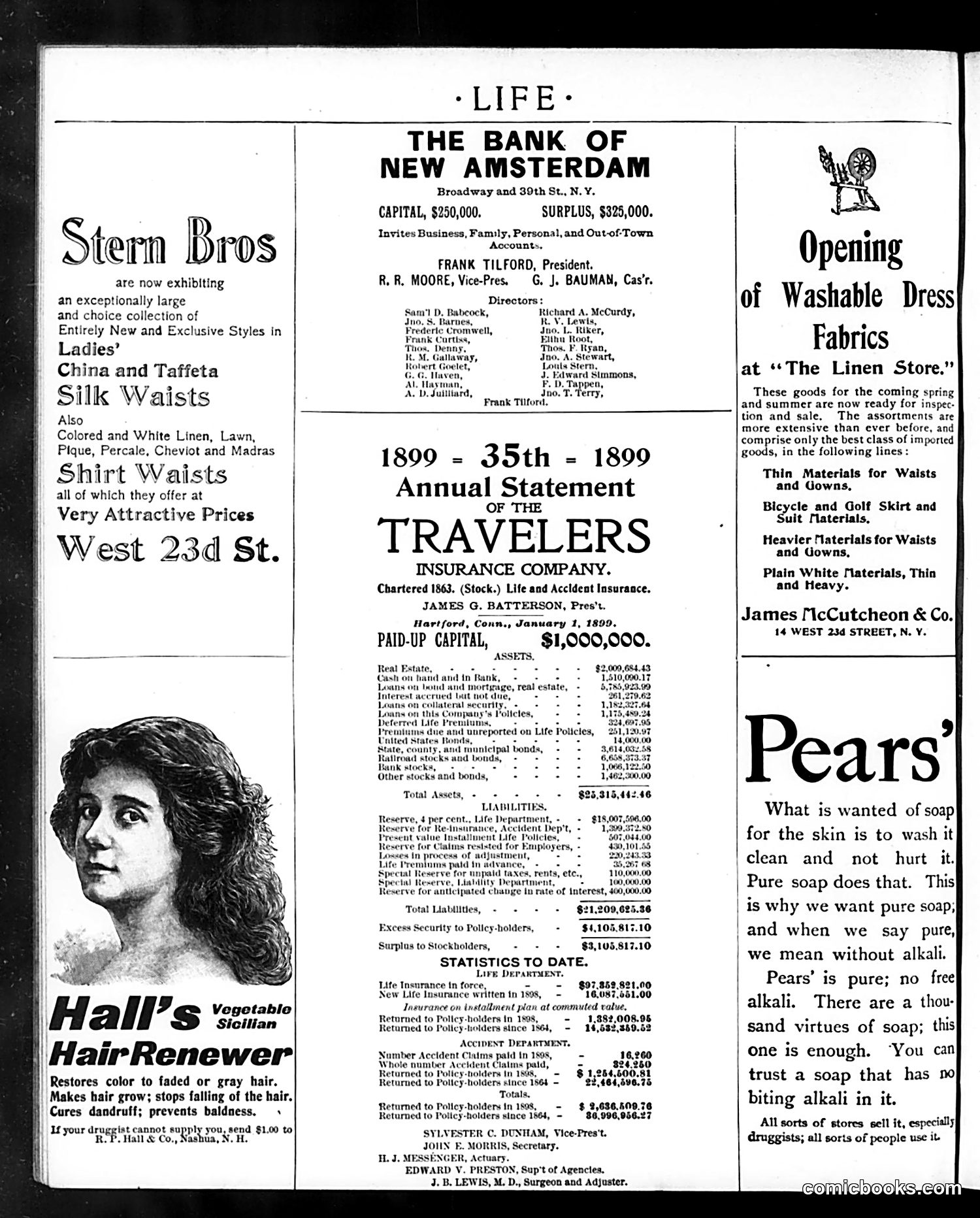
This page is primarily **advertising content** rather than satire or political commentary. It contains five commercial advertisements: 1. **Stern Bros** - Women's clothing retailer advertising silk waists 2. **Bank of New Amsterdam** - Financial institution listing officers and directors 3. **Travelers Insurance Company** - Annual financial statement showing assets and liabilities 4. **Hall's Vegetable Sicilian Hair Renewer** - Hair product with an engraved portrait of a woman (typical Victorian advertising imagery) 5. **Pears' Soap** - Advertisement emphasizing purity and lack of alkali 6. **James McCutcheon & Co.** - Fabric and dress goods retailer 7. **Opening of Washable Dress Fabrics** - Textile merchant announcement The single illustration is a conventional portrait accompanying the hair product advertisement—not political satire. This reflects *Life*'s role as both satirical magazine and advertising platform in 1899.
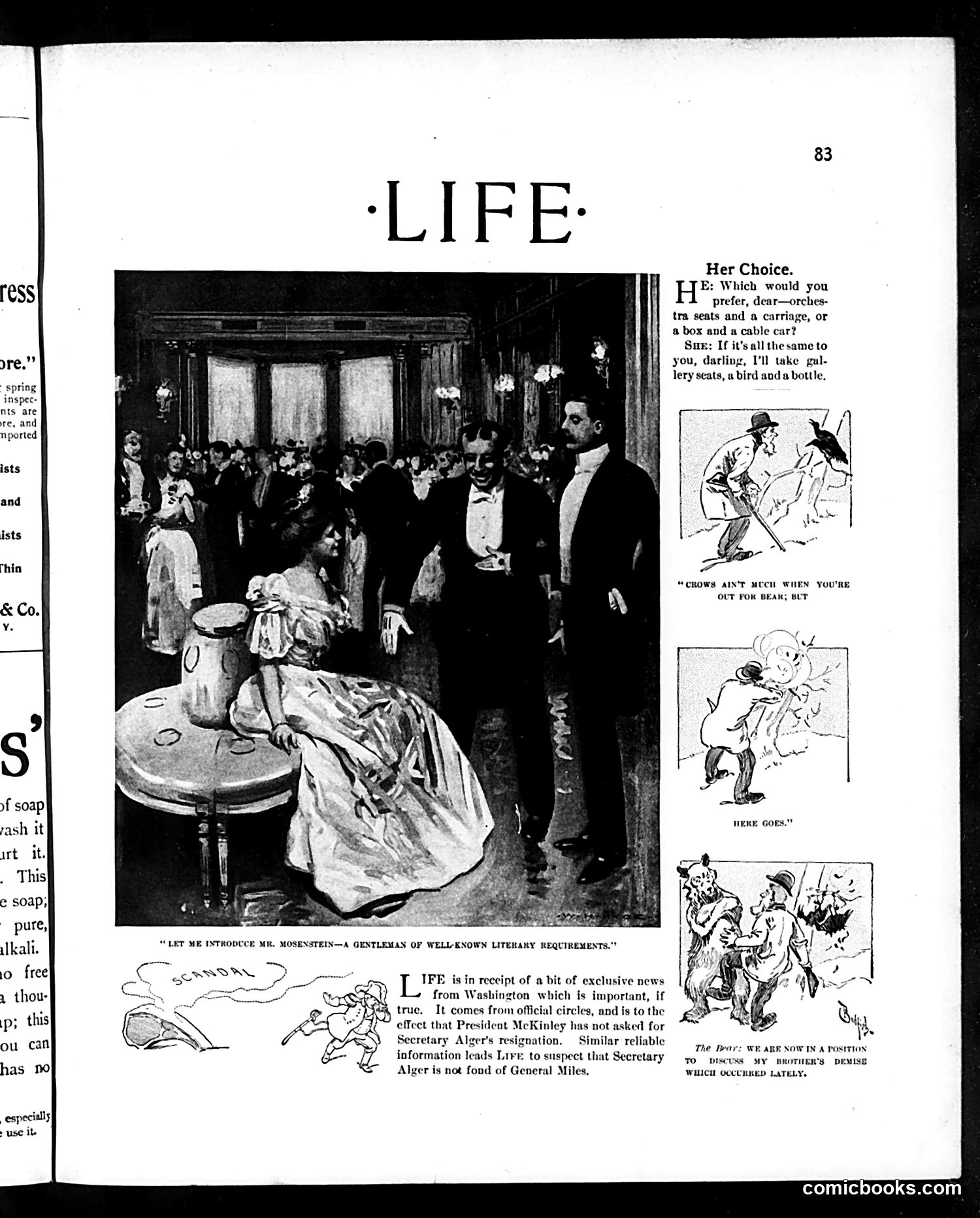
The large illustration depicts a formal evening reception or ball, likely from the early 1900s. The main text references introducing "Mr. Rosenstein—a gentleman of well-known literary requirements," suggesting social satire about a new acquaintance being presented in high society. The smaller cartoon strips on the right show a humorous dialogue titled "Her Choice," where a woman must choose between orchestra seats/carriage or a box/cable car. Her preference for "a bird and a bottle" instead reveals satirical commentary on women's values or preferences, contradicting expected refined tastes. The bottom mentions President McKinley and Secretary Alger's resignation, indicating contemporary political news. The overall page blends social satire with political commentary typical of Life's editorial approach.
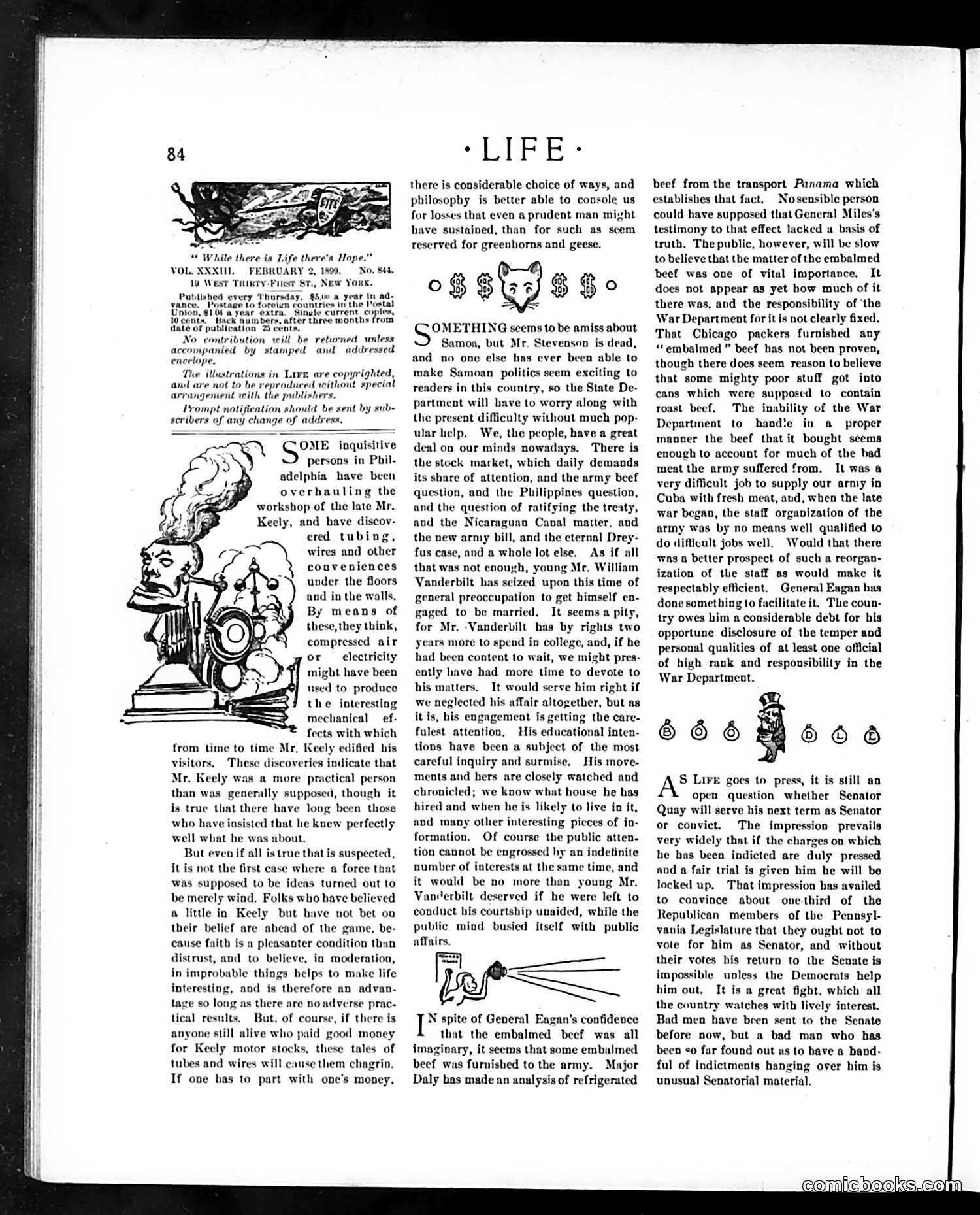
This page contains two main political cartoons satirizing early 20th-century American politics and scandals. The upper cartoon appears to critique mechanical inventions and their dubious practicality—possibly mocking a specific inventor or technological claim presented to the public. The lower section references several contemporary controversies: the "embalmbed beef scandal" (contaminated meat supplied to the U.S. Army, likely during the Spanish-American War), General Eagan's involvement in this affair, and political questions about Senator Quay's fitness to serve. The text discusses whether Quay—apparently facing corruption charges—deserves reelection and whether bad men belong in the Senate. The satire targets both military procurement failures and political corruption, suggesting the public should scrutinize whether compromised officials deserve continued power.
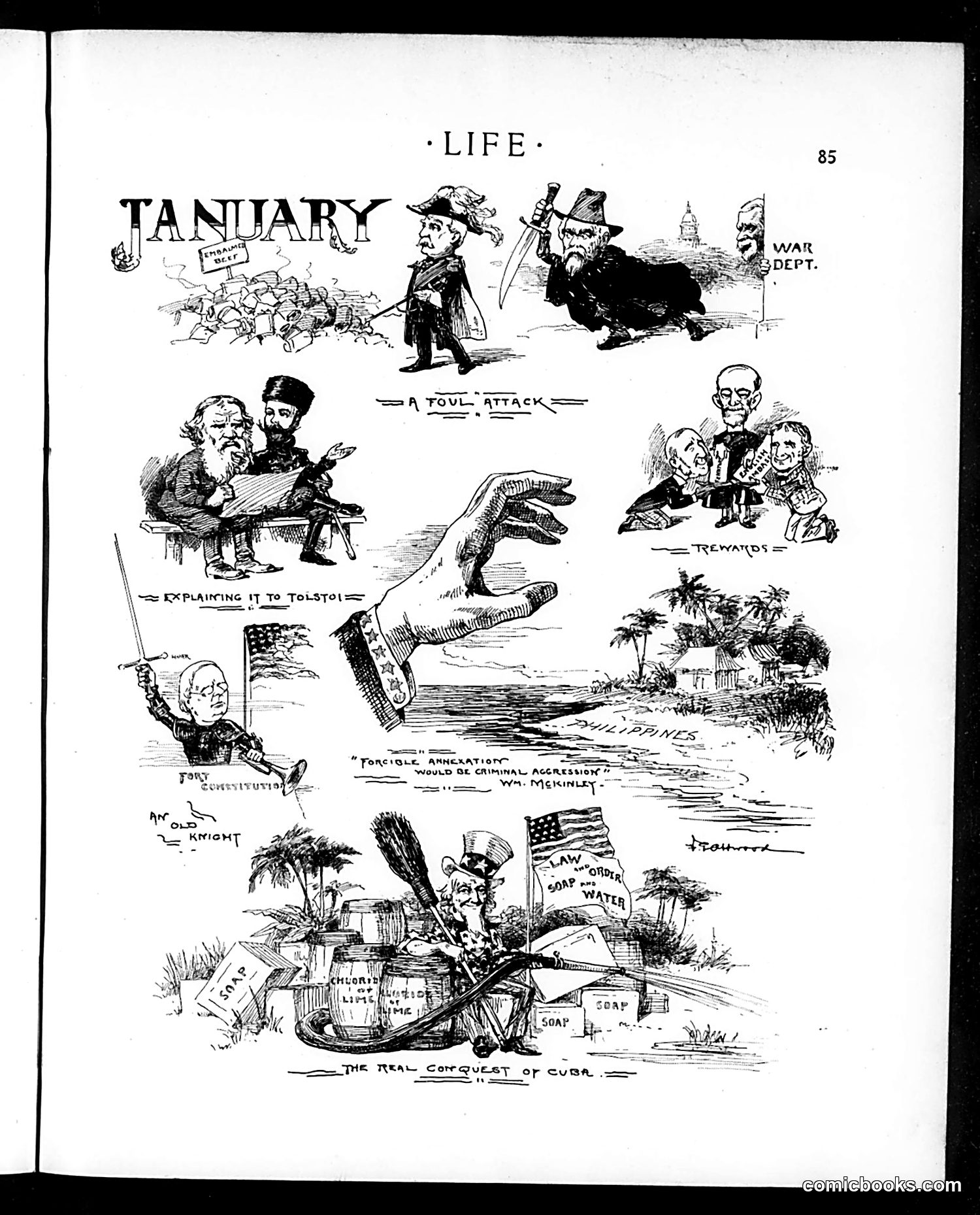
This page satirizes early 20th-century American foreign policy, particularly regarding the Philippines and Cuba. **"A Foul Attack"** shows figures representing American military/political leadership being struck down—likely mocking criticism of U.S. interventionism. **"Explaining it to Tolstoi"** depicts officials justifying American actions to the famous Russian writer, suggesting the difficulty of defending imperial policies to pacifist critics. **"The Real Conquest of Cuba"** portrays Uncle Sam surrounded by soap boxes and supplies, satirizing American commercialism disguised as humanitarian aid or conquest—suggesting profit motives underlie U.S. involvement in Cuba. **"Rewards"** shows figures receiving benefits, likely mocking those profiting from war or imperial expansion. The cartoons collectively critique American imperialism, militarism, and commercial exploitation masked as noble intervention—standard Progressive-era satire about American foreign adventures.
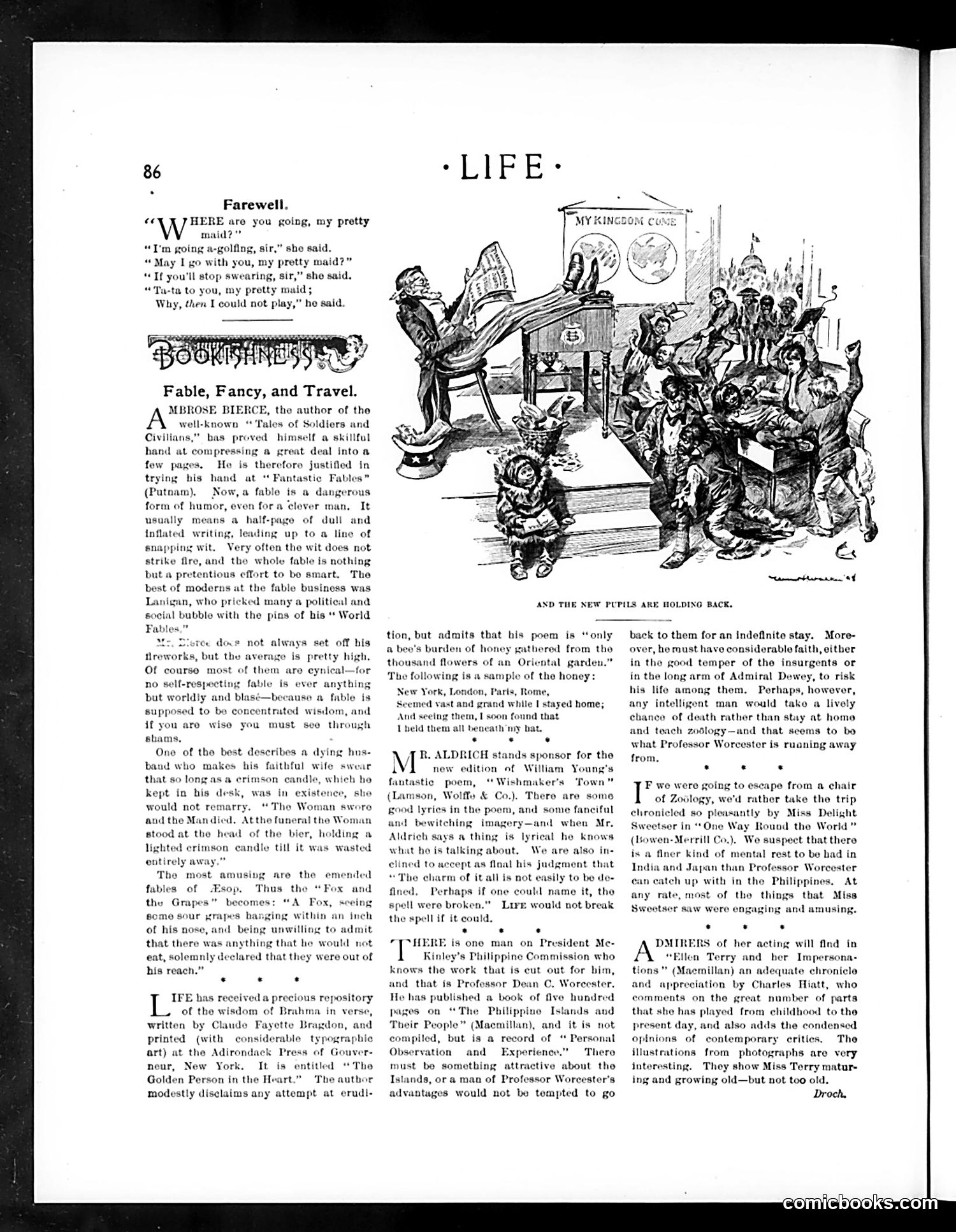
The main illustration depicts "My Kingdom Come," a satirical scene showing a shabby traveling circus or sideshow. The cartoon mocks the commercialization of spiritualism and occult entertainment popular in that era. The accompanying text reviews literary works, including Ambrose Bierce's "Fantastic Fables" and William Young's "Wishmaker's Town." The critic praises Bierce's skill at sharp, witty satire but notes fables can be dangerous—requiring concentrated wisdom rather than mere clever mockery. The page also discusses Professor Dean C. Worcester's book on the Philippine Islands, praising it as thoughtful observation rather than crude political propaganda. Overall, this appears to be a books-and-culture review section combining literary criticism with satirical illustration of contemporary trends.
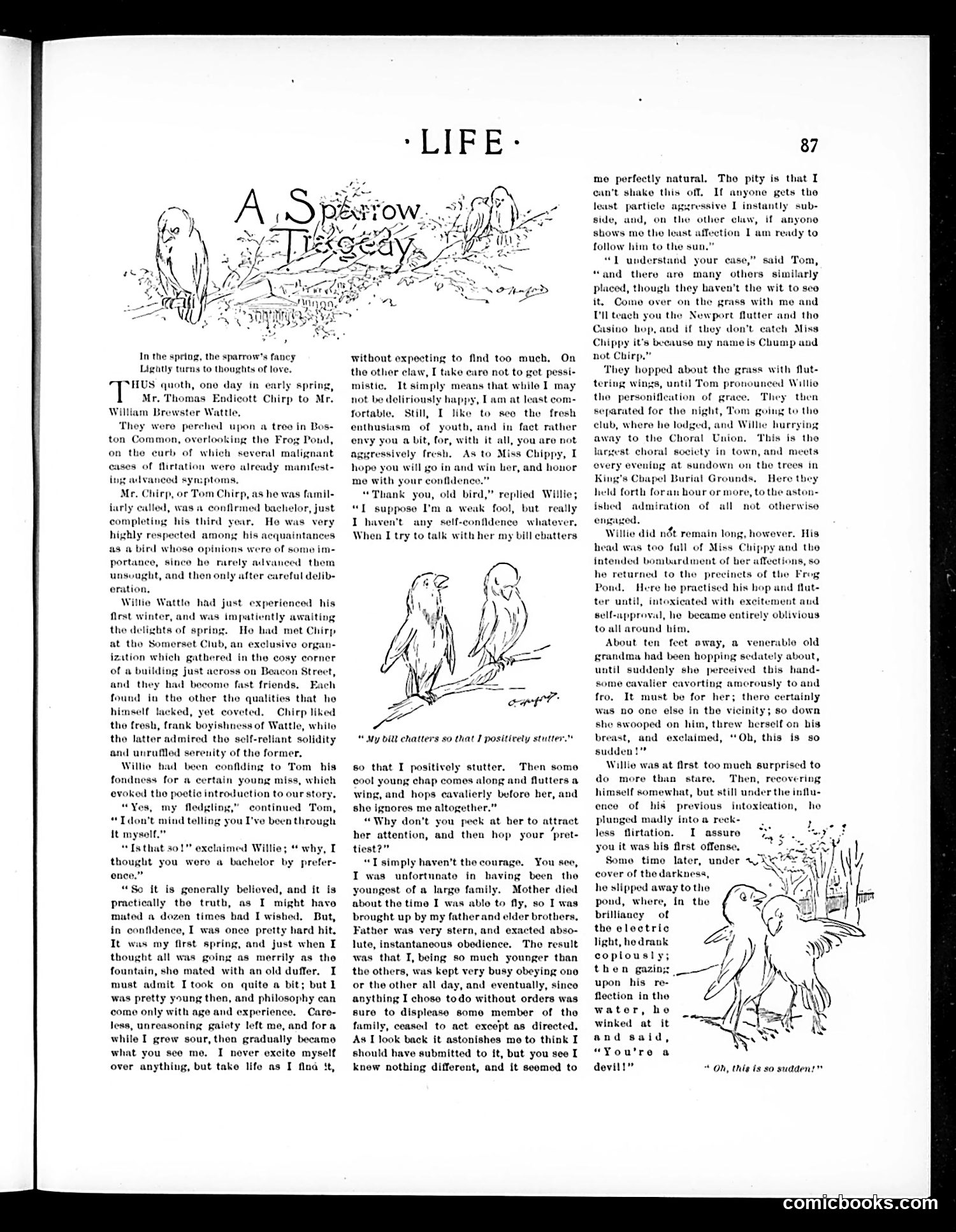
This is a humorous fictional story about sparrows, illustrated with pen sketches. The narrative follows Willie, a young sparrow, and his social anxieties. Willie is a confirmed bachelor living in Boston Common who struggles with self-confidence, particularly around Miss Chippy, a female sparrow he wishes to impress. The story satirizes human romantic and social conventions through animal characters. Willie's internal monologues about shyness, family pressure to marry, and his attempts to gain confidence reflect contemporary social expectations of the era. The illustrations show the sparrows in human-like situations—hopping about grass, socializing at clubs. This anthropomorphic approach allows the magazine to gently mock human courtship rituals and anxieties through avian stand-ins.
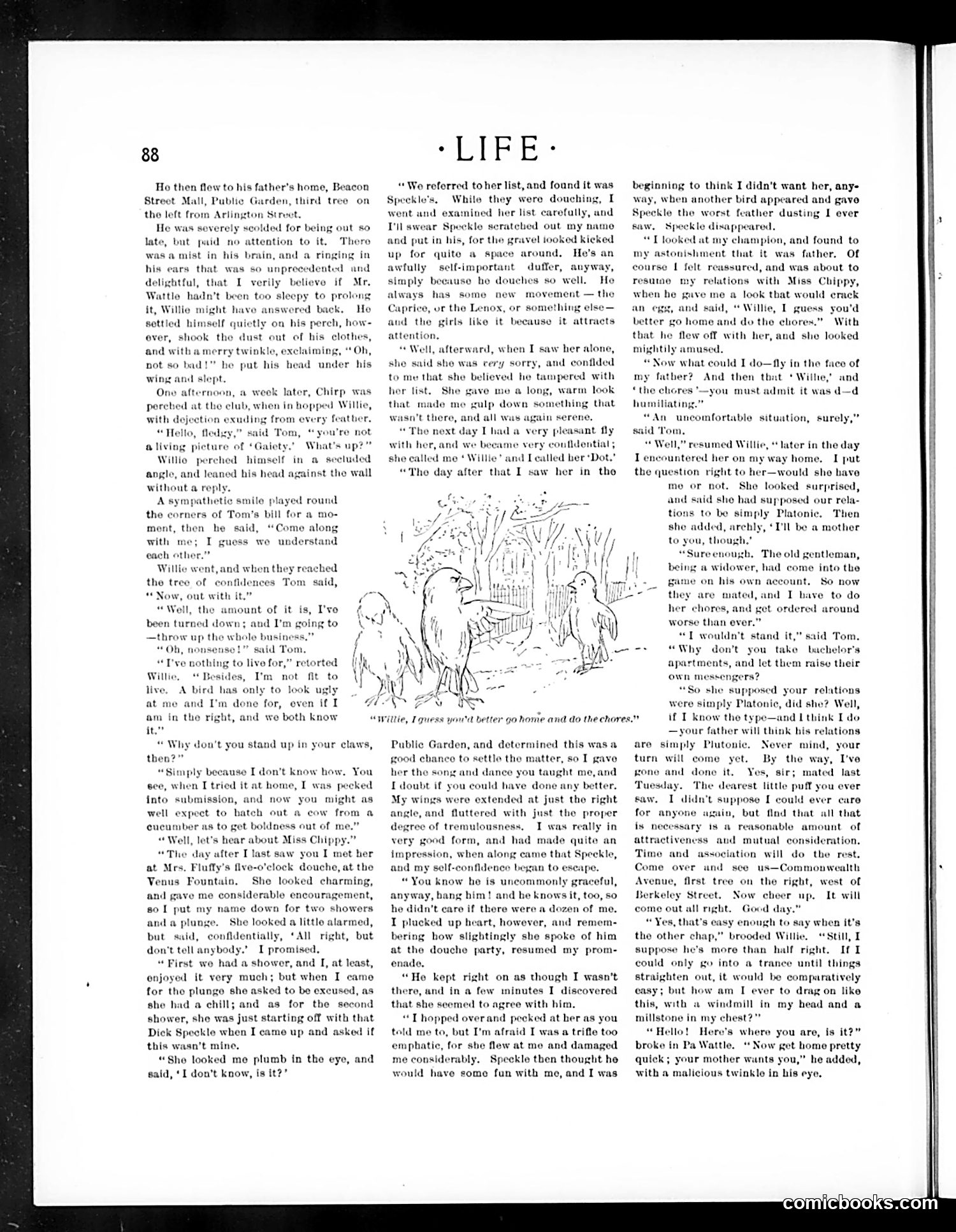
This page contains a narrative story about birds, primarily featuring dialogue between characters named Willie, Speckle, Chippy, and Tom. The accompanying illustration shows several birds in what appears to be a garden setting. The text describes romantic and social complications among the birds—Willie courts Speckle, who initially favors another bird called "Dot," creating jealousy and misunderstandings. The story uses bird characters as stand-ins for human romantic entanglements and social awkwardness. This appears to be **humorous fiction using animal characters as a vehicle for satirizing human social dynamics**—a common literary device of the era. The specific political or social commentary is unclear from this page alone; it reads primarily as light domestic comedy rather than direct political satire.
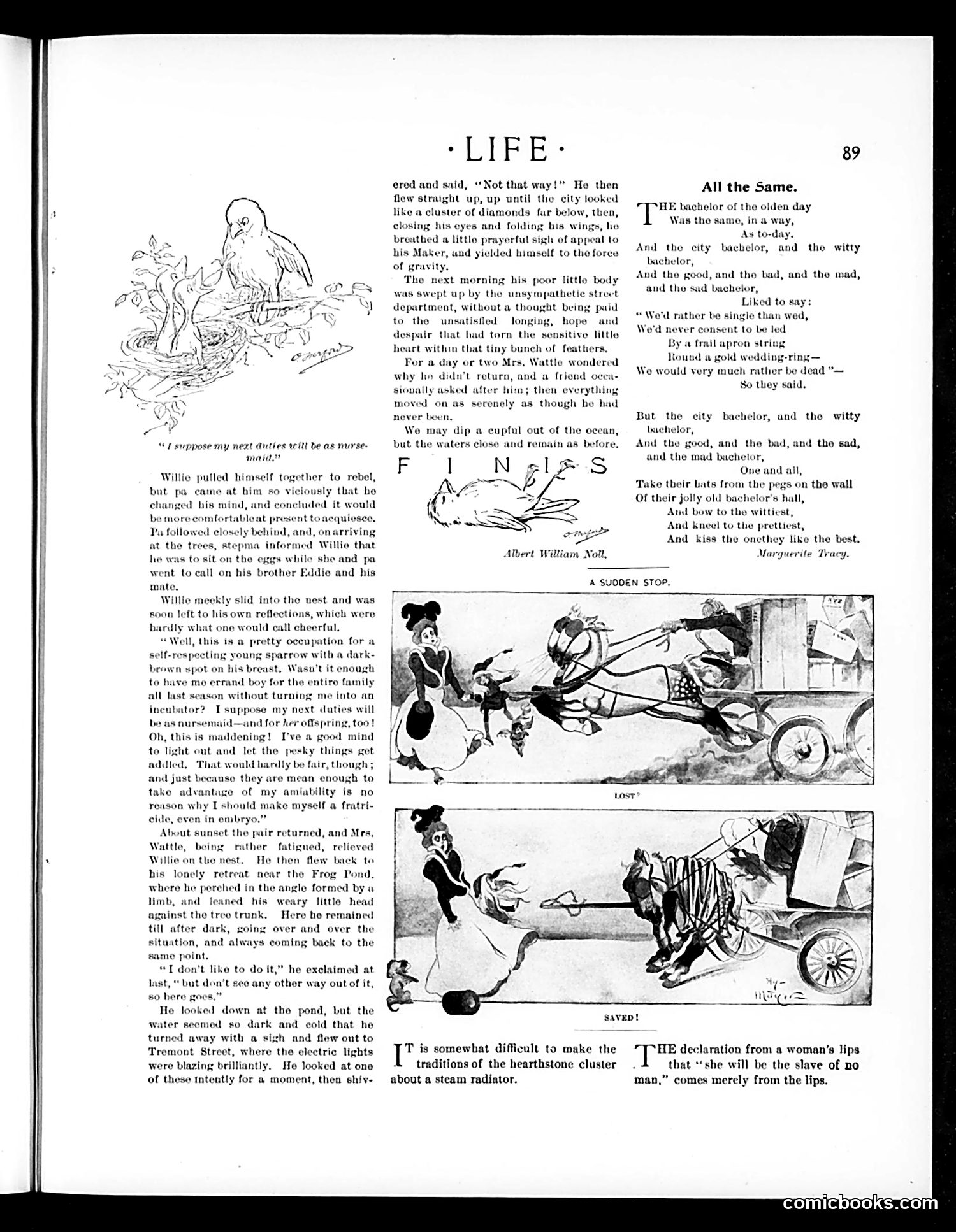
This page contains a story about Willie, a sparrow, and a separate illustrated poem titled "Finials" by Albert William Noix. **The Willie story** satirizes overly sentimental attitudes toward animals. Willie the sparrow is anthropomorphized extensively—he suffers romantic rejection, existential despair, and contemplates suicide at a pond. The narrative mocks both the bird's self-pitying melodrama and humans who project such emotions onto animals. Mrs. Wattle's excessive concern for the sparrow parodies Victorian sentimentality about nature. **"A Sudden Stop"** comic below shows a woman on a bicycle nearly colliding with a car, illustrating early automobile-pedestrian dangers during the transition from horse-drawn to motorized transportation. The page satirizes both sentimental nature-poetry traditions and modern urban hazards.
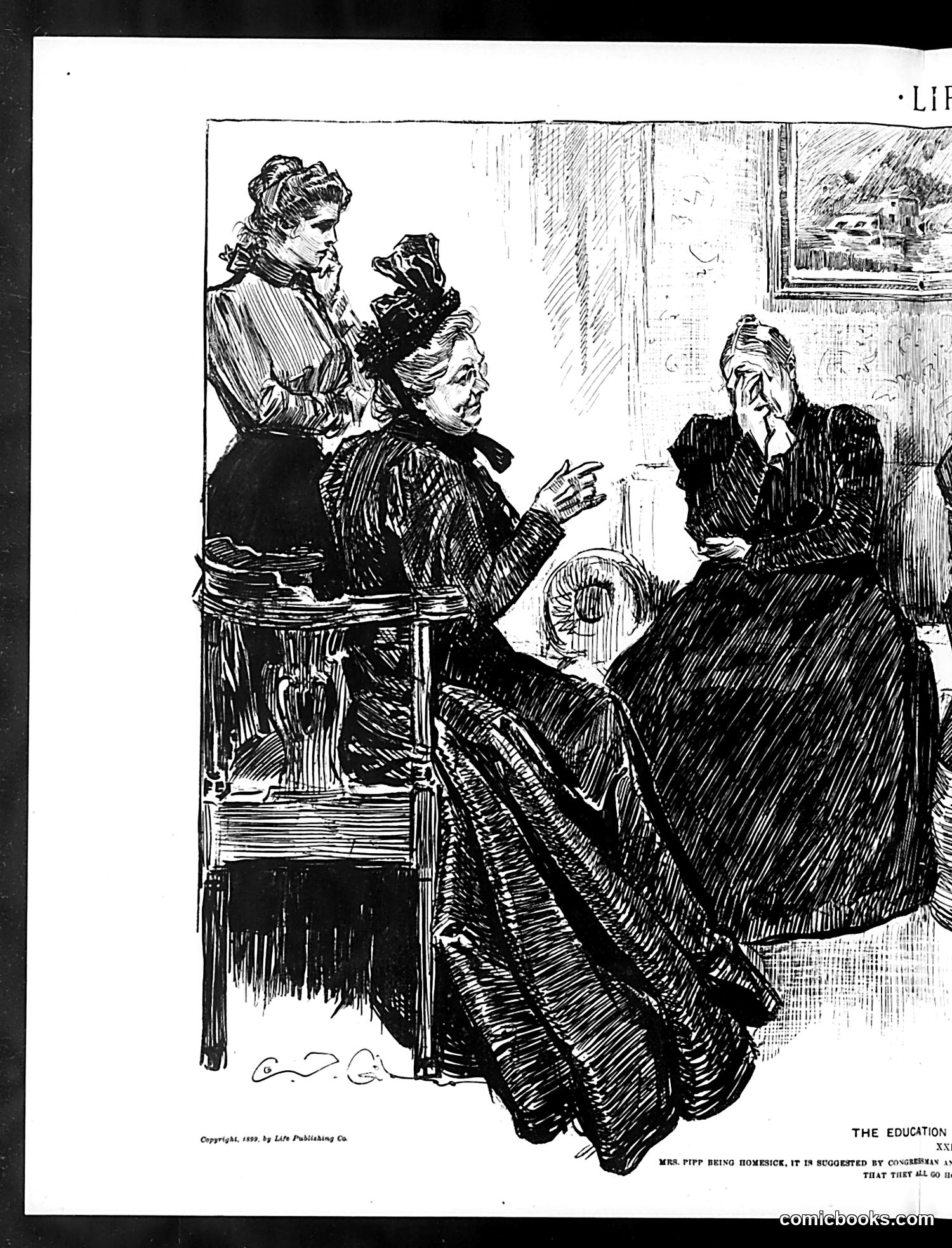
This 1899 Life cartoon depicts a social scene where two women stand on a platform or step addressing a seated woman. The caption references "Mrs. Pipp being homesick, it is suggested by conversation" that "they all go in." The satire appears to target upper-class social conventions and female education or social refinement of the Gilded Age period. The composition—with figures positioned hierarchically—suggests commentary on women's social status or the artificial nature of formal "education" in polite society. The homesickness reference and suggestion to "go in" together implies commentary on how women's social circles operated, possibly mocking the insularity or emotional dependency within those circles. The specific identity of "Mrs. Pipp" remains unclear from the visible text.
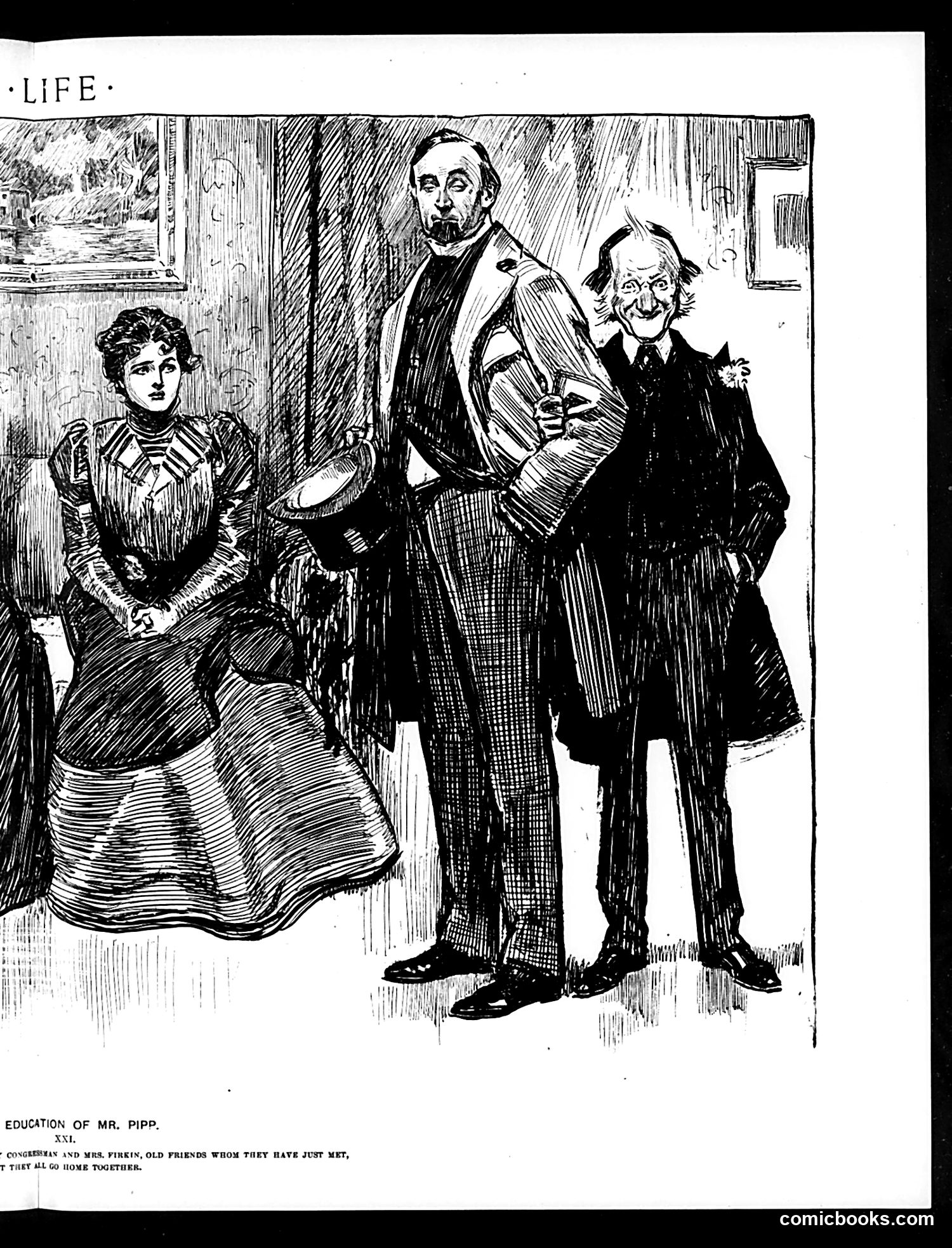
This is part XXI of a serialized satirical story titled "Education of Mr. Pipp." The caption indicates: "Congressman and Mrs. Pinkerton, old friends whom they have just met, and they all go home together." The cartoon depicts four figures in an interior setting. The scene appears to satirize social interactions among upper-class or political figures, with what seems to be an awkward or notable encounter between the characters. The woman on the left sits formally dressed, while three men stand—including what appears to be a congressman (identified as Pinkerton in the caption). Without additional context about the serialized narrative, the specific satire targets social pretension, political behavior, or domestic life among the wealthy and politically connected, typical of Life magazine's satirical humor from this era.
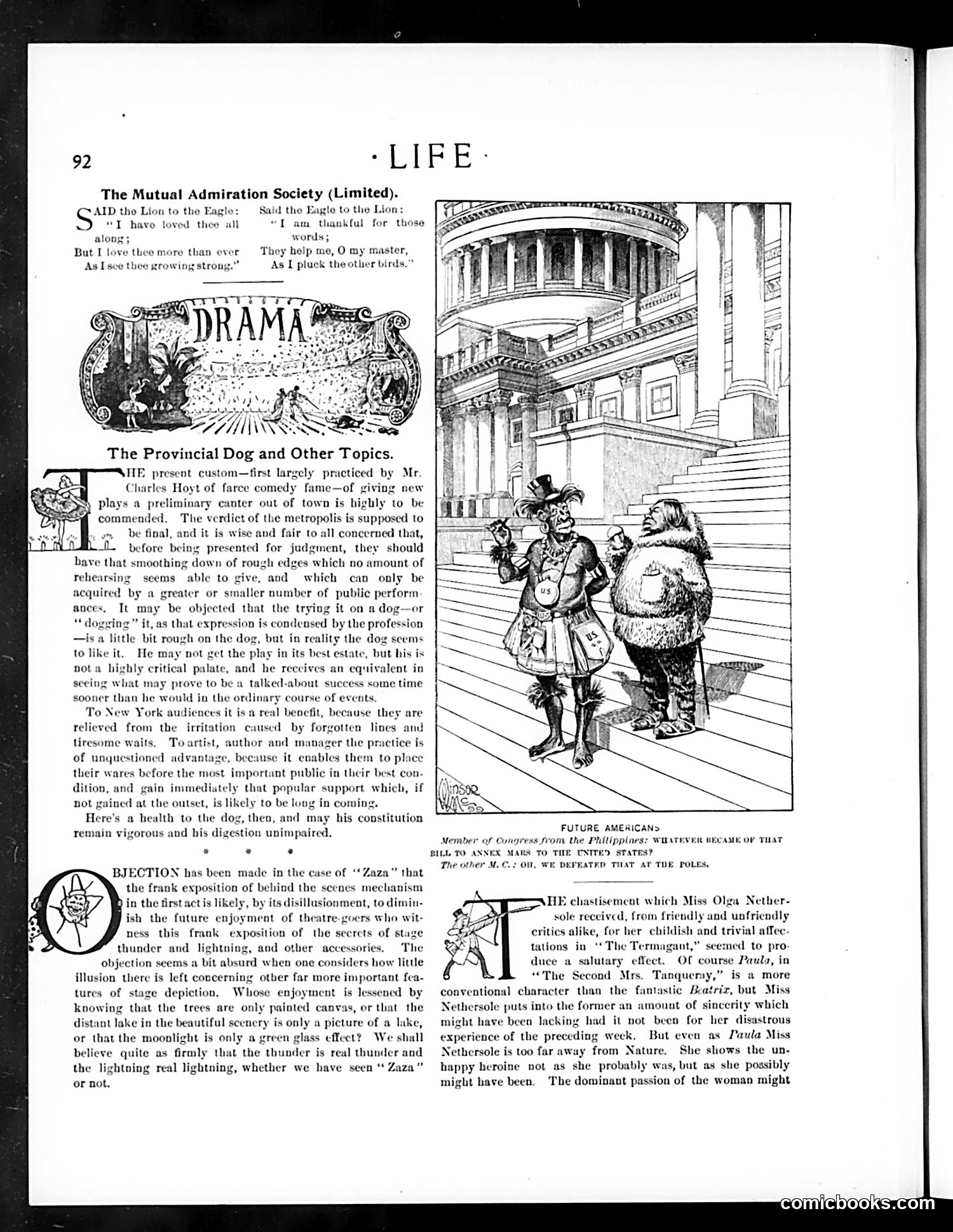
This page from *Life* magazine contains two distinct sections: **Upper section:** A dramatic illustration showing figures on the steps of what appears to be a classical government building (likely the Capitol), captioned "Future American's Member of Congress from the Philippines: Whatever Became of That Bill to Annex Mars to the United States?" This satirizes American imperial expansion following the Spanish-American War and the acquisition of the Philippines, mocking the grandiose ambitions of expansionist politicians by suggesting future absurdities like annexing Mars. **Lower section:** Theater criticism discussing Miss Olga Nethersole's performance in *Indu* and *The Second Mrs. Tanqueray*, praising her sincerity and emotional range while noting her distance from naturalistic acting. The page blends political satire with cultural commentary typical of *Life*'s editorial approach.
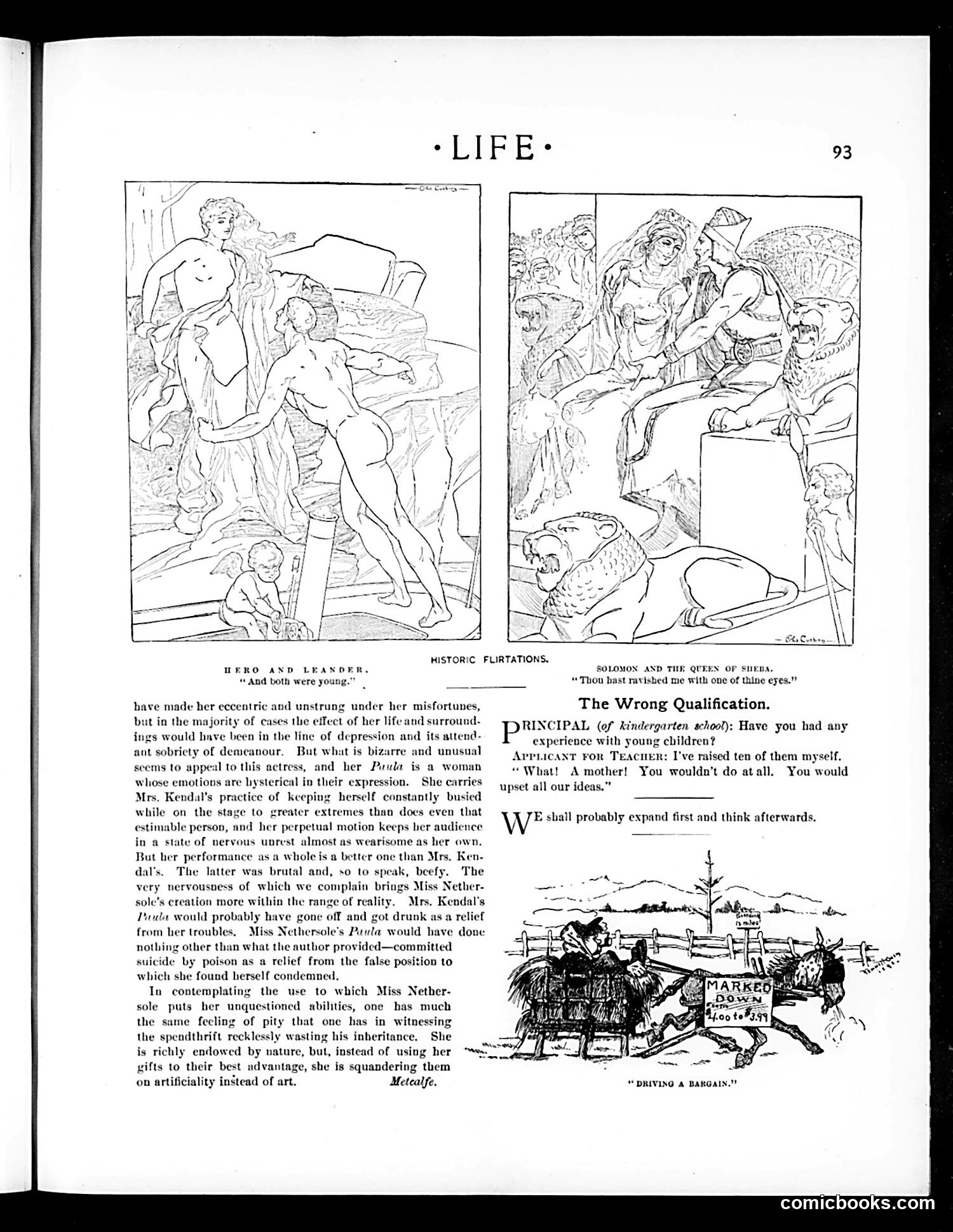
This page contains theatrical criticism and two unrelated satirical cartoons. **Top Section:** A review of actress Olga Nethersole's performance in the play *Paula*. The critic (Metcalfe) compares her to Mrs. Kendal, arguing that while Nethersole's hysterical, perpetually-in-motion performance is more realistic, she wastes her talent on artificiality rather than serious art—like a spendthrift squandering an inheritance. **"The Wrong Qualification" cartoon:** A kindergarten principal rejects a woman applicant who has raised ten children of her own, saying she would "upset all our ideas." This satirizes institutional rigidity: the school's theoretical methods are valued over actual parenting experience, mocking the disconnect between academic pedagogy and practical childcare. **"Driving a Bargain" illustration:** A humorous scene of a horse trade negotiation. The page reflects early 20th-century attitudes about women, theater, education, and the tension between tradition and practical competence.
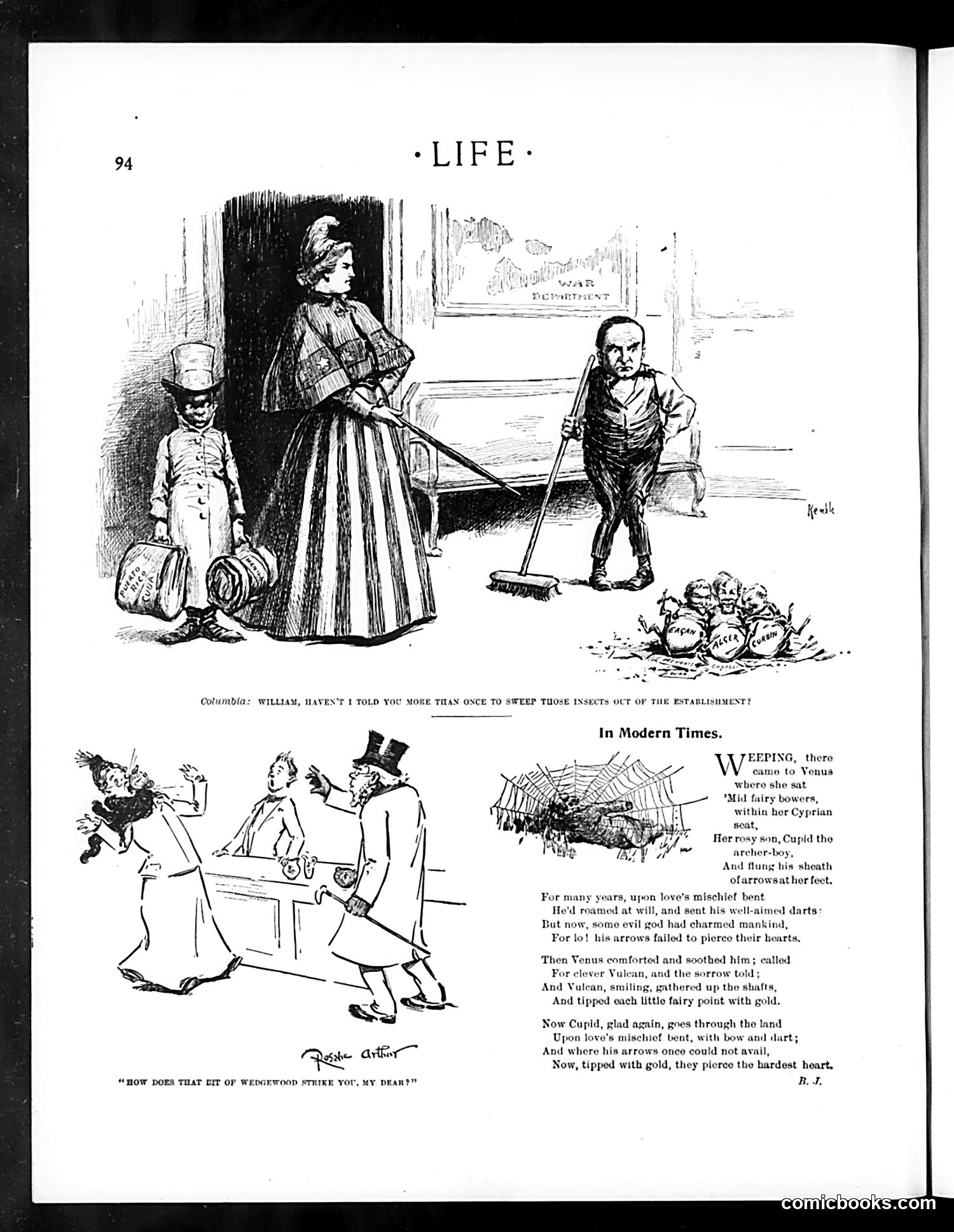
**Top Cartoon:** Columbia (personification of America) scolds "William" (likely Kaiser Wilhelm II of Germany) for not sweeping "insects" from "the establishment." This is Cold War-era or WWI-adjacent satire critiquing Germany's failure to control internal instability or political extremism. **Bottom Cartoon:** A social satire on materialism. Two gentlemen discuss "wedgewood" (fine pottery)—representing refined taste—while a woman between them appears distressed or conflicted, suggesting wealth/status supersedes genuine emotion. **Poem "In Modern Times":** A classical allegory modernized: Cupid's arrows (love) fail to move people until tipped with gold (money). The satire is explicit: wealth now conquers hearts where genuine affection once did, critiquing the era's materialism and commercialism replacing romantic or moral values. All three pieces target similar themes: failed institutions, moral decay substituted by greed or force.
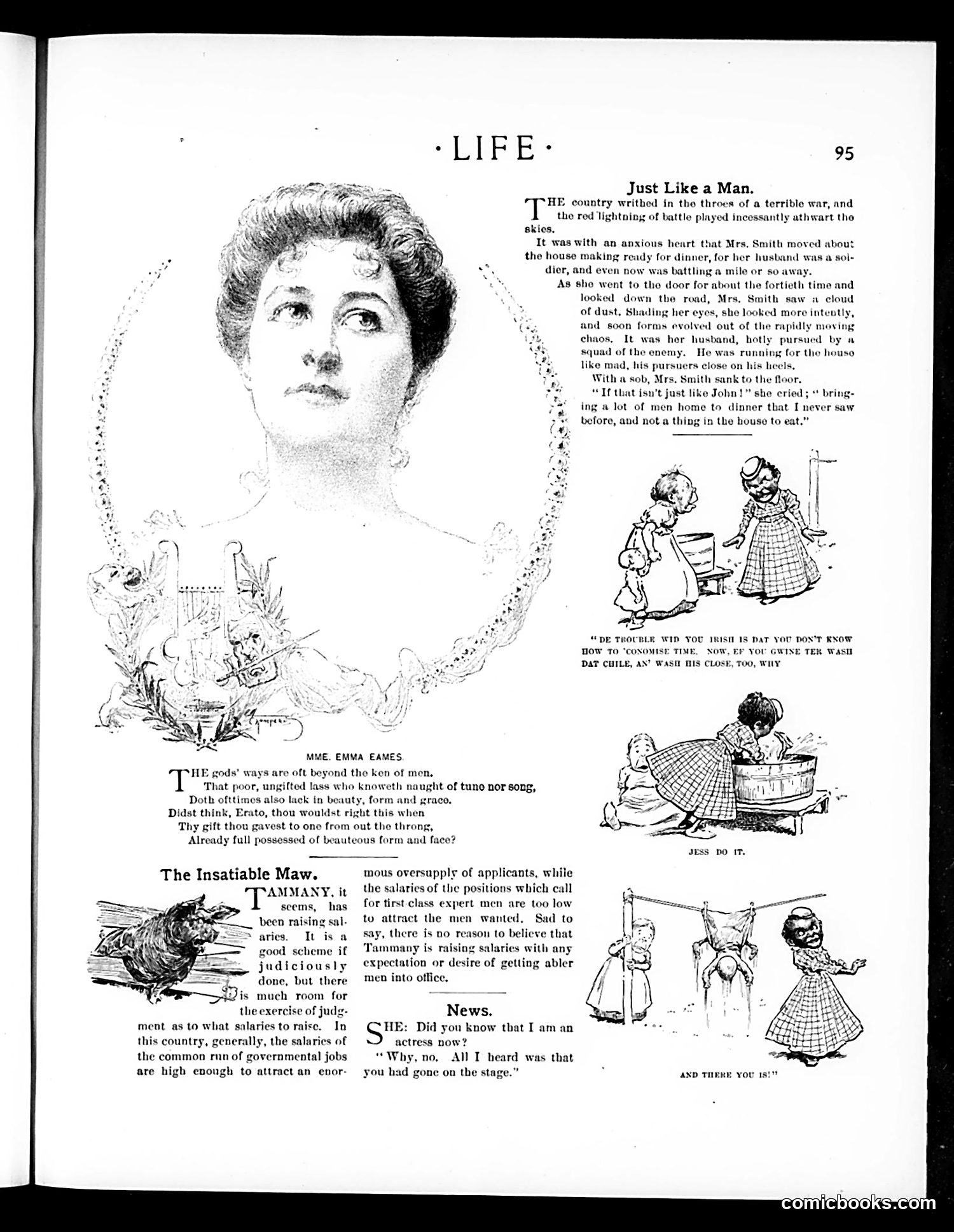
This page contains three satirical pieces from early 20th-century American Life magazine: **"Just Like a Man"** is a domestic humor story: During wartime, Mrs. Smith anxiously awaits her soldier husband. When he finally appears running toward home *pursued by enemy soldiers*, her reaction is exasperation—not about the danger, but that he's bringing unexpected dinner guests when she has no food prepared. The satire targets women's domestic preoccupations and the stereotype of wives caring more about housekeeping than their husbands' safety. **"Mme. Emma Eames"** is a poem praising the famous opera singer's vocal gifts compensating for physical plainness—a literary tribute rather than satire. **"The Insatiable Maw"** attacks Tammany Hall (New York's Democratic political machine) for raising government salaries without genuine intent to hire better-qualified officials. It criticizes political corruption and wasteful spending. The accompanying illustrations show children in period dress and domestic scenes supporting these narratives.
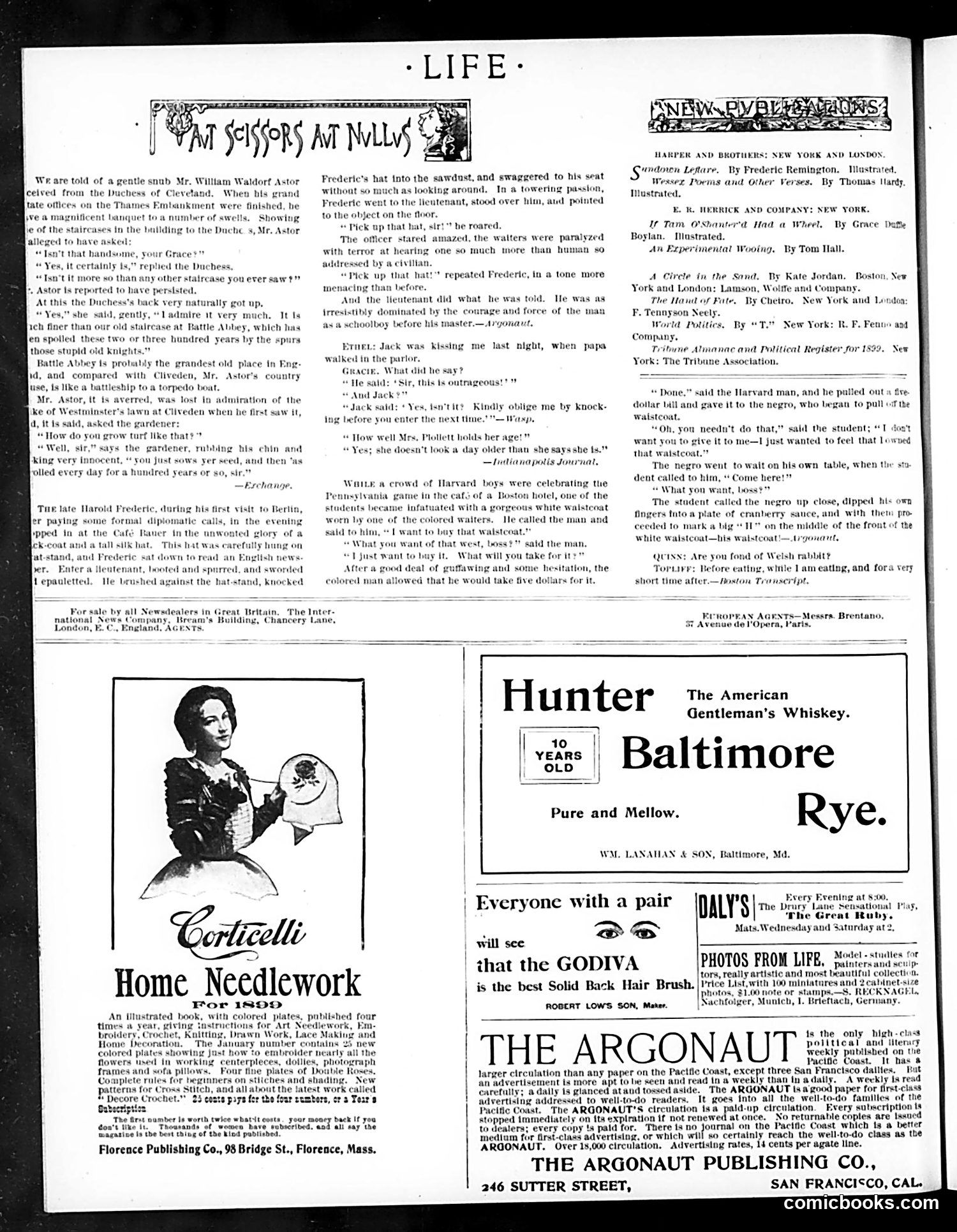
This page is primarily **literary advertisements and book reviews** rather than political cartoons. The OCR'd text contains multiple humorous anecdotes about wealthy American socialites (Astor, Duchess of Cleveland) and their servants, typical of *Life* magazine's satirical humor targeting the upper classes. The visible cartoon (left side) shows a woman with a **Corticelli Home Needlework** advertisement—standard period advertising. The anecdotes mock genteel pretension: one story depicts William Waldorf Astor forcing a subordinate to retrieve a hat from sawdust (asserting dominance through military-style barking); another involves Harvard students marking a waiter's waistcoat with cranberry sauce as a prank. The satire targets **class hierarchies and American wealth** through these scenarios of servants humiliated by employers and students. The humor relies on period attitudes about social subordination that modern readers would find offensive rather than amusing. The page predominantly features **book advertisements** for Harper & Brothers publishers, not political commentary.
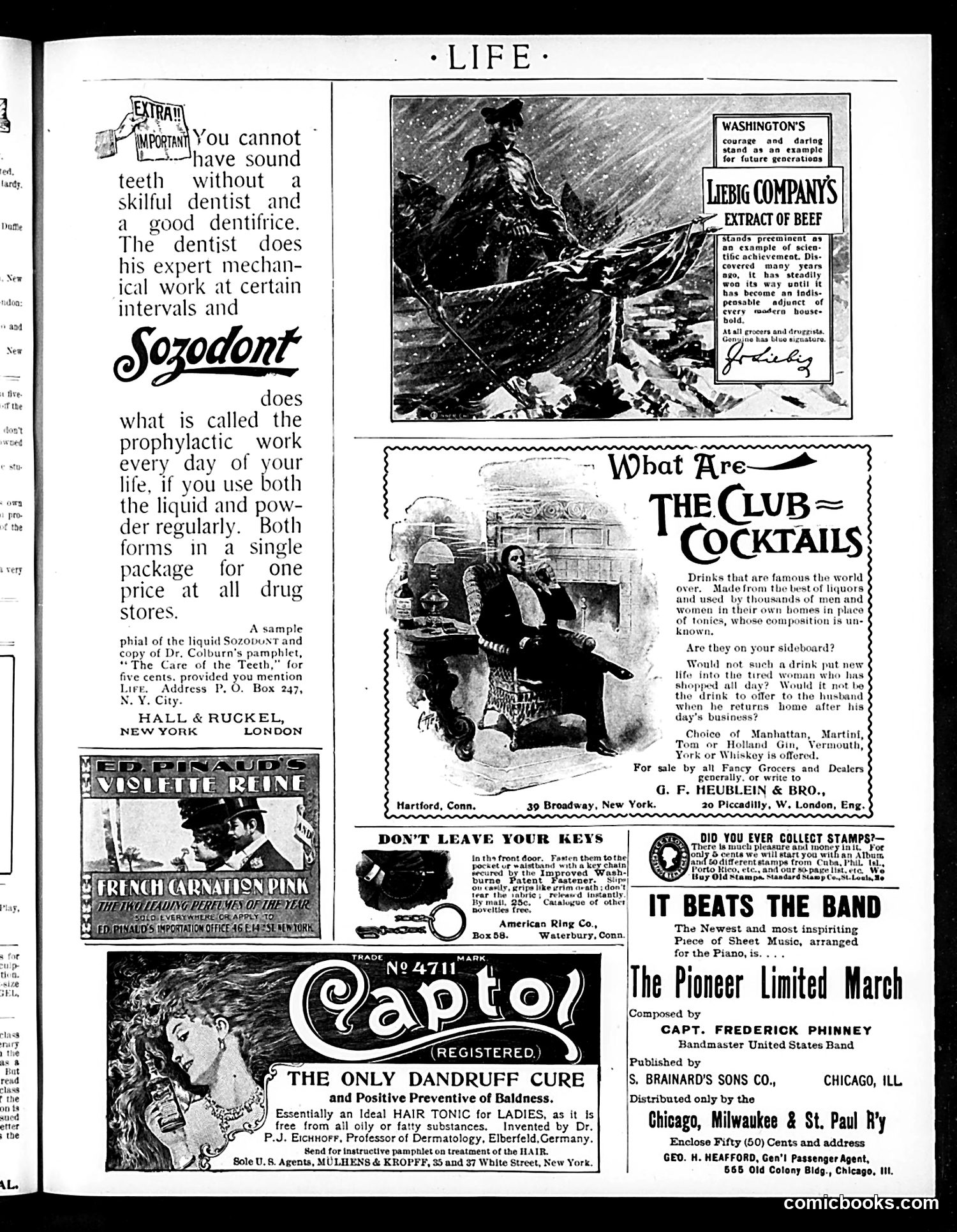
This is primarily an **advertising page** from an early 20th-century issue of Life magazine, not a political cartoon. The page contains multiple product advertisements rather than satirical commentary. The ads reflect period consumer concerns: **Sozodont** toothpaste/powder promises dental health; **Liebig Company's beef extract** markets itself as a health tonic; **Club Cocktails** advertisement promotes pre-mixed drinks for home consumption (likely pre-Prohibition); **Capilol** dandruff cure targets women's beauty anxieties; and various other products (keys, stamps, sheet music, hair tonic). Notably, the **Liebig ad includes a small illustration** showing what appears to be historical/patriotic imagery referencing Washington, lending prestige to the product through association with American heritage. The page demonstrates how Life monetized its readership through advertising while maintaining the magazine's refined aesthetic. There is no discernible political satire present—this is straightforward commercial content typical of the era.
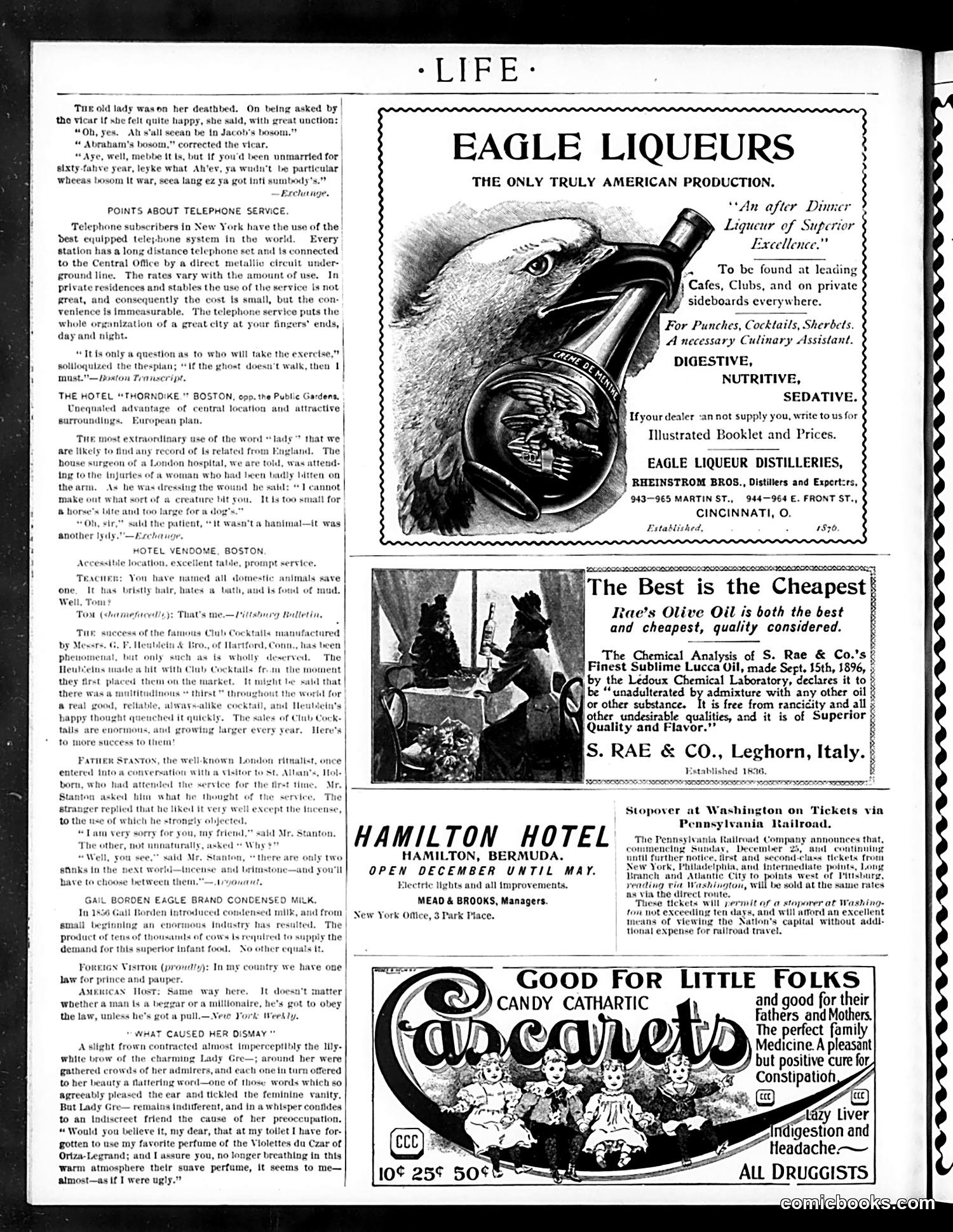
This page from *Life* magazine (which functioned as a satirical weekly in this era) contains **text humor and advertisements** rather than editorial cartoons. The main content includes three jokes targeting Victorian social conventions: 1. **The "bosom" anecdote** mocks clerical correction and propriety—a woman unmarried 65 years sardonically dismisses theological precision about whose bosom she'll rest in. 2. **The "lady" story** jokes about crude language, reporting a doctor's confusion comparing an injury to animals, with a patient cheekily self-identifying as the unnamed "animal" referenced. 3. **The ritualist anecdote** centers on Church of England ceremonialism, with a priest defending incense use despite visitors' objections—satirizing religious formalism. The bulk of the page comprises advertisements for **Eagle Liqueurs** (positioned as "truly American"), **Rae's Olive Oil**, the **Hamilton Hotel** (Bermuda), **Codoriol candy** for children's digestion, and rail travel—typical late-19th-century magazine advertising. The satire targets institutional pretension: clerical pomposity, religious ritualism, and linguistic euphemism.
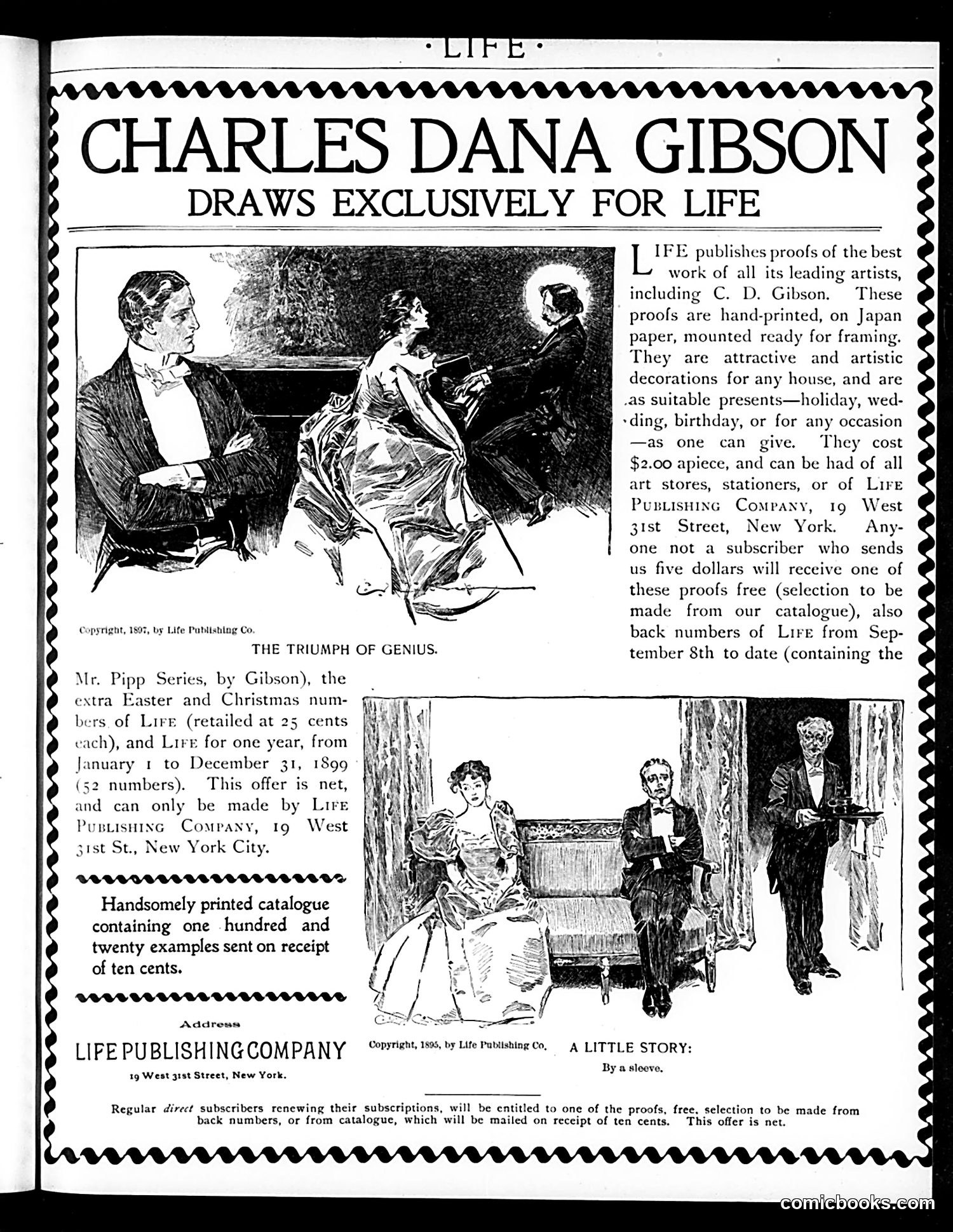
This is primarily **advertising** for Charles Dana Gibson's work and Life magazine's subscription offerings, not political satire. The page promotes Gibson's drawings, which were hugely popular at the time. "The Triumph of Genius" cartoon (top) depicts a social scene—a well-dressed man observing an elegantly gowned woman with a gentleman, suggesting Gibson's specialty: satirizing upper-class social interactions and romantic dynamics. The smaller cartoon, "A Little Story: By a sleeve," uses visual humor (showing only a servant's arm/sleeve) to suggest domestic comedy or social commentary about class distinctions—typical Gibson territory. The **real content** is subscription sales: Life offered reproductions of Gibson's work on Japan paper for $2 each as framed art, plus subscription deals bundling his "Pipp Series" with back issues. This reflects Gibson's massive cultural popularity in the 1890s as America's premier illustrator of genteel society humor.
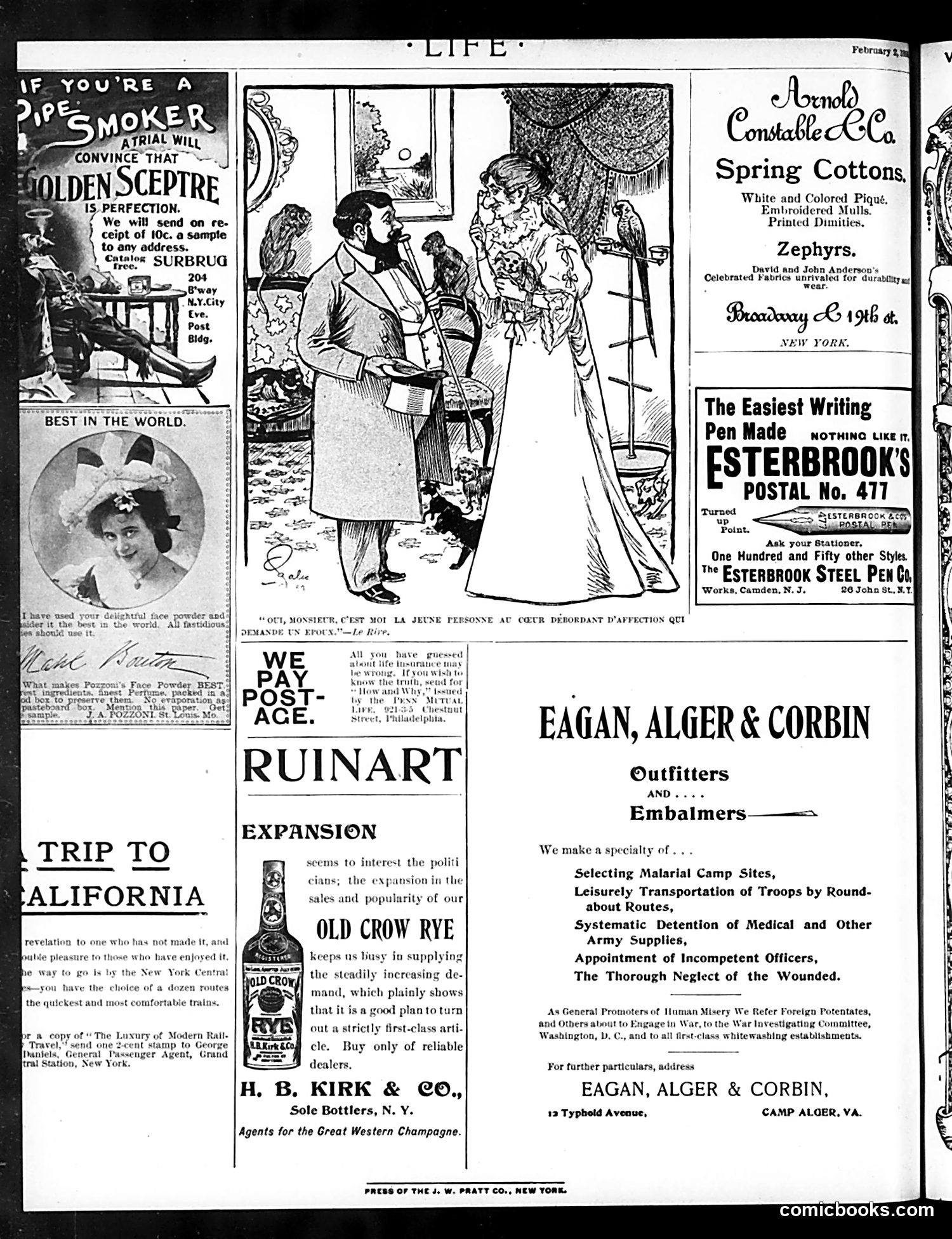
The main cartoon mocks the U.S. Army's conduct during the Spanish-American War (1898). The large advertisement for "EAGAN, ALGER & CORBIN—Outfitters and Embalmers" is a biting satirical fake ad targeting military leadership. **The targets:** General Nelson Miles (Eagan), Secretary of War Russell Alger, and Colonel (later General) Eagan, who were blamed for catastrophic mismanagement of the war effort—particularly the deaths of more soldiers from disease and poor conditions than combat. **The "services" listed** mock their actual failures: selecting malarial camp sites, detaining medical supplies, appointing incompetent officers, and neglecting wounded soldiers. The combination of "Outfitters and Embalmers" darkly implies their incompetence led to unnecessary deaths. This represents Life's prominent role as a reform-minded satirical publication exposing government corruption and military bungling during a pivotal moment in American history.