
Life, 1899-02-02 · page 6 of 20
Life — February 2, 1899 — page 6: what you’re looking at
What you’re looking at
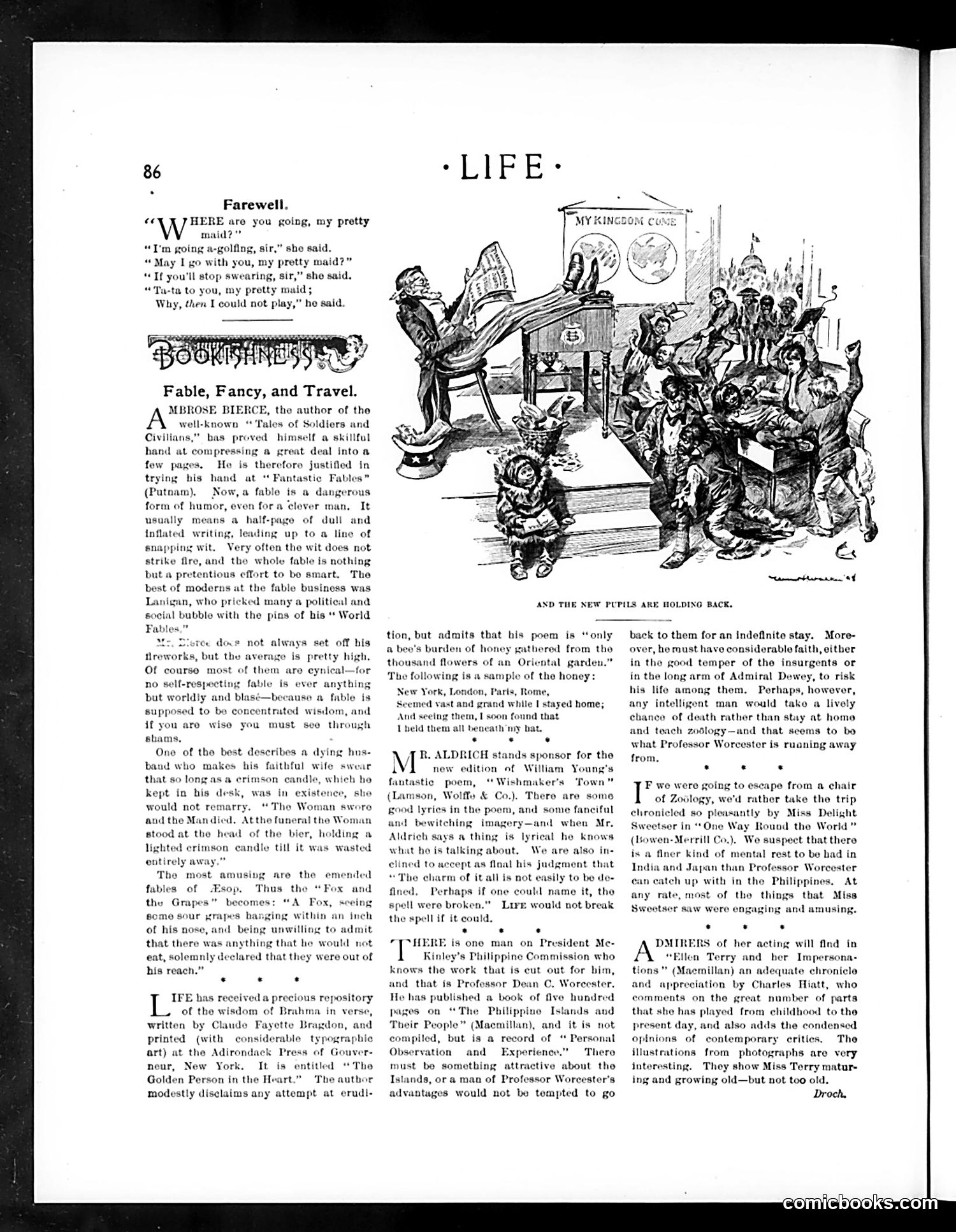
The main illustration depicts "My Kingdom Come," a satirical scene showing a shabby traveling circus or sideshow. The cartoon mocks the commercialization of spiritualism and occult entertainment popular in that era. The accompanying text reviews literary works, including Ambrose Bierce's "Fantastic Fables" and William Young's "Wishmaker's Town." The critic praises Bierce's skill at sharp, witty satire but notes fables can be dangerous—requiring concentrated wisdom rather than mere clever mockery. The page also discusses Professor Dean C. Worcester's book on the Philippine Islands, praising it as thoughtful observation rather than crude political propaganda. Overall, this appears to be a books-and-culture review section combining literary criticism with satirical illustration of contemporary trends.
📄 Transcribed text from this page (OCR, searchable)
Machine-transcribed from the original scan — historical spelling and the odd misread are preserved.
86 Farewell. “ HERE aro you going, my pretty maid?” “I'm going a-golfing, sir,” sho said. “May I go with you, my pretty maid?” “If you'll stop swearing, sir,” she said, ta to you, my pretty maid; Why, then I could not play,” he said. Fable, Fancy, and Travel. MBROSE BIERCE, the author of the A well-known “ Tales of Soldiers and Civilians,” bas proved himself a skillful hand at compressing a great deal into a fow pa Ho is therefore justified in trying his hand at “F Fables” (Putnam), Now,a fable is a dangerous form of humor, even for ver man, It usually means a half-page of dull and inflated writing, leading up to a line of snapping wit, Very often the wit does not strike fire, and the whole fable is nothing but a pretentious effort to be smart. The best of moderns ut the fable business was Lanigan, who pricked many a political and social bubble with the pins of his * World Fab! tastic Disree das not always set off his Hreworks, but the average is pretty high. Of course most of them are eynical—for no self-respecting fable is ever anything but worldly and blasé—because a fable is supposed to be concentrated wis if you aro wiso you ams. Ono of tho best describes a dying hus- band who makes his faithful wife that so longas a crimson candle, kept in his desk, sho would not remarry. “The Woman sworo and the Mandied, Attho funeral the Woman stood at the head of the bier, and must seo through swear which ho was in existence, holding a lighted crimson candle till it was wasted entirely away,” Tho most amusing are the emended fables of Eso, Thus the “Fox and the Grapes” es: “A Fox, seeing ur grapes banging within an inch and being unwilling to admit that there was anything that he would not eat, solemnly declared that they were out of his reach, beco: IFE has received a precious repository of the wisdom of Brah' written by Claude Fayette Bragdon, and printed (with art) at the Adi in verse, considerable ndack Press of Gouver- neur, ) York, It is entitled “T Golden Person in the Heart.” The author modestly disclaims any attempt at erudi- typograpbie AND THE NEW PUPILS ARE HOLDING BACK. tion, but admits that bis poem is “only a beo's burden of honey gathered from tho thousand flowers of an Oriental garden.” The following is a sample of the honey: New York, London, Paris, Rome, Seemed vast and grand while | stayed home; And seeing them, I soon found that L held them all beneath'my bat. . . R. ALDRICH stands sponsor for the new edition of Will tic poem, “ Wishmaker's: umson, Wolffe & Co,). There are somo od lyrics in the poem, and some fanciful and bewitching ery—and when Mr, Aldrich says a thing is lyrical he knows what ho is talking about, We clined to accept as foal his judgment that “The charm of it all is not easily fined. Perhaps if one could name it, the spell were broken.” Lure would not break the spell if it could, . . . *HERE is one man on President Me- Kinley’s Philippinc Commission who knows the work that is cut out for him, and that {8 Professor Dean C. Worcester. He has published a book of flve hundred pages on “The Philippine Istands and Their People” (Macmillan), and it is not compiled, but is a record of “ Personat Observation and Experience.” Thero must be something attractive about tho Islands, or a man of Professor Worcester’s advantages would not be tempted to go ima; @ also ine 0 be de- back to them for an Indefinite stay. More- over, he must have considerable faith, either in the good temper of the insurgents or in the long arm of Admiral Dewey, to risk his life among thom. Perhaps, however, any intelligont man would tako a lively cbance of death rather than stay at homo and teach zodlogy—and that seems to bo what Professor Worcester is ruaning away from, . . . F we were going to escape from a chair of Zoology, we'd rather take tho trip chronicled so pleasantly by Miss Delight ser in One Way Round the World” (bowen-Merrill Co.). We suspect that thero is a finer kind of mental rest to be bad in India and Japan than Professor Worcester ch up with in the Philippines. At most of tho things that Miss saw were engaging and amusing. Swe . . . DMIRERS of hor acting will find in A “Ellen Terry and ons” (Macmillan) an adequate and appreciation by CI comments on the ¢! that sho has pI her Impersona- ronicle les Hiatt, who at number of parts ed from childhood to the present day, and also adds the condensed Tho illustrations from photographs are very interesting. They show Miss Torry matur- ing and growing old—but not too old. Droch, opinions of contemporary. erities.