
A complete issue · 21 pages · 1898
Life — December 29, 1898
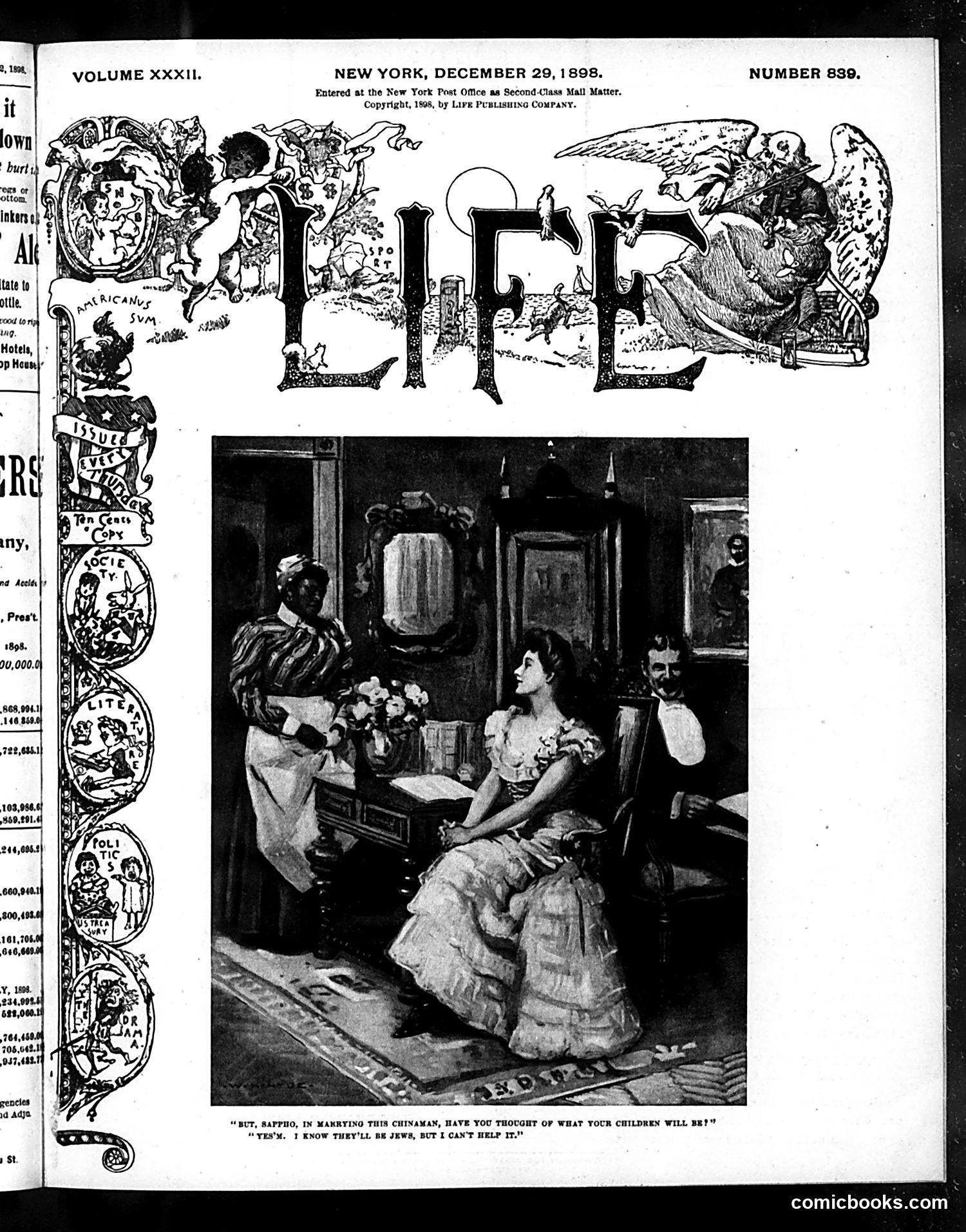
This illustration depicts an apparent domestic conflict scene. The caption reads: "But, Sappho, in marrying this Chinaman, have you thought of what your children will be?" / "Yes'm. I know they'll be Jews, but I can't help it." The satire targets late-19th-century anxieties about interracial marriage and mixed-race children. The joke relies on ethnic stereotyping: it suggests that a woman named "Sappho" (implying Greek or Jewish heritage) marrying a Chinese man would produce Jewish children—playing on period prejudices about Jewish identity as immutable and transmissible regardless of the father's ethnicity. This reflects 1898 American attitudes toward immigration, race, and assimilation during a period of significant Chinese immigration restrictions.
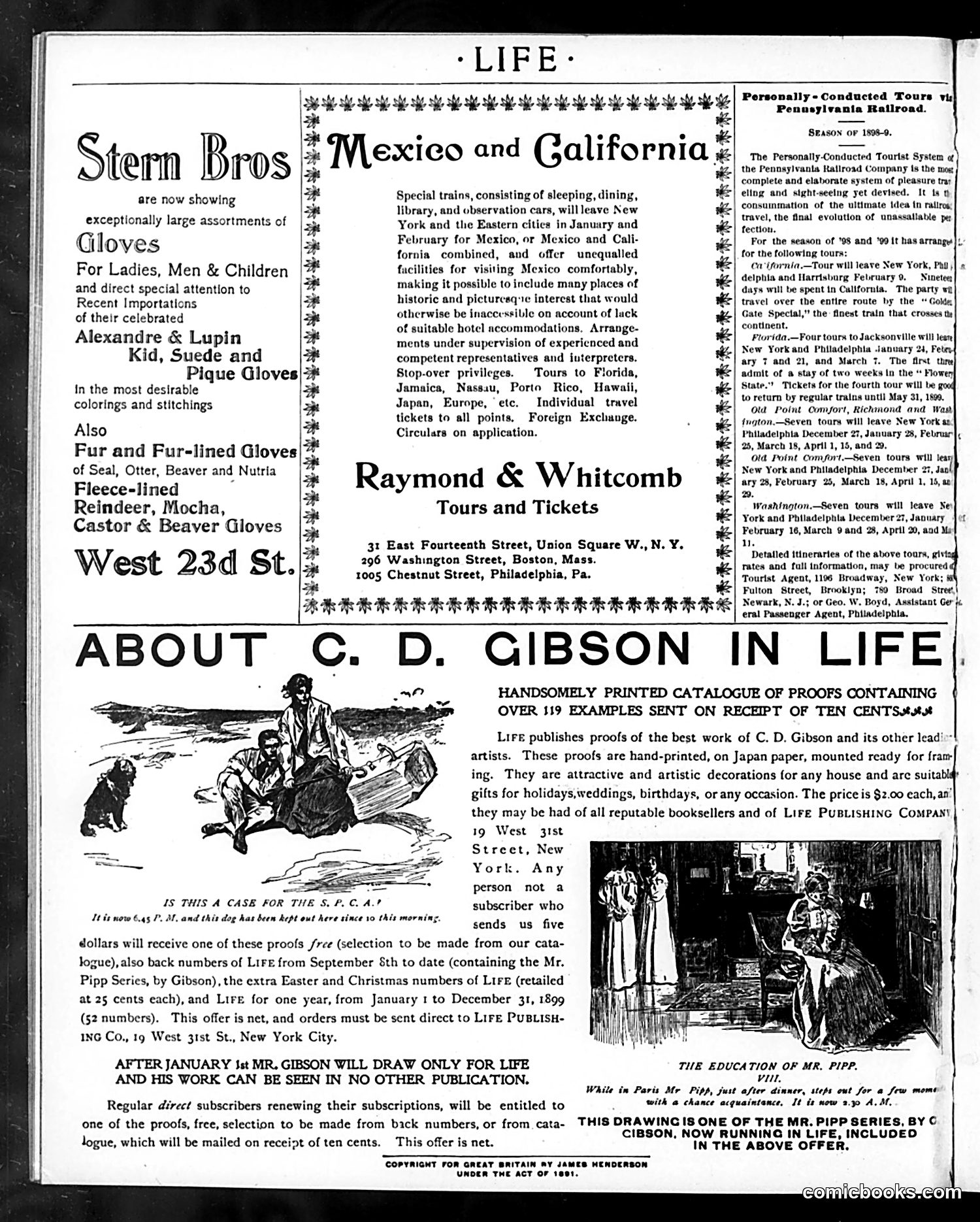
This page is primarily **commercial advertising** rather than political satire. The main content promotes C.D. Gibson's artwork and Life magazine's publishing offerings. The cartoon titled "The Education of Mr. Pipp" (visible at bottom right) appears to be part of Gibson's popular "Mr. Pipp Series." The illustration shows a domestic interior scene, likely depicting humorous situations from everyday middle-class life—Gibson's characteristic subject matter. The caption suggests the series focused on comedic social observations rather than political commentary. The page predominantly contains advertisements for glove retailers (Stern Bros.), travel tours (Raymond & Whitcomb), and Gibson's own proof catalogues, reflecting Life's function as both satirical publication and commercial magazine.
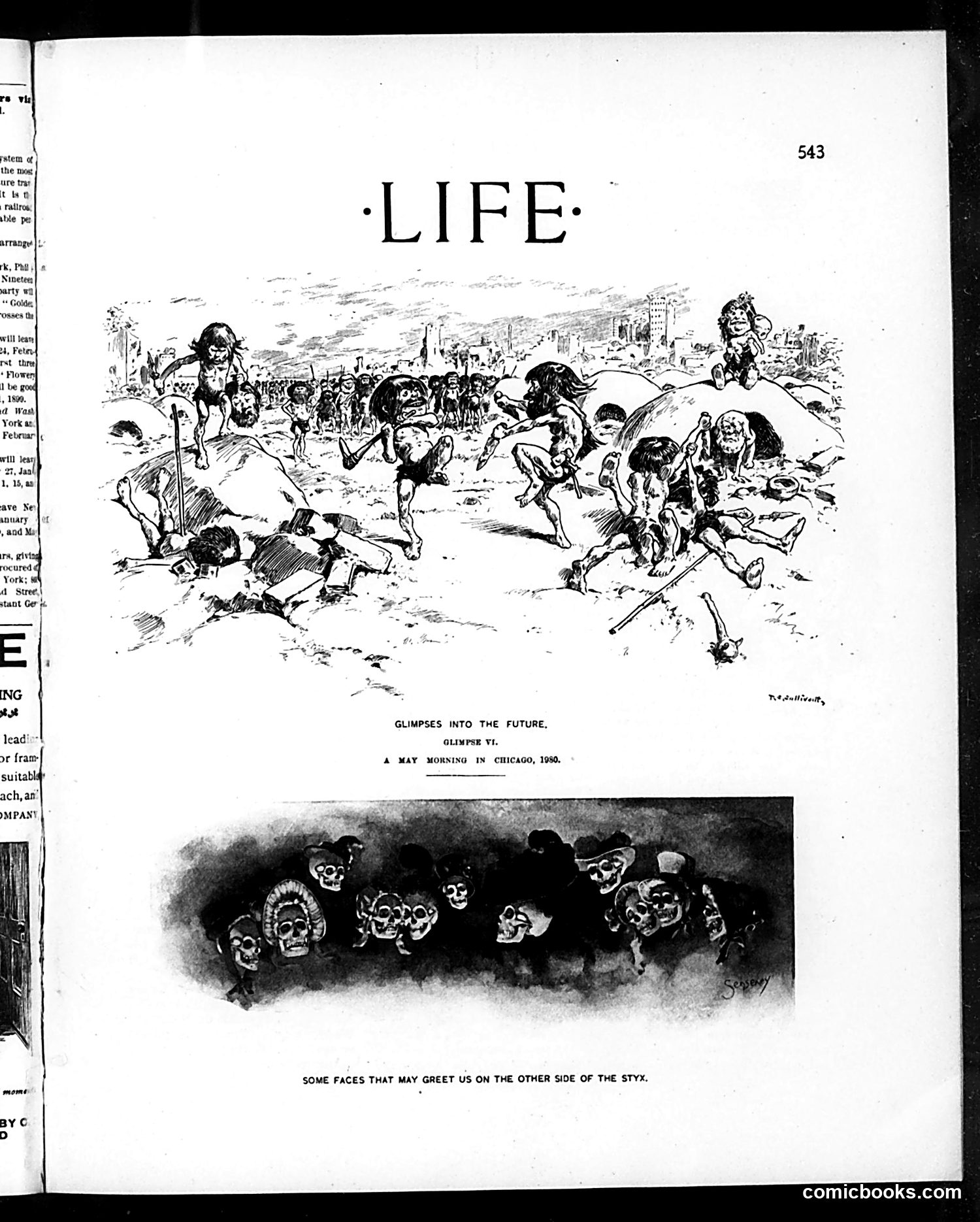
This page presents two contrasting future visions titled "Glimpses Into the Future" (Glimpse VI), dated May 1908 in Chicago. The upper cartoon depicts a chaotic street scene with ape-like or degenerate human figures engaged in primitive behavior—suggesting satirical commentary on social devolution or fears about urban degradation in early 20th-century America. The lower image, captioned "Some Faces That May Greet Us On The Other Side Of The Styx," shows demonic or skull-faced figures in darkness, referencing classical underworld mythology. This appears to be sardonic commentary on death or damnation. Together, these cartoons likely satirize contemporary anxieties about civilization's decline, possibly reflecting Progressive Era concerns about social corruption, moral decay, or evolutionary "backward" movement—themes common in early 1900s American satire.
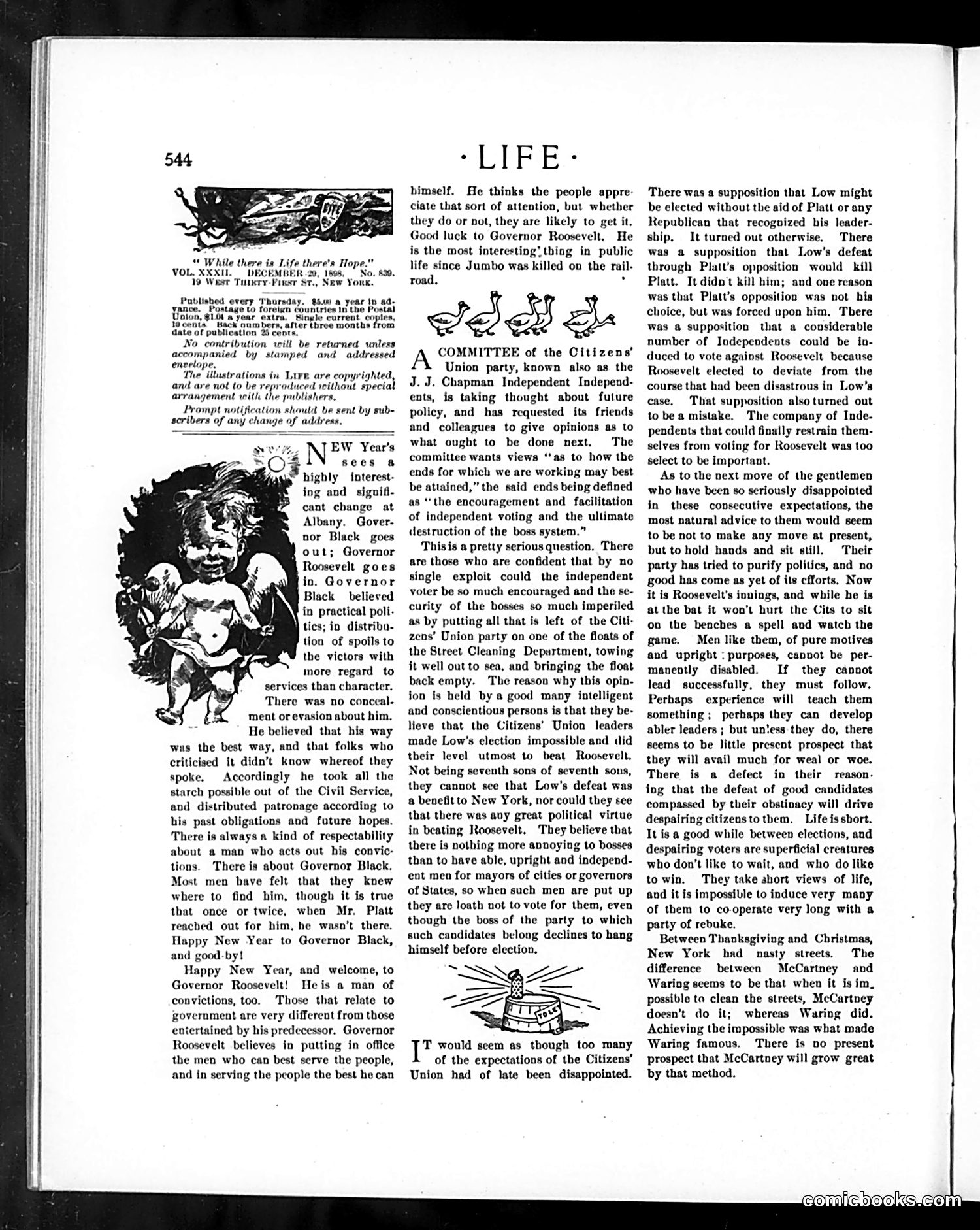
This page discusses New York politics and Governor Roosevelt's relationship with the Citizens' Union party. The text criticizes the Citizens' Union for disappointing expectations—specifically regarding their support for Roosevelt and their views on political reform. The left illustration depicts a figure (likely representing political corruption or "the boss system") being attacked or undermined. The cartoon satirizes the tension between reform-minded independents and practical politics. The right illustration shows what appears to be a decorative emblem or seal, possibly representing civic institutions. The commentary suggests the Citizens' Union had unrealistic hopes for eliminating machine politics and the "boss system," and the page questions whether their strategy of encouraging independent voters would actually succeed in reforming New York governance.
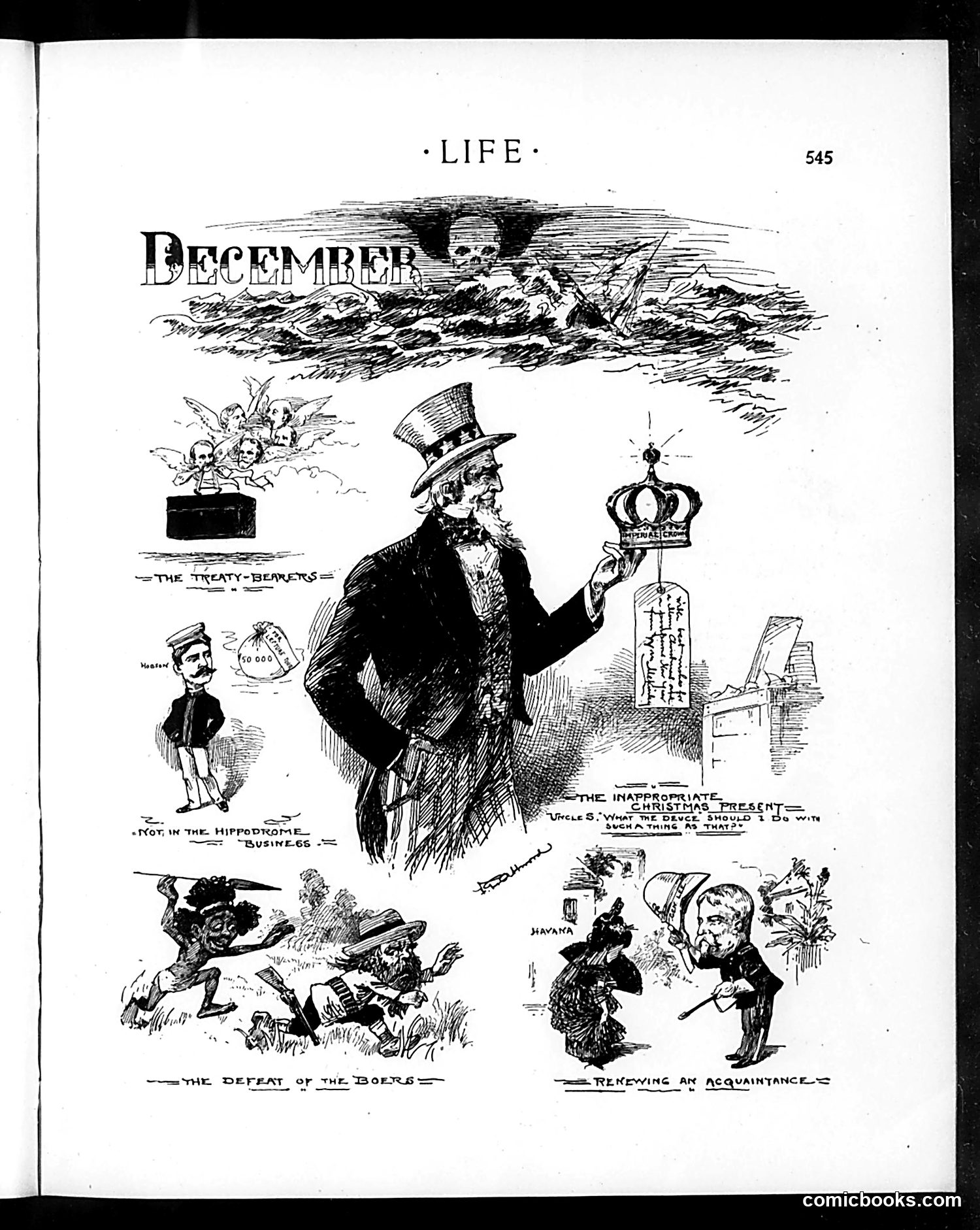
This is a satirical December page featuring several political cartoons. The main central figure appears to be a wealthy gentleman examining a crown, captioned "The Inappropriate Christmas Present—'Uncle S., What Device Should I Be With Such a Pal as That?'" This likely critiques American foreign policy or imperial ambitions around gift-giving or power dynamics. Other vignettes include: - "Foot in the Hippodrome Business" (possibly about entertainment/racing) - "The Defeat of the Boers" (referencing the Boer Wars) - "Renewing an Acquaintance" (unclear specific reference) - "The Treaty-Bearers" (top left, showing winged figures) The cartoons employ caricature and anthropomorphization typical of early-1900s satirical commentary on international affairs and social situations. Without publication date confirmation, precise historical references remain uncertain.
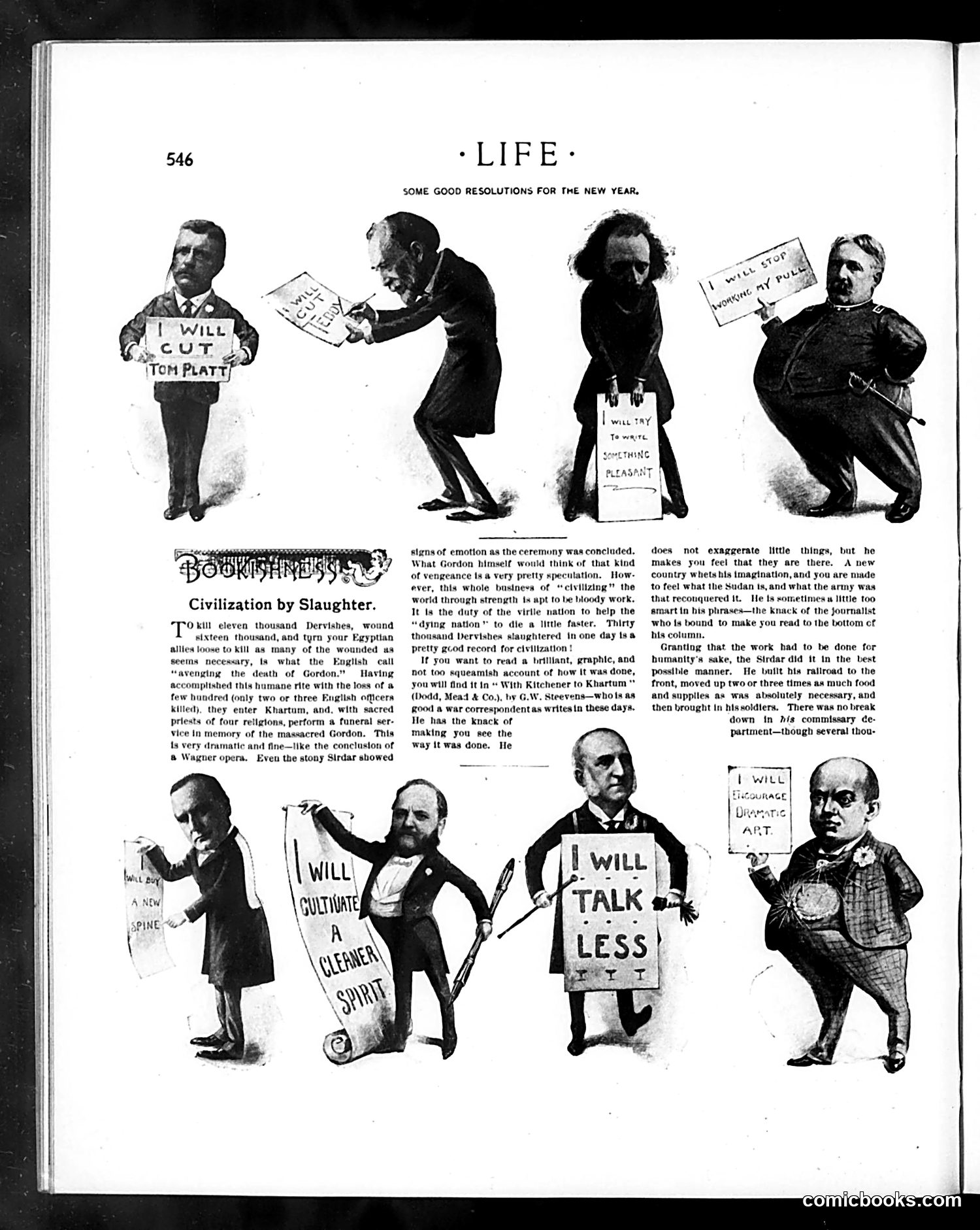
This Life magazine page satirizes prominent public figures through New Year's resolutions. The top row identifies Tom Platt with "I will cut," while others make various pledges. The article "Civilization by Slaughter" discusses war correspondence, referencing what appears to be the Boer War or similar contemporary conflict. The bottom row shows caricatured figures holding signs with resolutions like "I will cultivate a cleaner spirit," "I will talk less," and "I will encourage dissent's art." The exaggerated physical features and promises suggest these are wealthy or powerful men whose actual behavior contradicted such virtuous intentions—the satire being that these figures would never genuinely reform. The crude caricatures and mocking tone reflect early 1900s satirical conventions in American humor magazines.
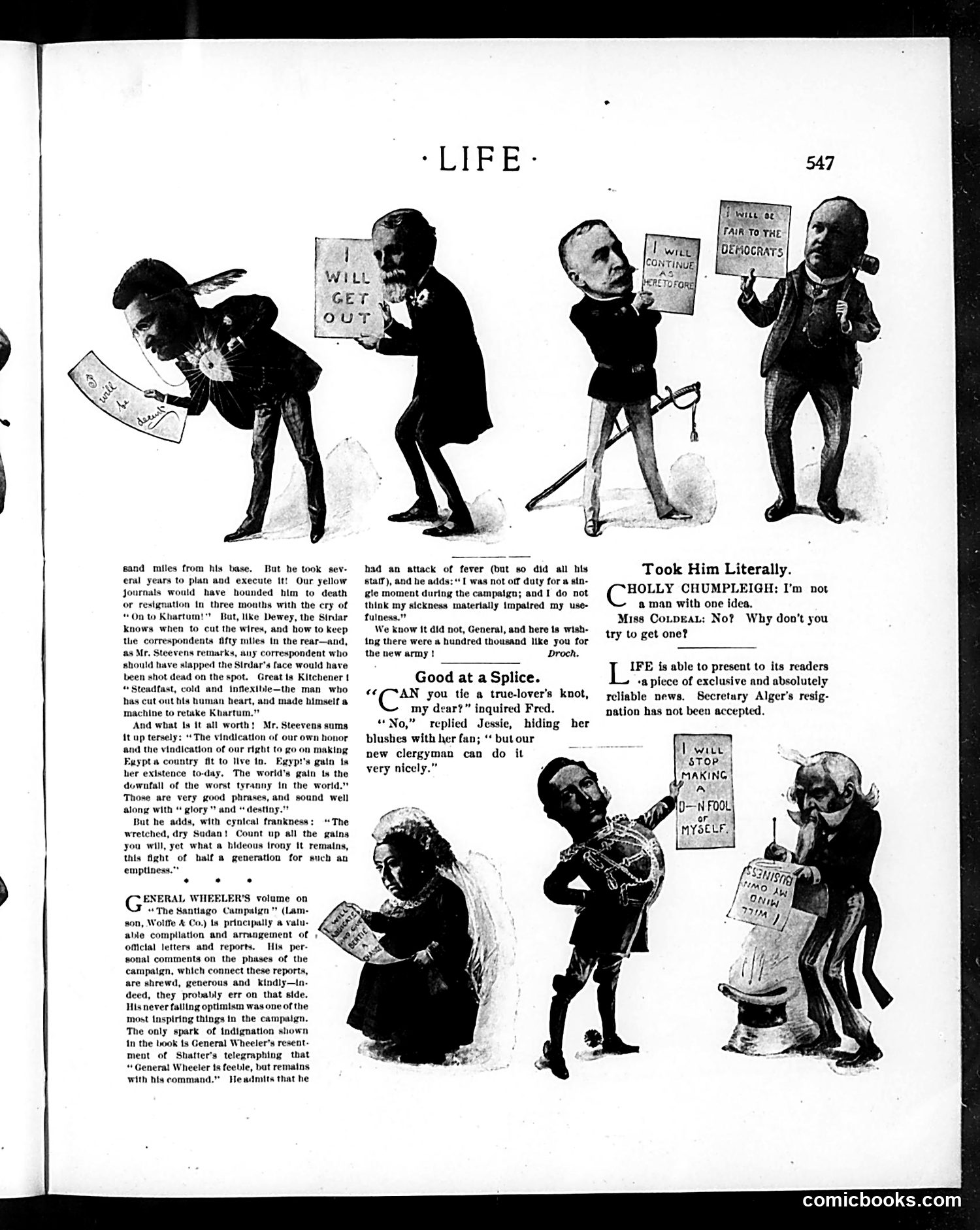
This page contains WWI-era political cartoons mocking various figures' positions on the war effort. The top row shows four caricatured men holding signs with contradictory statements ("I will get out," "will continue," "fair to the democrats"), satirizing politicians' inconsistent or evasive war rhetoric. The lower section, titled "Took Him Literally," features a dialogue between "Cholly Chumpleigh" and "Miss Coldeal" about a clergyman "tying a true-lover's knot," playing on double meanings of religious and romantic language. The bottom cartoons appear to show figures with signs about stopping and "making a fool of myself," likely mocking pacifists or war opponents. The satire targets political hypocrisy and unclear communication regarding American involvement in World War I.
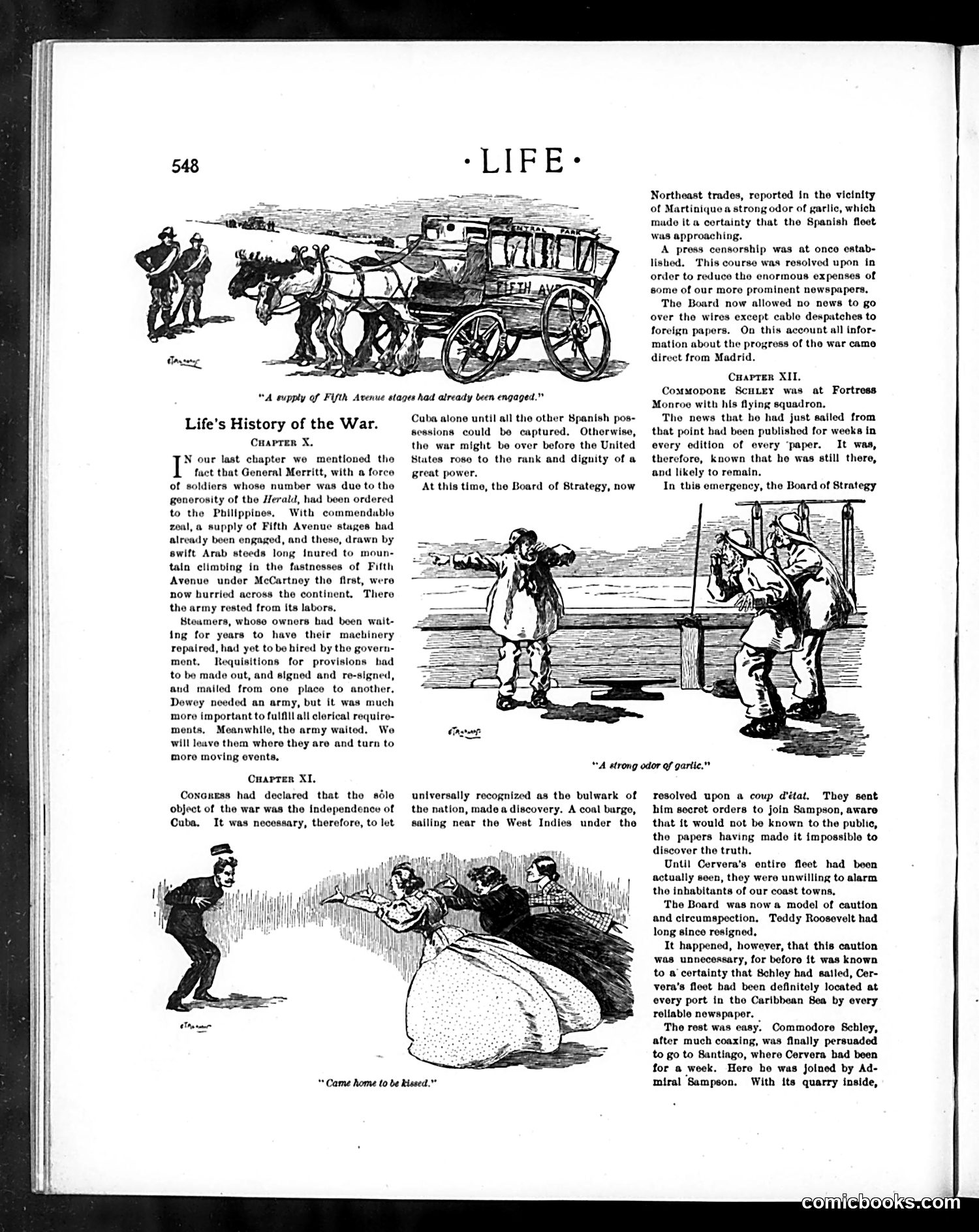
This page contains two chapters from "Life's History of the War," focusing on the Spanish-American War. The text discusses General Merritt's command in the Philippines and efforts to secure Cuba's independence. The cartoons appear to satirize military bureaucracy and diplomatic incompetence. One illustration shows a supply wagon, captioned "A supply of Fifth Avenue stages had already been engaged"—mocking the use of civilian vehicles for military purposes. Another cartoon, "Come home to be kissed," depicts what appears to be a soldier or military figure, likely satirizing sentimental attitudes toward war. A third image captioned "A strong odor of garlic" references Spanish forces, using ethnic stereotype humor common to 1890s American satire about the Spanish-American conflict.
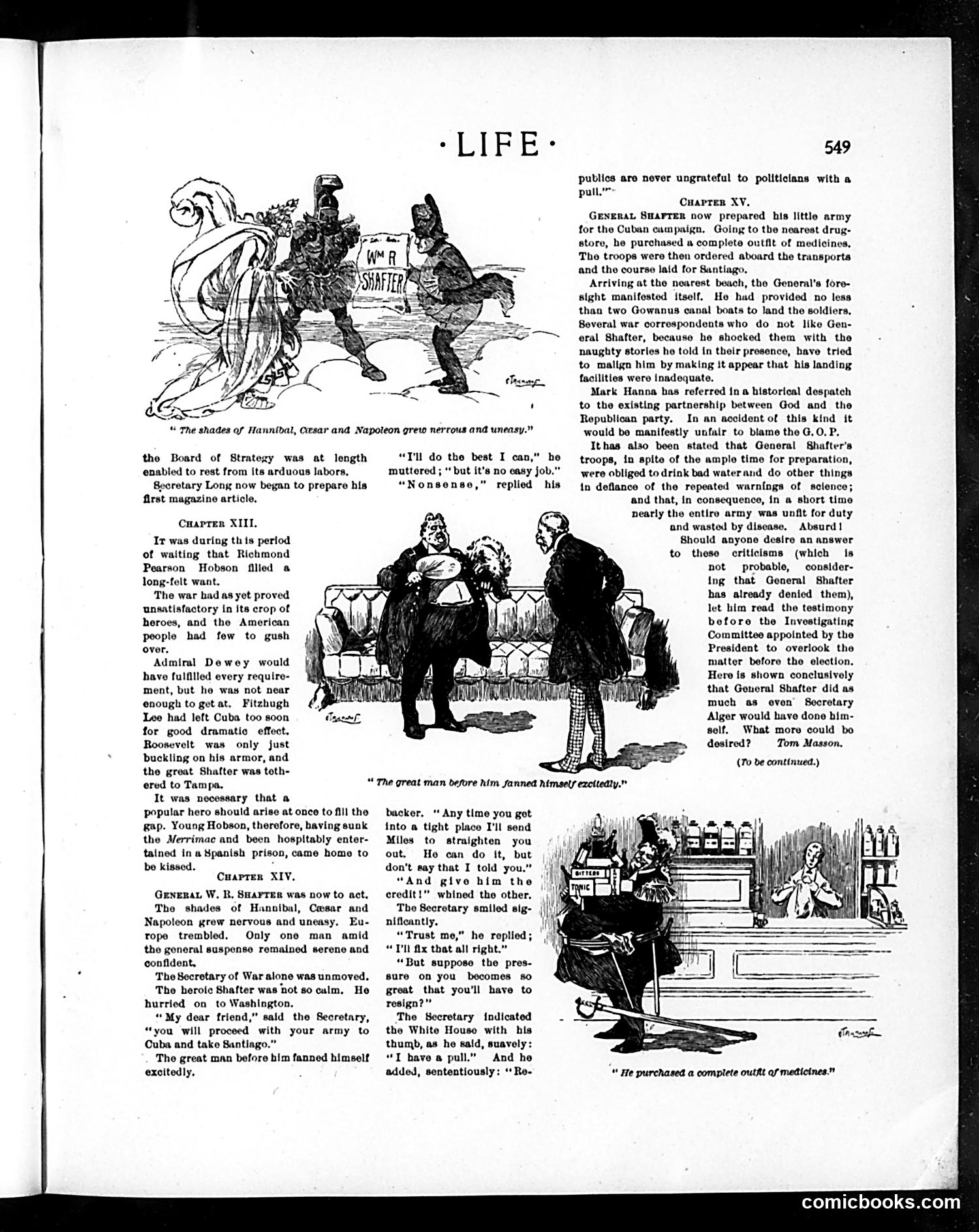
The page contains satirical illustrations about the Spanish-American War and General Shafter's Cuban campaign. The top cartoon depicts "the shades of Hannibal, Oscar and Napoleon grew nervous and uneasy"—historical military figures anxious about Shafter's competence. The middle illustration shows Shafter before an interviewer, captioned "The great man before him fanned himself excitedly." The bottom illustration shows someone purchasing "a complete outfit of medicines," satirizing the army's poor preparation and disease problems during the Cuban campaign. The accompanying text criticizes General Shafter's leadership, poor planning, and the resulting illness that disabled troops. It references a Congressional investigation and compares Shafter unfavorably to Secretary Alger, suggesting both failed the war effort. The satire targets military incompetence and inadequate logistics.
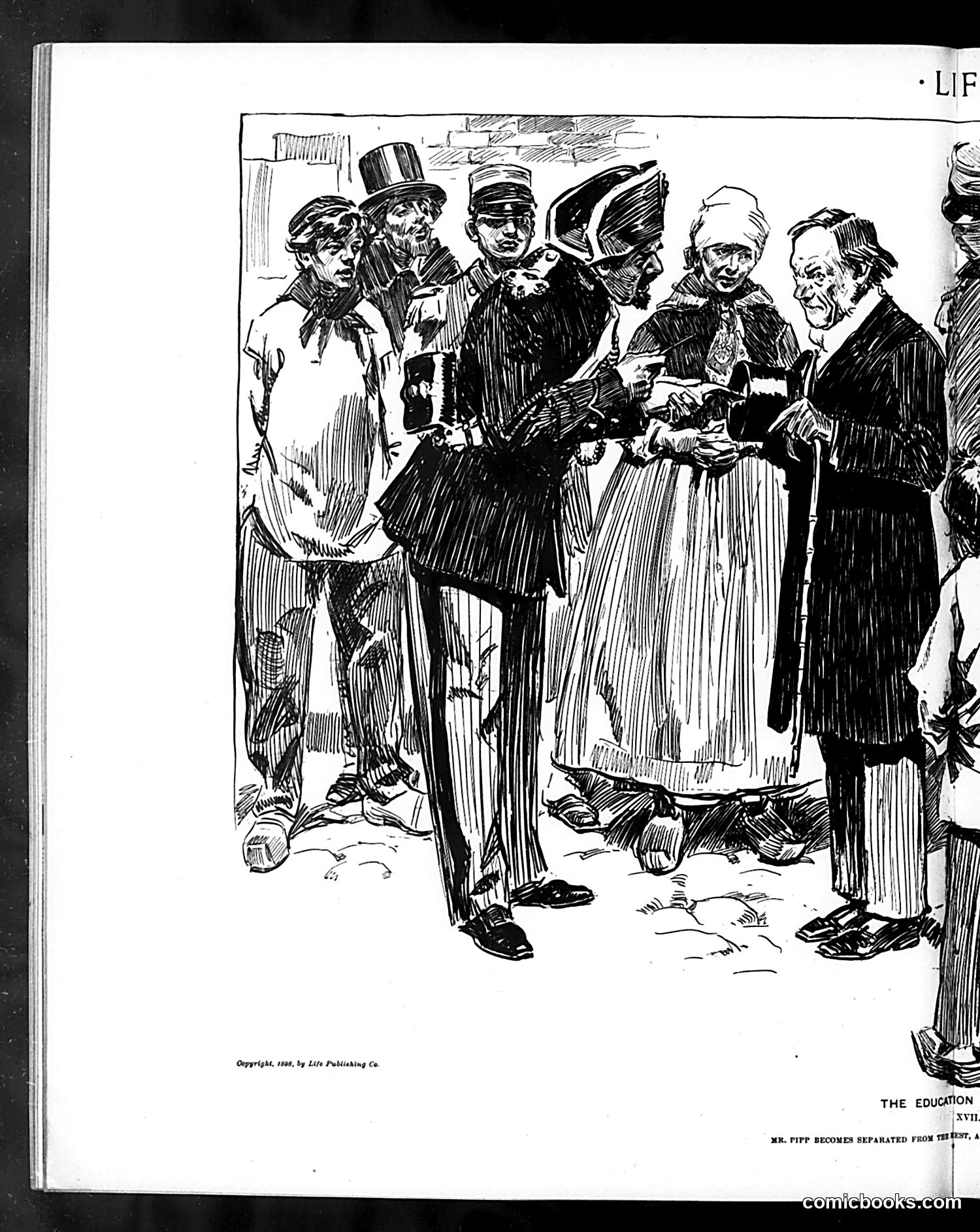
This political cartoon depicts a military officer (center, in uniform with plumed hat) distributing money or compensation to a group of civilians. The caption references "Mr. Pipp" becoming "repaired from the front," suggesting a soldier returning from combat. The satire appears to critique the financial consequences of military service—possibly addressing inadequate compensation, disability payments, or pension disputes for returning soldiers. The civilians' expressions range from hopeful to skeptical, suggesting debate about whether the amount offered was fair or sufficient. The text credit reads "Copyright, 1908, by Life Publishing Co," placing this during the early 20th century, likely referencing post-war financial settlements. Without clearer identification of "Mr. Pipp," the specific historical event remains uncertain, though the theme of soldier compensation was relevant during multiple periods.
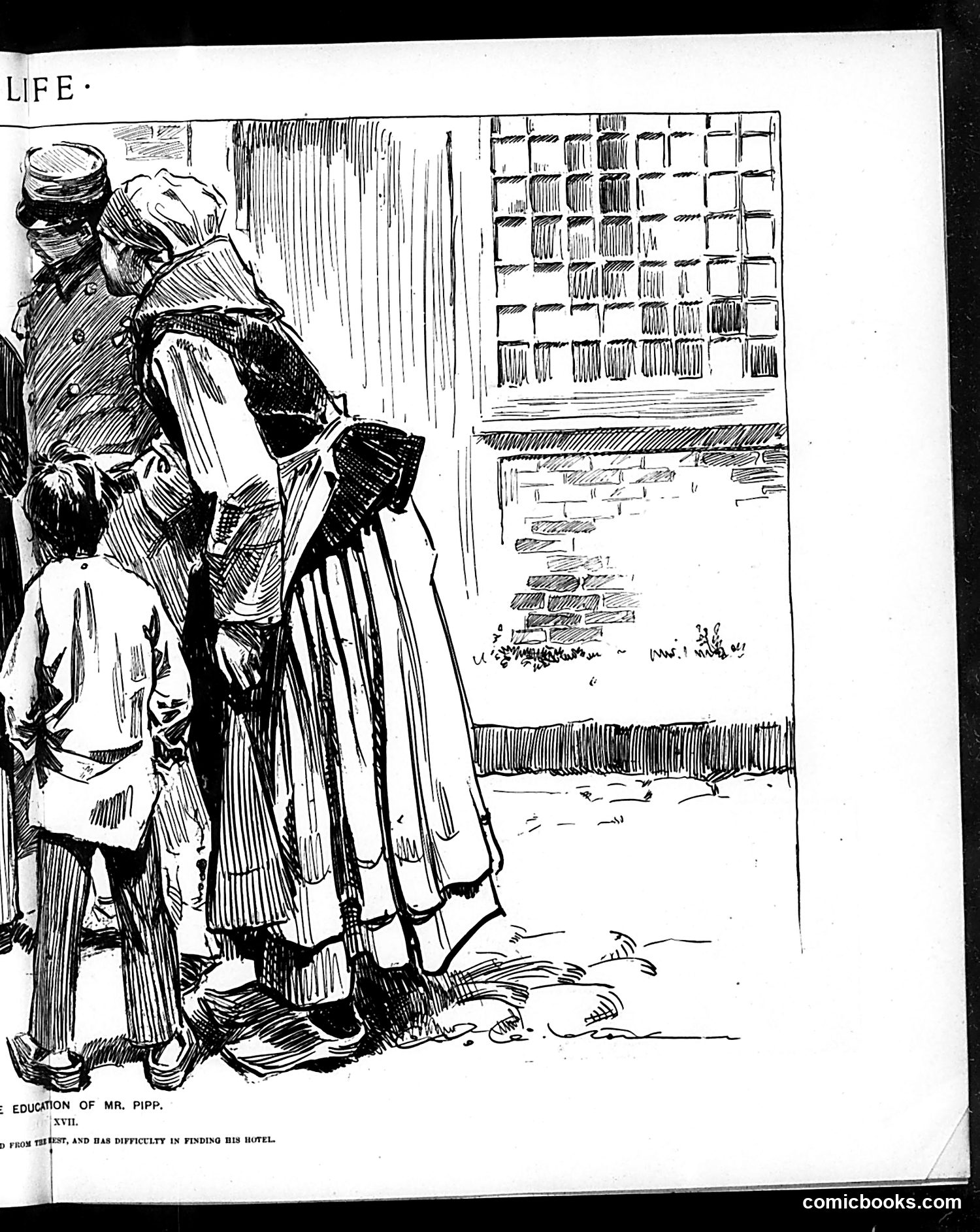
This appears to be from a serialized satirical comic titled "The Education of Mr. Pipp" (Chapter XVII). The illustration shows what appears to be an adult figure with two children viewing a brick building with barred windows—likely a jail or prison. The caption indicates Mr. Pipp "had difficulty in finding his hotel," suggesting he's been arrested or incarcerated instead. The satire appears to mock either Pipp's misfortune or poor judgment. Without seeing the full series context, the specific political or social commentary remains unclear—this could be lampooning crime, justice system issues, or simply depicting physical comedy about mistaken identity or location. The sketch style and publication format indicate this is early 20th-century American humor.
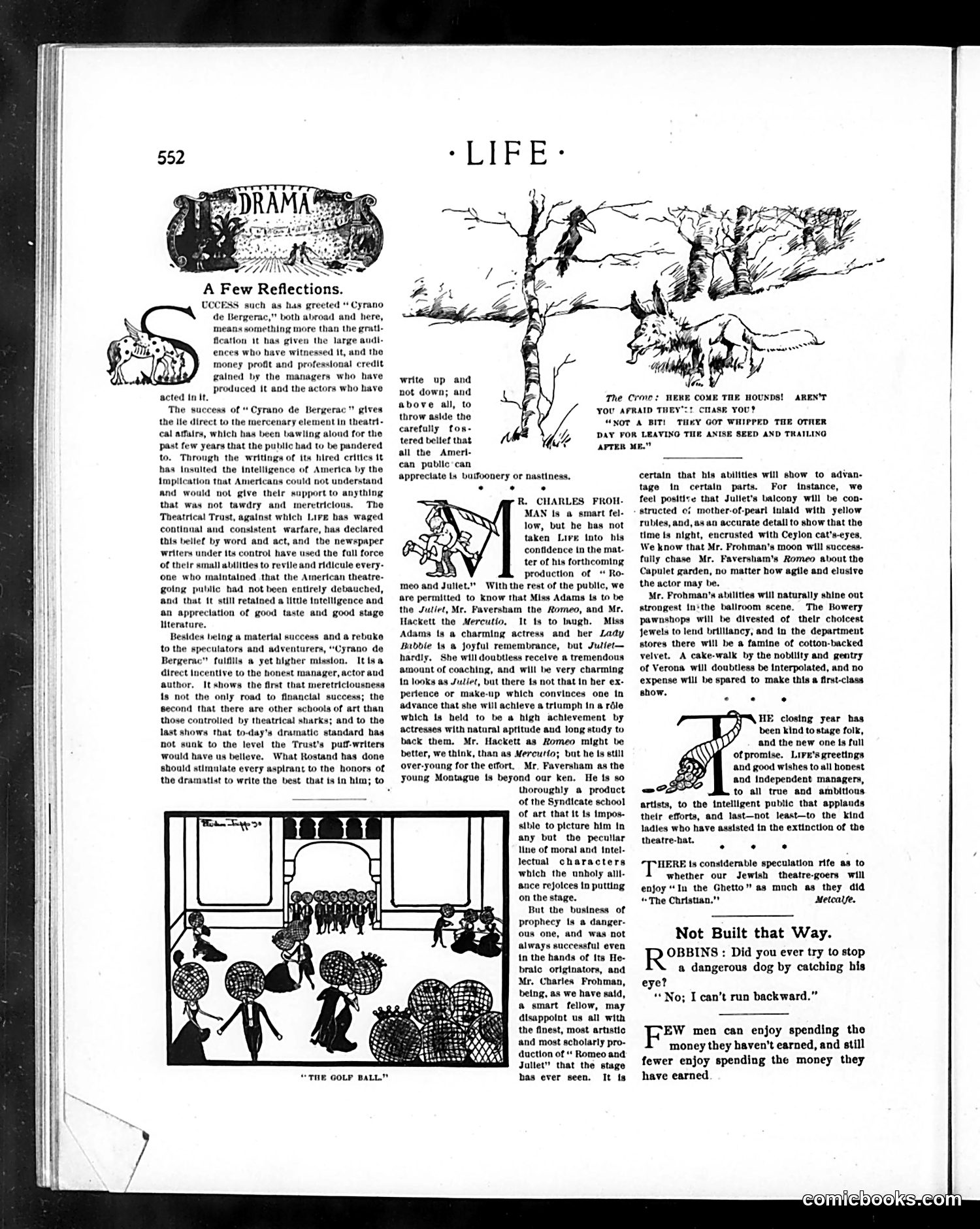
This page contains theatrical drama criticism and commentary. The main cartoon titled "The Golf Ball" depicts a stage scene with actors performing, satirizing theatrical production values and artistic ambitions. The "Drama" section discusses whether American theater audiences appreciate subtlety versus spectacle. The text criticizes certain theatrical productions while praising others—particularly mentioning performances of "Romeo and Juliet" and "The Merchant of Venice." The brief humor piece "Not Built that Way" is a simple joke about a man unable to stop a dangerous dog, with the punchline being literal—he wasn't constructed to accomplish this task. The text laments that contemporary theater often prioritizes commercial success over artistic merit, reflecting early 20th-century debates about "high" versus popular entertainment in American culture.
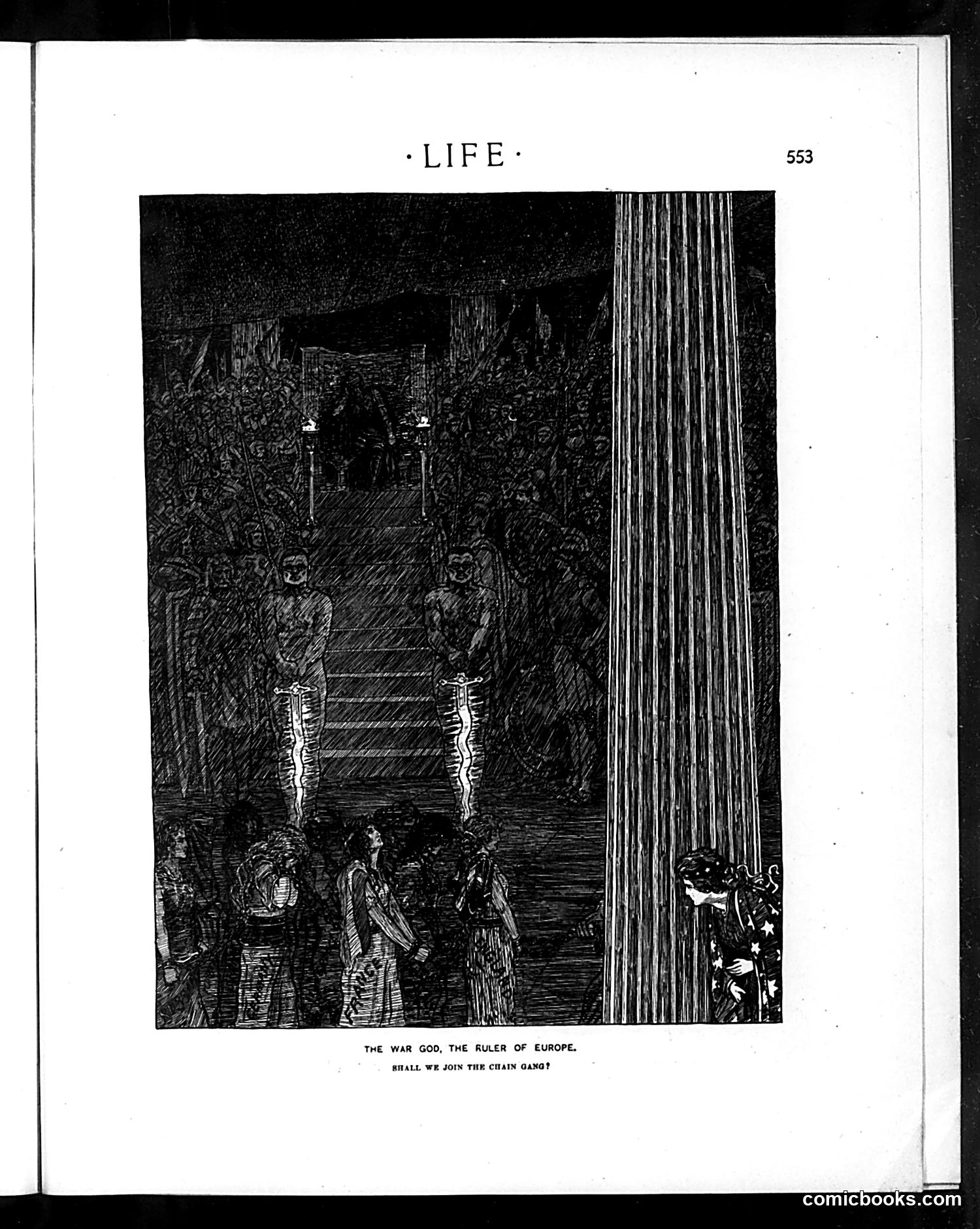
This is a WWI-era satirical cartoon from Life magazine (page 553). The image depicts a dark, menacing figure labeled "THE WAR GOD, THE RULER OF EUROPE" looming over a group of people, with the caption asking "SHALL WE JOIN THE CHAIN GANG?" The satire warns against American entry into World War I by portraying the war itself as a destructive deity that has already enslaved Europe. The "chain gang" metaphor suggests that joining the conflict would make Americans prisoners or slaves to warfare's brutality. The ominous, skeletal War God figure represents the devastating human cost already inflicted on European nations, implying America should resist similar entanglement. This reflects anti-interventionist sentiment prevalent in American public discourse before U.S. entry in 1917.
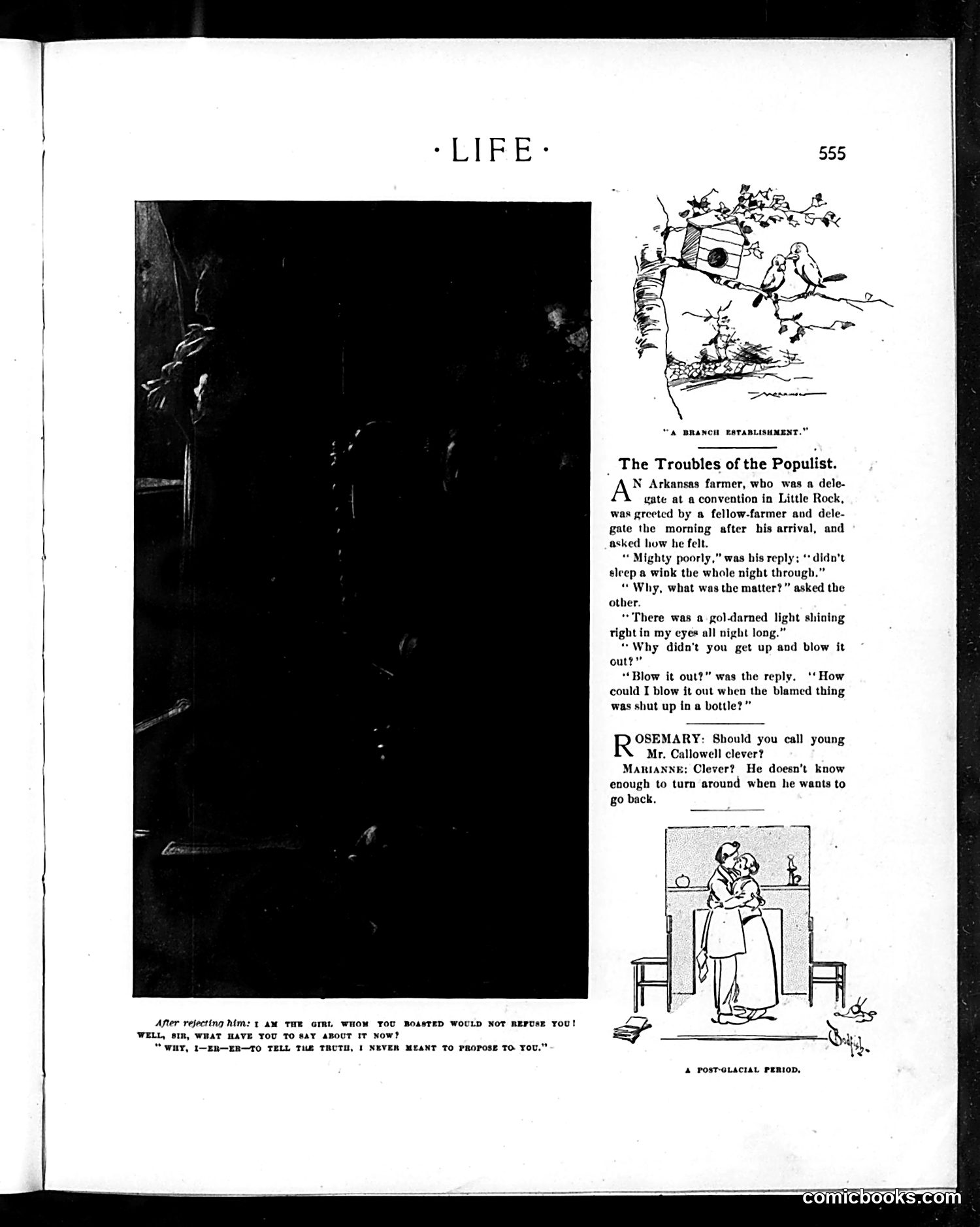
This page contains two separate satirical pieces: **"The Troubles of the Populist"** mocks a rural farmer-delegate at a Populist party convention in Little Rock, Arkansas. The joke relies on depicting him as comically ignorant: he complains a light kept him awake all night, then reveals he couldn't extinguish it because it was trapped in a bottle. This satirizes Populists (a late-19th-century agrarian political movement) as unsophisticated and foolish—a common criticism from urban, establishment magazines like *Life*. **"A Post-Glacial Period"** is a romantic cartoon showing a woman rejecting a man's stammering excuses after he boasted she wouldn't refuse his proposal. The title appears to reference geological epochs, suggesting his romantic incompetence is prehistoric. Both pieces employ satire typical of *Life*'s editorial stance: mocking rural/working-class figures and celebrating urban sophistication. The Populist sketch particularly reflects contemporary urban skepticism toward agrarian political movements.
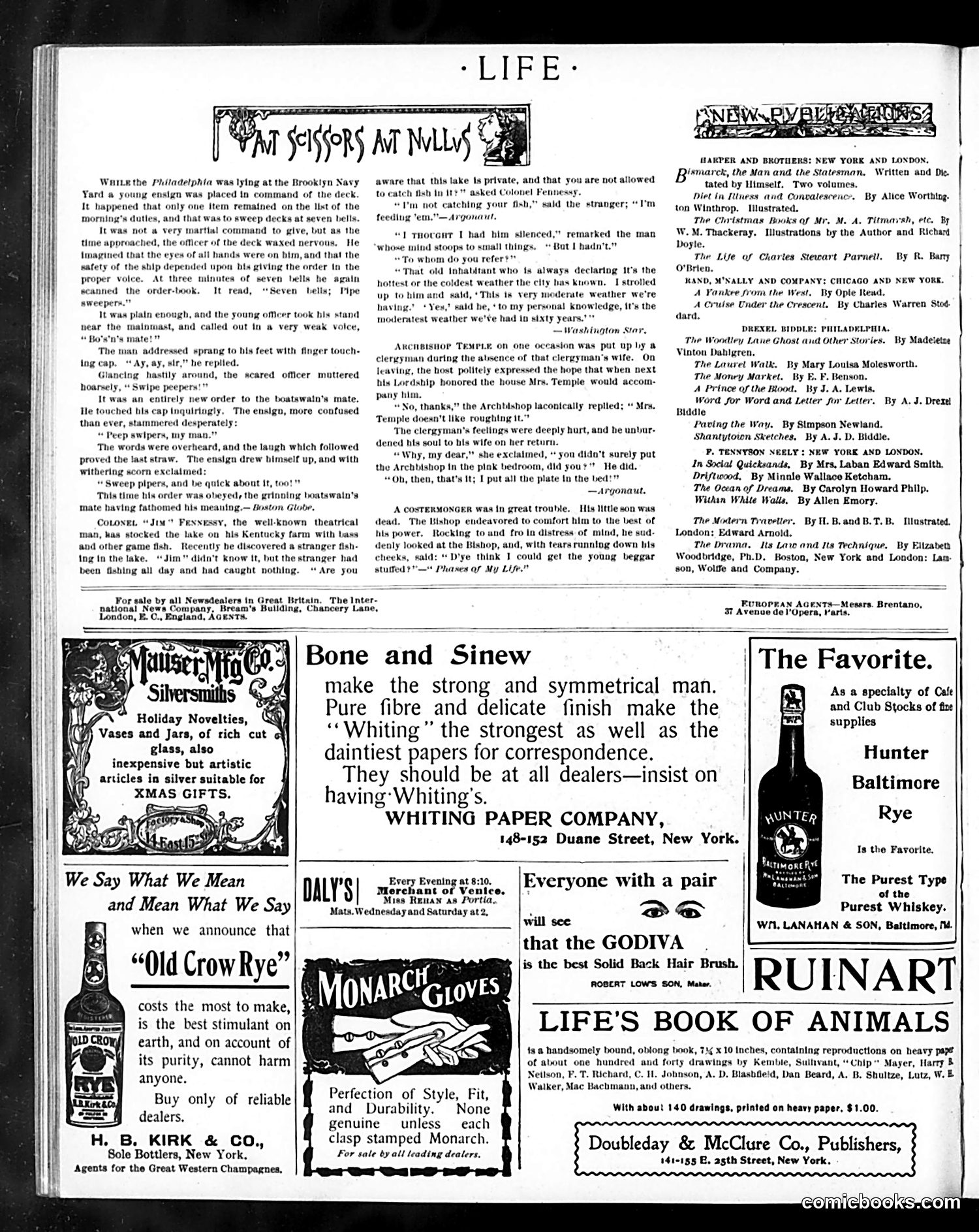
This is a page from *Life* magazine, primarily featuring **advertisements and book announcements** rather than political cartoons. The main readable content is a humorous anecdote titled "I'M SCISSORS AT NULLUS" about a young naval ensign who gives a weak order to "sweep pipers" aboard the USS *Philadelphia*. When other officers mock his command voice, he becomes so flustered he orders "Sweep pipers, and be quick about it, too!"—the joke being that the ensign's attempt at authority backfires when he repeats the ridiculous order with unintended emphasis. The page contains several other short, unrelated humorous stories (about priests, bishops, and costermongers), typical of *Life*'s satirical miscellany. The lower half features period advertisements for **Whiting Paper Company**, **Old Crow Rye whiskey**, **Monarch Gloves**, and other consumer products—reflecting the magazine's business model of pairing humor with commercial messaging.
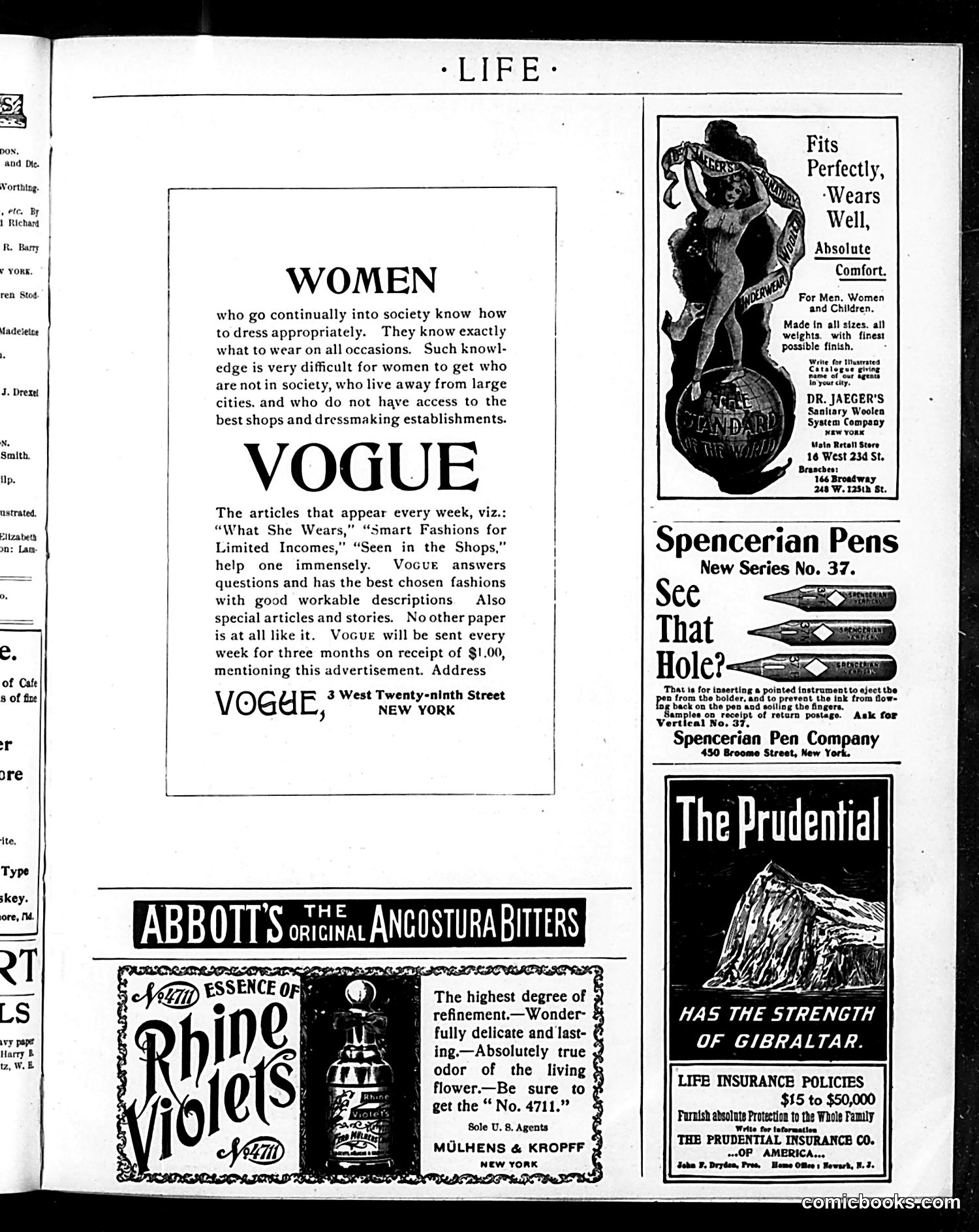
This page is primarily **advertising**, not political satire. The main content promotes Vogue magazine to women lacking access to urban fashion resources—positioning the publication as essential guidance for appropriate dress across social occasions. The advertisements target early 1900s consumers: Dr. Jaeger's wool undergarments (marketed as "sanitary"), Rhine Violets perfume (emphasizing refinement), Spencerian pens (with a humorous diagram explaining the pen's hole), Abbott's Angostura Bitters, and Prudential Insurance. The Vogue pitch reveals contemporary class anxieties: women outside major cities supposedly struggle with dress codes because they lack "access to the best shops and dressmaking establishments." This reflects genuine disparities in retail availability before mail-order became standard. The Prudential ad's "strength of Gibraltar" imagery uses a natural landmark to suggest reliability—common insurance advertising strategy of the era. **No satirical content is evident.** This is straightforward commercial messaging reflecting Edwardian-era consumer culture and social hierarchies.
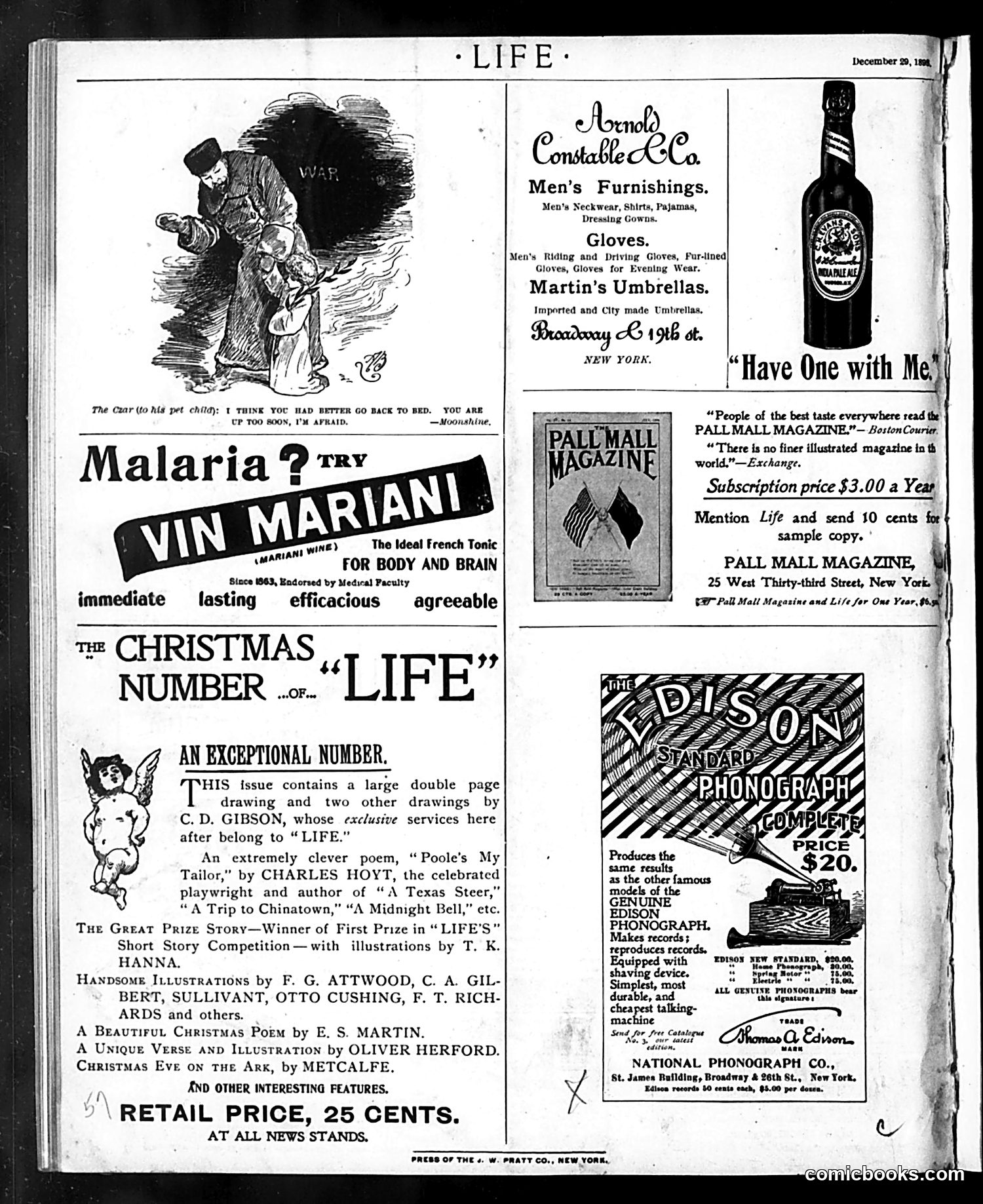
The cartoon depicts **the Russian Czar** addressing his young child, telling him to return to bed because he's "up too soon" and the Czar is "afraid." This is political satire referencing **the 1905 Russian Revolution** and worker unrest during the Russo-Japanese War period. The joke works on two levels: literally, a father worried about his child's health; politically, it suggests the Czar fears his people are "waking up" too early to revolutionary consciousness. The caption "Moonshine" reinforces this—the Czar is dismissing popular uprising as mere drunken fantasy rather than legitimate grievance. This reflects Life magazine's contemporary commentary on autocratic instability. The surrounding ads and Christmas issue promotion indicate this is from late 1905 or early 1906, when Russian labor strikes and political reform demands dominated American news coverage.
I can see this is a page from *Life* magazine, but the image is almost entirely black with only a white margin visible on the left side containing some faint OCR'd text fragments. The main content area is not legible in this scan. From what's barely visible on the left margin, there appear to be partial text snippets, but they're too fragmented and unclear to read with confidence. Without being able to see the actual cartoon(s) or read the accompanying text clearly, I cannot reliably identify the figures, political references, or satirical intent of this page. To properly analyze this as a historical political cartoon, a clearer image scan would be necessary.