
A complete issue · 21 pages · 1898
Life — December 1, 1898
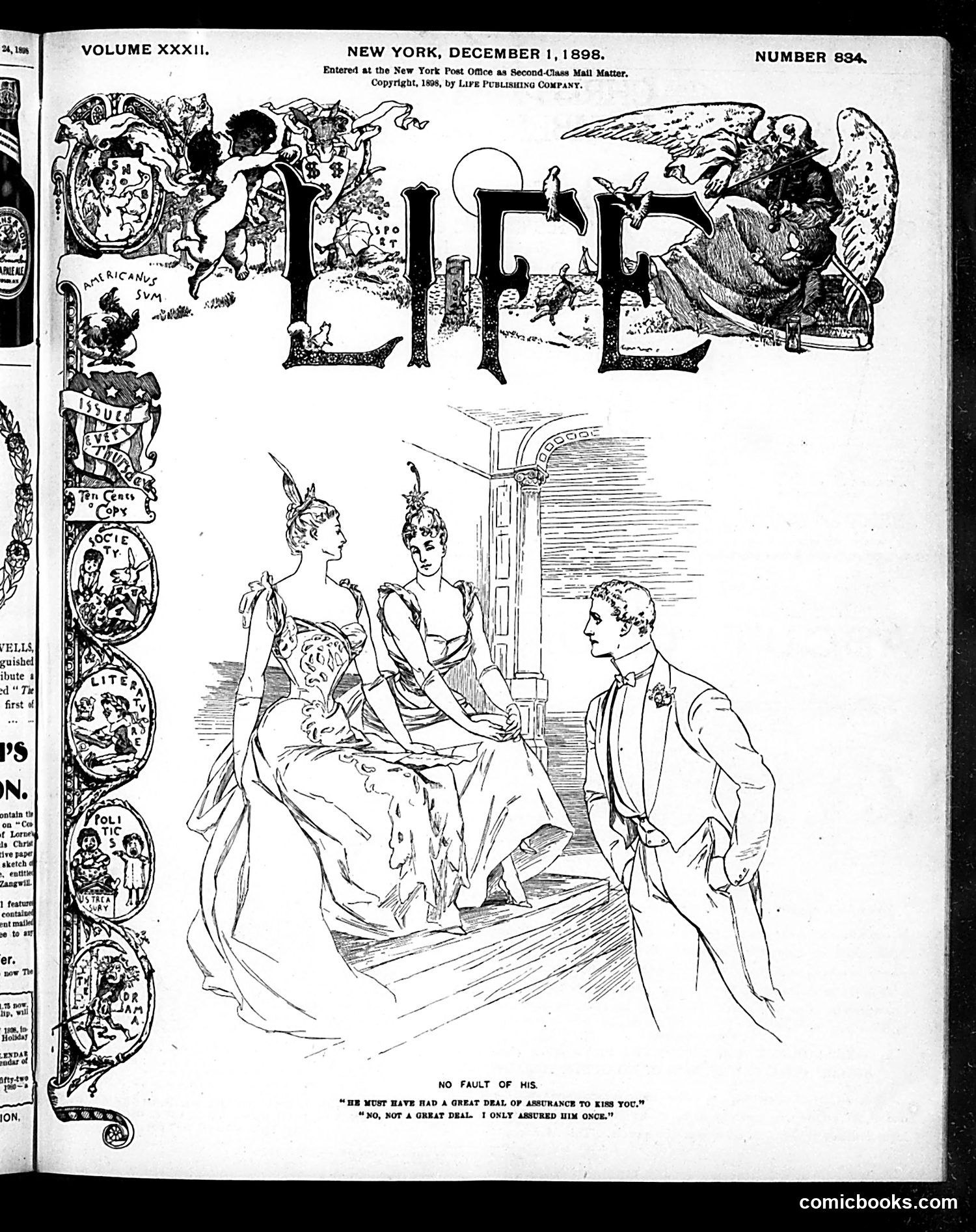
This satirical cartoon depicts a social scene with a well-dressed man entering a room where three elegantly-dressed women are gathered. The caption reads: "He must have had a great deal of assurance to kiss you." / "No, not a great deal. I only assured him once." The joke appears to be social satire about courtship and propriety in the 1890s. The woman's response suggests she gave a man permission ("assured him") to kiss her, implying a degree of romantic agency or flirtatiousness on her part—contradicting the man's apparent assumption that such boldness was the gentleman's fault alone. The cartoon satirizes the era's social conventions around gender, romance, and who bears responsibility in romantic encounters.
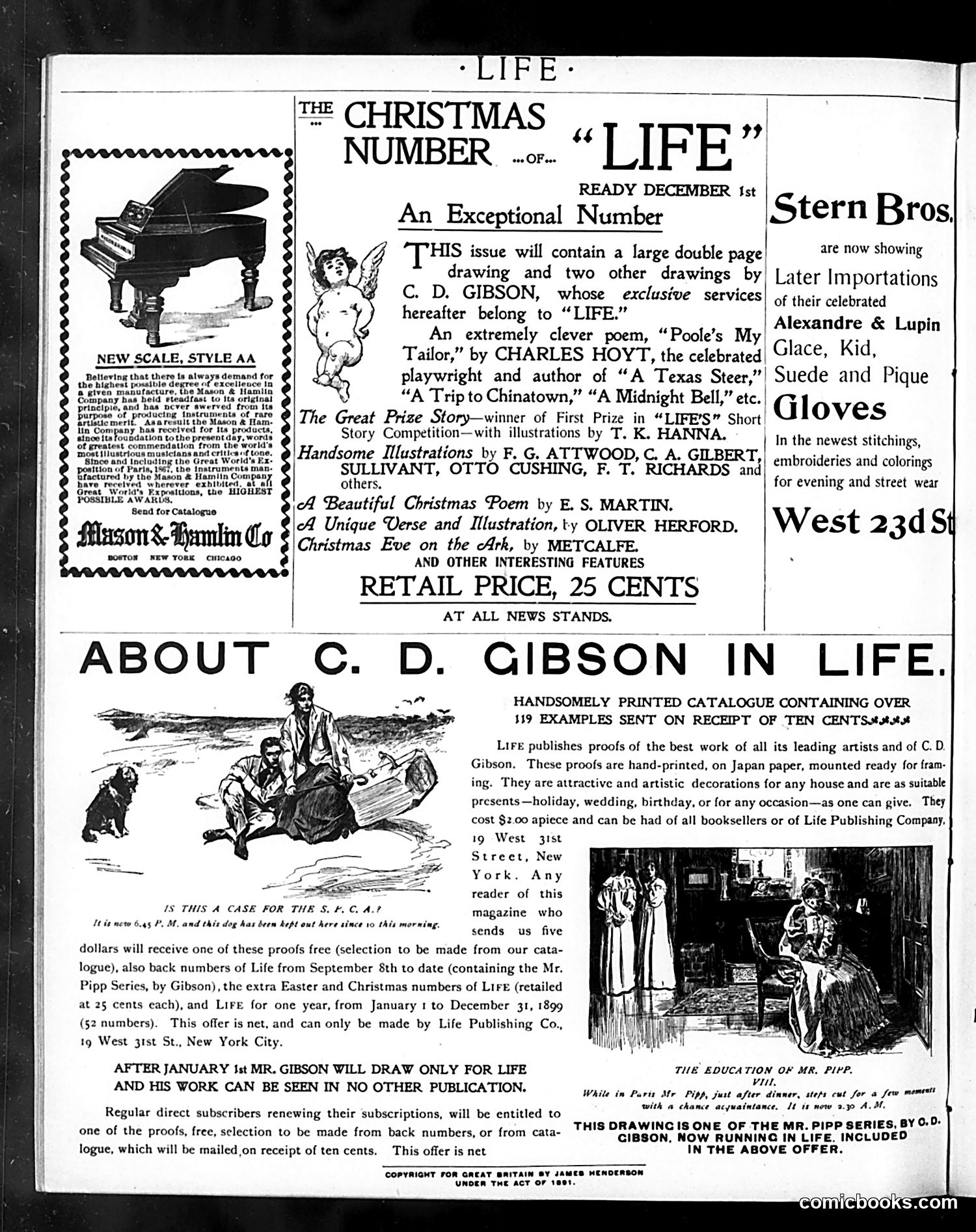
This page is primarily **advertising and promotional content** rather than political satire. The main feature announces Life magazine's Christmas issue (ready December 1st) and promotes **C.D. Gibson**, a celebrated illustrator whose work will appear in the publication. The small cartoon labeled "IS THIS A CASE FOR THE S.P.C.A.?" shows a man and boy with a dog on a beach, apparently making an S.P.C.A. (Society for the Prevention of Cruelty to Animals) joke—likely implying mistreatment, though the specific humor is unclear from the image alone. The page also advertises **Stern Bros** glove imports and Mason & Hamlin pianos. The Gibson content emphasizes his artistic prestige and offers readers free art proofs as a subscription incentive.
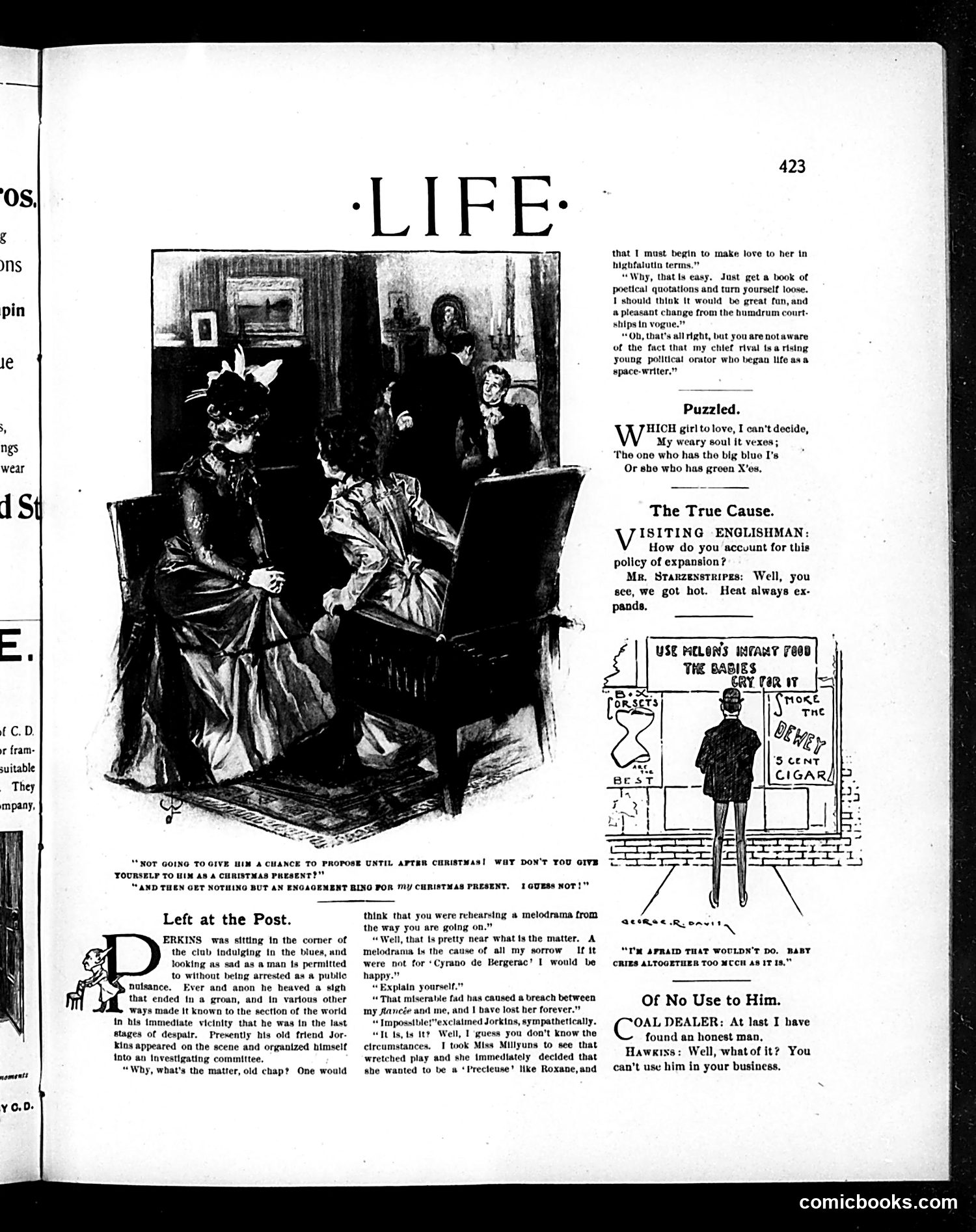
The main illustration depicts a Victorian-era social scene with well-dressed figures in conversation, likely satirizing upper-class society behavior or romantic entanglements. The accompanying text sections include several brief satirical pieces: - **"Puzzled"**: A short poem about romantic indecision between two suitors - **"The True Cause"**: A dialogue between a visiting Englishman and "Mr. Starzenstripes" (likely a caricatured American), joking that American territorial expansion results from heat—"Heat always expands" - **"Left at the Post"**: A narrative about someone named Erkins involved in some scandal or misunderstanding - Small comic advertisements and one-liners mocking various social types The satire appears aimed at Victorian social pretension, romantic confusion, and American expansionism, typical of Life's late 19th/early 20th-century humor.
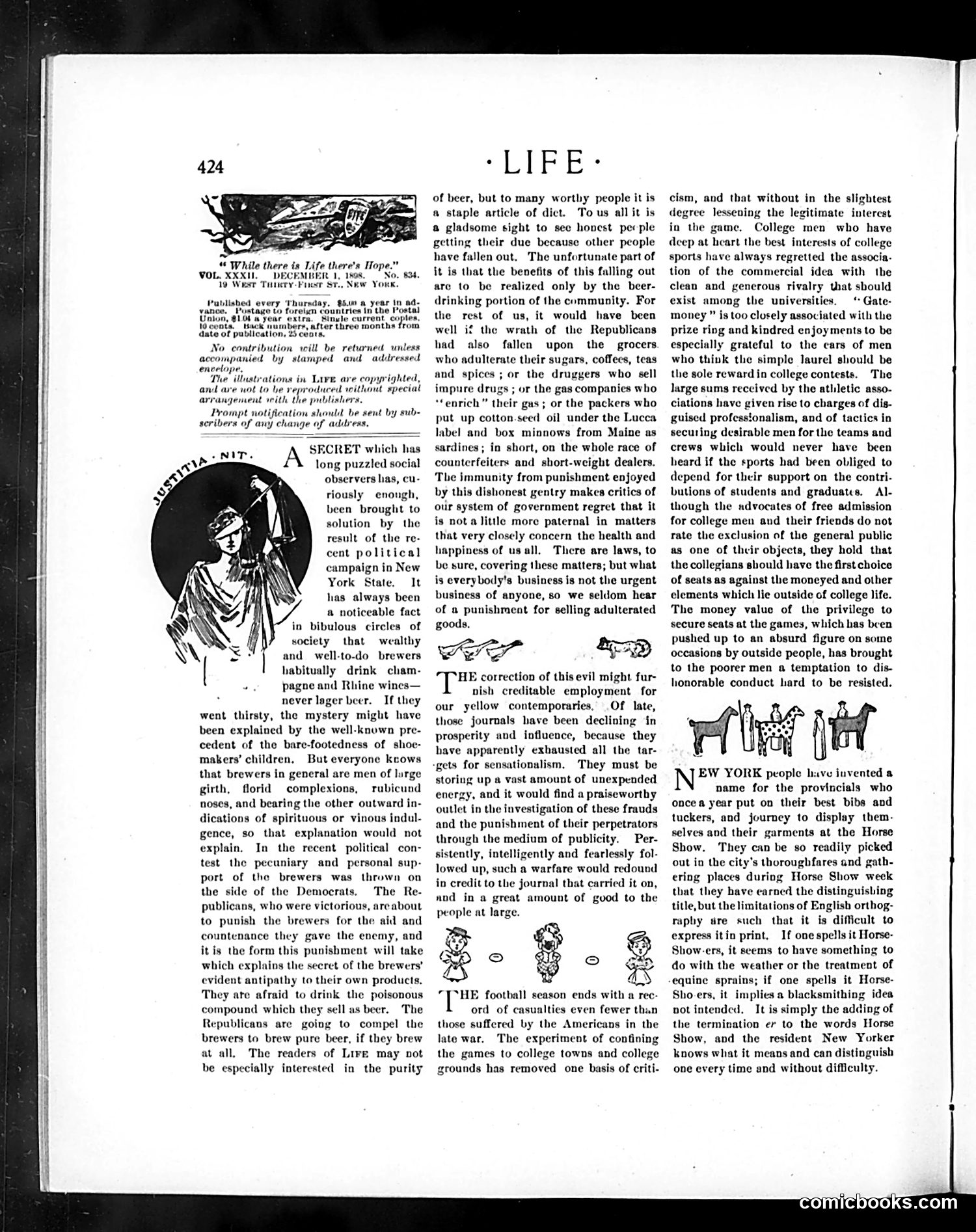
The main cartoon depicts a figure labeled "INTEMPERANCE" - a skeletal or death-like character holding a bottle. This illustration supports the article's critique of excessive drinking and brewers' influence on public health and politics. The text discusses a recent political scandal in New York State involving brewers and their opposition to Republican candidates. The article argues that brewers, who profit from alcohol sales, have become a corrupting political force. It critiques their "poisonous compound" influence and their efforts to punish politicians who don't support their interests. The piece advocates for government regulation of adulterated goods and criticizes journals that have declined in quality by sensationalizing brewery controversies rather than addressing legitimate public health concerns about alcohol's social costs.
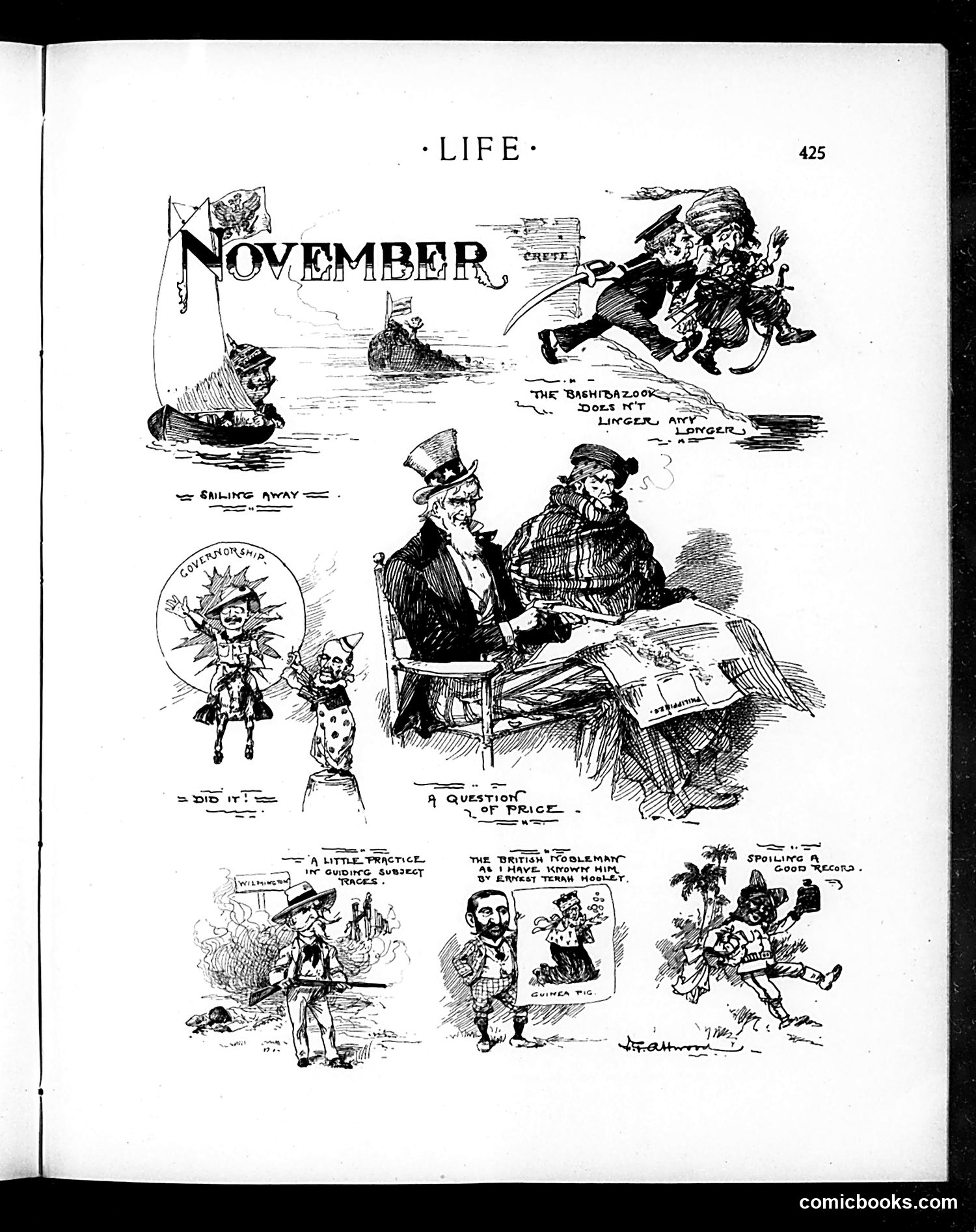
This page contains six political cartoons satirizing November 1890s events. The top cartoon references the Baghdazook (likely a foreign dignitary or political figure) who "does not linger any longer." Another shows two men discussing "A Question of Price," possibly addressing trade or tariff negotiations. "Sailing Away" depicts departure, likely of a political figure. "A Little Practice in Guiding Subject" appears to critique political leadership or governance. "The British Nobleman" references Ernest Terah Hooley, apparently a notable British figure. The final cartoon, "Spoiling a Good Record," suggests criticism of someone's reputation or achievements being damaged. The cartoons employ exaggerated facial features and satirical scenarios typical of 1890s Life magazine commentary on contemporary politics and social figures, though specific historical context for some references is unclear from the image alone.
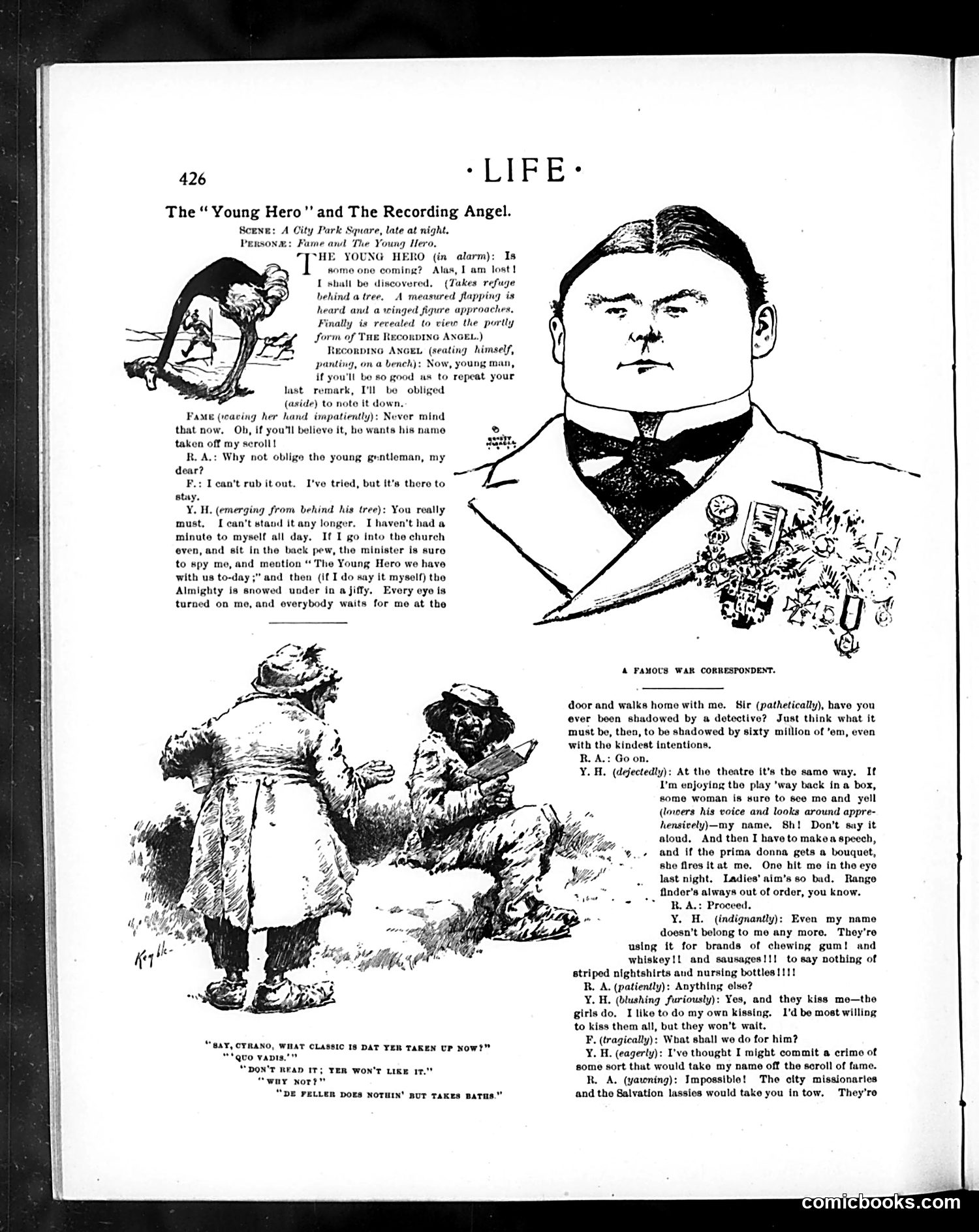
This page presents a satirical dialogue between "The Young Hero" (a pompous war correspondent) and "The Recording Angel" (a winged figure taking notes). The satire mocks the correspondent's vanity and self-aggrandizement. The joke centers on the correspondent's obsessive fear that his name won't be recorded in history, complaining that even church attendance gets noted but his war coverage might be forgotten. The angel's deadpan responses expose his narcissism—suggesting his name is only "used for brands of chewing gum and whiskey" and that "the Salvation lassies would take you in low." The accompanying sketches depict absurd "classic" moments supposedly taken up by journalists, mocking how war correspondents sensationalize and exaggerate their importance to historical record. The satire critiques journalistic self-importance and the trivialization of serious events.
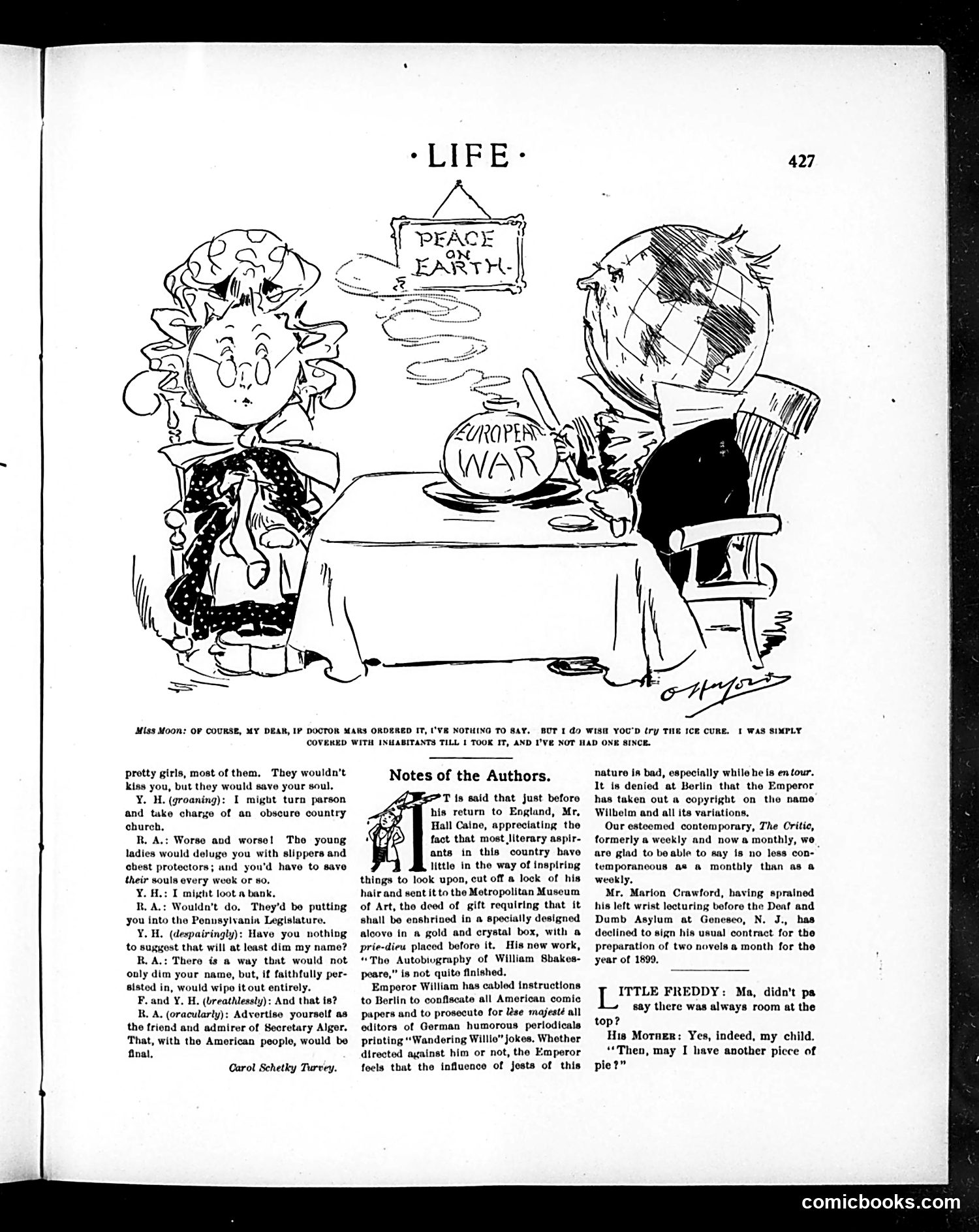
The main cartoon depicts two figures seated at a dining table. On the left is a grotesque caricature labeled "Miss Moon" (likely representing a female political figure or social commentator). On the right sits a figure representing European interests, with a globe for a head. Between them sits a bowl labeled "European War," while a banner overhead reads "Peace on Earth." The satire suggests the impossibility of achieving peace while war profiteers and self-interested parties control negotiations. The grotesque characterizations and the absurd imagery of dining while discussing war critique those who profit from or trivialize global conflict. The accompanying text references literary aspirations and copyright disputes, suggesting broader commentary on intellectual property and cultural authority during wartime.
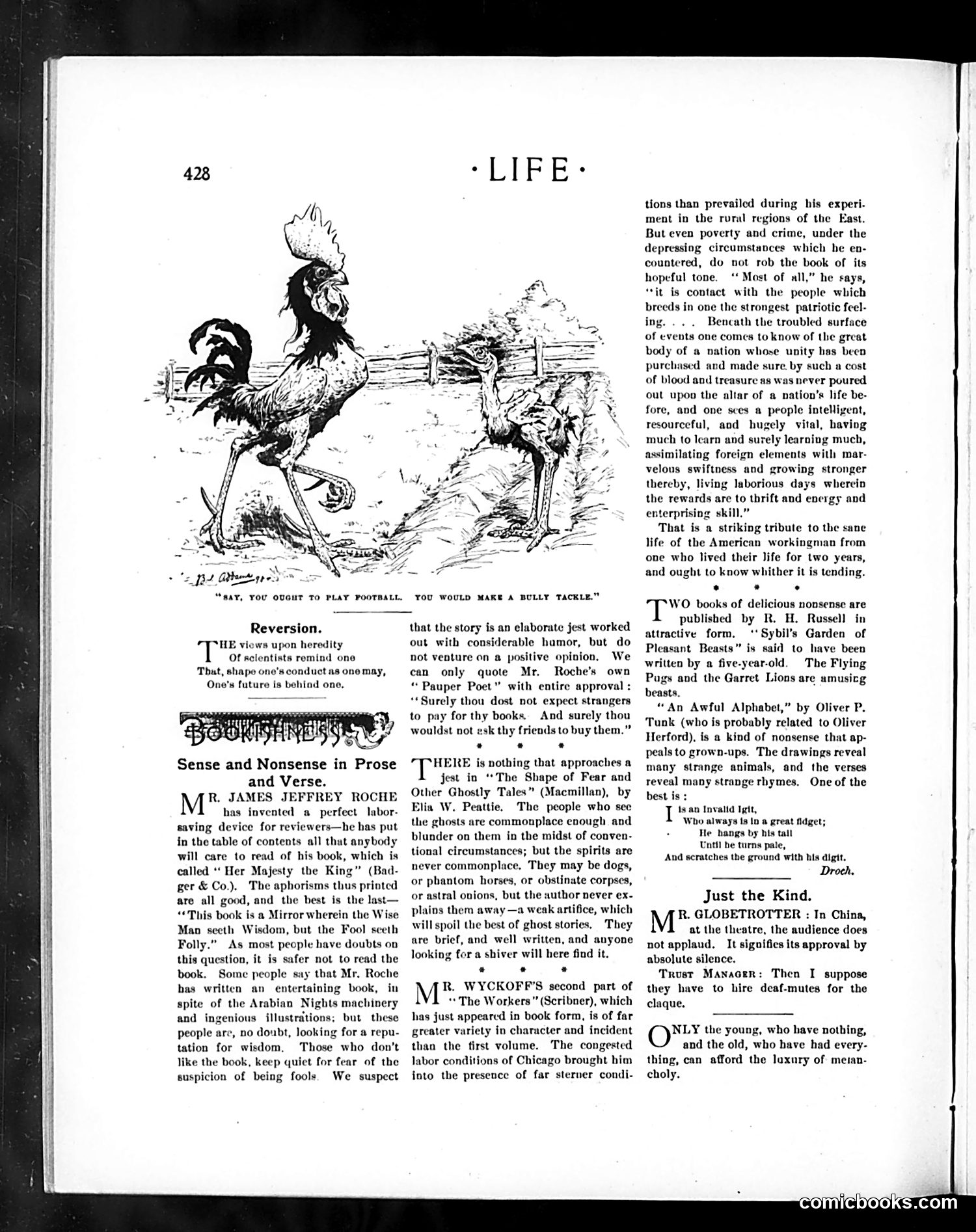
This cartoon depicts a rooster confronting what appears to be a much larger, aggressive dog. The rooster's caption reads: "Say, you ought to play football. You would make a bully tackle." The satire appears to be mocking someone's unsuitability for a particular role or activity. The "bully tackle" reference suggests the target was known for aggressive, domineering behavior—the kind that might make him effective at football's brutish physical play, but unsuitable for other purposes. Without the original publication date visible, the specific political or social target remains unclear, though the humor relies on equating the dog's rough nature with football's violent reputation.
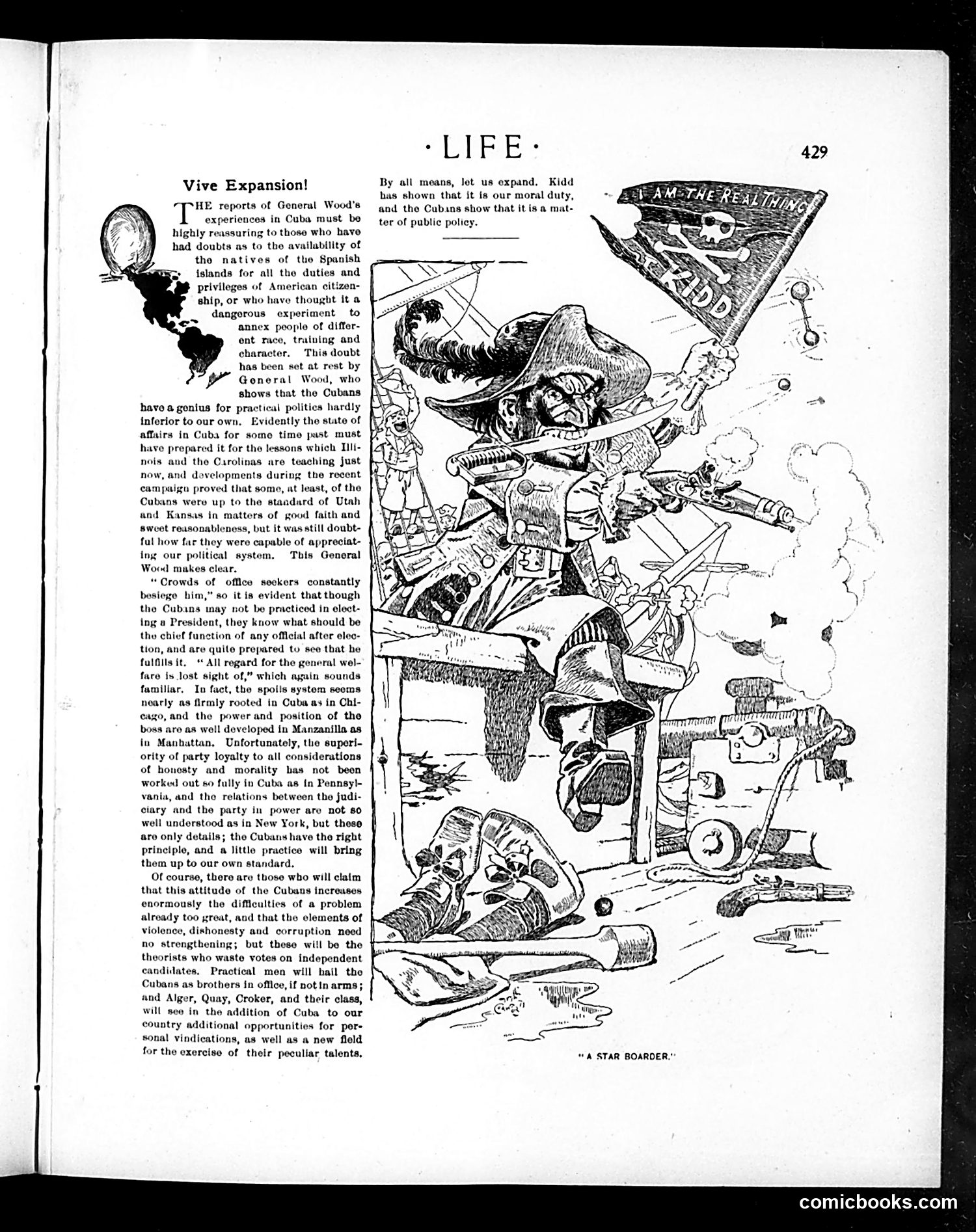
This satirical cartoon depicts Cuba as a disruptive "star boarder" (tenant) in an American household. The figure, wearing a large hat and surrounded by chaos—scattered furniture, broken items, and general disorder—represents Cuba disrupting American domestic life and politics. The accompanying article "Vive Expansion!" discusses General Wood's Cuba experiences and debates Cuban incorporation into American citizenship. The cartoon satirizes concerns about Cuban admission: the chaos imagery suggests Cubans would destabilize American society and politics, playing on period anxieties about racial and cultural differences. The "star boarder" metaphor implies Cuba is an unwelcome addition to the American household, creating problems rather than benefits—a critique of American expansionist policy and Cuban-American integration during the Spanish-American War era.
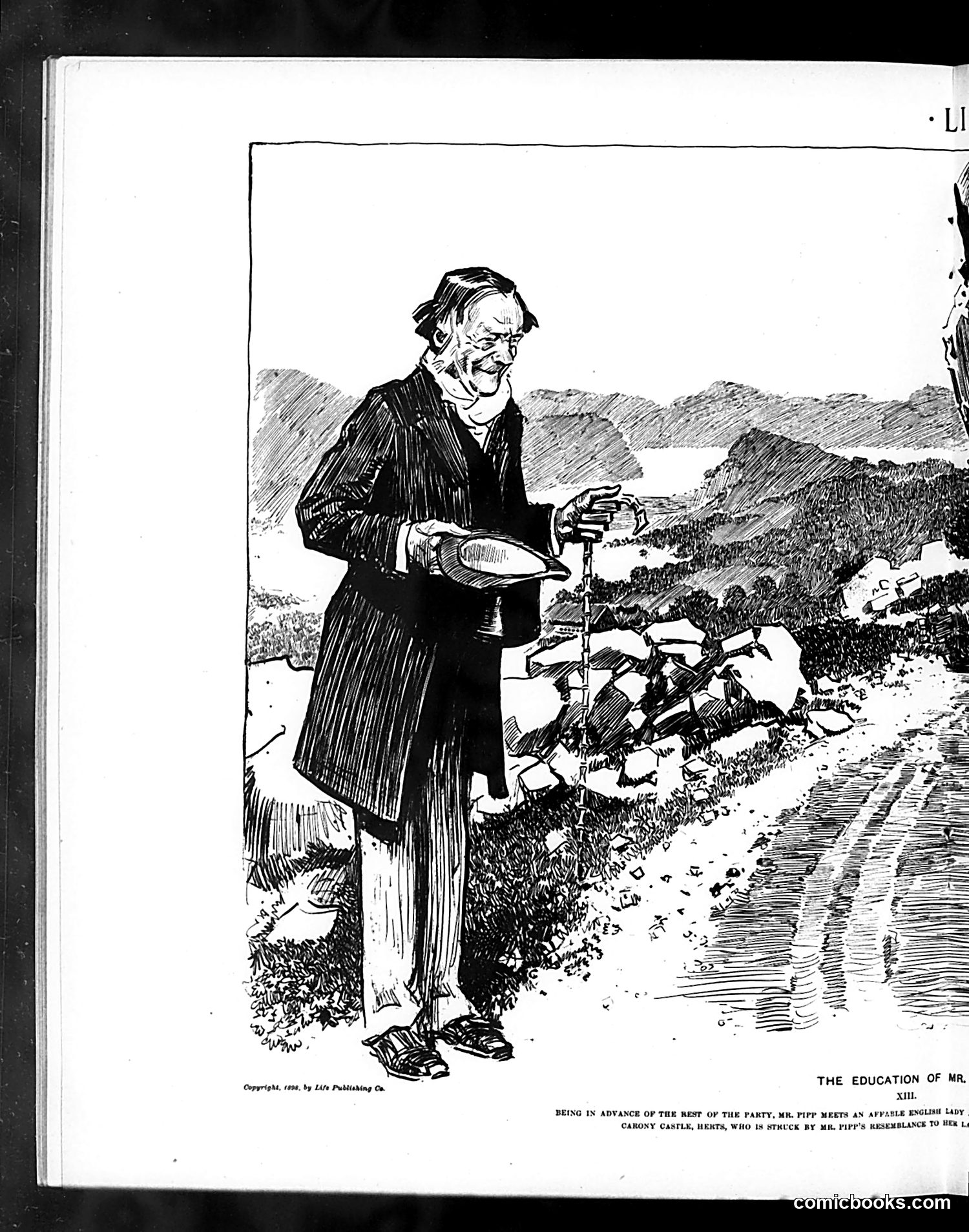
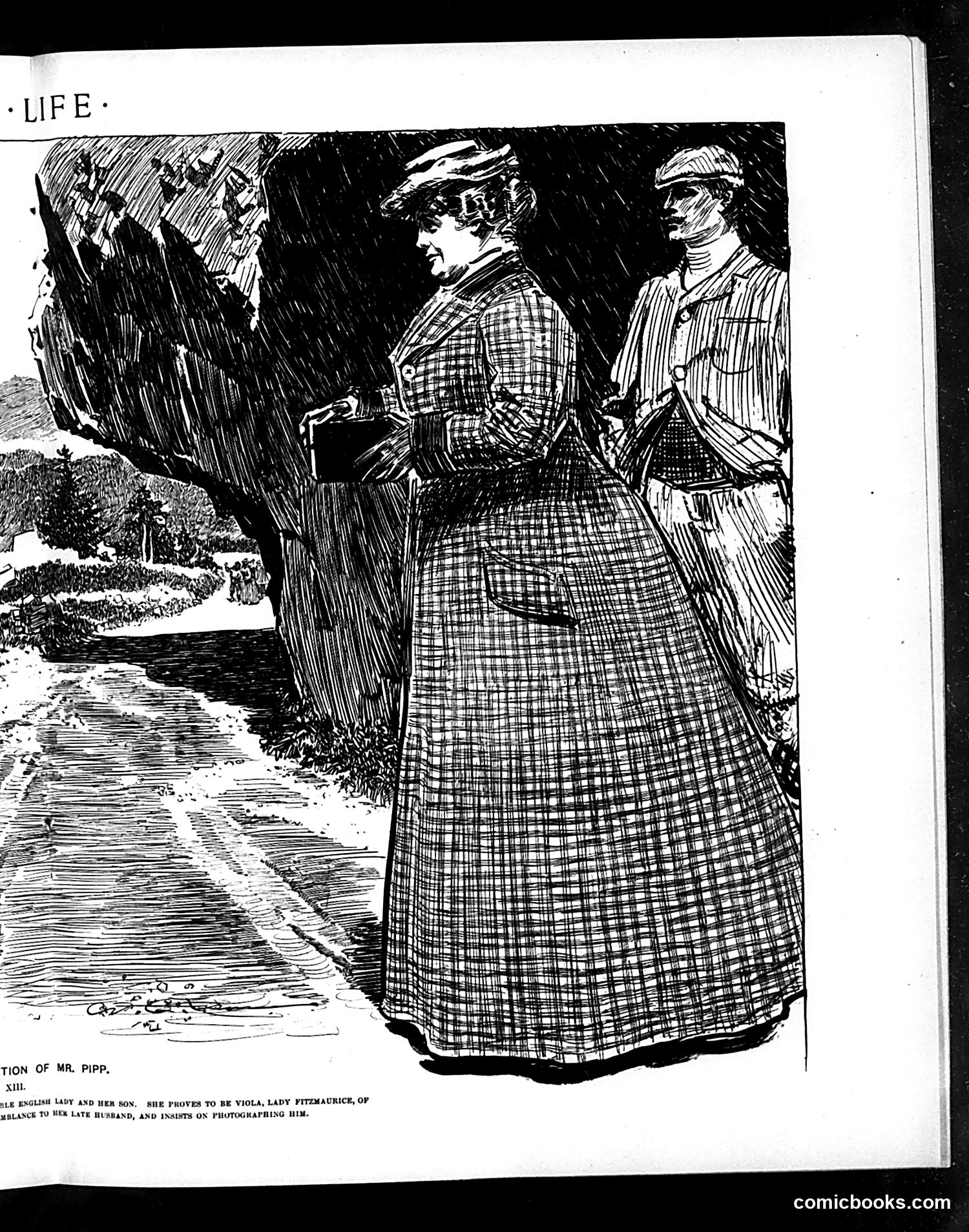
This appears to be an illustration from Life magazine's satirical section. The visible caption fragment references "Mr. Pipp" and mentions "an English lady and her son" with a character named "Lady Fitzmaurice" who "protests to be Viola" and "insists on photographing him." The image shows three figures in early 20th-century dress by a waterside. The central woman in a plaid dress appears to be the focus of the scene. Without the complete caption or publication date, the specific satirical point remains unclear—it may lampoon theatrical pretension, photography obsession, or a particular social scandal of the era. The detailed line-work suggests this is editorial illustration rather than pure cartooning. The full context needed to explain the joke to modern readers is not entirely visible on this page fragment.
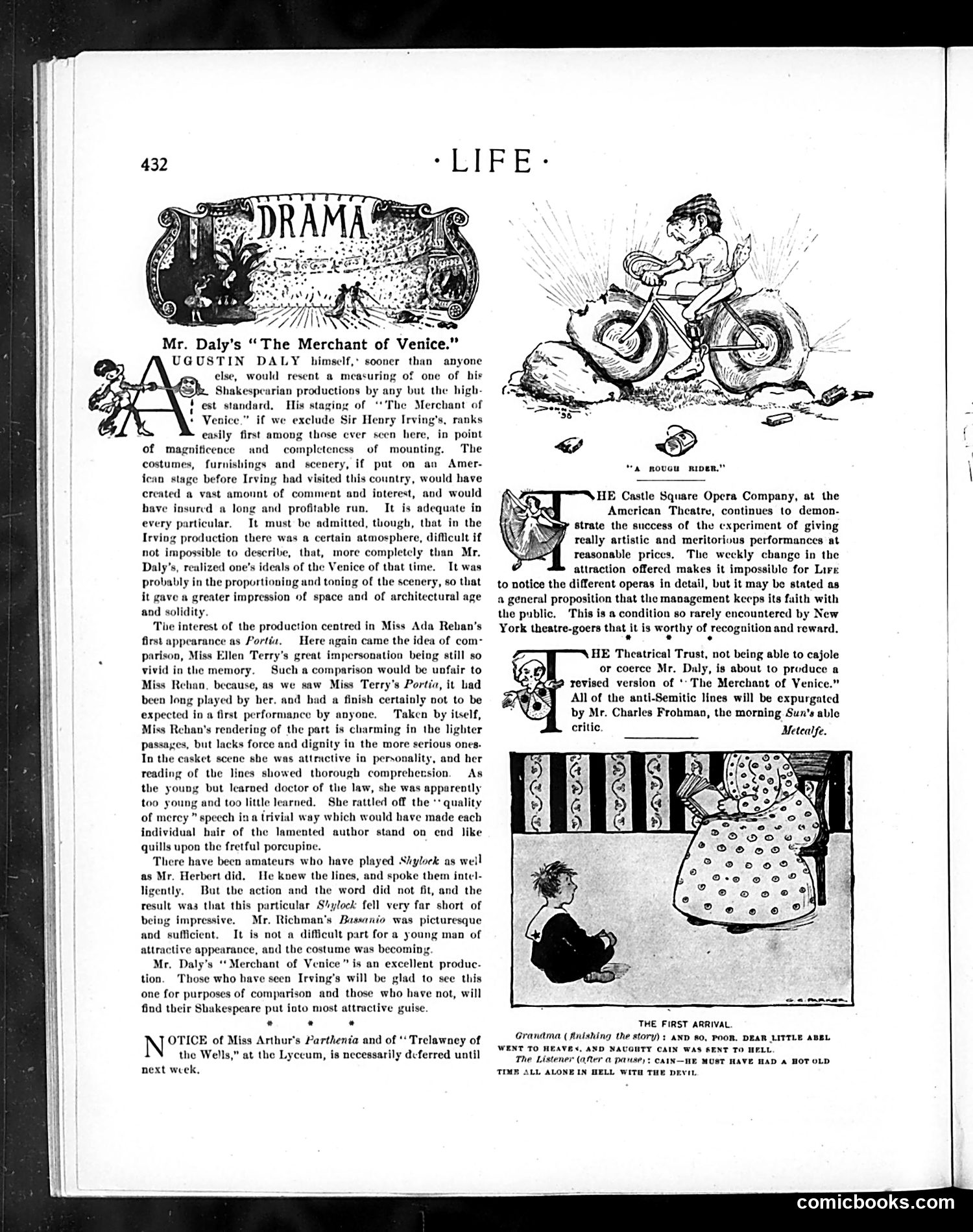
This page reviews Mr. Daly's production of "The Merchant of Venice," praising its scenic design and costumes while critiquing specific performances. The main text discusses Miss Ada Rehan's portrayal of Portia, comparing her favorably to earlier actress Miss Terry's interpretation. The two cartoons on the page appear unrelated to the drama review: "A Sober Rider" depicts someone on a bicycle, while "The First Arrival" shows a grandmother scolding a child about a cat, with text referencing hellish punishment. These are typical humorous domestic sketches common to Life magazine's satirical format, offering comedic relief alongside theater criticism.
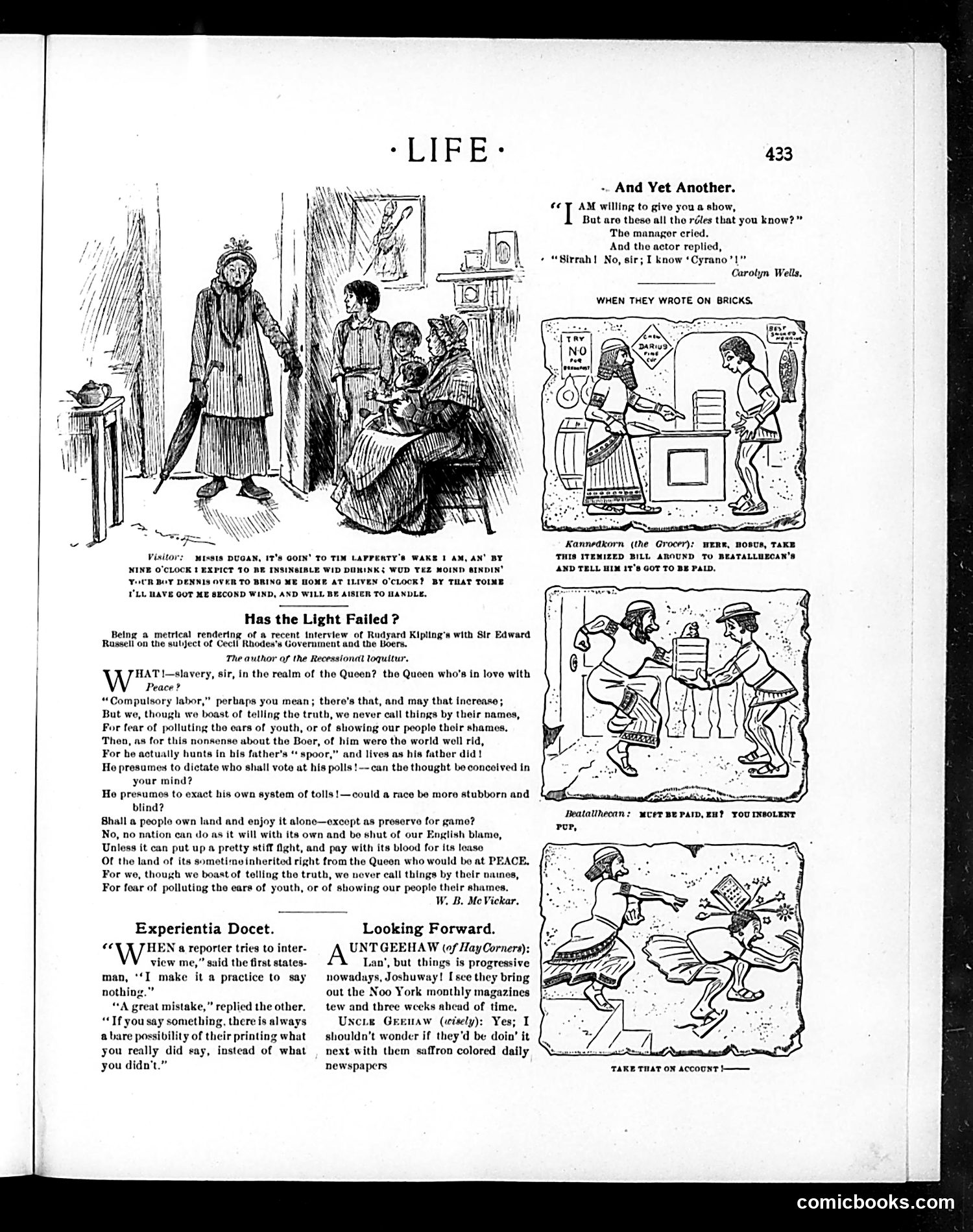
This page contains several distinct satirical pieces: **"Has the Light Failed?"** mocks British imperialism, specifically regarding the Boer War and Cecil Rhodes's colonial policies. The poem, attributed to W.B. McVickar, parodies Rudyard Kipling's rhetoric, exposing the hypocrisy of Britain claiming moral superiority while justifying conquest, forced labor, and subjugation of the Boers as necessary evils. **The cartoons "When They Wrote on Bricks"** depict working-class characters (Kannedkorn the grocer and Beatalihecan) in humorous domestic disputes—likely satirizing ordinary people's struggles with debt and commerce. **"Experientia Docet"** and **"Looking Forward"** are brief joke pieces mocking politicians' evasiveness and rural Americans' bemusement at modern progress (magazines arriving weeks early). The page overall critiques imperialism, political hypocrisy, and social pretension through verse and visual humor typical of *Life*'s satirical approach.
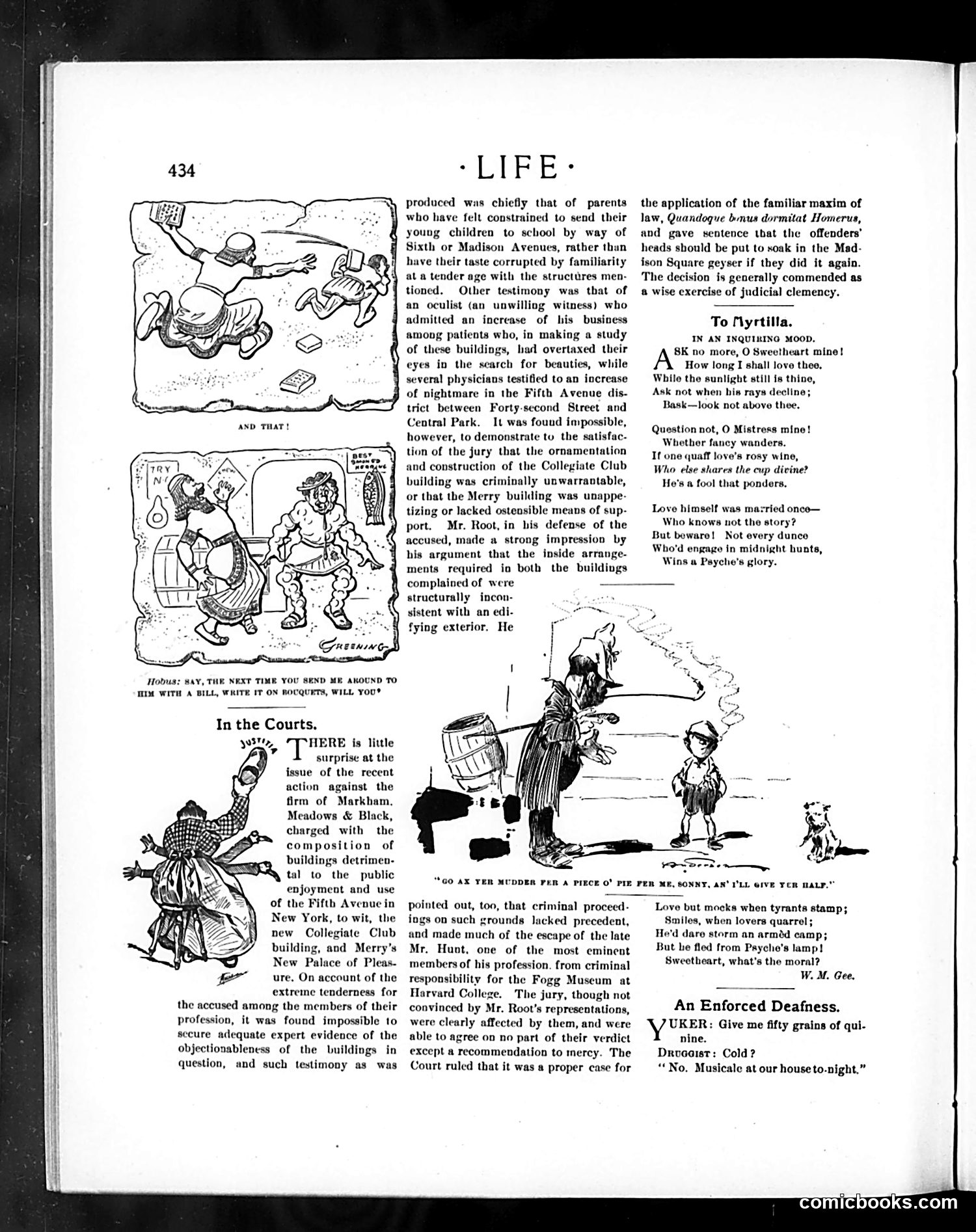
This page satirizes New York City architecture and architectural criticism of the era. The main section, "In the Courts," imagines a lawsuit against architects Markham, Meadows & Black for designing ugly buildings—specifically the new Collegiate Club building and "Merry's New Palace of Pleasure"—that damage Fifth Avenue's aesthetic value and even cause physical ailments (eyestrain, nightmares) among New Yorkers forced to view them. The satire targets professional architects' reluctance to testify against colleagues and the legal system's inability to prosecute ugliness. The lawyer (likely Elihu Root, a prominent attorney) argues absurdly that interior structure justifies exterior appearance. The judge's verdict—that offenders' "heads should be put to soak" if they repeat the offense—mocks the impossibility of meaningful punishment. The smaller cartoons and poem are unrelated humor about romantic relationships and a brief joke about quinine being prescribed for a musicale (concert) rather than cold symptoms—implying the event is unbearably tedious.
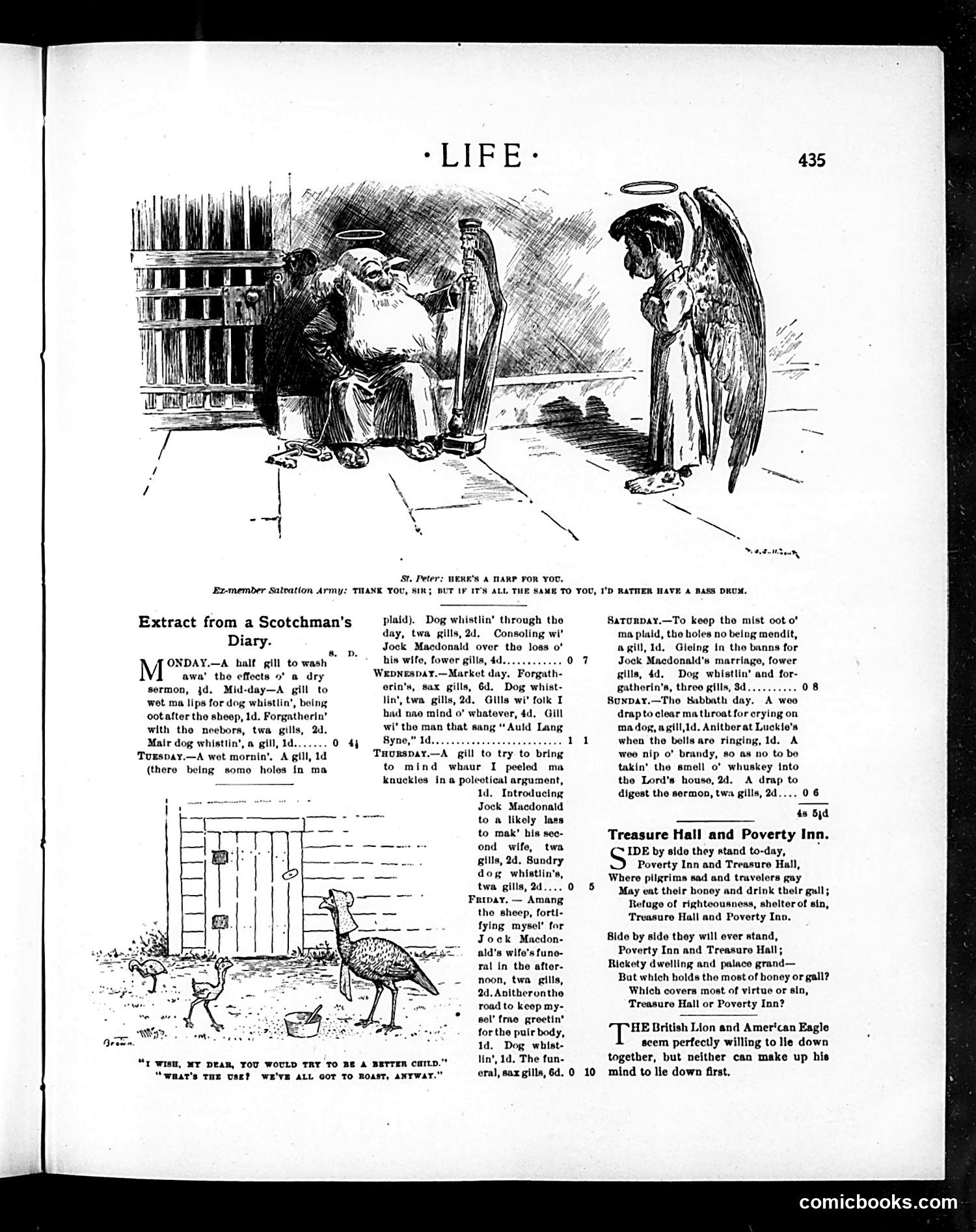
**Top Cartoon:** St. Peter (identifiable by his halo and keys) offers a harp to an ex-member of the Salvation Army at heaven's gate. The joke plays on the Salvation Army's famous brass bands—the ex-member declines the harp, preferring a bass drum instead, suggesting he'd rather continue the musical tradition he knew in life. **"Extract from a Scotchman's Diary":** A satirical accounting of a Scottish man's weekly spending, where nearly every activity—from consoling a bereaved friend to attending a funeral to dog whistling—is accompanied by purchases of "gills" (alcohol measures). The humor mocks Scottish drinking habits by presenting constant alcohol consumption as mundane routine, with everything itemized like household expenses. **Bottom cartoon:** Depicts the British Lion and American Eagle lying down together, unable to decide who goes first—a political reference to Anglo-American relations, likely post-WWI cooperation, with the satire suggesting both powers are reluctant partners in peace or alliance.
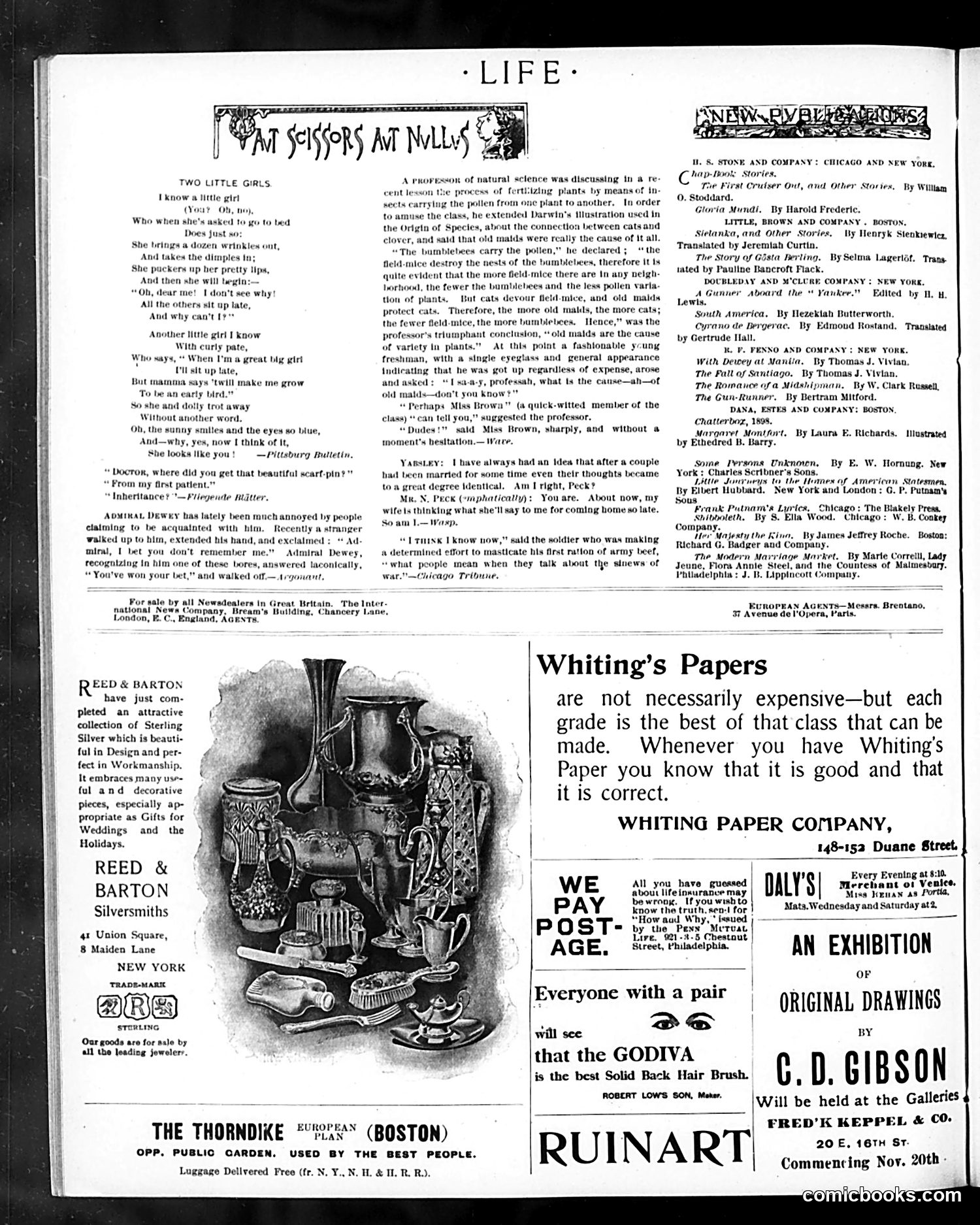
This page from *Life* magazine features several short humorous pieces typical of the publication's satirical style: **"Two Little Girls"** is a sentimental poem contrasting two children—one petulant and demanding about bedtime, the other obedient. The humor lies in the implied moral lesson about good behavior, ending with a quip comparing one girl's appearance to a Pittsburgh newspaper mascot. **"Scissors at Nullus"** presents a classroom anecdote where a natural science professor makes a logical chain connecting old maids to plant variation (via cats and field-mice). A "fashionable young freshman" interrupts with a crude joke implying old maids are caused by male indifference—contemporary humor mocking both academic pomposity and bachelor attitudes. **Other brief jokes** mock Admiral Dewey's irritation with social climbers and marital misunderstandings. The page is primarily **advertising and new book announcements** for publishers like Stone & Barton and Reed & Barton silversmith products. The cartoons/humor are minimal—this appears largely a commercial page disguised as editorial content, typical of early 1900s *Life* magazine format.
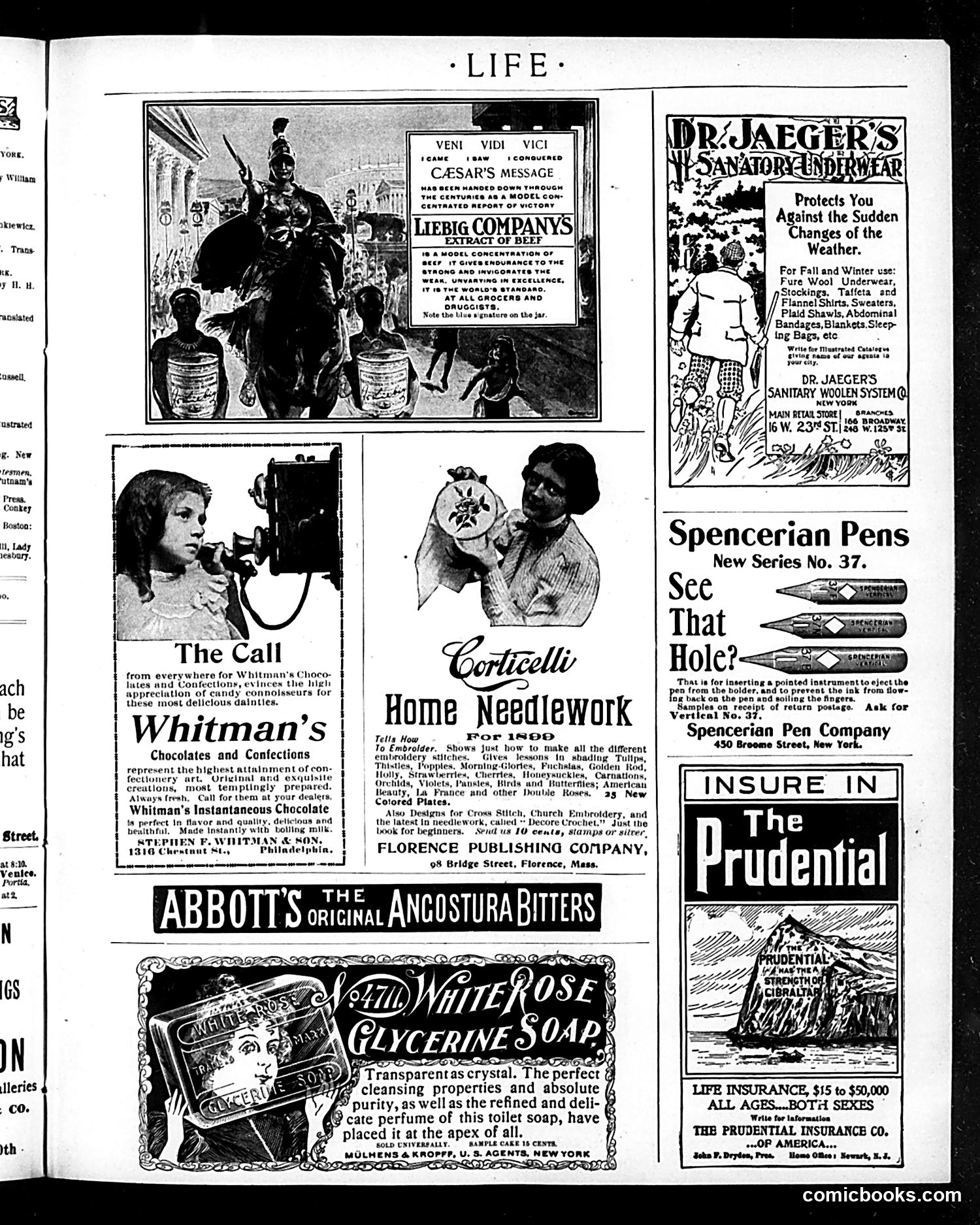
This page is primarily **advertising**, not political satire. The dominant content comprises commercial advertisements typical of early 20th-century American magazines. The top image references **Caesar's famous phrase "Veni, Vidi, Vici"** (I came, I saw, I conquered) to advertise Liebig Company's beef extract—a humorous comparison suggesting the product's conquering success in the marketplace. This is straightforward commercial messaging, not political commentary. Below are ads for **Whitman's Chocolates** ("The Call"), **Corticelli Home Needlework**, **Spencerian Pens**, **Abbott's Bitters**, **White Rose Glycerine Soap**, **Dr. Jaeger's Sanitary Underwear**, and **Prudential Insurance**. The "Call" image shows a woman operating an early telephone, reflecting consumer culture and modern technology. No satire or political content is evident—this is a commercial publication showcasing consumer goods and services of the era.
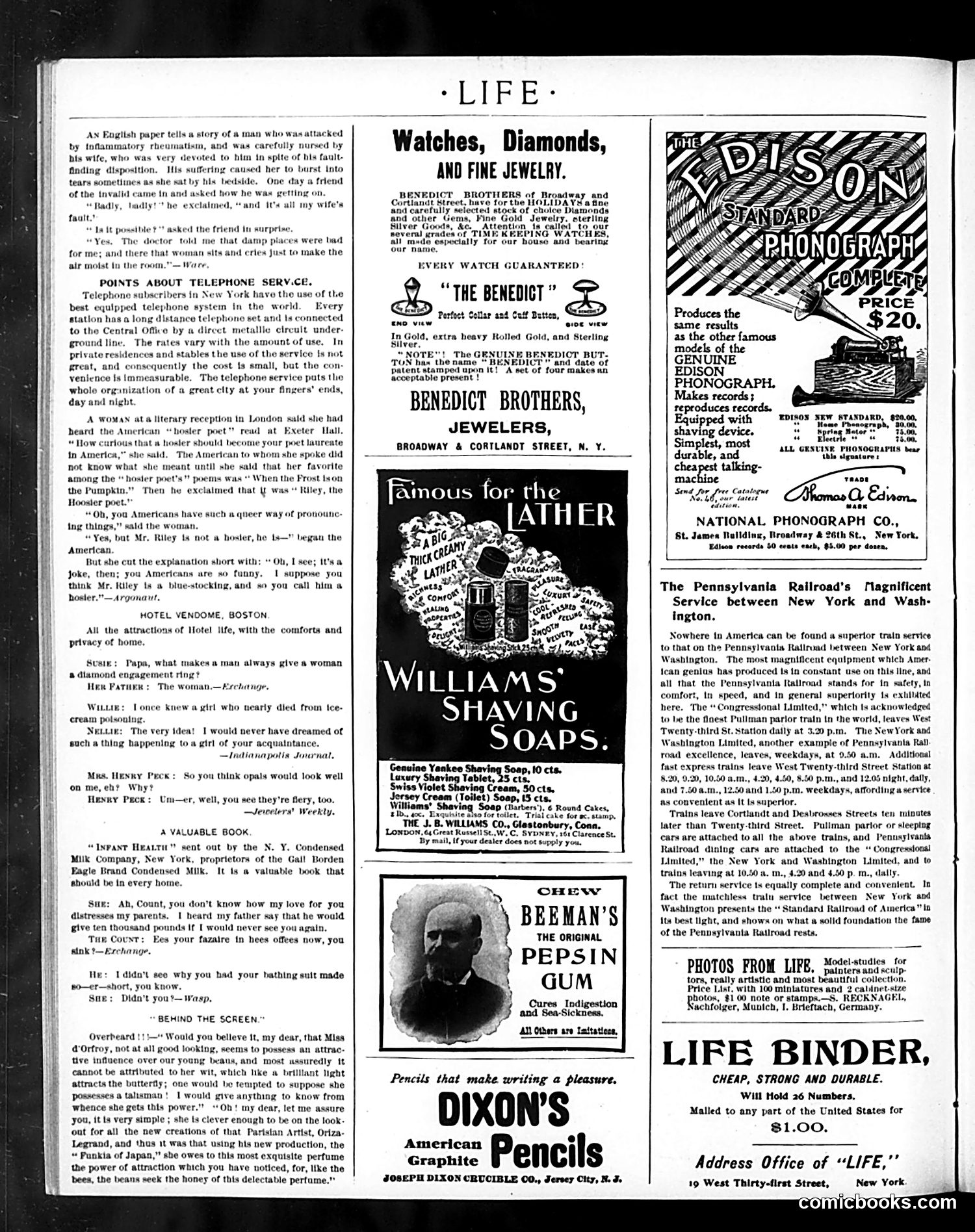
This page is primarily **advertisements and humorous anecdotes**, not political cartoons. The content reflects early 1900s American life: **Main Features:** The page contains brief comedic stories about social situations—a man blaming his devoted wife for his illness, confusion over American poet James Whitcomb Riley's regional accent ("Hoosier" mispronounced as "hoster"), and flirtatious exchanges about engagement rings and jewelry. **Historical Context:** These sketches reflect contemporary class anxieties and gender dynamics. The jokes assume readers understand: formal social etiquette, diamond engagement ring customs, regional American dialects, and romantic courtship conventions of the era. **Advertising:** The majority of space features luxury goods (watches, diamonds, phonographs, shaving soap) targeting wealthy readers—typical of *Life* magazine's upscale audience. **No Satire Present:** Unlike political cartoons, these are gentle humor about miscommunication and social pretension, not biting social critique. They're primarily filler content designed to entertain subscribers between advertisements.
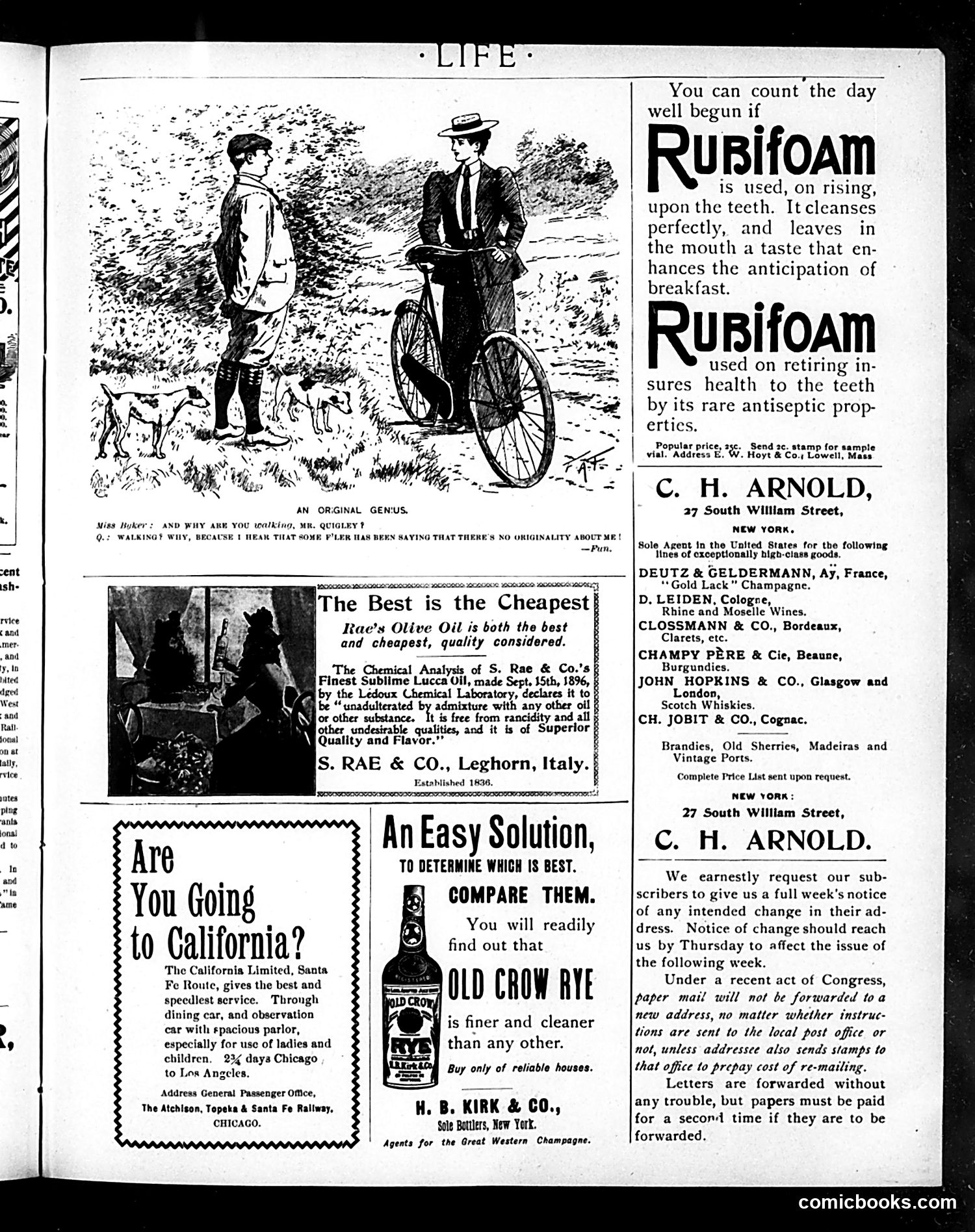
This page is primarily **advertisements with one small cartoon joke**. The cartoon ("An Original Genus") depicts Mr. Quigley defending his choice to walk by claiming someone said there's "no originality about me"—so he's walking to prove otherwise. The humor is gentle wordplay: his defensive reaction to criticism about lacking originality ironically demonstrates self-consciousness rather than genuine originality. The page is dominated by **turn-of-the-century product ads**: toothpaste (Rubifoam), olive oil, whiskey, champagne, and railroad service to California. These represent high-end luxury goods marketed to affluent readers. The "Best is the Cheapest" olive oil ad emphasizes quality assurance through chemical analysis—reflecting contemporary anxieties about product purity and adulteration, which were genuine public concerns before modern food regulation. The bottom section contains **subscriber notices** about address changes and mail forwarding costs under new Congressional regulations. This is largely a **commercial page** rather than satirical content, typical of Life's revenue model.
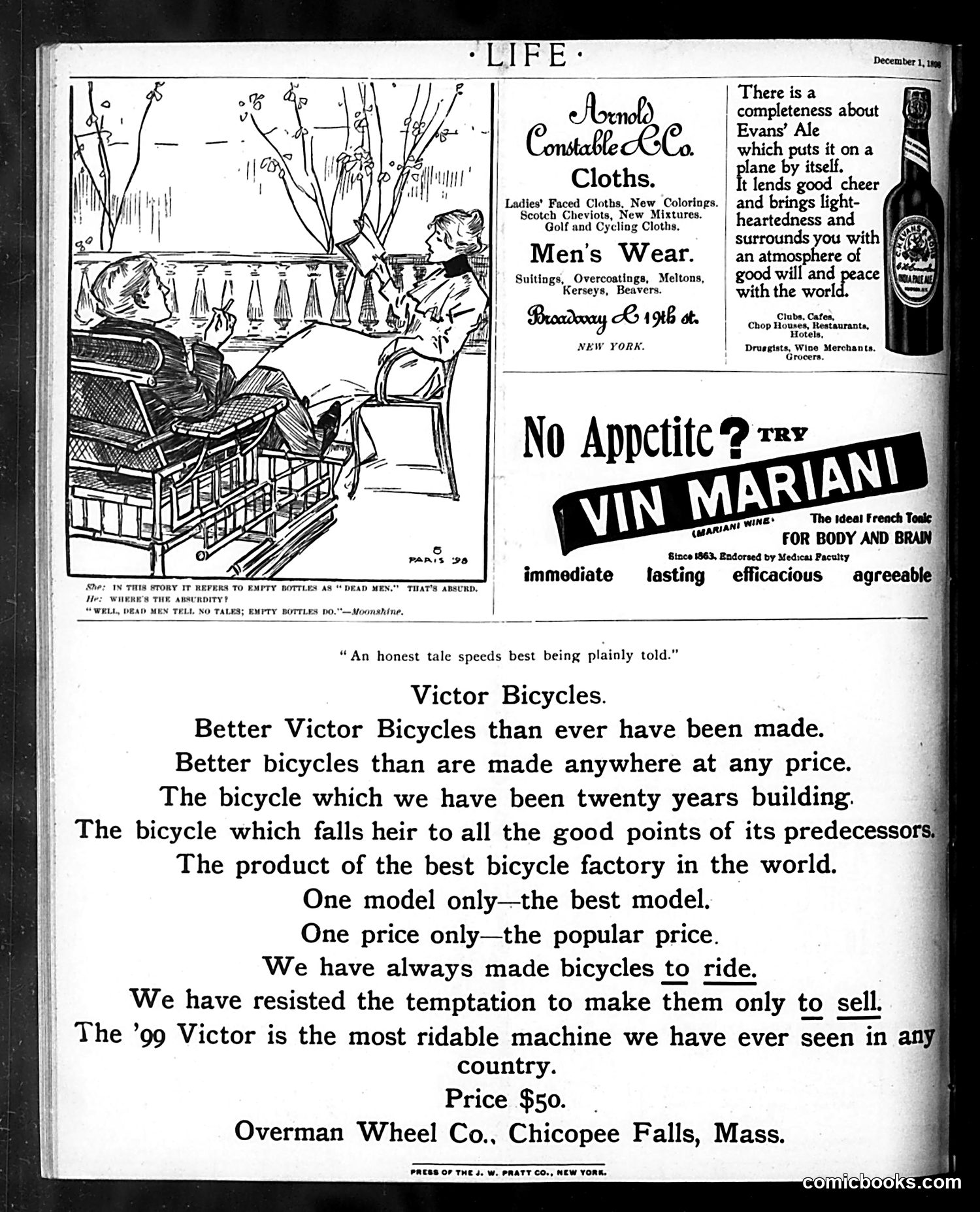
This page is primarily **advertising** with one small satirical cartoon at top-left. **The Cartoon:** Shows two figures in a domestic interior beneath bare tree branches. The caption references "empty bottles as 'dead men'"—a drinking slang term. One figure challenges this logic: "dead men tell no tales; empty bottles do," suggesting empty bottles are evidence of drinking and thus more incriminating than actual corpses. It's a mild joke playing on the contradiction in the phrase. **The Advertisements:** The page features prominent ads for: - Arnold Constable clothing (Broadway, NYC) - **Vin Mariani** - a French tonic wine marketed as medicinal for appetite and energy - Victor bicycles ($50, made in Massachusetts) - Evans' Ale These products represent typical 1890s consumer goods. Notably, Vin Mariani was a legitimate patent medicine of the era—wine-based tonics were marketed as healthful before pharmaceutical regulation tightened. The bicycle ad emphasizes quality and affordability during cycling's popularity boom.
I can see this is a mostly black page with minimal visible content. On the left margin, there are fragmentary text elements visible ("ple," "rs," "ny") and "comicbooks.com" appears in the bottom right corner. The page appears to be either a cover, back page, or heavily darkened interior page from a publication. Without clear imagery or legible text to analyze, I cannot reliably identify specific cartoons, political figures, or satirical content. The OCR text provided only shows "comicbooks.com," which is a modern website reference, not historical Life magazine content. To properly explain the satire and historical context for a modern reader, I would need a page with visible illustrations and readable text.