
Life, 1898-12-01 · page 8 of 21
Life — December 1, 1898 — page 8: what you’re looking at
What you’re looking at
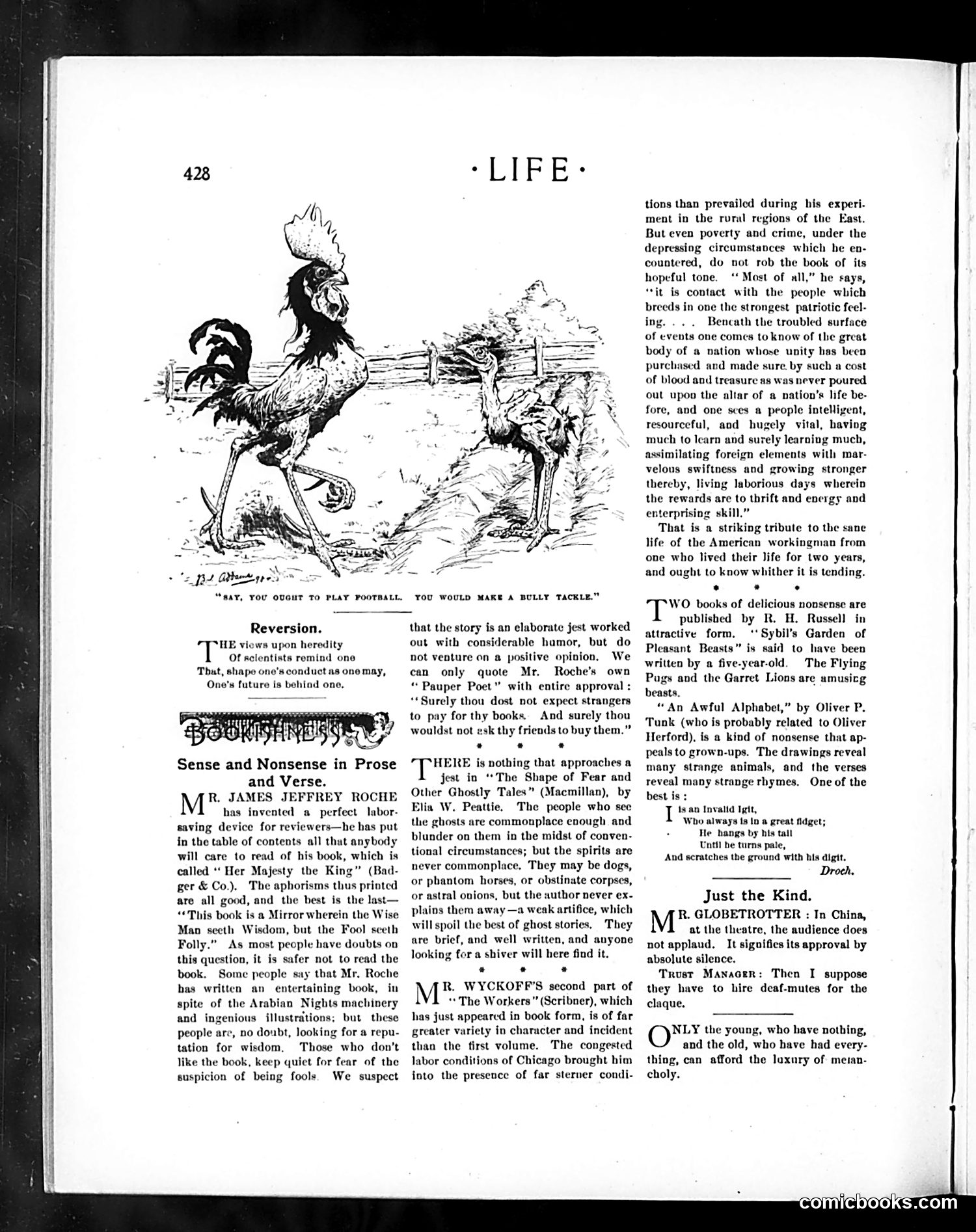
This cartoon depicts a rooster confronting what appears to be a much larger, aggressive dog. The rooster's caption reads: "Say, you ought to play football. You would make a bully tackle." The satire appears to be mocking someone's unsuitability for a particular role or activity. The "bully tackle" reference suggests the target was known for aggressive, domineering behavior—the kind that might make him effective at football's brutish physical play, but unsuitable for other purposes. Without the original publication date visible, the specific political or social target remains unclear, though the humor relies on equating the dog's rough nature with football's violent reputation.
📄 Transcribed text from this page (OCR, searchable)
Machine-transcribed from the original scan — historical spelling and the odd misread are preserved.
2 phy Mey “aay, YOU OUGUT TO PLAY POOTBALL. YOU WOULD MAKE A BULLY TACKLE.” Reversion. HE viows upon heredity Of rcientists remind one ‘Thut, shape ono's conduct as one may, One's future is behind one, Sense and Nonsense in Prose and Verse. M* JAMES JEFFREY ROCHE has invented a perfect labor- saving device for reviewers—he has put in the table of contents all thut anybody will care to read of his book, which is called ‘‘ Her Majesty the King” (Bad- ger & Co.), The aphorisms thus printed are all good, and the best is the last— “*This book is a Mirror wherein the Wise Man secth Wisdom, but the Fool seeth Folly.” As most people have doubts on this question, it is safer not to read the book. Some people say that Mr, Roche bas written an entertaining book, in spite of the Arabian Nights machinery and ingenious illustrations; but these people are, no doubt, looking for a repu- tation for wisdom, Those who don’t like the book, keep quiet for fear of the suspicion of being fools. We suspect that the story is an elaborate jest worked out with considerable hamor, but do not venture on a@ positive opinion. We can only quote Mr. Roche's own “ Pauper Poet” with entire approval : “Surely thou dost not expect strangers to pay for thy books. And surely thou wouldst not esk thy friends to buy them.” . . . HERE is nothing that approaches a jest in ‘The Shape of Fear and Other Ghostly Tales” (Macmillan), by Elia W. Peattie. The people who sec the ghosts are commonplace enough and blunder on them in the midst of conven- tional circumstances; but the spirits are never commonplace, They may be dogs, or phantom horses, or obstinate corpses, or astral onions, but the author never ex- plains them away—a weak artifice, which will spoil the best of ghost stories. They are brief, and well written, and anyone looking for a shiver will here find it. . . . R. WYCKOFF'S second part of I “The Workers” (Scribner), which has just appeared in book form, is of far greater variety in character and incident than the first volume. The congested labor conditions of Chicago brought him into the presence of far sterner condi- tions than prevailed during his experi. ment in the rural regions of the East. But even poverty and crime, under the depressing circumstances which he en- countered, do not rob the book of its hopeful tone.‘ Most of all,” he says, “it is contact with the people which breeds in one the strongest patriotic feel- ing... . Bencath the troubled surface of events one comes to know of the great body of a nation whose unity has been purchased and made sure. by such a cost of blood and treasure as was never poured out upoo the altar of a nation’s life be- fore, and one sces a people intelligent, resourceful, and hugely vital, haviog much to learn and surely learning much, assimilating foreign elements with mar- velous swiftness and growing stronger thereby, living laborious days wherein the rewards are to thrift and energy and enterprising skill.” That is a striking tribute to the sane life of the American workingman from one who lived their life for two years, and ought to know whither it is tending. . . . ‘WO books of delicious nonsense are published by R. H. Russell in attractive form. ‘‘Sybil’s Garden of Pleasant Beasts” is said to have been written by a five-year-old. The Flying Pugs and the Garret Lions are amusing beasts, “An Awful Alphabet,” by Oliver P. Tunk (who is probably related to Oliver Herford), is a kind of nonsense that ap- peals to grown-ups. ‘The drawings reveal many strange animals, and the verses reveal many strange rhymes. One of the best is : 1s an Invalld Igtt, Who always {a In a great fldget; He hangs by his tall Until he turns pale, And scratches the ground with his digit. Droch. Just the Kind. R. GLOBETROTTER : In China, at the theatre, the audience does not applaud. It signifies its approval by absolute silence. Trust Manacer: Then I suppose they have to hire deaf-mutes for the claque, NLY the young, who have nothing, and the old, who have had every- thing, can afford the luxury of metan- choly.