
Life, 1898-12-01 · page 14 of 21
Life — December 1, 1898 — page 14: what you’re looking at
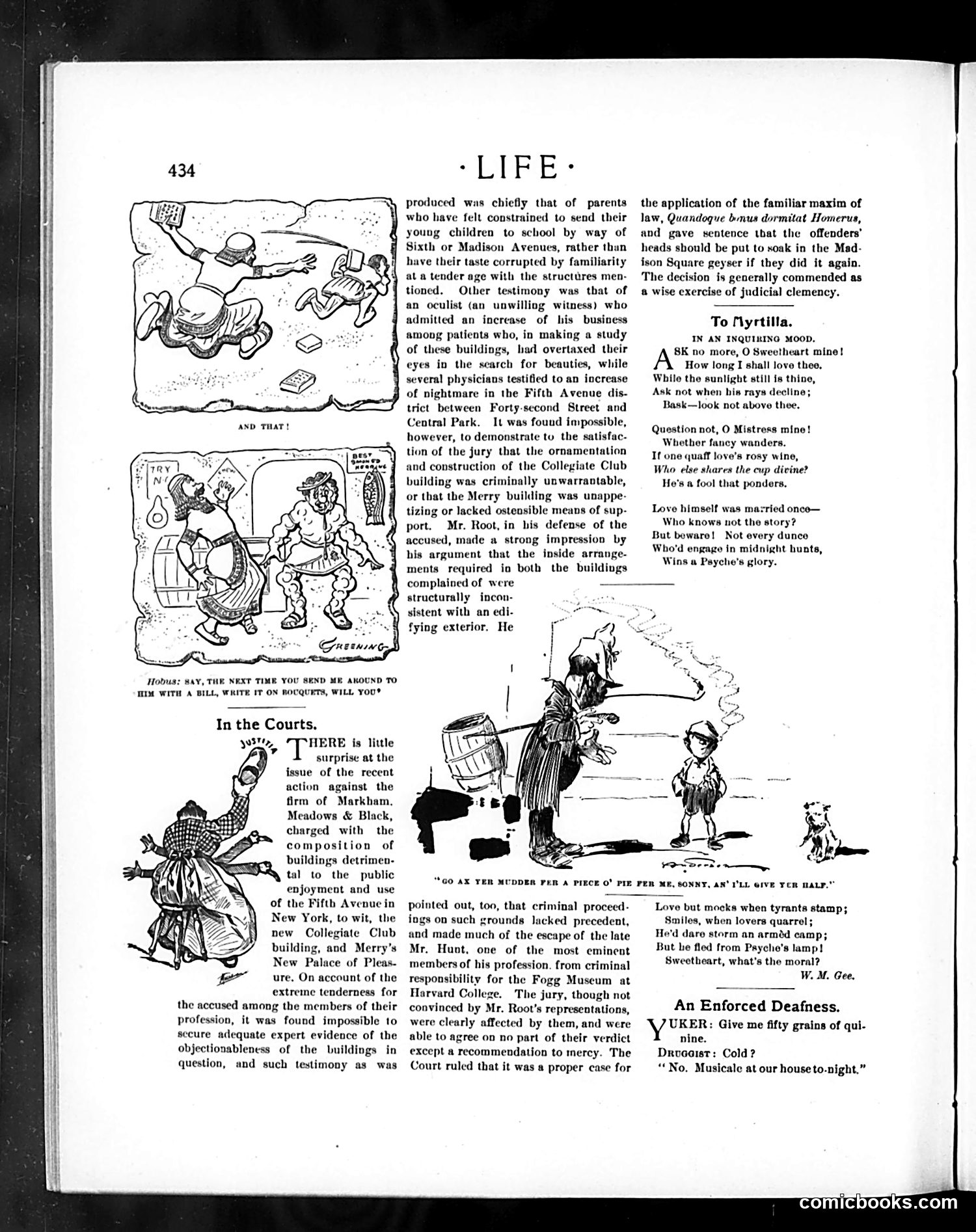
What you’re looking at
This page satirizes New York City architecture and architectural criticism of the era. The main section, "In the Courts," imagines a lawsuit against architects Markham, Meadows & Black for designing ugly buildings—specifically the new Collegiate Club building and "Merry's New Palace of Pleasure"—that damage Fifth Avenue's aesthetic value and even cause physical ailments (eyestrain, nightmares) among New Yorkers forced to view them. The satire targets professional architects' reluctance to testify against colleagues and the legal system's inability to prosecute ugliness. The lawyer (likely Elihu Root, a prominent attorney) argues absurdly that interior structure justifies exterior appearance. The judge's verdict—that offenders' "heads should be put to soak" if they repeat the offense—mocks the impossibility of meaningful punishment. The smaller cartoons and poem are unrelated humor about romantic relationships and a brief joke about quinine being prescribed for a musicale (concert) rather than cold symptoms—implying the event is unbearably tedious.
📄 Transcribed text from this page (OCR, searchable)
Machine-transcribed from the original scan — historical spelling and the odd misread are preserved.
* OEBtE ® produced was chiefly that of parents who have felt constrained to send their young children to school by way of Sixth or Madison Avenues, rather than have their taste corrupted by familiarity ata tender age with the structures men- tioned. Other testimony was that of an oculist (an unwilling witness) who admitted an increase of his business among patients who, in making a study of these buildings, had overtaxed their eyes in the search for beauties, while several physicians testified to an increase gj of nightmare in the Fifth Avenue dis- Hobus: SAY, THR NEXT TIME YOU SEND ME AKOUND TO HIM WITH A BILL, WRITE IT ON ROCQUETS, WILL YOU? In the Courts. wile, HERE is little surprise at the issue of the recent action against the firm of Markham, Meadows & Black, charged with the composition of buildings detrimen- tal to the public enjoyment and use of the Fifth Avenue in New York, to wit, the new Collegiate Club building, and Merry’s New Palace of Pleas- ure. On account of the extreme tenderness for the accused among the members of their profession, it was found impossible to secure adequate expert evidence of the objectionableness of the buildings in question, and such testimony as was trict between Forty-second Street and Central Park. It was found impossible, however, to demonstrate to the satisfac. tion of the jury that the ornamentation and construction of the Collegiate Club building was criminally unwarrantable, or that the Merry building was unappe- tizing or lacked ostensible means of sup- port. Mr. Root, in his defense of the accused, made a strong impression by his argument that the inside arrange- ments required io both the buildings complained of were structurally incon- sistent with an edi- fying exterior, He pointed out, too, that criminal proceed- ings on such grounds lacked precedent, and made much of the escape of the late Mr. Huot. one of the most eminent members of his profession. from criminal responsibility for the Fogg Museum at Harvard College. The jury, though not convinced by Mr. Root’s representations, were clearly affected by them, and were able to agree on no part of their verdict except a recommendation to mercy. The Court ruled that it was a proper case for the application of the familiar maxim of law, Quandogue bmus dormitat Homerus, and gave sentence tbat the offenders’ heads should be put to soak in the Mad- ison Square geyser if they did it again. The decision is generally commended as a wise exercise of judicial clemency. To MMyrtilla. IN AN INQUIRING MOOD, 8K no more, O Sweetheart mine! How long I shall love theo, While the sunlight still {s thine, Ask not when his rays decline; Bask—look not above thee. Question not, O Mistress mine! Whether fancy wanders, If one quaff love's rosy wine, Who else shares the cup divine? He's a fool that ponders. Lovo himself was mazried onco— Who knows not the story? But beware! Not every dunce Who'd engage in midnight hunts, Wins a Payche's glory. Ae “GO AX YER MUDDER FER A PIECE O' PIE FER ME, SONNY, AN’ I'LL OIVE YER MAL.” Love but mocks when tyrants stamp; Smiles, when lovers quarrel; He'd daro storm an armad camp; But he fled from Paycho's lamp! Sweetheart, what's the moral? W. M. Gee. An Enforced Deafness. AV UEEE: Give me fifty grains of qui- nine. Droaaist: Cold ? “‘No, Musicale at our house to-night.” Ccomicbooks.com