
A complete issue · 20 pages · 1898
Life — October 20, 1898
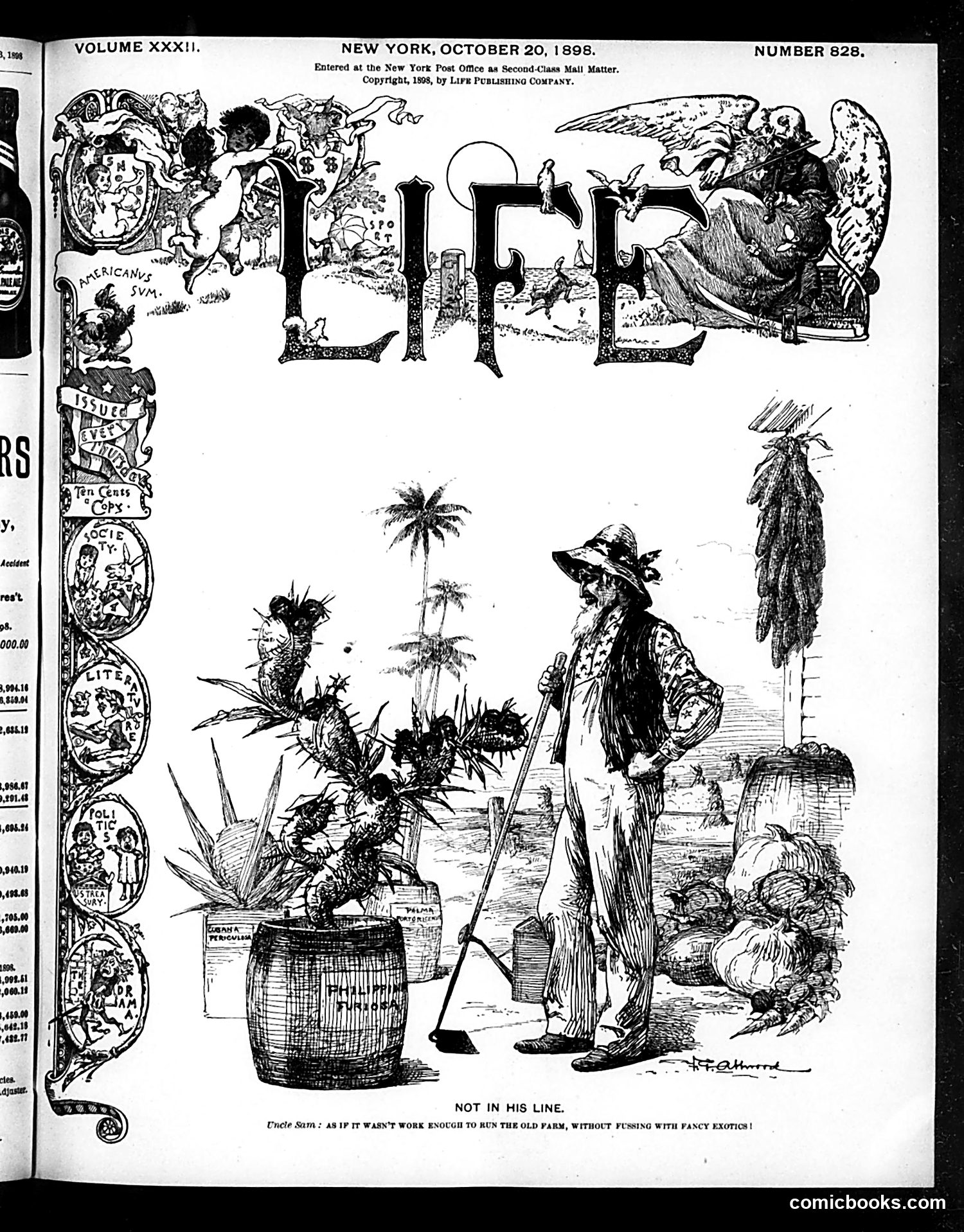
This cartoon satirizes someone (likely a political figure of the era) attempting agricultural work—specifically farm management—despite lacking competence. The caption reads: "Uncle Sam: As if it wasn't work enough to run the old farm, without fussing with fancy exotics!" The figure stands among tropical plants (cacti, palms) labeled with what appears to be "Cuban" references, suggesting this critiques American involvement in Cuba following the Spanish-American War (concluded earlier in 1898). The "fancy exotics" likely refers to colonial or imperial ventures Uncle Sam has taken on. The joke: managing overseas territories is outside Uncle Sam's traditional expertise as a farmer/nation-builder, creating complications beyond his capacity. The satire questions American imperial expansion into unfamiliar tropical territories.
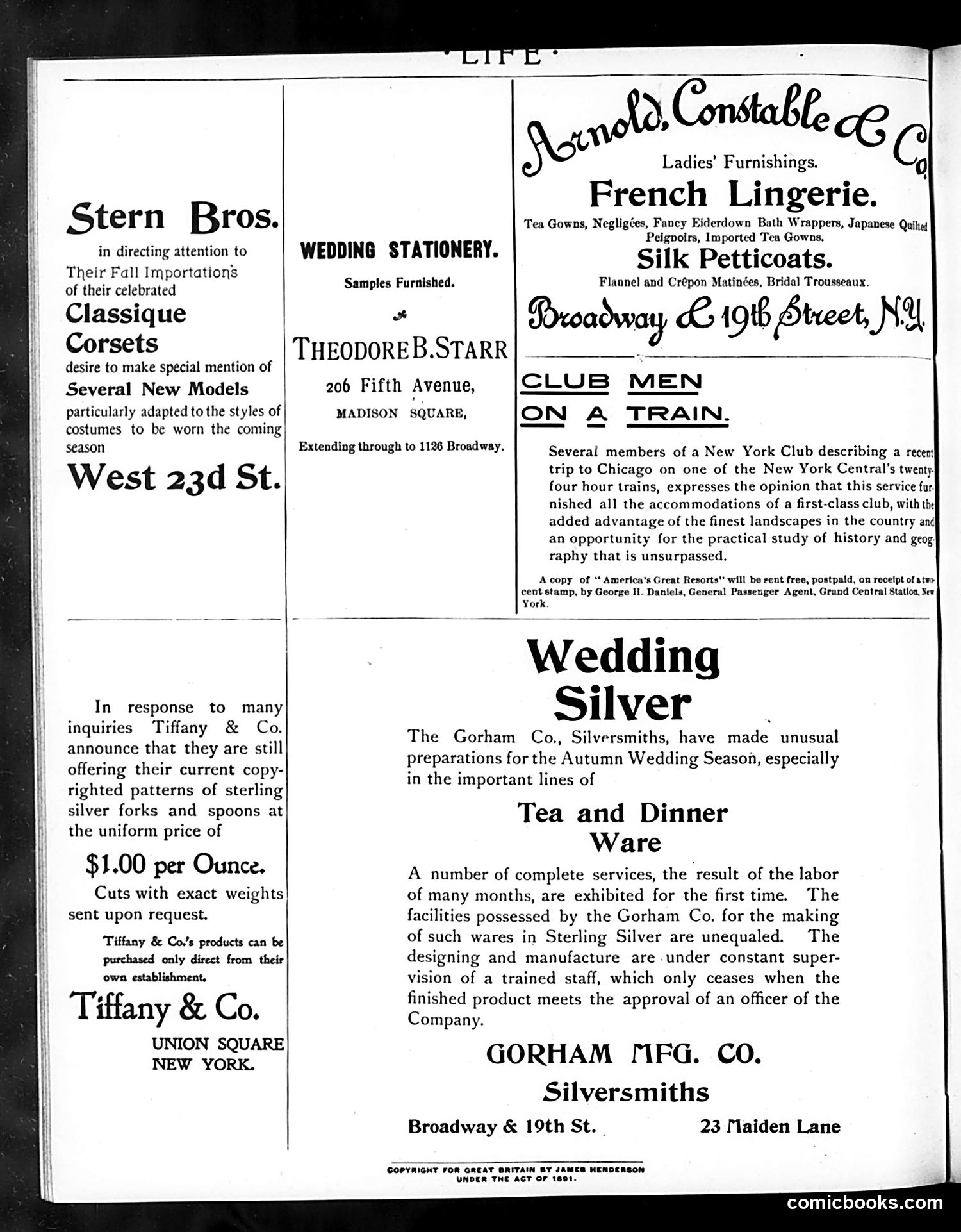
This page is **primarily advertising**, not satirical content. It contains ads for: - **Stern Bros.** corsets (West 23rd St.) - **Theodore B. Starr** wedding stationery (Fifth Avenue) - **Arnold, Constable & Co.** French lingerie and silk petticoats (Broadway & 19th St.) - **Tiffany & Co.** sterling silver forks and spoons ($1.00/ounce) - **Gorham Mfg. Co.** wedding silver tea and dinner ware (Broadway & 19th St.) There is one small editorial piece titled "Club Men on a Train" describing a New York club's excursion to Chicago. **No political cartoons or satire appear on this page.** The content reflects typical early 20th-century Life magazine advertising aimed at upper-class consumers, with particular emphasis on wedding-related merchandise.
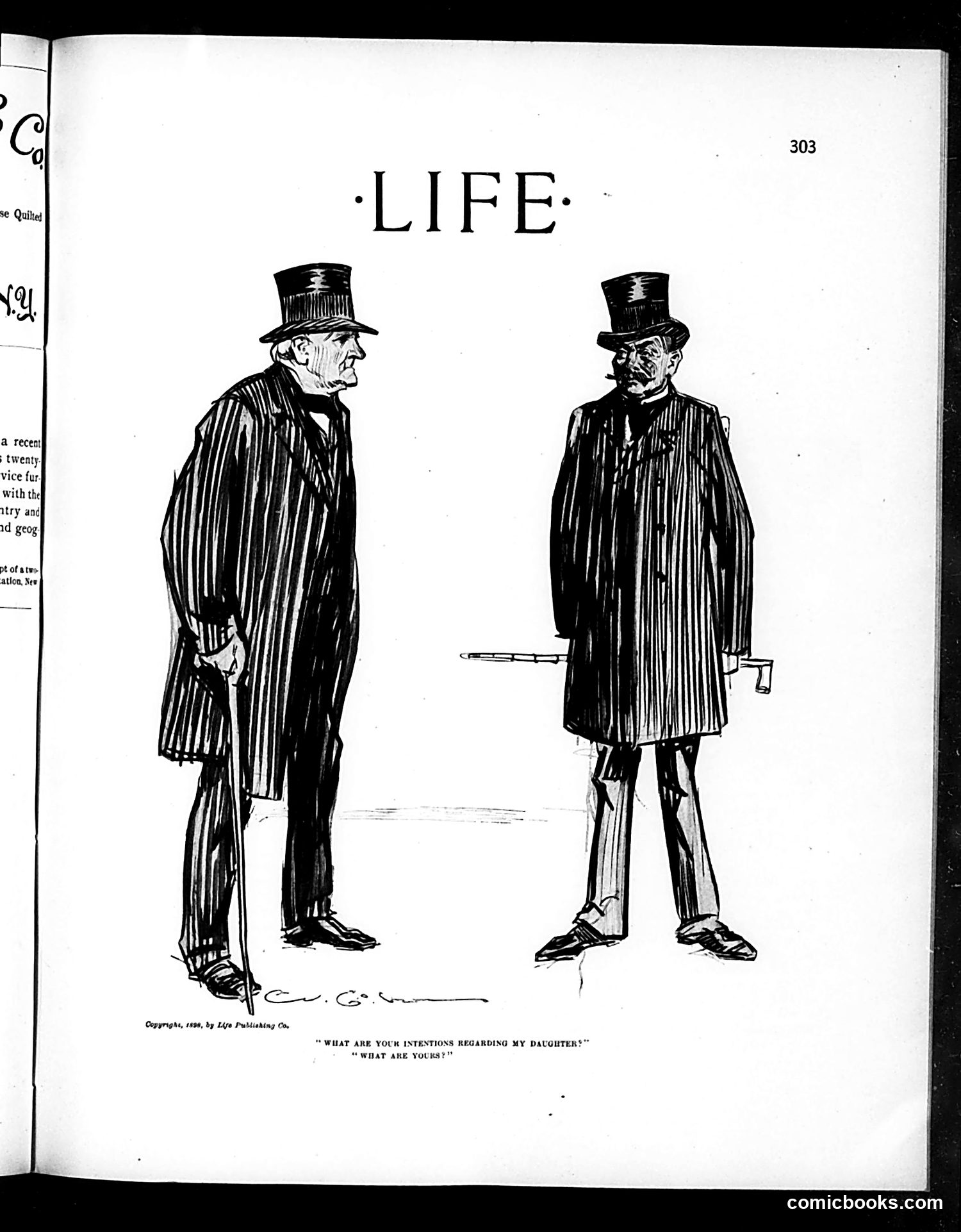
This cartoon depicts two men in formal attire and top hats engaged in what appears to be a confrontational conversation. The caption reads: "WHAT ARE YOUR INTENTIONS REGARDING MY DAUGHTER?" and "WHAT ARE YOURS?" The satire inverts the traditional gender dynamic of the era. Rather than the father interrogating a suitor about his honorable intentions toward the daughter, the suitor turns the question back on the father—implying the father himself may have questionable motives or behavior. This likely satirizes concerns about paternal authority, male conduct, or hypocrisy regarding women's treatment. The copyright notes "Life Publishing Co." and appears from the early 1900s based on style and printing. The cartoon's sharp social commentary mocks conventional propriety by exposing assumed male respectability as potentially hollow.
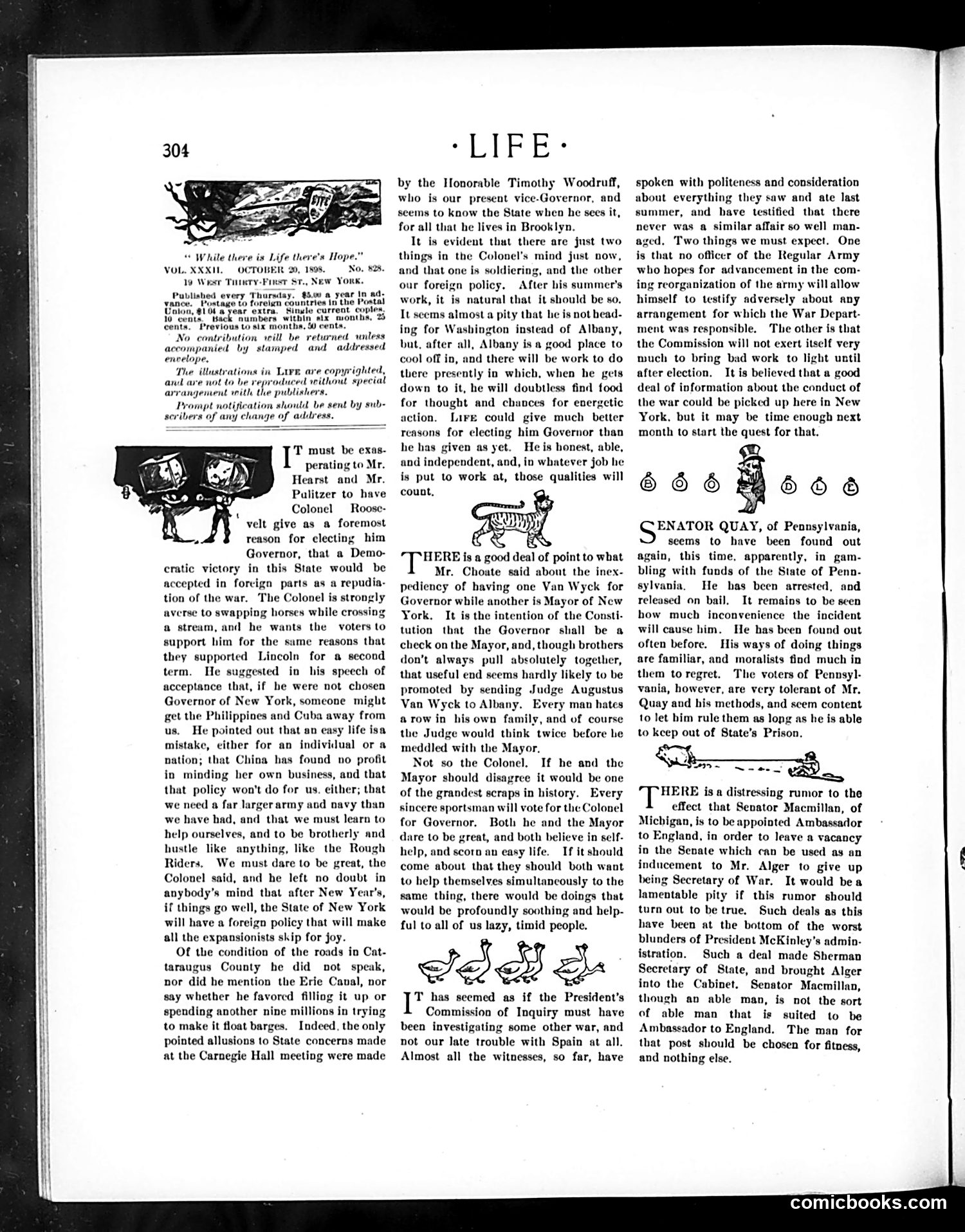
This page contains political commentary on New York State politics, likely from the 1880s. The text discusses Colonel Roosevelt as a gubernatorial candidate, praising his honesty and independence while debating his suitability for governor versus mayor positions. The small decorative illustrations appear to be generic political symbols rather than specific caricatures—including what looks like a lion or beast and geese in a line, serving as section dividers. The satire focuses on New York political rivalries: the text suggests Roosevelt could bring foreign policy expertise to the governorship, but humorously questions whether sending Judge Augustus Van Wyck to Albany as Governor (with another Van Wyck as Mayor) would create awkward family complications. The page also critiques Senator Quay of Pennsylvania regarding State Prison funds and rumors about a potential ambassadorship.
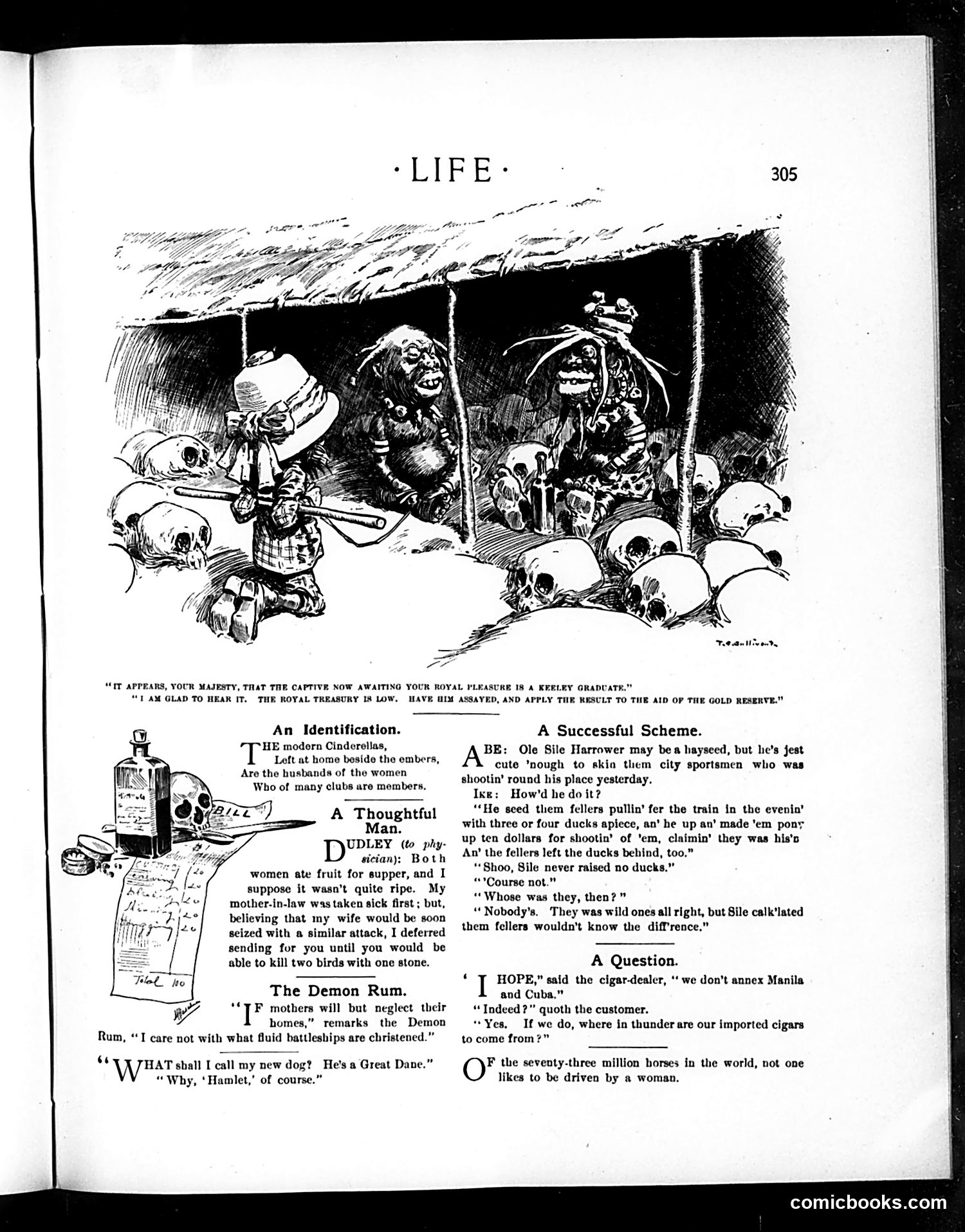
The top cartoon depicts what appears to be a political hostage scenario in a cave with skulls, referencing a contemporary captive situation involving royalty and ransom demands for "the gold reserve." Below are several brief humorous sketches: - "An Identification" jokes about club memberships among women - "A Thoughtful Man" presents a domestic anecdote about fruit poisoning - "The Demon Rum" criticizes mothers neglecting homes due to alcohol - "A Successful Scheme" describes a con artist impersonating a wealthy "city sportsman" to swindle money - "A Question" debates whether imported cigars come from Manila or Cuba These are typical Life magazine satirical humor pieces targeting early 20th-century social foibles: gender dynamics, domestic concerns, alcohol consumption, urban con artists, and consumer goods debates. The specific political reference at top remains unclear without additional context.
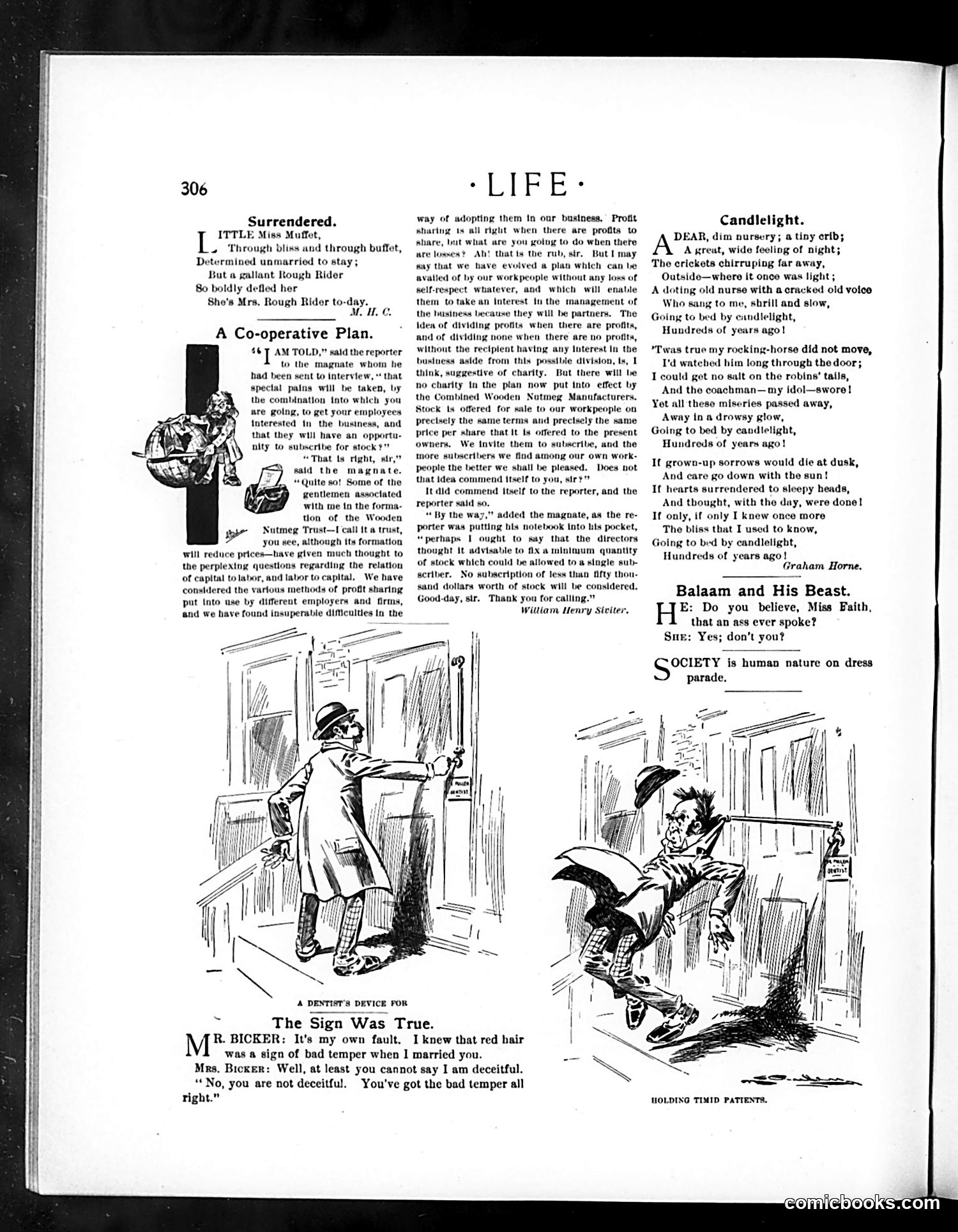
This page contains three distinct humor pieces. "A Co-operative Plan" discusses profit-sharing in business, advocating worker investment and partnership rather than charitable wage distribution. The accompanying illustration shows a businessman presenting this idea. "Candlelight" is a romantic poem by Graham Horne about courtship by candlelight. "Balaam and His Beast" and "The Sign Was True" are two cartoon vignettes with brief comedic dialogue. The first appears to be a dentist's joke about reading signs (red hair indicating bad temper). The second, "The Sign Was True," shows a married couple's domestic argument about the wife's red hair as a temperament indicator—the humor deriving from the husband acknowledging he ignored this warning sign before marriage. Both cartoons use exaggerated facial expressions typical of early 20th-century Life magazine humor.
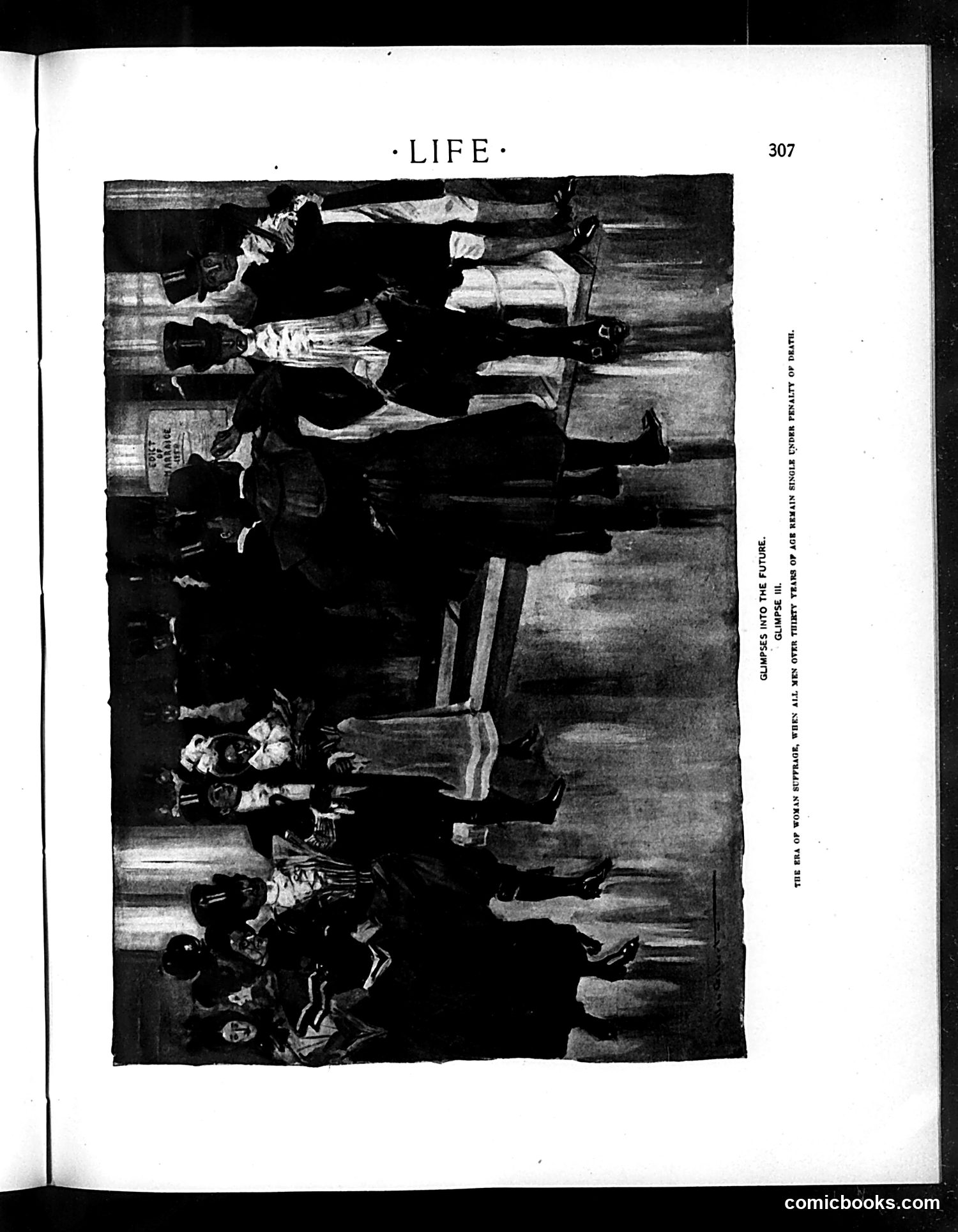
I can see this is page 307 from Life magazine, but the image quality and orientation make it difficult to read the specific caption or identify particular figures with certainty. The photograph appears to show multiple people in what looks like an indoor social setting, possibly depicting a scene meant for satirical commentary. The caption text on the right side is present but not legible enough for me to read accurately. Without being able to clearly identify the specific individuals depicted or read the accompanying text, I cannot reliably explain what political or social satire this particular cartoon or photograph is meant to convey. To provide accurate historical context, I would need a higher-resolution image or clearer text.
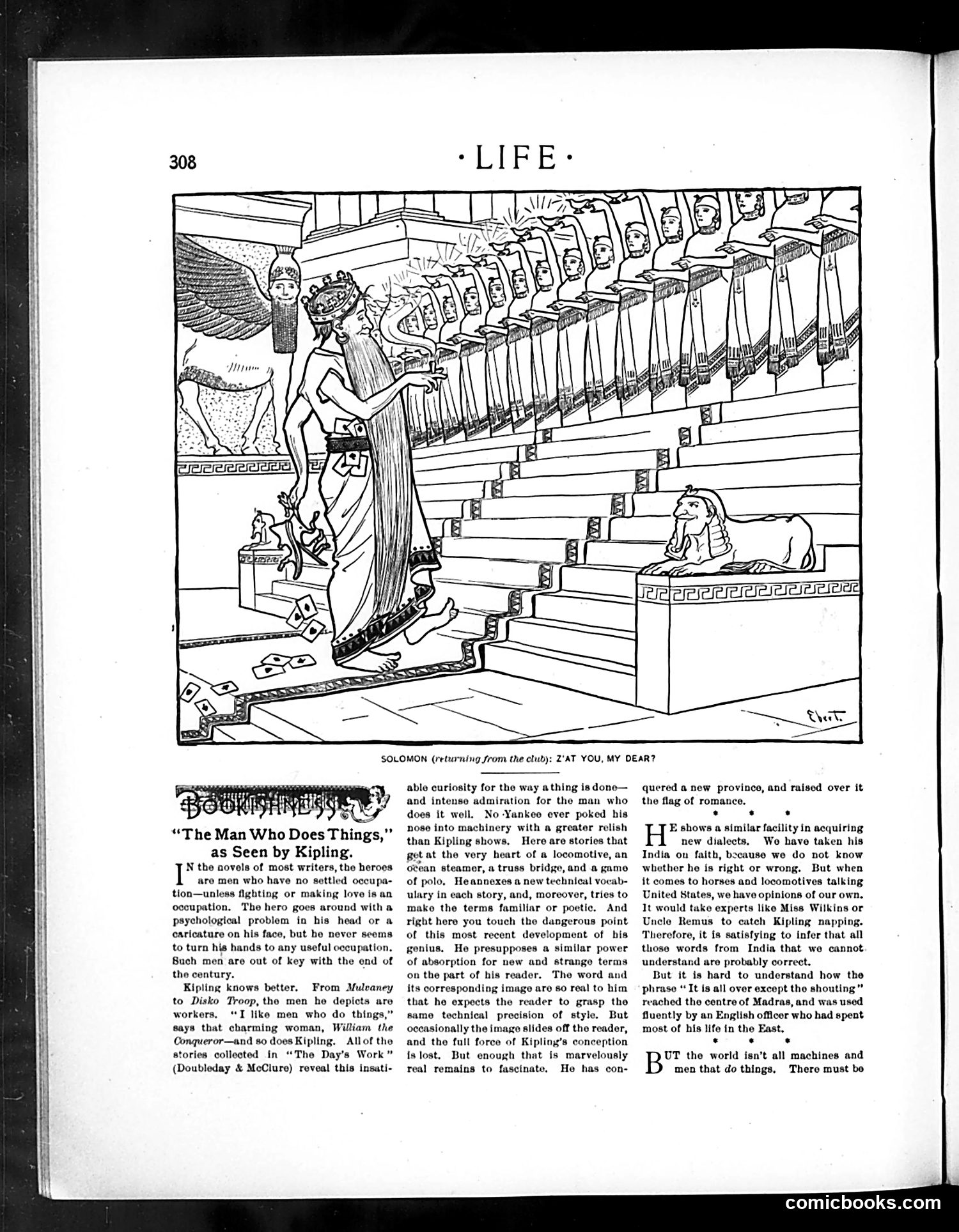
This cartoon satirizes Rudyard Kipling's literary approach to depicting mechanics and workers. The illustration shows Solomon (a biblical reference to wisdom and judgment) presiding over a grand throne room filled with identical, mass-produced figures—likely representing Kipling's characters. The accompanying article critiques how Kipling portrays working-class subjects with mechanical precision but limited individuality. The satire suggests that while Kipling demonstrates technical skill in describing industrial workers and machinery, he reduces them to interchangeable parts rather than developing them as complex human characters. The "chip" reference and Solomon's question about eating imply Kipling treats these worker-figures as disposable or consumable commodities rather than fully realized people.
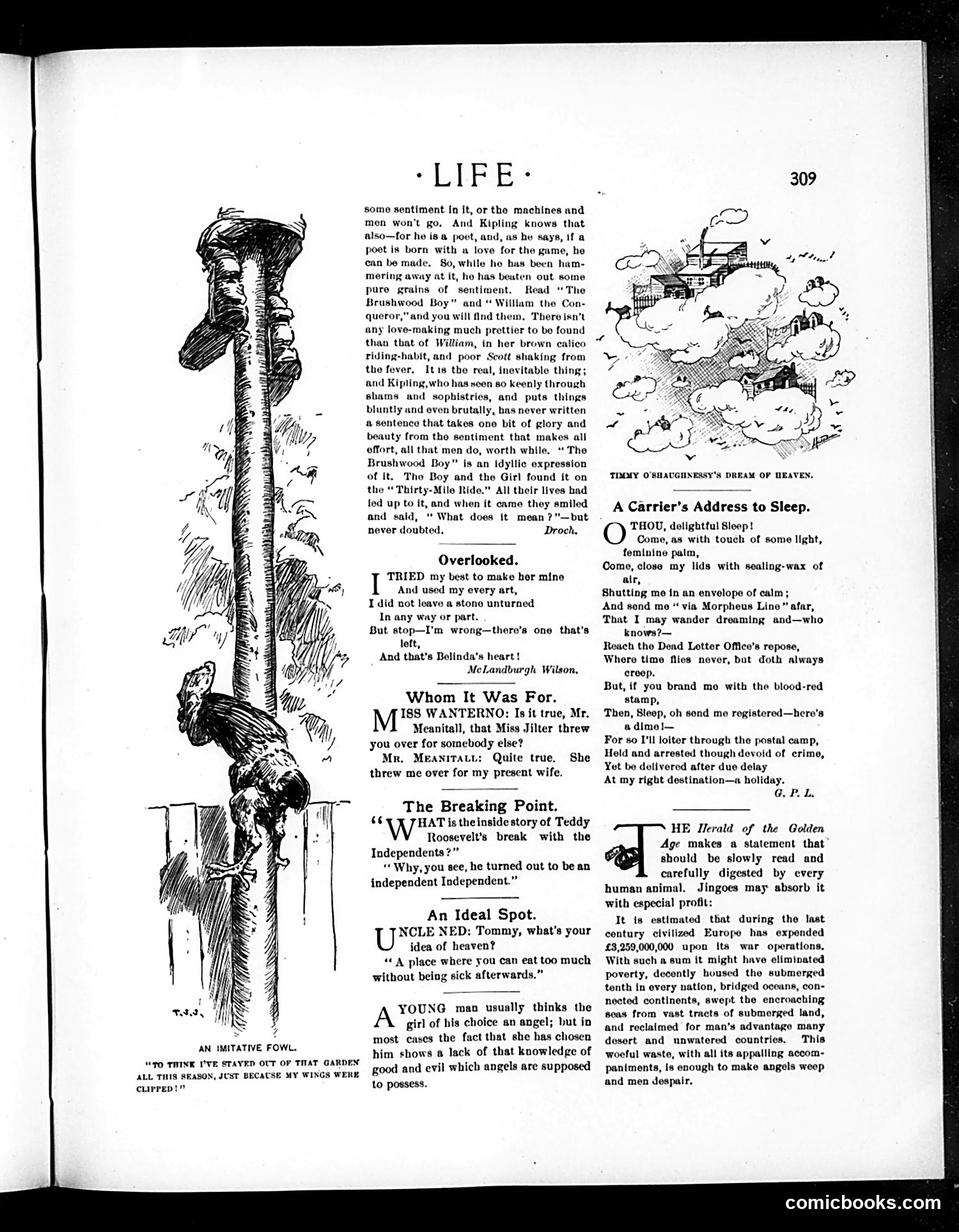
This page contains several short satirical pieces and illustrations typical of Life's humor format: **"An Imitative Fowl"** (left): A sketch showing a bird perched on a pole, with a caption about staying out of the garden "all this season, just because my wings were clipped." This appears to be gentle animal humor about constraint and mimicry. **Other pieces** include "Overlooked," "Whom It Was For," "The Breaking Point," and "An Ideal Spot"—brief comedic dialogues and observations on domestic life, romance, and social pretension. **"A Carrier's Address to Sleep"** is a poem (right) addressing sleep poetically, referencing postal delivery and whimsical concerns. The content reflects Life's characteristic early-20th-century style: light social satire, domestic humor, and sentimental verse rather than hard political commentary. The illustrations support gentle mockery of human foibles.
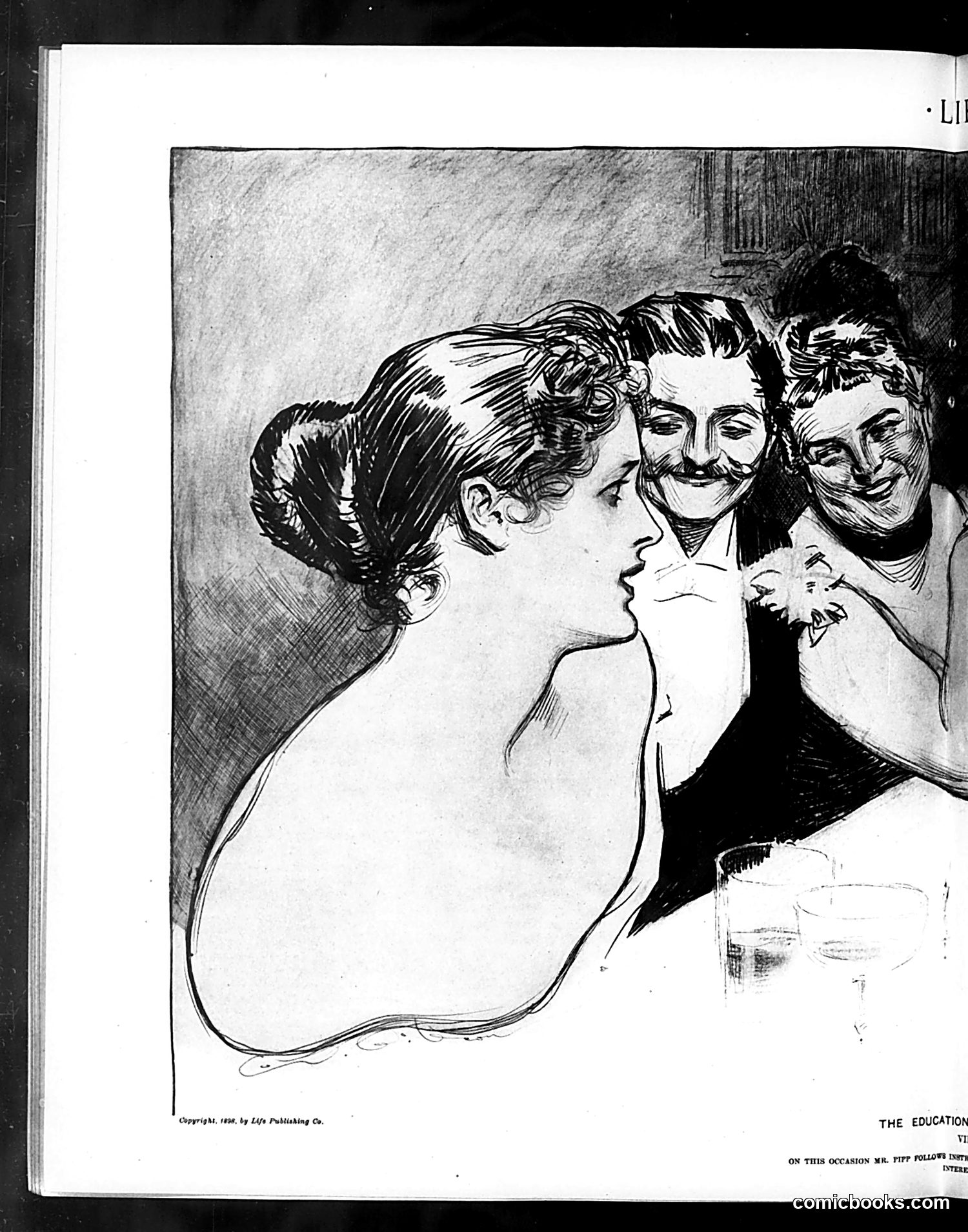
This appears to be a satirical illustration from *Life* magazine (copyright 1904, by Life Publishing Co.). The image shows a woman in profile on the left, viewed from behind, while three men on the right gaze at her with exaggerated, lustful expressions. The partially visible caption at bottom references "THE EDUCATION" and mentions "MR. FITT FOLLOWS" with text about an "OCCASION" and "INTER[EST]" — the full caption is cut off, making the specific satirical target unclear. The cartoon likely satirizes male behavior or attitudes toward women, possibly commenting on education, courtship, or social conduct of the era. The crude facial expressions suggest mockery of masculine conduct, though without the complete caption, the precise social or political reference remains uncertain.
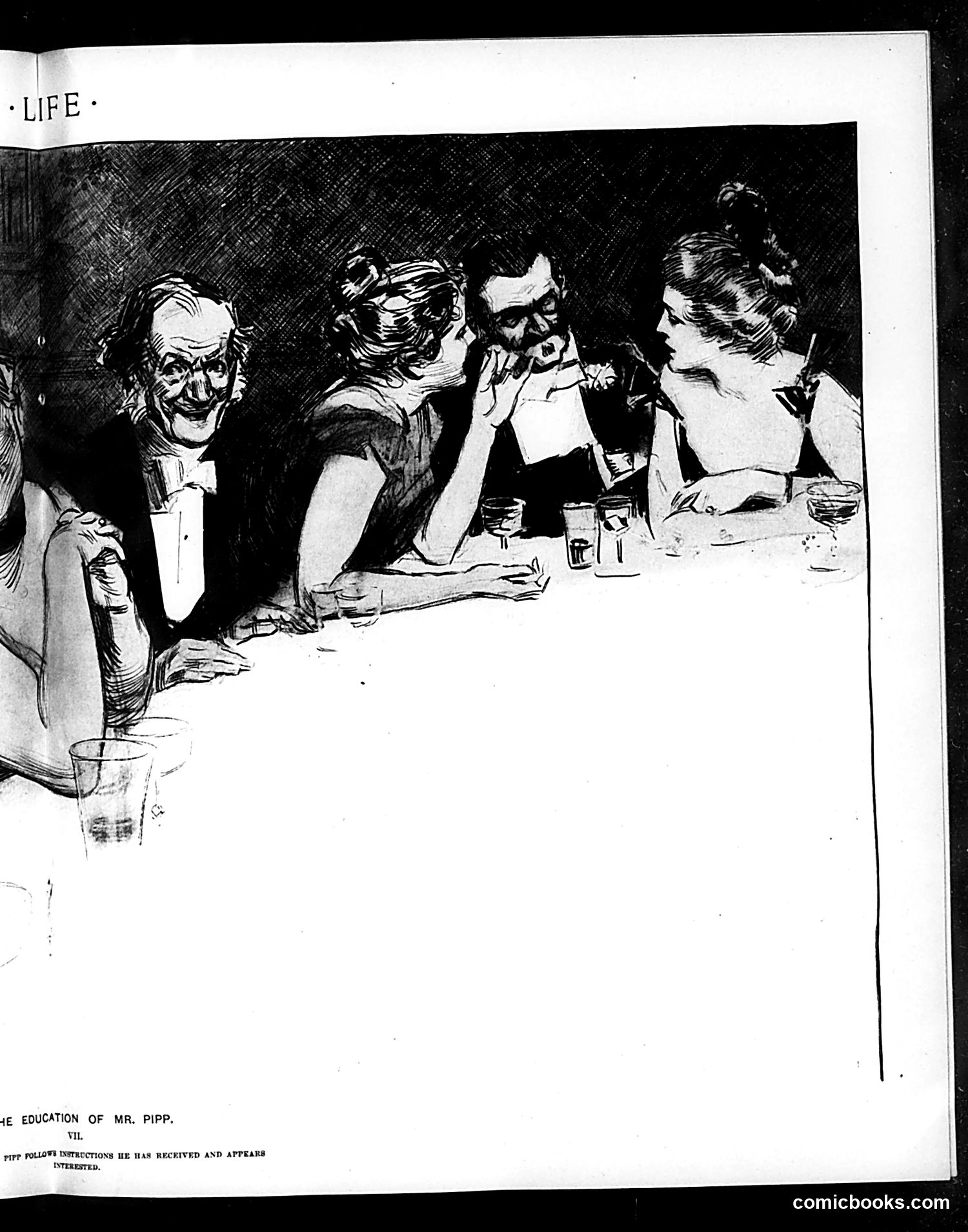
This appears to be part VII of a serialized satirical story titled "The Education of Mr. Pipp." The caption reads "Pipp follows instructions he has received and appears interested." The illustration shows four figures at what appears to be a formal dinner or social gathering. A man on the left (presumably Mr. Pipp) is shown in formal attire, interacting with three women. The artistic style and composition suggest this is social satire—likely depicting Pipp learning proper etiquette or social conduct through instruction from these women. Without additional context about the full series, the specific satire targets remain unclear, though the title suggests the piece humorously documents someone's social or cultural education through prescribed lessons or observations.
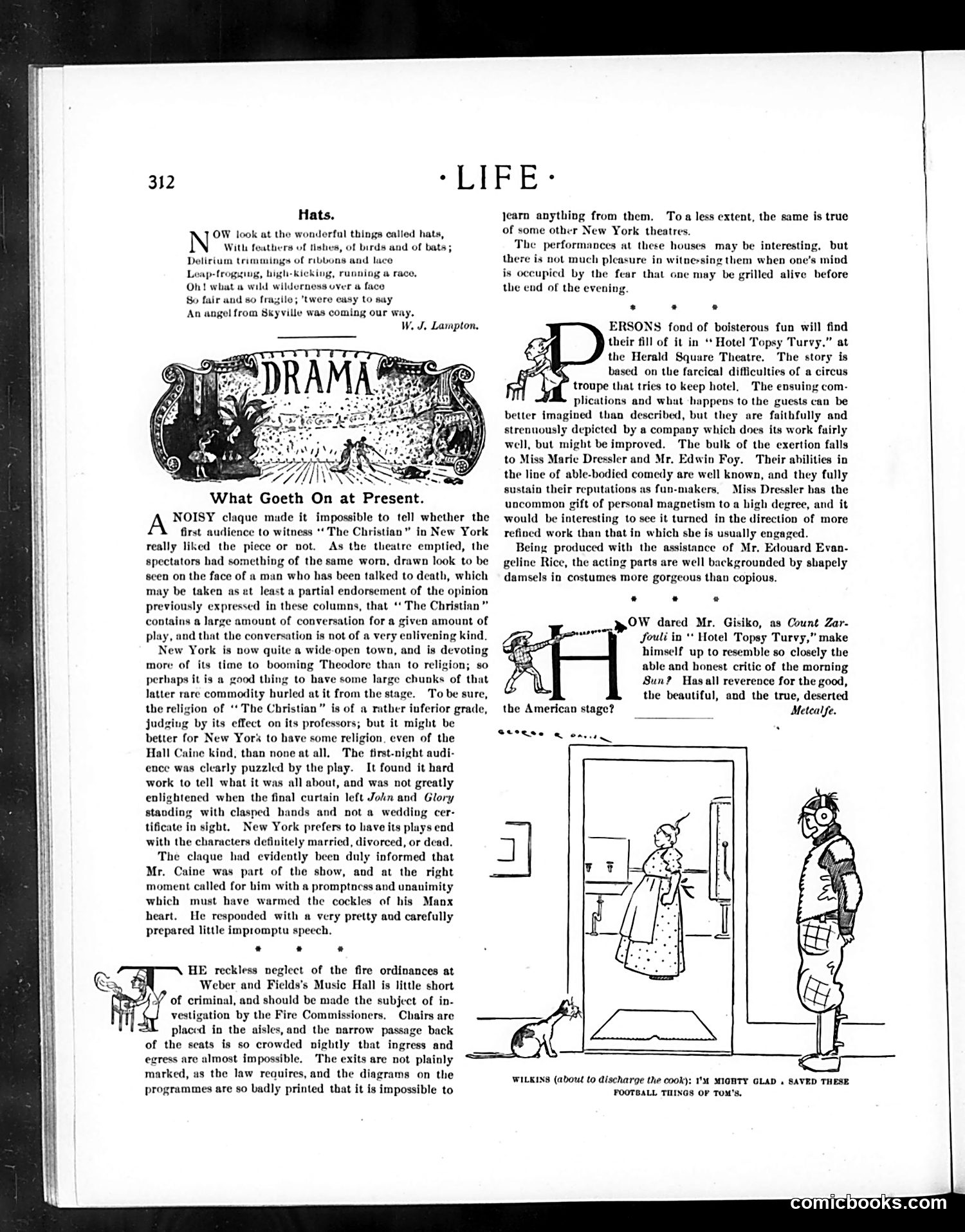
This page contains theater reviews critiquing New York productions. The "Drama" section reviews "The Christian," criticizing its religious content and confusing plot. The reviewer notes that audiences struggle to understand what the play is "about." The main cartoon at bottom depicts a domestic scene with a woman, child, and man in a doorway. The caption reads: "WILKINS (about to discharge the cook): I'M MIGHTY GLAD I SAVED THESE FOOTBALL THINGS OF TOR'S." This appears to be a humorous commentary on household management—likely suggesting that keeping the child's old football equipment unexpectedly proves useful (perhaps as collateral or leverage in some domestic negotiation with household staff). The joke relies on the irony of discarding items that later become valuable.
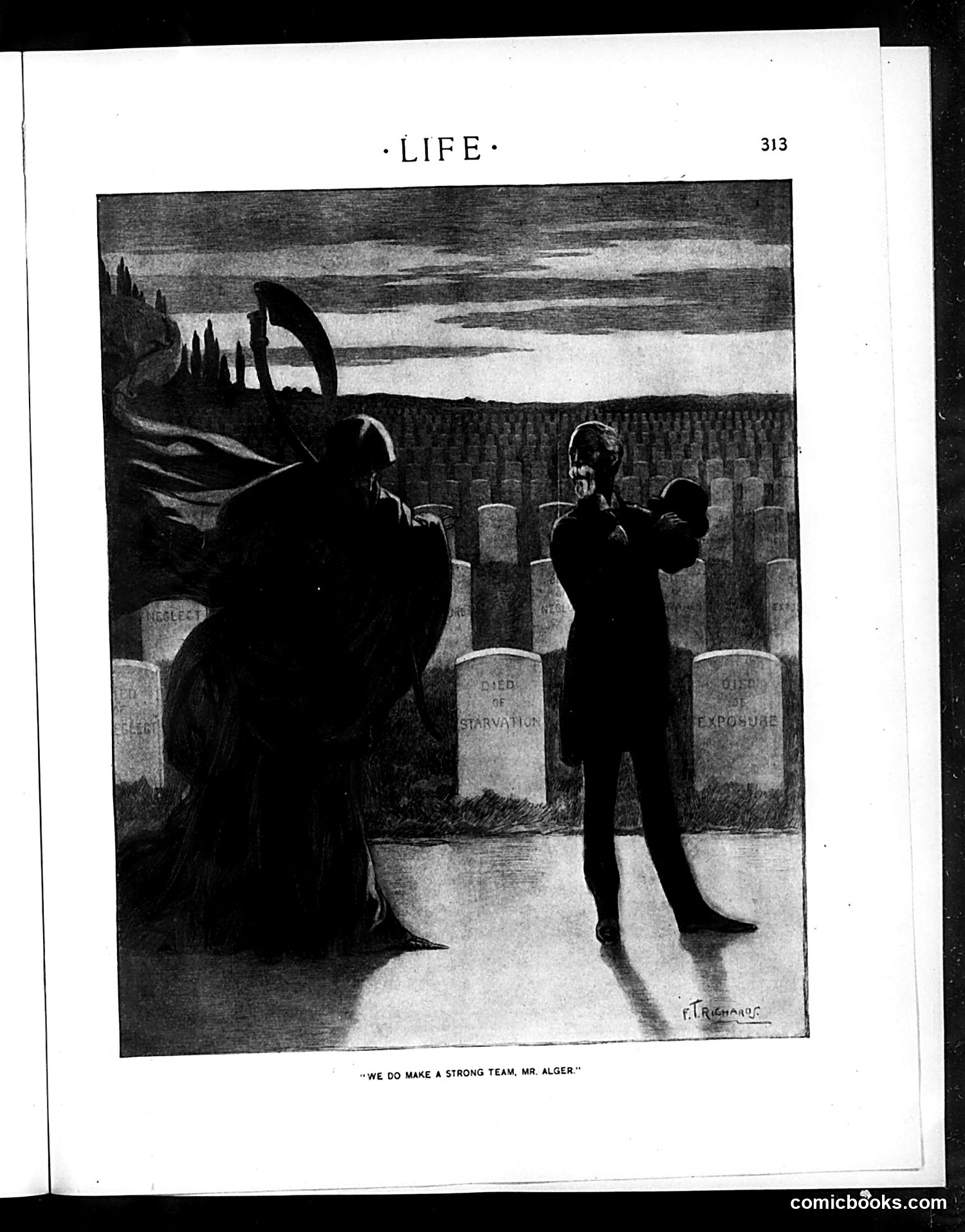
This is a satirical cartoon from *Life* magazine depicting a military cemetery scene. Two figures stand among grave markers—one appears to be Death (a skeletal or grim reaper figure on the left) and a military officer on the right. The caption reads, "We do make a strong team, Mr. Alger." The satire targets someone named Alger, likely referring to a political or military figure responsible for war policy. The joke suggests that this person's decisions create a "strong team" with Death itself—a dark criticism implying their policies result in mass casualties. The cemetery setting emphasizes the deadly consequences of their actions. Without additional context about which Alger is referenced, the precise historical target remains unclear, though the imagery critiques warmongering leadership.
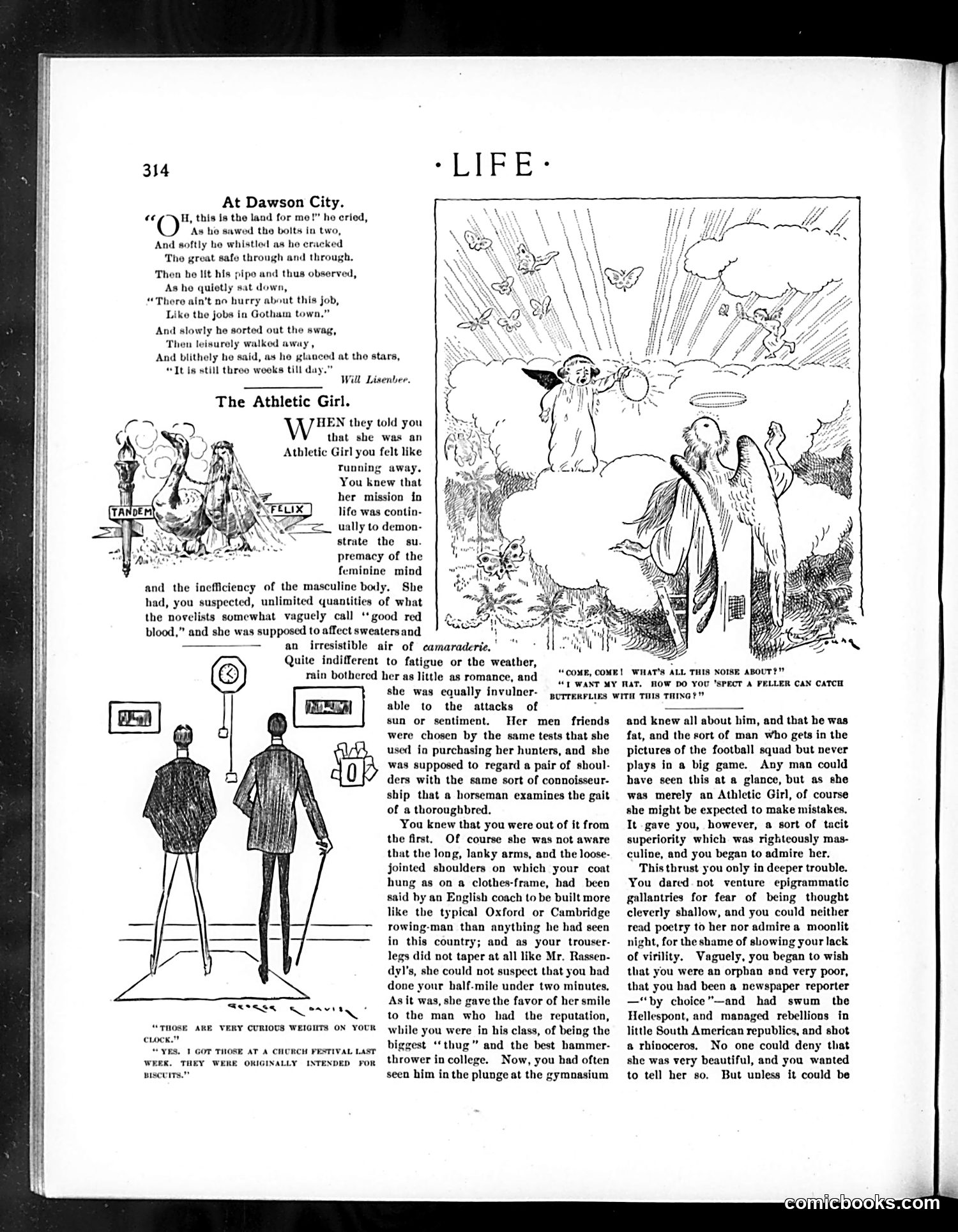
This article mocks the "New Woman" of the era—an educated, physically active female who challenged Victorian gender norms. The satire targets the anxiety she provoked in conventional men. The "Athletic Girl" is portrayed as aggressively independent: indifferent to weather, romance, or male sentiment. She judges men by physical prowess (like evaluating horses), favoring muscular "thugs" over sensitive, intellectual types. The narrator—a lanky, introspective man—feels emasculated by her standards, yet becomes infatuated. The humor lies in his desperate fantasies: he wishes he'd been a newspaper reporter, swum the Hellespont, or shot a rhinoceros—anything to seem sufficiently "virile" for her approval. This reflects genuine social anxiety about women's expanding independence and athleticism in the 1890s, presenting male insecurity as comedy while inadvertently revealing how threatening educated, physically confident women appeared to traditional masculine identity.
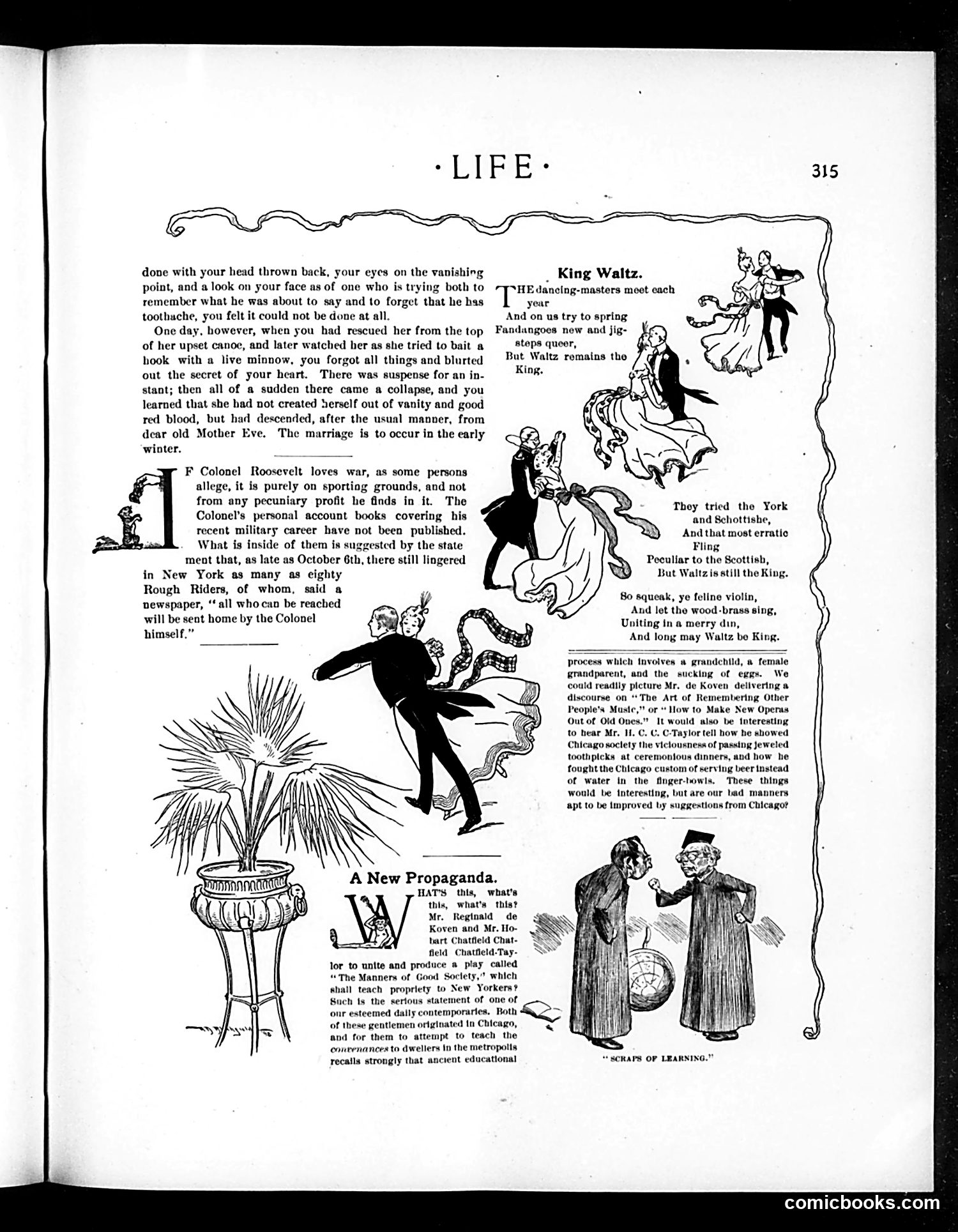
**"King Waltz"** mocks the pretensions of dance-masters and high society's obsession with proper form. The accompanying verses celebrate the waltz as superior to newer fad dances (York, Schottische, Scottish Fling), satirizing the constant pursuit of fashionable novelty among the wealthy. **The Roosevelt section** jokes about Colonel Theodore Roosevelt's claim that his recent military service was purely a "sporting" adventure, not profit-driven. The cartoon implies his Rough Riders are eager to leave New York, sardonically questioning his financial disinterest. **"A New Propaganda"** ridicules Chicago-based theater men (de Koven and Hobart Chatfield-Taylor) for proposing a play to teach New York high society proper etiquette and manners. The satire suggests that Chicago—still considered culturally inferior to New York in this era—has no authority to lecture New Yorkers on refinement. The final caption "Scraps of Learning" reinforces the mockery of their presumption.
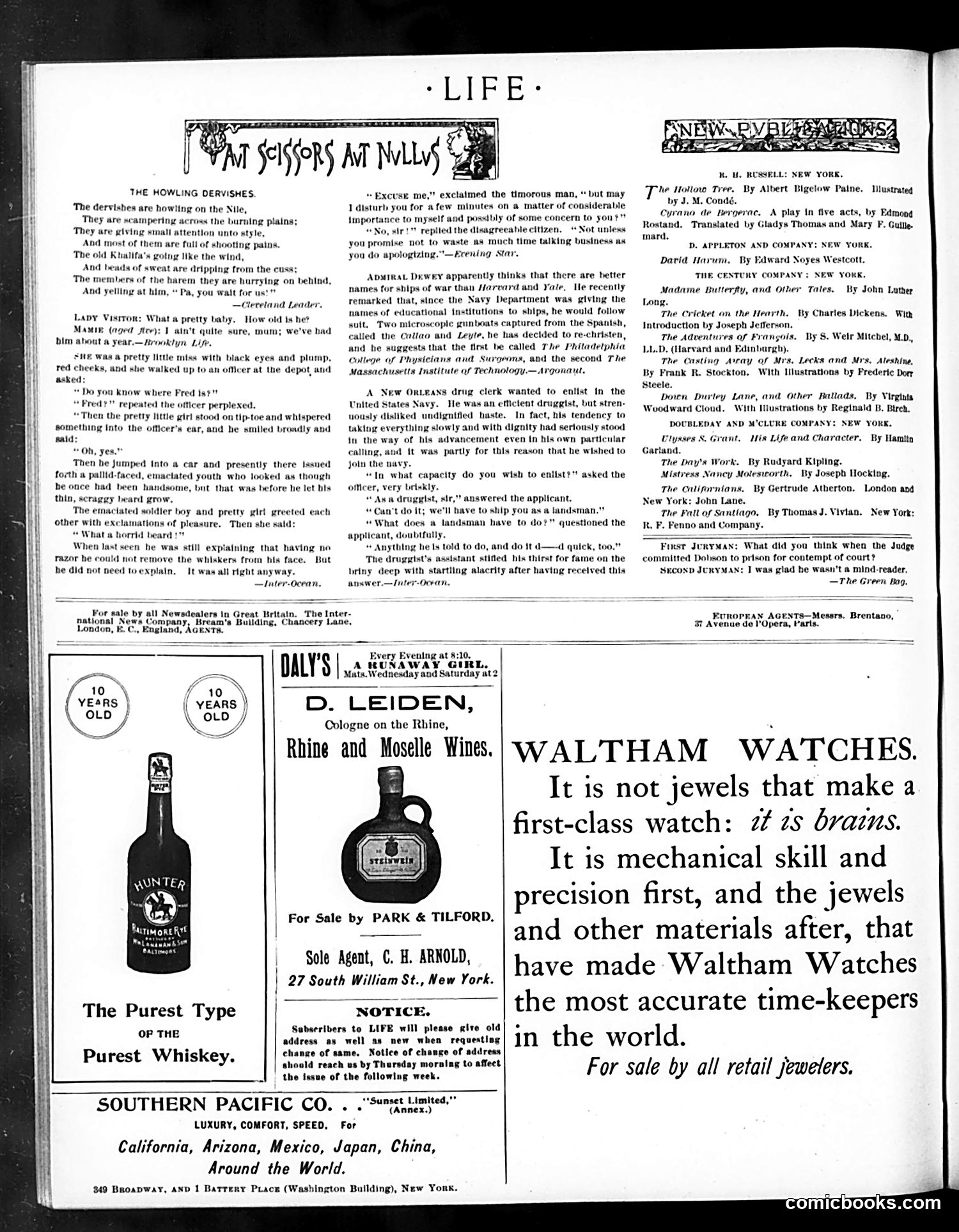
This page from *Life* contains several satirical short pieces typical of the magazine's humor: **"The Howling Dervishes"** mocks the Mahdist War in Sudan, referencing the Khalifa's forces retreating along the Nile. The humor derives from treating serious military conflict as absurd—soldiers worried about "style" and "shooting pains" rather than warfare. **Other brief comedic pieces** include: - A joke about a soldier's beard (romantic/domestic humor) - A story about a timid man repeatedly apologizing while discussing business - Satire on Admiral Dewey's plan to name naval ships after universities (suggesting ridiculous names like "Massachusetts Institute of Technology") - Humor about a dignified pharmacy clerk enlisting in the Navy The page is primarily **advertisements** (Hunter whiskey, D. Leiden wines, Waltham Watches, Southern Pacific Co.) with book reviews listed on the right side. The satire targets contemporary events—military campaigns, social pretension, bureaucratic absurdity—through short, punchy comedic scenarios rather than visual cartoons.
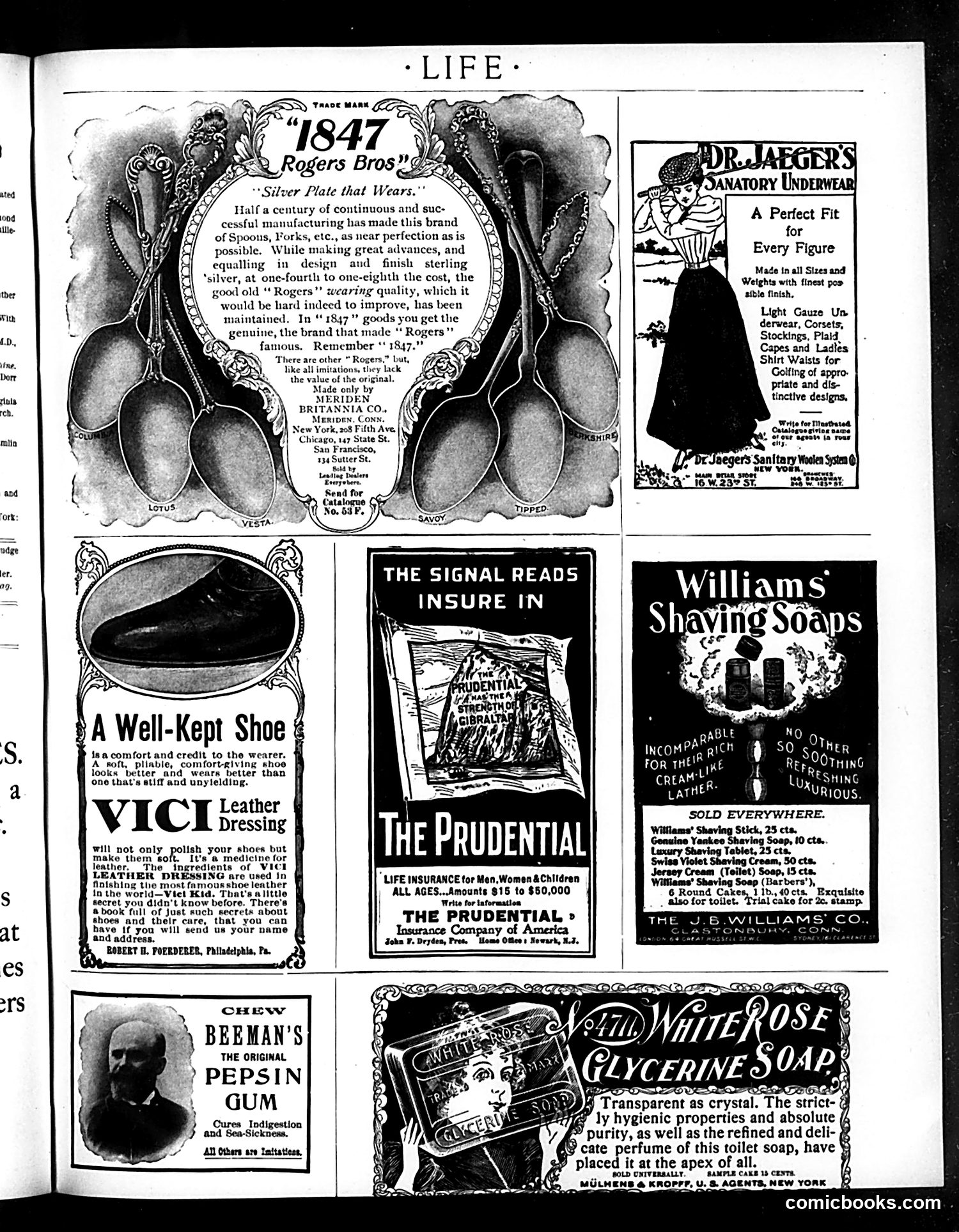
This is **primarily a advertisements page**, not a political cartoon. It contains six product advertisements typical of early 20th-century American commerce: The top features **Rogers Bros. silverware** ("1847"), emphasizing durability and quality despite lower cost than sterling silver. Below that, **Vici Leather Dressing** promotes shoe care products, while **The Prudential Insurance Company** advertises life insurance. Other ads include **Williams' Shaving Soaps** (highlighting quality and luxury), **White Rose Glycerine Soap** (emphasizing purity and hygiene), and **Beeman's Pepsin Gum** (claiming digestive benefits). Additionally, **Dr. Jaeger's Sanatory Underwear** and **The Signal** life insurance round out the offerings. **For modern readers**: These ads reflect early 1900s consumer culture—mass-produced goods marketed through brand reputation, hygiene consciousness, and aspirational lifestyle messaging. The claims (gum curing indigestion, specific soap benefits) would be considered fraudulent today.
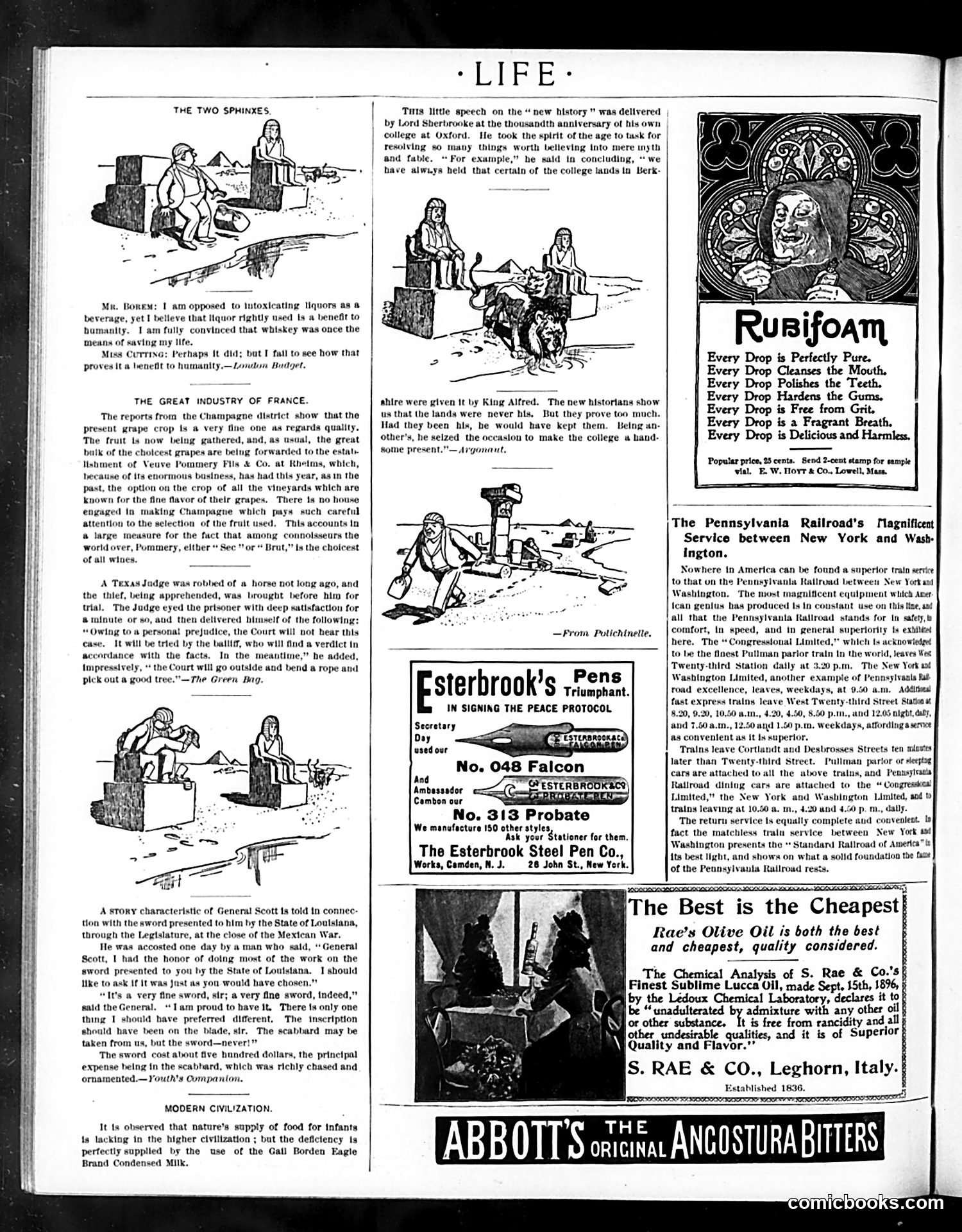
This page from *Life* magazine contains several distinct elements: **"The Two Sphinxes"** (top left): A satirical cartoon about college traditions. Lord Sherbrooke argued at Oxford's thousandth anniversary that the college should stop claiming lands it never actually owned, citing "new history." The cartoon mocks this—the figures represent the tension between preserving cherished institutional myths versus accepting historical facts that undermine them. **"The Great Industry of France"** discusses Champagne production quality, while other sections cover historical anecdotes (a Texas judge's humorous verdict on a horse thief). **The remaining content is primarily advertising**: Esterbrook pens, Rubifoam toothpaste, Pennsylvania Railroad service, olive oil, and Abbott's bitters—typical of *Life*'s revenue model blending satire with ads. The satirical point overall is gentle social commentary on institutions, tradition, and modern skepticism, wrapped around commercial pitches typical of early 20th-century magazines.
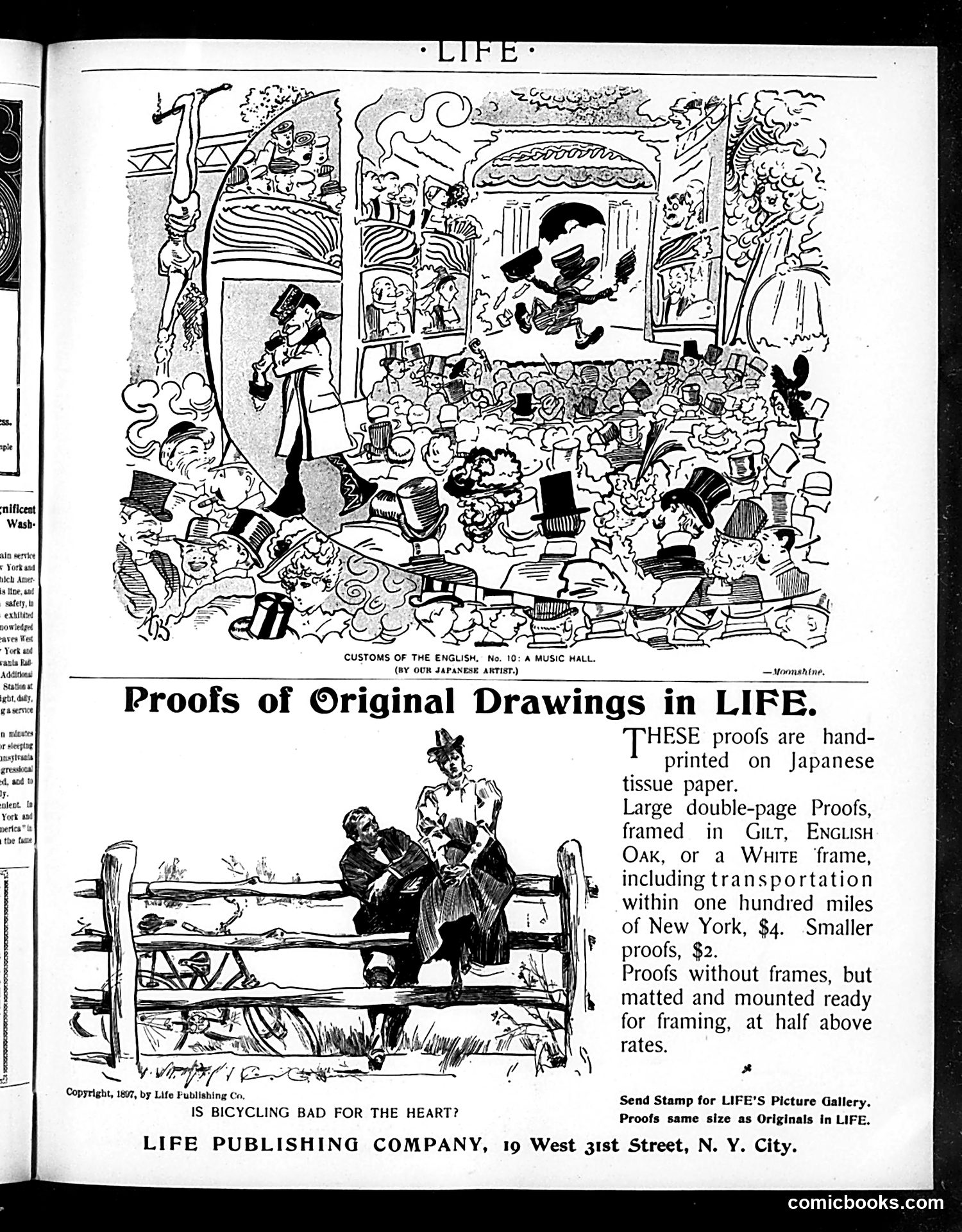
This 1897 *Life* magazine page features a satirical cartoon titled "Customs of the English, No. 10: A Music Hall," deliberately drawn by their "Japanese Artist" to create humorous cultural misunderstanding. The chaotic scene depicts a crowded English music hall with performers on stage and audiences in top hats, but rendered in an exaggerated, almost crude style—likely meant to parody how foreign artists might depict unfamiliar English customs. The humor derives from the contrast between refined English social institutions (the music hall, formal dress) and the deliberately clumsy, cartoonish artistic treatment. By attributing it to a Japanese artist, *Life* plays on late-19th-century American fascination with "exotic" foreign perspectives and the assumption that non-Western artists would find English society bewilderingly odd. The remainder is advertising for art proofs and an unrelated medical question about bicycling.
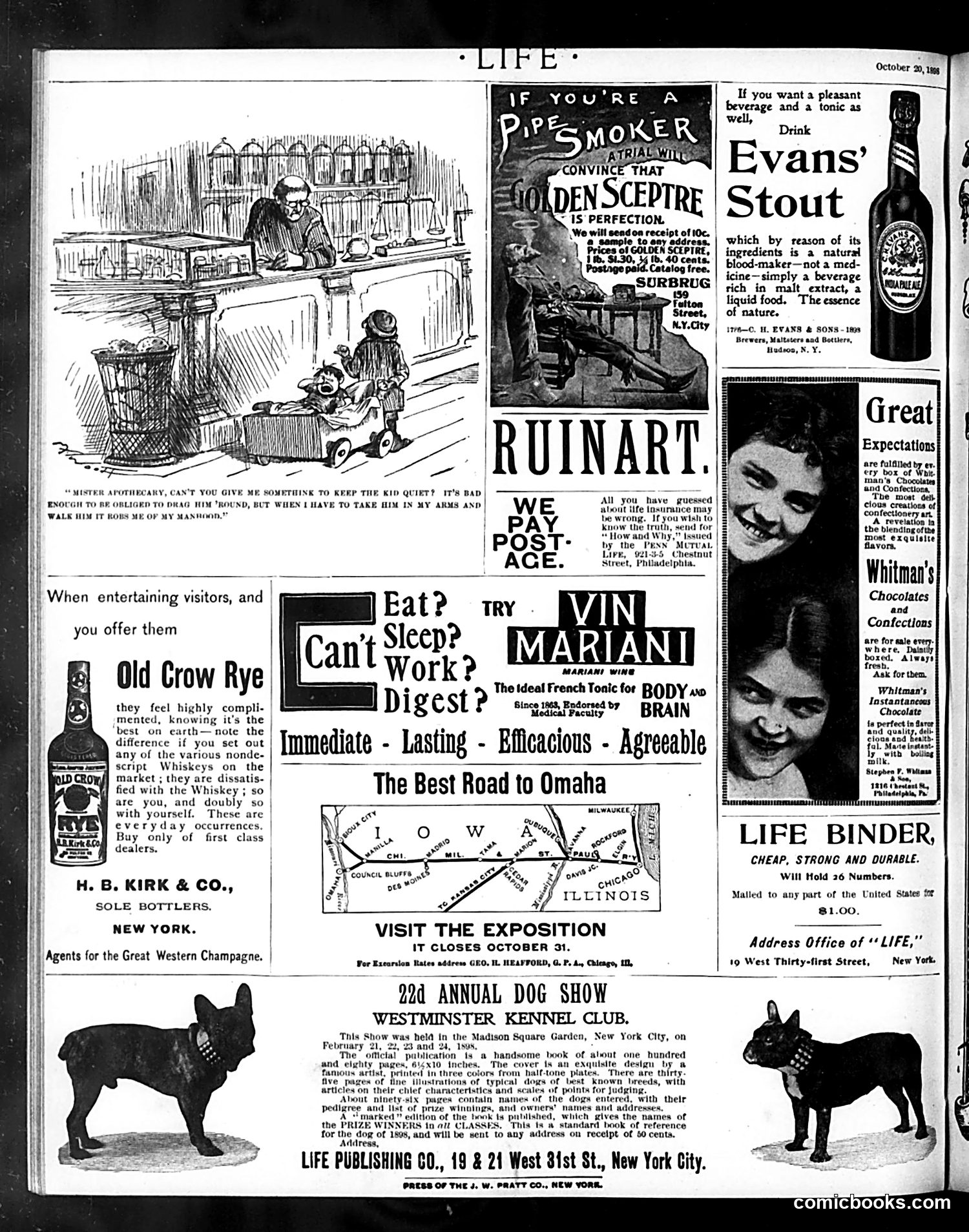
The main cartoon depicts a working-class immigrant father (identifiable by his accent in the dialogue) complaining to a pharmacist that he needs something to keep his child quiet—but when forced to carry the drugged child, it "robs him of his manhood." The satire targets both the desperation of poor parents seeking chemical sedatives for children and contemporary anxieties about masculinity and class. The implication is darkly comedic: the man prioritizes his sense of dignity over his child's welfare. The page is otherwise dominated by patent medicine and alcohol advertisements—Vin Mariani (cocaine wine), Old Crow Rye, and digestive tonics—typical of 1890s publications. These ads reveal what modern readers should recognize: such products freely marketed to the general public without regulation, often containing narcotics. Minor content includes a dog show announcement and Life's own promotional materials, making this primarily an advertising page with one satirical cartoon.