
Life, 1898-10-20 · page 8 of 20
Life — October 20, 1898 — page 8: what you’re looking at
What you’re looking at
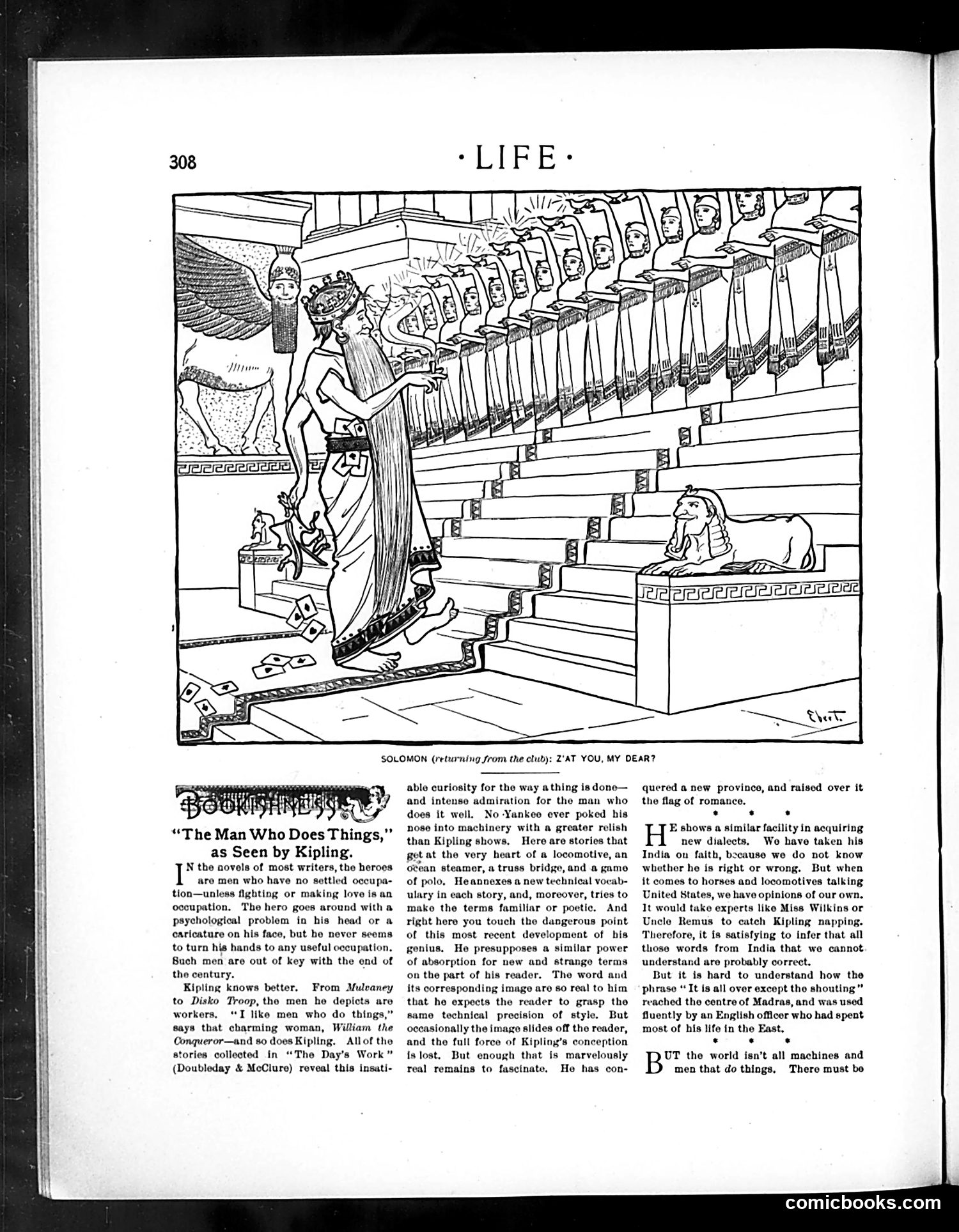
This cartoon satirizes Rudyard Kipling's literary approach to depicting mechanics and workers. The illustration shows Solomon (a biblical reference to wisdom and judgment) presiding over a grand throne room filled with identical, mass-produced figures—likely representing Kipling's characters. The accompanying article critiques how Kipling portrays working-class subjects with mechanical precision but limited individuality. The satire suggests that while Kipling demonstrates technical skill in describing industrial workers and machinery, he reduces them to interchangeable parts rather than developing them as complex human characters. The "chip" reference and Solomon's question about eating imply Kipling treats these worker-figures as disposable or consumable commodities rather than fully realized people.
📄 Transcribed text from this page (OCR, searchable)
Machine-transcribed from the original scan — historical spelling and the odd misread are preserved.
SOLOMON (returning rom the club): Z'AT YOU, MY DEAR? “The Man Who Does Things,” as Seen by Kipling. N the aovels of most writers, the heroes are men who have no settled occupa- tion—unless fighting or making love is an occupation. The hero goes around with a psychological problem in his head or a caricature on his face, but he never seems: to turn his hands to any useful occupation. Buch men are out of key with the end of the century. Kipling knows better. From Mulcaney to Disko Troop, tho men he depicts are workers, “I like men who do things,” says that charming woman, William the Conqueror—and 80 does Kipling. Allof the stories collected in “Tho Day's Work” (Doubleday & McClure) reveal this insati- able curiosity for the way athing is dono— and intense admiration for the man who does it well, No-Yankeo ever poked his nose into machinery with a greater relish than Kipling shows, Here are stories that get at the very heart of a locomotive, an ovean steamer, a truss bridge, and a gamo of polo, Heannexes anew technical vocab- ulary in each story, and, moreover, tries to make the terms familiar or poetic. And right here you touch the dangerous point of this most recent development of bis genius, He presupposes a similar power of absorption for new and strange terms on the part of his reader. The word and its corresponding image are 80 real to him that he expects the reader to grasp tho same technical precision of style. But occasionally the image slides off tho reader, and the full force of Kipling’s conception is lost, But enough that is marvelously real remains to fascinate, Hoe has con- quered a new province, and raised over it the flag of romance. . . . E shows a similar facility in acquiring new dialects. Wo have taken his India on faith, because we do not know whether he is right or wrong. But when it comes to horses and locomotives talking United States, we have opinions of our own. It would take experts like Miss Wilkins or Uncle Remus to catch Kipling napping. Therefore, it is satisfying to infer that all those words from India that we cannot understand are probably correct. But it is hard to understand how the phrase “ It is all over except the shouting” reached tho centre of Madras, and was used fluently by an English officer who had spent most of his life in the East, . . . UT the world isn’t all machines and men that do things. There must bo comicbooks.com