
A complete issue · 20 pages · 1898
Life — July 21, 1898
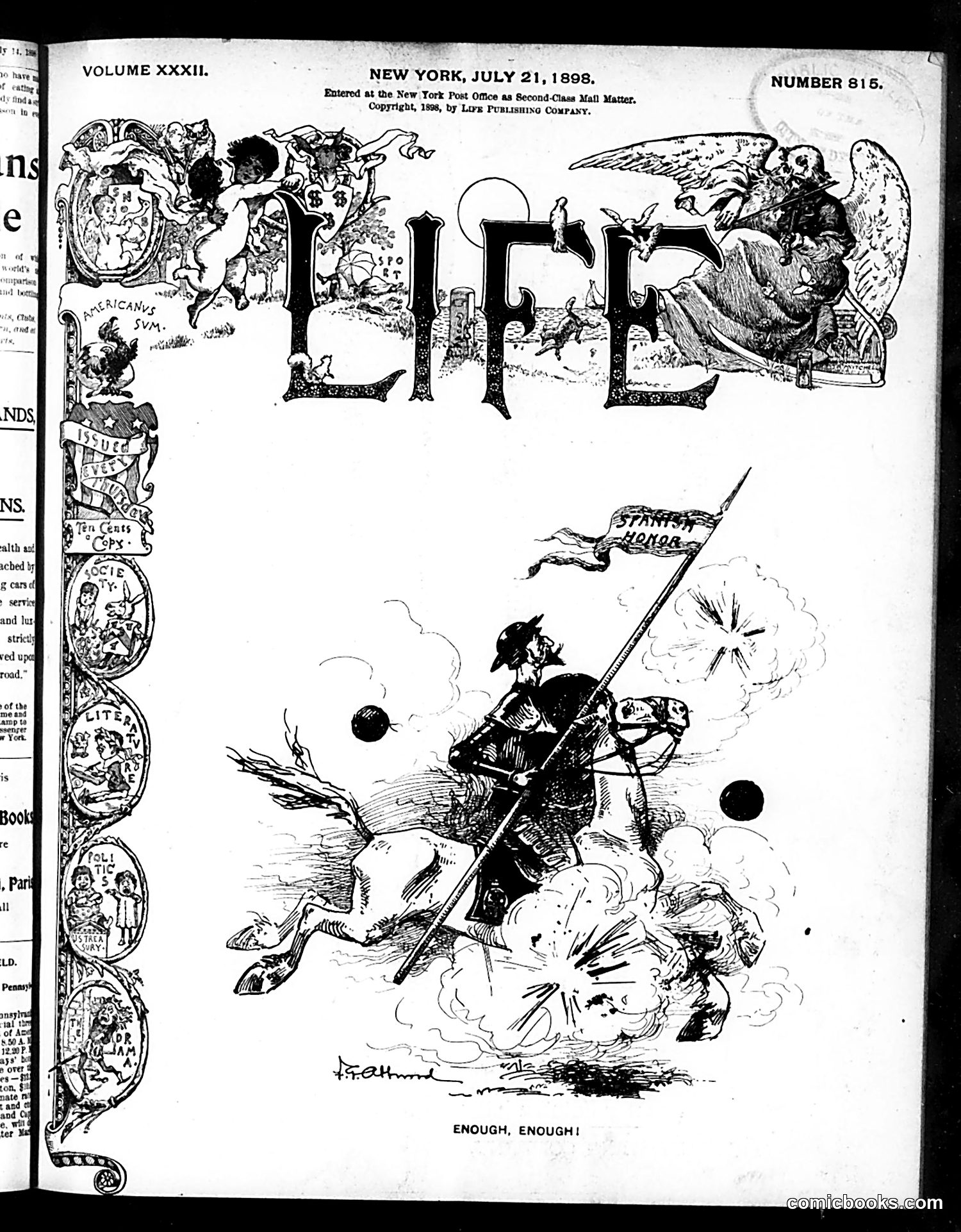
This page features a political cartoon titled "ENOUGH, ENOUGH!" depicting a figure on horseback wielding a flag labeled "STANDARD HONOR" while riding through clouds of smoke and explosions. The cartoon appears to reference the Spanish-American War (1898), which had recently concluded. The rider likely represents American military or political leadership, while the chaotic scene with smoke and cannon fire symbolizes ongoing conflict or aggression. The caption "ENOUGH, ENOUGH!" suggests the cartoonist is criticizing continued American military intervention or imperial ambitions, arguing that enough bloodshed has occurred. The "STANDARD HONOR" flag indicates the satire targets justifications for continued warfare framed as national honor or patriotic duty. This reflects contemporary debate over American expansionism and the Philippines conflict following Spain's defeat.
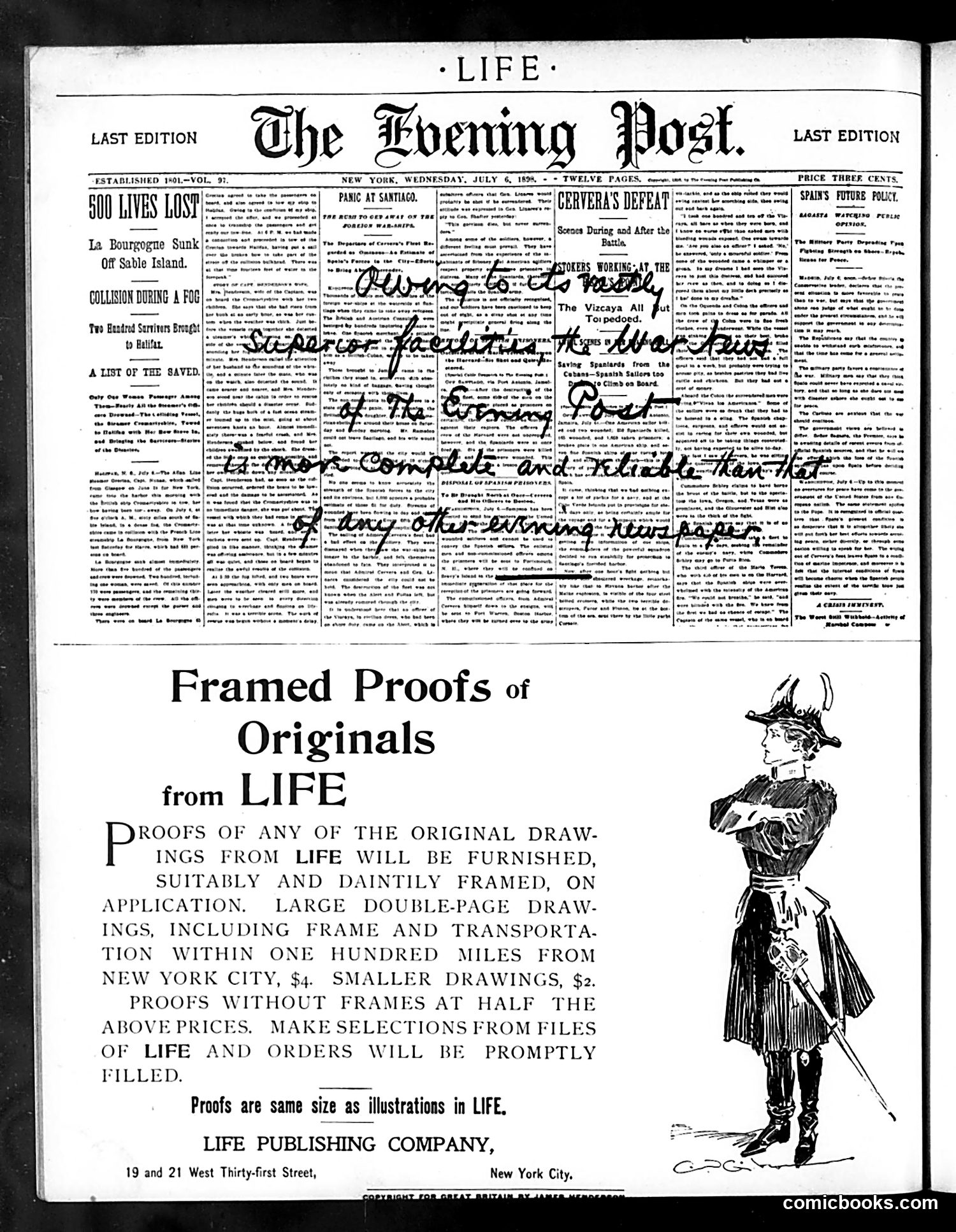
This page is primarily a newspaper front page with multiple news stories about maritime disasters and military conflicts, likely from the Spanish-American War period (references to "Spain's Future Fleet" and Cuban matters are visible). The bottom half contains an advertisement for "Framed Proofs of Originals from LIFE," offering to frame drawings from the satirical magazine for customers. The illustrated figure appears to be a fashionable woman in period dress, serving as decorative marketing material rather than political commentary. The handwritten annotations overlaid on the newspaper appear to be later editorial marks or corrections, not part of the original publication.
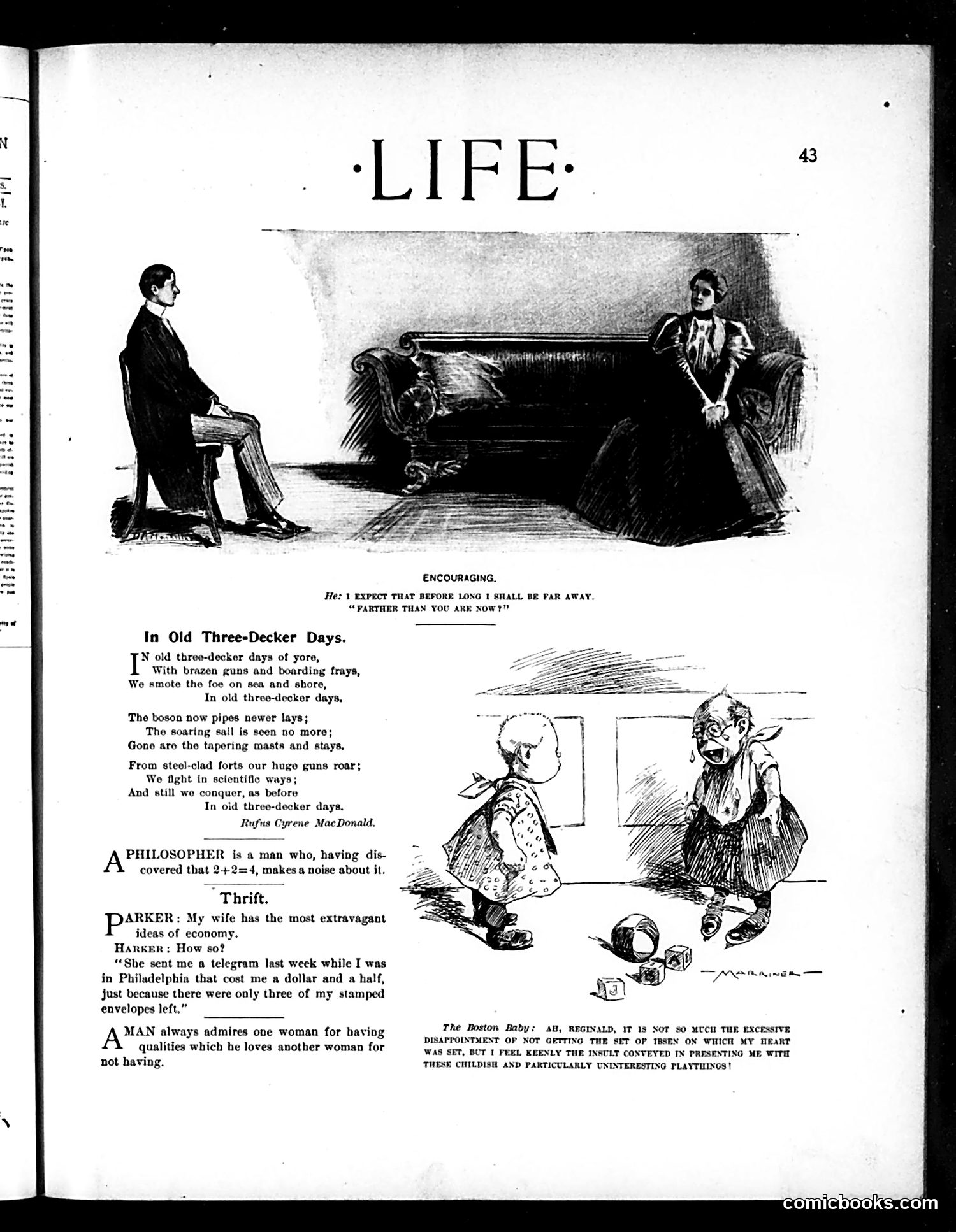
**Top Cartoon:** A man and woman sit apart on a sofa. The caption reads "ENCOURAGING" with dialogue: "He: I EXPECT THAT BEFORE LONG I SHALL BE FAR AWAY. 'FARTHER THAN YOU ARE NOW.'" This satirizes an unhappy marriage where the husband expresses his intention to leave, which the wife apparently welcomes—she's not trying to stop him. **Lower Content:** Includes a poem "In Old Three-Decker Days" by Rufus Cyrene MacDonald (likely period verse about naval warfare), a definition of a "PHILOSOPHER," and two jokes labeled "PARKER" and "DARKER" about frugal wives and male admirability. **Bottom:** A sketch of children with toys, captioned "The Boston Baby"—appears to be social commentary on parenting or child behavior, though the specific reference is unclear today.
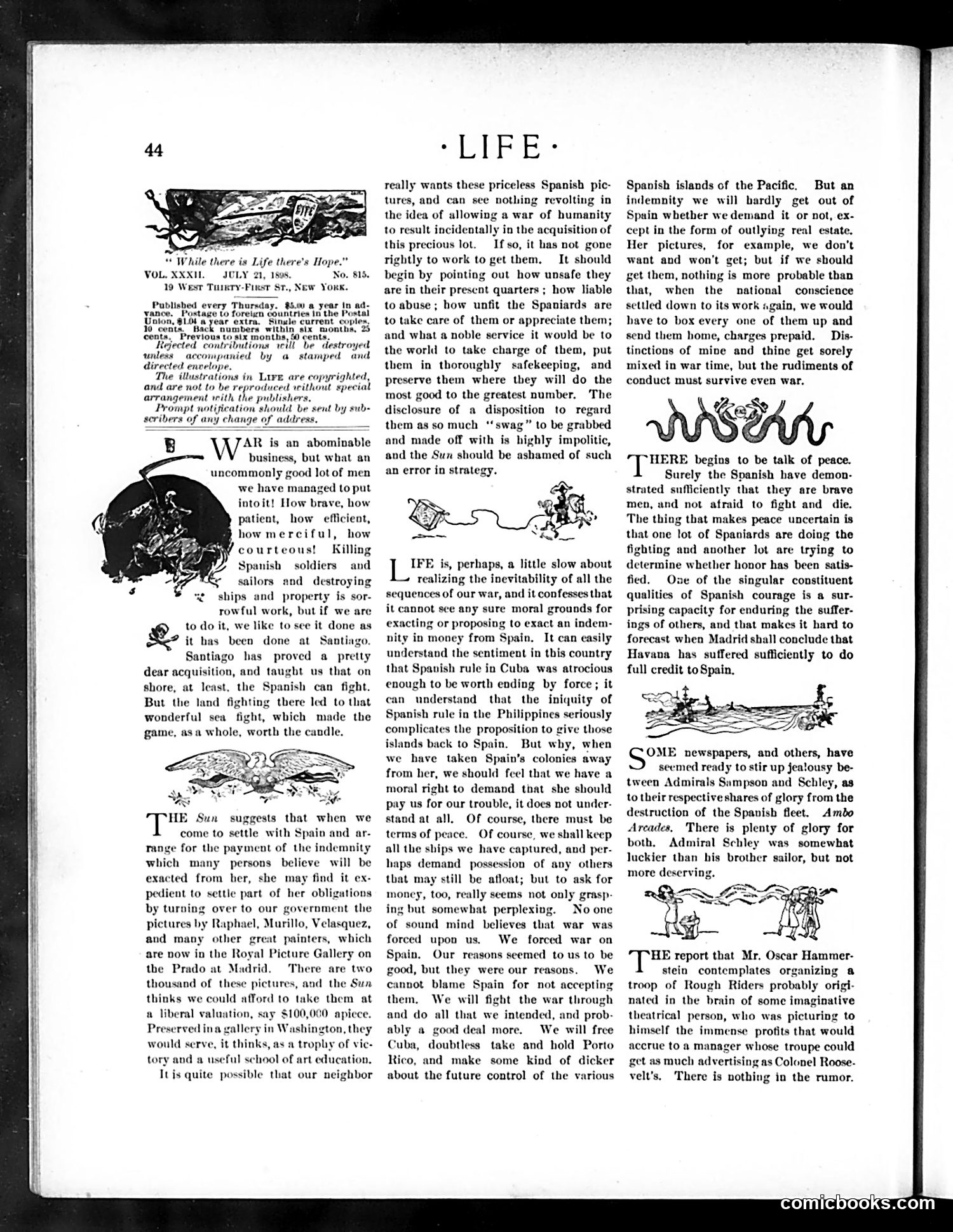
This page from *Life* magazine (July 21, 1898, Vol. XXXII, No. 815) discusses the Spanish-American War, specifically debating Spain's indemnity payments and colonial possessions. The text argues for demanding financial compensation from Spain and controlling her former colonies (Cuba, Puerto Rico, Philippines). The article defends this position against moral objections, asserting America has rightful claims after military victory. The decorative illustrations—small vignettes of ships and soldiers—reinforce the military/naval theme. The cartoons appear designed to satirize Spanish vulnerability rather than mock specific individuals, emphasizing America's superior naval power (referenced repeatedly in the text). The broader satire suggests American moral justification for imperial expansion through military conquest, a key debate of this imperialist era.
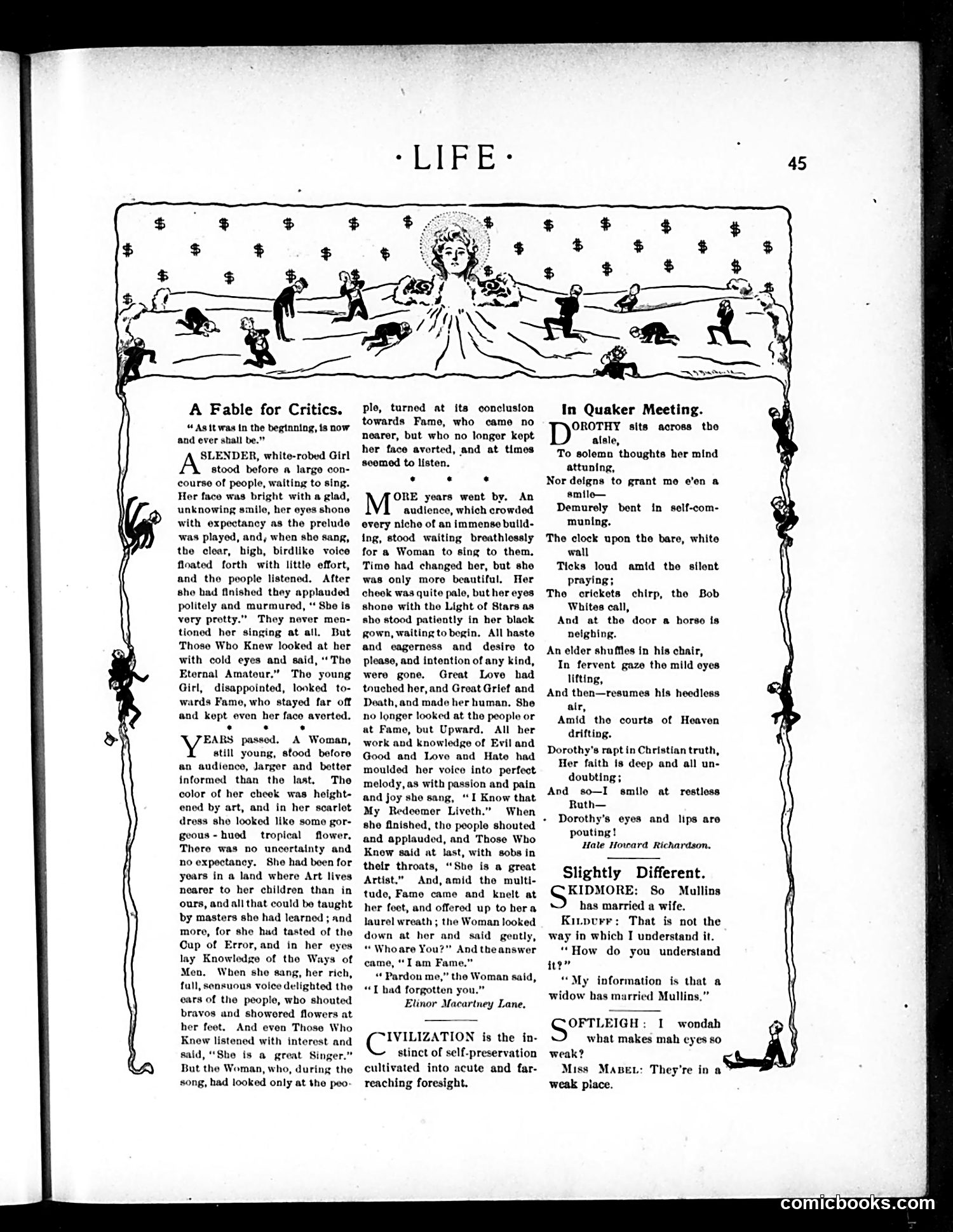
This page contains three separate satirical pieces rather than a single cartoon: 1. **"A Fable for Critics"**: A story about a talented singer (Slender, white-robed girl) who performs for critics and audiences. The narrative critiques how fame changes artists—she becomes beautiful but loses her authentic passion. The fable suggests critics and public adulation corrupt genuine artistic talent. 2. **"In Quaker Meeting"**: A short poem about Dorothy in a Quaker meeting, mocking religious solemnity with mundane details (clocks, crickets, horses). It satirizes the quiet, serious nature of Quaker worship. 3. **"Slightly Different"** and **"Softleigh"**: Brief humorous dialogues making jokes about marriage and relationships. The illustrations show figures in various poses, complementing the satirical text about society, art, and manners.
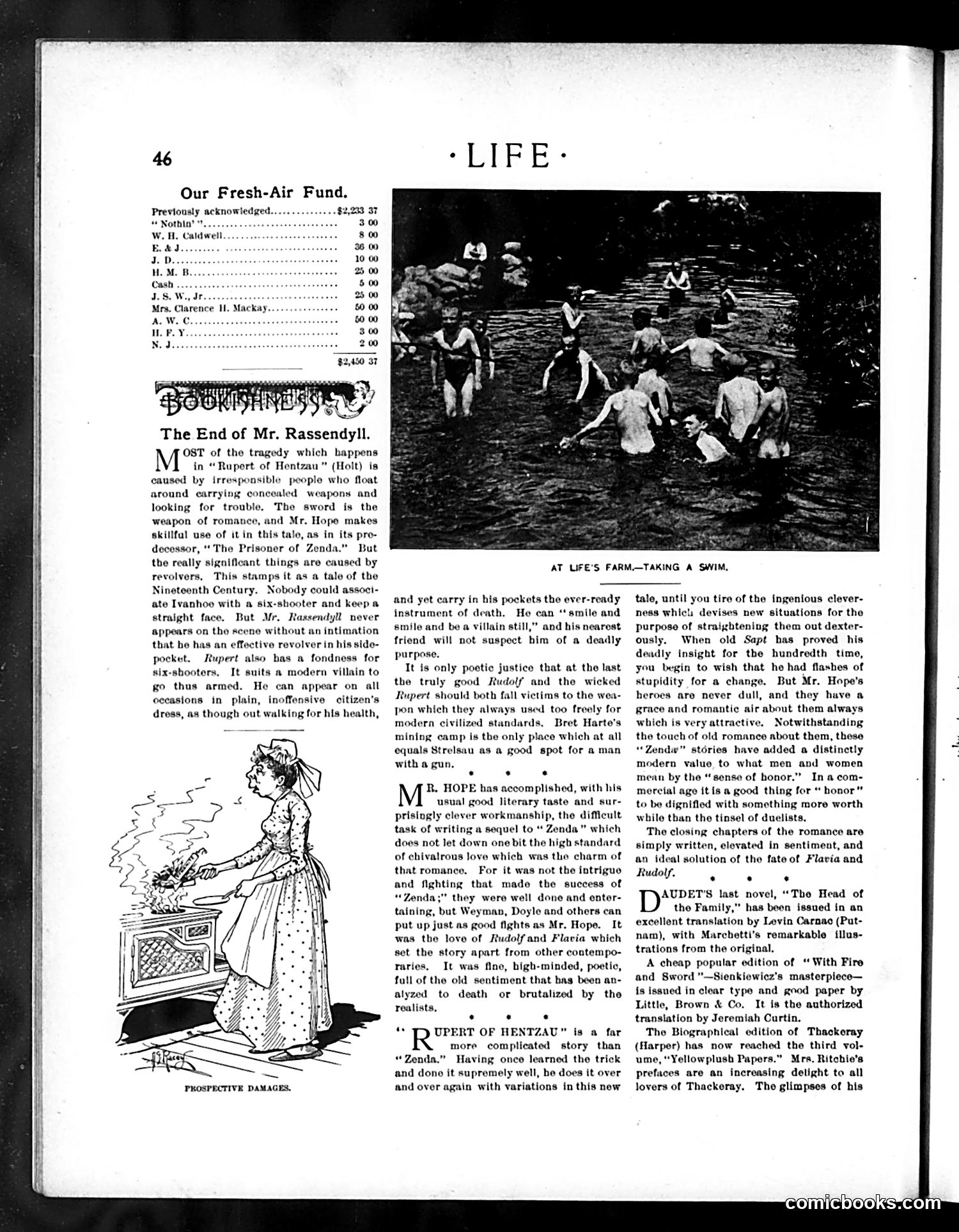
This page primarily contains **literary criticism** rather than political satire. It reviews Mr. Hope's works, particularly sequels to "Zenda" (a popular 1894 romance novel). The text praises Hope's "high standard of chivalrous love" and his skill at adventure writing. The single cartoon titled **"Prospective Damages"** appears to depict a woman in Victorian dress, though the specific satirical point is unclear from this image alone. It likely comments on romantic or marital themes consistent with the literary discussion. The page includes a photograph labeled "At Life's Farm—Taking a Swim" showing people bathing, and fundraising information for a "Fresh-Air Fund" at the top—suggesting this is a charitable appeal typical of the era's magazines.
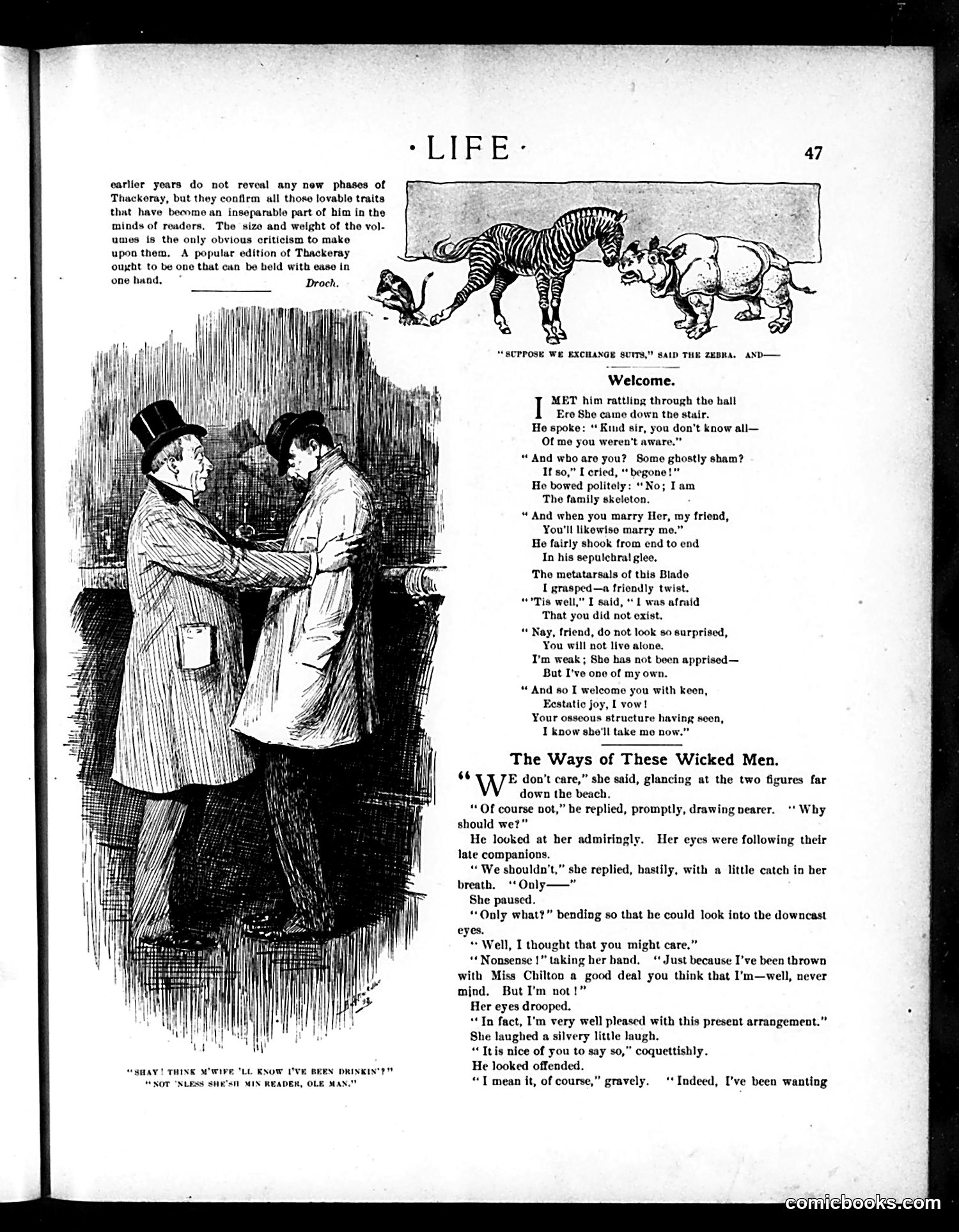
This page contains two distinct pieces of satirical content: **Upper illustration**: A zebra and rhinoceros exchange dialogue ("Suppose we exchange suits," said the zebra, "and—Welcome"). This appears to be a fable-style joke about animals swapping identities, likely satirizing social pretense or the idea that appearance doesn't change essential nature. **Lower illustration and "The Ways of These Wicked Men"**: Shows two men in Victorian dress discussing two women on a beach. The dialogue reveals the men are casually discussing romantic entanglements and using women as objects of conquest. One man claims indifference toward a woman he'd previously courted, while the other boasts about his own romantic conquests. The satire targets masculine callousness and the treatment of women as disposable romantic interests in Victorian/Edwardian society—critiquing the careless emotional cruelty of "wicked men."
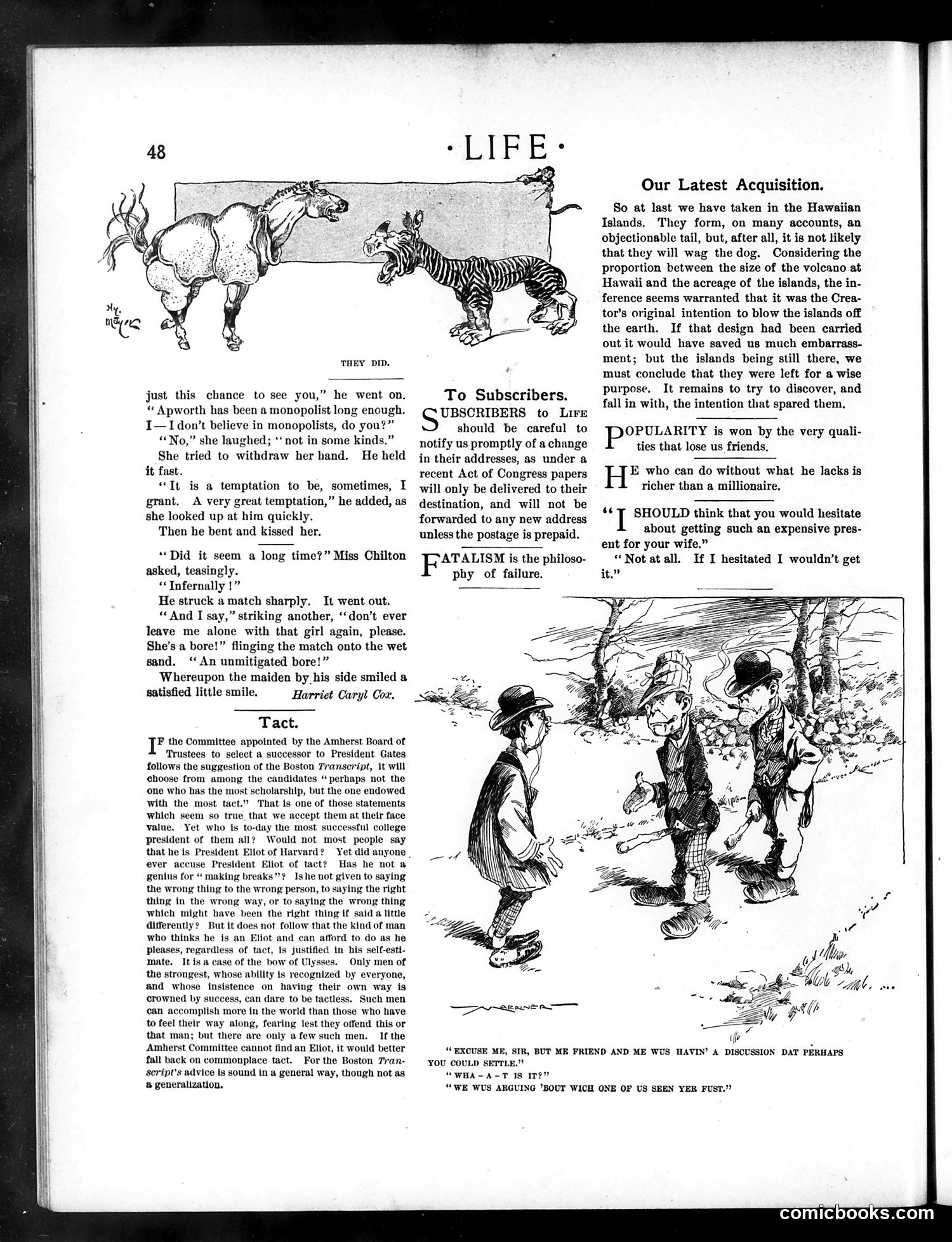
This page from *Life* magazine contains satirical commentary and a cartoon illustration rather than political caricature. The text sections—"Our Latest Acquisition," "To Subscribers," "Tact," and quoted aphorisms—are editorial commentary on contemporary social topics. "Our Latest Acquisition" jokes about acquiring the Hawaiian Islands, treating their annexation as a humorous possession. The "To Subscribers" notice addresses practical business matters about address changes and postage. The main cartoon illustration depicts three men in rural/outdoor clothing appearing to settle a dispute or argument near some trees. The caption references "a discussion dat perhaps you could settle" regarding a disagreement about "sich one of us seen yer fust"—suggesting a comedic conflict over who encountered someone first, rendered in dialect humor typical of the era. The page exemplifies *Life's* mix of topical satire, practical notices, and comedic illustration.
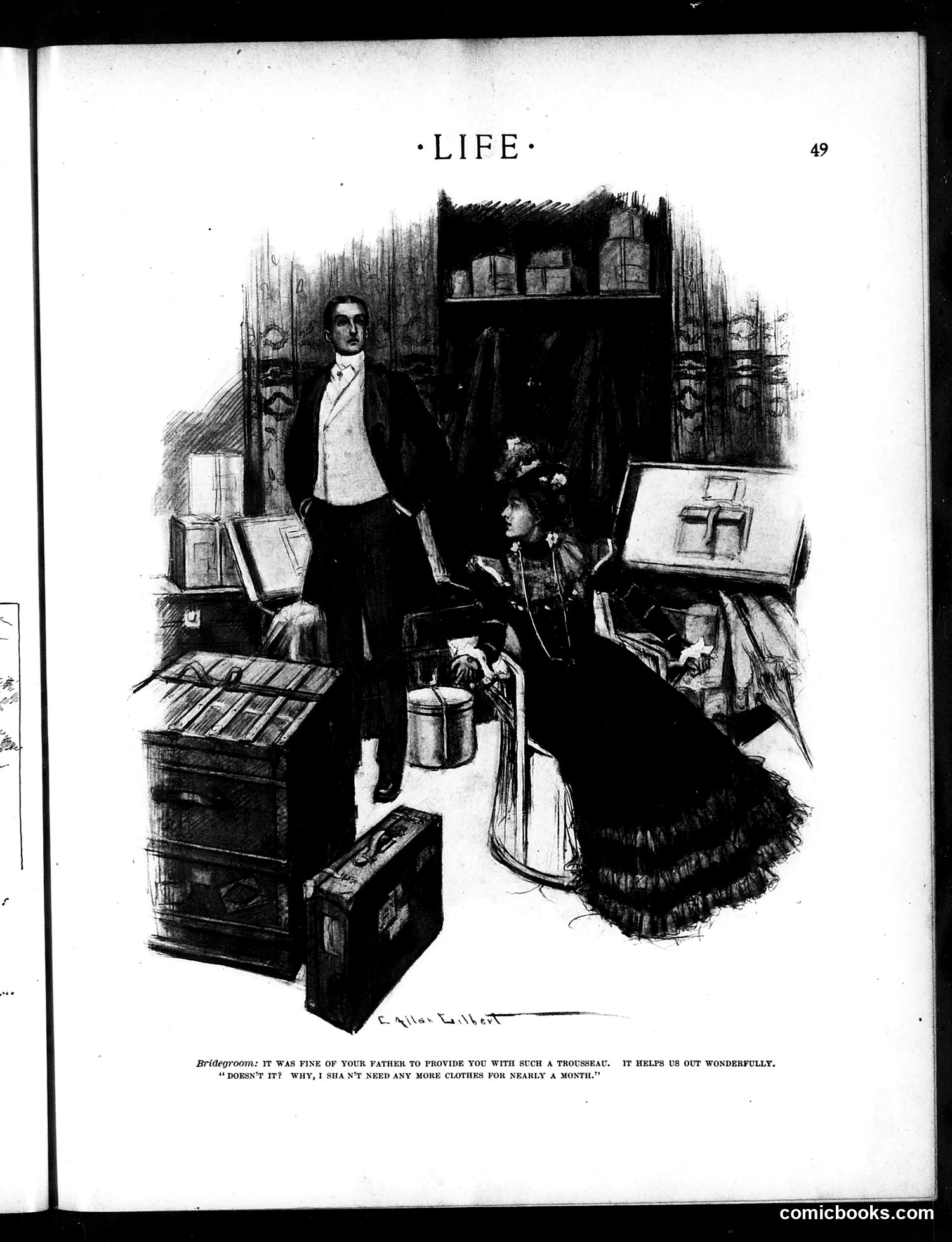
This is a satirical cartoon from *Life* magazine (page 49) depicting a bridegroom scene. The illustration shows a well-dressed man standing beside a seated woman surrounded by multiple open trunks and suitcases. The caption reads: "Bridegroom: 'IT WAS FINE OF YOUR FATHER TO PROVIDE YOU WITH SUCH A TROUSSEAU. IT HELPS US OUT WONDERFULLY. 'DOESN'T IT? WHY, I SHA'N'T NEED ANY MORE CLOTHES FOR NEARLY A MONTH.'" The satire targets the extravagant dowries and wedding trousseaus expected of brides in the late 19th/early 20th century. The joke mocks the groom's mercenary attitude—he's pleased not because of the bride's value, but because her extensive wardrobe means he won't need to buy himself new clothes for weeks. It critiques both the excessive material expectations surrounding marriage and the groom's shallow priorities.
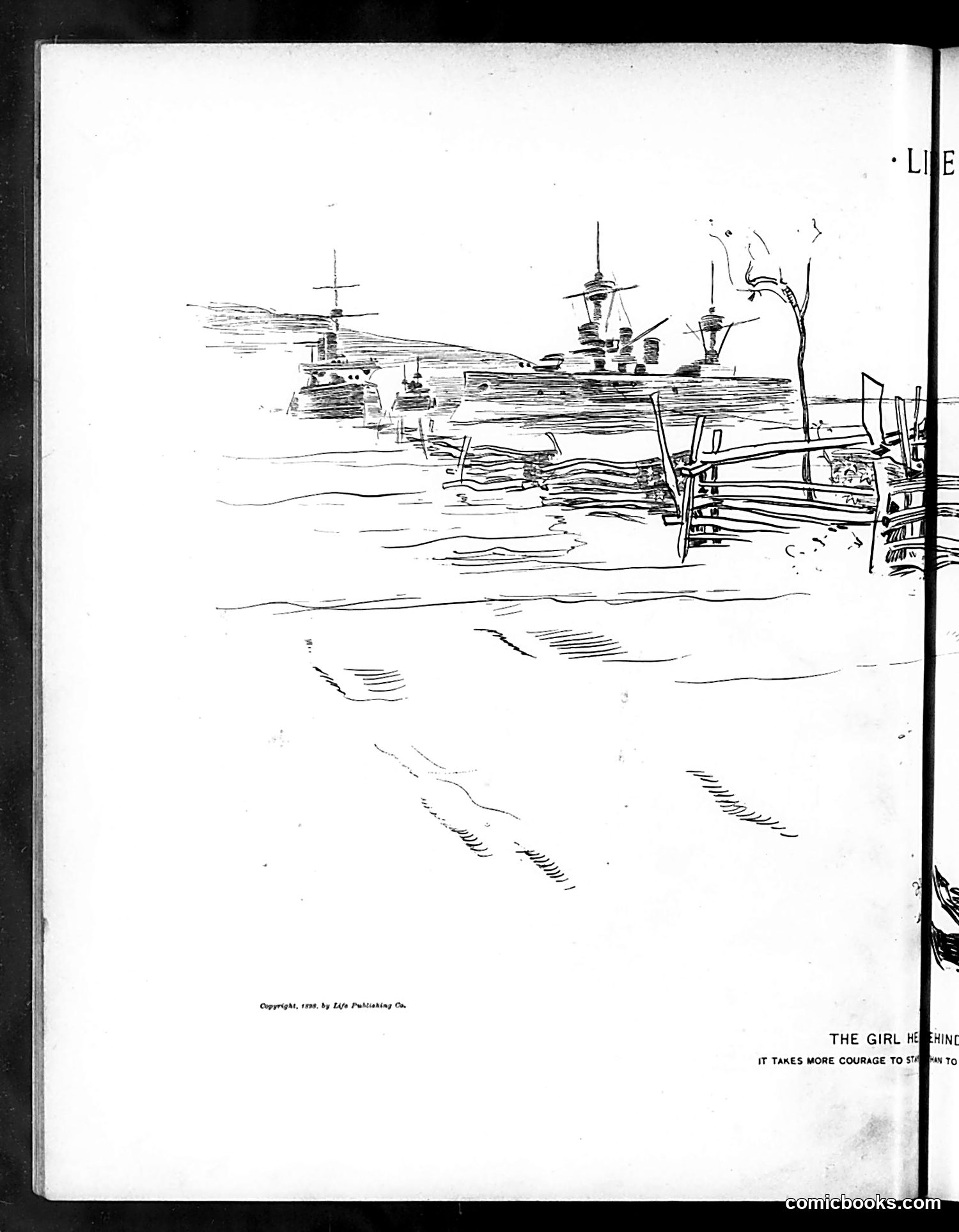
This page contains a pen-and-ink sketch depicting several warships anchored in water, viewed from shore. On the right, there's a wooden fence or paling in the foreground, and a bare tree branch. The visible text at bottom reads "THE GIRL HE CHING" and "IT TAKES MORE COURAGE TO ST[AY] TO" (text cut off), suggesting this illustration accompanies a story or article about romantic courage or commitment. However, **I cannot definitively identify the specific political or satirical commentary** without seeing the complete article text or knowing the publication date. The naval imagery could reference military preparedness, international relations, or naval power, but the connection to the incomplete caption about a girl and courage remains unclear. More context would be needed for accurate interpretation.
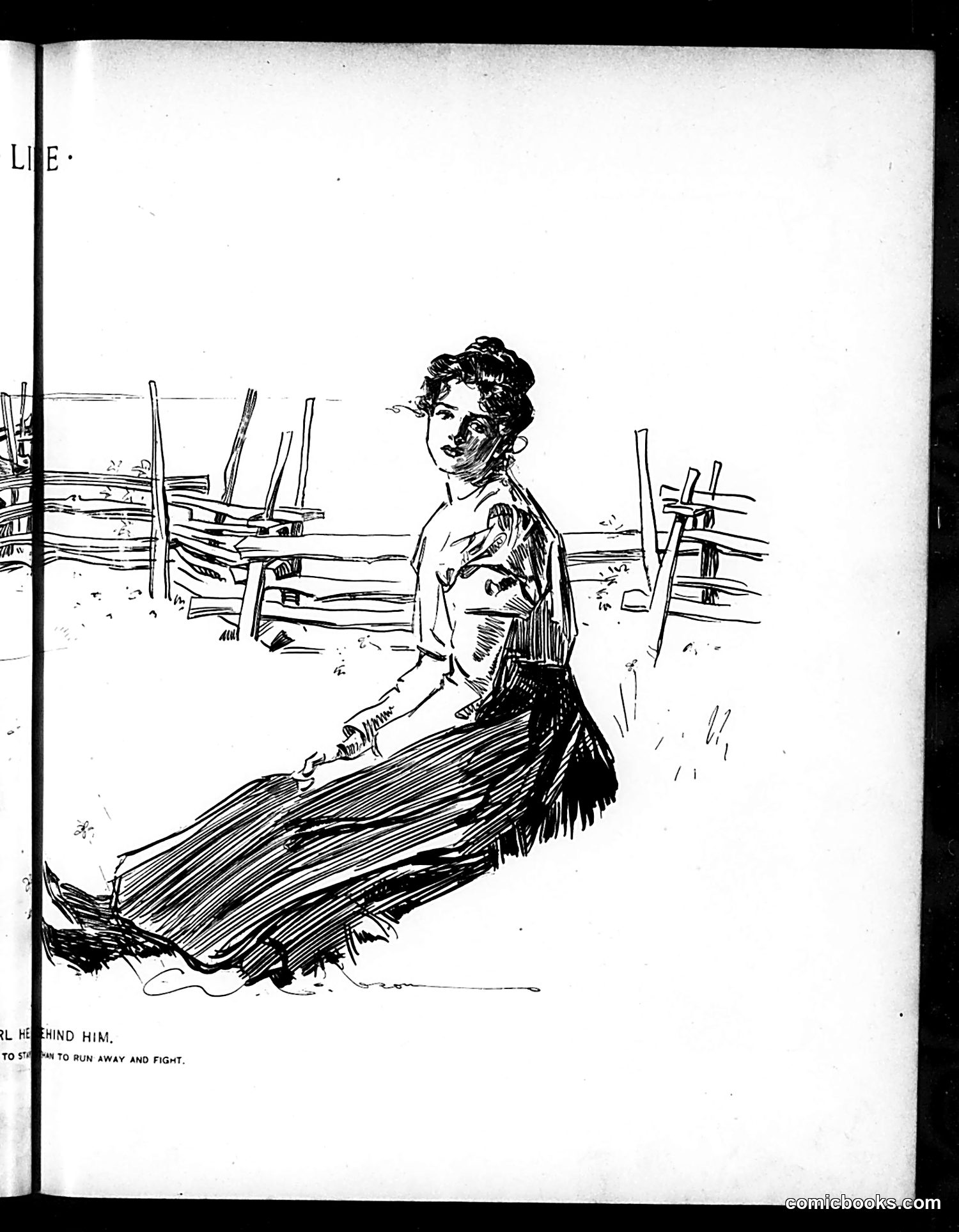
This appears to be a satirical illustration from *Life* magazine showing a woman in late 19th or early 20th-century dress, seated with a flowing skirt. The visible caption reads partially: "...RL HE HIND HIM, / TO ST...MAN TO RUN AWAY AND FIGHT." The incomplete text makes the specific reference unclear, but the composition suggests commentary on gender relations or women's roles of the era. The woman's confident pose and the fragmented caption referencing someone running away to fight suggest the cartoon may satirize either women's independence, romantic dynamics, or perhaps women's involvement in contemporary political/social movements. Without the complete caption, I cannot definitively identify which specific social issue or figure is being mocked. The artistic style is consistent with early 20th-century American satirical illustration.
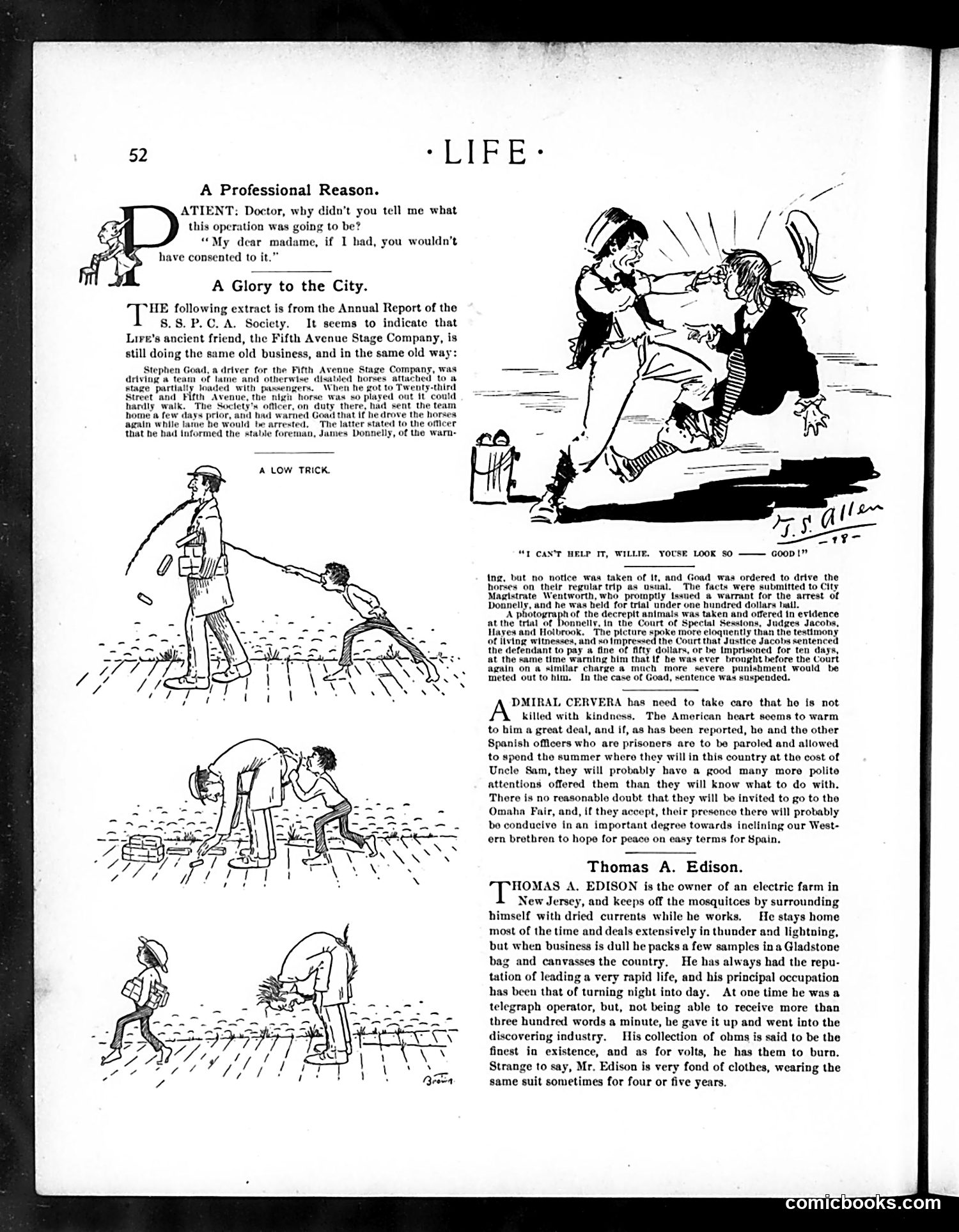
This page contains three humorous anecdotes with accompanying cartoons: **"A Professional Reason"** depicts a patient questioning a doctor about withholding surgical details, with the doctor's reply that disclosure would prevent consent—satirizing medical paternalism. **"A Glory to the City"** recounts an incident involving the Fifth Avenue Stage Company, where a driver's horse escaped, creating chaos. The story humorously describes the attempted capture and eventual arrest of the driver rather than the horse, poking fun at bureaucratic absurdity. **"A Low Trick"** shows illustrated sequences of what appears to be childhood mischief or pranks. The final section praises **Thomas A. Edison**, describing his electric farm in New Jersey and his eccentric habits—wearing the same suit for years and working extensively with thunder and lightning experiments—presenting him as both brilliant and peculiarly obsessive.

This is a portrait page from *Life* magazine (page 53) featuring a sketch of Thomas A. Edison, the famous American inventor and industrialist. The image shows a detailed pen-and-ink drawing of Edison's face in three-quarter view, capturing his distinctive features with careful shading and cross-hatching technique typical of early 20th-century portraiture. As a public figure of immense prominence—Edison revolutionized electrical power and lighting—he was a frequent subject for *Life*'s satirical and serious illustration work. The portrait appears to be a straightforward biographical feature rather than a political cartoon, presented as part of the magazine's coverage of notable American figures of the era.
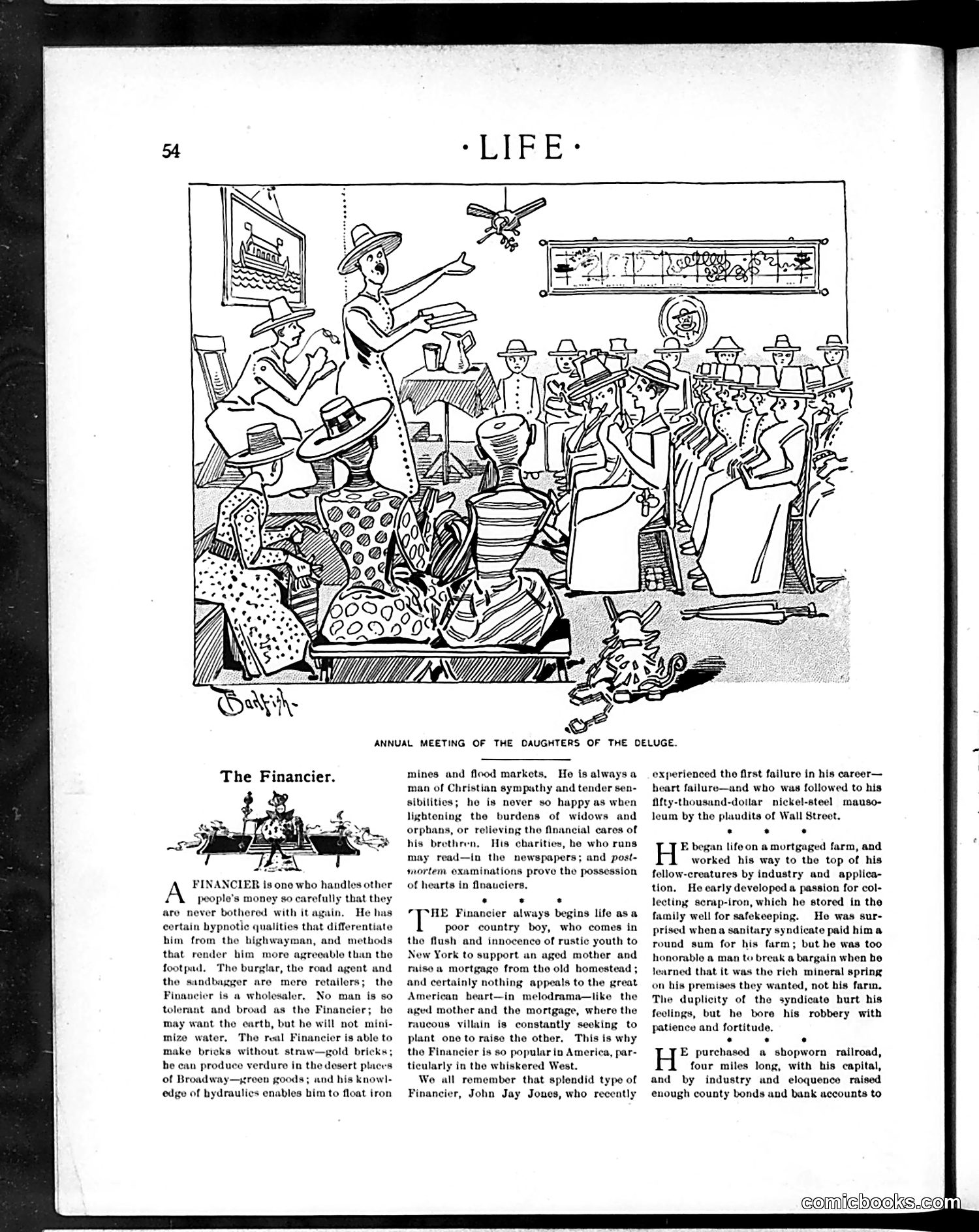
This is a satirical article attacking financiers and robber barons of the Gilded Age. The text uses mock-heroic language to expose financial fraud: it defines "Financier" as someone who handles others' money so they're "never bothered with it again"—a euphemism for theft. The cartoon above depicts "Annual Meeting of the Daughters of the Deluge," likely mocking wealthy women at a society event, possibly connected to financial scandals. The article then narrates the rise of an unnamed financier (possibly alluding to real figures like John Jay Jones, mentioned as recently deceased), who begins as a poor farm boy but enriches himself through dubious means: manipulating mortgages, mining operations, and railroad schemes. Life magazine is satirizing how American society romanticizes these "self-made men" while ignoring their predatory practices—"gold bricks" (swindles), market manipulation, and exploitation of widows and orphans. The humor lies in the deadpan, admiring tone masking contempt for financial corruption.
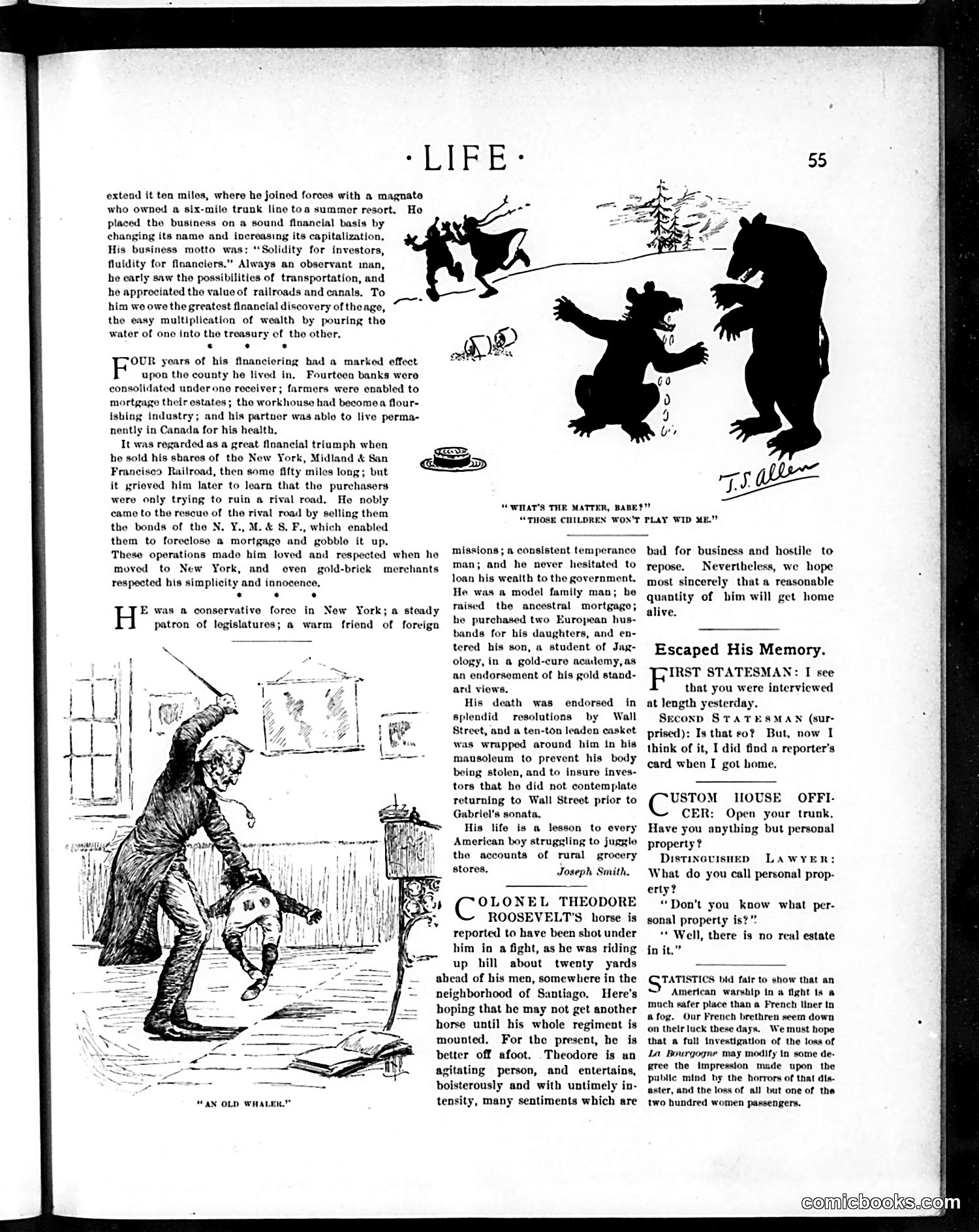
This page satirizes **Gilded Age robber baron capitalism** through a biographical sketch of a fictional financier. The text mocks how wealthy industrialists manipulated railroads and banks, consolidating power while impoverishing farmers ("enabled to mortgage their estates") and enriching themselves through shell games—notably "pouring the water of one into the treasury of the other" (issuing fraudulent bonds). The cartoons reinforce the critique: - **"An Old Whaler"** shows a corrupt businessman, representing predatory finance - **"What's the Matter, Babe?"** depicts excluded children, implying ordinary people were left out of prosperity The page also includes **contemporary political jabs**: Roosevelt's horse, custom house corruption, and French naval incompetence. The humor assumes readers understood these references as current events—Roosevelt's recent Spanish-American War service (Santiago reference), and concerns about maritime safety and government corruption were immediate scandals.
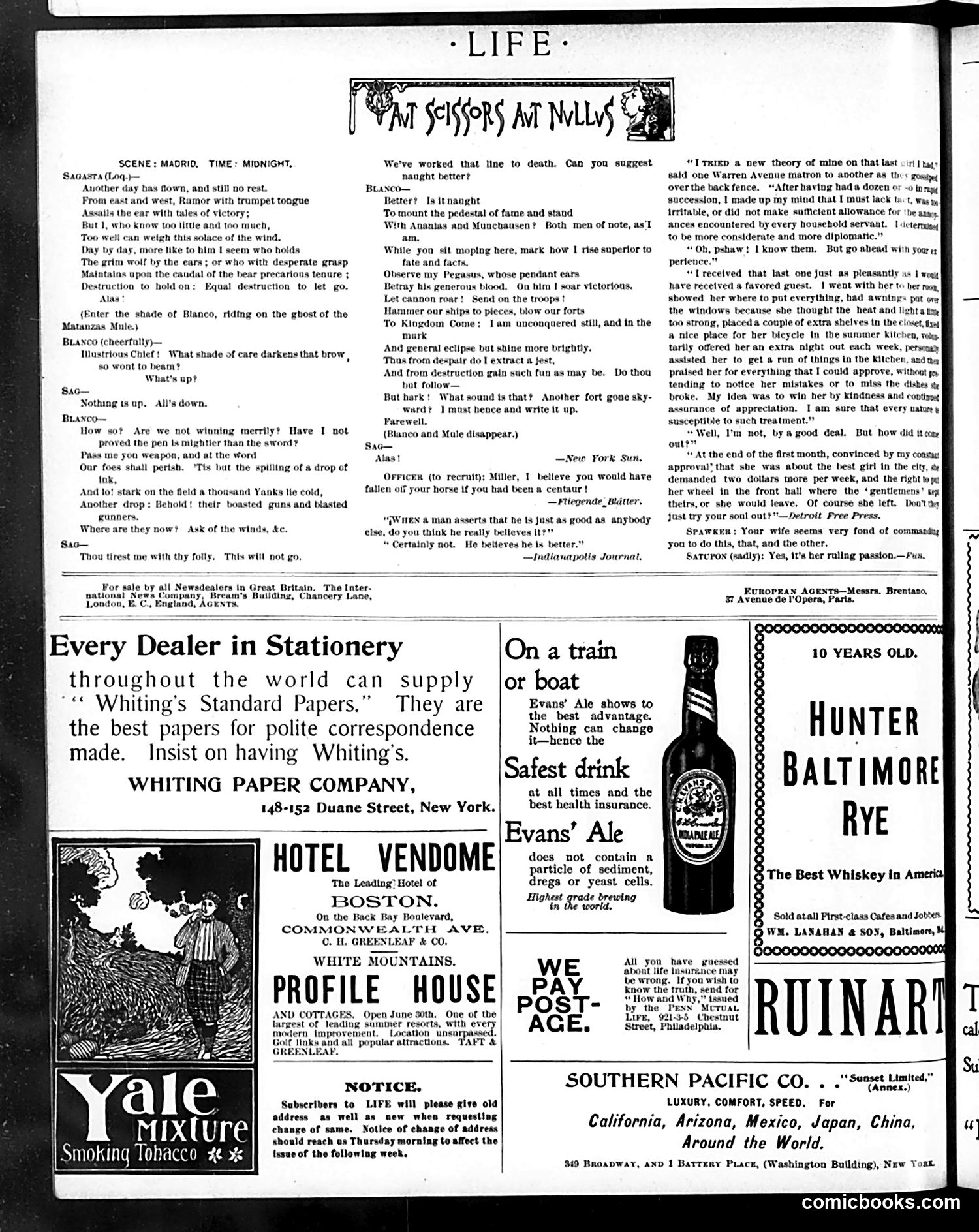
This page features a satirical dramatic scene set in Madrid at midnight, featuring **Sagasta** (Spain's Prime Minister) and **Blanco** (appears to be a Spanish military/political figure). The satire mocks Spanish leadership during the Spanish-American War. Blanco boasts delusionally about victory—comparing himself to mythological figures Ananias and Munchausen (both famous liars)—while claiming his "Pegasus" will carry him to glory. He insists Spain remains "unconquered" despite military disasters, planning to write propaganda about victories. Sagasta, by contrast, expresses despair, using metaphors of holding a wolf by the ears—unable to let go without destruction. The satire ridicules Spanish denial of battlefield reality and reliance on propaganda ("the pen is mightier than the sword") rather than actual military success. The cartoon reflects American contempt for Spanish leadership's refusal to acknowledge their military defeats in this 1898 conflict.
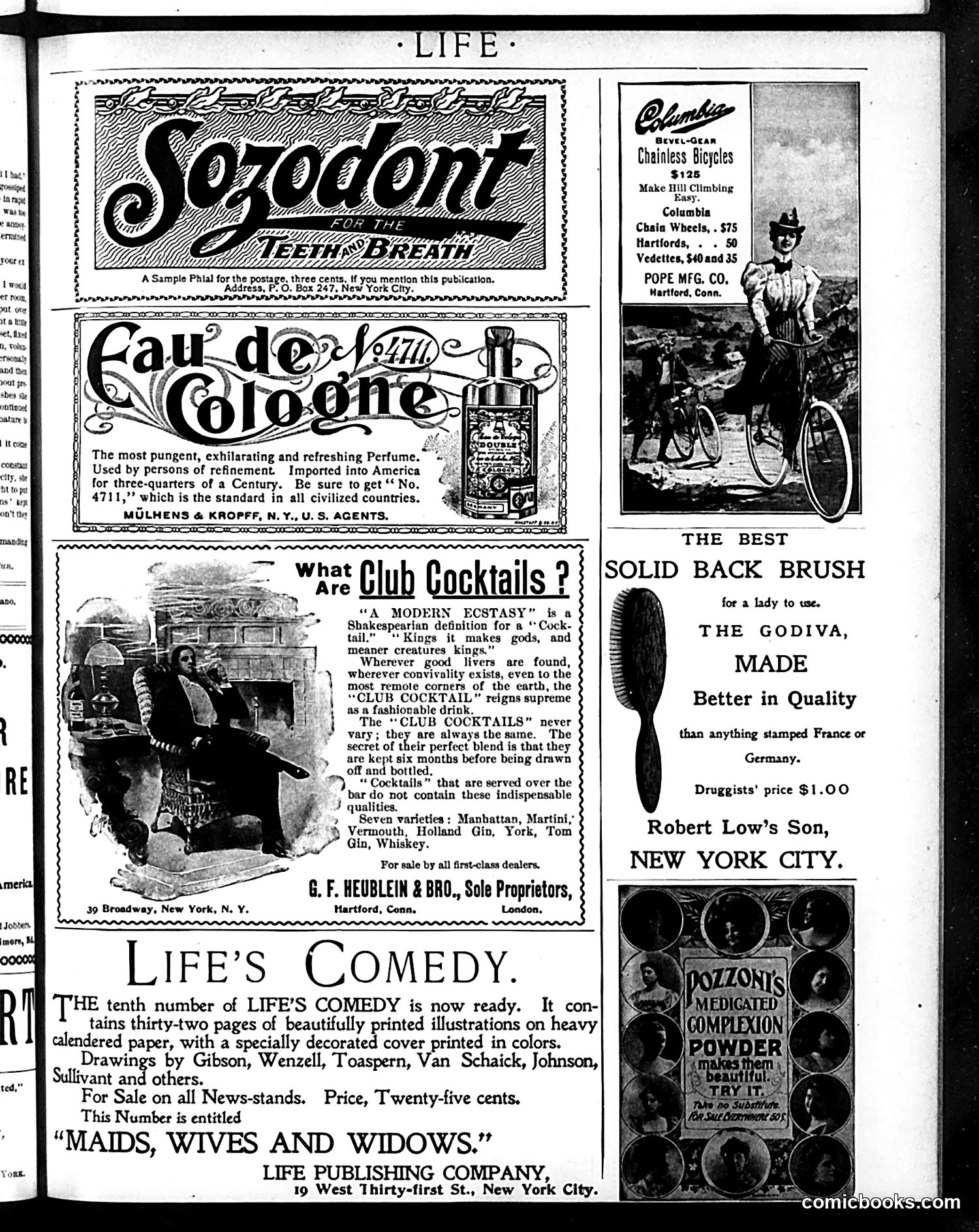
This page is primarily **advertisements and publishing announcements** from Life magazine, with no significant political or social satire visible. The ads promote consumer products typical of the era: Sozodont toothpaste, Eau de Cologne perfume, Columbia bicycles, and the Godiva hairbrush. The "Club Cocktails" ad emphasizes their superiority—factory-blended and aged six months, unlike inferior bar versions—reflecting turn-of-the-century anxieties about mass production and authenticity. The main content announcement promotes Life's "Comedy" series, featuring satirical illustrations by prominent cartoonists (Gibson, Wenzell, et al.). The tenth issue's theme, "**Maids, Wives and Widows**," suggests gender-focused humor typical of period satire, though the specific content isn't shown here. No identifiable political figures or current events are referenced on this page.
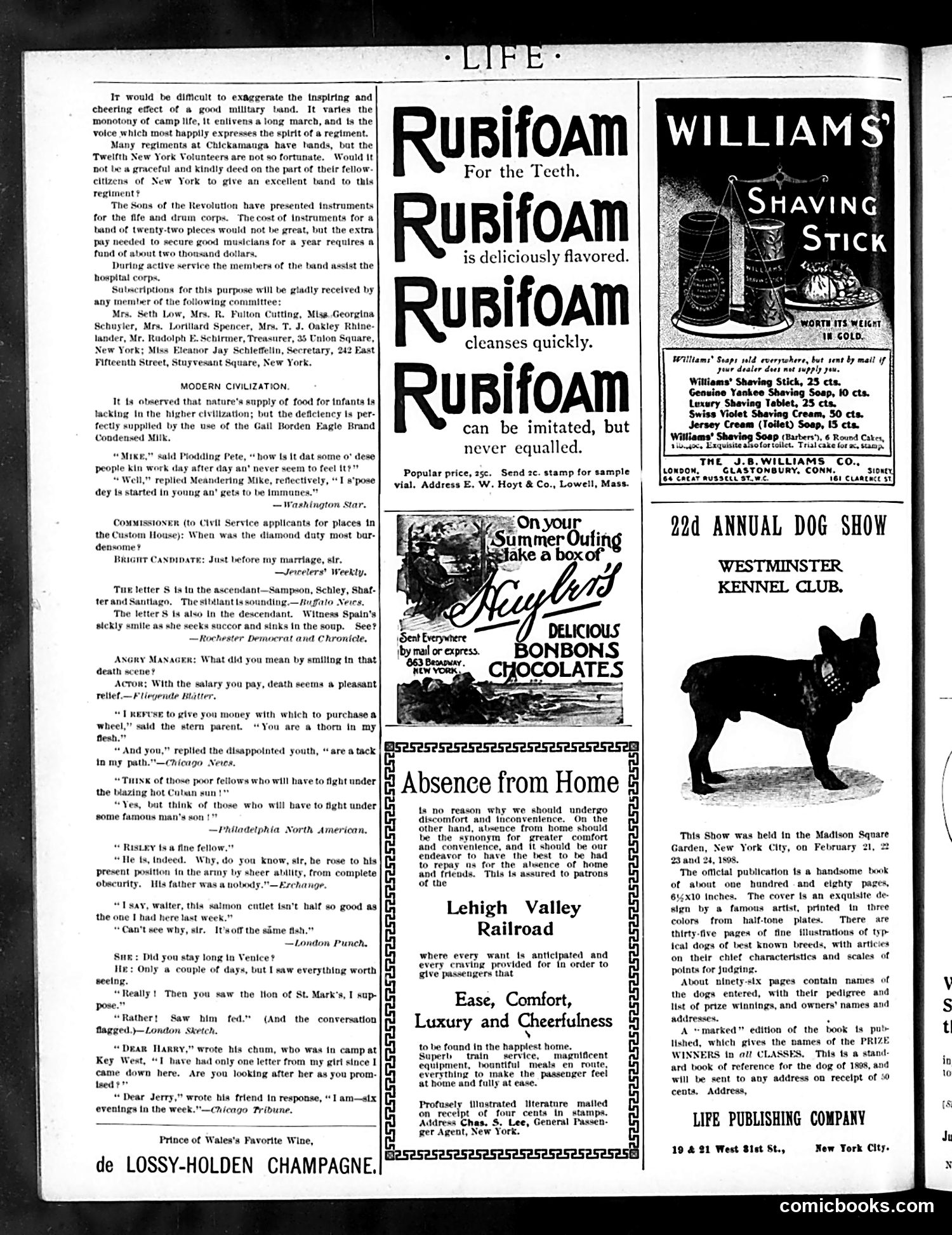
This page is primarily **advertising and humor columns**, not political cartoons. The content consists of: **Advertisements:** Rupifoam toothpaste, Williams' Shaving Stick, Naylor's Chocolates, and Lehigh Valley Railroad dominate the layout. **Humor sections:** Multiple short jokes and anecdotes fill the left column, typical of Life's satirical format. These include workplace humor ("death seems a pleasant relief" given low actor's salary), puns on the letter "S" (referencing Spanish-American War figures like Sampson and Santiago), and romantic comedy. **Notable content:** A brief serious section solicits donations for a military band for the Twelfth New York Volunteers at Chickamauga—likely referencing the Spanish-American War era (1898) based on the Cuban Sun reference in one joke. The 22nd Annual Dog Show advertisement appears on the right side. Overall, this is a typical turn-of-the-century magazine page mixing advertising revenue with light satire and gentle humor—no significant political message or cartoon present.
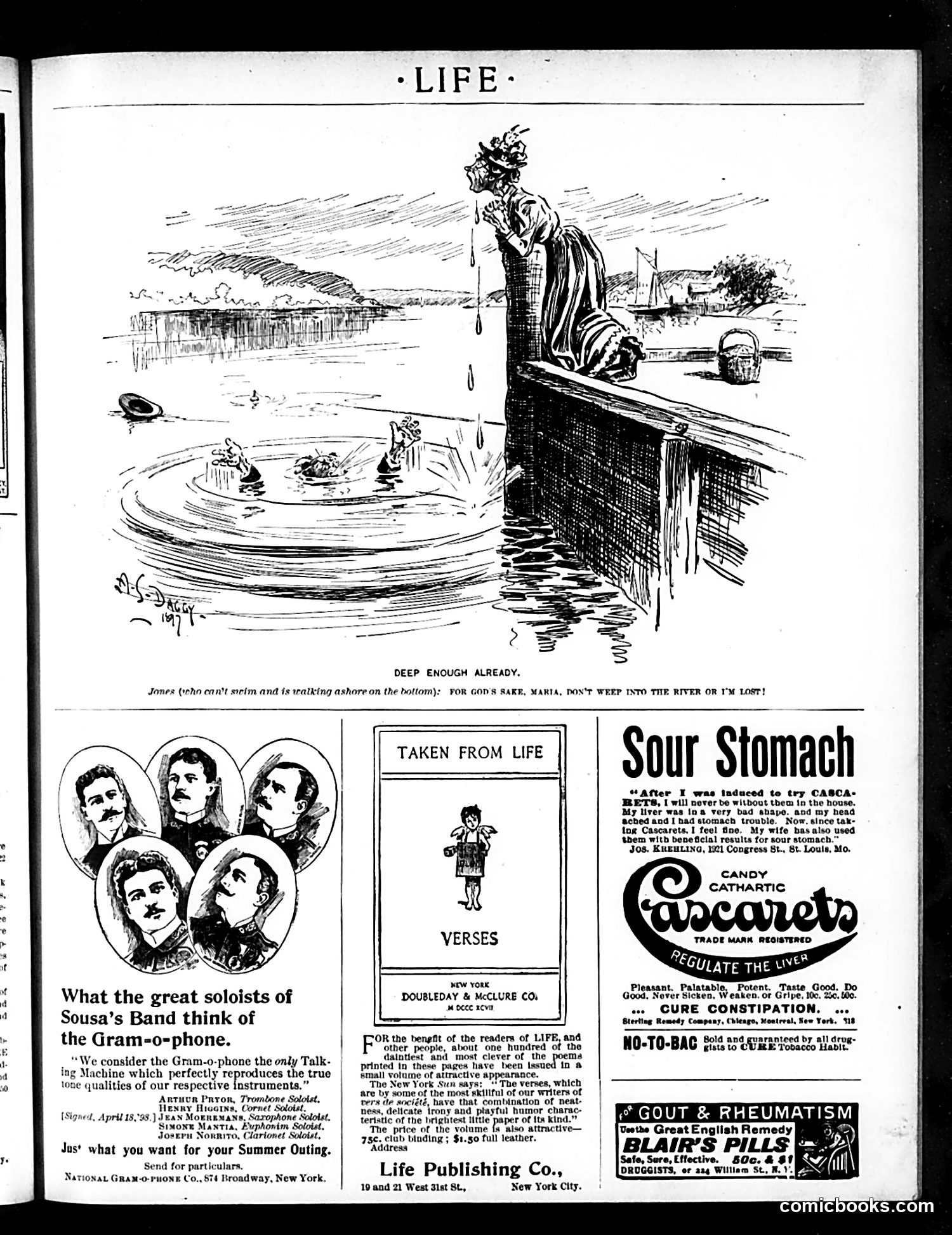
This page from *Life* magazine (circa 1893) contains satirical content mixed with period advertising. **Top Cartoon**: "Deep Enough Already" depicts a man (Jones) who cannot swim, wading in deep water, calling to his wife Maria not to cry into the river or he'll drown. The humor is absurdist—his drowning depends on her tears, a darkly comic exaggeration of domestic anxiety. **Middle Section**: Advertisements for Sousa's Band's gramophone and a poetry collection from *Life* Publishing dominate. The gramophone ad quotes famous band members (Puron, Higgins, Mantia, Norrito) praising its sound quality—typical product endorsement advertising of the era. **Right Side**: Patent medicine advertisements for Cascarets (a laxative) and Mo-to-Bac (for gout/rheumatism) with testimonials. These were common in period magazines, often making exaggerated health claims. The page reflects late-19th-century advertising practices and *Life*'s satirical humor style, which often featured absurdist domestic scenarios and slapstick situations.
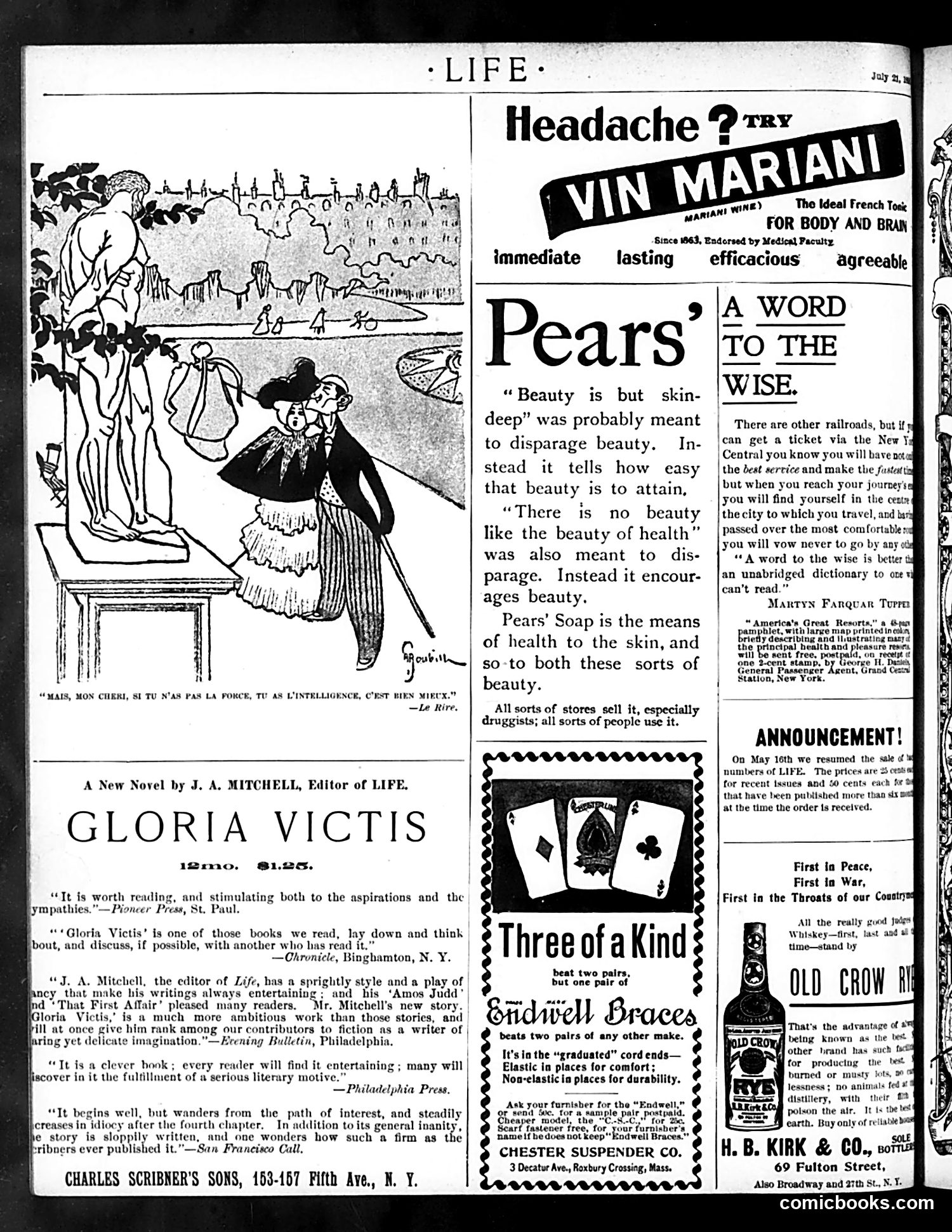
The main cartoon depicts a French scene (indicated by the French caption from *Le Rire*, a French satirical magazine) showing what appears to be a woman at a statue or monument, with a man in formal dress addressing her. The caption translates roughly to: "But my dear, if you don't have strength, you at least have intelligence, which is much better." The satire appears to target **gender relations and female capability**—likely mocking either: (1) condescending attitudes toward women's intellectual versus physical power, or (2) French gallantry as insincere flattery. The specific context is unclear without knowing the original *Le Rire* publication date, but the joke plays on the contrast between physical force and mental ability. The rest of the page consists primarily of **period advertisements** (Vin Mariani wine, Pears' Soap, Endwell Braces, Old Crow whiskey) and book reviews for J.A. Mitchell's novel *Gloria Victis*—typical Life magazine editorial and advertising content from this era.