
Life, 1898-07-21 · page 6 of 20
Life — July 21, 1898 — page 6: what you’re looking at
What you’re looking at
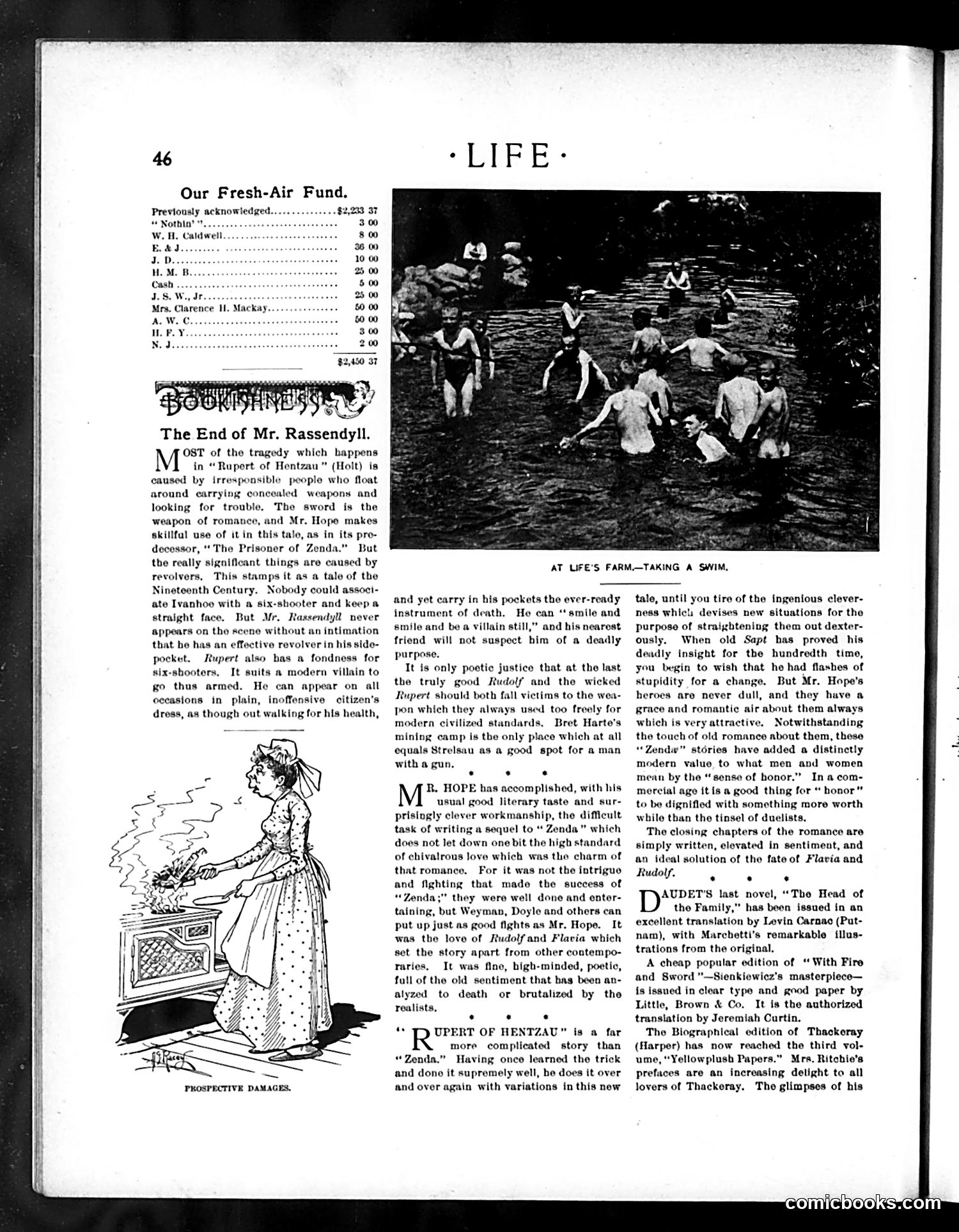
This page primarily contains **literary criticism** rather than political satire. It reviews Mr. Hope's works, particularly sequels to "Zenda" (a popular 1894 romance novel). The text praises Hope's "high standard of chivalrous love" and his skill at adventure writing. The single cartoon titled **"Prospective Damages"** appears to depict a woman in Victorian dress, though the specific satirical point is unclear from this image alone. It likely comments on romantic or marital themes consistent with the literary discussion. The page includes a photograph labeled "At Life's Farm—Taking a Swim" showing people bathing, and fundraising information for a "Fresh-Air Fund" at the top—suggesting this is a charitable appeal typical of the era's magazines.
📄 Transcribed text from this page (OCR, searchable)
Machine-transcribed from the original scan — historical spelling and the odd misread are preserved.
46 Our Fresh-Air Fund. 2,233 37 300 800 36 00 10 00 Previously acknowledged J.8.We, dre Mra. Clarence HH. Mac A.W. C, The End of Mr. Rassendyll. OST of the tragedy which happens in “Ruport of Hentzau” (Holt) is caused by irresponsible people who float around carrying concealed weapons and looking for trouble, The sword is the weapon of romance, and Mr. Hope makes skillful use of it in this tale, as in its pro- decessor, “The Prisoner of Zenda.” But the really significant things are caused by revolvers, This stamps it as a tale of the Nineteenth Century. Nobody could assoct- ate Ivanhoo with a six-sbooter and keep a straight face. But Mr. Rassendyll never appears on tho scene without an intimation that be has an effective revolver in his sido- pocket. Rupert also bas a fondness for six-sbooters, It suits a modern villain to go thus armed. He can appear on all occasions in plain, inoffensive citizen's dress, as though out walking for his health, PROSPECTIVE DAMAGES. AT UFE'S FARM.—TAKING A SWIM, and yot carry in his pockets the ever-ready instrument of death, He can “smile and sinile and be a villain still,” and his nearest friend will not suspect him of a deadly purpose. It is only poetic justice that at the last the truly good Rudolf and the wicked Rupert should both fall victims to the wea- pon which they always used too freely for modern civilized standards, Bret Harto’s mining camp Is the only place which at all equals Strelsau as a good spot for a man with a gun, . . R. HOPE has accomplished, with his usual good literary taste and sur- prisingly clever workmanship, the dimcult task of writing a sequel to “ Zenda” which does not let down one bit the high standard of chivalrous love which was the charm of that romance, For it was not the fatriguo and fighting that mado the success of “Zenda;” they were well dono and entor- taining, but Weyman, Doyle and othors can put up just as good fights as Mr. Hope. It was the love of Rudolf and Flavia which set the story apart from other contempo- raries, It was flno, high-minded, poetic, full of the old sentiment that has been an- alyzed to death or brutalized by tho realists, . . . ‘* Z UPERT OF HENTZAU" is a far more complicated story than “Zonda.” Having onco learned the trick and dono it supromely well, he does it over and over again with variations in this now tale, until you tire of the Ingenious clever- ness which devises new situations for the purpose of straightening them out dexter- ously, When old Sapt bas proved his deadly insight for the hundredth time, you begin to wish that he had flashes of stupidity for a change. But Mr. Hope's heroes are never dull, and they have a grace and romantic air about them always which is very attractive, Notwithstanding the touch of old romance about them, these “Zendw” stdries have added a distinctly modern value to what men and women mean by the “sense of honor.” In a com- mercial ago it is a good thing for “ honor” to be dignified with something more worth while than tho tinsel of duelists. The closing chapters of the romance are simply written, elevated in sentiment, and fn ideal solution of the fate of Flavia and Rudolf. . . . AUDET'S last novel, “Tho Head of tho Family,” has been issued in an excellent translation by Levin Carnac (Put- nam), with Marchetti’s remarkable illus- trations from the original, A cheap popular edition of “With Fire and Sword "—Sienkiewicz’s masterpieco— is issued in clear type and good paper by Little, Brown & Co, It is the authorized translation by Jeremiah Curtin. Tho Biographical edition of Thackeray (Harper) has now reached the third yol- ume, “Yellowplush Papers.” Mrs, Ritchie's prefaces are an increasing delight to all lovers of Thackeray. Tho glimpses of his