
Life, 1898-07-21 · page 4 of 20
Life — July 21, 1898 — page 4: what you’re looking at
What you’re looking at
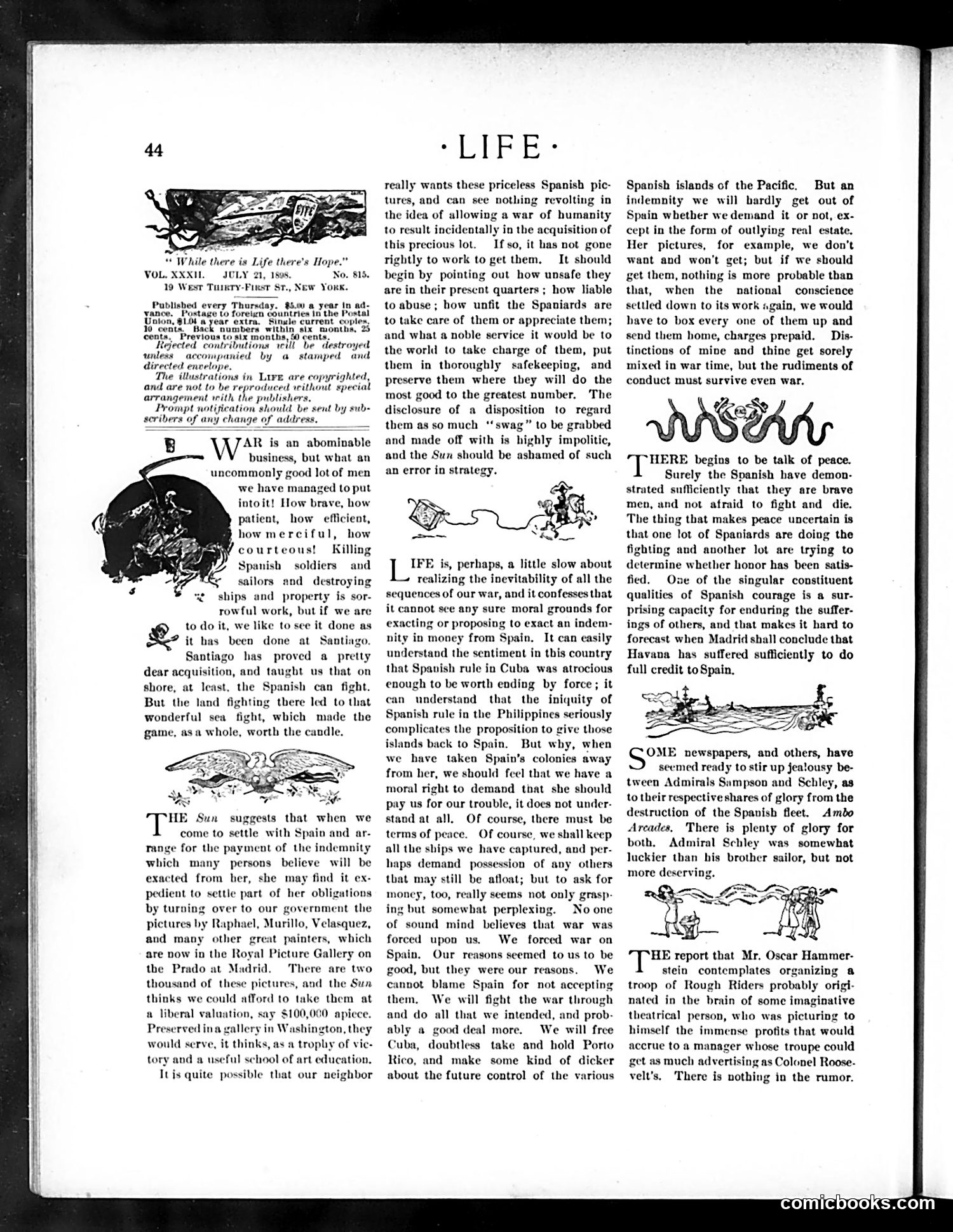
This page from *Life* magazine (July 21, 1898, Vol. XXXII, No. 815) discusses the Spanish-American War, specifically debating Spain's indemnity payments and colonial possessions. The text argues for demanding financial compensation from Spain and controlling her former colonies (Cuba, Puerto Rico, Philippines). The article defends this position against moral objections, asserting America has rightful claims after military victory. The decorative illustrations—small vignettes of ships and soldiers—reinforce the military/naval theme. The cartoons appear designed to satirize Spanish vulnerability rather than mock specific individuals, emphasizing America's superior naval power (referenced repeatedly in the text). The broader satire suggests American moral justification for imperial expansion through military conquest, a key debate of this imperialist era.
📄 Transcribed text from this page (OCR, searchable)
Machine-transcribed from the original scan — historical spelling and the odd misread are preserved.
“ While there is Life there's Hope.” VOL. XXXL JULY 21, 1898, No, 815. 19 West Tuery-Finst St., New YORK. Published every Thursday. 85.00 a year In ad~ yance. Postage to foreien res in the Po: Union, 104 a year extra. Single current coples, 10 cents, numbers within six months, 25 Prev 1x mont cent {0 cents. Rejected tributions will be destroyed unless accompanied by a stamped and directed envelope. The illustrations in Lure are copyrighted, and are not to be reproduced without special arrangement with the publish Prompt notification should be seut by sub- scribers of any change of address. AR is an abominable V business, but what an uncommonly good lot of men we have managed to put intoit! How brave, how patient, how efficient, how merciful, how courteous! Killing Spanish soldiers and s sailors and destroying ships and property is sor- rowful work, but if we are to do it, we like to see it done as it has been done at Santiago. Santiago has proved a pretty dear acquisition, and taught us that on shore, at Icast, the Spanish can fight. But the land fighting there led to that wonderful sea fight, which made the game, asa whole, worth the candle, ra . HE Sun suggests that when we come to settle with Spain and ar- range for the payment of the indemnity which many persons believe will be exacted from her, she may find it ex- pedient to settle part of her obligations by turning over to our government the pictures by Raphael, Murillo, Velasquez, and many other great painters, which are now in the Royal Picture Gallery on the Prado at Madrid. There are two thousand of these pictures, and the Sun thinks we could afford to take them at a liberal valuation, say $100,000 api Preserved ina gallery g would serve, it thinks, as a trophy of vie- tory and a useful school of art education, Itis quite possible that our neighbor “LPB really wants these priceless Spanish pic- tures, and can see nothing revolting in the idea of allowing a war of humanity to result incidentally in the acquisition of this precious lot. If so, it has not gone rightly to work to get them, It. should begin by pointing out how unsafe they are in their present quarters ; how liable to abuse ; how unfit the Spaniards are to take care of them or appreciate them; and what a noble service it would be to the world to take charge of them, put them in thoroughly safekeeping, and preserve them where they will do the most good to the greatest number. The disclosure of a disposition to regard them as so much “swag” to be grabbed and made off with is highly impolitic, and the Sux should be ashamed of such an error in strategy. Ons S., IFE is, perhaps, a little slow about realizing the inevitability of all the sequences of our war, and it confesses that it cannot sce any sure moral grounds for exacting or proposing to exact an indem- nity in money from Spain, It can easily understand the sentiment in this country that Spanish rule in Cuba was atrocious enough to be worth ending by force ; it can understand that the iniquity of Spanish rule in the Philippines seriously complicates the proposition to give those islands back to Spain. But why, when we have taken Spain’s colonies away from her, we should feel that we have a moral right to demand that she should pay us for our trouble, it does not under- stand at all. Of course, there must be terms of peace. Of course, we shall keep all the ships we have captured, and per- haps demand possession of any others that may still be afloat; but to ask for money, too, really seems not only grasp: ing but somewhat perplexing. No one of sound mind believes that war was forced upon us. We forced war on Spain, Our reasons seemed to us to be good, but they were our reasons. We cannot blame Spain for not accepting them, We will fight the war through and do all that we intended, and prob- ably a good deal more. We will free Cuba, doubtless take and hold Porto Rico, and make some kind of dicker about the future control of the various Spanish islands of the Pacific. But an indemnity we will bardly get out of Spain whether we demand it or not, ex- cept in the form of outlying real estate. Her pictures, for example, we don't want and won't get; but if we should get them, nothing is more probable than that, when the national conscience settled down to its work sgain, we would have to box every one of them up and send them home, charges prepaid. Dis- tinctions of mine and thine get sorely mixed in war time, but the rudiments of conduct must survive even war. WISH HERE begins to be talk of peace. Surely the Spanish have demon- strated sufficiently that they are brave men, and not afraid to fight and die. The thing that makes peace uncertain is that one lot of Spaniards are doing the fighting and another lot are trying to determine whether honor has been satis- fied. One of the singular constituent qualities of Spanish courage is a sur- prising capacity for enduring the suffer- ings of others, and that makes it hard to forecast when Madrid shall conclude that Havana has suffered sufficiently to do full credit toSpain, Ge Some newspapers, and others, have seemed ready to stir up jealousy be- tween Admirals Sampson and Schley, as to their respective shares of glory from the destruction of the Spanish fleet. Ambo Arcades, There is plenty of glory for both, Admiral Schley was somewhat luckier than his brother sailor, but not more deserving. 'HE report that Mr. Oscar Hammer- stein contemplates organizing a troop of Rough Riders probably origi- nated in the brain of some imaginative theatrical person, who was picturing to himself the immense profits that would accrue to a manager whose troupe could get as much advertising as Colonel Roose- velt’s, There is nothing in the rumor.