
A complete issue · 20 pages · 1898
Life — July 7, 1898
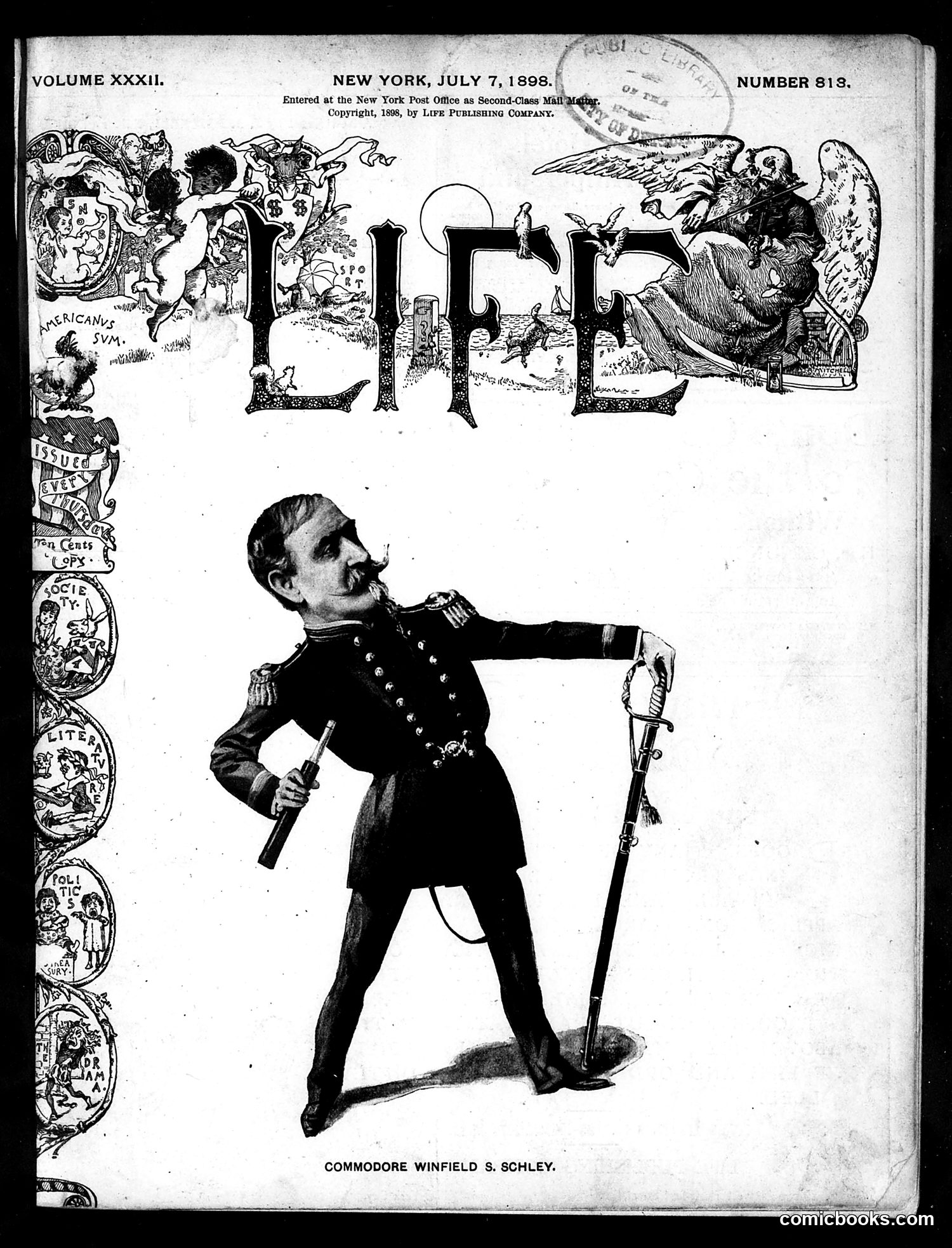
This page features **Commodore Winfield S. Schley**, a naval officer depicted in full dress uniform holding a sword and telescope. The caption identifies him by name. The timing (July 1898) places this during the Spanish-American War. Schley commanded the Flying Squadron and is likely being satirized here regarding his role in naval operations, possibly the Battle of Santiago de Cuba (July 3, 1898). The decorative header with classical and allegorical figures suggests *Life* magazine's typical satirical treatment of public figures. Without additional visible text on the page, the specific point of satire is unclear—whether this mocks Schley's tactics, his ambitions, or disputes over credit for victories. The military pose suggests either celebration or ironic commentary on his prominence.
This page is primarily **advertising and literary promotion** rather than political satire. The content includes: 1. **Hotel Ampersand advertisement** - promoting a Saranac Lake resort with special attractions for young people 2. **Gram-o-phone advertisement** - featuring Hon. Chauncey M. Depew endorsing the phonograph as entertainment for family and friends 3. **"Gloria Vict" novel promotion** - advertising J.A. Mitchell's new book, with positive reviews quoted from major newspapers 4. **Framed proofs service** - Life Publishing Company offering to provide framed artwork from their magazine's original drawings The two illustrated figures appear to be **decorative fashion illustrations** typical of the era, not political caricatures. This is a standard magazine page mixing commercial advertisements with publishing promotions rather than satirical content.
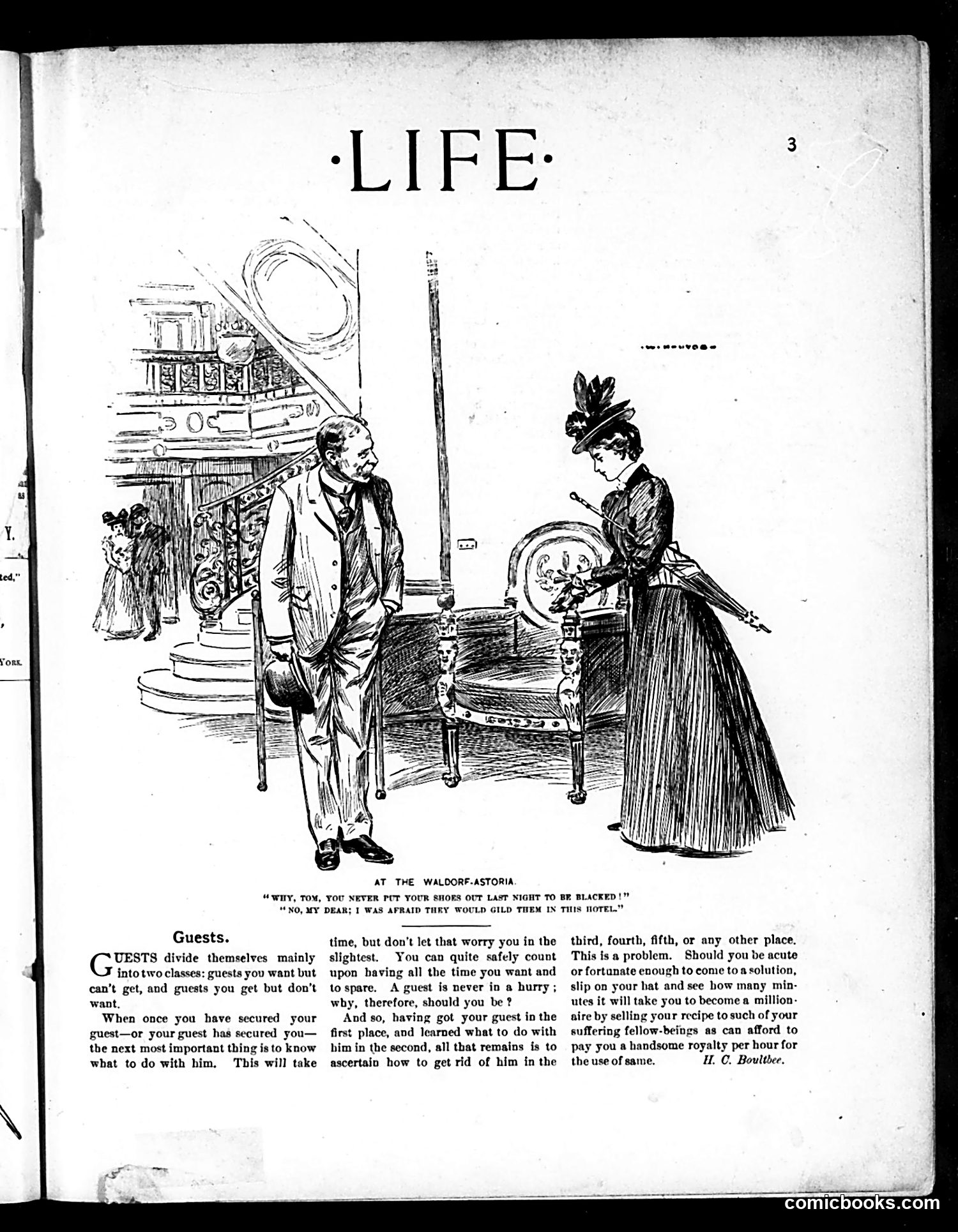
This page contains a satirical cartoon titled "At the Waldorf-Astoria" depicting a scene between a man and woman at a fancy hotel. The caption reads: "Why, Tom, you never put your shoes out last night to be blacked!" / "No, my dear; I was afraid they would gild them in this hotel." **The Satire:** The joke mocks the Waldorf-Astoria's reputation for excessive luxury and presumed overpricing. The husband fears the hotel will unnecessarily embellish even basic services (gilding his shoes) and charge accordingly. It's commentary on wealthy establishments' perceived tendency to inflate costs through unnecessary elaboration. The accompanying article on "Guests" offers etiquette advice about entertaining visitors—straightforward social guidance typical of Life's satirical magazine content mixing humor with practical advice.
This page discusses the Spanish-American War, specifically the Battle of Santiago de Cuba. The text debates whether General Blanco and General Shafter's military strategies were sound. The cartoons (though small and somewhat unclear) appear to illustrate war-related themes, possibly depicting soldiers or military equipment relevant to the Santiago campaign. The editorial argues that Spanish resistance has proven less formidable than expected, and that America should prepare for post-war considerations. It discusses college graduates' duty to engage in public affairs, and mentions debates over rowing competitions at Harvard versus other institutions. The overall tone suggests cautious optimism about American military prospects while urging serious civic engagement from educated Americans regarding the war's conclusion and aftermath.
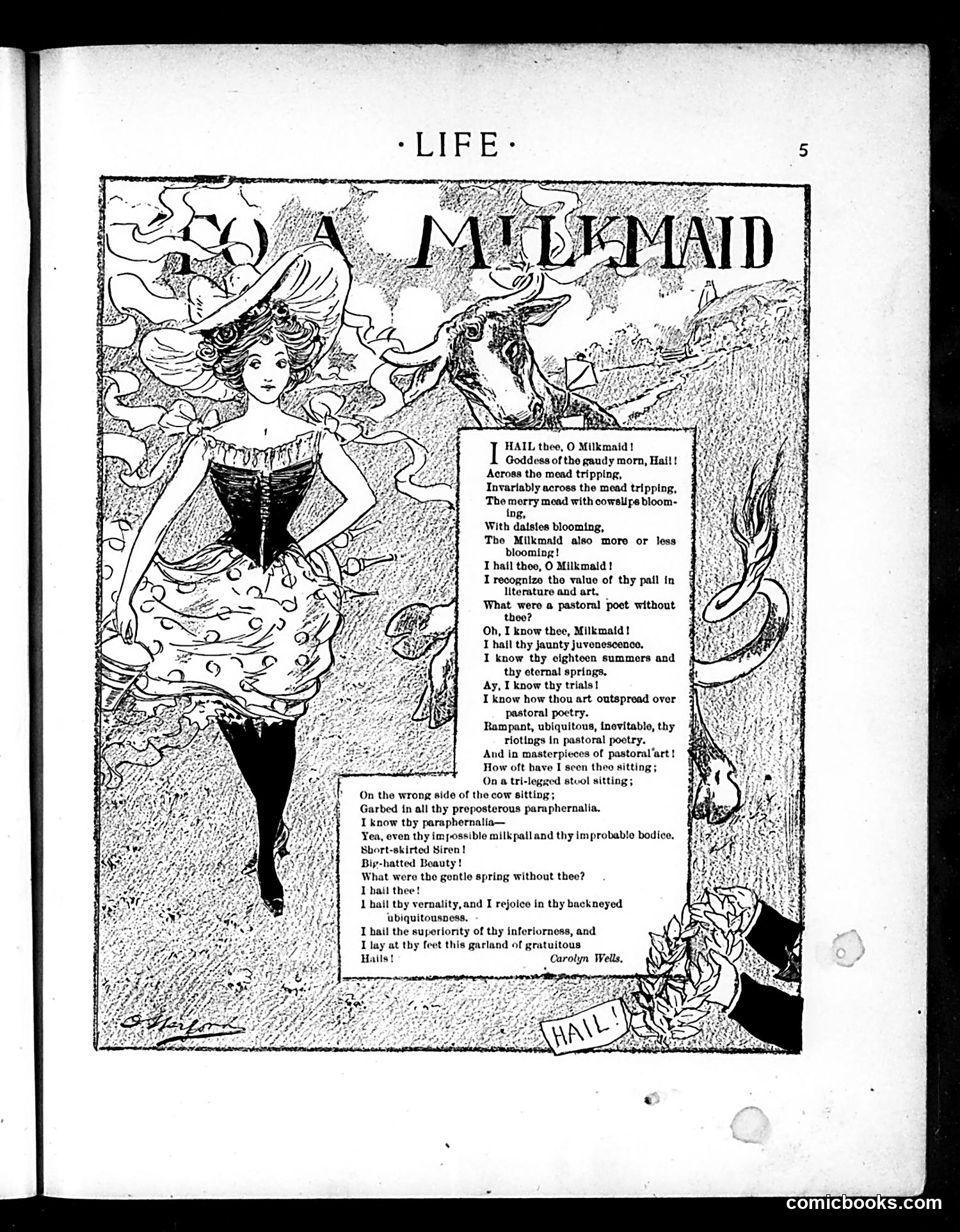
This is a humorous poem by Carolyn Wells praising a milkmaid. The illustration shows an elaborately dressed woman in fashionable attire—far too ornate and refined for actual farm work—striking a theatrical pose. The satire appears to mock the romanticization of pastoral life by upper-class society. The poem's grandiose language ("Hail thee, O Milkmaid!") ironically elevates a working-class figure to goddess-like status, celebrating her for mundane tasks like milking cows and spring work. The visual joke reinforces this: the figure is clearly a sophisticated woman playing at being a milkmaid rather than an actual laborer. This likely satirizes contemporary literary or artistic trends that idealized rustic simplicity while actual farm work remained unglamorous and physically demanding.
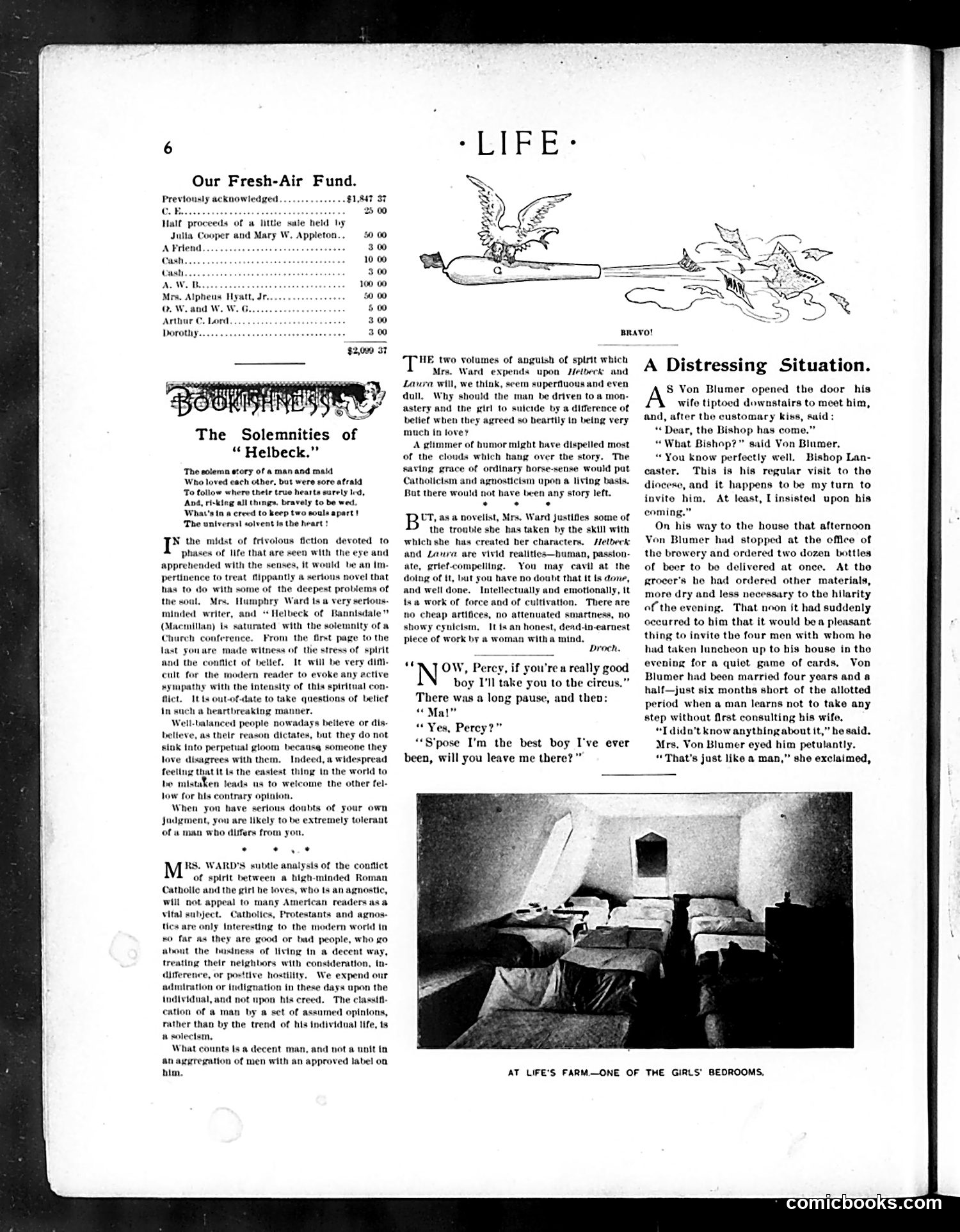
This page contains literary criticism rather than political cartoons. The main article discusses Mrs. Ward's novel "Helbeck," examining its treatment of religious conflict between a Catholic man and agnostic woman. The critic argues the work presents shallow characters and that such sectarian disputes lack relevance to American readers, who judge people by individual merit rather than creed. The accompanying story, "A Distressing Situation," depicts a domestic comedy: Mr. Von Blumer's wife invites the Bishop to dinner without consulting him, forcing him to arrange elaborate preparations. The humor derives from marital miscommunication and social anxiety about entertaining clergy. The page reflects early 20th-century American attitudes about religion's declining role in personal judgment.
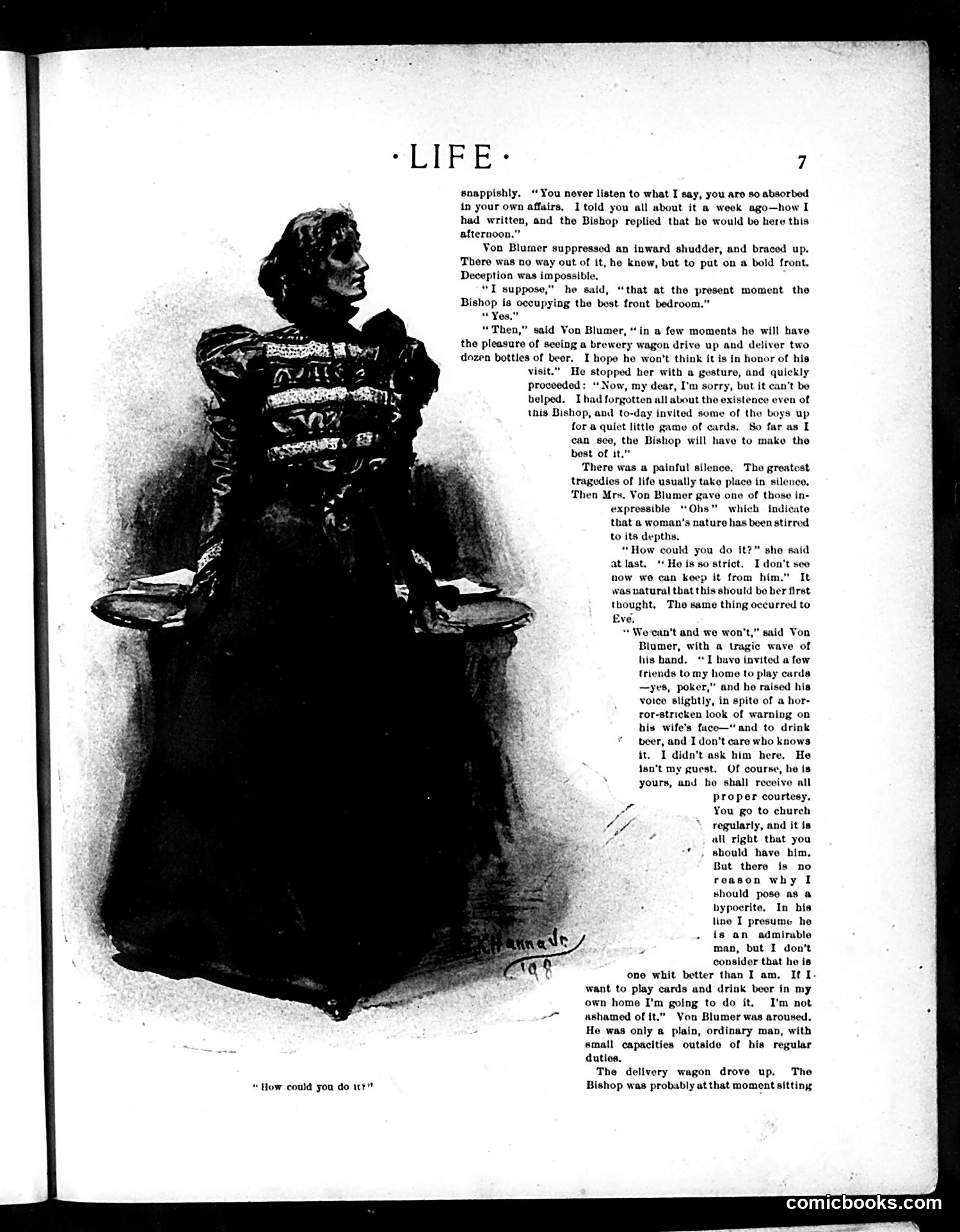
This page satirizes a German military officer (identified as "Von Blumer" in the text) who has invited a Bishop to his home for poker and beer—activities the Bishop finds morally objectionable. The illustration shows Von Blumer in ornate military dress, gesturing defensively. The satire mocks Prussian militarism and German social hypocrisy: Von Blumer, a strict military man, cannot understand why the Bishop objects to "innocent" card-playing and drinking, yet simultaneously expects proper courtesy. The joke highlights the cultural clash between rigid military values and religious morality, suggesting Germans either don't understand or deliberately flout Christian ethics. This likely reflects early 20th-century American attitudes toward Germany before or during World War I.
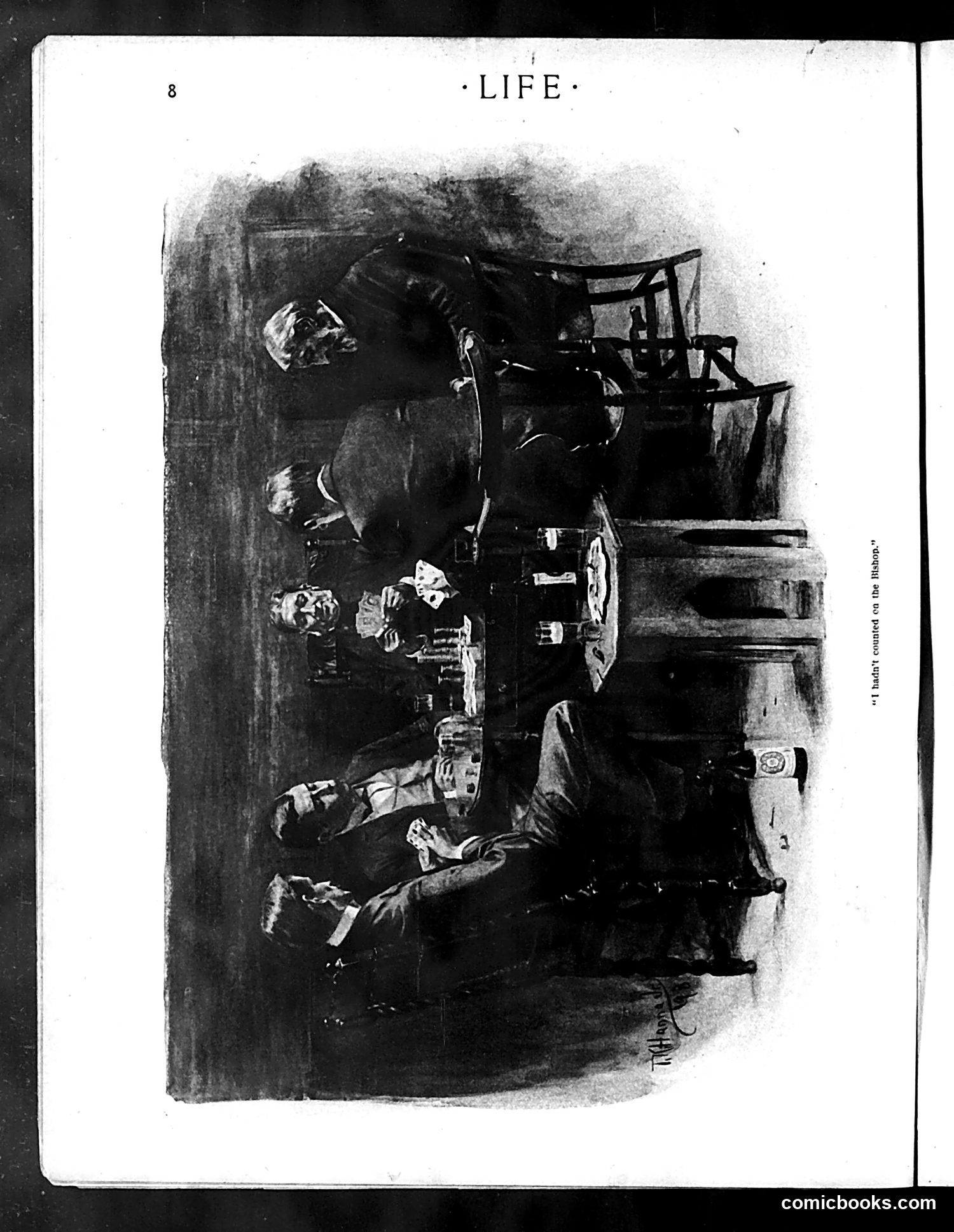
This is page 8 from *Life* magazine, featuring a single illustration that appears to be rotated 90 degrees. The image shows what seems to be a domestic or social scene with multiple figures in period dress (likely early 20th century based on the clothing). There's a caption on the right side reading "I hate crowded to the bishop!" though this is partially difficult to read with certainty. The cartoon appears to depict a satirical social scene, possibly mocking upper-class manners, domestic life, or religious hypocrisy—common targets of *Life*'s satire during this era. However, without clearer visibility of specific details and without being certain of the exact caption text, I cannot definitively identify the specific social commentary or figures being caricatured. The style and composition suggest social satire rather than political commentary.
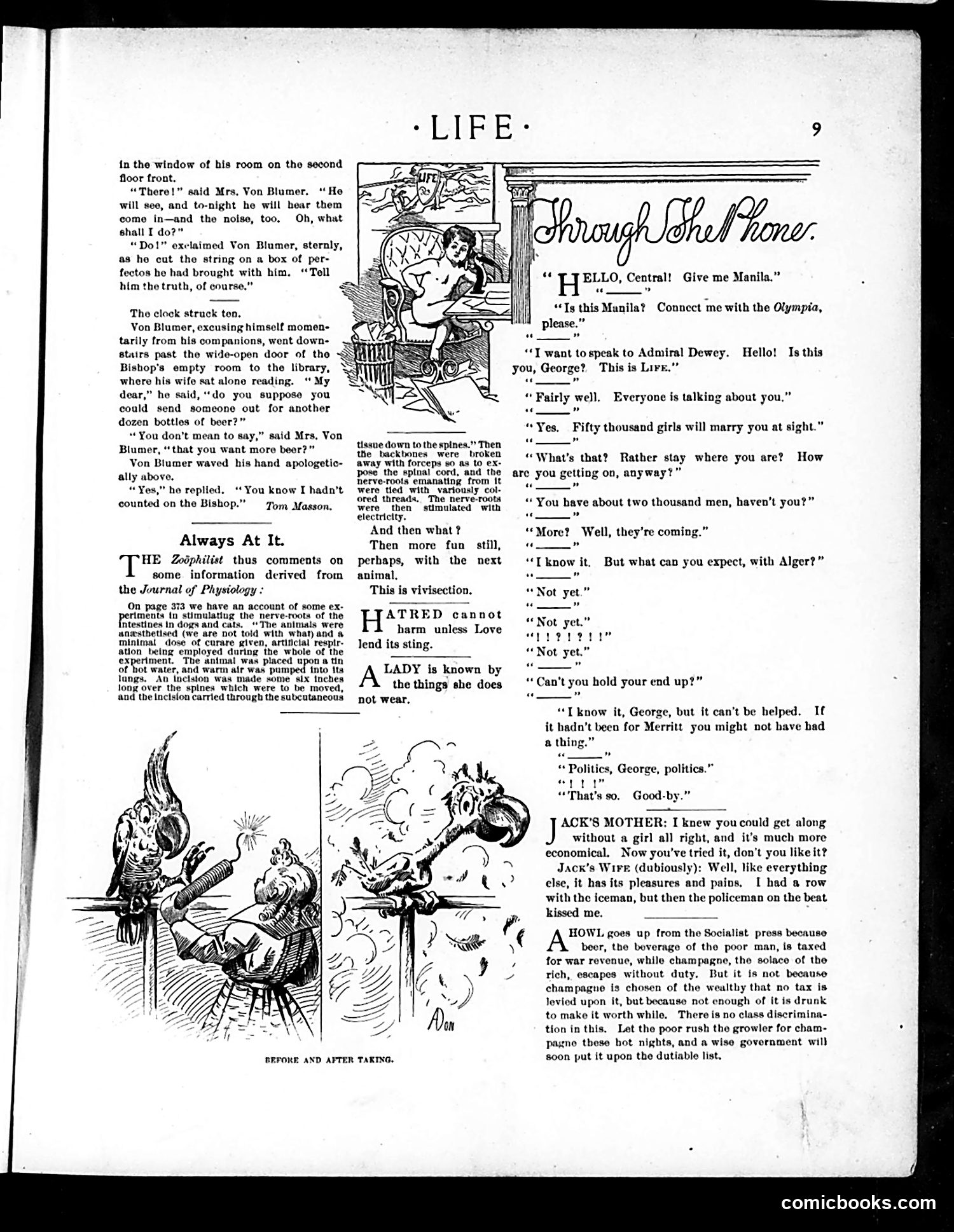
This page contains satirical dialogue and illustrations from early 20th-century American Life magazine. The main content includes: **"Through Shell Phone"** — A humorous conversation where someone named George (likely a public figure) receives calls about his sudden fame and marriage prospects. The satire mocks the sensationalism of media coverage and public obsession with celebrities. **"Always At It"** — A Zoophilist comment about animal experimentation, criticizing vivisection practices on dogs and cats for physiological research. **"Before and After Taking"** — A cartoon showing comic exaggeration of the effects of some substance or treatment, illustrated with cartoonish figures. The page exemplifies Life's blend of social commentary, scientific critique, and humor targeting contemporary American society's trends and ethical practices around 1900-1920.
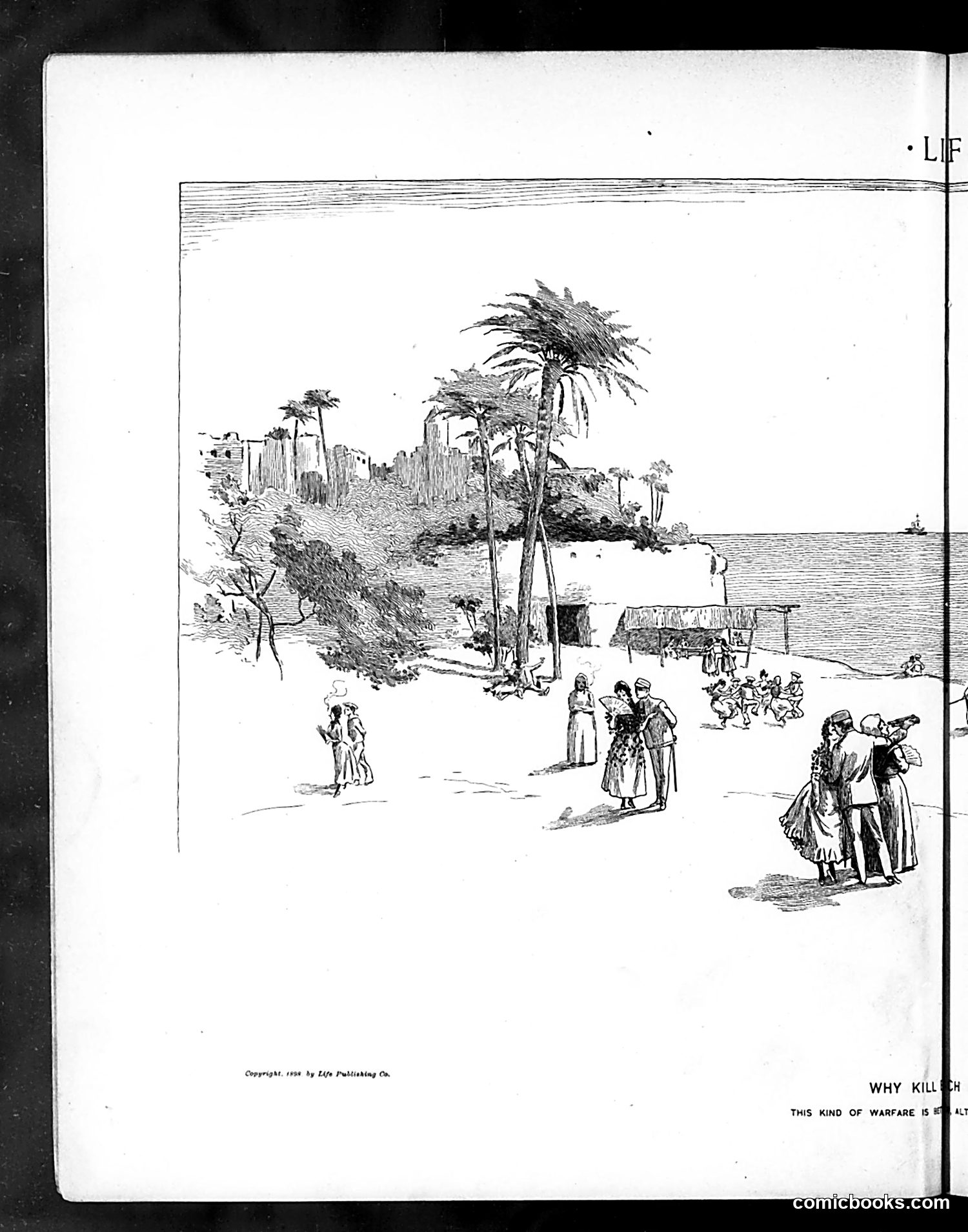
This appears to be an illustration from Life magazine (copyright 1898 by Life Publishing Co., visible at bottom). The sketch depicts a beach or coastal scene with colonial-era fortifications in the background and various figures in period dress scattered across sandy ground near a palm tree. The partially visible text at bottom right reads "WHY KILL EH / THIS KIND OF WARFARE IS E[?]LT" — suggesting this is satirizing a specific military conflict or colonial warfare practice. Given the 1898 date, this likely references the Spanish-American War or contemporaneous colonial conflicts. However, without the complete caption text, I cannot definitively identify which specific conflict or figures are being satirized. The fortifications and tropical setting suggest a Caribbean or Pacific location.
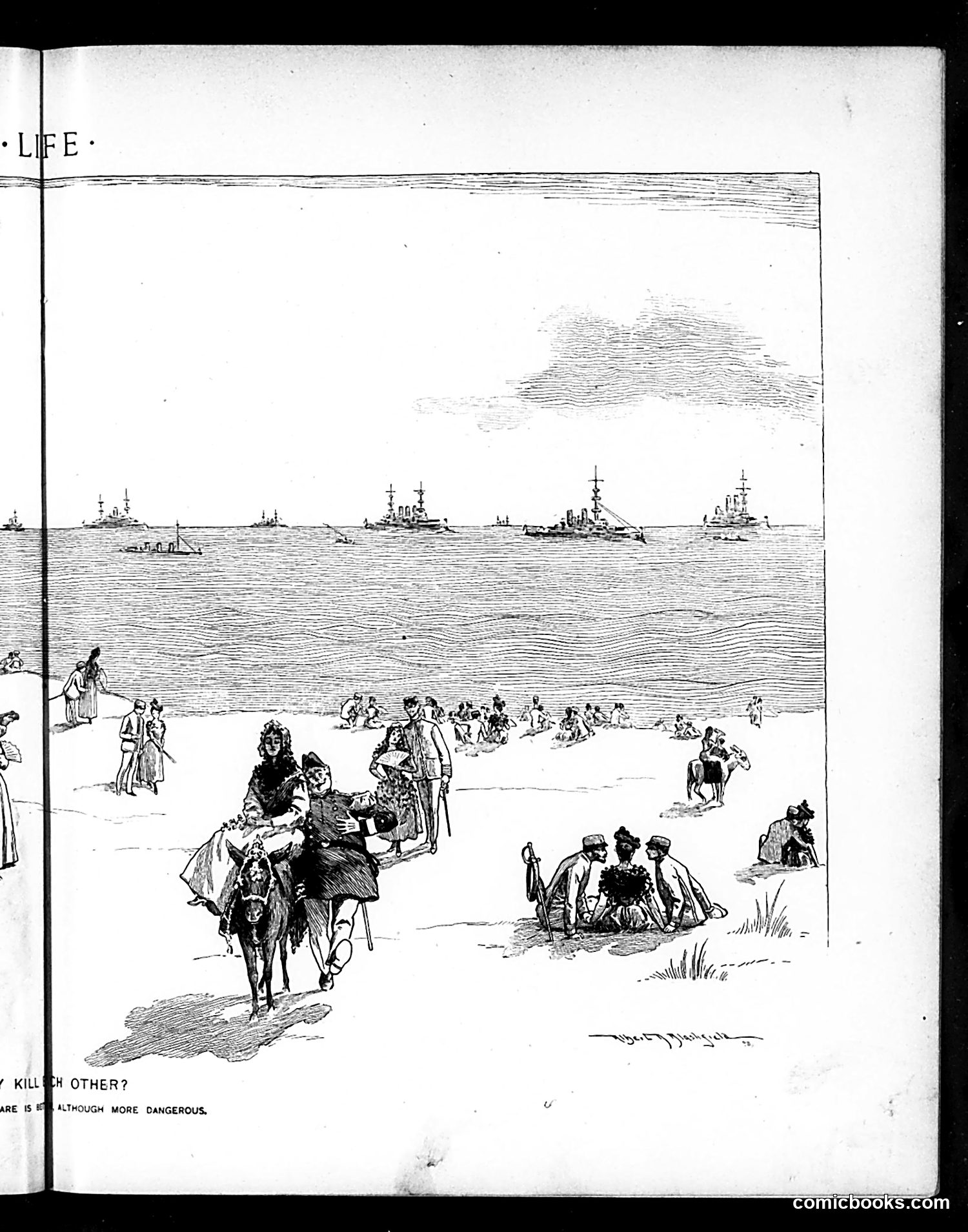
This illustration depicts a beach scene with military warships visible on the horizon. Well-dressed civilians and military personnel gather on the shore. The visible OCR text fragment reads "WHY KILL EACH OTHER?" with what appears to be "ARE IS [MORE] ALTHOUGH MORE DANGEROUS" below it. The cartoon appears to satirize the absurdity of warfare by contrasting leisurely beachgoers with an active naval military presence. The juxtaposition suggests irony about how civilians pursue peaceful recreation while military forces remain mobilized offshore—questioning the logic of military conflict when peaceful coexistence is possible. Without the complete caption or publication date, the specific historical conflict referenced remains unclear, though the naval imagery suggests this comments on early 20th-century militarization or a particular international conflict period.
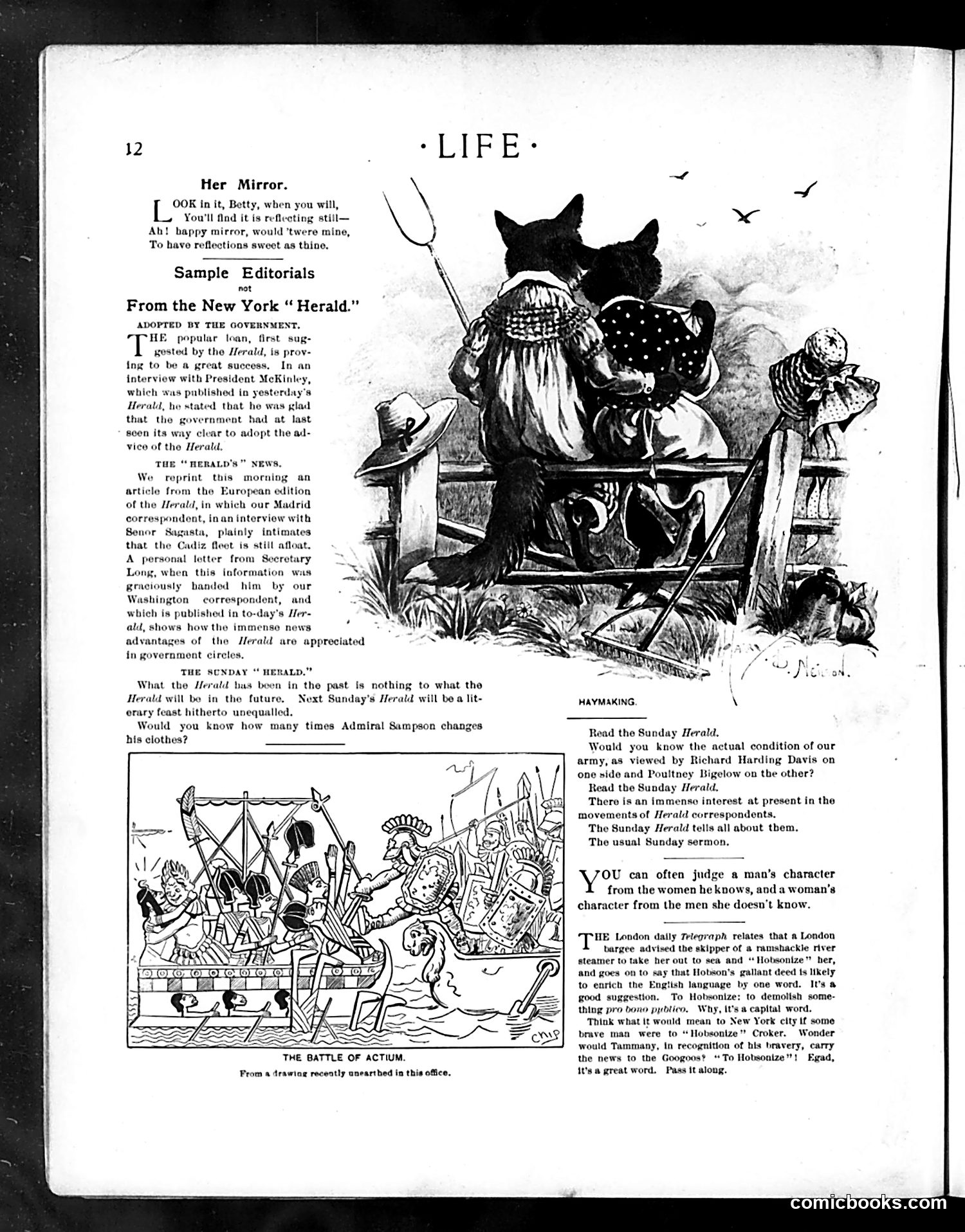
This page from *Life* magazine contains two main elements: **"Her Mirror"** (top): A sentimental poem about a woman admiring herself, paired with an illustration of a woman at a mirror with cats nearby—a gentle, domestic scene typical of the era's popular verse. **"Sample Editorials from the New York Herald"**: Text praising the *Herald* newspaper's government influence and future prospects, noting Secretary Long graciously shared information with their Washington correspondent. **"The Battle of Actium"** (bottom): A chaotic military illustration depicting a naval battle, labeled as "recently unearthed in this office"—likely a humorous fake historical drawing poking fun at the editorial staff or contemporary military affairs. The page exemplifies *Life*'s mix of light humor, social commentary, and literary content typical of early 20th-century satirical magazines.
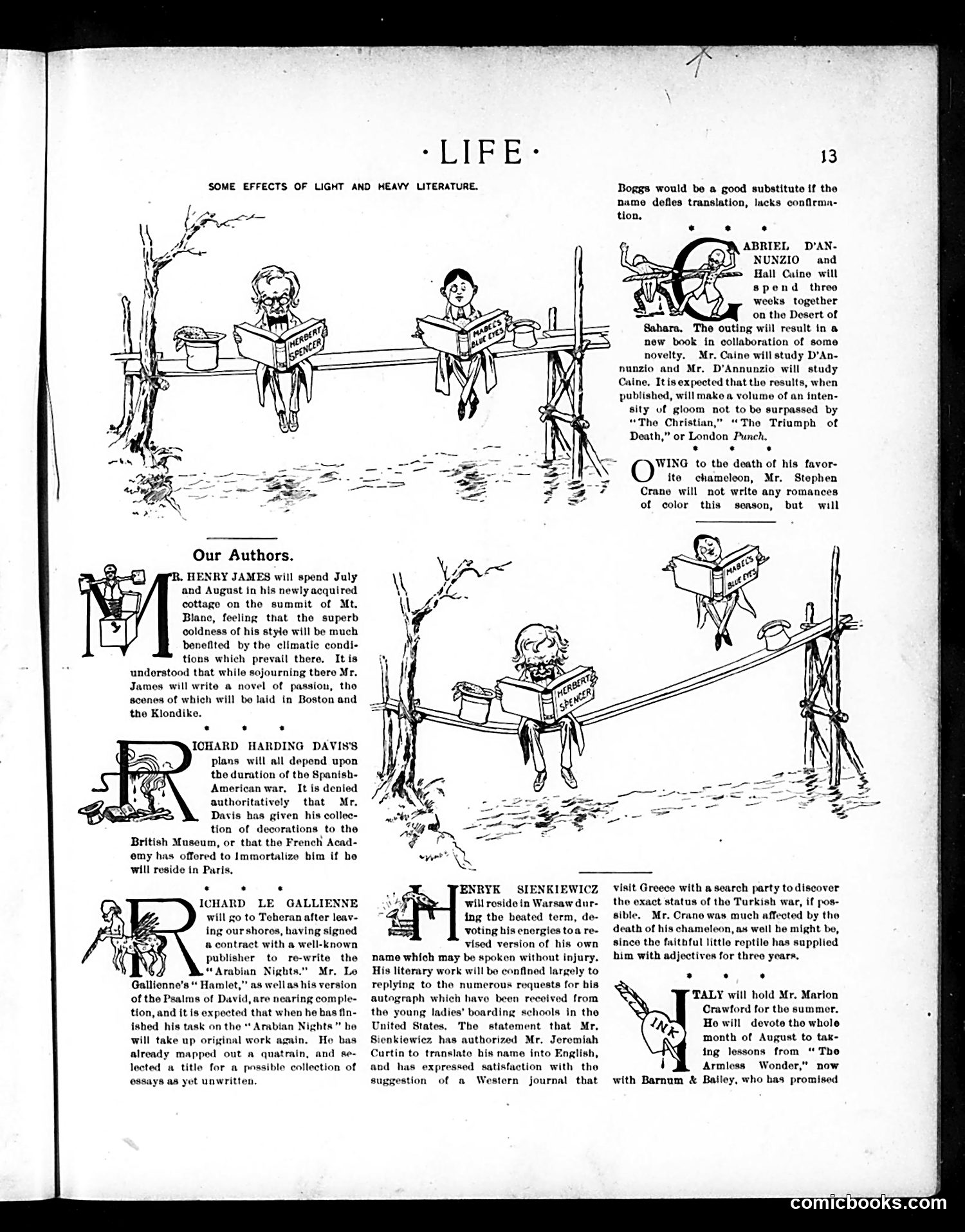
This page satirizes prominent American and European literary figures of the 1890s through absurdist humor about their summer plans and projects. **The jokes target:** - **Henry James**: His notoriously dense, "cold" writing style will supposedly benefit from Mount Blanc's climate; he'll write a "novel of passion" set implausibly in Boston and the Klondike - **Richard Harding Davis**: His plans depend on the Spanish-American War's duration (he was a war correspondent) - **Richard Le Gallienne**: He's rewriting the "Arabian Nights" while simultaneously completing other major works—an absurdly impossible schedule - **Henryk Sienkiewicz**: His Polish name is so difficult to pronounce that he's trying to rename himself; "Boggs" is mockingly suggested as a substitute - **Stephen Crane**: His chameleon (used as a color-changing writing reference) has died, so he'll search Greece for the Turkish war instead of writing - **Gabriel D'Annunzio and Hall Caine**: Their Sahara collaboration will produce a gloom-filled book The cartoon illustrations show authors precariously reading on skeletal trees—visual metaphor for the "heaviness" of their literature versus lighter reading fare.
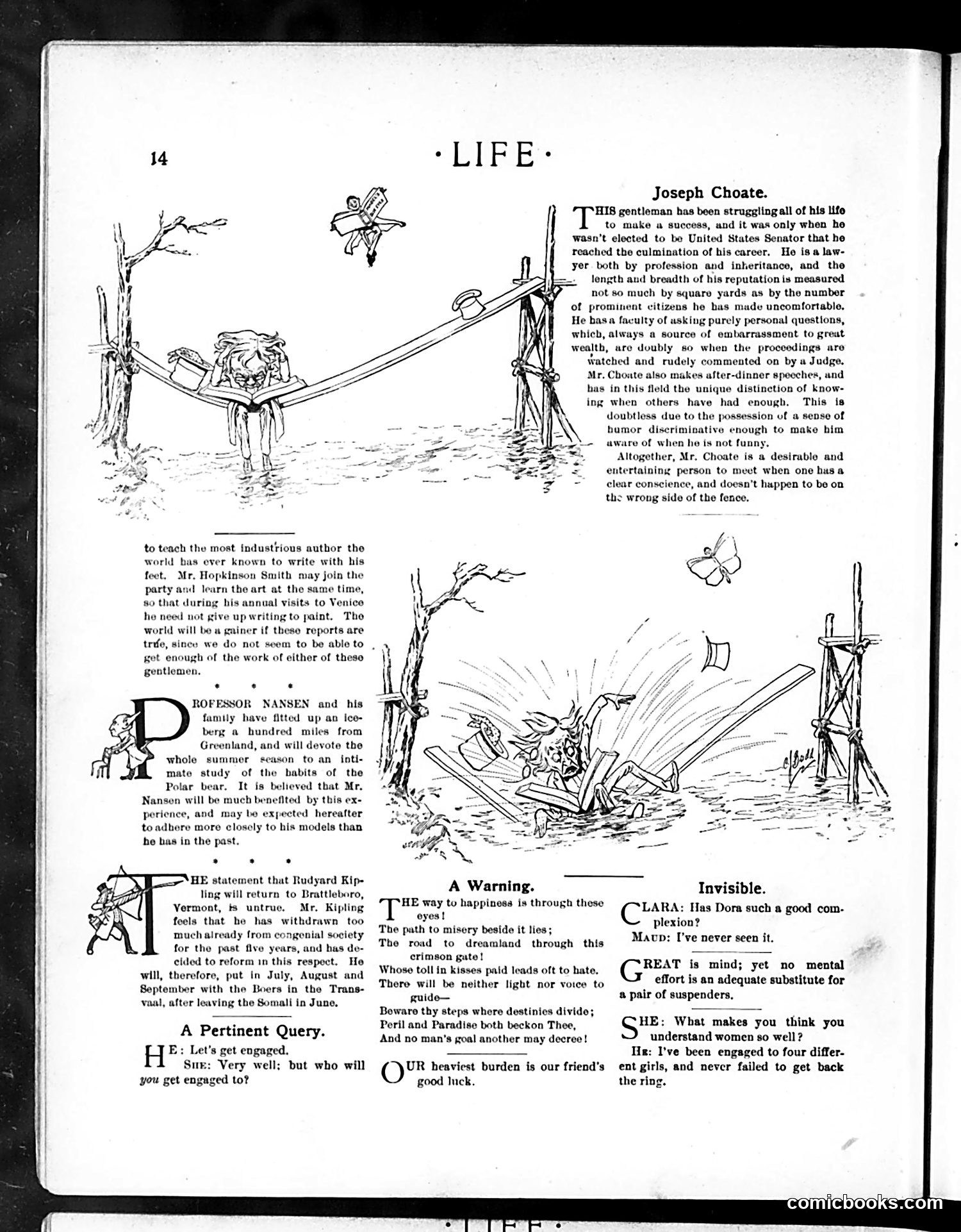
This page from *Life* magazine contains several satirical pieces mocking prominent figures of the era: **Joseph Choate** receives the main profile—a prominent lawyer and diplomat noted for asking uncomfortable personal questions at social gatherings, particularly about wealth. The satire suggests he's uncomfortable to be around unless one has a clear conscience, playing on his reputation for pointed interrogation. **Professor Nansen** is mocked for his polar bear research expedition, with backhanded praise suggesting he should "adhere more closely to his models than he has in the past"—likely critiquing his artistic or literary work as inauthentic. **Rudyard Kipling** is satirized for claiming to withdraw from society while actually planning to spend summer with the Boers in the Transvaal—contemporary reference to the Second Boer War (1899-1902), implying his stated reasons for leaving are pretextual. The remaining short humor pieces mock romance, women, and social pretensions typical of *Life*'s satirical tone. The cartoons illustrate these social comedies with period-appropriate illustrations.
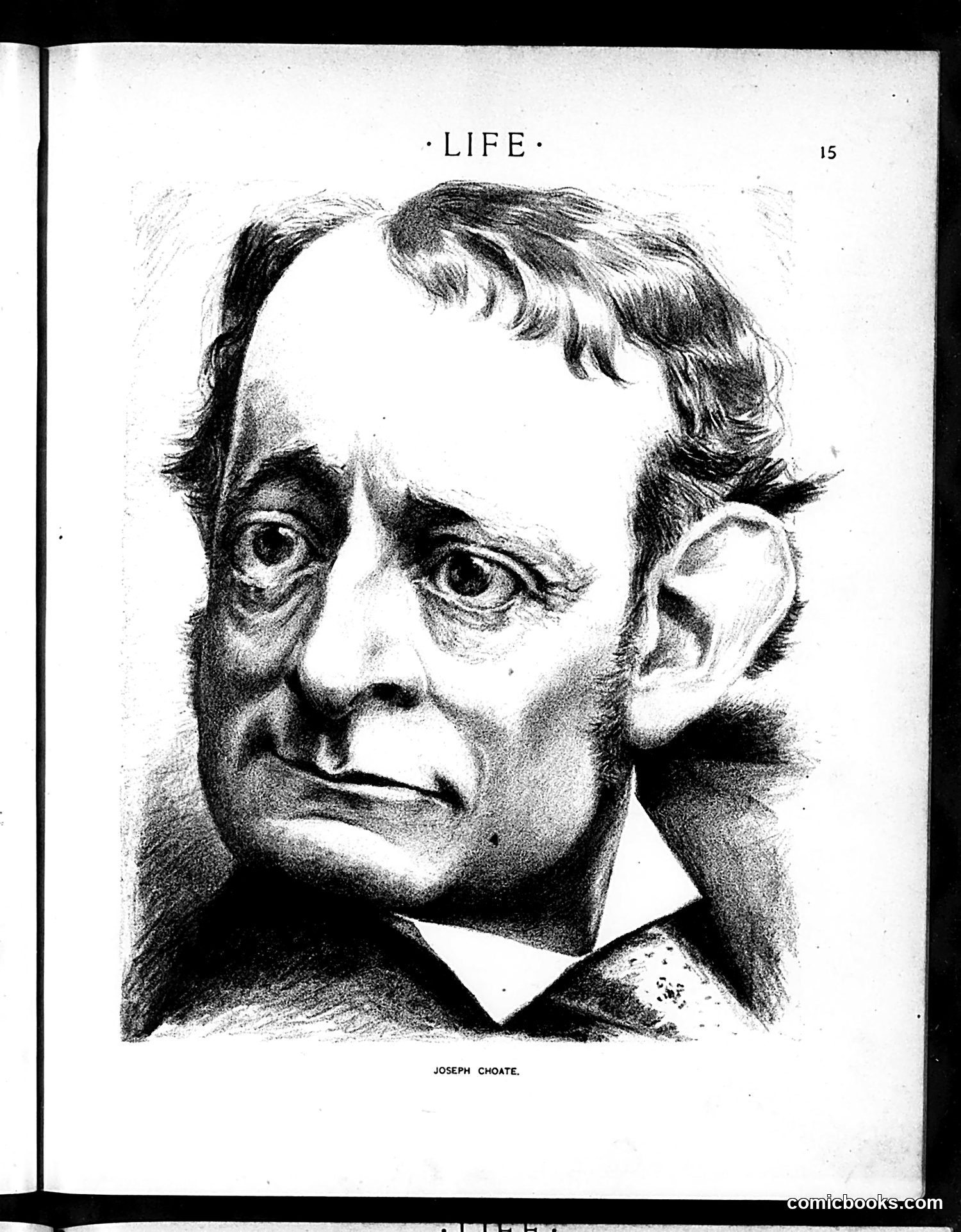
This is a portrait illustration from *Life* magazine (page 15) labeled "JOSEPH CHOATE." The image shows a detailed pen-and-ink sketch of a middle-aged man with distinctive features: thin hair, prominent eyes with deep-set expression, and a formal appearance wearing what appears to be a dress shirt and bow tie. Joseph Choate was a prominent American lawyer, diplomat, and public figure. Without additional text on this page, the satirical context isn't fully clear from the image alone. However, *Life*'s caricatured portraits typically aimed at political or social commentary on contemporary figures. The distinctive rendering of his facial features—particularly the intense eyes and pronounced expression—suggests editorial commentary, though the specific point of satire here remains unclear without accompanying article text.
This page contains **primarily advertisements and satirical definitions**, not political cartoons. The main satirical content is a glossary of terms related to the **Spanish-American War** (1898). It mocks Spanish military incompetence through mock definitions: - **Cervera** (Spanish Admiral Pascual Cervera): characterized as a "juggler with ships" who holds a record for "keeping his ships out of harm's way"—mocking his naval defeats - **Cuba**: defined as "a place that costs a lot of money to give away"—satirizing American war spending - **Fleet**: "a flock of Spanish ships which runs around the ocean and declines to let its pursuers put salt on its tail feathers"—mocking Spanish naval weakness - **Defeat**: called "a Spanish synonym for victory"—direct ridicule of Spanish military performance The upper portion reprints nostalgic Civil War poetry about "hardtack" (military rations), contrasting past American military glory with current Spanish incompetence. The advertisements (Whiting Paper, Monarch Bicycles, Yale Tobacco) are secondary content on this page.
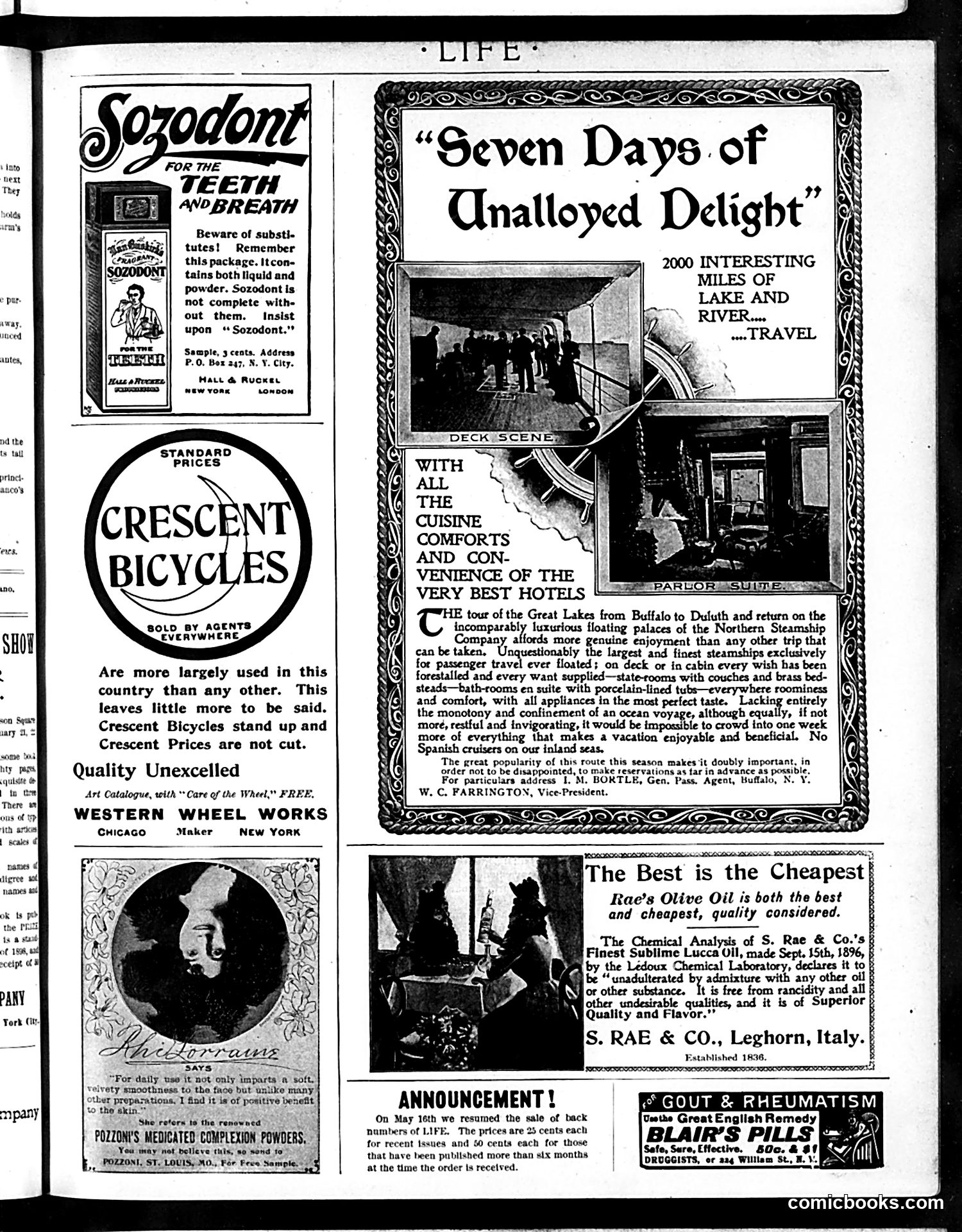
This is primarily a **advertisements page** from Life magazine, not a satirical cartoon feature. The page contains standard late-19th/early-20th-century product ads with minimal political or social commentary. Key advertisements include: - **Sozodont** (tooth powder/liquid) and **Crescent Bicycles** — promoting consumer goods - **Northern Steamship Company** — advertising luxury Great Lakes cruises marketed as "Seven Days of Unallowed Delight" - **Pozzoni's Medicated Complexion Powders** — beauty products with testimonials - **S. Rae & Co. Olive Oil** and **Blair's Pills** — health/wellness products The page's only notable social reference is the **steamship ad's dismissive comment** about "No Spanish cruisers on our inland seas" — likely referencing recent Spanish-American War anxieties (1898), suggesting American steamship superiority and safety. Otherwise, this reflects typical turn-of-century consumer culture: bicycles as novelty status symbols, medicinal powders for beauty, and luxury leisure travel for the affluent.
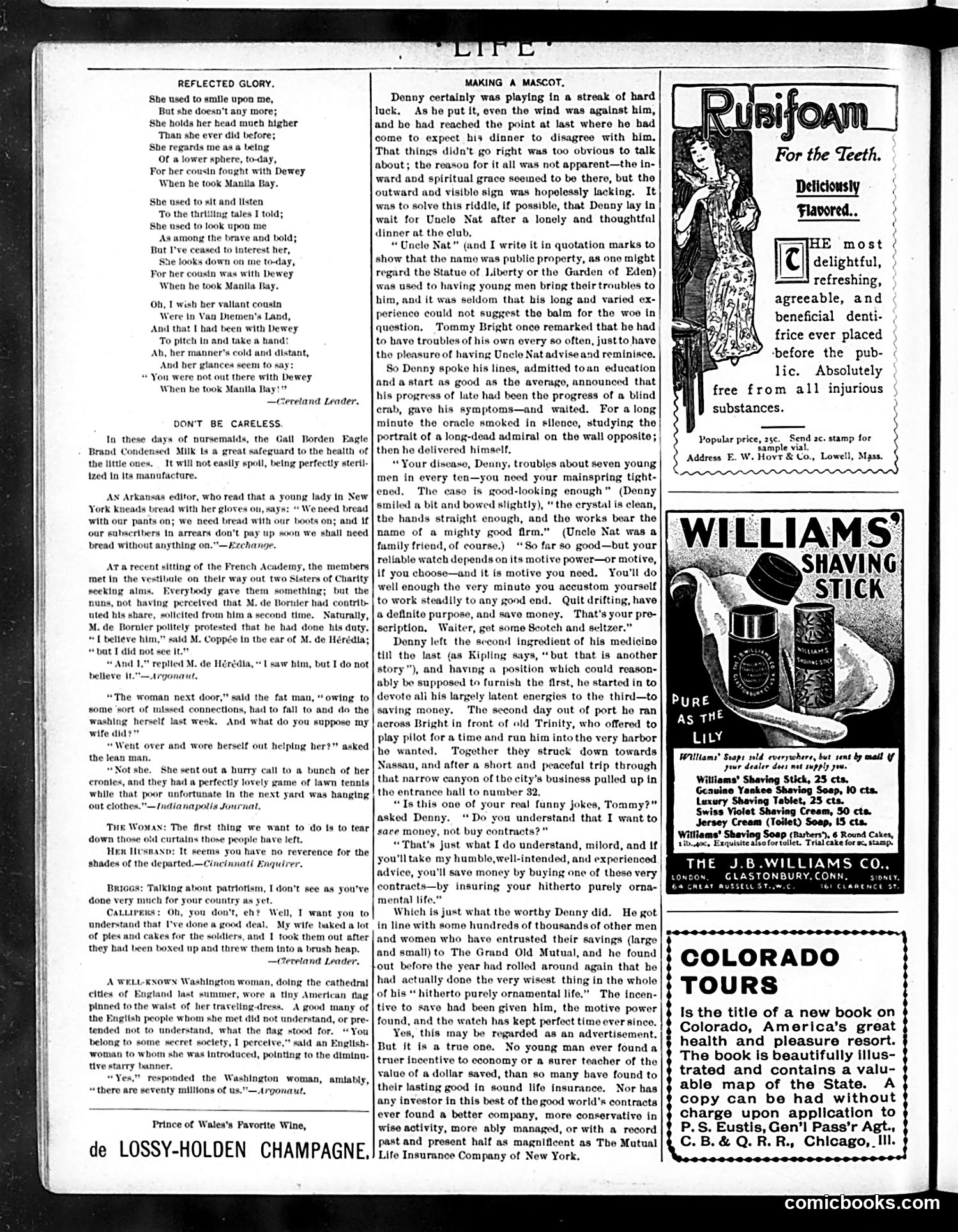
This page contains primarily **humorous prose and poetry** rather than political cartoons. The main satirical content is: **"Reflected Glory"** (poem): A man laments losing a woman's romantic interest because her cousin fought with Admiral Dewey at Manila Bay (during the 1898 Spanish-American War). She now considers herself socially superior through this "reflected glory" of her relative's military service. The satire mocks how people capitalize on others' accomplishments for social status. **"Making a Mascot"** (prose): A story about a man named Denny experiencing bad luck, with the narrative suggesting he's become a social "mascot" or object of pity. The other items are brief humorous anecdotes about social situations and human nature—not political commentary. **Context for modern readers**: The Dewey reference assumes knowledge of the Spanish-American War and Admiral Dewey's fame, which made military service in that conflict a status marker in 1898-99 America. The satire targets social climbing and unearned prestige. The page is primarily **advertising** (Rubifoam toothpaste, Williams' Shaving Stick, Colorado Tours guide).
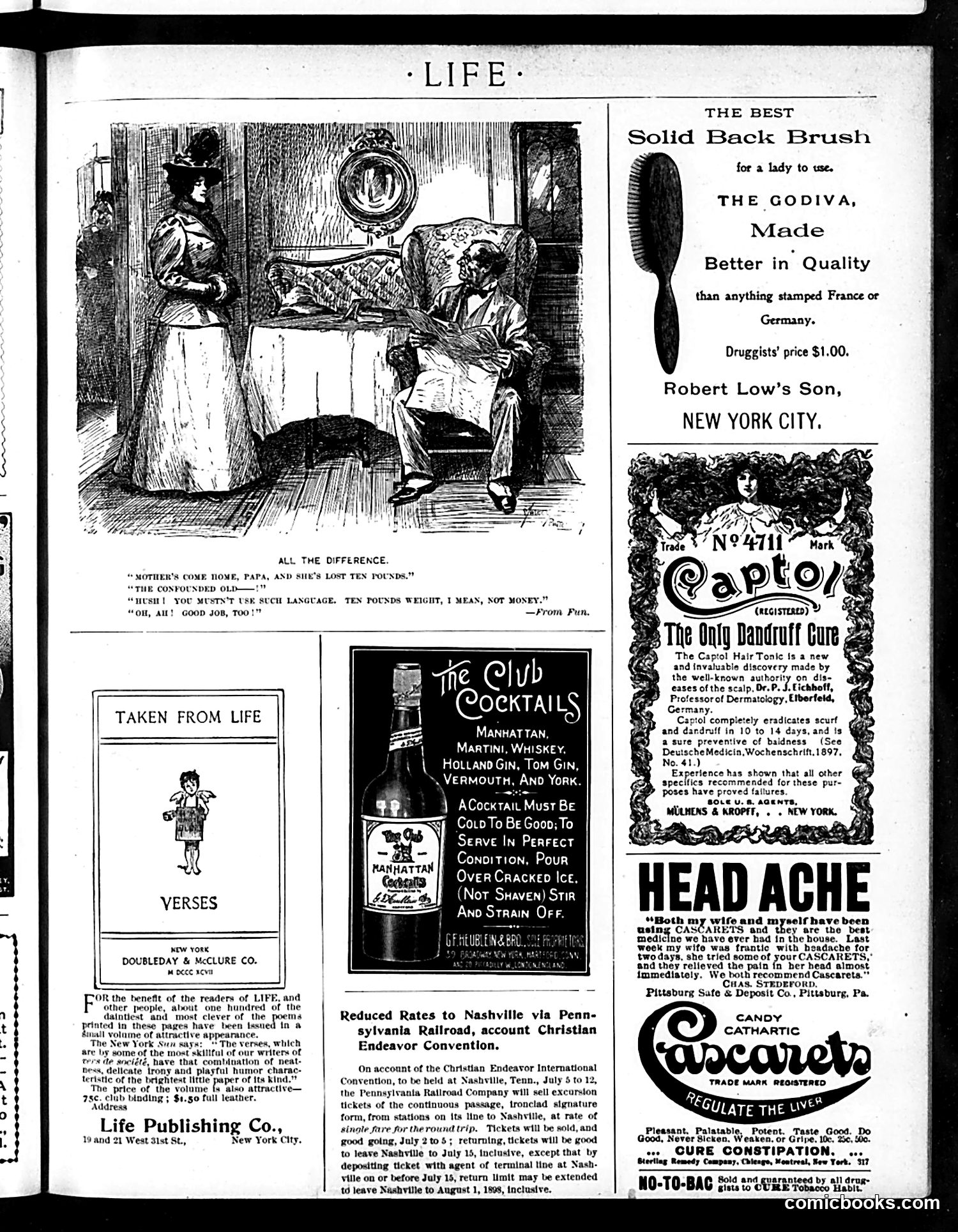
This page is primarily **advertisements with one satirical cartoon**. The cartoon, titled "All the Difference," depicts a domestic scene where a wife has returned home after losing ten pounds in weight. The husband initially misunderstands, thinking she's lost money and reacting with profanity ("The confounded old—!"). When corrected that she's lost *weight*, not money, he approves: "Oh, all! Good job, too!" **The satire**: The joke mocks Victorian-era gender relations and priorities. It suggests husbands care far more about their wives' physical appearance and weight than their financial management—even joking that weight loss is worth celebrating more than monetary loss would be regrettable. This reflects period attitudes about women's bodies as objects of male approval and the trivialization of women's concerns. The "clever" wordplay (weight vs. money) was typical of *Life* magazine's humor style. The remainder is product advertising: brushes, poetry collections, cocktail recipes, train tickets, hair tonics, and patent medicines—typical of the magazine's revenue model.
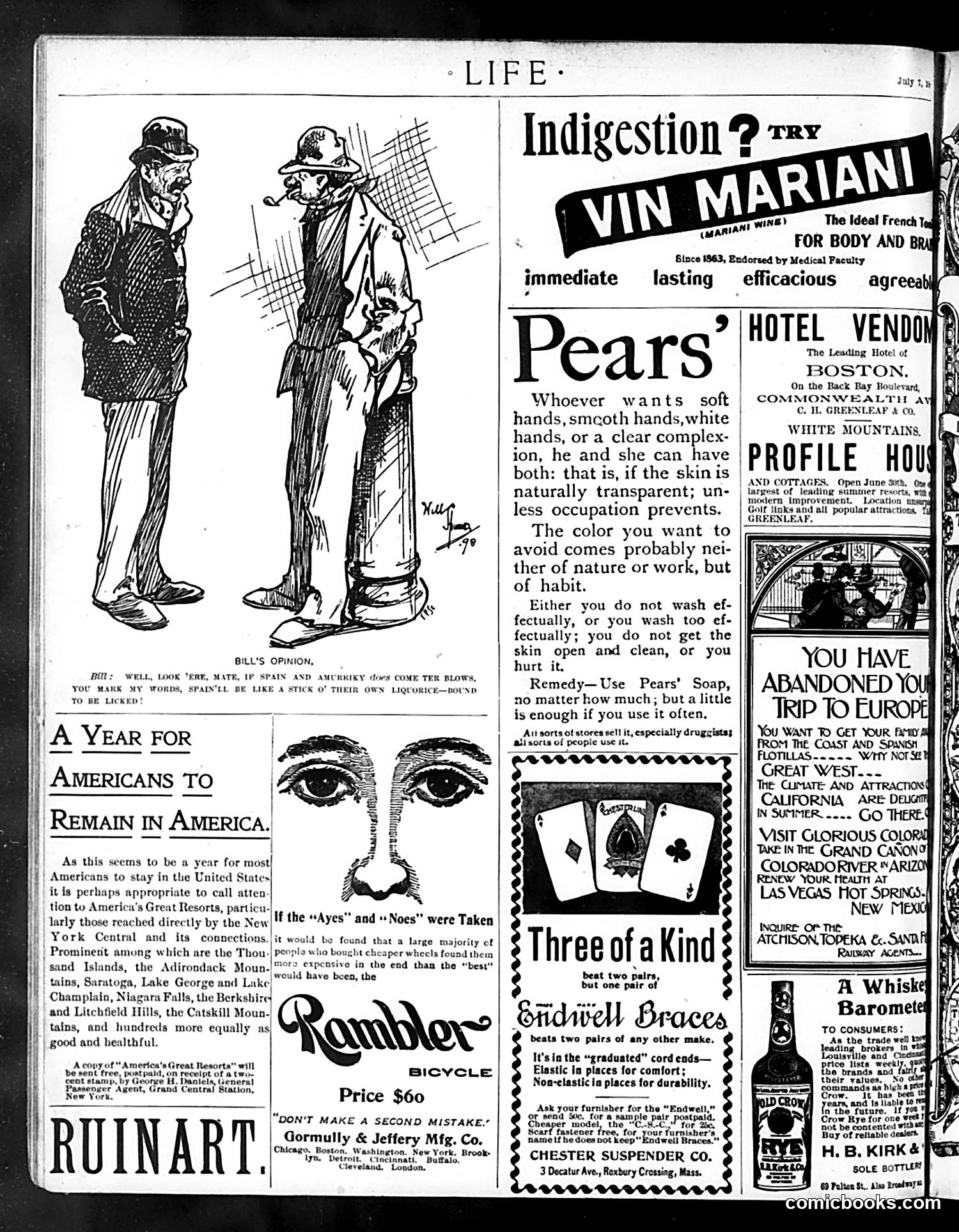
This political cartoon satirizes American attitudes toward the Spanish-American War (likely 1898). Two men in working-class dress—identifiable by their accents rendered in dialect—discuss potential conflict between Spain and America. The figure on the left, labeled "Bill," employs a British accent and colorful metaphor: if Spain and America go to war, Spain will be "like a stick o' their own liquorice—bound to be licked!" The satire mocks overconfident predictions of American military superiority. The cartoon captures popular sentiment that America would easily defeat Spain, while also gently ridiculing both the dialect humor common to period comedy and the bravado surrounding imperial ambitions. The accompanying editorial promoting domestic tourism suggests the magazine's broader message: Americans should remain confident in their nation's resources and strength.