
Life, 1898-07-07 · page 4 of 20
Life — July 7, 1898 — page 4: what you’re looking at
What you’re looking at
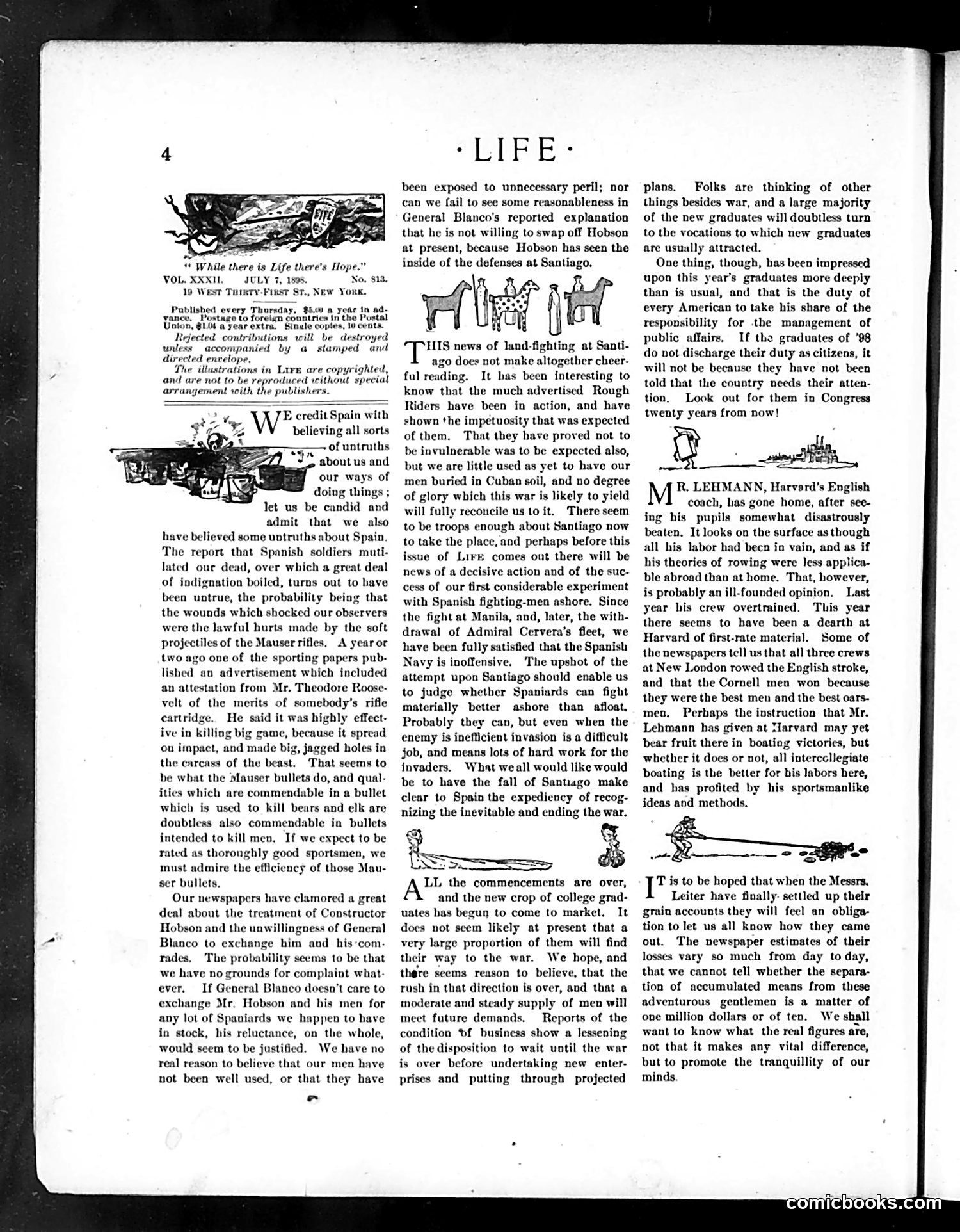
This page discusses the Spanish-American War, specifically the Battle of Santiago de Cuba. The text debates whether General Blanco and General Shafter's military strategies were sound. The cartoons (though small and somewhat unclear) appear to illustrate war-related themes, possibly depicting soldiers or military equipment relevant to the Santiago campaign. The editorial argues that Spanish resistance has proven less formidable than expected, and that America should prepare for post-war considerations. It discusses college graduates' duty to engage in public affairs, and mentions debates over rowing competitions at Harvard versus other institutions. The overall tone suggests cautious optimism about American military prospects while urging serious civic engagement from educated Americans regarding the war's conclusion and aftermath.
📄 Transcribed text from this page (OCR, searchable)
Machine-transcribed from the original scan — historical spelling and the odd misread are preserved.
e is Life there’s Hope.” 7, 1898. No. 813. New Youk. Published every Thursday, $5.00 a year in ad- vance. Hostage to foreign countries in the Postal Union, @L06 a year extra. Single copies, 10 cents. Rejected contributions will be destroyed unless accompanied by a@ stamped ant directed envelope. The illustrations in Lire are copyrighted, anil are not to be reproduced without special arrangement with the publishers. credit Spain with believing all sorts of untruths about us and our ways of doing things ; let us be candid and admit that we also have believed some untruths about Spain. The report that Spanish soldiers muti- lated our dead, over which a great deal of indignation boiled, turns out to have been untrue, the probability being that the wounds which shocked our observers were the lawful hurts made by the soft projectiles of the Mauser rifles. A year or two ago one of the sporting papers pub- lished an advertisement which included an attestation from Mr, Theodore Roose- velt of the merits of somebody's rifle cartridge. He said it was highly effect- ive in killing big game, because it spread on impact, and made big, jagged holes in the carcass of the beast. That seems to be what the Mauser bullets do, and qual- ities which are commendable in a bullet which is used to kill bears and elk are doubtless also commendable in bullets intended to kill men. If we expect to be rated as thoroughly good sportsmen, we must admire the efficiency of those Mau- ser bullets. Our newspapers have clamored a great decal about the treatment of Constructor Hobson and the unwillingness of General Blanco to exchange him and his‘com- rades. The probability seems to be that we have no grounds for complaint what- ever. If General Blanco doesn’t care to exchange Mr. Hobson and his men for any lot of Spaniards we happen to have in stock, his reluctance, on the whole, would scem to be justified. We have no real reason to believe that our men have not been well used, or that they bave rd “ERPE been exposed to unnecessary peril; nor can we fail to see some reasonableness in General Blanco's reported explanation that he is not willing to swap off Hobson at present, because Hobson has seen the inside of the defenses at Santiago. alle Mad Ts news of land-fighting at Santi- ago does not make altogether cheer- ful reading. It has been interesting to know that the much advertised Rough Riders have been in action, and have shown the impetuosity that was expected of them. That they have proved not to be invulnerable was to be expected also, but we are little used as yet to have our men buried in Cuban soil, and no degree of glory which this war is likely to yield will fully reconcile us to it. There seem to be troops enough about Santiago now to take the place, and perhaps before this issue of Lire comes out there will be news of a decisive action and of the suc- cess of our first considerable experiment with Spanish fighting-men ashore. Since the fight at Manila, and, later, the with- drawal of Admiral Cervera’s fleet, we have been fully satisfied that the Spanish Navy is inoffensive. The upshot of the attempt upon Santiago should enable us to judge whether Spaniards can fight materially better ashore than afloat, Probably they can, but even when the enemy is inefficient invasion is a difficult job, and means lots of hard work for the invaders. What weall would like would be to have the fall of Santiago make clear to Spain the expediency of recog- nizing the inevitable and cnding the war. : a LL the commencements are over, and the new crop of college grad- uates has begun to come to market. It does not seem likely at present that a very large proportion of them will find their way to the war. We hope, and there seems reason to believe, that the rush in that direction is over, and that a moderate and steady supply of men will meet future demands. Reports of the condition Sf business show a lessening of the disposition to wait until the war is over before undertaking new enter- prises and putting through projected plans. Folks are thinking of other things besides war, and a large majority of the new graduates will doubtless turn to the vocations to which new graduates are usually attracted. One thing, though, has been impressed. upon this year’s graduates more deeply than is usual, and that is the duty of every American to take his share of the responsibility for the management of public affairs. If the graduates of '98 do not discharge their duty as citizens, it will not be because they have not been told that the country needs their atten- tion, Look out for them in Congress twenty years from now! R. LEHMANN, Harvord’s English coach, has gone home, after see- ing his pupils somewhat disastrously beaten. It looks on the surface as though all his labor had bec in vain, and as if his theories of rowing were less applica- ble abroad than at home. That, however, is probably an ill-founded opinion. Last year his crew overtrained. This year there seems to have been a dearth at Harvard of first-rate material. Some of the newspapers tell us that all three crews at New London rowed the English stroke, and that the Cornell men won because they were the best men and the best oars- men, Perhaps the instruction that Mr. Lehmann has given at Harvard may yet bear fruit there in boating victories, but whether it does or not, all interccllegiate boating is the better for his labors here, and has profited by his sportsmanlike ideas and methods, T is to be hoped that when the Messrs, Leiter have finally: settled up their grain accounts they will feel an obliga- tion to let us all know how they came out. The newspaper estimates of their losses vary so much from day to day, that we cannot tell whether the separa- tion of accumulated means from these adventurous gentlemen is a matter of one million dollars or of ten. We shall want to know what the real figures are, not that it makes any vital difference, but to promote the tranquillity of our minds.