
A complete issue · 21 pages · 1898
Life — June 30, 1898
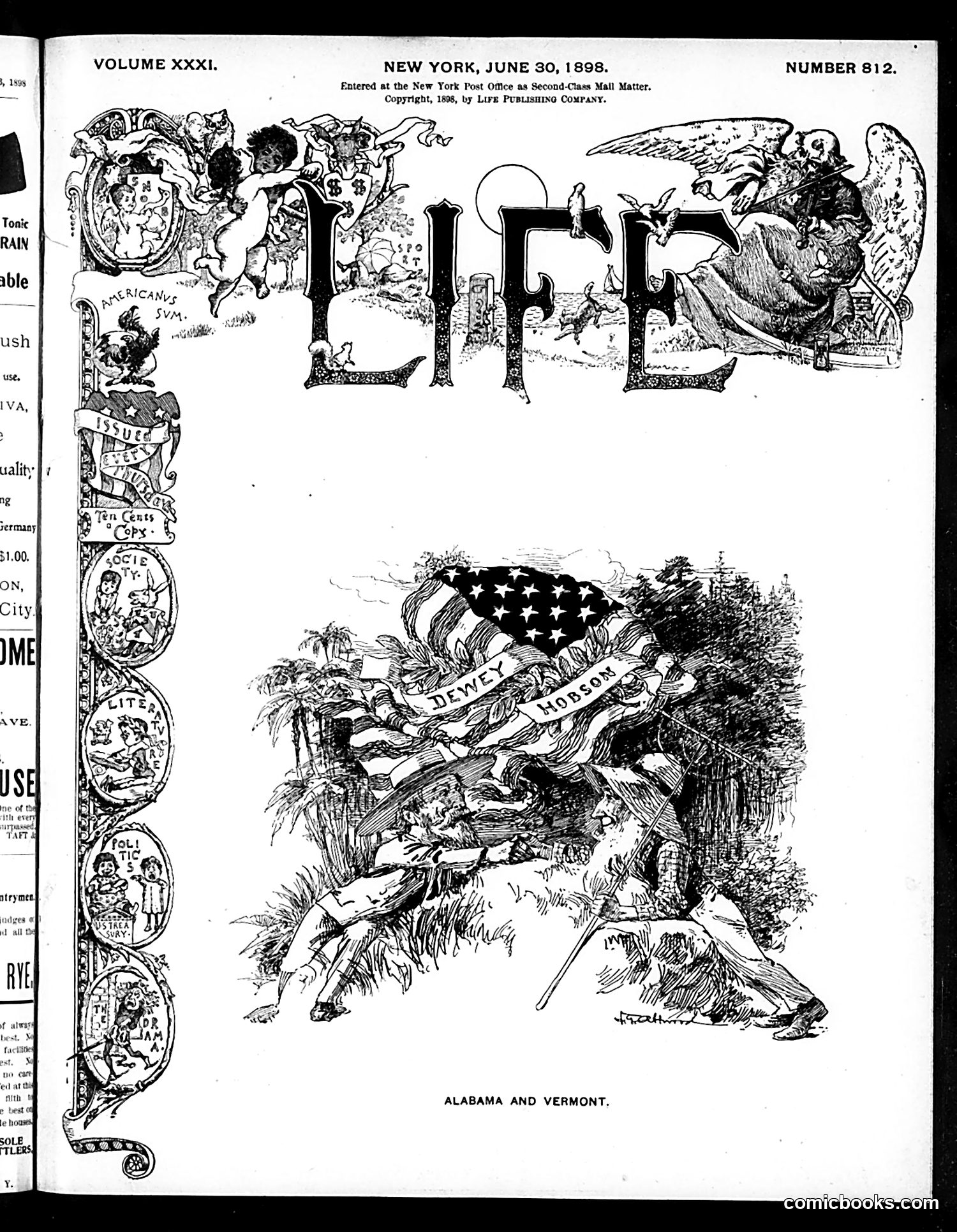
This political cartoon satirizes two U.S. states through personification. The figures labeled "DEWEY" and "HOBSON" appear to reference Admiral George Dewey and Lieutenant Richmond Hobson, both celebrated naval heroes from the Spanish-American War (1898). The cartoon likely critiques how different regions of America were responding to or capitalizing on wartime nationalism. The ornate left border contains allegorical medallions representing American themes and institutions. The magazine's masthead features elaborate decorative elements typical of late-Victorian design. Without additional context visible on this page, the specific criticism of Alabama and Vermont remains unclear, though it likely involves contrasting regional attitudes toward the war or national politics of that moment.
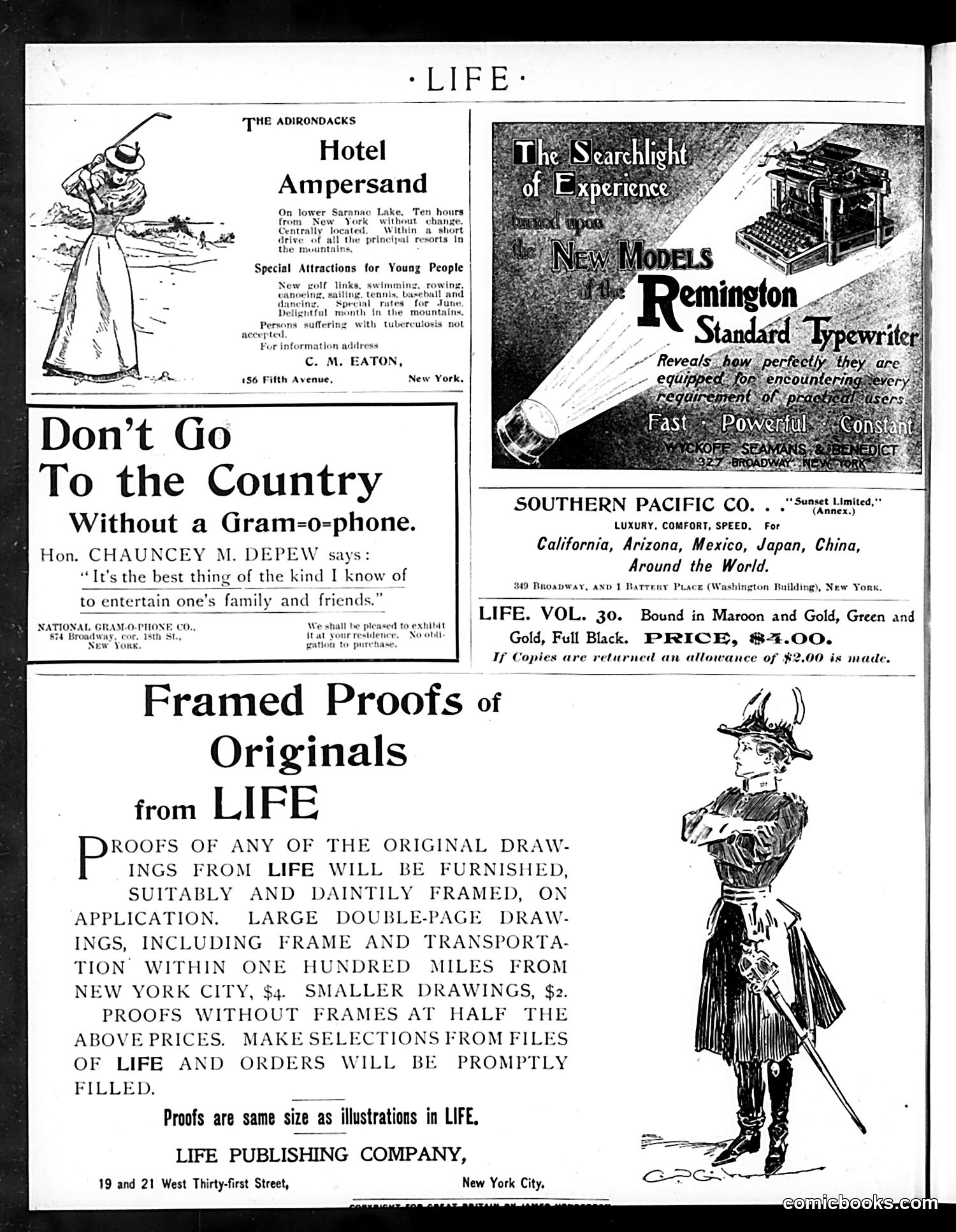
This page is primarily **advertising**, not political satire. It contains commercial promotions for: 1. **Hotel Ampersand** — a Adirondack resort offering recreational activities 2. **Gram-o-phone** — a phonograph device, endorsed by Hon. Chauncey M. Depew as entertainment for family and friends 3. **Remington Standard Typewriter** — highlighting new models 4. **Southern Pacific Co.** — travel services to California, Arizona, Mexico, Japan, and China 5. **LIFE magazine itself** — offering framed proofs of original drawings from the publication The decorative illustrations (a woman in period dress, a military figure) are typical of early 20th-century advertisement styling but carry no specific political meaning. This appears to be a back-page or interior advertising section rather than editorial content featuring satire or commentary.
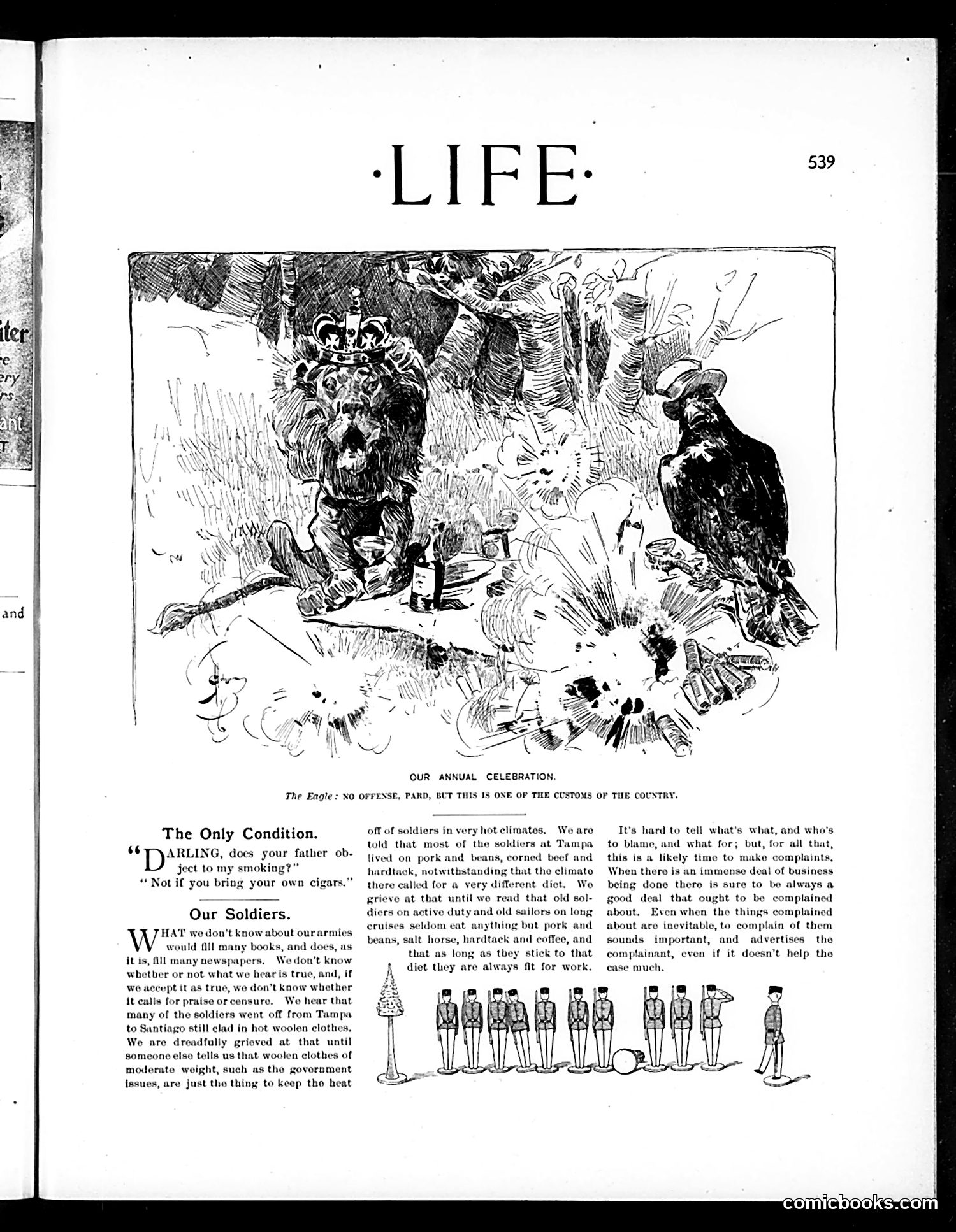
**Top Cartoon ("Our Annual Celebration"):** An eagle (symbol of America) presides over what appears to be a formal military or governmental gathering. The caption states this depicts "one of the customs of the country," suggesting satire of American traditions or ceremonies. **Main Articles:** "**The Only Condition**" presents a humorous domestic dispute about smoking—a father objects to his daughter's cigar smoking. "**Our Soldiers**" critiques military conditions, particularly soldiers deployed to hot climates like Tampa (likely Spanish-American War era). The piece mocks the impracticality of woolens in tropical heat and catalogs soldiers' complaints about inadequate food and supplies—pork, salt horse, hardtack, coffee. The satirical point: despite genuine hardships, soldiers are encouraged to complain minimally about "inevitable" wartime inconveniences. The bottom illustration shows uniformed soldiers in formation, reinforcing the military subject matter.
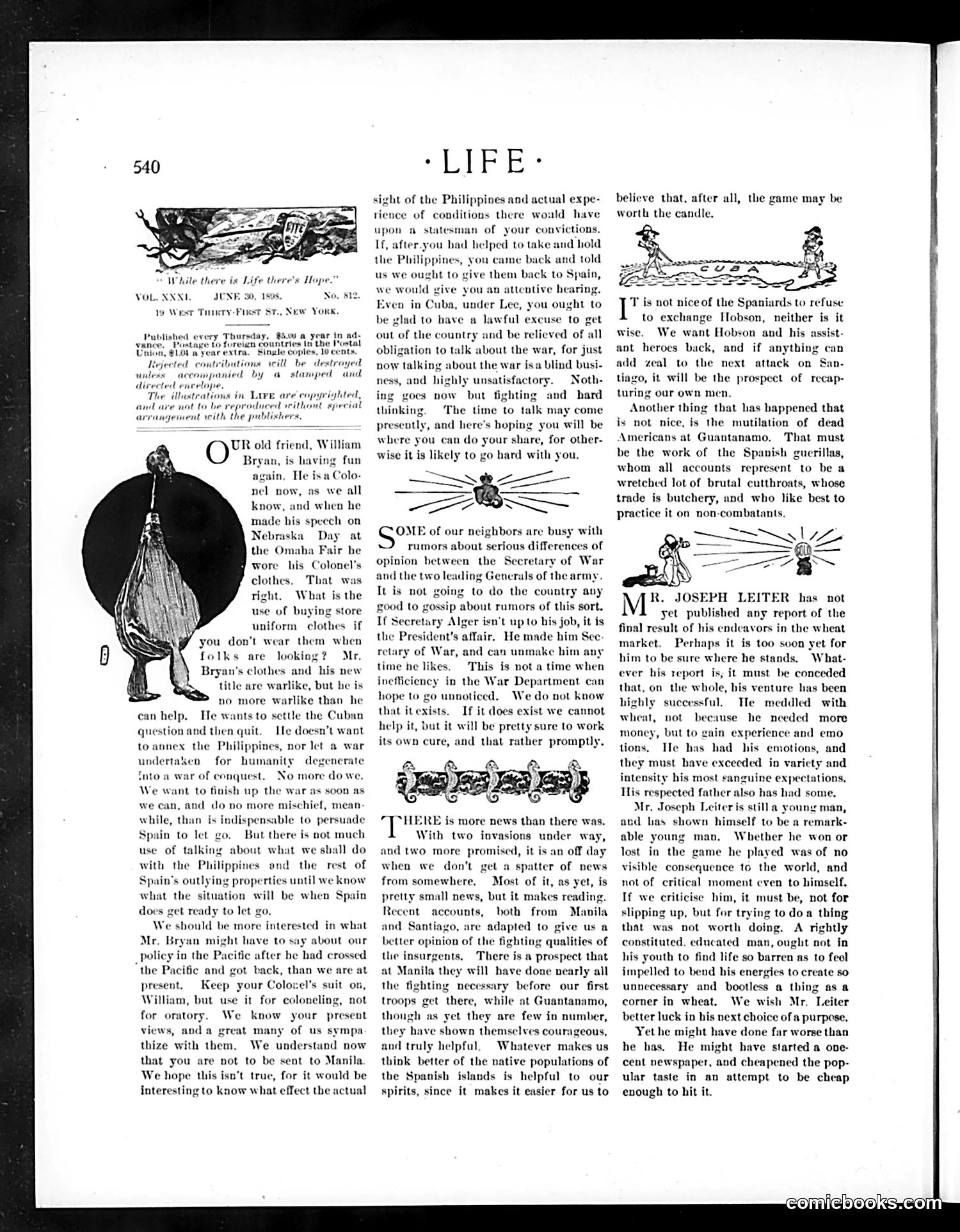
This page contains editorial commentary on the Spanish-American War, then underway. The main cartoon depicts **William Jennings Bryan** in military uniform, sarcastically addressing concerns about his fitness as a political leader. The text discusses military matters: Secretary of War Alger's competence, rumors about army leadership, and news from the Philippines and Cuba. A secondary item criticizes **Joseph Leiter**, a young businessman/speculator, for failing to publish market reports—suggesting he's inexperienced and unworthy of public attention. The overall tone mocks political figures and military leadership during wartime while dismissing lesser figures as undeserving of serious consideration. The satire targets both incompetence and overreaching ambition among public figures.
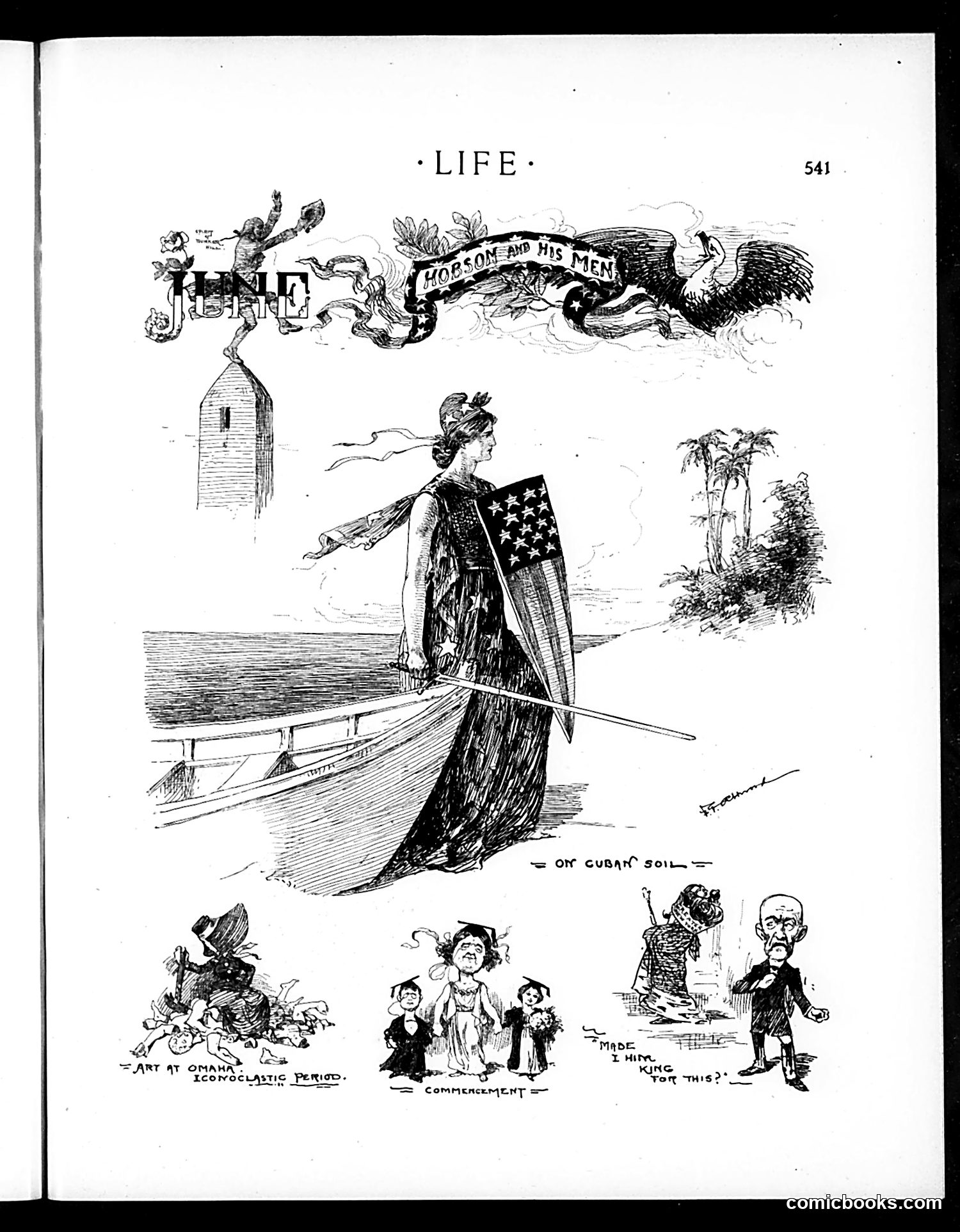
This page presents political satire from the Spanish-American War era, likely early 1900s. The central figure is Lady Liberty/Columbia (personification of America) holding the American flag, standing on Cuban soil. The banner at top reads "Hobson and His Men," referencing Lieutenant Richmond Pearson Hobson, a naval hero from the conflict. The lower vignettes mock American imperialism: "Art at Omaha: Iconoclastic Period" satirizes cultural destruction; "Commencement" appears to reference nation-building efforts; "Made I Him King for This?" questions whether America has created problematic leadership in territories it controls. The overall message critiques American expansion in Cuba and its consequences—suggesting the nation's ideals may be compromised through imperial conquest.
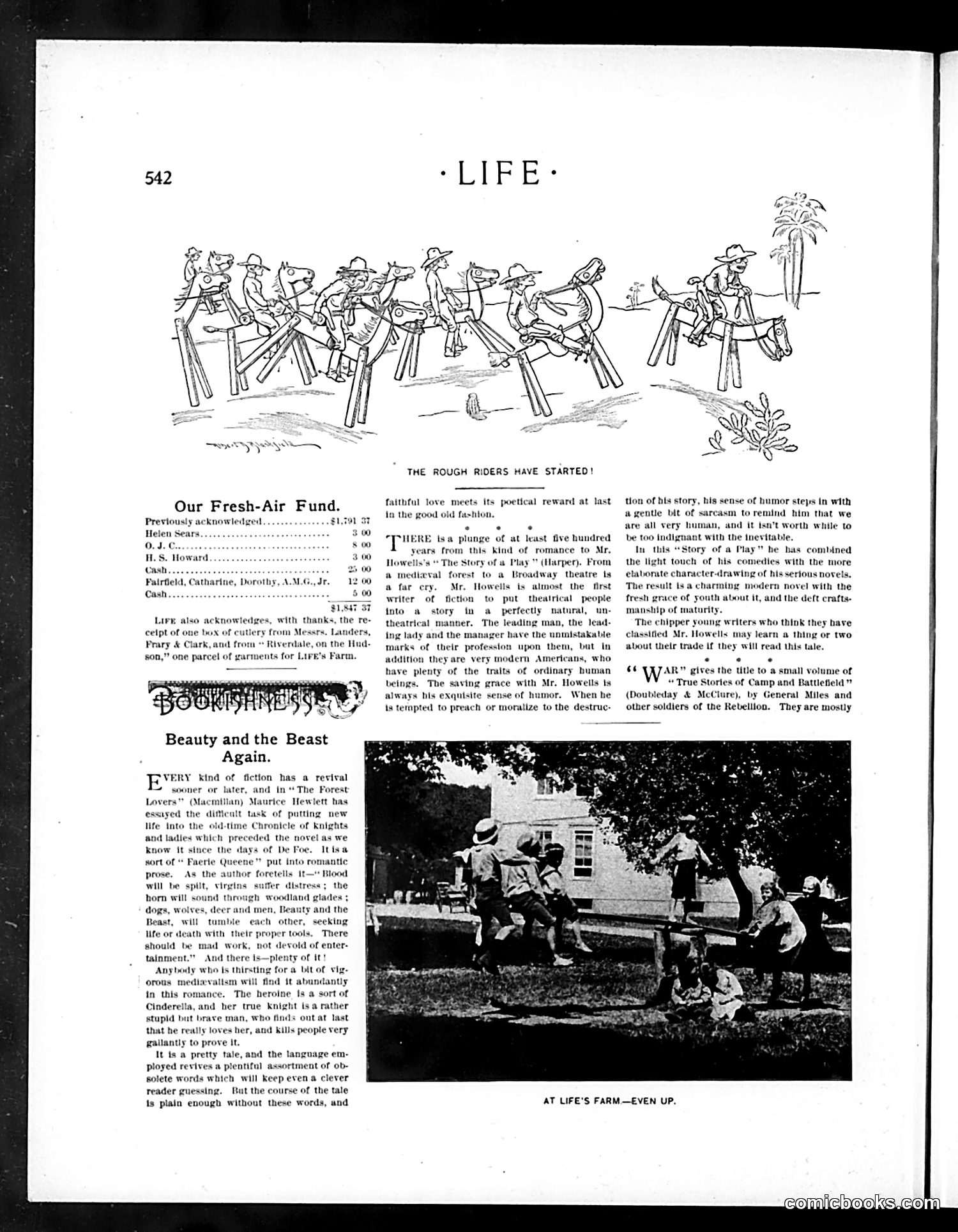
**Top Cartoon: "The Rough Riders Have Started"** This depicts mounted soldiers in a comedic, chaotic scene. Given the caption and the style, this likely satirizes Theodore Roosevelt's famous Rough Riders cavalry unit from the Spanish-American War (1898). The exaggerated, tumbling poses mock the unit's romanticized reputation, suggesting incompetence or comic disorder beneath the heroic mythology. **"Our Fresh-Air Fund" Section:** Lists charitable donations—a legitimate fundraising announcement, not satire. **"Beauty and the Beast Again" Section:** A book review of Maurice Hewlett's "The Forest Lovers," discussing a romantic tale set in medieval times. This is genuine literary criticism, not political satire. The page mixes satirical cartoons with straightforward cultural content typical of Life magazine's format.
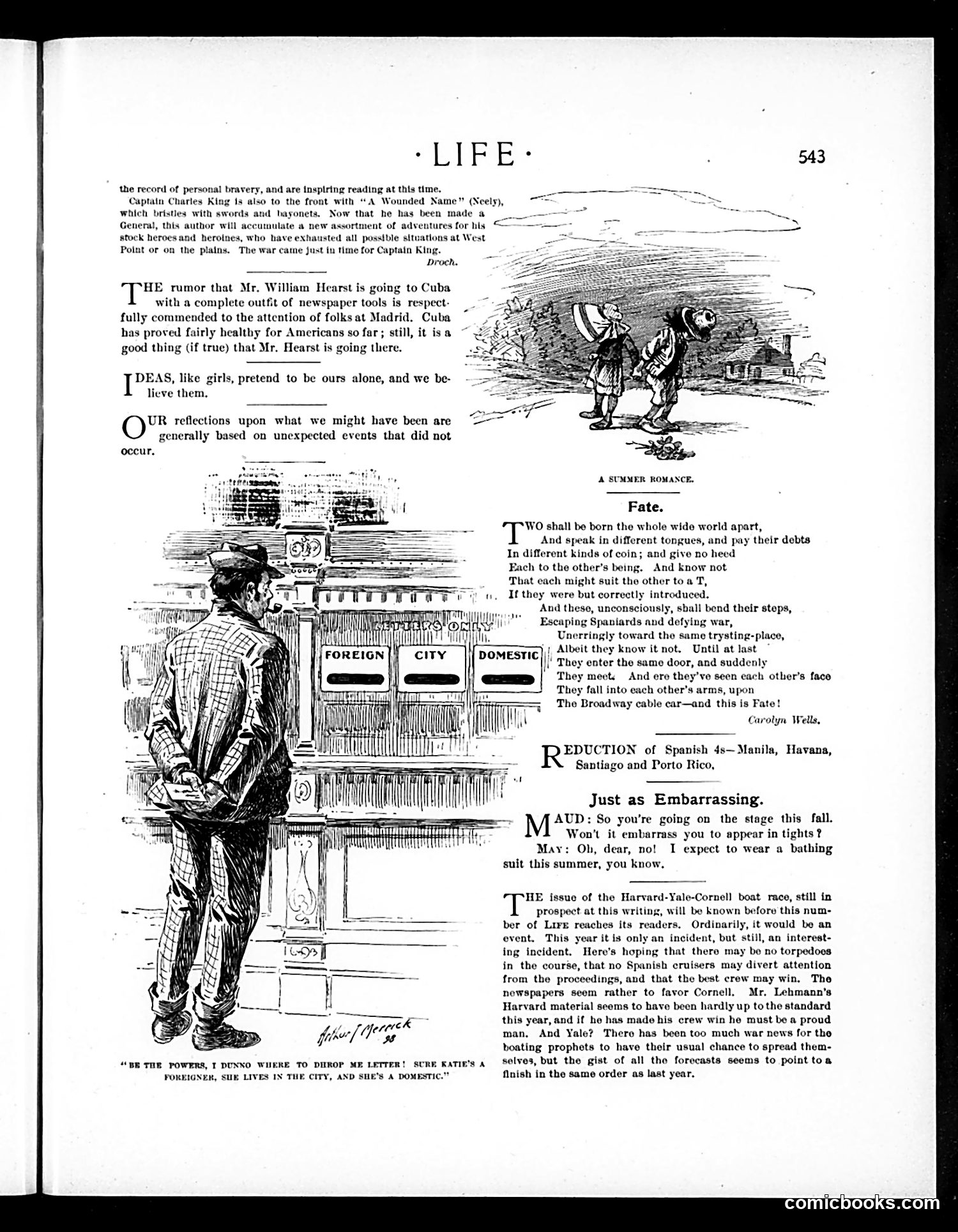
The main cartoon depicts a man at a ticket booth labeled "Foreign City" and "Domestic," captioned: "Be the powers, I dunno where to drop me letter! Sure Katie's a foreigner, she lives in the city, and she's a domestic." This is a joke about Irish immigration and domestic service. The humor relies on the confusion between "foreigner" (immigrant) and "domestic" (household worker), suggesting an Irish immigrant man trying to mail a letter to a woman named Katie who works as a domestic servant in the city. The dialect ("Be the powers," "dunno") and Irish name reinforce ethnic stereotyping common to early 20th-century American satire, mocking both Irish immigrants and the class divisions of urban domestic labor.
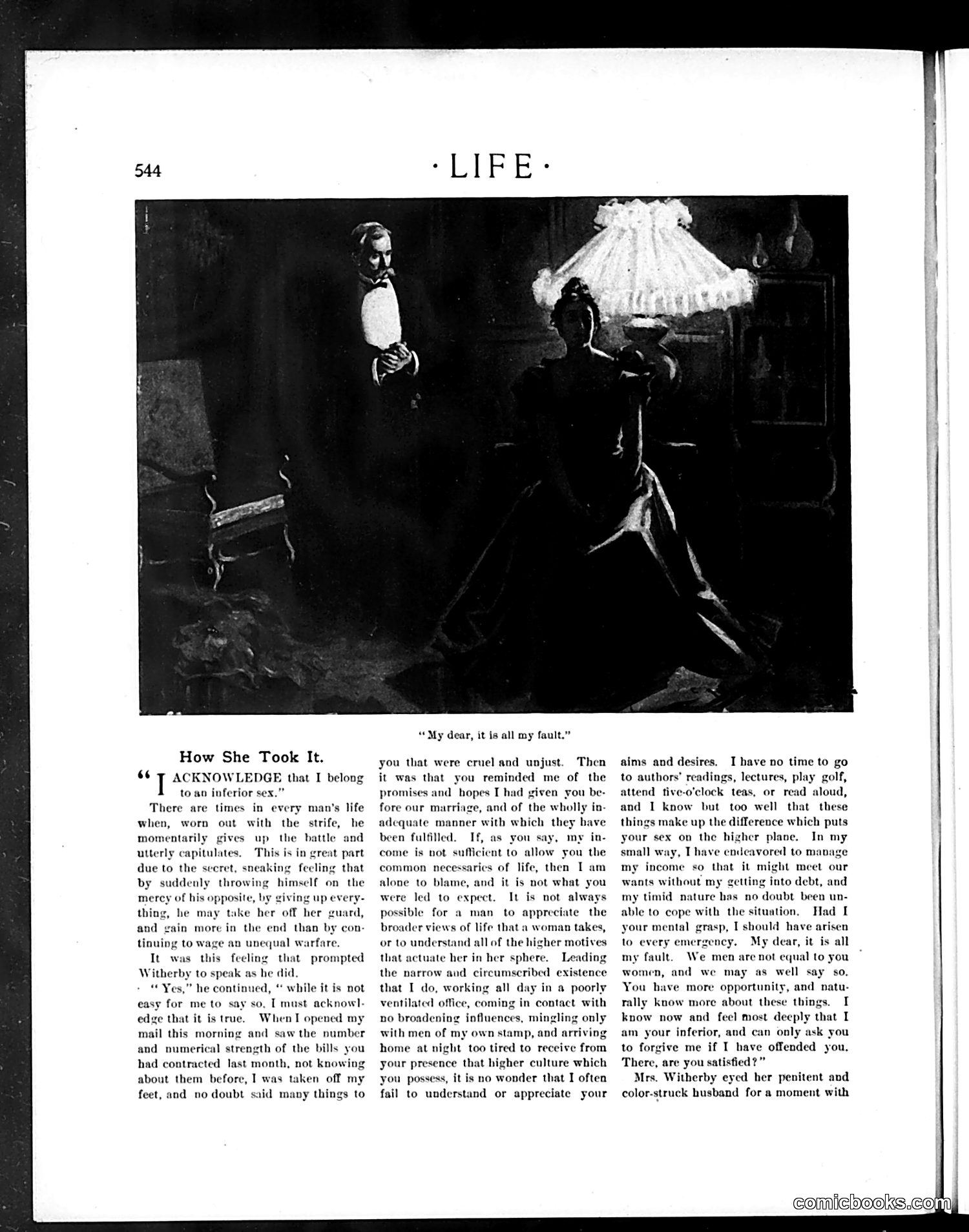
This appears to be a dramatic domestic scene from an early 20th-century satirical story in Life magazine. The image shows a tense confrontation between a man and woman in a darkly lit interior, with the caption "My dear, it is all my fault." The accompanying text depicts a husband confessing financial mismanagement to his wife—specifically, unpaid bills that have accumulated over a month. The story satirizes gender roles and marital dynamics of the era: the husband expects blame but finds his wife surprisingly philosophical and forgiving, citing her own limited understanding of "higher" financial matters due to her constrained sphere of activity. The satire seems to mock both the husband's assumption of guilt and the wife's resigned acceptance of her dependent status, illustrating period attitudes toward women's economic knowledge and marital authority.
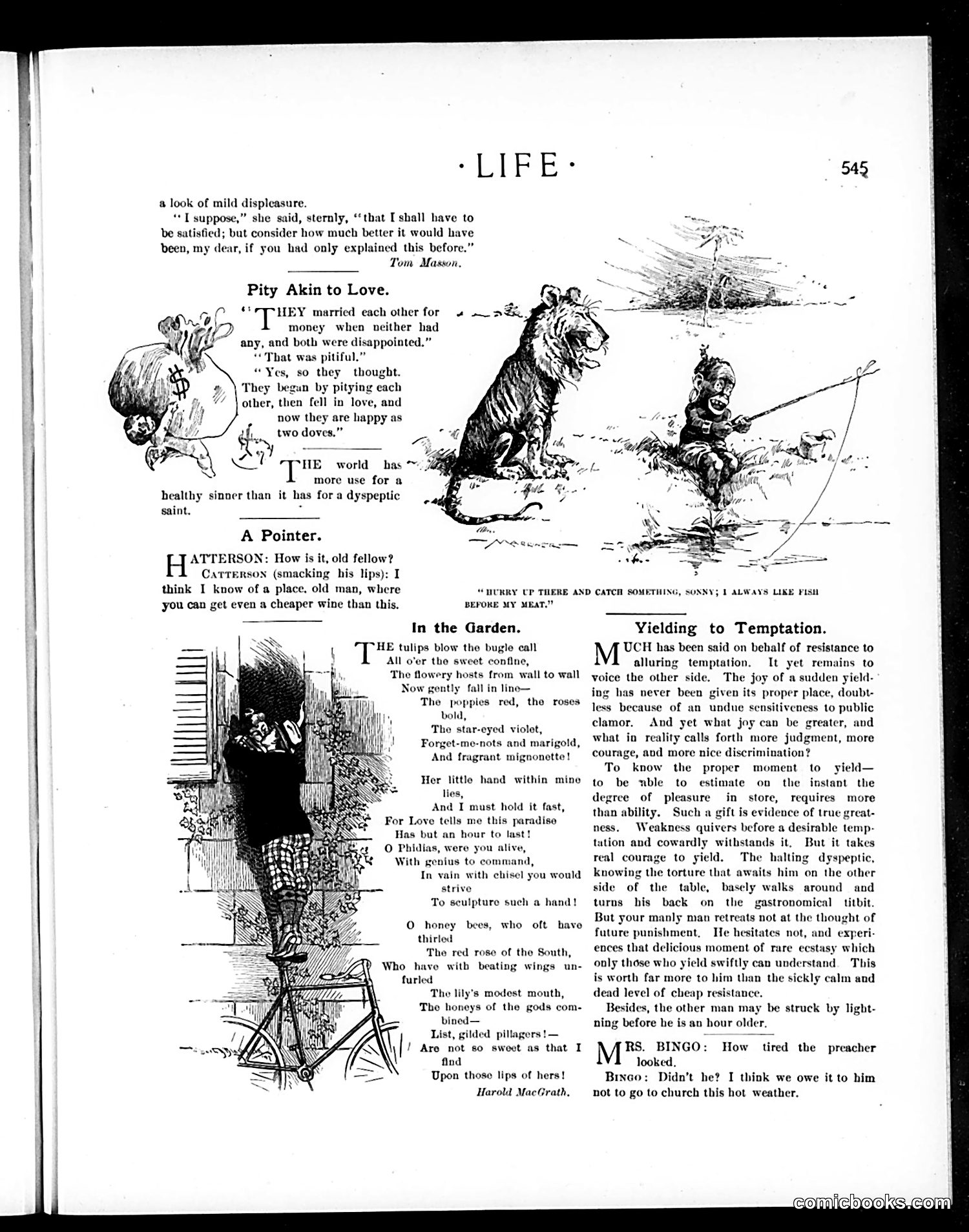
This page contains several humorous literary pieces and illustrations rather than political cartoons. **"Pity Akin to Love"** presents a brief narrative about a couple who married for money, discovered neither had any, pitied each other, fell in love, and became happy—satirizing mercenary marriage conventions. **"A Pointer"** shows two men (Hatterton and Catterson) discussing cheaper wine, with an accompanying sketch of a bicycle-riding couple in a garden. **"In the Garden"** is a romantic poem about tulips and flowers, illustrated with a Victorian couple on a bicycle. **"Yielding to Temptation"** is a longer philosophical essay examining the morality of yielding to temptation, arguing that true strength involves knowing when to surrender rather than always resisting. **"Mrs. Bingo"** concludes with a brief joke about avoiding church in hot weather. The page emphasizes romantic and social humor typical of early 20th-century American magazines.
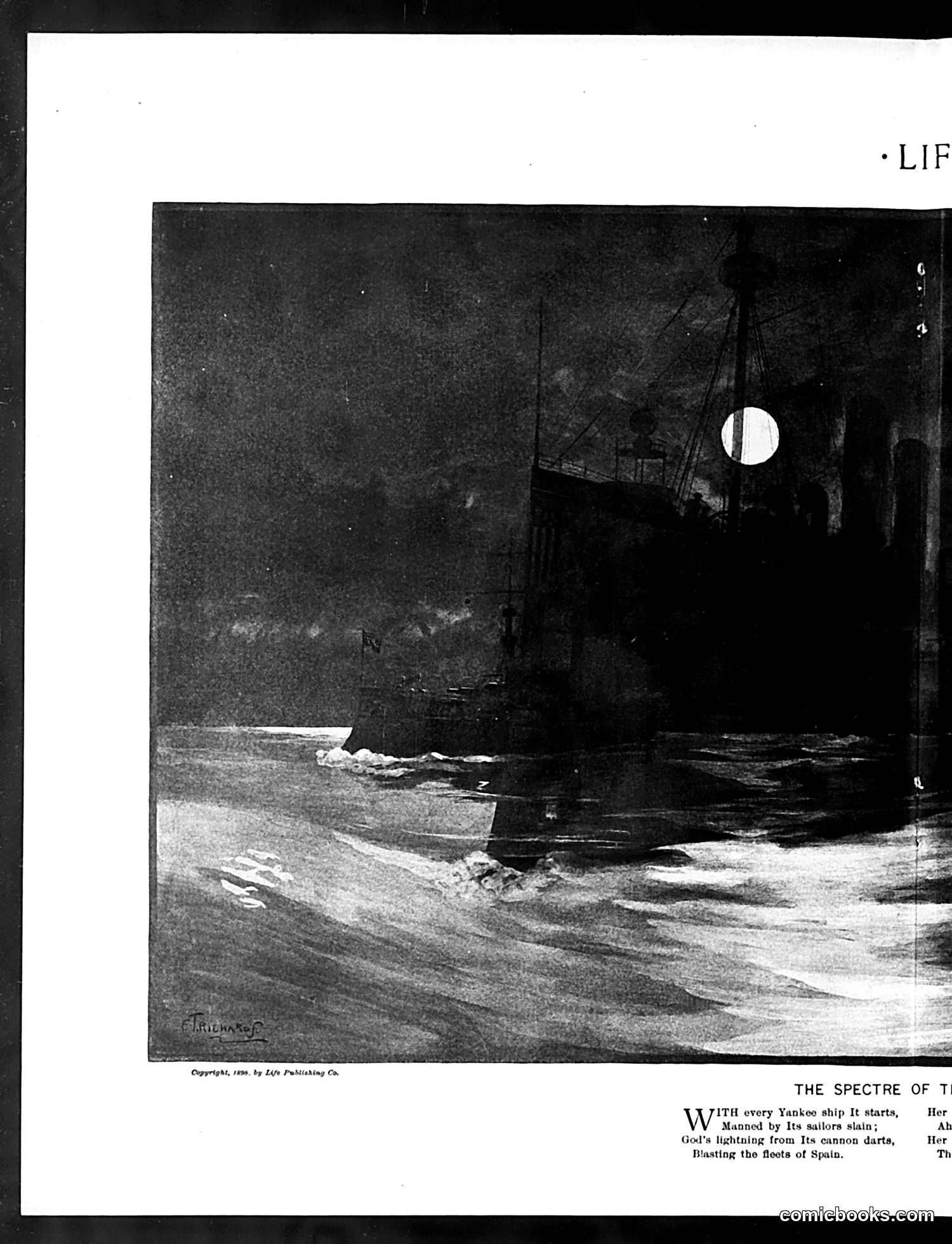
This illustration depicts "The Spectre of the Yankee Ship"—a dramatic maritime scene showing a ghostly vessel with a full moon behind it, surrounded by turbulent waves. The accompanying verse references "every Yankee ship" being "Manned by its sailors slain" and invokes "God's lightning from its cannon darts, / Blasting the fleets of Spain." The satire appears to celebrate American naval power during the Spanish-American War (1898), portraying Yankee ships as supernatural forces of divine retribution against Spanish forces. The ghostly imagery transforms American vessels into instruments of fate, suggesting manifest destiny and American superiority. This reflects period triumphalism about U.S. military dominance and the conflict's outcome.
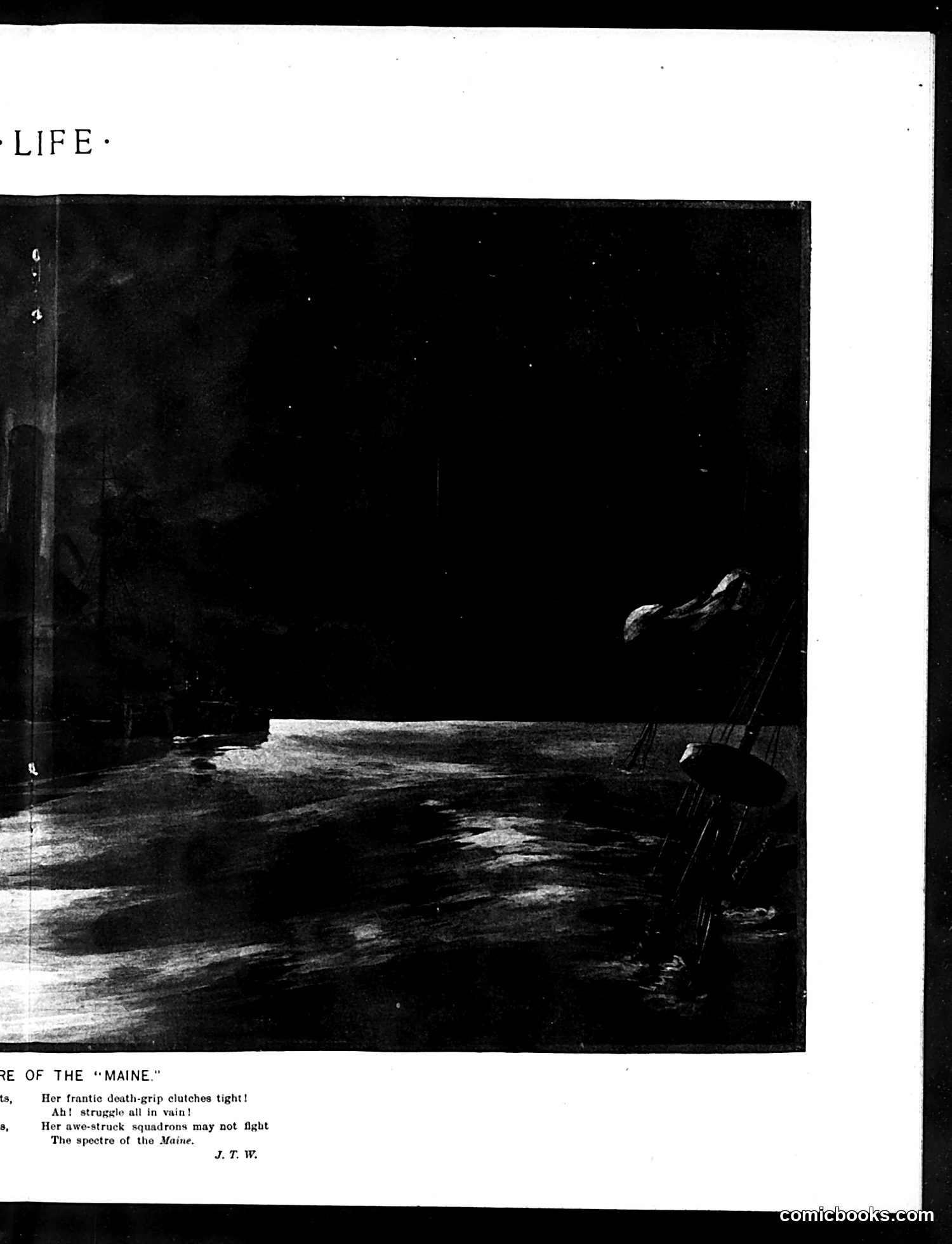
This page features an illustration titled "THE OF THE 'MAINE'" (likely "The Wreck of the Maine"), depicting a dramatic maritime disaster scene. The dark, atmospheric image shows wreckage and a figure in distress aboard what appears to be a ship. Below the illustration are poetic lines attributed to "J. T. W." that reference "Her frantic death-grip clutches tight!" and mention "awe-struck squadrons" that "may not fight / The spectre of the Maine." This appears to reference the USS Maine explosion of 1898, a pivotal event that sparked the Spanish-American War. The poem's reference to squadrons unable to fight "the spectre" suggests commentary on the military and political responses to this disaster, though the exact satirical point remains somewhat unclear without additional context.
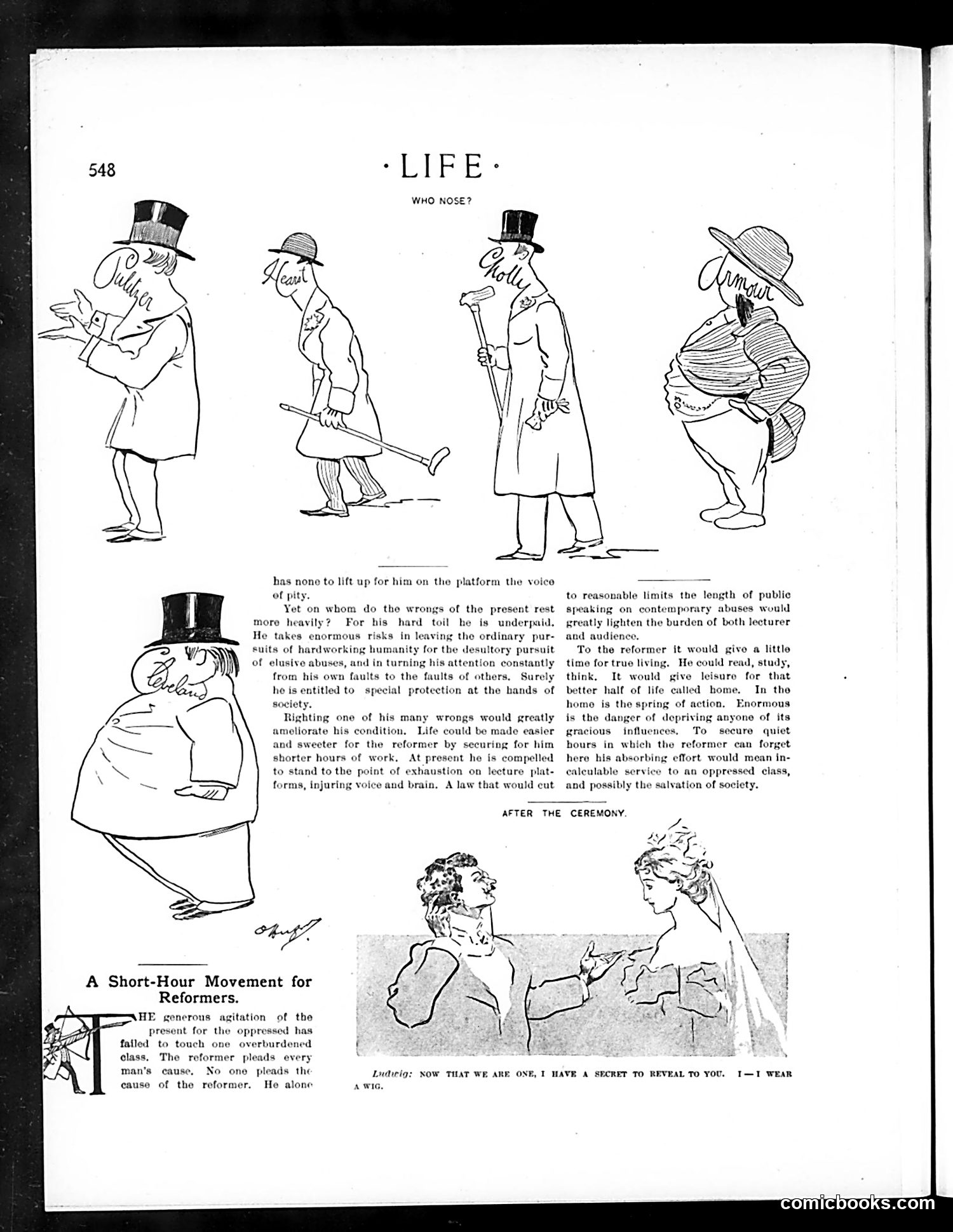
This page from *Life* magazine presents a satirical critique of reformers and their social activism. The top section, titled "Who Nose?" depicts four caricatured figures representing different types of reformers—labeled "Politics," "Health," "Piety," and "Armor"—each with exaggerated noses, suggesting their prominence or intrusiveness in public affairs. The accompanying text criticizes reformers for standing on lecture platforms preaching about others' faults while ignoring their own inadequacies. It argues that reformers burden both themselves and their audiences, and suggests that limiting public speaking on contemporary abuses would benefit society. The bottom section, "A Short-Hour Movement for Reformers," continues this mockery, advocating that reformers' causes deserve attention but their constant agitation has become tiresome to the public.
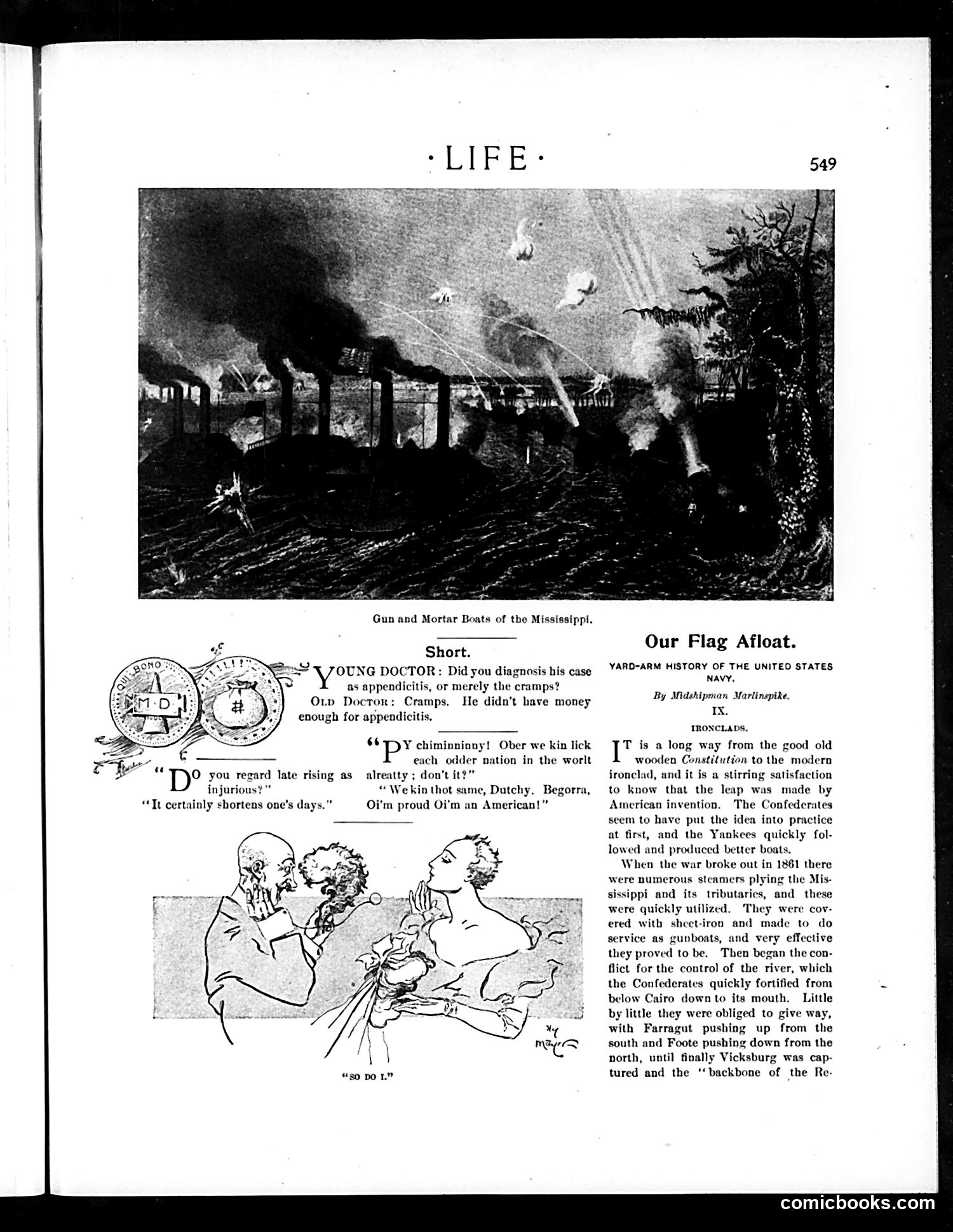
This page contains three distinct pieces of satirical content: **"Short" Comic Strip:** Two brief jokes about class and ethnicity. The first mocks doctors who diagnose expensive conditions (appendicitis) based on patients' ability to pay rather than medical reality. The second features ethnic stereotypes (likely Irish and German immigrants) humorously boasting about American superiority. **"So Do I" Cartoon:** A visual gag about the pun "shortens one's days"—playing on the double meaning of "days" as both time periods and daylight hours. Late rising literally shortens the daylight portion of one's day. **"Our Flag Afloat" Article:** A serious historical narrative about U.S. Navy ironclad gunboats during the Civil War (1861), contrasting wooden ships like the Constitution with modern iron-plated vessels. It describes the Confederacy's river fortifications from Cairo to the Mississippi's mouth and Union commanders Farragut and Foote's successful campaign to capture strategic points, culminating in Vicksburg's capture. The page mixes humor with genuine naval history.
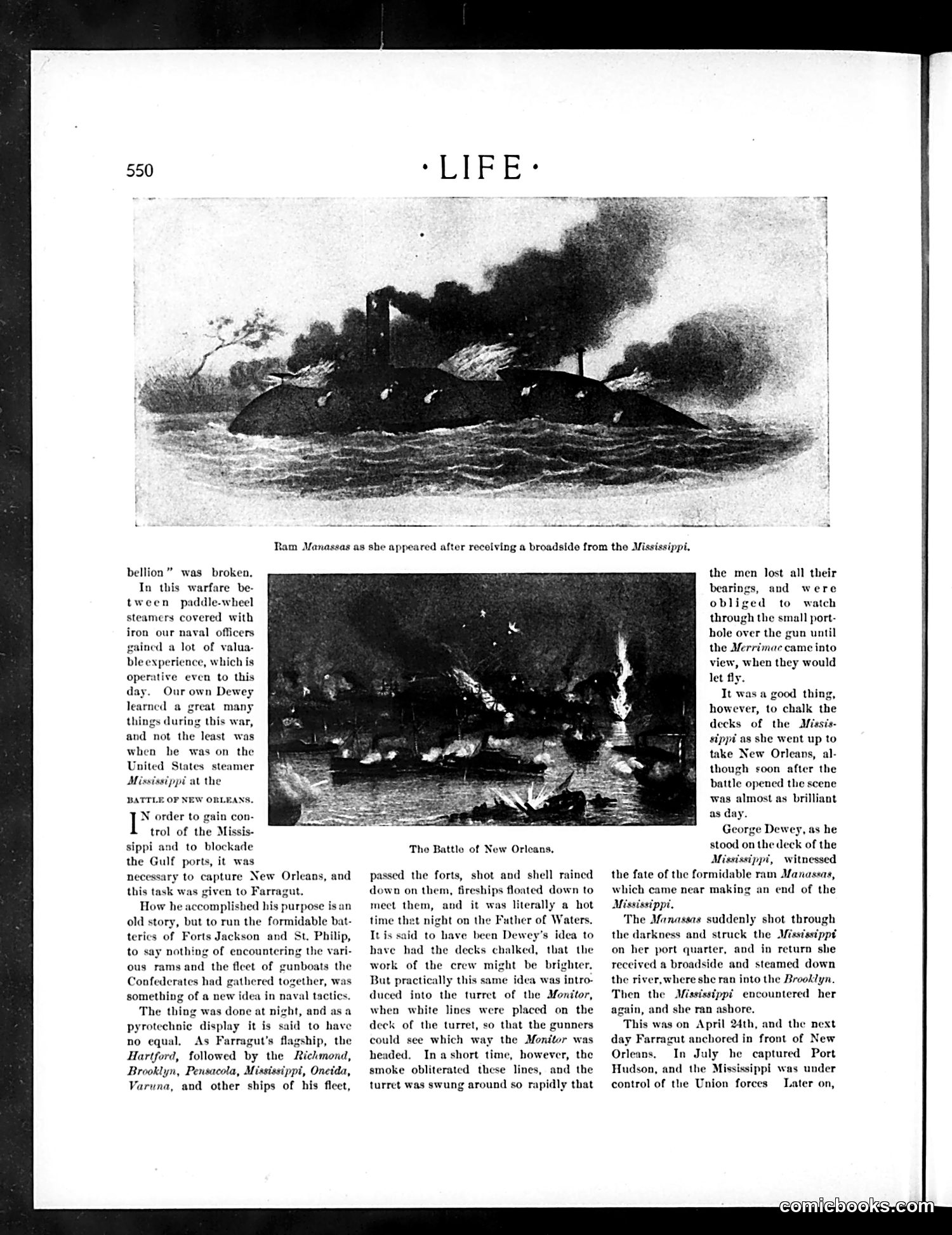
This page recounts the Civil War Battle of New Orleans (April 1862), focusing on naval warfare between ironclad and steam-powered vessels. The two illustrations show the Confederate ram *Manassas* after being damaged by the Union steamer *Mississippi*. The text celebrates Admiral Farragut's successful passage of Confederate forts to capture New Orleans, highlighting the innovative tactics used—notably, chalking deck lines so gun crews could maintain bearings amid smoke. The passage emphasizes how this battle provided valuable naval experience, particularly for future Admiral George Dewey, who witnessed the *Manassas* ramming and being repelled by Union ships. The article frames this as a pivotal moment in naval warfare: the transition from traditional tactics to ironclad combat. The detailed descriptions of the night battle's "pyrotechnic display" convey both the chaos and technological innovation of Civil War naval engagement.
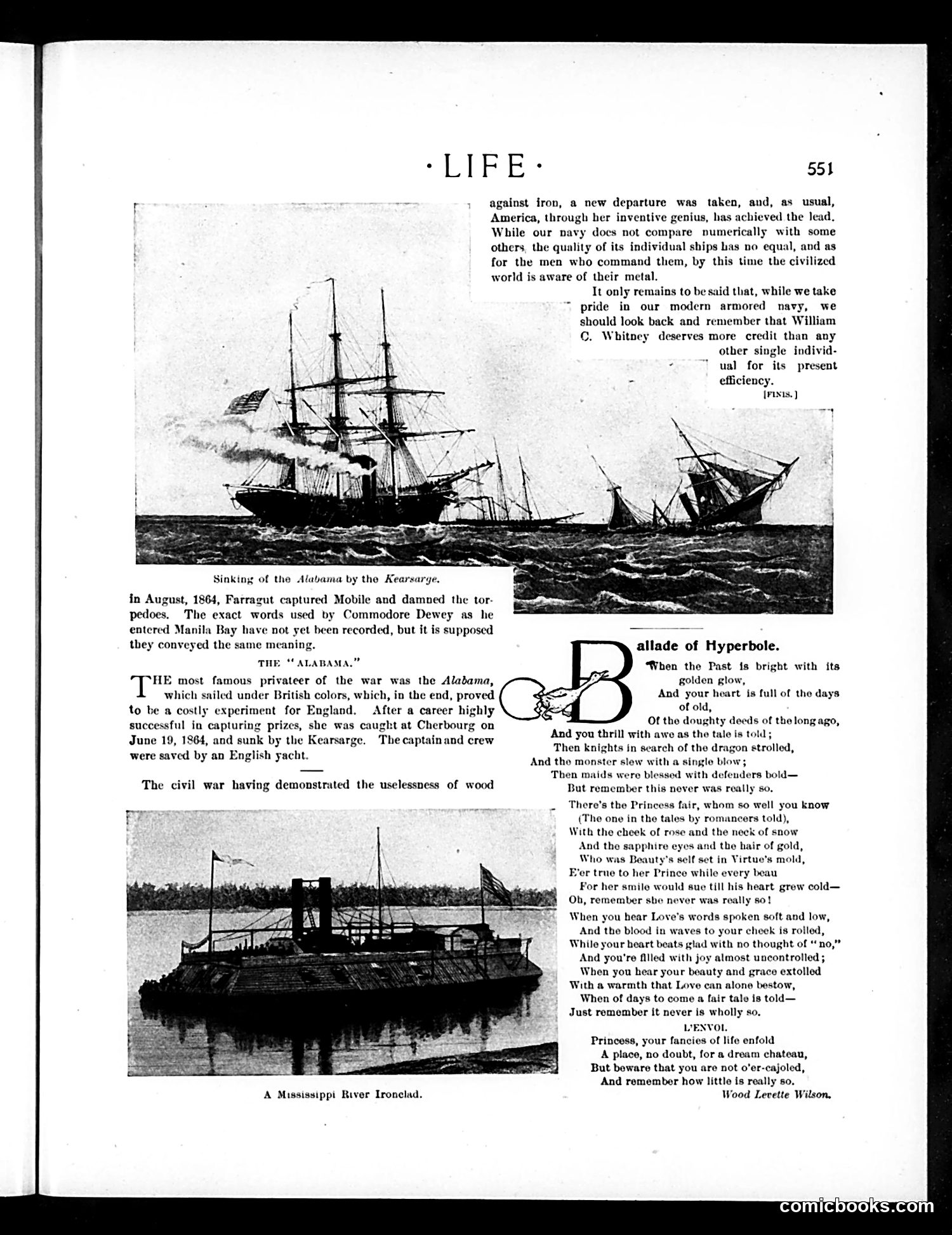
This page celebrates American naval innovation during and after the Civil War. The two illustrations show: 1. **"Sinking of the Alabama by the Kearsarge"** (top): Depicts the famous 1864 naval battle where the USS Kearsarge destroyed the Confederate raider Alabama off France—a significant Union victory. 2. **"A Mississippi River Ironclad"** (bottom): Shows an armored riverboat, exemplifying the Civil War's shift from wooden ships to ironclad vessels—revolutionary military technology America pioneered. The text praises American naval superiority, specifically crediting William C. Whitney (Secretary of the Navy 1885-1889) for modernizing the fleet. References to Commodore Dewey and Admiral Farragut reinforce American martial achievement. The poem "Ballad of Hyperbole" (by Wood Levette Wilson) is unrelated satire, gently mocking romantic idealization—cautioning that past glories and love's promises are never quite as perfect as remembered. The page overall celebrates American technological progress and naval power.
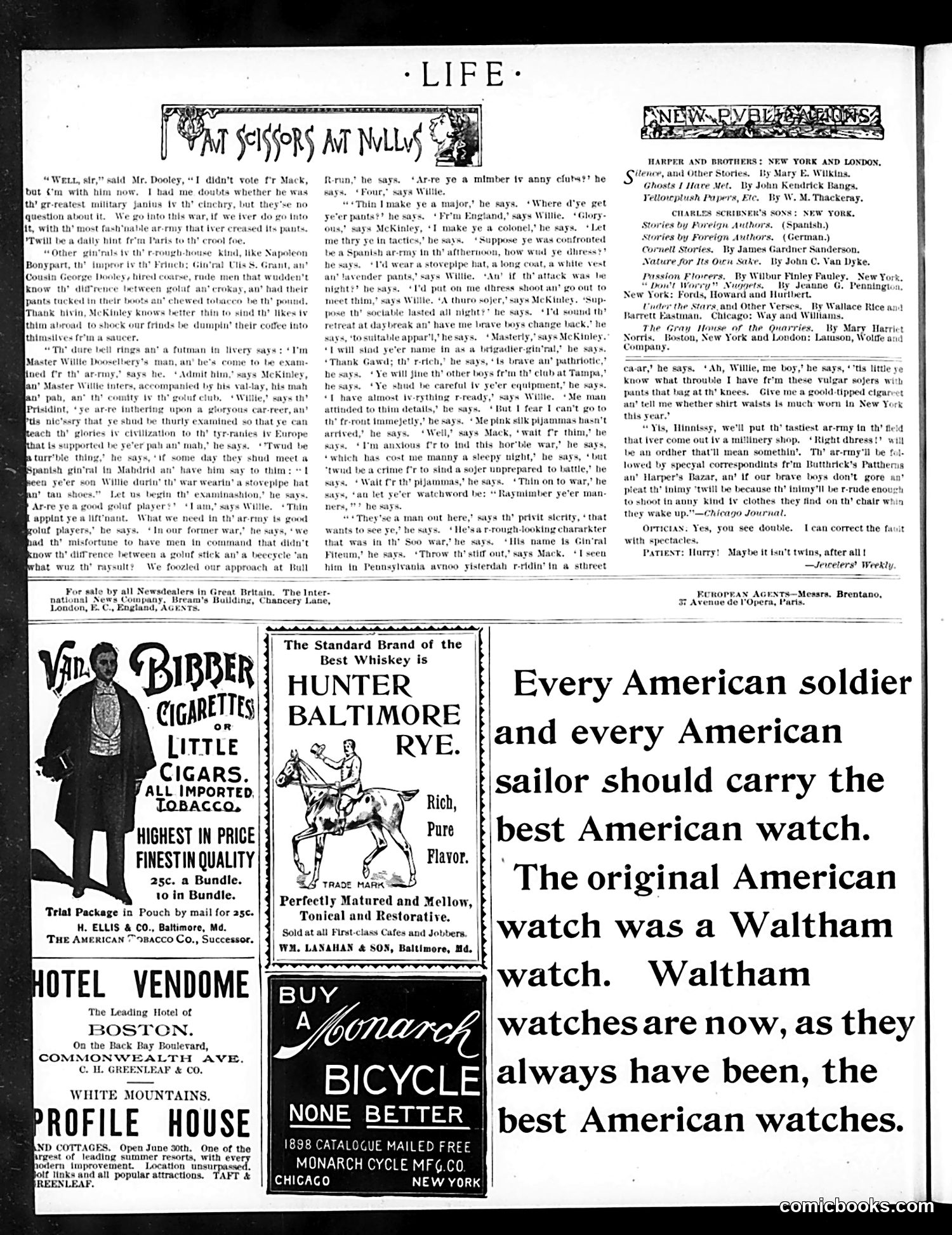
This page features a satirical dialogue between **Mr. Dooley** (a popular Irish-American character known for political commentary) and **McKinley** (likely President William McKinley), discussing military preparedness, probably regarding the Spanish-American War era. The humor centers on **contrasting perspectives on soldiering**: McKinley emphasizes tactical training and proper uniforms, while Dooley focuses on practical, humorous details—whether soldiers wear proper pants, silk pajamas, and ensuring they have good cigars. The satire mocks **upper-class concerns about military "respectability"** (tailored uniforms, equipment) versus working-class pragmatism. Dooley's Irish-inflected dialect adds comic effect while his character voices skepticism about military formality. The page is primarily **advertising** (whiskey, bicycles, hotels, cigars, watches) with this satirical story occupying the upper portion—typical of Life's mixed content format.
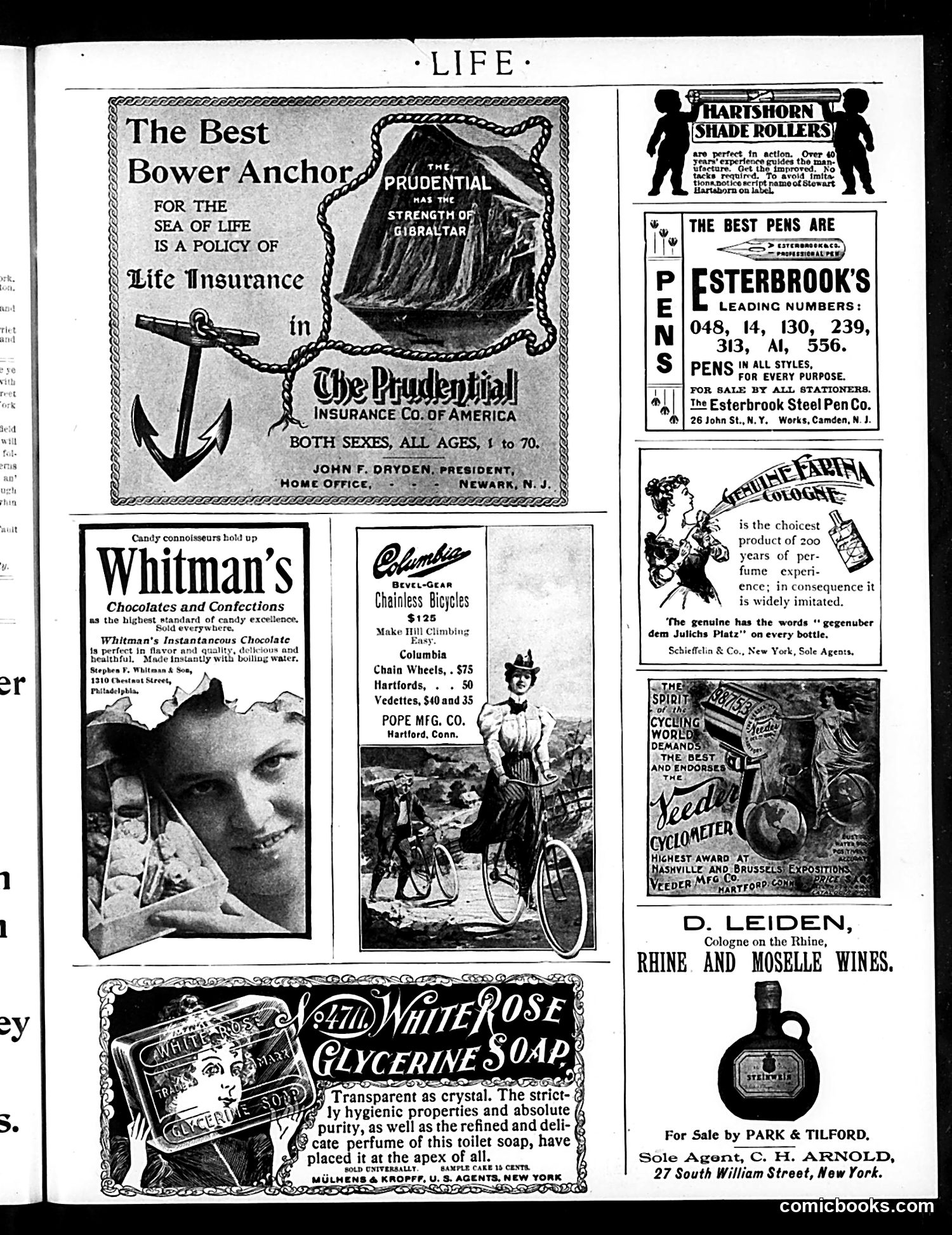
This is primarily a **advertising page**, not a satirical cartoon. It contains multiple product advertisements typical of early 20th-century American magazines, including: - **Life Insurance** (Prudential), using an anchor metaphor for financial security - **Whitman's Chocolates**, positioned as a premium candy brand - **Columbia Bicycles**, advertising chainless models and accessories - **Esterbrook Pens**, listing model numbers - **White Rose Glycerine Soap**, emphasizing hygiene and purity - **Genuine Farina Cologne** and **Rhine/Moselle Wines**, imported European luxury goods The page reflects the consumer culture and advertising standards of the era, mixing aspirational products (insurance, imported goods) with everyday items (candy, soap, bicycles). There is no apparent political satire or social commentary—it's a straightforward commercial publication designed to generate revenue through paid advertisements.
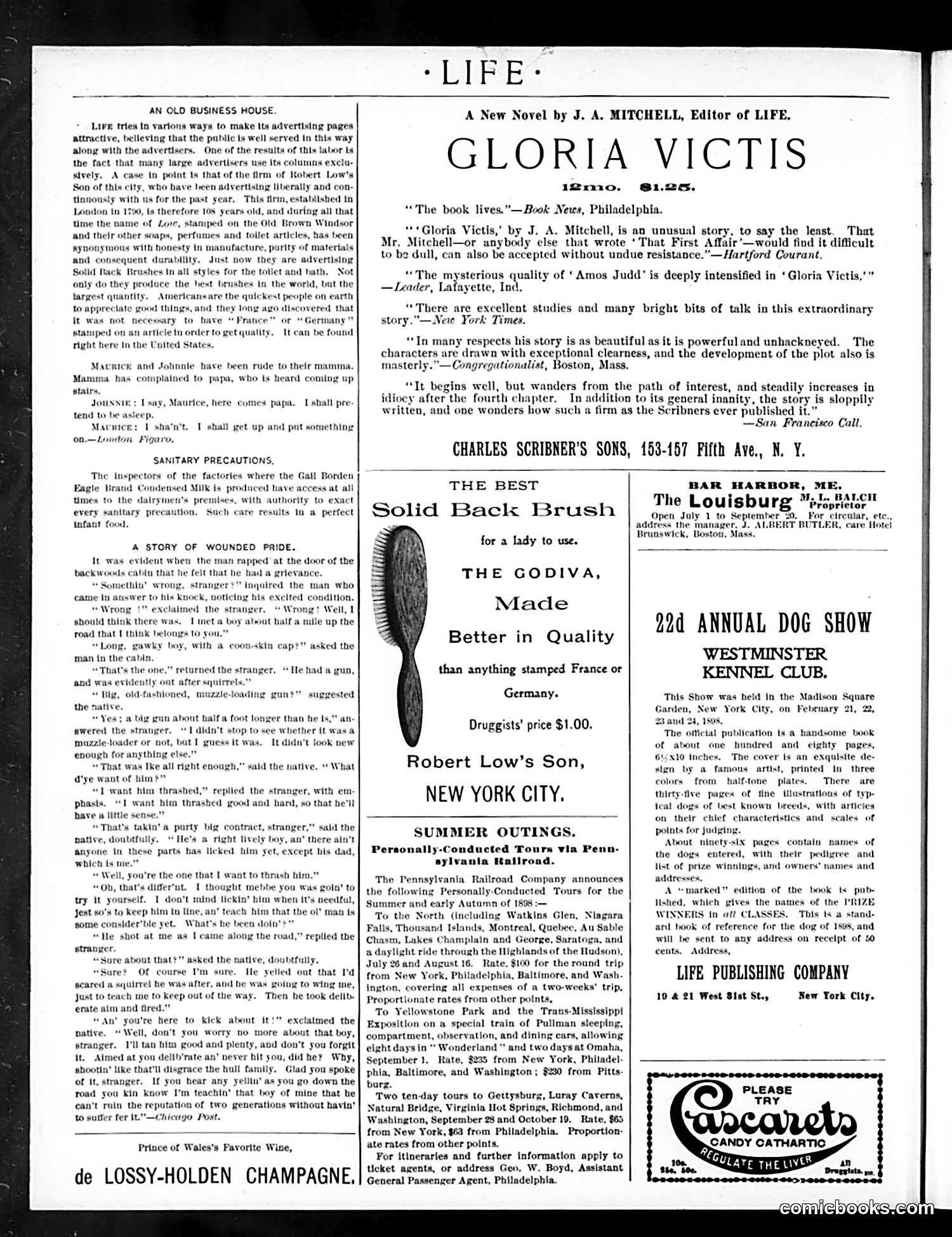
This page is primarily **advertising and promotional content**, not political satire. It features: 1. **"An Old Business House"** — a puff piece promoting Robert Low & Son, a 108-year-old soap and toiletry company, emphasizing American manufacturing quality versus European imports. 2. **Two brief comedic sketches** (not cartoons): - "Maurice and Johnnie" — a domestic humor piece about children being rude to their mother before their father arrives - "A Story of Wounded Pride" — backwoods dialect humor about a stranger wanting a boy thrashed for shooting at him, only to learn the boy is the father's son (and the father alone has authority to discipline) 3. **Book and product advertisements** for *Gloria Victis* (a novel by J.A. Mitchell), brushes, champagne, and railroad tours. There is **no political cartoon or satire** on this page—it's a commercial issue mixing light entertainment with advertisements to promote consumer products and services.
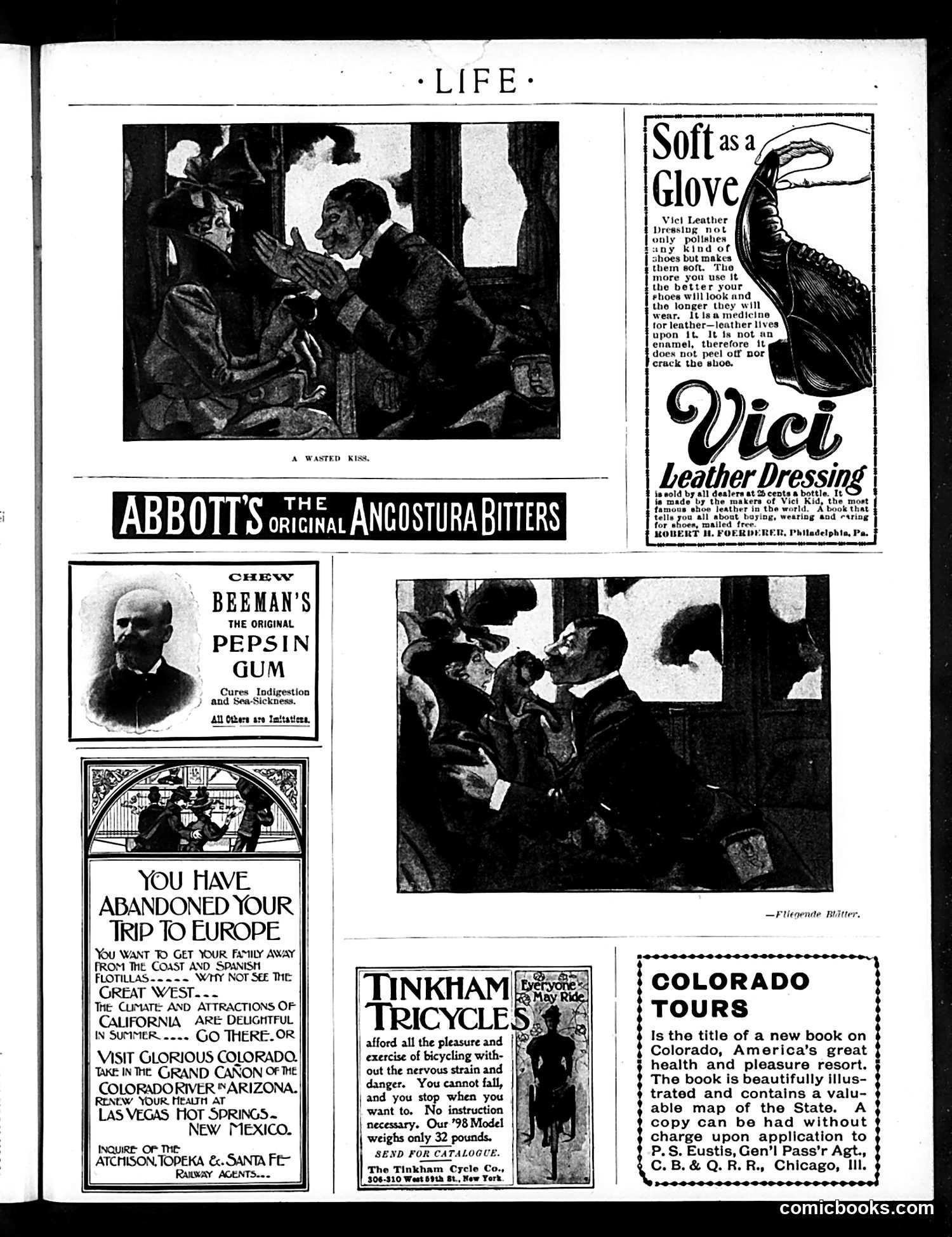
This page is primarily **advertising** with one small cartoon at the top. The cartoon titled "A Wasted Kiss" (credited to *Fliegende Blätter*, a German publication) shows two figures in formal dress—a man attempting to kiss a woman's hand while she appears distracted or dismissive. The joke plays on social awkwardness: the man's romantic gesture goes unappreciated or unnoticed. The page itself is dominated by period advertisements for consumer goods (Beeman's gum, Vici leather dressing, Tinkham tricycles) and travel promotions. One notable ad encourages Americans to vacation in the American West instead of Europe, citing concerns about "Spanish flotillas"—likely referencing Spanish naval presence or tensions during this era (possibly related to Spanish colonial territories). The "Colorado Tours" advertisement promotes tourism to Colorado as a health resort, reflecting the era's belief in Western climate as medicinal.
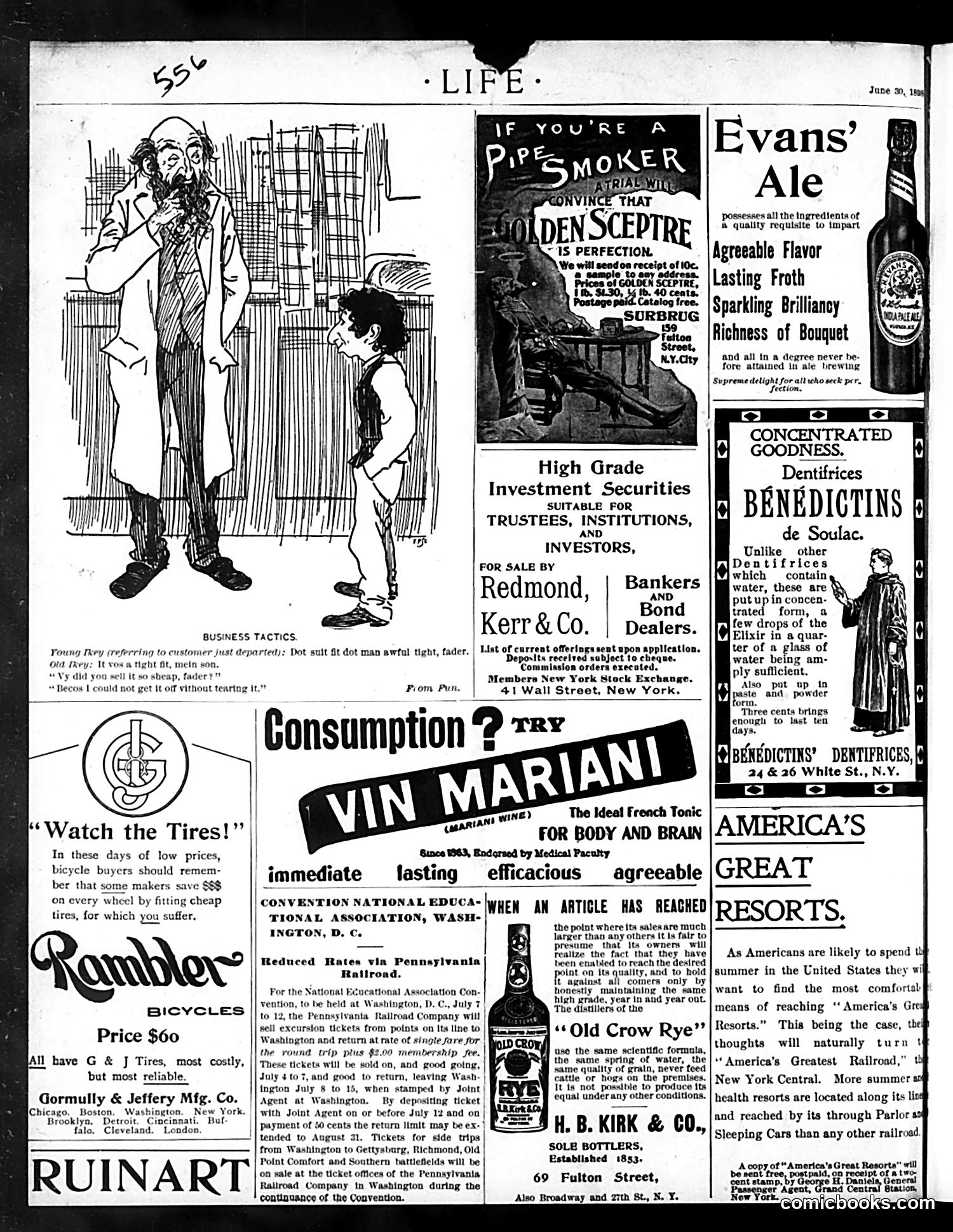
This satirical cartoon depicts a tall, bearded man (appearing to represent a dishonest businessman or tailor) confronting a young boy customer. The dialogue reveals the con: the man claims the ill-fitting suit is the boy's fault—"Dot suit fit dot man awful tight, fader"—using an exaggerated accent to suggest a foreign swindler. The boy protests he couldn't wear it without tearing it. The satire mocks deceptive sales practices common in the era: blaming customers for products' defects rather than accepting responsibility. The exaggerated dialect stereotype reinforces contemporary prejudices against immigrant merchants. The humor relies on readers recognizing this as a familiar scam tactic—shifting blame to extract money from customers. The surrounding advertisements for bicycles, investment securities, and tonics contrast honest business claims ("most reliable") with this dishonest approach, implicitly endorsing quality over deception.
I can see this is a page from Life magazine that appears to be mostly blank or heavily faded, with some advertising or product imagery visible on the left margin (including what looks like a bottle). The OCR text provided is empty or unreadable. Without legible text or clear cartoon imagery to examine, I cannot reliably identify specific political figures, social references, or explain the satirical point of this page. The image quality and fading make it impossible to discern the intended content with accuracy. To provide a proper analysis, I would need a clearer, higher-contrast version of this page where both the text and illustrations are readable.