
Life, 1898-06-30 · page 14 of 21
Life — June 30, 1898 — page 14: what you’re looking at
What you’re looking at
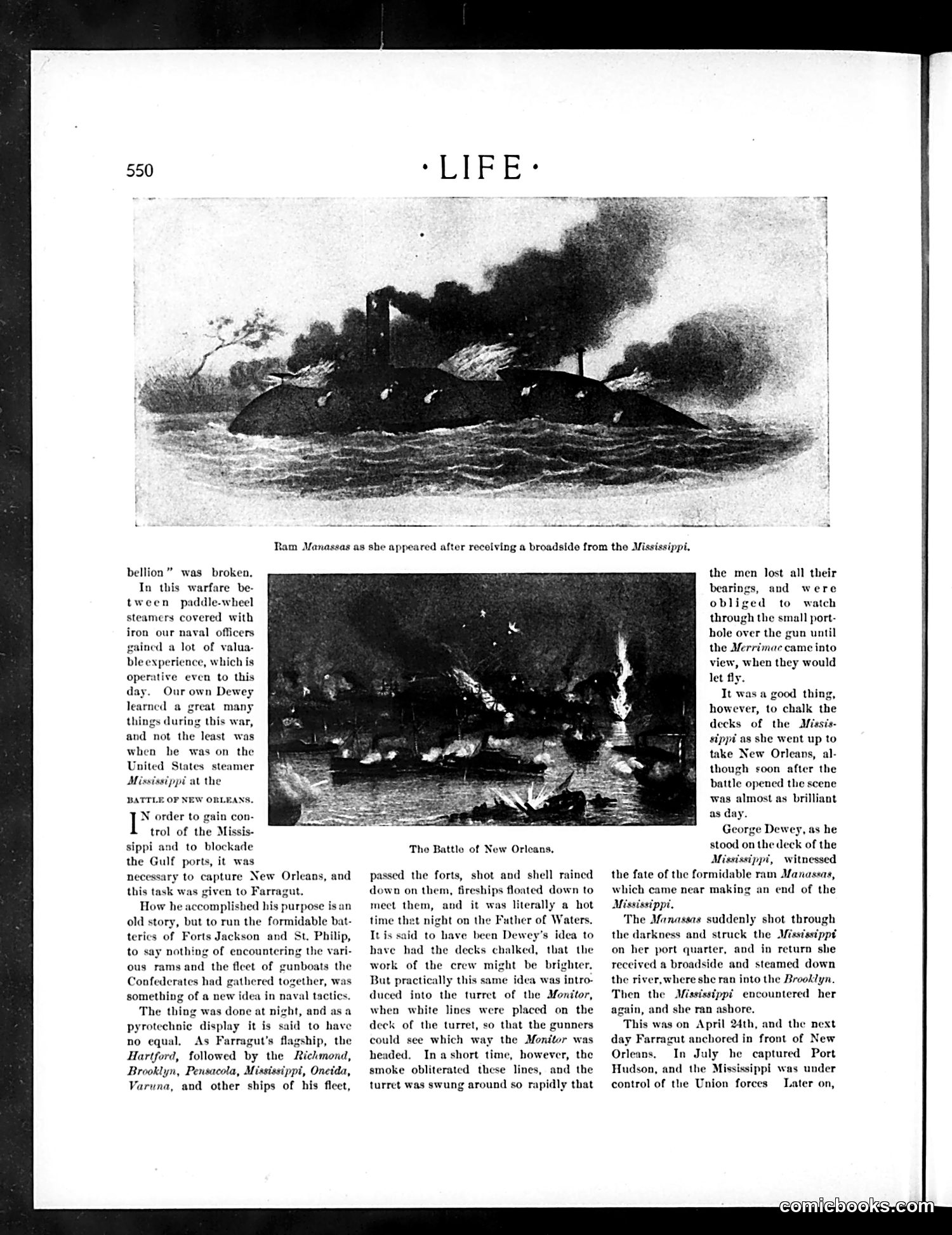
This page recounts the Civil War Battle of New Orleans (April 1862), focusing on naval warfare between ironclad and steam-powered vessels. The two illustrations show the Confederate ram *Manassas* after being damaged by the Union steamer *Mississippi*. The text celebrates Admiral Farragut's successful passage of Confederate forts to capture New Orleans, highlighting the innovative tactics used—notably, chalking deck lines so gun crews could maintain bearings amid smoke. The passage emphasizes how this battle provided valuable naval experience, particularly for future Admiral George Dewey, who witnessed the *Manassas* ramming and being repelled by Union ships. The article frames this as a pivotal moment in naval warfare: the transition from traditional tactics to ironclad combat. The detailed descriptions of the night battle's "pyrotechnic display" convey both the chaos and technological innovation of Civil War naval engagement.
📄 Transcribed text from this page (OCR, searchable)
Machine-transcribed from the original scan — historical spelling and the odd misread are preserved.
Ram Manassas as she appeared after receiving a broadside from the Mississippi, bellion” was broken. In this warfare be- tween paddle.wheel steamers covered with iron our naval officers gaincd a lot of valua- ble experience, which is operative even to this day. Our own Dewey learned a great many things during this war, and not the least was when he was on the United States steamer Mississippi at the BATTLE OF NEW ORLE N order to gain con- trol of the Missis. sippi and to blockade the Gulf ports, it was necessary to capture New Orleans, and this task was given to Farragut, How he accomplished his purpose isan old story, but to run the formidable bat- terics of Forts Jackson and St. Philip, to say nothing of encountering the v: ous rams and the fleet of gunboats the Confederates had gathered together, was something of a new idea in naval tactics. The thing was done at night, and asa pyrotechnic display it is said to have no equal, As Farragut’s flagship, the Hartford, followed by the Richmond, Brooklyn, Pensacola, Mississippi, Onetda, Varuna, and other ships of his fleet, The Battle of New Orleans, passed the forts, shot and shell rained down on them, fireships floated down to meet them, and it was literally a hot time thet night on the Father of Waters, It is said to have been Dewey's idea to have had the decks chalked, that the work of the crew might be brighter, But practically this same idea was intro- duced into the turret of the Monitor, when white lines were placed on the deck of the turret, so that the gunners could see which way the Monitor was headed. Ina short time, however, the smoke obliterated these lines, and the turret was swung around so rapidly that the men lost all their bearings, and were obliged to watch through the small port hole over the gun until the Merrimac came into view, when they would let fly. It was a good thing, however, to chalk the decks of the Missis- sippi as she went up to take New Orleans, al- though soon after the battle opened the scene was almost as brilliant as day. George Dewey, as he stood on the deck of the Misxissippi, witnessed the fate of the formidable ram Manassas, which came near making an end of the Mississippi. The Manassas suddenly shot through the darkness and struck the Mississippt on her port quarter, and in return she received a broadside and steamed down the river, where she ran into the Brooklyn. Then the Mississippi encountered her again, and she ran ashore. This was on April 24th, and the next day Farragut anchored in front of New Orleans, In July he captured Port Hudson, and the Mi ppl was under control of the Union forces Later on,