
A complete issue · 20 pages · 1898
Life — March 17, 1898
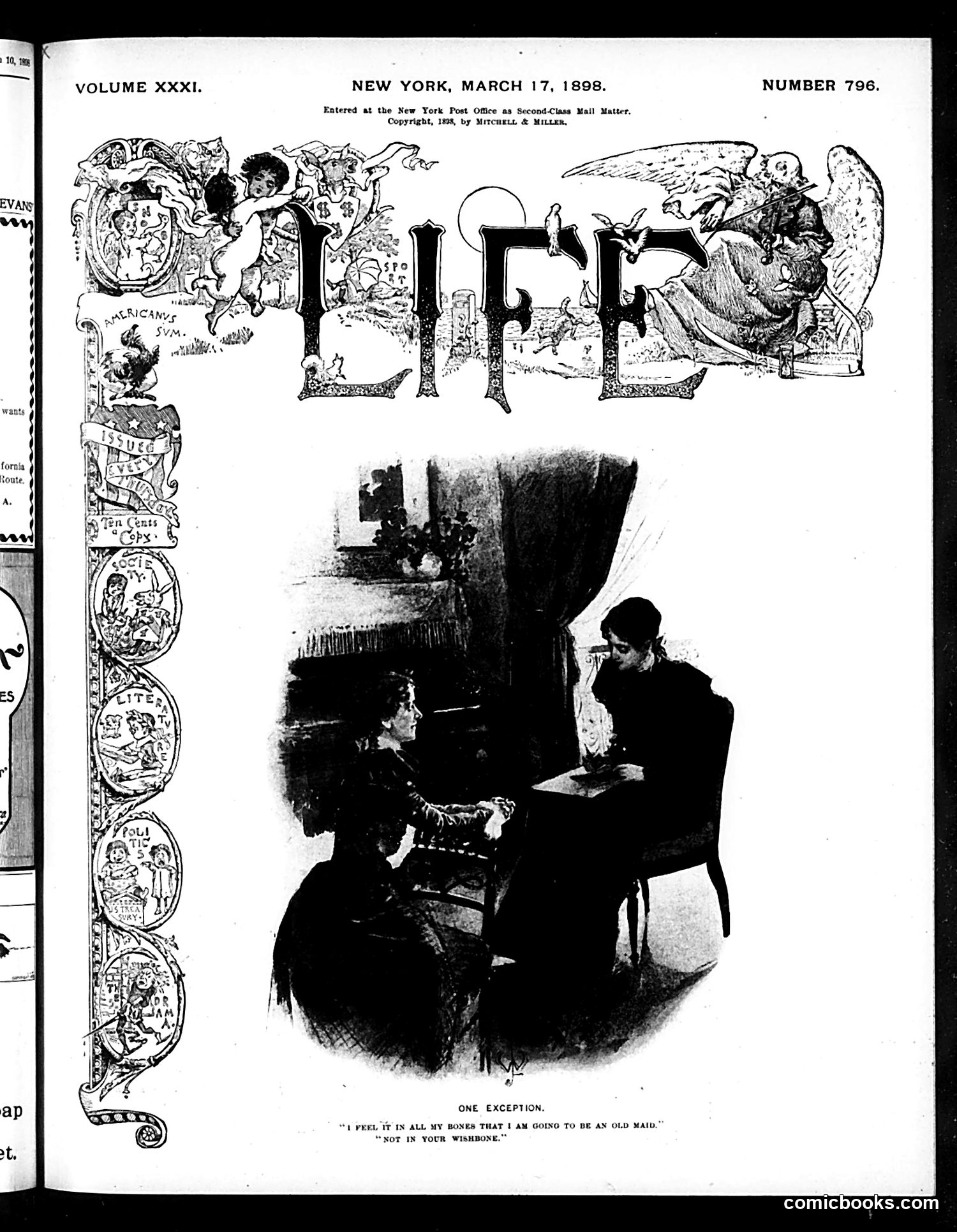
This single-panel cartoon satirizes marriage and aging. Two figures sit together—a woman on the left appears anxious or concerned, while a man on the right reads or examines something (possibly a marriage proposal or document). The caption reads: "I FEEL IT IN ALL MY BONES THAT I AM GOING TO BE AN OLD MAID." The man's response: "NOT IN YOUR WISHBONE." The joke plays on the woman's worry about remaining unmarried. The man offers reassurance, suggesting her "wishbone" (symbol of luck and hope) represents an exception to her grim prediction. This reflects late-Victorian anxieties about unmarried women and the social pressure surrounding marriage, while the man's comment attempts gallant but slightly condescending comfort.
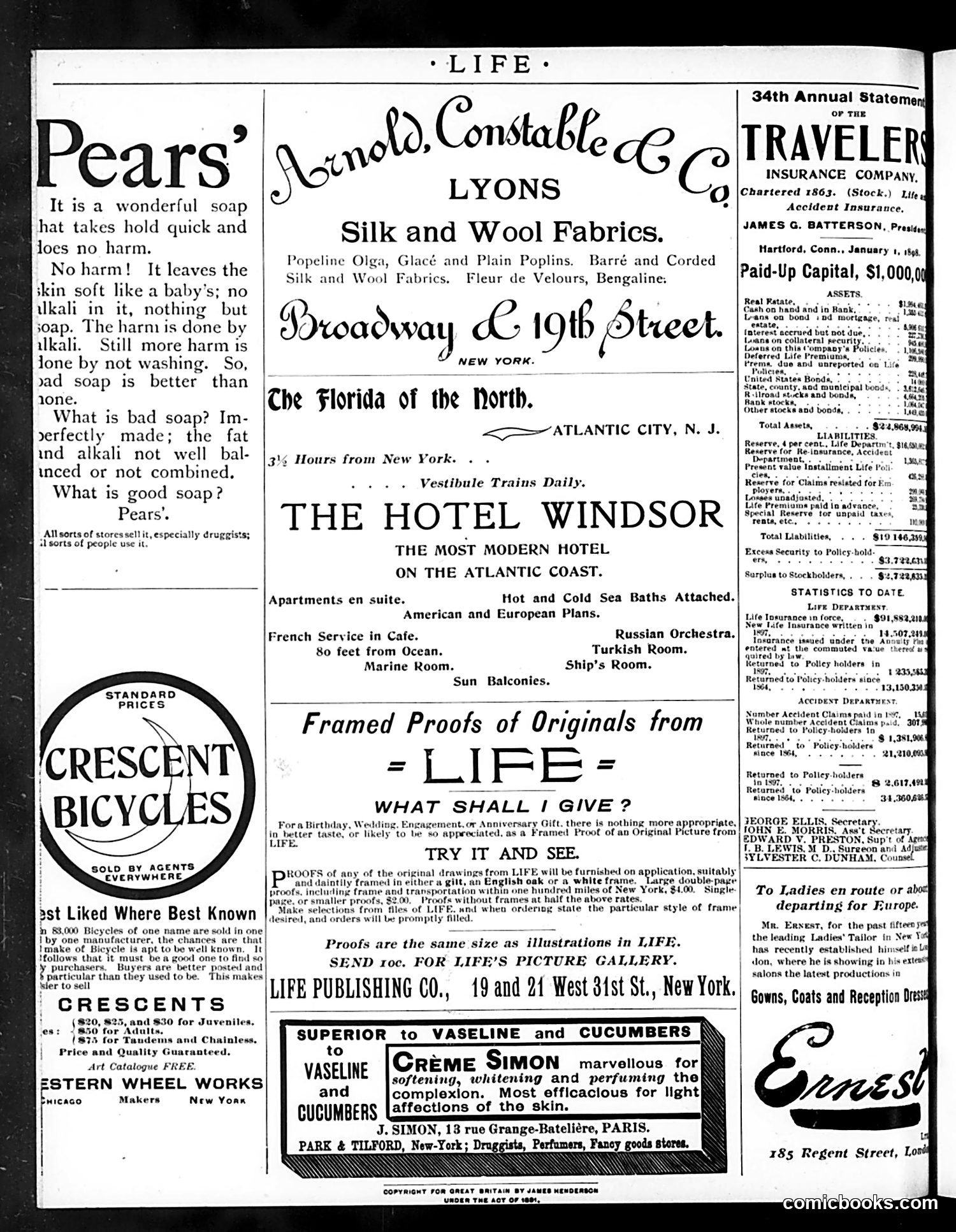
This page is **primarily advertising** with minimal editorial content. The advertisements include: - **Pears' Soap**: Claims about soap quality and skin safety - **Arnold, Constable & Co.**: Silk and wool fabrics from New York - **Hotel Windsor**: Atlantic City resort featuring modern amenities - **Crescent Bicycles**: Standard pricing and availability - **Life Publishing**: Offers framed proofs of original drawings from Life magazine as gifts - **Creme Simon**: Cosmetic product claiming superiority to Vaseline The "Framed Proofs of Originals from LIFE" section appears to be the only editorial-adjacent content, promoting Life's ability to sell reproductions of its published artwork. No political cartoons or satirical commentary are present on this page. It's a standard commercial publication page from the early 1900s demonstrating Life magazine's advertising model.
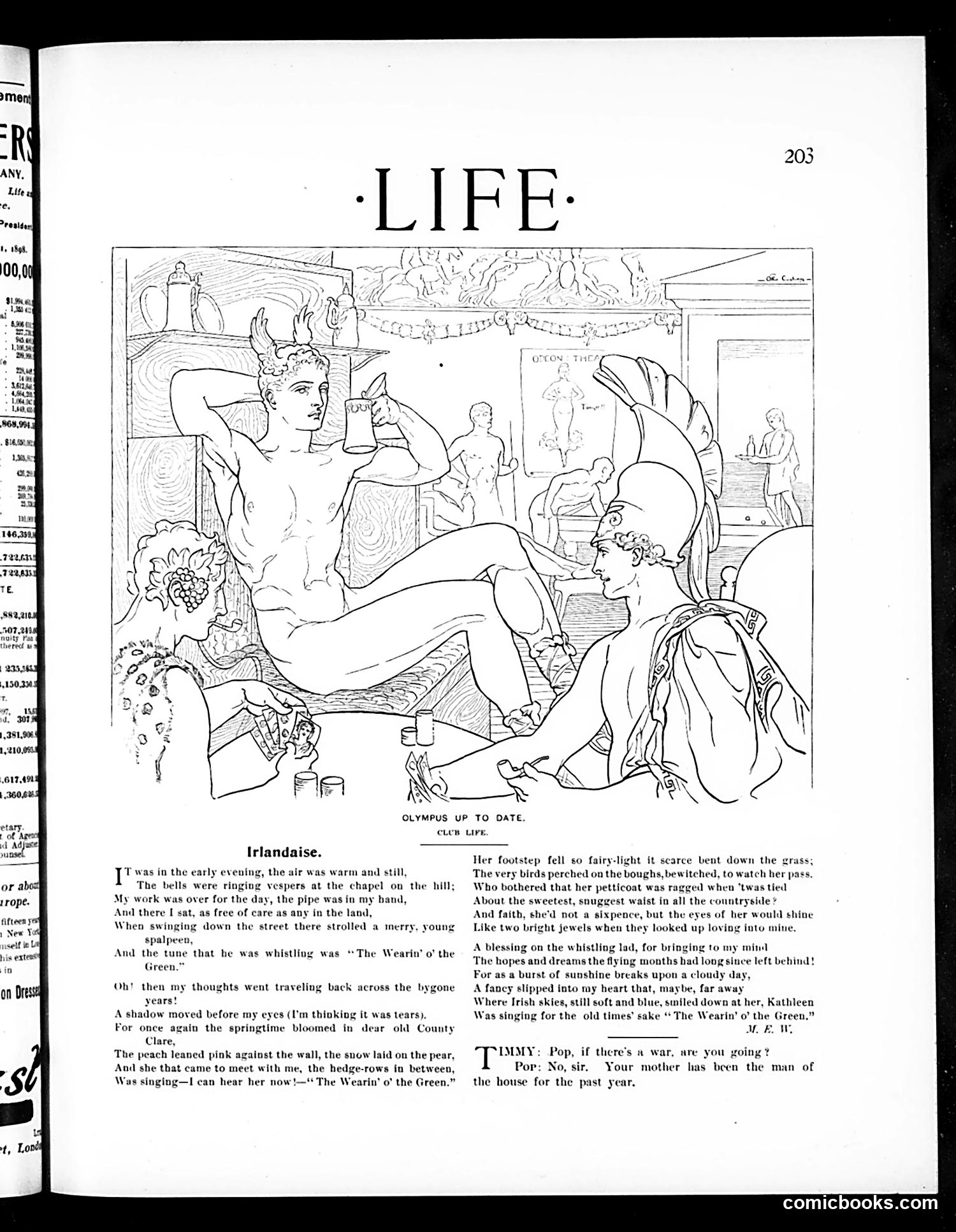
This page from *Life* magazine contains two separate pieces: **"Olympus Up to Date" (top illustration):** A satirical drawing depicting Greek gods/goddesses in a modern club setting, lounging and socializing. The caption suggests commentary on classical mythology adapted to contemporary leisure culture—likely mocking both high-minded classical references and modern "bohemian" club life. **"Irlandaise" (poem with dialogue):** A sentimental Irish-themed poem about a young woman singing an old Irish song ("The Wearin' o' the Green"). It includes a brief dialogue between "Timmy" and "Pop" discussing potential war and the mother's role managing the household. The war reference appears topical but without additional context, the specific conflict referenced is unclear—possibly World War I era given the magazine's apparent vintage. The overall tone mixes nostalgia, sentimentality, and social observation typical of early 20th-century American humor magazines.
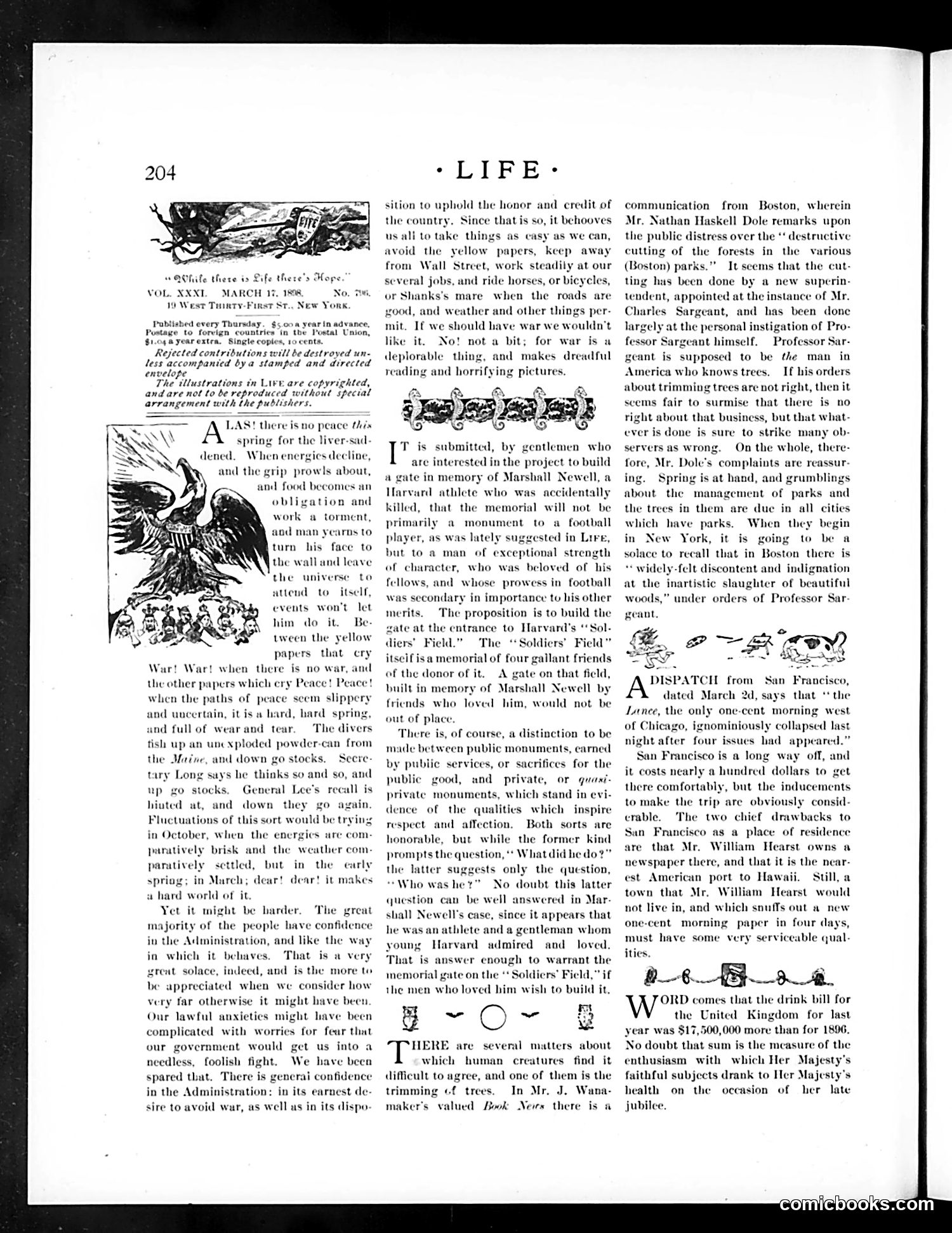
This page contains editorial commentary rather than political cartoons. The text discusses several social issues of the era: **Key topics:** - War anxieties and the desire to avoid conflict ("when the paths of peace seem slippery") - A proposed memorial gate at Harvard for Marshall Newell, a football player who died accidentally - The distinction between public monuments (for public service) versus private memorials - Tree-trimming practices in cities, with Professor Sargent apparently advocating for careful management of urban forests - A dispatch from San Francisco noting the collapse of a one-cent morning newspaper after only four days The decorative illustrations appear to be period ornaments rather than satirical cartoons. The page reflects turn-of-century Progressive Era concerns about civic improvement, memorialization, and urban management.
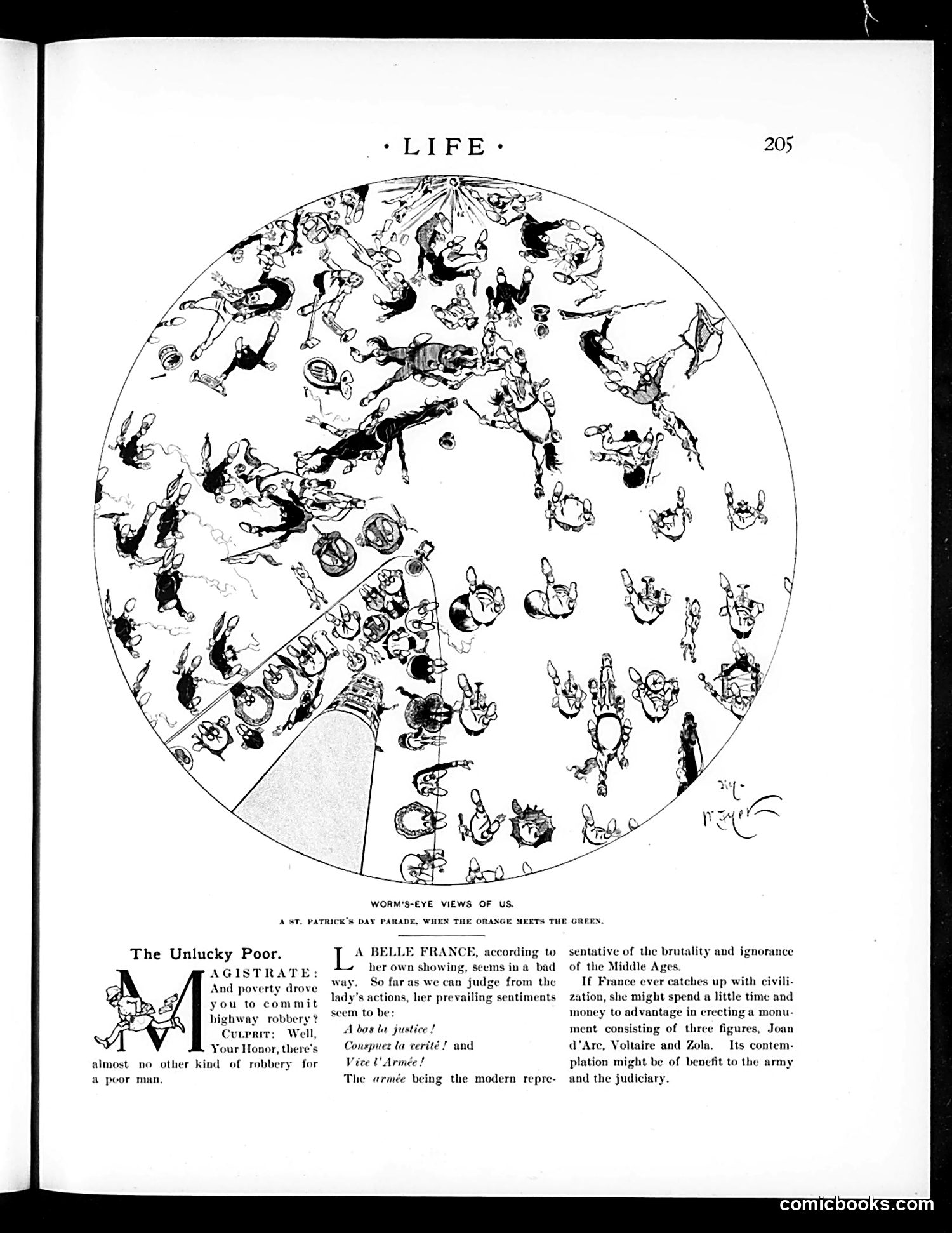
The page contains two distinct elements: **The Circular Illustration:** Labeled "Worm's-Eye Views of Us: A St. Patrick's Day Parade When the Orange Meets the Greens," this bird's-eye-view cartoon depicts a chaotic street scene from above, showing pedestrians scattered during what appears to be sectarian conflict between Irish Catholic and Protestant groups (the "Greens" and "Orange" refer to traditional Irish-American ethnic/religious divisions). The composition emphasizes disorder and commotion. **"The Unlucky Poor" Dialogue:** Below, a brief comic exchange between characters discusses highway robbery and poverty, suggesting social commentary on crime driven by economic desperation. One character argues poverty forces people to crime; another dismisses this as excuse-making. **Context:** This reflects late 19th/early 20th-century American concerns about Irish immigrant communities, sectarian tensions, and urban poverty—all satirized through Life magazine's characteristic irreverent approach.
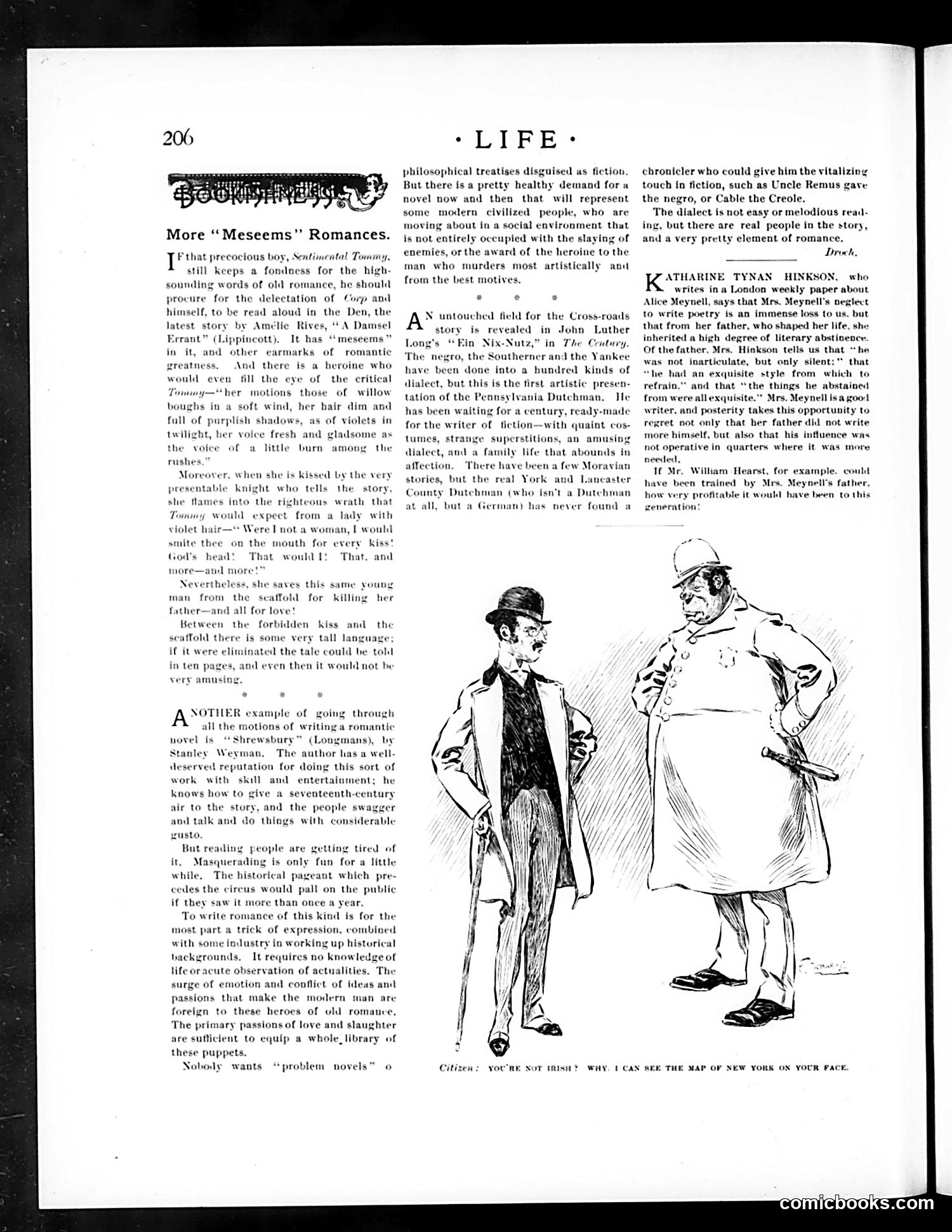
The text discusses romantic fiction writing, specifically critiquing authors who write historical novels set in past centuries. The article argues that modern readers are tiring of "masquerading" in historical settings and that truly compelling romance requires contemporary observation and emotional authenticity. The cartoon below depicts two men in conversation. The caption reads: "CITIZEN: YOU'RE NOT IRISH? WHY, I CAN SEE THE MAP OF NEW YORK ON YOUR FACE." This is a ethnic stereotype joke playing on the Irish immigrant population in early 20th-century New York. The "map" reference appears to be mocking Irish facial features as a comedic insult, reflecting the era's casual ethnic humor common in American satirical magazines. The joke relies on anti-Irish prejudice typical of the period.
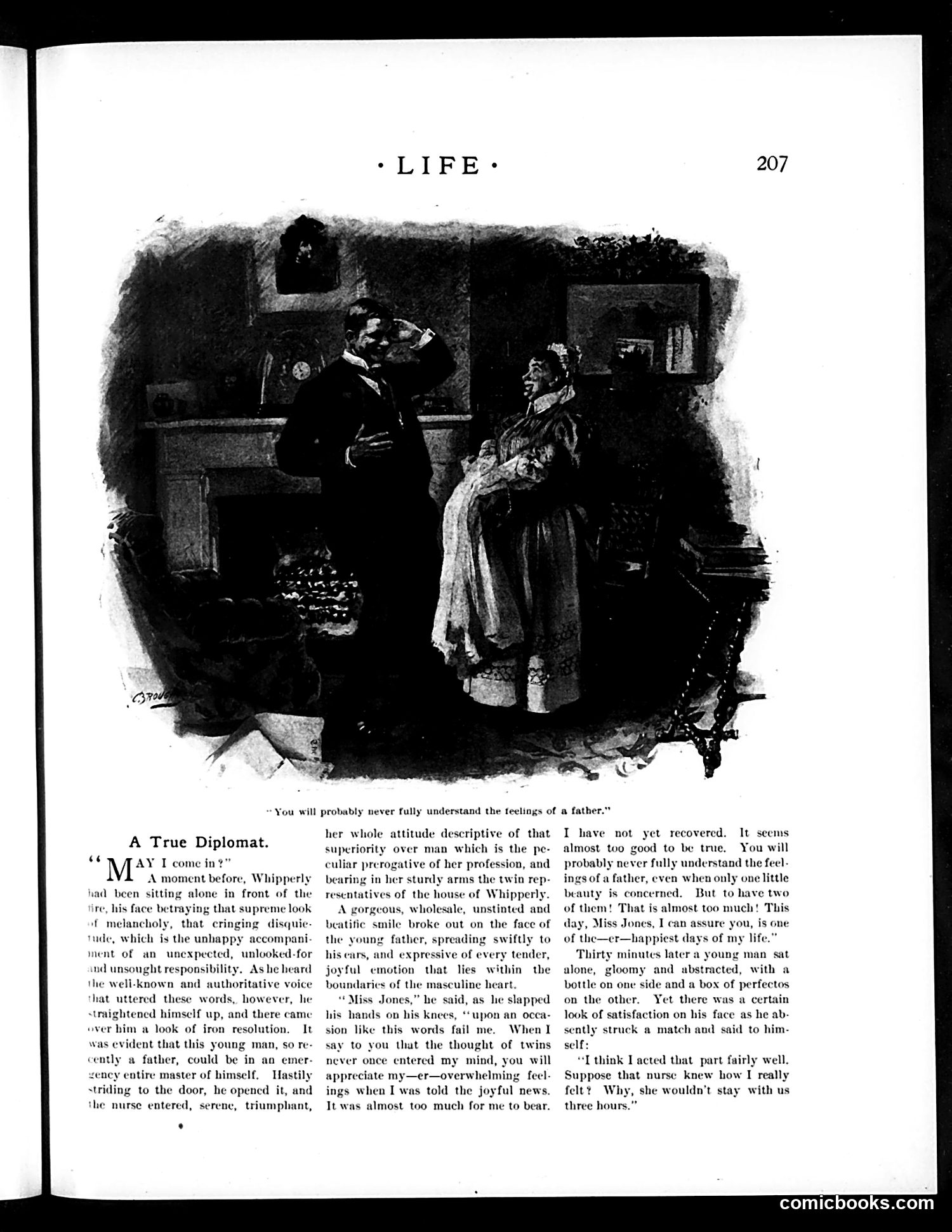
This appears to be a satirical story illustration from *Life* magazine depicting a domestic scene. The narrative concerns a father learning he has fathered twins and his emotional response—described in the text as overwhelming feelings of pride mixed with anxiety about responsibility. The "diplomat" reference in the title likely satirizes the father's careful emotional management: he must balance expressing joy over the birth while concealing his deeper worries about parental obligations. The illustration shows what appears to be the father with a nurse and another figure in a Victorian-era interior. The satire plays on masculine emotional restraint and the contrast between public composure and private feeling—a common theme in early 20th-century *Life* humor about domestic life and gender roles.
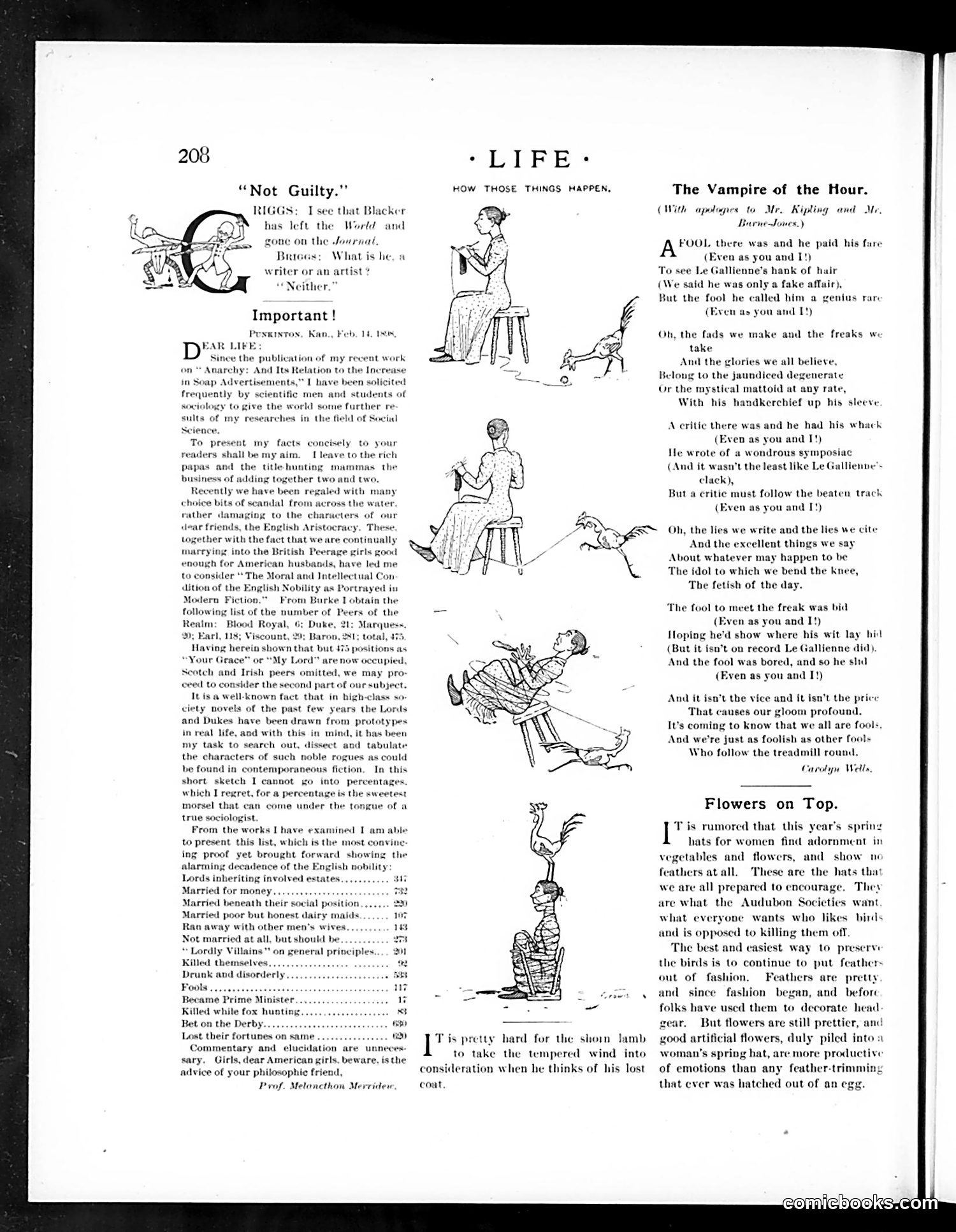
The top-left cartoon shows a dialogue between Biggs and Riggs about Blacke leaving the *World* newspaper for the *Journal*—likely referencing actual journalism industry movements of the 1890s. The joke turns on Riggs calling Blacke "neither" a writer nor artist, suggesting mediocrity. "The Vampire of the Hour" is a longer satirical poem mocking a foolish critic. It describes someone who paid to see Gallienne's theatrical production but became a harsh reviewer, calling himself a "genius." The poem ridicules this hypocritical behavior—praising his own work while attacking others—concluding that such fools follow trends uncritically. The accompanying illustrations show exaggerated figures embodying this ridiculous critic type.
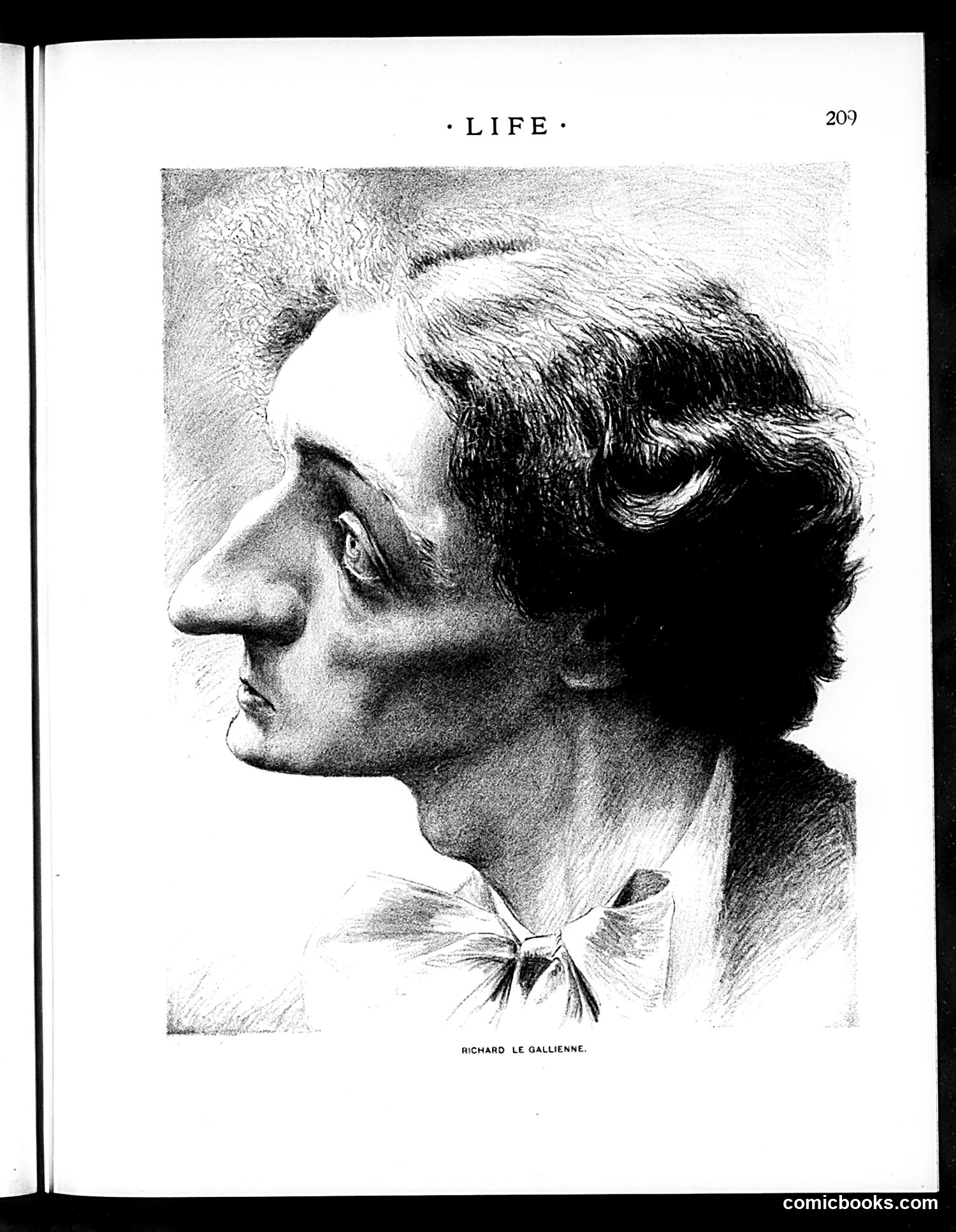
This page from *Life* magazine (page 209) features a profile portrait sketch labeled "RICHARD LE GALLIENNE." The drawing shows a man in side view wearing a bow tie, with distinctive wavy dark hair and refined facial features rendered in fine cross-hatching. Le Gallienne was a prominent late 19th/early 20th-century English writer, poet, and critic. The portrait appears to be a straightforward biographical illustration rather than political satire. *Life* regularly featured such celebrity portraits of notable literary and cultural figures of the era. Without additional context or satirical elements visible, this functions as a recognition piece celebrating a notable public intellectual of the period.
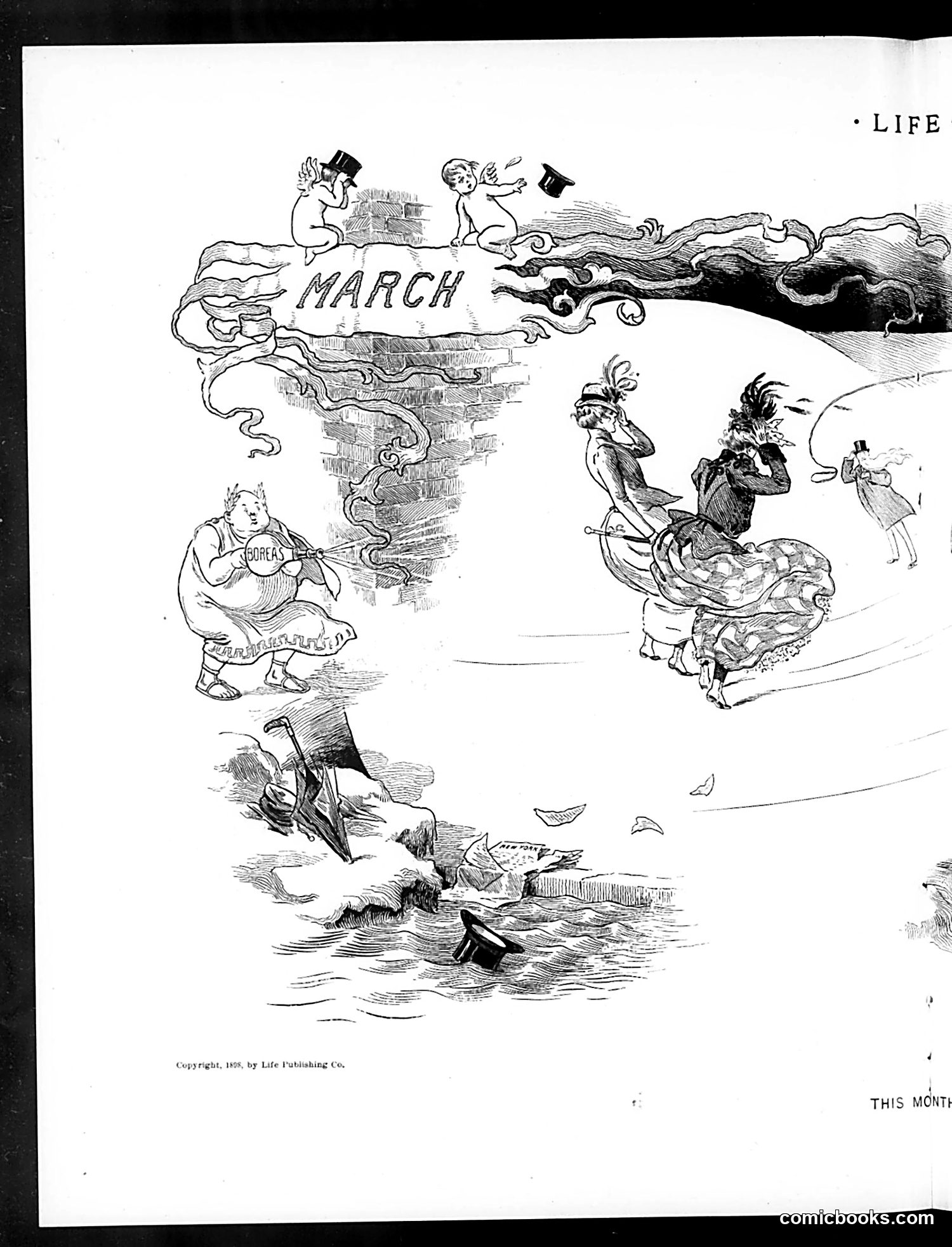
This satirical illustration depicts **March as a turbulent month** symbolized by the word "MARCH" on a stormy, wind-whipped landscape. The personified month, rendered as a classical figure with wings and wild hair, dominates the composition with swirling, chaotic energy. Below, various figures struggle against the month's chaos: a rotund man labeled "MARCH" battles the wind, while others ride an animal (possibly representing unpredictable weather or conditions). At the bottom, a figure in a top hat is blown into water or swept away—likely satirizing how March's unpredictability affects people, particularly the wealthy or powerful. The cartoon plays on the traditional saying that "March comes in like a lion," using exaggerated visual metaphors to mock the month's notorious instability and its effects on society.
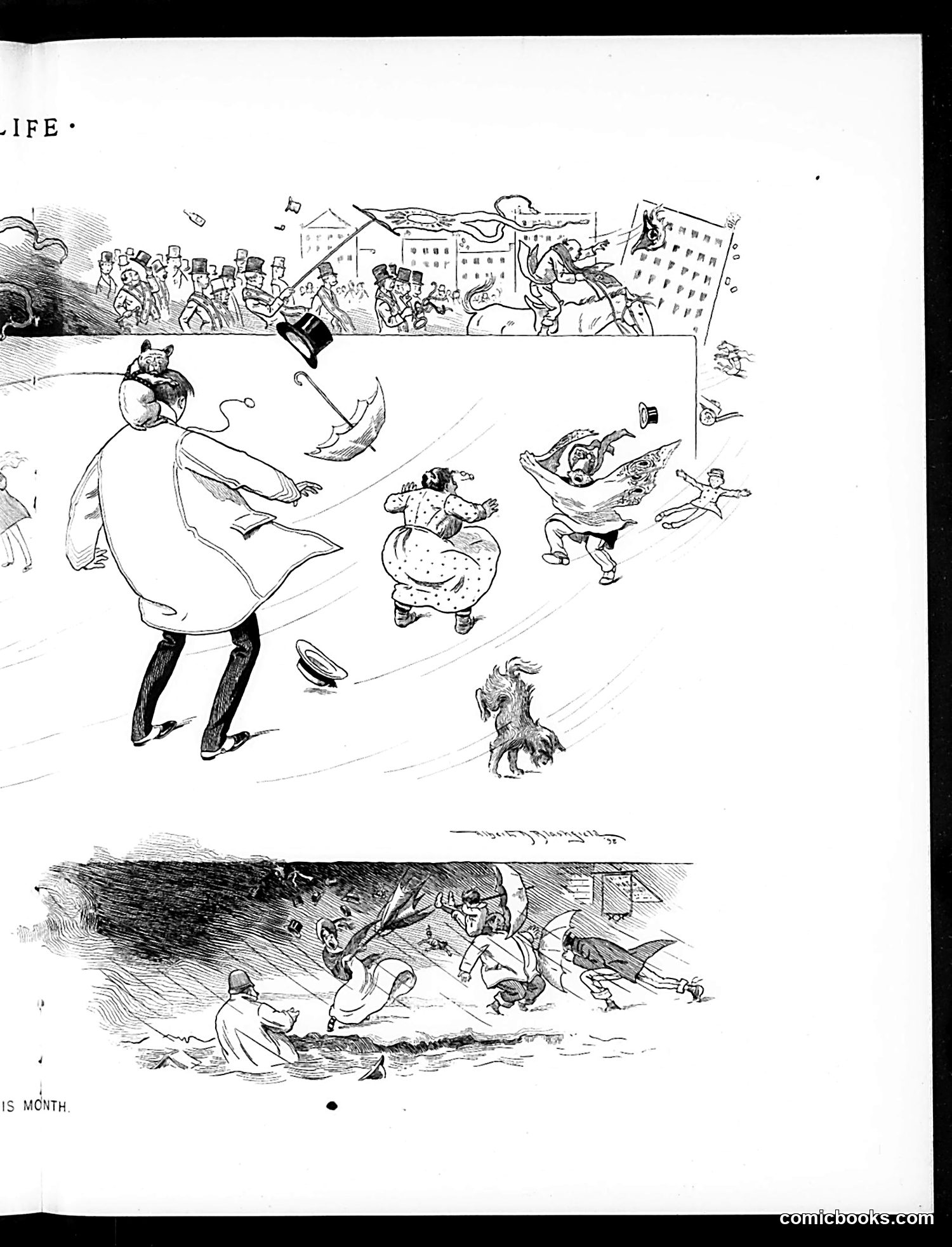
This page from *Life* magazine contains two satirical cartoons depicting social chaos and disorder. The top cartoon shows a large figure (appearing to be a caricatured authority or political leader) juggling chaos in a public square—with people fleeing, buildings visible, and various objects flying through the air. The figure's exaggerated posture and the swirling confusion suggest incompetence or loss of control. The bottom cartoon depicts what appears to be a collision or accident scene with multiple figures tumbling or scrambling in disorder, suggesting societal breakdown or public disaster. Without visible dates or clearer identifying text, the specific political events referenced remain unclear. However, both cartoons employ *Life* magazine's characteristic style: exaggerated caricature and physical comedy to criticize political mismanagement or social disorder of the period. The satire suggests government failure to maintain order.
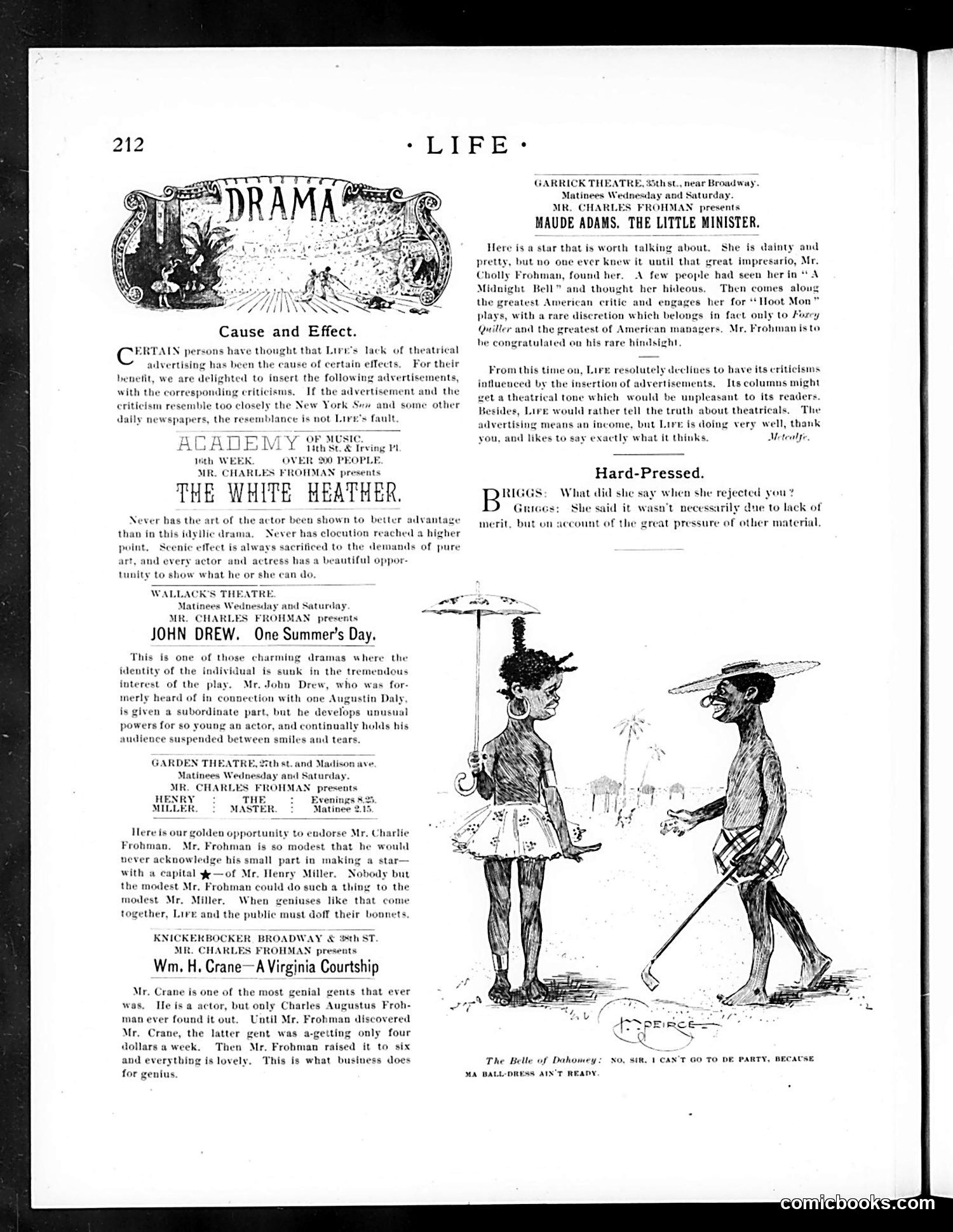
This drama review page focuses on theatrical productions presented by Charles Frohman, a prominent Broadway producer. The cartoon depicts two figures in what appears to be a social situation—one holding an umbrella, the other with a golf club. The caption reads: "The Bells of Dishonomy: 'No, Sir, I Can't Go to Be Party, Because Ma Ball-dress Ain't Ready.'" The satire mocks lower-class social pretension—the character uses awkward dialect ("Ain't") while citing fashionable concerns (ball-dress readiness) as an excuse. This represents turn-of-century humor about working-class attempts at gentility and the absurdity of social climbing. The juxtaposition of casual activity (golf/umbrella) with formal dress concerns emphasizes the comedic contradiction.
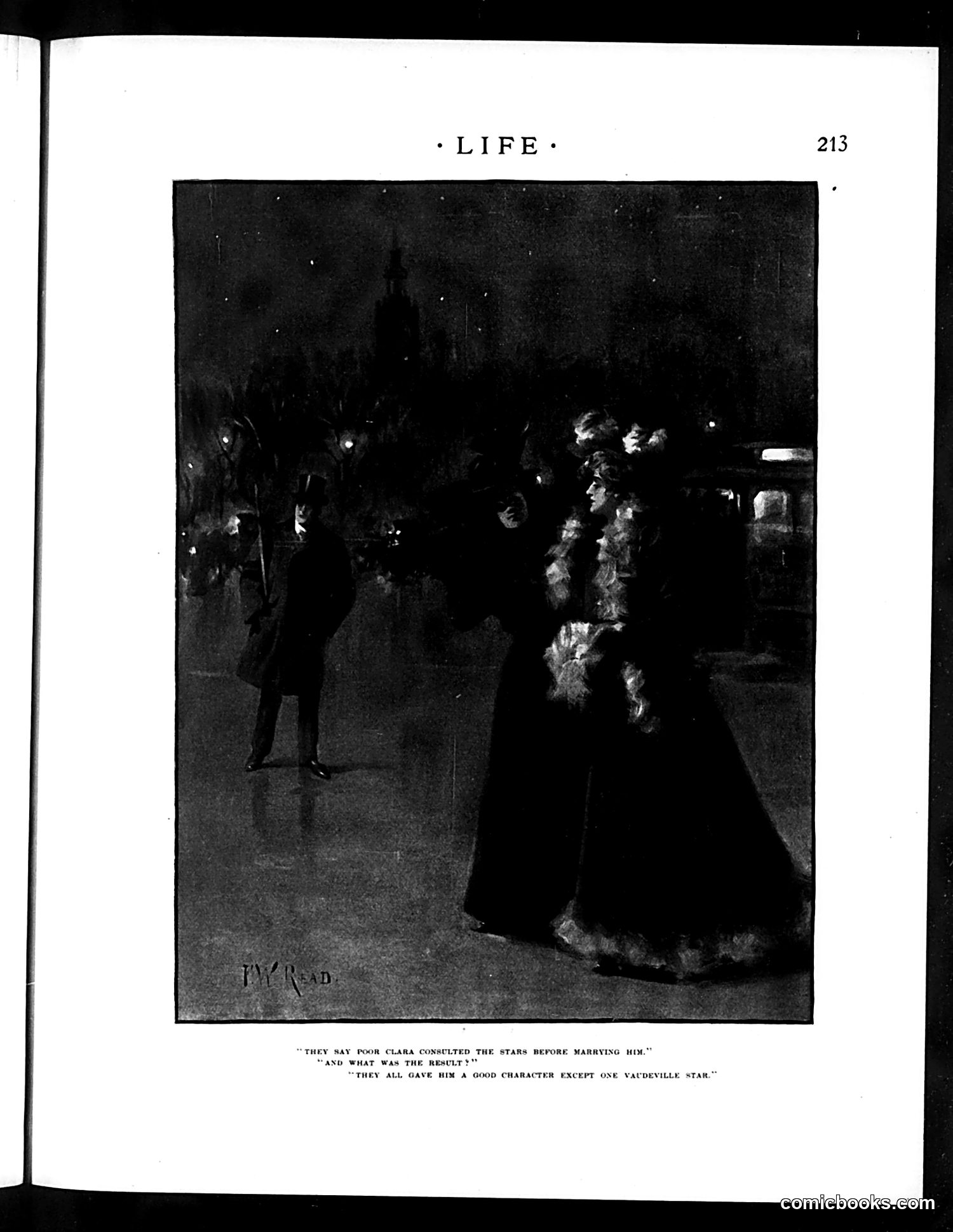
This appears to be a satirical illustration about consulting the stars (astrology) before marriage. The caption jokes that when "poor Clara" consulted the stars for character references about her intended husband, all the celestial bodies gave him positive recommendations—except one vaudeville star. The humor works on multiple levels: it plays on the period practice of consulting astrology for major life decisions, while also mocking the notion that a vaudeville performer (associated with theatrical entertainment and questionable morality in that era) would be the sole dissenting voice. The joke suggests both the absurdity of star-gazing for marriage advice and a satirical jab at vaudeville entertainers' reputations, implying this particular star had reason to know something unfavorable about the suitor.
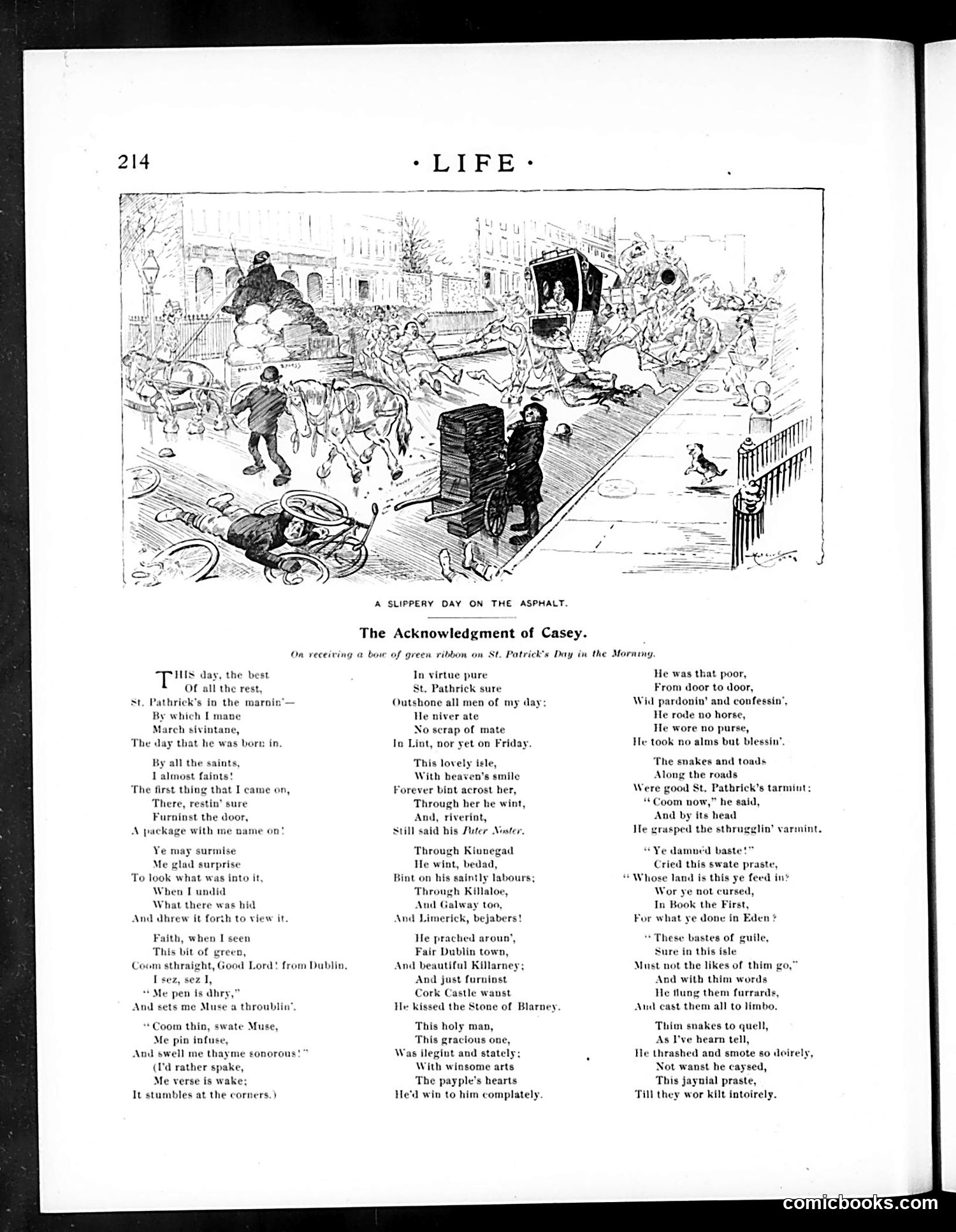
This Life magazine page combines two pieces celebrating St. Patrick's Day (March 17). The **cartoon** depicts a chaotic street scene in what appears to be an Irish-American urban neighborhood—likely New York or Boston. The humor is visual: pedestrians slip and fall on wet pavement while horse-drawn carriages, delivery carts, and crowds create mayhem. The title's "slippery" pun plays on both the literal wet ground and Irish-American stereotypes. The **poem below**, "The Acknowledgment of Casey," is written in exaggerated Irish dialect ("sthrugglin' varmint," "bedad"). It humorously describes Casey receiving a green ribbon on St. Patrick's Day morning, then launches into mock-heroic praise of St. Patrick himself—detailing his poverty, piety, and most comically, his expulsion of snakes from Ireland (a biblical reference played for laughs through crude dialect). Both pieces mock Irish-American culture through affectionate stereotyping: drunken behavior, religious devotion, and stage-Irish speech patterns that were common in turn-of-the-century American humor.
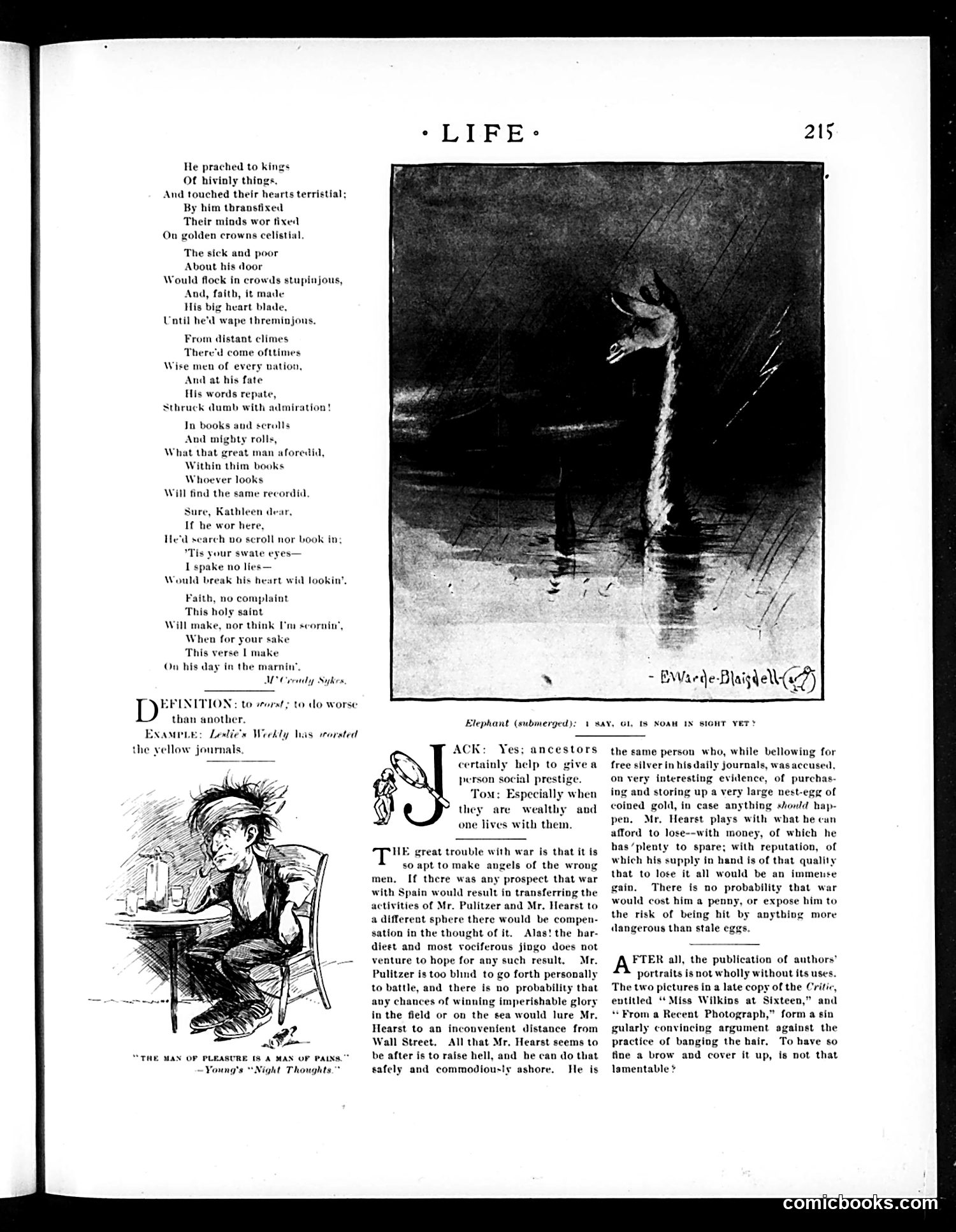
This page contains two distinct satirical pieces: **Top Section:** A sentimental Irish poem (by M. Corny Sykes) romanticizing a religious figure—likely a saint or holy man—who ministered to kings and common people alike, written in exaggerated Irish dialect. **Main Satire:** A scathing attack on newspaper publishers **William Randolph Hearst and Joseph Pulitzer**, who were agitating for war with Spain (the Spanish-American War context). The author argues these men profit from warmongering while avoiding personal risk—Hearst especially, depicted as hypocritical: he publicly championed "free silver" while hoarding gold coins privately. The piece mocks them for stirring up conflict ("raise hell") from the safety of Wall Street rather than enlisting themselves. **Bottom Section:** A brief comment on author photographs, using before-and-after images of "Miss Wilkins" to satirize the fashion of women wearing bangs that cover their foreheads. The satire targets media manipulation and cowardly jingoism masquerading as patriotism.
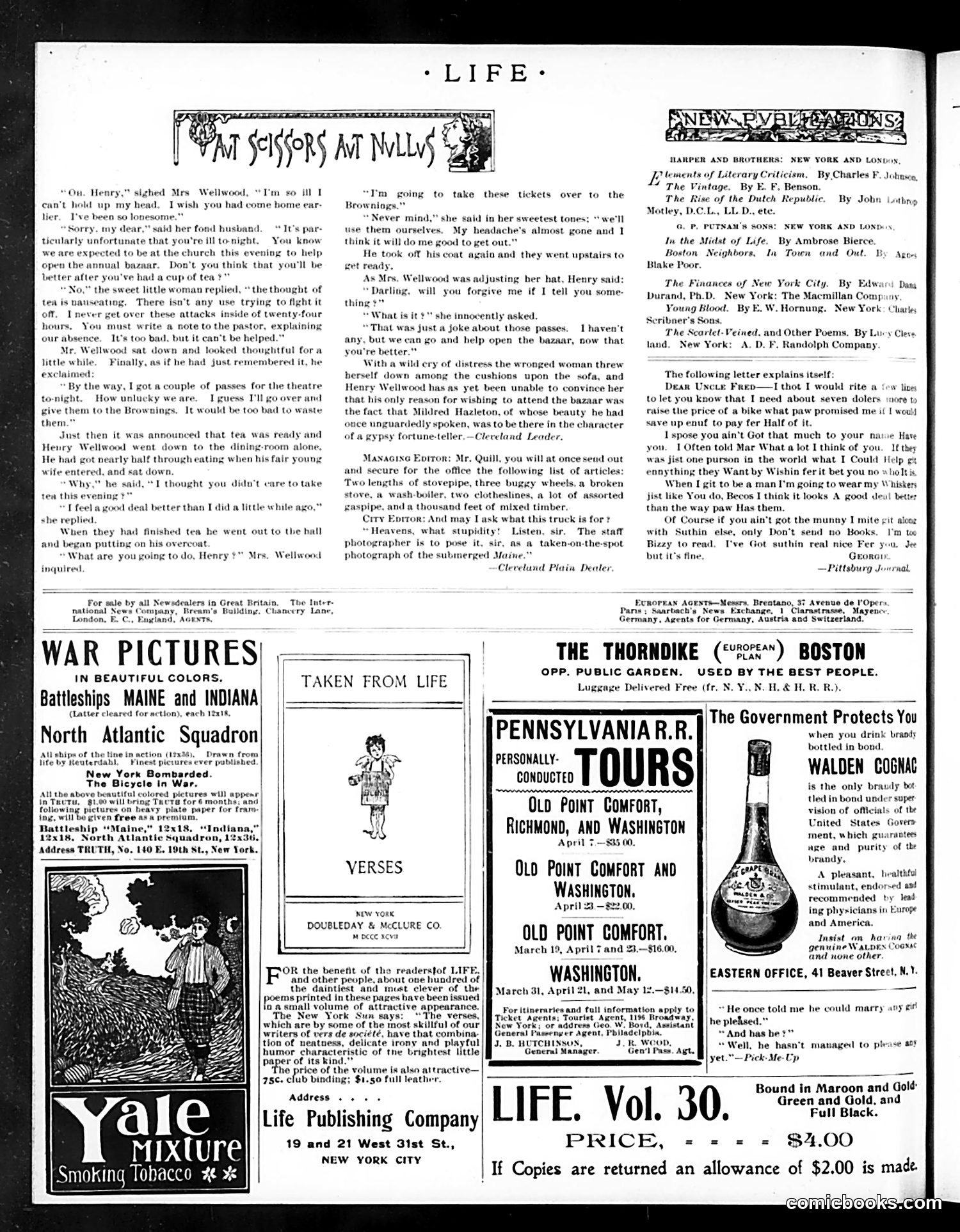
This page contains a domestic humor story rather than a political cartoon. The narrative satirizes marital deception and hypocrisy among the middle class. **The Setup:** Mrs. Wellwood claims illness to avoid attending a church bazaar. Her husband Henry, appearing sympathetic, says he'll give away theater tickets he obtained. The wife miraculously recovers and insists on going out instead. **The Satire:** Henry then admits the theater tickets were a fabrication—his real reason for wanting to attend the bazaar was to see a woman named Mildred Hazleton, whom he'd previously praised. His wife feels betrayed by his deception masquerading as concern. **The Point:** The joke exposes how both spouses manipulate each other through false excuses. While the wife faked illness for unstated reasons, Henry used sympathy as a cover for his own interest in another woman. The humor derives from their mutual dishonesty being exposed simultaneously—neither can claim moral superiority. This reflects early-20th-century magazine humor mocking bourgeois marriage as a performance of affection masking self-interest.
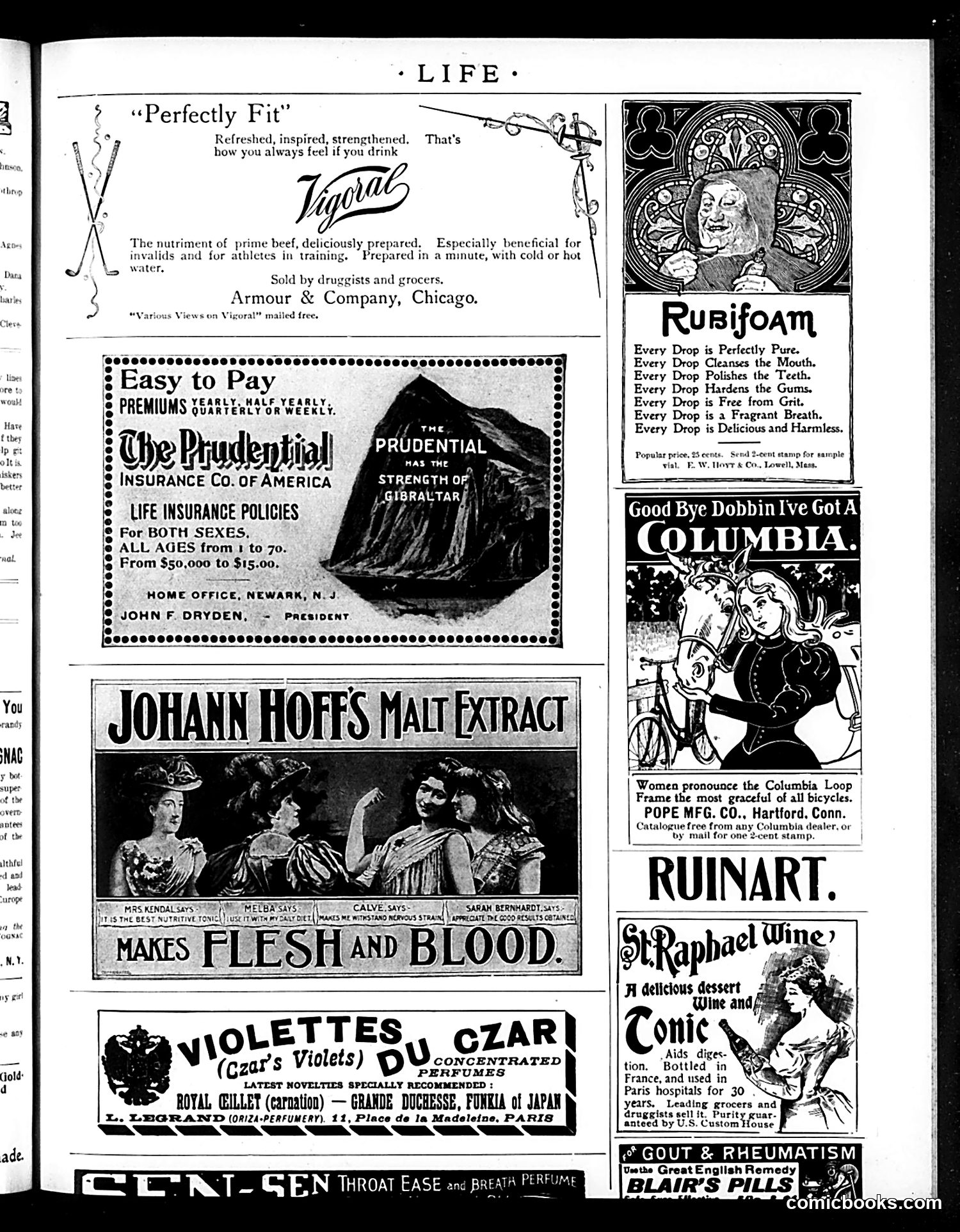
This is primarily an **advertising page** from an early-20th-century American satirical magazine, containing no political cartoons or satire requiring historical context. The ads reflect period attitudes toward health and consumer products: - **Vigoral** (beef extract) and **Johann Hoffs Malt Extract** promise physical rejuvenation—typical of an era when patent medicines made extravagant health claims without regulation. - **Rubifoam** toothpaste uses exaggerated promises ("Every Drop...") common in unregulated advertising. - **Columbia bicycles** emphasize the "graceful" frame as appealing to women—bicycles were genuinely revolutionary for female mobility and independence in this era. - **St. Raphael Wine** and **Blair's Pills** represent medicinal products marketed as cure-alls. The celebrity endorsements (Kendal, Bernhardt, Calve) indicate how early advertising borrowed star power. The overall tone reflects an unregulated marketplace where dubious health claims were standard marketing practice—a context modern readers would find shocking.
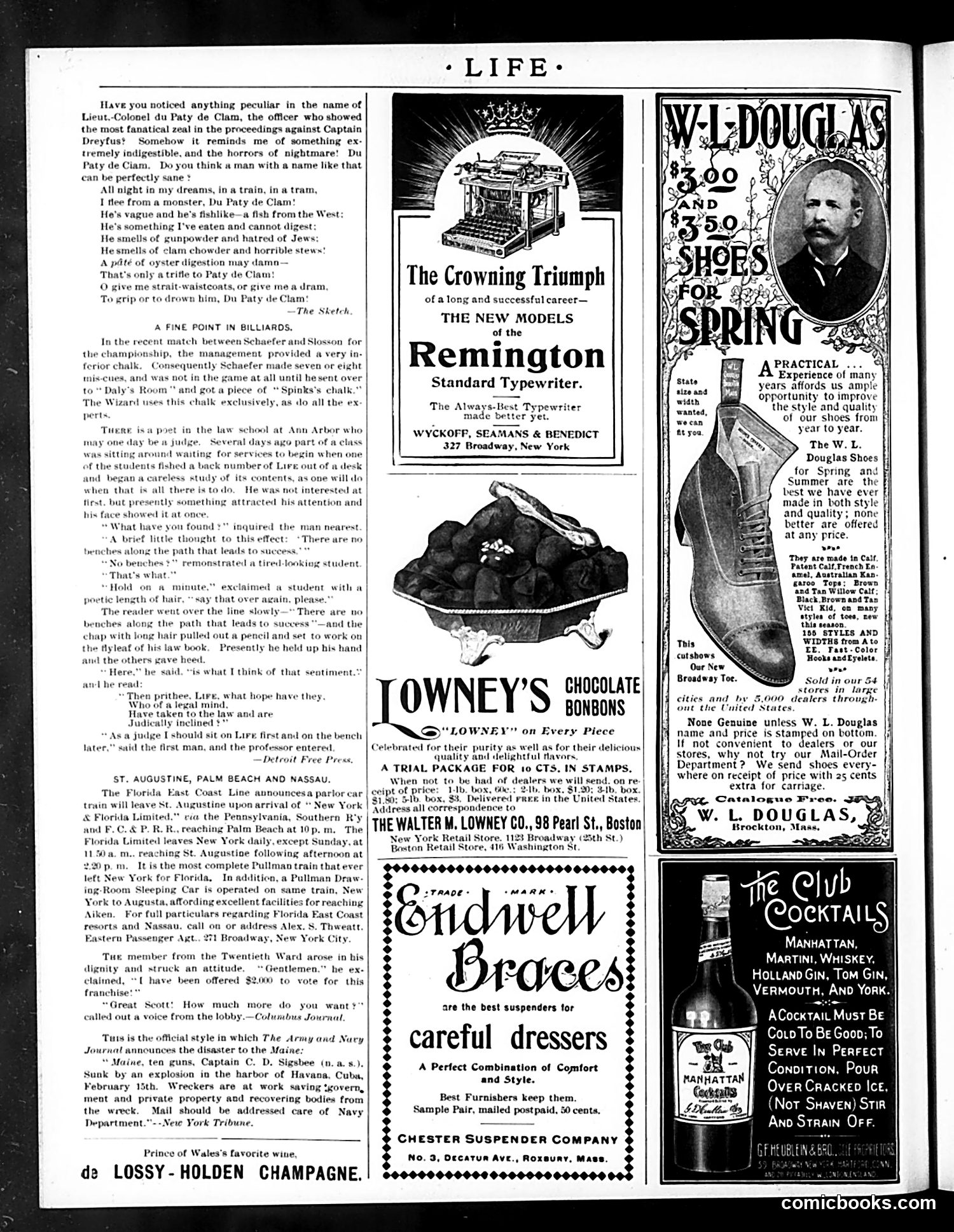
This page contains a satirical poem attacking **Lieutenant-Colonel du Paty de Clam**, a French military officer who played a key role in prosecuting Captain Alfred Dreyfus in the famous 1890s scandal. The poem mocks du Paty de Clam's name itself, claiming it sounds indigestible and nightmare-inducing. The satire accuses him of antisemitism ("smells of gunpowder and hatred of Jews") and suggests his involvement in the affair reflects moral corruption or insanity. The Dreyfus Affair was a major international scandal involving a Jewish French officer falsely accused of treason. Du Paty de Clam was instrumental in the prosecution. This poem represents the international outrage from supporters of Dreyfus's innocence, using absurdist humor and wordplay ("clam chowder") to ridicule the officer driving the unjust case. The page is otherwise advertising and miscellaneous content.
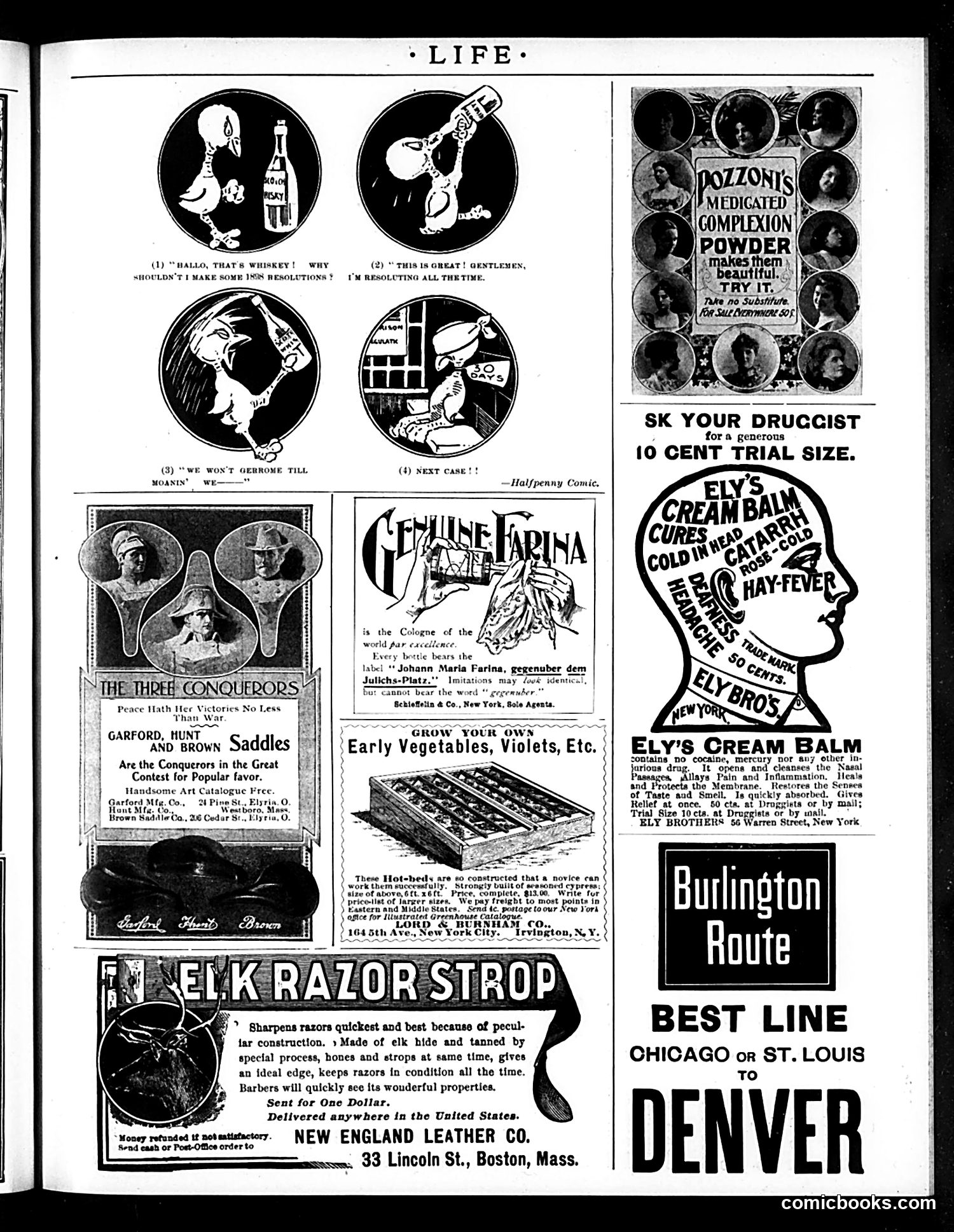
The four-panel cartoon depicts drunken men making absurd New Year's resolutions. Panel 1 shows a man claiming he'll stop drinking whiskey. Panel 2 has another man drunkenly declaring he's "resoluting all the time." Panels 3-4 show escalating chaos: a man vomiting and swearing they won't "groan till we moan," followed by a courtroom scene with "Next case!" **The satire:** This mocks the widespread tradition of making (and immediately breaking) New Year's resolutions. The joke is that these men are so drunk and disorderly that their resolutions are meaningless—they're already failing them in real-time. The progression from drinking to vomiting to legal trouble illustrates how hollow such promises were for habitual drinkers, particularly working-class men frequenting pubs. It's cynical humor about human weakness and self-deception.
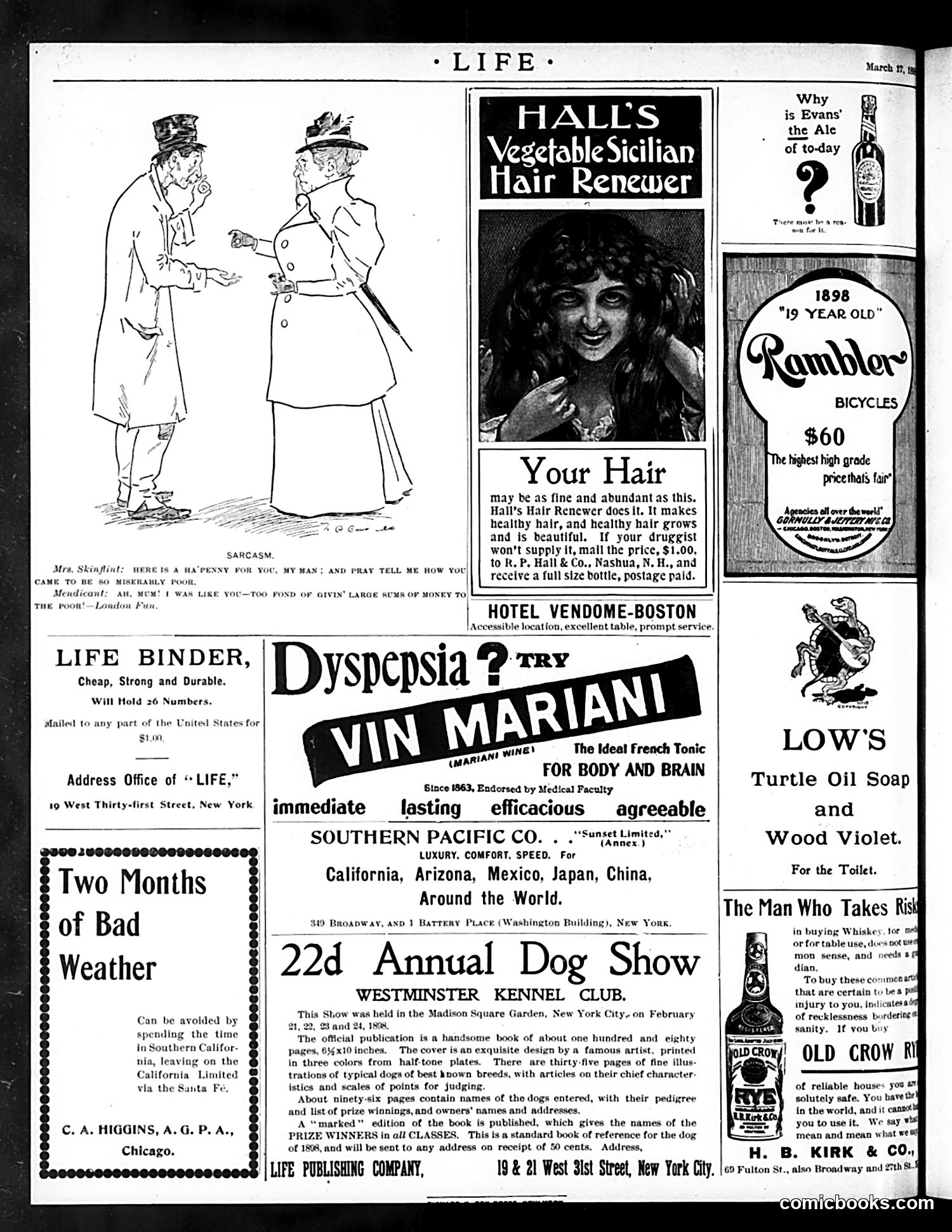
## The Main Cartoon The cartoon labeled "SARCASM" depicts two figures in conversation. A shabby man (labeled "Mendicant") asks a well-dressed woman for charity, claiming poverty. She responds with mock sympathy, saying she'd *like* to help but gives him only a ha'penny—a worthless coin. The joke's sting comes in the caption's revelation: she actually *causes* poverty by wastefully giving large sums to "the Poor"—meaning she donates indiscriminately to charity, which the cartoon suggests enables idleness rather than solving it. The satire critiques both the beggar's dishonesty and the woman's naive charity. This reflects late-Victorian anxieties about whether aid to the poor perpetuated dependency rather than encouraging self-reliance—a common argument among the era's wealthy classes. ## Context This page is primarily advertisements (hair products, bicycles, wine tonics, dog shows, soap). The cartoon's message aligns with period attitudes: suspicion of beggars and skepticism about charitable giving as potentially counterproductive.