
Life, 1898-03-17 · page 6 of 20
Life — March 17, 1898 — page 6: what you’re looking at
What you’re looking at
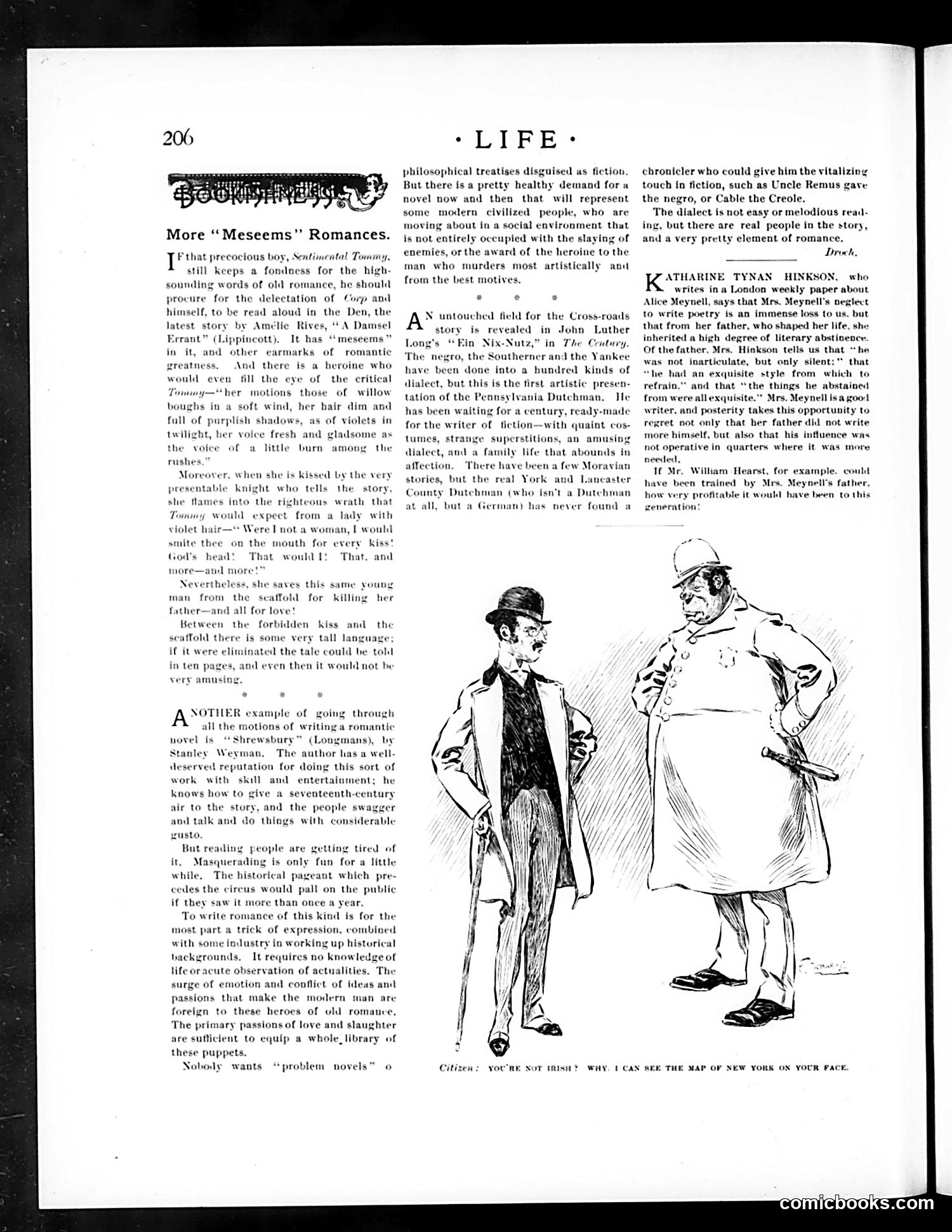
The text discusses romantic fiction writing, specifically critiquing authors who write historical novels set in past centuries. The article argues that modern readers are tiring of "masquerading" in historical settings and that truly compelling romance requires contemporary observation and emotional authenticity. The cartoon below depicts two men in conversation. The caption reads: "CITIZEN: YOU'RE NOT IRISH? WHY, I CAN SEE THE MAP OF NEW YORK ON YOUR FACE." This is a ethnic stereotype joke playing on the Irish immigrant population in early 20th-century New York. The "map" reference appears to be mocking Irish facial features as a comedic insult, reflecting the era's casual ethnic humor common in American satirical magazines. The joke relies on anti-Irish prejudice typical of the period.
📄 Transcribed text from this page (OCR, searchable)
Machine-transcribed from the original scan — historical spelling and the odd misread are preserved.
More ‘“‘Meseems”’ Romances. [i that precocious boy, Sentimental Tommy, still keeps a fondness for the high- sounding words of old romance, he should procure for the delectation of Corp and himself, to be read aloud in the Den, the st story by Amélic Rives, A Damsel rant” (Lippincott). + and It has ‘mes earmarks of And there is a beroine who even fill the of the critica’ her those of willow boughs in a soft wind, her bair dim and full of purplish shadows, as of violets in twilight, ber voice fresh and gl the little burn other romantic would Tommy— motions Isome as voice of among the rushes.” Moreover, when she is kissed by the very ntable knight who tells the story, flames in’ the righteous wrath that Xpect from a lady with Were I not. a woman, | would smite thee on the mouth for every kiss! Vs head! That would! That, and ud mor Neverthel many would violet bair— ves this sam man from the fold for killi father—and all for love! Between the forbidden seaffold th if it were kiss and tall lan ale could be to es, and even then it would not be very amusing. is some ve iminated the in ten pa ANOTHER example of going through all the motions of writing a romantic hrewsbury” (Ls by Weyman, The erved rey work with novel is nley uthor has a well- ion for doing this sort of skill and entertainment; he knows how to give a seventeenth-century air to the story, and the people swas and talk and do thiegs with consider: gusto But reading people are getting tired of it, Masquerading is only fun for a litte while, The historical pageant which pre- cedes the circus would pall on the public if they saw it more than once a year. To write romance of this kind is for the most part a trick of expression, combit with some industry in working up backgrounds, It requires no knowle life or acute observation of actualities. The surge of emotion and conflict of ideas and passions that make the modern man are foreign to these heroes of old romauce, The primary passions of love and slaughter sufticient to equip a whole library of ¢ puppets. Nobody wants “problem novel * LIFE: philosophical treatises disguised as fiction. But there fs a pretty healthy demand for « novel now and then that will represent modern civilized people, who are moving about in a social environment that is not entirely occupied with the slaying of enemies, or the award of the heroine to the man who murders most artistically anit from the best motives. some * ® * N untouched field for the Cross-roads story is revealed in John Luther Long's “Bin Nix-Nutz,” in The Cente The negro, the Southerner and the Yanke have been done into a hundred kinds of dialect, but this is the first artistic presen- tation of the Pennsylvania Dutehn has been waiting for a century, ready-m) for the writer of fiction tumes, strange supersti dialect, and a family life that abounds in affection. There have been a few Moravian stories, but the real York and Lancaster County Dutehman (who isn’t a Dutehman UM, but a German) has never found a with quaint c jons, an amusin, Citizen: vou'ne No tmisi WHY. chronicler who could give him the vitalizing h in fiction, such as Uncle Remus gave negro, or Cable the Creole. ‘The dialect is not easy or melodious read- ing, but there are real people in the story, and a very pretty element of romance, Droch, KATHARINE TYNAN HINKSON, who writes ina London weekly paper about Alice Meynell, says that Mrs, Meynell’s neglect to write poetry is an immense loss to us. but that from her father, who shaped her life, she inherited a high degree of literary abstinence. Of the father, Mrs, Hinkson tells us that “he was not inarticulate, but only silent: that “he had an exquisite style from which to refrain,” and that “the things he abstained from were all exquisite.” Mrs. Meynell isa goo! writer, and posterity takes this opportunity regret not only that ber father did not write more himself, but also that his influence was hot operative in quarters where it was more needed, If Mr. William Hearst, for example. could ined by Mrs. Meynell’s father, generati 1 CAN SER THE MAP OF NEW YORK ON YOUR PACE.