
Life, 1898-03-17 · page 4 of 20
Life — March 17, 1898 — page 4: what you’re looking at
What you’re looking at
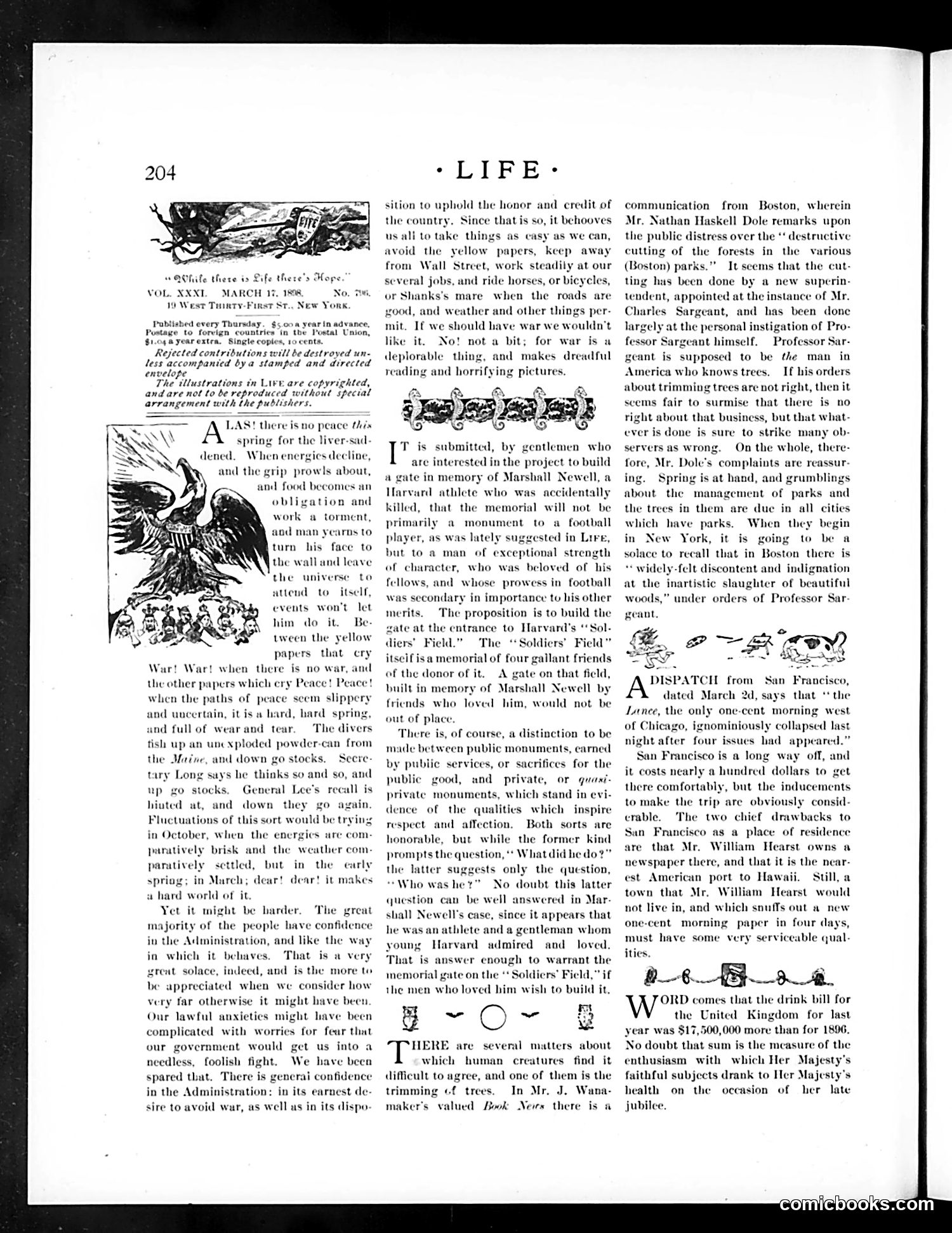
This page contains editorial commentary rather than political cartoons. The text discusses several social issues of the era: **Key topics:** - War anxieties and the desire to avoid conflict ("when the paths of peace seem slippery") - A proposed memorial gate at Harvard for Marshall Newell, a football player who died accidentally - The distinction between public monuments (for public service) versus private memorials - Tree-trimming practices in cities, with Professor Sargent apparently advocating for careful management of urban forests - A dispatch from San Francisco noting the collapse of a one-cent morning newspaper after only four days The decorative illustrations appear to be period ornaments rather than satirical cartoons. The page reflects turn-of-century Progressive Era concerns about civic improvement, memorialization, and urban management.
📄 Transcribed text from this page (OCR, searchable)
Machine-transcribed from the original scan — historical spelling and the odd misread are preserved.
“OQOife there is Life there's Hope VOL. XXXL MARCH 17, 1898 No. 74, 19 West Tuinty-First St., New York. Published every Thursday. $5.00 yearin advance, Postage to foreign countrics in the Postal Union, $1.04 year extra. Single copies, 10 cents. Rejected contributions will be destroyed un- tess accompanied bya stamped and directed envelope The illustrations in Live are copyrighted, and are not to be reproduced without special arrangement with the publishers. A's there is no peace this spring for the liver-sad- dened, When energies decline, and the grip prowls about, and food becomes an obligation and work a torment, aod man yearns to turn his face to the wall and leave the universe to attend to itself, events won't let him do it. Be- tween the yellow papers that cry War! War! when there is no war, and the other papers which cry Peace! Peace! when the paths of peace secm slippery and uncertain, it isa hard, hard spring, and fullof wearand tear. The divers tish up an unexploded powder-can from the Maine, and down g Scere: says he thinks so and so, and General Lee's recall is nd down they Fluctuations of this sort would be trying in October, When the energics are com- paratively brisk and the weather com- tary Lons up go stocks. hiuted at, gain paratively settled, but in) the early in March; dear! dear! it makes d world of it Yet it might be harder. The great majority of the people have confidence iu the Administration, and like the way in which it That is a very great solace, indeed, and is the more to be appreciated when we consider how very far otherwise it might have been. Our lawful anxietics might lave been complicated with worries for feur that our government would get us into a needless, foolish fight. We have beca spared that. There is generai confidence in the Administration: in its earnest de- sire to avoid war, as well us in its dispo behaves. -LIFE- sition to uphold the honor and credit of the country, Since that is so, it behooves us all to take thin can, avoid the yellow papers, keep away from Wall Street, work steadily at our several jobs, and ride horses, or bicycles, or Shanks's mare when the roads are good, and weather and other things per- mit. If we should have war we wouldn't like it. No! not a bit; deplorable thing, and makes dreadful reading and horrifying pictures. iRA ES BES omer oe I" is submitted, by gentlemen who are interested in the project to build a gate in memory of Marshall Newell, a Harvard athlete who was accidental killed, that the memo: will not be primarily a monument to a football player, as was lately suggested in Lire, but to a man of exceptional strength of character, who was beloved of his fellows, and whose prowess in football was secondary in importance to his other merits. The proposition is to build the gate at the entrance to Harvard's ‘Sol- Fiel he ‘Soldiers’ Field itseif isa memorial of four gallant friends of the donor of it. A gate on that field, built in memory of Marshall Newell by friends who loved him, would not be out of place. There is, of course, a distinction to be made between public monuments, earned by public services, or sacrifices for the yas wi for war is a diers’ public good, and private, or quani- private monuments, wh dence of the qualities which inspire and affection, Both sorts are honorable, but while the former kind prompts the question, ‘* Whatdid he do?” the latter suggests only the question, “Who was het” No doubt this latter question can be well answered in Mar- shall Newell's case, since it appears that he was an athlete and a gentleman whom young Harvard admired and That is answer cnough to warrant the memorial gate on the ‘* Soldiers’ Field,” if the men who loved him wish to build it, B~O~ 8 we HERE are several matters about which human creatures find it difficult to agree, and one of them is the trimming ¢f trees. In Mr. J. Wana- ued Book News there ) stand in evi- respect loved. maker's is a communication from Boston, wherein Mr. Nathan Haskell Dole remarks upon the public distress over the ‘ destructive cutting of the forests in the various (Boston) parks.” It seems that the cut- ting has been done by a new superin- tendent, appointed at the instance of Mr. Charles Sargeant, and has been done largely at the personal instigation of Pro- ant himself. Professor Sar- geant is supposed to be the man in strees. If his orders about trimming trees are not right, then it scems fair to surmise that there is no right about that business, but that what- ever is done is sure to strike many ob- servers as wrong. On the whole, there- fore, Mr. Dole’s complaints are reassur- ing. Spring is at hand, and grumblings about the management of parks and the trees in them are due in all cities which have parks. When they begin in New York, it is going to be a solace to recall that in Boston there is + widely-felt discontent and indignation at the inartistic slaughter of beautiful woods,” under orders of Professor Sar- America who knov geant, BP > ER ey) See Ps DISPATCH from San Francisco, dated March 2d, says that * the Lance, the only one-cent morning west of Chicago, ignominiously collapsed last night after four issues had appeared.” San Francisco is a long way off, and it costs nearly a hundred dollars to get there comfortably, but the inducements to make the trip are obviously consid- erable. The two chief drawbacks to San Francisco as a place of residence e that Mr. William Hearst owns a newspaper there, and that it is the near- est American port to Hawaii. Still, a town that Mr, William Hearst’ would not live in, and which souffs out a new one-cent- morning paper in four days, must have some very serviceable qual- ities. o_6._ R34. ORD comes that the drink bill for the United Kingdom for last year was $17,500,000 more than for 1896. No doubt that sum is the measure of the enthusiasm with which Her Majesty's faithful subjects drank to Her Majesty's health on the occasion of her late jubilee.