
A complete issue · 20 pages · 1897
Life — December 23, 1897
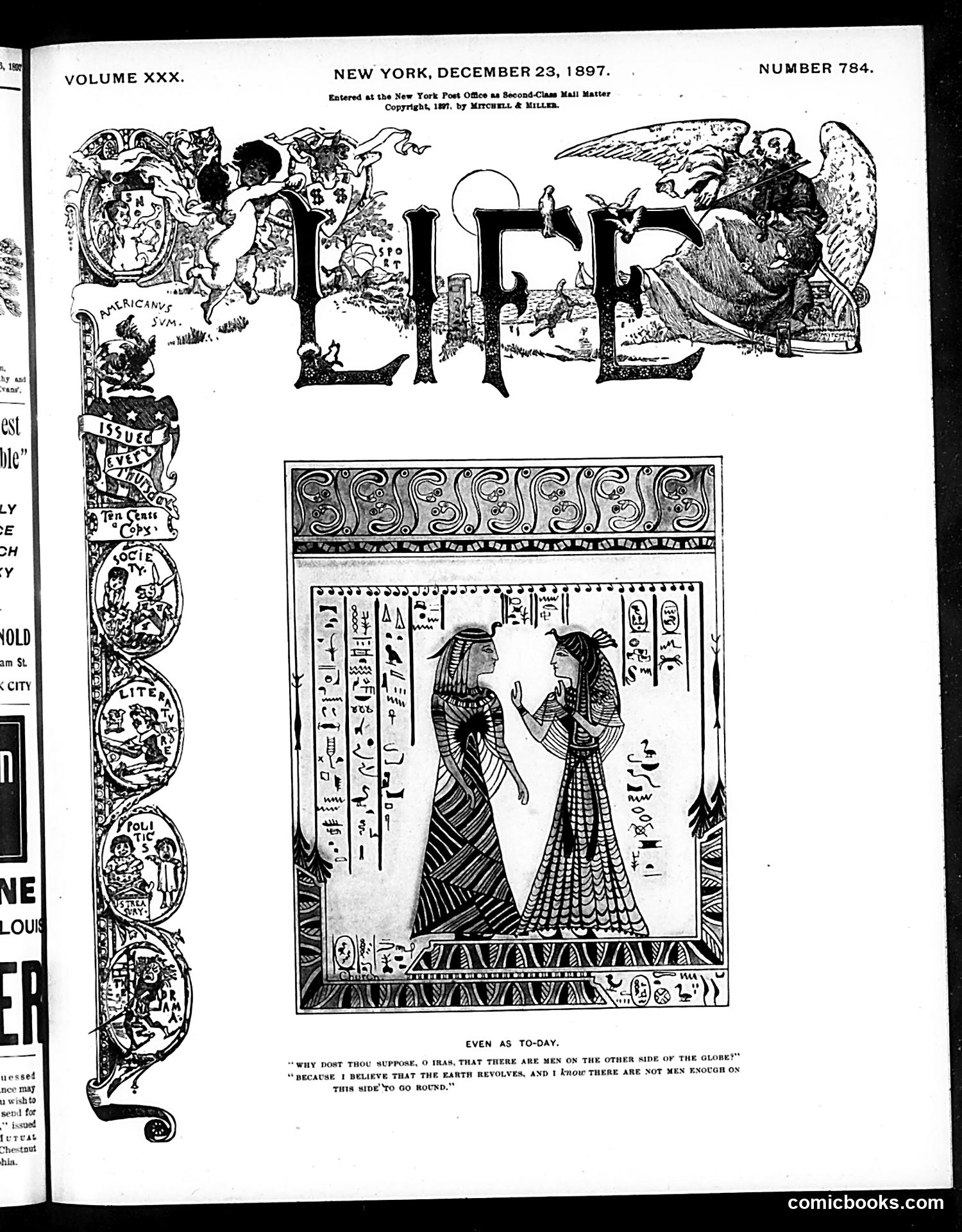
This page features an Egyptian-themed cartoon titled "Even as To-Day." The central image depicts two ancient Egyptian figures in traditional dress and headdresses, flanked by hieroglyphics. The caption questions whether men exist "on the other side of the globe," suggesting the earth revolves, and notes "I know there are not men enough on this side to go round." The satire appears to mock contemporary debates about population, geography, or possibly gender relations of the 1890s. The Egyptian setting—ancient and "exotic" to Western readers—contrasts with modern social commentary, a common rhetorical device in satirical magazines. The specific social or political issue referenced is unclear without additional context, though it likely concerns contemporary anxieties about overpopulation or marriage/courtship matters.
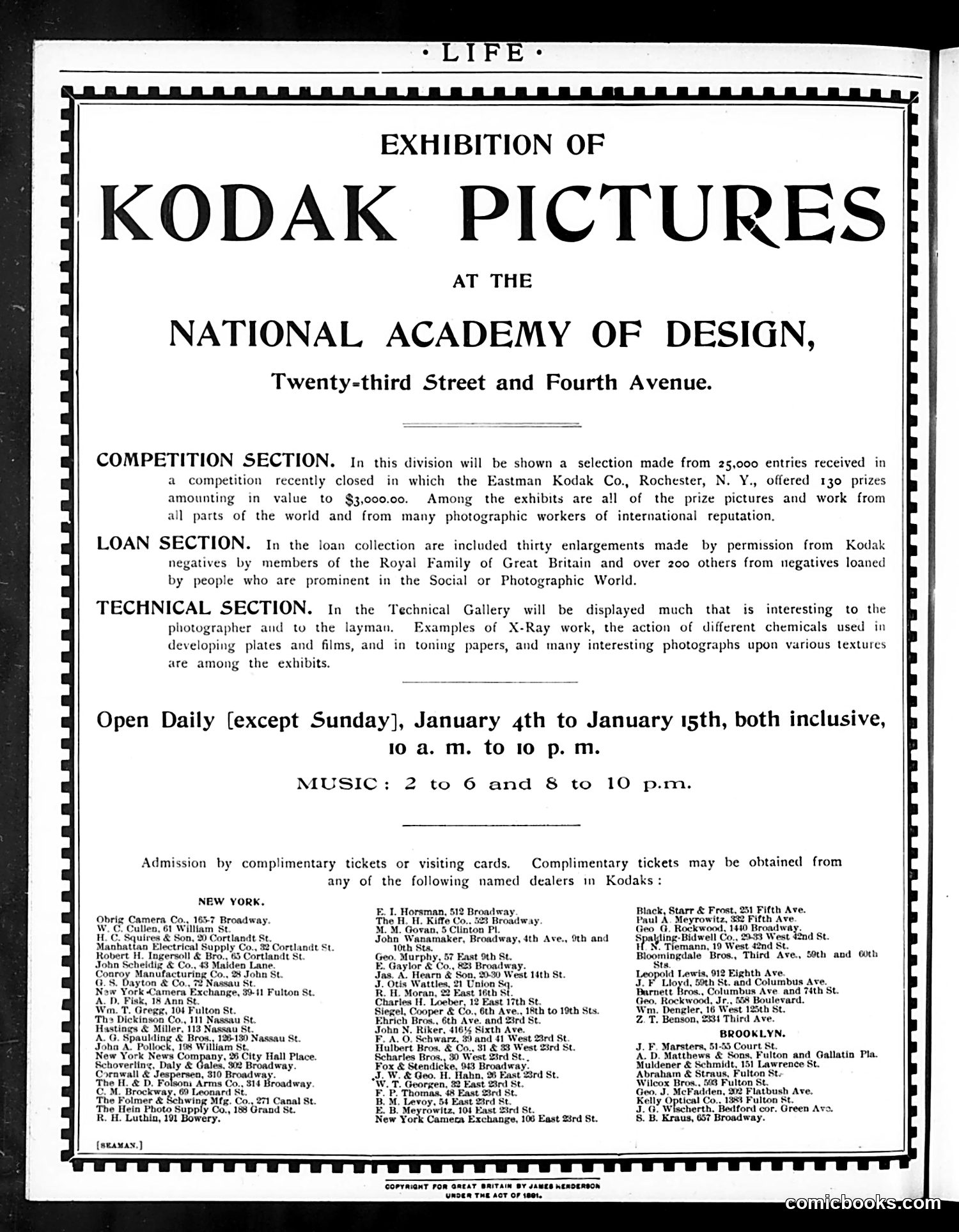
This page is entirely **advertising and announcement**, not satirical content. It announces an "Exhibition of Kodak Pictures" at the National Academy of Design in New York (January 4-15), featuring three sections: 1. **Competition Section** — selections from 25,000 entries in a Kodak photography competition with 130 prizes 2. **Loan Section** — 30 enlargements from British Royal Family negatives plus 200+ others 3. **Technical Section** — X-ray work, chemical processes, and photographic techniques The bulk of the page lists dozens of Kodak dealers in New York where complimentary admission tickets could be obtained. This appears in *Life* magazine simply as a paid advertisement promoting Kodak's photography exhibition and products to the magazine's readers.
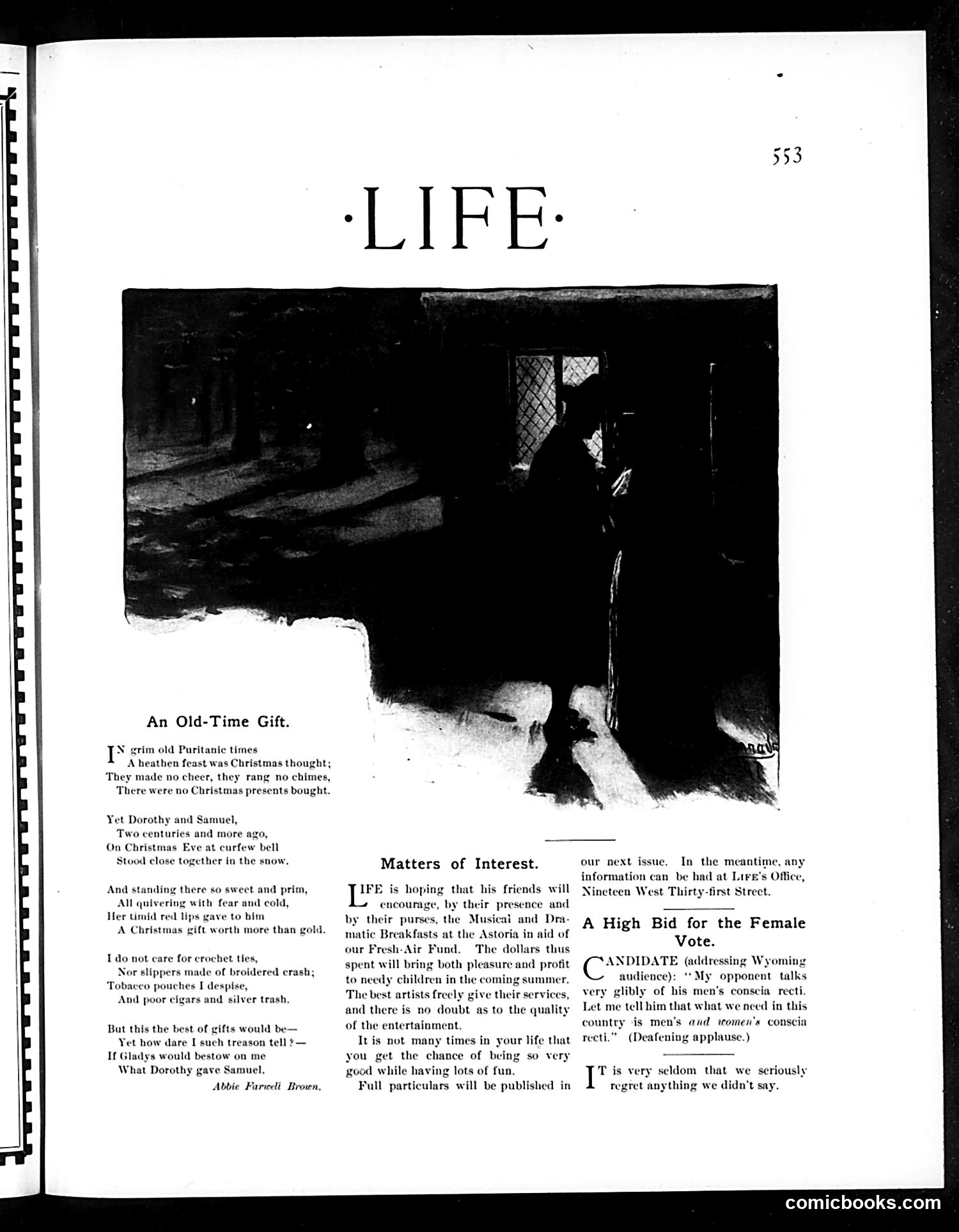
This page contains a poem titled "An Old-Time Gift" by Abbie Farwell Brown, contrasting Christmas customs from "two centuries and more ago" with modern times. The poem celebrates a historical gift of gold given by Dorothy and Samuel on Christmas Eve, presented as more meaningful than contemporary material presents. The accompanying black-and-white photograph shows what appears to be an interior domestic scene, though details are obscured by the image quality. Below the poem are two brief articles: one about the Astor Fresh Air Fund's Musical and Dramatic Breakfasts, and another titled "A High Bid for the Female Vote," discussing women's political representation and suffrage concerns. The page primarily focuses on nostalgia and social commentary rather than political satire.
This page contains an editorial essay by Dr. Felix Adler titled "Prejudice Against Jews in this Country" rather than political cartoons. The small decorative illustration appears to be a generic satirical figure, not representing a specific person. Adler argues against antisemitic discrimination in America, asserting that Jews are "truthful, clean, courteous and modest" and should be accepted in society. He criticizes the "social discrimination against Jews" as baseless, arguing their separation reflects prejudice rather than legitimate differences. The essay defends Jewish integration into American life while acknowledging that some Jews, like members of any group, may have undesirable traits. Adler advocates for practical coexistence based on individual merit rather than ethnic prejudice. This represents early 20th-century progressive advocacy against antisemitism in American public discourse.
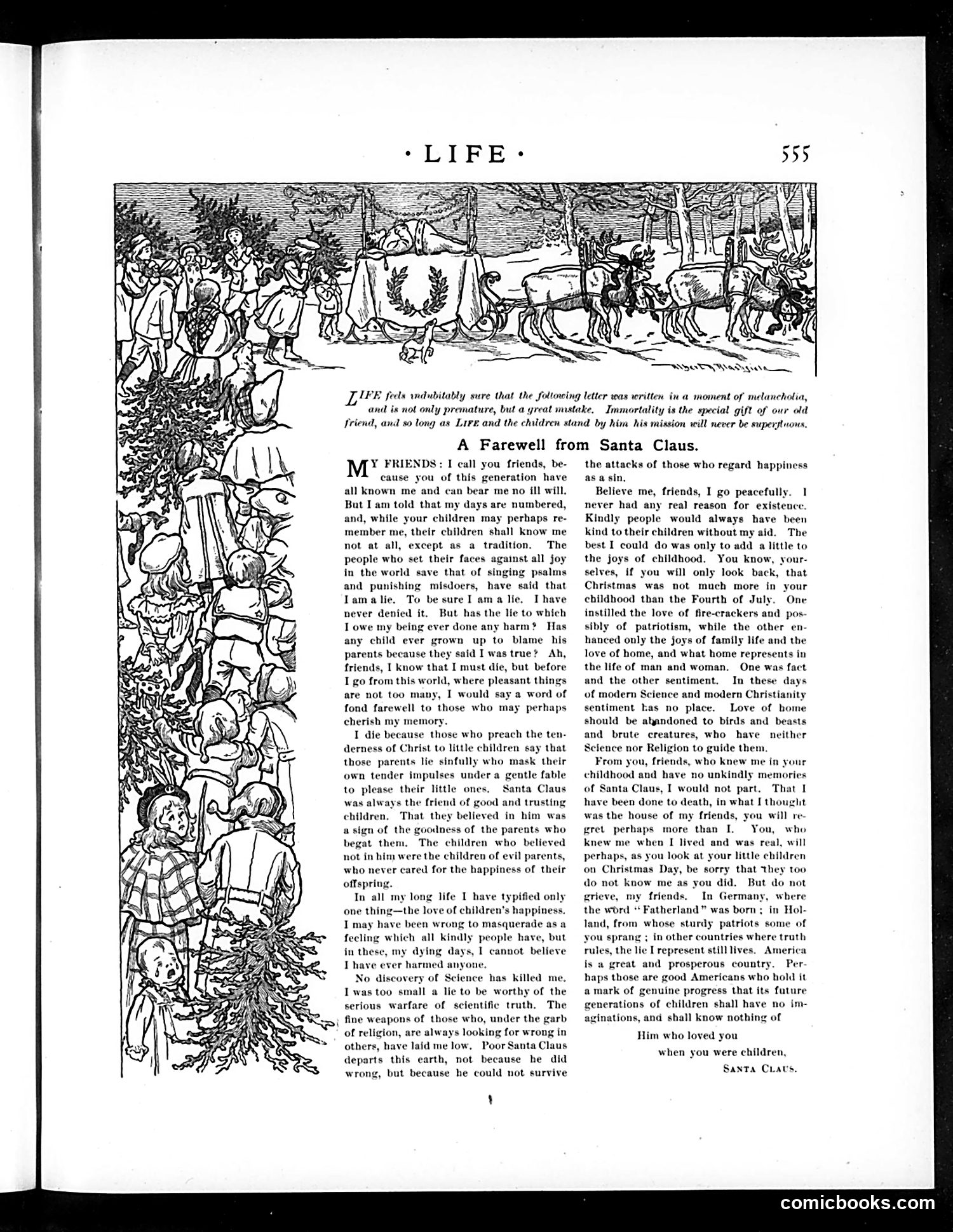
This piece is Santa Claus's deathbed letter to children, rejecting the modern attack on him as a "lie." The letter defends Santa against what appears to be early 20th-century rationalist or scientific criticism—efforts to discredit Santa to children as dishonest parenting. Santa argues his value lies in promoting childhood happiness and love of home, not in literal truth. He contrasts this with modern "Science" and "Rationalism," which he sees as cold replacements. The letter attacks those who expose Santa as liars, blaming them for destroying innocent joy. The ornate left-margin illustration depicts children and Christmas scenes nostalgically. This reflects *Life* magazine's conservative defense of Victorian childhood sentimentality against emerging modern skepticism about traditional myths.
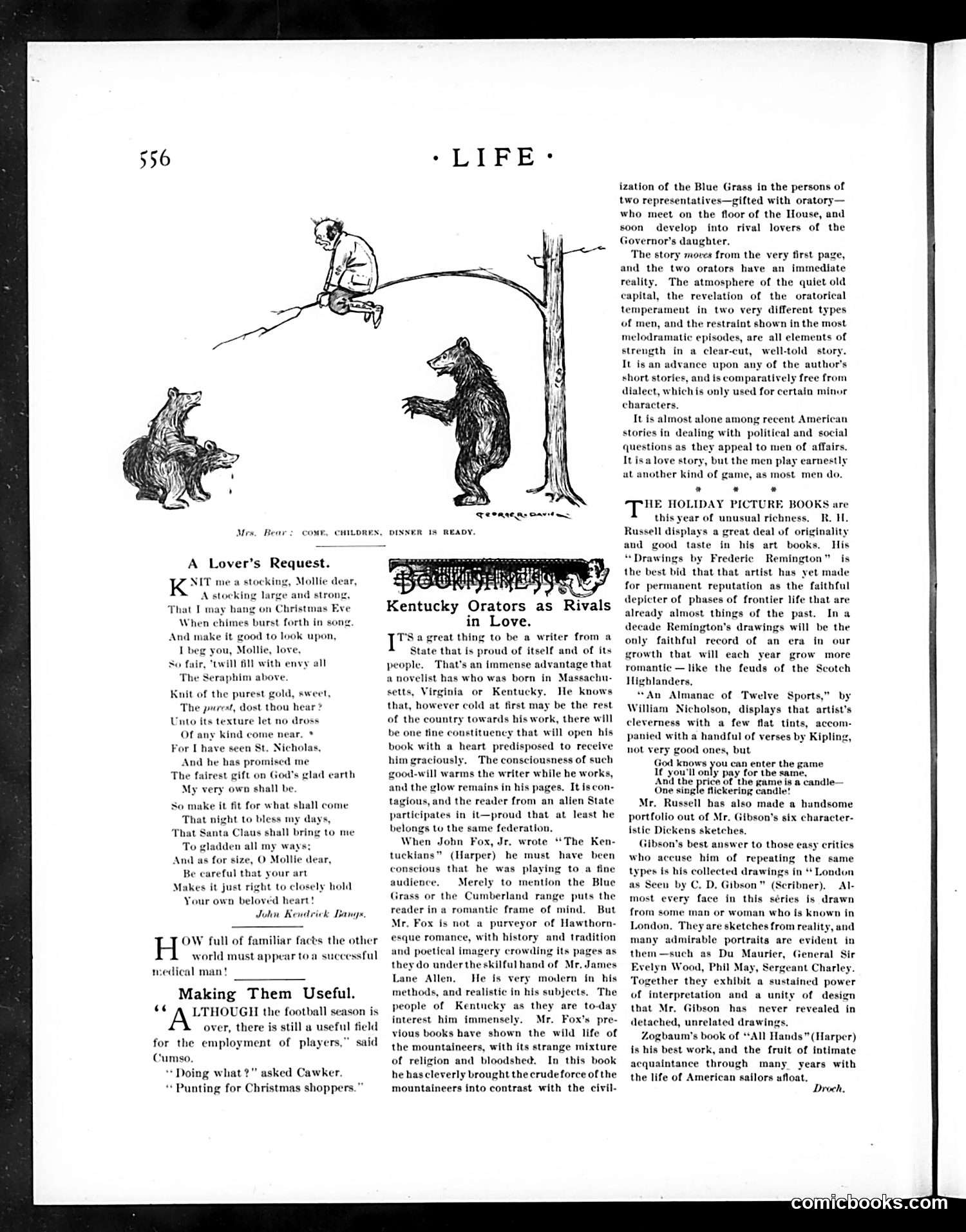
This page contains literary content rather than political satire. The main illustration shows a woman calling children to dinner while bears emerge from the woods—a humorous domestic scene titled "Mrs. Bear: Come, Children, Dinner is Ready." Below this is a poem titled "A Lover's Request," a sentimental romantic verse with no apparent satirical intent. The page primarily reviews contemporary books, including works by Frederic Remington (Western art drawings) and discussions of John Fox Jr.'s Kentucky fiction. There's also brief commentary on holiday picture books and other literary works. The content reflects Life magazine's dual nature as both satirical publication and serious literary journal, though this particular page leans heavily toward book criticism and lighter humor rather than political commentary.
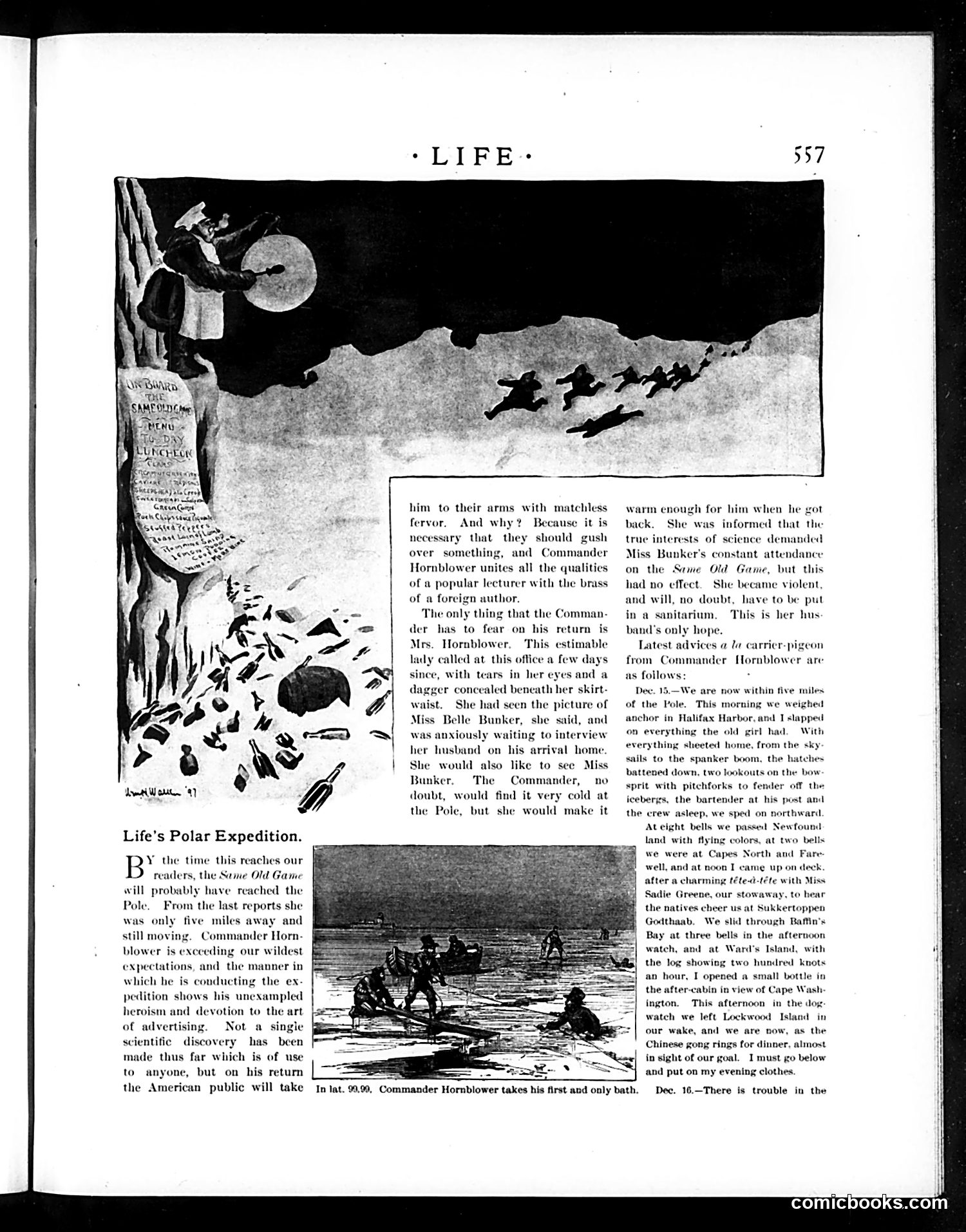
This page satirizes Commander Hornblower's Arctic expedition to reach the South Pole. The cartoon depicts the expedition team (shown as silhouettes trudging across snowy terrain) and includes illustrated scenes of polar conditions. The satire focuses on Mrs. Hornblower, the Commander's wife, who anxiously awaits his return at home. The text mocks the expedition's scientific claims while highlighting the domestic anxiety it causes—Mrs. Hornblower worries about her husband's safety and wants to see Miss Belle Bunker, apparently a popular lecturer. The joke appears to be about how polar expeditions, presented as grand scientific endeavors, are actually sources of personal worry for those left behind. The accompanying illustrations and detailed expedition log entries underscore the contrast between heroic adventure narrative and mundane domestic concern.
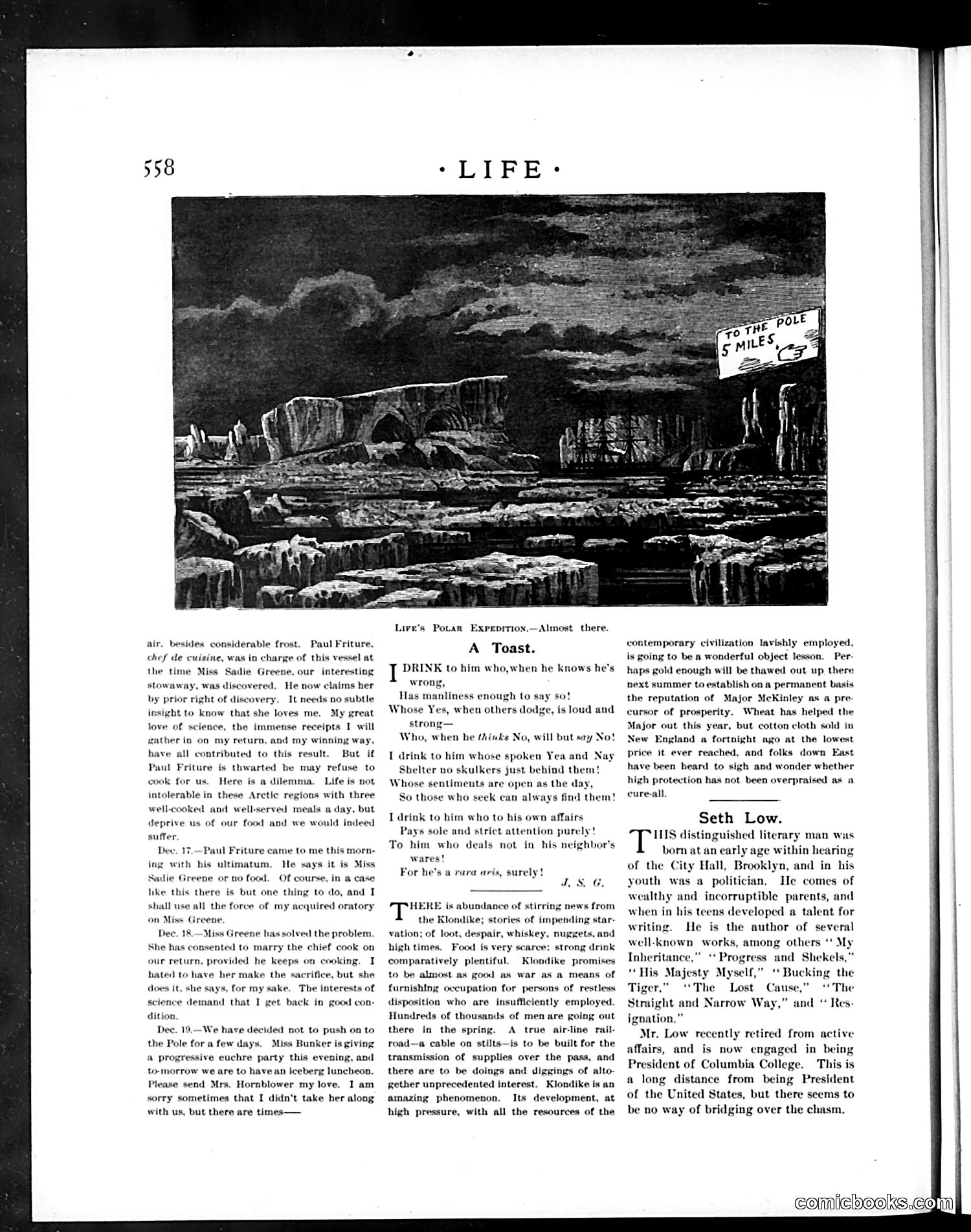
This page from *Life* magazine contains two distinct sections: **Upper section:** An illustration labeled "Life's Polar Expedition—Almost there" depicts an Arctic landscape with an ice formation and a sign reading "5 MILES TO THE POLE." This appears to be a visual reference to polar exploration expeditions of the era. **Lower section:** Two articles—"A Toast" (a poem by J.S.G.) and "Seth Low" (a biographical sketch). The Seth Low article discusses a distinguished Brooklyn-born literary man and politician who served as President of Columbia College. It notes the difficulty of "bridging over the chasm" between different social groups in America. The page mixes exploratory adventure imagery with reflective commentary on American social divisions and notable public figures of the period.
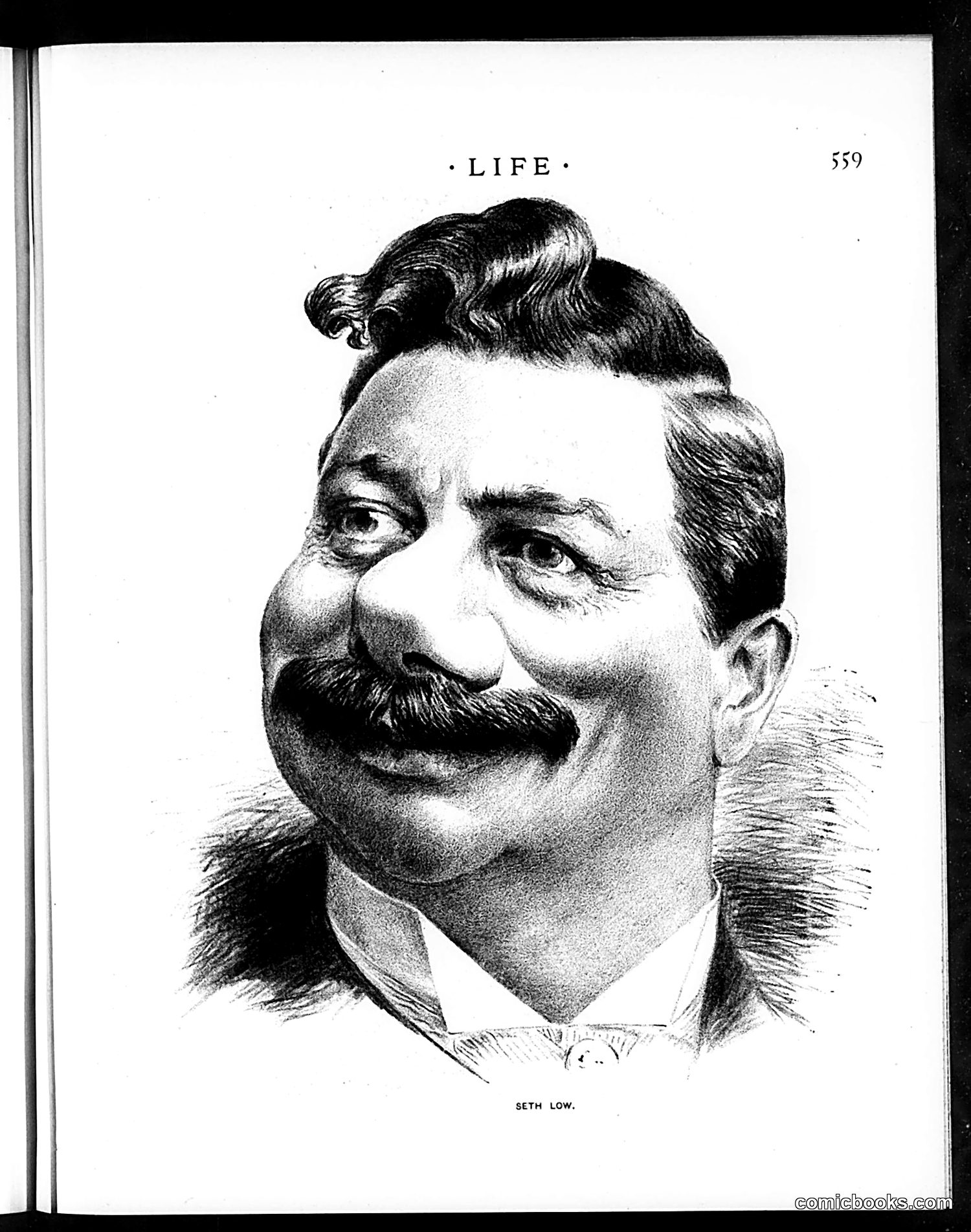
This page features a portrait sketch of **Seth Low**, identified by the caption beneath the image. The illustration appears in *Life* magazine's "Life" section (page 559), suggesting it's a biographical or commemorative feature rather than satire. The detailed engraving-style portrait emphasizes Low's distinctive appearance: prominent mustache, swept-back hair, and formal attire with visible collar. Without additional context on the page, the specific reason for his inclusion isn't clear from the image alone. However, Seth Low was a notable American figure—likely a university president or public official of the period—warranting his appearance in this satirical magazine's biographical coverage.
This appears to be a title page or section divider from *Life* magazine, as indicated by the "LIFE" header visible in the top right corner and "A CHRISTMAS" text at the bottom. The image itself is predominantly dark and atmospheric—a moody charcoal or ink sketch showing what appears to be an interior scene with a piano or similar furniture piece rendered in heavy shadow. The artistic style is deliberately dramatic and somewhat abstract. Without additional context, caption text, or clearer subject matter visible in the image, I cannot identify specific political figures, caricatures, or satirical references. The page appears to function as a visual introduction to a Christmas-themed section rather than containing explicit editorial cartooning or social commentary.
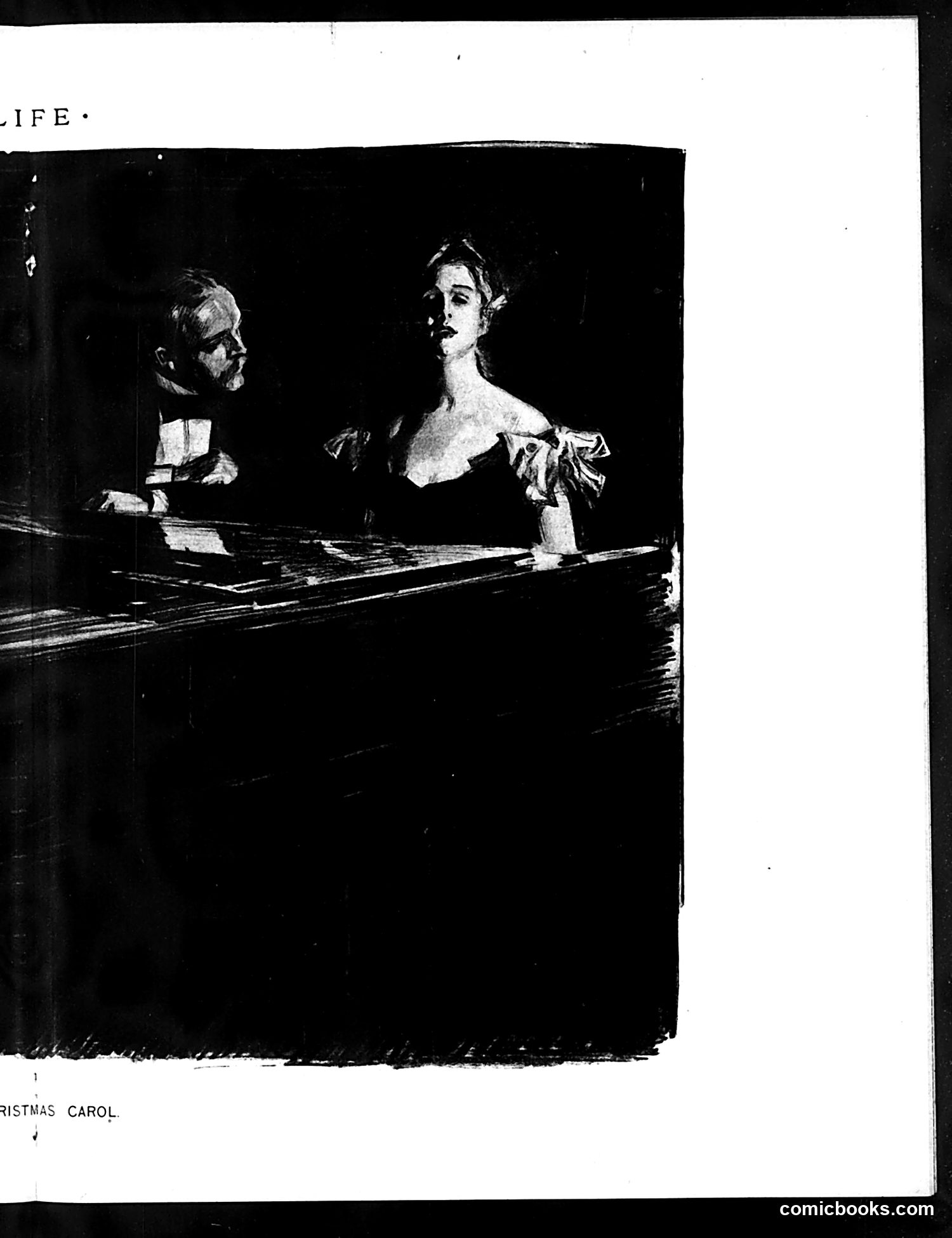
This appears to be an illustration related to **"A Christmas Carol,"** as indicated by the caption text visible at the bottom of the page. The image shows two figures in what appears to be a darkly lit interior scene. On the left is an older man in formal attire (possibly depicting Scrooge), and on the right is a woman in an elegant black dress with off-shoulder sleeves. The dramatic black-and-white illustration style and theatrical composition suggest this is depicting a scene from Charles Dickens's famous novella—likely a ghost visitation or supernatural encounter central to the story's moral redemption narrative. Without additional OCR text visible, the specific satirical point remains unclear, though Life magazine frequently used literary classics as vehicles for social commentary about contemporary issues like greed, charity, and moral responsibility.
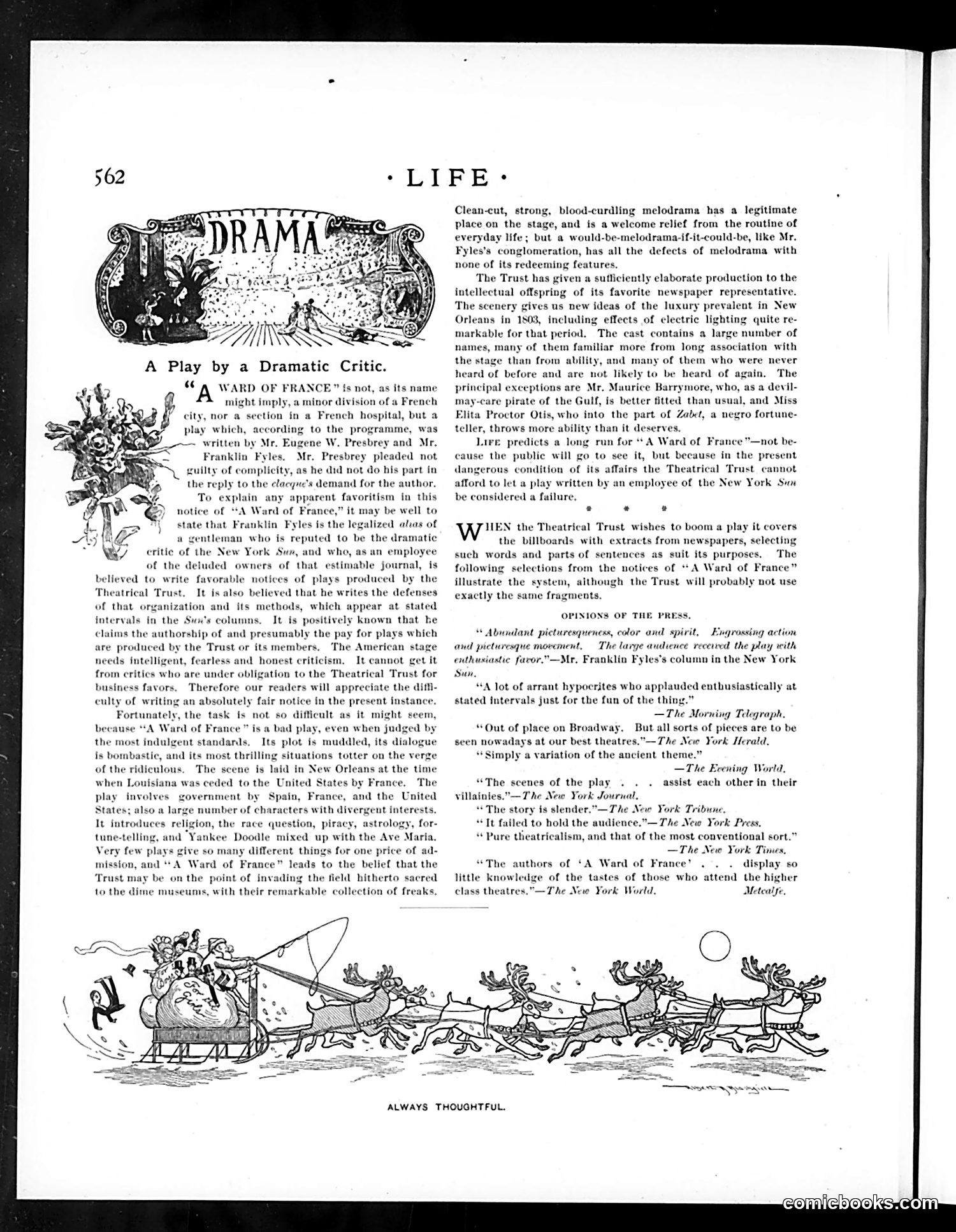
This page reviews "A Ward of France," a play by dramatic critic Franklin Pyle. The text criticizes the production, arguing that while melodrama has legitimate theatrical value, this particular play lacks merit despite elaborate staging. The bottom illustration shows Santa's sleigh pulled by reindeer, captioned "ALWAYS THOUGHTFUL." This appears unrelated to the play review above it—likely a seasonal cartoon or separate satirical piece common to Life's format. The page includes quoted critical opinions from various newspapers, mostly negative, suggesting the play was poorly received. The satire targets both the play's pretensions and possibly Pyle's credentials as both critic and playwright—a conflict of interest the text explicitly addresses.
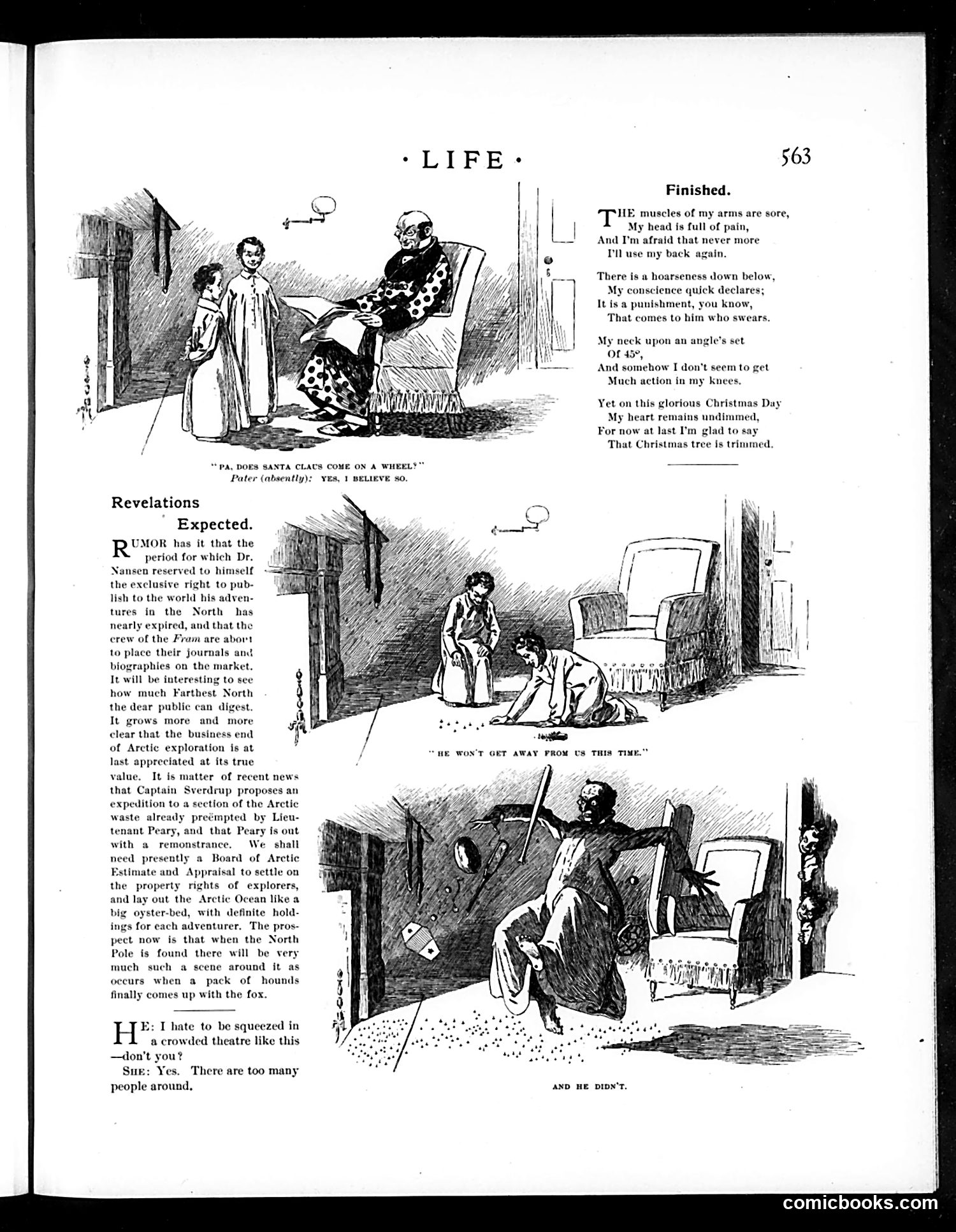
This *Life* magazine page contains three distinct pieces of humor: **"Finished"** (top): A poem-illustrated joke about exhausted parents after trimming a Christmas tree. The father has strained muscles, a sore neck at a 45-degree angle, and a hoarse voice from swearing—but proudly declares the tree is finally decorated. A child asks if Santa comes "on a wheel," and the distracted father absently agrees, missing the absurdity. The humor lies in the relatable domestic chaos of holiday preparation. **"Revelations Expected"** (middle): Satirizes Arctic exploration's commercialization. It references Dr. Nansen's exclusive publishing rights to his North Pole expedition accounts and notes that crew members now want to publish their own journals. The piece mockingly suggests Arctic exploration has become a business, with explorers like Captain Sverdrup and Lieutenant Peary competing for territorial claims. Life satirizes this as if the North Pole were divvied up like an "oyster-bed," reducing noble exploration to property dispute. **Bottom dialogue**: A brief joke about theater crowding.
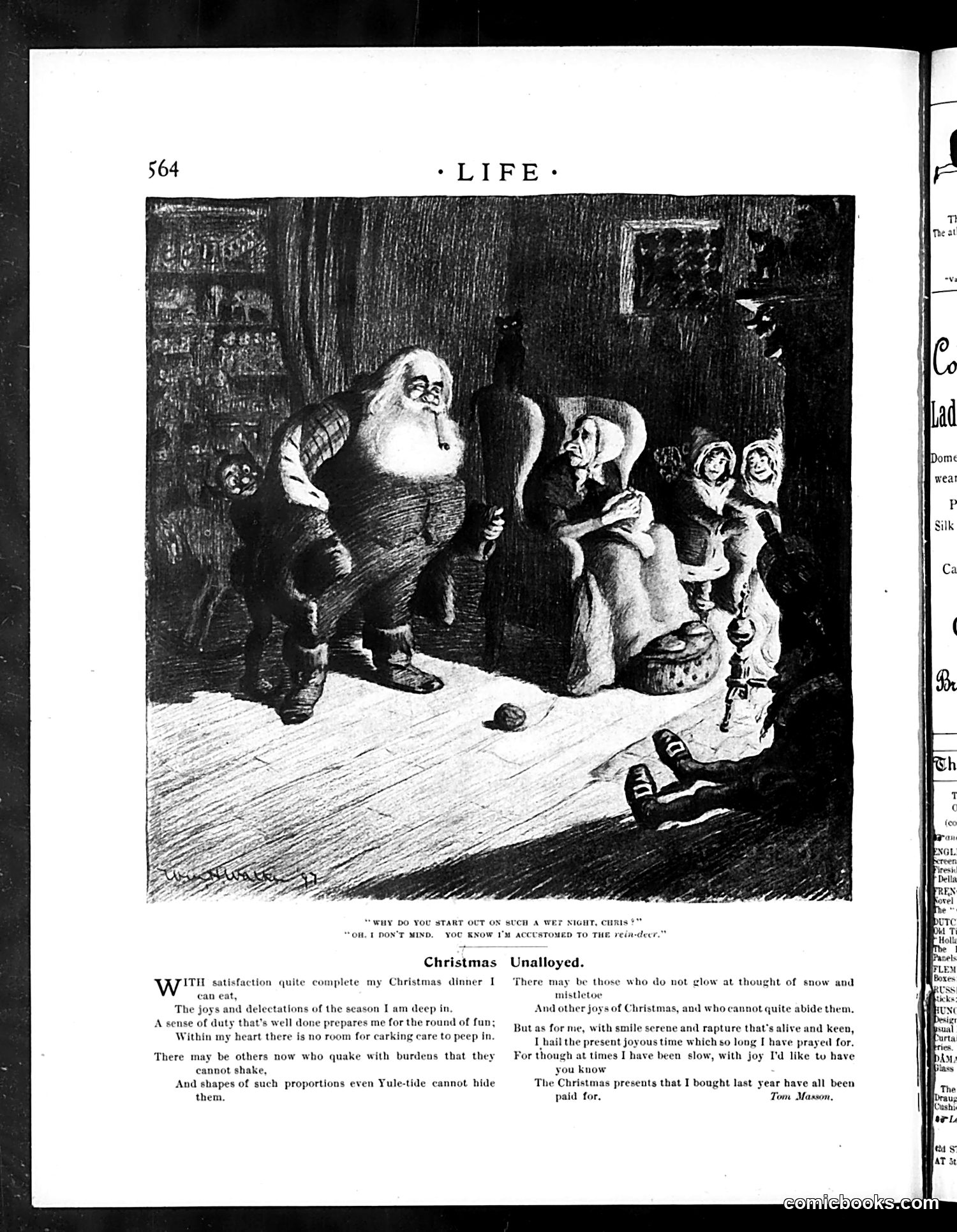
This is a humorous poem by Tom Masson accompanying an illustration showing a jolly, rotund Santa Claus-like figure with working-class characters in what appears to be a modest home setting. The satire targets middle-class anxieties about Christmas debt and financial strain. The poem's speaker boasts of his contentment—he's completed Christmas dinner, carries no worry, and celebrates "joyous time." However, the punchline reveals the joke: he's happy because **he has finally paid off last year's Christmas presents**. The underlying point mocks the Victorian/Edwardian practice of going into debt for holiday gift-giving. While others "quake with burdens," this man finds peace not in the season's spiritual joy but in debt repayment. The illustration's humble setting reinforces that even working-class families faced financial pressure to purchase Christmas gifts beyond their means.
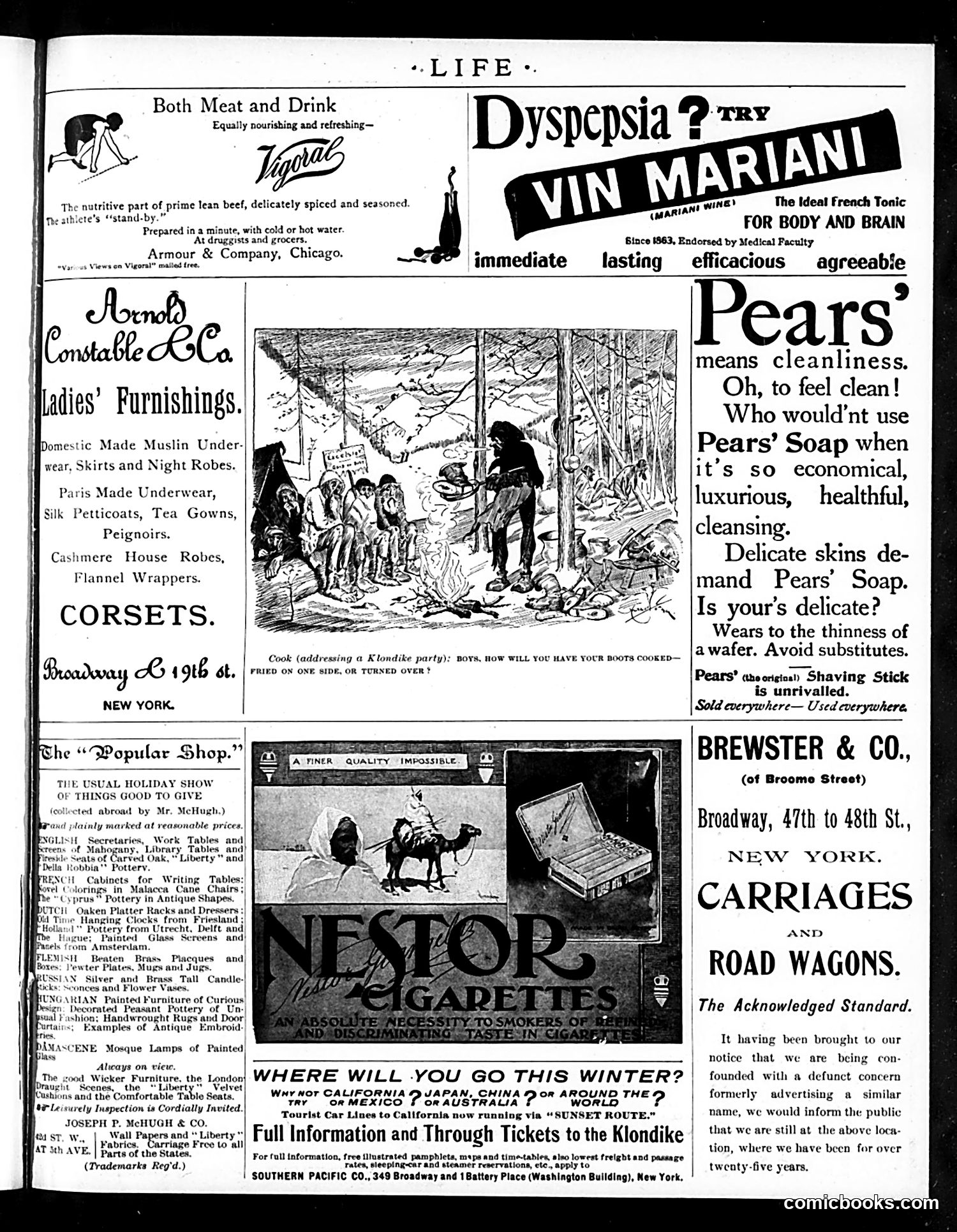
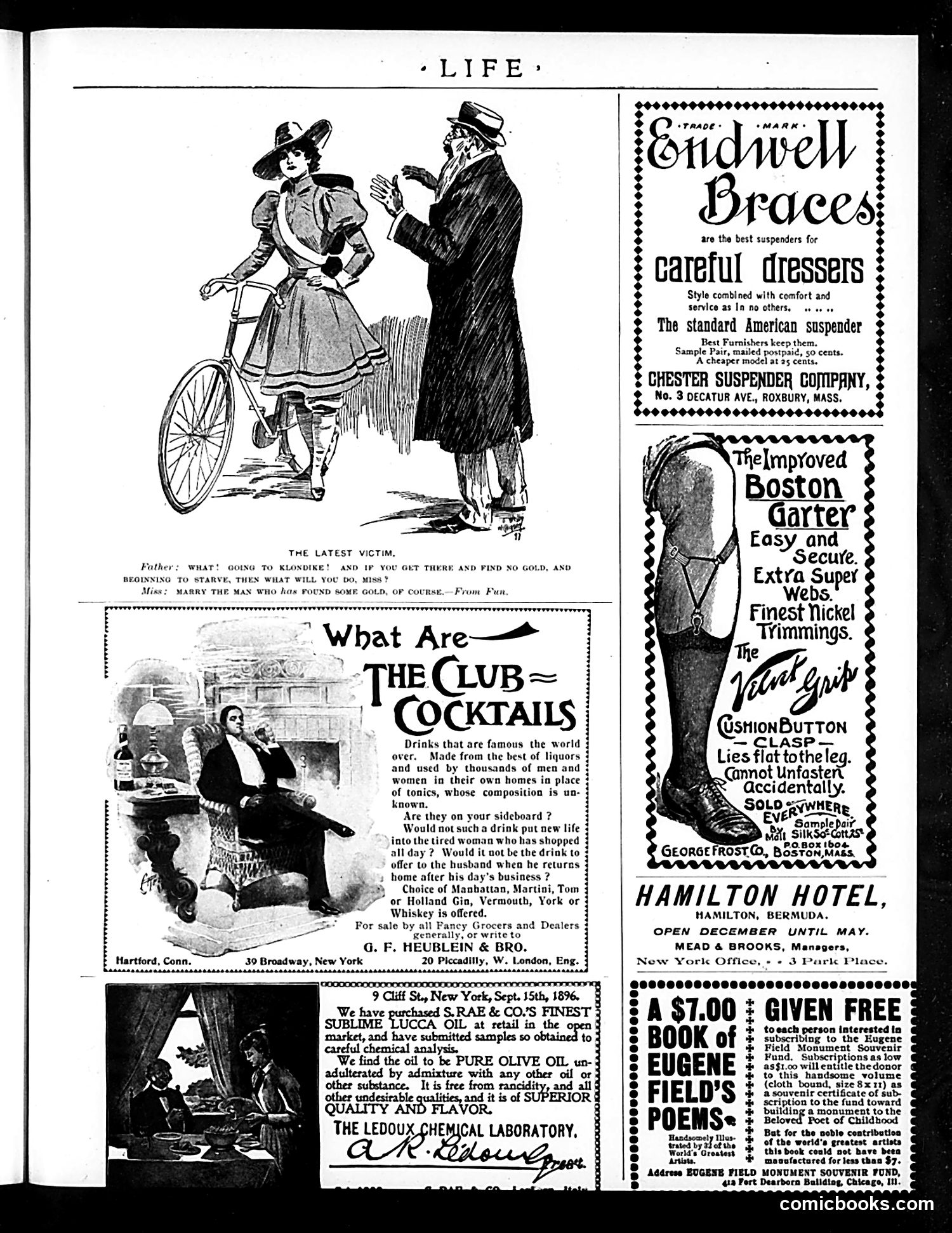
This page is primarily **advertisements** from what appears to be the 1890s, with one satirical cartoon. The main cartoon depicts a cook addressing prospectors during the **Klondike Gold Rush**, asking how they'd like their boots prepared—"fried on one side, or turned over?" This is dark humor: the joke implies that during the harsh Klondike conditions, starving miners might actually eat their own boots for survival. The cartoon mocks both the desperation of gold-seekers and the absurdity of the situation. The surrounding ads promote patent medicines (Vigoral for "dyspepsia"), ladies' undergarments, soaps, and luxury goods—typical Late Victorian-era products. One ad at bottom references Klondike travel routes, capitalizing on contemporary gold-rush fever. The "Popular Shop" listing advertises imported goods from Europe and Asia, reflecting wealthy Americans' taste for exotica. Overall, the page blends satirical commentary on current events (the Klondike craze) with period advertisements aimed at affluent readers.
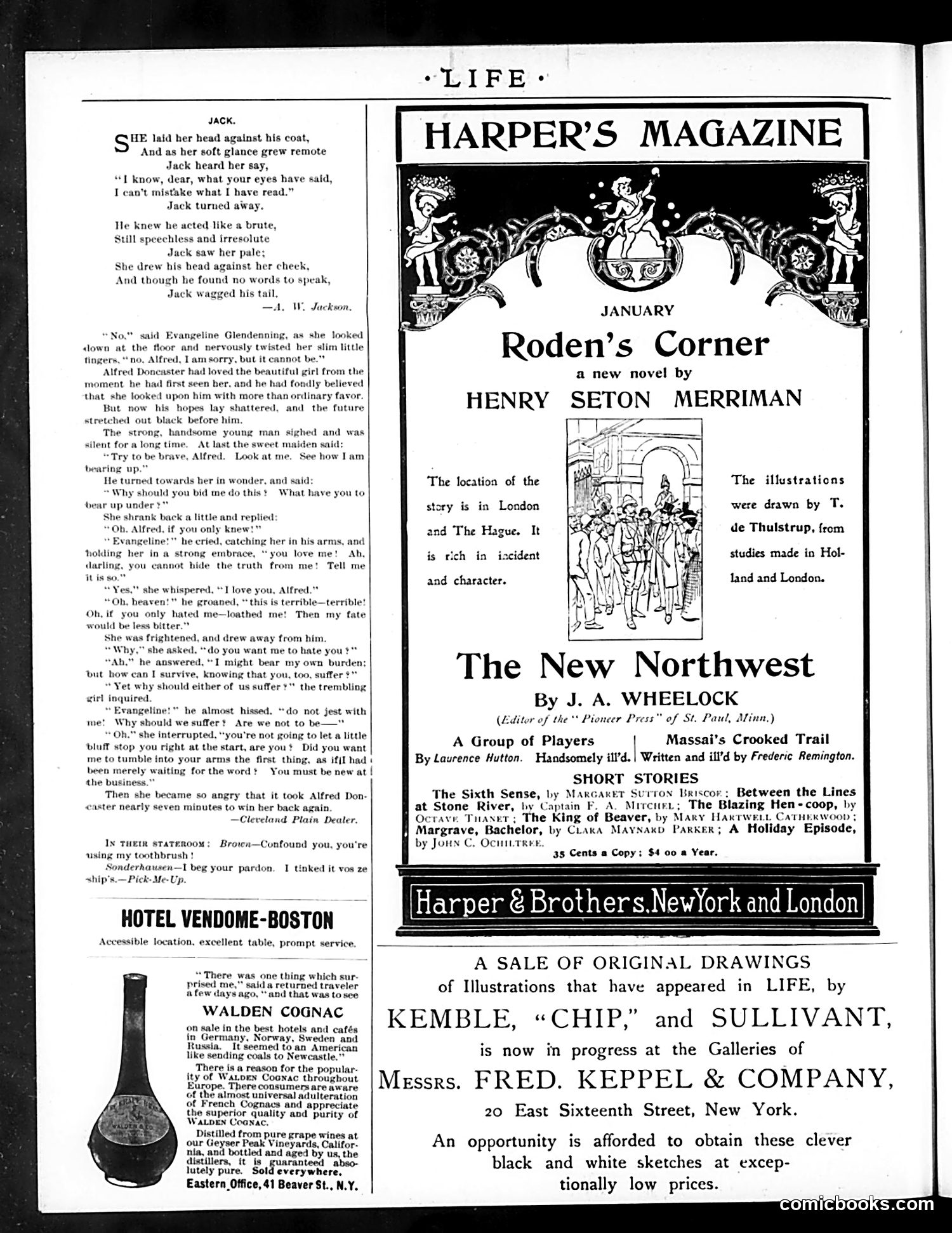
This page is primarily **advertising and editorial content** for Harper's Magazine, not a political cartoon. The left column contains a **sentimental romantic narrative** (likely serialized fiction) about characters Jack, Evangeline, and Alfred Doncaster—depicting melodramatic dialogue about love and heartbreak. Below are two brief **comic anecdotes**: one about a toothbrush mix-up on a ship, and another about a traveler surprised to find Walden Cognac sold in European hotels. The right side is a **magazine cover/advertisement** for Harper's January issue, promoting Henry Seton Merriman's novel *Roden's Corner* (set in London and The Hague), illustrated by T. de Thulstrup. It also advertises various short stories and a sale of original drawings by illustrators Kemble, "Chip," and Sullivant at Fred. Keppel & Company gallery. There is **no political satire** on this page—it's primarily commercial and entertainment content typical of early 20th-century Life magazine.
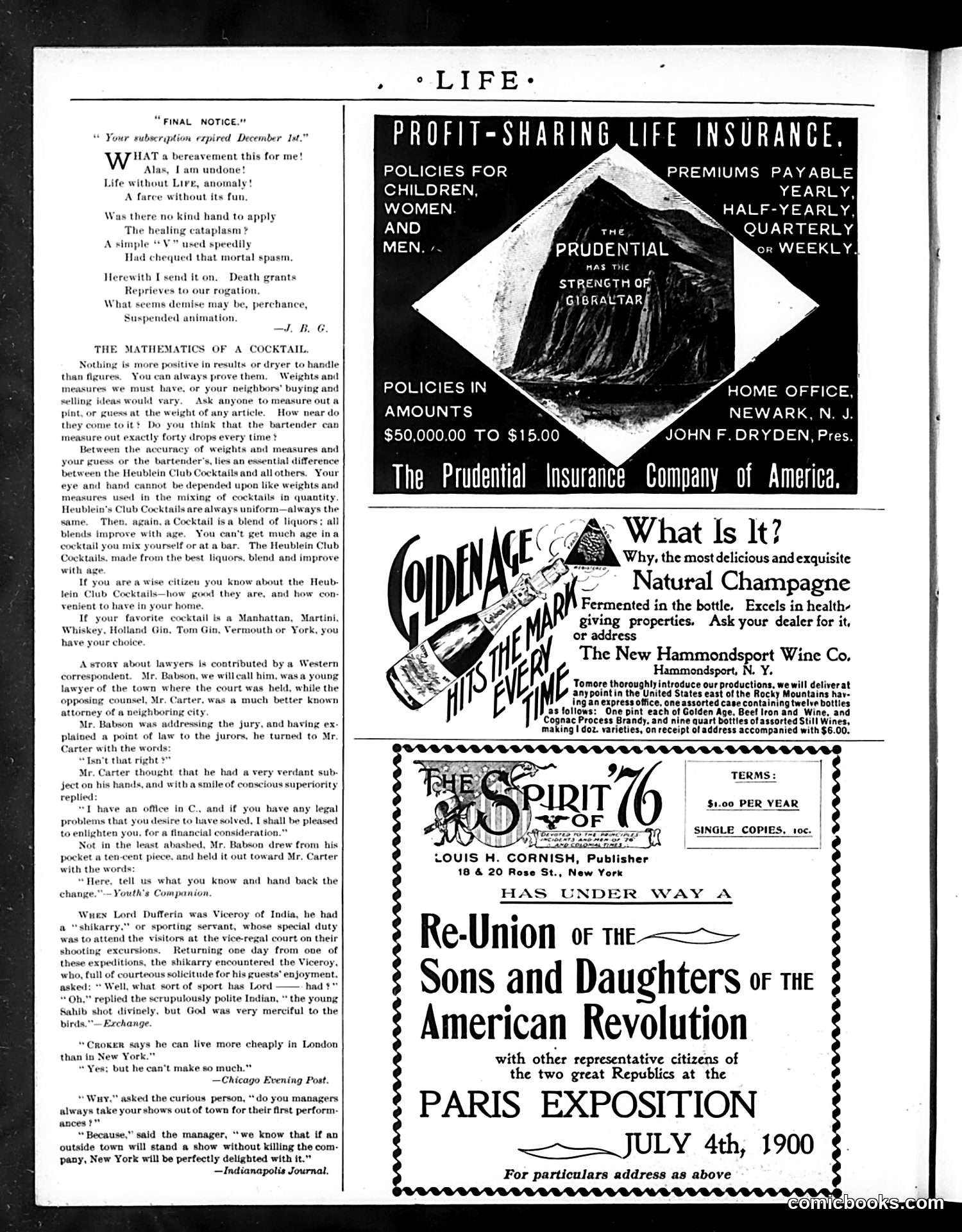
This is primarily an **advertising and miscellaneous content page** from Life magazine (circa 1900, based on the Paris Exposition reference). The left column contains **humorous anecdotes and poetry** rather than political cartoons—including a joke about a lapsed Life subscription, commentary on cocktail mixing precision, and lawyer/colonial India stories. These are lighthearted social observations typical of Life's satirical humor. The **advertisements dominate**: The Prudential Insurance Company features a large diamond-shaped image (appears to be Gibraltar), promoting profit-sharing policies. Below that, Golden Age Champagne advertises a bottled product, and a major announcement promotes a "Re-Union of the Sons and Daughters of the American Revolution" at the Paris Exposition on July 4th, 1900. There are **no political cartoons visible**. The page reflects turn-of-the-century American consumer culture and patriotic celebration rather than political satire. The content assumes readers familiar with Life's genteel, educated audience and their consumer interests.
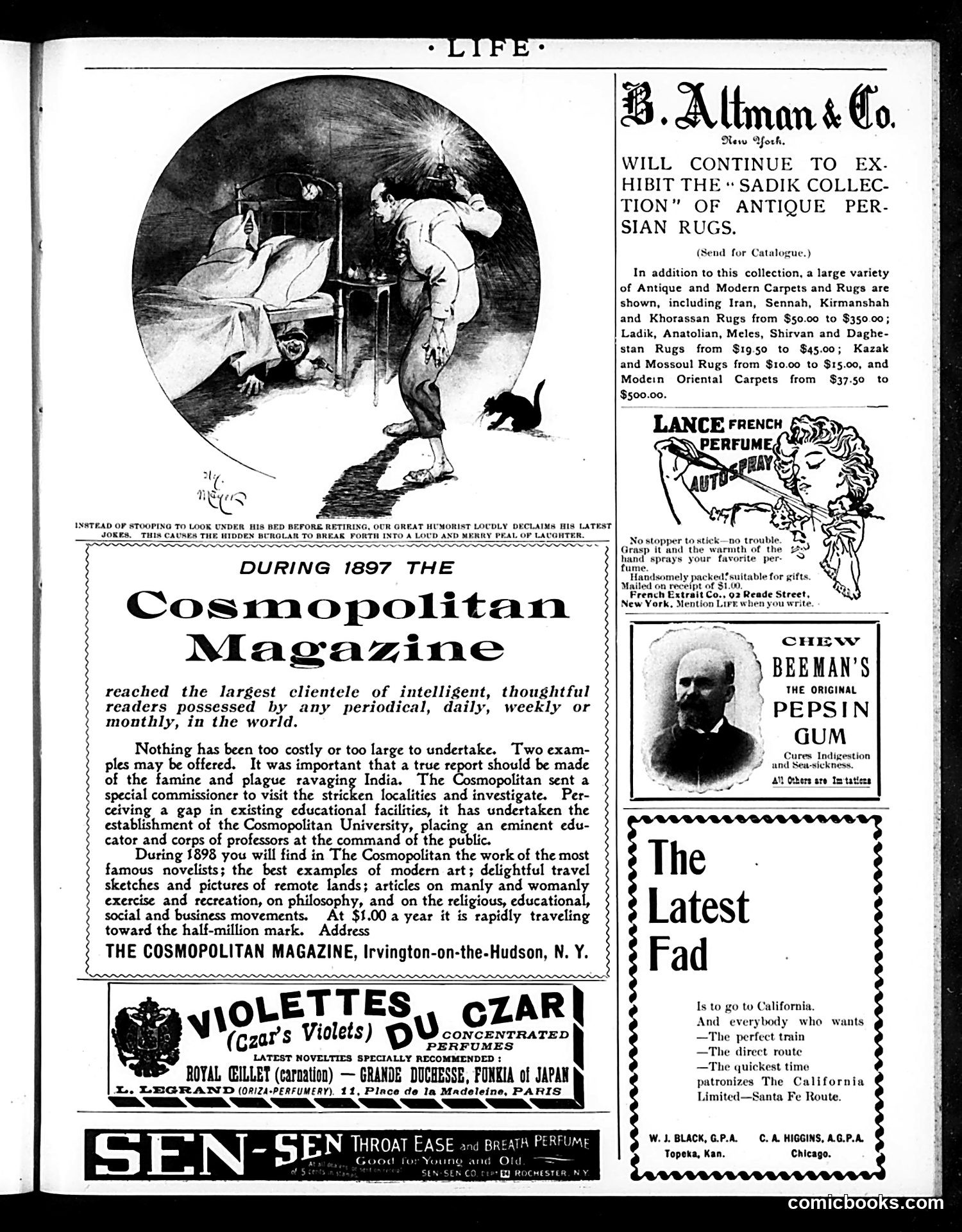
This is primarily a **advertisements and promotional page** rather than political satire. The main content includes: **Central Cartoon**: A humorous illustration depicts a man standing while another reclines in bed. The caption explains the joke: instead of bending down to look under the bed before retiring, the humorist loudly declares jokes to scare out any hidden burglar. The humor relies on the absurdist premise—using noise and comedy as a security measure. **Surrounding Advertisements**: The page features luxury goods typical of 1890s wealthy consumers—Persian rugs (B. Altman & Co.), French perfumes, Beeman's pepsin gum, and throat lozenges. **Editorial Content**: The Cosmopolitan Magazine advertisement emphasizes its coverage of famine relief in India and establishment of a "Cosmopolitan University," positioning the publication as serious journalism alongside entertainment. The page reflects **late-Victorian consumer culture** and magazine advertising practices rather than substantive political commentary.
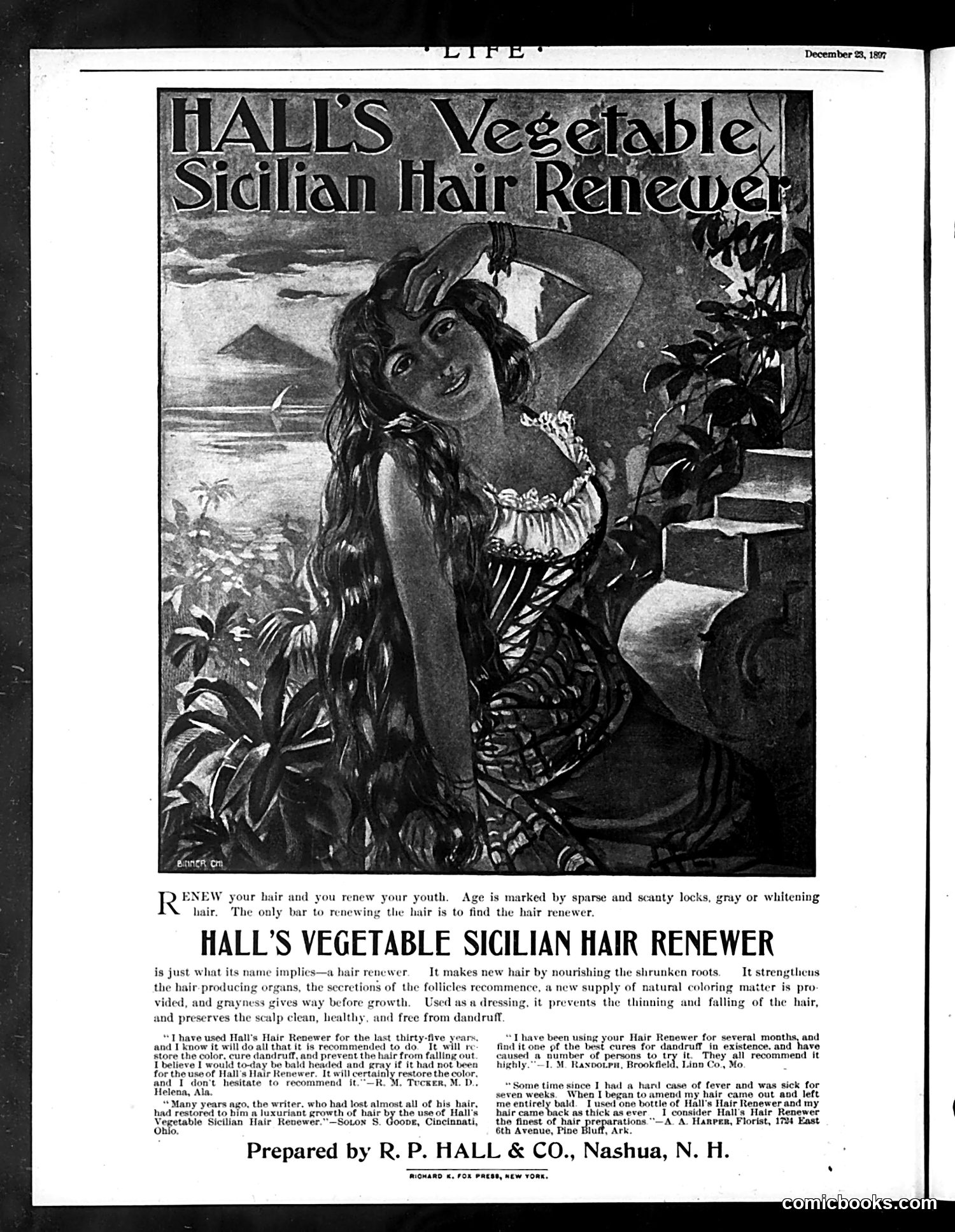
This page is primarily a **product advertisement**, not a political cartoon. It advertises Hall's Vegetable Sicilian Hair Renewer, a patent medicine claiming to restore hair color and prevent baldness. The illustrated image shows a woman with luxuriously long, dark hair in an exotic tropical setting, presumably demonstrating the product's promised results. The accompanying text emphasizes that aging is marked by gray or thinning hair, and that this product can "renew your youth" by restoring natural hair color and growth. The page includes multiple testimonials from satisfied customers (identified by name and location) claiming the product cured baldness, dandruff, and hair loss after various illnesses or conditions. This reflects late-19th-century marketing practices: using aspirational imagery, pseudo-scientific claims about how the product works, and customer testimonials to build credibility for patent medicines that were largely unregulated and often ineffective.