
Life, 1897-12-23 · page 12 of 20
Life — December 23, 1897 — page 12: what you’re looking at
What you’re looking at
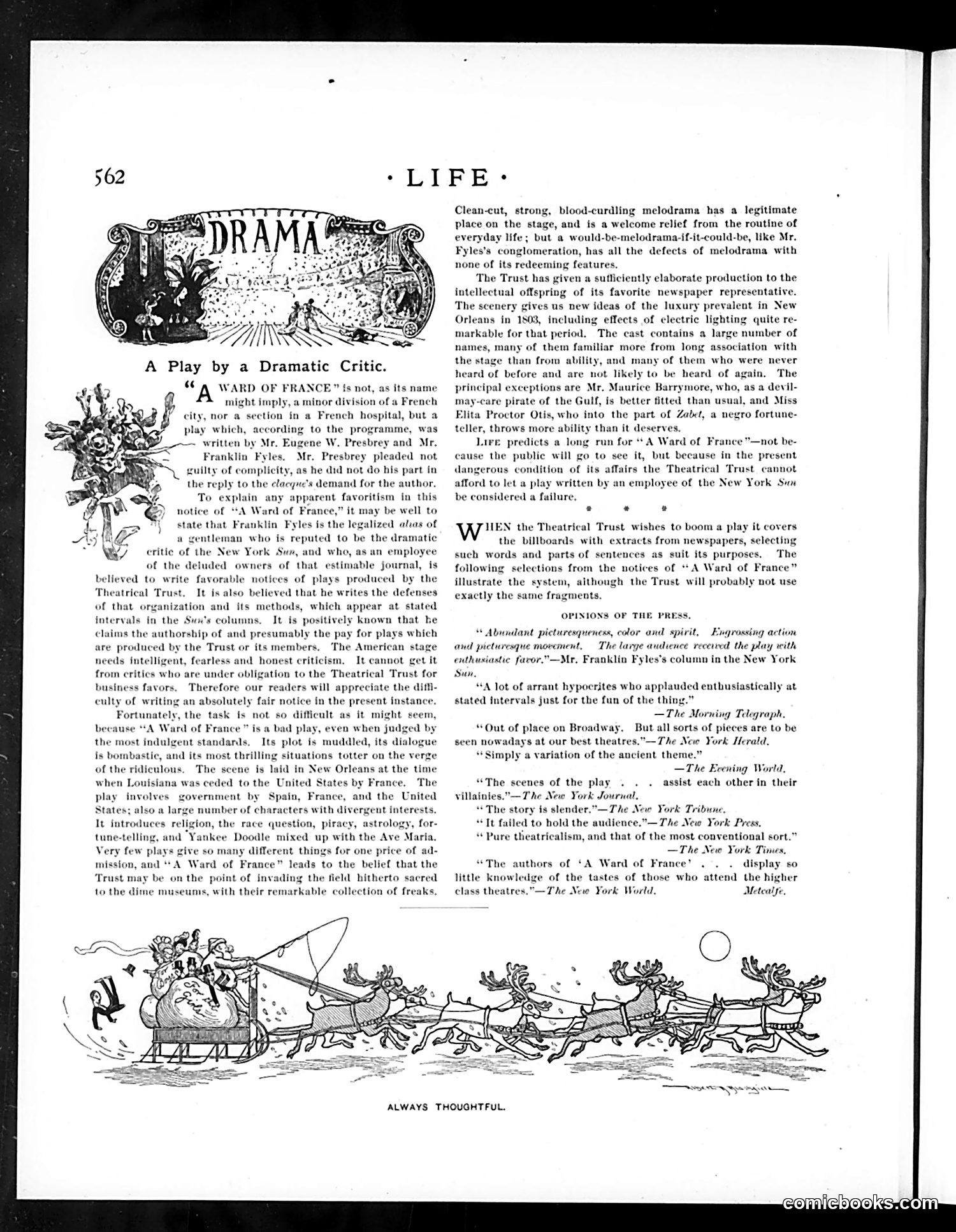
This page reviews "A Ward of France," a play by dramatic critic Franklin Pyle. The text criticizes the production, arguing that while melodrama has legitimate theatrical value, this particular play lacks merit despite elaborate staging. The bottom illustration shows Santa's sleigh pulled by reindeer, captioned "ALWAYS THOUGHTFUL." This appears unrelated to the play review above it—likely a seasonal cartoon or separate satirical piece common to Life's format. The page includes quoted critical opinions from various newspapers, mostly negative, suggesting the play was poorly received. The satire targets both the play's pretensions and possibly Pyle's credentials as both critic and playwright—a conflict of interest the text explicitly addresses.
📄 Transcribed text from this page (OCR, searchable)
Machine-transcribed from the original scan — historical spelling and the odd misread are preserved.
- LIFE: A Play by a Dramatic Critic. 6 WV WARD OF FRANCE” fs not, as its name might imply, a minor division of a French city, nor a section in a French hospital, but a play which, according to the programme, was _-~— written by Mr, Eugene W. Presbrey and Mr. Franklin Fyles. Mr. Presbrey pleaded not guilty of complicity, as he did not do his part in lacy *s demand for the author. rent favoritism in this nce,” it may be well to the reply to th To exp notice of i 2 an who is reputed to be the dramatic critic of the New York Sun, and who, as an employee of the deluded owners of that estimable journal, is ed to write favorable notices of plays produced by the rical Trust, It is also believed that he writes the defenses organization and its methods, which appear at stated ervals in the Swx’s columns. It is positively known that be ms the authorship of and presumably the pay for plays which are produced by the Trust or its members. ‘The American needs intelligent, fearless and honest criticism, It cannot from ics who are under obligation to the Theatrical Trust for business favors. Therefore our readers will appreciate the diffi- culty of writing an absolutely fair notice in the present instance, Fortunately, the task {s not so difficult as it might seem, because “A Ward of France” is a bad play, even when judged by the most indulgent standards, Its plot is muddled, its dialogue is bombastic, and its most thrilling situations totter on the verge oft idiculous. The scene is laid in New Orleans at the time when Louisiana was ceded to the United States by France. Th pain, France, and the United ers with divergent interests, , for- Maria, for one price of ad- play involves government by States; also a] arg It introduces religion, the race question, piracy, astrolog tune-telling, and "Yankee Doodle mixed up with the Av Very few plays so many different thin mission, and “A Ward of France” leads to the belief that the ‘Trust may be on the point of invading the field hitherto sacred to the dime museums, with their remarkable collection of freaks, ge number of ¢ Clean-cut, strong, blood-curdling melodrama has a legitimate place on the stage, and is a welcome relief from the routine of everyday life; but a would-be-melodrama-if-it-could-be, like Mr. Fyles’s conglomeration, has all the defects of melodrama with none of its redeeming features. The Trust has given a sutliciently elaborate production to the intellectual offspring of its favorite newspaper representative. The scenery gives us new ideas of the luxury prevalent in New Orleans in 1803, including effects of electric lighting quite re- markable for that period. The cast contains a large number of names, many them familiar more from long association with the stage than from ability, and many of them who were never heard of before and are not likely to be heard of again. The principal exceptions are Mr. Maurice Barrymore, who, as a devil- are pirate of the Gulf, is better fitted than usual, and Miss a Proctor Otis, who into the part of Zabet, a n teller, throws more ability than it deserves. Lire predicts a long run for “A Ward of France ”—not be- cause the public will go to see it, but because in the present dangerous condition of its affairs the Theatrical Trust cannot afford to let a play written by an employee of the New York Siw be considered a failure. * * * HEN the Theatrical Trust wishes to boom a play it covers the billboards with extracts from newspapers, selecting such words and parts of sentences as suit its purposes, The following selections from the noti of “A Ward of France” illustrate the system, although the Trust will probably not use exactly the same fragments. OPINIONS OF THE PRESS, “+ Abundant picturesquencss, color and spiri aud picturesque movement, — The large audience received the play with enthusiastic favor."—Mr, Franklin Fyles’s column in the New York Sun. “A lot of arrant hypocrites who applauded enthusiastically at stated intervals just for the fun of the thing.” —The Morning Telegraph. “Out of place on Broadway, But all sorts of pieces are to be seen nowadays at our best theatres."—The New York Herald, “Simply a variation of the ancient them —The Evening World, assist each other in their Engvossing action “The scenes of the play villainies."—The New York Journal, “The story is slender."—The New York Tribune “It failed to hold the audience.”— The New York Press, “ Pure theatricalism, and that of the most conventional sort.” —The New York Times, “The authors of ‘A Ward of F displa little knowledge of the tastes of those who attend the hii class theatres."—The New York World, Metcalfe, ALWAYS THOUGHTFUL.