
Life, 1897-12-23 · page 6 of 20
Life — December 23, 1897 — page 6: what you’re looking at
What you’re looking at
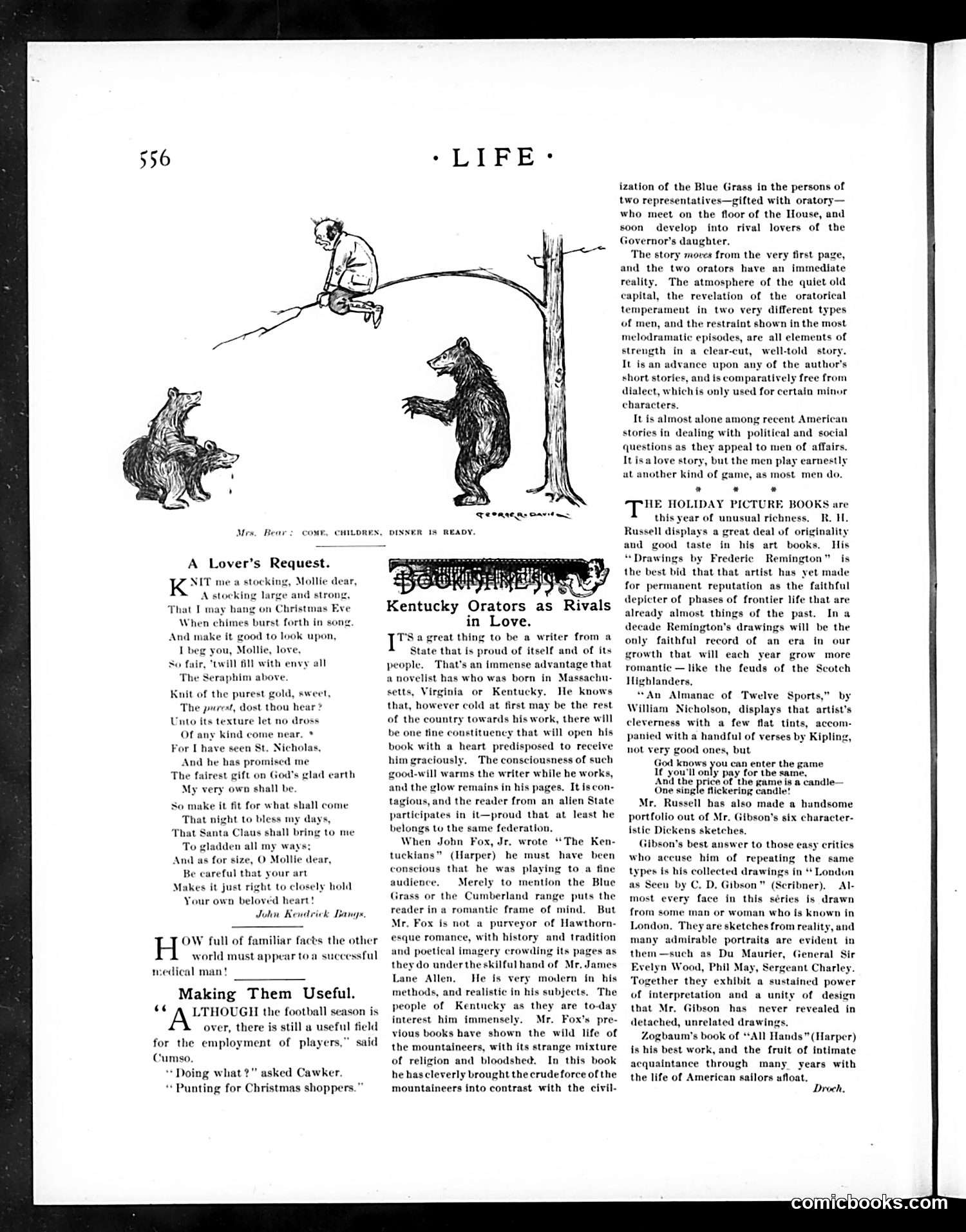
This page contains literary content rather than political satire. The main illustration shows a woman calling children to dinner while bears emerge from the woods—a humorous domestic scene titled "Mrs. Bear: Come, Children, Dinner is Ready." Below this is a poem titled "A Lover's Request," a sentimental romantic verse with no apparent satirical intent. The page primarily reviews contemporary books, including works by Frederic Remington (Western art drawings) and discussions of John Fox Jr.'s Kentucky fiction. There's also brief commentary on holiday picture books and other literary works. The content reflects Life magazine's dual nature as both satirical publication and serious literary journal, though this particular page leans heavily toward book criticism and lighter humor rather than political commentary.
📄 Transcribed text from this page (OCR, searchable)
Machine-transcribed from the original scan — historical spelling and the odd misread are preserved.
Mrs. Bear: come, CHILDREN, A Lover’s Request. NIT me a stocking, Mollie d A stocking nd stro That I may bang on Christmas E When chimes burst forth in song And make it good to look upon, I beg you, Mollie, love, So fair, Owill HH with envy all he Seraphim above. large Knit of the purest gold, sweet, The purest, dost thou hear ? Unto its texture let no dross Of any kind come near. * For I have seen St. Nicholas, And he has promised me The fairest gift on God's My very own shall be. ad earth So make it fit for what shall come That night to bless my ¢ That Santa Claus shall bring to me To gladden all my w And as for size, O Mollie dear, Be careful that your art Makes it just right to closely hold Your own beloved heart! John Kendrick Bangs. OW full of familiar facts the other world must appear toa successful H medical man! Making Them Useful. “A .THOUGH the football season is over, there is still a useful field for the employment of players, Cumso. * Doing what?” asked Cawker. “ Punting for Christmas shoppers.” said qTeoRne Rs One DINNER 18 READY. BS Kentucky Orators as Rivals in Love. [TSazgreat thing to be a writer from a State that is proud of itself and of its people, That's an immense advantage that a novelist has who was born in Massachu- tts, Virginia or Kentucky. He knows that, however cold at first may be the rest of the country towards his work, there will be one tine constituency that will open his book with a heart predisposed to receive him graciously. The consciousness of such good-will warms the writer while he works, and the glow remains in his pages. It iscon- tagious, and the reader from an alien State participates in it—proud that at least he belongs to the same federation, When John Fox, Jr, wrote “The Ken- tuckians” (Harper) he must have been conscious that he was playing to a fine udience. Merely to mention the Blue ass or the Cumberland range puts the reader ina romantic frame of mind. But Mr, Fox is not a purveyor of Hawthorn- esque romance, with history and tradition and poetical imagery crowding its pages as they do underthe skilful hand of Mr, James Lane Allen, He is very modern in bis methods, and realistic in his subjects. The people of Kentucky as they are to-day interest him immensely. Mr. Fox's pre- vious books have shown the wild life of the mountaineers, with its strange mixture of religion and bloodshed, In this book he has cleverly brought the crudeforce of the mountaineers into contrast with the civil- ization of the Blue Grass in the persons of two representatives—gifted with oratory— who meet on the floor of the House, and soon develop into rival lovers of the Governor's daughte: he story moves from the very first page, and the two orators have an immediate reality. The atmosphere of the quiet old capital, the re’ tion of the oratorical temperament in two very different types of men, and the restraint shown in the most melodramatic episodes, are all elements of strength in a clear-cut, well-told story It is an advance upon any of the author's short stories, and is comparatively free from dialect, whichis only used for certain minor characters. It is almost alone among recent American stories in dealing with political and social questions as they appeal to men of affairs. It isa love story, but the men play earnest at another kind of game, as most men do. * * . HE HOLIDAY PICTURE BOOKS are this year of unusual richnes RW Russell displays a great deal of originality and good taste in his art books. His “Drawings by Frederic Remington” is the best bid that that artist has yet made for permanent reputation as the faithful depicter of phases of frontier life that are already almost things of the past. Ina decade Remington’s drawings will be the only faithful record of an era in our growth that will each year grow more romantic —like the feuds of the Scotch Mighlanders, “An Almanac of Twelve Sports,” by William Nicholson, displays that artist's cleverness with a few flat tints, accom- panied with a handful of verses by Kipling, not very good ones, but God knows jou can enter the game If you'll only pay for the same, And the price of the game is a candle- One single flickering candle! Mr. Russell has also made a handsome portfolio out of Mr. Gibson's six character- istic Dickens sketches. Gibson’s best answer to those easy critics who accuse him of repeating the same types fs his collected drawings in“ Londo en by C.D, Gibson” (Scribner). Al- y face in this séries is drawn man or woman who is known in London. They are sketches from reality, many admirable portraits are them—such as Du Maurier, General Sir elyn Wood, Phil May, Sergeant Charle: Together they exhibit a sustained power of interpretation and a unity of design that Mr, Gibson has never revealed in detached, unrelated drawings. Zogbaum's book of “All Hands * (Harper) is his best work, and the fruit of intimate acquaintance through many years with the life of American sailors afloat. Droch. from som