
A complete issue · 26 pages · 1897
Life — December 2, 1897
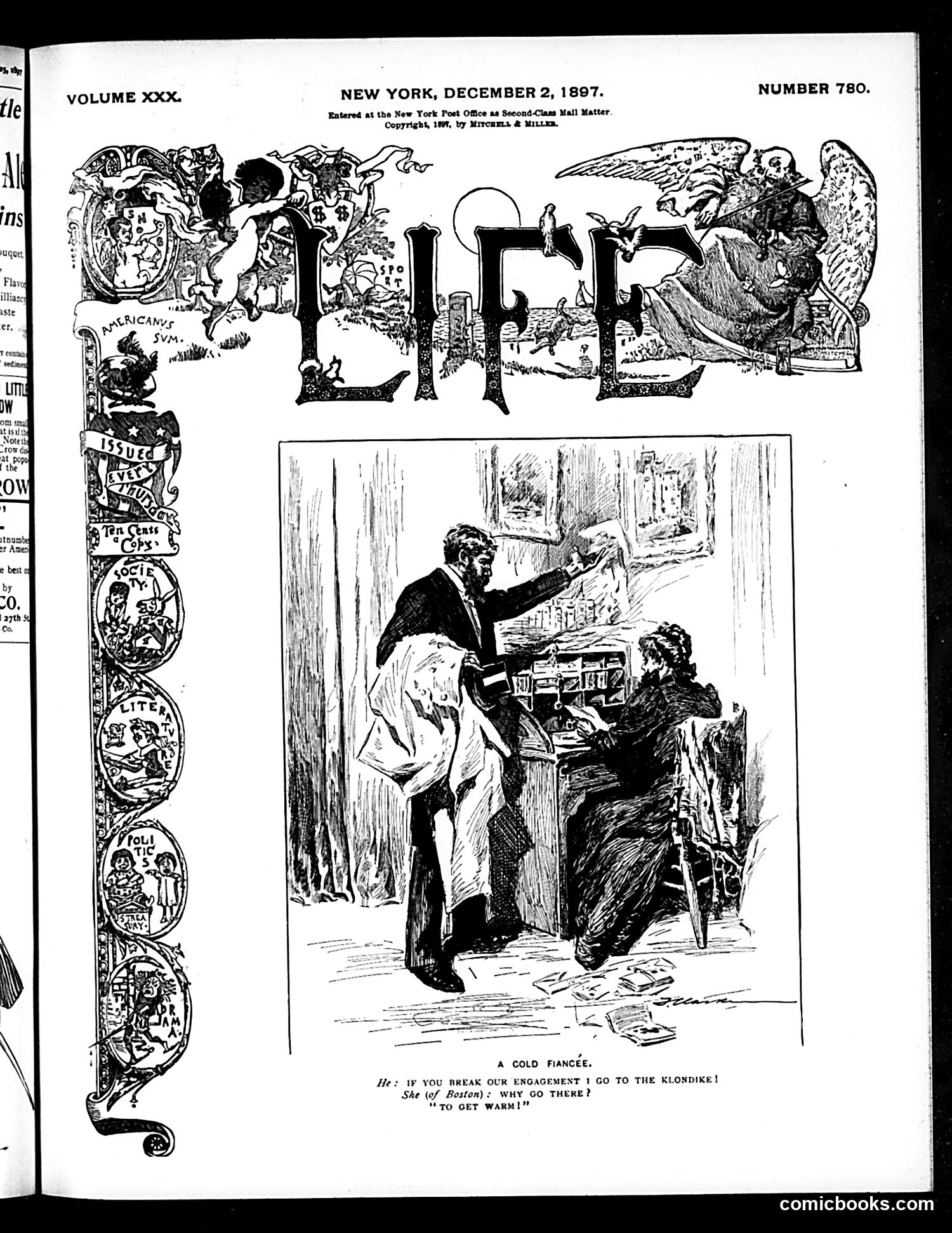
This cartoon satirizes a broken engagement. The caption reads: "He: 'If you break our engagement I go to the Klondike!' / She (of Boston): 'Why go there? / 'TO GET WARM!'" The joke plays on the Klondike Gold Rush (1896-1899), when thousands rushed to Canada's Yukon seeking gold in harsh, frigid conditions. The woman's retort—that the Klondike would be warmer than her cold reception—is a cutting insult about her emotional coldness. The reference to "Boston" suggests she's a proper, reserved New England woman. The humor derives from the ironic contrast: the man threatens to endure notorious Arctic hardship, yet she implies even that frozen wasteland would be preferable to her company.
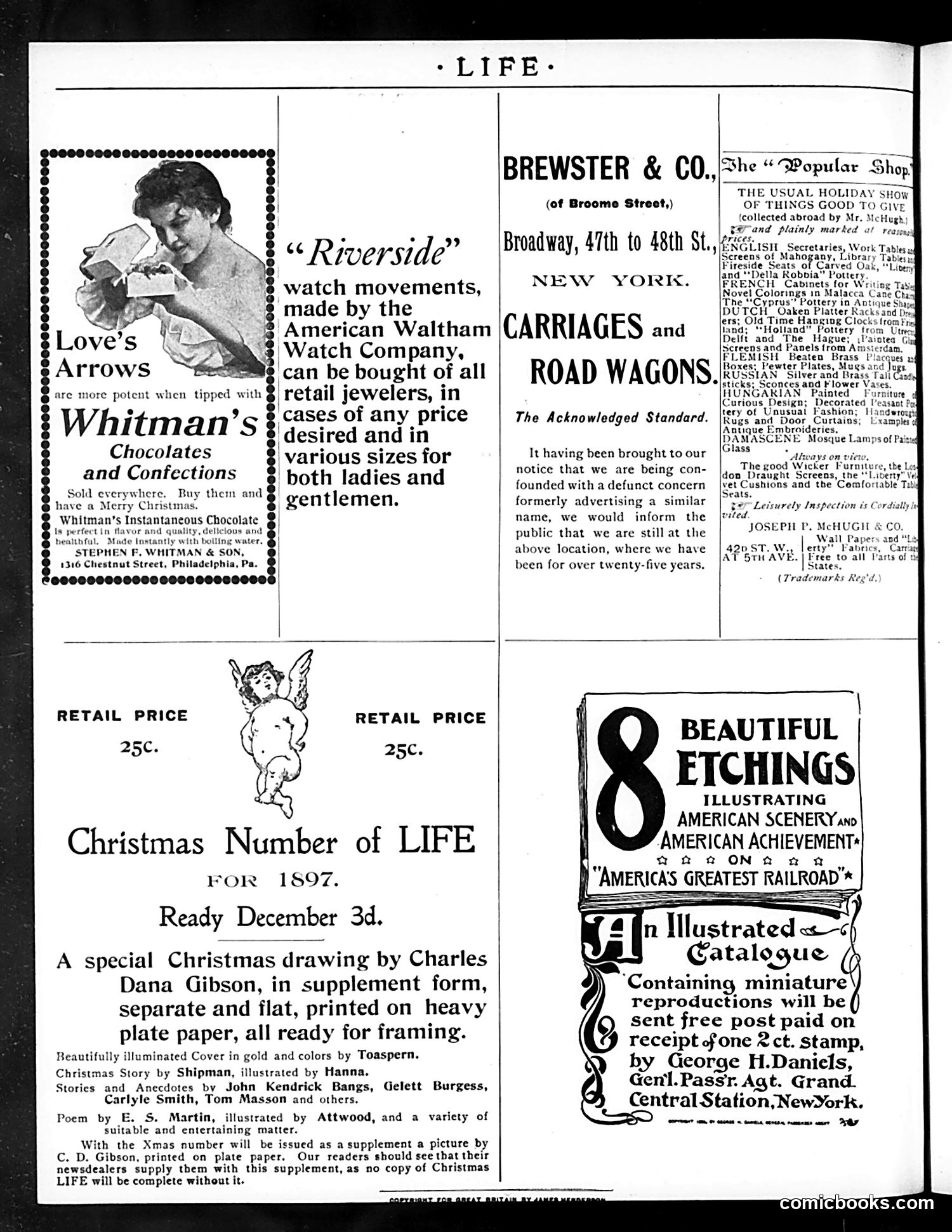
This page is primarily **advertising and promotional content** rather than political satire. The main elements include: - **Whitman's Chocolates ad** (left): Uses the phrase "Love's Arrows" to market holiday confections, employing romantic imagery typical of period advertising. - **Brewster & Co.** (center-top): Advertisement for carriages and road wagons, establishing their reputation and location. - **Life Magazine Christmas issue promotion** (center-bottom): Announces the December 3rd Christmas Number (1897), featuring special Charles Dana Gibson drawings and holiday stories by various authors. - **Etchings catalog ad** (right): Promotes railroad-themed etchings available through George H. Daniels. The page reflects late-19th-century commercial culture rather than satirical content, showcasing how Life magazine monetized holiday readership through advertising.
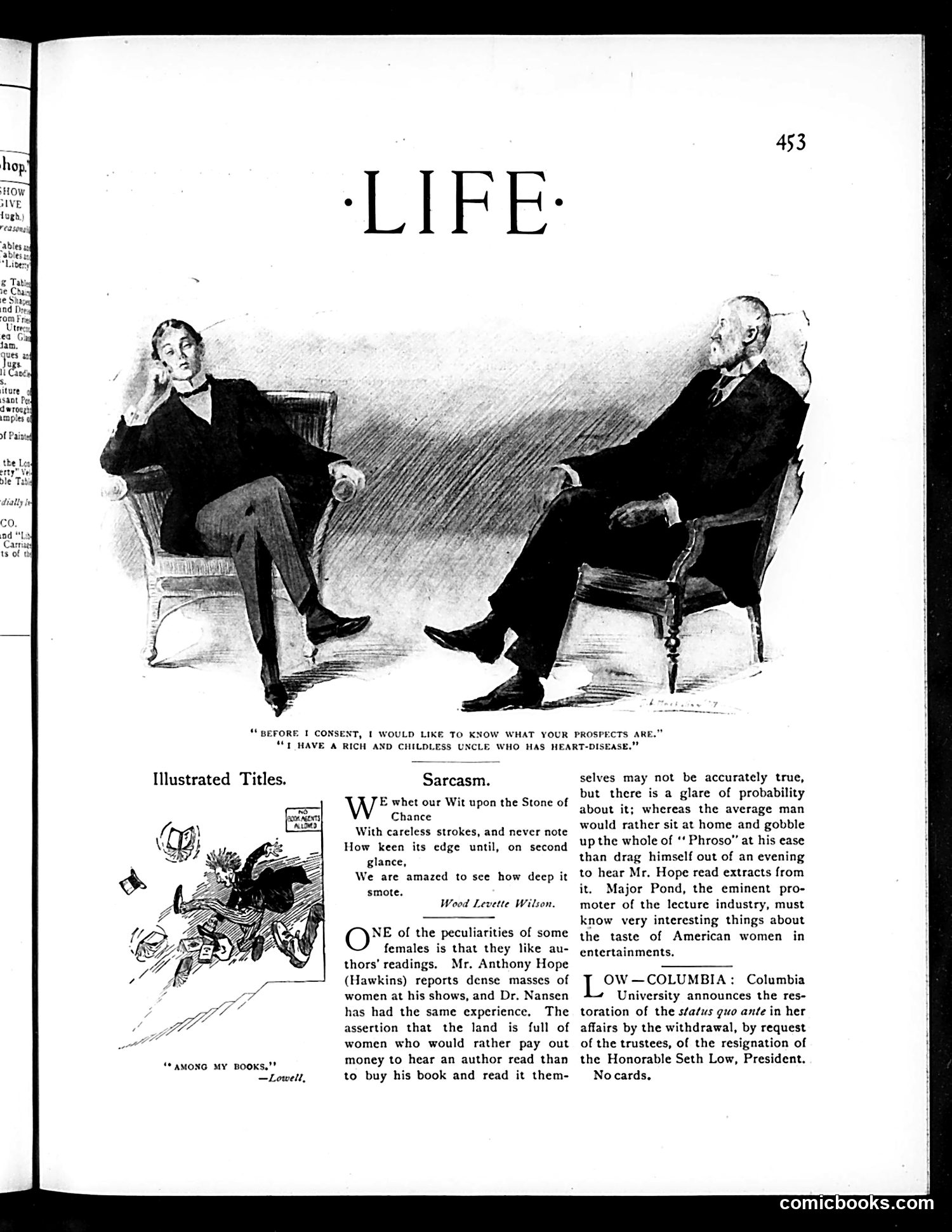
The main cartoon depicts two men in conversation, with the caption: "Before I consent, I would like to know what your prospects are. I have a rich and childless uncle who has heart-disease." This is satire on mercenary marriage proposals—the speaker is evaluating a potential suitor not on character or love, but on financial inheritance prospects. The dark humor centers on the cynical calculation that the suitor's "rich and childless uncle" with a fatal condition represents future wealth. It mocks Victorian-era marriage customs where financial security often outweighed emotional considerations. The surrounding text discusses literary readings and entertainment preferences among women, suggesting broader commentary on American social attitudes. The satire exposes the transactional nature of courtship among the upper classes.
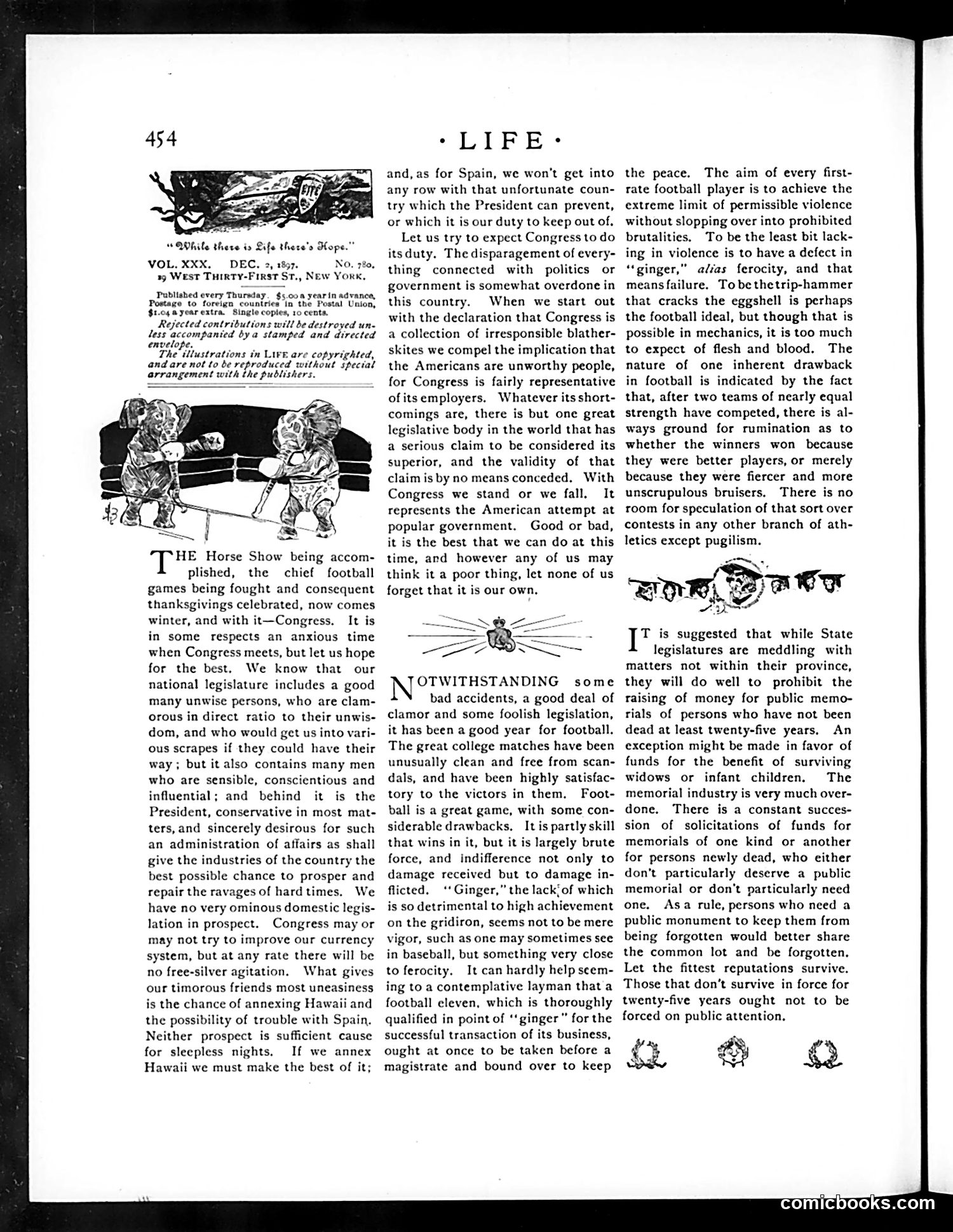
The page contains two editorial sections rather than traditional political cartoons. The main illustrated item shows two figures in what appears to be a domestic scene on a couch, likely a humorous commentary on daily life. The text discusses Congress, political governance, and football. The editorial criticizes Congress as an institution while defending it as "our own" attempt at popular government. A significant section praises college football's recent "clean" season while warning against the sport's inherent brutality—specifically mentioning "Ginger," likely a player known for violent play, as problematic for achieving excellence on the field. The final section addresses state legislatures potentially prohibiting fundraising for public memorials to deceased persons, suggesting such restrictions are unnecessary. The overall tone is satirical commentary on American civic institutions and social practices.
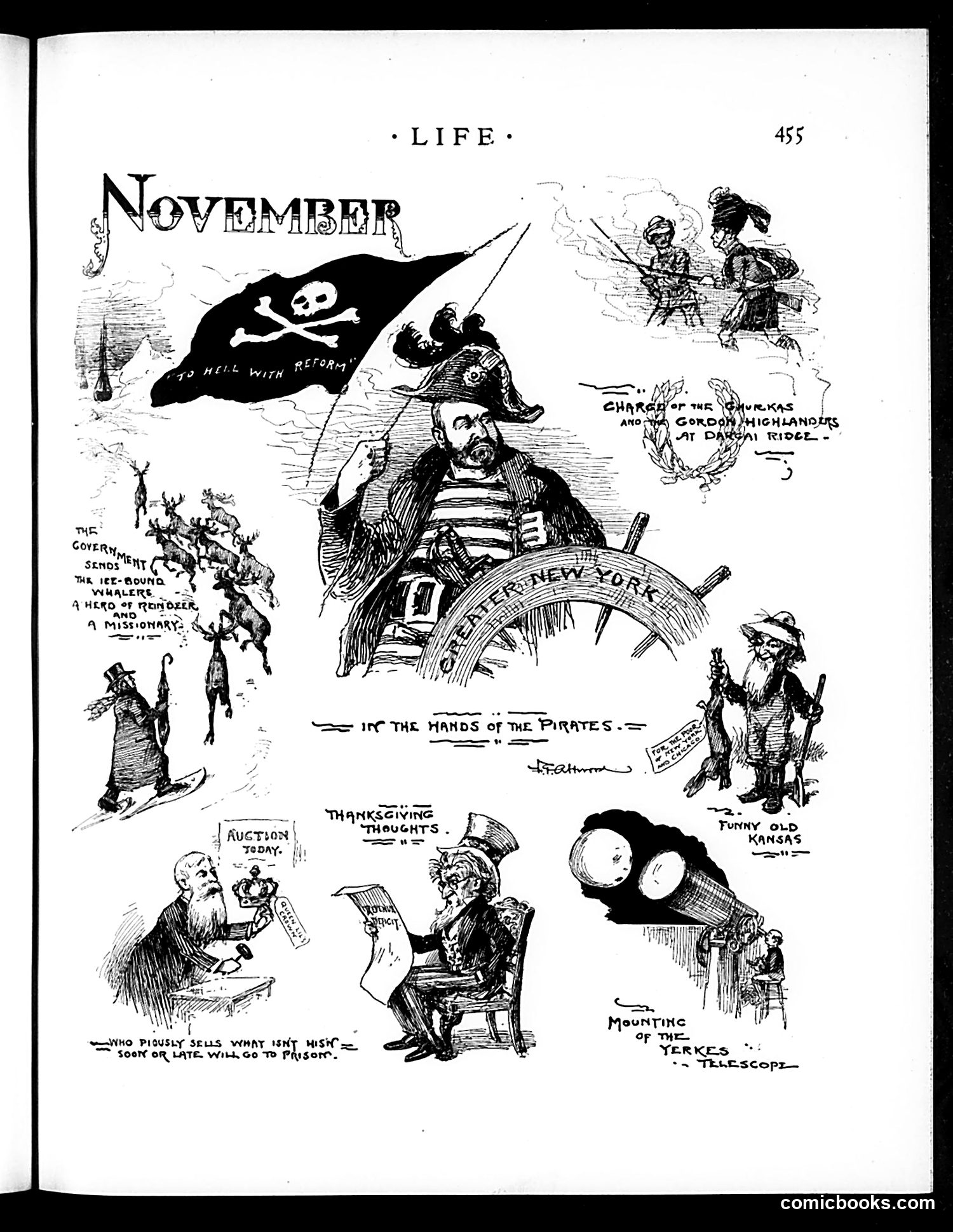
This page presents November 1900s satirical sketches mocking contemporary political and social figures. The central image shows a pirate at the helm of a ship labeled "S.S. New York," holding a skull-and-crossbones flag reading "To Hell with Reform"—likely criticizing corrupt New York politics or governance. Surrounding vignettes include "Charge of the Gurkhas" (referencing British colonial military), "Funny Old Kansas," and "Mounting of the Terkes Telescope." Other sketches mock "Thanksgiving Thoughts" and reference "Who Piously Sells What Isn't Wish Soon or Late Will Go to Prison." The overall theme appears to satirize political corruption, reform failures, and various contemporary scandals, though specific figures and events remain unclear without additional historical context.
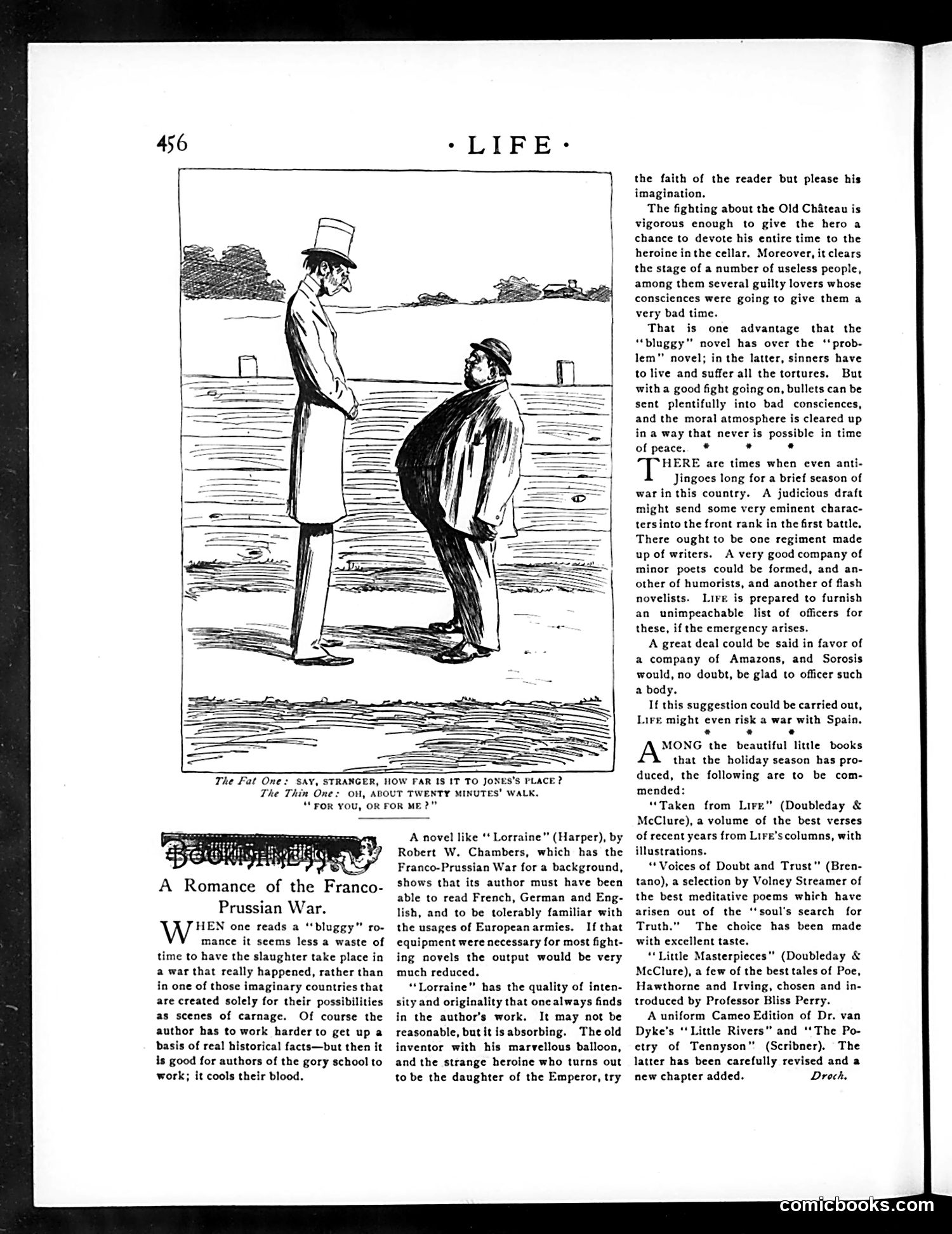
The main illustration depicts two men on a beach in what appears to be a WWI military context. The caption identifies them as "The Fat One" and "The Thin One," with dialogue suggesting a casual encounter ("Say, stranger, how far is it to Joshua Reach?" / "Oh, about twenty minutes' walk. For you, or for us?"). The accompanying article reviews "Lorraine," a novel about the Franco-Prussian War by Robert W. Chambers. The text discusses how "buggy" (melodramatic) war novels can still serve a purpose by allowing readers emotional engagement with conflict without moral consequences—essentially escapist entertainment. The cartoon likely satirizes the absurdity of casual wartime interactions or contrasts soldier types, though the exact satirical point remains unclear from the image alone.
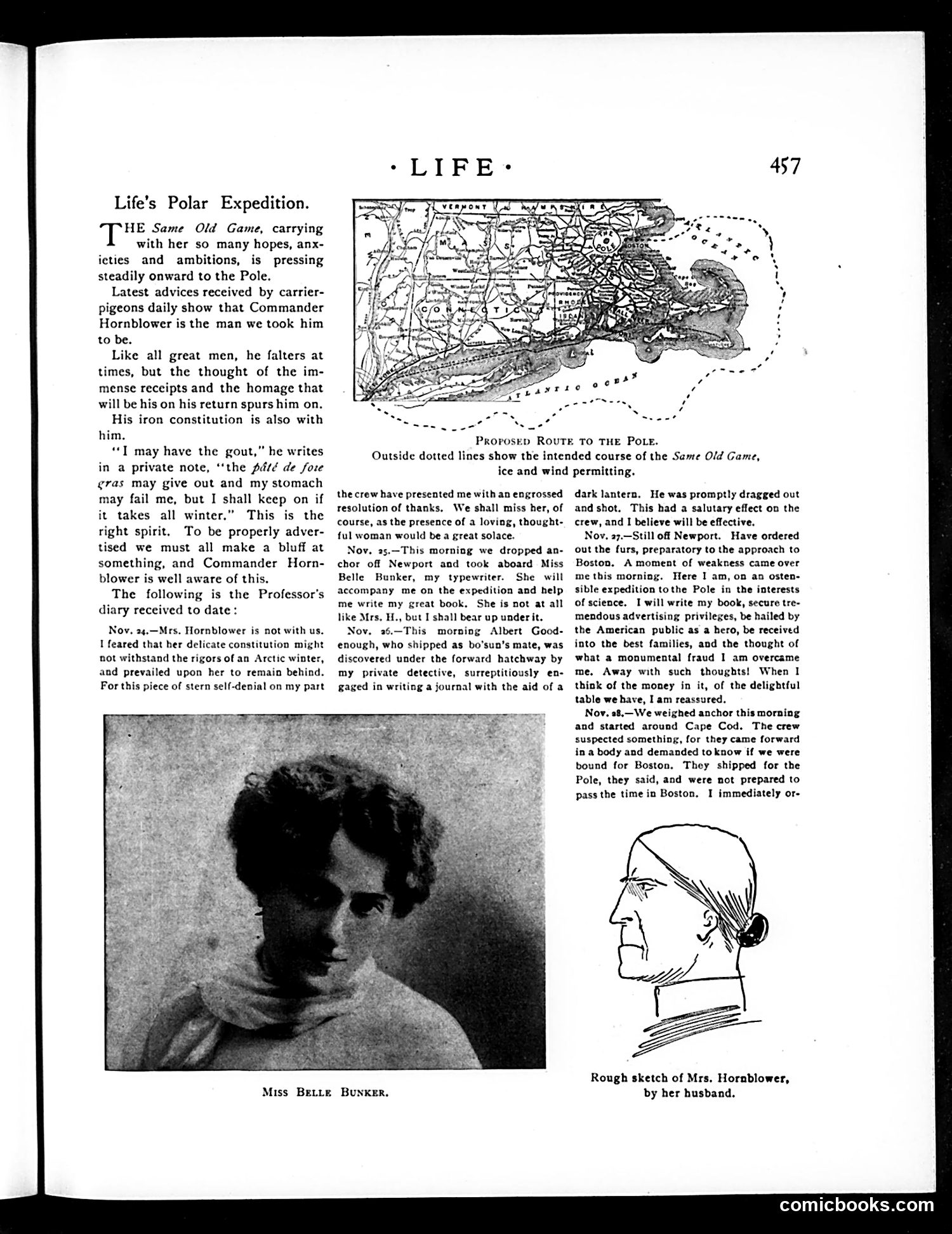
This page documents Commander Hornblower's polar expedition attempt, featuring diary entries and photographs. The text humorously portrays Hornblower as determined but physically struggling—he admits to having "the gout" and stomach troubles, yet persists toward the Pole. Miss Belle Bunker, shown in a photograph, accompanies the expedition as Hornblower's typewriter operator. A sketch labeled "Rough sketch of Mrs. Hornblower, by her husband" appears on the right. The satire centers on the contrast between the expedition's ambitious goals and Hornblower's compromised physical condition. The inclusion of a female typist and the domestic humor (Mrs. Hornblower's sketch) mock the pretensions of polar exploration while highlighting the expedition's practical, unglamorous reality. The map shows the proposed route to the Pole with ice and wind considerations marked.
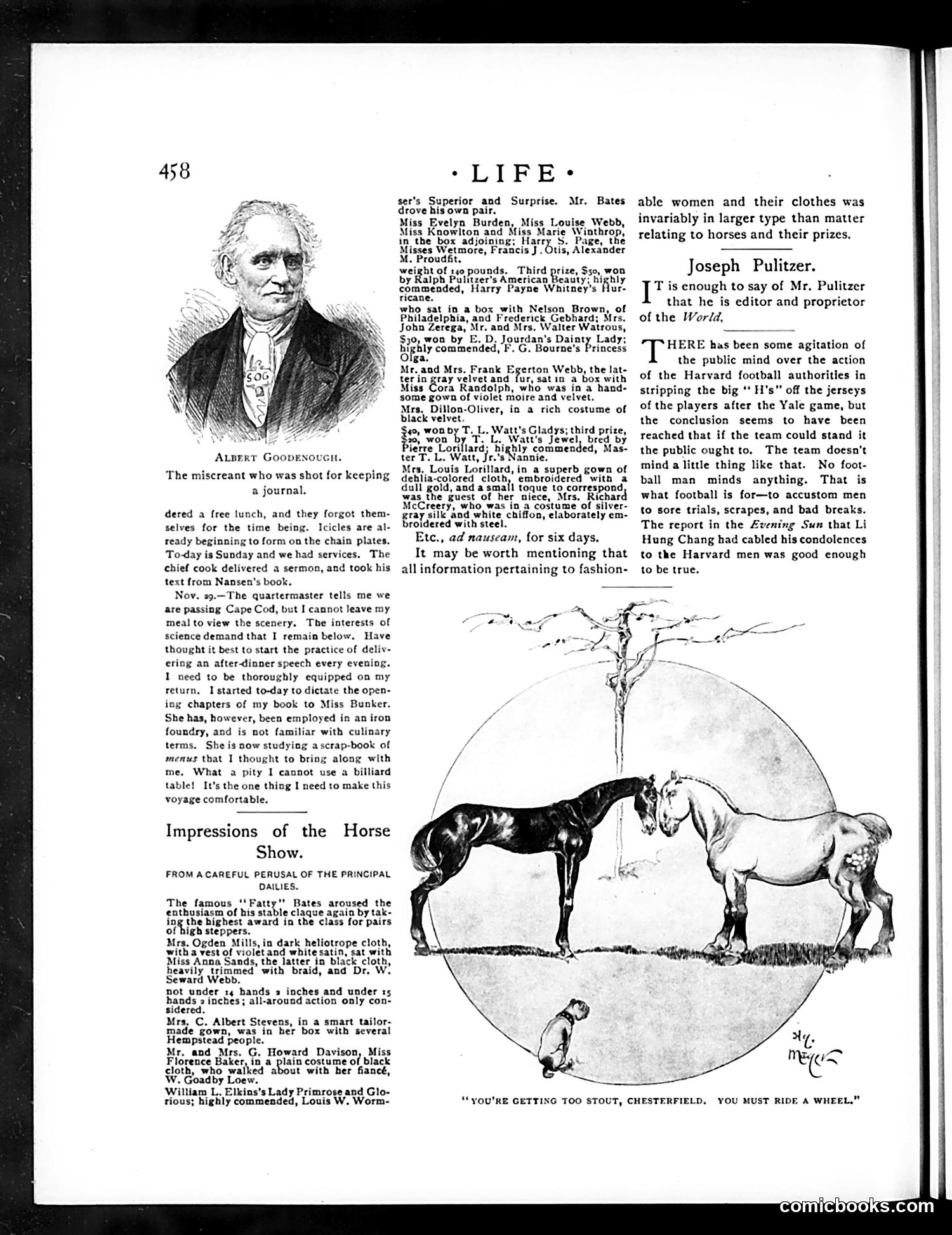
This page contains three sections: a portrait of Albert Goodenough with commentary about a journalistic mishap, a brief note from "Joseph Pulitzer" (the magazine's satirical take on the famous newspaper publisher), and an illustrated article titled "Impressions of the Horse Show." The main cartoon depicts horses and riders at what appears to be a prestigious equestrian event, with the caption: "YOU'RE GETTING TOO STOUT, CHESTERFIELD. YOU MUST RIDE A WHEEL." This is social satire mocking wealthy attendees of high-society horse shows, suggesting that one participant ("Chesterfield") has become overweight and should exercise using a bicycle instead—poking fun at the leisure class's vanity and fitness concerns.
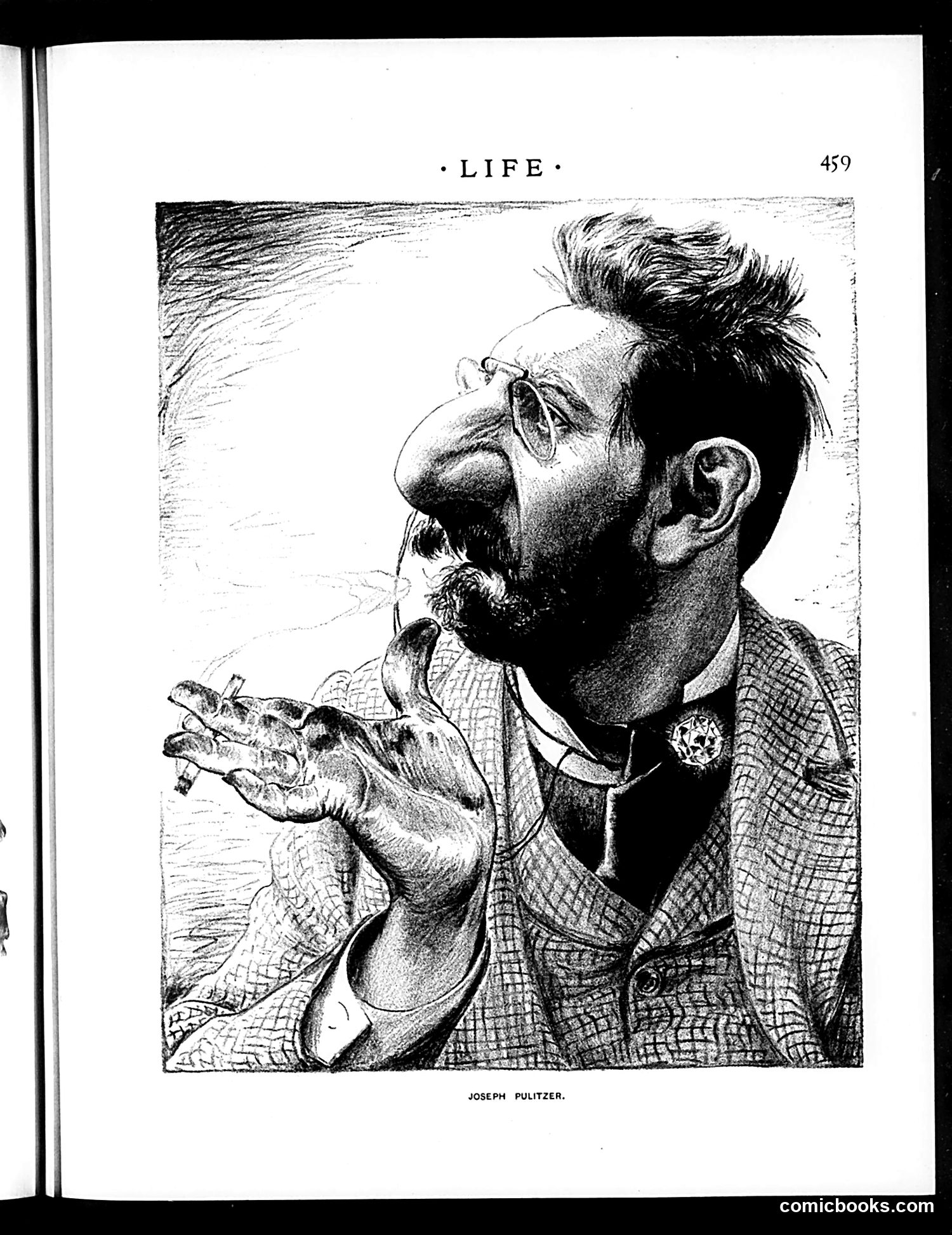
This page from *Life* magazine presents a portrait of **Joseph Pulitzer**, the prominent newspaper publisher. The detailed pen-and-ink drawing emphasizes his distinctive features: prominent nose, full beard, glasses, and swept-back hair styled in a topknot. He wears a checkered shirt and appears to be gesturing expressively with his hand. Pulitzer was a major American media figure known for sensationalist journalism and yellow journalism practices. The portrait appears to be a straightforward biographical illustration rather than satirical commentary. The page number (459) and the *Life* masthead indicate this is from the magazine's regular editorial content, likely featuring notable public figures of the era.
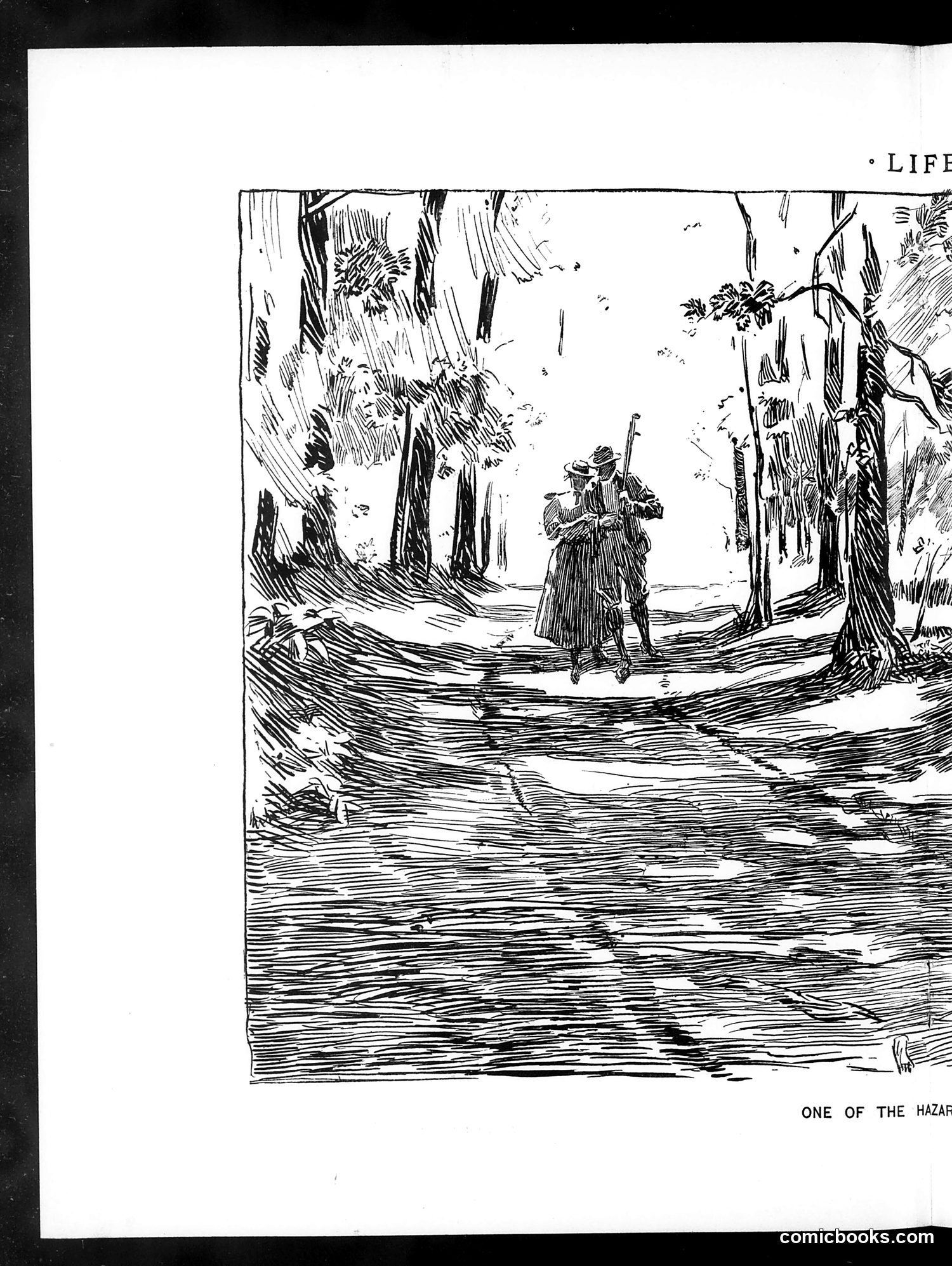
This appears to be an illustration from Life magazine showing a solitary figure standing in a forest or wooded area near water. The figure carries a rifle and wears period clothing with a hat, suggesting a hunter or outdoorsman. The caption reads "ONE OF THE HAZAR[D]" (text cut off), which likely completes to "ONE OF THE HAZARDS" — suggesting this illustrates a danger or risk associated with hunting or wilderness activities. However, **without the complete caption or additional context on the page, I cannot definitively identify the specific political or social satire intended**. The illustration appears to be depicting a hunting scene, but whether it's commentary on hunting dangers, class commentary, or another satirical point remains unclear from the visible information alone.
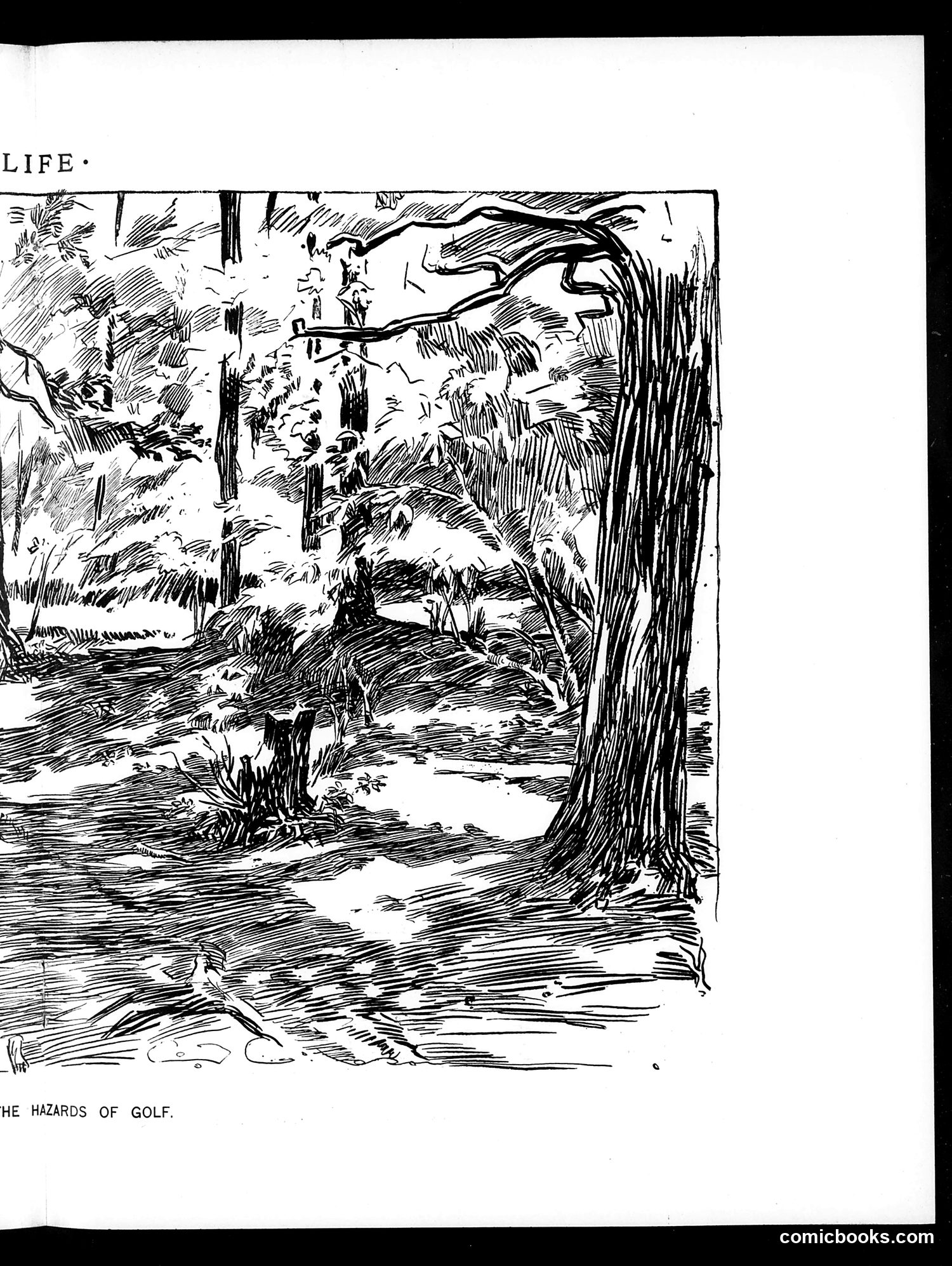
This is a satirical illustration from *Life* magazine depicting the dangers of golf. The sketch shows a wooded landscape with gnarled trees, rough terrain, and water hazards—natural obstacles that make golf challenging and frustrating. The title "The Hazards of Golf" suggests this is social satire about the sport itself, likely mocking the difficulties and frustrations golfers face on the course, or possibly critiquing golf culture among the wealthy or leisure class. The dark, sketchy artistic style emphasizes the chaotic, almost treacherous nature of the landscape. Without additional context or visible figures, it appears to be general commentary on golf as a sport rather than political satire targeting specific individuals.
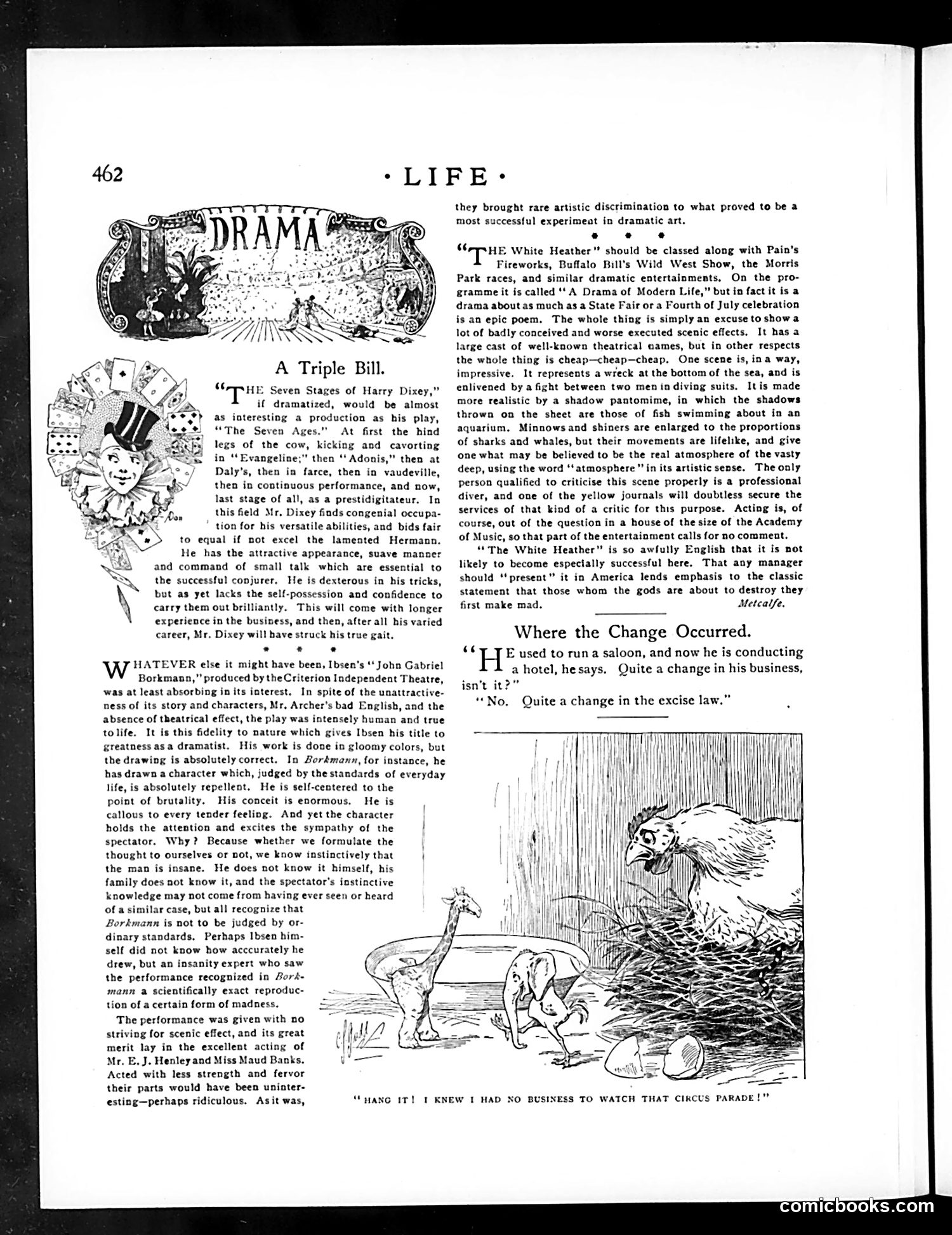
This page contains theater criticism under the "DRAMA" section. The main content reviews several theatrical productions, including "The Seven Stages of Harry Dissey" and "John Gabriel Borkmann." The small cartoon at bottom, captioned "HANG IT! I KNEW I HAD NO BUSINESS TO WATCH THAT CIRCUS PARADE!", shows a man gesturing in frustration while watching what appears to be trained animals performing. The joke satirizes someone who attended a circus parade despite knowing he shouldn't waste time on such entertainment—yet he couldn't resist watching anyway. It's gentle humor about human weakness for spectacle and distraction. The section "Where the Change Occurred" presents a brief comedic exchange about a man switching from running a saloon to conducting a hotel, attributing his improved behavior to stricter excise laws rather than personal reform.
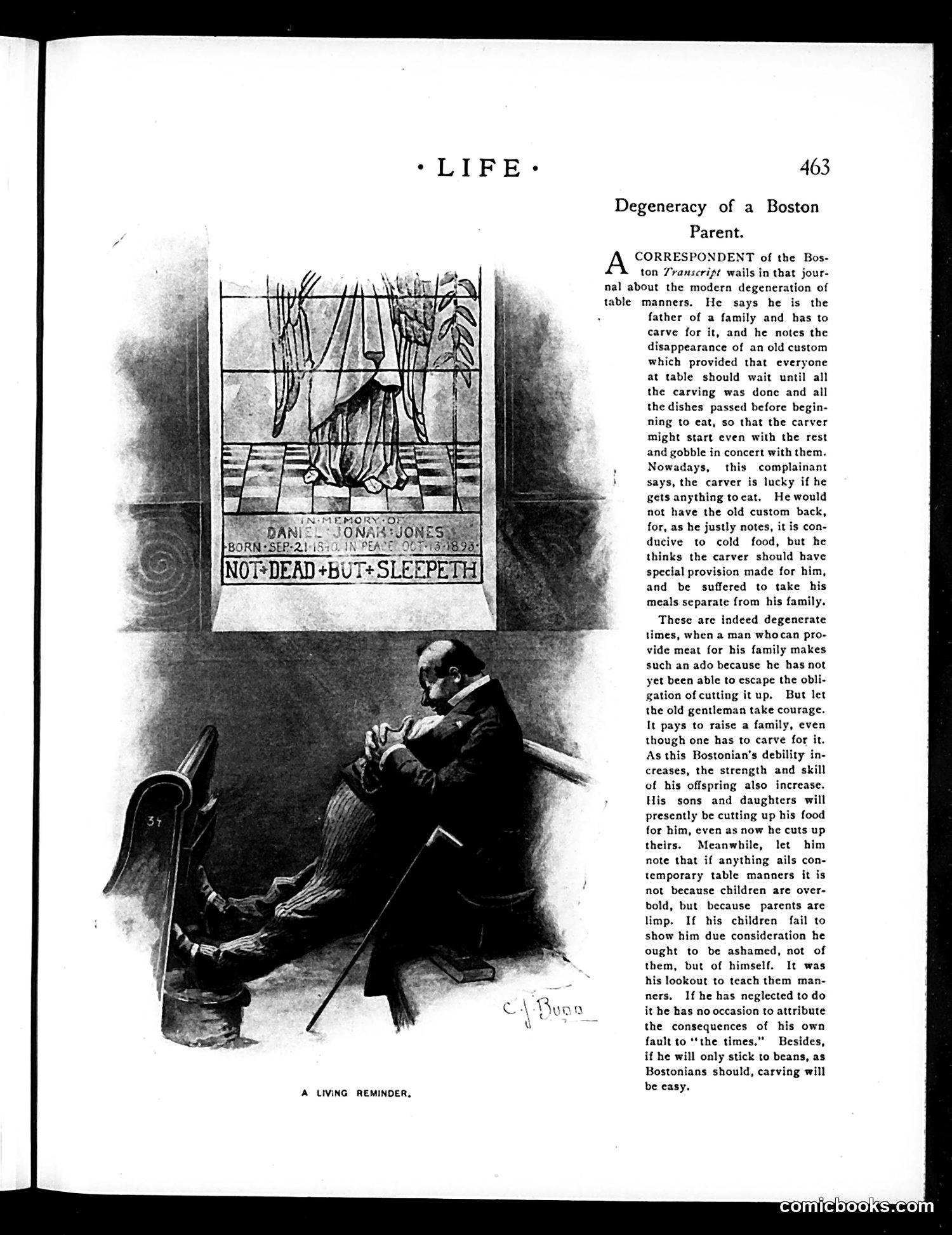
This satirical piece mocks a Boston Transcript correspondent who complained about declining table manners. The writer claims carvers no longer eat with their families—everyone else eats while he's still carving, leaving him with cold food. Life's response is withering: the real problem isn't modern degeneracy but parental weakness. Parents, not children, have abandoned proper discipline and manners-teaching. The magazine turns the complaint back on the father: if his children show him disrespect, *he* should be ashamed, not "the times." The closing jab—"if he will only stick to beans, as Bostonians should, carving will be easy"—further mocks Boston propriety while suggesting the whole complaint is absurdly trivial. The accompanying illustration shows a weary, seated man with carving implements, labeled "A Living Reminder."
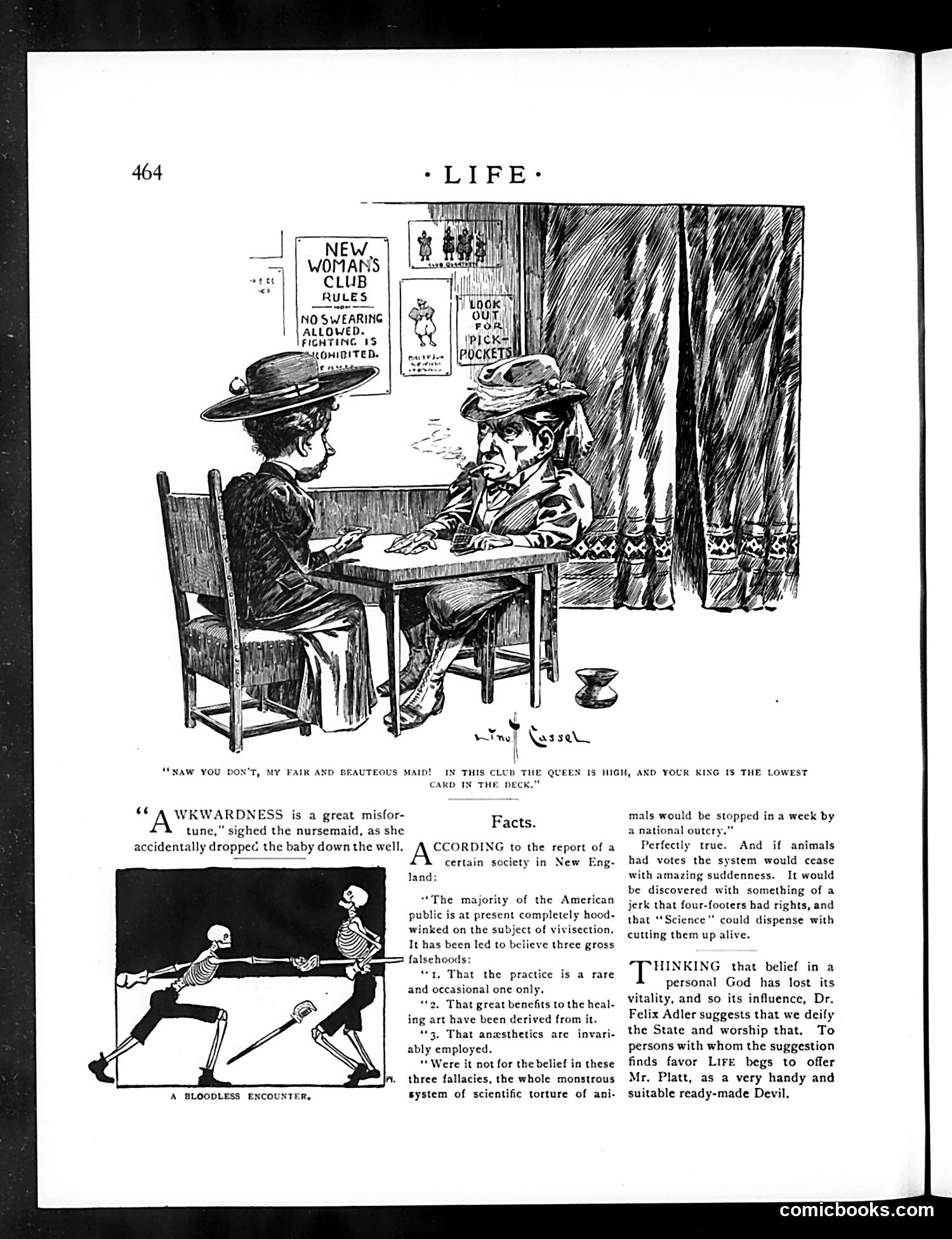
**Top Cartoon:** A card game at a "New Woman's Club" where posted rules forbid swearing and fighting. The joke plays on emerging women's clubs of the era—spaces where women gathered independently. The caption's chess reference (queen high, king low) inverts traditional gender hierarchy, satirizing anxieties about women's changing social roles. **Middle Cartoon ("A Bloodless Encounter"):** Two skeleton figures in a sword fight. The title puns on "bloodless"—skeletons have no blood to spill. This appears unrelated to surrounding text. **"Facts" Section:** Criticizes animal vivisection (live animal experimentation), citing a New England society's claim that the public believes three falsehoods justifying the practice. The text argues animals would stop vivisection "if they had votes," sarcastically suggesting democratic power should protect them. The final paragraph references "Mr. Platt" as a "ready-made Devil," likely political commentary, though the specific figure remains unclear. Overall: Social satire targeting women's changing roles, animal welfare advocacy, and political figures.
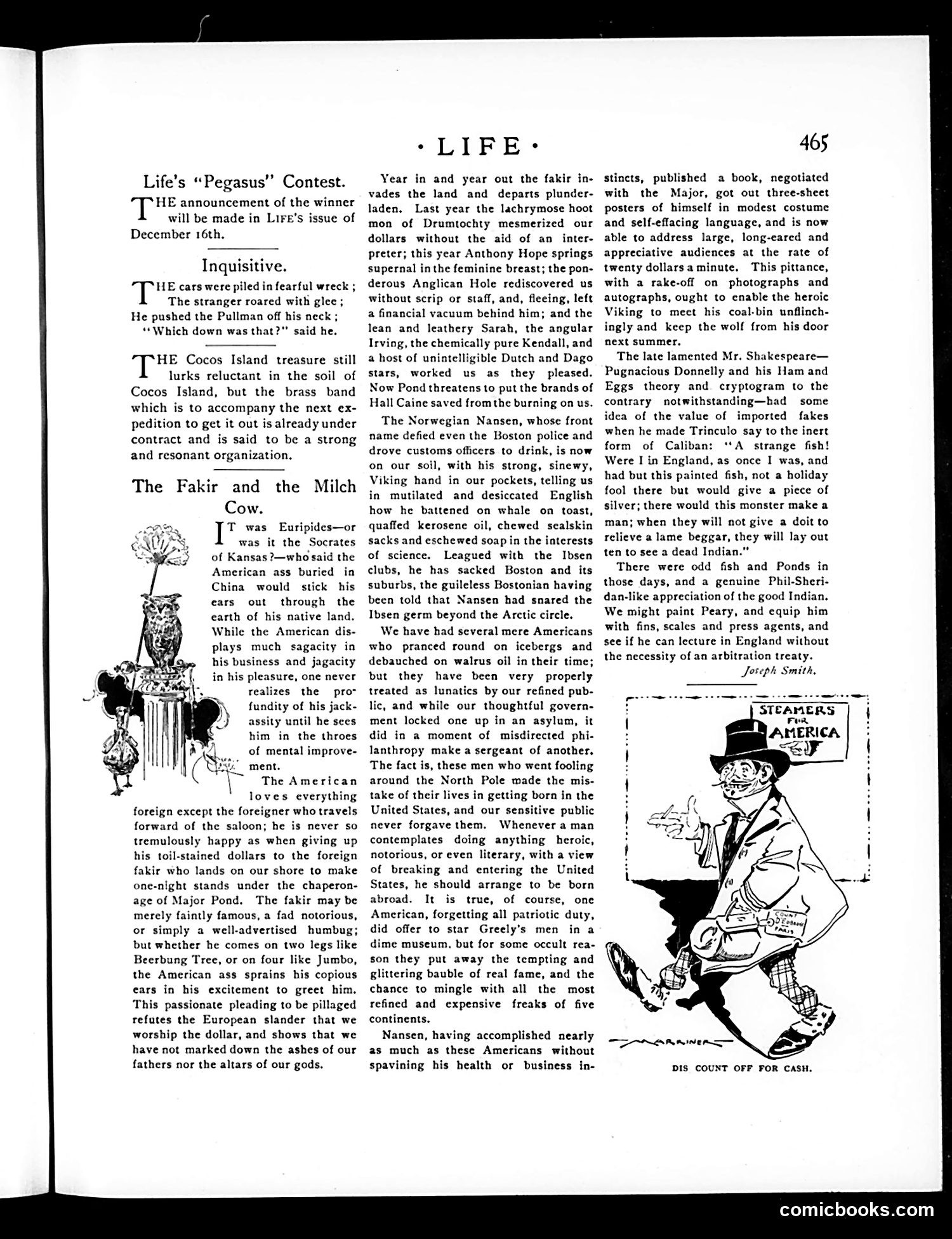
This satirical essay mocks American audiences' obsession with foreign celebrities and "fakirs" (charlatans). The author argues Americans eagerly pay to see foreign performers—whether famous or merely well-advertised—while treating homegrown American adventurers as lunatics. The specific example is Fridtjof Nansen, the Norwegian Arctic explorer, currently touring America. The text ridicules how Americans flock to hear Nansen's exaggerated tales of eating whale on toast and chewing sealskin while avoiding soap, all delivered in broken English. The essay contrasts this with how America locked up its own polar explorers in asylums. The "milch cow" metaphor suggests Americans are passive, profitable targets for foreign exploitation. Life satirizes American cultural inferiority complex—the belief that anything foreign is automatically superior, while American achievement is dismissed as mere eccentricity. The broader joke: Americans worship foreign "fakirs" while scorning domestic heroes.
This page contains several satirical pieces targeting contemporary social issues: **"I'm Scissors Am Nulls"** opens with a poem mocking women cyclists—a controversial topic of the 1890s. The joke: a woman rides her bicycle so obsessively she dies and reaches heaven, only to find bicycles banned there. This satirizes anxieties about the "New Woman" and her independence via cycling. **The Kaiser story** ridicules German authoritarianism and the law of *Majestätbeleidigung* (lèse-majesté), which criminalized insulting the German Emperor. The humor: a British man accidentally insults the Kaiser and is arrested, but cleverly deflects by claiming he meant the Russian Emperor instead—implying German police care more about protecting the Kaiser's dignity than justice. **The warning box** addresses a separate issue: counterfeit Life cartoons being sold as originals. This was apparently a real problem. The page is largely advertisements otherwise. The overall tone reflects Life's role as a vehicle for middle-class satire on gender roles, foreign politics, and consumer culture.
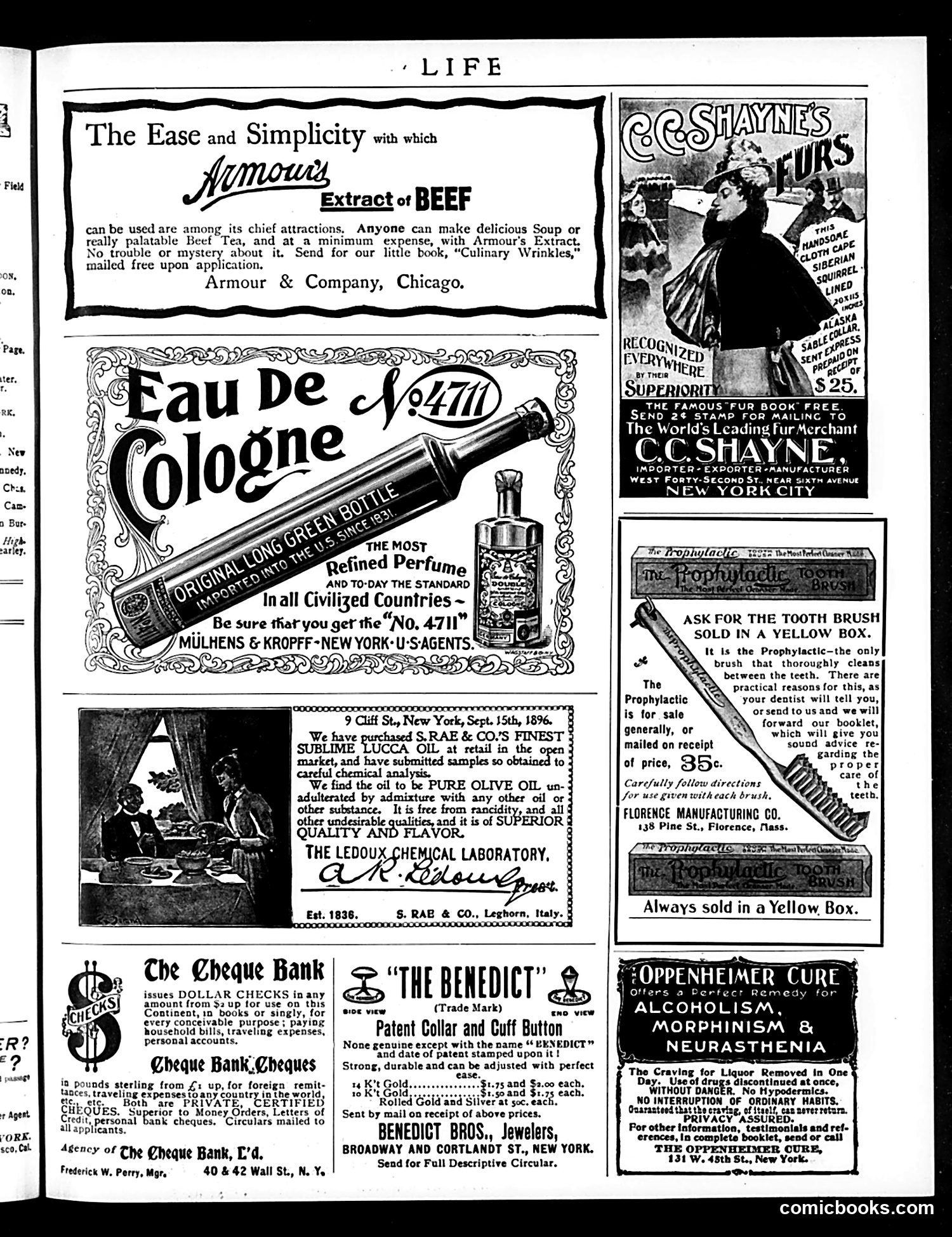
This is primarily an **advertising page** from Life magazine (circa 1896, based on the "Our St. New York" dateline visible in one ad). There are no political cartoons or satirical content—the page consists entirely of period product advertisements. Notable ads include: - **Armour's Extract of Beef** (soup/cooking product) - **Eau de Cologne No. 4711** (perfume, marketed as "the most refined perfume") - **C.C. Shayne Furs** (fur merchant advertisement) - **Prophylactic Toothbrush** (sold in yellow box) - **The Cheque Bank** (financial services for travelers) - **Benedict Patent Collar and Cuff Button** - **Oppenheimer Cure** (for alcoholism and neurasthenia) The ads reflect late-Victorian consumer culture and medical attitudes, including remedies for conditions like "neurasthenia" (a common 19th-century diagnosis). The typography and layout are characteristic of 1890s print advertising.
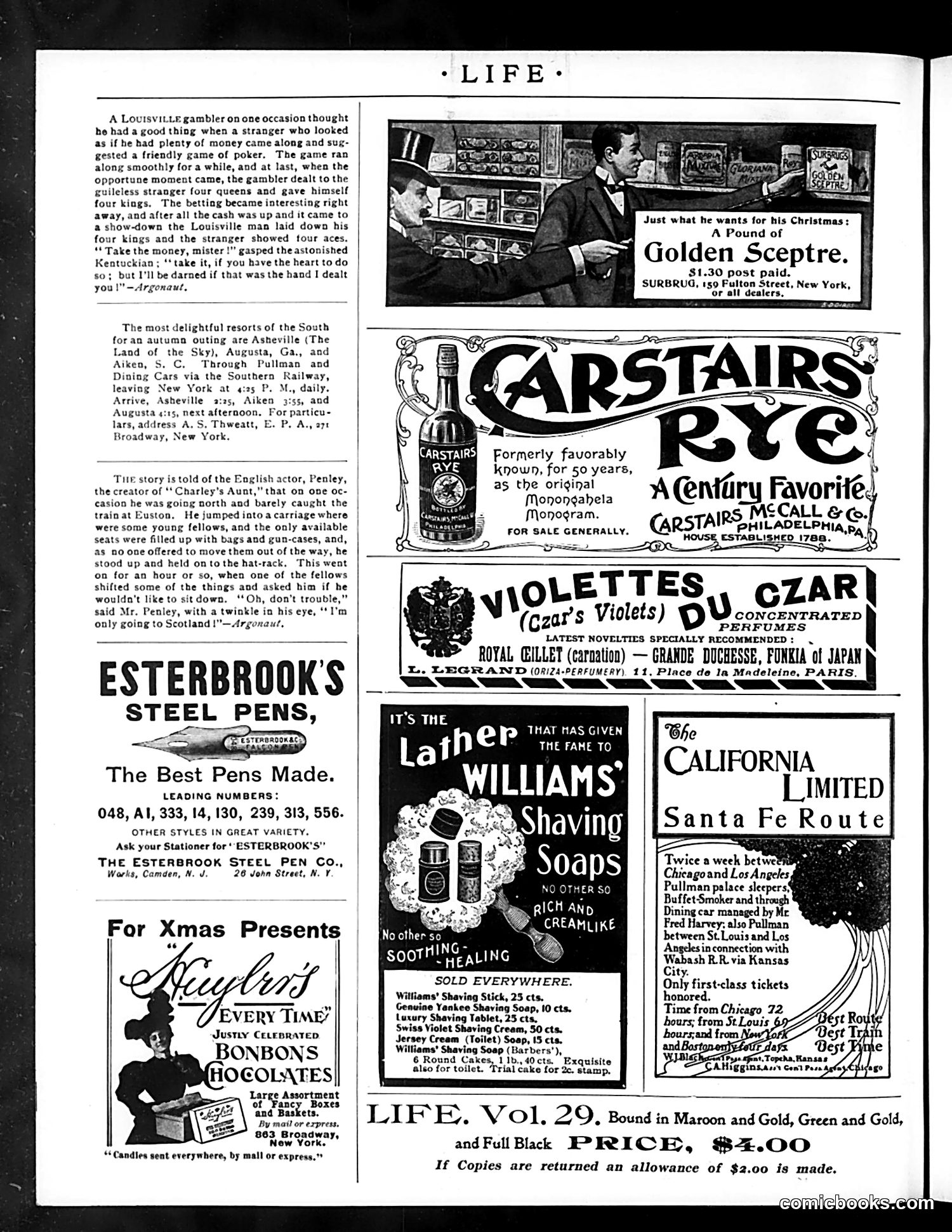
This page is primarily **advertisements and humorous anecdotes** rather than political satire. The two brief stories showcase period humor: 1. **"The Louisville Gambler"**: A con-artist narrative where a naive gambler is outplayed—he deals himself four kings but loses to four aces, admitting bewilderment at being beaten at his own trick. 2. **"The English Actor Penley"**: A joke about actor Penley (creator of "Charley's Aunt") standing uncomfortably on a train to Scotland. When offered a seat, he quips he needn't sit since he's "only going to Scotland"—implying it's a short journey, though Scotland is quite distant. The remainder consists of period advertisements for luxury goods: Golden Sceptre tobacco, Carstairs Rye whiskey, Esterbrook pens, bonbons, perfumes, shaving soaps, train service, and the magazine itself. This reflects early 1900s consumer culture and advertising practices in American magazines.
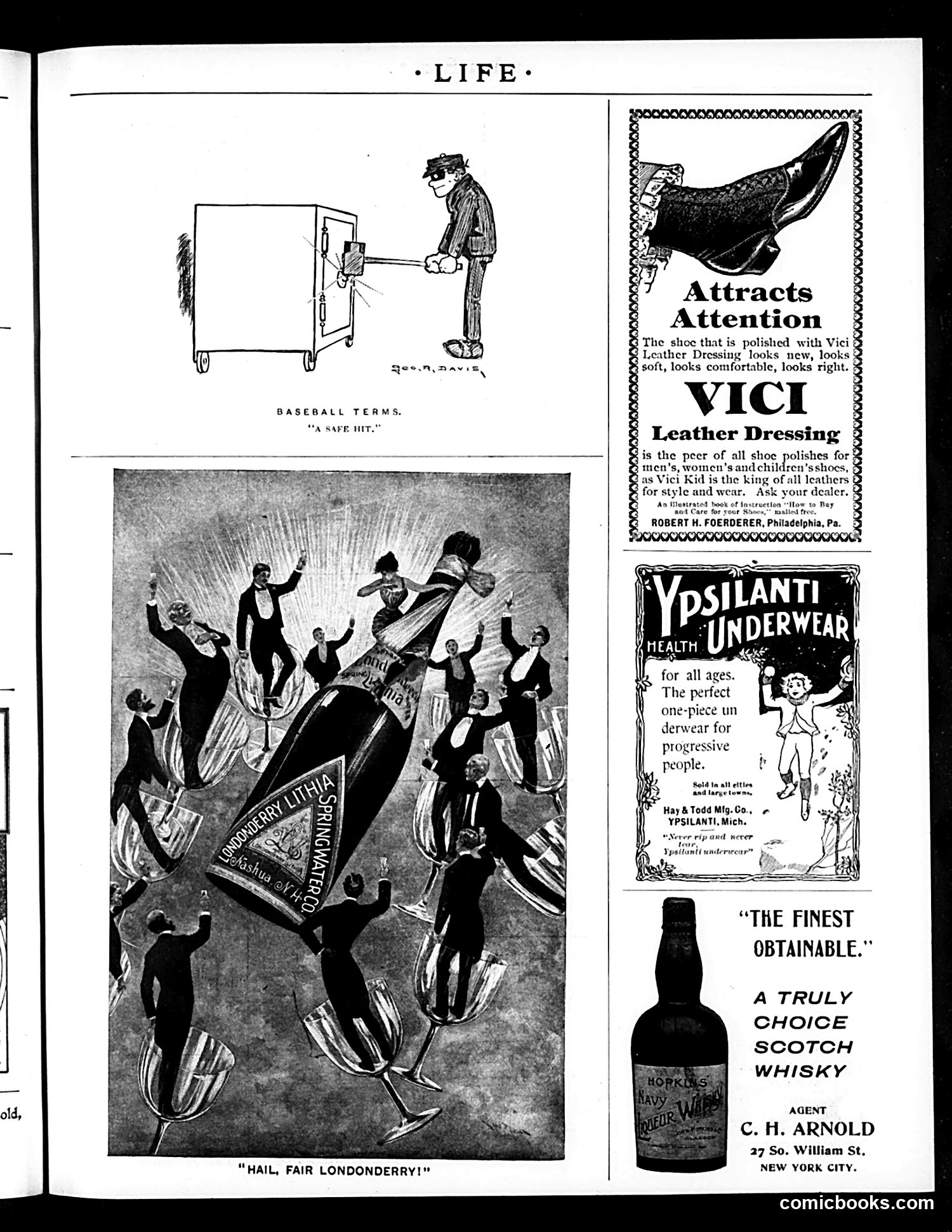
**Top cartoon ("A Safe Hit")**: A baseball joke. A man at a safe (the baseball term "safe" doubled with a literal vault) represents scoring safely in baseball without being tagged out. **Large center image ("Hail, Fair Londonderry!")**: Depicts men in formal dress celebrating atop what appears to be a large bottle or container labeled "Londonderry Lithia Spring Water." This appears to be advertising or satirizing a mineral water brand, showing enthusiastic endorsement. The celebratory pose suggests the product's popularity or the exaggerated marketing claims typical of early-20th-century patent medicines and bottled waters. **Right side**: Three product advertisements (Vici Leather Dressing shoe polish, Ypsilanti Health Underwear, and Horkum's Navy Scotch Whisky) typical of Life magazine's revenue model. These are straightforward ads, not satire. The page mixes genuine satire (baseball pun) with advertisement content, reflecting Life's dual purpose as both humor magazine and advertising vehicle.
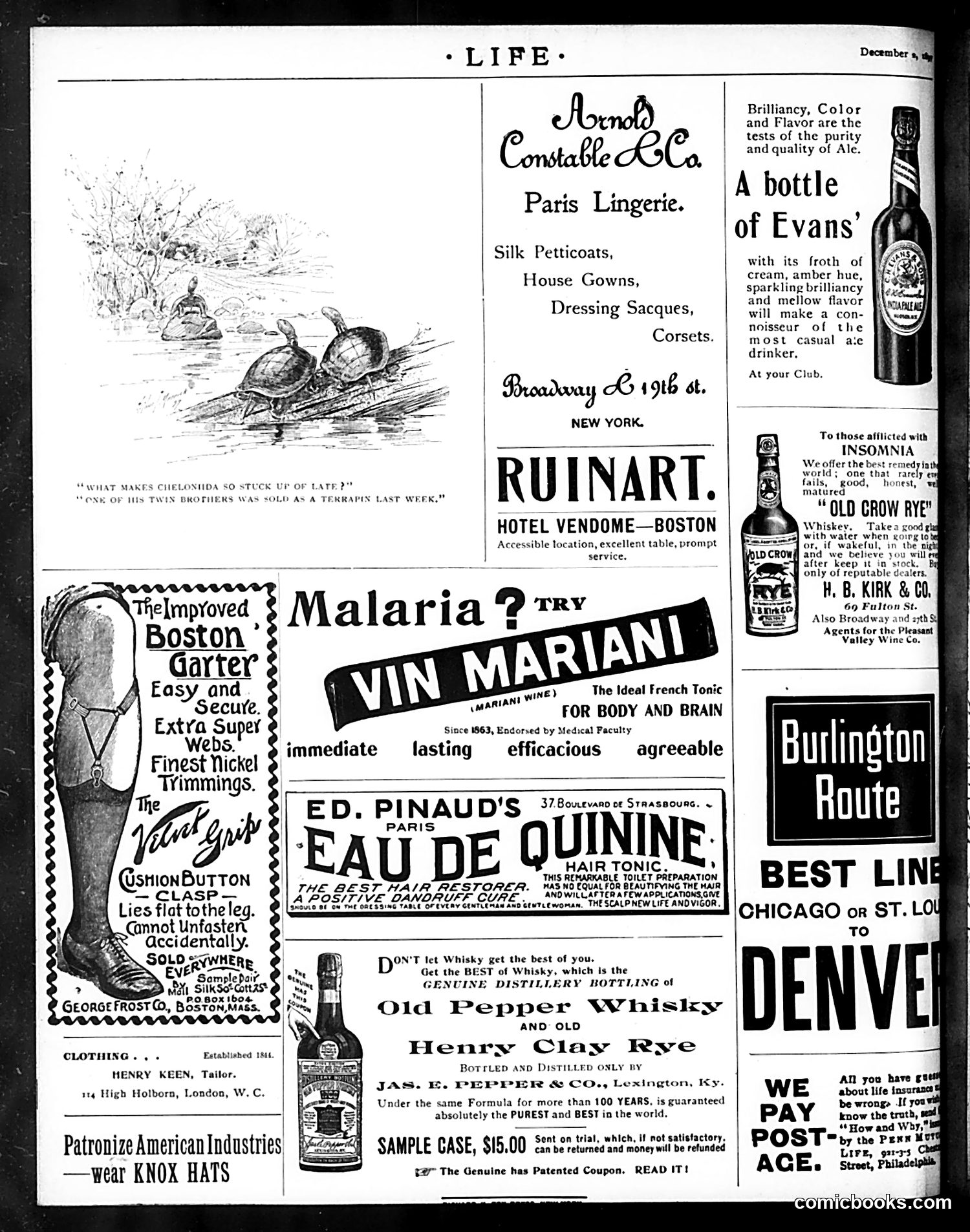
This is primarily an **advertising page** from Life magazine (circa early 1900s, based on styling). The single cartoon at top-left is minimal satirical content. ## The Cartoon The brief joke depicts two turtles ("Cheloniida"). One asks why the other has become "stuck up of late." The answer: "One of his twin brothers was sold as a terrapin last week." **The humor**: A social commentary on pretension—the turtle is acting superior because a sibling was sold commercially as food, suggesting he's adopted airs based on (unfortunate) family notoriety. It's gentle mockery of snobbish behavior rooted in dubious circumstances. ## The Advertisements The bulk of the page consists of patent medicines, clothing, spirits, and toiletries typical of the era—including **Vin Mariani** (wine tonic), whisky brands, hair restorer, and a "garter clasp." These ads reflect Edwardian consumer culture and the pre-FDA era when dubious health claims were unregulated.
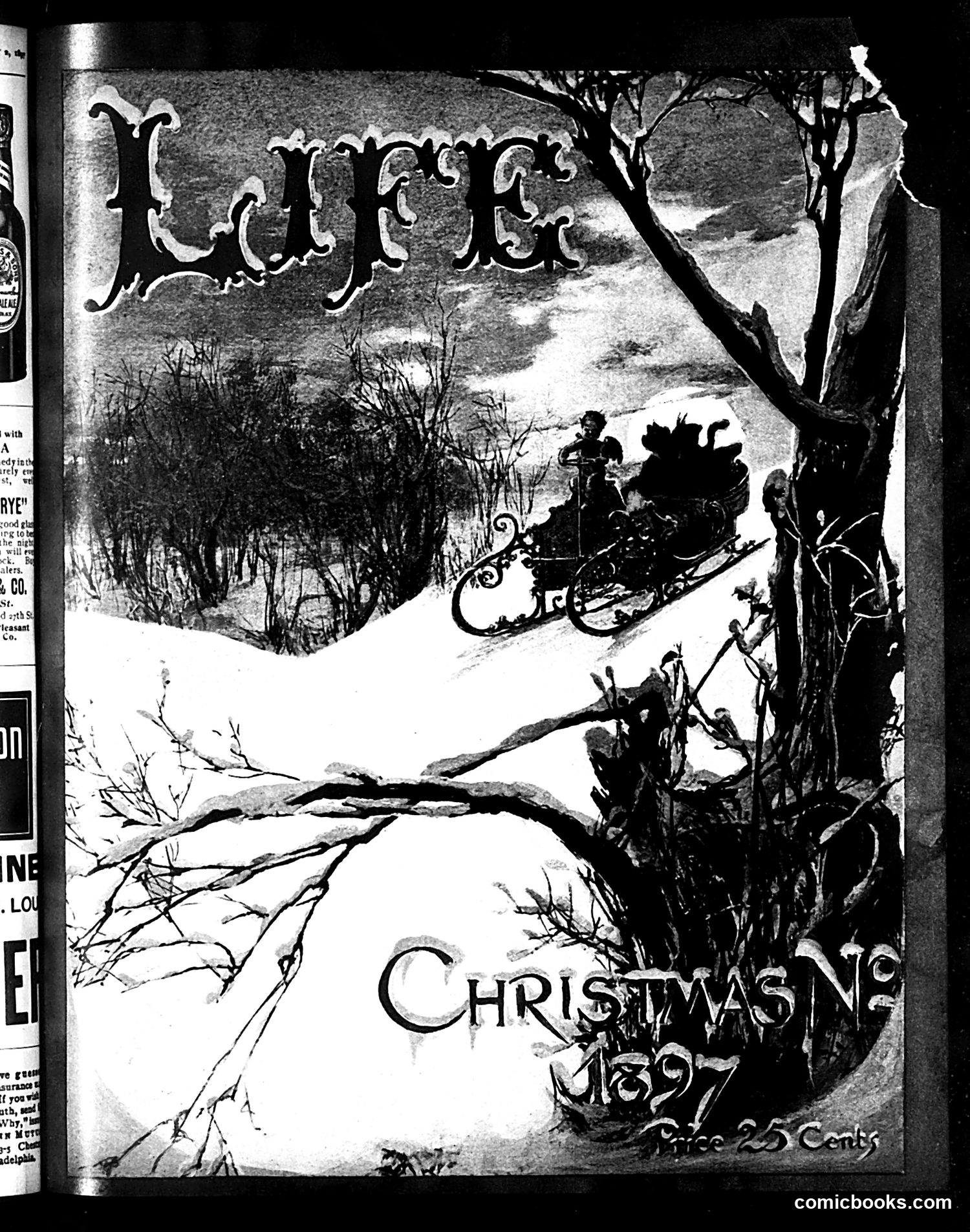
This is the cover of *Life* magazine's Christmas 1897 issue (priced at 25 cents). The illustration depicts a winter holiday scene with a horse-drawn sleigh carrying passengers through snow, with bare trees framing the composition. The ornate "Life" masthead appears at the top in decorative lettering. The image represents a nostalgic, romantic vision of Christmas—likely appealing to *Life*'s middle-class readership during the Gilded Age. The sleigh ride was an idealized symbol of holiday leisure and festivity. Without additional OCR text from the page's interior, I cannot identify specific satirical targets or political commentary this cover may have contained, as the visual alone presents conventional holiday imagery rather than obvious caricature or social critique.
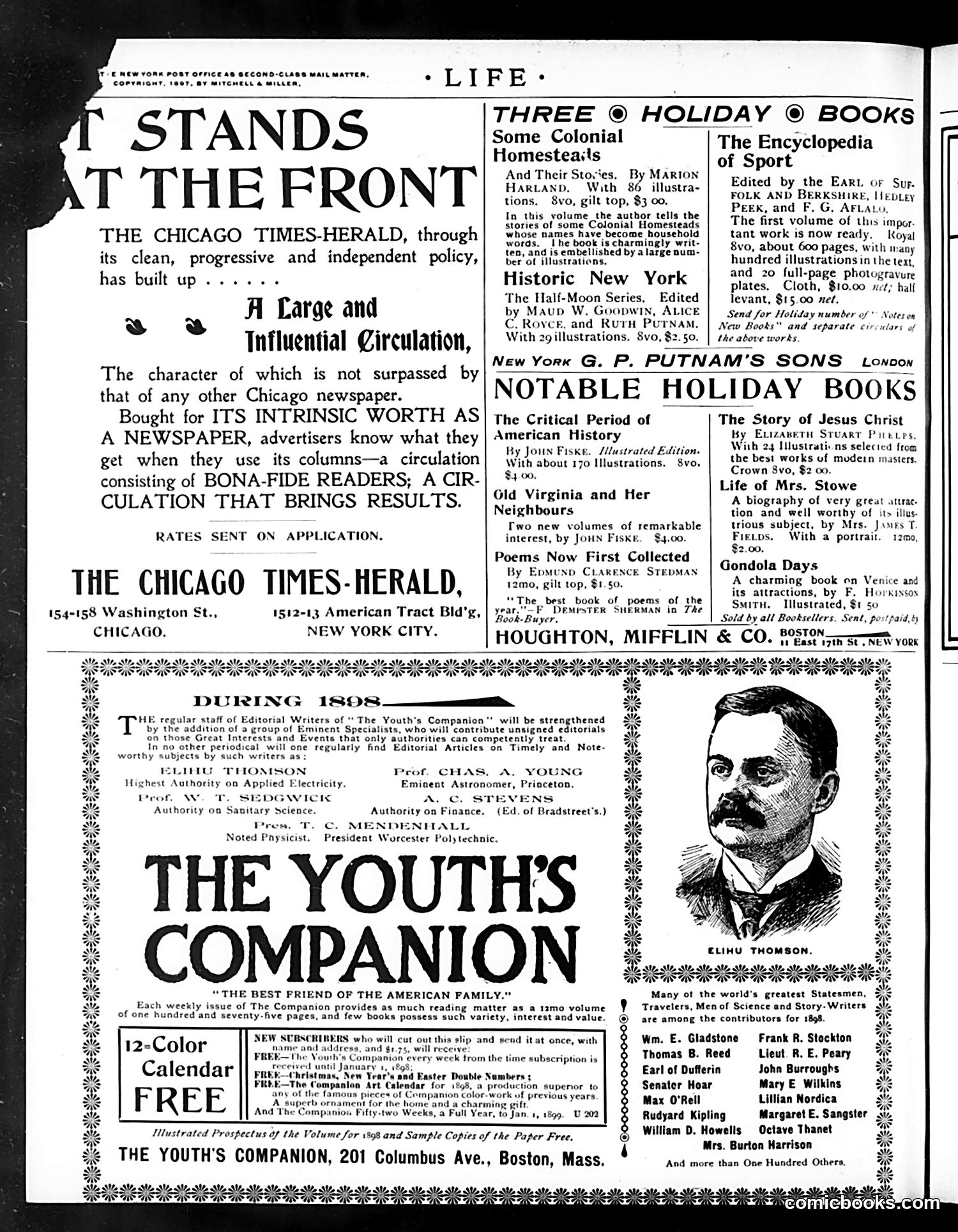
This page is primarily a collection of advertisements from 1898, not a political cartoon. The main content includes: 1. **The Chicago Times-Herald advertisement** (top left) — promoting the newspaper's circulation and advertising value. 2. **Holiday book advertisements** (right) — promoting works by publishers G.P. Putnam's Sons and Houghton, Mifflin & Co., featuring history and literary titles. 3. **A portrait of Elihu Thomson** (center-right) — an electrical engineer and inventor, presented as an authority for publication purposes. 4. **The Youth's Companion advertisement** (bottom) — promoting the magazine's educational mission and its use of expert contributors on topics like electricity, astronomy, and finance. It lists contributors including figures like Thomas B. Reed (likely the politician). The page reflects turn-of-the-century publishing and editorial practices, emphasizing authority and expert knowledge. There is no evident satire or political cartoon here.
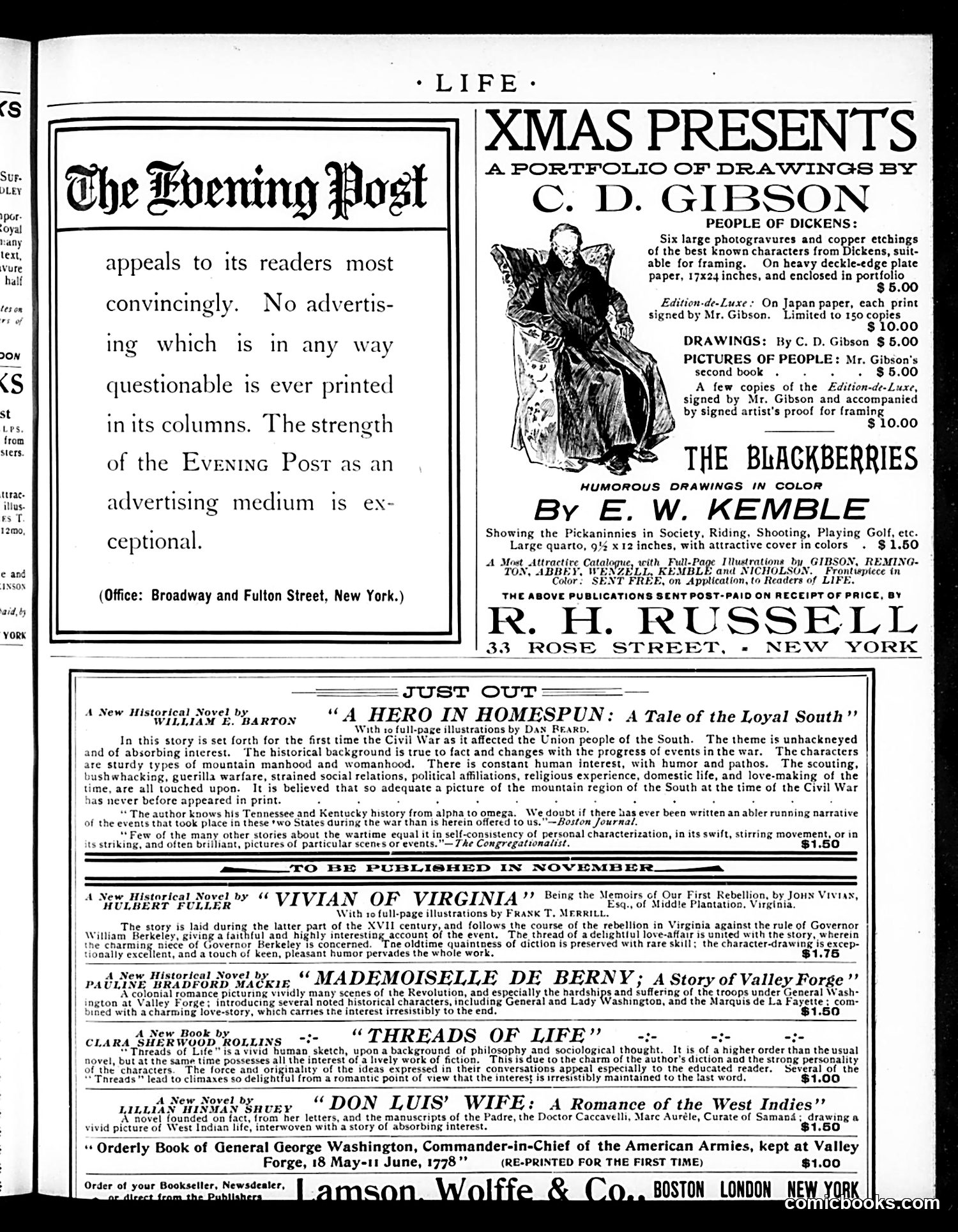
This is primarily an **advertising page** for holiday gift books, not a political cartoon. The page showcases Christmas-season book recommendations from publisher R.H. Russell. The main advertised items include: - **C.D. Gibson's art portfolios** featuring Dickens characters and society drawings - **E.W. Kemble's "The Blackberries"** — humorous drawings depicting Black characters (referred to as "Pickaninnies") in various activities Several historical novels are promoted, including Civil War narratives like "A Hero in Homespun" and "Vivian of Virginia." **For modern readers:** The page reflects late 19th/early 20th-century publishing and advertising norms. Kemble's work, while presented as lighthearted humor, employed racist caricature conventions common to that era. The prominence of Civil War fiction reflects post-war America's continued cultural preoccupation with reconciliation narratives, particularly those sympathetic to the South. The Evening Post endorsement at top-left emphasizes the magazine's credibility as an advertising medium.
This page is primarily **advertising for books**, not a political cartoon. It features holiday book recommendations from major 19th-century publishers—D. Appleton and Company and J. B. Lippincott Company. The listings include titles by popular authors like Rudyard Kipling (*The Seven Seas*), Hall Caine (*The Christian*), and Sarah Grand (*The Beth Book*). Works cover diverse subjects: dance history, Napoleon's letters, ornithology, marriage customs, and Russian travel. The only non-advertising element is a boxed ad for **Richard K. Fox Press** emphasizing their "half-tone printing" quality. This appears to be a page from *Life* magazine's book review section rather than satirical content—a common magazine feature for holiday shopping guidance.
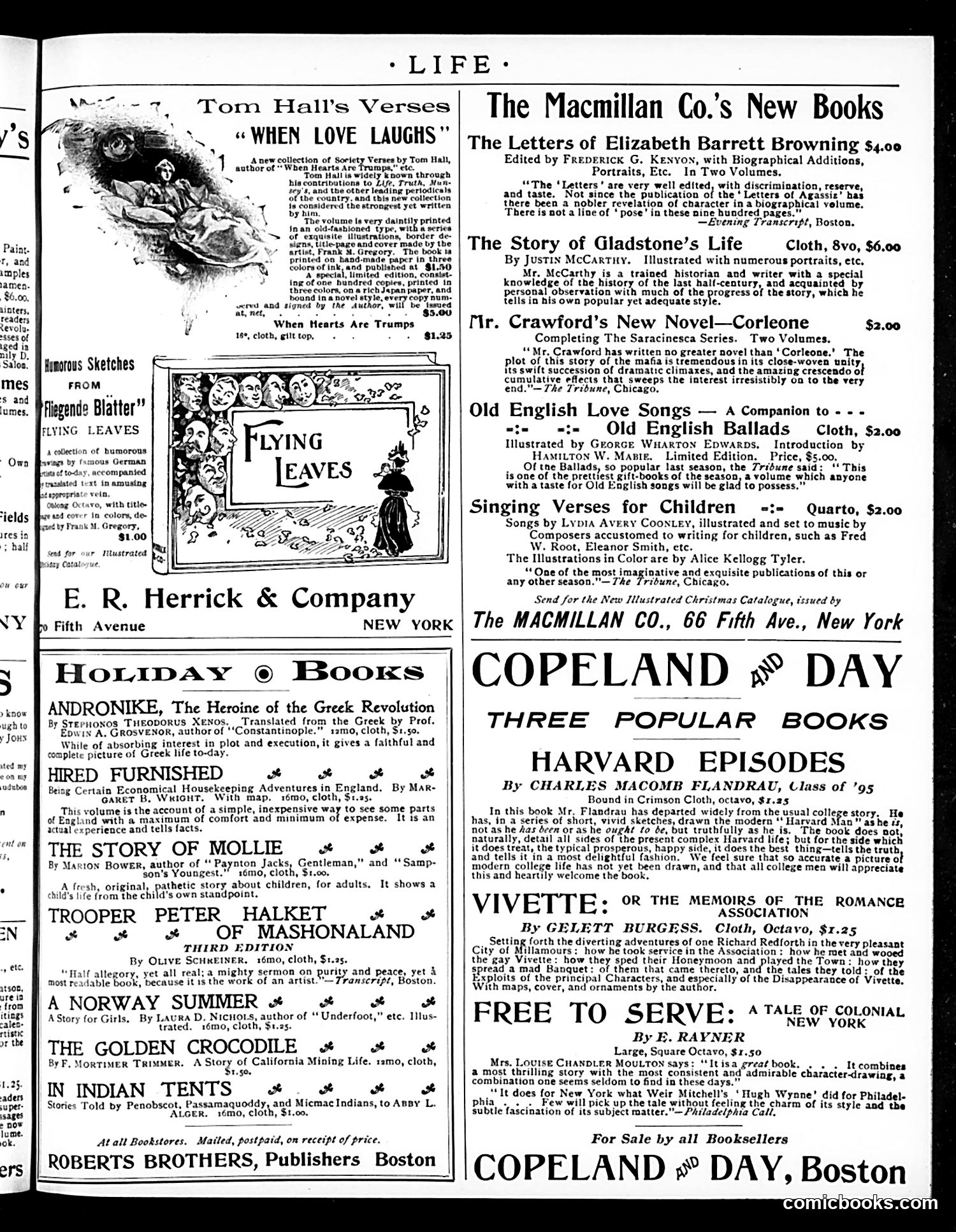
This page is primarily **advertising, not satire or political commentary**. It consists almost entirely of book advertisements from publishers (Macmillan, E.R. Herrick & Company, Roberts Brothers, and Copeland & Day). The only illustrated content is a decorative header for "Flying Leaves"—a collection of humorous sketches translated from the German periodical *Fliegende Blätter*. The illustration shows a whimsical figure in period dress, but this is **ornamental rather than satirical**. The books advertised reflect late-19th/early-20th century literary tastes: poetry collections, travel narratives, fiction about exotic locales (India, Egypt, Mashonaland), and biographical/epistolary works. Notable are titles like Elizabeth Barrett Browning's letters and a biography of William Gladstone, indicating this page targets educated, cultured readers. **No political cartoon or satirical commentary is present on this page.**
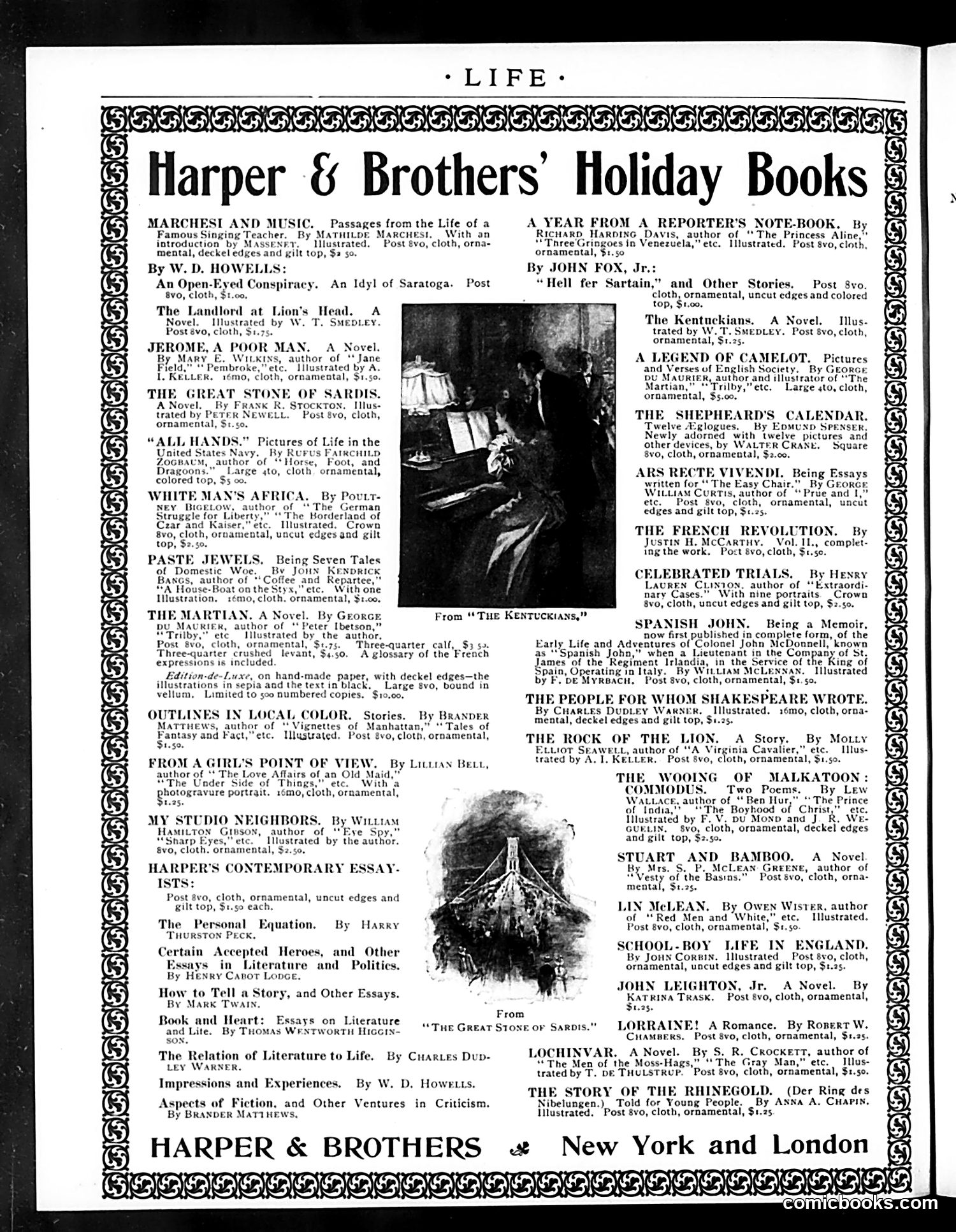
This is a **publisher's advertisement**, not a satirical cartoon page. Harper & Brothers is listing their holiday book offerings for the season. The two images embedded in the page are **illustrations from featured books**: one labeled "From 'The Kentuckians'" showing what appears to be a domestic or social scene, and another labeled "From 'The Great Stone of Sardis'" depicting what looks like a volcanic or dramatic landscape. The page itself is promotional content—a catalog of novels, essays, and literary works by popular authors of the era (W.D. Howells, Mark Twain, George du Maurier, etc.), designed to encourage holiday purchases. There is no political satire or social commentary visible here; it is straightforward commercial publishing advertising typical of *Life* magazine's advertising sections.