
Life, 1897-12-02 · page 6 of 26
Life — December 2, 1897 — page 6: what you’re looking at
What you’re looking at
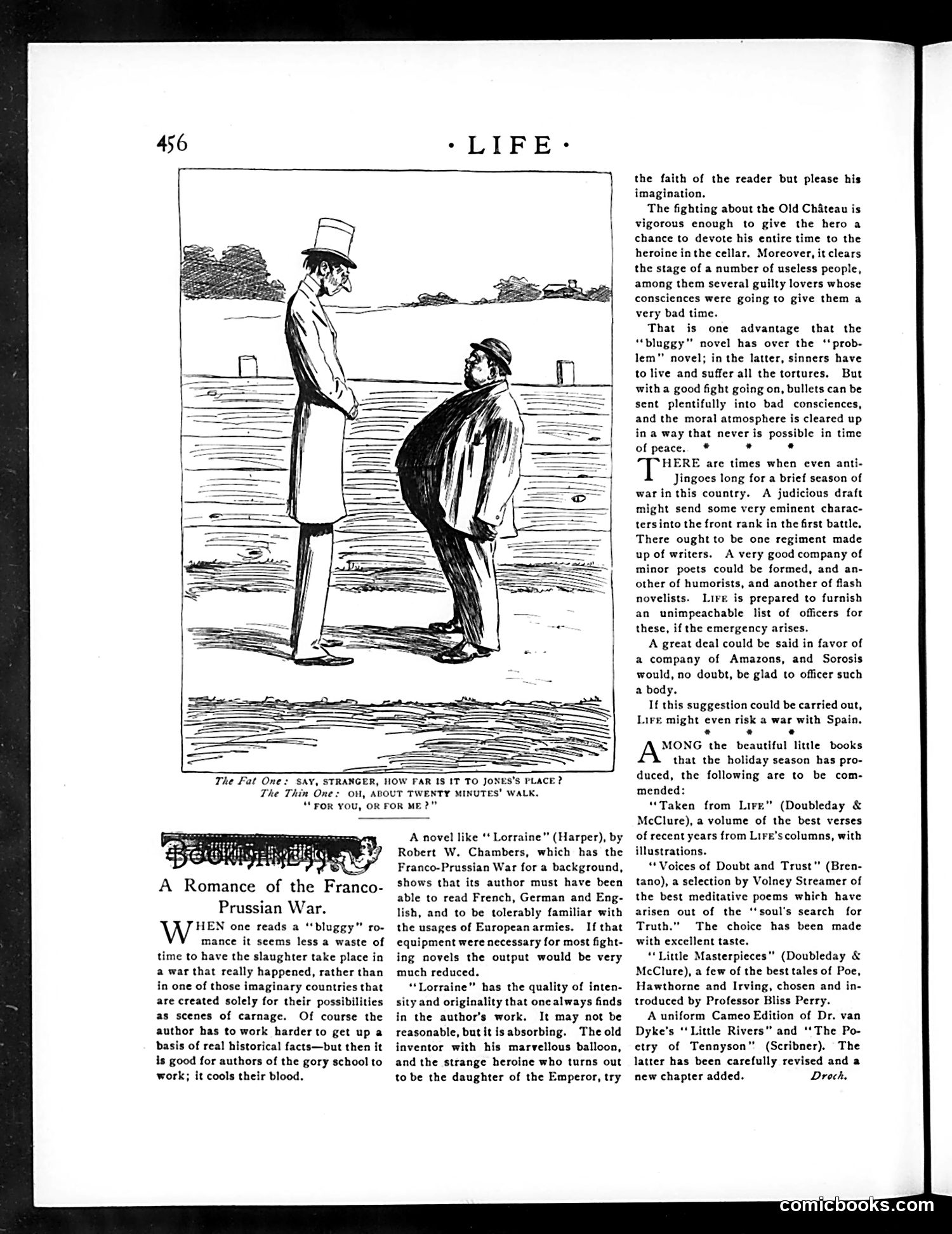
The main illustration depicts two men on a beach in what appears to be a WWI military context. The caption identifies them as "The Fat One" and "The Thin One," with dialogue suggesting a casual encounter ("Say, stranger, how far is it to Joshua Reach?" / "Oh, about twenty minutes' walk. For you, or for us?"). The accompanying article reviews "Lorraine," a novel about the Franco-Prussian War by Robert W. Chambers. The text discusses how "buggy" (melodramatic) war novels can still serve a purpose by allowing readers emotional engagement with conflict without moral consequences—essentially escapist entertainment. The cartoon likely satirizes the absurdity of casual wartime interactions or contrasts soldier types, though the exact satirical point remains unclear from the image alone.
📄 Transcribed text from this page (OCR, searchable)
Machine-transcribed from the original scan — historical spelling and the odd misread are preserved.
The Thin One: OH, ABOUT TWENTY MINUTES’ WALK. “FOR YOU, OR FOR ME?" A Romance of the Franco- Prussian War. HEN one reads a “bluggy” ro- mance it seems less a waste of time to have the slaughter take place in a war that really happened, rather than in one of those imaginary countries that are created solely for their possibilities as scenes of carnage. Of course the author has to work harder to get up a basis of real historical facts—but then it is good for authors of the gory school to work; it cools their blood. A novel like ‘ Lorraine” (Harper), by Robert W. Chambers, which has the Franco-Prussian War for a background, shows that its author must have been able to read French, German and Eng- lish, and to be tolerably familiar with the usages of Europeanarmies. If that equipment were necessary for most fight- ing novels the output would be very much reduced. “Lorraine” has the quality of inten- sity and originality that oncalways finds in the author’s work. It may not be reasonable, butit isabsorbing. The old inventor with his marvellous balloon, and the strange heroine who turns out to be the daughter of the Emperor, try the faith of the reader but please his imagination. The fighting about the Old Chateau is vigorous enough to give the hero a chance to devote his entire time to the heroine inthe cellar. Moreover, it clears the stage of a number of useless people, among them several guilty lovers whose consciences were going to give them a very bad time. That is one advantage that the “‘bluggy" novel has over the ‘‘prob- lem" novel; in the latter, sinners have to live and suffer all the tortures. But with a good fight going on, bullets can be sent plentifully into bad consciences, and the moral atmosphere is cleared up in a way that never is possible in time * of peace, * 4 HERE are times when even anti- Jingoes long for a brief season of war inthis country. A judicious draft might send some very eminent charac- tersinto the front rank in the first battle, There ought to be one regiment made up of writers. A very good company of minor poets could be formed, and an- other of humorists, and another of flash novelists. Lire is prepared to furnish an unimpeachable list of officers for these, if the emergency arises. A great deal could be said in favor of a company of Amazons, and Sorosis would, no doubt, be glad to officer such a body. If this suggestion could be carried out, Lire might even risk a war with Spain, . . . MONG the beautiful little books that the holiday season has pro- duced, the following are to be com- mended: “Taken from Lire” (Doubleday & McClure), a volume of the best verses of recent years from Lire’scolumns, with illustrations. “Voices of Doubt and Trust" (Bren- tano), a selection by Volney Streamer of the best meditative poems which have arisen out of the ‘‘soul’s search for Truth.” The choice has been made with excellent taste. ‘Little Masterpieces” (Doubleday & McClure), a few of the best tales of Poe, Hawthorne and Irving, chosen and in- troduced by Professor Bliss Perry. A uniform Cameo Edition of Dr. van Dyke's ‘Little Rivers” and ‘The Po- etry of Tennyson” (Scribner). The latter has been carefully revised and a new chapter added. Droch. Ccomicbooks.com