
Life, 1897-12-02 · page 12 of 26
Life — December 2, 1897 — page 12: what you’re looking at
What you’re looking at
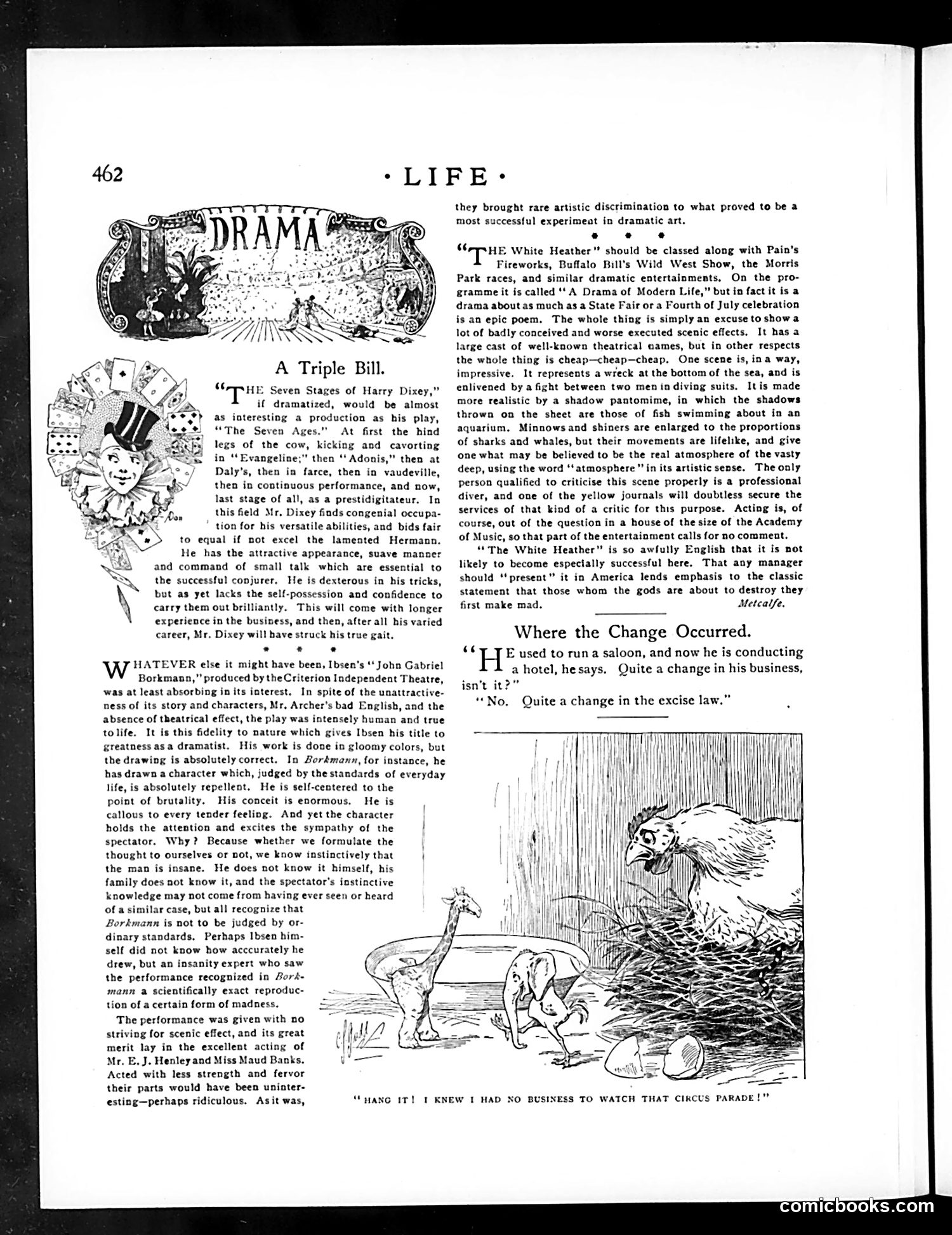
This page contains theater criticism under the "DRAMA" section. The main content reviews several theatrical productions, including "The Seven Stages of Harry Dissey" and "John Gabriel Borkmann." The small cartoon at bottom, captioned "HANG IT! I KNEW I HAD NO BUSINESS TO WATCH THAT CIRCUS PARADE!", shows a man gesturing in frustration while watching what appears to be trained animals performing. The joke satirizes someone who attended a circus parade despite knowing he shouldn't waste time on such entertainment—yet he couldn't resist watching anyway. It's gentle humor about human weakness for spectacle and distraction. The section "Where the Change Occurred" presents a brief comedic exchange about a man switching from running a saloon to conducting a hotel, attributing his improved behavior to stricter excise laws rather than personal reform.
📄 Transcribed text from this page (OCR, searchable)
Machine-transcribed from the original scan — historical spelling and the odd misread are preserved.
LIFE: AI | 7] Se A Triple Bill. “pe Seven Stages of Harry Dixey,” amatized, would be almost as interesting a production as his play, “The Seven Ages." At first the hind legs of the cow, kicking and cavorting in ‘*Evangeline;” then ‘ Adonis,” then at Daly's, then in farce, then in vaudeville, then in continuous performance, and now, last stage of all, as a prestidigitateur. In this field Mr, Dixey finds congenial occupa- tion for his versatile abilities, and bids fair XK > to equal if not excel the lamented Hermann. He has the attractive appearance, suave manner and command of small talk which are essential to the successful conjurer. He is dexterous in his tricks, but as yet lacks the self-possession and confidence to carry them out brilliantly, This will come with longer experience in the business, and then, after all his varied career, Mr. Dixey will have struck his true gait, * * . HATEVER else it might have been, Ibsen's John Gabriel Borkmann,” produced by theCriterion Independent Theatre, was at least absorbing in its interest. In spite of the unattractive- ness of its story and characters, Mr. Archer's bad English, and the absence of theatrical effect, the play was intensely human and true tolife. It is this fidelity to nature which gives Ibsen his title to greatness asa dramatist. His work is done in gloomy colors, but the drawing is absolutely correct. In Bordmann, for instance, he has drawn a character which, judged by the standards of everyday life, is absolutely repellent. He is self-centered to the point of brutality. His conceit is enormous, He is callous to every tender feeling. And yet the character holds the attention and excites the sympathy of the spectator, Why? Because whether we formulate the thought to ourselves or not, we know instinctively that the man is insane. He does not know it himself, his family does not know it, and the spectator's instinctive knowledge may not come from having ever seen or heard of a similar case, but all recognize that Borkmann is not to be judged by or- dinary standards, Perhaps Ibsen him- self did not know how acccurately he drew, but an insanity expert who saw the performance recognized in Bork- mann a scientifically exact reproduc- tion of a certain form of madness. The performance was given with no striving for scenic effect, and its great merit lay in the excellent acting of Mr. E, J. Henley and Miss Maud Banks. Acted with less strength and fervor their parts would have been uninter- esting—perhaps ridiculous. Asit was, “Haye iT! they brought rare artistic discrimination to what proved to be a most successful experimeat in dramatic art. oe 8 @ HE White Heather"? should be classed along with Pain's Fireworks, Buffalo Bill's Wild West Show, the Morris Park races, and similar dramatic entertainments, On the pro- gramme it is called ‘A Drama of Modern Life,” but in fact it is a drama about as much as a State Fair or a Fourth of July celebration isan epic poem. The whole thing is simply an excuse to show a lot of badly conceived and worse executed scenic effects. It has a large cast of well-known theatrical eames, but in other respects the whole thing is cheap—cheap—cheap. One scene is, ina way, impressive. It represents a wreck at the bottom of the sea, and is enlivened by a fight between two men in diving suits. It is made more realistic by a shadow pantomime, in which the shadows thrown on the sheet are those of fish swimming about in an aquarium, Minnows and shiners are enlarged to the proportions of sharks and whales, but their movements are lifelike, and give one what may be believed to be the real atmosphere of the vasty deep, using the word ‘tatmosphere"’in its artistic sense. The only person qualified to criticise this scene properly is a professional diver, and one of the yellow journals will doubtless secure the services of that kind of a critic for this purpose. Acting is, of course, out of the question in a house of the size of the Academy of Music, so that part of the entertainment calls for no comment. “The White Heather” is so awfully English that it is not likely to become especially successful here. That any manager should “present” it in America lends emphasis to the classic statement that those whom the gods are about to destroy they first make mad. Metcalfe. “, Where the Change Occurred. E used to runa saloon, and now he is conducting a hotel, hesays, Quite a change in his business, isn’t it?” “ce Quite a change in the excise law.” I KNEW I HAD NO BUSINESS TO WATCH THAT CIKCUS PARADE!" comicbooks.com