
A complete issue · 20 pages · 1897
Life — November 25, 1897
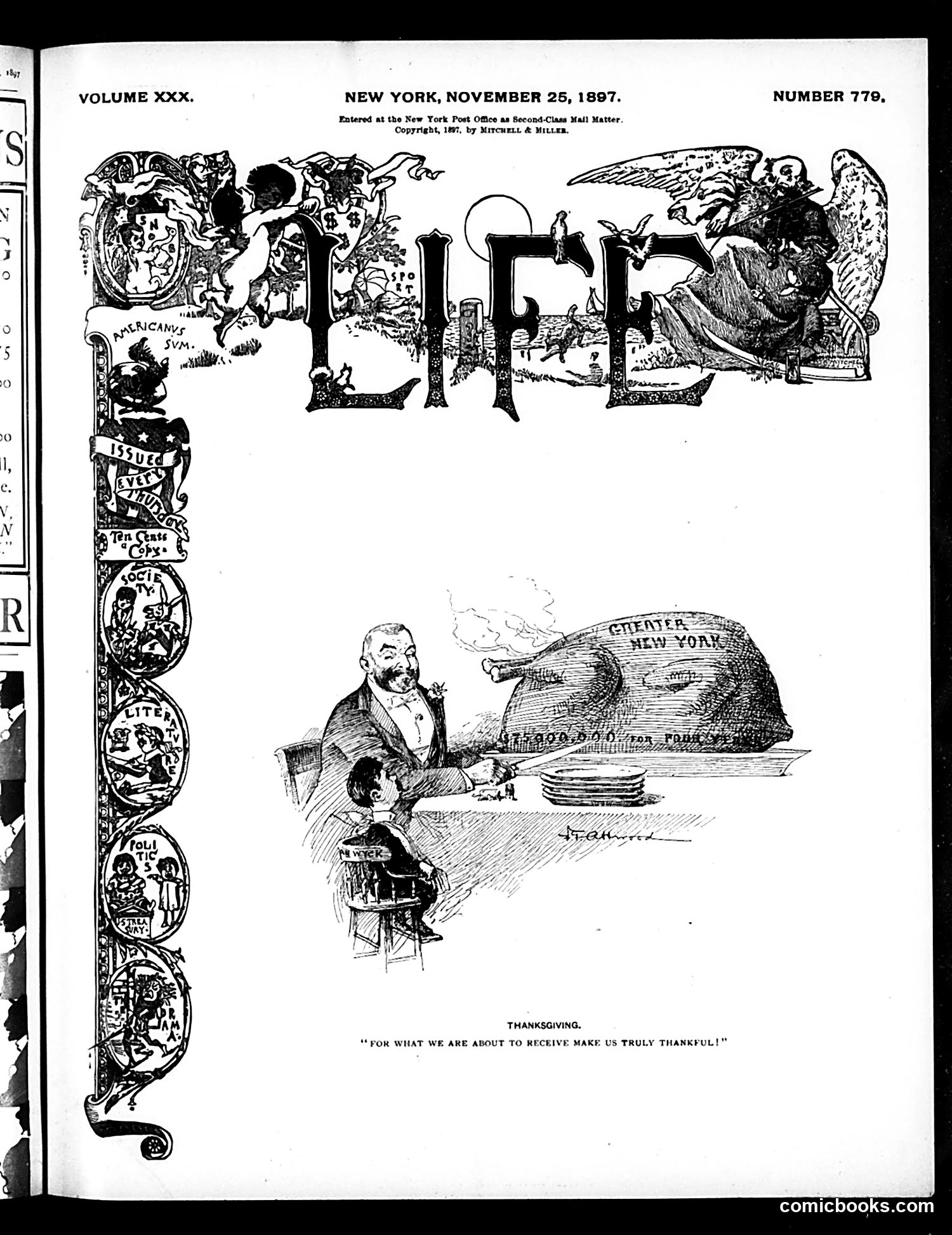
This Thanksgiving-themed page features a political cartoon satirizing American imperialism. The main illustration depicts a man (likely representing Uncle Sam or American political leadership) presenting a large bird labeled "GLEANER, NEW YORK" to a child figure. The bird appears grotesquely oversized, suggesting aggressive expansion or acquisition. The caption reads: "FOR WHAT WE ARE ABOUT TO RECEIVE MAKE US TRULY THANKFUL!" This references America's 1890s imperial ambitions, particularly the Spanish-American War era. The "gleaner" metaphor suggests America opportunistically harvesting territory or resources. The child's uncertain expression implies questioning whether these acquisitions represent genuine progress or problematic overreach. The ornate left border contains decorative medallions typical of Life's design aesthetic.
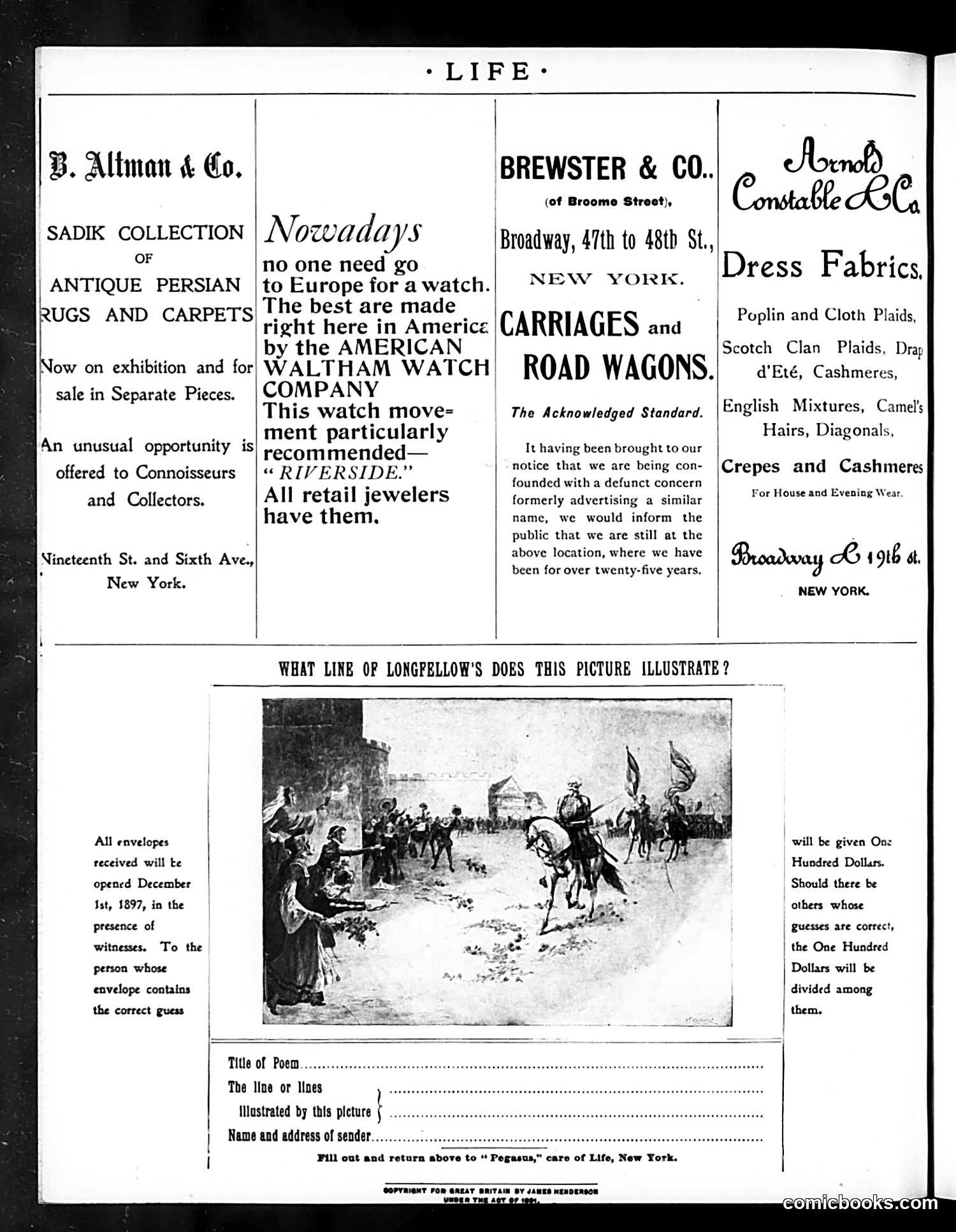
This page is primarily **advertising**, not satire or political commentary. The top section contains four advertisements for luxury goods: antique Persian rugs, American watches, carriages/wagons, and dress fabrics. The lower half features a **poetry contest**. A historical illustration depicts what appears to be a military or frontier scene with mounted soldiers and flags. Readers are challenged to identify which line of Longfellow's poetry the picture illustrates. The contest offers a hundred-dollar prize to the correct guesser (with winnings divided if multiple people answer correctly). This represents typical late-19th century magazine content mixing commercial advertising with reader-engagement contests rather than editorial satire.
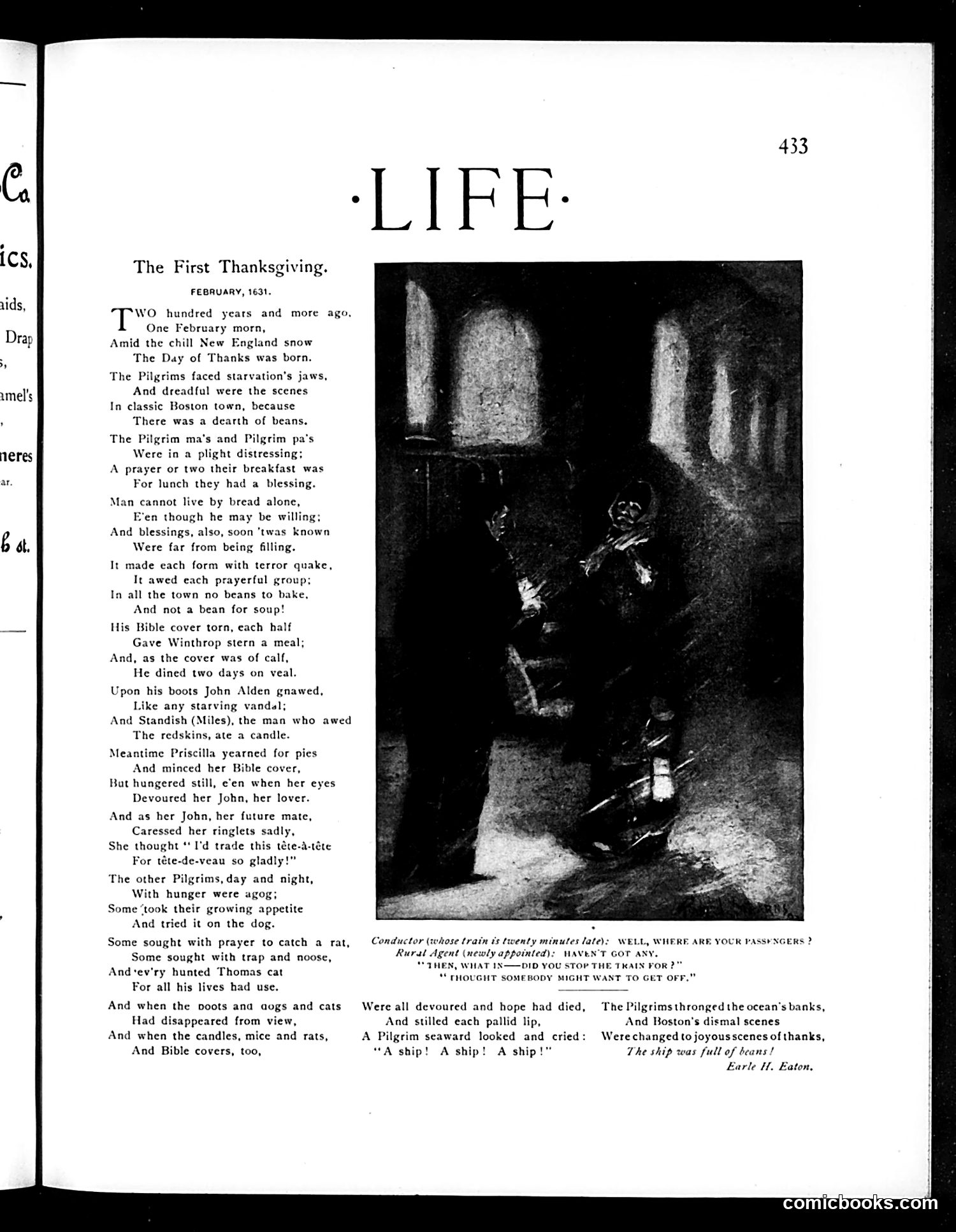
This is a poem satirizing the Pilgrims' desperate hunger during their first winter in New England. Rather than romanticizing the founding narrative, it depicts them starving—eating Bible covers, candles, and their own boots. The accompanying illustration shows Pilgrims in a sparse interior with minimal food. The satire works by contrasting the traditional "First Thanksgiving" holiday narrative (celebrating abundance and gratitude) with historical reality: severe deprivation. Named individuals like John Alden and Priscilla appear, referencing actual colonists, grounding the dark humor in real history. Published in February 1931, during the Great Depression, the satire likely resonated with contemporary readers experiencing their own economic hardship, drawing a parallel between past and present American suffering.
This page contains three distinct satirical pieces: 1. **"While there is Life there's Hope"** (top): A dark cartoon depicting violent conflict, likely referencing the Spanish-American tensions over Cuba mentioned in the text. 2. **Main article**: Discusses whether Republican William McKinley "beat" Democrat William Platt in a New York election. The satire mocks claims that Platt won, suggesting Republicans fabricated this narrative for political advantage. 3. **Trainor's bill**: Commentary on an assemblyman's proposal to divide New York State into two—Manhattan State and another. The text satirizes this as an impractical scheme that resurfaces periodically but goes nowhere. 4. **Harvard-Yale football**: Brief sports commentary critiquing the game's increasing brutality and questioning whether physical development justifies the violence. The overall tone is sharply critical of political deception and impractical schemes.
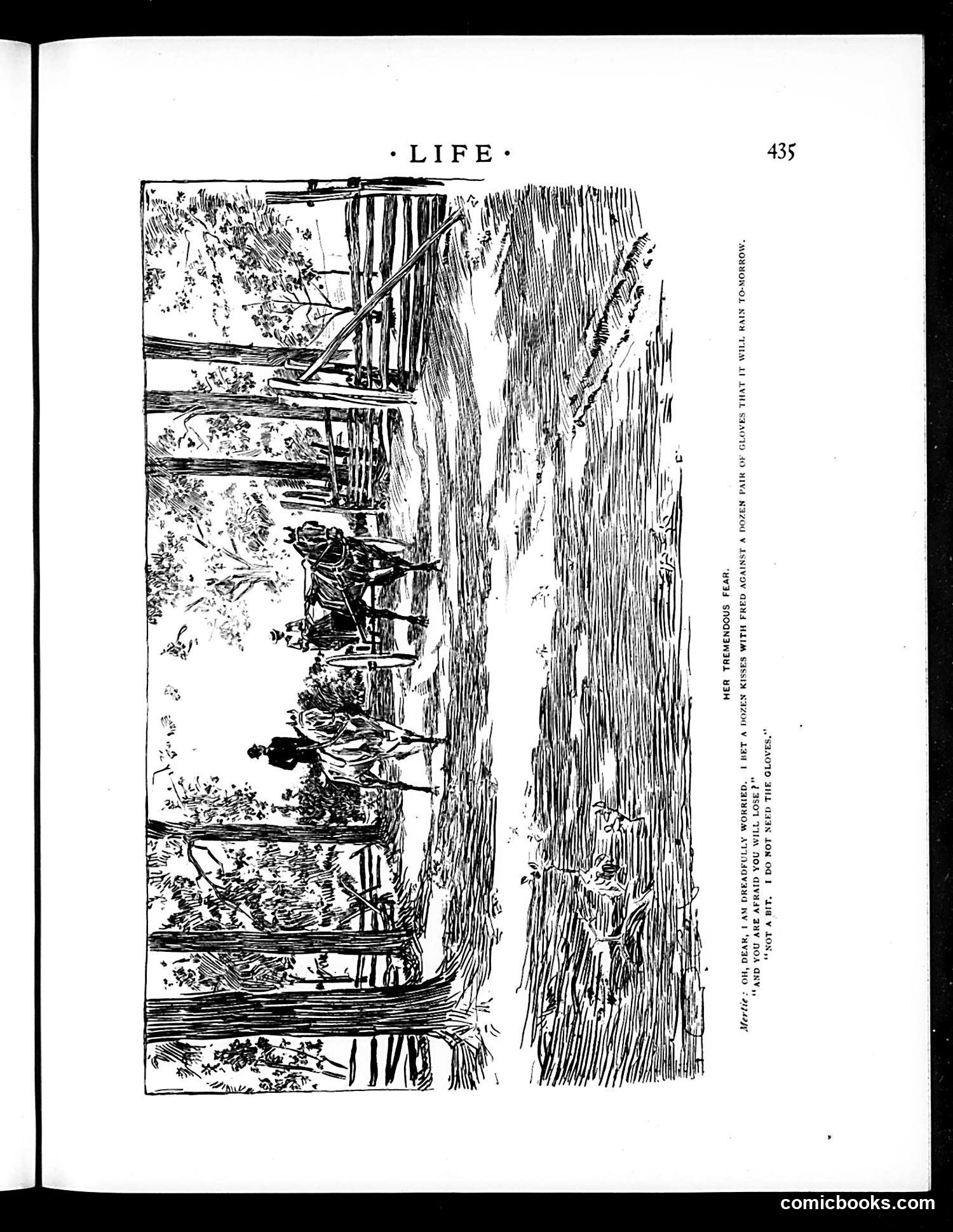
I can see this is page 435 from Life magazine, containing a black and white illustration that appears to be oriented sideways. The image shows what looks like a rural or agricultural scene with multiple human figures arranged vertically along what may be a fence or structure, with detailed cross-hatching for texture and landscape elements. However, I cannot reliably read the caption text in the image due to the orientation and image quality. Without being able to read the accompanying text clearly, I cannot confidently identify which specific political or social figures are caricatured, what event is being referenced, or what the satirical point of the cartoon is meant to be. To provide accurate historical interpretation, I would need either a clearer image or confirmation of the caption text.
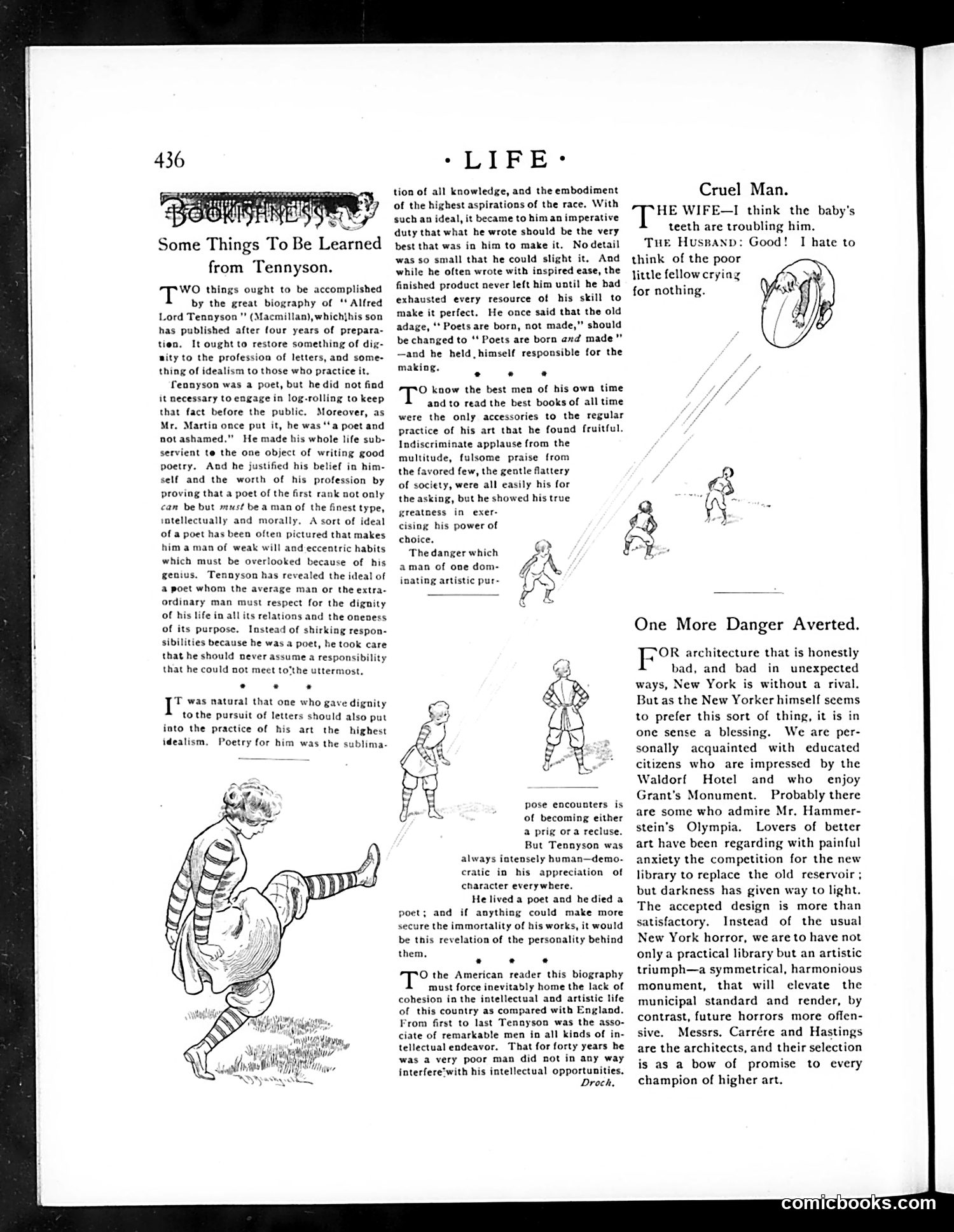
This page contains two distinct sections: **"Some Things To Be Learned from Tennyson"** (left) discusses the poet's artistic standards and work ethic, arguing poets must take responsibility for their craft. The accompanying illustration shows a child tumbling down a slope—likely representing the consequence of careless work or inattention to detail. **"One More Danger Averted"** (right) satirizes New York architecture debates. It praises the accepted design for a new public library (likely the Waldorf Hotel replacement), calling it a blessing. The piece gently mocks New Yorkers' obsession with architectural competitions while suggesting the chosen design represents artistic compromise—a "bow of promise" rather than true excellence. The figures ascending the slope likely represent the city's cultural aspirations.
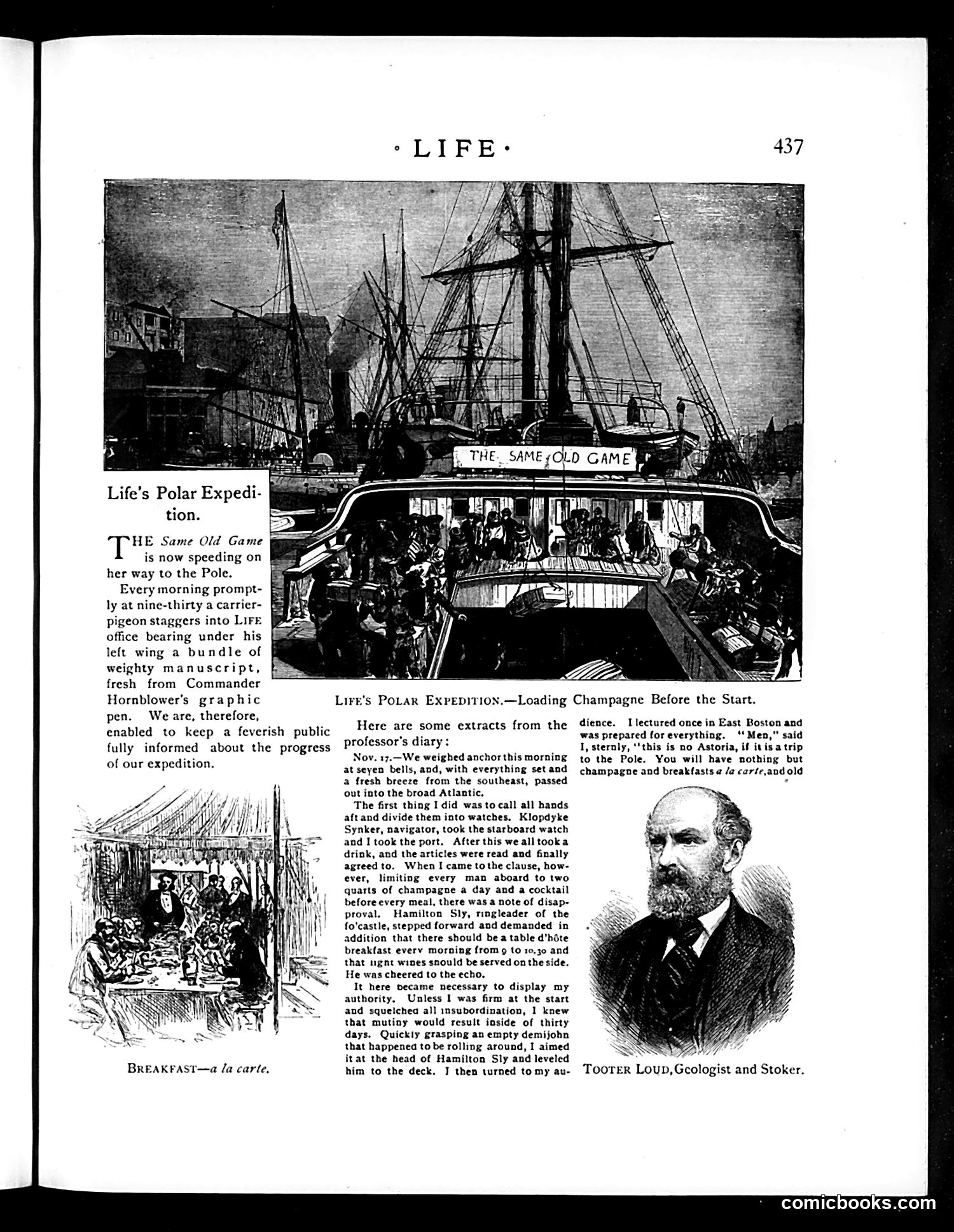
This page documents Life's satirical coverage of a polar expedition aboard "The Same Old Game." The main cartoon shows the ship's interior crowded with passengers, depicting a champagne-laden voyage rather than serious exploration. The satirical point: this is presented as a frivolous wealthy expedition, not genuine scientific research. The text includes diary excerpts from Commander Hornblower describing strict discipline measures—rationing champagne and cocktails, establishing watches—suggesting mutinous crew behavior that required harsh authority. The portrait identifies Tooter Loud as "Geologist and Stoker," likely a satirical character name. The "breakfast à la carte" sketch below shows the expedition's indulgent dining. The satire mocks polar expeditions as fashionable social events masquerading as scientific endeavors, filled with wealthy passengers rather than serious explorers.
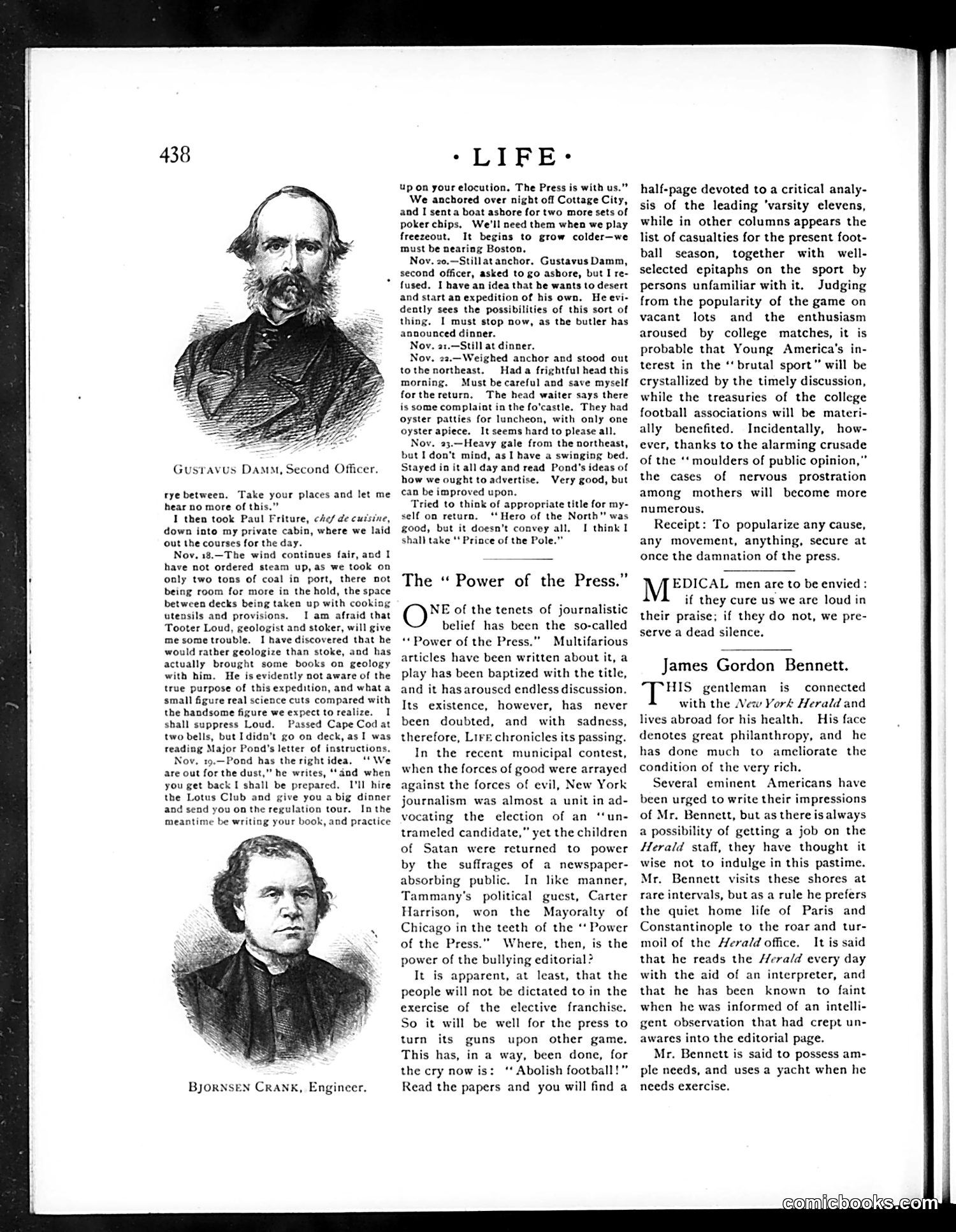
This page features two portrait engravings with biographical sketches. The upper portrait is labeled "Gustavus Damm, Second Officer" and includes a narrative about shipboard life anchored off Cottage City, discussing provisions and crew duties. The lower portrait is "Bjornsen Crank, Engineer." The main article, "The 'Power of the Press,'" discusses journalism's influence on elections and public opinion. It references a recent municipal contest in New York where journalism nearly functioned "as a unit" advocating for an "untrammeled candidate," suggesting the press's substantial but potentially problematic power over democratic processes. A separate section profiles "James Gordon Bennett," connected to the *New York Herald*, characterizing him as a philanthropist who prefers quiet home life in Paris and Constantinople to the Herald's bustling office.
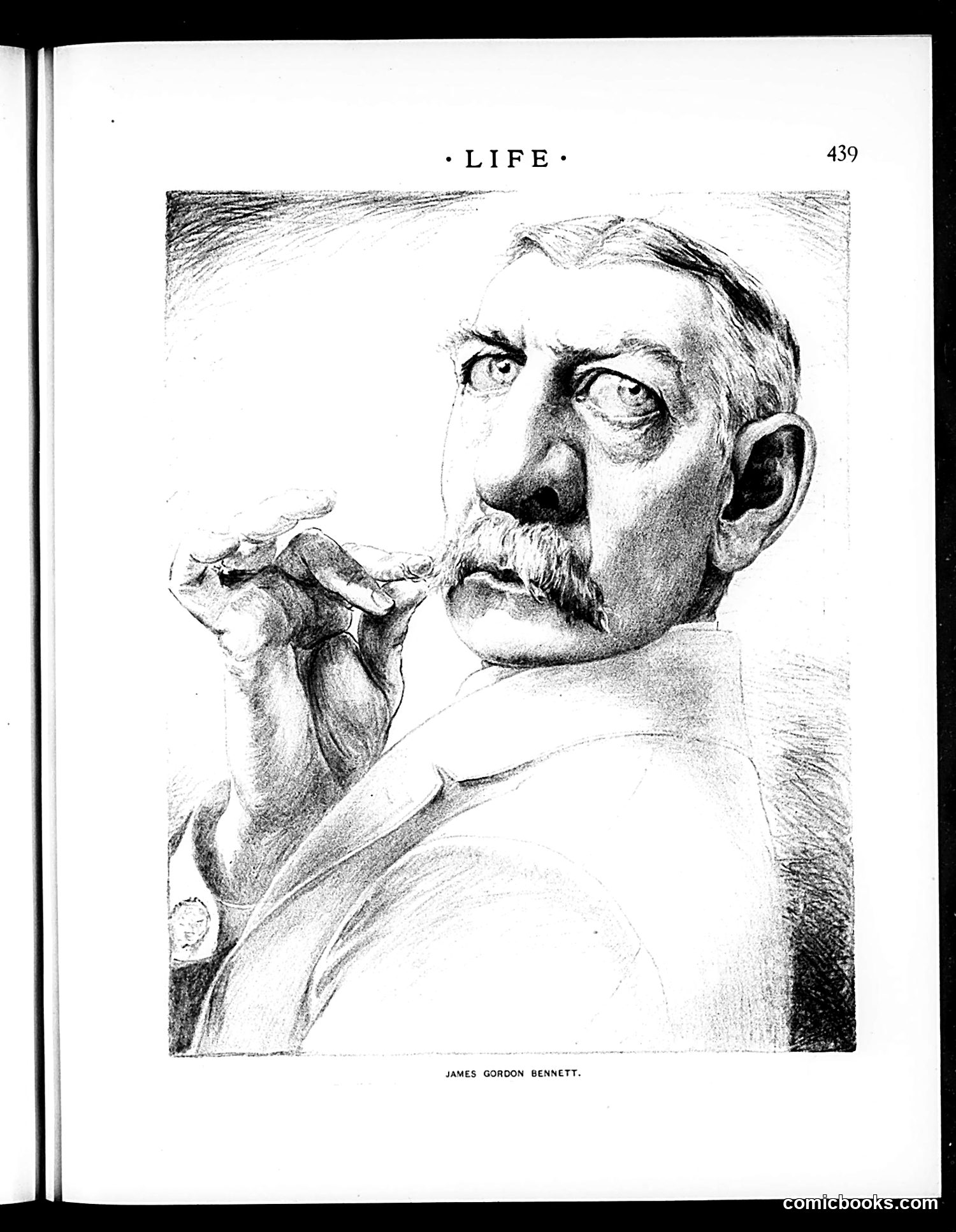
This is a portrait page from Life magazine (page 439) featuring **James Gordon Bennett**, identified by the caption below the sketch. The detailed pencil drawing shows a distinguished older man with a prominent mustache and goatee, depicted in three-quarter profile. He's shown smoking a cigar and wearing what appears to be formal attire with a pocket watch visible. Bennett was a prominent 19th-century newspaper publisher and editor, known for founding the *New York Herald*. Life magazine, being a satirical publication, likely featured this portrait to comment on Bennett's public prominence or editorial influence. Without additional text on the page, the specific satirical point remains unclear, but his inclusion suggests he was a notable public figure worthy of Life's editorial attention.
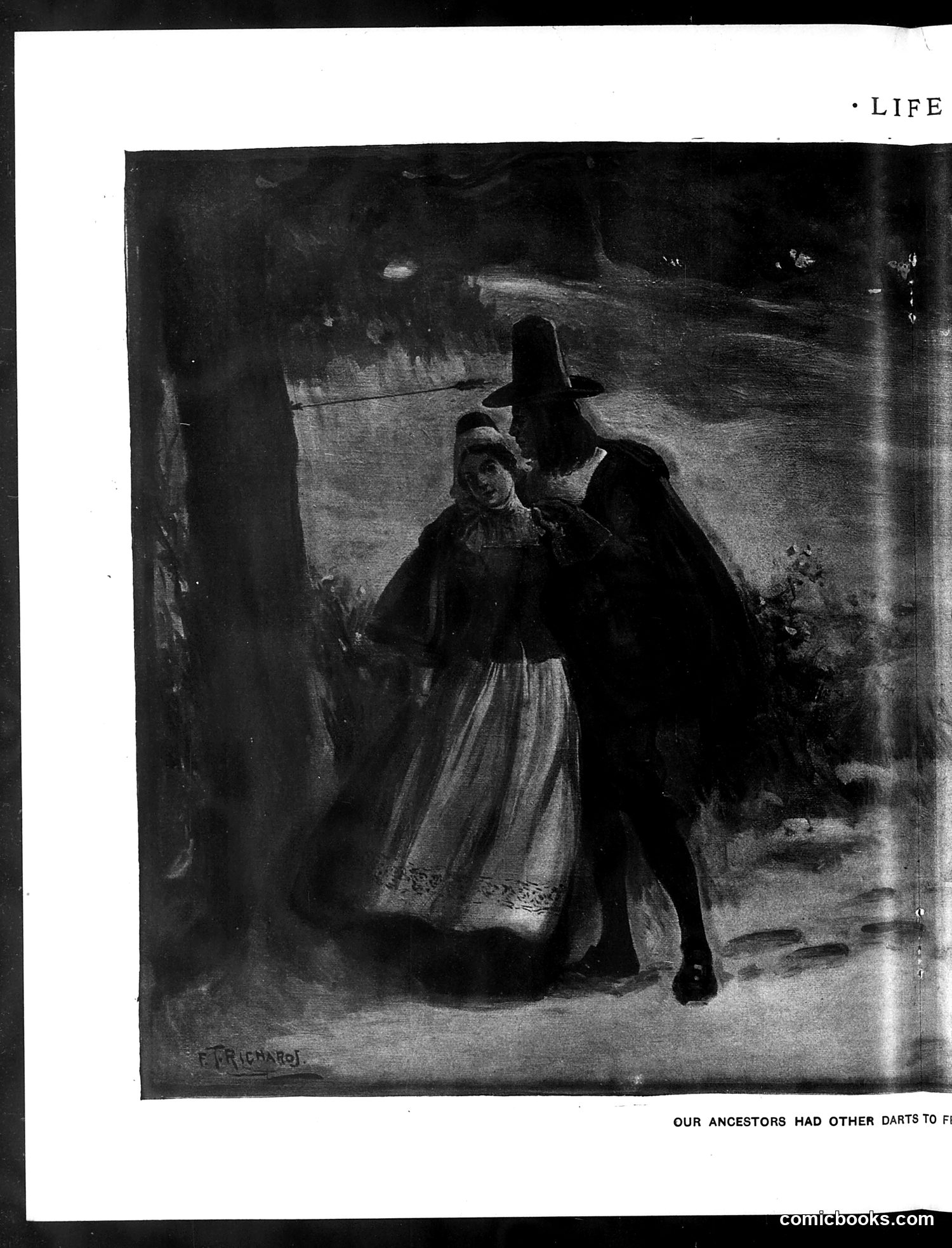
This appears to be a satirical illustration from Life magazine showing two figures in a darkened alley or passageway. The visible caption reads: "OUR ANCESTORS HAD OTHER DARTS TO FI[RE]" (text cut off). The image depicts what seems to be a cloaked or formally dressed figure confronting a woman in period costume, suggesting a historical or romantic scenario. The artist's signature appears to be "Friedlander." Without the complete caption text, the specific satirical point is unclear. However, the juxtaposition of historical dress with the caption about ancestors suggests social commentary—possibly about changing morality, romance, or social conduct across generations. The dark, dramatic staging emphasizes the tension of the scene. The exact political or social target cannot be determined from the visible information alone.
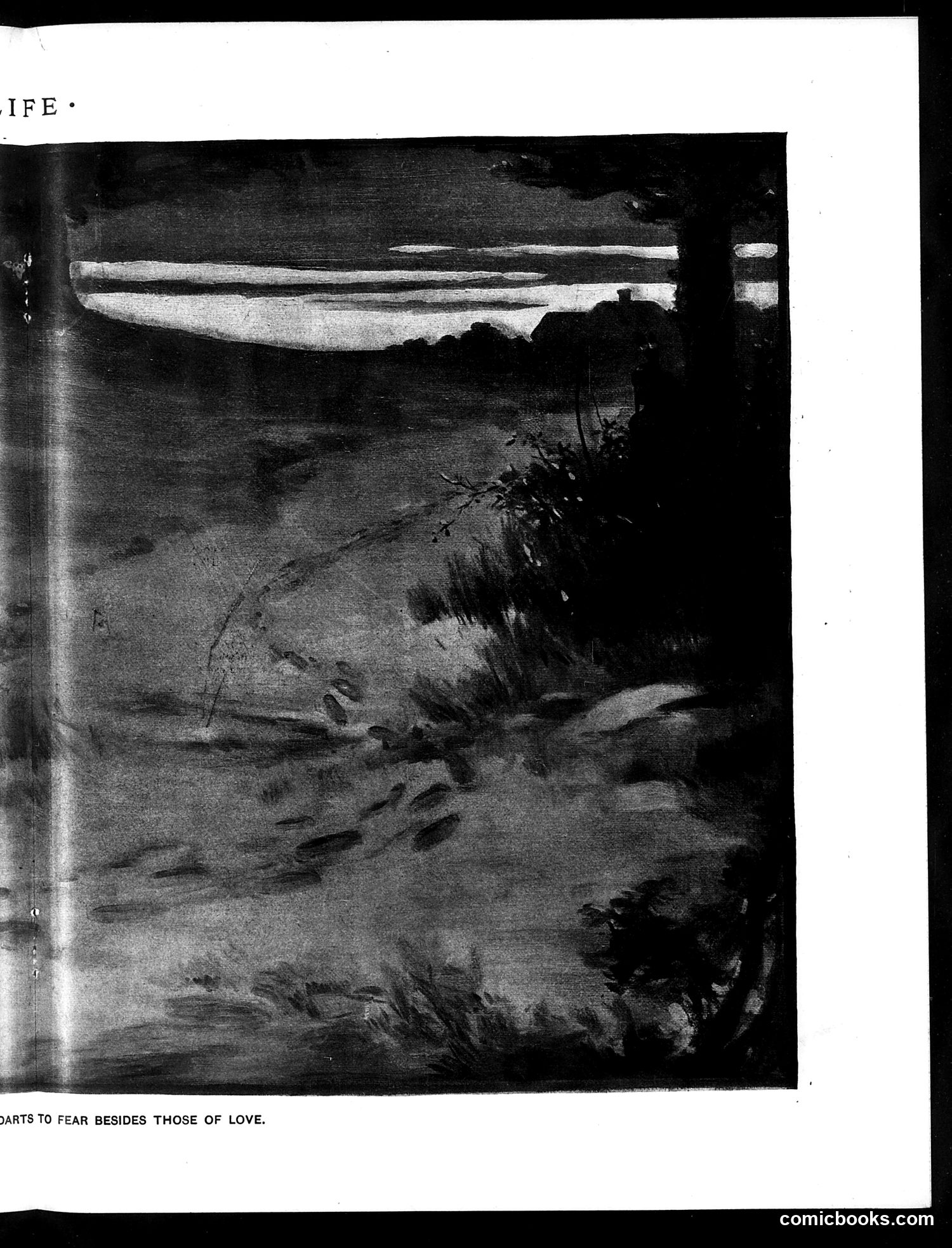
This appears to be a page from Life magazine featuring a landscape illustration or photograph showing a nighttime or twilight scene with a body of water, distant shoreline, vegetation in the foreground, and what seems to be a lit structure or lighthouse on the horizon. The visible text fragment at the bottom reads "DARTS TO FEAR BESIDES THOSE OF LOVE," suggesting this image accompanies commentary about romantic or emotional concerns. However, without additional context or complete text from this page, the specific satirical meaning, political references, or cartoon commentary remains unclear. The image quality and black-and-white reproduction make detailed identification of any figures or caricatures difficult to discern with certainty. More complete text or caption information would be needed to explain the intended satire to a modern reader.
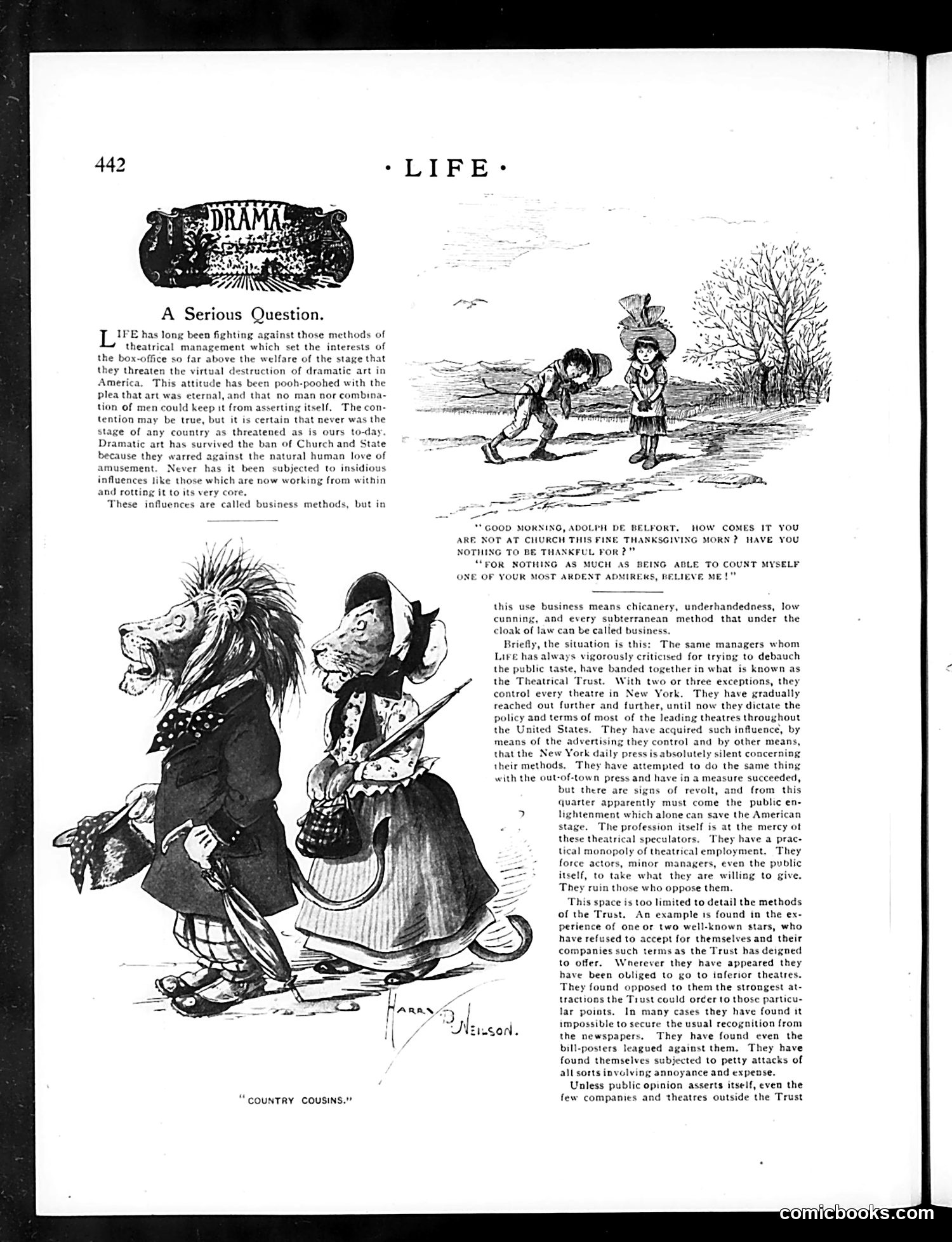
This page critiques the **Theatrical Trust**, a monopolistic cartel controlling American theaters and dramatic productions. The article denounces their "business methods" — described as "chicanery, underhandedness, low cunning" — that stifle theatrical competition and artistic freedom. The cartoon "Country Cousins" (by Harry Neilson) depicts two grotesque figures representing the Trust's control. The dialogue between the rural characters above satirizes their hypocrisy: attending church on Thanksgiving while exploiting others. The piece argues the Trust forces actors and theaters into submission, controls advertising, and crushes opposition through intimidation and legal pressure. The satire targets how this monopoly has strangled independent theater throughout America, leaving few alternatives outside their control.
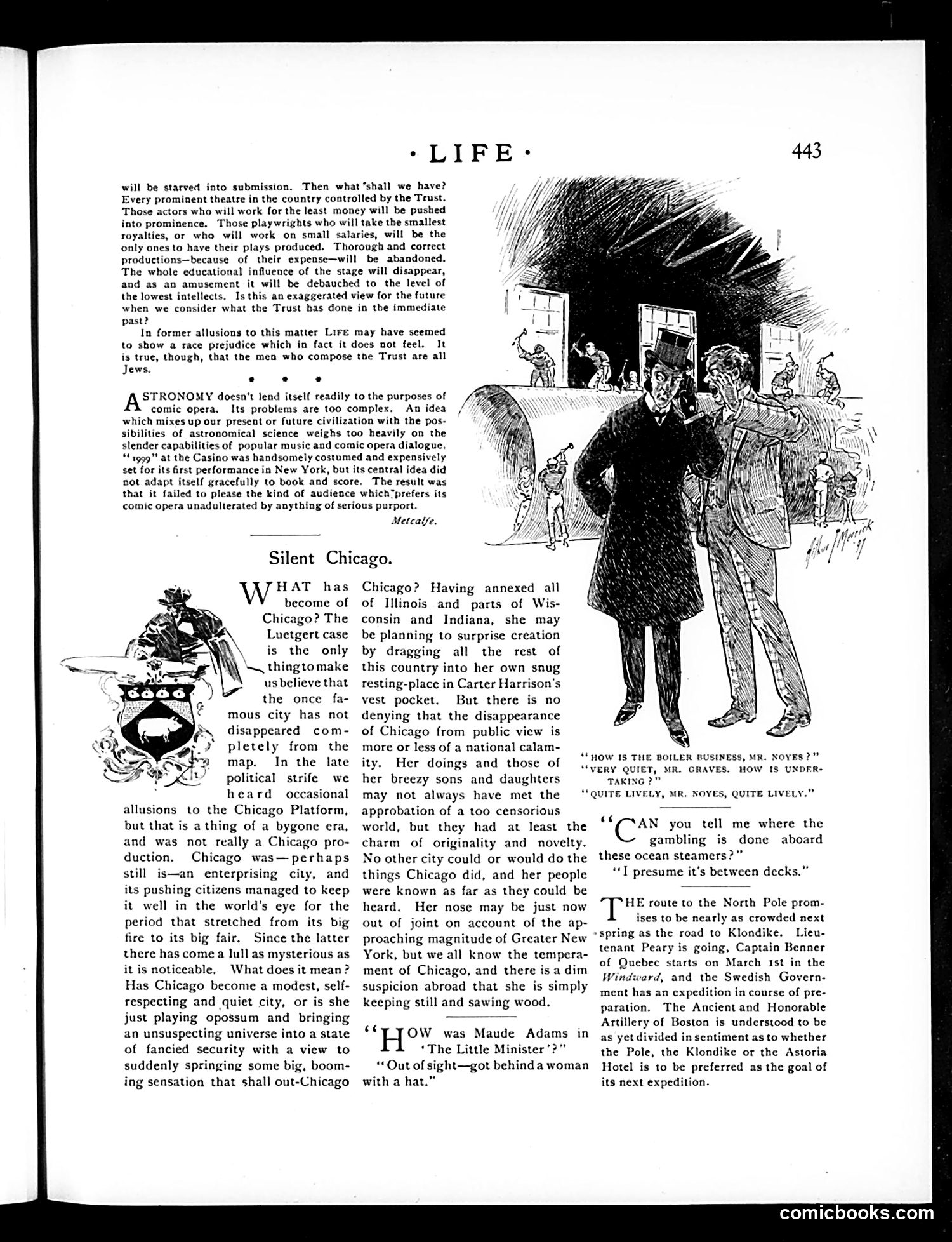
This page contains early 20th-century satirical commentary on American cultural and political issues: **Main Content:** The opening section attacks a theatrical "Trust" (a monopolistic business combination), arguing it will degrade stage quality by promoting cheap productions and underpaid talent. Notably, the text explicitly states the Trust's leaders "are all Jews"—reflecting the antisemitic conspiracy theories common in that era. **"Silent Chicago"** section satirizes Chicago's decline from prominence. Once a booming, attention-grabbing city (referenced: the Luetgert case, the Chicago Platform, the Great Fire and World's Fair), Chicago has faded from public notice, apparently "playing opossum." The humor suggests the city's aggressive character has mysteriously vanished. **Side jokes** mock theatrical reviews and frontier expeditions to the North Pole and Klondike. The cartoon illustrations appear to show social scenes, though specific figures remain unclear from the image quality. The overall tone is cynical about business practices, urban decline, and cultural trends of the period.
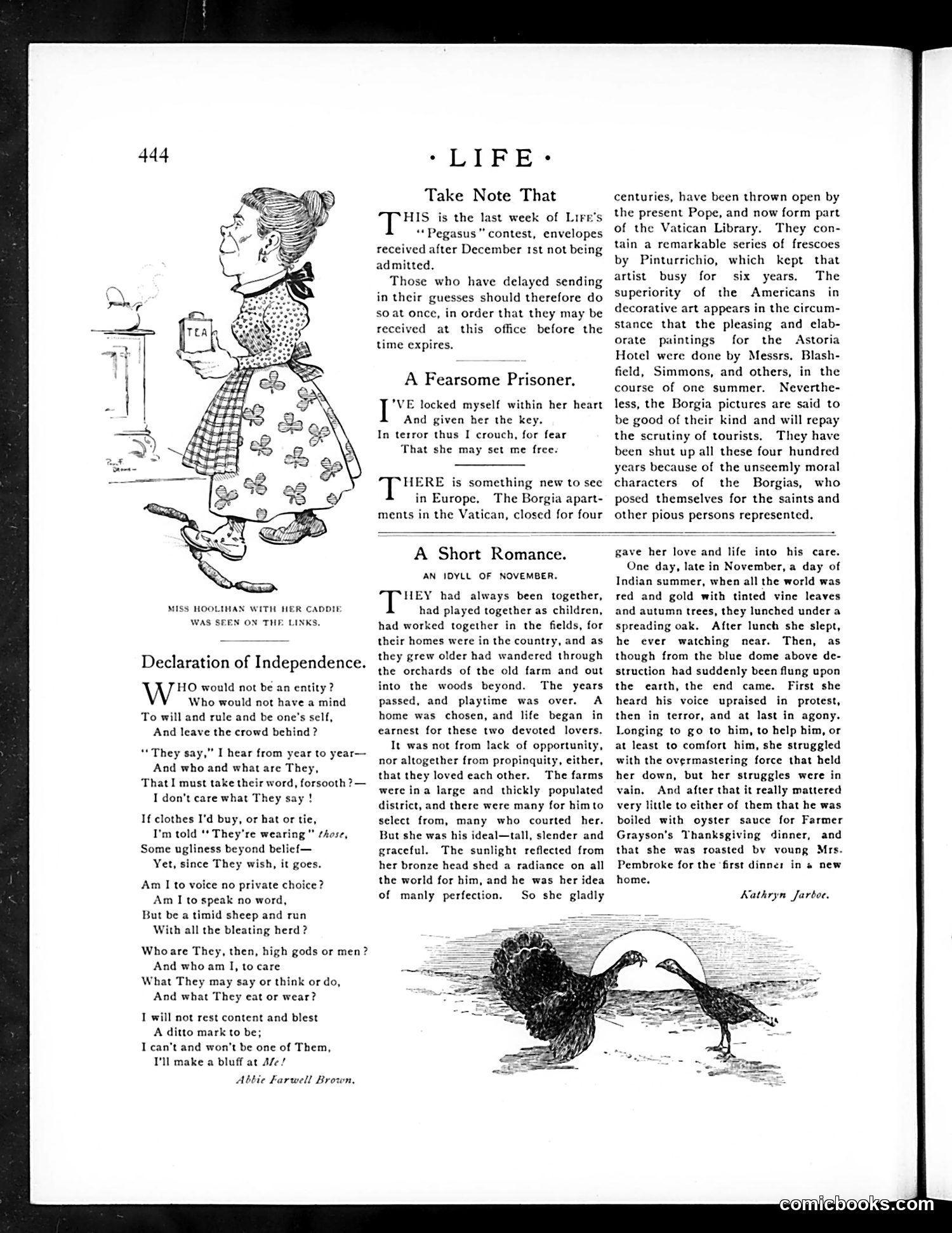
This page contains three separate satirical pieces: **"Declaration of Independence"** (poem by Abbie Farwell Brown): A critique of conformity and blind adherence to social fashion. "They"—undefined society—dictates what people wear, think, and do. The speaker rebels against this herd mentality, asserting individual choice over peer pressure. **"A Fearsome Prisoner"** (brief poem): A romantic paradox about surrendering oneself to love—locking one's heart away in another's possession. **"A Short Romance"** (story by Kathryn Farber): A rural love story of childhood sweethearts who marry. The narrative cuts off mid-sentence, but appears to end tragically when the couple's peaceful moment is interrupted by the man's sudden distress. The page also includes administrative notes about Life's "Pegasus" contest deadline and commentary on newly-opened Borgia apartments in the Vatican, sardonically comparing Renaissance frescoes unfavorably to American decorative art from a contemporary hotel. The cartoon shows "Miss Hoolihan with her caddie"—a woman golfing, suggesting the then-novel phenomenon of female participation in leisure sports.
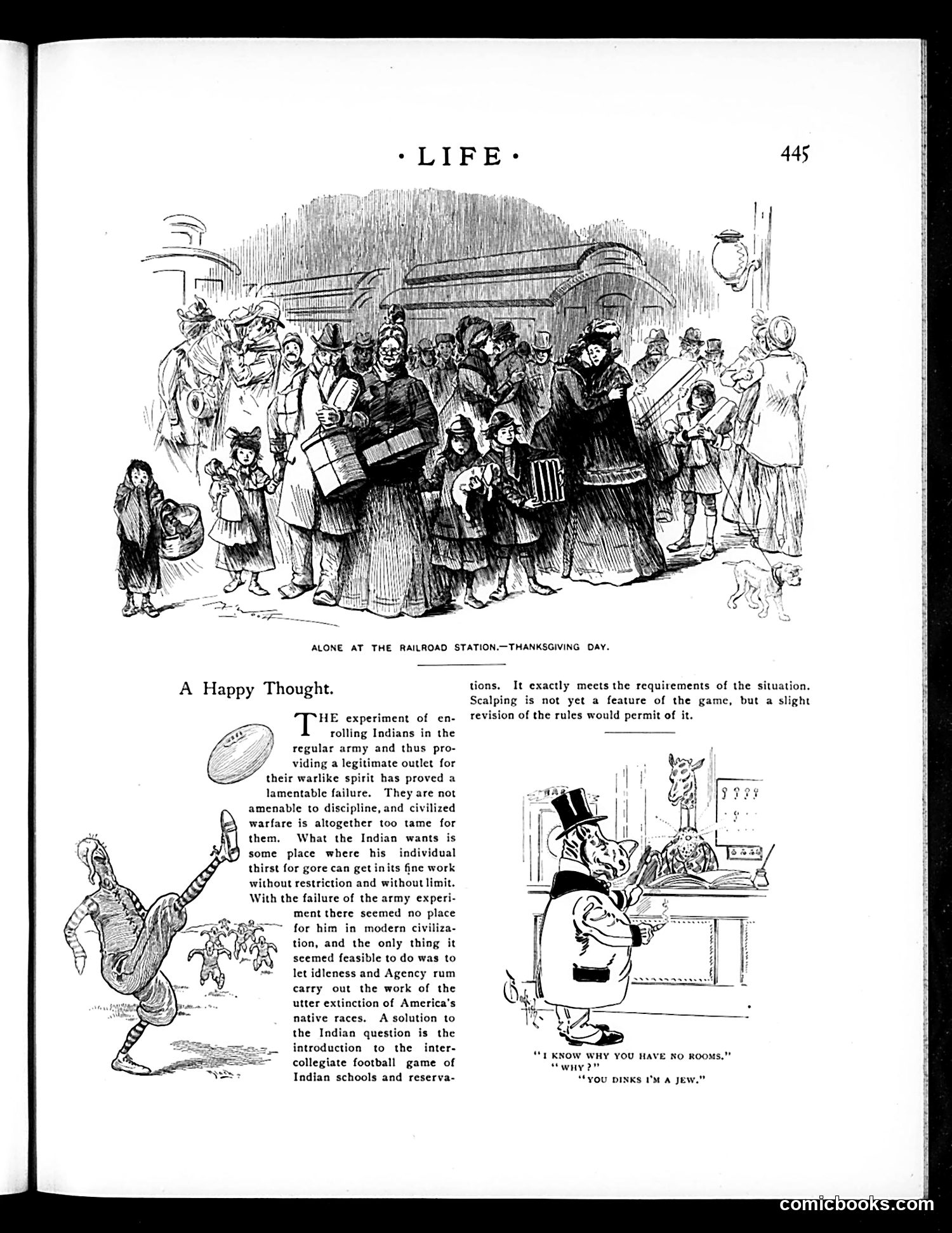
**Top Illustration:** "Alone at the Railroad Station—Thanksgiving Day" depicts a crowded scene of travelers (appearing to be wealthy, well-dressed Americans) at a train station, contrasting with a solitary figure of a Native American woman with a child on the left, visually isolated from the group. **Main Article & Cartoon:** The text proposes introducing American football to Indian schools and reservations as a solution to perceived "Indian problems." The accompanying cartoon shows a Native American man in exaggerated caricature performing an aggressive football move, with the caption suggesting football would satisfy Native Americans' supposed natural warlike instincts rather than "idleness and Agency rum." **Bottom Cartoon:** Shows a landlord refusing rooms to someone, with dialogue suggesting antisemitic discrimination ("You dinks I'm a Jew"). **Context:** The page reflects early 20th-century attitudes viewing Native Americans as uncivilizable obstacles to progress, while simultaneously mocking Jewish immigrants facing housing discrimination—combining racist stereotypes in a purportedly "humorous" satirical magazine.
This page from *Life* magazine contains several satirical pieces mocking marriage and relationships: **"Then and Now"** presents a cynical poem about a man who, decades ago, promised his wife he'd achieve fame "with you to cheer me on." The satire reveals he never succeeded—and now blames *her* for handicapping him, suggesting how men deflect responsibility onto wives for their failures. The other brief pieces continue this misogynistic theme: a man tells his wife he'll pay her doctor bills directly, so she "dodges the doctor right along" (implying wives are manipulative); and a fire insurance agent anecdote mocks a "smart Alec" customer trying to defraud the company. These jokes reflect early 20th-century attitudes portraying women as obstacles to male success or financial drains—humor that punches down at women rather than up at power. The page also includes book advertisements and a warning about unauthorized reproduction of *Life*'s cartoons.
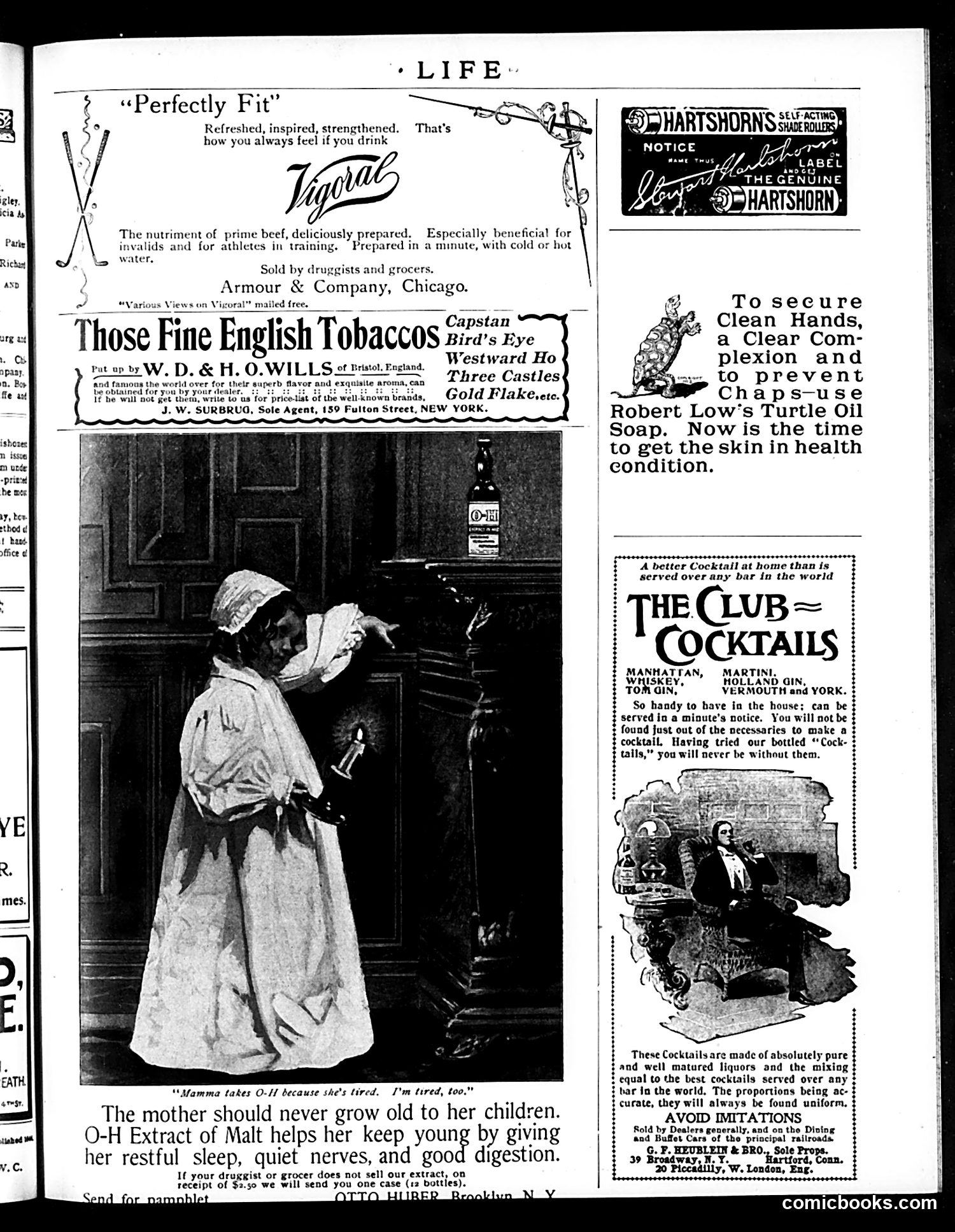
This page is primarily **advertising**, not satire or editorial cartoons. It contains four distinct product ads typical of early 20th-century magazines: 1. **Vigorat** (beef extract) and **English Tobaccos** — positioned as healthful products for athletes and invalids 2. **O-H Extract of Malt** — the central image shows a tired mother, with text claiming the product keeps mothers "young" by providing sleep and digestion aid. This reflects era attitudes about women's exhaustion and the marketing of tonics/extracts as cure-alls 3. **Robert Low's Turtle Oil Soap** — promoting clear skin and preventing chapping 4. **The Club Cocktails** — pre-mixed bottled cocktails advertised as convenient for home use The page reflects **pre-Prohibition American consumer culture** (pre-1920), when patent medicines, tonics, and alcohol were freely advertised as health products. The tired-mother imagery is notable for modern readers as an early example of marketing that exploits domestic fatigue. These ads show how differently products—especially alcohol and unregulated "extracts"—were promoted then.
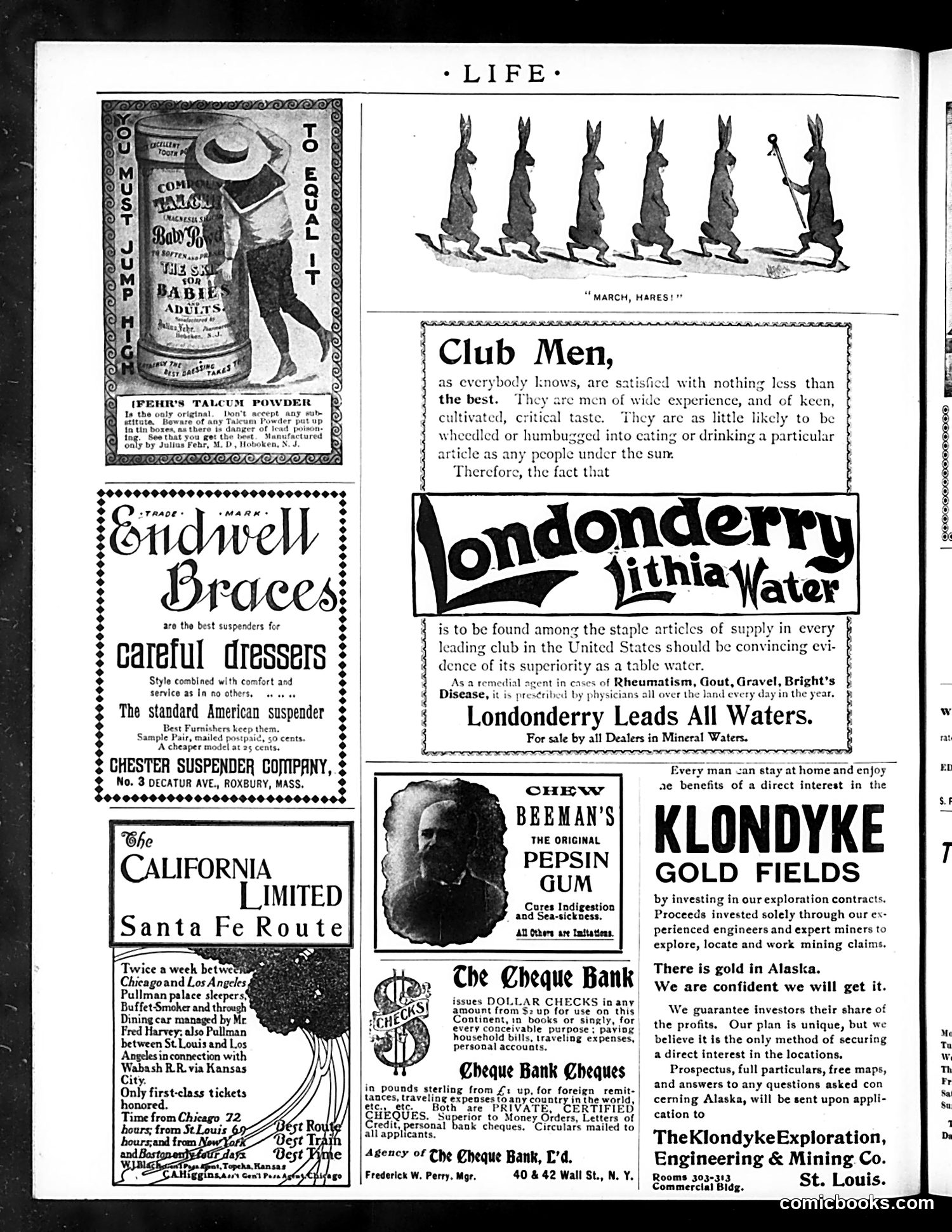
This page is primarily **advertising**, with one small cartoon at the top. The cartoon shows six rabbits marching in a line, titled "March, Hares!" This is a visual pun on the phrase "mad as a March hare"—a traditional expression meaning wildly crazy. The image depicts literal hares marching obediently in formation, which plays with the idiom for humorous effect. The remainder of the page contains period advertisements for various products and services: talcum powder, suspenders, railroad tickets, gum, mineral water, and notably, the "Klondyke Gold Fields" investment scheme. This last ad is notable as a speculative mining investment opportunity in Alaska—reflecting the turn-of-the-century gold rush fever that swept America. The ads collectively target upper-class "club men" mentioned in the editorial text, emphasizing quality products for discerning gentlemen.
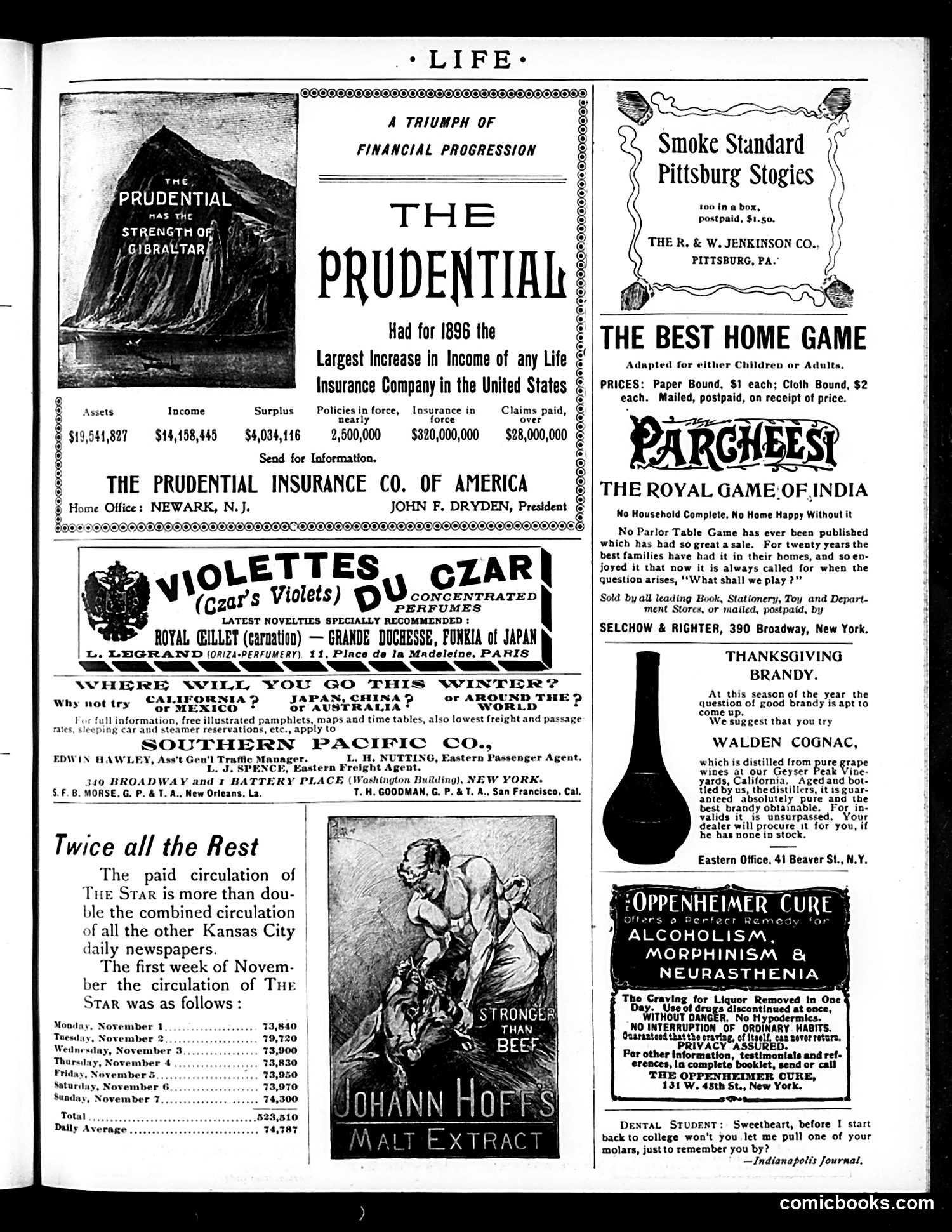
This page is primarily **advertisements** from circa 1896, with minimal editorial cartooning. The main content includes: **Notable Advertisements:** - **Prudential Insurance**: Boasts financial success metrics, using Gibraltar imagery to suggest strength/stability - **Southern Pacific Railroad**: Travel promotion for winter destinations (California, Japan, China, Australia) - **Parlor Games & Brandy**: Consumer goods marketed for genteel households - **Oppenheimer Cure**: Quack medical advertisement claiming to "cure" alcoholism and morphinism in one day—a red flag for fraudulent patent medicine common in this era **The One Cartoon:** A brief joke at page bottom: A dental student asks his sweetheart to let him extract a molar as a keepsake before returning to college. This is mild period humor playing on sentimental romance. **Context**: This reflects Gilded Age America—booming insurance/railroad industries, widespread quack medicine advertising, and genteel consumer culture. The page is representative of *Life*'s revenue model: satirical editorial content subsidized by lucrative advertising.
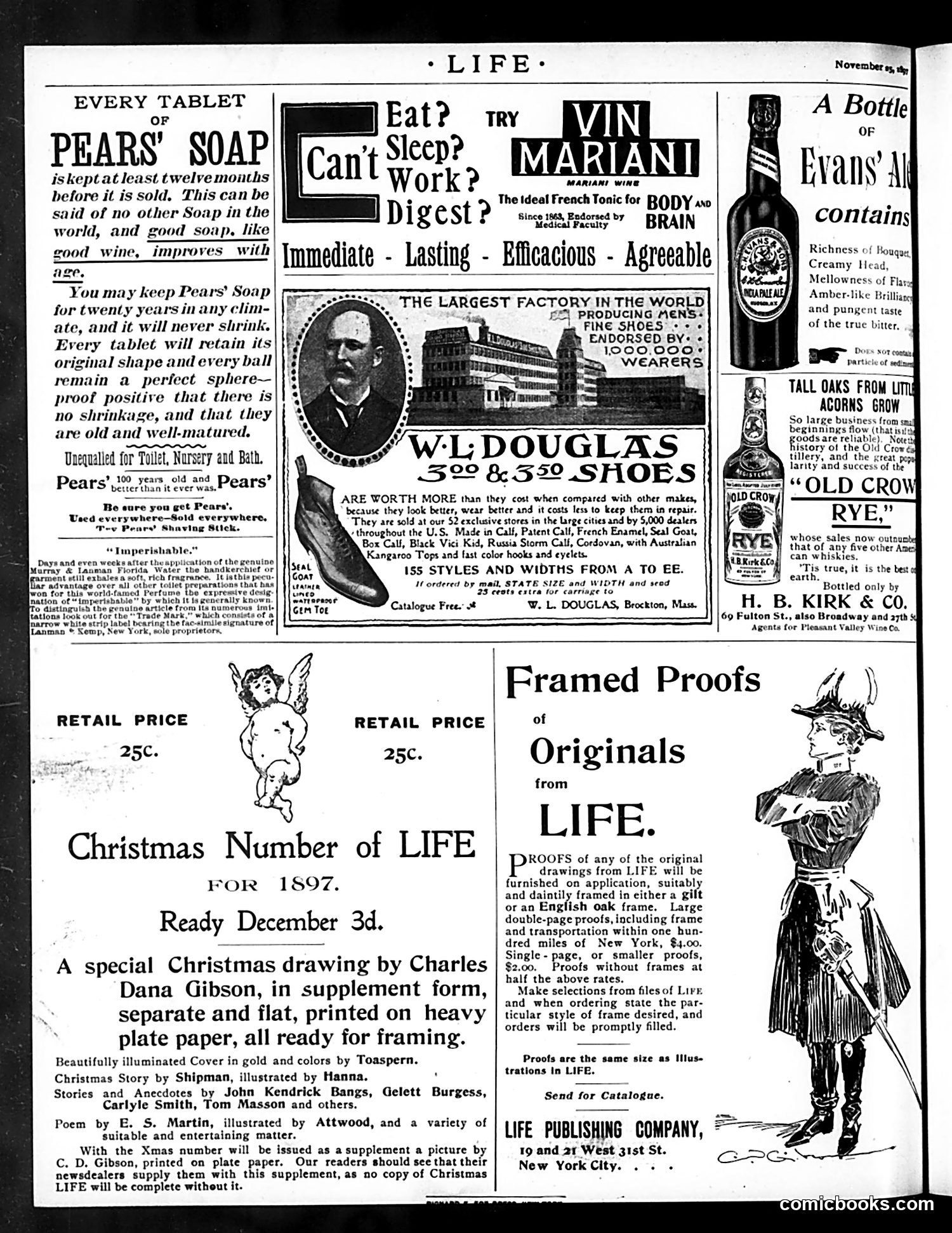
This page is primarily **advertisements** mixed with announcements. The main content includes: **Advertisements:** - **Pears' Soap**: Claims superiority by aging like fine wine; promises durability over 20 years - **Vin Mariani**: A "French Tonic" for body and brain (likely cocaine-wine, common patent medicines of the era) - **W.L. Douglas Shoes**: Emphasizes value and quality across multiple styles - **Old Crow Rye Whiskey**: Uses an oak-grows-from-acorns metaphor for business success - **Evans' Ale**: Describes flavor characteristics **Main Editorial Content:** Announces the upcoming **Christmas Number of Life (December 3rd, 1897)** featuring: - A special Charles Dana Gibson illustration (Gibson was Life's famous illustrator of idealized women) - Stories by prominent humorists (Gelett Burgess, John Kendrick Bangs) **Service Note:** Life Publishing Company offers framed proofs of original drawings from the magazine for purchase. The page reflects 1890s consumer culture and the magazine's revenue model combining editorial content with lucrative advertising.