
Life, 1897-11-25 · page 6 of 20
Life — November 25, 1897 — page 6: what you’re looking at
What you’re looking at
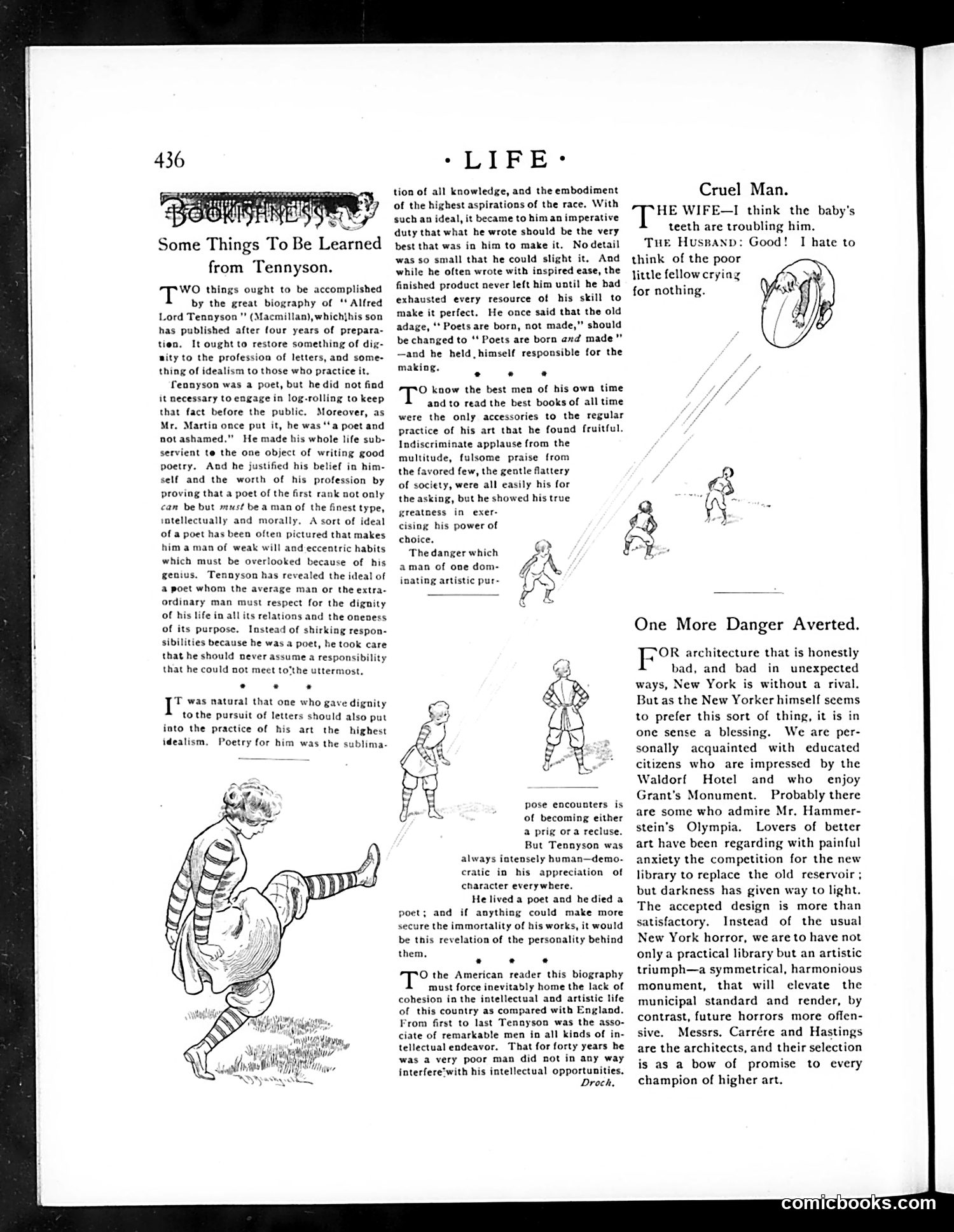
This page contains two distinct sections: **"Some Things To Be Learned from Tennyson"** (left) discusses the poet's artistic standards and work ethic, arguing poets must take responsibility for their craft. The accompanying illustration shows a child tumbling down a slope—likely representing the consequence of careless work or inattention to detail. **"One More Danger Averted"** (right) satirizes New York architecture debates. It praises the accepted design for a new public library (likely the Waldorf Hotel replacement), calling it a blessing. The piece gently mocks New Yorkers' obsession with architectural competitions while suggesting the chosen design represents artistic compromise—a "bow of promise" rather than true excellence. The figures ascending the slope likely represent the city's cultural aspirations.
📄 Transcribed text from this page (OCR, searchable)
Machine-transcribed from the original scan — historical spelling and the odd misread are preserved.
Some Things To Be Learned from Tennyson. WO things ought to be accomplished by the great biography of ‘* Alfred Lord Tennyson " (Macmillan), whichjhis son has published after four years of prepara- tien, It ought to restore something of dig- aity to the profession of letters, and some- thing of idealism to those who practice it. fennyson was a poet, but he did not find it necessary to engage in log-rolling to keep that fact before the public. Moreover, as Mr. Martin once put it, he was ‘a poet and not ashamed.” He made his whole life sub- servient te the one object of writing good poetry. And he justified his belief in him- self and the worth of his profession by proving that a poet of the first rank not only can be but must bea man of the finest type, intellectually and morally. A sort of ideal of a poet has been often pictured that makes him a man of weak will and-eccentric habits which must be overlooked because of his genius, Tennyson has revealed the ideal of a poet whom the average man or the extra- ordinary man must respect for the dignity of his life in all its relations and the oneness of its purpose. Instead of shirking respon- sibilities because he was a poet, he took care that he should never assume a responsibility that he could not meet to‘the uttermost. [728 atural that one who gave dignity to the pursuit of letters should also put into the practice of his art the highest idealism, Poetry for him was the sublima- ‘LIFE: tion of all knowledge, and the embodiment of the highest aspirations of the race. With such an ideal, it became to him an imperative duty that what he wrote should be the very best that was in him to make it. No detail was so small that he could slight it. And while he often wrote with inspired ease, the finished product never left him until he bad exhausted every resource of his skill to make it perfect. He once said that the old adage, ‘* Poets are born, not made,” should be changed to ‘* Poets are born and made” —and he held, himself responsible for the making. . : * ‘© know the best men of his own time and to read the best books of all time were the only accessories to the regular practice of his art that he found fruitful. Indiscriminate applause from the multitude, fulsome praise from the favored few, the gentle flattery of society, were all easily his for the asking, but he showed his true greatness in exer- cising his power of choice, The danger which aman of one dom- inating artistic pur- pose encounters is of becoming either a prig ora recluse. But Tennyson was always intensely human—demo- cratic in his appreciation of character everywhere. He lived a poet and he died a poet; and if anything could make more secure the immortality of his works, it would be this revelation of the personality behind them, . . . © the American reader this biography must force inevitably home the lack of cohesion in the intellectual and artistic life of this country as compared with England. From first to last Tennyson was the asso- ciate of remarkable men in all kinds of in- tellectual endeavor. That for forty years he was a very poor man did not in any way interfere'with his intellectual opportunities. Droch, Cruel Man. HE WIFE—I think the baby's teeth are troubling him. TuE Huspanp: Good! I hate to think of the poor little fellow crying for nothing. One More Danger Averted. OR architecture that is honestly bad, and bad in unexpected ways, New York is without a rival. Butas the New Yorker himself seems to prefer this sort of thing, it is in one sense a blessing. We are per- sonally acquainted with educated citizens who are impressed by the Waldorf Hotel and who enjoy Grant's Monument. Probably there are some who admire Mr, Hammer- stein's Olympia. Lovers of better art have been regarding with painful anxiety the competition for the new library to replace the old reservoir ; but darkness has given way to light. The accepted design is more than satisfactory. Instead of the usual New York horror, we are to have not only a practical library but an artistic triumph—a symmetrical, harmonious monument, that will elevate the municipal standard and render, by contrast, future horrors more offen- sive. Messrs. Carrére and Hastings are the architects, and their selection is as a bow of promise to every champion of higher art. Comicbooks.com