
A complete issue · 20 pages · 1897
Life — November 4, 1897
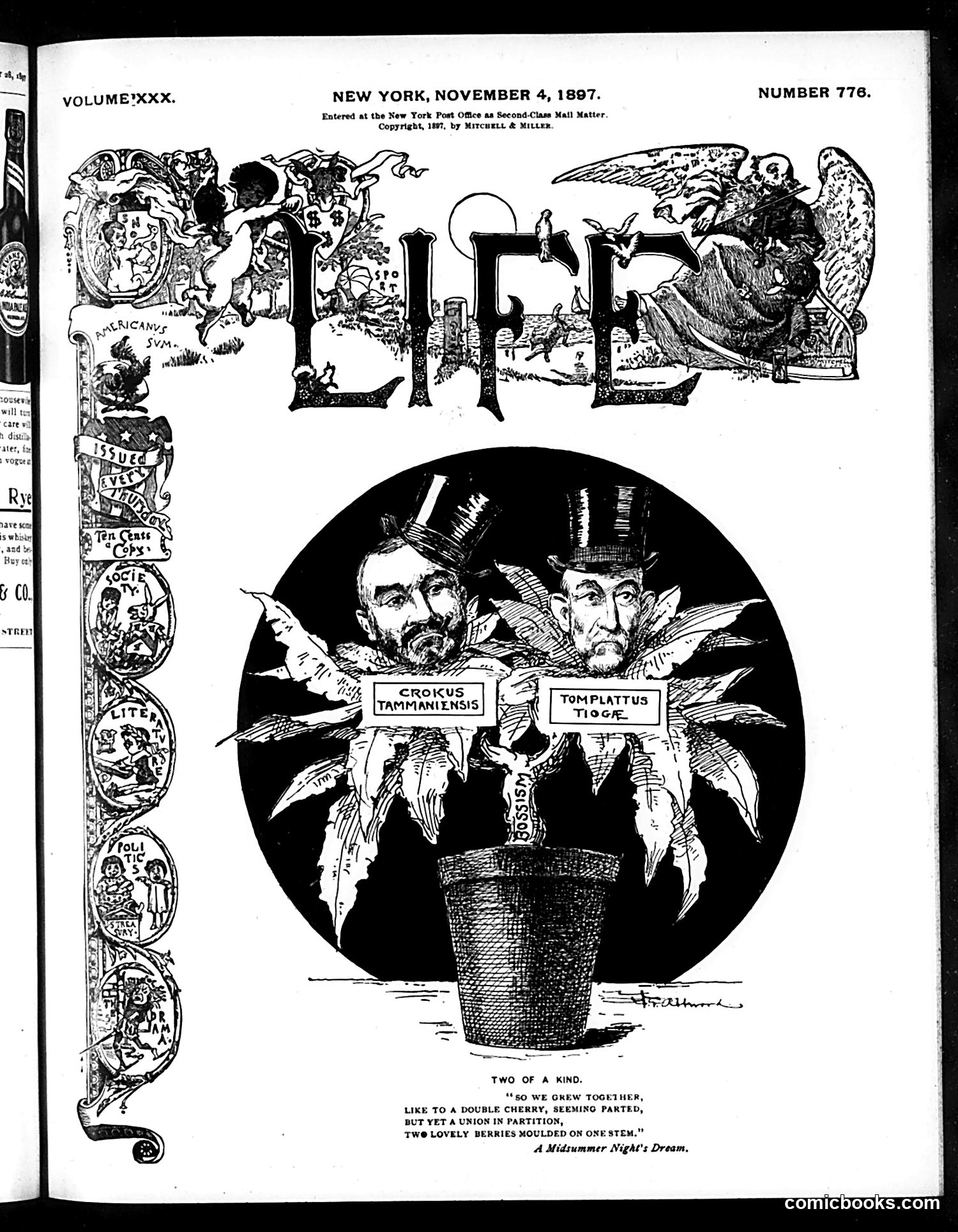
The main cartoon depicts two men's heads emerging from a single plant pot, labeled "Crokus Tammaniensis" and "Tom Plattus Tiogge." The caption reads "Two of a Kind," with a Shakespeare quotation about "two lovely berries moulded on one stem." This appears to be political satire targeting New York politicians, likely referencing Tammany Hall (the Democratic political machine) and someone named Platt. The botanical metaphor suggests these figures are naturally paired or grow from the same corrupt root system. The Latin-style naming mocks them as specimens of the same species. Without additional context about 1897 New York politics, I cannot definitively identify the specific individuals being caricatured, though Tammany Hall references suggest Democratic machine politics satire.
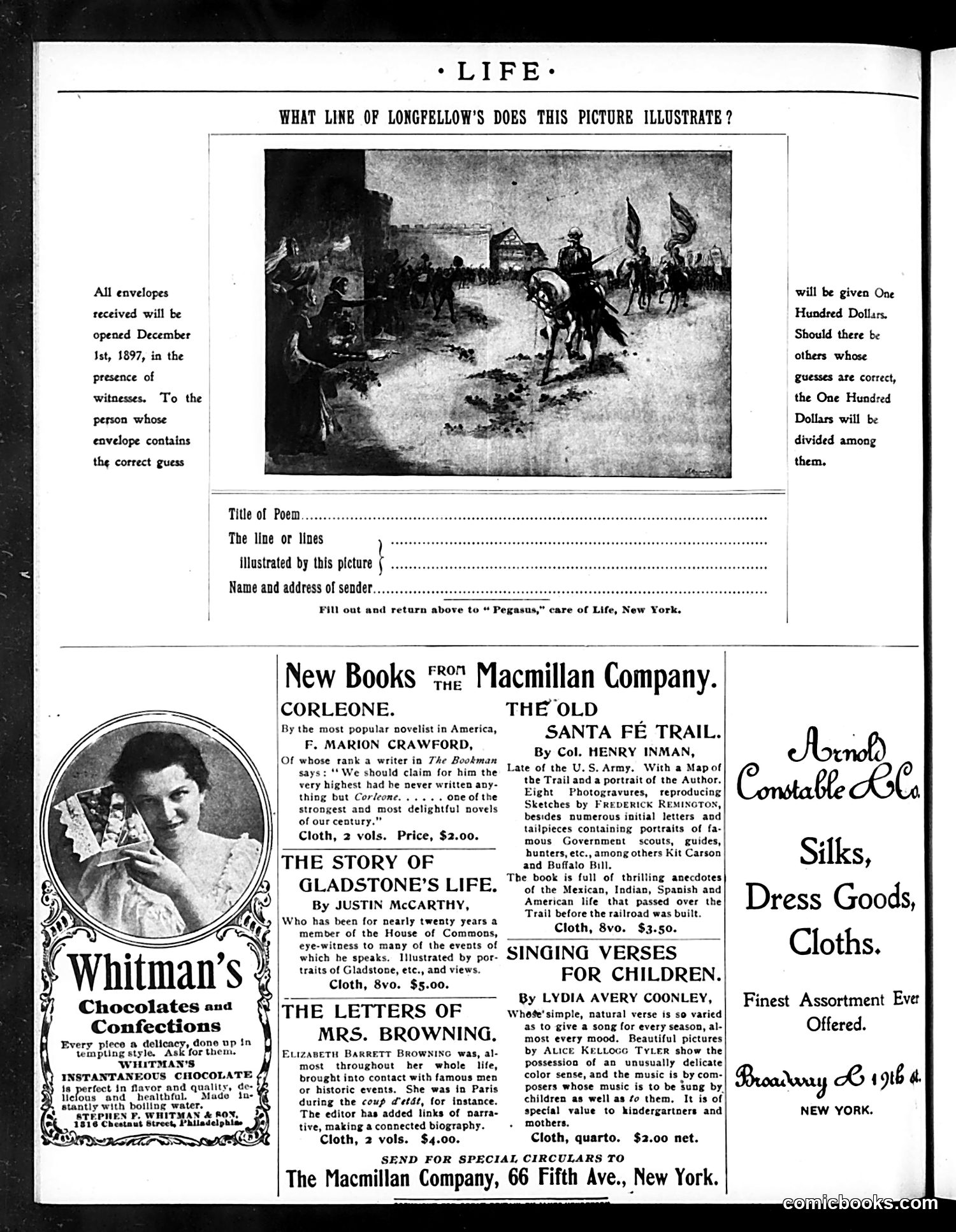
This page is **primarily advertising**, not satire or editorial content. The top section features a contest: readers must identify which Henry Wadsworth Longfellow poem is illustrated by a historical scene depicting what appears to be a military or frontier encounter with horses, soldiers, and flags. The winner receives $100. Below are book advertisements from Macmillan Company (including works on Gladstone and Mrs. Browning's letters), Whitman's Chocolates, and Arnold Constable & Co. silks and dress goods. The Longfellow contest represents the magazine's engagement with classic American literature, but there is **no political cartoon or satire present on this page**—it's a straightforward advertisements and reader-participation contest layout.
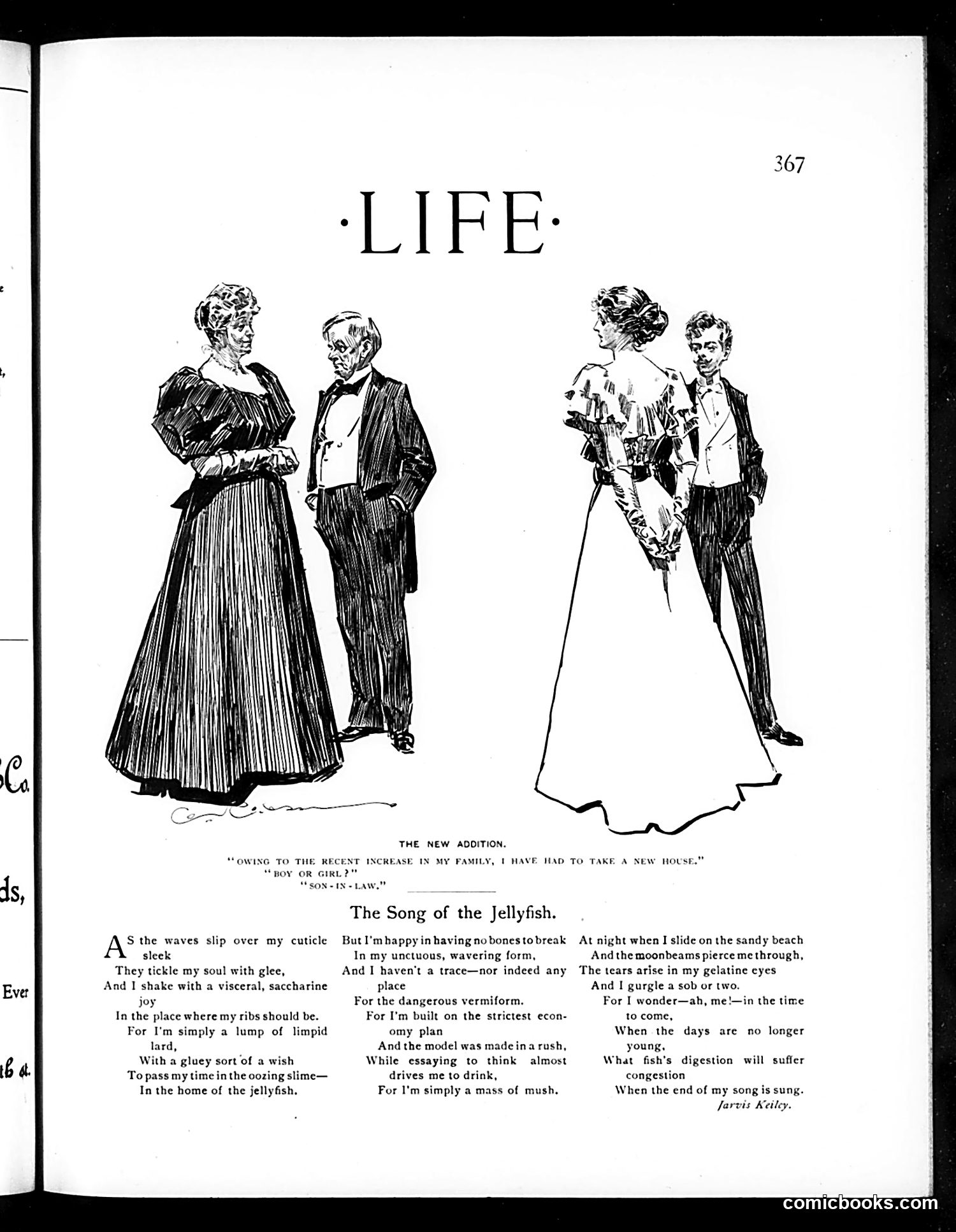
This page contains two distinct elements: **The Cartoon ("The New Addition"):** Four figures in formal Edwardian dress illustrate a caption about needing "a new house" due to "recent increase in my family." The joke plays on the double meaning—it suggests either a new child or a new in-law ("son-in-law"), implying that marriage expansions create housing pressures. This reflects early 20th-century social anxieties about growing families and domestic space. **"The Song of the Jellyfish":** Below is a humorous poem by Farett Kelby personifying a jellyfish's existence—its boneless form, simple structure, and mindless existence. The satirical point appears to mock simple, unthinking life or possibly critique human complacency by comparing people to jellyfish. The tone is whimsical rather than biting.
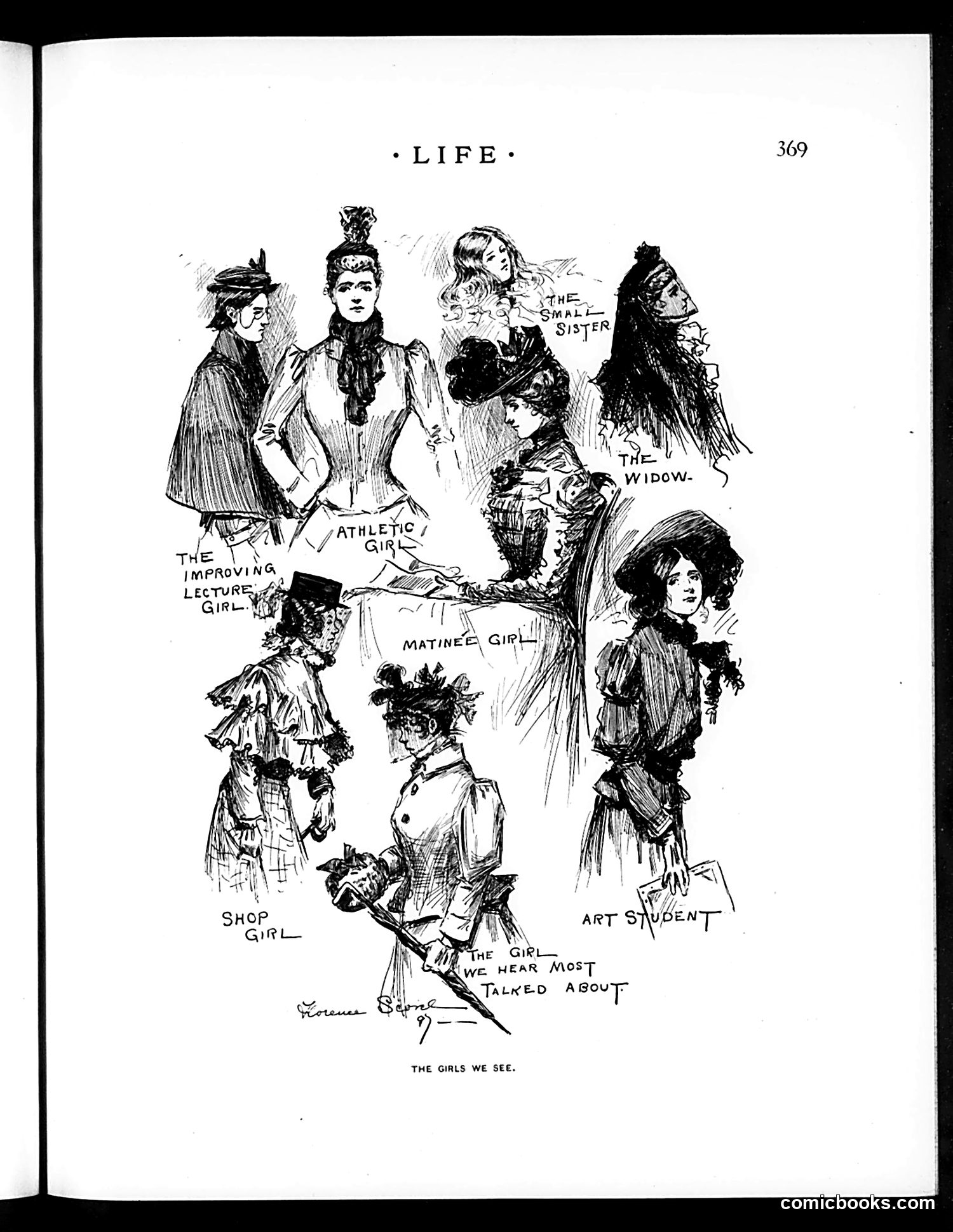
This illustration from *Life* magazine (page 369) presents stereotypical female archetypes of the era through satirical character sketches. Each figure is labeled with a social type: "The Improving Lecture Girl," "Athletic Girl," "The Small Sister," "The Widow," "Matinee Girl," "Shop Girl," "Art Student," and "The Girl We Hear Most Talked About." The satire mocks contemporary women by reducing them to social categories, poking fun at their pretensions and behaviors. The "Athletic Girl" represents the era's emerging independent woman, while types like "Shop Girl" and "Art Student" suggest class and cultural aspirations. The overall effect satirizes how society categorized and stereotyped women based on their appearance, occupation, and leisure activities.
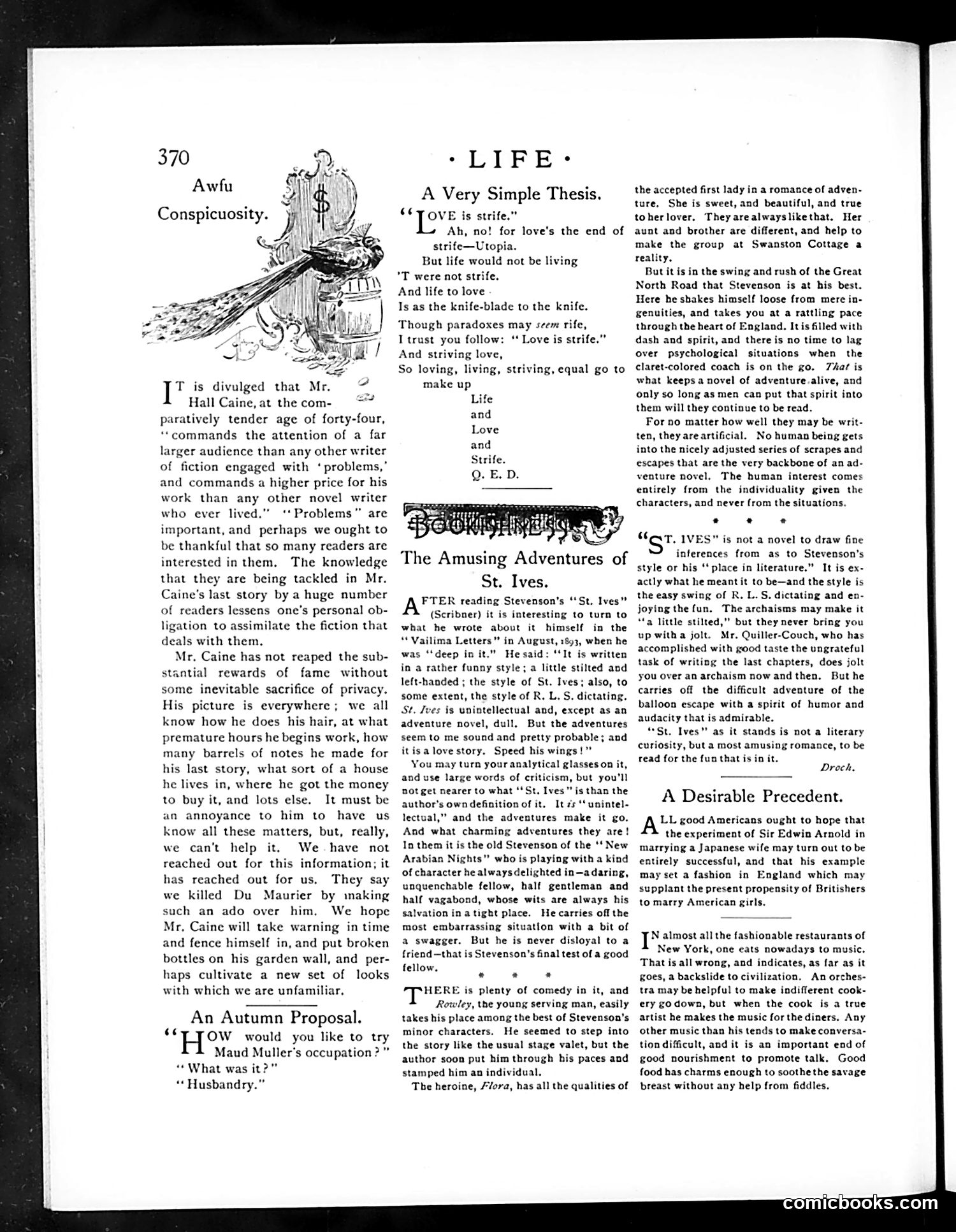
The page contains literary commentary rather than political cartoons. The main illustration shows a figure labeled "Awfu Conspicuosity" — appearing to be a wealthy, ostentatiously dressed person spilling money or valuables. This seems to satirize excessive displays of wealth and pretentiousness. The articles discuss author Hall Caine's literary work and debate Robert Louis Stevenson's "St. Ives," critiquing whether it qualifies as serious literature or mere adventure fiction. The "Autumn Proposal" section humorously suggests "Husbandry" as Maud Muller's occupation — likely a literary reference. The satire targets both conspicuous consumption (the main illustration) and literary pretension—mocking both wealthy affectation and overly serious critical attitudes toward popular fiction.
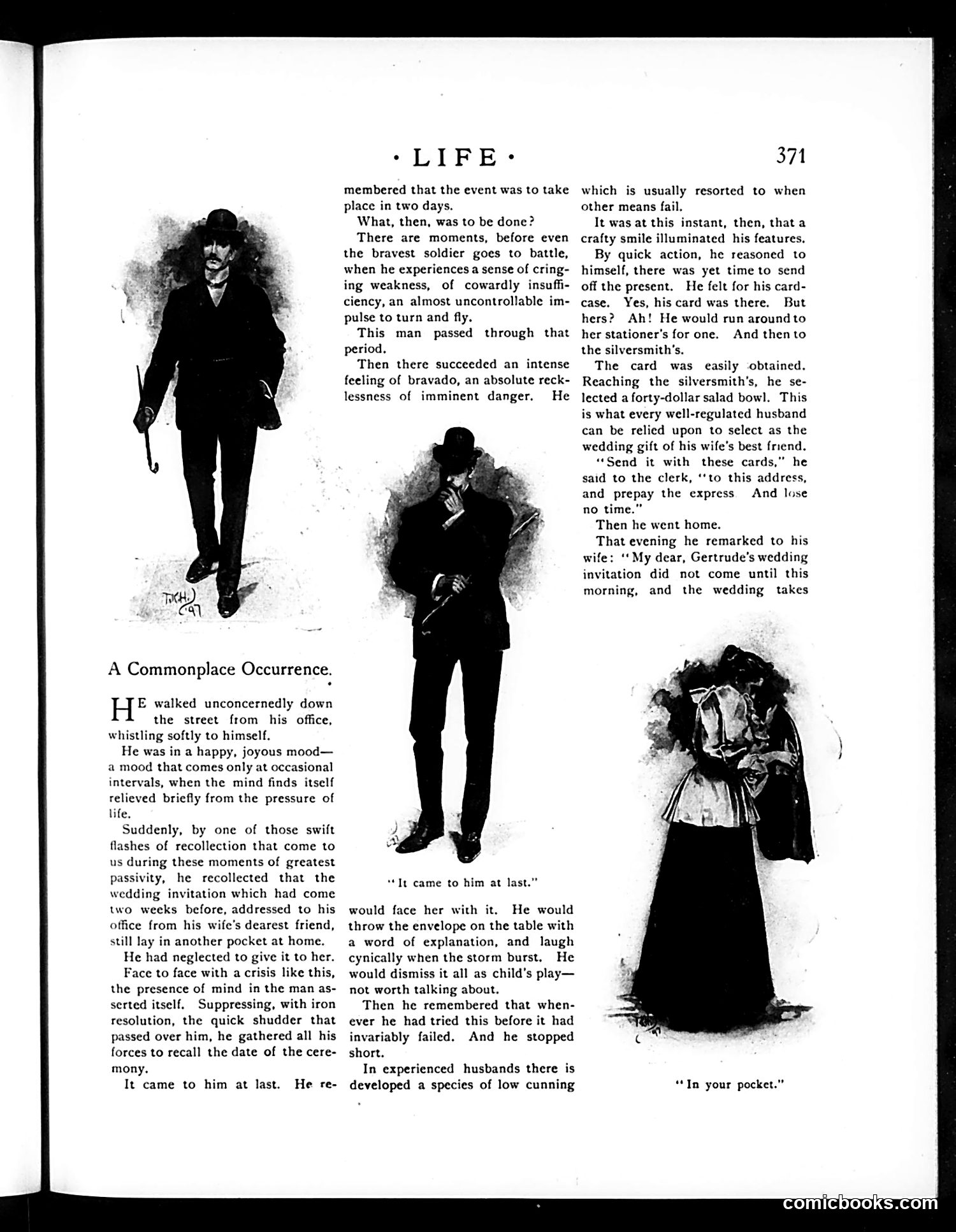
This satirical story illustrates the social anxieties of married men regarding their wives' friendships. The narrative centers on a husband who receives a wedding invitation from his wife's best friend but forgets to mention it to his wife. When he finally remembers the event is happening that morning, he must hastily obtain a wedding gift. The cartoon's humor derives from depicting a "commonplace" domestic crisis—the husband's negligence and scrambling to recover—as if it were dramatic and serious. The three illustrations show his guilty anxiety, his scheming, and his wife's reaction. The piece satirizes both male forgetfulness in domestic matters and the social importance wives place on such obligations, suggesting this was a relatable scenario for Life magazine's readers around the early 20th century.
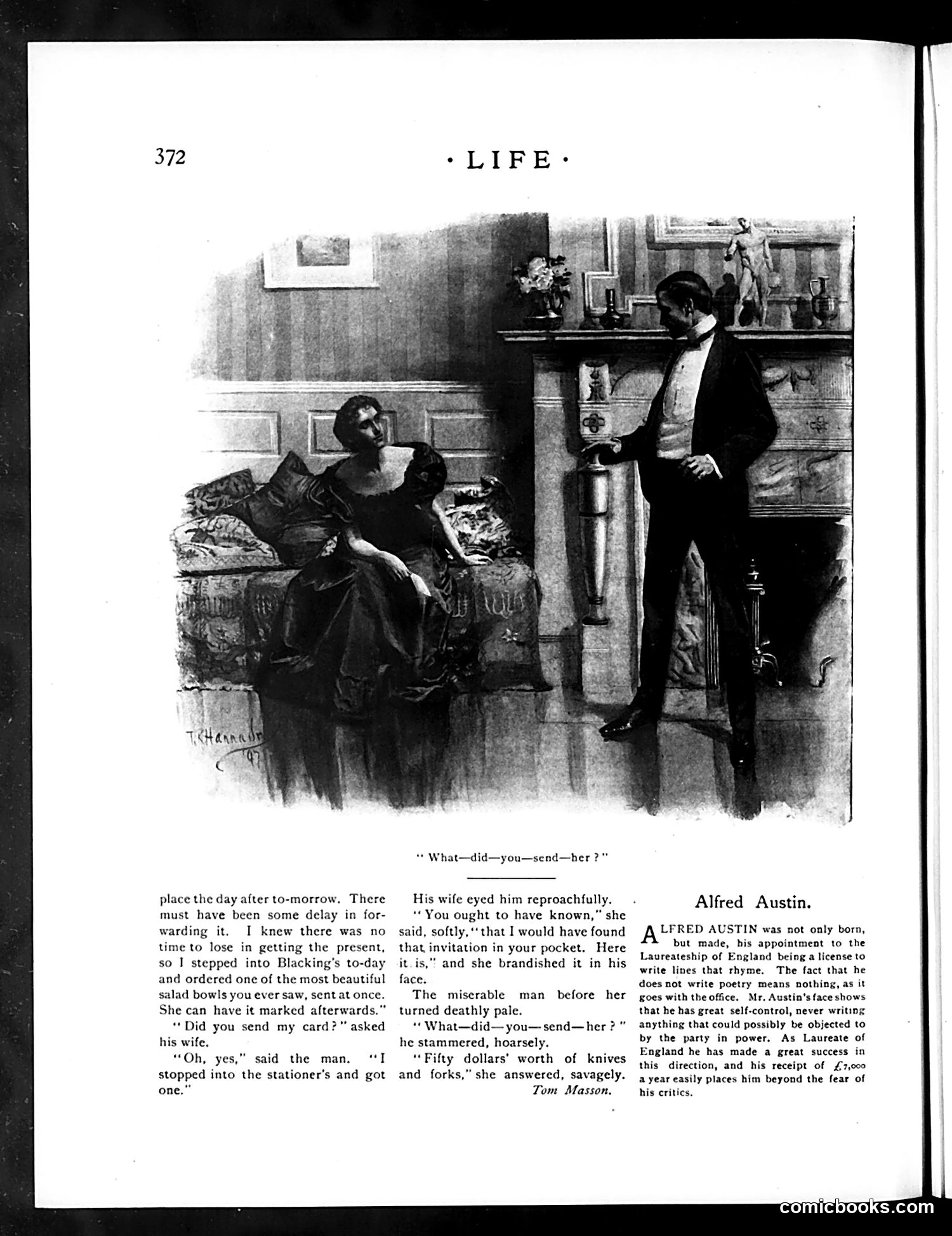
This page from *Life* magazine contains an illustration and story excerpt by T. Chermayeff depicting a domestic drama. The sketch shows a well-dressed man confronting his wife, who reclines on a sofa in an elegant interior. The dialogue reveals the wife has sent a woman (implied romantic rival) an expensive gift—"fifty dollars' worth of knives and forks"—supposedly from the husband without his knowledge. The satire targets marital infidelity and deception. The wife's calculated act—framing her husband for sending costly gifts to another woman—appears designed to humiliate or manipulate him. The humor derives from the absurdity of the gift choice (kitchenware) and the wife's bold, sarcastic response to her husband's outrage, suggesting the fashionable upper-class marriage depicted is fraught with duplicity.
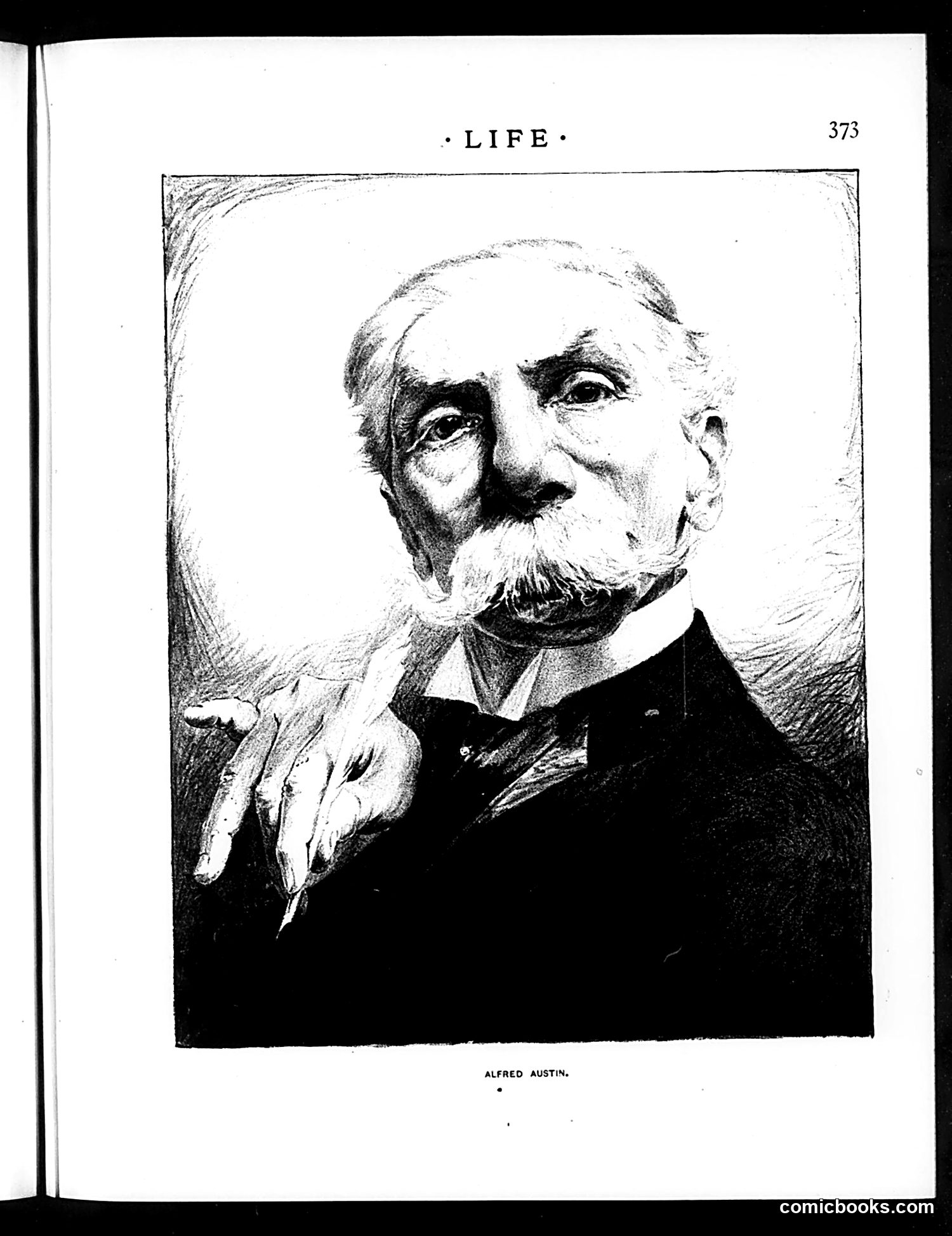
This page from *Life* magazine (page 373) features a portrait labeled "ALFRED AUSTIN." The image is a sketch-style portrait of an elderly gentleman with a distinctive long mustache, wearing formal attire with a bow tie. Without additional context on this page, I cannot definitively identify why Austin is being featured or whether this is satirical commentary. Alfred Austin was a British poet and journalist of the late 19th century, but I cannot determine from the image alone whether *Life* is mocking him, celebrating him, or what contemporary reference or controversy might be involved. The portrait style appears straightforward rather than overtly caricatured, though *Life* was primarily a satirical publication.
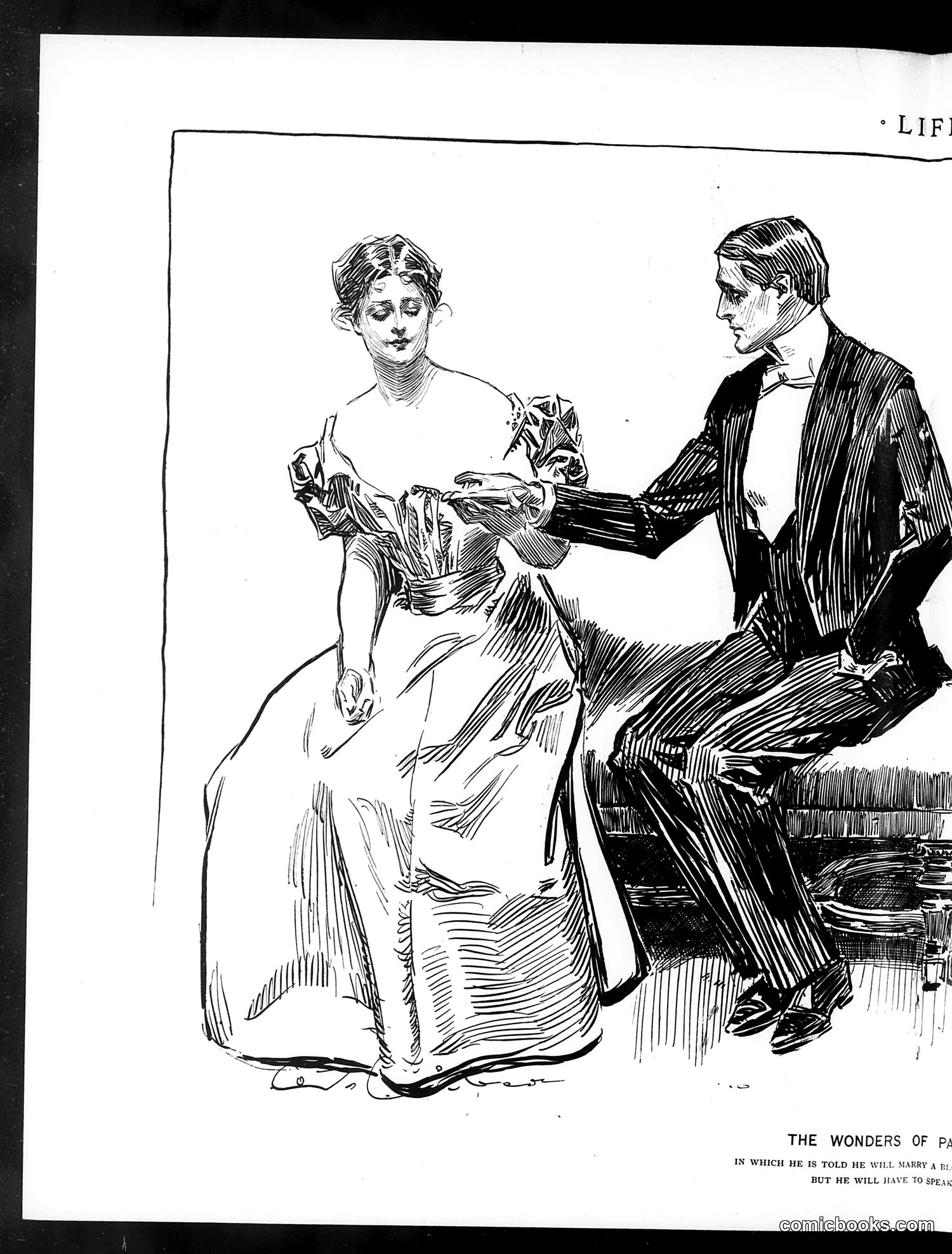
This appears to be a satirical illustration from *Life* magazine depicting a romantic scene between a well-dressed man and woman. The caption reads "THE WONDERS OF PA[RENTS]" with text mentioning "IN WHICH HE IS TOLD HE WILL MARRY A BL[...] BUT HE WILL HAVE TO SPE[...]" The joke satirizes parental interference in courtship and marriage prospects. The man appears to be receiving advice or warnings from an authority figure (suggested by his formal attire and demeanor) about his romantic prospects—likely that he'll marry someone of a certain social standing, but must meet certain conditions first. This reflects early 20th-century social satire about class consciousness, parental control over children's marriages, and the tension between romantic choice and social expectations. The specific name or event referenced remains unclear from the visible text.
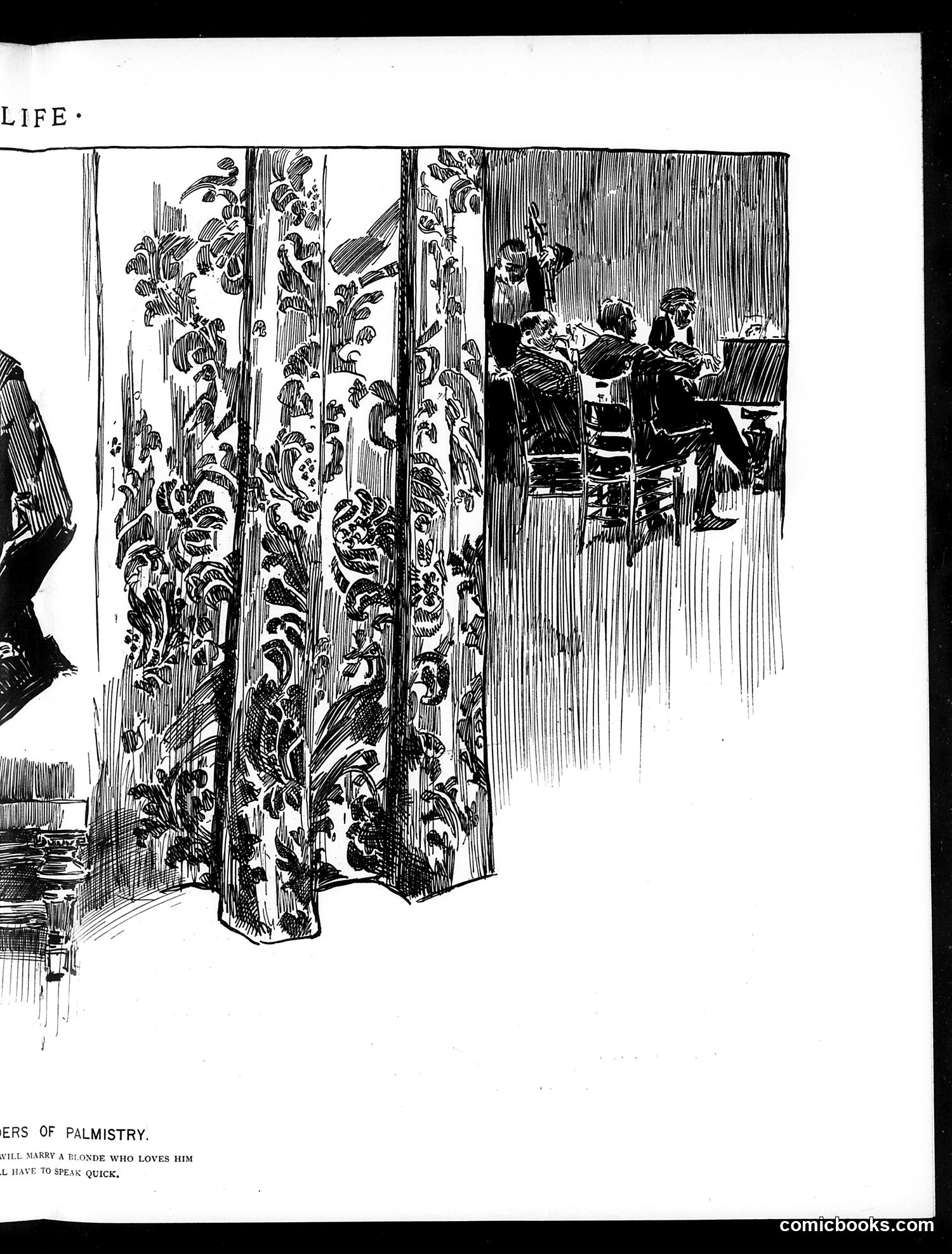
This page from *Life* magazine appears to show an interior scene with decorative folding screens featuring ornate floral patterns. Several figures in formal dress are seated and standing in the background, suggesting an upper-class social gathering or parlor setting. The visible text at bottom references "ERS OF PALMISTRY" (likely "READERS OF PALMISTRY") and mentions "WILL MARRY A BLONDE WHO LOVES HIM" and "L HAVE TO SPEAK QUICK," suggesting the cartoon satirizes fortune-telling or palm reading as entertainment among the wealthy elite. The satire likely mocks either the credulity of the upper classes in believing such predictions, or the absurdity of fortune-tellers making generic romantic prophecies. The ornate screens emphasize the pretentious setting where such fanciful predictions would occur.
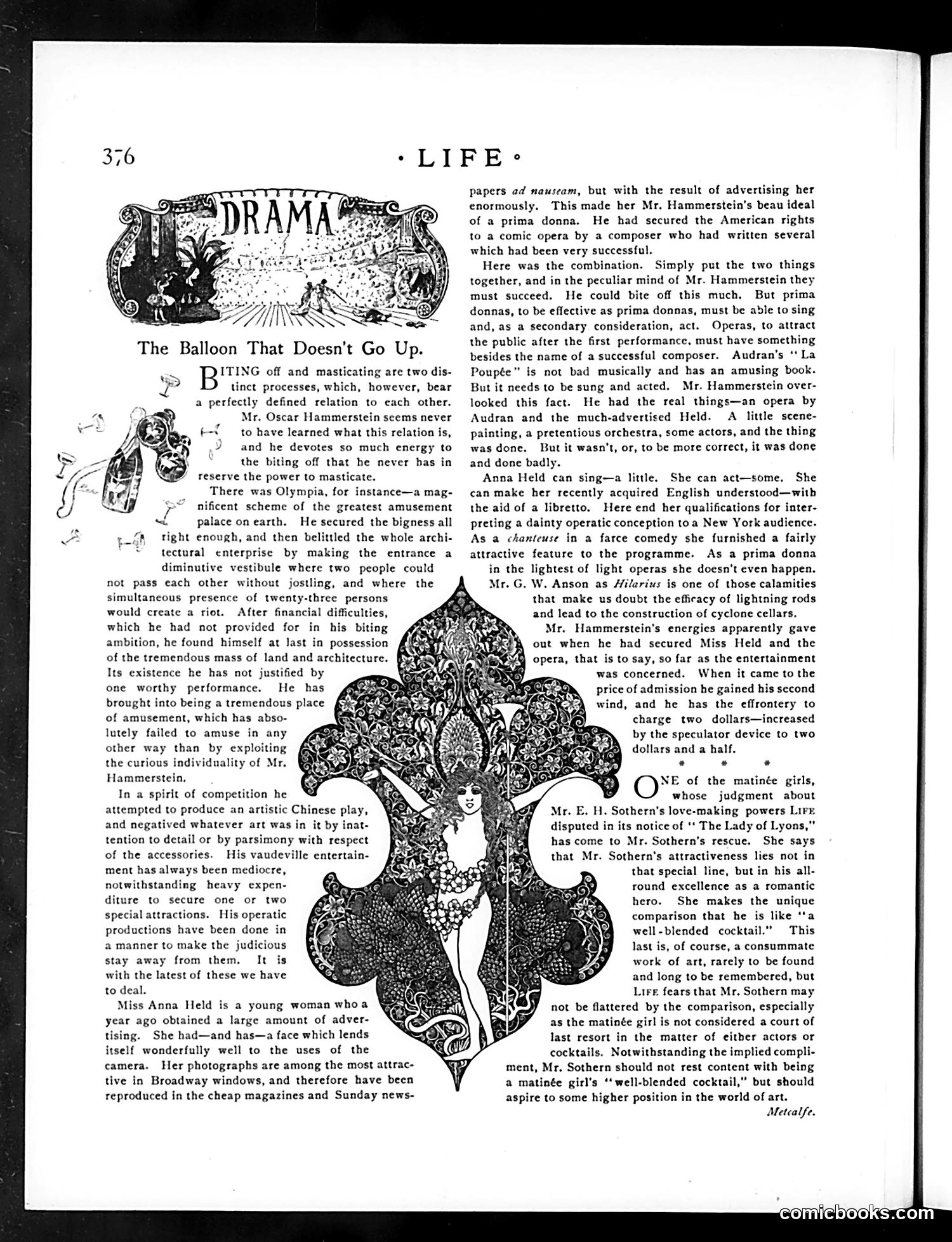
This drama column critiques Oscar Hammerstein's theatrical ambitions. The text describes Hammerstein as someone who loves "biting off" grand projects but lacks the restraint needed for successful theatrical mastery. The central illustration—an ornate, decorative design featuring a female figure—likely represents the operetta "La Poupée," which combines music by a successful composer with Hammerstein's libretto. The column suggests this pairing should work but didn't, partly because the lead actress Anna Held, while photogenic and popular, lacks the vocal and acting abilities the role demands. The "balloon that doesn't go up" metaphor suggests ambitious theatrical productions that fail to achieve liftoff—Hammerstein's characteristic problem of overreaching beyond his capabilities.
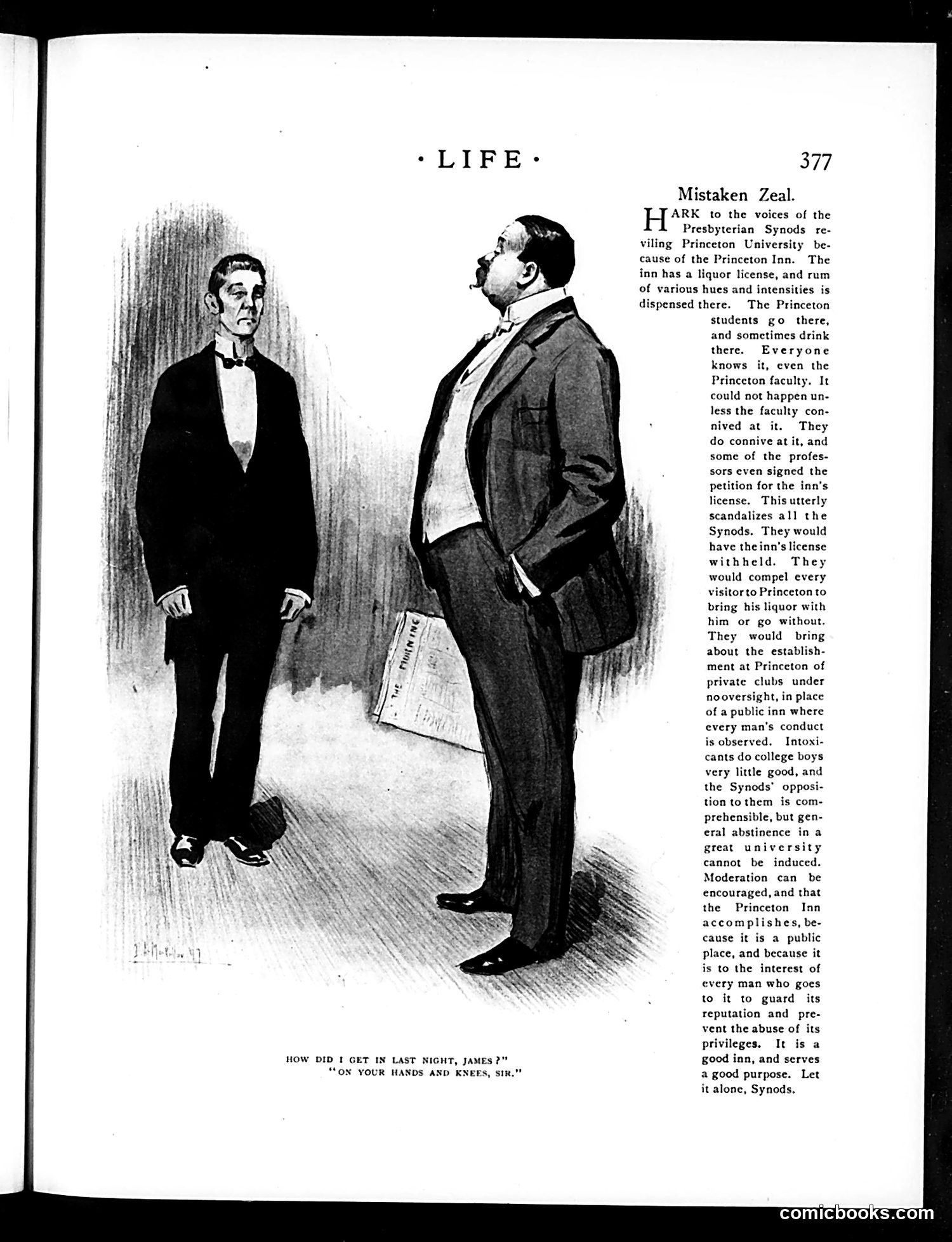
This cartoon satirizes Presbyterian church leaders ("Synods") attempting to revoke the liquor license of Princeton University's inn. The image shows two men in formal dress; the caption depicts a student asking a companion how he got home drunk the previous night, receiving the answer "on your hands and knees, sir." The article argues the Synods' opposition is counterproductive. While acknowledging that alcohol isn't beneficial for students, Life contends that a publicly visible, regulated inn actually *encourages* moderation better than driving drinking underground into private clubs beyond oversight. The satire mocks the Synods' "mistaken zeal"—their well-intentioned but naïve belief that strict prohibition will work, when practical experience shows supervised public establishments serve a legitimate purpose in managing student conduct.
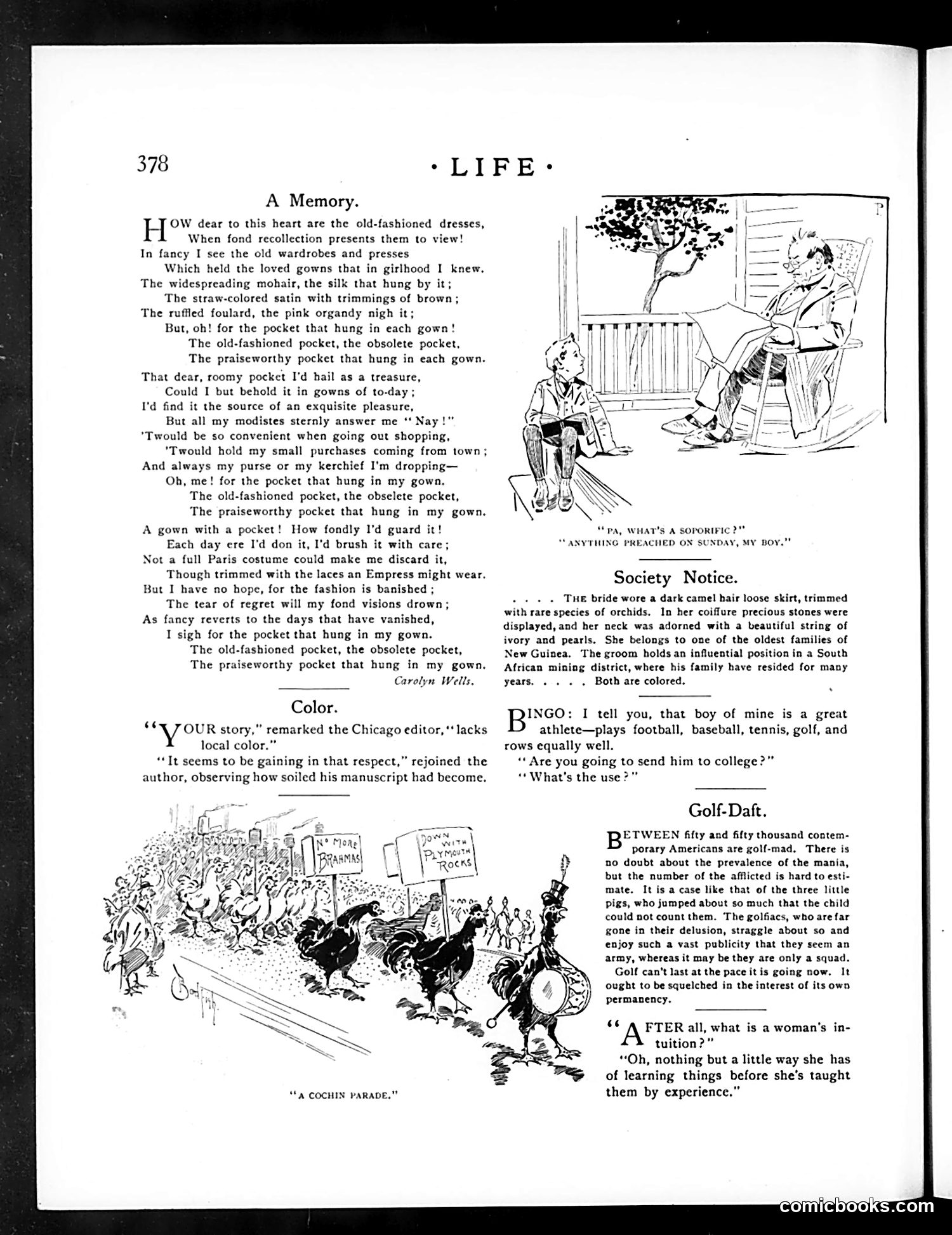
This page contains several satirical pieces typical of early 20th-century *Life* magazine: **"A Memory"** (poem by Carolyn Wells): A nostalgic lament about old-fashioned women's dresses that had functional pockets—a practical feature absent from contemporary fashionable gowns. The satire mocks both women's fashion's impracticality and the fashion industry's dismissal of utility. **"Color"** (joke): A pun about a manuscript becoming "local color" through getting dirty/soiled—mocking editors' vague critical demands. **"A Cochin Parade"** (cartoon): Depicts chickens parading, likely satirizing some contemporary trend or social pretension (unclear without more context). **"Society Notice"**: Mock-serious announcement of a wedding between colonials from New Guinea and South Africa, ending with the casual note "Both are colored"—satirizing how society pages ignore racial identity until the final reveal. **"Golf-Daft"**: Social commentary comparing golf enthusiasts to three frantic pigs, arguing golf's popularity is exaggerated and the craze should be "squelched" ironically "in its own interest."
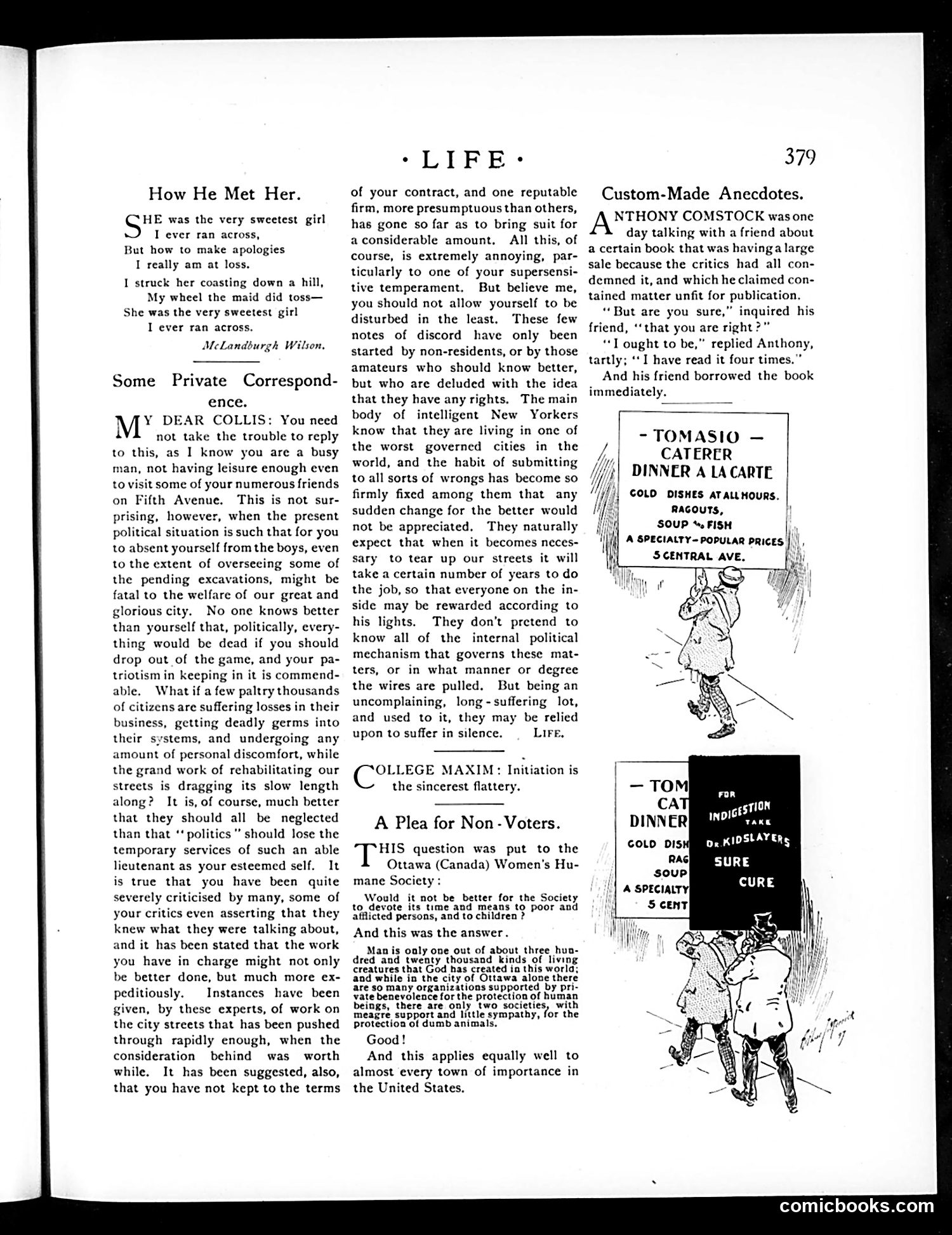
This page contains satirical political commentary typical of *Life* magazine's muckraking style. The main letter mocks a city official (addressed as "Collis," likely referencing a real political figure) overseeing street construction. The satire attacks municipal corruption: the writer feigns praise while describing how the official prioritizes his political position over citizens' welfare. Streets remain torn up for years, businesses suffer, people get sick, and contractors aren't paid—yet the "intelligent New Yorkers" passively accept this because they're accustomed to poor governance. The piece exposes how entrenched political patronage networks excuse incompetence and negligence. The advertisements below (for Tomasio's restaurant) and brief items like "College Maxim" are filler. The page's larger critique: urban corruption thrives because citizens expect nothing better and politicians exploit this resignation—a common Progressive Era complaint about machine politics.
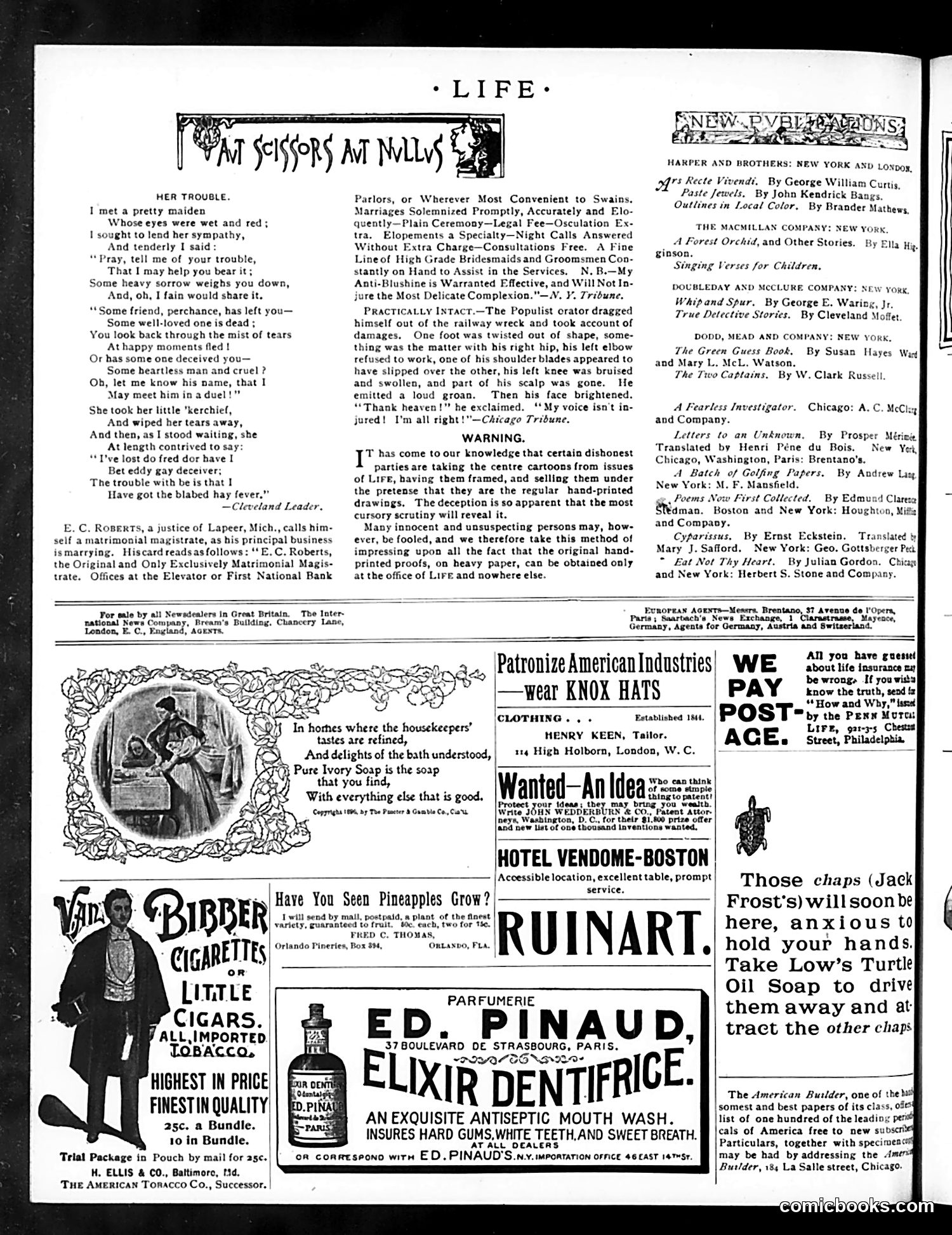
This page primarily contains **book advertisements and literary notices** rather than political cartoons. However, it includes one notable satirical piece: **"Practically Intact"** ridicules a **Populist orator** who survives a railway wreck. The joke centers on the politician's absurd priorities: despite suffering severe injuries (twisted foot, damaged hip, bruised knee, missing scalp), he expresses relief that his voice—his tool for public speaking—remains unharmed. The satire mocks Populist politicians as self-absorbed demagogues whose primary concern is their ability to deliver speeches, not substantive policy or genuine suffering. The page also includes advertisements for Knox Hats, Bibber Little Cigars, and various patent medicines—typical of Life's revenue model. A warning notice cautions readers against counterfeit hand-printed Life cartoons being fraudulently sold, indicating the magazine's popularity and vulnerability to forgery.
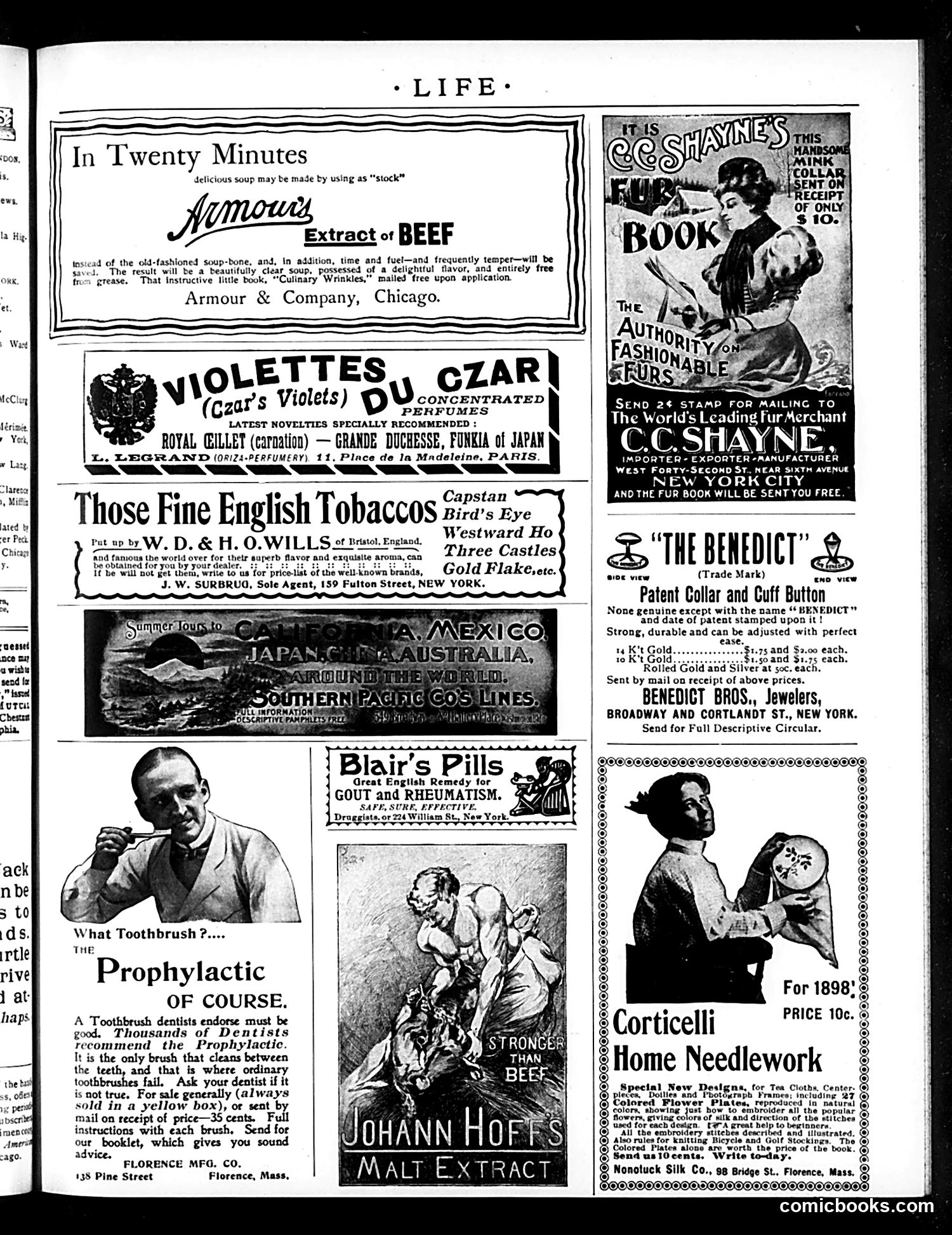
This is primarily an **advertising page** rather than a satirical cartoon page. It contains various product advertisements from the 1890s era, including: **Notable ads:** - Armour & Company beef extract (promising quick soup) - Violettes du Czar perfume, referencing Russian nobility - English tobaccos marketed internationally - Blair's Pills for gout and rheumatism - The Prophylactic toothbrush (endorsed by dentists) - Johann Hoff's Malt Extract - C.C. Shayne fur merchant - Corticelli Home Needlework instruction book for 1898 The page reflects **late Victorian consumer culture**: products emphasize efficiency ("In Twenty Minutes"), social respectability (celebrity endorsements, medical authority), and aspirational luxury (imported European goods, royal references). There is **no political satire** visible here—Life's satirical content appears on other pages. This demonstrates how 1890s magazines mixed editorial content with advertising, and how contemporary ads reveal period obsessions with convenience, status, and self-improvement.
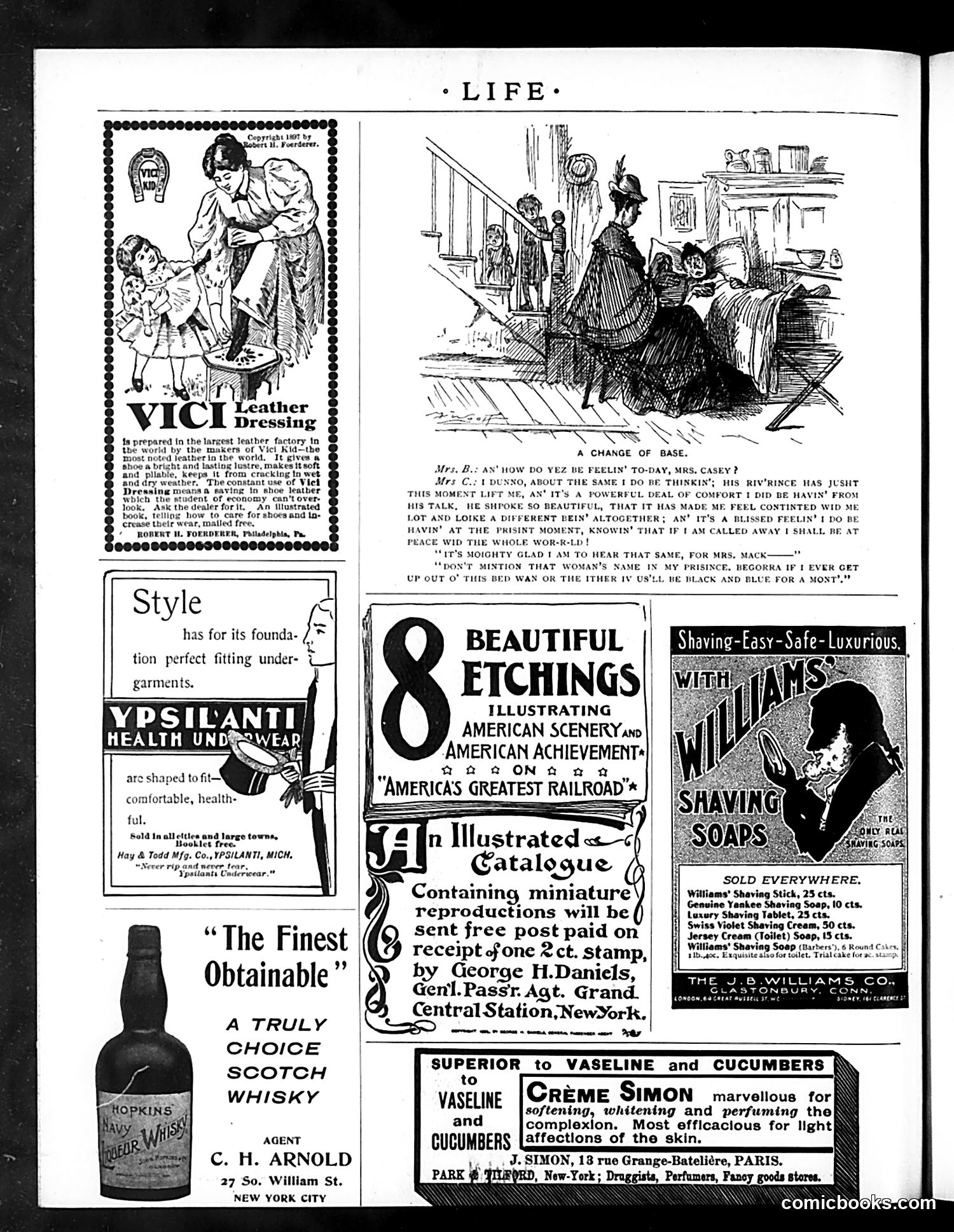
This page is primarily **advertisements** with one cartoon titled "A Change of Base." The cartoon depicts two Irish working-class women (identifiable by their dialect spelling: "yez," "feelin'," "shpoke") discussing how a priest's sermon has emotionally transformed one of them. Mrs. Casey feels renewed hope and spiritual comfort from "His Riv'rence's" beautiful talk, making her feel like "a different bein' altogether." **The satire:** The joke relies on ethnic stereotyping common to the era—caricaturing Irish immigrants through exaggerated brogue and religious devotion. The humor targets the perceived susceptibility of working-class Irish Catholics to emotional manipulation by clergy ("shpoke so beautiful"). **Modern context:** This reflects turn-of-century American attitudes toward Irish immigrants, portraying them as simple, religious, and easily swayed by ecclesiastical authority—a form of gentle but condescending ethnic humor typical of *Life* magazine's satirical approach. The rest of the page contains period product advertisements (shoe polish, underwear, whisky, shaving soap).
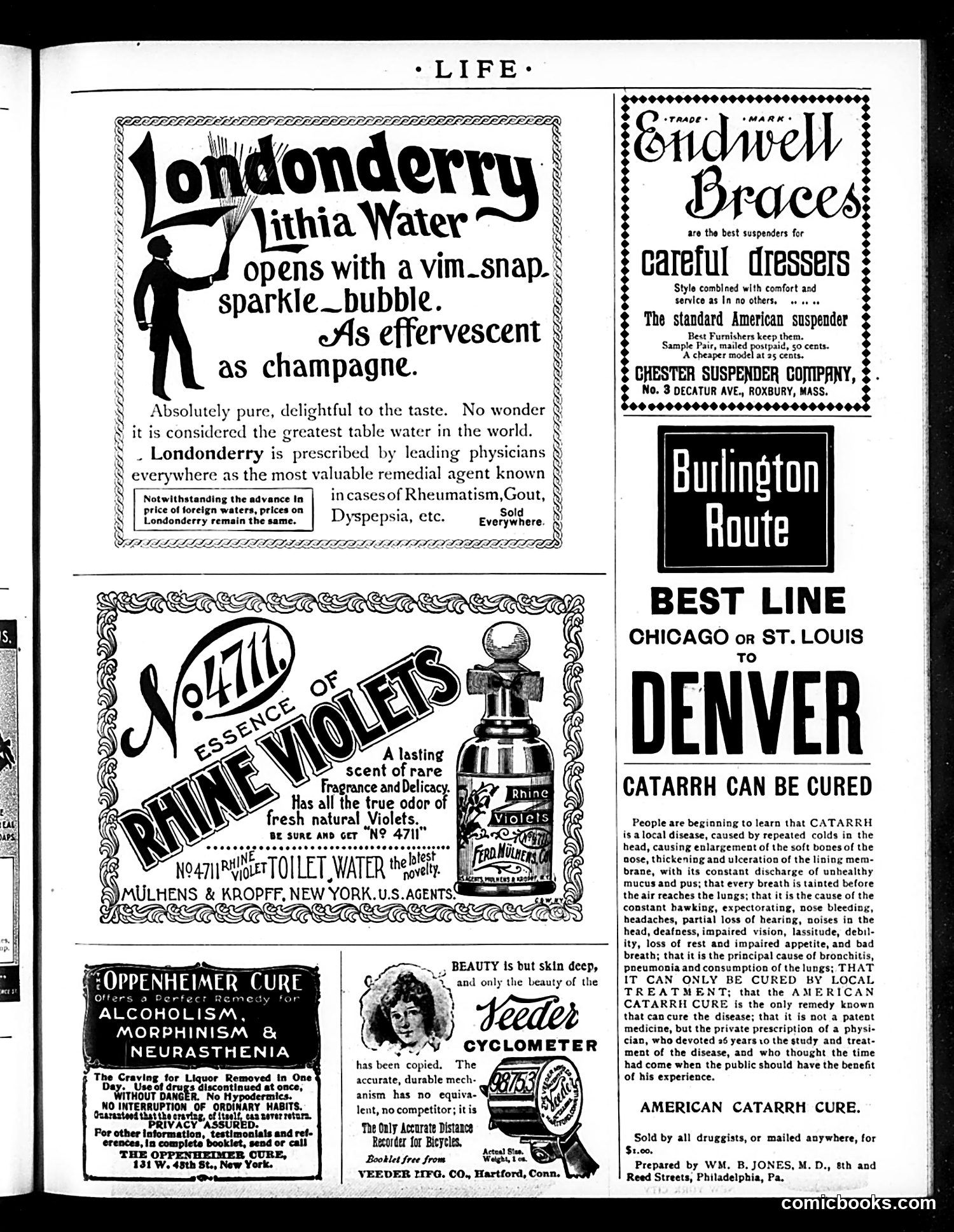
This page contains **no political cartoons or satire**—it is entirely **commercial advertising**, typical of early 20th-century Life magazine. The ads promote various patent medicines and products common to the era: - **Londonderry Lithia Water**: marketed as a cure-all for rheumatism, gout, and dyspepsia - **Oppenheimer Cure**: promises to eliminate alcohol and morphine addiction "in one day" - **American Catarrh Cure**: claims to cure respiratory disease through "local treatment" - **Veeder Cyclometer**: bicycle odometer - **Endwell Braces** and other consumer goods These ads reflect a **pre-FDA regulatory era** when medical claims were unregulated and often fraudulent. The emphasis on "curing" serious diseases through mail-order remedies highlights how different medical consumer culture was before modern pharmaceutical oversight. The page demonstrates Life's reliance on advertising revenue to fund satirical content elsewhere in the magazine.
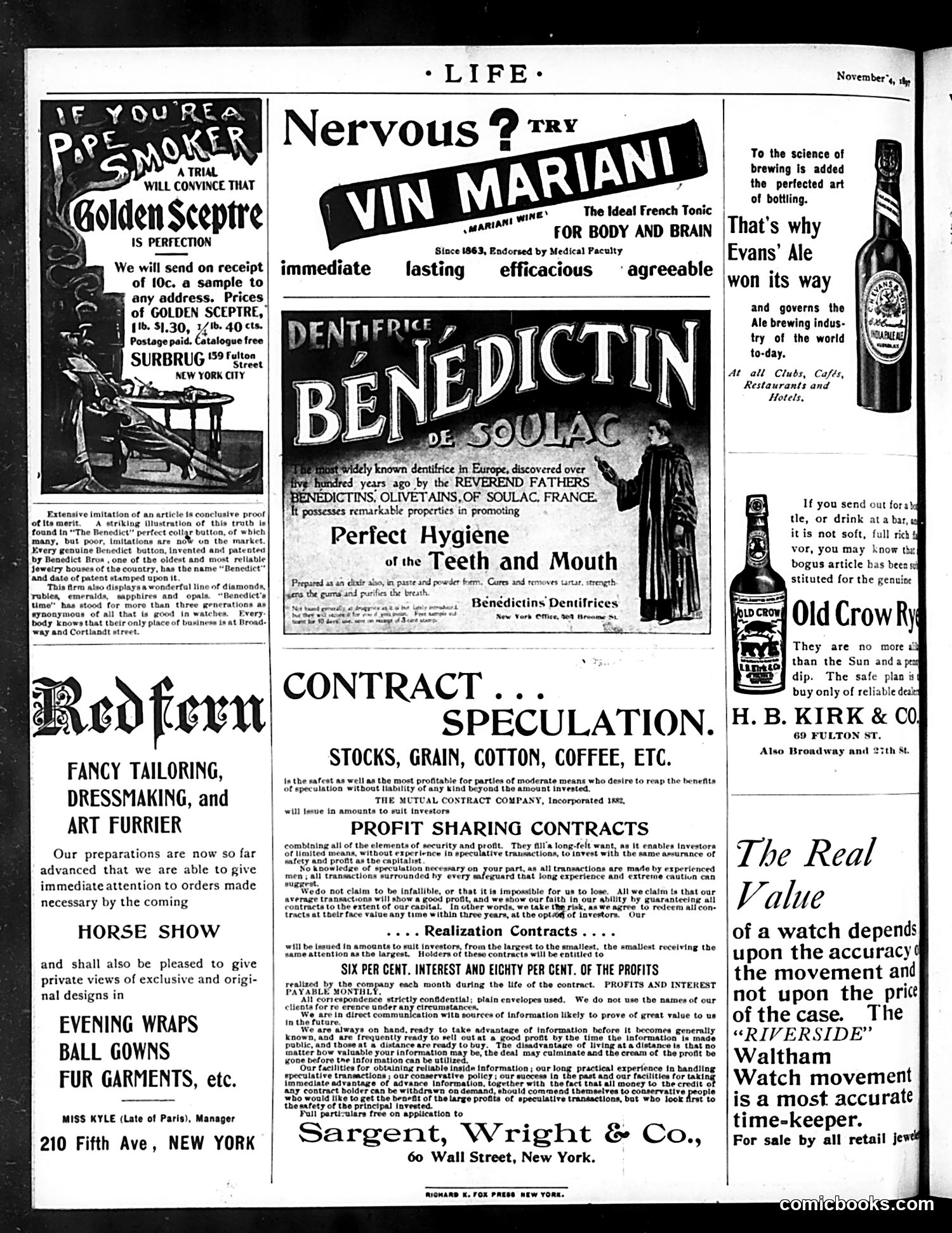
This page is **primarily advertising**, not editorial content or satire. It contains commercial pitches for various products and services typical of early 20th-century America. The ads promote: - **Patent medicines** ("Vin Mariani" tonic, "Benedictin" dentifrice) — products making health claims now recognized as dubious or fraudulent - **Luxury services** (Redfern's tailoring, furs, ball gowns for high society) - **Financial speculation schemes** (Mutual Contract Company offering "safe" stock/commodity trading) - **Alcohol** (Evans' Ale, Old Crow Rye) - **Jewelry** (Benedict collar buttons, watches) For modern readers, the striking element is how openly these ads make extraordinary health promises and financial guarantees—claims that would violate modern FDA and FTC regulations. The page reflects an era before consumer protection laws, when advertisers made unsubstantiated medical and financial claims freely. There is **no discernible political cartoon or satire** on this page.