
Life, 1897-11-04 · page 12 of 20
Life — November 4, 1897 — page 12: what you’re looking at
What you’re looking at
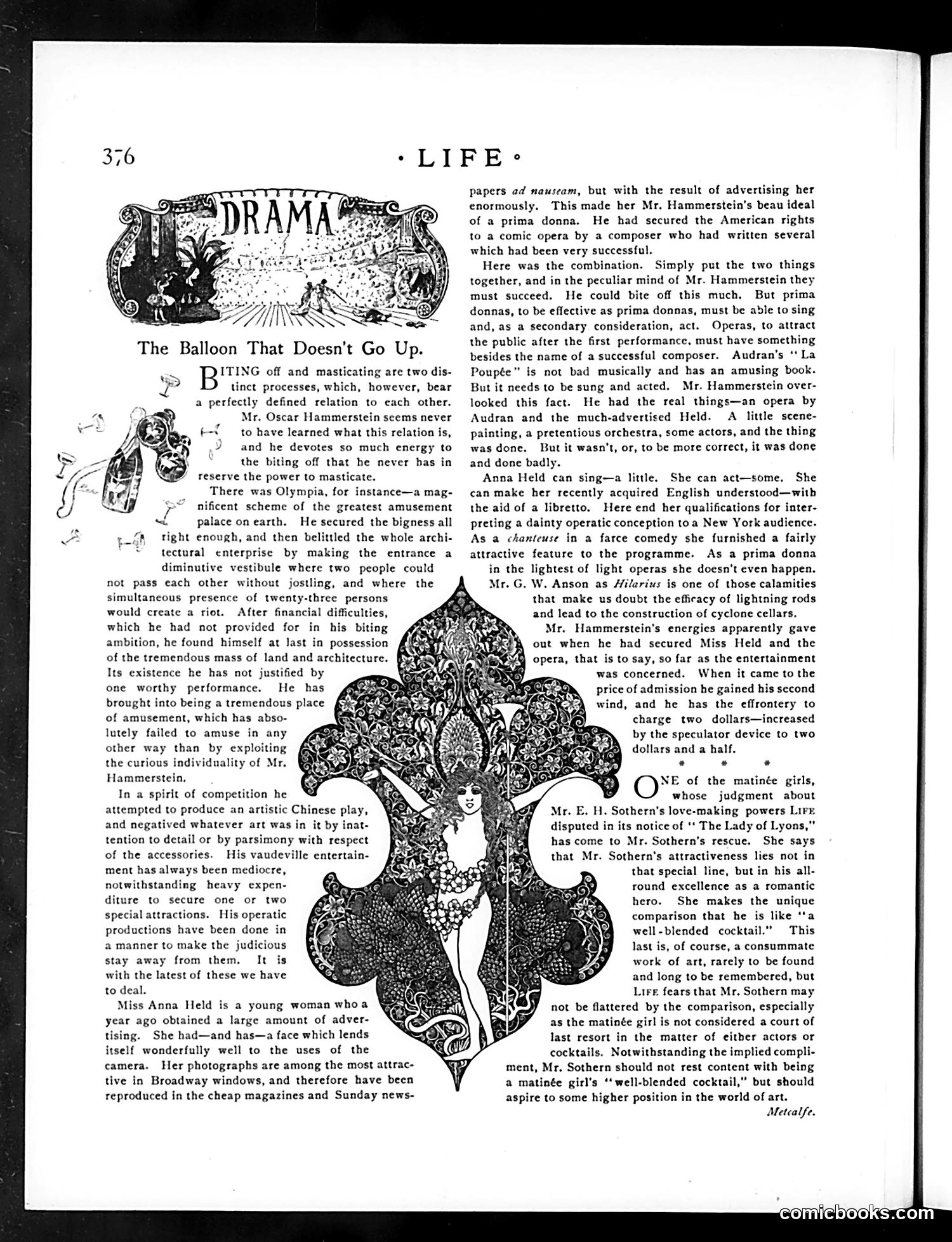
This drama column critiques Oscar Hammerstein's theatrical ambitions. The text describes Hammerstein as someone who loves "biting off" grand projects but lacks the restraint needed for successful theatrical mastery. The central illustration—an ornate, decorative design featuring a female figure—likely represents the operetta "La Poupée," which combines music by a successful composer with Hammerstein's libretto. The column suggests this pairing should work but didn't, partly because the lead actress Anna Held, while photogenic and popular, lacks the vocal and acting abilities the role demands. The "balloon that doesn't go up" metaphor suggests ambitious theatrical productions that fail to achieve liftoff—Hammerstein's characteristic problem of overreaching beyond his capabilities.
📄 Transcribed text from this page (OCR, searchable)
Machine-transcribed from the original scan — historical spelling and the odd misread are preserved.
*LIFE> The Balloon That Doesn't Go Up. ITING off and masticating are two dis- tinct processes, which, however, bear a perfectly defined relation to each other. Mr. Oscar Hammerstein seems never to have learned what this relation is, and he devotes so much energy to the biting off that he never has in reserve the power to masticate. There was Olympia, for instance—a mag- nificent scheme of the greatest amusement palace on earth. He secured the bigness all tight enough, and then belittled the whole archi- tectural enterprise by making the entrance a diminutive vestibule where two people could not pass each other without jostling, and where the simultaneous presence of twenty-three persons would create a riot. After financial difficulties, which he had not provided for in his biting ambition, he found himself at last in possession of the tremendous mass of land and architecture. Its existence he has not justified by one worthy performance. He has brought into being a tremendous place of amusement, which has abso- lutely failed to amuse in any other way than by exploiting the curious individuality of Mr. Hammerstein, In a spirit of competition he attempted to produce an artistic Chinese play, and negatived whatever art was in it by inat- tention to detail or by parsimony with respect of the accessories. His vaudeville entertain- ment has always been mediocre, notwithstanding heavy expen- diture to secure one or two special attractions. His operatic productions have been done in a manner to make the judicious stay away from them, It is with the latest of these we have to deal. Miss Anna Held is a young woman whoa year ago obtained a large amount of adver- tising. She had—and has—a face which lends itself wonderfully well to the uses of the camera. Her photographs are among the most attrac- tive in Broadway windows, and therefore have been reproduced in the cheap magazines and Sunday news- papers ad nauseam, but with the result of advertising her enormously. This made her Mr. Hammerstein's beau ideal of a prima donna. He had secured the American rights to a comic opera by a composer who had written several which had been very successful. Here was the combination. Simply put the two things together, and in the peculiar mind of Mr. Hammerstein they must succeed. He could bite off this much. But prima donnas, to be effective as prima donnas, must be able to sing and, as a secondary consideration, act. Operas, to attract the public after the first performance, must have something besides the name of a successful composer. Audran’s ‘* La Poupée” is not bad musically and has an amusing book. But it needs to be sung and acted. Mr. Hammerstein over- looked this fact. He had the real things—an opera by Audran and the much-advertised Held. A little scene- painting, a pretentious orchestra, some actors, and the thing was done. But it wasn’t, or, to be more correct, it was done and done badly. Anna Held can sing—a little. She can act—some. She can make her recently acquired English understood—with the aid of a libretto. Here end her qualifications for inter- preting a dainty operatic conception toa New York audience. As a chanteuse in a farce comedy she furnished a fairly attractive feature to the programme. As a prima donna in the lightest of light operas she doesn't even happen. Mr. G. W. Anson as Hilarius is one of those calamities that make us doubt the efficacy of lightning rods and lead to the construction of cyclone cellars. Mr. Hammerstein's energies apparently gave out when he had secured Miss Held and the opera, that is to say, so far as the entertainment was concerned. When it came to the price of admission he gained his second wind, and he has the effrontery to charge two dollars—increased by the speculator device to two dollars and a half. * * * NE of the matinée girls, s whose judgment about Mr. E. H. Sothern’s love-making powers LIFE disputed in its notice of ** The Lady of Lyons,” has come to Mr. Sothern’s rescue, She says that Mr. Sothern's attractiveness lies not in that special line, but in his all- round excellence as a romantic hero. She makes the unique comparison that he is like “a well-blended cocktail. This last is, of course, a consummate work of art, rarely to be found and long to be remembered, but Lire fears that Mr. Sothern may not be flattered by the comparison, especially as the matinée girl is not considered a court of last resort in the matter of either actors or cocktails. Notwithstanding the implied compli- ment, Mr. Sothern should not rest content with being a matinée girl's ‘‘well-blended cocktail,” but should aspire to some higher position in the world of art. Metcalfe.