
Life, 1897-11-04 · page 6 of 20
Life — November 4, 1897 — page 6: what you’re looking at
What you’re looking at
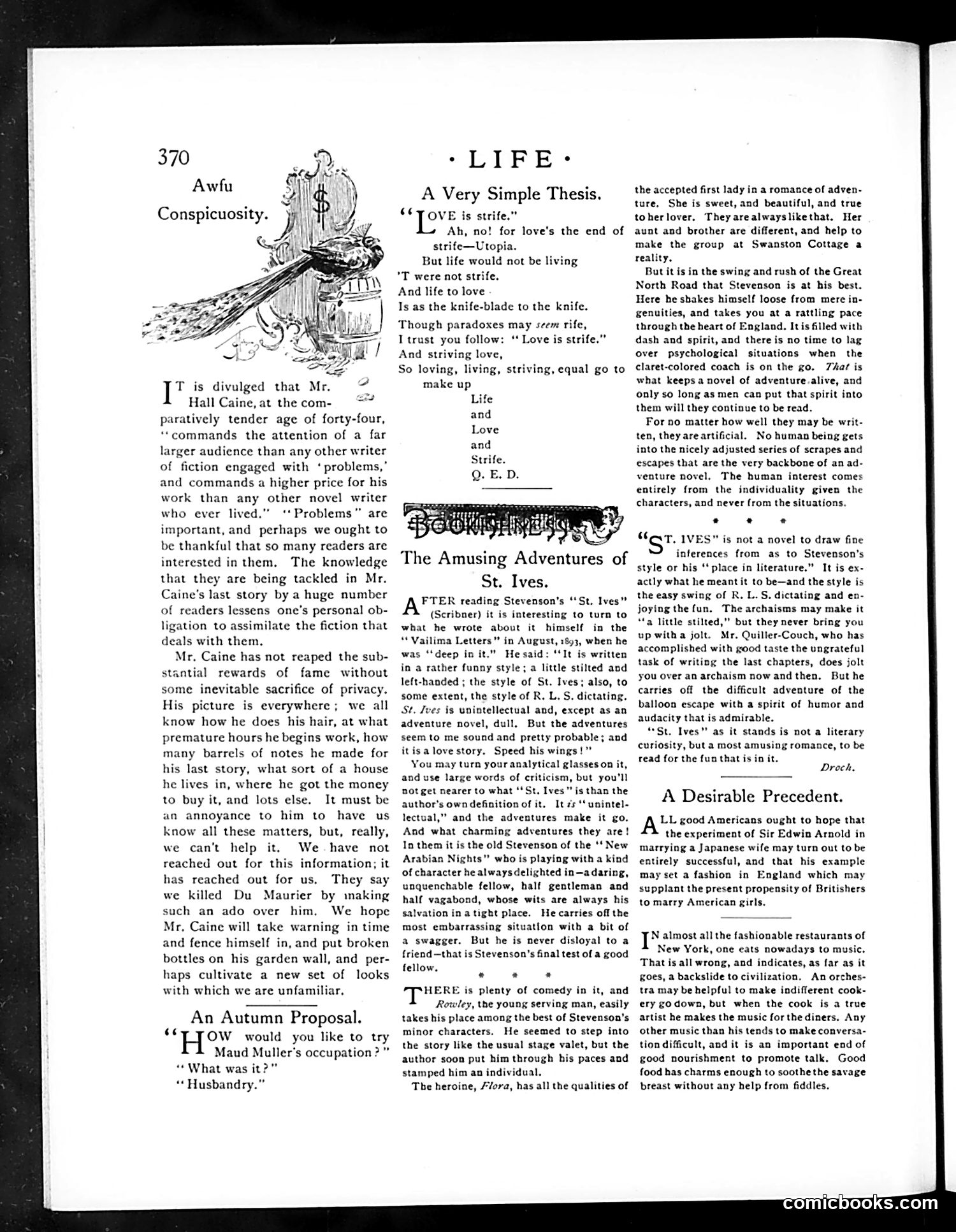
The page contains literary commentary rather than political cartoons. The main illustration shows a figure labeled "Awfu Conspicuosity" — appearing to be a wealthy, ostentatiously dressed person spilling money or valuables. This seems to satirize excessive displays of wealth and pretentiousness. The articles discuss author Hall Caine's literary work and debate Robert Louis Stevenson's "St. Ives," critiquing whether it qualifies as serious literature or mere adventure fiction. The "Autumn Proposal" section humorously suggests "Husbandry" as Maud Muller's occupation — likely a literary reference. The satire targets both conspicuous consumption (the main illustration) and literary pretension—mocking both wealthy affectation and overly serious critical attitudes toward popular fiction.
📄 Transcribed text from this page (OCR, searchable)
Machine-transcribed from the original scan — historical spelling and the odd misread are preserved.
370 Conspicuosity. J’ is divulged that Mr. Hall Caine,at the com- = paratively tender age of forty-four, ‘commands the attention of a far larger audience than any other writer of fiction engaged with ‘problems,’ and commands a higher price for his work than any other novel writer who ever lived.” ‘* Problems” are important, and perhaps we ought to be thankful that so many readers are interested in them, The knowledge that they are being tackled in Mr. Caine’s last story by a huge number of readers lessens one’s personal ob- ligation to assimilate the fiction that deals with them, Mr. Caine has not reaped the sub- stantial rewards of fame without some inevitable sacrifice of privacy. His picture is everywhere; we all know how he does his hair, at what premature hours he begins work, how many barrels of notes he made for his last story, what sort of a house he lives in, where he got the money to buy it, and lots else. It must be an annoyance to him to have us know all these matters, but, really, we can't help it. We have not reached out for this information; it has reached out for us. They say we killed Du Maurier by making such an ado over him. We hope Mr, Caine will take warning in time and fence himself in, and put broken bottles on his garden wall, and per- haps cultivate a new set of looks with which we are unfamiliar. An Autumn Proposal. as OW would you like to try Maud Muller's occupation?” “What was it?” “* Husbandry.” * LIFE: A Very Simple Thesis. “OVE is strife.” Ah, no! for love's the end of strife—Utopia. But life would not be living 'T were not strife. And life to love Is as the knife-blade to the knife. Though paradoxes may seem rife, I trust you follow: ‘ Love is strife.” And striving love, So loving, living, striving, equal go to make up Life and Love and Strife. e Amusing Adventures of St. Ives. FTER reading Stevenson's ‘St. Ives” (Scribner) it is interesting to turn to what he wrote about it himself in the “* Vailima Letters” in August, 1893, when he was ‘‘deep in it.” He said: ‘It is written in a rather funny style; a little stilted and left-handed ; the style of St. Ives; also, to some extent, the style of R. L. S. dictating. St. Jves is unintellectual and, except as an adventure novel, dull, But the adventures seem to me sound and pretty probable; and itisa love story, Speed his wings!" You may turn your analytical glasses on it, and use large words of criticism, but you'll not get nearer to what ‘St, Ives" is than the author's owndefinition of it, It 7s ‘* unintel- lectual,” and the adventures make it go. And what charming adventures they are! In them it is the old Stevenson of the ‘‘New Arabian Nights” who is playing with a kind of character he always delighted in—adaring, unquenchable fellow, half gentleman and half vagabond, whose wits are always his salvation in a tight place. He carries off the most embarrassing situation with a bit of a swagger. But he is never disloyal to a friend —that is Stevenson's final test of a good fellow. * * * HERE is plenty of comedy in it, and Rowley, the young serving man, easily takes his place among the best of Stevenson's minor characters. He seemed to step into the story like the usual stage valet, but the author soon put him through his paces and stamped him an individual, The heroine, F/ora, has all the qualities of the accepted first lady in a romance of adven- ture, She is sweet, and beautiful, and true toherlover, They arealwayslikethat. Her aunt and brother are different, and help to make the group at Swanston Cottage a reality. But it is in the swing and rush of the Great North Road that Stevenson is at his best. Here he sbakes himself loose from mer genuities, and takes you at a rattling pace through the heart of England. It is filled with dash and spirit, and there is no time to lag over psychological situations when the claret-colored coach is on the go. That is what keepsa novel of adventure.alive, and only so long as men can put that spirit into them will they continue to be read. For no matter how well they may be writ- ten, they are artificial. No human being gets into the nicely adjusted series of scrapes and escapes that are the very backbone of an ad- venture novel, The human interest comes entirely from the individuality given the characters, and never {rom the situations. “st 1VES" is not a novel to draw fine inferences from as to Stevenson's style or his ‘place in literature.” It is ex- actly what he meant it to be—and the style is the easy swing of R, L. S, dictating and en- joying the fun. The archaisms may make it “a little stilted,” but they never bring you up witha jolt. Mr. Quiller-Couch, who has accomplished with good taste the ungrateful task of writing the last chapters, does jolt you over an archaism now and then, But he carries off the difficult adventure of the balloon escape with a spirit of humor and audacity that is admirable. “St. Ives" as it stands is not a literary curiosity, but a most amusing romance, to be read for the fun that is in it. . ° * Droch, A Desirable Precedent. Auten Americans ought to hope that the experiment of Sir Edwin Arnold in marrying a Japanese wife may turn out tobe entirely successful, and that his example may set a fashion in England which may supplant the present propensity of Britishers to marry American girls. y almost all the fashionable restaurants of New York, one eats nowadays to music, That is all wrong, and indicates, as far as it goes, a backslide to civilization, An orches- tra may be helpful to make indifferent cook- ery go down, but when the cook is a true artist he makes the music forthe diners. Any other music than his tends to make conversa- tion difficult, and it is an important end of good nourishment to promote talk. Good food has charms enough to soothe the savage breast without any help from fiddles. Comicbooks.com