
A complete issue · 20 pages · 1897
Life — October 7, 1897
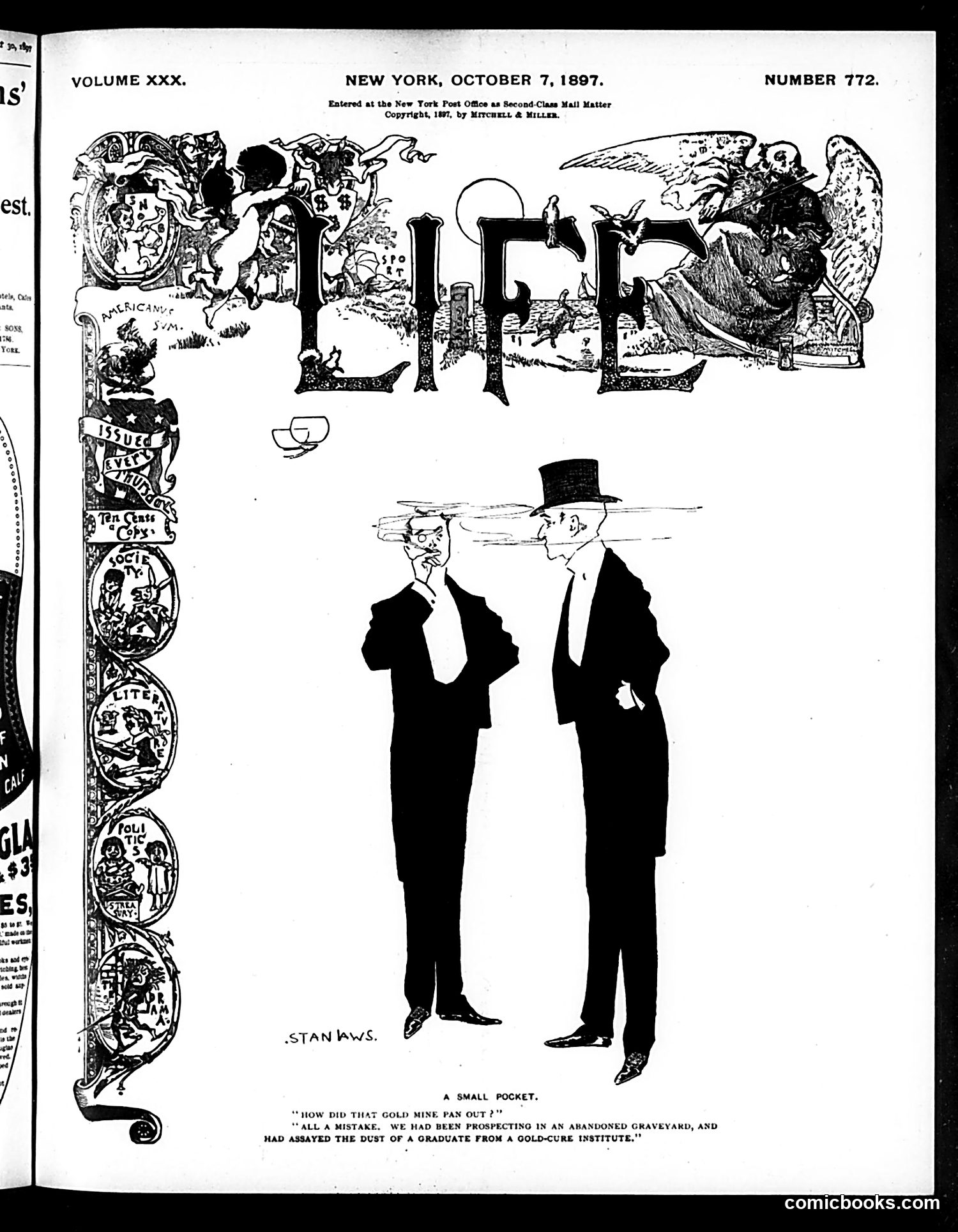
This page features a single-panel cartoon titled "A Small Pocket" by Stan Law (signature visible). Two well-dressed gentlemen in top hats converse, with one explaining their mistaken gold-mining venture. The caption reads: "How did that gold mine pan out?" / "All a mistake. We had been prospecting in an abandoned graveyard, and had assayed the dust of a graduate from a gold-cure institute." **The Satire:** This jokes about the "gold-cure" movement—a late-19th century medical fad claiming to cure alcoholism and other ailments using gold treatments. The cartoon mocks these fake cure institutes by suggesting prospectors mistakenly assayed remains of someone treated there, implying the "gold-cure" was worthless fraud—literally producing nothing but dust.
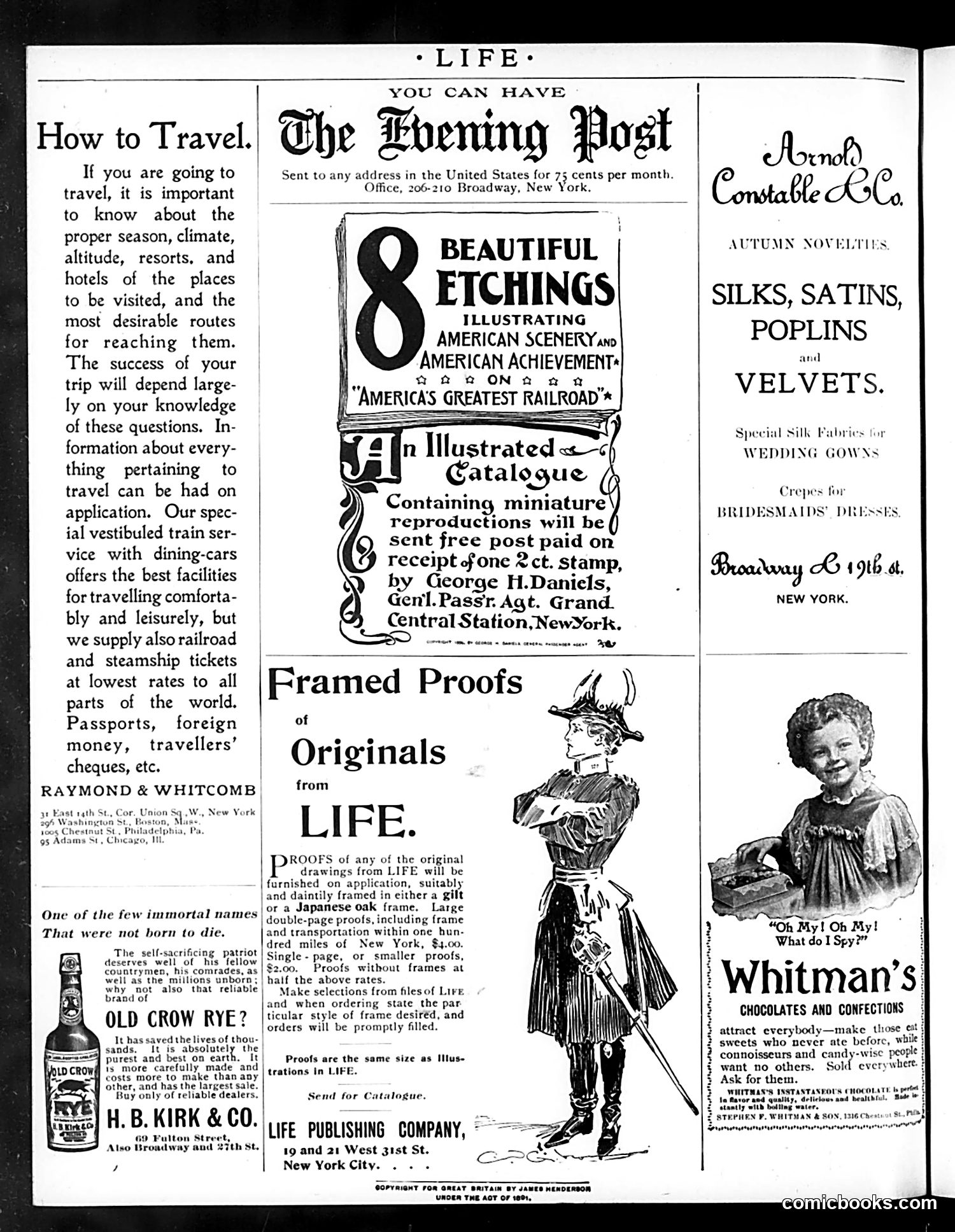
This page is primarily **advertising**, not satire or political commentary. It contains commercial advertisements for: 1. **The Evening Post newspaper** (75 cents/month subscription) 2. **Railroad etchings catalogue** featuring American scenery 3. **Arnold Constable & Co.** fabric and clothing retailer 4. **Framed proofs from LIFE magazine** - offering original artwork reproductions 5. **Old Crow whiskey** - with a bottle illustration 6. **Whitman's Chocolates** - featuring a child's portrait The only visual with potential satirical intent is the fashionable woman illustration advertising "Framed Proofs of Originals from LIFE," but it's primarily decorative rather than commentary. This appears to be a typical early 20th-century magazine back matter page combining editorial space with revenue-generating advertisements, rather than containing political cartoons or social satire.
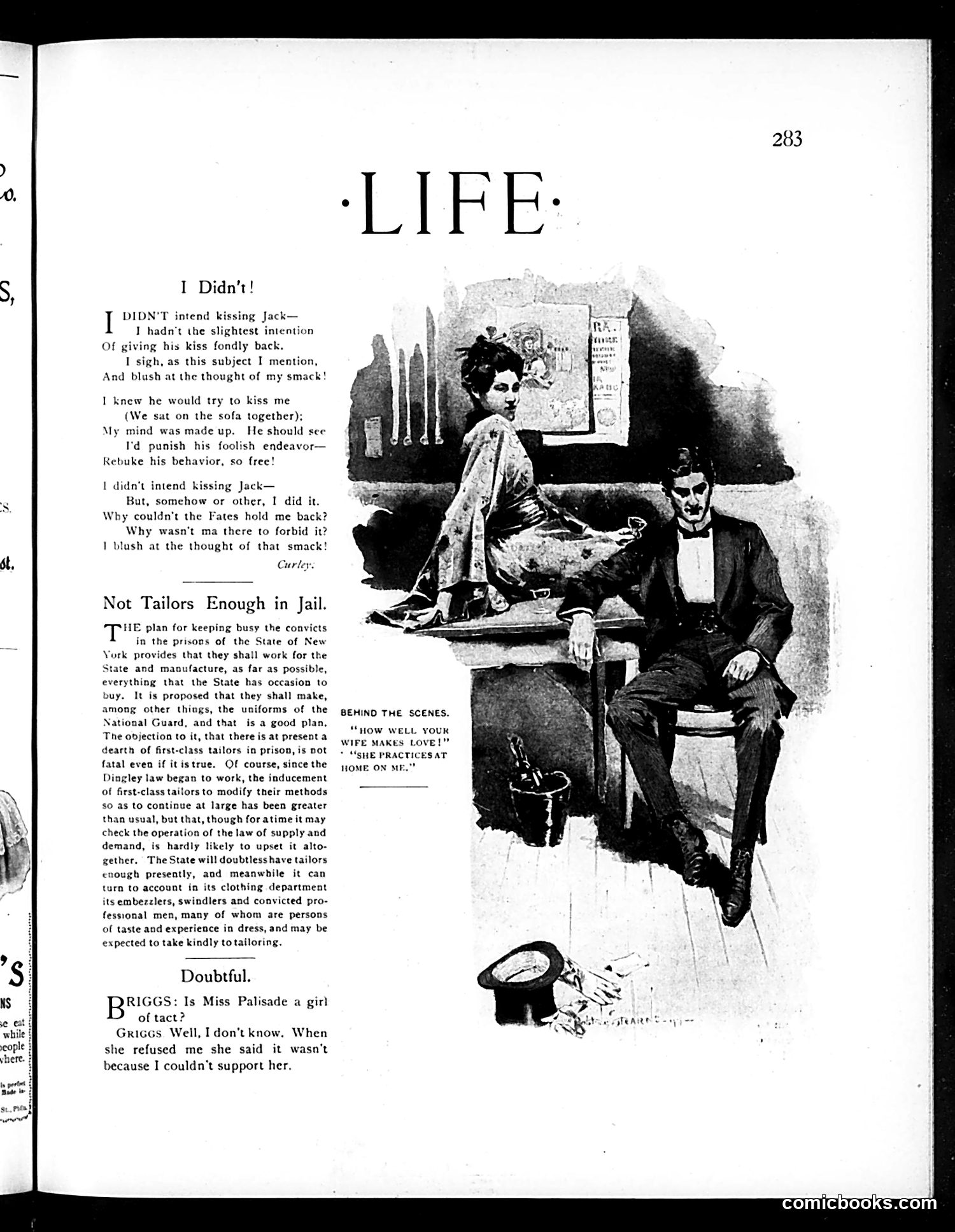
This page contains three distinct humor pieces: 1. **"I Didn't!"** - A poem by Carter about a man named Jack who kissed someone without intending to, exploring the contradiction between his actions and stated intentions. 2. **"Not Tailors Enough in Jail"** - Social commentary on New York's prison labor system, specifically criticizing the shortage of tailors in prisons. The piece argues that while convicts should work productively, there aren't enough skilled tailors to meet state clothing demands. 3. **"Doubtful"** - A brief dialogue joke where Briggs questions Miss Palisade's tact, and Griggs responds with a humorous anecdote about her refusing him because he couldn't support her financially. The accompanying illustration labeled "Behind the Scenes" depicts a domestic scene, likely illustrating marital or romantic tension related to the content.
This page contains three opinion pieces criticizing New York political figures circa early 1900s. "Awaiting a Crisis" mocks Seth Low's mayoral campaign for Greater New York, suggesting he lacks the forceful personality needed for the role. "The Sun and Mr. Low" discusses the newspaper *Sun*'s editorial stance toward Low, noting the paper's "lively neighbor" relationship involves scrutinizing Low's motives and character while claiming superior moral authority. "William's Useful Failings" and "How About Mahan?" critique public figures William and Captain Mahan. The pieces suggest William governs arbitrarily (worse than Congress) and harbor anti-British/anti-monarchist views, while praising Mahan's scholarly contributions despite his naval-power advocacy. The cartoons appear decorative rather than directly illustrating specific arguments, featuring period-appropriate satirical imagery typical of Life's format.
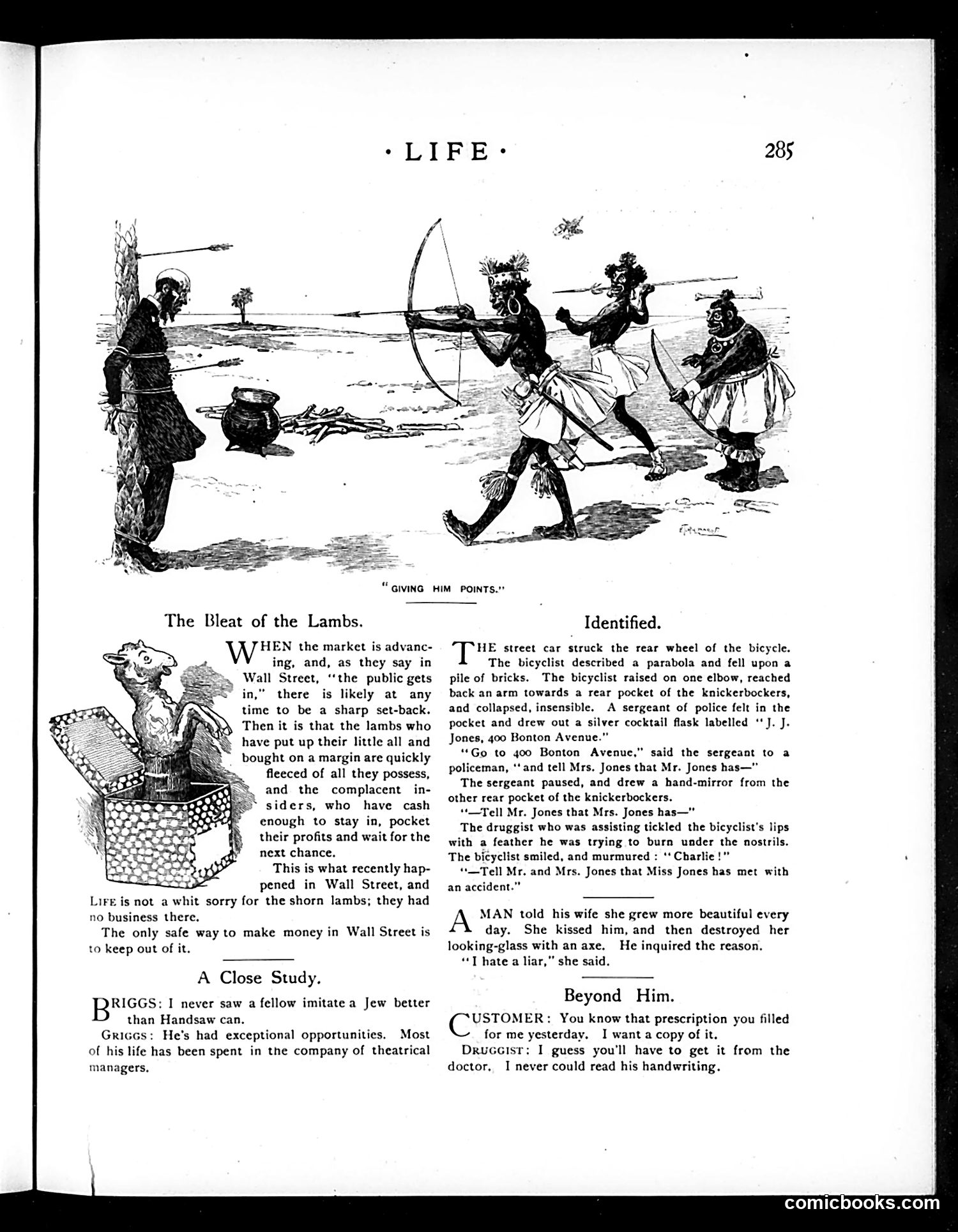
**Top Cartoon - "Giving Him Points":** This satirizes archery instruction or competition, depicting what appears to be a Native American figure being taught by a European observer. The title suggests condescension—"giving him points" implies patronizing instruction to someone presumed less skilled. This reflects early 20th-century attitudes portraying Indigenous peoples as needing "civilization" instruction from white Americans. **Text Articles Below:** The page contains three brief humor pieces: "The Bleat of the Lambs" (about Wall Street market losses), "A Close Study" (theater manager dialogue), and "Identified"/"Beyond Him" (miscellaneous brief jokes about accidents and prescriptions). The overall page mixes satirical commentary on finance and social situations with period-typical racial stereotyping imagery.
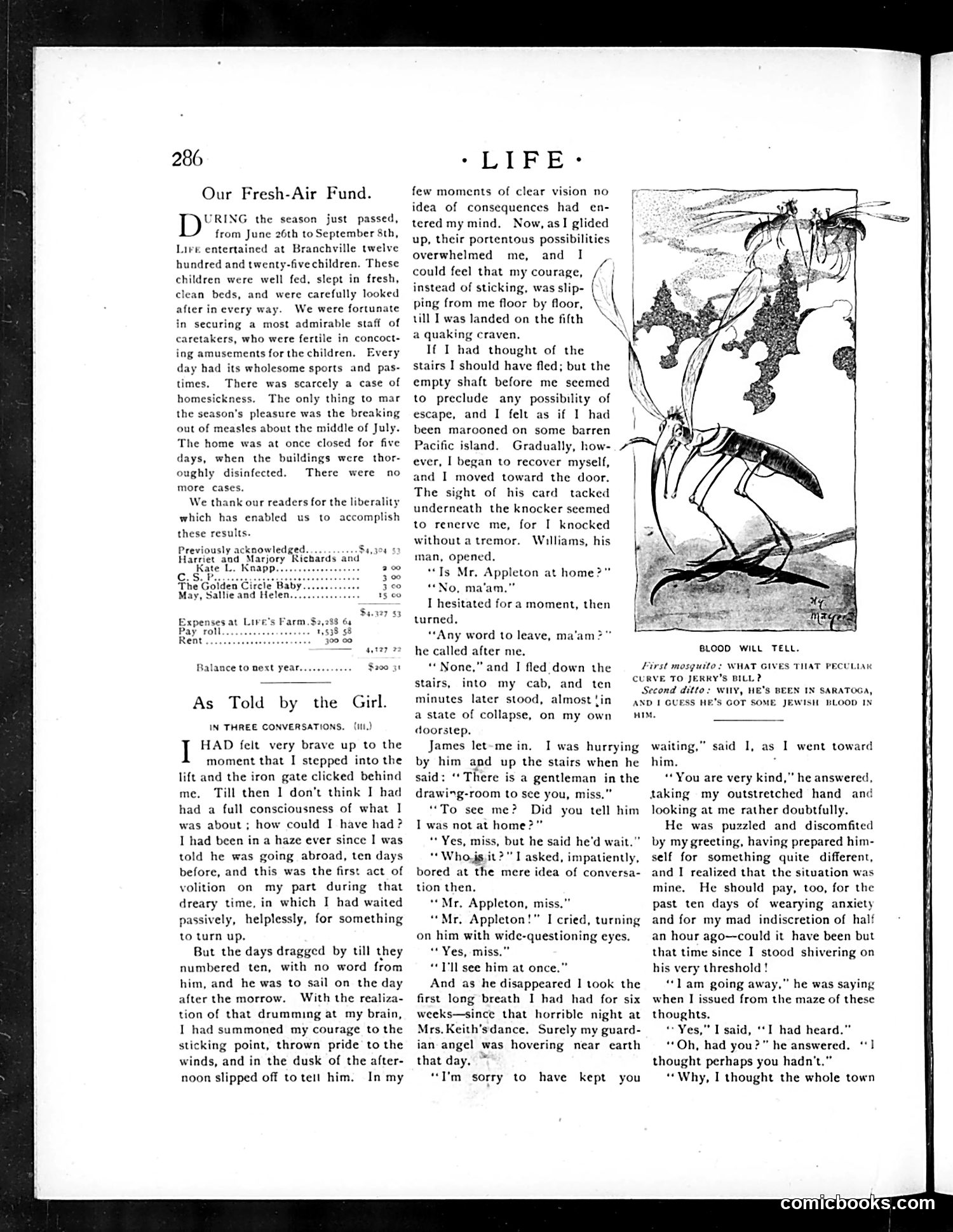
This page contains a narrative story titled "As Told by the Girl" rather than political satire. The accompanying illustration depicts a woman descending a staircase in what appears to be a dramatic moment, with the caption "Blood will tell." The caption includes a cryptic subtitle about "First mosquito" and references to "Jerry's bill" and "Saratoga," suggesting this may allude to a contemporary scandal or social situation, though the specific reference is unclear without additional context. The text describes an anxious encounter where the narrator hesitates before meeting someone, revealing emotional tension. The story explores themes of social anxiety and unspoken tension between characters rather than political commentary. This appears to be serialized fiction rather than satirical content.
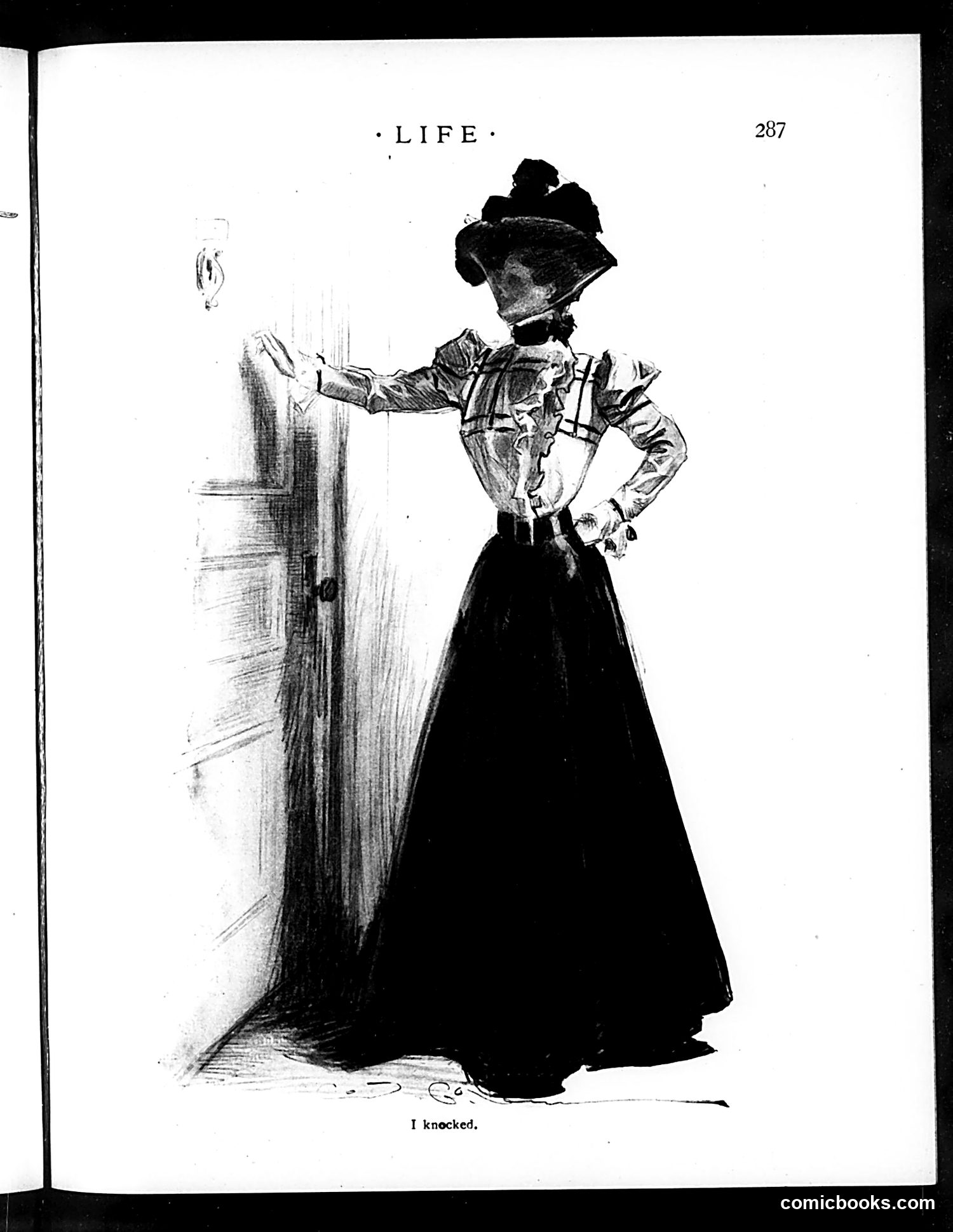
This is a single-panel illustration from Life magazine showing a fashionably dressed woman in early 1900s attire—featuring a large feathered hat, puffy-sleeved blouse with decorative elements, and a full skirt—standing at a doorway. The caption reads "I knocked." The joke appears to be about social conventions and gender roles of the era. The woman's confident posture and the simple statement "I knocked" likely satirizes either the impropriety of an unmarried woman calling on a man, or perhaps mocks the rigidity of social etiquette where such an action would require explanation or apology. The illustration style and fashion suggest this dates to the Gibson Girl era, when Life frequently published social satire about upper-class American manners and courtship customs.
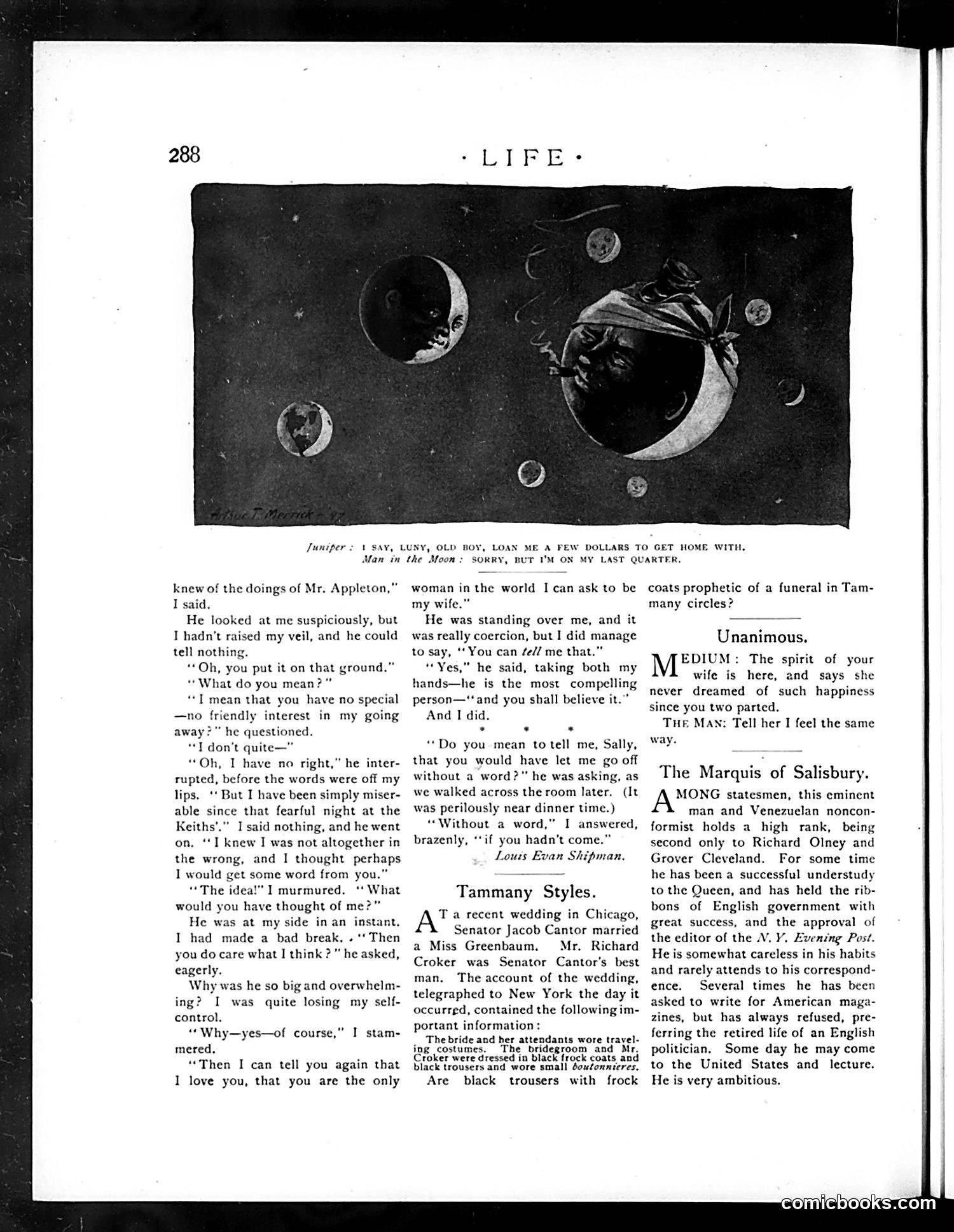
The illustration at the top depicts celestial bodies—moons and planets in space, with what appears to be a man's face incorporated into one of the larger spheres. This is likely a fantastical or whimsical illustration, possibly related to the popular "Man in the Moon" folklore or science fiction imaginings of the era. The page primarily contains serialized fiction and gossip items rather than political satire. The dialogue excerpt discusses romantic entanglement and jealousy. "Tammany Styles" section reports on a Chicago wedding involving Senator Jacob Cantor and mentions Senator Richard Croker, a Tammany Hall political figure. The final section profiles the Marquis of Salisbury, a British statesman, describing his political influence and refined but reclusive character. This appears to be a society/gossip page rather than satirical commentary.
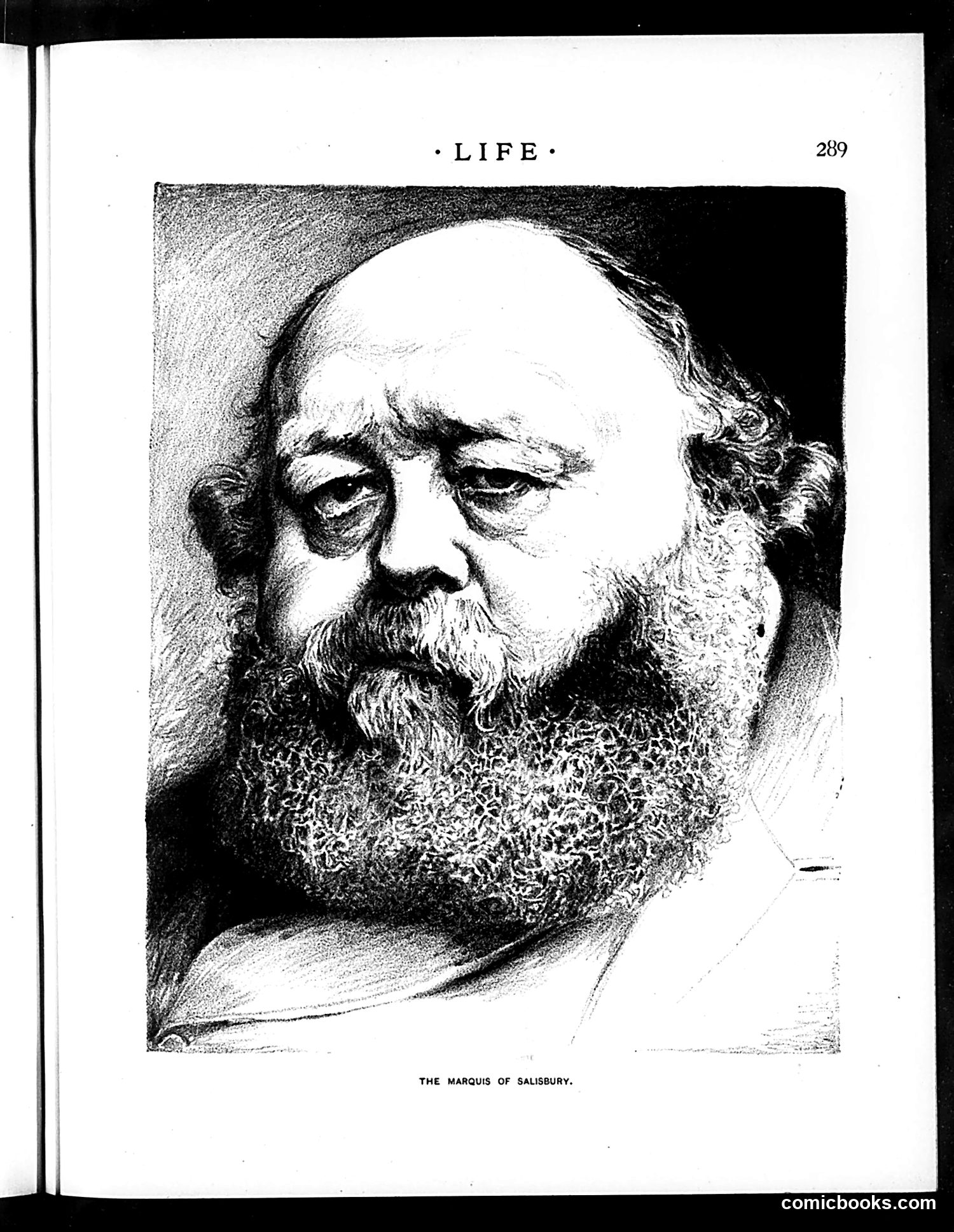
This page from *Life* magazine features a portrait labeled "The Marquis of Salisbury," a prominent British political figure of the late 19th century. The image is a detailed engraving showing an older gentleman with a full, long beard, receding hairline, and dignified expression—typical of *Life*'s serious portrait style during this period. Without additional satirical text or caricature elements visible on this page, this appears to be a straightforward biographical illustration rather than a political cartoon. *Life* regularly featured such portraits of notable international figures for its educated readership interested in current affairs and prominent personalities.
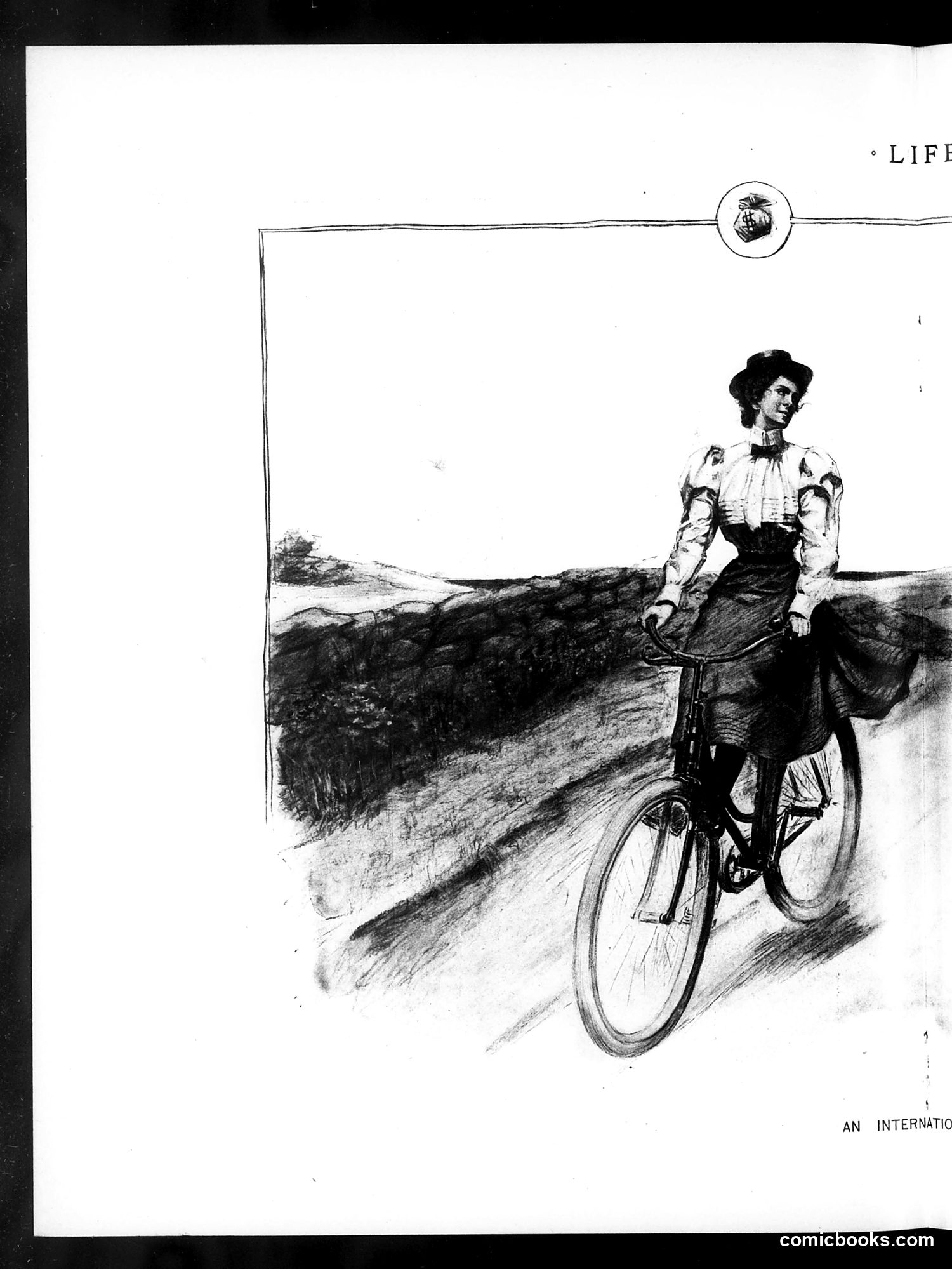
This appears to be a cover or illustration from *Life* magazine showing a woman in late 1890s attire riding a bicycle on a country road. The "LIFE" masthead is visible at top right, with partial text "AN INTERNATIO[NAL]" at bottom. The image likely satirizes the "New Woman" of the 1890s—a social figure who challenged Victorian gender norms by adopting activities like cycling, which required practical clothing (visible here as bloomers/split skirt rather than restrictive corsets). Cycling represented independence and mobility for women, making it both celebrated and controversial. The illustration's romantic, idealized tone suggests *Life* is celebrating rather than mocking this modern woman, positioning the bicycle as a symbol of female liberation during this era of social change.
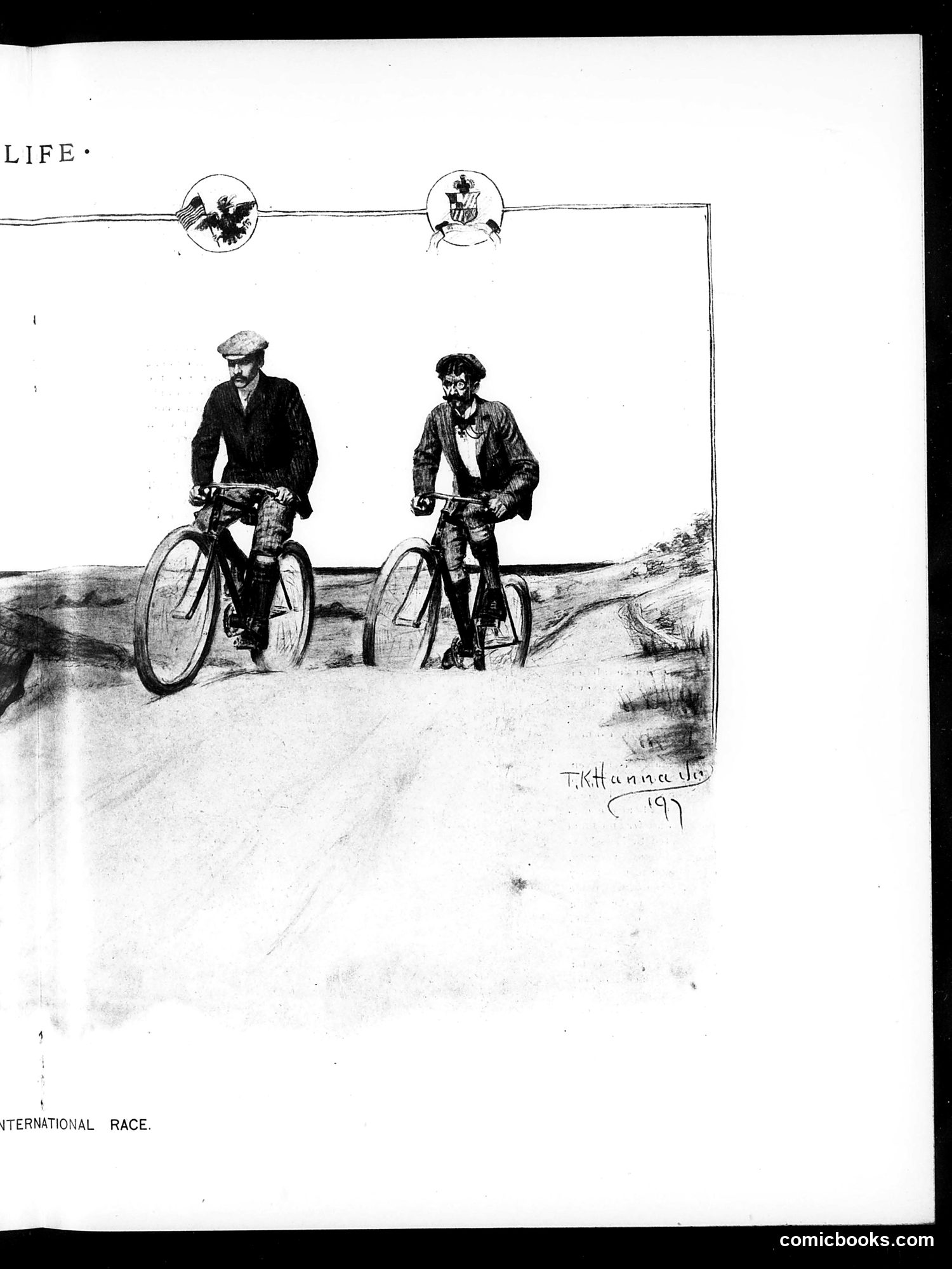
This Life magazine page shows two cyclists on a rural road beneath the heading "LIFE" and appears to be titled "INTERNATIONAL RACE" (visible at bottom). The two riders, rendered in detailed pen-and-ink style by artist T.K. Hunnah (signed lower right, dated '99), depict men in early 1900s cycling attire racing on bicycles. The small circular vignettes above show what appear to be national emblems or coats of arms, suggesting this satirizes international competition. The specific joke or satire isn't entirely clear without additional context, but the work likely comments on turn-of-the-century international rivalries or the bicycle craze that swept Western nations. The formal dress and determined expressions suggest this mocks either international athletic competition or nationalist posturing of the era.
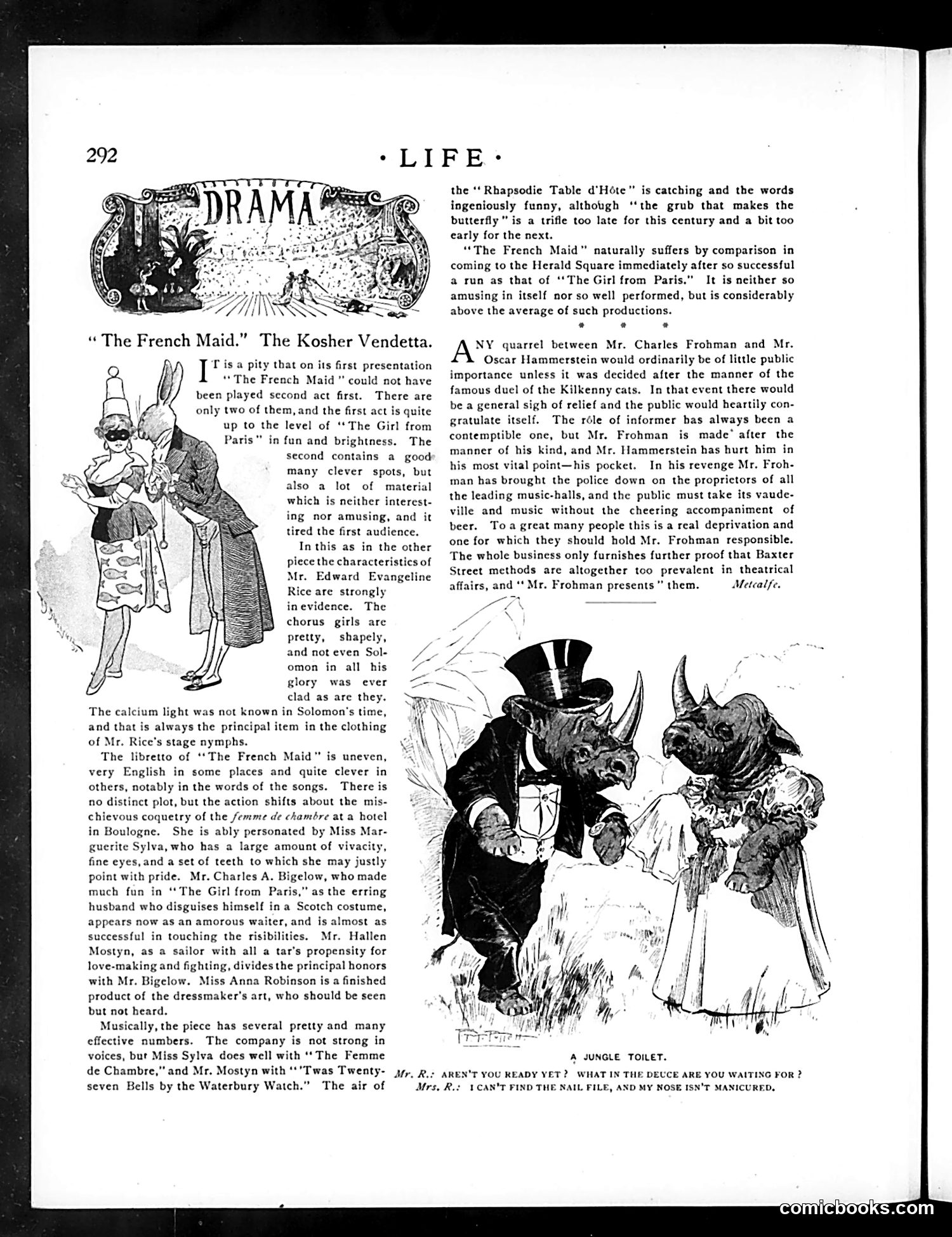
This page reviews theatrical productions, primarily "The French Maid." The main cartoon, titled "A Jungle Toilet," depicts two figures in formal dress—a man in top hat and tails confronting a woman in an elaborate gown. The dialogue references finding a nail file and manicured noses, suggesting a humorous scene about grooming or vanity in an incongruous setting (the "jungle" setting of the title). The review discusses the play's uneven libretto, performances by various actors, and musical numbers. It criticizes the company's weak voices but praises Miss Sylva's performance. The text references other theatrical pieces including "The Girl from Paris" and mentions specific performers like Charles Bigelow and Miss Anna Robinson. The satire appears directed at theatrical productions and performers of the era.
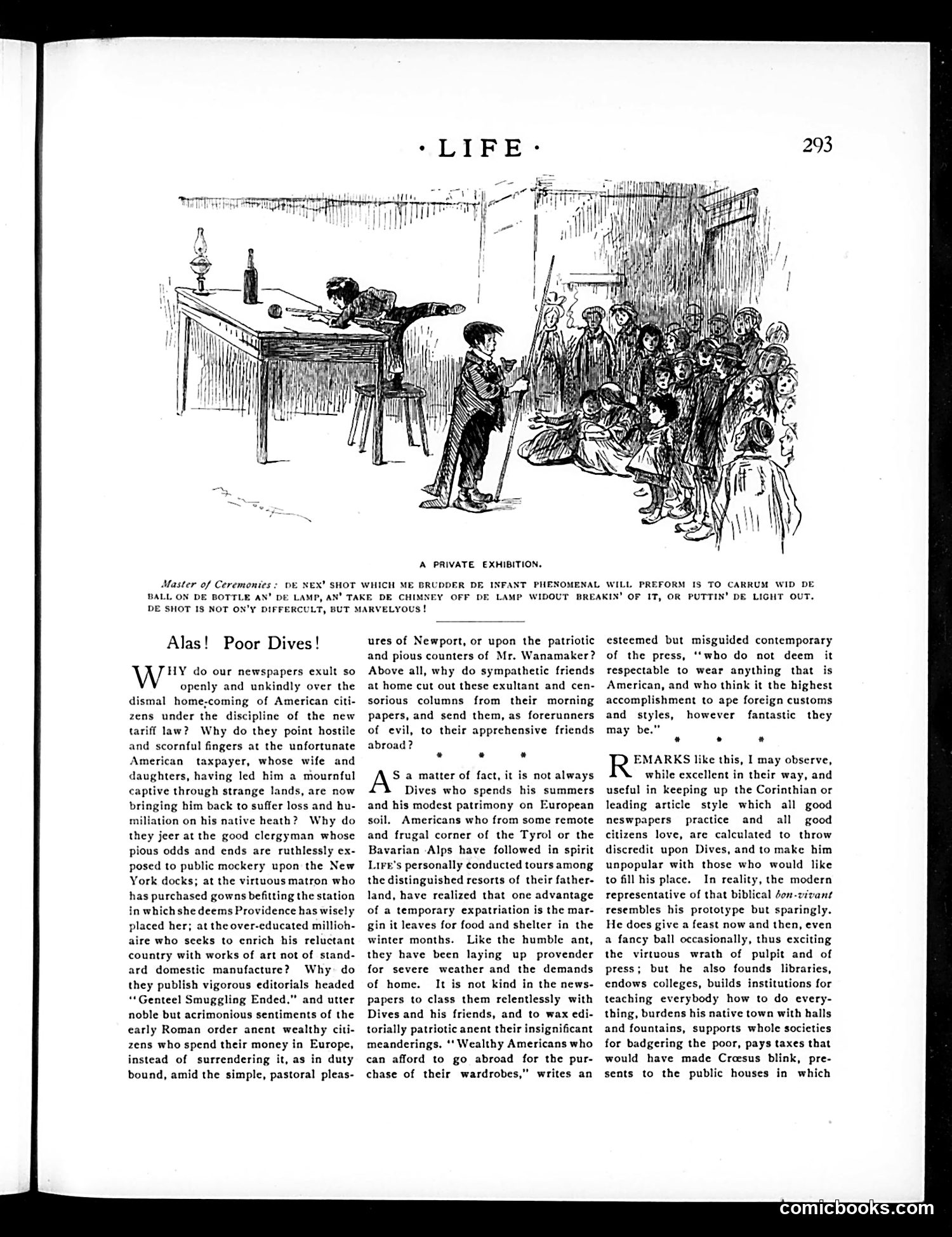
The cartoon depicts a street performer ("Master of Ceremonies") presenting a trick to a gathered crowd—balancing a ball on a bottle and lamp while removing the lamp's chimney without breaking it or extinguishing the light. The accompanying article sarcastically defends wealthy Americans ("Dives") who spend money abroad, mocking newspaper editorials that criticize them for shopping in Europe and returning with foreign goods rather than supporting domestic American commerce. The satire targets the press's self-righteous condemnation of the rich, arguing that such wealthy individuals also philanthropically fund libraries, colleges, and institutions benefiting their home communities. The "performance" likely metaphorically represents the delicate balancing act wealthy Americans must perform: enjoying luxuries abroad while maintaining respectable public appearances at home. The article defends them against what Life considers hypocritical and envious press attacks.
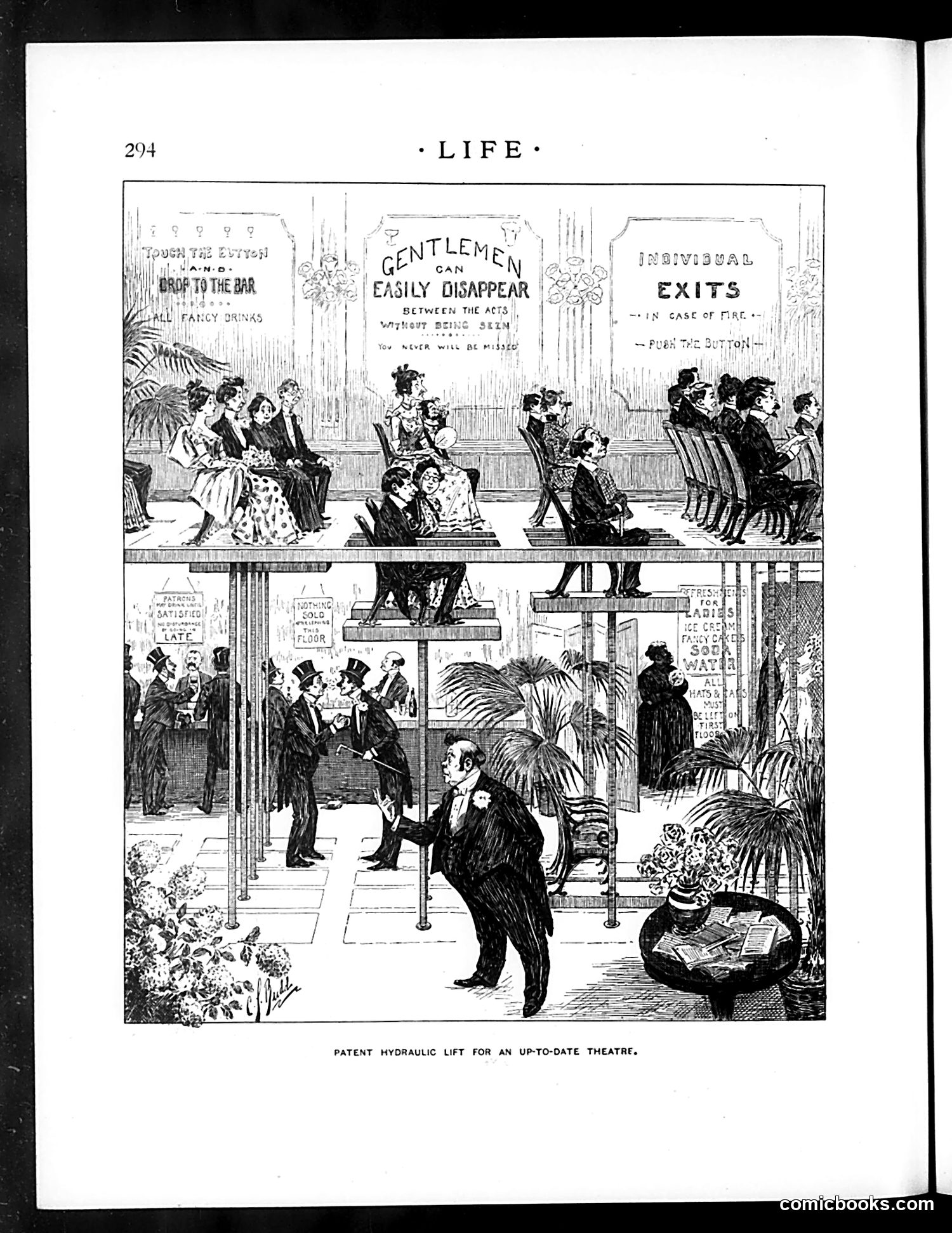
This satirical cartoon mocks a theatrical innovation—a hydraulic lift system designed to efficiently move audience members between theater levels during intermissions. The upper panel shows gentlemen disappearing between acts (the sign promises "you'll never be missed"), while the lower panel depicts the mechanical reality: a crowded, chaotic basement operation where people are literally being hydraulically lowered and raised like cargo. The satire targets the absurdity of applying industrial mechanization to human comfort and theater-going. The contrast between the promised convenience (fancy drinks, smooth exits) and the undignified reality of being pumped up and down like machinery exposes the hubris of modern "progress." The joke hinges on the ridiculous notion that patrons would accept being treated as mechanical objects for efficiency's sake.
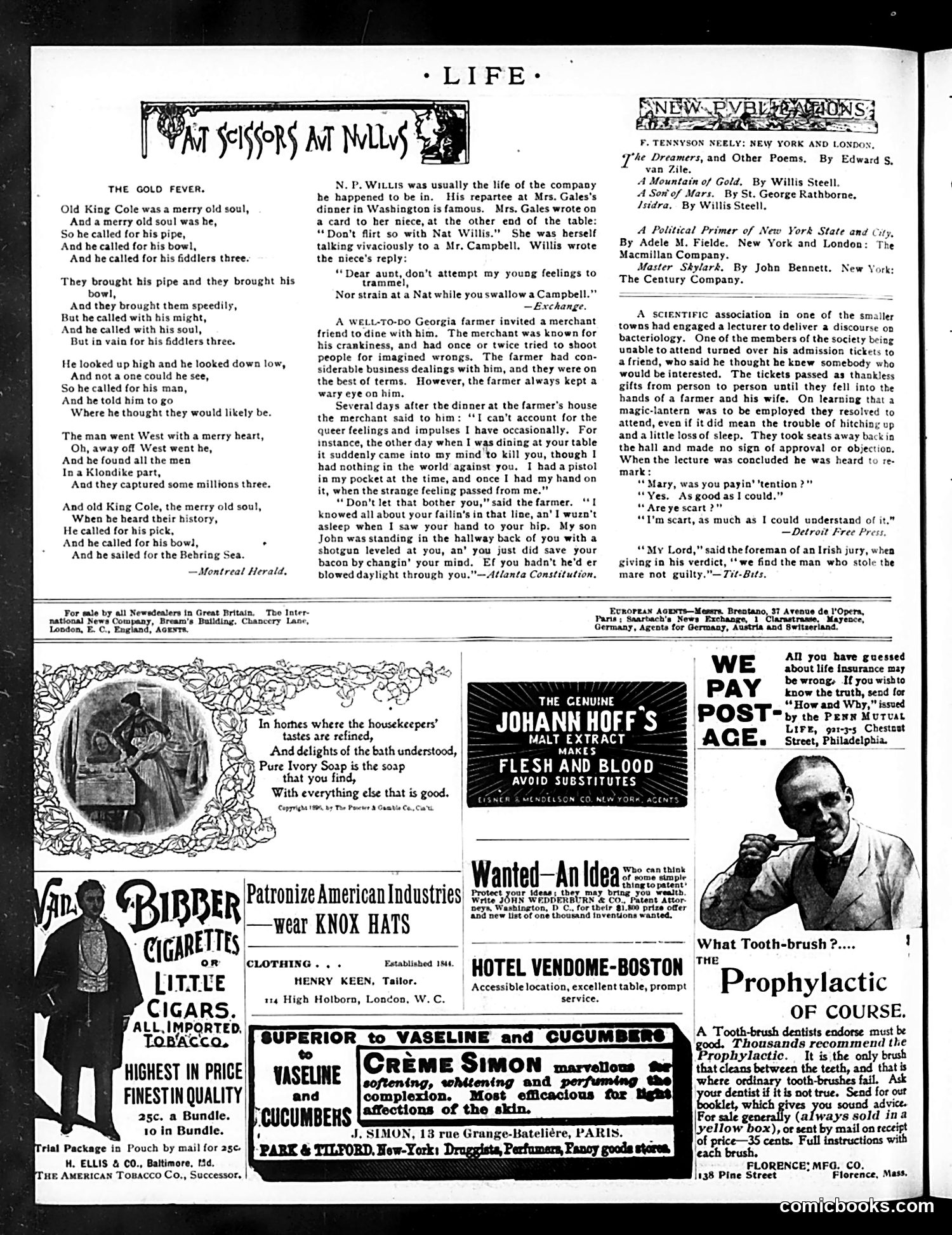
This page from the satirical magazine *Life* combines poetry, humor columns, and advertisements typical of the era. **"The Gold Fever"** poem (top left) mocks the Klondike Gold Rush by reworking the nursery rhyme "Old King Cole." The joke: King Cole searches for entertainers but finds everyone has abandoned civilization for gold prospecting in the Klondike region. The farmer and merchant anecdotes below offer dry humor about regional American characters—one featuring Southern dialect and frontier justice, another satirizing a merchant's violent impulses. **The advertisements** (bottom half) are period pieces reflecting consumer goods: tobacco products, clothing, soap, and dubious patent medicines like "Creme Simon" and "Prophylactic" toothbrushes—typical of early 1900s marketing claims. The overall page reflects *Life*'s satirical approach: mocking contemporary phenomena (the Gold Rush craze) while publishing genteel humor pieces and carrying ads that themselves often became subjects of gentle mockery in the magazine.
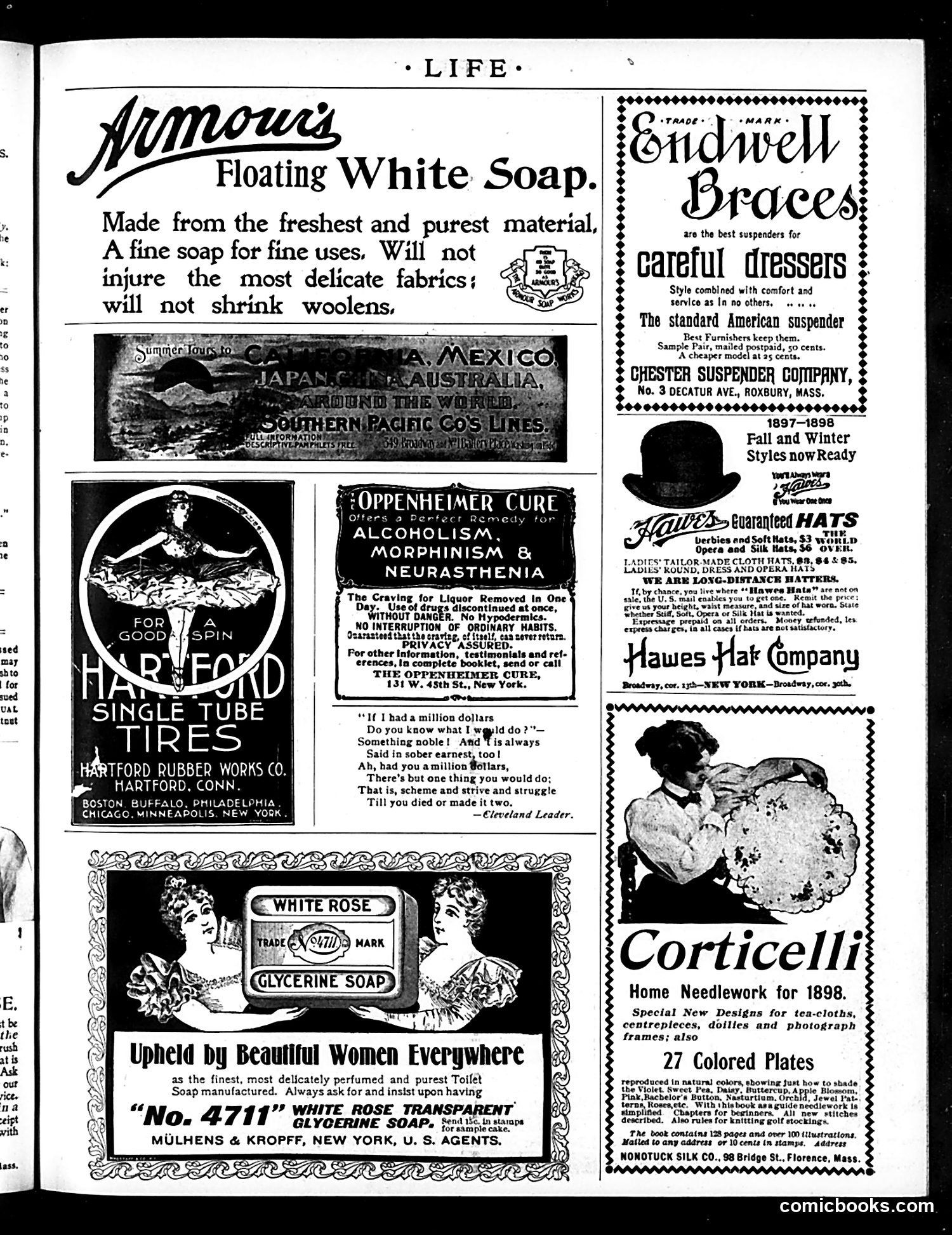
This is primarily an **advertising page**, not a satirical cartoon page. However, one item warrants note: The **Cleveland Leader quotation** presents mild social satire about wealth and ambition. It mocks the cliché that if someone suddenly acquired a million dollars, they'd do "something noble." The joke's punchline—that they'd actually just scheme to double it—reflects late-19th-century skepticism about the moral character of the wealthy and their stated philanthropic intentions. This likely resonates with ongoing debates about robber barons and industrial wealth accumulation during the Gilded Age. The remainder of the page consists of advertisements for mundane consumer goods: soaps, tires, suspenders, hats, needlework instruction, and (notably) the **Oppenheimer Cure**—a quack medical treatment claiming to eliminate alcoholism and morphine addiction in one day without withdrawal symptoms. This pseudo-medical advertisement is historically significant as evidence of widespread patent medicine fraud in this era.
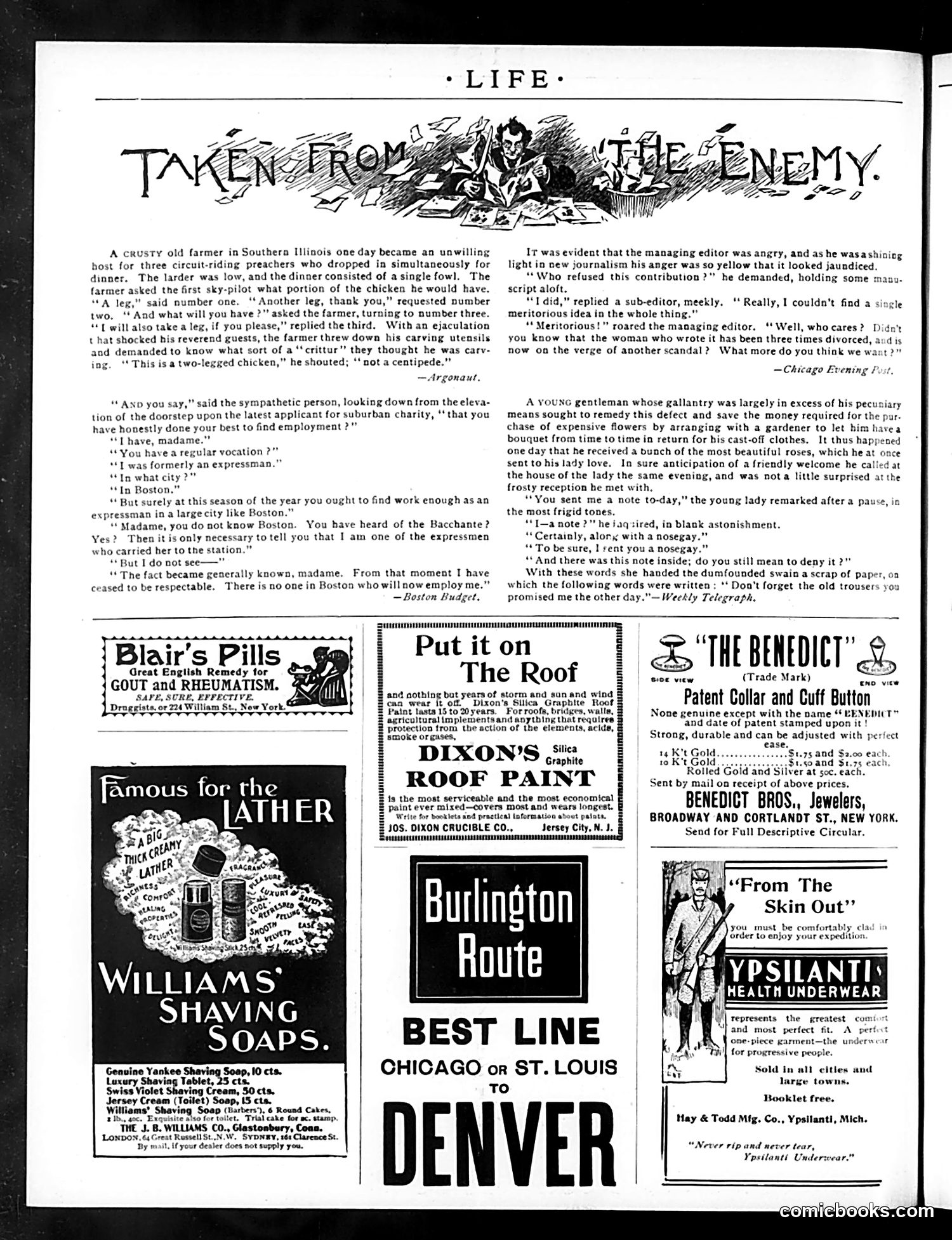
This page contains four humorous anecdotes mocking social pretense and hypocrisy: 1. **The Farmer and Preachers**: A farmer frustrated by three clergy demanding chicken legs, exposing their greed despite religious vows. 2. **The Unemployed Expressman**: A Boston charity applicant ruined professionally after being associated with transporting the "Bacchante" (likely a scandal-linked statue or person), satirizing how arbitrary social shame destroys respectability. 3. **The Managing Editor**: A newspaper editor praising a terrible manuscript solely because the (divorced) female author has scandal value—mocking yellow journalism's exploitation of sensationalism over quality. 4. **The Romantic Fraud**: A young man sending cast-off clothes disguised as flower purchases, exposed when a note from the gardener arrives requesting "the old trousers"—ridiculing romantic deception and economic desperation. All four stories ridicule hypocrisy, false respectability, and social pretense among different classes. The page is primarily text-based satirical humor with period advertisements below.
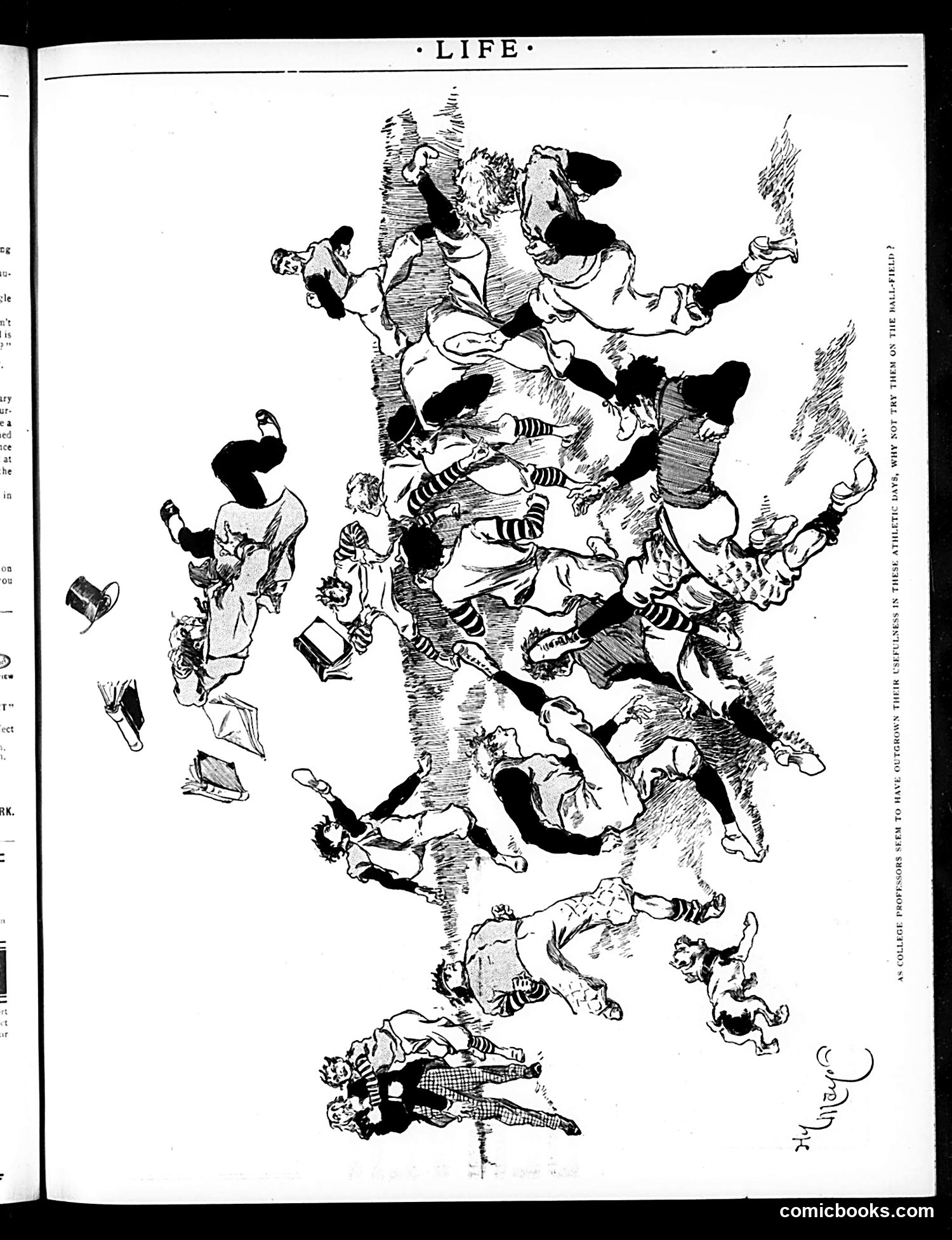
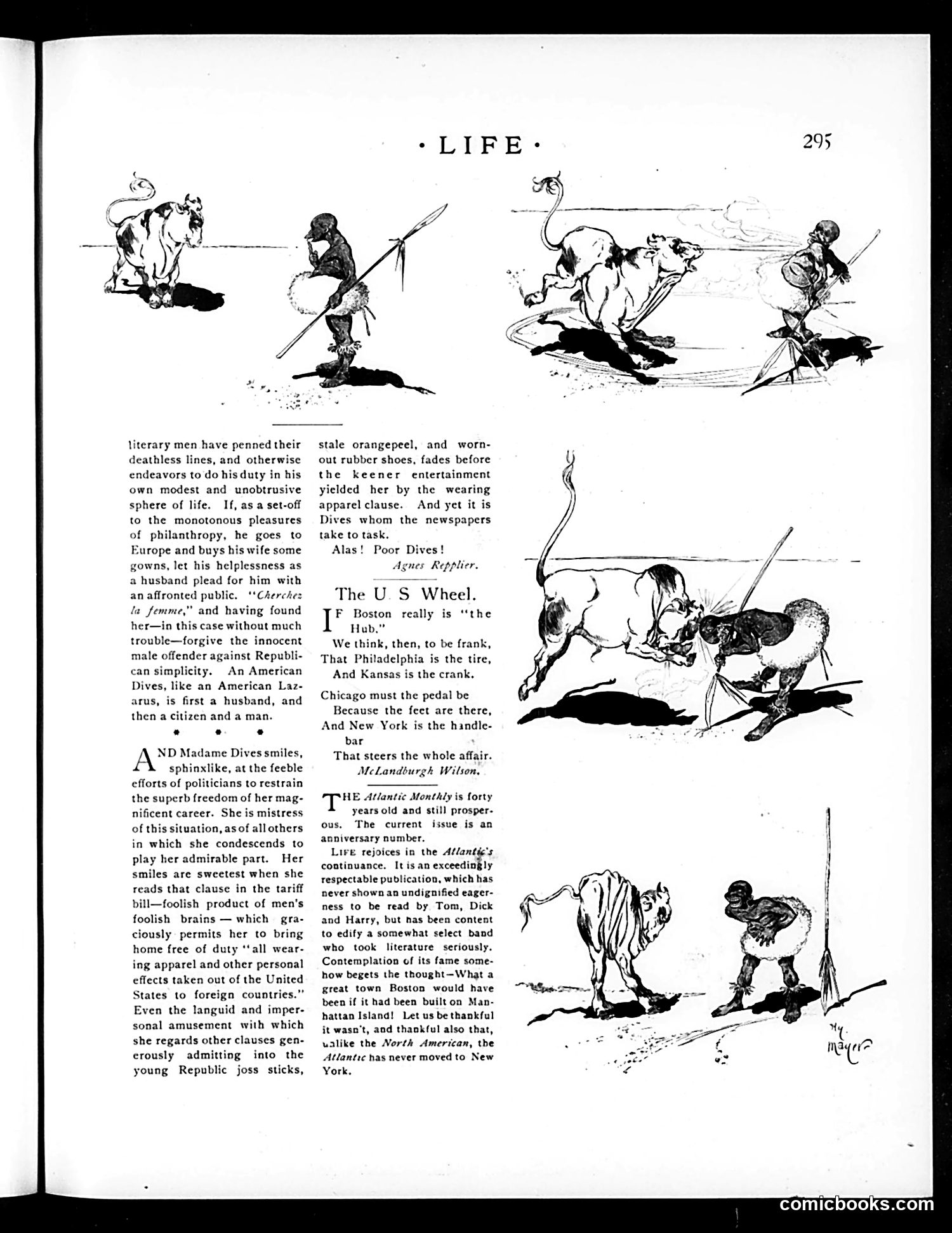
This appears to be a satirical cartoon from *Life* magazine depicting chaos or disorder, possibly representing political or social turmoil. The illustration shows numerous figures in disarray around what resembles a tree or central structure, with scattered objects and people in various states of commotion. Without legible OCR text accompanying the image, I cannot definitively identify the specific figures, historical event, or political figures being caricatured. The style and composition suggest commentary on either political infighting, social upheaval, or institutional dysfunction—common *Life* magazine satirical subjects from the early-to-mid 20th century. To provide accurate historical context and identify specific references, I would need either clearer text or additional publication details (date, caption, or title) visible on the page.
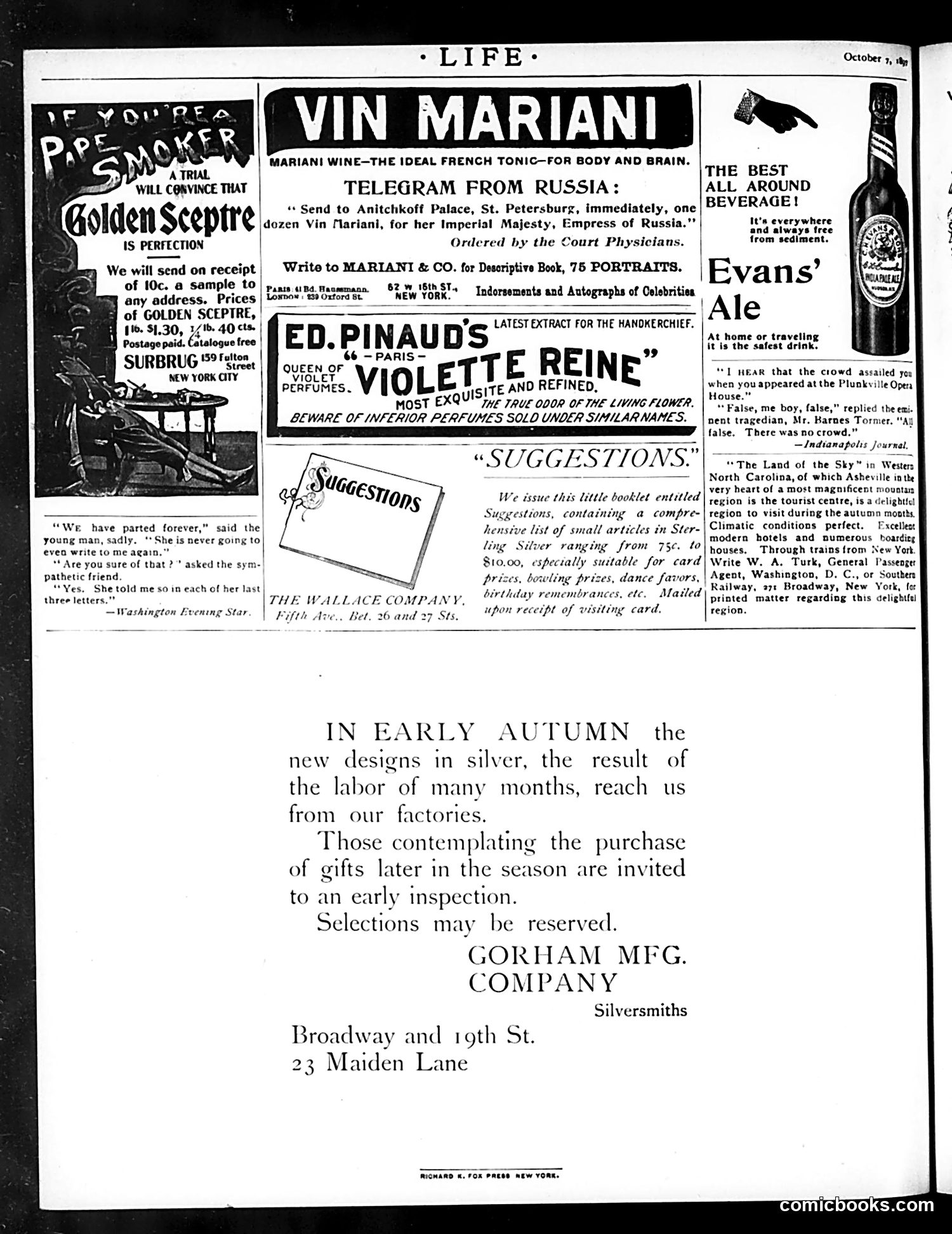
This page is primarily **advertising**, with brief satirical content. Key elements: **Main Advertisements:** - **Vin Mariani**: A French wine tonic claiming health benefits, marketed with a fake "telegram from Russia" claiming the Empress ordered it. This exploits celebrity endorsement culture. - **Golden Sceptre Smoker**: Cigarette sample offer - **Ed. Pinaud's Violette Reine**: Perfume marketed as superior to inferior knockoffs - **Evans' Ale**: Positioned as the best beverage - **Gorham Manufacturing**: Silverware company **Satirical Content:** Two brief jokes appear: 1. A young man claims his lover "will never write" again—but she already told him so "in each of her last three letters" (ironic contradiction) 2. A theater anecdote about a man claiming he was assailed by crowds at an event, contradicted as false The page exemplifies **late-19th-century advertising tactics**: fake endorsements, dubious health claims, and celebrity appeal. The satirical elements mock romantic melodrama and social pretension common in period humor.