
A complete issue · 20 pages · 1897
Life — July 29, 1897
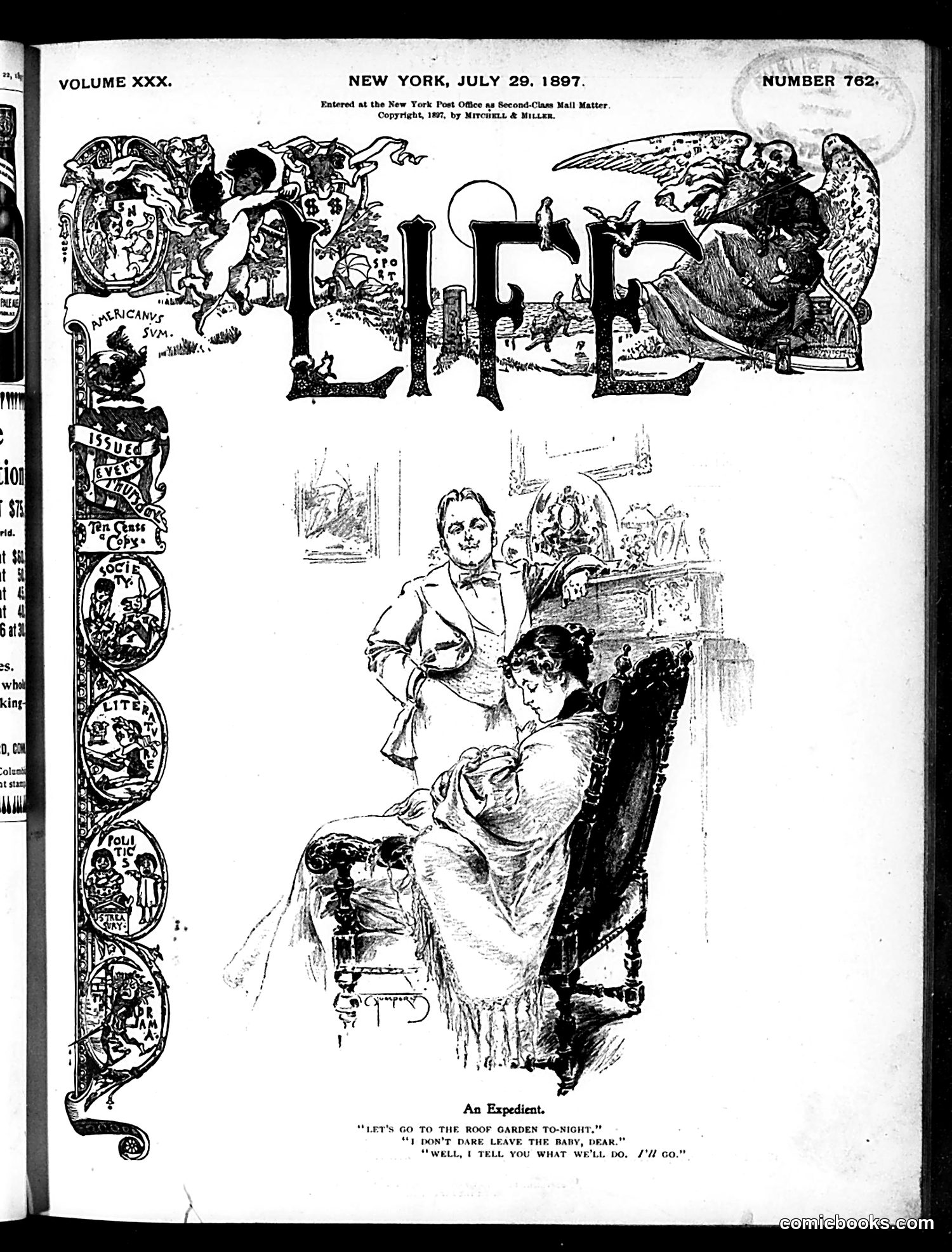
This cartoon satirizes marital dynamics through a domestic scene. A man stands confidently while his wife sits, and he proposes taking her to the roof garden at night. When she objects that they can't leave the baby alone, he dismisses her concern, saying "I tell you what we'll do. I'll go." The satire mocks male self-centeredness in marriage: the husband frames his solo outing as a solution to her dilemma rather than actually solving anything. He's essentially saying he'll go to the roof garden without her—leaving her with the baby regardless. It's a joke about husbands' creative excuses to do what they want while appearing to address their wives' concerns.
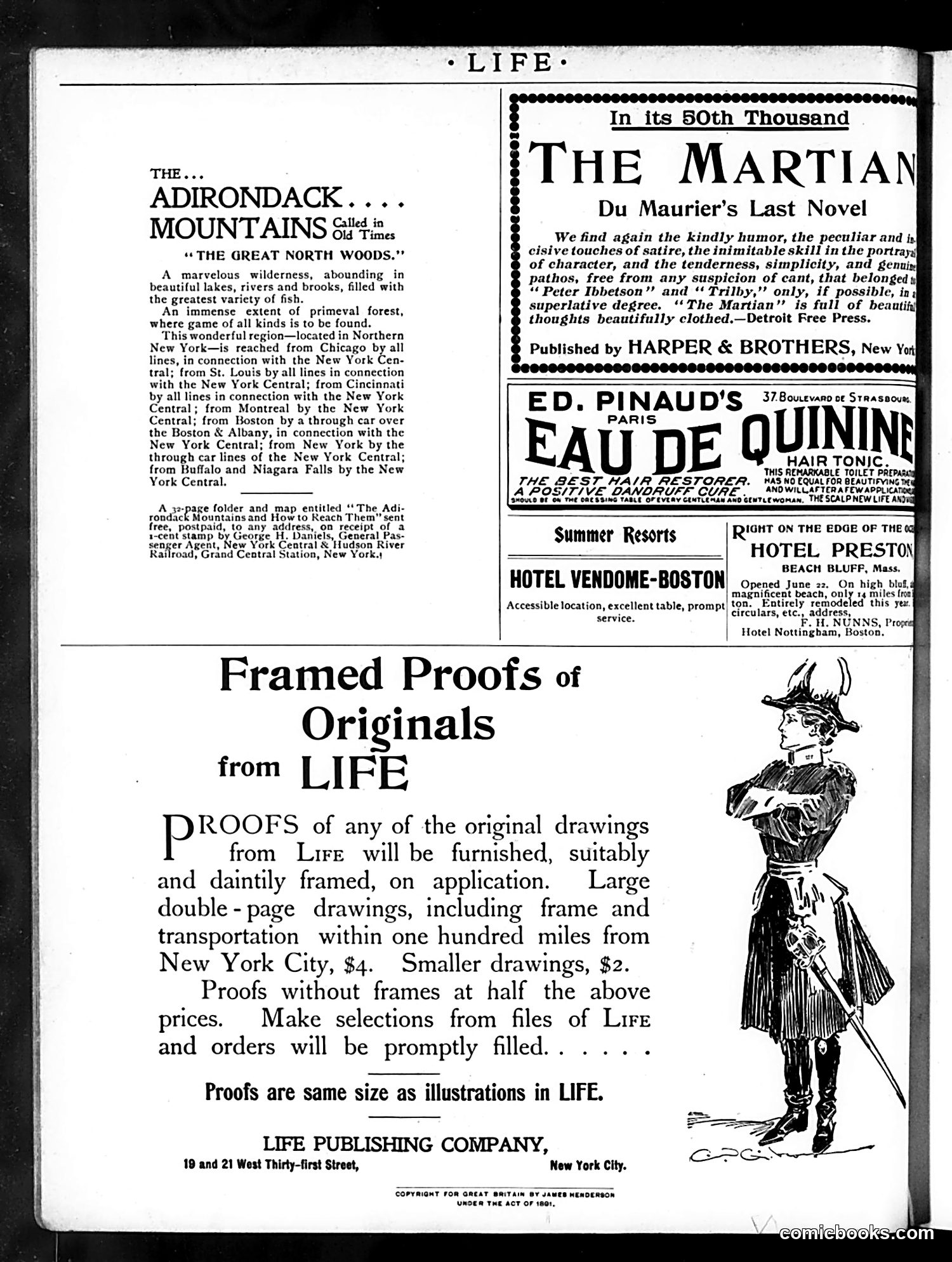
This page is primarily **advertising and promotional content** rather than satirical cartoons. The main elements are: 1. **Travel advertisement** for the Adirondack Mountains, describing accessible rail routes from major Eastern cities 2. **Book advertisement** for "The Martian," described as Du Maurier's last novel, published by Harper & Brothers 3. **Hair tonic advertisement** for "Eau de Quinine" from Paris 4. **Summer resort ads** for hotels in Boston and Beach Bluff, Massachusetts 5. **Service announcement** promoting framed proofs of original LIFE magazine drawings available for purchase The illustrated figure on the right appears to be a fashionable woman in period dress, likely serving as decorative branding for the publication rather than political satire. The page reflects early 20th-century magazine economics: advertising revenue subsidized editorial content.
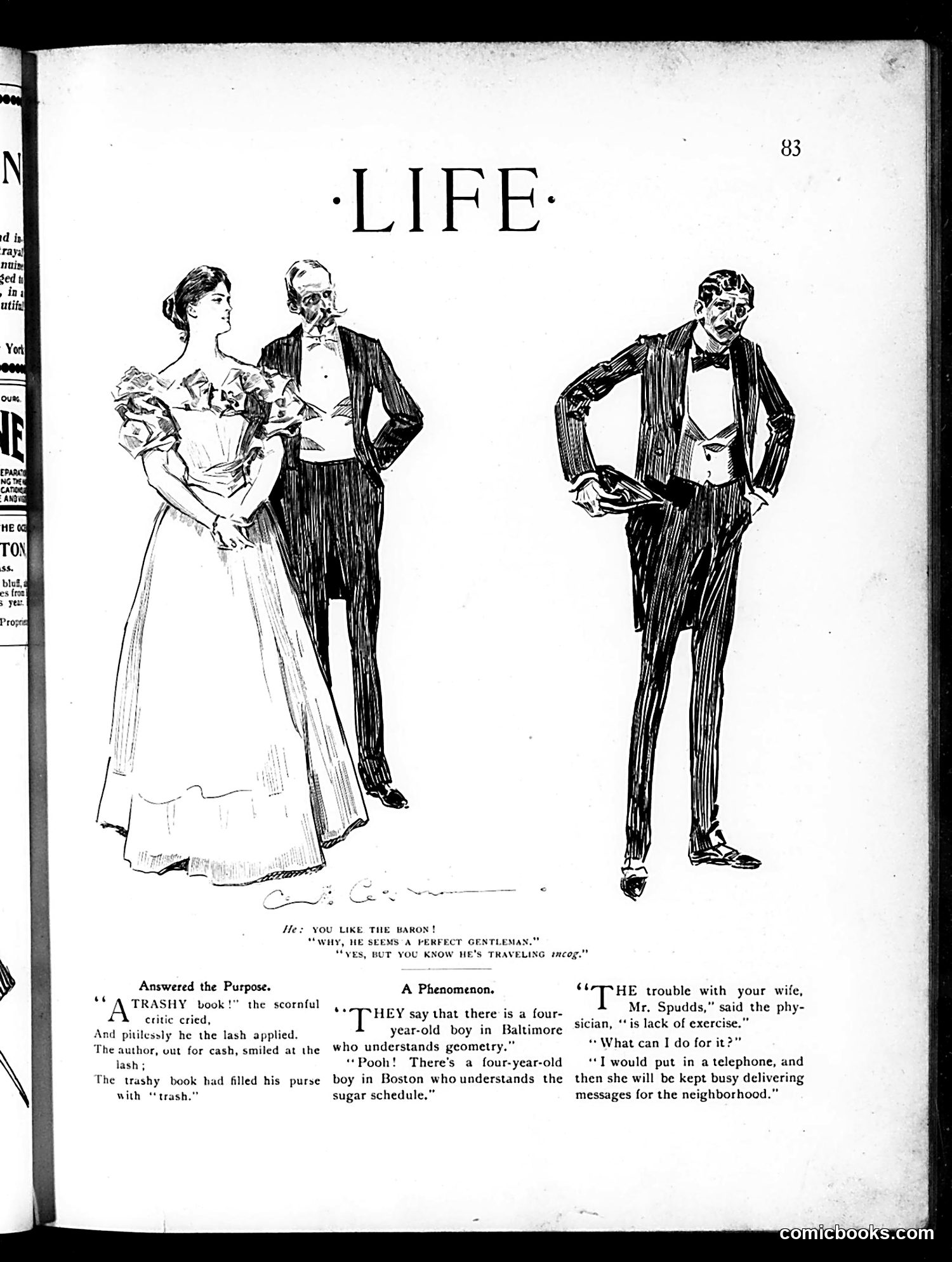
This page contains three separate jokes typical of early 20th-century satirical humor. **Top illustration**: Shows a couple with a man remarking on another man's traveling habits. The joke plays on the phrase "traveling incog" (incognito)—suggesting the man travels secretly, possibly implying infidelity or impropriety. **"Answered the Purpose"**: Mocks a scornful critic who dismisses a trashy book as "trash," yet admits the author succeeded financially—satirizing the gap between literary merit and commercial success. **"A Phenomenon"**: Jokes about a precocious four-year-old understanding geometry or sugar schedules—absurdist humor mocking child prodigies or inflated claims about children's intelligence. **"The Trouble with Your Wife"**: A physician suggests the solution to a sedentary wife is working as a telephone operator delivering neighborhood messages—satire on women's prescribed domestic roles and emerging work opportunities.
This page contains three distinct sections with minimal visual satire. The main cartoon at top left, titled "Where is Life there's Hope," depicts what appears to be a scraggly figure—likely representing struggle or hardship—though details are unclear from the image quality. The remainder consists of three serious opinion pieces: "The Sherman Dispatch" (criticizing British government's seal-fishing policies), "Some Favorable Signs" (discussing agricultural recovery in western states), and "The Summer School" (advocating educational value of summer programs). The small illustrations—sheep and cattle—appear decorative rather than satirical. This page emphasizes editorial commentary over visual humor, making it primarily a text-driven discussion of contemporary political and social issues circa early 1900s.
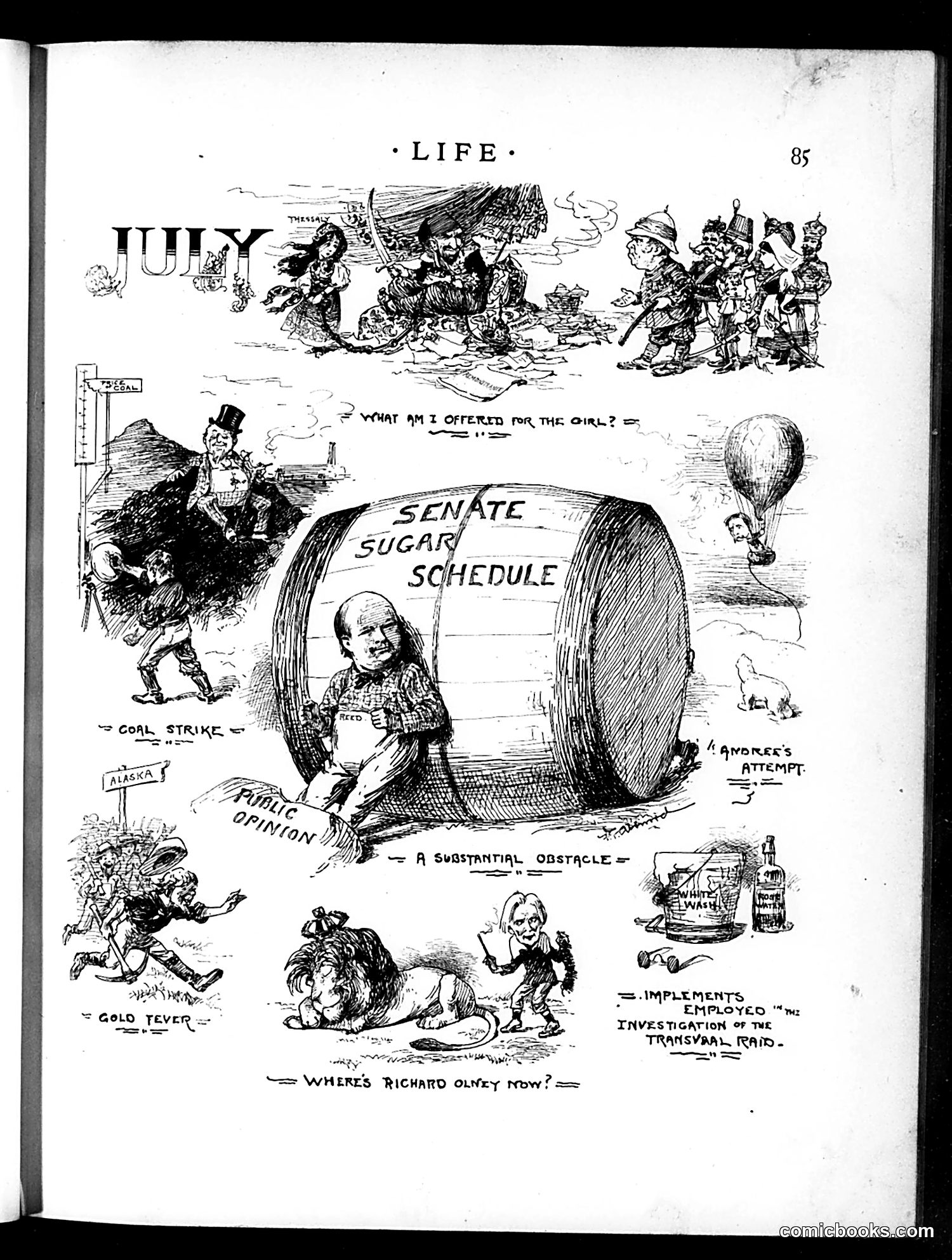
This page features multiple satirical vignettes commenting on early 20th-century American politics and social issues. The central image depicts a large barrel labeled "Senate Sugar Schedule" as "A Substantial Obstacle," suggesting Senate protectionist policies on sugar were impeding progress. The surrounding sketches reference specific contemporary events: "Coal Strike," "Gold Fever," "Alaska," and "Gold Fever" appear to address labor disputes and resource conflicts of the era. One panel asks "What am I offered for the girl?" indicating commentary on commodification or exploitation. Another references "Amoree's Attempt" and a "Transvaal Raid," likely alluding to international conflicts. The final line asks "Where's Richard Olney now?"—presumably referencing a contemporary political figure—suggesting he's conspicuously absent from addressing these crises. The cartoonist criticizes governmental inaction on multiple pressing issues.
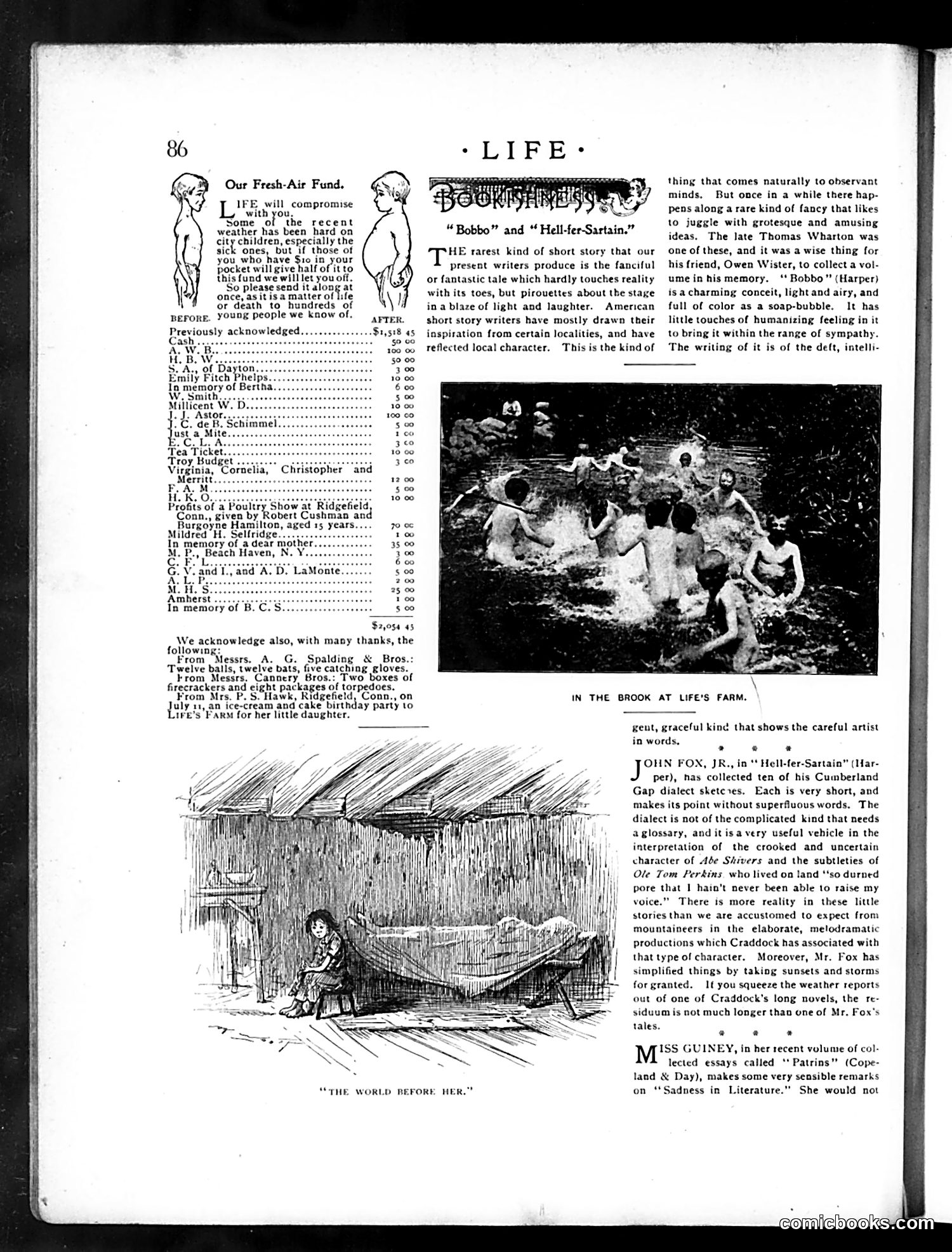
This page contains literary criticism rather than political satire. The upper section discusses "Bobbo" and "Hell-fer-Sartain"—short story collections praised for their fantastical, whimsical qualities and use of local American characters. The critic notes these stories represent a rare, valuable approach in contemporary literature. The two illustrations are literary—the top photograph shows "In the Brook at Life's Farm," while the lower sketch titled "The World Before Her" appears to depict a domestic or rural scene, likely illustrating one of the discussed stories. The left column lists financial contributions to LIFE's "Fresh-Air Fund," a charitable program providing outdoor experiences for urban youth. This was a genuine philanthropic effort, not satire. The page demonstrates LIFE's dual function as both humor magazine and literary arbiter.
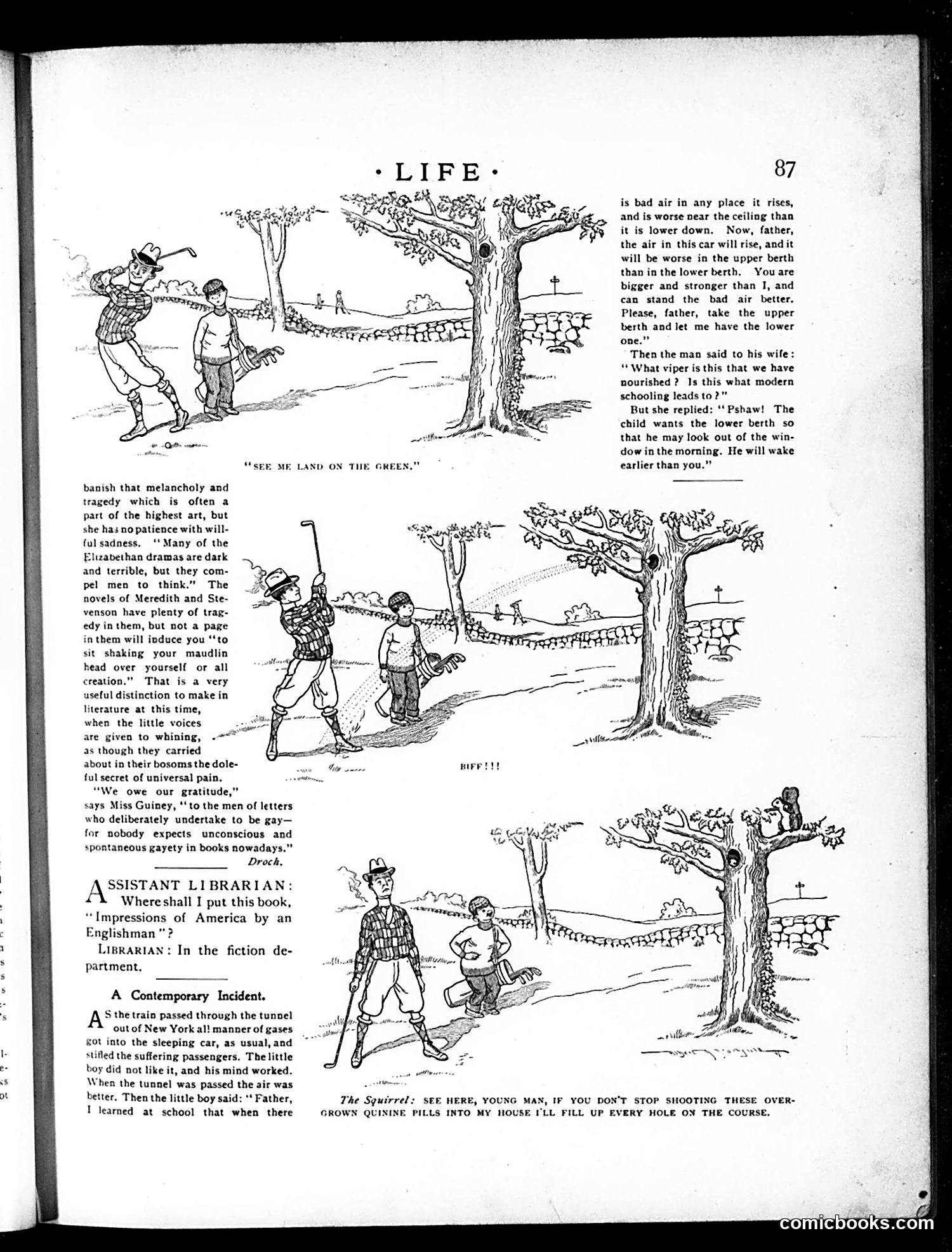
This page contains humorous vignettes rather than political cartoons. The main illustrations show children playing golf and baseball near a large tree, with dialogue about proper berth selection on trains and complaints about "modern schooling." The satire targets **early 20th-century parenting anxieties**: parents debating practical matters (upper vs. lower berths) while children prioritize comfort and outdoor play. A recurring joke involves a squirrel threatening to fill golf holes with quinine pills if shooting doesn't stop—absurdist animal humor typical of the era. The text sections include commentary on literature and an "Assistant Librarian" question about book placement, reflecting contemporary intellectual concerns. The overall tone mocks both pedantic adults and the gap between educational theory and children's actual interests.
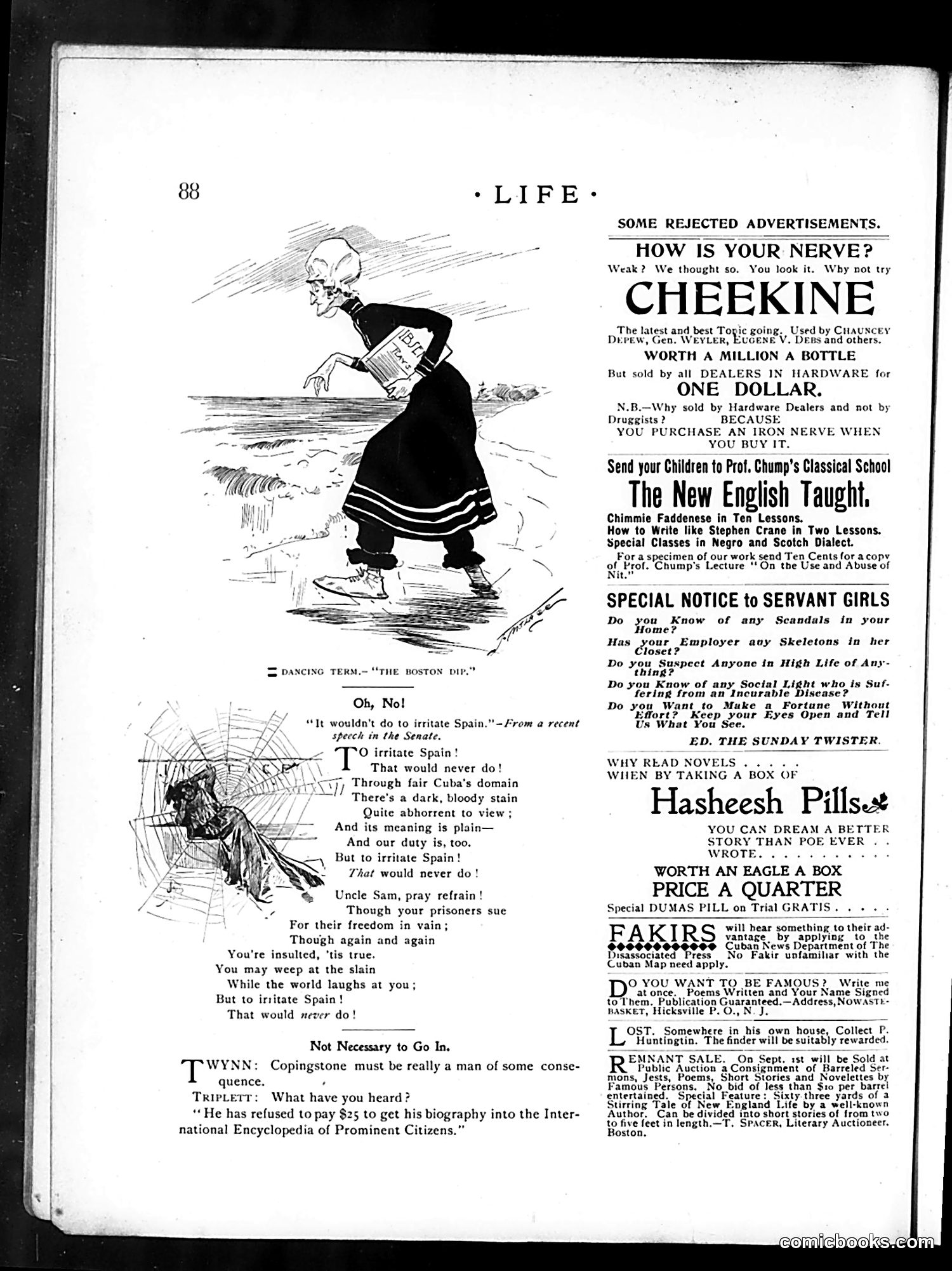
This page is primarily **advertising and satirical notices** rather than a coherent political cartoon. The main illustration shows a skeletal figure labeled "Dancing Term: 'The Boston Dip'"—likely mocking a contemporary dance craze. Below is a poem titled "Oh, No!" addressing Spain, referencing Cuba's independence struggle and American intervention concerns. The right column contains mock advertisements and notices, including fake remedies ("Hasheesh Pills," "Fakirs") and humorous classifieds. One notable piece, "Special Notice to Servant Girls," satirizes sensationalist journalism by parodying breathless scandal-mongering typical of the era's penny press. Overall, the page satirizes American popular culture, medical quackery, and yellow journalism—common Life magazine targets of the period.
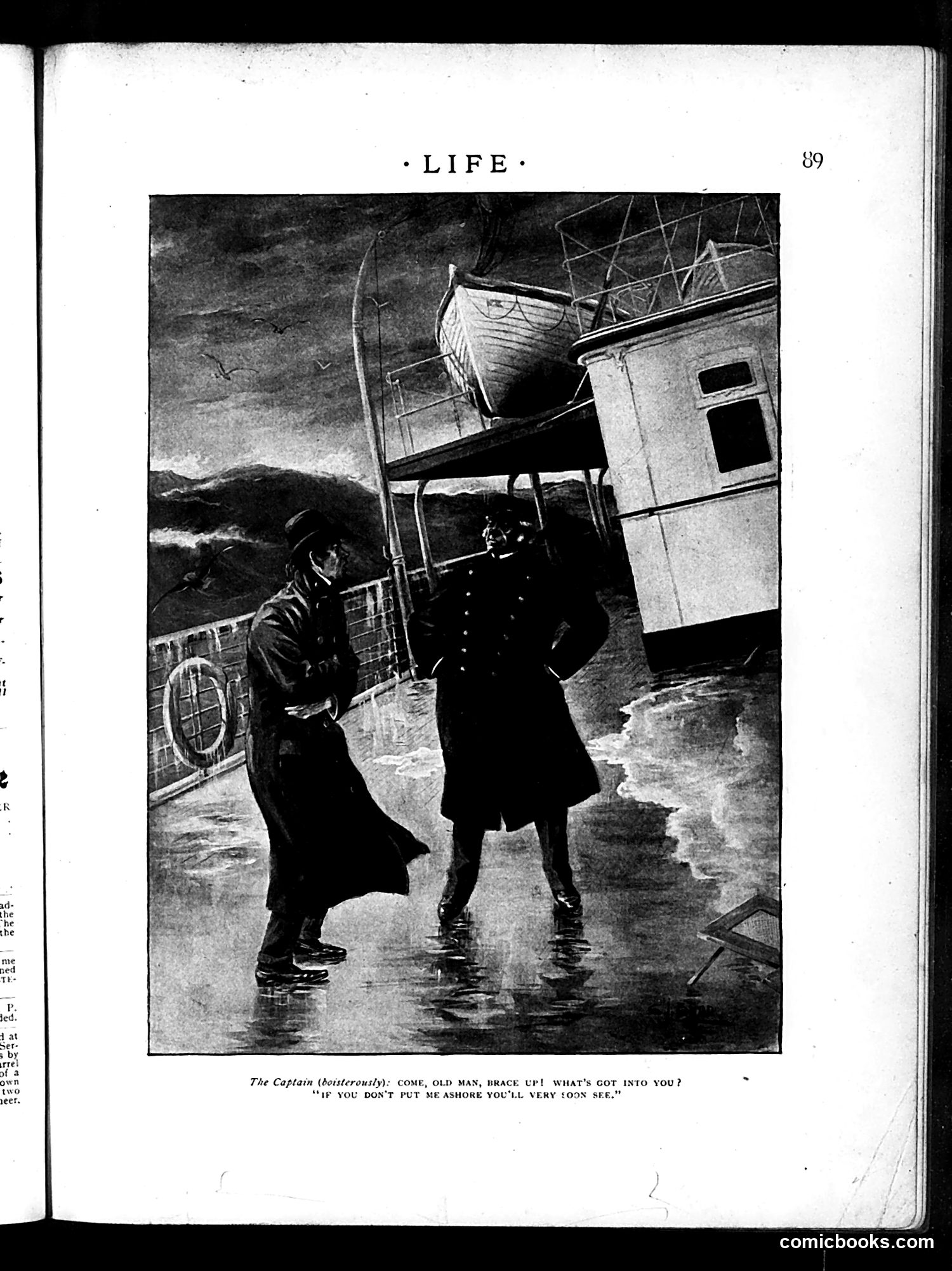
This page from *Life* magazine shows a dramatic scene set aboard a ship during what appears to be stormy or wet conditions. Two figures in dark coats stand on a wet deck near a small cabin structure and moored boat. The caption reads: "The Captain (boisterously): 'COME, OLD MAN, BRACE UP! WHAT'S GOT INTO YOU?' 'IF YOU DON'T PUT ME ASHORE YOU'LL VERY SOON SEE.'" The humor appears to be a visual gag about seasickness. The "old man" (likely a passenger) is threatening to vomit on the captain unless put ashore immediately. The captain's cheerful obliviousness contrasts with the passenger's obvious physical distress—a common comedic setup in early 20th-century humor about maritime travel and the discomforts of ocean voyages.
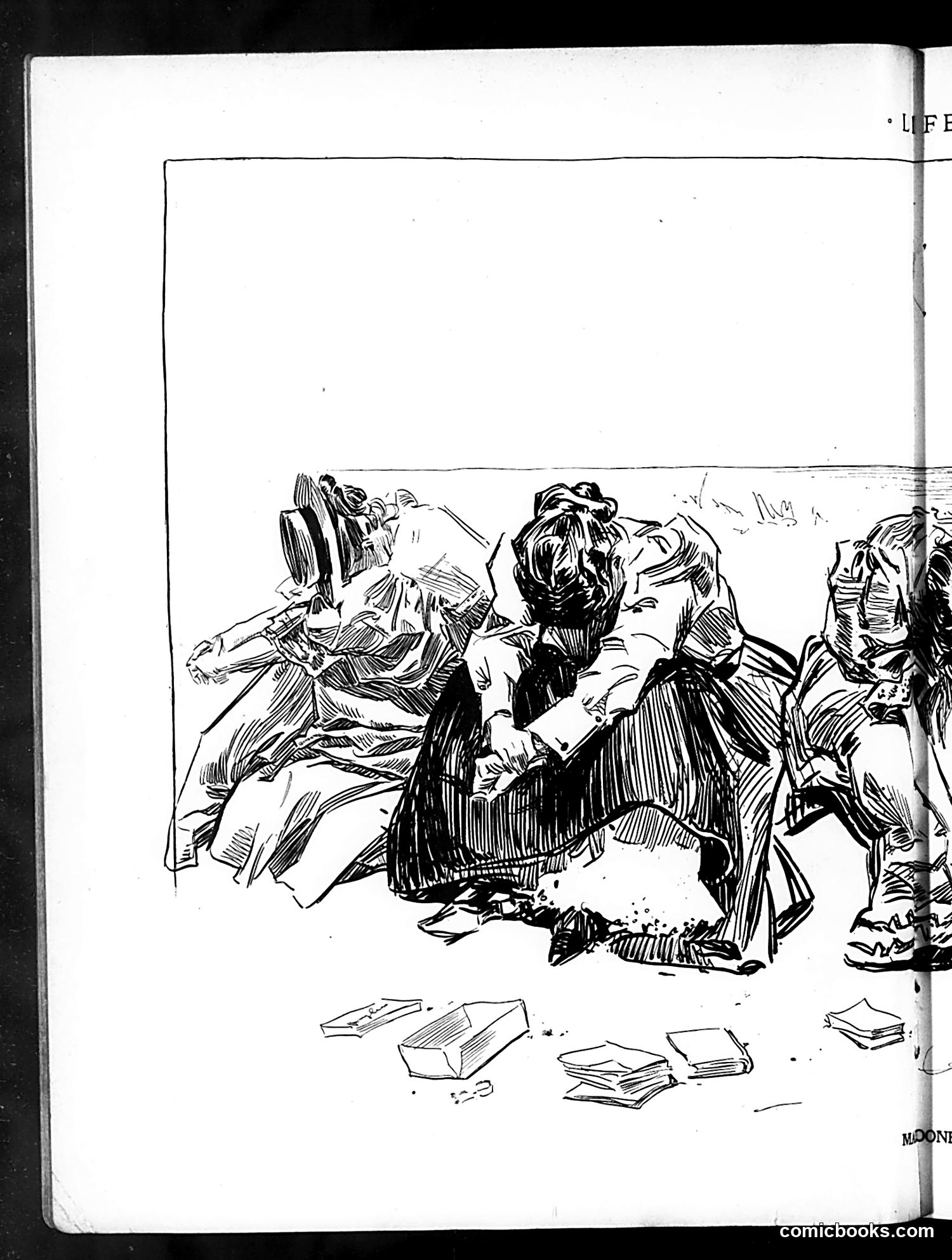
This appears to be an illustration from *Life* magazine showing a group of people gathered around scattered papers or documents on the ground. The figures are drawn in expressive ink style, with one central figure in dark clothing prominently featured among several others in lighter garments. However, without accompanying caption text visible on this page, I cannot definitively identify the specific figures, the political or social context being satirized, or the intended joke. The scattered papers suggest a theme related to documents, correspondence, or written materials, but the exact meaning—whether this references a political scandal, social commentary, or another contemporary event—remains unclear from the image alone. To accurately explain this cartoon's significance to a modern reader, the original caption would be essential.
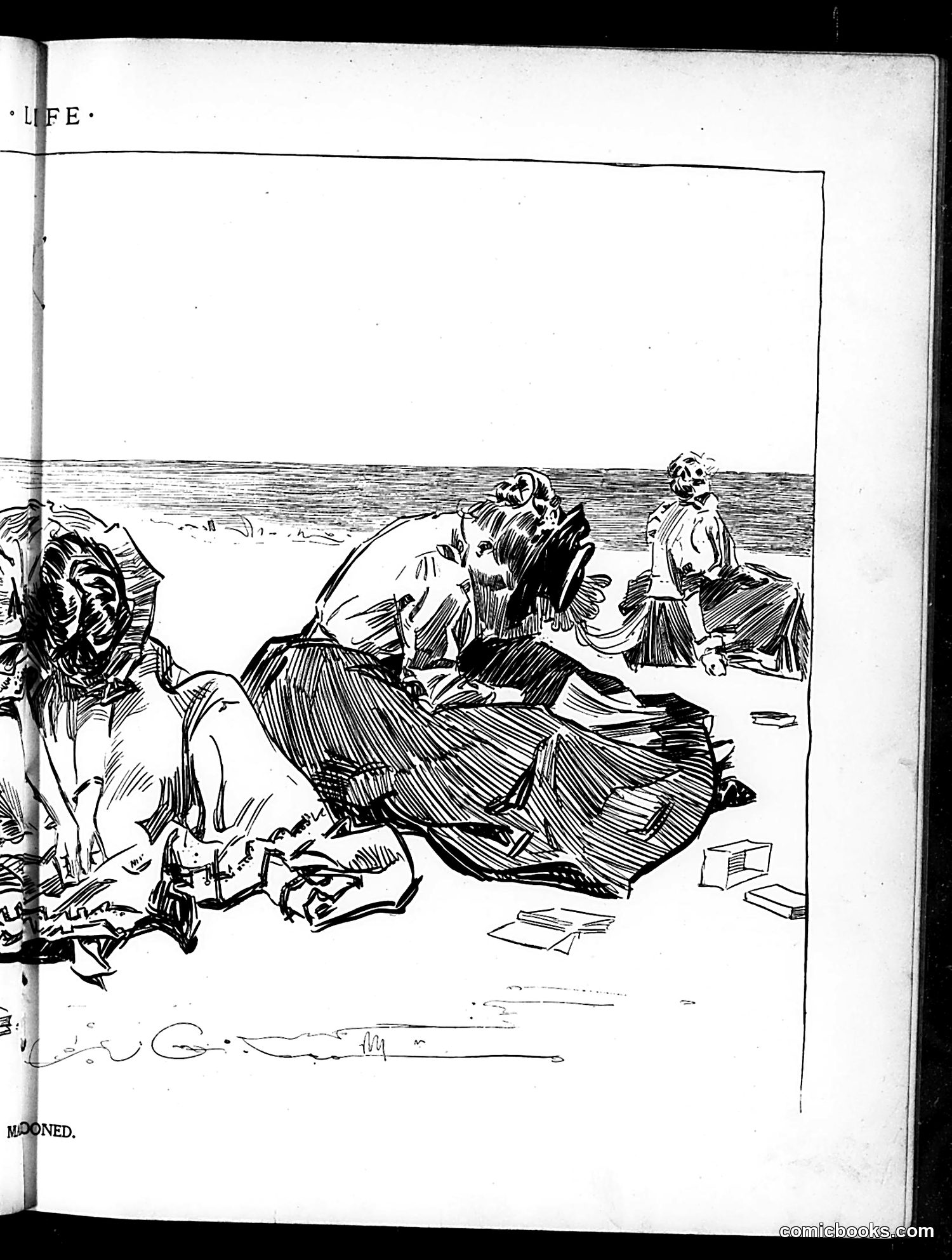
This appears to be a satirical illustration signed by "Mahooned" (visible at bottom left). The sketch depicts several figures on a beach or sandy shore with the ocean in the background. Multiple people are shown in Victorian-era dress, scattered across the scene with what appear to be papers or documents on the ground. The composition suggests a shipwreck or castaways scenario—a common satirical setup in period publications. Without clearer identifying details or accompanying text, I cannot definitively identify the specific political figures or events being referenced. The scattered papers and beached positioning suggest commentary on some crisis or disaster, but the precise subject remains unclear from the image alone.
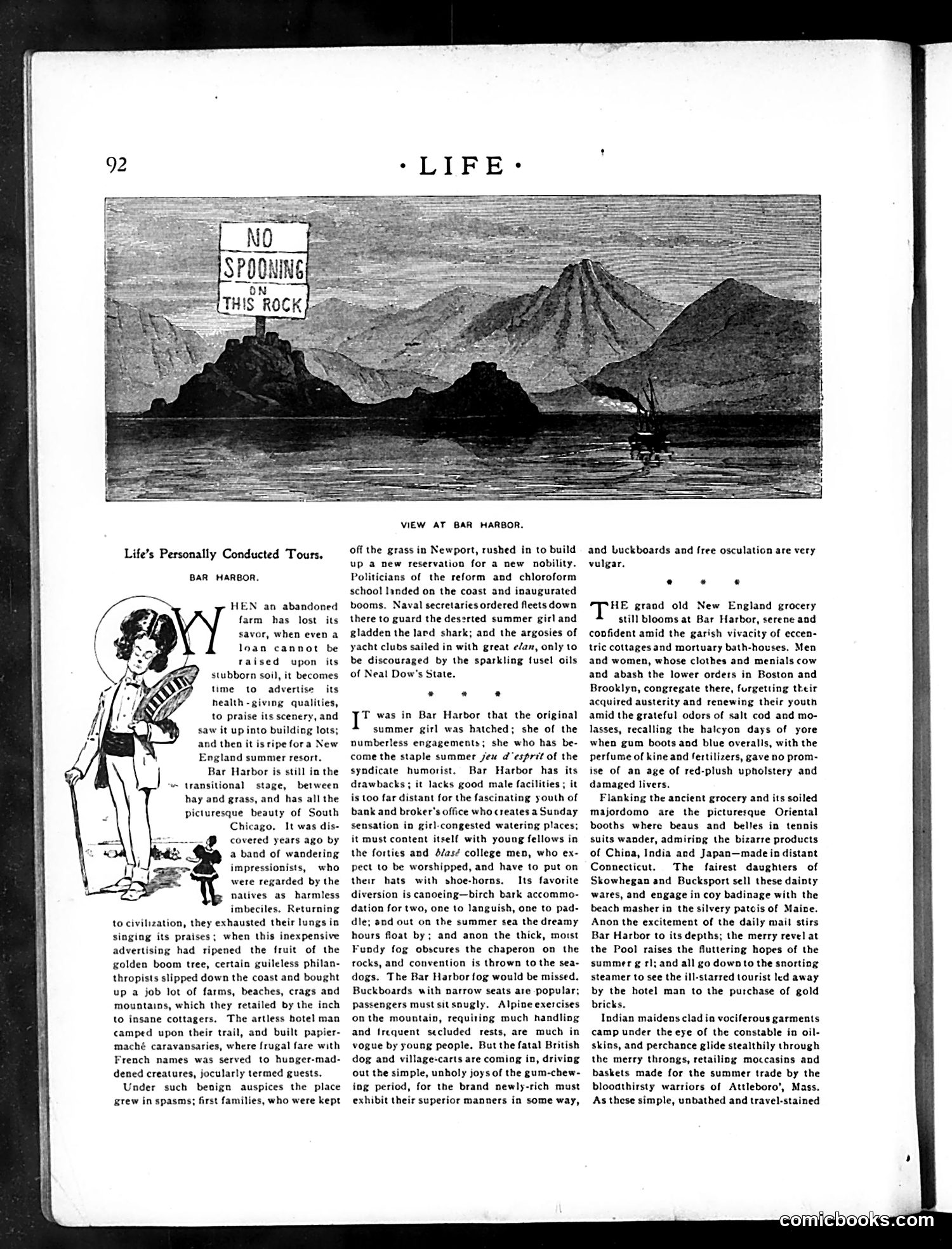
This page features a satirical article about Bar Harbor, Maine, titled "Life's Personally Conducted Tours." The engraving at top shows the rocky coastal landscape; a sign reads "NO SPOONING ON THIS ROCK"—a humorous reference to the Victorian-era term "spooning" (romantic kissing/cuddling). The accompanying illustration depicts a young woman in fashionable dress, likely representing the "summer girl" mentioned in the text. The article critiques Bar Harbor's transformation from a quiet retreat into a fashionable resort destination, mocking both the nouveau riche vacationers and the commercialization of the landscape. The text satirizes the area's pretensions, the vulgar behavior of wealthy visitors, and the erosion of the location's former charm under the pressure of tourism and social climbing.
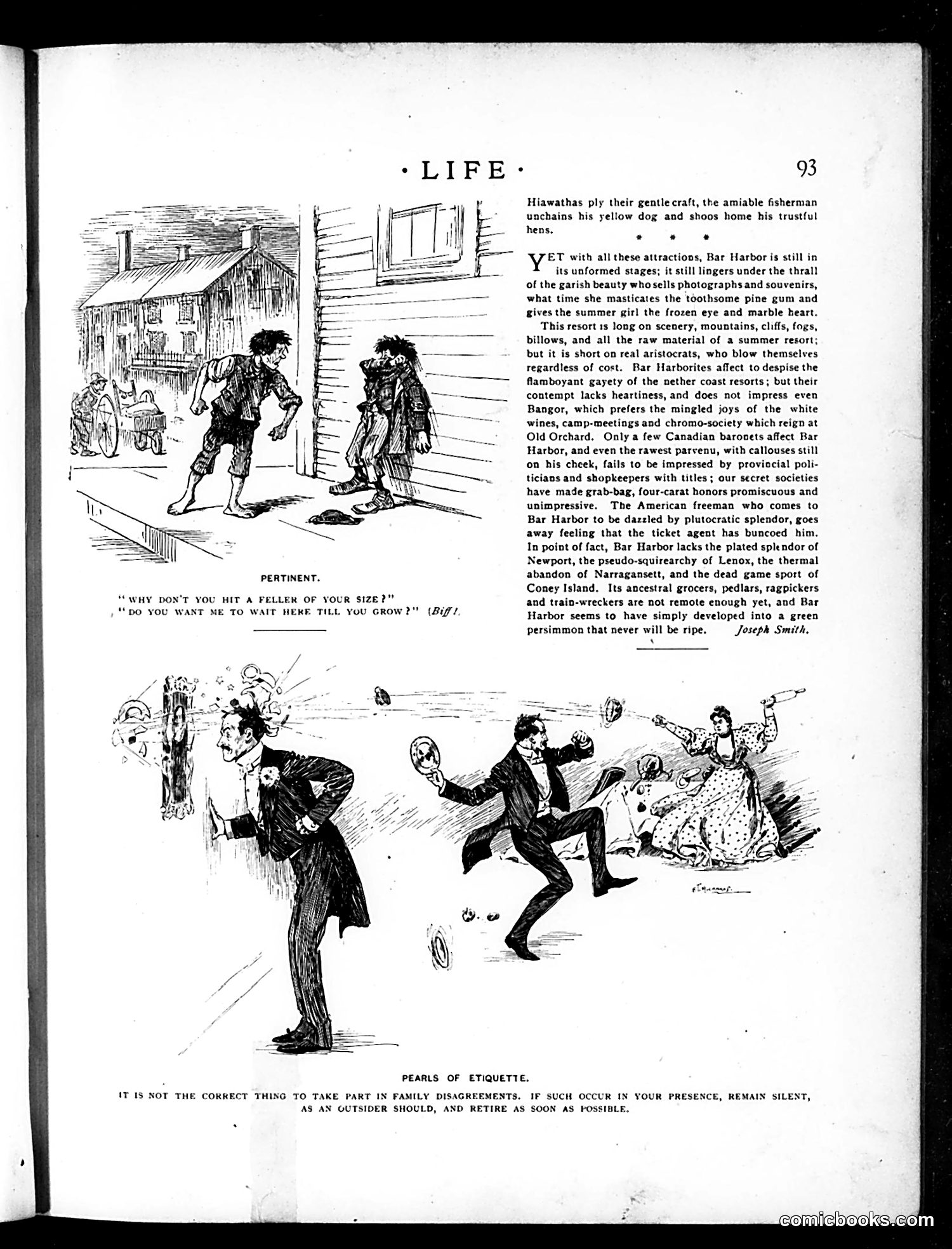
This page contains two separate satirical pieces from *Life* magazine: **Top cartoon ("Pertinent"):** A small boy confronts a larger opponent with the classic schoolyard taunt "Why don't you hit a feller of your size?" The larger figure replies "Do you want me to wait here till you grow?"—mocking the boy's presumption. The joke satirizes someone attempting to challenge someone far more powerful. **Main article and lower cartoon ("Pearls of Etiquette"):** The text critiques Bar Harbor, Maine as a summer resort that lacks the refined aristocratic prestige of Newport or Lenox. Despite scenic beauty, it attracts newly wealthy "parvenu" (social climbers) and common tradespeople rather than genuine old-money elites—making it a "green persimmon that never will be ripe." The lower cartoon humorously depicts family quarreling while guests look uncomfortable, illustrating the etiquette rule about remaining silent during others' disputes. The satire targets social pretension and the American nouveaux riches.
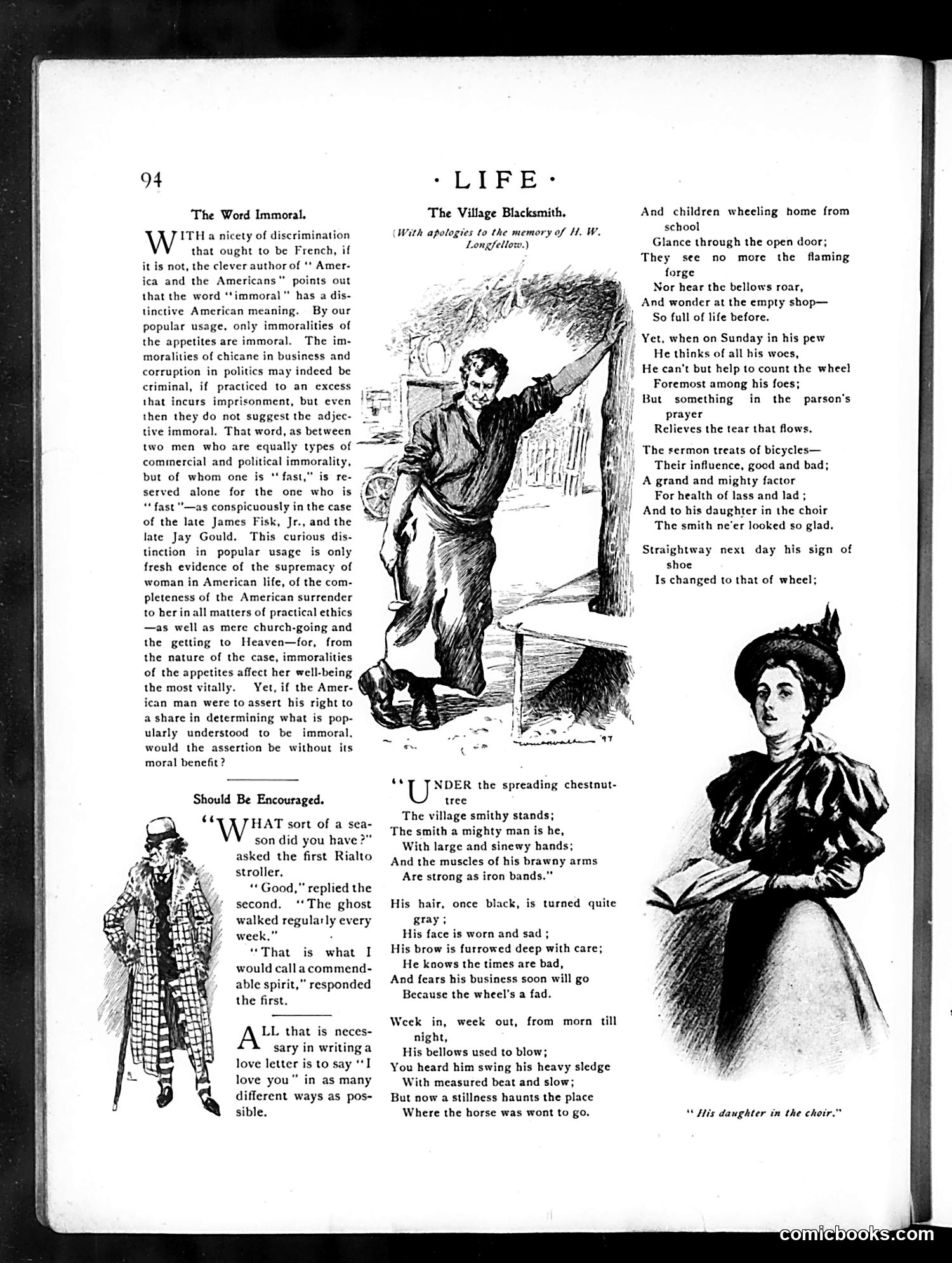
**"The Word Immoral"** critiques American hypocrisy: the essay argues that "immoral" applies only to sexual/appetitive misconduct, never to business corruption or political crime. The author credits women's social dominance for this double standard—since sexual impropriety affects women most directly, society condemns it exclusively. The essay cites Gilded Age financiers James Fisk Jr. and Jay Gould as examples of commercially unscrupulous men deemed acceptable because they weren't sexually "fast." **"The Village Blacksmith"** is a darker parody of Longfellow's famous poem. The blacksmith faces economic ruin—not from decline, but from bicycles replacing horses. His depression lifts only when his daughter shows enthusiasm for bikes in church. He immediately pivots his business to bicycle repair, choosing commercial survival over traditional craft. The satire captures turn-of-the-century anxieties about technological disruption and generational obsolescence.
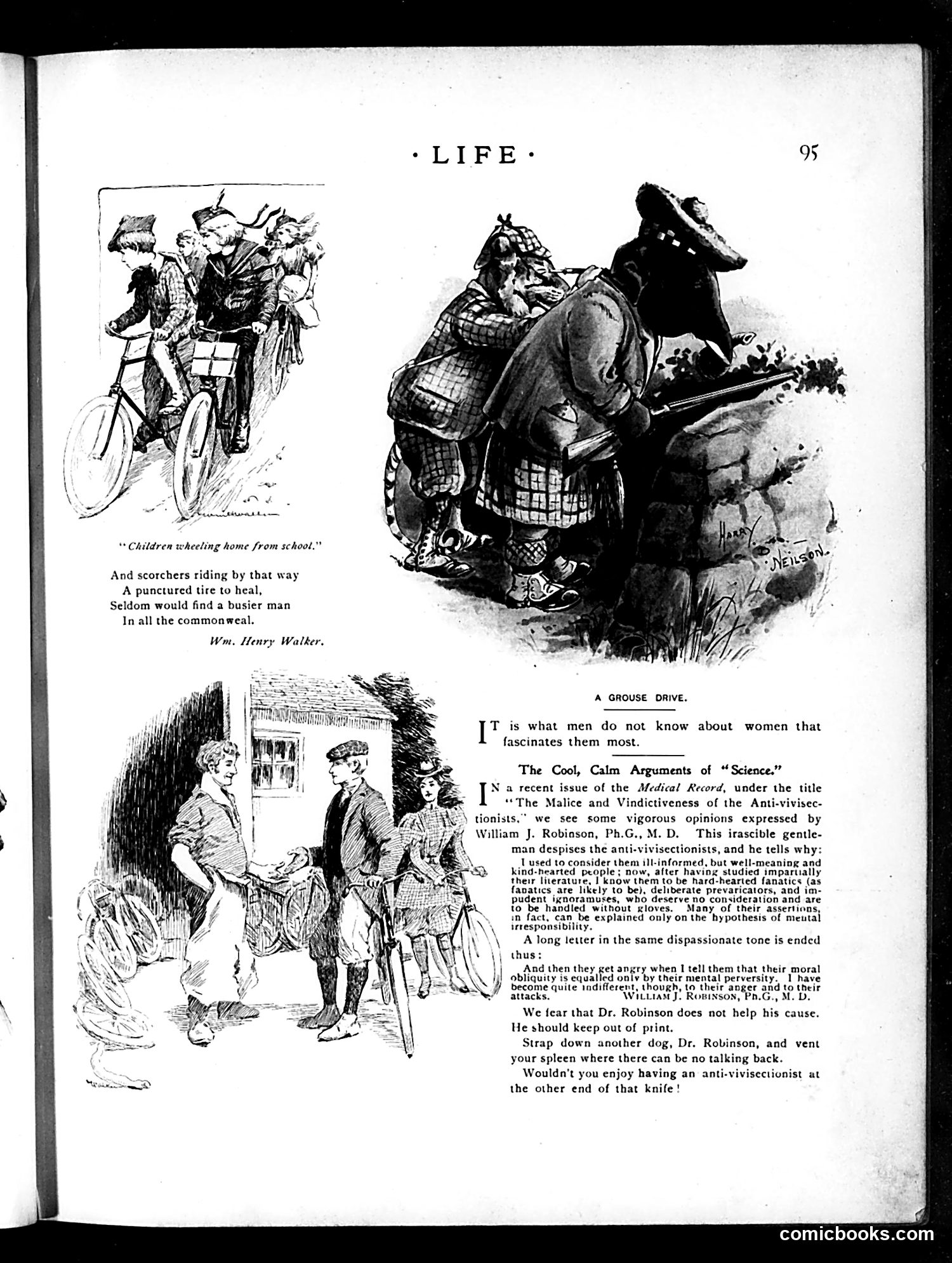
This page satirizes Dr. William J. Robinson's angry response to anti-vivisection activists (those opposing animal experimentation). Robinson had published a scathing letter in the *Medical Record* calling anti-vivisectionists "hard-hearted fanatics" and "deliberate prevaricators" with "mental irresponsibility." Life's editors mock Robinson's defensive, hostile tone, arguing he damages his own cause by attacking opponents rather than engaging rationally. The final lines are biting sarcasm: they suggest Robinson would prefer silencing critics entirely—even sarcastically wishing an anti-vivisectionist were "at the other end of that knife" (i.e., strapped down for experimentation instead of being allowed to argue back). The three accompanying illustrations are unrelated social sketches about bicycles and street encounters. The satire targets both Robinson's intemperate rhetoric and, implicitly, the vivisection debate itself—a significant animal-welfare controversy of the era.
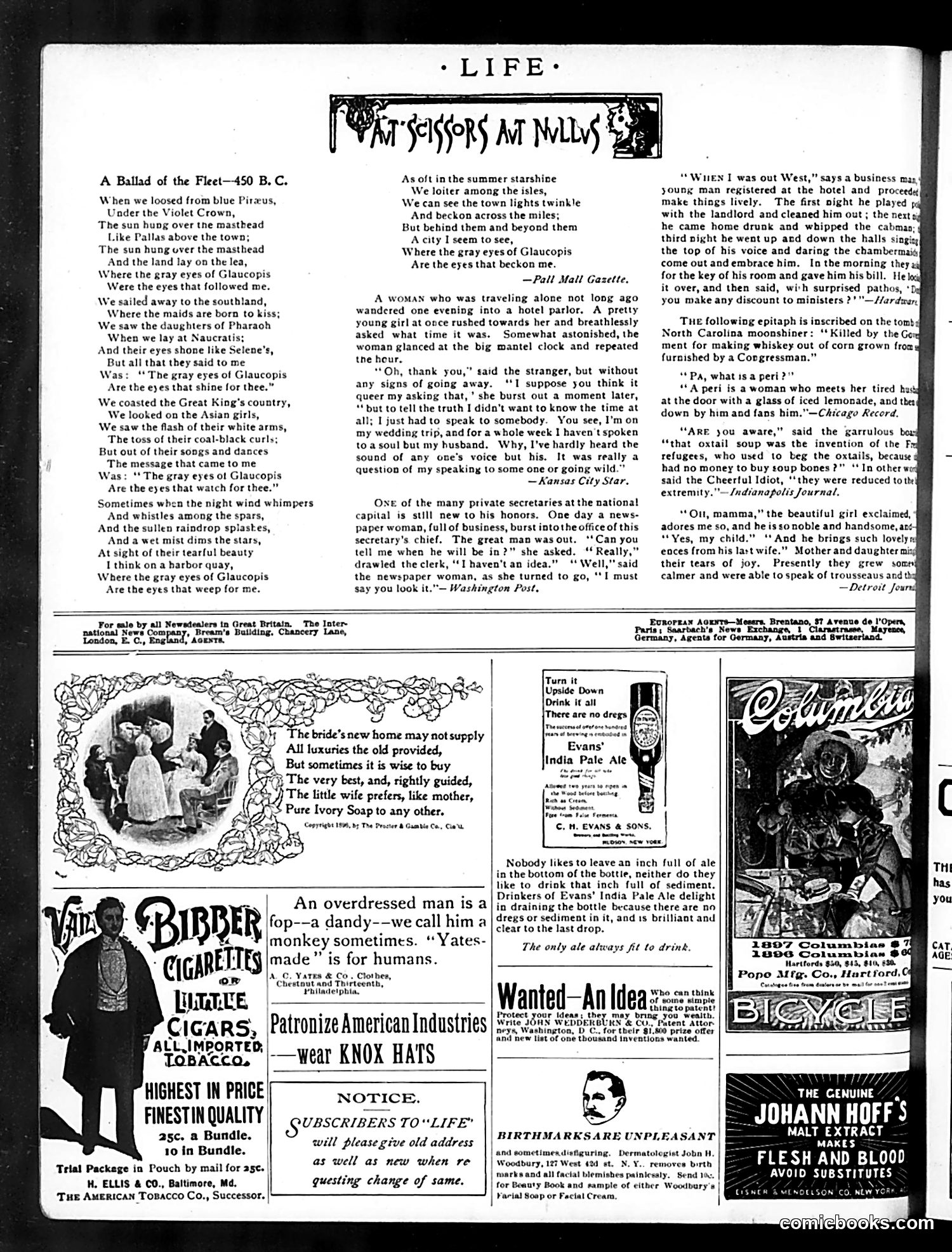
This page contains primarily **literary and humorous anecdotes** rather than political cartoons. The main content includes: **"A Ballad of the Fleet—450 B.C."**: A romantic poem about a Greek sailor whose beloved's "gray eyes of Glaucopis" haunt him across Mediterranean travels. It's nostalgic verse evoking classical antiquity. **Humorous short stories**: Several brief anecdotes satirizing social behavior—a lonely bride on her honeymoon desperate for human conversation; a newspaper woman mocking a secretary's ignorance; a business traveler causing chaos at a hotel; jokes about Southern moonshiners and French refugees. The **advertisements** (Bibber Cigarettes, Knox Hats, Evans' Ale, Bicycle, Pommade) are period typical. This appears to be a **general interest/humor issue** rather than focused political satire. The humor targets everyday social awkwardness and Victorian-era American life rather than specific political figures or events.
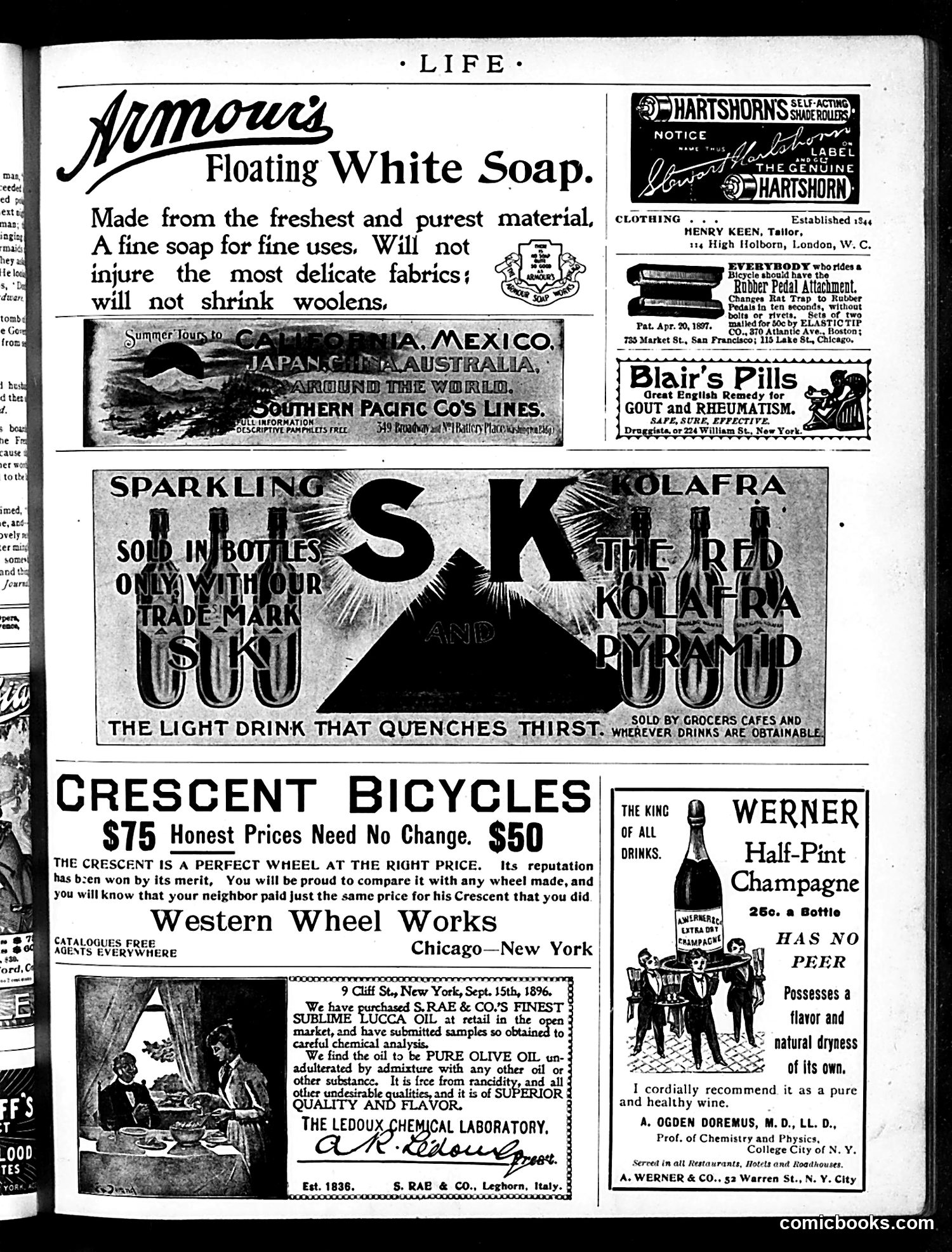
This page is primarily **advertising**, not political satire. It contains various product advertisements typical of an 1896 *Life* magazine issue, including: - **Armour's Floating White Soap** — a cleaning product - **S.K. Kolafra** — a sparkling beverage marketed as "the light drink that quenches thirst" - **Crescent Bicycles** — promoted as affordable, quality cycles at honest prices ($50-$75) - **Blair's Pills** — a patent medicine for gout and rheumatism - **Werner Half-Pint Champagne** — endorsed by a chemistry professor - Various other products (Hartshorns, clothing, oil) The ads emphasize product quality, honest pricing, and scientific endorsement (note the chemistry professor's testimonial). There is **no discernible political cartoon or satirical commentary** on this page—it's a standard commercial advertising section typical of late-19th-century magazines, which relied heavily on paid advertisements for revenue.
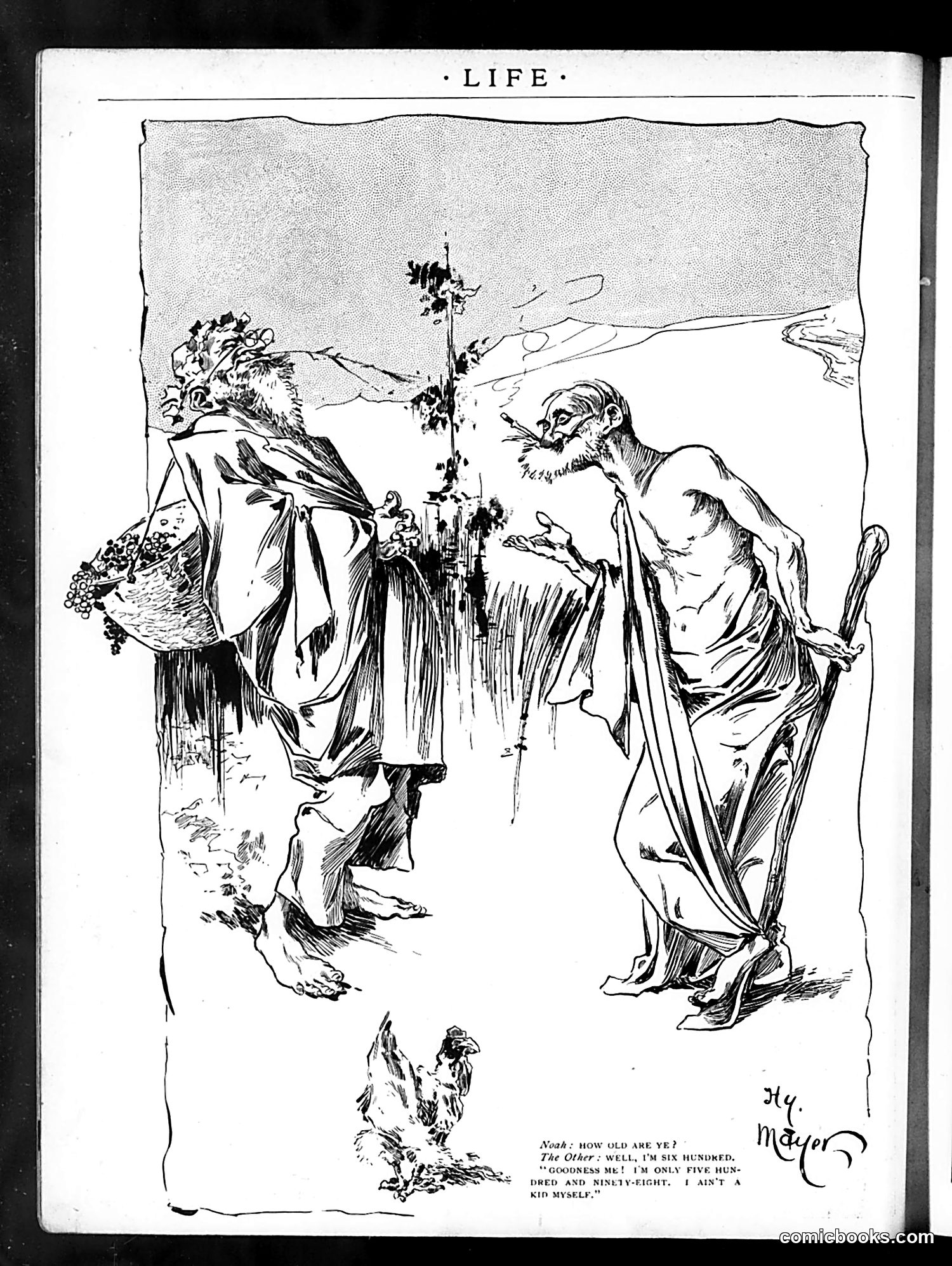
This appears to be a satirical cartoon from *Life* magazine featuring two elderly figures in conversation. One character claims to be "six hundred" years old, while the other boasts of being "only five hundred and ninety-eight" and adds "I ain't a kid myself." The joke relies on exaggerated age claims—a common satirical device mocking elderly individuals' tendency to complain about their age or boast about longevity. A rooster at the bottom suggests barnyard/rural humor. Without knowing the specific publication date or identified caricatures, the precise political target remains unclear. However, the style and setup suggest this may be mocking either elderly political figures, business tycoons, or simply poking fun at aging in general—a frequent subject for *Life* magazine's social satire. The artist's signature appears to be "Maurer" or similar.
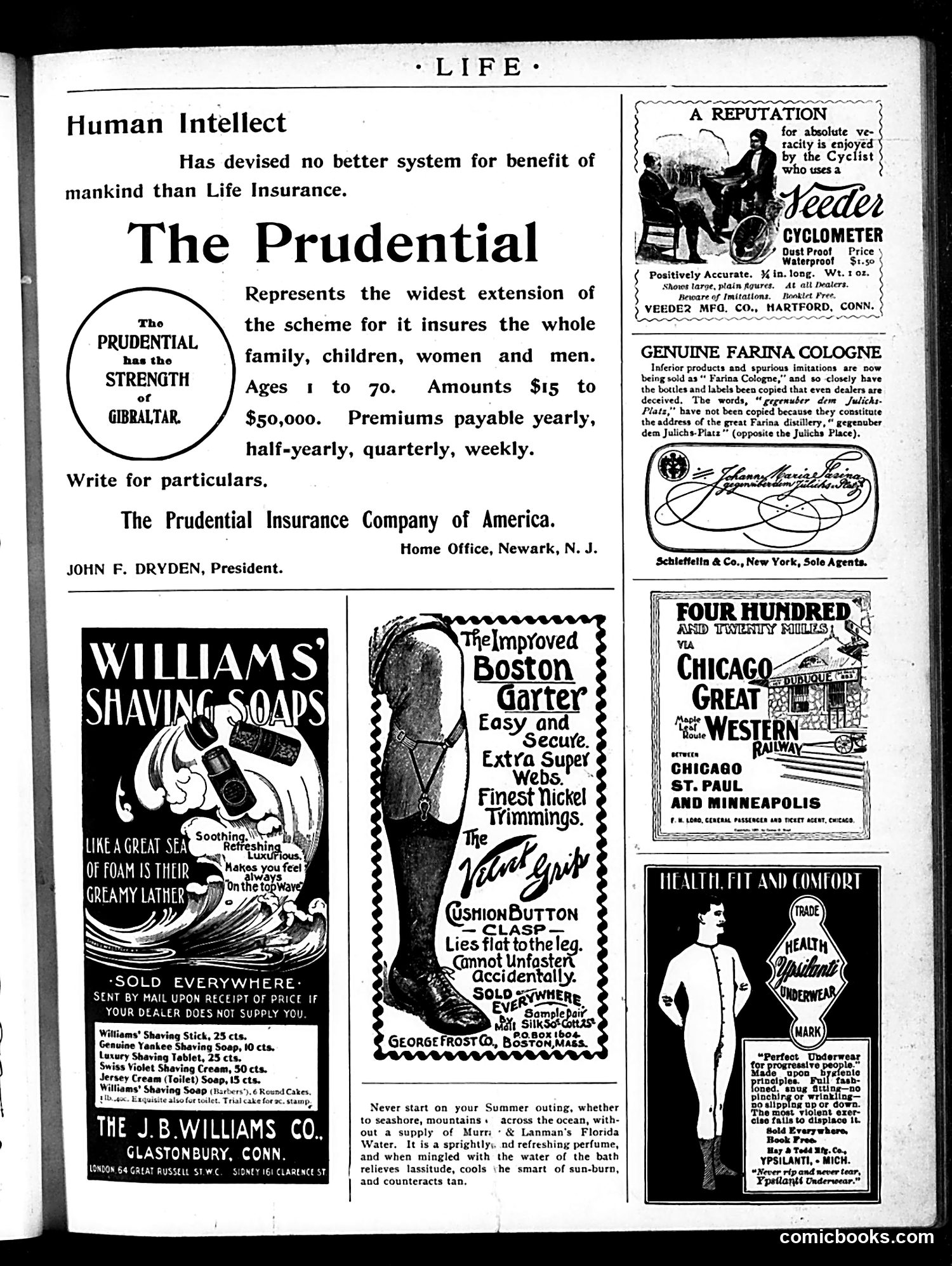
This is primarily an **advertising page**, not a satirical cartoon section. The layout features multiple product advertisements typical of early 20th-century magazines. The opening text asserts that life insurance represents humanity's best invention for social benefit—a claim the magazine appears to endorse earnestly rather than satirize. The Prudential Insurance Company advertisement dominates the upper portion, promoting their family coverage plans. The remaining space showcases period consumer goods: Williams' Shaving Soaps, the "Improved Boston Garter" (a men's sock supporter with a cushioned button to prevent slipping), a "Health-Fit and Comfort" undershirt, Farina Cologne (with warnings against counterfeits), and Murr & Lanman's Florida Water perfume. The text about summer outings at bottom recommends this perfume for sun protection—reflecting era-specific beauty concerns about tanning. This represents standard commercial magazine content from the early 1900s, with no apparent political satire or social commentary present.
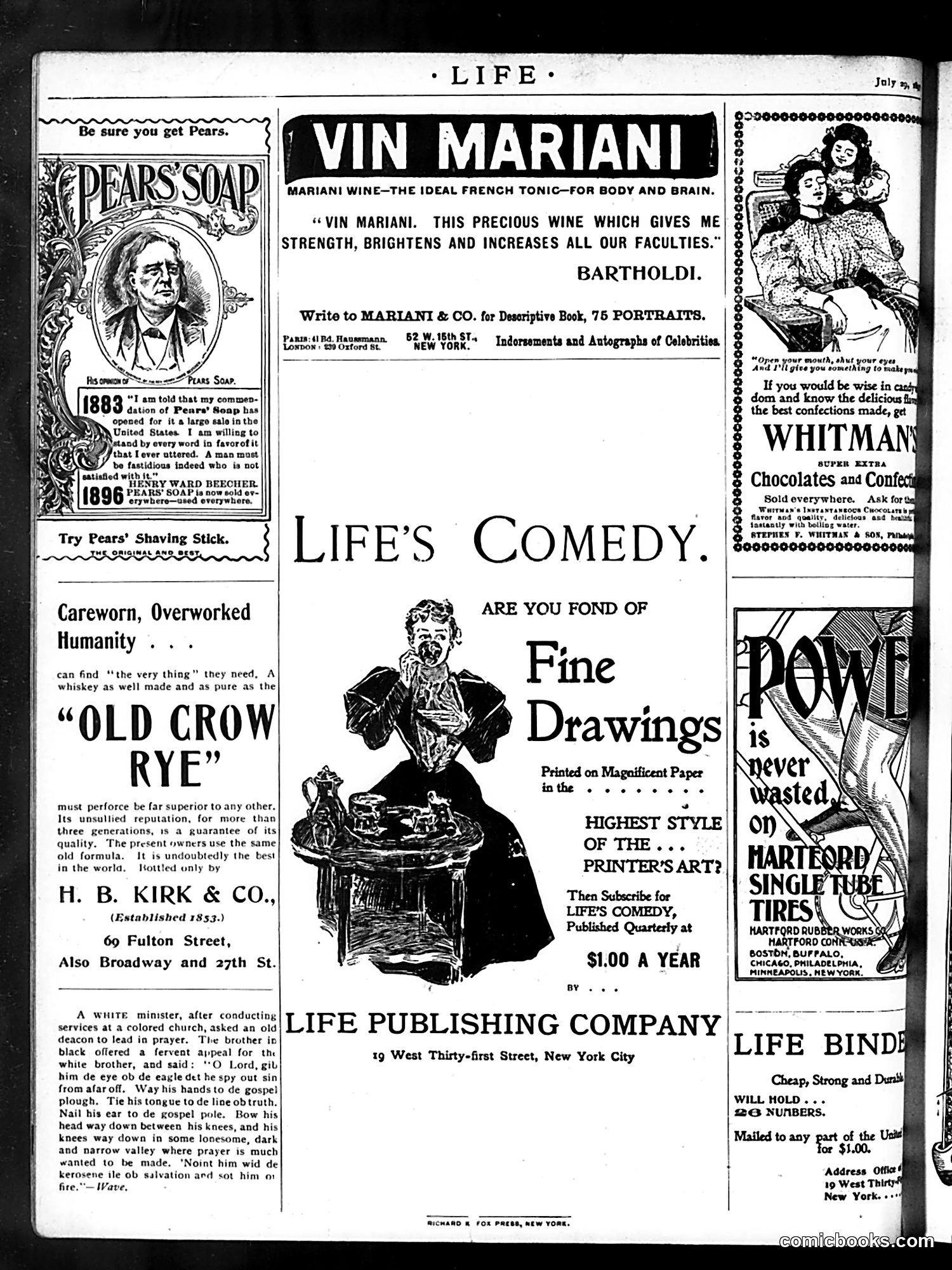
This is primarily an **advertising page** from Life magazine (date unclear from image), featuring multiple product endorsements typical of the era. The main content includes: **Central cartoon**: A satirical drawing of an well-dressed man at a table, accompanying an advertisement for "Life's Comedy" subscription ($1/year), promoting fine drawings and printer's art. **Notable advertisements**: - **Pears' Soap** and **Old Crow Rye whiskey** — luxury products endorsed with testimonials - **Vin Mariani wine** — a French tonic claiming to enhance "strength" and "faculties," endorsed by Bartholdi (the sculptor) - **Whitman chocolates** and **Hartford Single Tube Tires** **Social humor**: A anecdote about a Black deacon's elaborate prayer for a white minister uses period dialect ("gib him de eye," "kerosene ile") — this reflects the magazine's casual racial stereotyping common to that era. The page demonstrates how Life blended satirical content with profitable advertising, targeting affluent readers through product endorsements and genteel humor.