
Life, 1897-07-29 · page 14 of 20
Life — July 29, 1897 — page 14: what you’re looking at
What you’re looking at
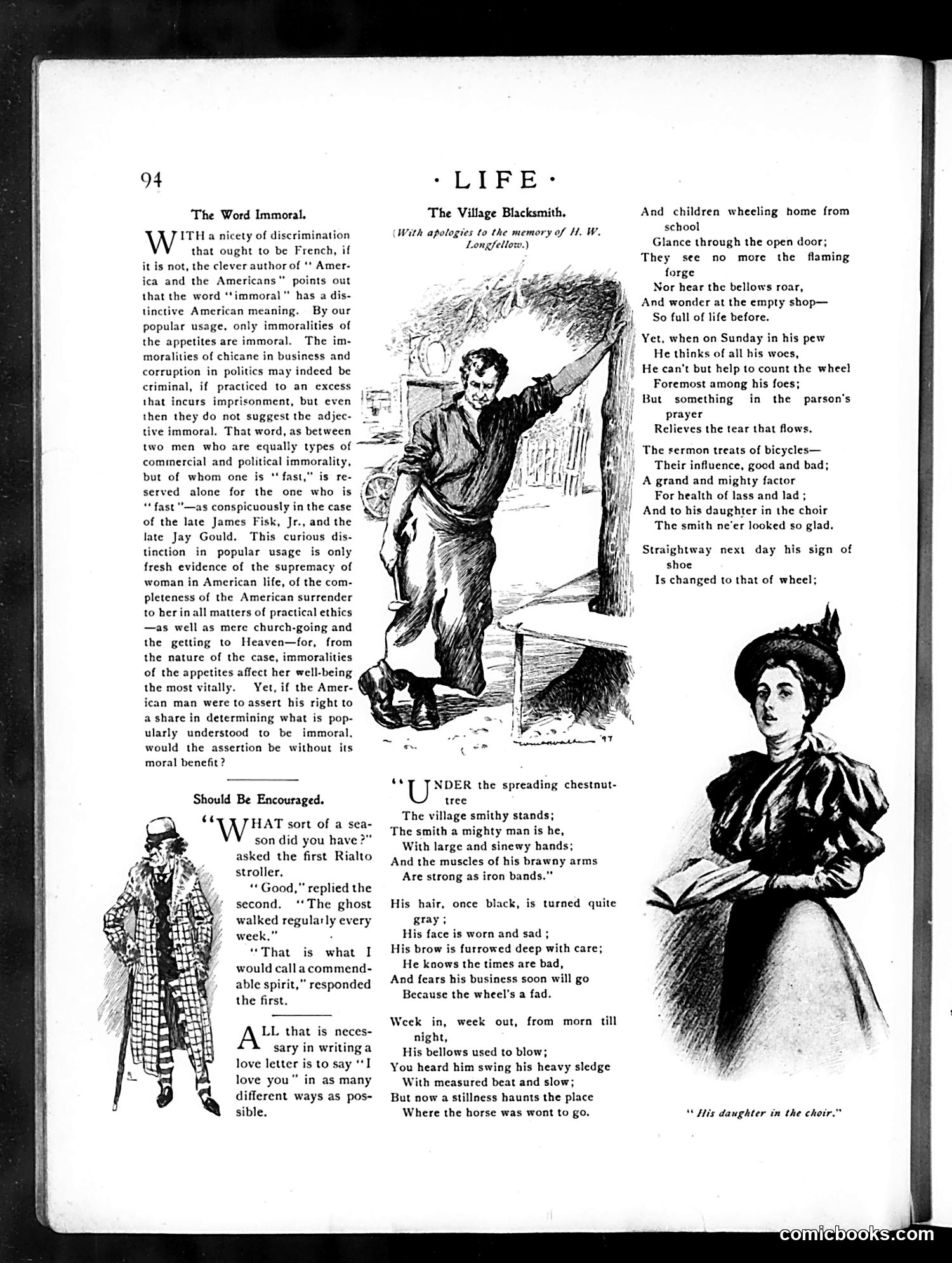
**"The Word Immoral"** critiques American hypocrisy: the essay argues that "immoral" applies only to sexual/appetitive misconduct, never to business corruption or political crime. The author credits women's social dominance for this double standard—since sexual impropriety affects women most directly, society condemns it exclusively. The essay cites Gilded Age financiers James Fisk Jr. and Jay Gould as examples of commercially unscrupulous men deemed acceptable because they weren't sexually "fast." **"The Village Blacksmith"** is a darker parody of Longfellow's famous poem. The blacksmith faces economic ruin—not from decline, but from bicycles replacing horses. His depression lifts only when his daughter shows enthusiasm for bikes in church. He immediately pivots his business to bicycle repair, choosing commercial survival over traditional craft. The satire captures turn-of-the-century anxieties about technological disruption and generational obsolescence.
📄 Transcribed text from this page (OCR, searchable)
Machine-transcribed from the original scan — historical spelling and the odd misread are preserved.
The Word Immoral. ITH a nicety of discrimination that ought to be French, if it is not, the clever author of ‘* Amer- ica and the Americans” points out that the word ‘timmoral” has a dis- By our popular usage, only immoralities of the appetites are immoral. The im- moralities of chicane in business and corruption in politics may indeed be criminal, if practiced to an excess that incurs imprisonment, but even then they do not suggest the adjec- tive immoral. That word, as between two men who are equally types of commercial and political immorality, but of whom one is ‘‘ fast,” is re- served alone for the one who is ** fast "—as conspicuously in the case of the late James Fisk, Jr., and the late Jay Gould. This curious dis- tinction in popular usage is only fresh evidence of the supremacy of woman in American life, of the com- pleteness of the American surrender to ber in all matters of practical ethics —as well as mere church-going and the getting to Heaven—for, from the nature of the case, immoralities of the appetites affect her well-being the most vitally. Yet, if the Amer- ican man were to assert his right to a share in determining what is pop- ularly understood to be immoral, would the assertion be without its moral benefit? tinctive American meaning. Should Be Encouraged. “ HAT sort of a sea- son did you have ?” asked the first Rialto stroller, “Good,” replied the second. ‘The ghost walked regularly every week.” : “That is what I would calla commend- able spirit,” responded the first. L that is neces- sary in writinga love letter is to say ‘I love you” in as many different ways as pos- sible. * LIFE: The Village Blacksmith. With apologies to the memory of H.W. Longfellow.) &s NDER the spreading chestnut- tree The village smithy stands; The smith a mighty man is he, With large and sinewy hands; And the muscles of his brawny arms Are strong as iron bands.” His hair, once black, is turned quite gray; His face is worn and sad ; His brow is furrowed deep with care; He koows the times are bad, And fears his business soon will go Because the wheel's a fad. Week in, night, His bellows used to blow; You heard him swing his heavy sledge With measured beat and slow; But now a stillness haunts the place Where the horse was wont to go. week out, from morn till And children wheeling home from school Glance through the open door; They see no more the flaming forge Nor hear the bellows roar, And wonder at the empty shop— So full of life before. Yet, when on Sunday in his pew He thinks of all his woes, He can't but help to count the wheel Foremost among his foes; But something in the prayer Relieves the tear that flows. parson's The sermon treats of bicycles— Their influence, good and bad; A grand and mighty factor For health of lass and lad ; And to his daughter in the choir The smith ne‘er looked so glad. Straightway next day his sign of shoe Is changed to that of wheel; “* His daughter in the choir.”