
A complete issue · 20 pages · 1897
Life — June 17, 1897
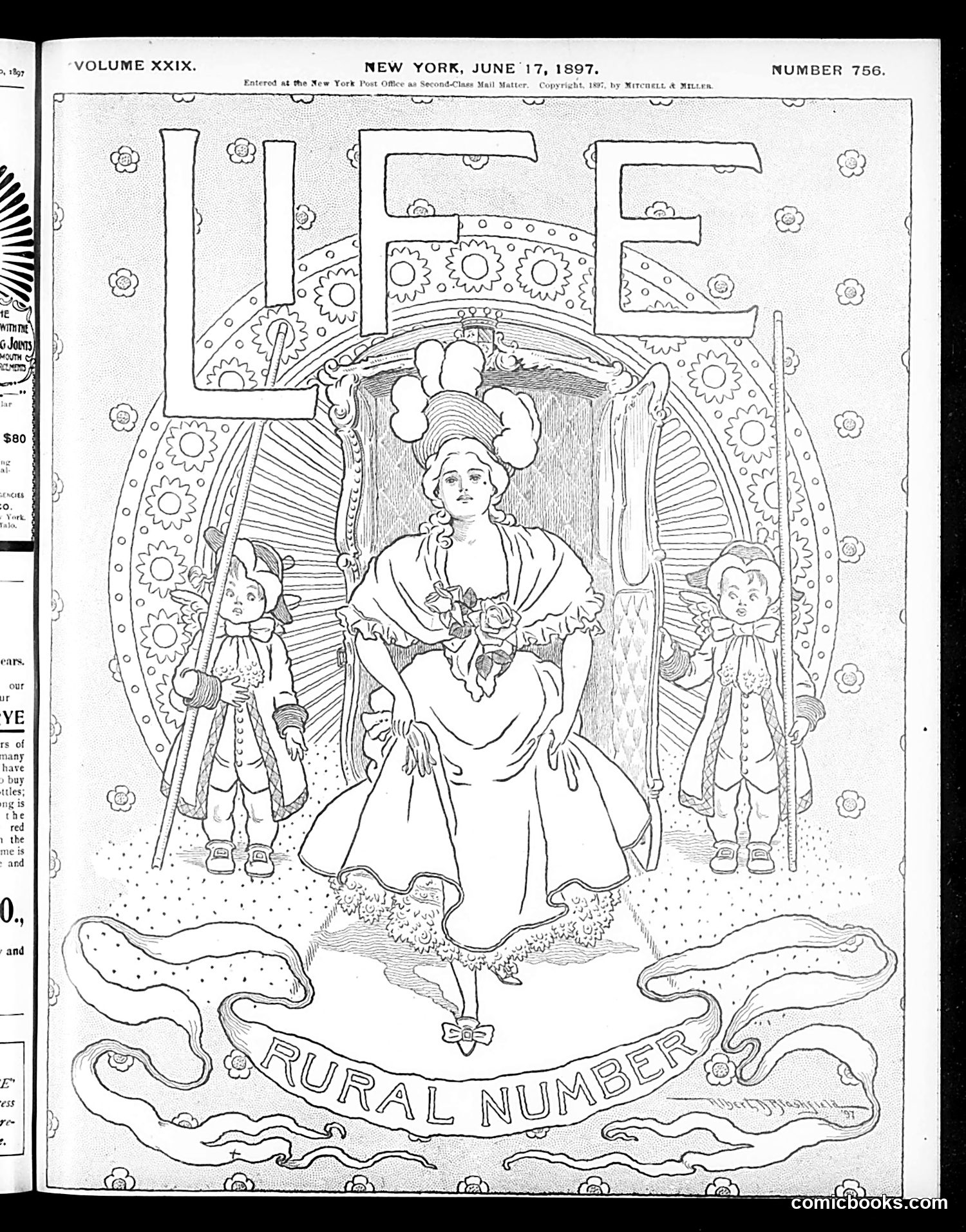
This is a "Rural Number" cover featuring a woman with two children in a mechanized interior space. The large letters "LIFE" dominate the composition, filled with gears and industrial imagery—a stark visual contrast to the "rural" designation. The satire appears to comment on the **mechanization of rural/agricultural life** in the 1890s. Despite the cover's label celebrating rural America, the imagery ironically depicts a thoroughly industrialized, gear-filled environment surrounding this rural family. This likely reflects contemporary anxieties about modernization's encroachment on traditional agrarian society. The decorative framing with gears and mechanical elements satirizes how industrial progress was reshaping even countryside existence during America's rapid industrialization period.
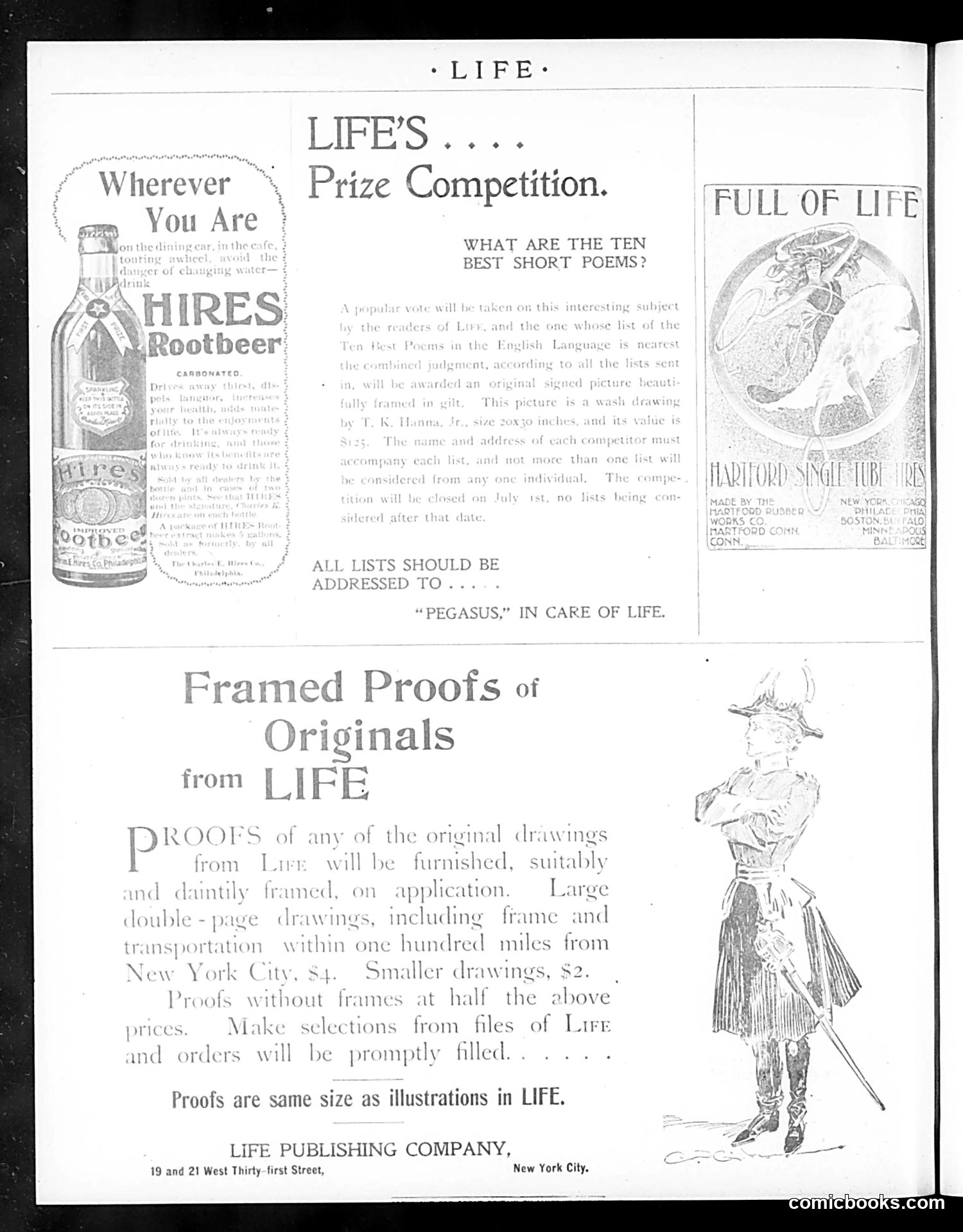
This page is primarily **advertising and promotional content** for Life magazine rather than political satire or commentary. The left side advertises **Hires Rootbeer** with a product bottle illustration. The center announces **Life's Prize Competition** asking readers to vote on "the ten best short poems" in English literature, with the winning list to be beautifully framed and awarded. The right side showcases a **wash drawing by T.K. Hanna, Jr.** titled "Full of Life," depicting what appears to be a figure in period costume (possibly 18th-century dress based on the hat and clothing style). The bottom section offers **framed proofs of original drawings** from Life available for purchase—a mail-order service for readers who want reproductions of the magazine's illustrations. This is essentially a **business/marketing page** rather than editorial commentary.
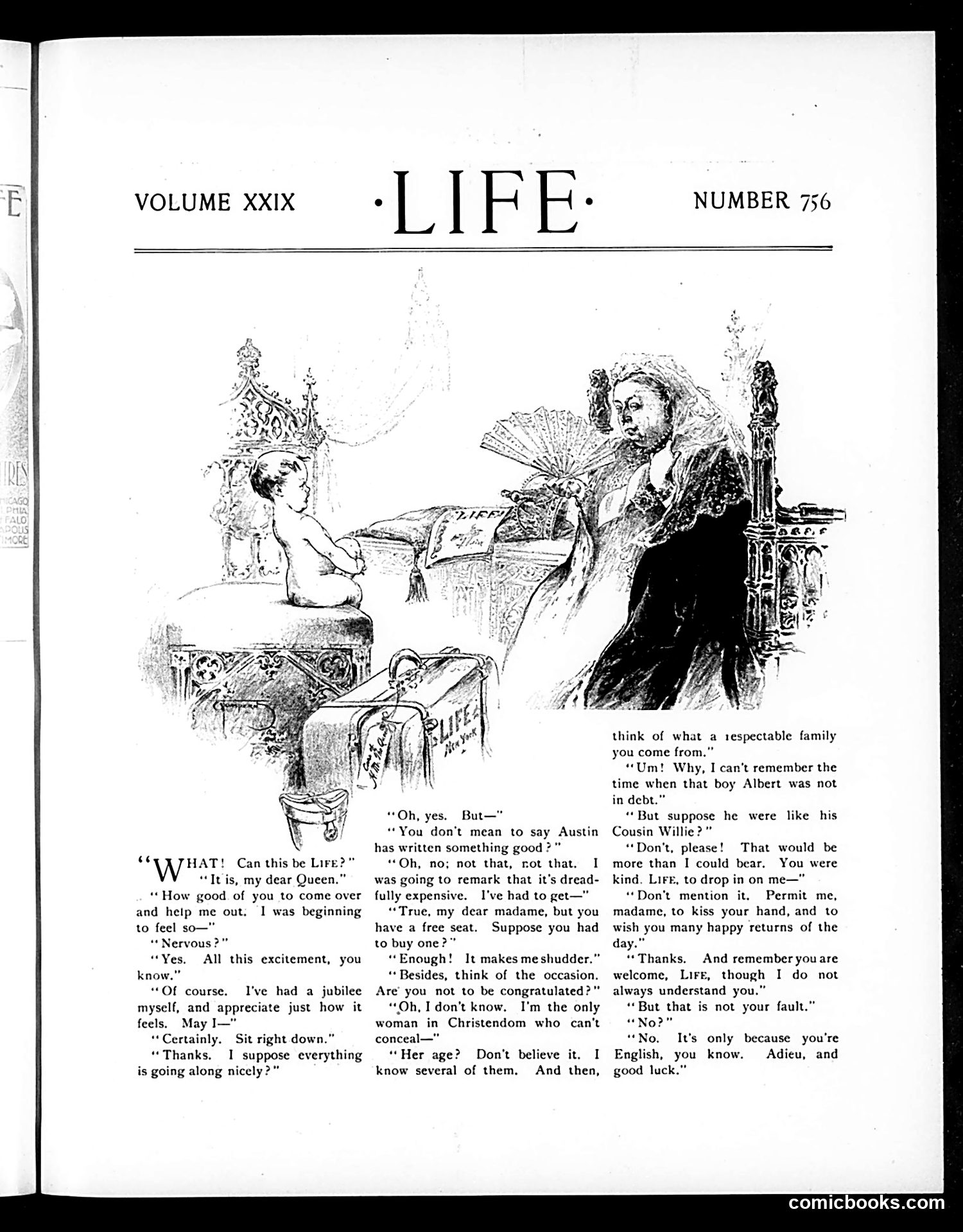
This page depicts a domestic social scene rather than political satire. An elegantly dressed woman reclines while receiving a young male visitor, creating a comedic situation about propriety and reputation. The dialogue reveals the humor: the woman worries about appearing respectable while entertaining an unmarried man. She mentions an "Albert" perpetually in debt and compares the visitor unfavorably to "Cousin Willie." The woman expresses anxiety about gossip in "Christendom," suggesting she's the only woman there who can "conceal" her age. The satire targets Victorian-era social anxieties—particularly female vanity, financial concerns among the gentry, and the rigid social codes governing unmarried interactions. The ornate furnishings emphasize the upper-class setting where such propriety concerns matter most.
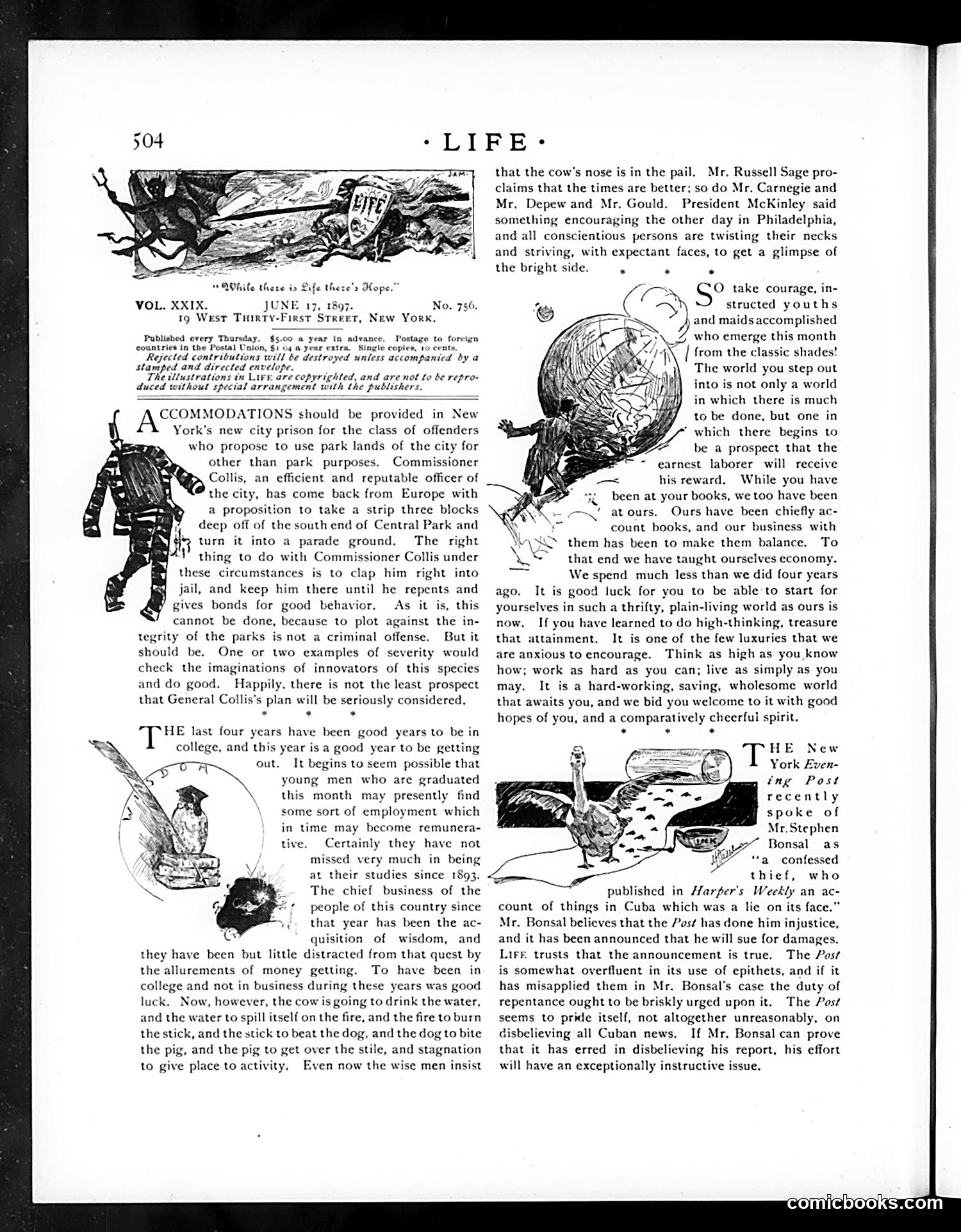
This page contains editorial commentary on contemporary issues rather than traditional political cartoons. The main topics discussed are: 1. **New York City Prison Reform**: Commissioner Collis proposes converting a strip of Central Park into a prison parade ground. The editorial critiques this as problematic, though acknowledges it's unlikely to be seriously considered. 2. **College Employment**: The piece celebrates improving economic conditions allowing recent college graduates to find employment after years of difficulty since 1893 (the Panic). 3. **Cuban Affairs**: The editorial defends *Life* magazine against accusations by Stephen Bonsai, published in *Harper's Weekly*, regarding misreported Cuban news. *Life* asserts their reporting is accurate and suggests Bonsbal's criticism itself may be unreliable. The page reflects late-1890s American concerns: urban infrastructure, economic recovery, and the Spanish-American conflict.
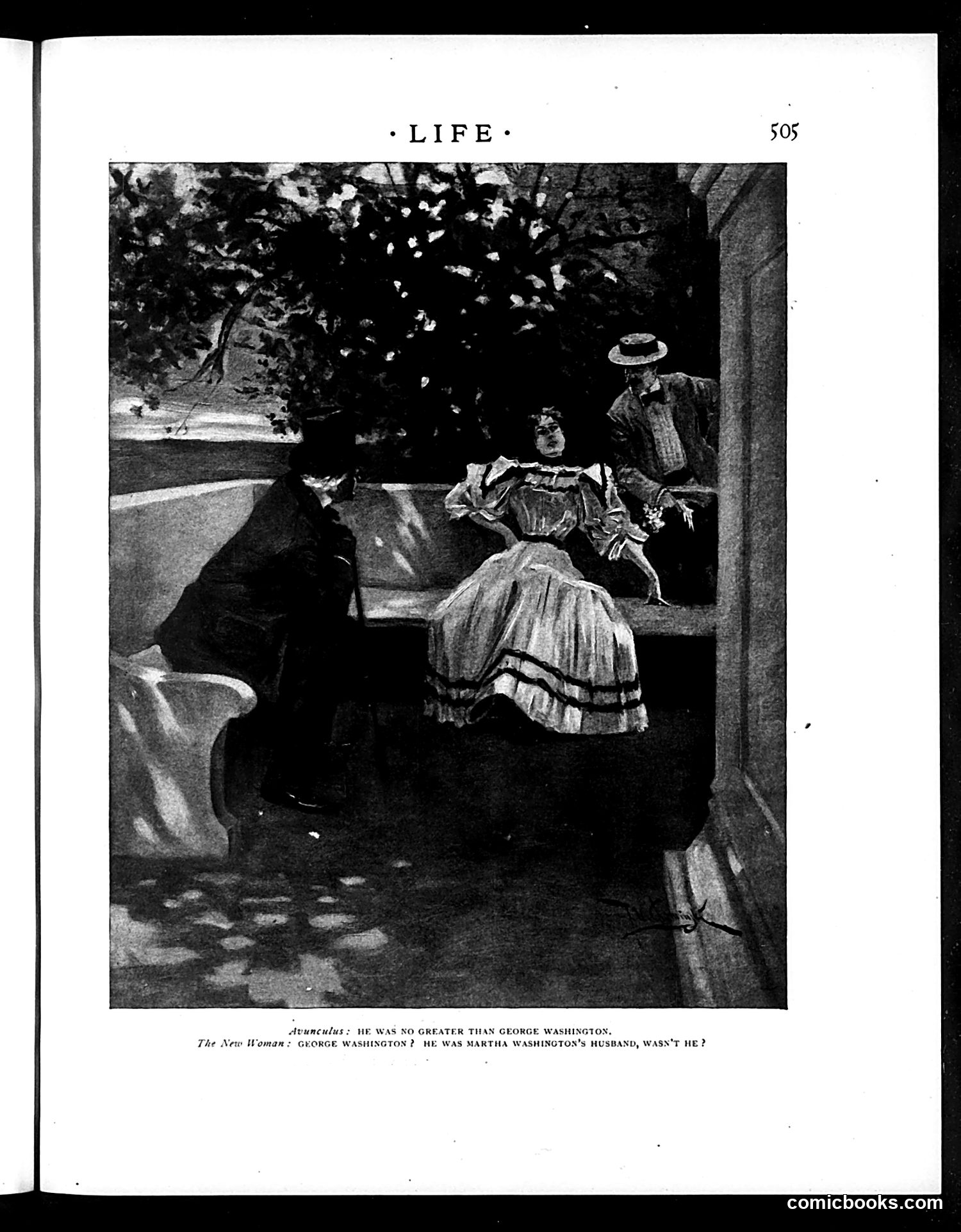
This page from *Life* magazine presents a satirical scene set in a garden. The caption identifies two figures: "Hercules" and "The New Woman," with dialogue suggesting a comparison between George Washington and Martha Washington's marriage. The satire appears to mock contemporary attitudes about women's roles and relationships. "Hercules" (representing traditional masculinity/heroic ideals) boasts he was "no greater than George Washington," while "The New Woman" responds with a cutting observation: "George Washington? He was Martha Washington's husband, wasn't he?"—implying that Martha was the truly significant figure. This reverses traditional gender hierarchies, suggesting the emerging "New Woman" (likely referencing early 20th-century feminism) recognizes female agency and importance in historical narratives. The joke mocks men who claimed prominence while depending on women's contributions.
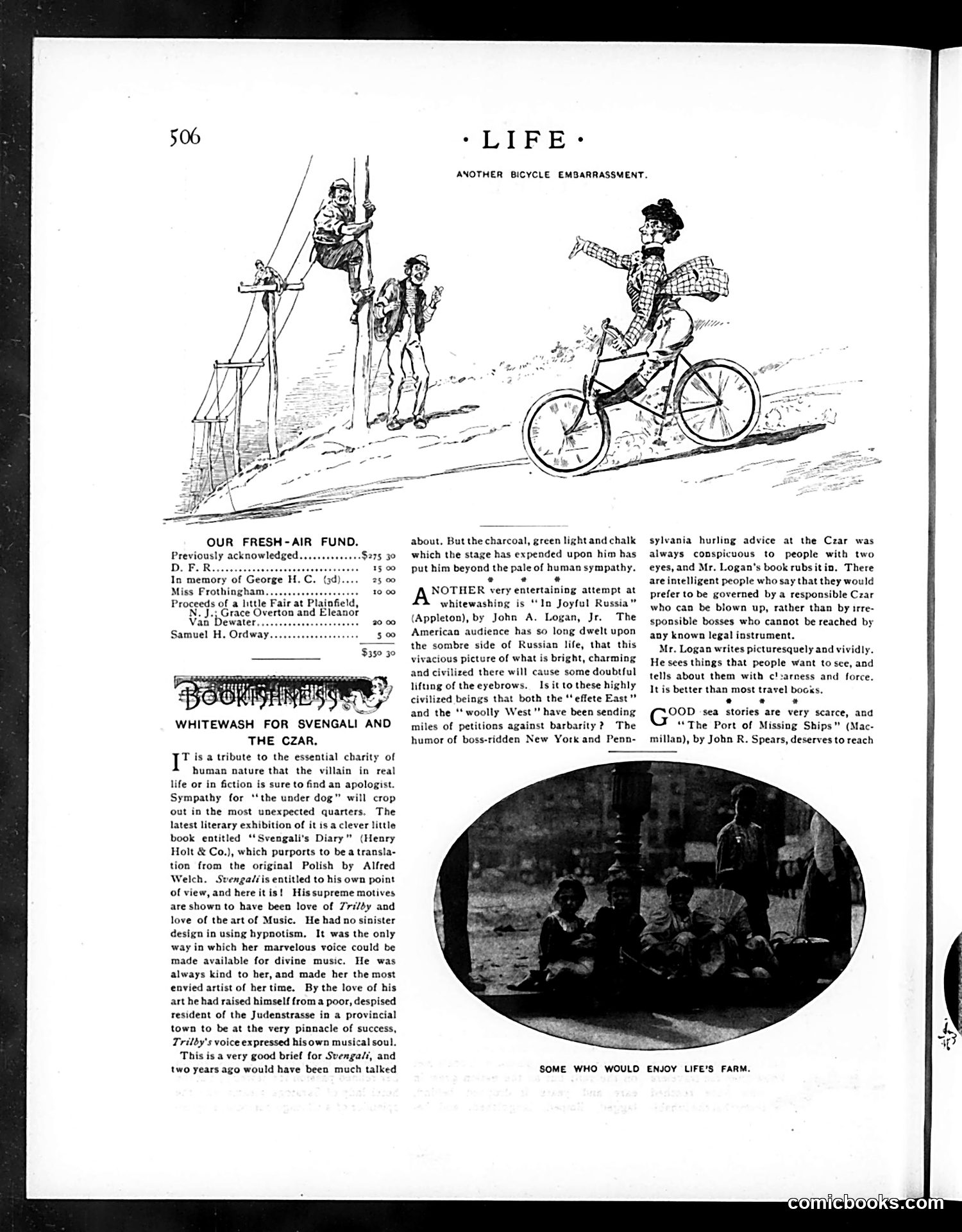
This cartoon satirizes a common early-1900s social hazard: bicycle riding accidents, particularly involving women in restrictive clothing. The illustration shows a woman cyclist signaling with a megaphone while riding, having apparently startled two pedestrians on a utility pole—suggesting she nearly caused them to fall. The humor targets the awkwardness of bicycle culture as it intersected with Victorian-era dress codes. Women wearing long skirts, corsets, and elaborate hats attempted to ride bicycles designed for more practical clothing, creating genuinely dangerous situations. The exaggerated megaphone suggests the cyclist's obliviousness to the chaos she creates. This reflects real social tensions of the era regarding women's independence, fashion, and emerging transportation technology.
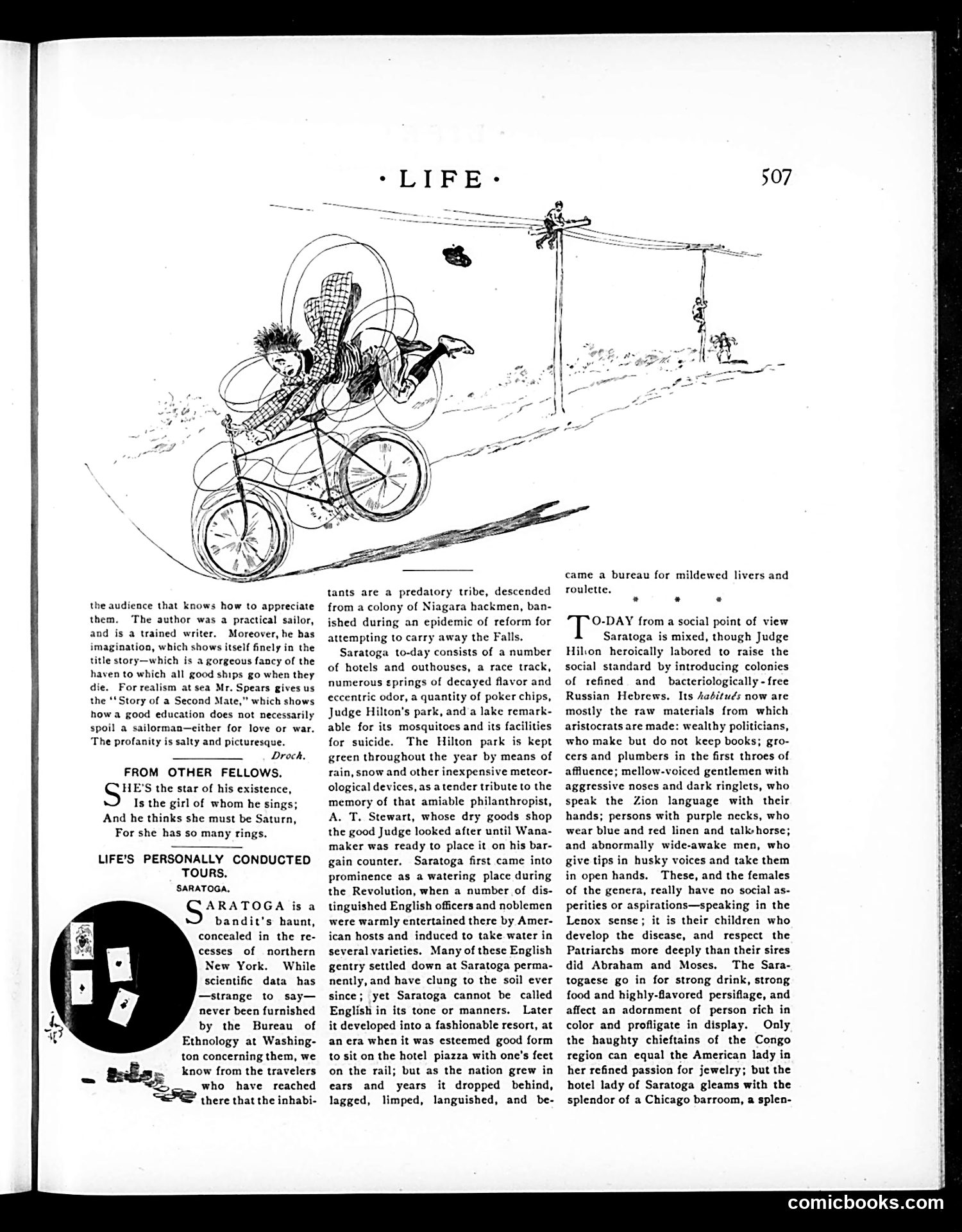
The main illustration depicts a chaotic bicycle scene with figures tumbling over cycles, accompanied by swirling motion lines suggesting wild, uncontrolled movement. The accompanying text discusses Saratoga, New York, a fashionable resort town. It describes how Saratoga "today from a social point of view...is mixed" due to Judge Hilton's efforts raising its social standard by introducing "refined and bacteriologically-free Russian Highbrows." The satire appears to mock Saratoga's pretensions of social refinement and the influx of wealthy but culturally questionable newcomers. The chaotic bicycle illustration may symbolize the disorder or absurdity of these social aspirations. The piece critiques both the town's inconsistent social standards and those attempting to elevate its status through dubious means.
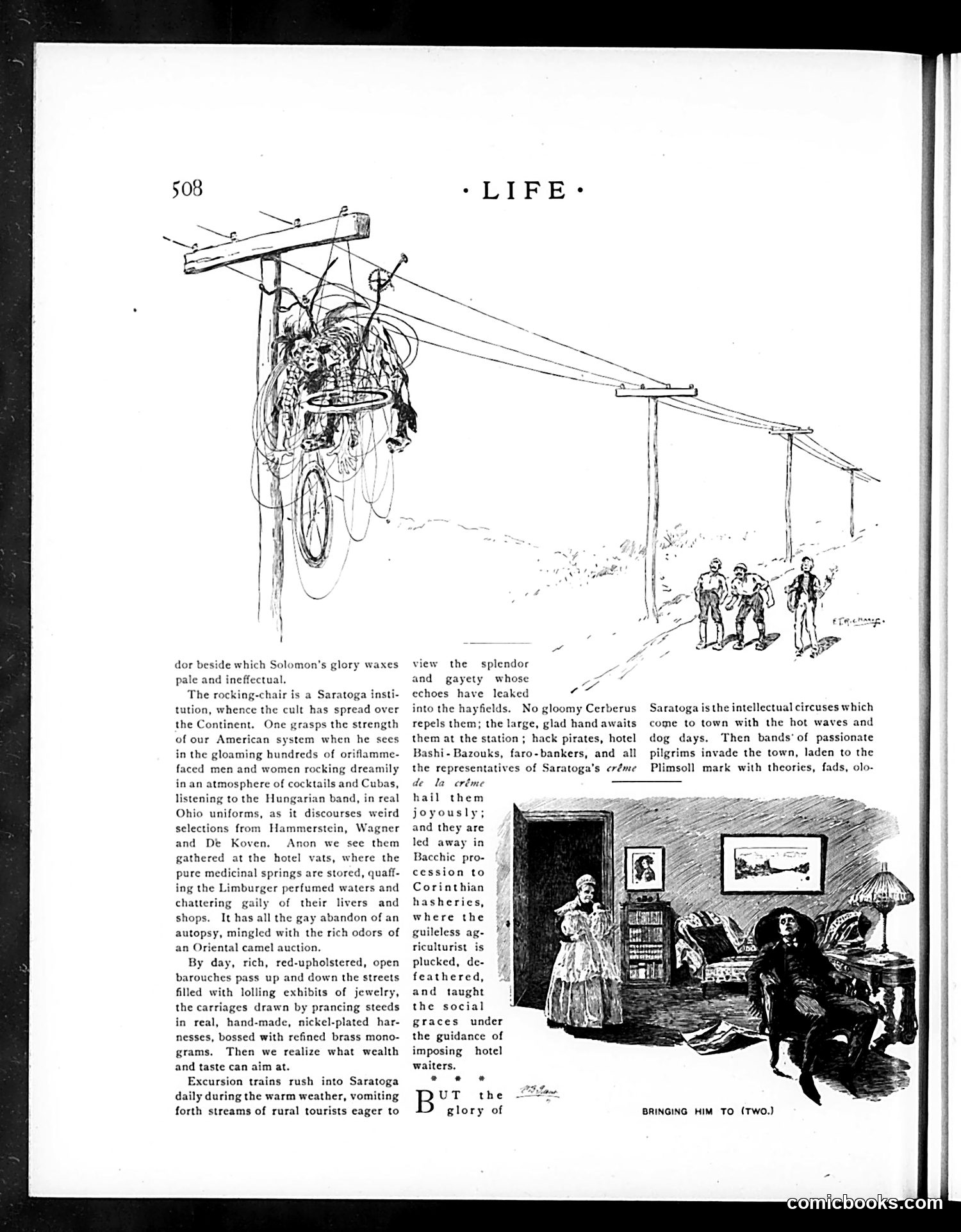
This page satirizes **Saratoga Springs, New York**, a wealthy resort destination. The top illustration shows bicycles and overhead power lines, depicting the town's modern infrastructure alongside leisure activities. The text mocks Saratoga's pretensions: it describes the "rocking-chair" culture, wealthy tourists in "real Ohio uniforms," and the town's attempt to project sophistication through orchestras, Cuban cocktails, and Hungarian bands. The satire suggests these cultural affectations are hollow—mere performance for the wealthy vacationing class. The bottom illustration, captioned "BRINGING HIM TO (TWO.)" shows an interior scene, likely depicting social dynamics at the resort's hotels and gatherings. The overall point: Saratoga represents shallow materialism and affected gentility among America's leisure class.
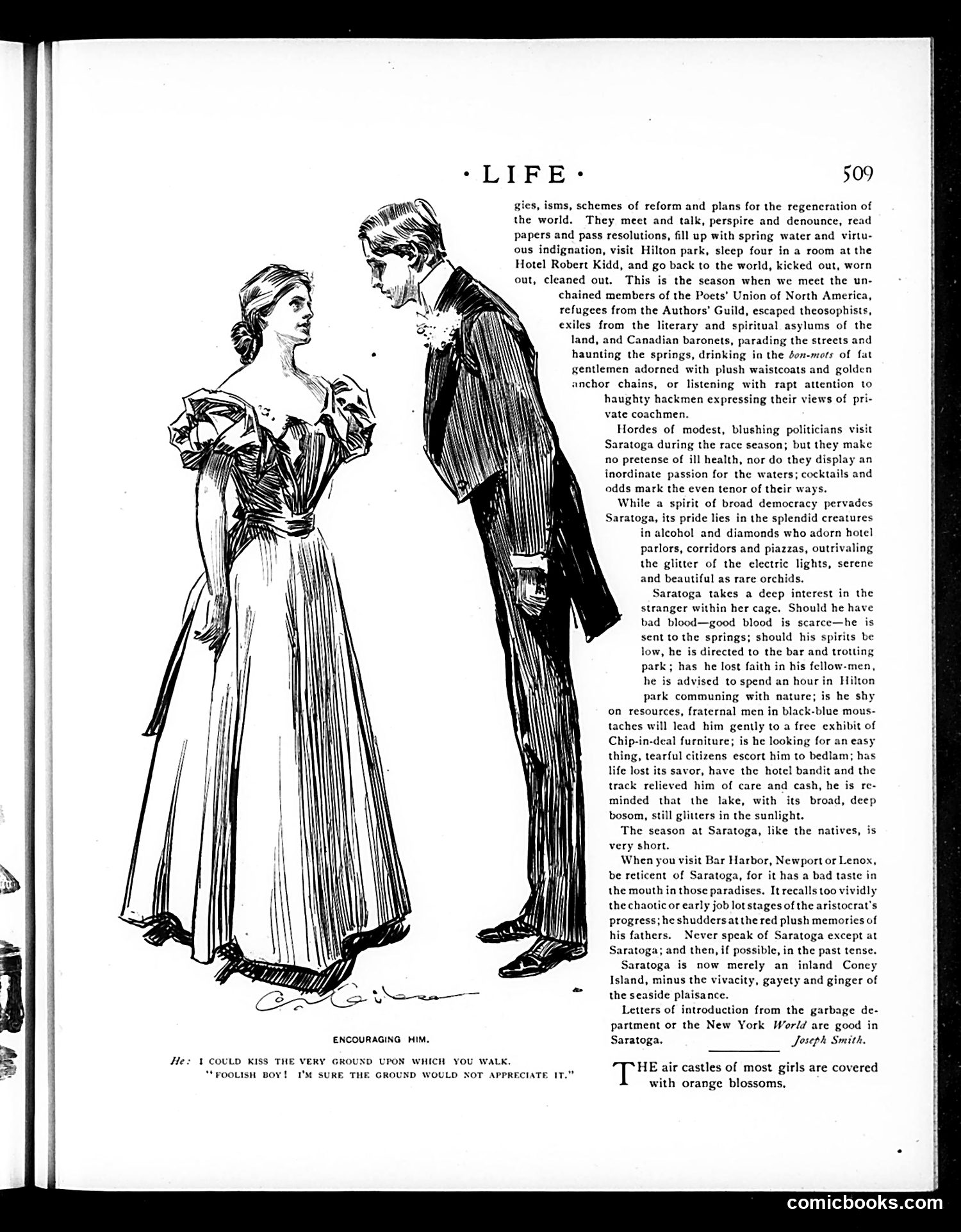
This cartoon depicts a young woman in an elegant Edwardian gown speaking to a tall gentleman in formal attire. The caption reads: "He: 'I could kiss very soundly upon which you walk.' / 'Foolish boy! I'm sure the ground would not appreciate it.'" The satire mocks overwrought romantic flattery and courtship conventions of the early 1900s. The man offers extravagant, hyperbolic compliments typical of sentimental suitors of the era. The woman's witty, deflating response—suggesting the *ground* wouldn't appreciate his excessive praise—gently ridicules both his earnestness and the artificial formality of period romance. It's gentle social comedy about courtship etiquette and masculine sentimentality.
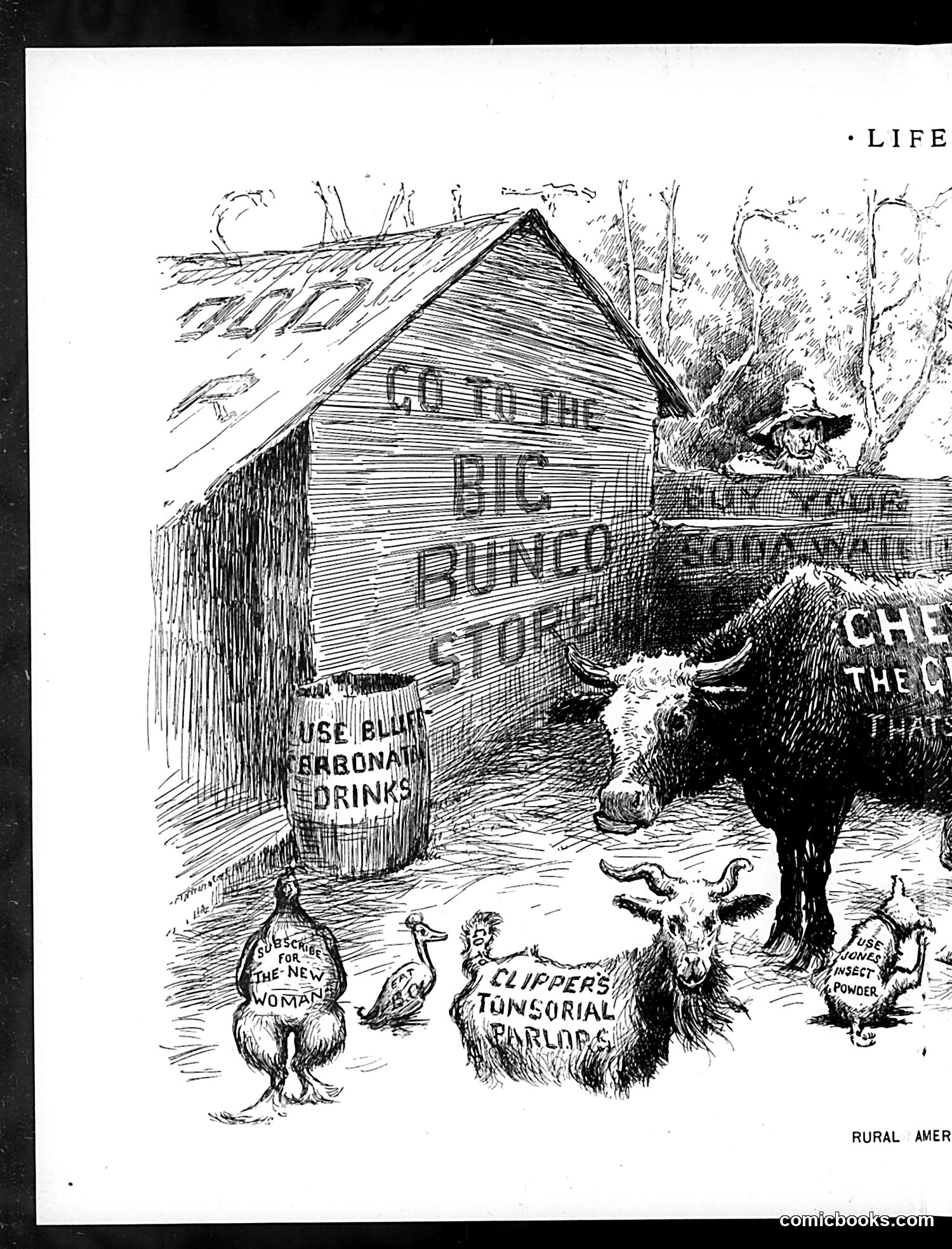
This cartoon satirizes rural life and rural advertising practices. A dilapidated barn advertises various patent medicines and commercial products—"Big Bungalow Store," "Use Bille Carbonate Drinks," "Subscribe for the New Woman," "Clippers Tonsorial Parlors," and what appears to be insect powder. The scene depicts farm animals (a cow, goats, a duck, and birds) gathered around the barn, treating it like a general store or community hub. The satire mocks how rural areas were saturated with patent medicine ads and dubious commercial products, often advertised on barns and buildings. It suggests rural communities were targets for aggressive marketing of questionable remedies and services, with the ramshackle barn itself becoming a billboard for consumer goods.
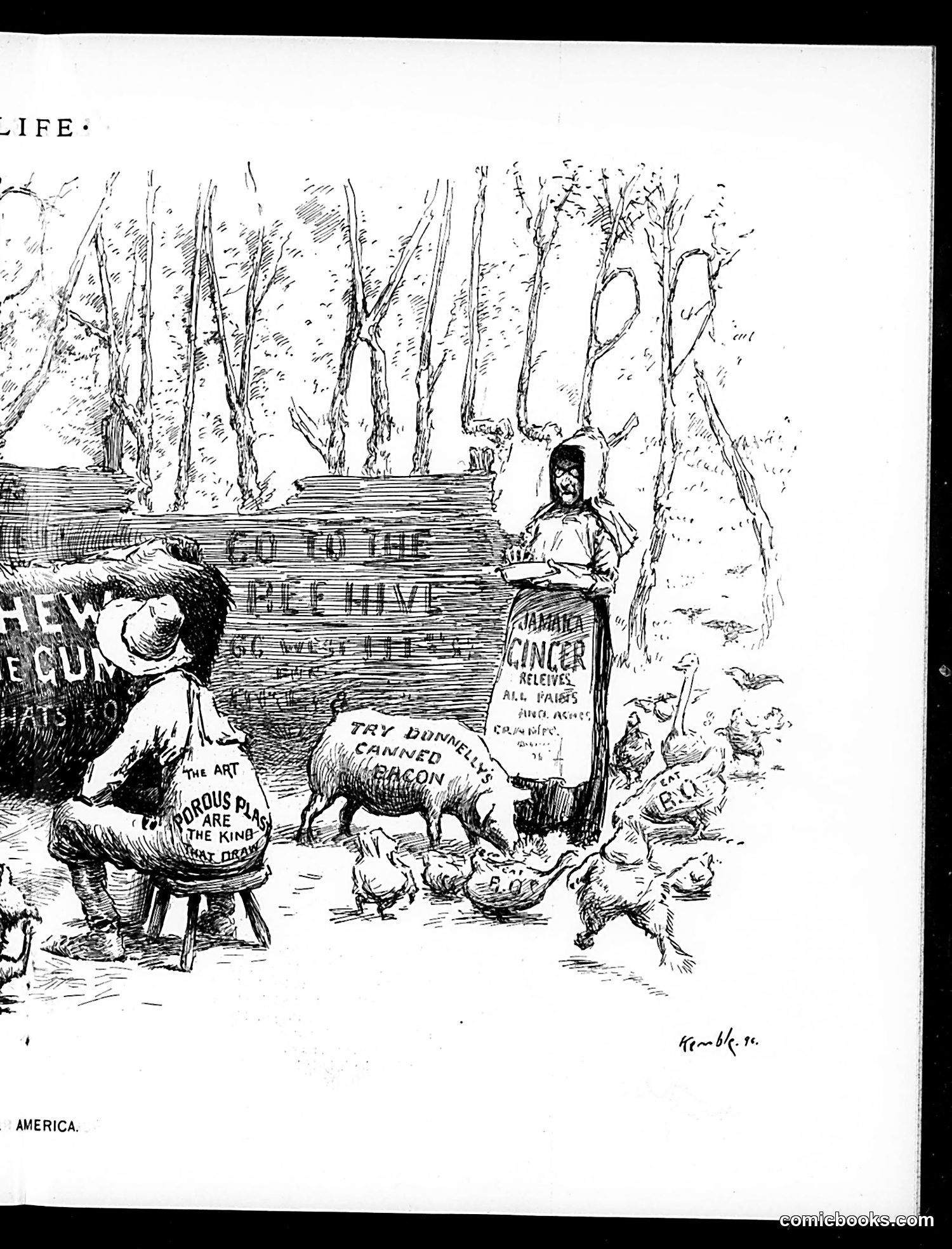
This is a satirical illustration depicting what appears to be a homeless encampment or shantytown, likely from the Great Depression era. The crude shelters are labeled with advertisements and product names—"Dinnel's Bacon," "Jamaica Ginger," and "Cancer" (possibly a patent medicine)—suggesting corporate exploitation of the poor. The figures include a man in a hat on the left (possibly representing a social commentator or artist, given the text "THE ART") and various impoverished people and animals. The satire mocks how companies advertised their products even to destitute populations, and may critique both poverty and false advertising practices. The overall message appears to be social commentary on economic inequality and corporate indifference during American hardship.
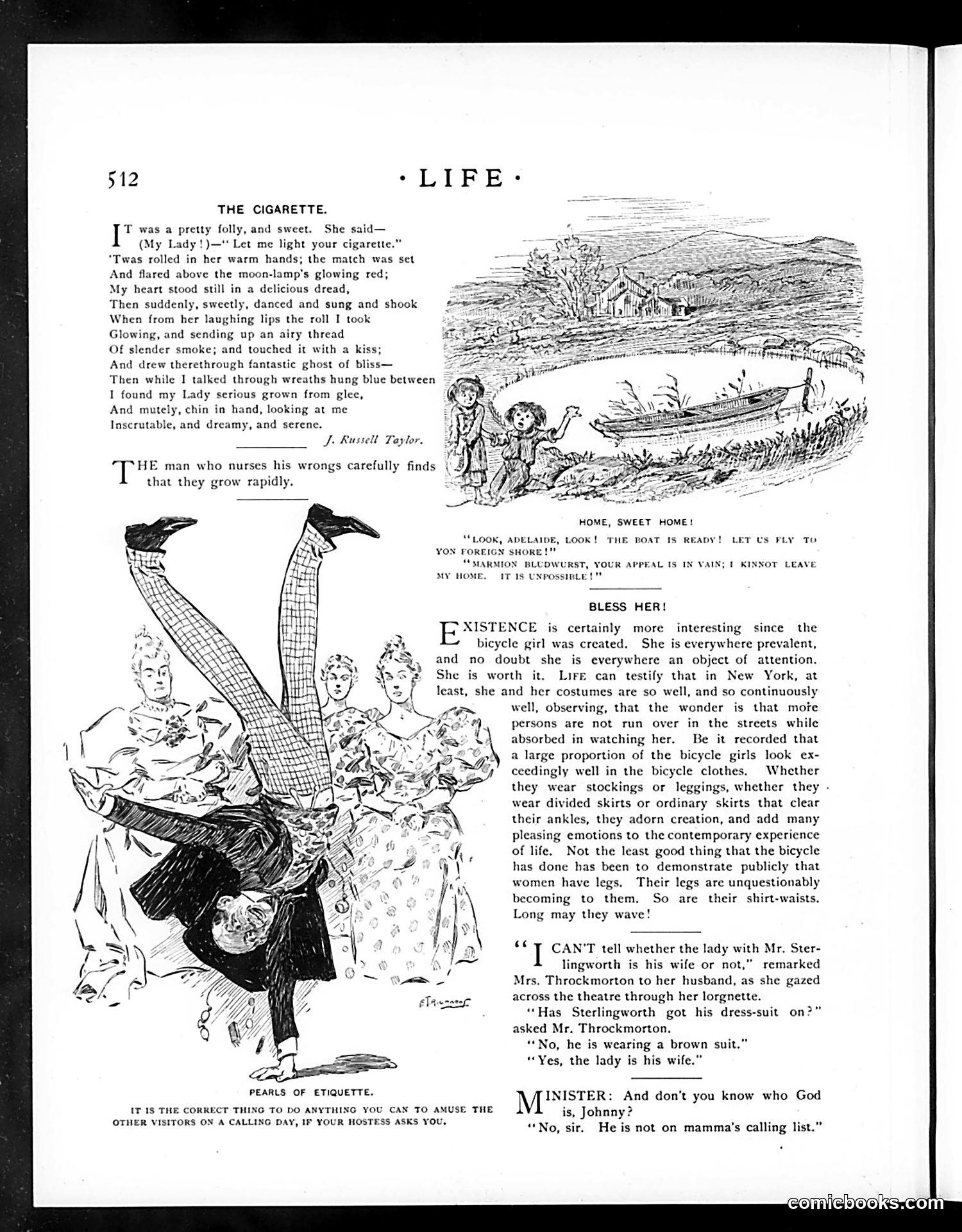
This page contains three distinct satirical pieces: 1. **"The Cigarette"** - A romantic poem by J. Russell Taylor about a woman lighting a cigarette, treating the act as a seductive, intimate gesture. The accompanying illustration shows men in exaggerated poses watching women with elongated legs—a humorous critique of how cigarette-smoking (then a relatively new social behavior for women) was portrayed as scandalous or alluring. 2. **"Home, Sweet Home"** - A sentimental illustration contrasting rural/domestic bliss with modern life, captioned with dialogue about boats and foreign shores. 3. **"Bless Her!"** - Prose celebrating the "bicycle girl," a symbol of women's independence and liberation. It satirizes both the bicycle craze and changing women's fashion (shorter skirts, stockings), while mocking both admirers and critics of these social changes. The page satirizes evolving gender roles and women's increasing public presence in the 1890s-1900s.
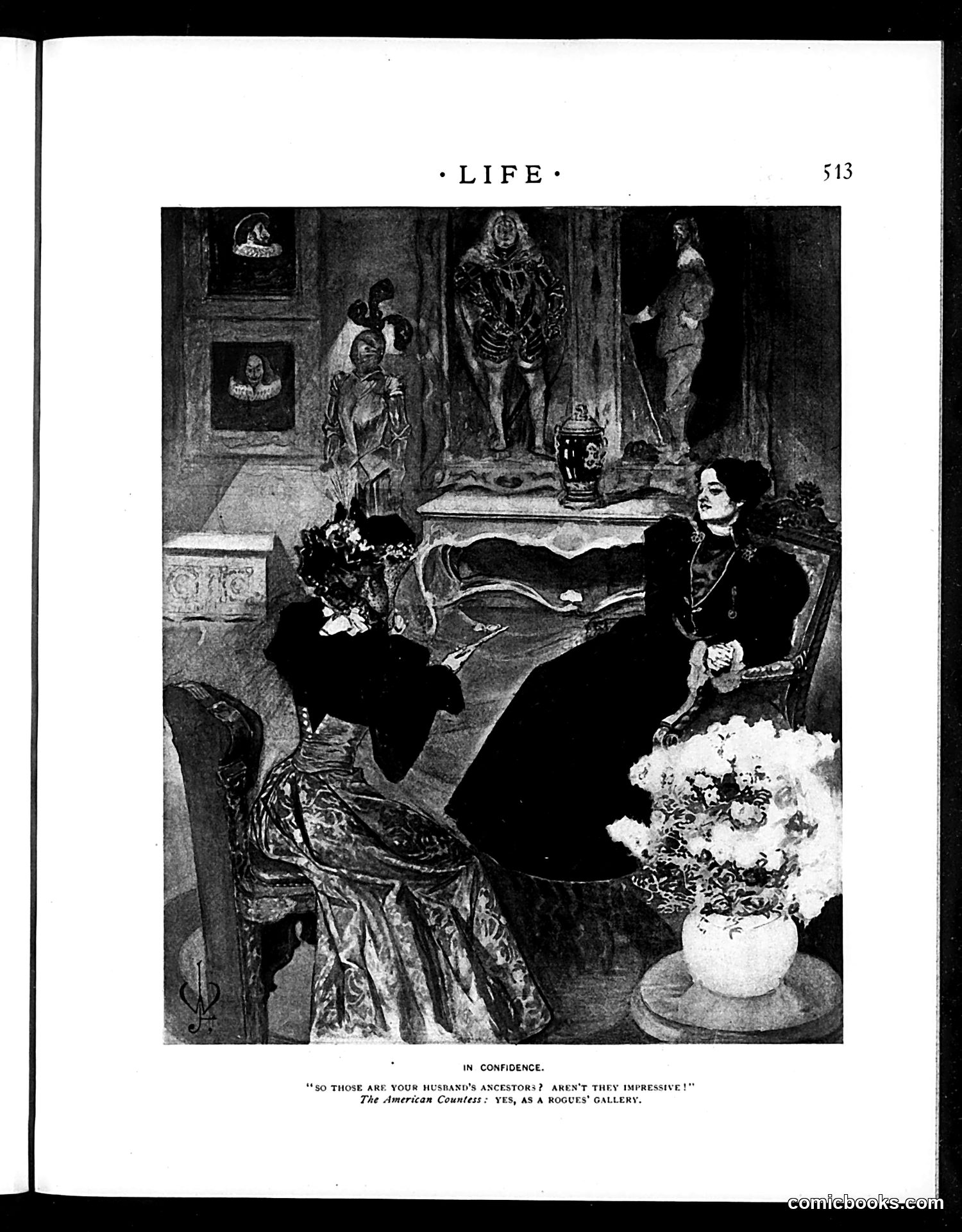
This illustration satirizes social climbing and aristocratic pretension among wealthy Americans. Two women in an ornate interior examine portraits of ancestors on the wall. One woman, identified as "The American Countess," remarks that her husband's ancestors constitute "a rogues' gallery"—meaning they're criminals or disreputable characters rather than honorable forebears. The joke targets the nouveau riche: Americans who married into European nobility and then displayed their acquisitions as status symbols. The satire suggests that such "impressive" ancestral lineages are actually filled with scoundrels, yet the countess presents them proudly anyway. The cartoon mocks both the pretentiousness of American wealth-seekers and the questionable moral standing of European aristocracy they so eagerly courted.
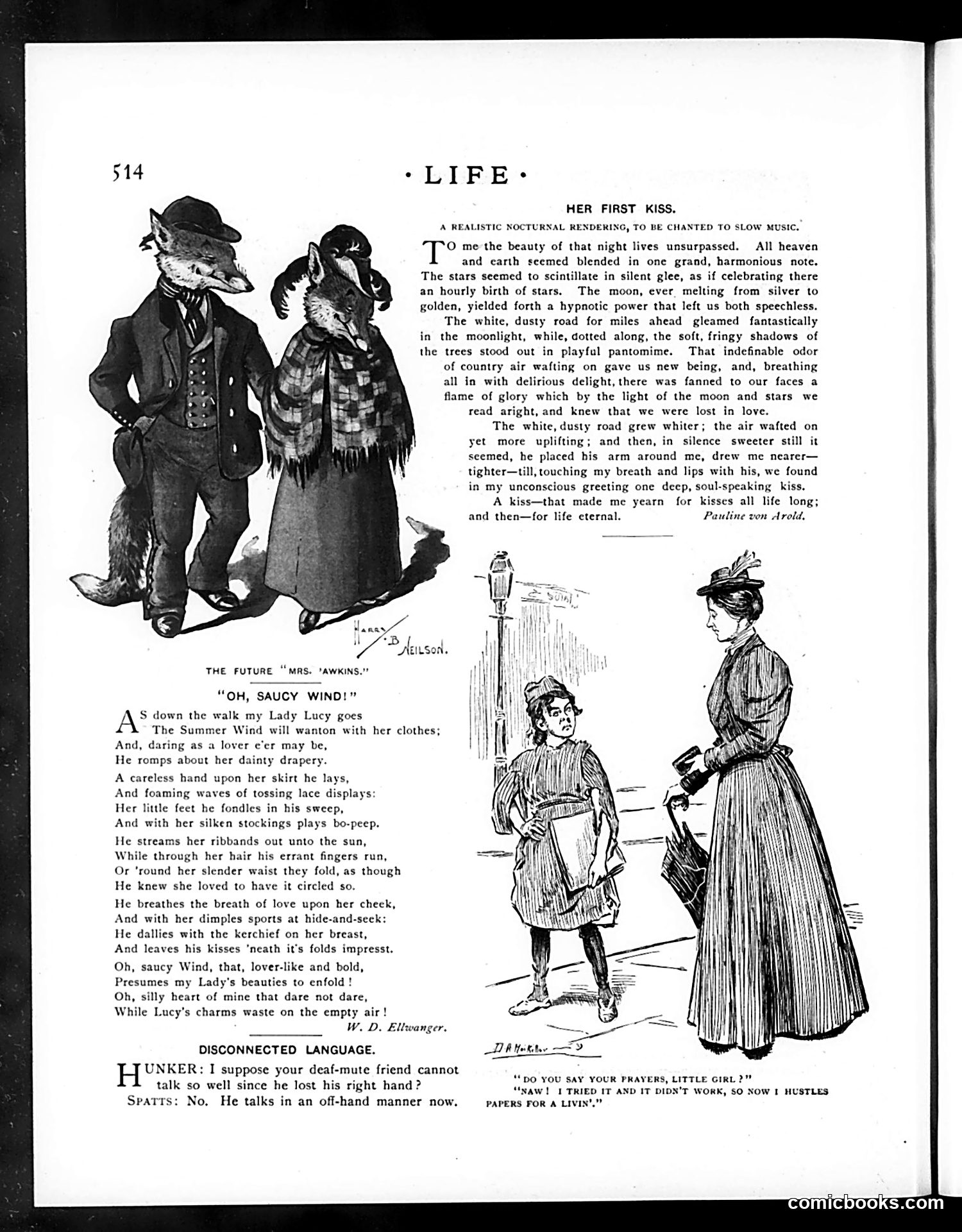
This page from *Life* magazine contains romantic and humorous pieces typical of late 19th/early 20th-century American satire. **"Her First Kiss"** is a sentimental poem about a romantic encounter under moonlight—earnest Victorian romance meant to be read aloud with dramatic effect. The illustration shows a couple in period dress embracing. **"The Future 'Mrs. 'Awkins'"** mocks working-class speech patterns, depicting what appears to be a street vendor or poor woman being accosted. The title suggests social commentary on class and marriage prospects. **"Oh, Saucy Wind"** is a flirtatious poem personifying the wind as a lover playfully touching a woman's clothes and body—acceptable Victorian innuendo through nature metaphor. **"Disconnected Language"** is a joke: the punchline plays on "off-hand" (literally, using the wrong hand to speak sign language) and includes a harsh joke about a poor girl forced to sell newspapers rather than say prayers—commentary on poverty and child labor. The overall tone reflects *Life*'s satirical approach to romance, class, and social conditions of the era.
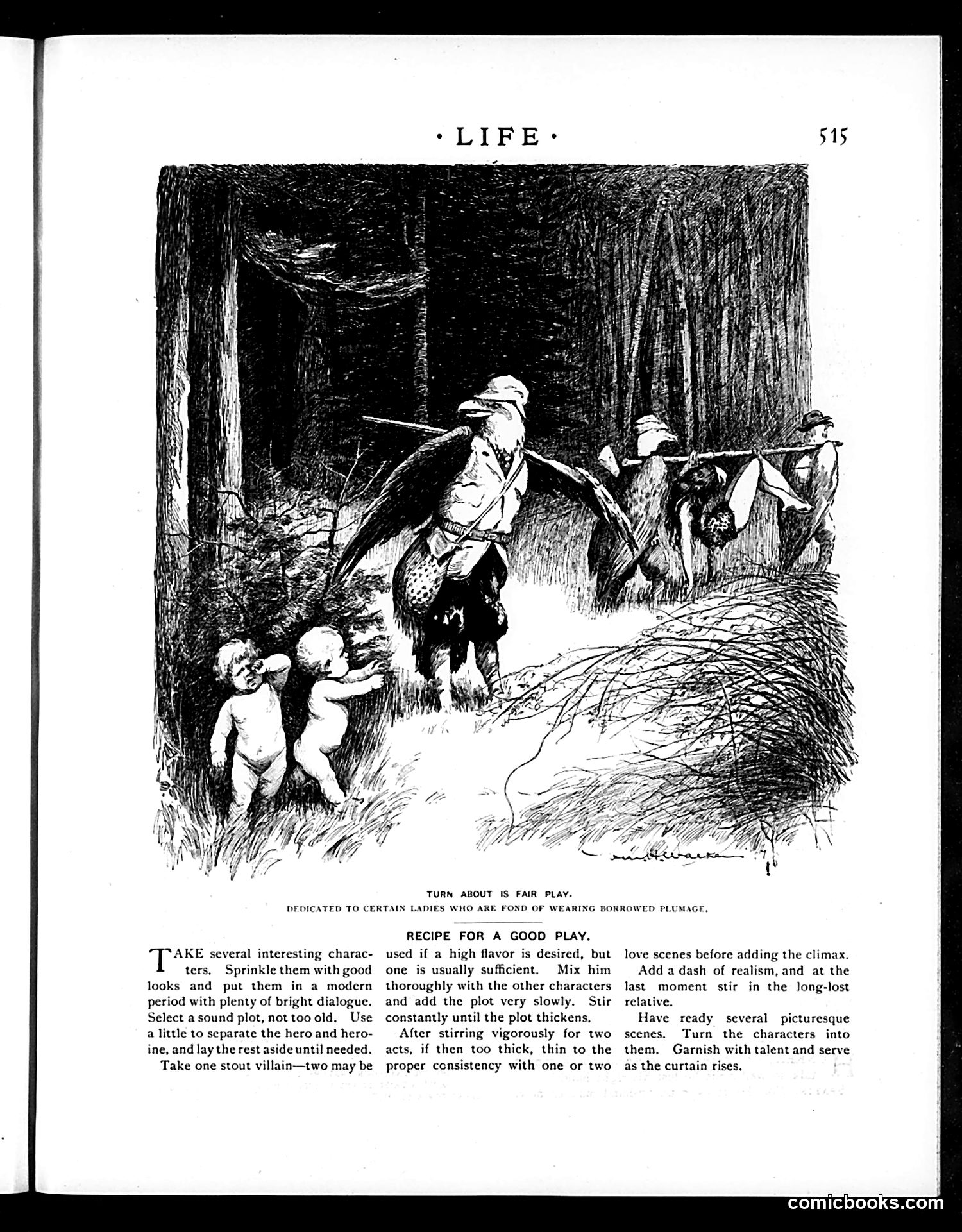
This page satirizes women wearing borrowed clothing or accessories—likely fashionable feathers or plumage they didn't own. The cartoon's title "Turn About Is Fair Play" suggests the satire is retaliatory. The illustration shows hunters with guns pursuing cherubs (cupids) through a forest, apparently to harvest their wings/feathers. The joke: if ladies are "fond of wearing borrowed plumage," they deserve to have it taken from them the way feathers are harvested from birds. The text below parodies theatrical "recipes," treating playwriting like cooking—a contemporary satirical format common in *Life* magazine. This appears designed as a humorous aside rather than directly related to the cartoon's message. The satire targets what the author views as vain women engaging in dishonest fashion practices, using dark humor (hunting cherubs) to mock the practice.
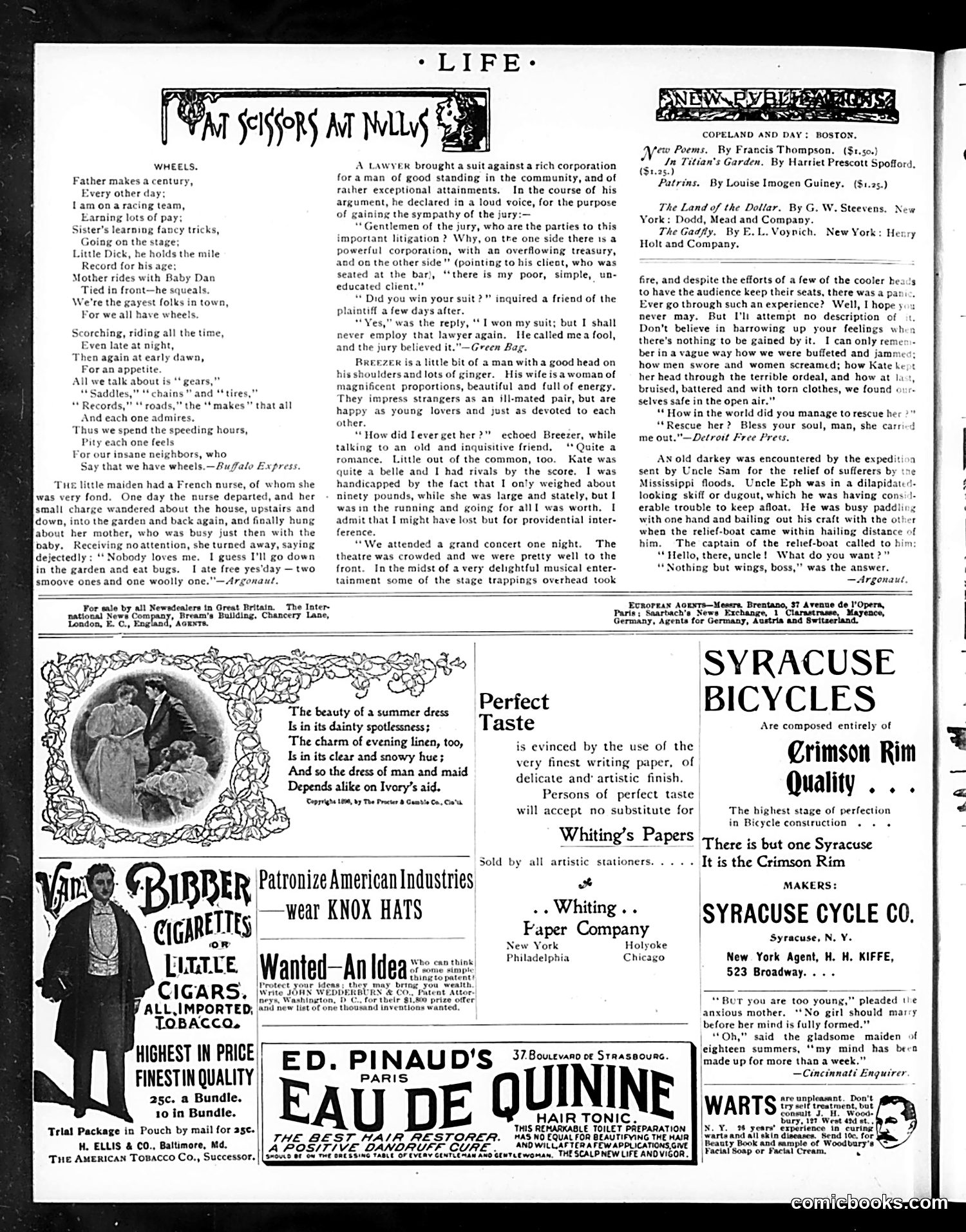
This page from *Life* magazine is primarily **humorous verse and anecdotes**, not political cartoons. The main content includes: 1. **"Wheels"** — A poem satirizing the bicycle craze of the era. It depicts a family obsessed with cycling, with every family member riding constantly ("Father makes a century / Every other day"). The joke is that neighbors think them "insane" for this behavior, suggesting how novel and consuming the bicycle fad had become. 2. **Three humorous short stories**: One about a child's malapropism, another about a lawyer who wins his case but insults his client, and a third about a small man named Breezer who wins over a larger woman despite being physically outmatched. The **advertisements** promote bicycles (Syracuse), cigarettes, paper, and hair restorer—typical period products. The satire reflects turn-of-the-century concerns: bicycle mania as a social phenomenon, class anxiety (the lawyer story), and gender dynamics. The humor is gentle, focused on domestic situations rather than politics.
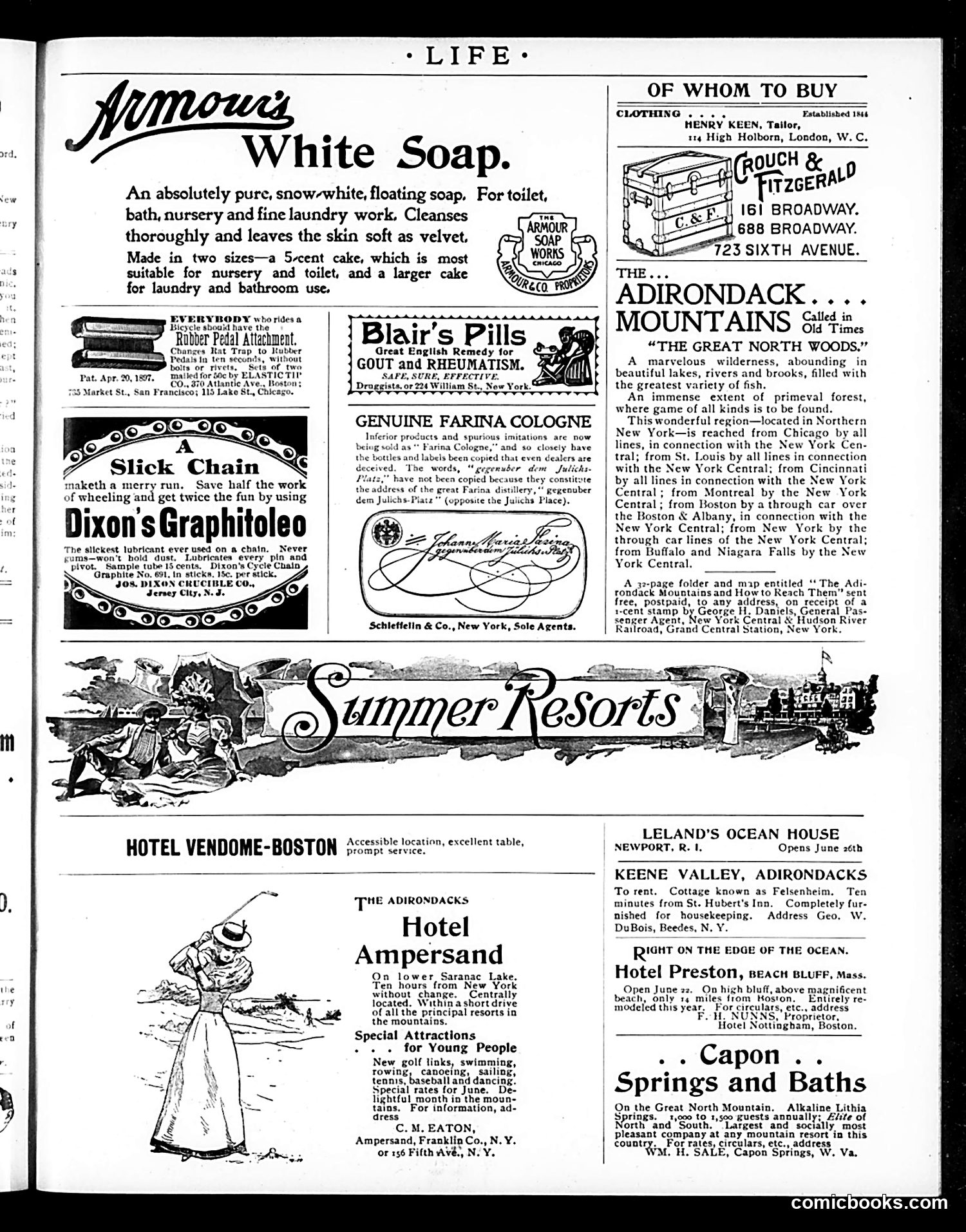
This page is **primarily advertising**, not satirical content. It's a commercial section featuring product advertisements and resort promotions typical of early-20th-century magazines. The ads include: - **Armour's White Soap** — a toilet and laundry product marketed for its purity - **Blair's Pills** — a patent medicine claiming to cure gout and rheumatism - **Dixon's Graphitoleo** — a chain lubricant - **Farina Cologne** — with a note warning against counterfeits - Numerous **summer resort advertisements** for upscale destinations (Adirondack Mountains, Newport hotels, beach resorts) The only mildly humorous element is the illustration accompanying **Hotel Ampersand**, showing a woman fishing, which gently plays on the resort's outdoor recreation offerings. There is **no political satire or social commentary** on this page — it's essentially a classified advertising section showcasing consumer goods and leisure destinations for affluent readers of the era.
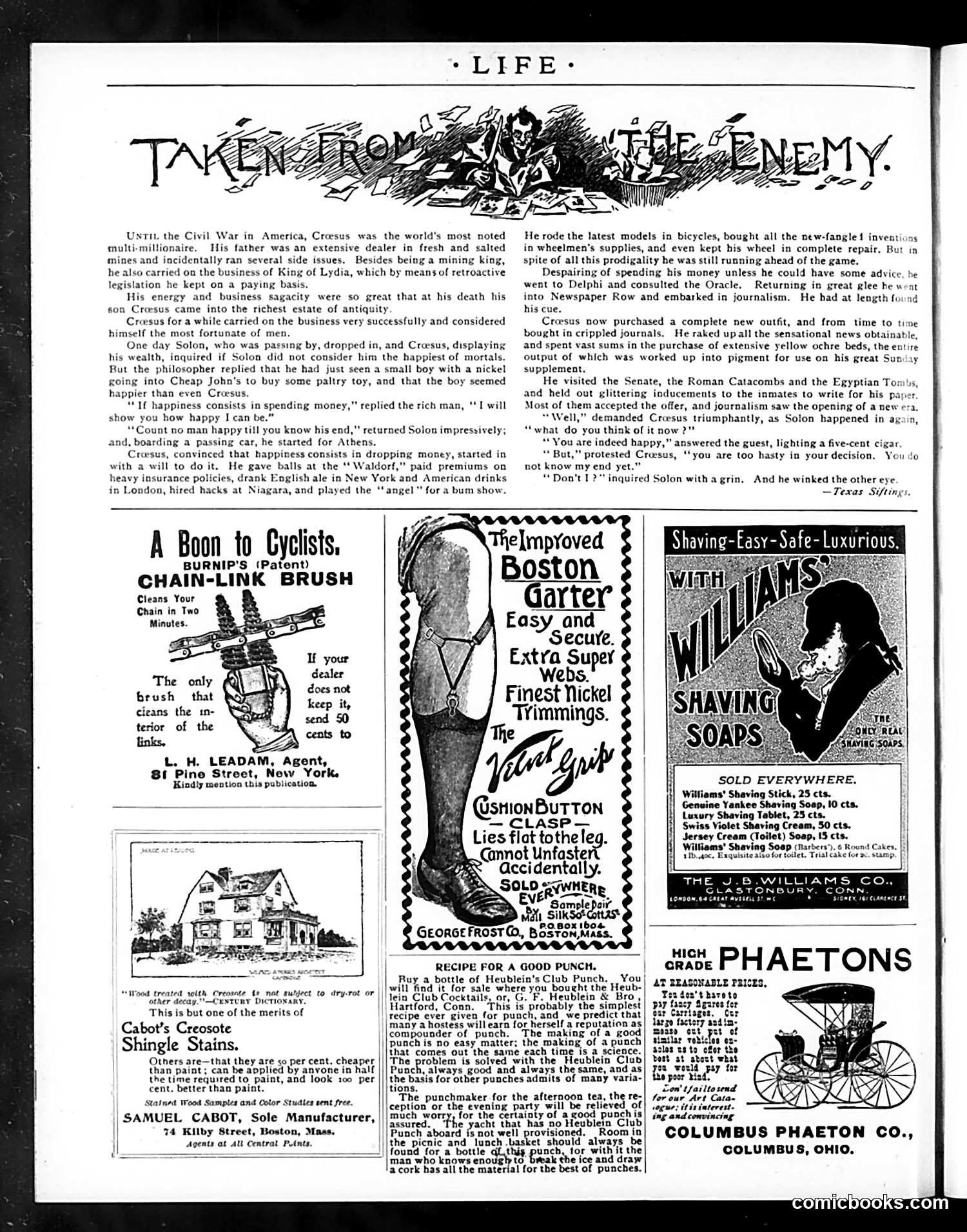
This story (credited to *Texas Siftings*) retells the ancient encounter between King Croesus and the philosopher Solon, applying it to American wealth and excess of the era. **The Setup**: Wealthy industrialist Croesus believes money guarantees happiness. Solon warns that no one's fortune should be judged until life's end—a classical memento mori. **The Satire**: Croesus attempts to "buy" happiness through conspicuous consumption: fancy balls, bicycles, new inventions, English ale in New York, journalism ventures with "yellow ochre beds" (yellow journalism). Despite reckless spending, he stays profitable—the joke being that even trying to lose money, the rich remain rich. **The Sting**: When Croesus boasts of his success, Solon knowingly grins and "winked the other eye"—implying Croesus's end will reveal his true fortune. The moral: wealth without wisdom brings no lasting happiness. **Context**: This Gilded Age satire mocks robber barons' spending sprees and yellow journalism's sensationalism while invoking ancient philosophy to suggest their comeuppance awaits.
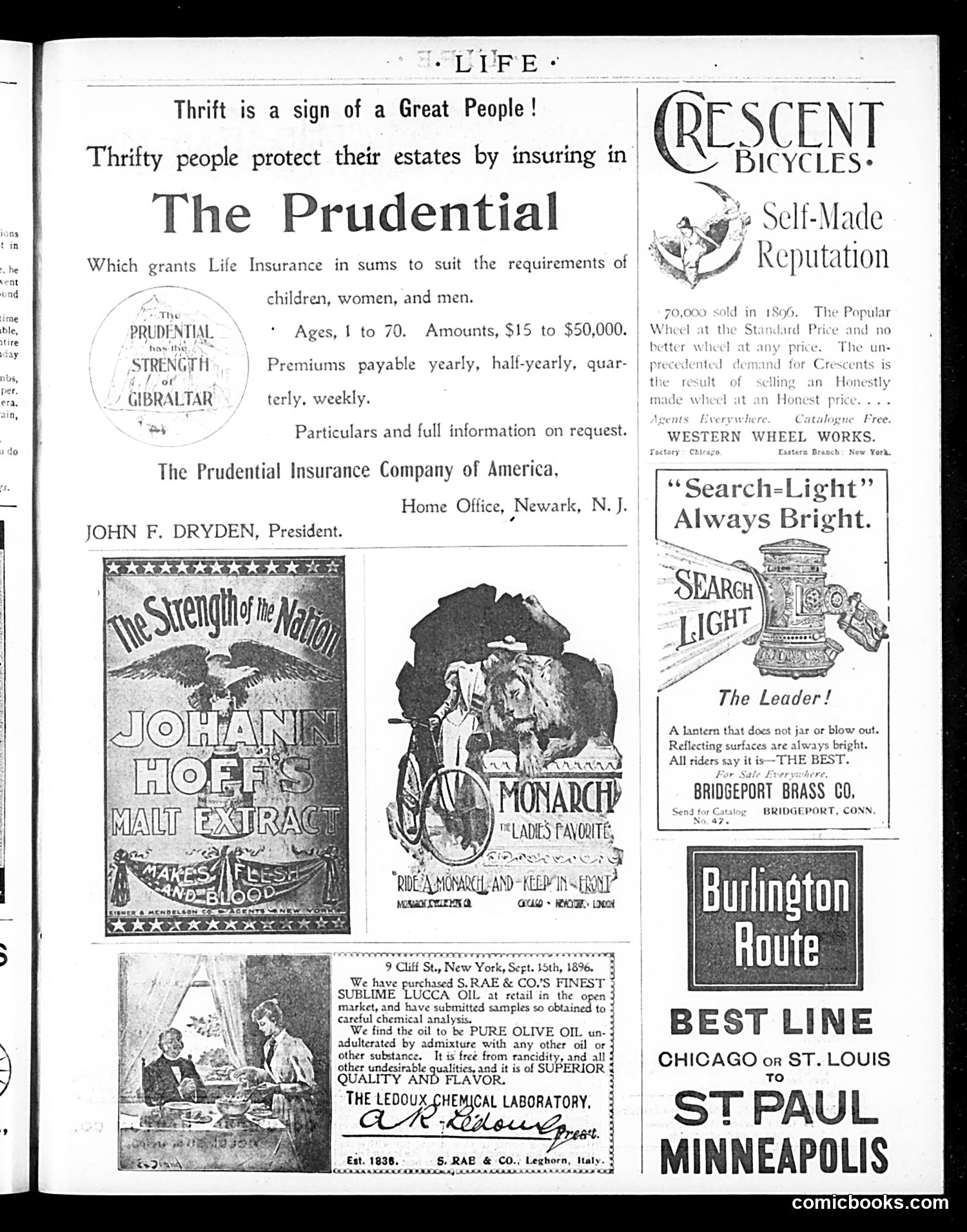
This is primarily a **commercial advertising page**, not a satirical cartoon page. The content consists of period advertisements (likely 1896, based on visible dating). The main items include: - **The Prudential Insurance Company** ad, emphasizing "thrift" as a virtue of "great people" and promoting life insurance for families - **Crescent Bicycles** advertisement highlighting their "self-made reputation" and sales success - **Search-Light lantern** for cyclists, marketed as superior and reliable - **Burlington Route** railroad advertisement - **Johanni Hoff's Malt Extract** (a tonic/health product) - **Monarch bicycle** for women - **Ledoux Chemical Laboratory** certification of olive oil purity The satirical element, if any, is subtle: the ads reflect **turn-of-century consumer culture and emerging middle-class aspirations**—insurance as respectability, bicycles as modern recreation, branded products as quality markers. However, this appears to be a straightforward commercial compilation rather than political satire.
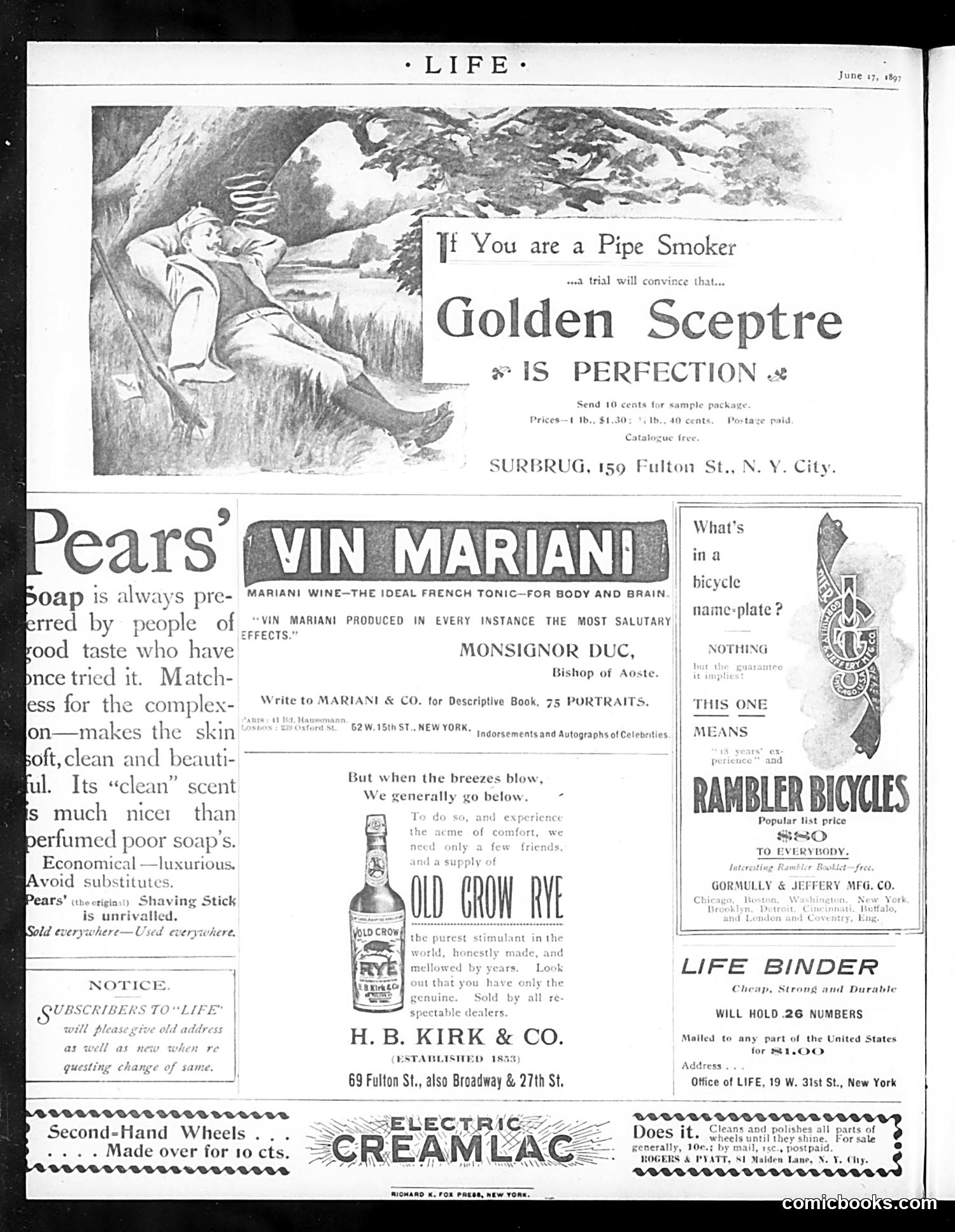
This page is primarily **advertising, not political satire**. It's the classified/advertisement section of Life magazine from June 17, 1897. The content includes promotions for consumer products: pipe tobacco (Golden Sceptre), French wine tonic (Vin Mariani), soap (Pears'), whiskey (Old Crow Rye), bicycles (Rambler), and other goods. The only illustrative element is a generic sketch of a man reclining under a tree—likely intended to evoke leisure and relaxation to sell the pipe tobacco. There is no political cartoon, caricature, or social satire visible. The page reflects late-19th-century advertising conventions and consumer culture but contains no commentary on political figures or events. It's essentially a historical document of period commercial messaging.