
Life, 1897-06-17 · page 6 of 20
Life — June 17, 1897 — page 6: what you’re looking at
What you’re looking at
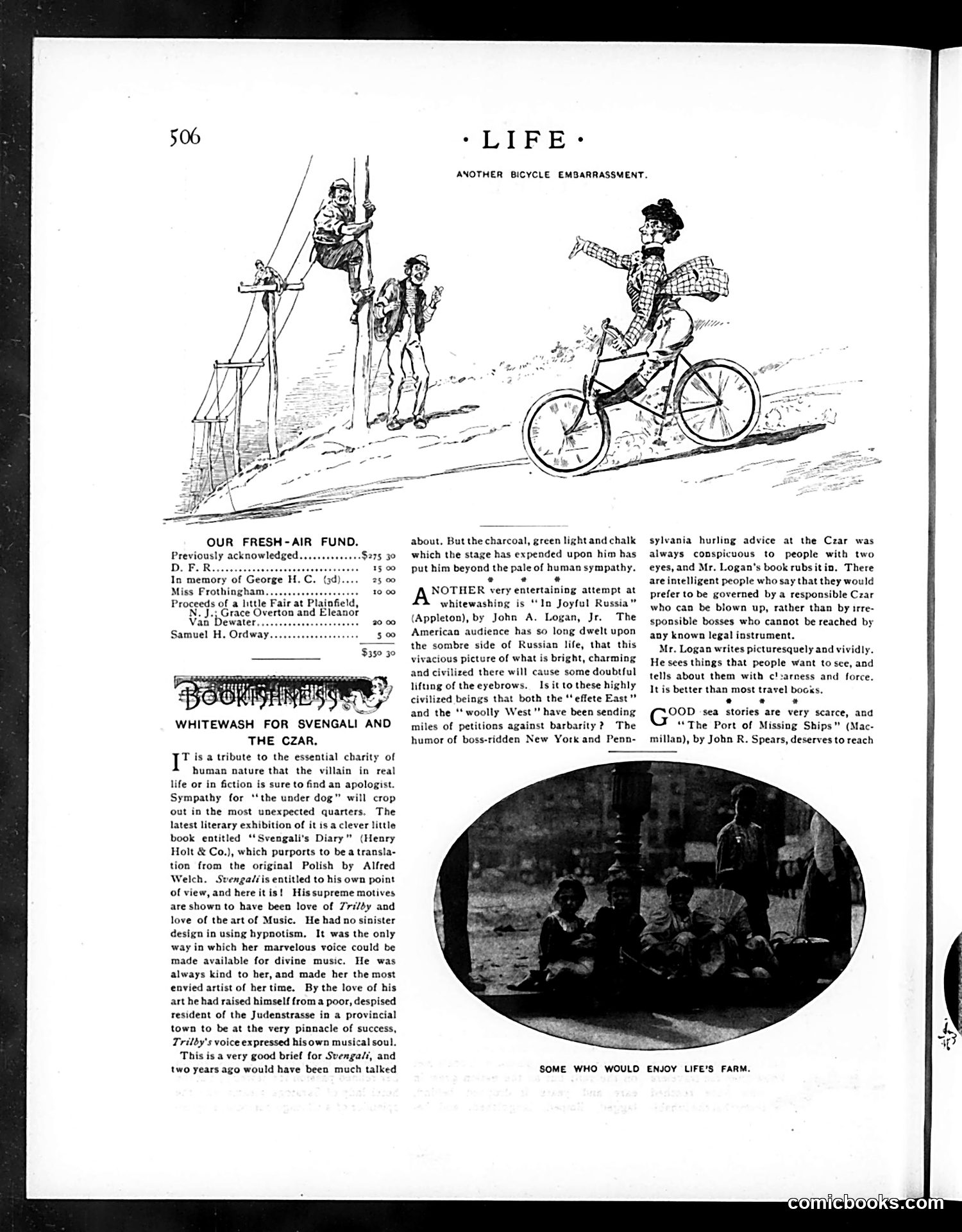
This cartoon satirizes a common early-1900s social hazard: bicycle riding accidents, particularly involving women in restrictive clothing. The illustration shows a woman cyclist signaling with a megaphone while riding, having apparently startled two pedestrians on a utility pole—suggesting she nearly caused them to fall. The humor targets the awkwardness of bicycle culture as it intersected with Victorian-era dress codes. Women wearing long skirts, corsets, and elaborate hats attempted to ride bicycles designed for more practical clothing, creating genuinely dangerous situations. The exaggerated megaphone suggests the cyclist's obliviousness to the chaos she creates. This reflects real social tensions of the era regarding women's independence, fashion, and emerging transportation technology.
📄 Transcribed text from this page (OCR, searchable)
Machine-transcribed from the original scan — historical spelling and the odd misread are preserved.
OUR FRESH-AIR FUND. Previously acknowledged... D. F.R.. In memory of George H.C. Miss Frothingham.. Proceeds of a little Fair at Plainfield, Grace Overton and Eleanor Vai‘ bewater Samuel H. Ordway.... WHITEWASH FOR SVENGALI AND THE CZAR, T isa tribute to the essential charity of human nature that the villain in real life or in fiction is sure to find an apologist. Sympathy for ‘the under dog” will crop out in the most unexpected quarters. The latest literary exhibition of it is a clever little book entitled “Svengali’s Diary" (Henry Holt & Co.), which purports to bea transla- tion from the original Polish by Alfred Welch. Svengaliis entitled to his own point of view, and here it is! His supreme motives are shown to have been love of 7ri/éy and love of the art of Music. He had no sinister design in using hypnotism. It was the only way in which her marvelous voice could be made available for divine music. He was always kind to her, and made her the most envied artist of her time. By the love of his art he had raised himself from a poor, despised resident of the Judenstrasse in a provincial town to be at the very pinnacle of success, Trilby's voice expressed hisown musical soul. This is a very good brief for Svengali, and two years ago would have been much talked LIFE ANOTHER BICYCLE EMBARRASSMENT. about, But the charcoal, green light and chalk which the stage has expended upon him has put him beyond the pale of human sympathy. © « NOTHER very entertaining attempt at whitewashing is “In Joyful Russia” (Appleton), by John A. Logan, Jr. The American audience has so long dwelt upon the sombre side of Russian life, that this vivacious picture of what is bright, charming and civilized there will cause some doubtful lifting of the eyebrows. Is it to these highly civilized beings that both the ‘effete East” and the ‘woolly West " have been sending miles of petitions against barbarity? The humor of boss-ridden New York and Penn- sylvania hurling advice at the Czar was always conspicuous to people with two eyes, and Mr. Logan's book rubsitin, There are intelligent people who say that they would prefer to be governed by a responsible Czar who can be blown up, rather than by irre- sponsible bosses who cannot be reached by any known legal instrument. Mr. Logan writes picturesquely and vividly. He sees things that people want to sce, and tells about them with cl:arness and force. It is better than most travel books. of @ OOD sea stories are very scarce, and “The Port of Missing Ships” (Mac- millan), by John R. Spears, deserves to reach SOME WHO WOULD ENJOY LIFE’S FARM. xt Sp