
A complete issue · 18 pages · 1896
Life — October 29, 1896
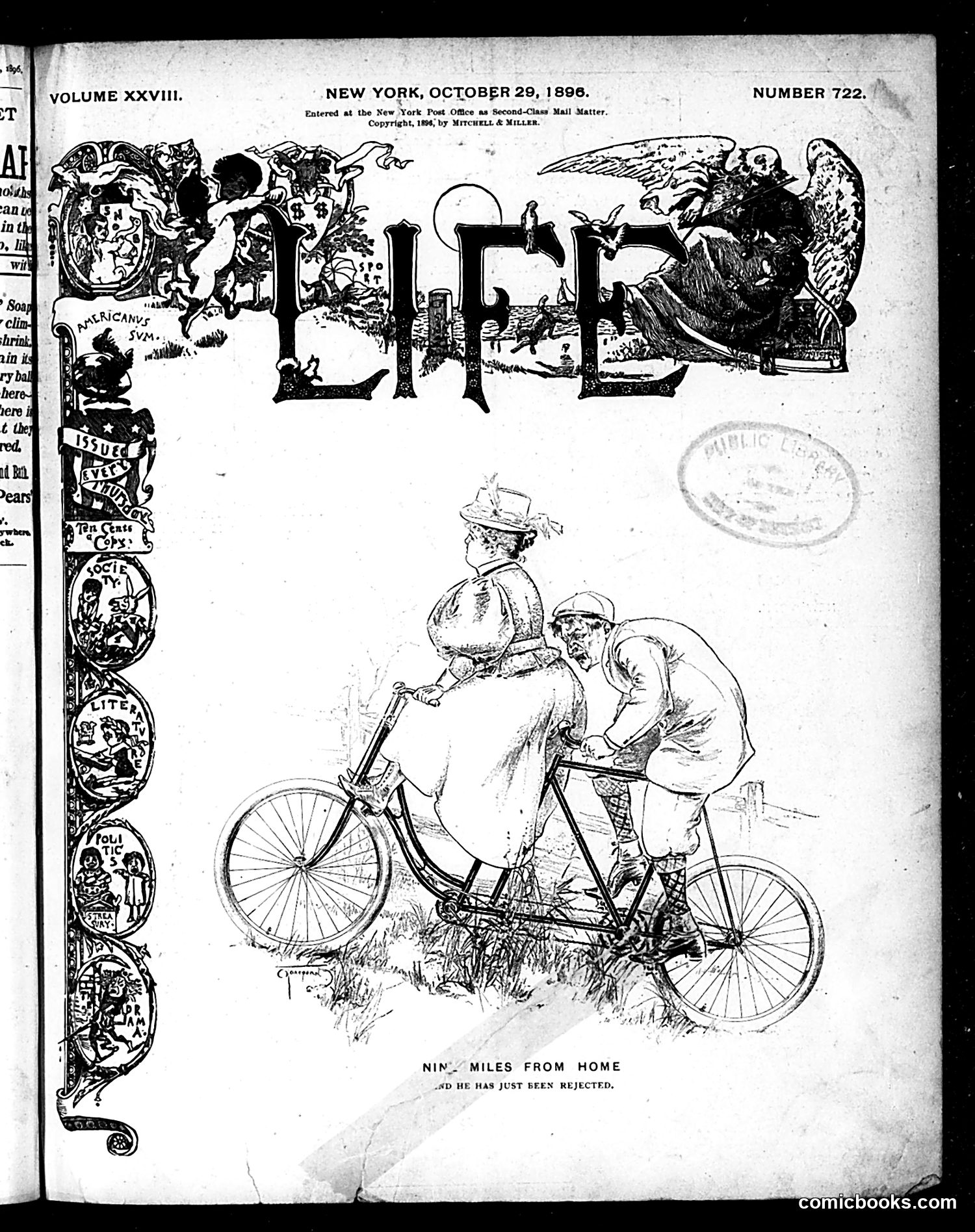
This 1898 *Life* magazine cartoon satirizes the bicycle craze of the 1890s. The illustration shows a dejected couple on a tandem bicycle, with the caption indicating the man has just been rejected in a marriage proposal. The humor lies in the social awkwardness: they're forced to share intimate proximity on a bicycle after romantic rejection. The woman appears indifferent or satisfied with her refusal, while the man slouches dejectedly. The ornate left border contains decorative vignettes reflecting *Life's* satirical content. This cartoon mocks both the era's bicycle mania—which enabled unprecedented mixed-gender socializing—and the vulnerability of rejected suitors who must continue their journey home with their disappointed romantic interest.
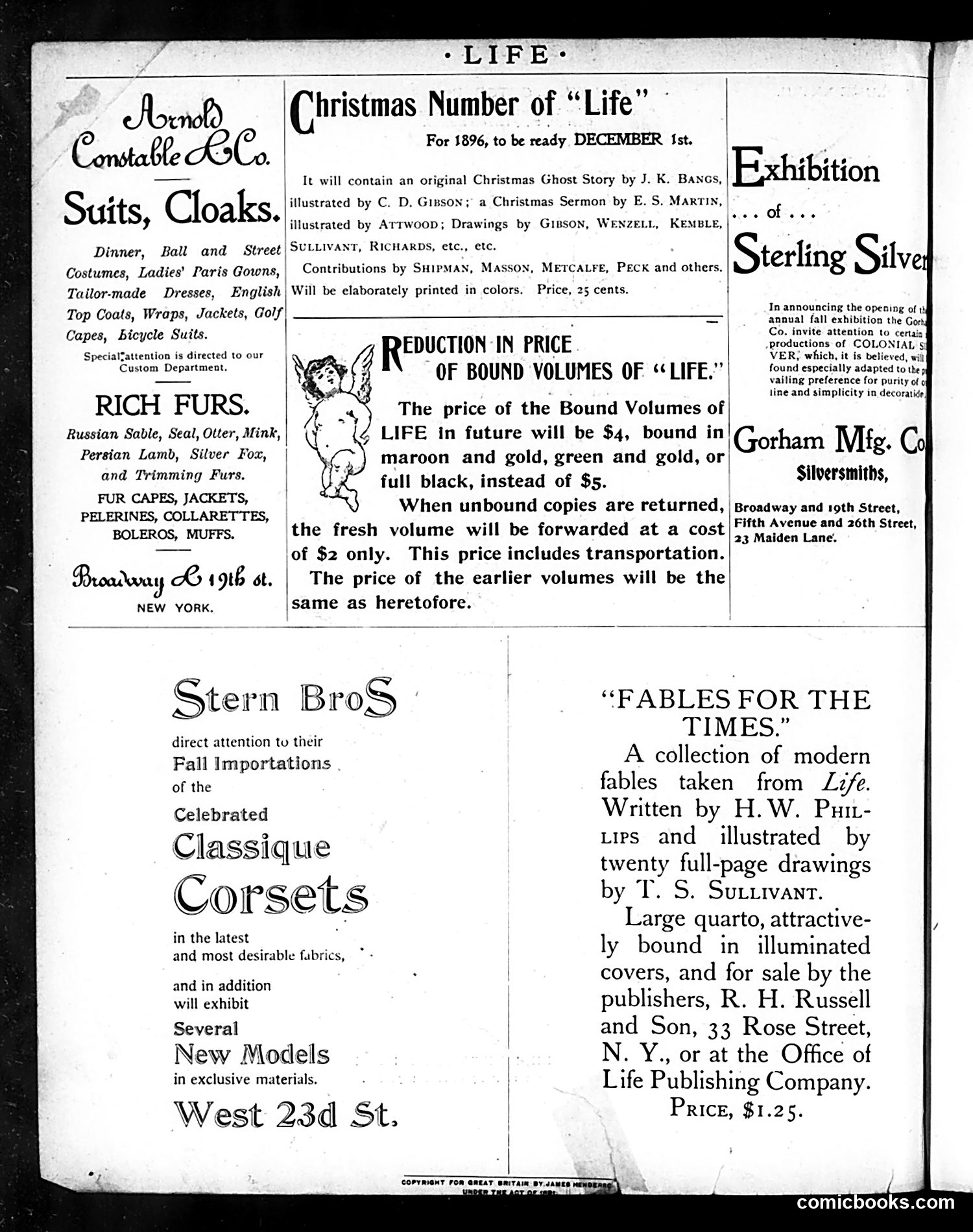
This page is primarily **advertisements** with one small decorative element. There is a winged cherub/cupid illustration accompanying the "Reduction in Price of Bound Volumes of 'Life'" announcement, but this is ornamental rather than satirical content. The ads promote various goods: Arnold Constable & Co. offers clothing and furs; Gorham Manufacturing Company advertises sterling silver; Stern Bros. promotes imported corsets; and R.H. Russell and Son publishes "Fables for the Times" by H.W. Phillips with illustrations by T.S. Sullivant. The only potentially meaningful content is the book "Fables for the Times"—described as modern fables from *Life* magazine—though the specific satirical subjects aren't detailed here. This appears to be a standard commercial page rather than political satire.
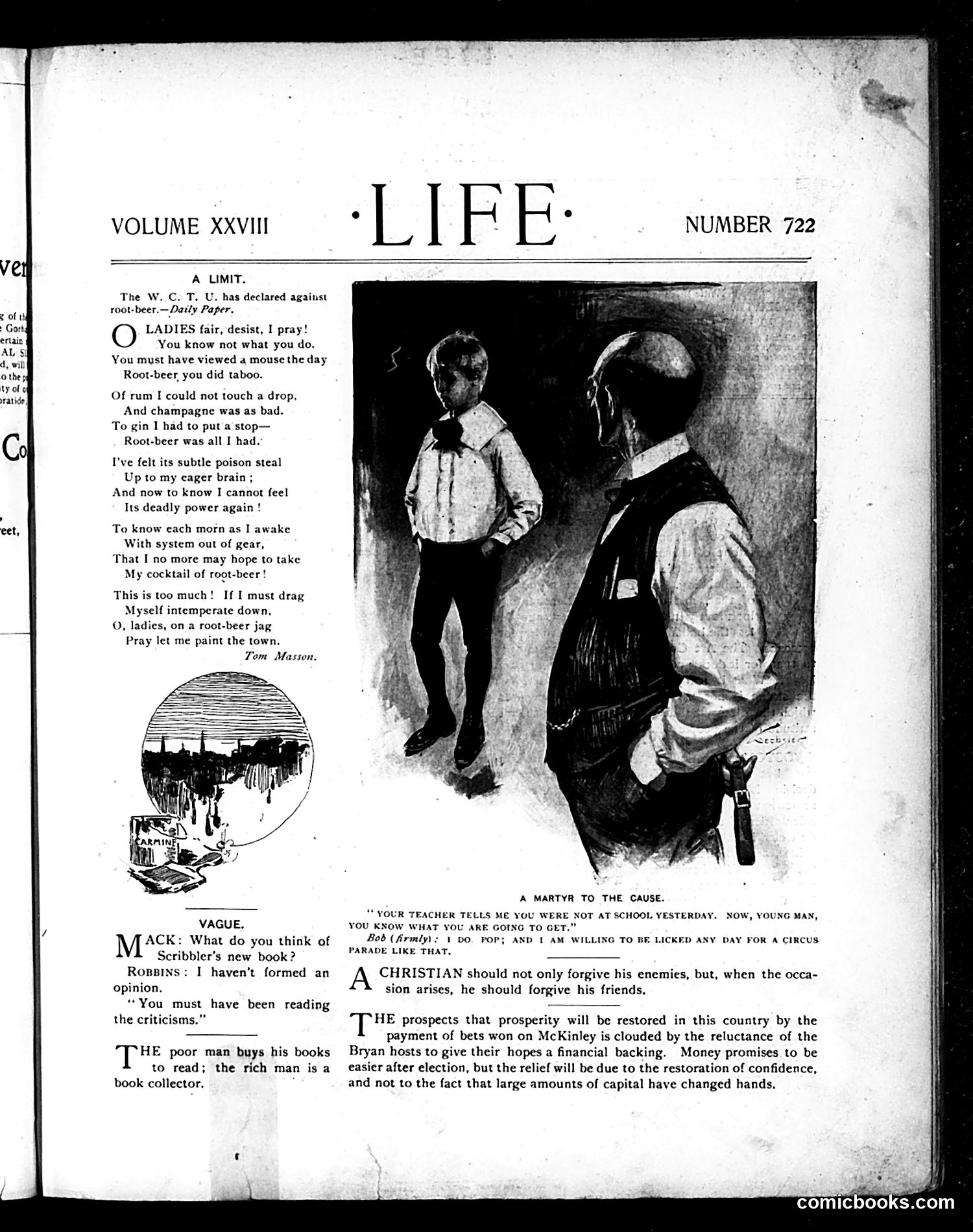
**"A Limit" (top left):** A satirical poem about root beer prohibition. The W.C.T.U. (Women's Christian Temperance Union) had declared against root beer, which the poem mocks—the speaker laments being unable to enjoy even this non-alcoholic beverage due to temperance movement overreach. **"A Martyr to the Cause" (right illustration):** Shows what appears to be a schoolboy being disciplined, captioned about a teacher reporting the boy wasn't at school. The satire suggests overzealous enforcement of standards. **Bottom political commentary:** References McKinley-era economic policies, suggesting that prosperity won't return through betting on McKinley's promises, but rather through restored confidence and capital movement—a critique of post-election economic optimism. The page critiques both temperance extremism and political-economic naïveté.
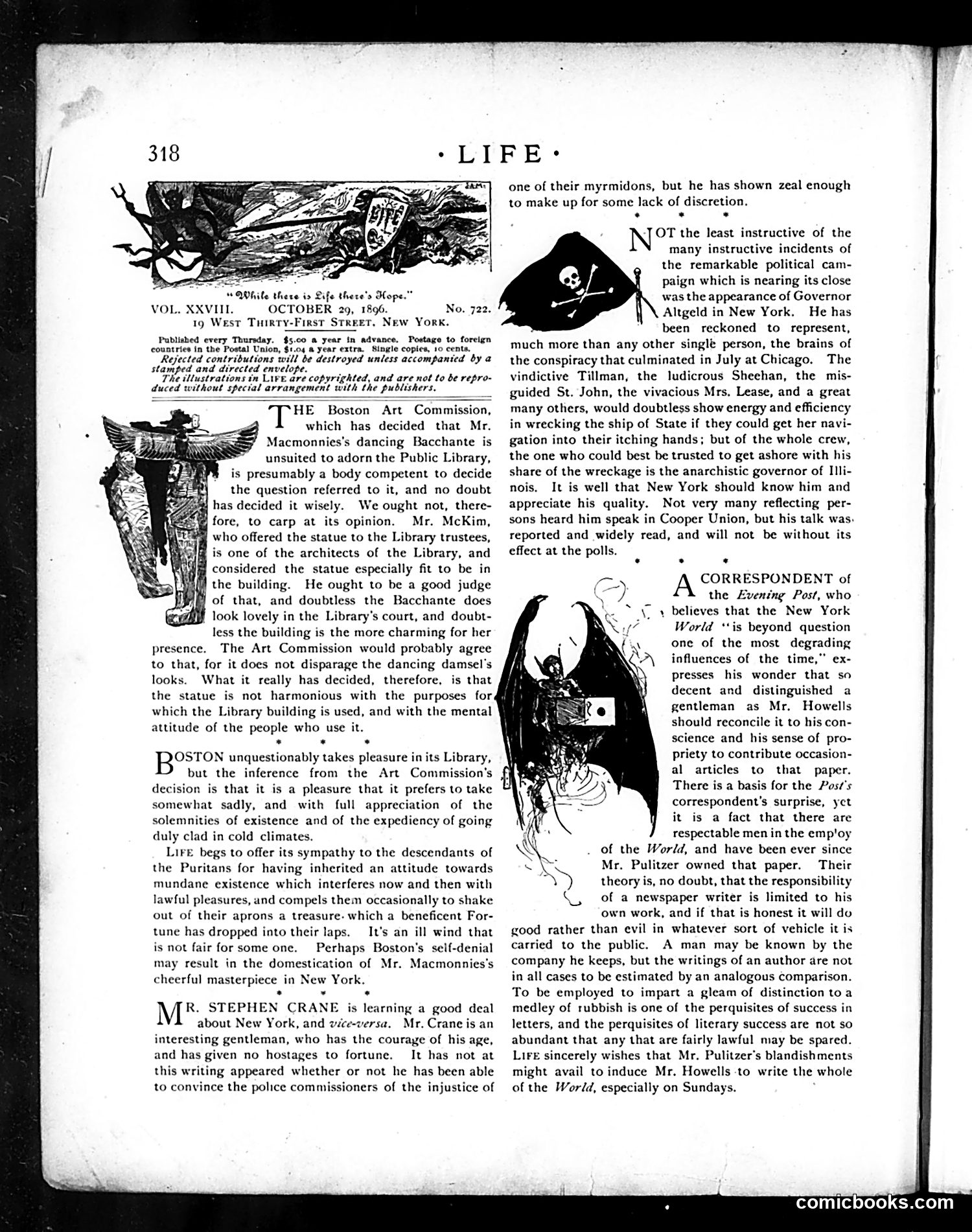
This page contains editorial commentary on New York politics during the 1896 election season. The cartoons satirize Governor Altgeld of Illinois and various political conspirators involved in what appears to be a corruption scheme. The text references specific figures—including "the vindictive Tillman, the ludicrous Sheehan, the misguided St. John"—as co-conspirators whom Altgeld supposedly orchestrated. The overall point criticizes Altgeld as the mastermind behind a political conspiracy targeting New York's governance. The page also defends Governor Altgeld against attacks from the *Evening Post*, arguing that newspaper criticism of his character is unfair. The satirical cartoons (appearing as decorative elements) visually reinforce these political attacks through exaggerated imagery typical of 1890s partisan journalism.
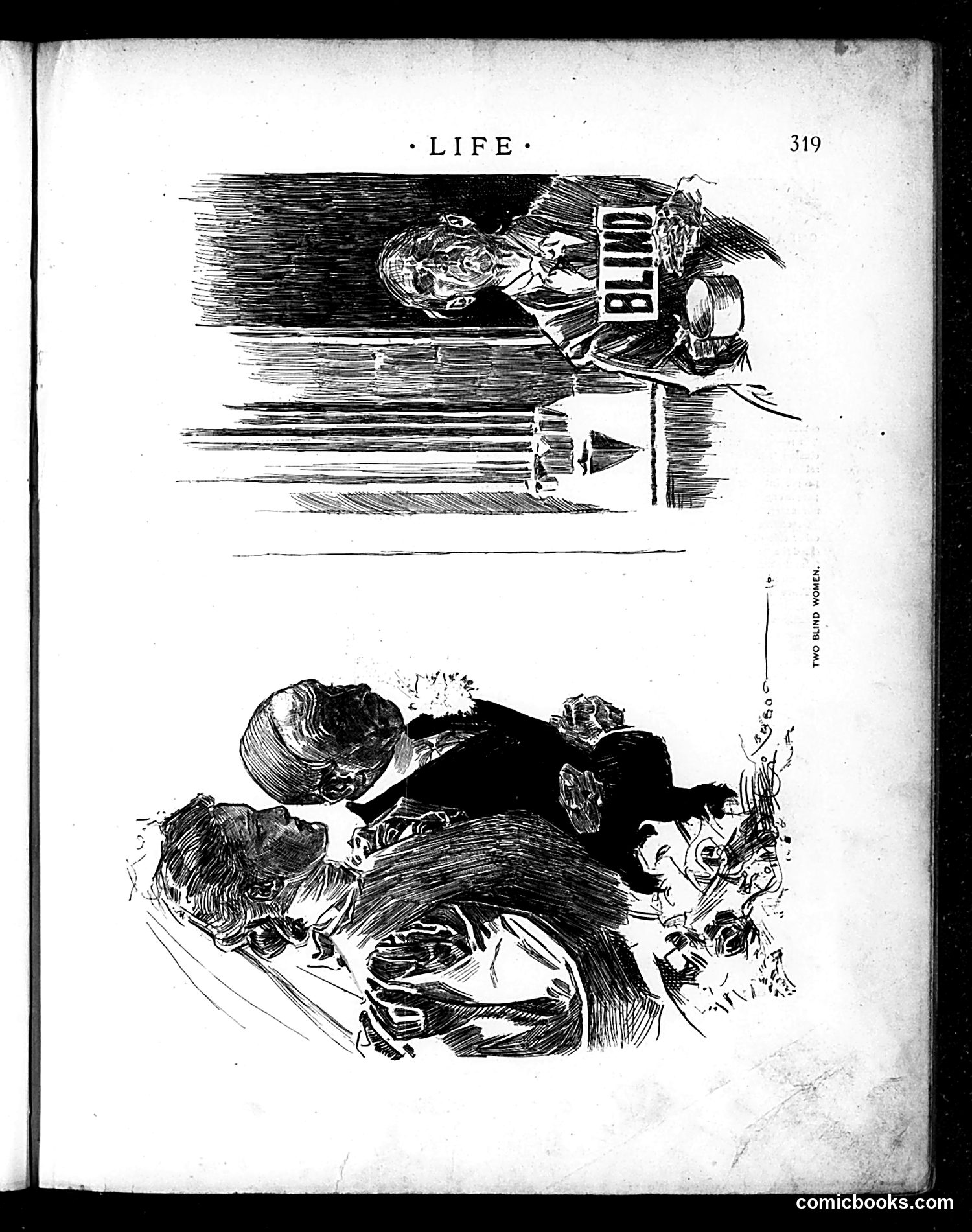
This page contains two political cartoons in black ink. The top illustration depicts a figure labeled "BLUFF" wielding what appears to be a large stick or club as a weapon. The second cartoon shows multiple figures in what seems to be a confrontational scene. Without clearer text or additional context visible on this page, I cannot confidently identify the specific political figures, the historical event referenced, or the precise satirical message. The style and technique are consistent with early-to-mid 20th century American editorial cartooning, but determining which political situation or personalities are being mocked would require additional source information or clearer OCR text that isn't provided here. The page number (319) suggests this is from a specific issue, which would help date the content.
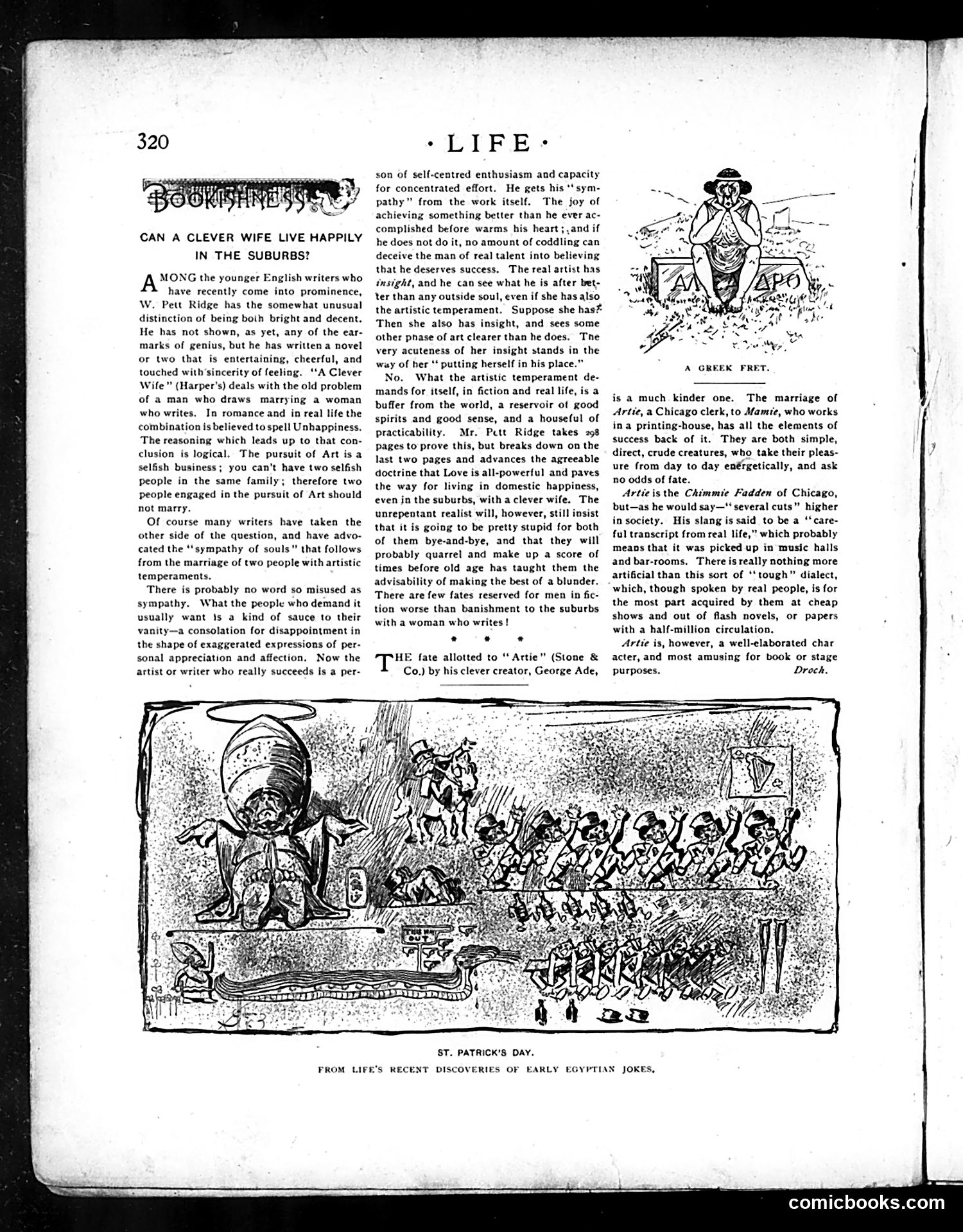
**Main Content:** This page discusses whether clever wives can live happily in suburbs. The article argues that artistic temperament in women creates domestic unhappiness, citing the character "Artie" from a novel as an example of a wife whose writing career conflicts with suburban domestic life. **Bottom Cartoon:** Titled "St. Patrick's Day: From Life's Recent Discoveries of Early Egyptian Jokes," this is a humorous visual pun. It depicts an Egyptian scene with snakes emerging from a basket—referencing the snake-charming tradition—conflating this with St. Patrick's Irish snake-expulsion legend. The joke plays on the supposed antiquity of the St. Patrick's Day joke itself, suggesting even ancient Egyptians told similar jokes. It's lighthearted ethnic and cultural wordplay typical of early 20th-century American humor.
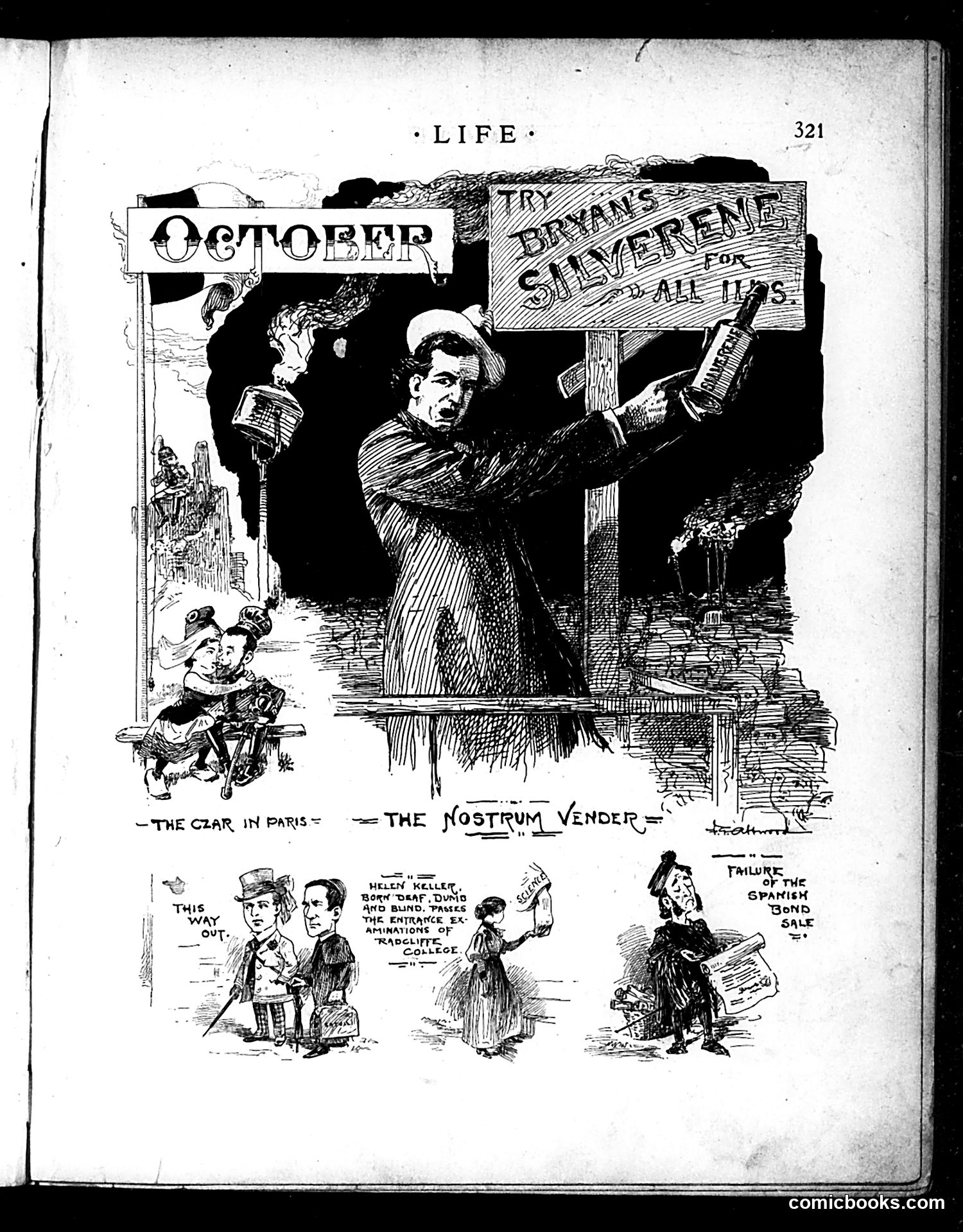
This October page features "The Nostrum Vender," a satirical cartoon depicting someone hawking "Bryan's Silverence for All Ills"—a political jab at William Jennings Bryan, the Populist/Democratic politician who championed free silver coinage as an economic cure-all. The main illustration shows a street vendor promoting silver as a miraculous cure, with "The Czar in Paris" as a smaller subplot below. The smaller vignettes mock various contemporary figures and issues, including references to Helen Keller and what appears to be educational or social movements. The satire ridicules Bryan's promotion of silver as a panacea for economic problems—suggesting his solution was as dubious and ineffective as patent medicine nostrums sold by street vendors to gullible crowds.
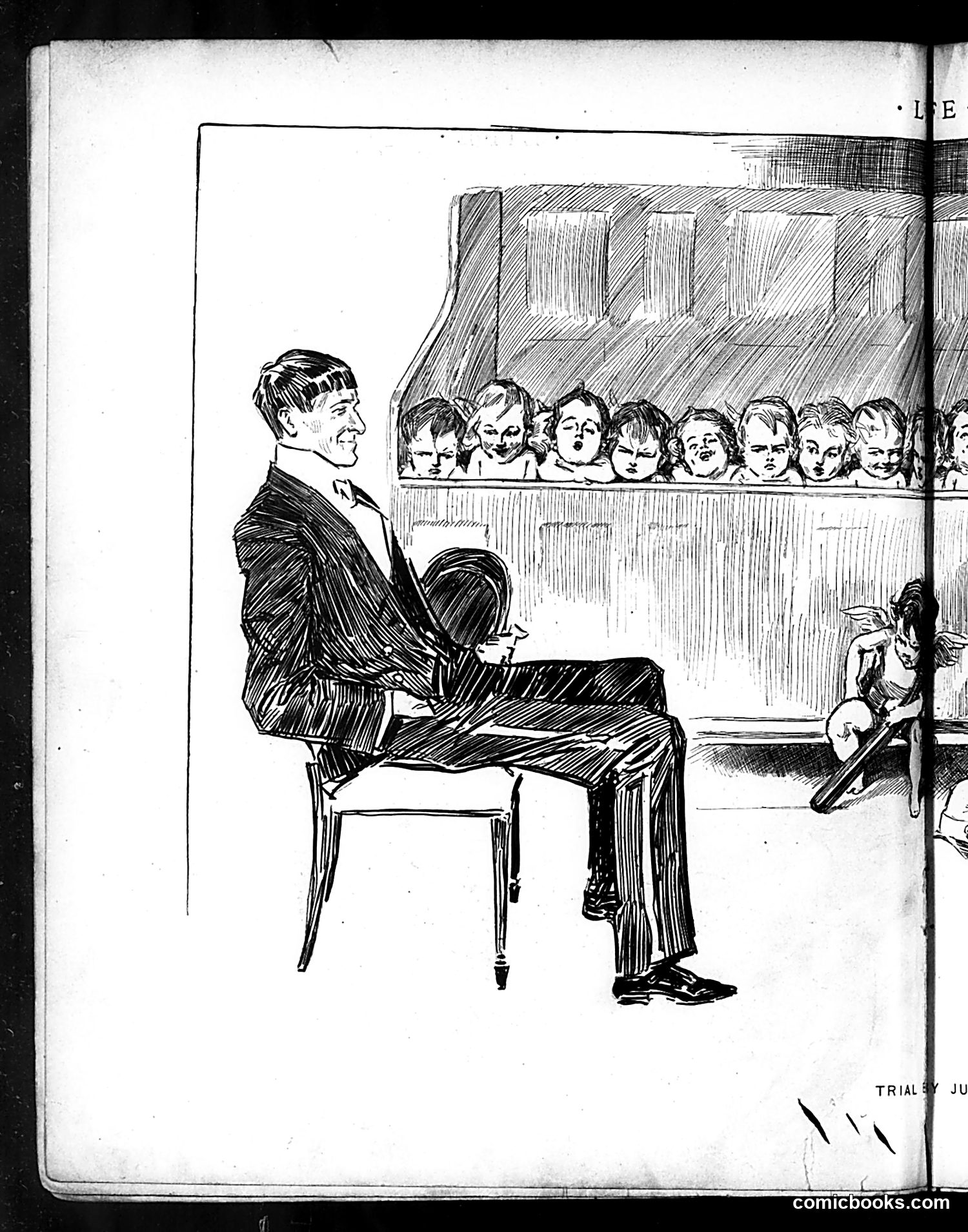
This cartoon depicts a man in formal business attire seated alone, facing away from the viewer toward a courtroom or jury box where approximately ten children's faces peer down at him. The caption reads "TRIAL BY JU[RY]" (text cut off). The satire appears to mock the absurdity of being judged by an incompetent or inappropriate jury—in this case, children. The visual humor comes from the grotesque contrast: a serious legal proceeding overseen by childish, wide-eyed jurors who are clearly unqualified to render judgment on adult matters. This likely critiques either the legal system's inadequacies or, more specifically, may reference a particular trial where the jury selection was questioned as incompetent or biased. The exaggerated expressions suggest the children are bewildered, adding to the satirical commentary on flawed justice.
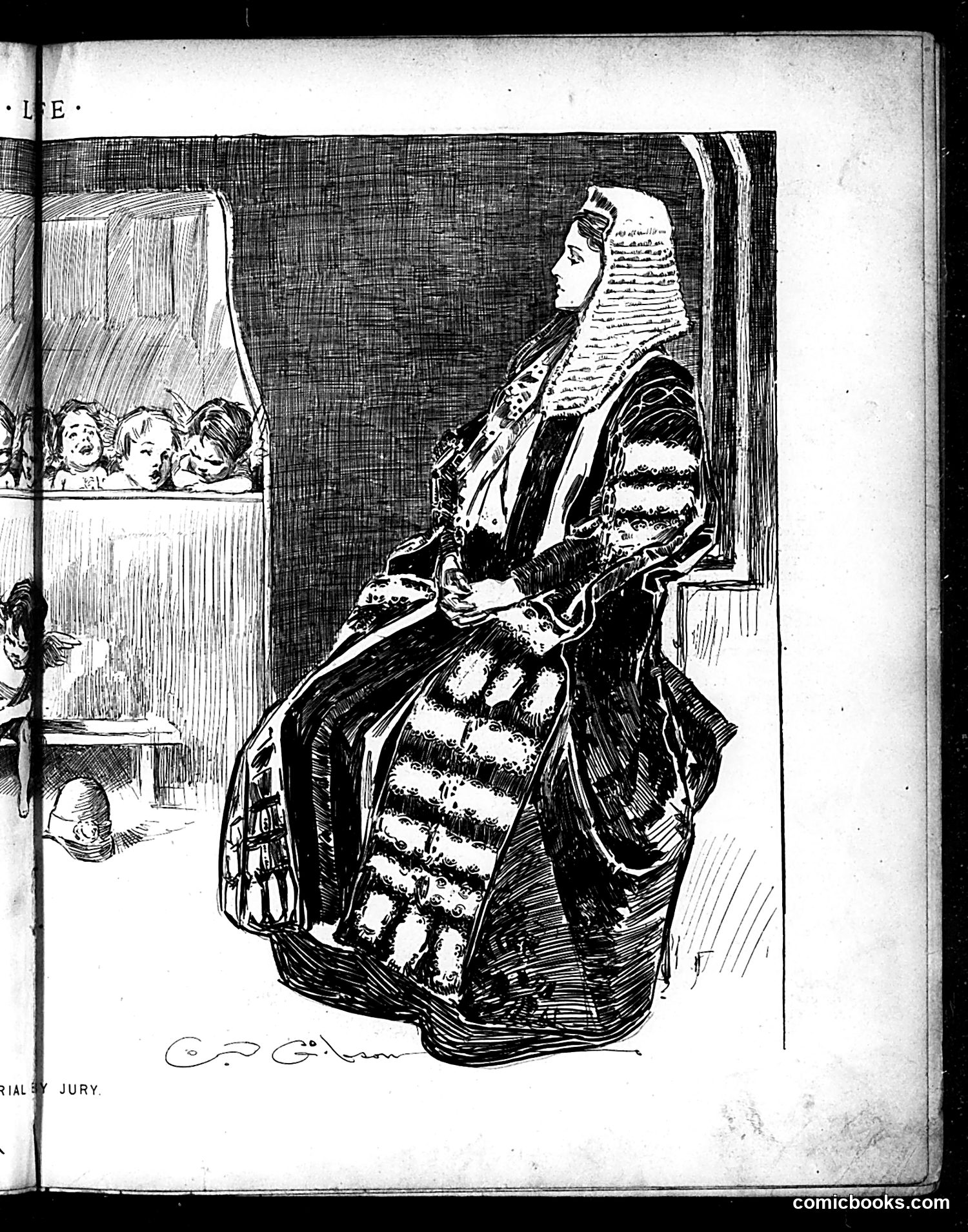
This appears to be a satirical illustration from *Life* magazine depicting a figure in elaborate royal or judicial robes and Egyptian-style headdress, seated in a position of authority. The figure is shown in profile, wearing ornate striped garments and holding what appears to be a sword or ceremonial weapon. On the left side, children are visible peering from behind a curtain or barrier, suggesting this is a theatrical or public performance. Without clearer text identifying the specific political figure or event being satirized, I cannot definitively state who is being caricatured or what contemporary issue this addresses. The Egyptian styling and theatrical staging suggest mockery of someone adopting grandiose, authoritarian airs for public consumption—likely a commentary on political pomposity or excessive vanity during the era when *Life* published this cartoon.
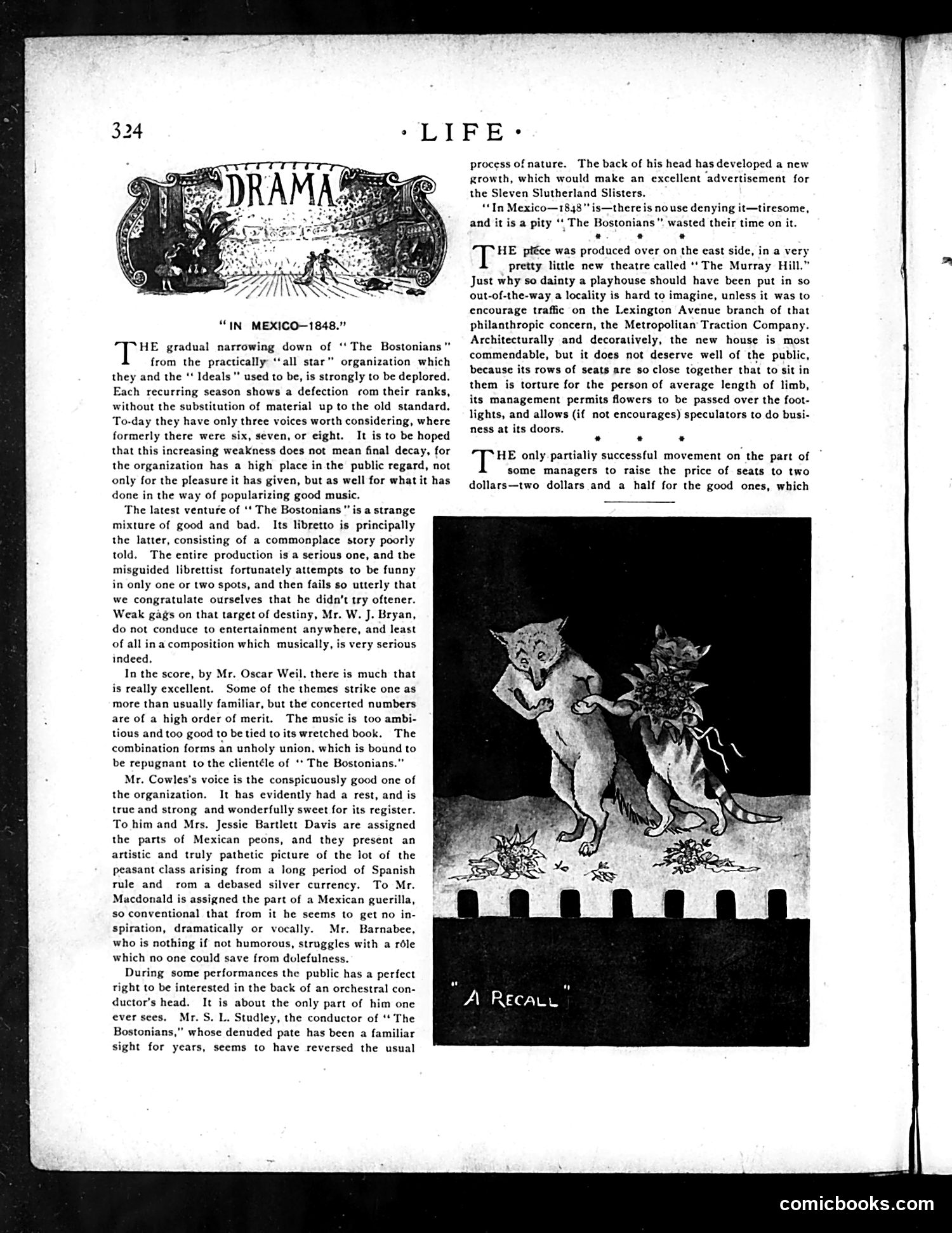
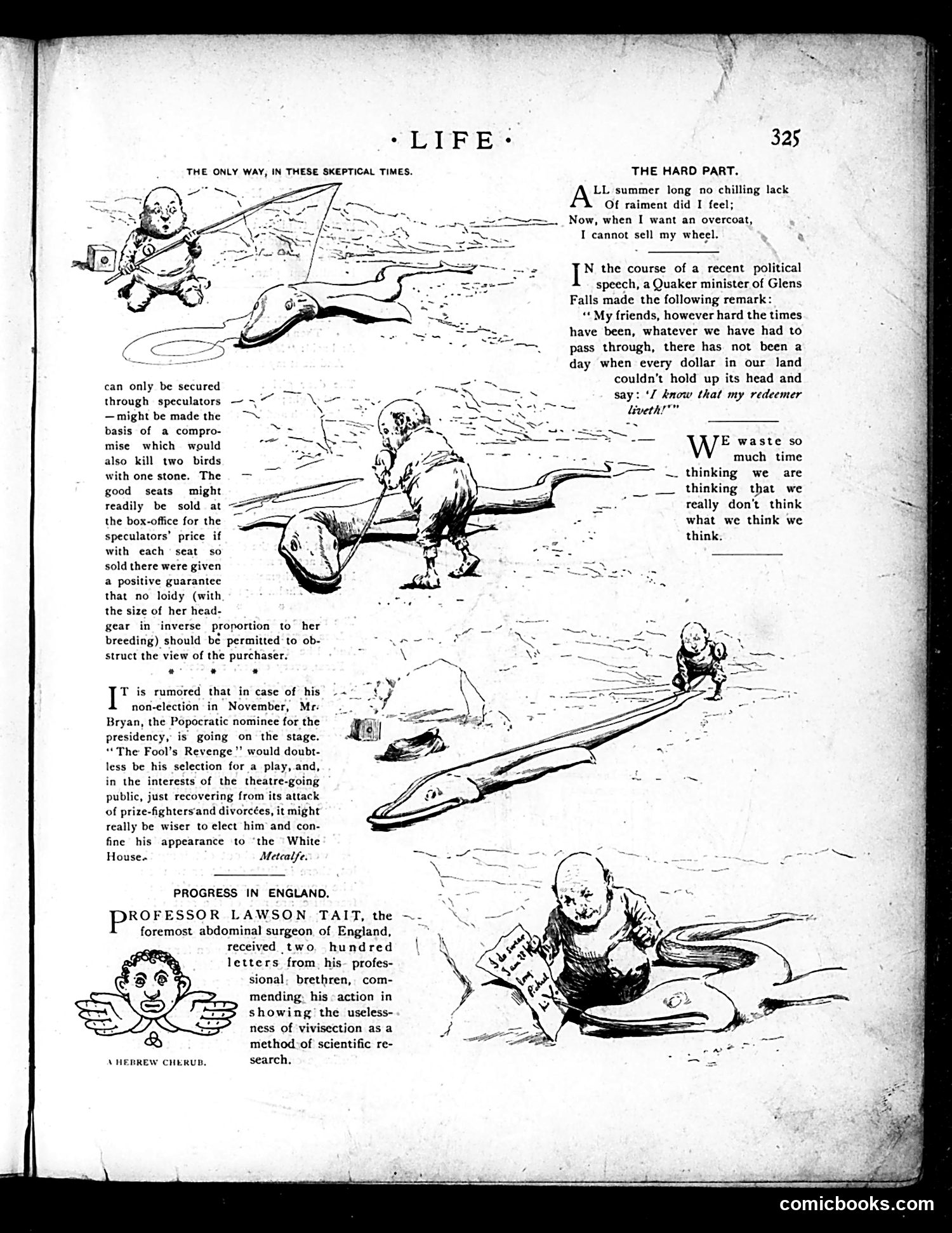
This page satirizes economic hardship and political responses during what appears to be a recession or depression. The left cartoon mocks theatrical speculation and box-office schemes as solutions to financial crisis—the figures are literally "fishing" or grasping at straws. The right section, "The Hard Part," quotes a Quaker minister expressing faith in divine redemption despite economic collapse. The satire suggests citizens cling to faith while actual solutions remain elusive. The bottom note about "Mr. Bryan" (likely William Jennings Bryan, the populist politician) jokingly proposes he pursue theater rather than politics—a dismissive jab suggesting his political prospects are finished. The recurring visual metaphor: people struggling, improvising, and grasping desperately at inadequate solutions to systemic economic failure.
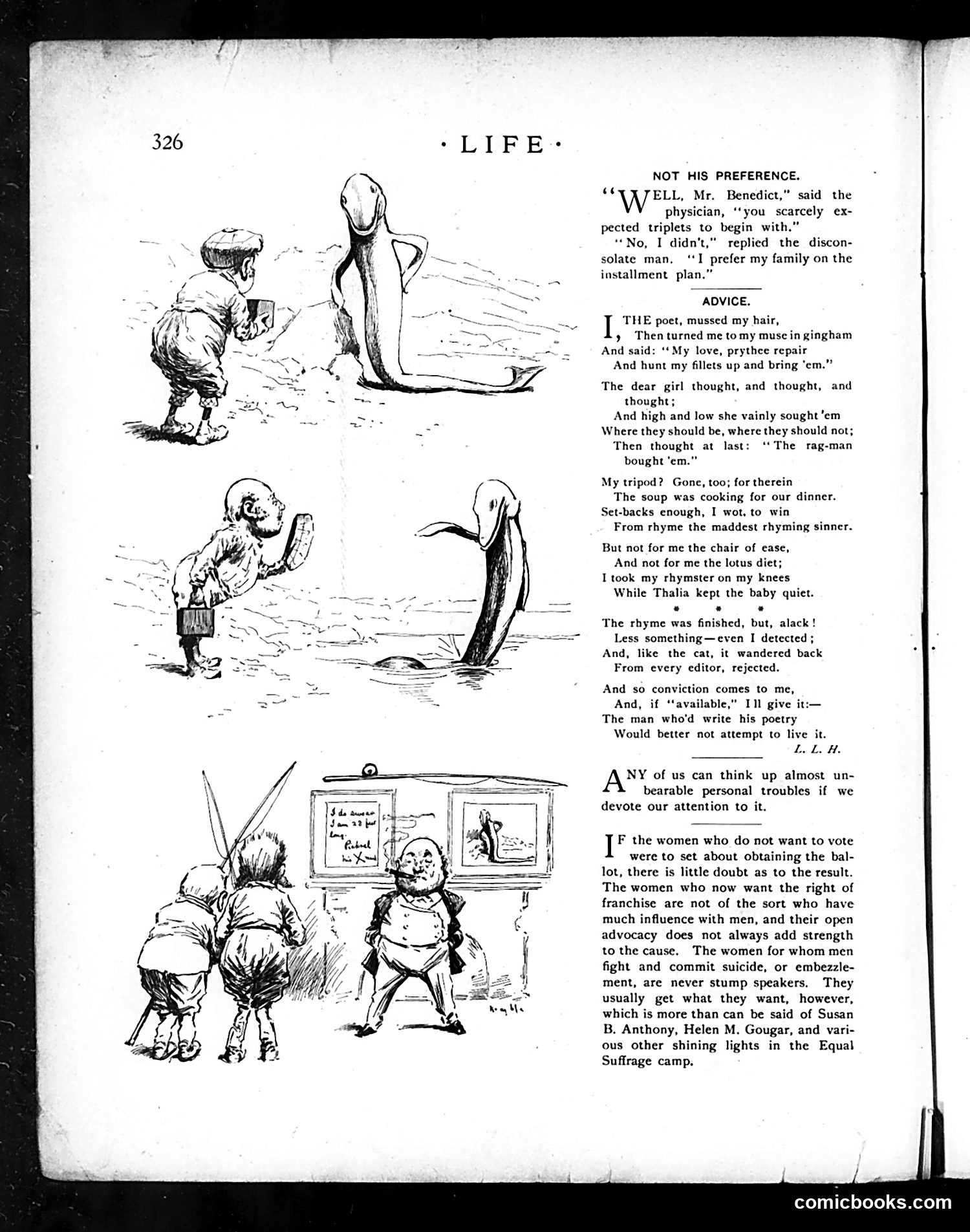
This page contains three distinct pieces of satire: **Top cartoon ("Not His Preference"):** A man tells his doctor he prefers having children "on the installment plan" rather than triplets—joking that spreading out children financially is preferable to having multiple births at once. **Middle section ("Advice"):** A poem by L.L.H. satirizes the struggling artist's life. A poet's muse sends him on errands (hunting for lost cooking equipment) while he tries to write, his tripod becomes a soup pot, and his finished poem gets rejected by every editor. The moral: aspiring writers shouldn't actually *live* the bohemian lifestyle they romanticize—poverty and chaos don't help creativity. **Bottom section:** Commentary on women's suffrage, arguing that women *opposed* to voting wouldn't help the movement gain strength. The author dismissively contrasts famous suffragists like Susan B. Anthony and Helen M. Gougar with women who achieve goals through "influence" rather than activism—implying suffragists lack the social power of conventionally attractive women.
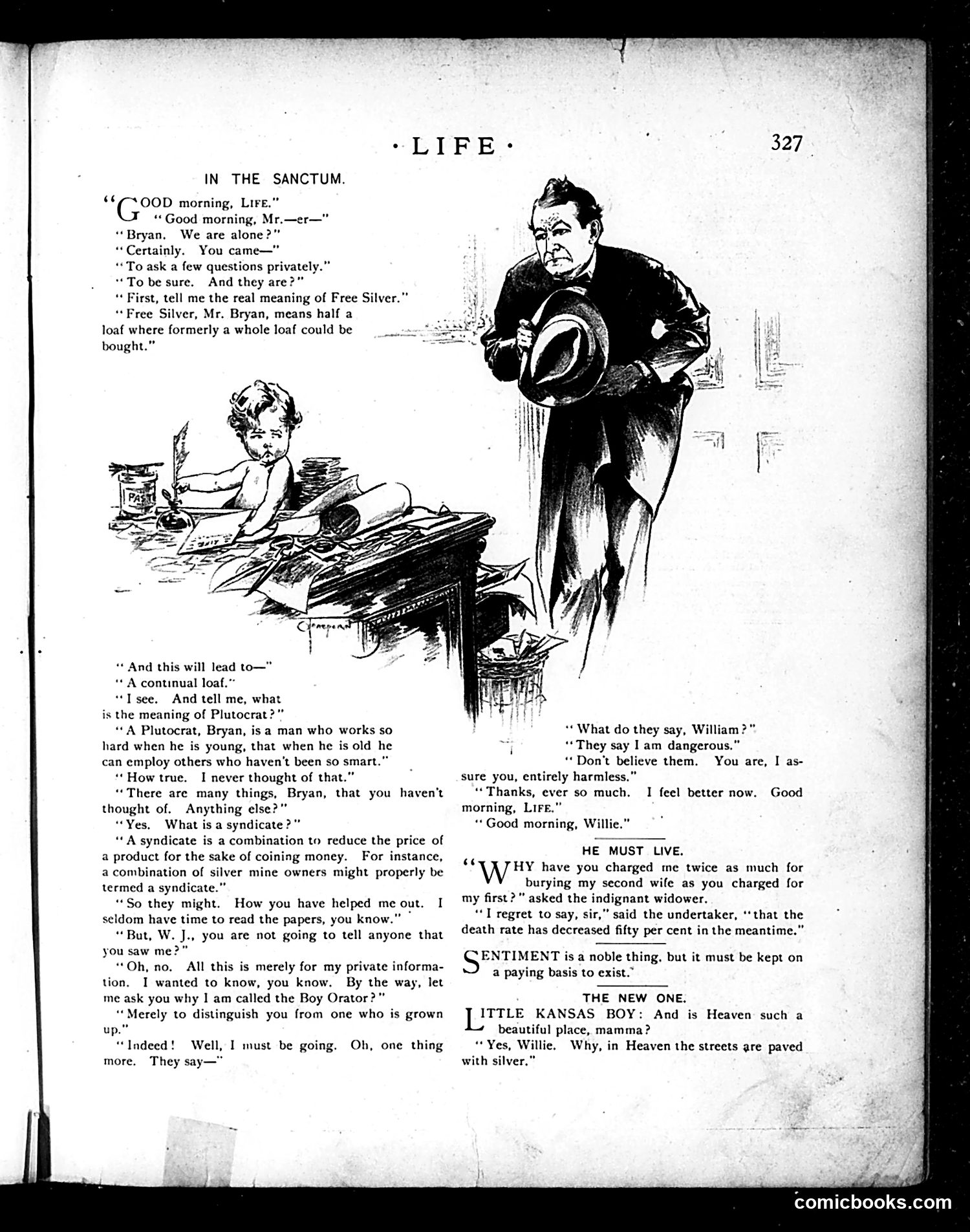
This page mocks **William Jennings Bryan**, the populist politician famous for advocating "Free Silver" (unlimited silver coinage). The top cartoon shows Life's editor condescendingly "educating" Bryan on economics. The joke: Bryan's free silver policy would devalue currency—"half a loaf where formerly a whole loaf could be bought"—leading to continuous inflation ("a continual loaf"). The editor also insults Bryan as intellectually lazy and calls him "dangerous" only ironically, suggesting he's actually harmless. The cartoon ridicules Bryan as naive and uninformed about basic economics, while defending wealthy industrialists ("Plutocrats") as merely successful hard workers. The magazine uses humor to delegitimize Bryan's populist economic proposals by portraying him as intellectually unfit. The bottom sections contain unrelated brief satirical pieces about undertakers and children's religious education.
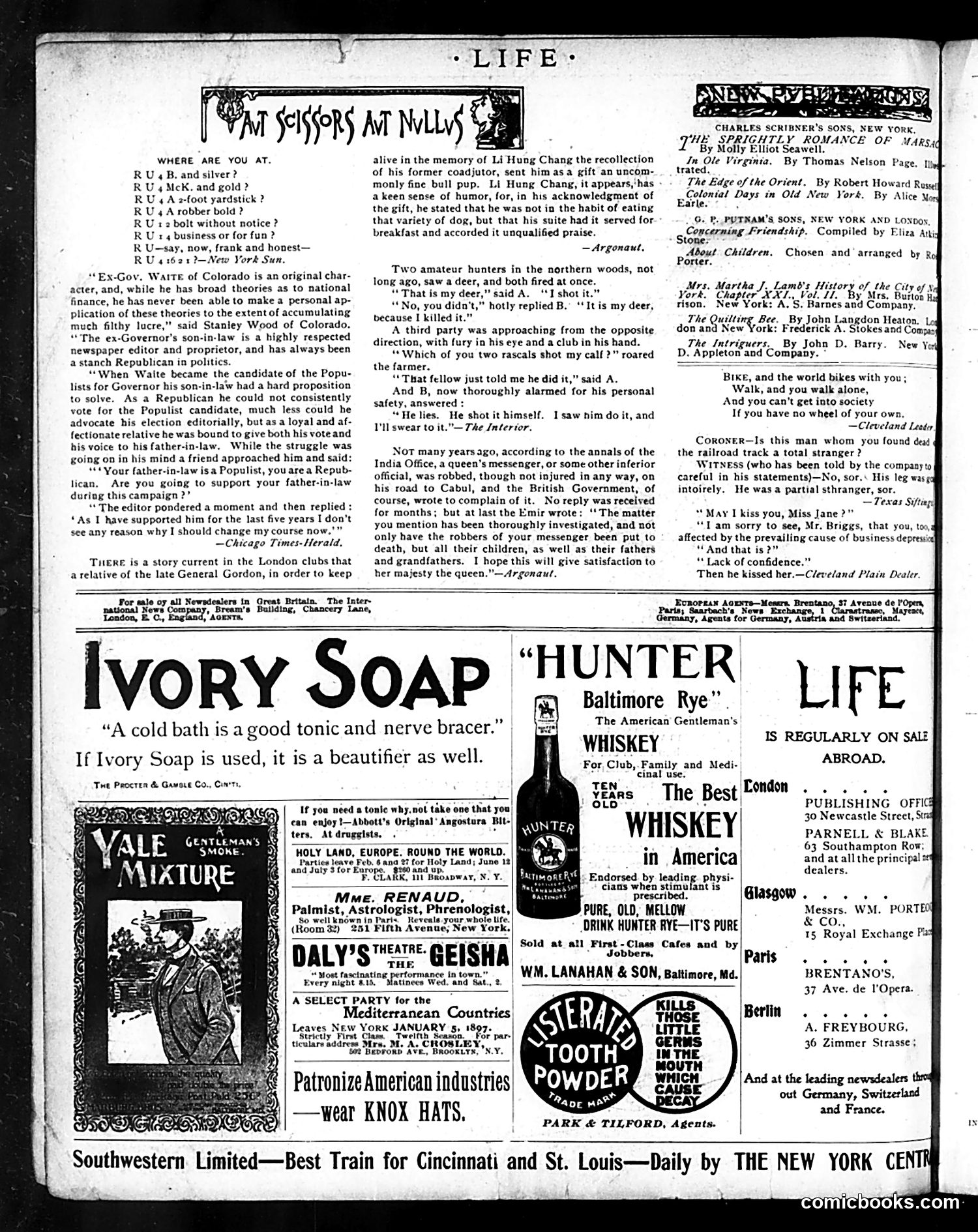
This page features **no political cartoon**, but rather a collection of humorous short stories typical of *Life* magazine's satirical format. The title "Am Scissors at Nullus" (Latin wordplay on "scissors") introduces four anecdotes: 1. **Ex-Governor Waite of Colorado**: A editor struggles with supporting his Populist father-in-law while remaining Republican—resolving the conflict by claiming he's "supported him for the last five years" anyway. 2. **Li Hung Chang and the bull pup**: A story mocking cultural misunderstanding: a British official sends a bulldog to the Chinese diplomat as a gift; Li Hung Chang supposedly serves it for breakfast, claiming his staff "accorded it unqualified praise." 3. **The hunters' dispute**: Two sportsmen blame each other for shooting a farmer's calf instead of a deer. 4. **The Emir's justice**: A darkly comic tale about an Indian official's response to a robbery—executing not just perpetrators but their entire families. The page is primarily **advertisements** below the stories.
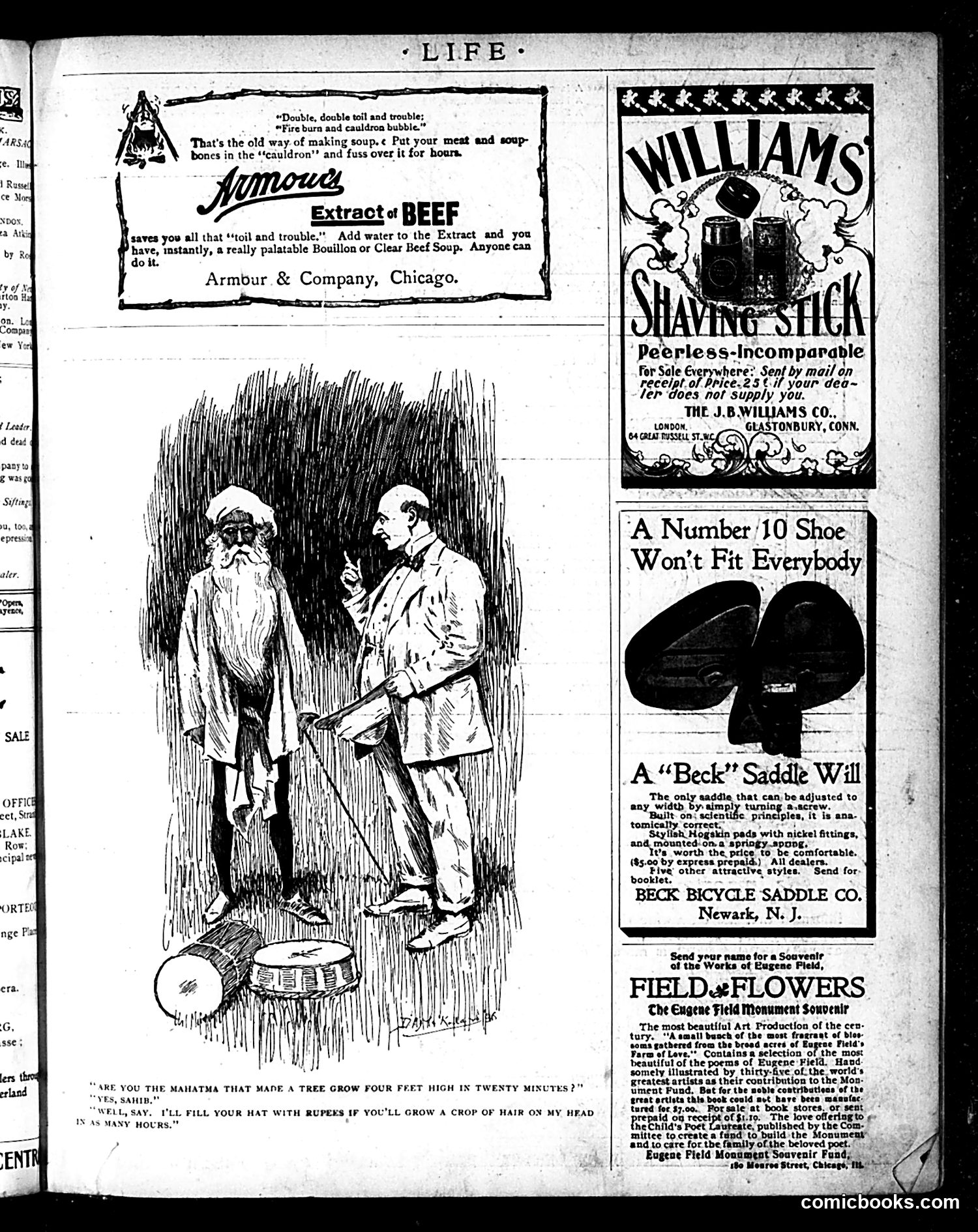
The main cartoon depicts a dialogue between two figures—an elderly man with a long beard (appearing to represent a traditional holy man or "Mahatma," referencing Indian spiritual figures) and a Western businessman. The joke turns on an impossible wager: the businessman challenges the Mahatma to grow hair on his bald head in twenty-four hours, offering rupees (Indian currency) as an absurd incentive—implying the Mahatma's claimed miraculous powers (growing a tree four feet high in twenty minutes) are fraudulent. This satirizes both Western fascination with Indian mysticism and skepticism toward claimed Eastern spiritual powers. The cartoon mocks gullibility about "miracle workers" while playing on period stereotypes. The page is primarily advertisements (Armour beef extract, Williams shaving stick, Beck bicycle saddles, Field Flowers souvenir book), with this single cartoon as editorial content typical of Life's satirical format.
This page is **primarily advertising**, not editorial content with political satire. It's a collection of product advertisements from the 1890s, including: - **Sozodont** dentifrice (teeth cleaning products) - **Violettes du Czar** perfume from Paris - **S. Rae & Co.'s olive oil** (with a chemical analysis letter) - **Major's Water Filter** for coolers - **Whitman's chocolate** and **Lowney's chocolate bonbons** - **Haviland China** (porcelain dinnerware from France and Italy) - **Mr. Wenzell's book** "In Vanity Fair" The single illustration shows what appears to be a **laboratory or testing scene**, supporting the olive oil company's credibility claims about purity testing. There is **no apparent political cartoon or satire** on this page. It represents typical late-19th-century Life magazine advertising—a mix of luxury consumer goods (imported perfumes, fine china) and practical household products, reflecting the magazine's affluent readership.
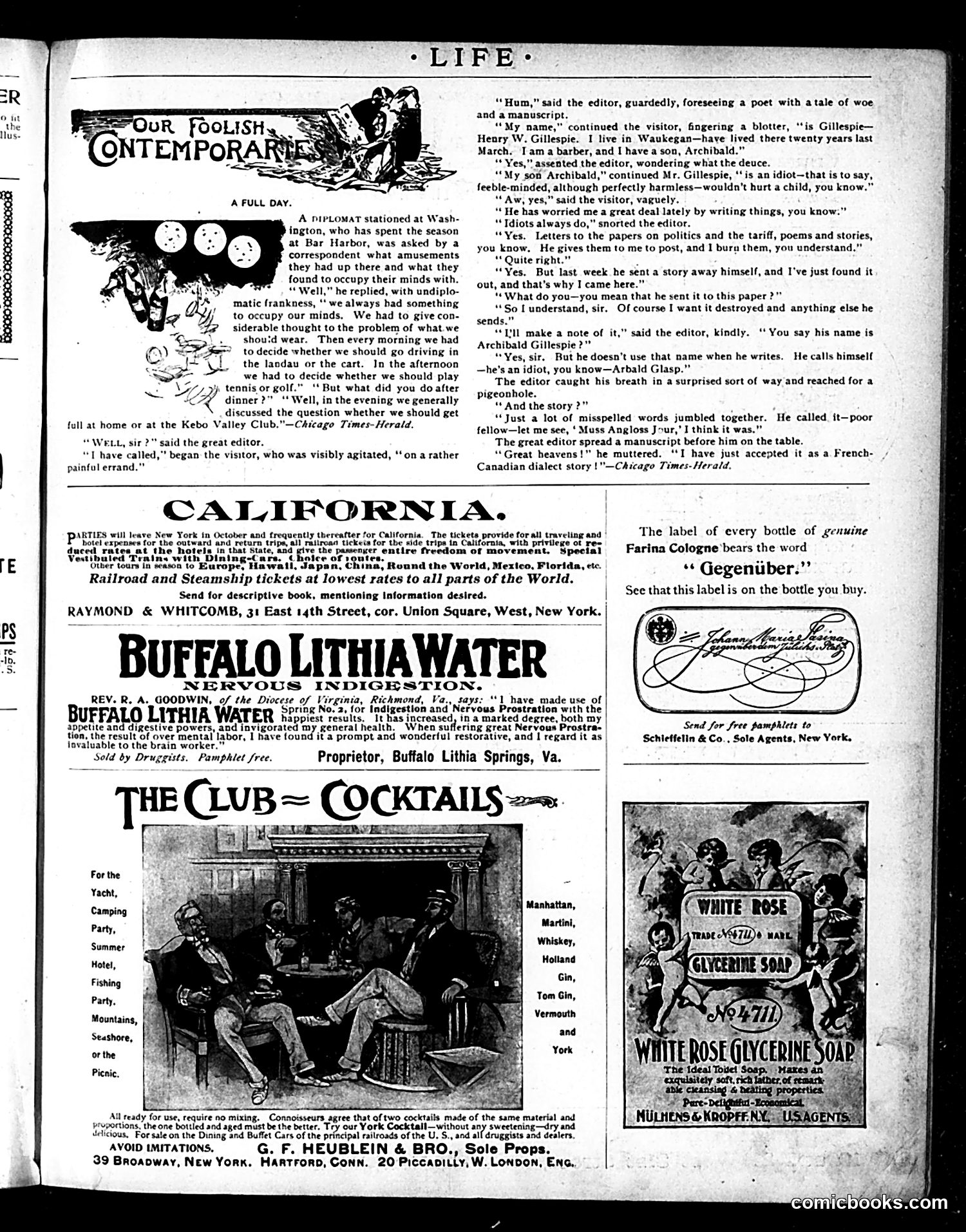
This satirical cartoon mocks editorial incompetence. A barber named Henry Gillespie visits a newspaper editor with a peculiar problem: his mentally disabled son Archibald has been secretly submitting manuscripts. The father burns them to prevent embarrassment. The joke hinges on dramatic irony: the editor has *already accepted* one of Archibald's stories—titled "Muss Angloss Jour" (apparently "Miss Anglaise Jour")—but mistakenly published it as a "French-Canadian dialect story," praising it as genuine literature. When the father reveals the author's identity and misspellings, the editor realizes he's been duped into publishing an idiot's work. The satire targets editorial judgment and pretension: editors accept incoherent writing if it's dressed up as exotic or literary, while remaining oblivious to actual quality. The "foolish contemporary" refers to editors who lack discernment.
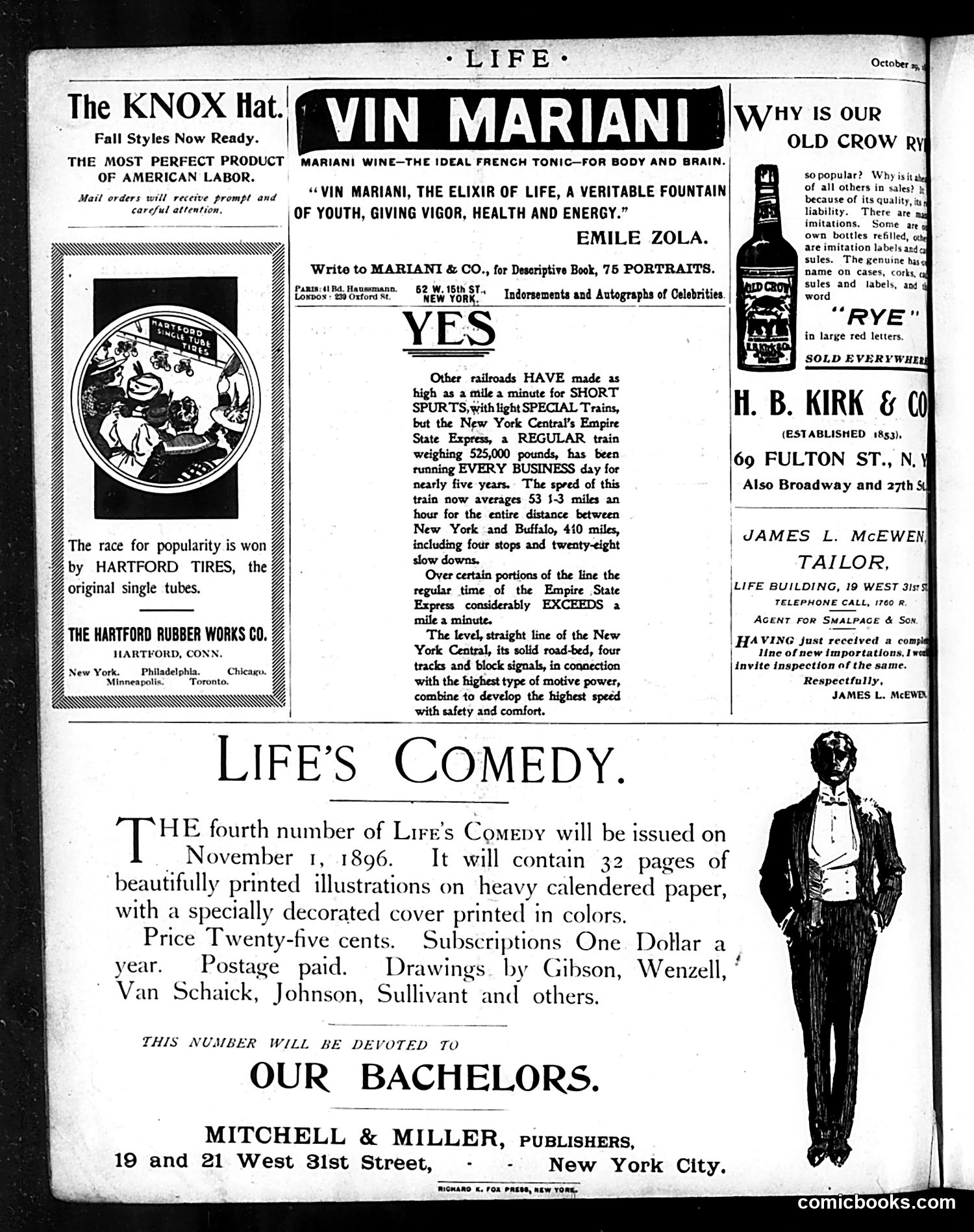
This is primarily an **advertising page** from *Life* magazine (October 1896), not a satirical cartoon. The page showcases period advertisements for luxury and consumer goods: Knox hats, Hartford tires, Vin Mariani (a wine tonic), Old Crow whiskey, the New York Central's Empire State Express train, and tailoring services. The only notable content is an announcement for *Life's* upcoming fourth comedy issue (November 1, 1896), devoted to "Our Bachelors," featuring illustrations by prominent cartoonists Gibson, Wenzell, and others—suggesting the issue will satirize unmarried men. The ads themselves reflect 1890s consumer culture: Vin Mariani is endorsed by author Émile Zola as a health elixir, while the Empire State Express advertisement boasts about railroad speed and reliability. There's no political satire on this particular page—it's a straightforward commercial and promotional document typical of magazine publishing at the time.