
Life, 1896-10-29 · page 4 of 18
Life — October 29, 1896 — page 4: what you’re looking at
What you’re looking at
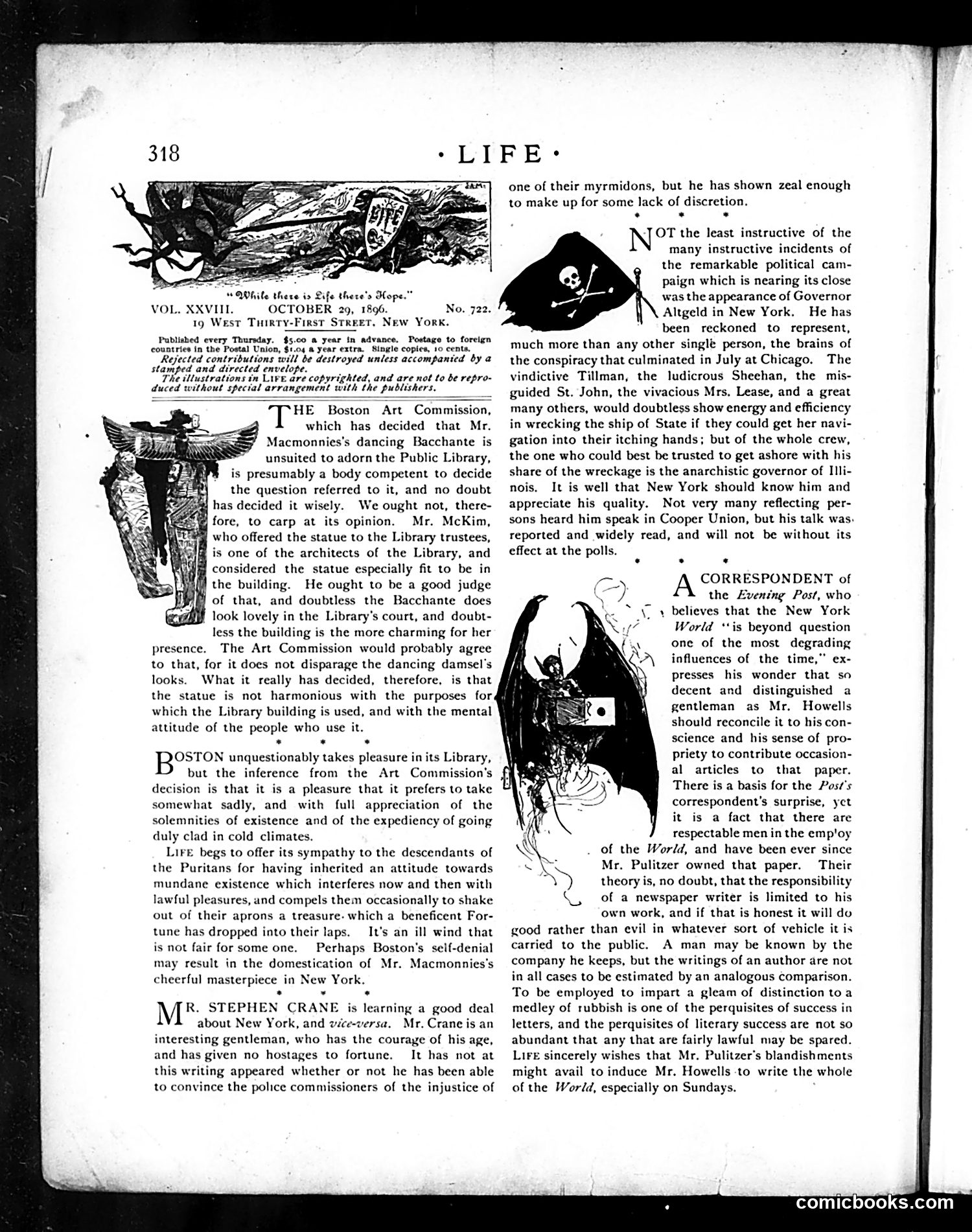
This page contains editorial commentary on New York politics during the 1896 election season. The cartoons satirize Governor Altgeld of Illinois and various political conspirators involved in what appears to be a corruption scheme. The text references specific figures—including "the vindictive Tillman, the ludicrous Sheehan, the misguided St. John"—as co-conspirators whom Altgeld supposedly orchestrated. The overall point criticizes Altgeld as the mastermind behind a political conspiracy targeting New York's governance. The page also defends Governor Altgeld against attacks from the *Evening Post*, arguing that newspaper criticism of his character is unfair. The satirical cartoons (appearing as decorative elements) visually reinforce these political attacks through exaggerated imagery typical of 1890s partisan journalism.
📄 Transcribed text from this page (OCR, searchable)
Machine-transcribed from the original scan — historical spelling and the odd misread are preserved.
* LIFE: “QWhile there is Life there's Hope.” VOL. XXVIIL. OCTOBER 29, 1896. No. 722. 1g West Tuirt New York. Pablished every Thursday. $5.00 a year in advance. Postage to foreign countries in the Postal Uni 4 & year extra. Single copies, 10 cents, Rejected contributions be destroyed unless accompanied by a stamped and directed envelope. The illustrations in Live are copyrighted, and are not to be repro- duced without special arrangement with the publishers. HE Boston Art Commission, which has decided that Mr. Macmonnies's dancing Bacchante is . unsuited to adorn the Public Library, is presumably a body competent to decide the question referred to it, and no doubt has decided it wisely. We ought not, there- fore, to carp at its opinion. Mr. McKim, who offered the statue to the Library trustees, f@ is one of the architects of the Library, and Wj considered the statue especially fit to be in the building. He ought to be a good judge of that, and doubtless the Bacchante does look lovely in the Library's court, and doubt- less the building is the more charming for her presence. The Art Commission would probably agree to that, for it does not disparage the dancing damsel’s looks. What it really has decided, therefore, is that the statue is not harmonious with the purposes for. which the Library building is used, and with the mental attitude of the people who use it. . . . Bostos unquestionably takes pleasure in its Library, but the inference from the Art Commission's decision is that it is a pleasure that it prefers to take somewhat sadly, and with full appreciation of the solemnities of existence and of the expediency of going duly clad in cold climates. LiFe begs to offer its sympathy to the descendants of the Puritans for having inherited an attitude towards mundane existence which interferes now and then with lawful pleasures, and compels them occasionally to shake out of their aprons a treasure. which a beneficent For- tune has dropped into their laps. It’s an ill wind that is not fair for some one. Perhaps Boston's self-denial may result in the domestication of Mr. Macmonnies’s cheerful masterpiece in New York. . . R. STEPHEN CRANE is learning a good deal about New York, and v versa. Mr. Crane is an interesting gentleman, who has the courage of his age, and has given no hostages to fortune. It has not at this writing appeared whether or not he has been able to convince the police commissioners of the injustice of one of their myrmidons, but he has shown zeal enough to make up for some lack of discretion. . . . OT the least instructive of the many instructive incidents of the remarkable political cam- paign which is nearing its close was the appearance of Governor Altgeld in New York. He has been reckoned to represent, much more than any other single person, the brains of the conspiracy that culminated in July at Chicago. The vindictive Tillman, the ludicrous Sheehan, the mis- guided St. John, the vivacious Mrs, Lease, and a great many others, would doubtless show energy and efficiency in wrecking the ship of State if they could get her navi- gation into their itching hands; but of the whole crew, the one who could best be trusted to get ashore with his share of the wreckage is the anarchistic governor of IIli- nois. It is well that New York should know him and appreciate his quality. Not very many reflecting per- sons heard him speak in Cooper Union, but his talk was. reported and widely read, and will not be without its effect at the polls. CORRESPONDENT of the Evening Post, who \ 4 believes that the New York World ‘‘is beyond question one of the most degrading influences of the time,” ex- presses his wonder that so decent and distinguished a gentleman as Mr. Howells should reconcile it to his con- science and his sense of pro- priety to contribute occasion- al articles to that paper. There is a basis for the Post's correspondent's surprise, yct it is a fact that there are respectable men in the emp'oy of the World, and have been ever since Mr. Pulitzer owned that paper. Their theory is, no doubt, that the responsibility of a newspaper writer is limited to his own work, and if that is honest it will do good rather than evil in whatever sort of vehicle it is carried to the public. A man may be known by the company he keeps, but the writings of an author are not in all cases to be estimated by an analogous comparison. To be employed to impart a gleam of distinction toa medley of rubbish is one of the perquisites of success in letters, and the perquisites of literary success are not so abundant that any that are fairly lawful may be spared. Lire sincerely wishes that Mr. Pulitzer’s blandishments might avail to induce Mr. Howells to write the whole of the World, especially on Sundays. comicbooks.com