
Life, 1896-10-29 · page 10 of 18
Life — October 29, 1896 — page 10: what you’re looking at
A restored page from Life, 1896-10-29. Page through the whole issue in the reader above.
📄 Transcribed text from this page (OCR, searchable)
Machine-transcribed from the original scan — historical spelling and the odd misread are preserved.
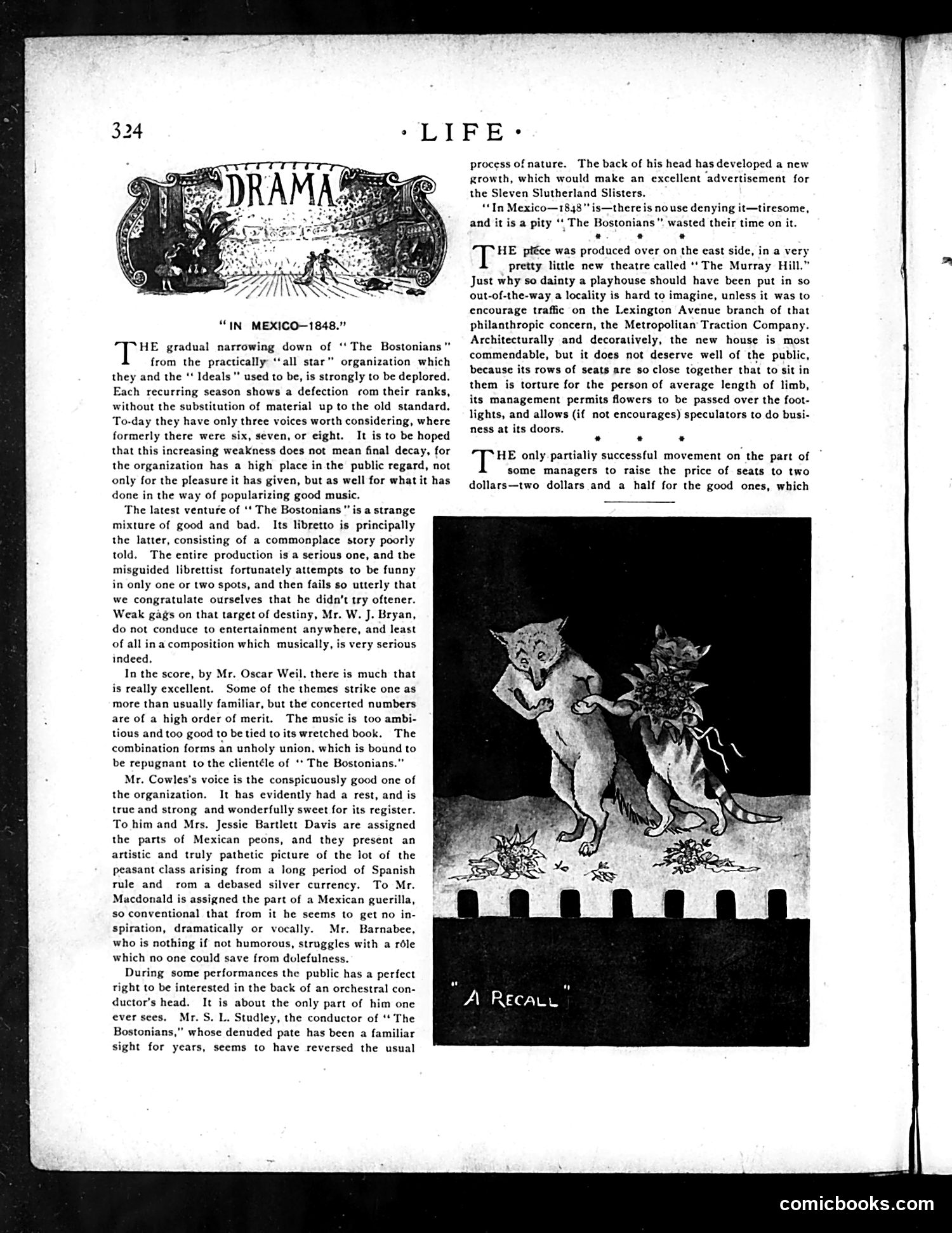
> LIFE: “IN MEXICO—1848.” HE gradual narrowing down of ‘‘ The Bostonians” from the practically “all star” organization which they and the ‘ Ideals" used to be, is strongly to be deplored. Each recurring season shows a defection com their ranks, without the substitution of material up to the old standard, To-day they have only three voices worth considering, where formerly there were six, seven, or eight. It is to be hoped that this increasing weakness does not mean final decay, for the organization has a high place in the public regard, not only for the pleasure it has given, but as well for what it has done in the way of popularizing good music. The latest venture of ‘* The Bostonians " is a strange mixture of good and bad. Its libretto is principally the latter, consisting of a commonplace story poorly told. The entire production is a serious one, and the misguided librettist fortunately attempts to be funny in only one or two spots, and then fails so utterly that we congratulate ourselves that he didn’t try oftener. Weak gags on that target of destiny, Mr. W. J. Bryan, do not conduce to entertainment anywhere, and least of all ina composition which musically, is very serious indeed, In the score, by Mr. Oscar Weil. there is much that is really excellent. Some of the themes strike one as more than usually familiar, but the concerted numbers are of a high order of merit. The music is too ambi- tious and too good to be tied to its wretched book. The combination forms an unholy union. which is bound to be repugnant to the clientéle of ‘* The Bostonians.” Mr. Cowles’s voice is the conspicuously good one of the organization. It has evidently had a rest, and is true and strong and wonderfully sweet for its register. To him and Mrs. Jessie Bartlett Davis are assigned the parts of Mexican peons, and they present an artistic and truly pathetic picture of the lot of the peasant class arising from a long period of Spanish rule and rom a debased silver currency. To Mr. Macdonald is assigned the part of a Mexican guerilla, so conventional that from it he seems to get no in- spiration, dramatically or vocally. Mr. Barnabee, who is nothing if not humorous, struggles with a rdle which no one could save from dolefulness. During some performances the public has a perfect right to be interested in the back of an orchestral con- ductor’s head. It is about the only part of him one ever sees. Mr. S. L. Studley, the conductor of ‘* The Bostonians,” whose denuded pate has been a familiar sight for years, seems to have reversed the usual A REcace process of nature. The back of his head has developed a new growth, which would make an excellent advertisement for the Sleven Slutherland Slisters. “In Mexico—1848" is—there is no use denying it—tiresome, and it is a pity “" The Bostonians” wasted their time on it. « . * HE piéce was produced over on the east side, in a very pretty little new theatre called ‘‘ The Murray Hill.” Just why so dainty a playhouse should have been put in so out-of-the-way a locality is hard to imagine, unless it was to encourage traffic on the Lexington Avenue branch of that philanthropic concern, the Metropolitan Traction Company. Architecturally and decoratively, the new house is most commendable, but it does not deserve well of the public, because its rows of seats are so close together that to sit in them is torture for the person of average length of limb, its management permits flowers to be passed over the foot- lights, and allows (if not encourages) speculators to do busi- ness at its doors. * * HE only partialiy successful movement on the part of some managers to raise the price of seats to two dollars—two dollars and a half for the good ones, which comicbooks.com