
A complete issue · 18 pages · 1896
Life — August 6, 1896
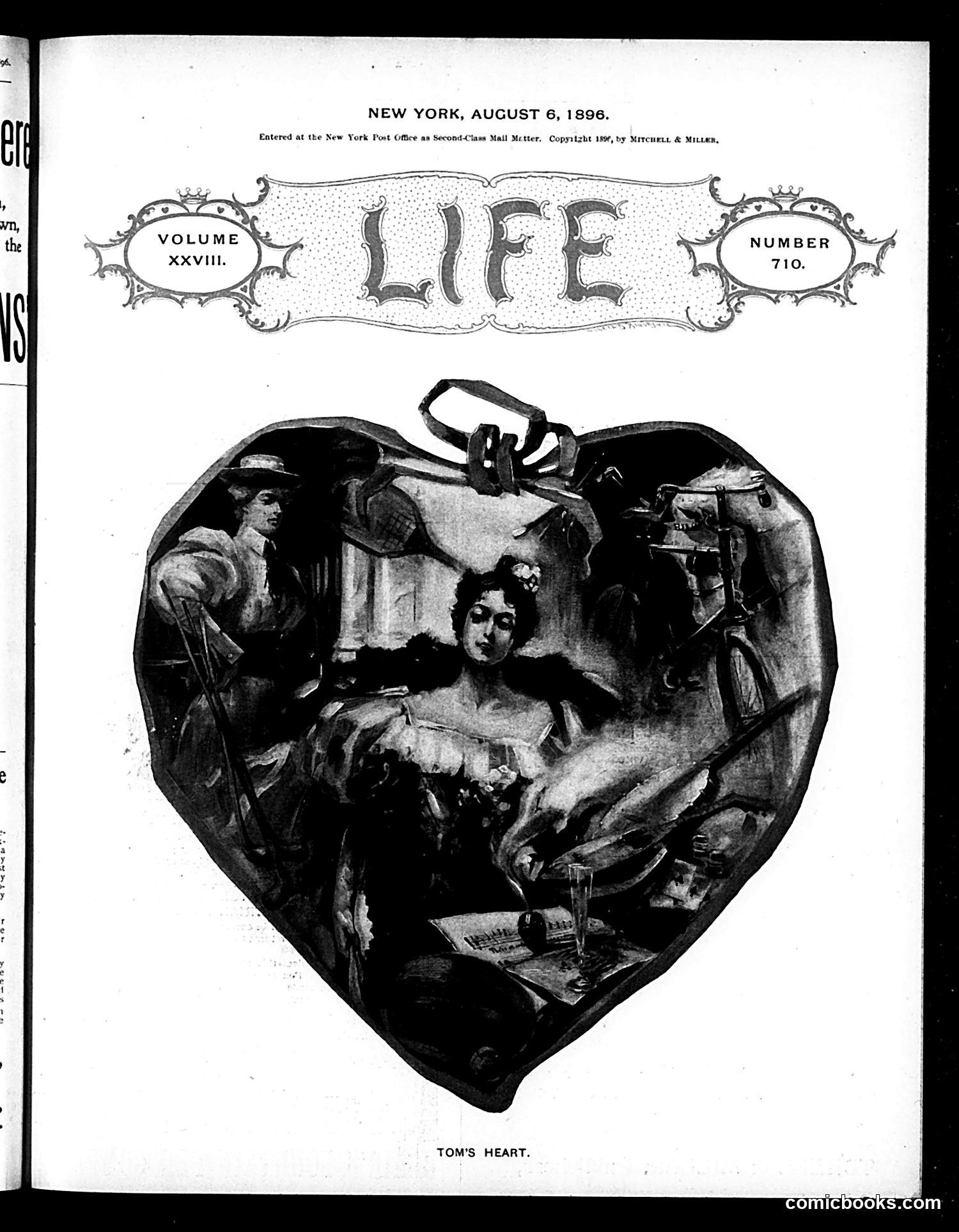
This heart-shaped illustration titled "Tom's Heart" depicts a domestic interior scene with multiple figures engaged in various activities—reading, conversing, and working. Without additional context or caption text beyond the title, the specific political or social satire is unclear from the image alone. The title suggests this represents someone named "Tom" and his emotional or domestic world. Given Life magazine's satirical tradition, this likely comments on contemporary social matters—possibly domestic life, sentimentality, or personal character—but the precise reference remains uncertain. The elaborate heart frame underscores a romantic or sentimental theme, though whether the satire is affectionate or critical cannot be determined from the visual evidence alone.
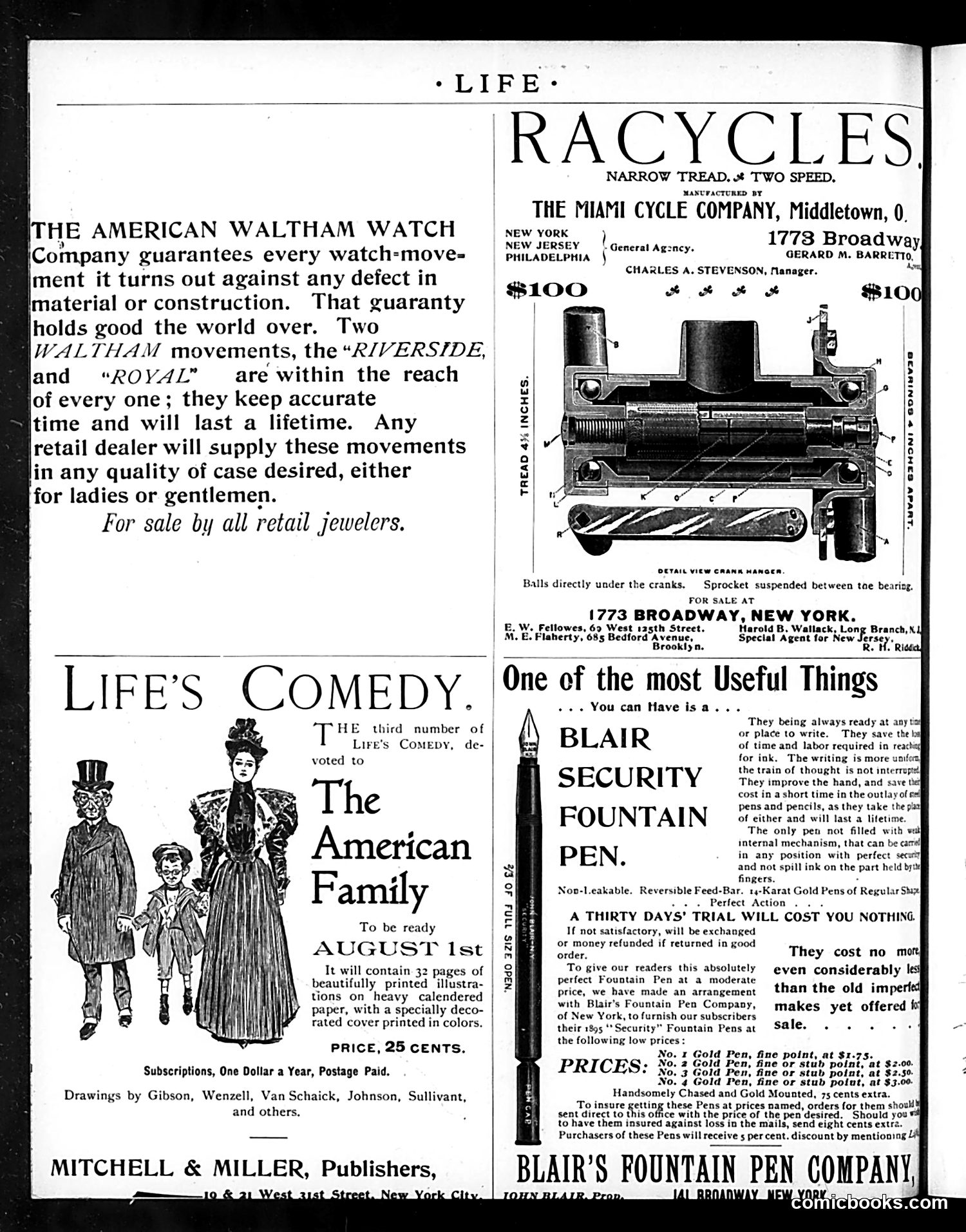
This page is **primarily advertising**, not political satire. It contains four distinct ads: 1. **American Waltham Watch Company** — promoting affordable watch movements ("Riverside" and "Royal" models) for mass consumers 2. **Miami Cycle Company** — advertising a $100 racing bicycle with technical specifications 3. **Life's Comedy** — promoting the upcoming August 1st issue of *Life* magazine itself, featuring "The American Family" 4. **Blair Security Fountain Pen** — marketing a reversible fountain pen with a 30-day trial offer The only potentially comedic element is the illustration for *Life*'s upcoming issue, showing three fashionable figures in period dress, but without additional context, the specific satirical point remains unclear. The page primarily reflects early 20th-century consumer culture and magazine self-promotion.
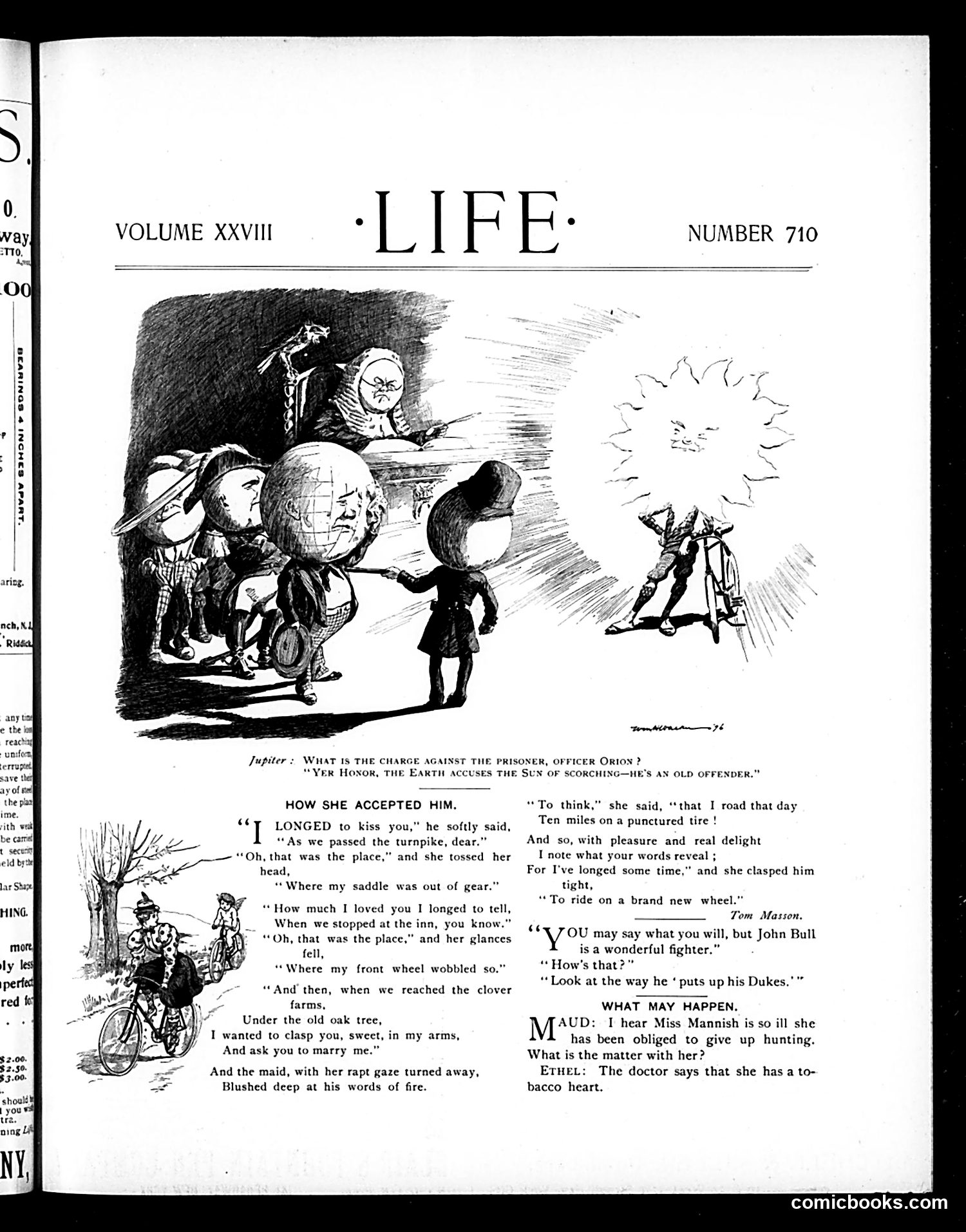
This page contains romantic/humorous fiction rather than political satire. The top cartoon shows a classical theatrical scene—likely referencing Shakespeare's *The Tempest* (Jupiter, Prospero, and Miranda appear in the caption about "the prisoner, officer Orion")—presented as comedic illustration. The main story, "How She Accepted Him," is a sentimental romance about a couple's courtship, featuring their bicycle ride and his marriage proposal. The accompanying illustrations show their encounters on the road. The bottom section includes brief gossip items about society figures (Miss Mannish's hunting, a woman with a tobacco heart condition), typical of Life's society commentary. This is **not** political satire but rather lighthearted domestic/romantic content with social observation—representative of Life's mixed editorial approach during this period.
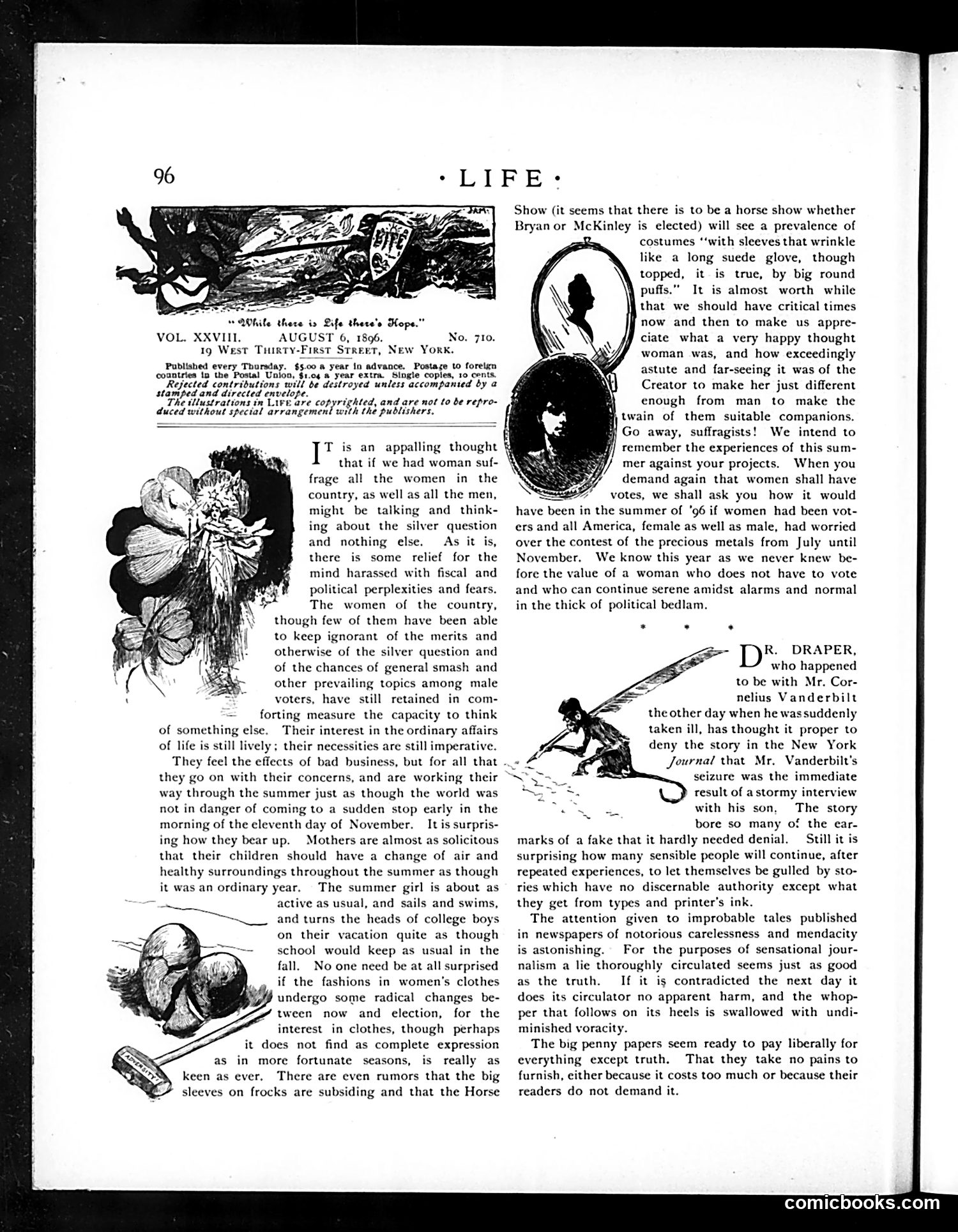
This page contains editorial commentary on women's suffrage during the 1896 presidential election (Bryan vs. McKinley mentioned). The text criticizes newspapers for publishing sensational, false stories about women voters and suffragists during summer 1896. The decorative illustrations (flowers, a figure in profile, a cherub-like figure) appear to be generic editorial ornaments rather than specific political caricatures. The main argument: the author condemns penny papers for fabricating stories about women's political engagement to boost sales, noting these tales contradict truth. The piece advocates for serious consideration of women's voting rights while mocking the media's irresponsible coverage of the suffrage movement and female political participation during this election season.
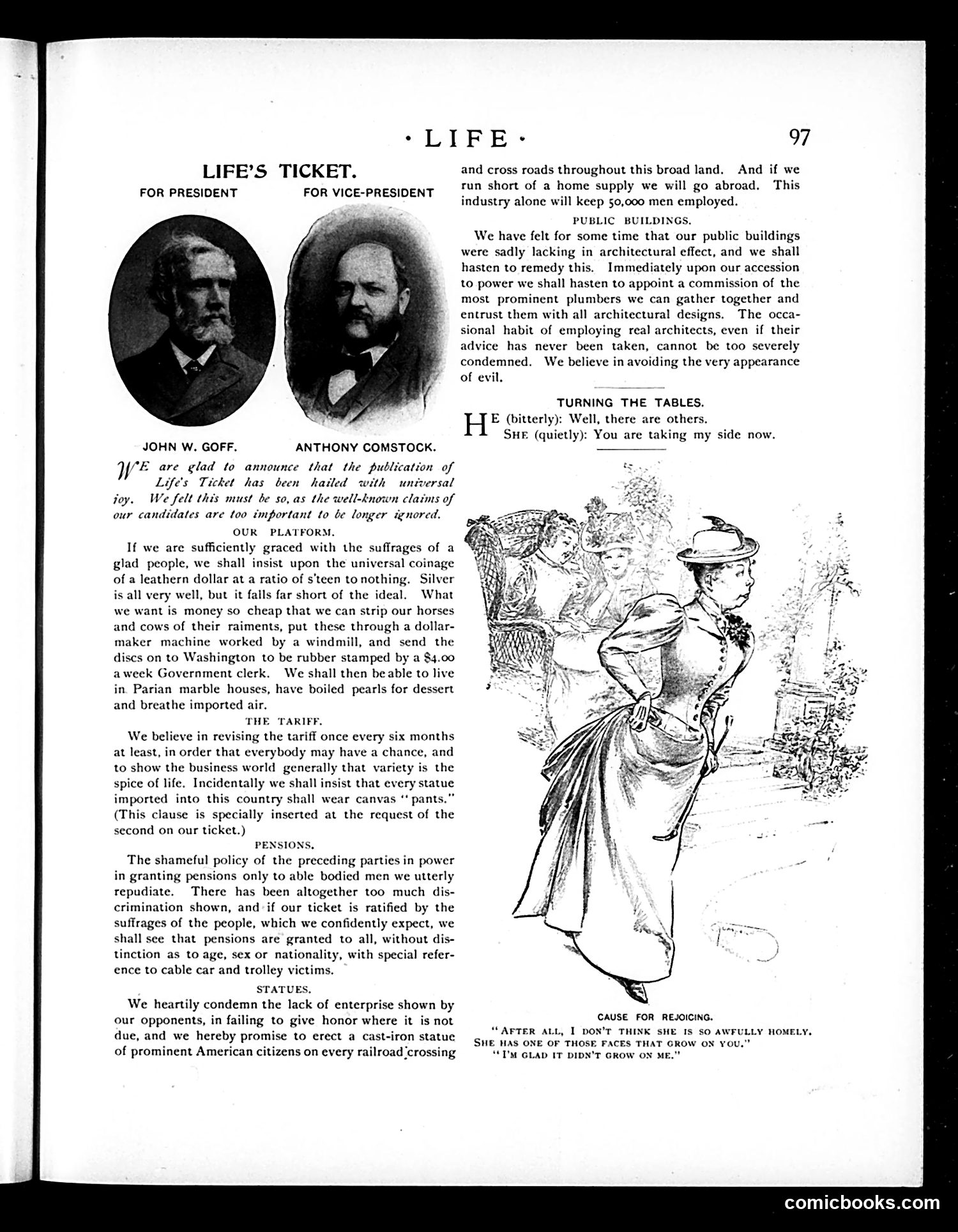
This page presents "Life's Ticket" — a satirical political platform for the 1884 presidential election, nominating **John W. Goff for President and Anthony Comstock for Vice-President**. The platform mockingly proposes absurd policies: a leather dollar currency, windmill-powered money-making machines, statue erections at every railroad crossing, and tariff changes every six months. It ridicules pension policies and architectural oversight. The accompanying cartoon "Turning the Tables" depicts a woman confronting a man, with dialogue about his face "growing on" her — likely satirizing social hypocrisy or relationship dynamics of the era. **Context:** This appears to be satirizing actual political candidates or movements from the 1880s through exaggerated, impossible policy proposals—a common Life magazine tactic for political commentary.
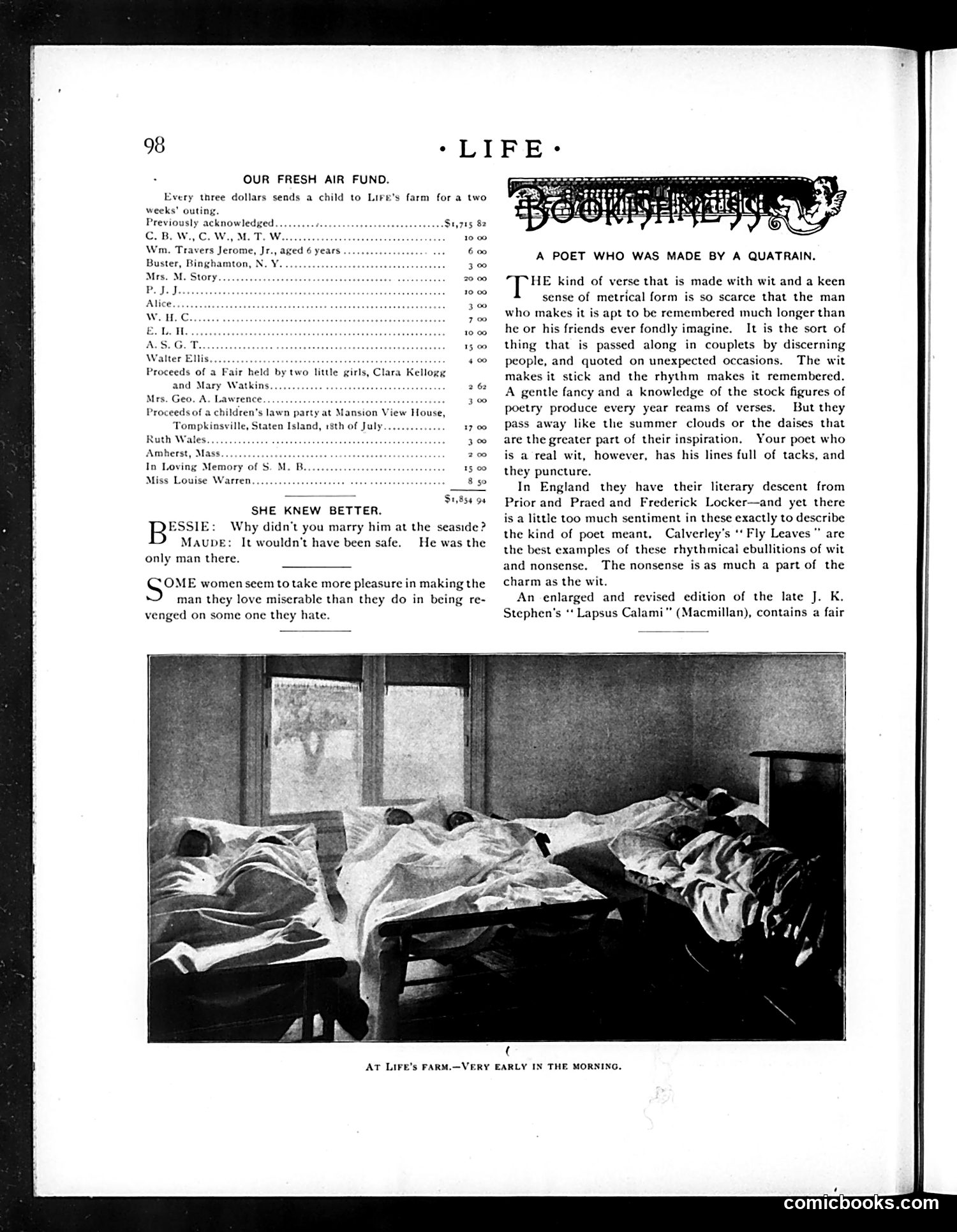
This page contains two unrelated sections: **Upper Left - "Our Fresh Air Fund"**: A charity listing acknowledging donations to send children to Life's farm for two-week stays. The amounts range from $3-$17, typical of small charitable contributions from the early 20th century. **Main Content - "A Poet Who Was Made by a Quatrain"**: A literary essay praising witty, memorable verse—particularly light poetry with clever rhythm and wordplay. The author argues such verse is undervalued compared to serious poetry, citing English poets and referencing J.K. Stephen's "Lapsus Calami." **Image**: Shows multiple people sleeping in beds at Life's farm, captioned "Very Early in the Morning"—presumably illustrating the farm where children stayed. The page is primarily literary/charitable content rather than political satire. No specific political figures or events are referenced.
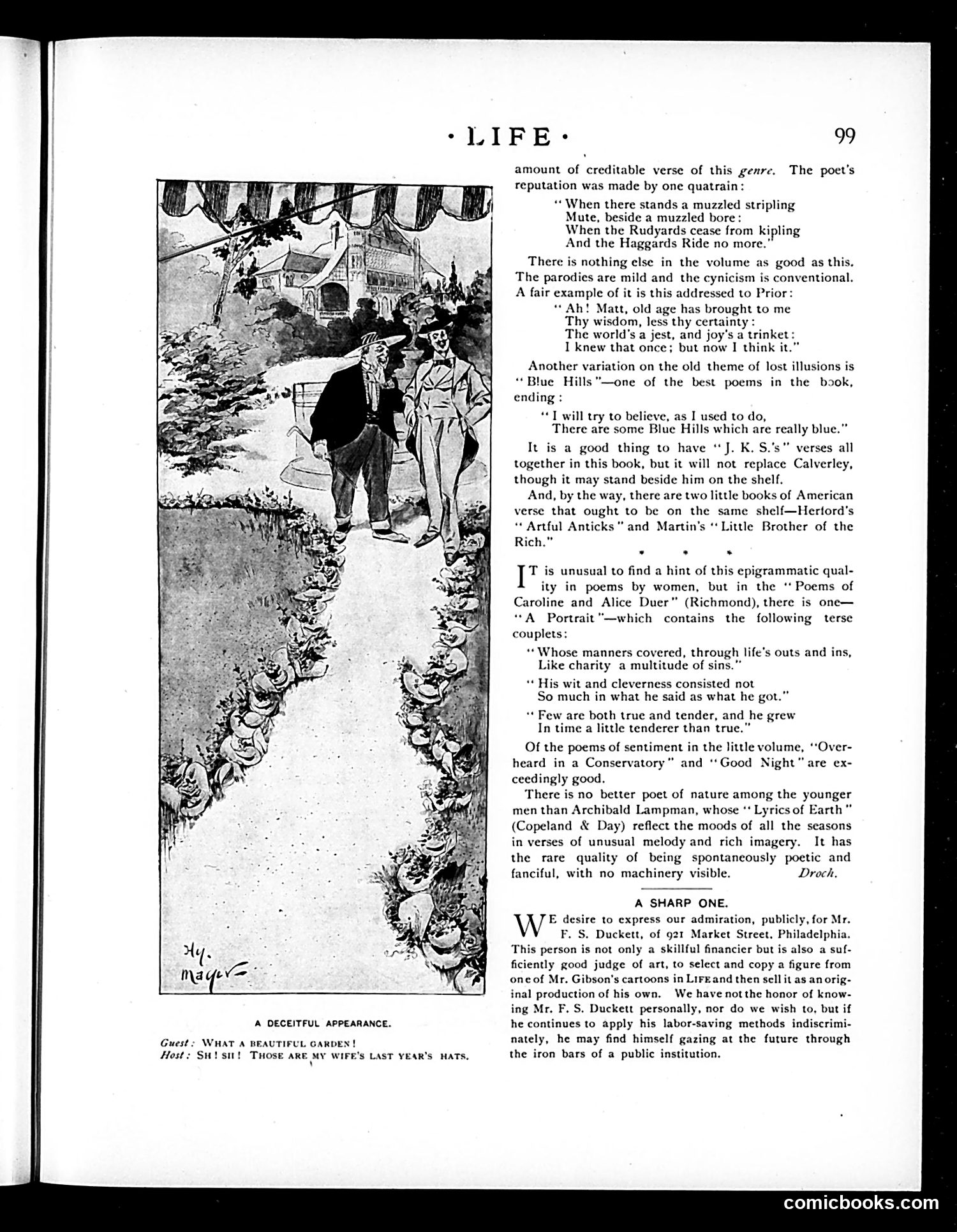
This page primarily contains **literary criticism** rather than political cartoons. The main illustration, titled "A Deceitful Appearance," shows two figures in a garden setting with a joke below: a guest compliments the garden, and the host reveals those are actually his wife's old hats. The text discusses various poets and verse, including J.K.S.'s parodies and Archibald Lampman's nature poetry. The page concludes with "A Sharp One"—a brief notice praising F.S. Duckett of Philadelphia as both a skilled financier and art judge, while subtly mocking his labor-saving business methods, suggesting his "future" involvement with "public institutions" (possibly jail). The humor relies on wordplay and social commentary about business practices rather than political satire.
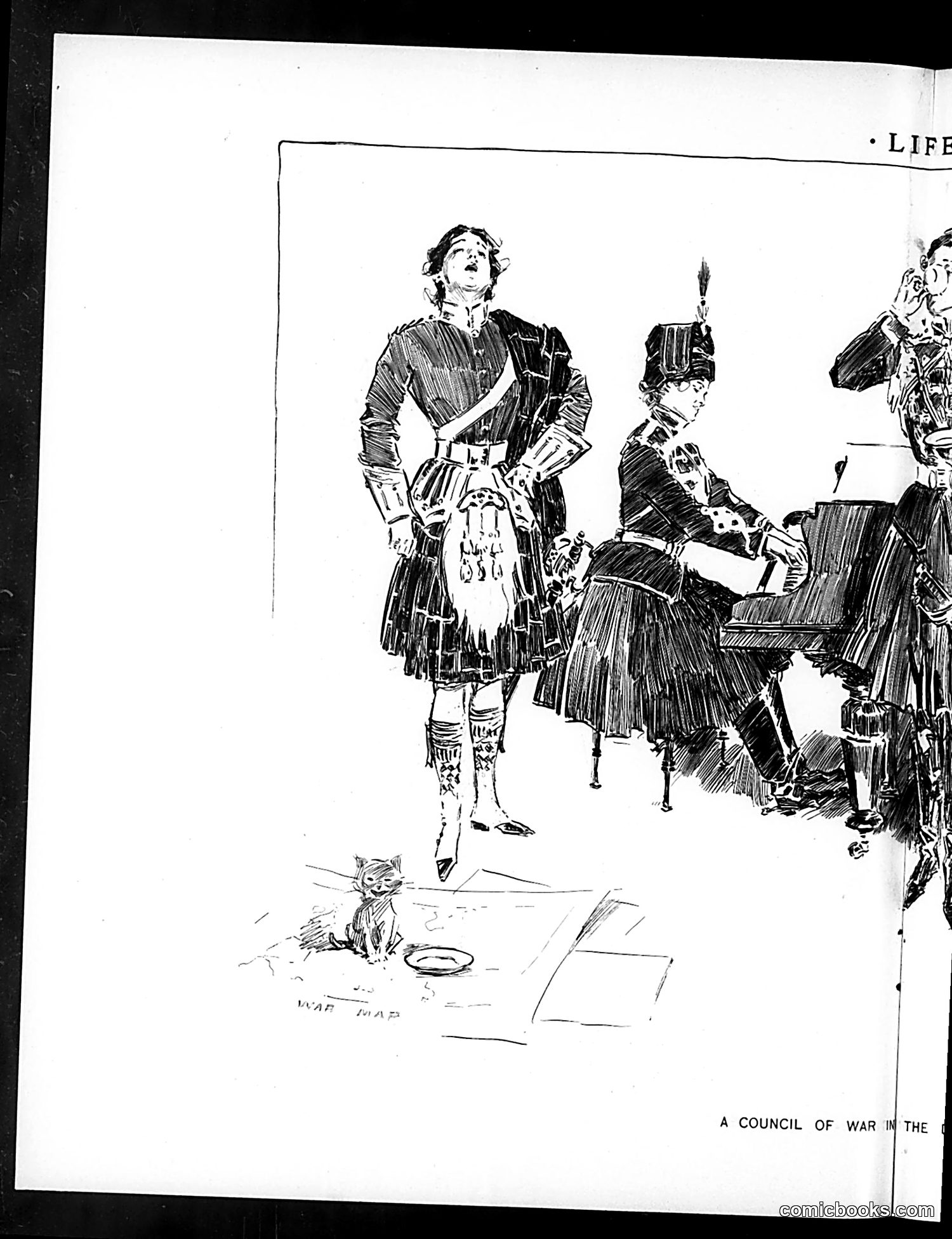
This political cartoon satirizes military leadership during wartime, likely from the early 20th century based on the uniforms and artistic style. The central figure is a Scottish officer (identifiable by the kilt) standing prominently while others sit in formal military dress. A small cat sits on the floor among scattered papers labeled "war map." The satire appears to mock the ineffectiveness or absurdity of military planning—the serious generals in their formal uniforms gathered for strategy while a mere cat sits amid the crucial "war maps." This suggests the cartoon is ridiculing either incompetent military leadership or the futility of their elaborate war councils. The juxtaposition of dignified military pomp with the casual cat implies the proceedings may be pointless or controlled by forces beyond rational planning.
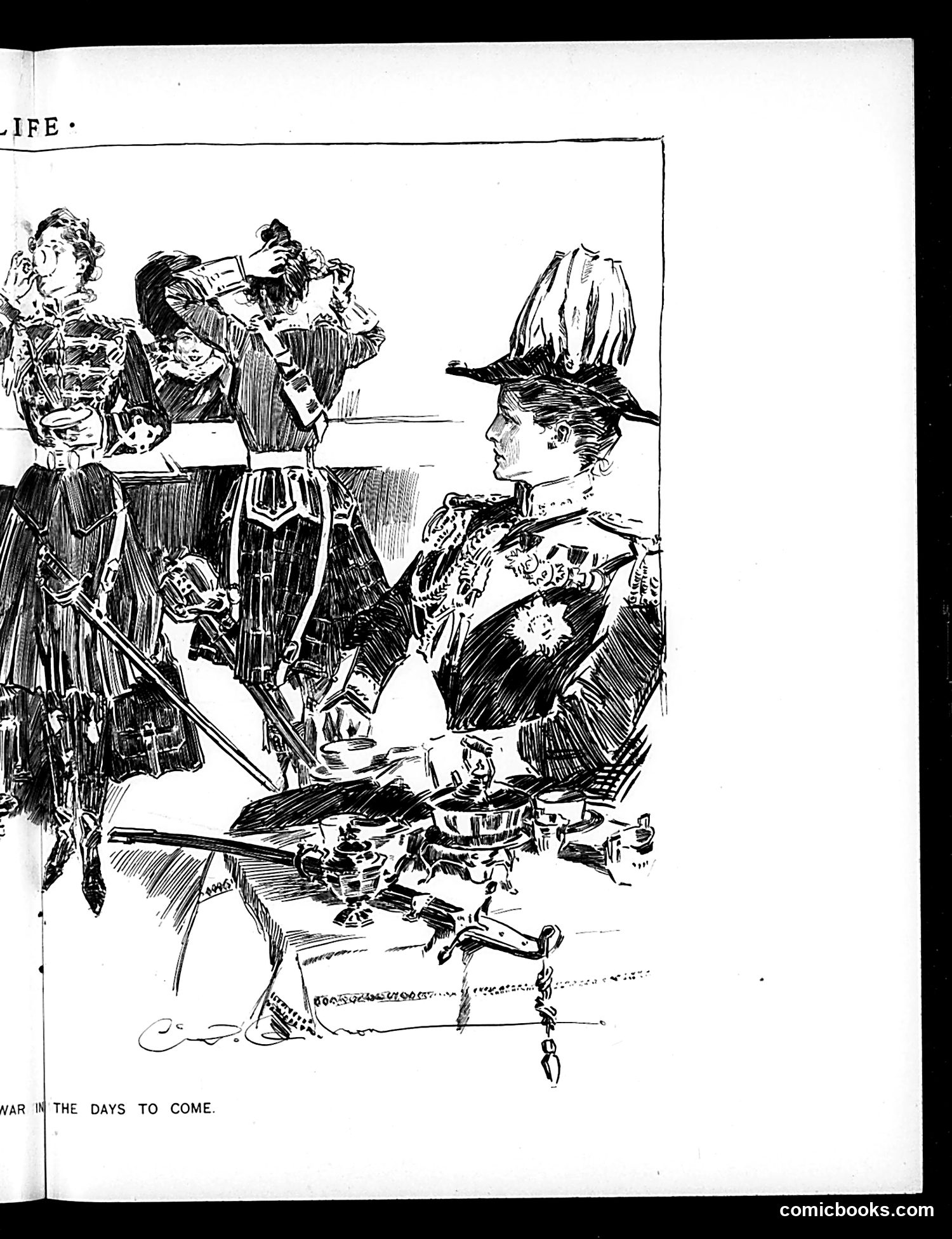
This appears to be a political cartoon from Life magazine satirizing military or imperial leadership. The image shows a uniformed figure seated at a desk with elaborate regalia and decorations, receiving visitors or subordinates in ornate military dress. The setting suggests a formal state or military audience. The caption reads "WAR IN THE DAYS TO COME," indicating commentary on future warfare or military preparedness. The elaborate uniforms, decorations, and formal protocol being depicted suggest satire of military hierarchy, pomp, and ceremony—possibly critiquing the ostentatious nature of military leadership or the aristocratic traditions of command. Without clearer identification of the specific historical figures or dated context visible on the page, the exact political target remains unclear, though the tone appears critical of militarism and formal military culture.
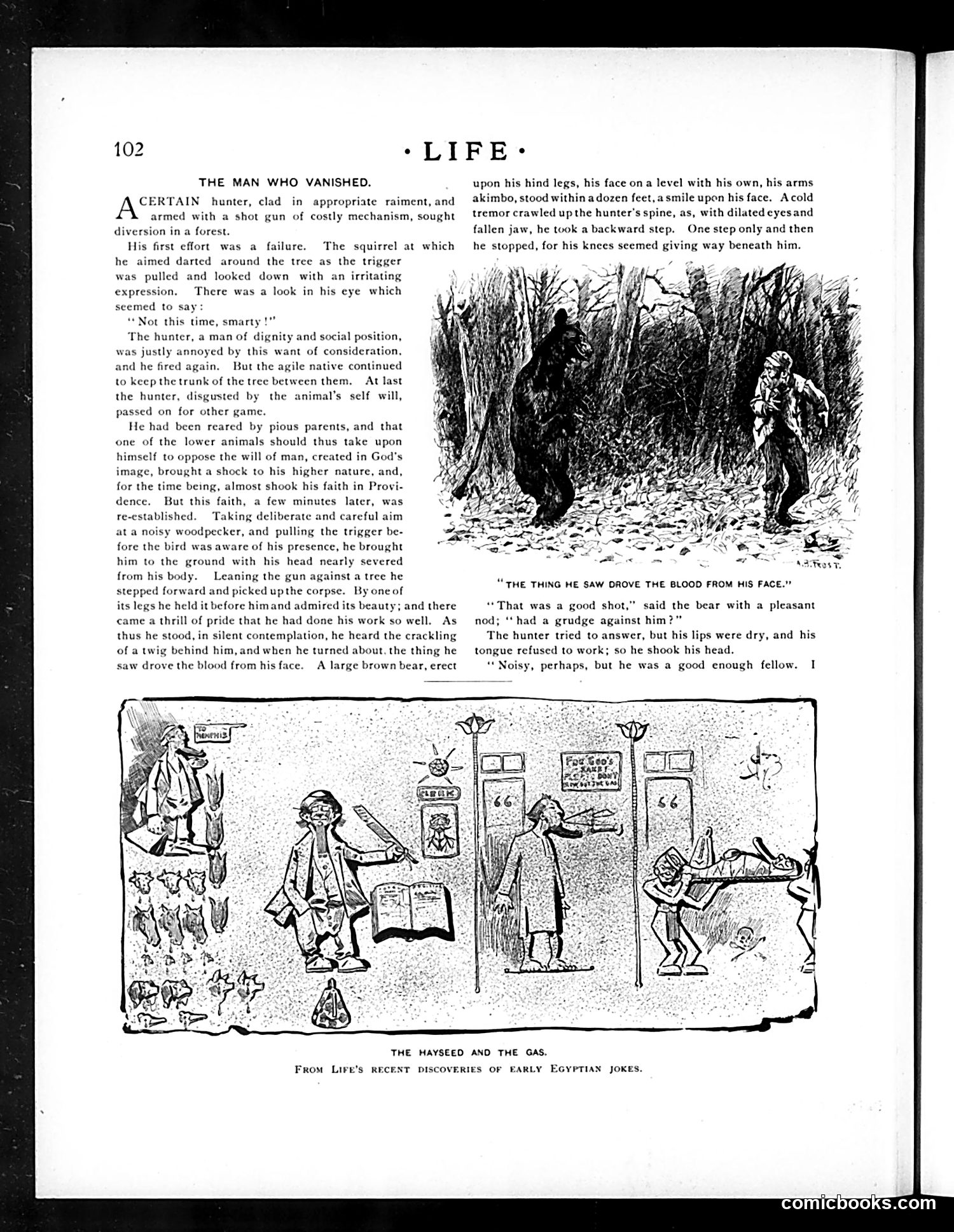
The main story is a literary tale about a hunter who attempts to shoot a squirrel, misses, and encounters a bear instead. The narrative explores themes of pride and hubris—the hunter, described as a "man of dignity and social position," is humbled by his failure and his encounter with the animal's superior will. The lower cartoon, titled "The Hayseed and the Gas," appears to satirize rural Americans' unfamiliarity with modern urban conveniences, specifically gas technology. The illustration shows Egyptian hieroglyphic-style figures, suggesting this is a humorous comparison between ancient ignorance and contemporary rural bewilderment with industrial progress—a common turn-of-the-century satirical theme about rural versus urban sophistication.
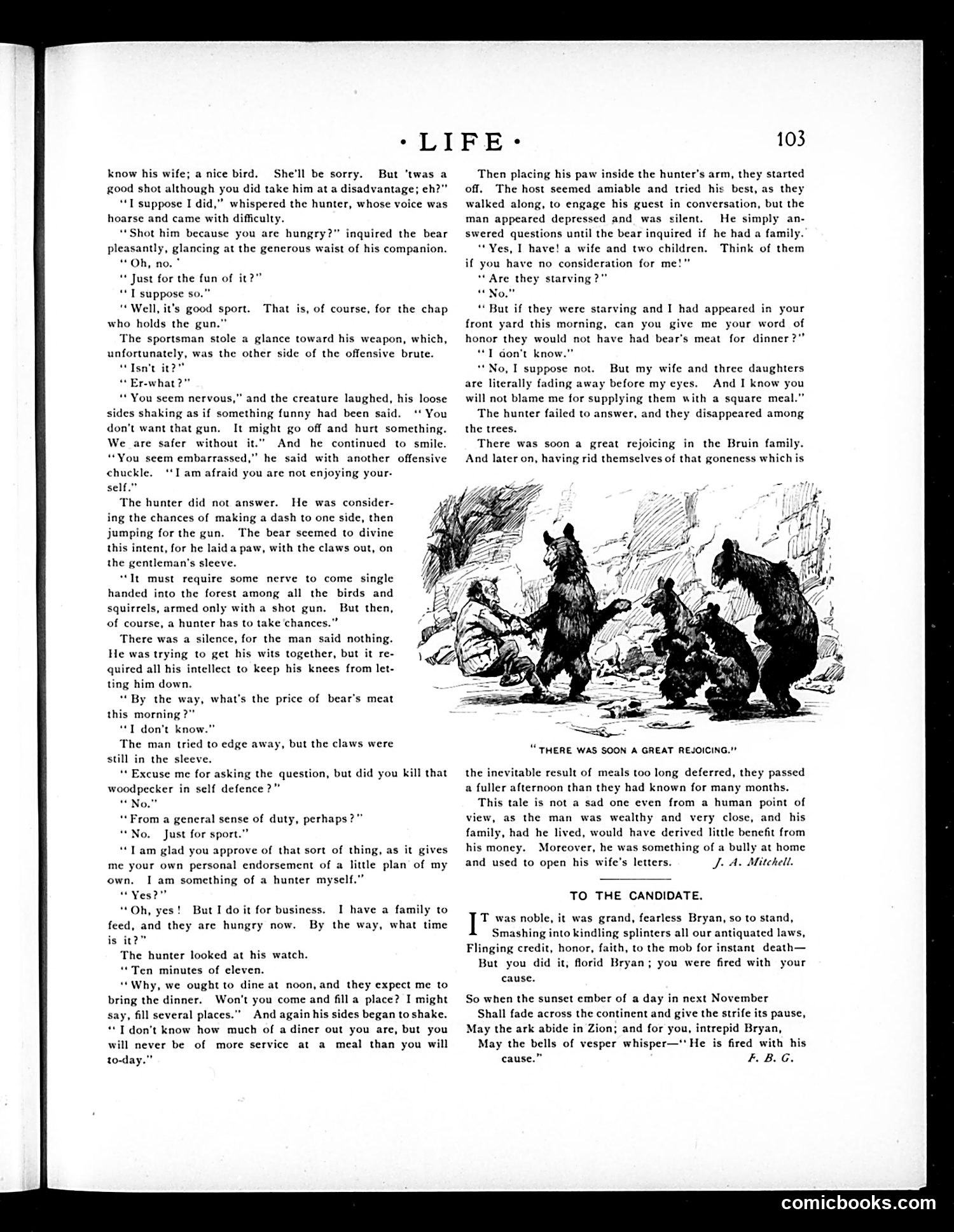
This page contains a story titled "Life" with an accompanying illustration showing a hunter and bear in conversation. The narrative depicts a satirical debate between a sportsman and a bear he's hunting about the ethics of killing for sport versus necessity. The bear argues that killing for "sport" is morally indefensible when the hunter's family is fed and safe, while the bear's family faces starvation. The hunter's discomfort with this moral challenge—combined with his inability to shoot—suggests the satire critiques wealthy sportsmen who hunt for entertainment while dismissing practical concerns about feeding families. The page concludes with a poem titled "To the Candidate" criticizing someone named Bryan, likely William Jennings Bryan, for abandoning his political cause.
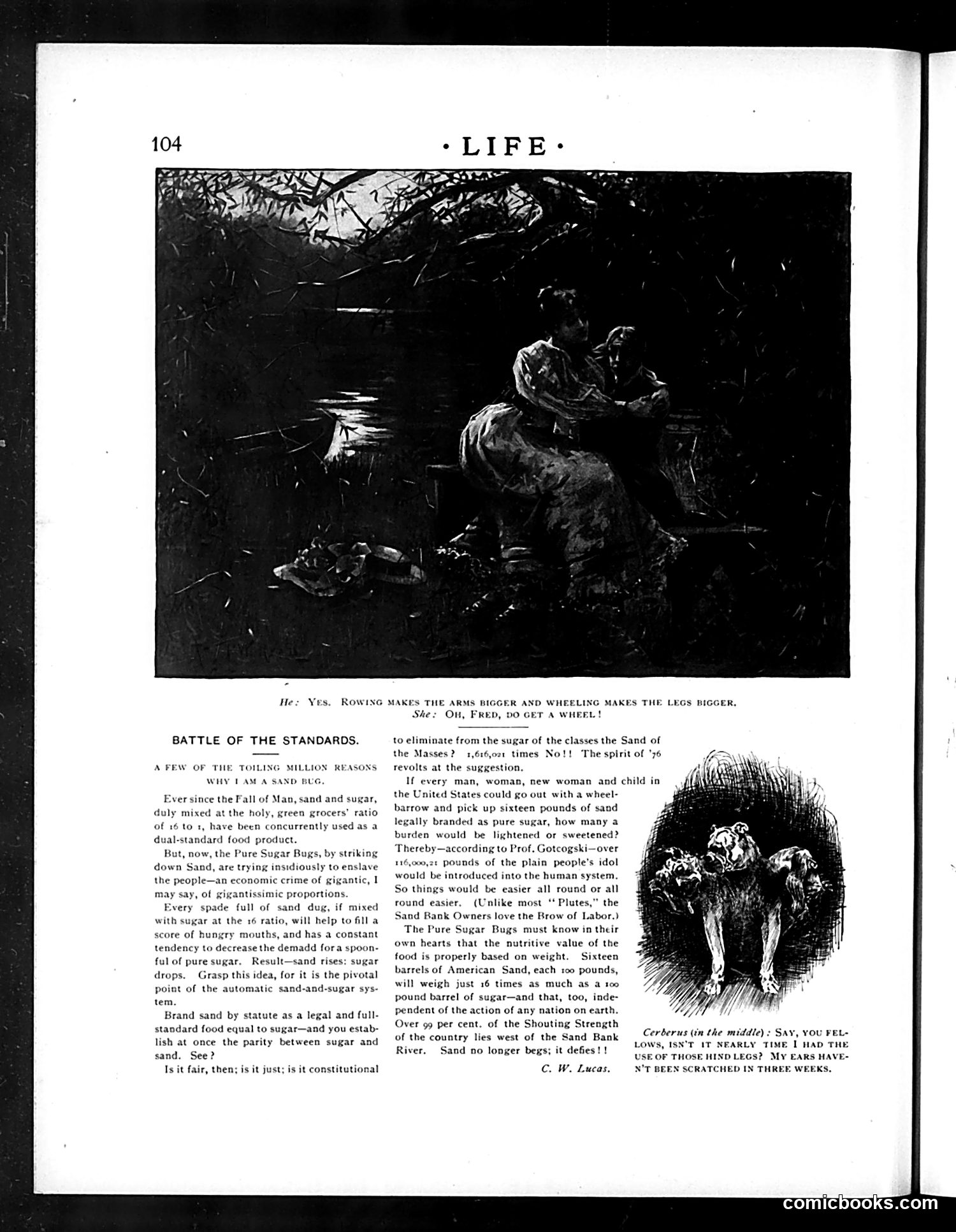
This is a satirical attack on the **bimetallic monetary debate** of the late 1800s, using sand and sugar as metaphors for silver and gold. The "16 to 1" ratio references the proposed silver-to-gold standard that populists advocated. **The satire works like this:** Opponents of free silver (the "Pure Sugar Bugs") are portrayed as trying to prevent mixing sand (silver) with sugar (gold) at a 16:1 ratio. The author argues this helps common workers ("the Masses," "the plain people") by effectively increasing their purchasing power—a pound of mixed commodity would stretch further than pure gold. The accompanying illustration shows people laboring with a wheelbarrow by a canal, likely depicting working-class struggle. The cartoon attacks **elite interests** ("Plutes"/plutocrats and "Sand Bank Owners") for opposing currency expansion that would benefit ordinary Americans. The western geography ("west of the Sand Bank River") reflects populist strength in agrarian regions. This represents the bitter **Free Silver vs. Sound Money debate** that dominated 1890s American politics, pitting agricultural interests against financial establishments.
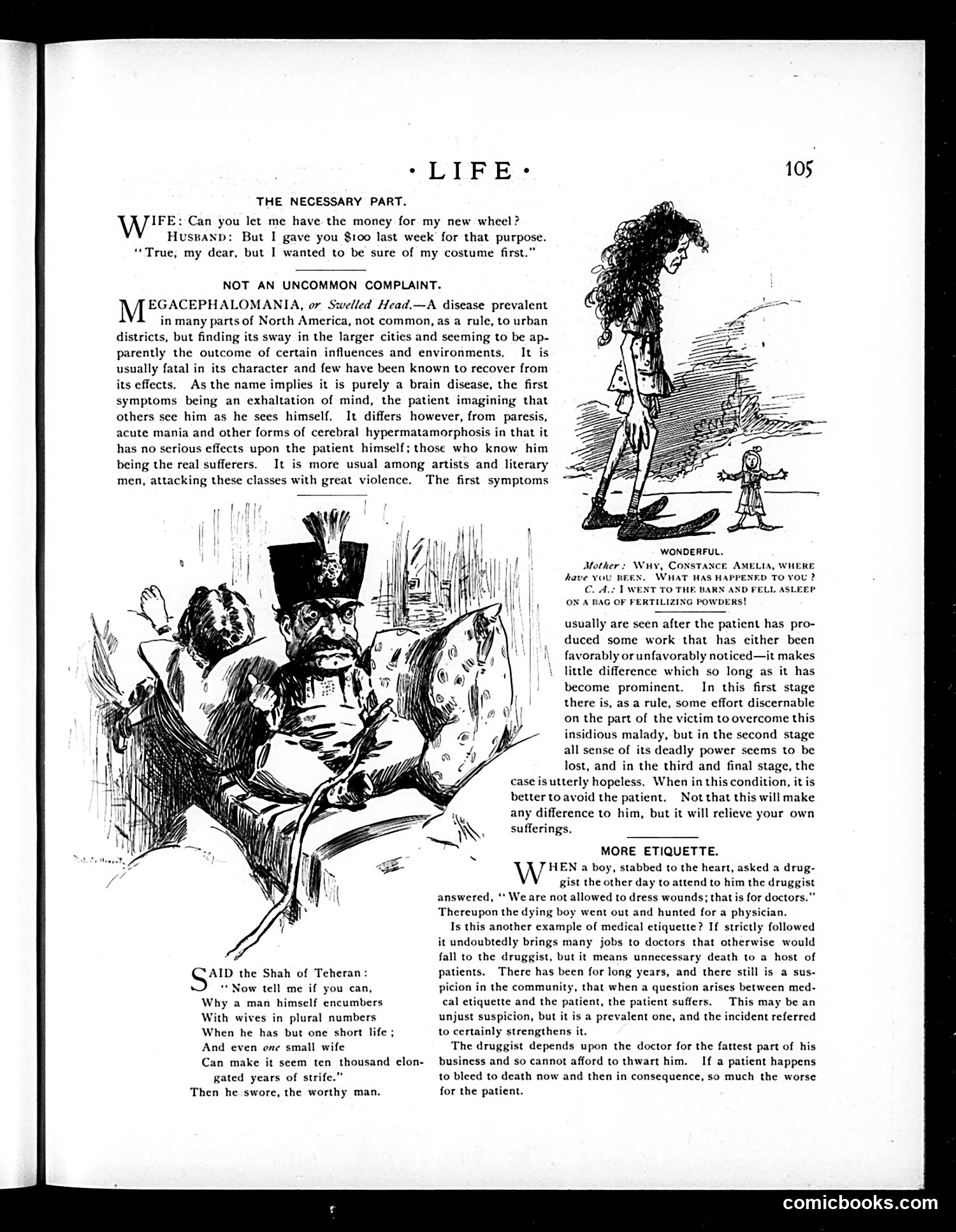
This page contains three satirical pieces from early 20th-century American Life magazine: **"The Necessary Part"** mocks wives' spending priorities—a husband gives his wife $100 for a bicycle wheel, but she prioritizes buying a fashionable costume first, treating the practical need as secondary to appearance. **"Megacephalomania"** satirizes artistic pretension, coining a fake disease name for "swelled head" or arrogance. The satire targets artists and literary men who become unbearably conceited after producing noticed work (whether praised or criticized). The accompanying cartoon shows a pompously dressed figure, presumably representing this type. **"More Etiquette"** critiques professional boundaries between druggists and doctors as dangerously rigid. A stabbed boy dies seeking a physician when a druggist refuses to dress his wound due to professional protocol. The satire argues doctors maintain this separation to protect their monopoly on lucrative medical work, prioritizing professional turf over patient survival. All three pieces reflect turn-of-the-century concerns: consumer culture, artistic vanity, and professional ethics protecting income over human welfare.
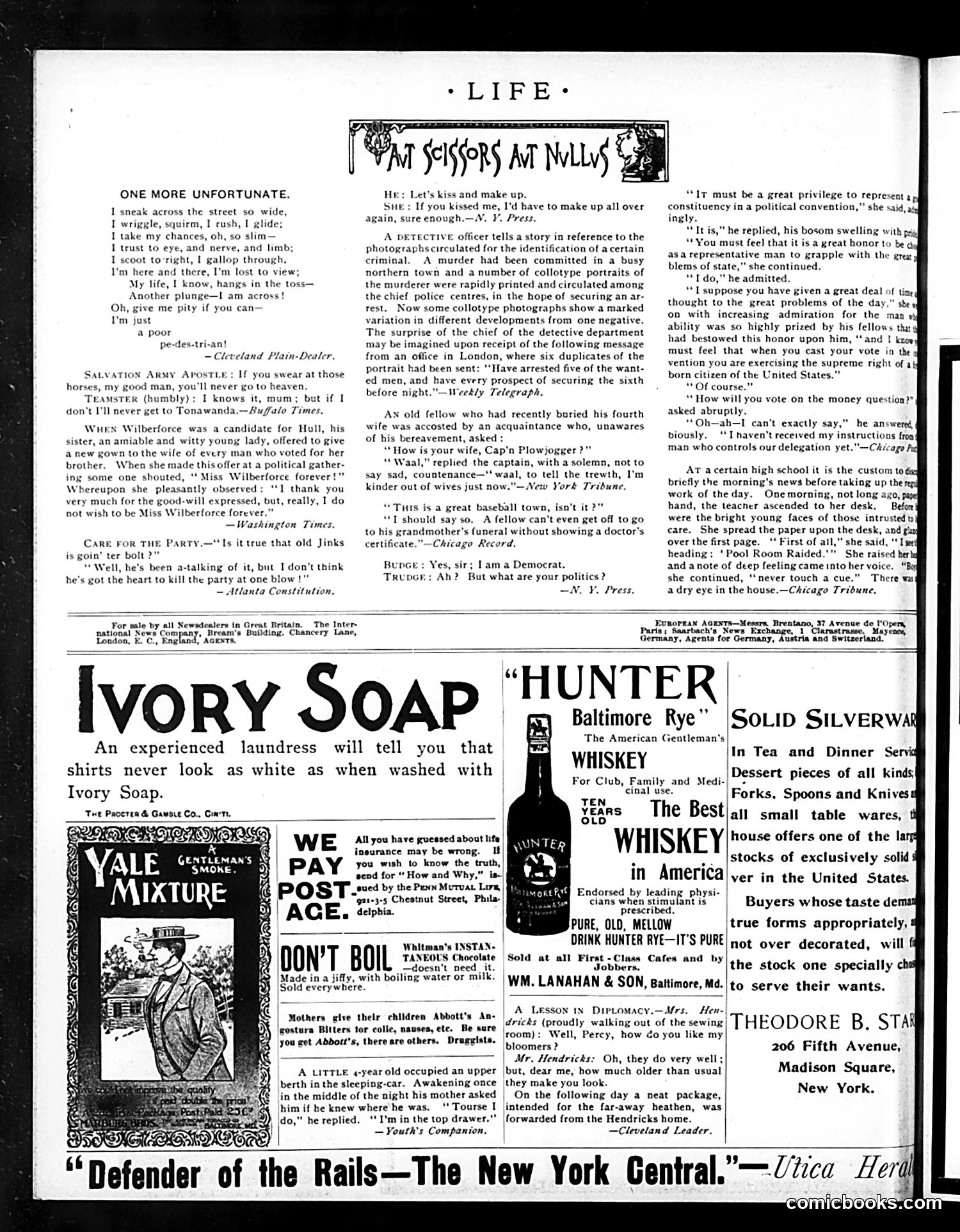
This page from Life magazine contains several short humorous anecdotes satirizing American social conventions and politics circa early 1900s. The main cartoon depicts pedestrian life—a person nervously navigating city streets dodging traffic, presenting modern urban danger as absurd theater. The accompanying verse mocks the anxiety of crossing streets. Other jokes target: religious hypocrisy (Salvation Army worker vs. pragmatic teamster), political opportunism (a politician admitting he doesn't know his own stance on currency and must wait for instructions from party bosses), and marital instability (a widower casually mentioning he's outlived four wives). The page's satire consistently exposes gap between stated ideals (duty, morality, principle) and actual behavior (self-interest, survival, obedience). The political joke is particularly sharp—the delegate's ignorance about major policy issues reflects Life's critique of machine politics controlling individual representatives.
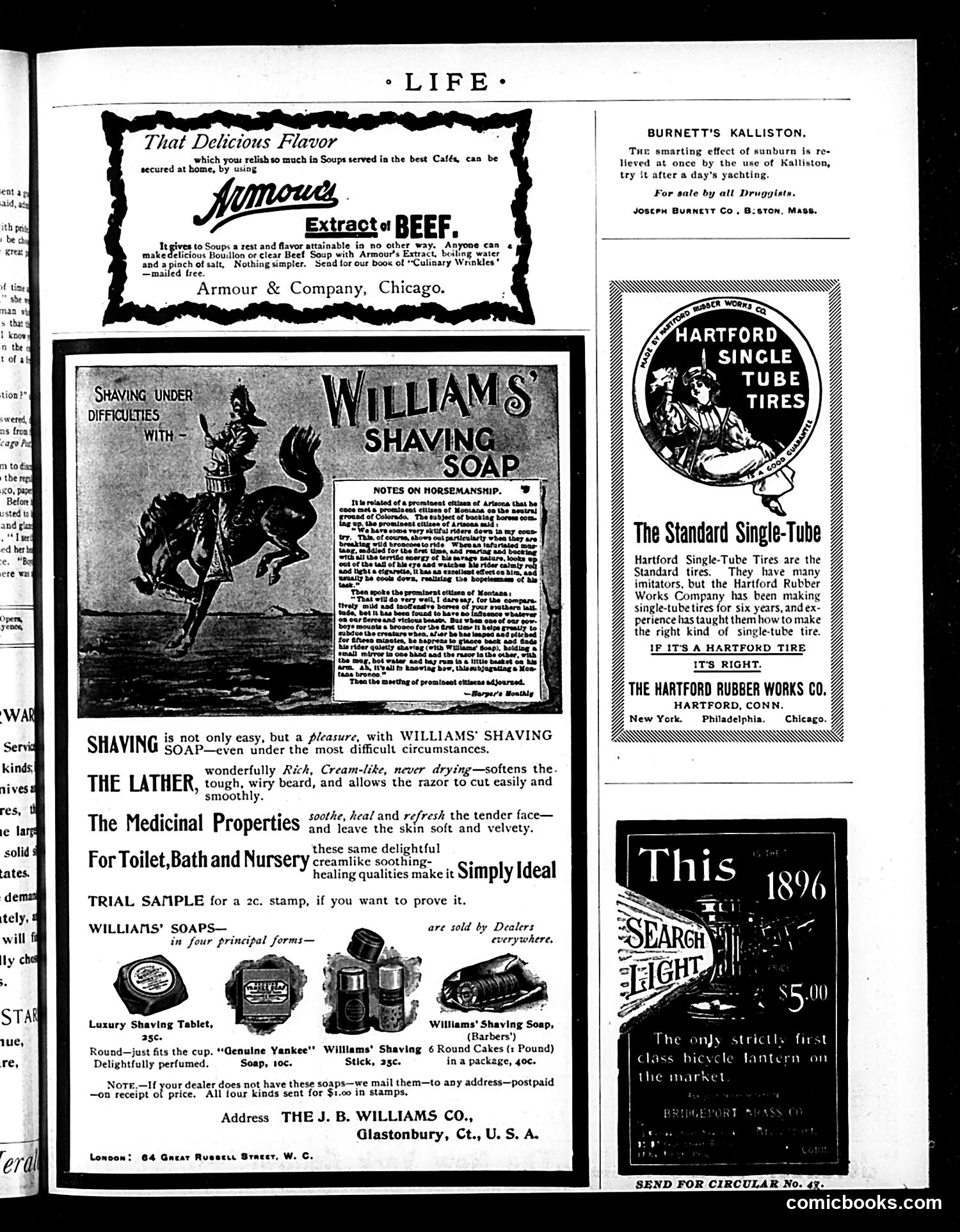
This is primarily an **advertising page** from Life magazine, circa 1896 (based on the Searchlight lantern ad dating). There is no political cartoon or satire on this page. The single illustrated content is a **Williams' Shaving Soap advertisement** featuring a man on horseback titled "Notes on Horsemanship." The image appears to be a humorous or instructional illustration about proper riding technique, not political commentary. The accompanying text provides tips on horseback riding form. The rest of the page consists of product advertisements for: - Armour's Beef Extract - Williams' Shaving Soap (various forms) - Burnett's Kalliston (sunburn relief) - Hartford Single-Tube Tires - Searchlight lanterns These are straightforward commercial ads typical of late-19th-century magazines, with no satirical or political content visible. The page reflects the era's advertising style and consumer products available to middle and upper-class readers.
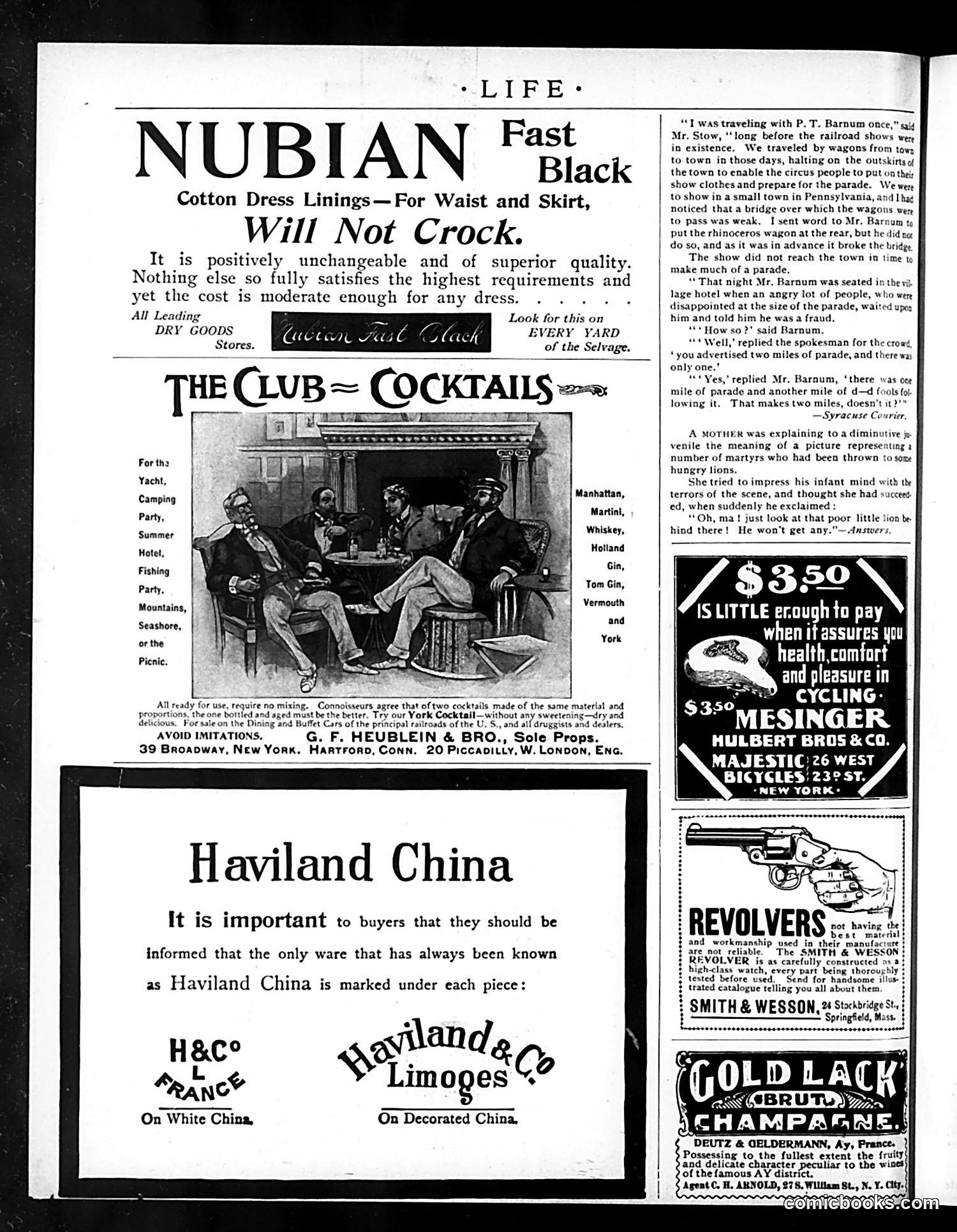
This page from *Life* magazine contains primarily **advertisements** rather than editorial cartoons or satire. The main advertisements are: 1. **Nubian Cotton Dress Linings** - promoting a fabric product 2. **Club Cocktails** - pre-mixed bottled cocktails by G.F. Heublein & Bro. 3. **Haviland China** - distinguishing authentic Haviland from imitators 4. Various smaller ads (Mesinger bicycles, Smith & Wesson revolvers, Gold Lack champagne) The right column contains **humorous anecdotes** rather than cartoons—brief stories told in *Life*'s characteristic comic style, including a P.T. Barnum tale about a broken bridge and a joke about a child watching Christians fed to lions. These are **verbal humor**, not visual satire. This appears to be a standard commercial/entertainment issue rather than a politically satirical one. The "Life" brand here was primarily a humor and lifestyle magazine, not the serious news magazine it later became.
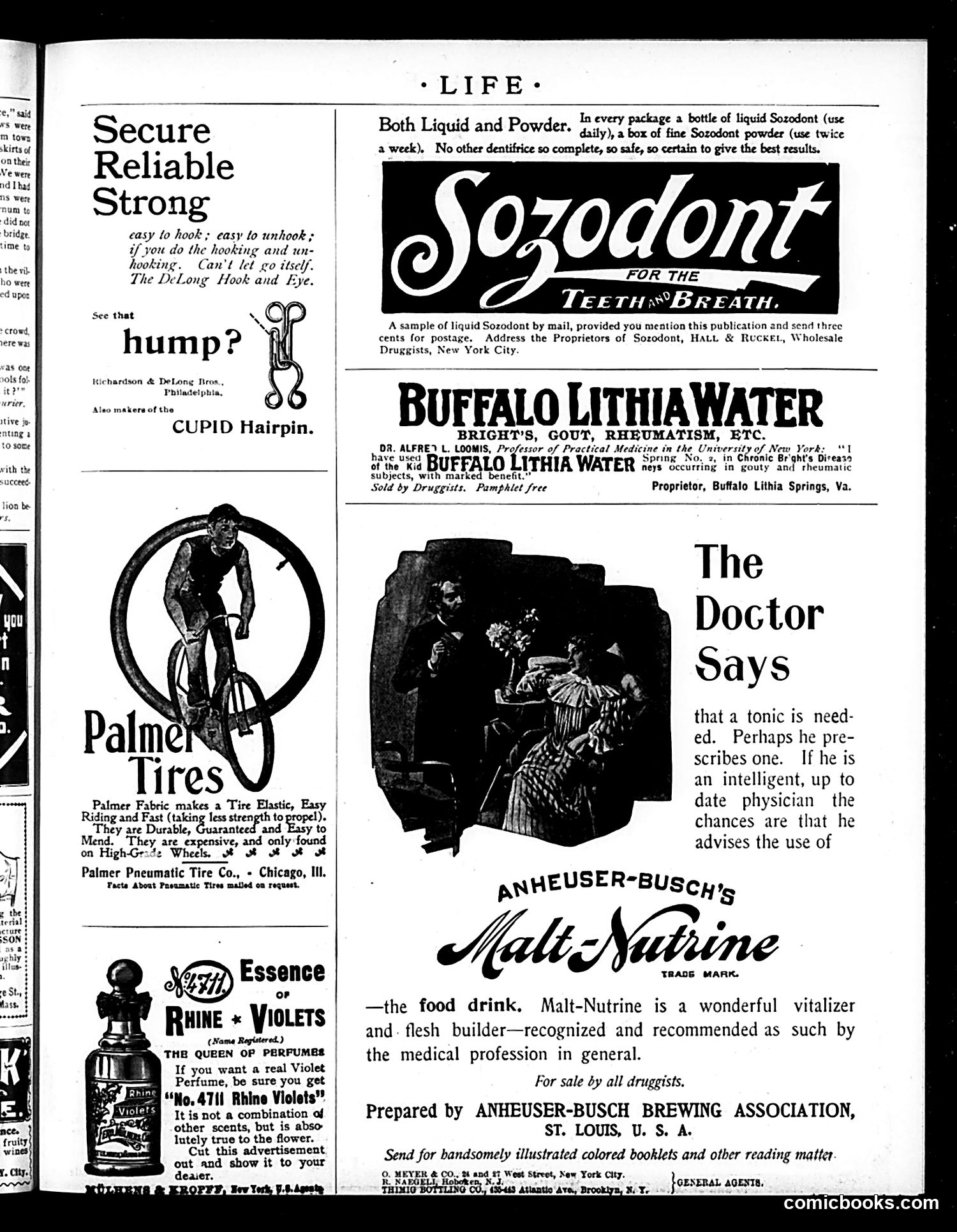
This page is primarily **advertising**, not satire or political commentary. It contains multiple patent and product advertisements typical of early 1900s American magazines. Notable ads include: **DeLong Hook and Eye** — a fastening device marketed with a humorous illustration of a cyclist, playing on the brand name's double meaning ("can't let go itself"). **Sozodont** — a dental product (liquid and powder) claiming completeness and safety for teeth and breath. **Buffalo Lithia Water** — mineral water marketed as cure-all for Bright's disease, gout, and rheumatism, endorsed by Professor Alfred L. Loomis of New York University. **Palmer Pneumatic Tires** — bicycle tires advertised as elastic, durable, and easy to repair. **Anheuser-Busch's Malt-Nutrine** — a "food drink" (malt beverage) presented as a health tonic, endorsed by "the doctor" as a flesh-builder and vitalizer. The page reflects the era's marketing of dubious patent medicines and health products with medical endorsements, before modern FDA regulations.
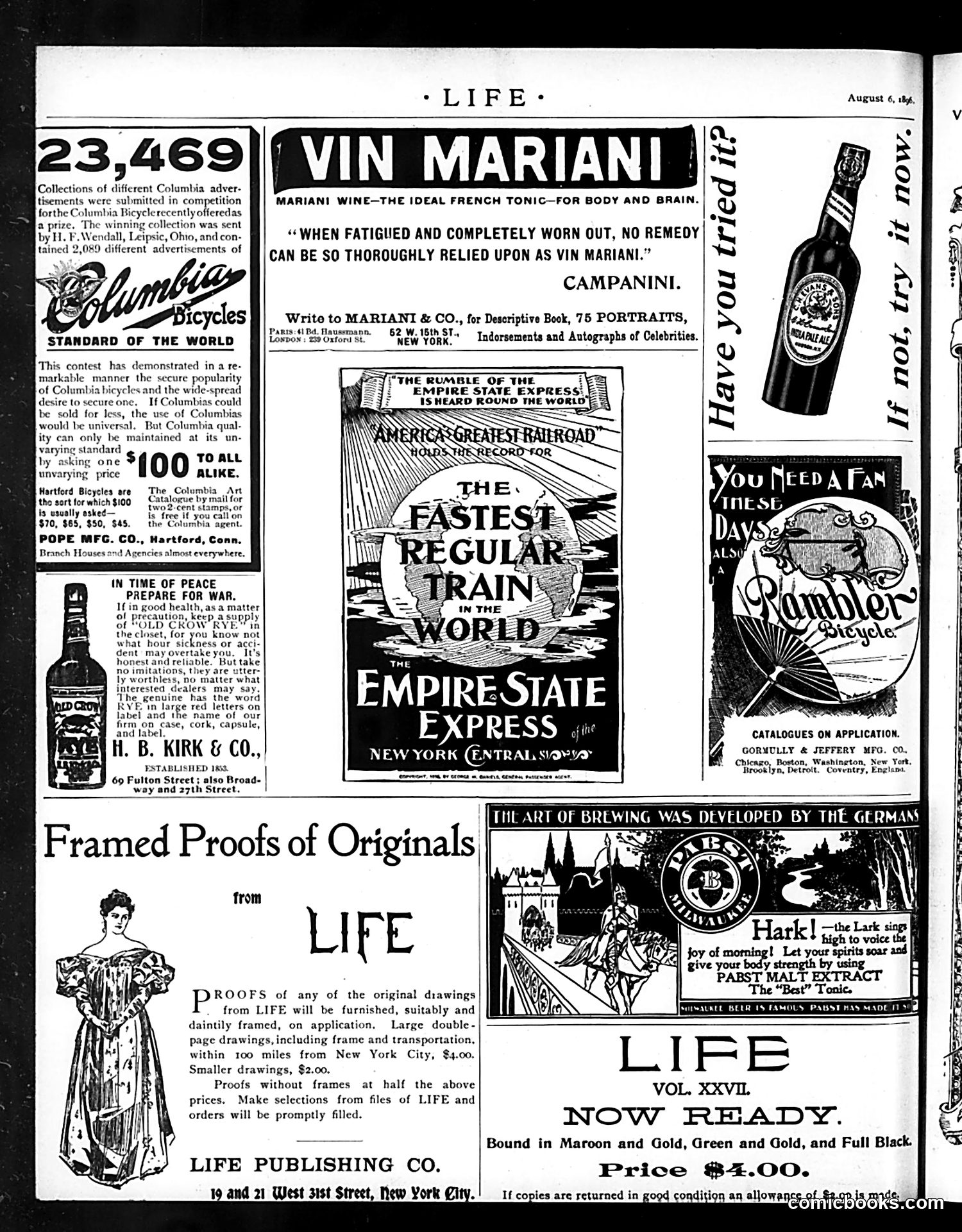
This is primarily an **advertising page** rather than a satirical cartoon page. The page showcases various commercial products typical of the 1880s: **Key advertisements include:** - **Columbia Bicycles** — promoted as the "Standard of the World," with contests demonstrating their popularity - **Vin Mariani** — a French wine tonic marketed as a cure for fatigue, endorsed by celebrities (Campanini is quoted) - **Old Crow Rye whiskey** — positioned as preventative medicine ("In Time of Peace Prepare for War") - **Railroad and bicycle advertisements** — the Empire State Express and Rambler bicycles - **Pabst Malt Extract** — a brewing product The page also advertises **Life Publishing Company's services**: framed proofs of original artwork from the magazine itself, available for purchase. Rather than satire, this reflects **late-Victorian consumer culture** and the emerging importance of celebrity endorsements and branded products in American advertising. The prices and business addresses indicate this was a thriving commercial period for emerging industries like bicycles and patent medicines.