
A complete issue · 18 pages · 1896
Life — July 9, 1896
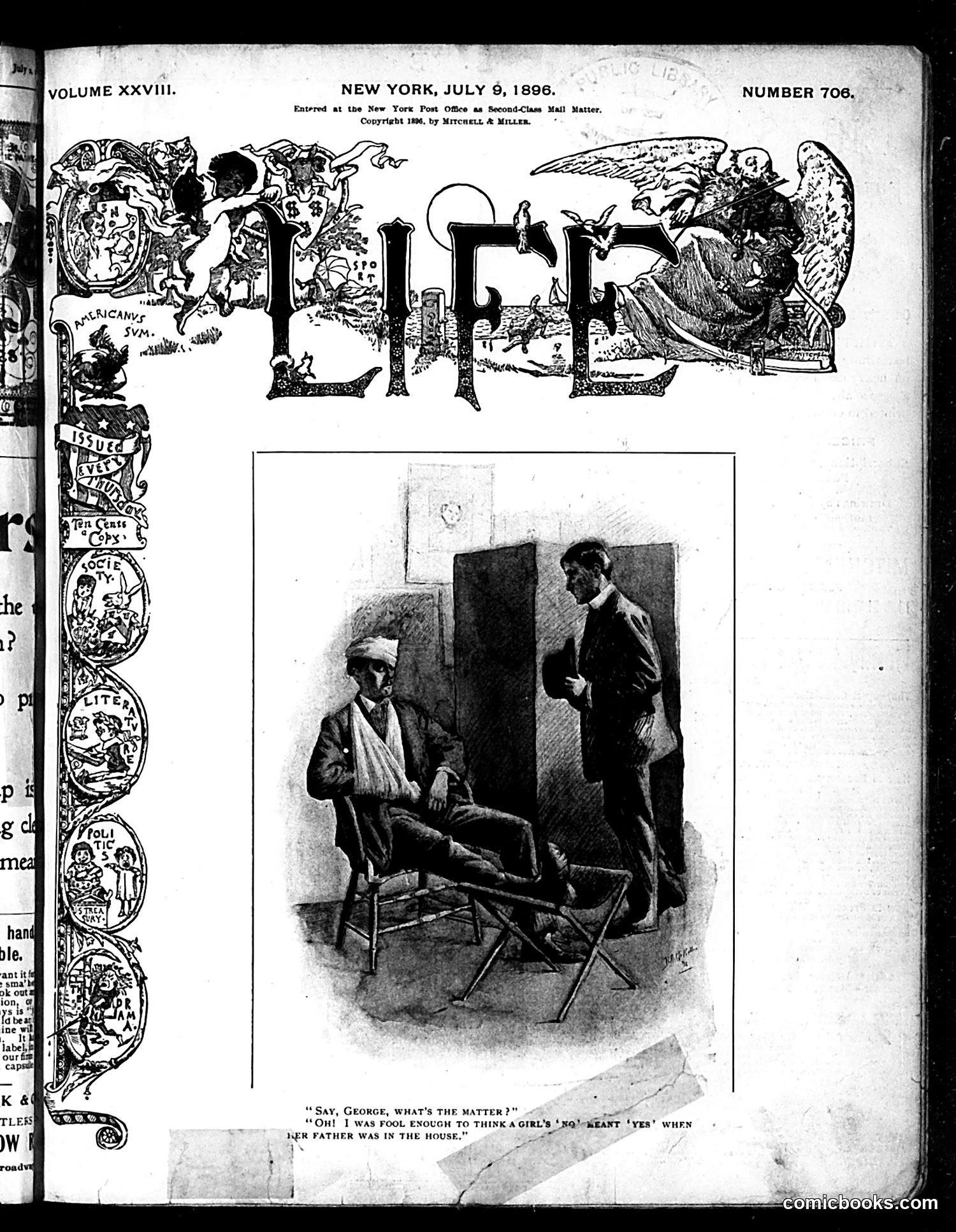
The illustrated caption reads: "Say, George, what's the matter?" / "Oh! I was fool enough to think a girl's 'no' meant 'yes' when her father was in the house." This is a romantic comedy sketch satirizing courtship conventions of the 1890s. A young man (George) sits injured or distressed while another man questions him. The joke plays on the social hypocrisy of the era: a father's presence supposedly changed a young woman's romantic behavior—her public rejection of a suitor's advances ("no") was understood to actually mean acceptance ("yes"), but *only* when her father wasn't watching. The humor mocks both the awkward formality of paternal supervision over courtship and the duplicity it supposedly enabled in young women's expressed preferences.
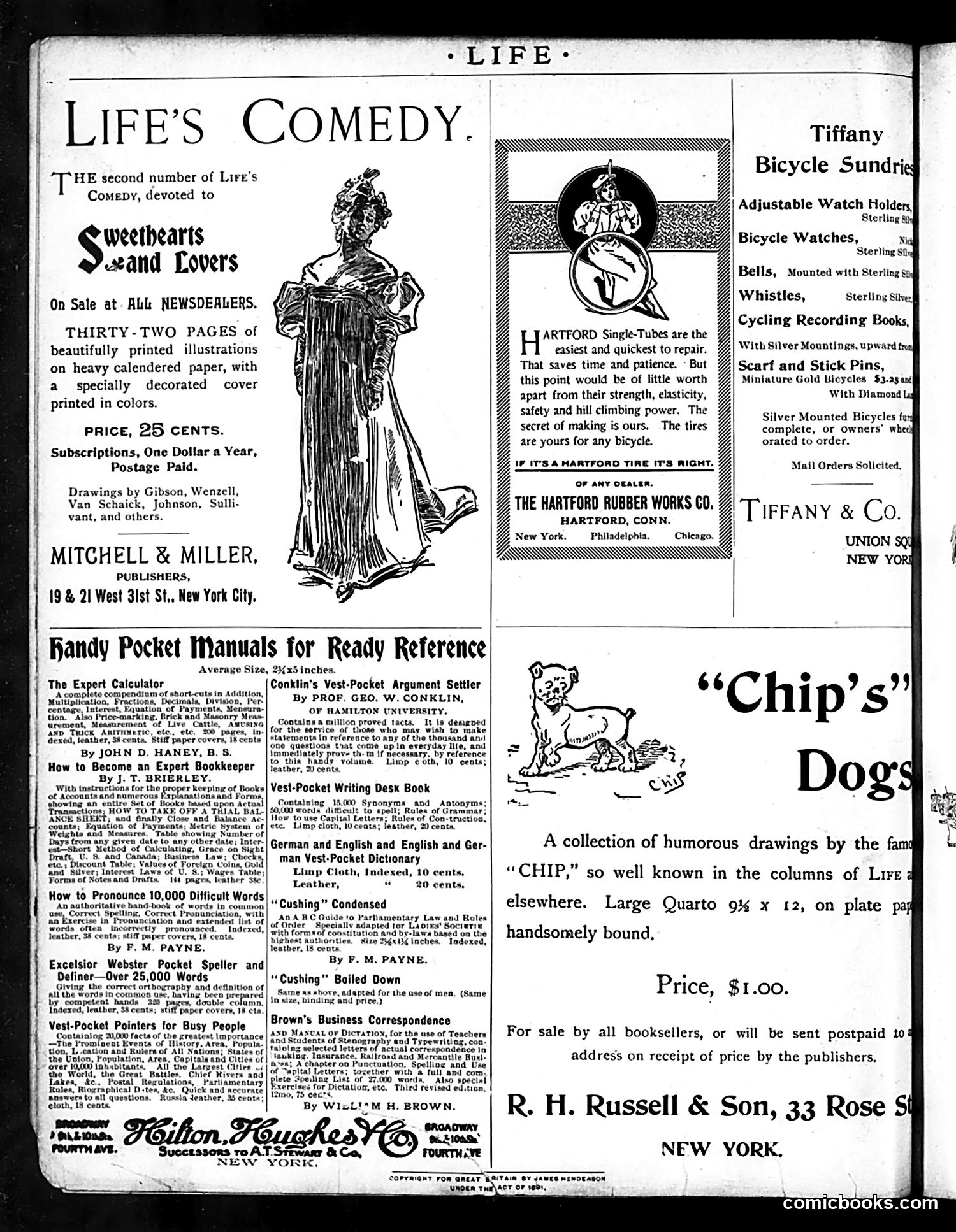
This page is **primarily advertising**, not political satire or editorial content. The main elements are: 1. **Life's Comedy** (top left): Advertisement for Life magazine's second issue, featuring "Sweethearts and Lovers" — a romantic/comedic illustrated publication selling for 25 cents. 2. **Hartford Rubber Works** (center): Product advertisement for bicycle tires, emphasizing durability and safety features. 3. **Tiffany & Co.** (right): Advertisement for luxury bicycle accessories and jewelry. 4. **"Chip's Dogs"** (lower right): Book advertisement featuring humorous dog drawings by an artist known as "Chip" from Life magazine's columns. 5. **Handy Pocket Manuals** (left side): Multiple reference books advertised, including calculators, writing guides, and language books. The page reflects early 20th-century consumer culture focused on bicycles, luxury goods, and self-improvement literature. No political messaging is evident.
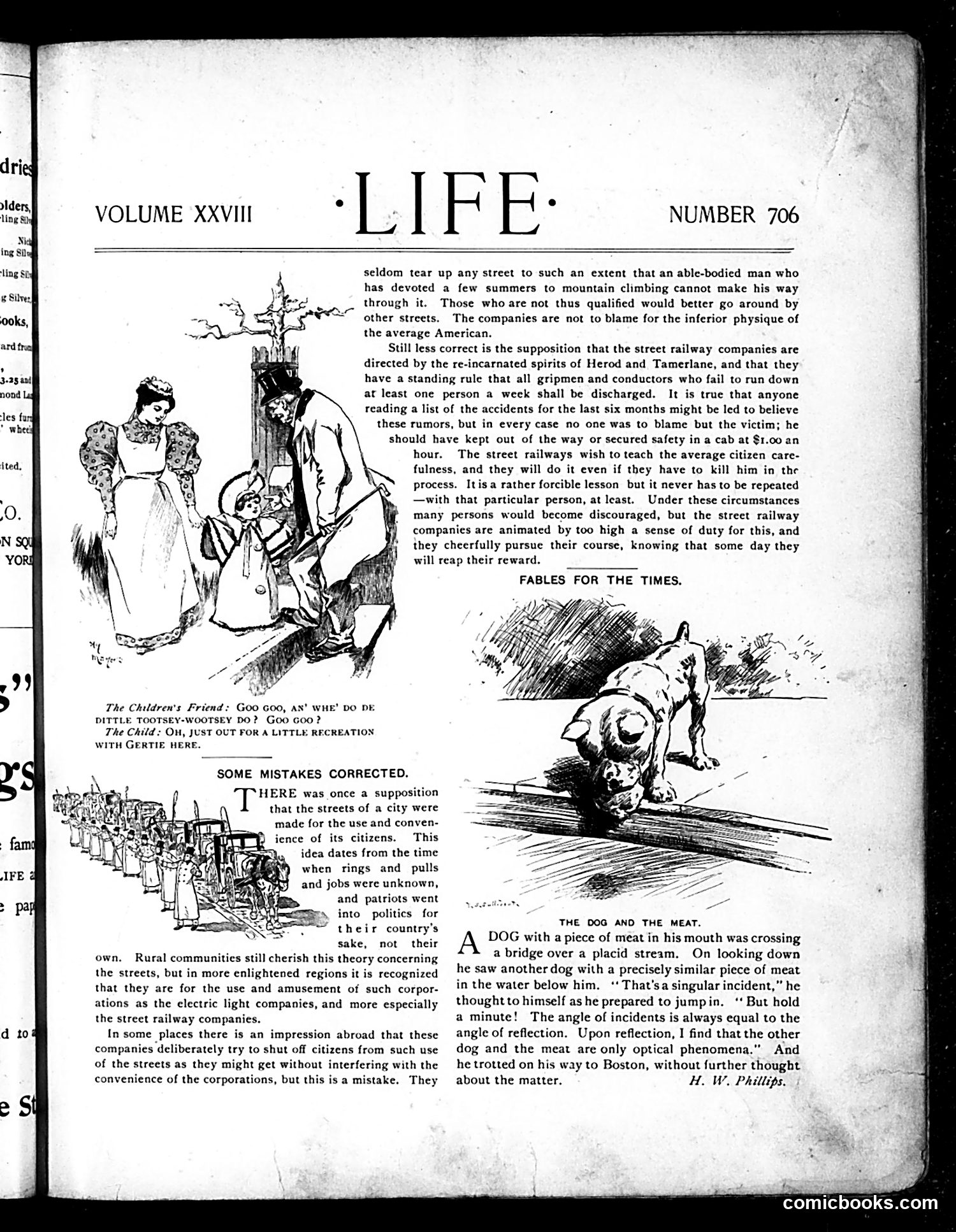
This Life magazine page contains two satirical pieces: **"Fables for the Times"** critiques street railway (trolley) companies. The text defends them against accusations of deliberately endangering citizens, arguing instead that accidents result from carelessness rather than malice. It portrays the companies as duty-bound despite public suspicion. **"The Dog and the Meat"** is a moral fable illustrated with a dog crossing a bridge. A dog carrying meat sees its reflection and drops the original piece attempting to grab the reflection, losing everything—a classic Aesop's fable warning against greed and gullibility. The trolley piece's defensive tone suggests contemporary public anger over street railway safety, a genuine progressive-era concern. The fable placement beside it may imply ironic commentary on public perception versus corporate claims.
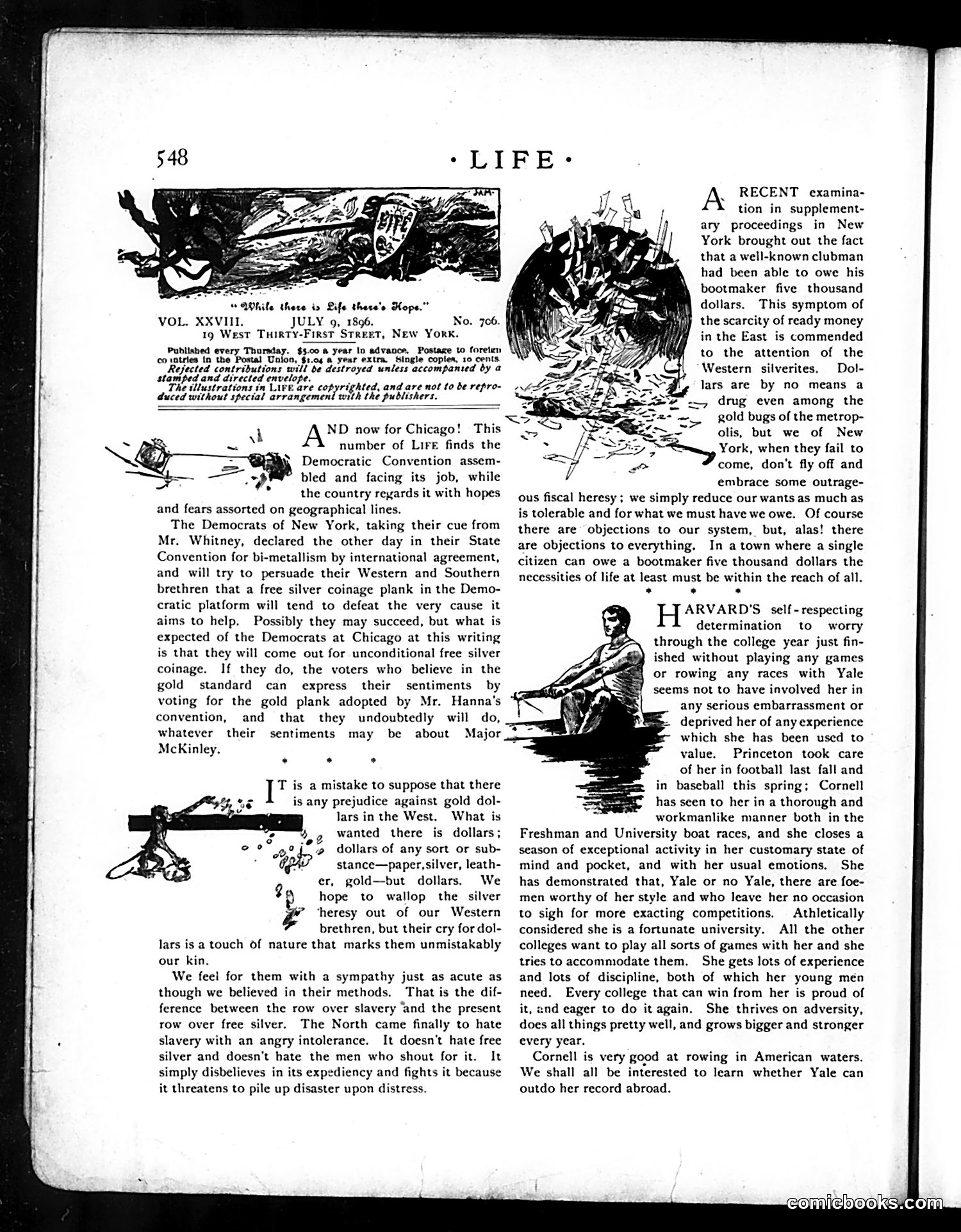
This page contains three political cartoons critiquing Democratic Party positions on currency. **Top cartoon**: Depicts chaos at the Democratic Convention, sarcastically titled "While there is Life there's Hope." The Democrats are shown in disarray over monetary policy. **Middle cartoon**: Shows a figure (likely representing Western Democrats) pouring silver dollars, criticizing their push for "free silver coinage"—a major 1896 election issue. The text argues that Western Democrats want unlimited silver coinage to benefit their mining interests, contrasting this with Eastern preference for gold. **Bottom section**: Shifts to women's college sports, praising Vassar's athlete for avoiding Yale social embarrassment. This appears unrelated satirical commentary on collegiate women's athletics. The issue's central theme attacks Democratic silver-coinage advocacy as economically reckless.
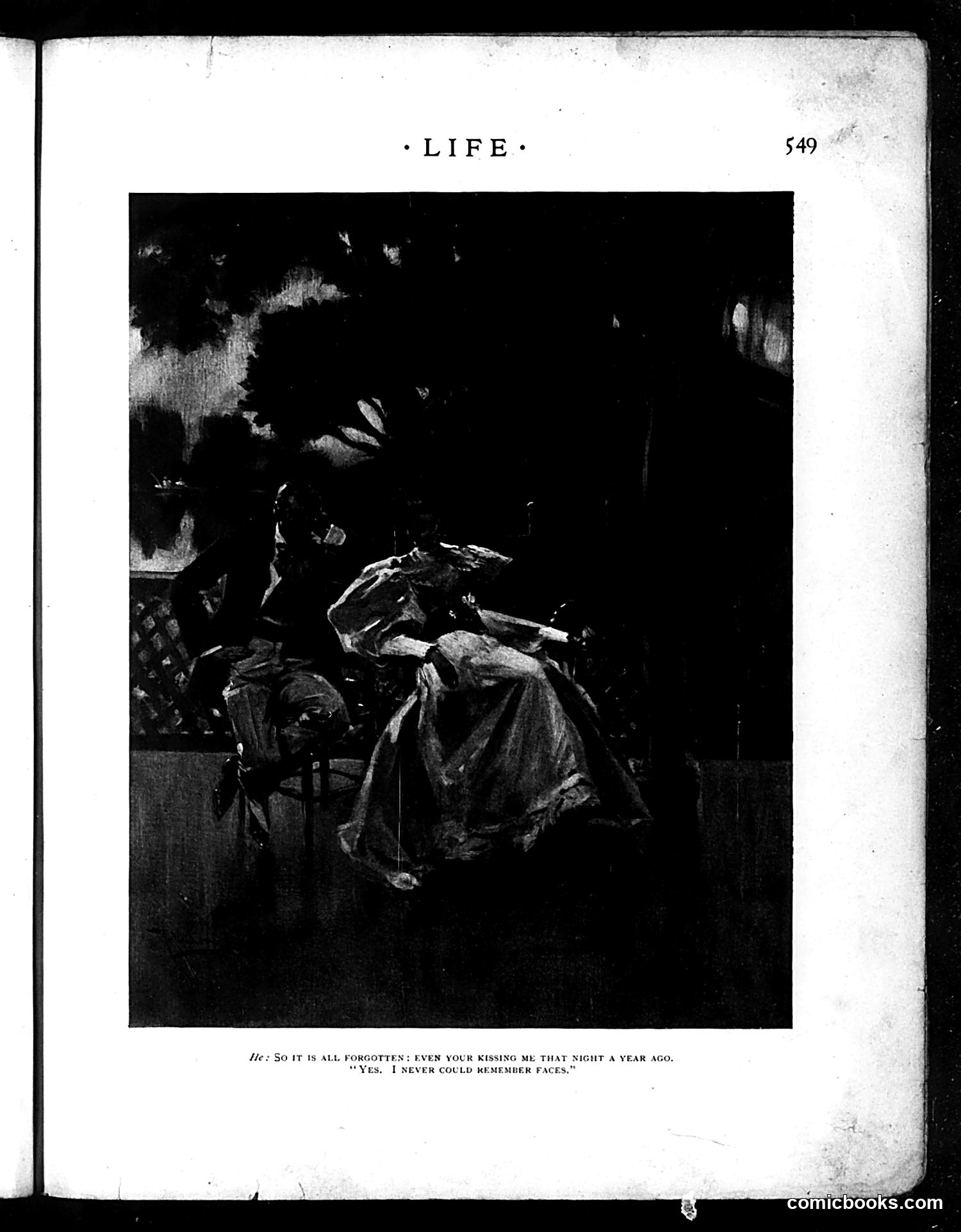
This appears to be a dramatic scene from a theatrical or film production rather than a political cartoon. The image shows two figures in an intimate moment—a man leaning toward a woman who is reclining or seated. The dialogue beneath suggests a romantic or melodramatic plot: the man says "So it is all forgotten; even your kissing me that night a year ago," to which the woman replies "Yes, I never could remember faces." The humor derives from the woman's callous response—she cannot even recall the man's appearance despite their previous intimate encounter a year prior. This plays on themes of romantic rejection and the comedy of casual forgetfulness in romantic entanglements, typical of early 20th-century satirical humor in *Life* magazine.
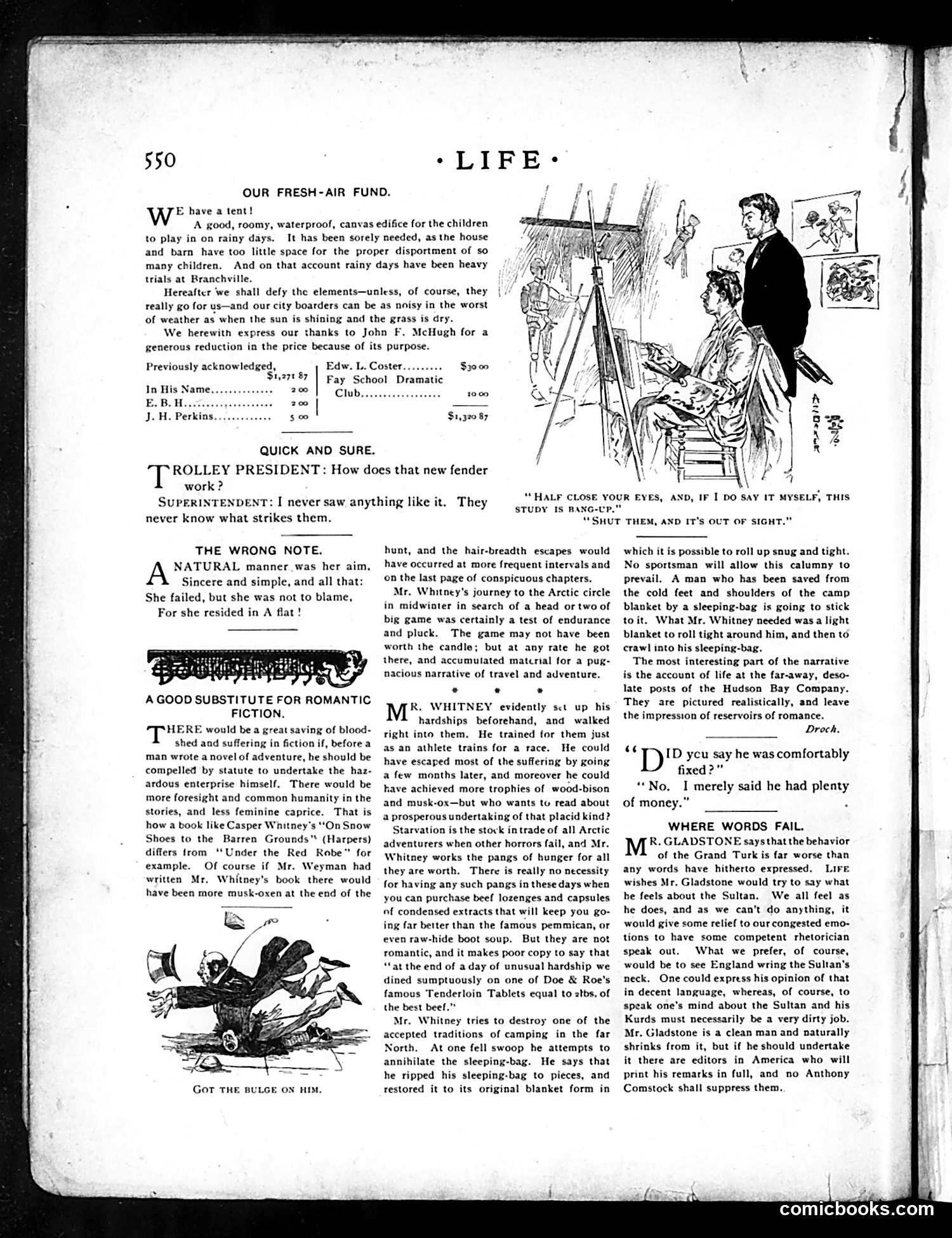
This page contains several humorous short pieces rather than a single political cartoon. **"Our Fresh-Air Fund"** announces donations toward a tent for children's outdoor play, with a joke about its waterproof qualities. **"Quick and Sure"** is a brief dialogue joke about a trolley president asking a superintendent about new fender work. **"The Wrong Note"** appears to be a literary critique, mocking sentimental romantic fiction writing. **"A Good Substitute for Romantic Fiction"** sarcastically suggests that real adventure narratives (specifically Mr. Whitney's Arctic expedition accounts) are more compelling than formulaic romance novels, offering genuine drama over manufactured sentiment. The illustration shows someone in a tent, likely related to the fresh-air fund discussion. Overall, the page satirizes both domestic complacency and overwrought popular literature through gentle mockery.
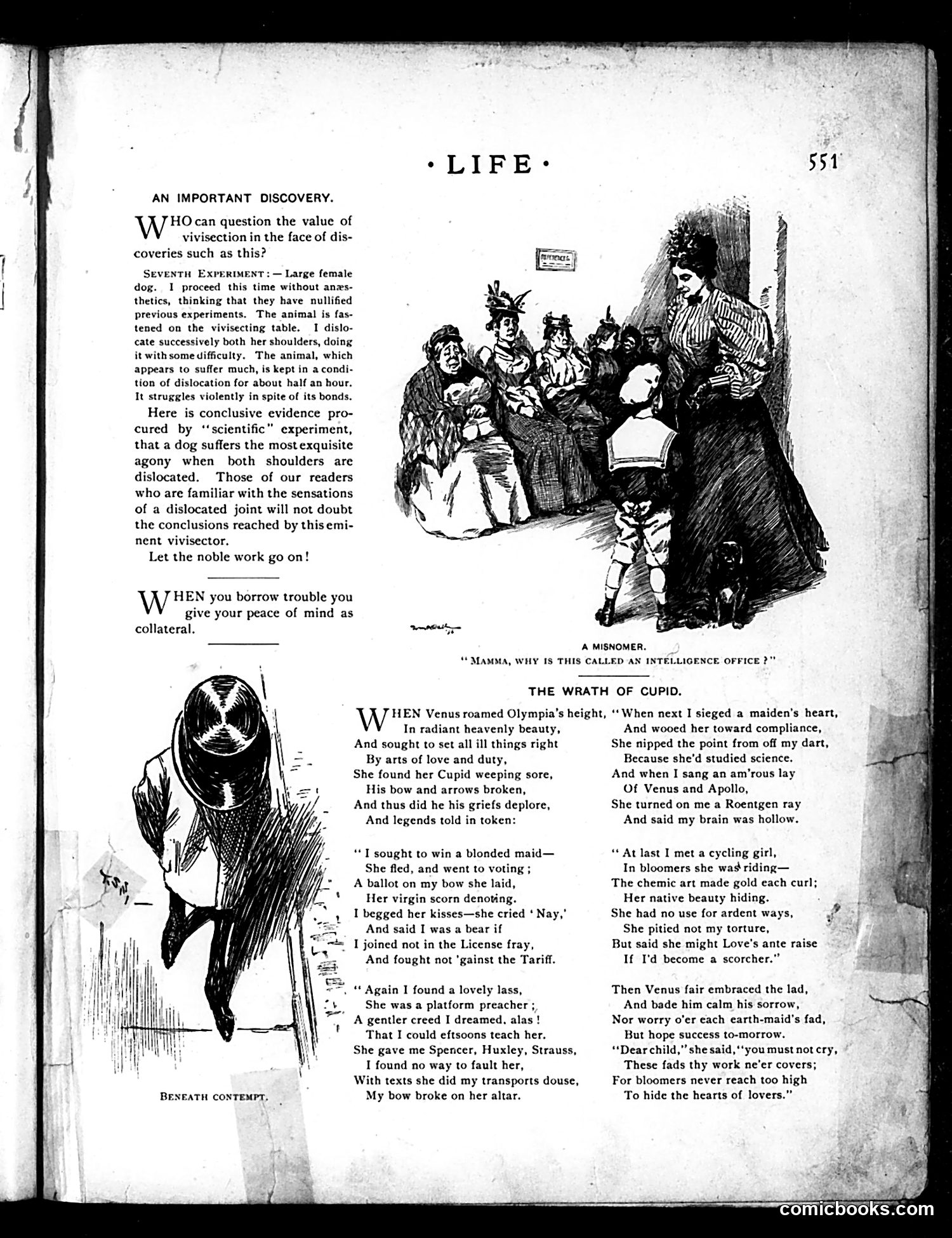
**"An Important Discovery"** (top): A satirical article mocking vivisection experiments. It describes a large female dog being dissected while alive on a vivisection table, presented as "conclusive evidence" that dogs suffer extreme agony when both shoulders are dislocated. The satire critiques the justification of animal cruelty under the guise of scientific advancement—the rhetoric ("Let the noble work go on!") dripping with sarcasm. **"A Misnomer"** (illustration, right): A social scene captioned asking why an "Intelligence Office" is so named, suggesting ironic commentary on employment agencies or government offices. **"The Wrath of Cupid"** (bottom): A humorous poem about Venus/Cupid punishing a scientifically-minded woman who rejected love, presented as moral comeuppance for female intellectualism—reflecting period anxieties about educated women.
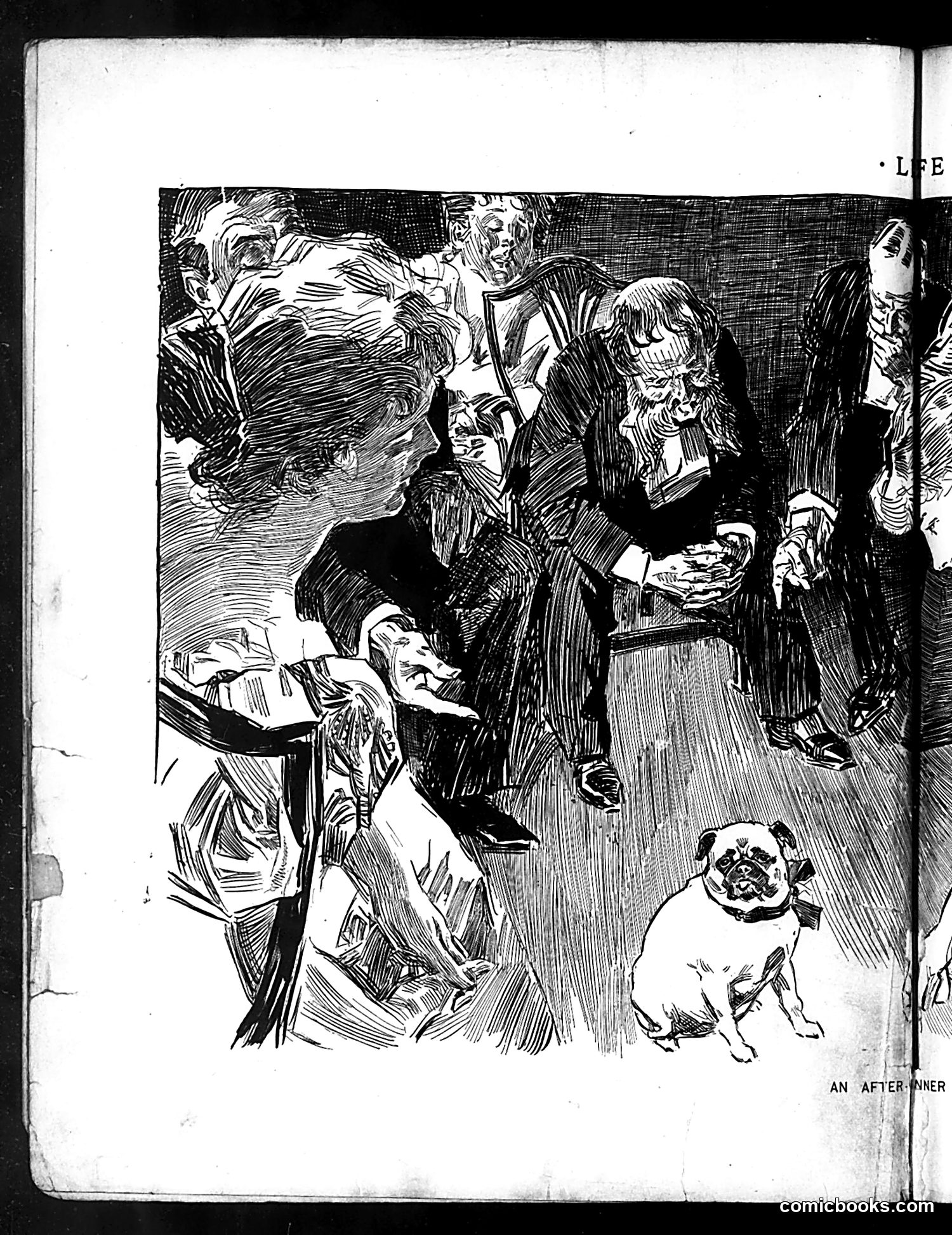
This satirical sketch depicts a formal social gathering, likely from the late 19th or early 20th century based on the style. The title "An After-Dinner" suggests this occurs following an elegant meal among the upper classes. The cartoon appears to mock high-society pretensions: well-dressed gentlemen and ladies engage in conversation while a small pug dog sits prominently in the foreground, seemingly as much a part of the gathering as the human guests. The dog's prominent placement—treated as a social equal—likely satirizes the vanity and self-importance of aristocratic or wealthy socialites who dote excessively on their pets. The exaggerated facial expressions and body language typical of Life's satirical style emphasize the absurdity of treating a lapdog as a distinguished guest.
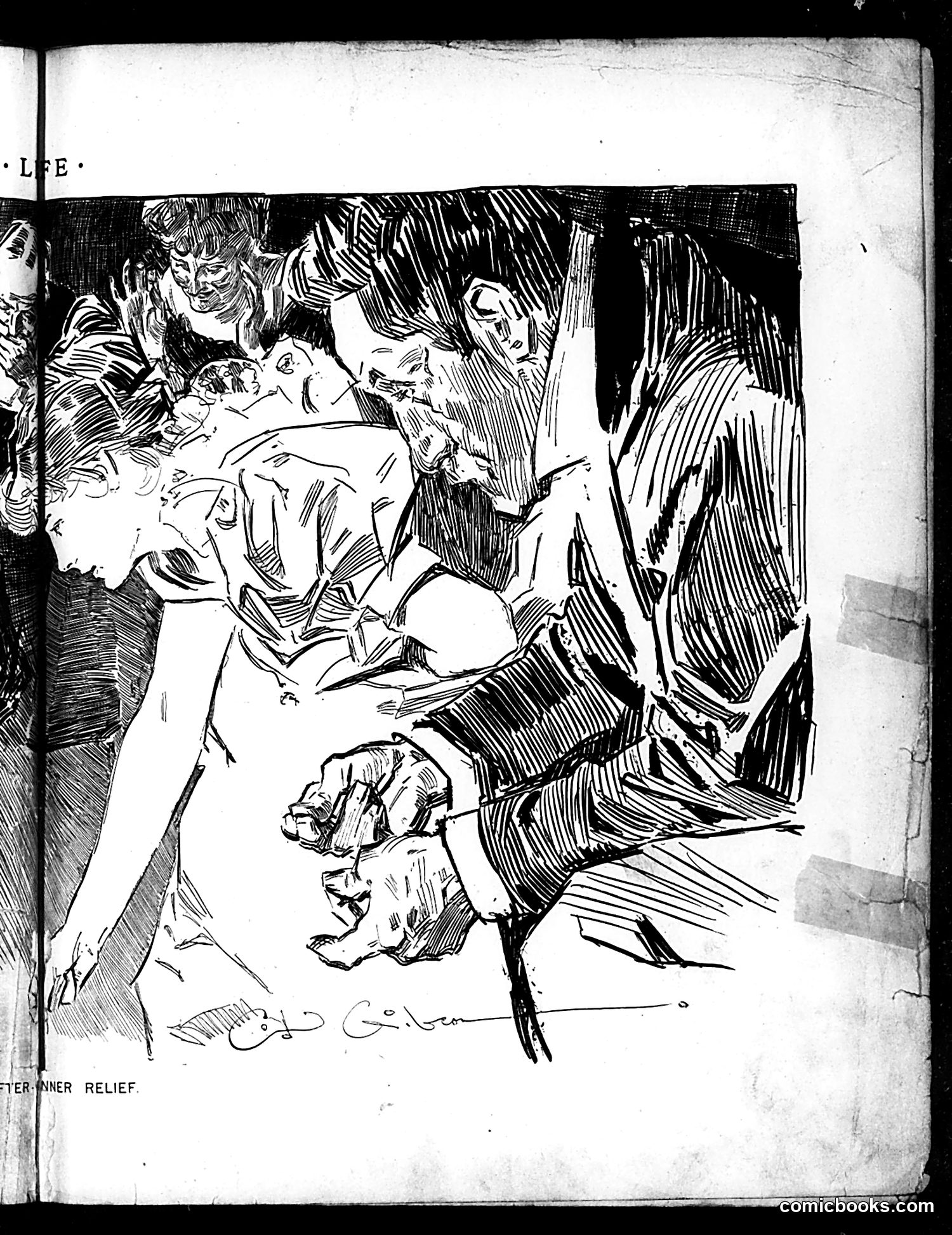
This page from *Life* magazine shows a sketch labeled "PETER INNER RELIEF" (text partially visible at bottom). The illustration depicts what appears to be a chaotic domestic or indoor scene with multiple figures in expressive poses, rendered in bold ink lines characteristic of early 20th-century satirical cartooning. The exact subject and satire are unclear from the visible information. The title "Peter Inner Relief" suggests wordplay—possibly referencing Peter Stuyvesant or another historical Peter, with "inner relief" implying ironic commentary on a situation. However, without additional context or clearer OCR of surrounding text, the specific political or social target of this satire cannot be determined with certainty. The energetic drawing style indicates humor or criticism was intended.
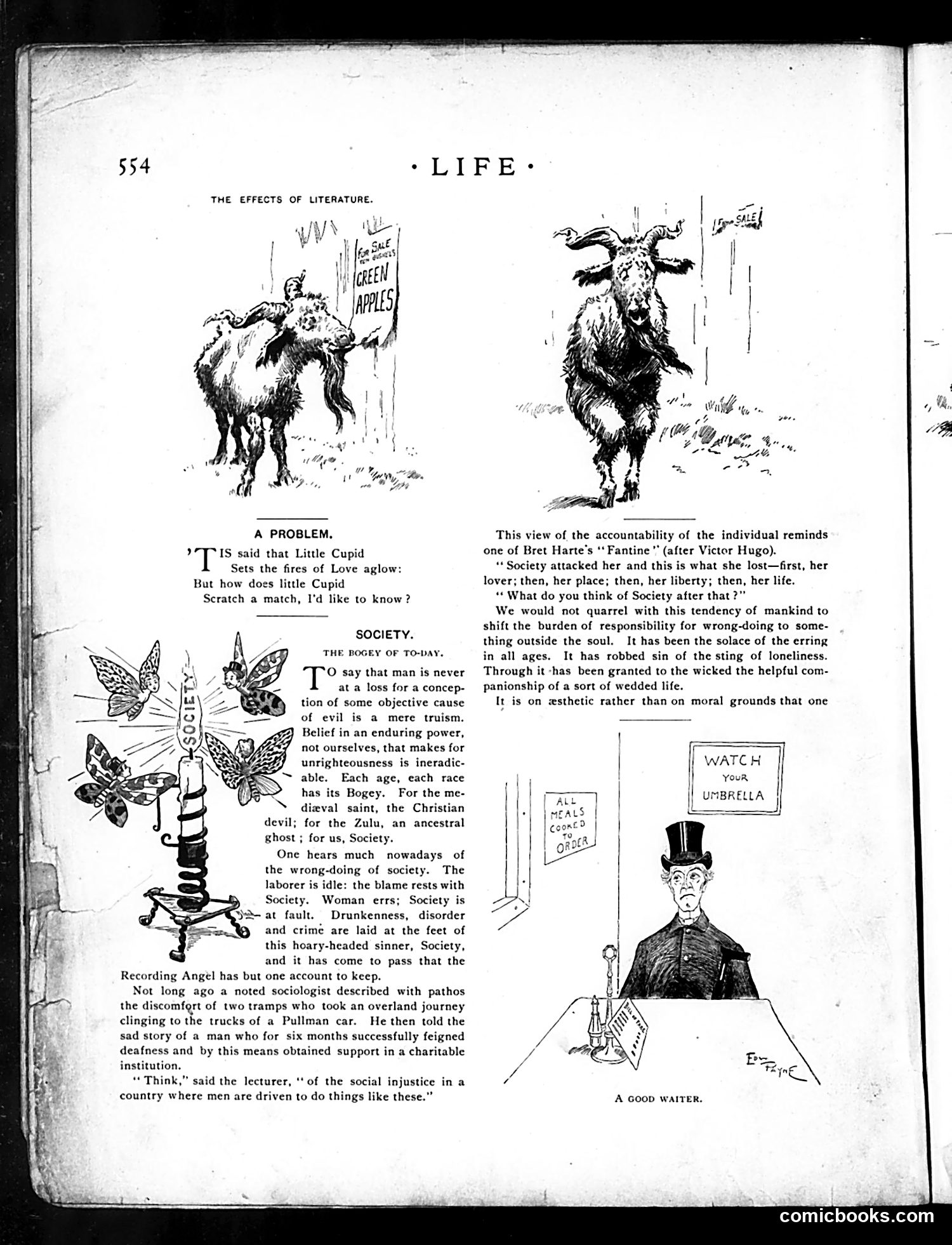
This page satirizes contemporary social criticism and blame-shifting. The top cartoons show goats—representing society's scapegoats—literally labeled with society's problems ("Green Apples"). The main text, titled "Society: The Bogey of To-Day," argues that modern critics wrongly blame "Society" as an impersonal force for society's ills (poverty, drunkenness, crime), rather than holding individuals accountable. The author suggests this deflects responsibility onto an abstract concept. The bottom illustration, "A Good Waiter," depicts a waiter carefully watching his umbrella—a visual pun suggesting people obsess over trivial matters while ignoring larger issues. The satire critiques the era's tendency to blame societal structures rather than personal moral responsibility for social problems.
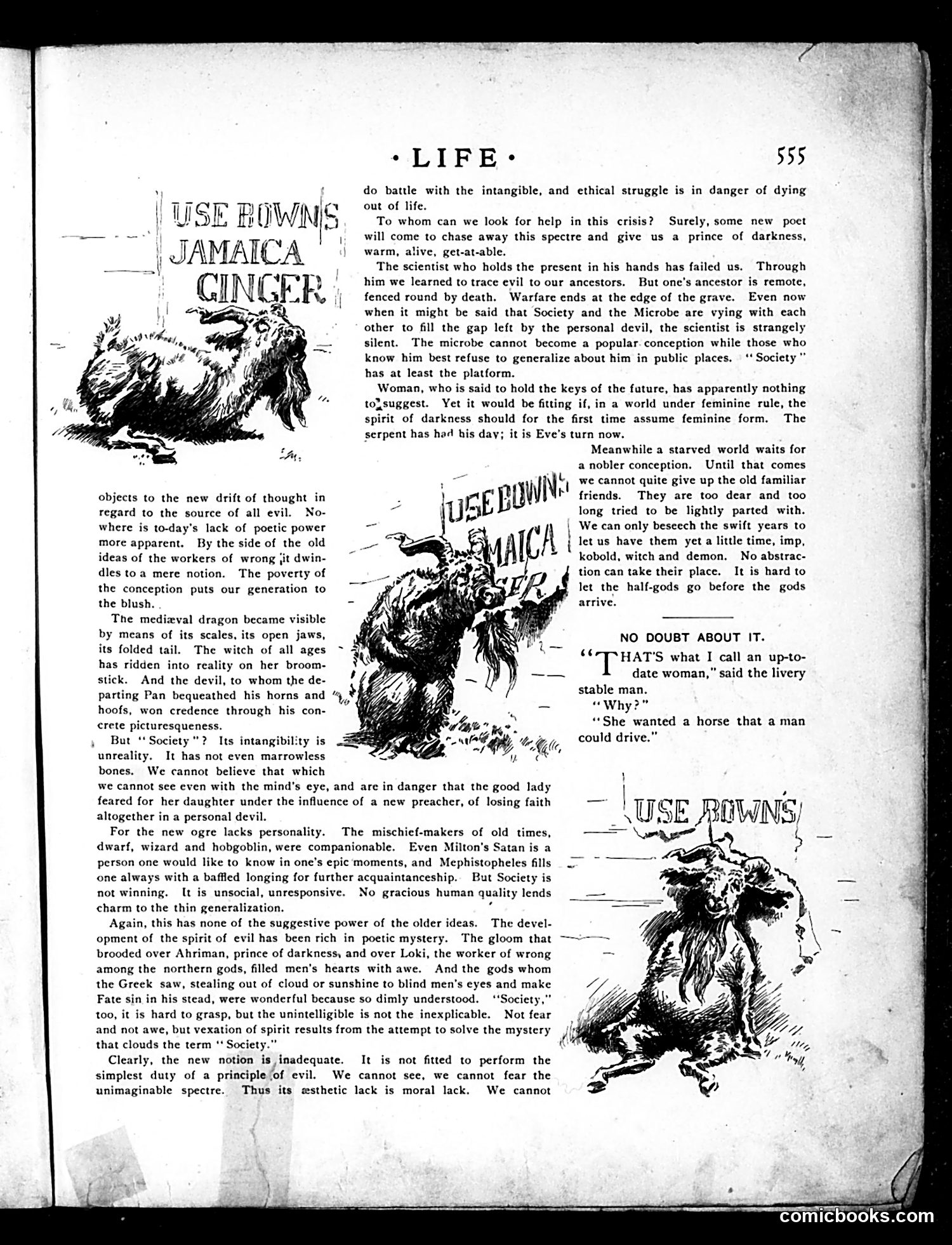
This page contains three "Use Brown's Jamaica Ginger" advertisements featuring grotesque illustrations of creatures or demons. The advertisements appear to be satirical rather than sincere product promotions—a common Life magazine strategy. The main article discusses "Society" as an abstract concept of evil, contrasting modern scientific explanations for wrongdoing with older supernatural frameworks (dragons, witches, devils). The writer argues that blaming abstract "Society" for moral problems lacks the visceral power of traditional evil imagery and is therefore morally weak. The ginger ads likely mock both patent medicine culture and the tendency to attribute social ills to unnamed forces. The ugly creatures humorously embody the kind of tangible evil the article argues we've lost by dismissing "Society" as our new scapegoat.
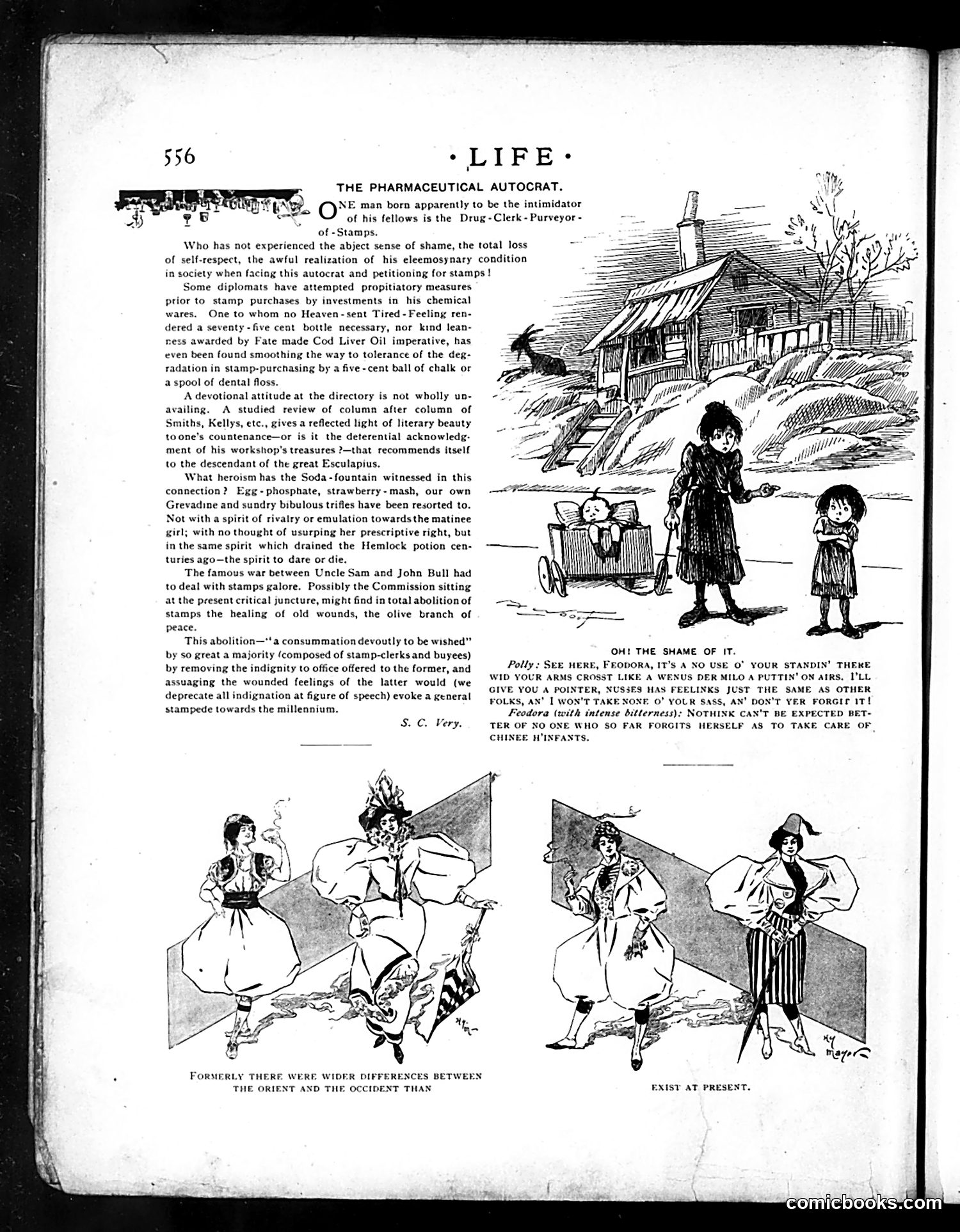
This page satirizes the humiliating social dynamics of purchasing postage stamps from pharmacy clerks in the late 19th/early 20th century. The main article mocks how customers must defer to these "stamp-purveyors," who wielded petty authority over ordinary people needing stamps. The piece ironically describes customers' desperate attempts to appease these clerks through small purchases of patent medicines or dental supplies. The dialogue cartoon below satirizes class pretension. A working-class nurse (likely Irish, indicated by dialect) rebukes a snobby woman named Feodora for condescension. The nurse asserts that caring for Chinese infants doesn't diminish her dignity—she has feelings equal to anyone else's. The bottom cartoons contrast past Eastern/Western differences with present similarities, suggesting modernization has equalized global cultures. The satire targets both petty bureaucratic power and class-based social snobbery.
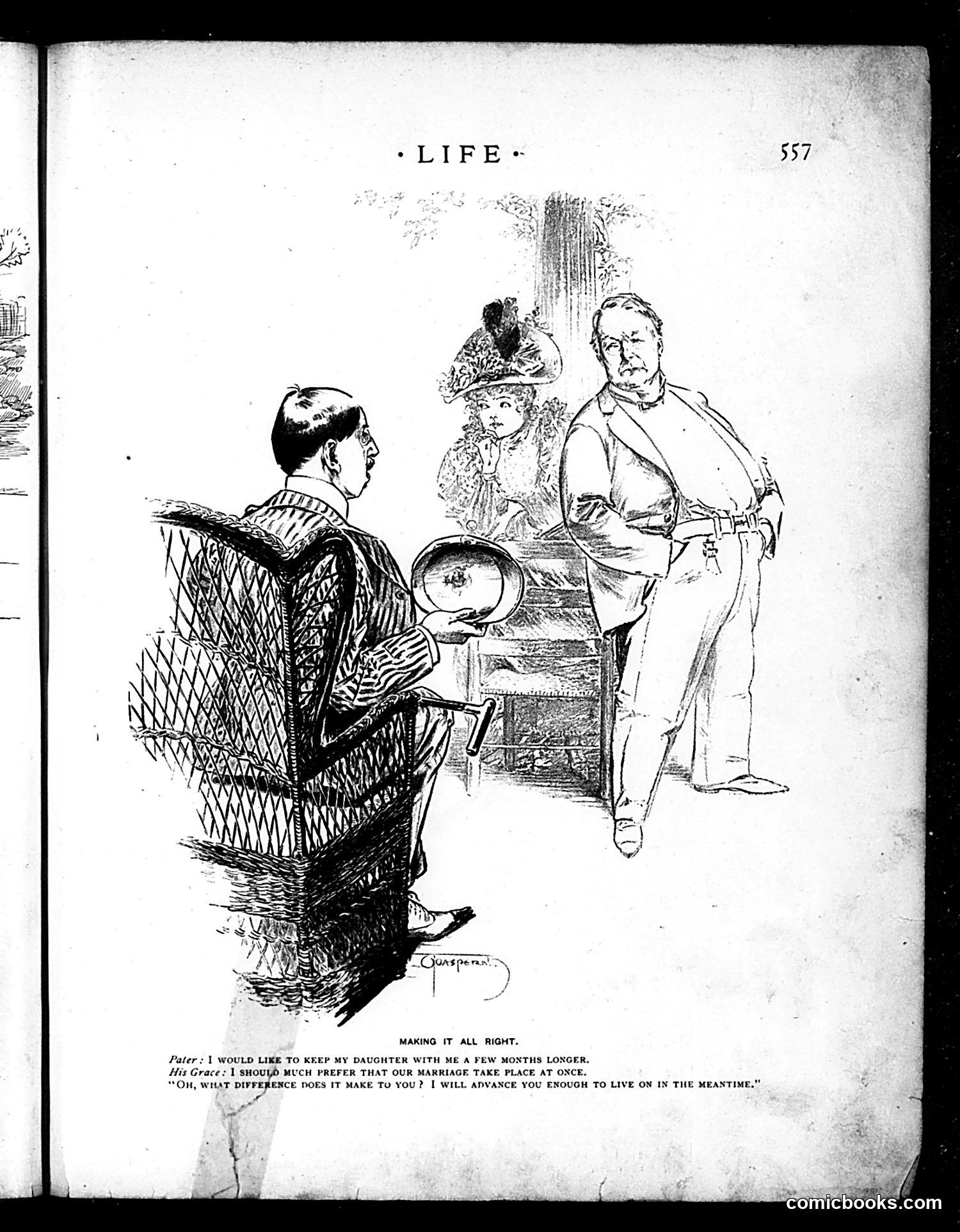
This satirical cartoon depicts a financial negotiation over marriage. A father ("Pater") seeks to delay his daughter's wedding, while an aristocrat ("His Grace," identifiable by formal dress) pressures for immediate marriage. The punchline reveals the true transaction: the aristocrat offers money to the father as compensation for the delay, effectively purchasing the right to marry the daughter. The satire targets aristocratic marriage practices of the era, where wealthy titled men would marry for financial gain, and fathers would essentially sell daughters to solve economic problems. The cartoon mocks both the venality of the aristocracy and the commodification of women in marriage, presenting the negotiation with bitter irony—the aristocrat's "generosity" actually exposes the mercenary nature of the entire arrangement.
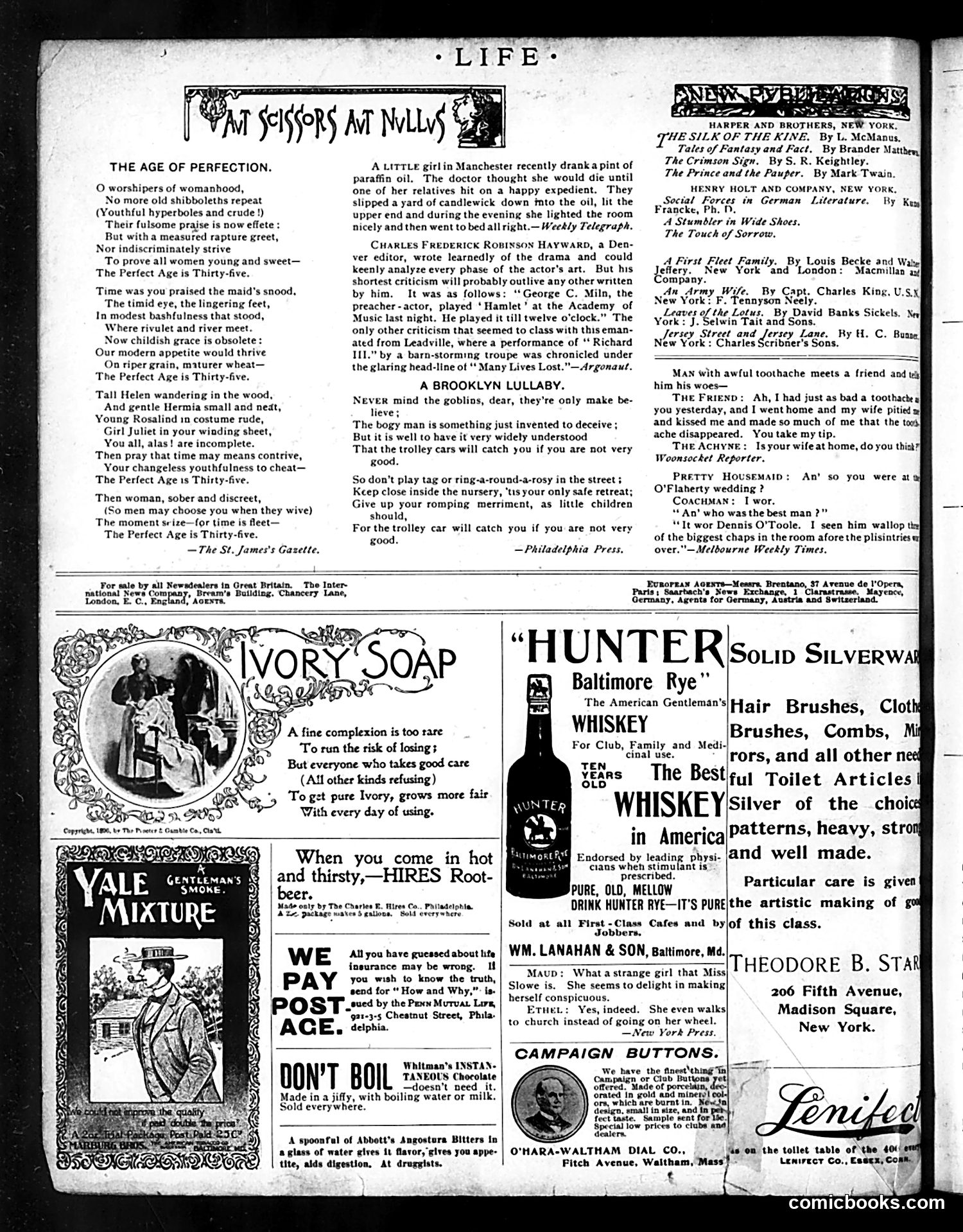
This page contains **poetry and humor columns** rather than political cartoons. The main satirical content includes: **"The Age of Perfection"** — A poem mockingly celebrating women at thirty-five as the "perfect age," inverting Victorian ideals that prized youth and innocence. It sarcastically suggests men should deliberately age women out of their "youthful hyperboles" into mature "ripeness." **"A Brooklyn Lullaby"** — Dark humor warning children that trolley cars (then-modern public transit) will catch them if they misbehave—replacing traditional bogeymen with contemporary urban dangers. This reflects anxiety about new transportation technology and urban life hazards. **Miscellaneous anecdotes** mock professional incompetence: a film critic's one-sentence review dismissing Hamlet, and a theater critic's headline "Many Lives Lost" about a bad production. The page is primarily **satirical social commentary** on changing gender expectations, modern urban dangers, and professional absurdity—typical of Life magazine's early editorial voice.
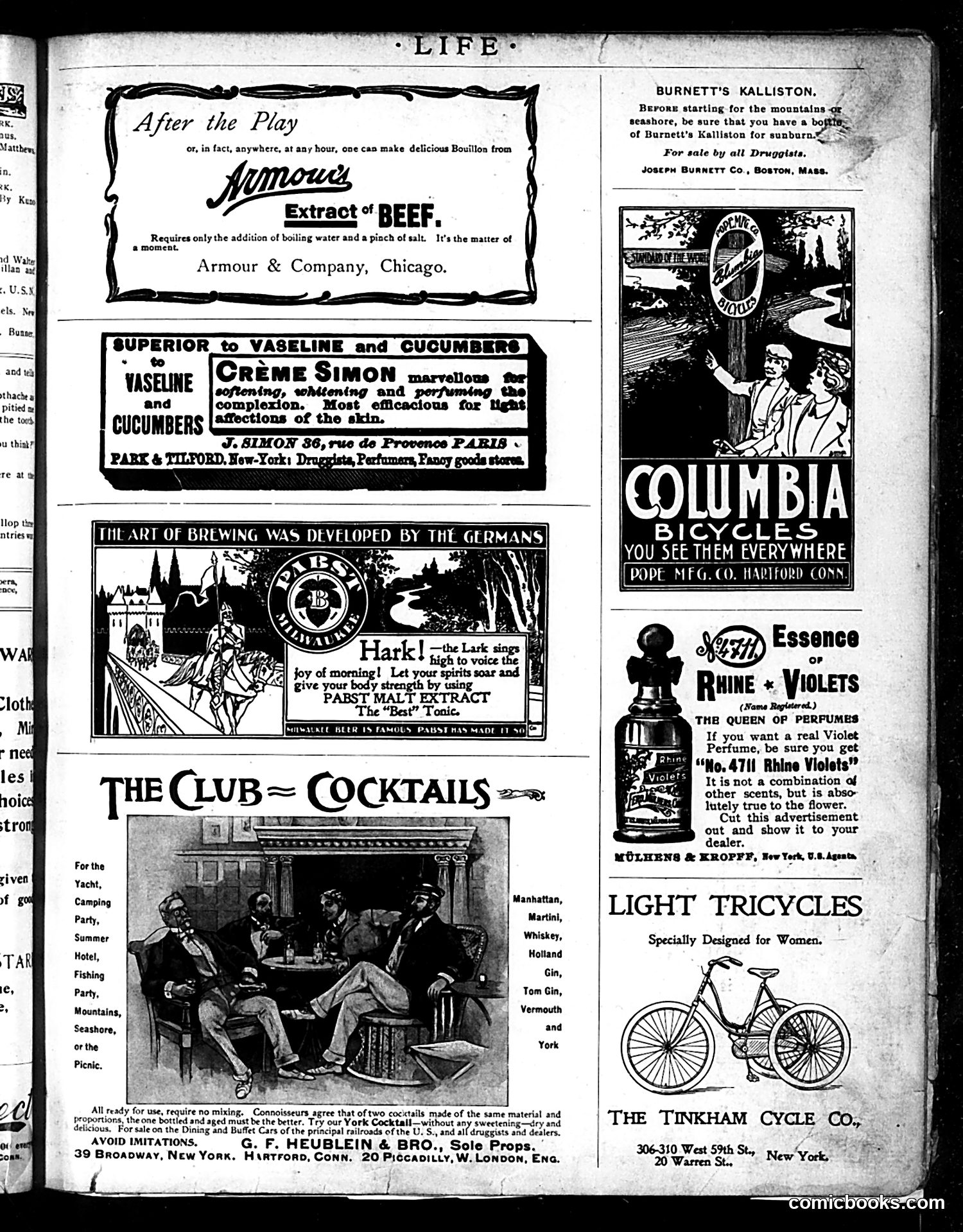
This is primarily a **product advertisements page** from an early 20th-century American magazine, containing no political cartoons or satire requiring historical context. The page features typical period advertisements for: - **Food/beverage products**: Armour's beef extract, Heublein cocktails (pre-mixed drinks), and Crème Simon beauty cream - **Consumer goods**: Columbia bicycles, Rhine Violets perfume, light tricycles for women, and Burnett's Kalliston sunburn remedy - **One illustrated ad** shows men enjoying cocktails in a club setting, emphasizing the convenience of pre-bottled, ready-to-use drinks The ads reflect early 1900s consumer culture—convenience foods, leisure activities (cycling was trendy for women), and emerging brand marketing. The "Club Cocktails" illustration is purely commercial, depicting gentlemen relaxing rather than making any satirical point. This is a straightforward advertising section with no political commentary or hidden meanings to decode.
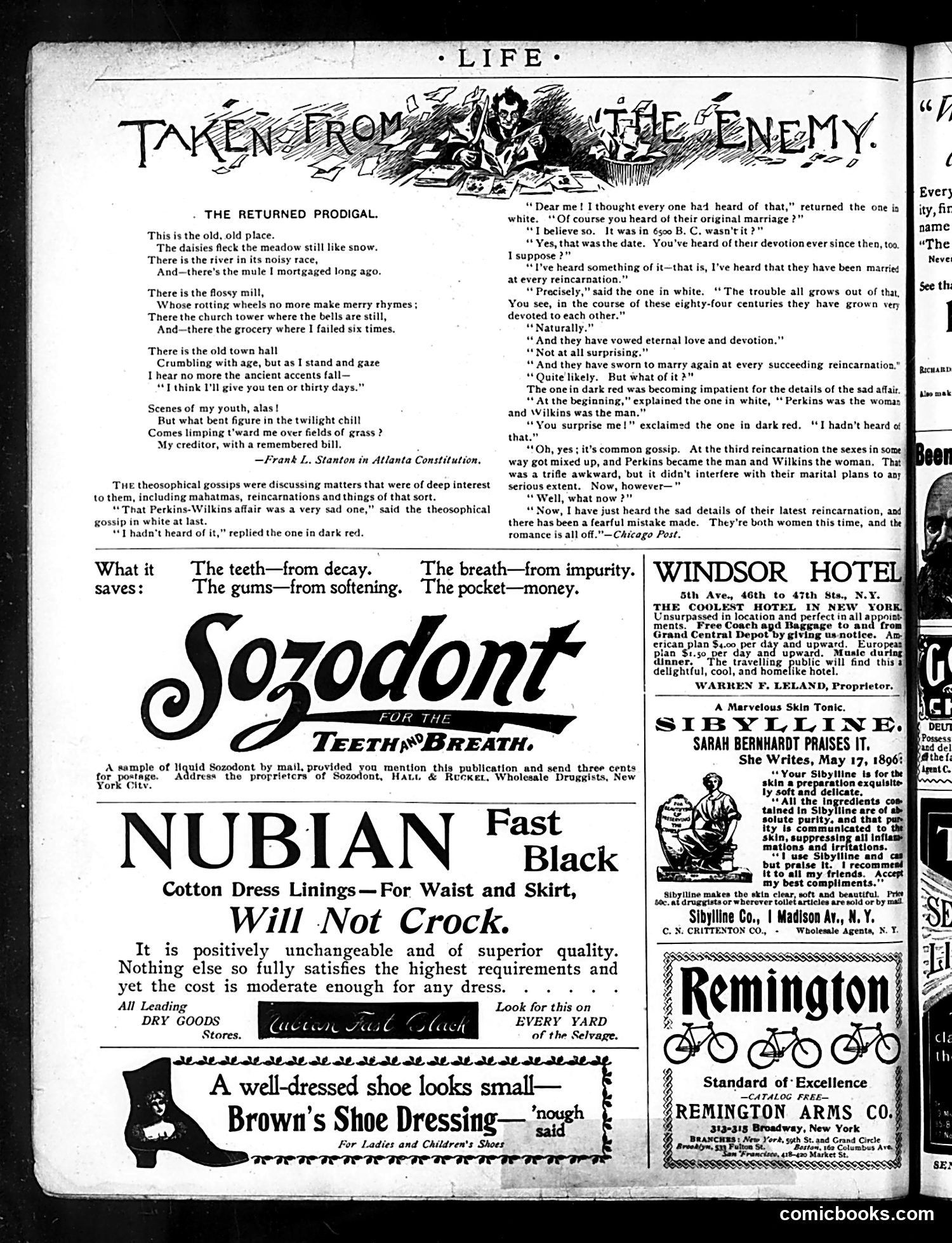
This page satirizes theosophical beliefs in reincarnation popular in early 1900s intellectual circles. Two gossiping theosophists discuss the troubled romance of "Perkins" and "Wilkins," a couple who've supposedly reincarnated together for 84 centuries since 6500 B.C., remaining devoted through multiple lifetimes. The joke culminates when the storyteller reveals their latest reincarnation problem: both are now women, making their romantic relationship impossible—"the romance is all off." The satire mocks theosophists' earnest belief in reincarnation and the absurd complications such a doctrine creates. The accompanying poem about returning to one's hometown adds nostalgic melancholy. The page is primarily this satirical story with period advertisements (Sozodont toothpaste, Nubian dress linings, Brown's Shoe Dressing) below.
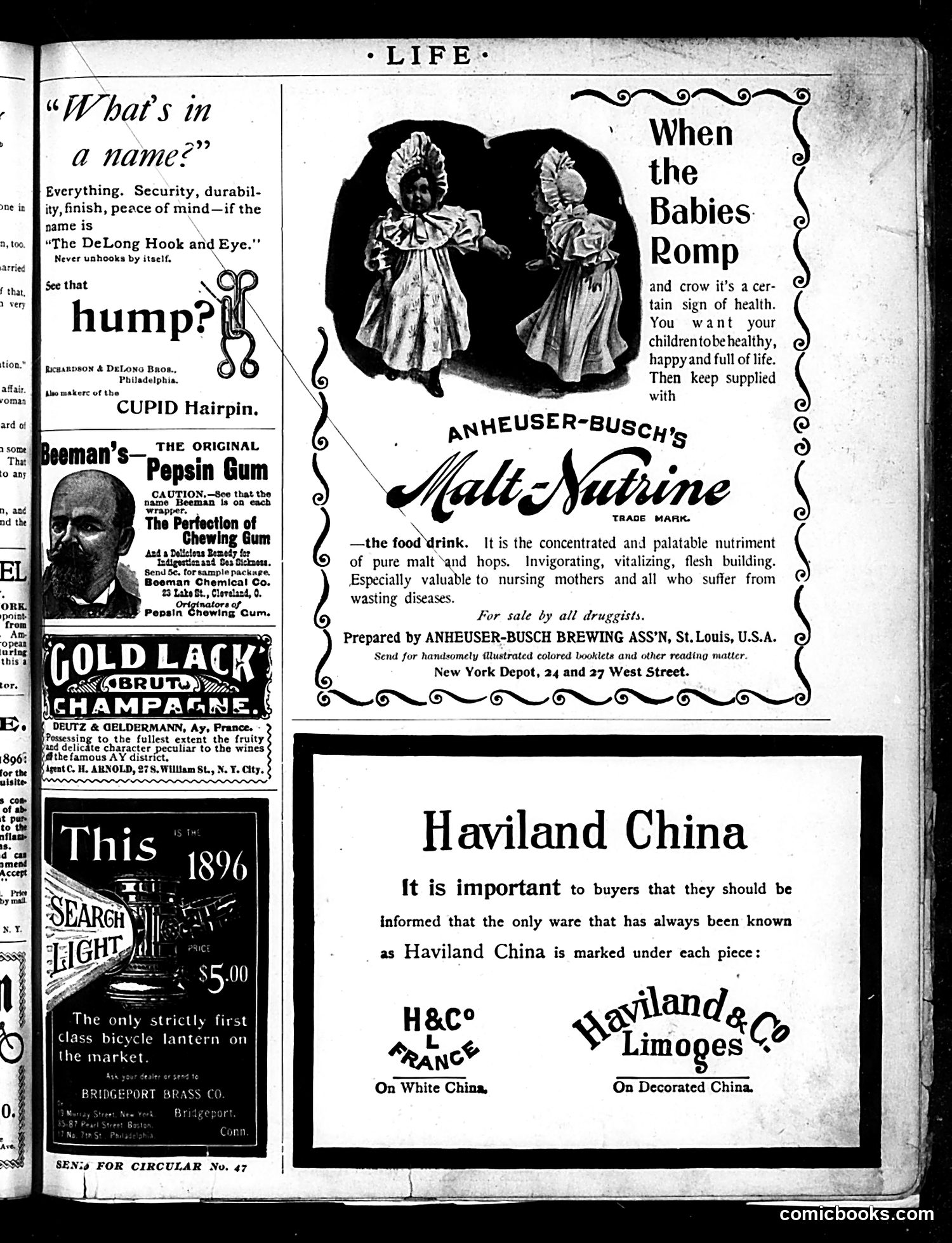
This is primarily an **advertising page** rather than political satire. The content consists of five product advertisements: 1. **DeLong Hook and Eye** — a fastener claiming reliability ("Never unhooks by itself") 2. **Beeman's Pepsin Gum** — chewing gum marketed as a digestive aid 3. **Gold Lack Champagne** — French wine advertisement 4. **Anheuser-Busch Malt-Nutrine** — a malt beverage marketed as nutritious "food drink," notably promoted for nursing mothers and those with "wasting diseases." The illustration shows healthy babies, implying the product supports child health 5. **Haviland China** — porcelain dinnerware, warning buyers to verify authentic marks (H&Co France vs. Haviland & Co Limoges) to avoid counterfeits The page reflects late-19th-century advertising practices: products marketed with health/medical claims now considered dubious, ornate design, and emphasis on brand names as guarantees of quality.
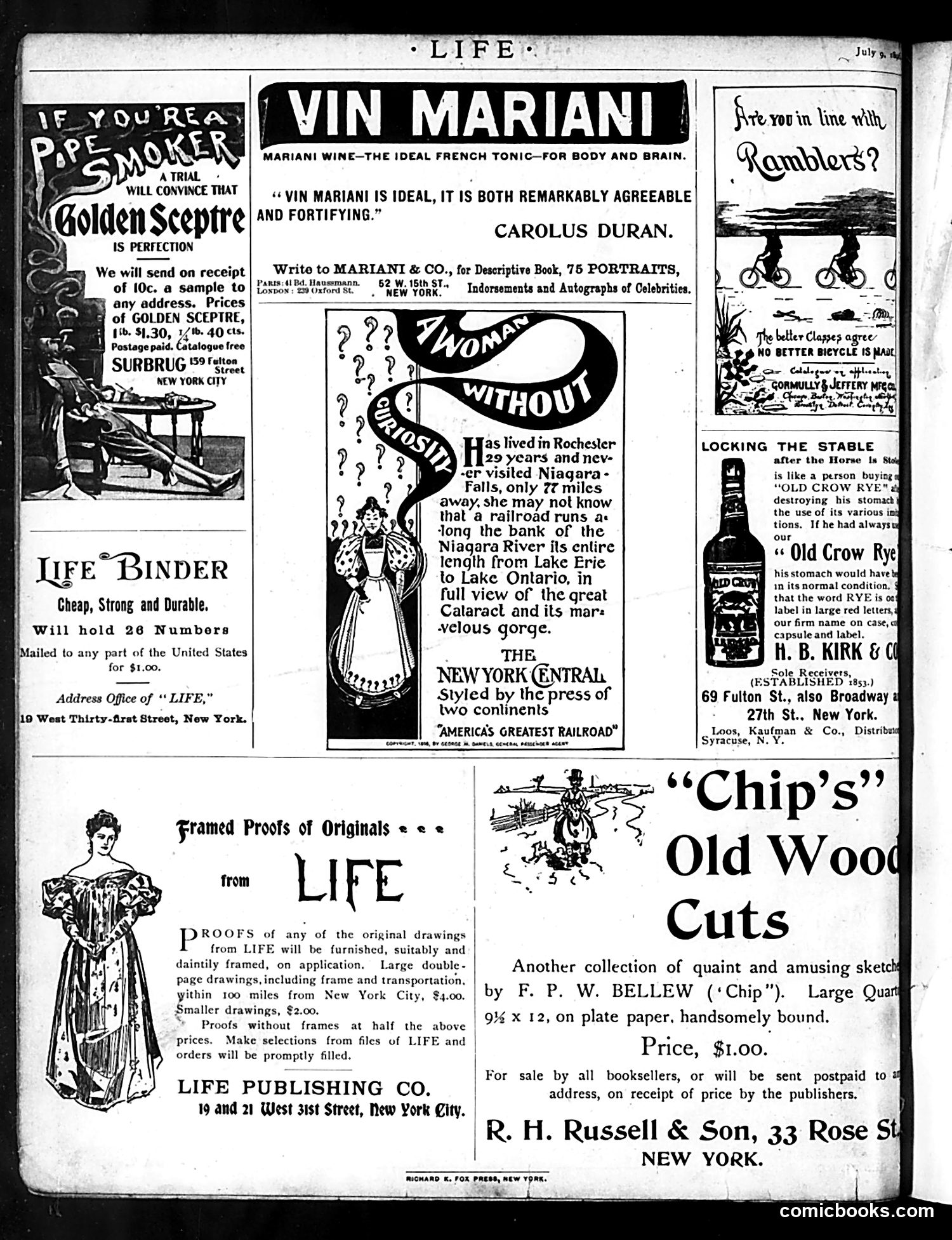
This page is primarily **advertisements** interspersed with one central cartoon. The main cartoon depicts a woman's silhouette filled with question marks, illustrating the concept of someone lacking curiosity. The accompanying text describes a woman from Rochester who has lived 29 years near Niagara Falls—only 77 miles away—yet has never visited it. The New York Central Railroad uses this as a hook to promote rail travel along the Niagara gorge. **The satire's point**: The cartoon mocks human indifference and lack of initiative. A woman living so close to one of America's great natural wonders yet never bothering to see it exemplifies missed opportunity and apathy. The railroad advertisement frames this as a gentle prod to readers: don't be equally incurious—use our trains to explore America's attractions. The surrounding ads (Golden Sceptre cigars, Vin Mariani wine, Old Crow Rye whiskey, bicycles) suggest Life's 1890s-era audience of urban, leisure-class consumers.