
Life, 1896-07-09 · page 10 of 18
Life — July 9, 1896 — page 10: what you’re looking at
What you’re looking at
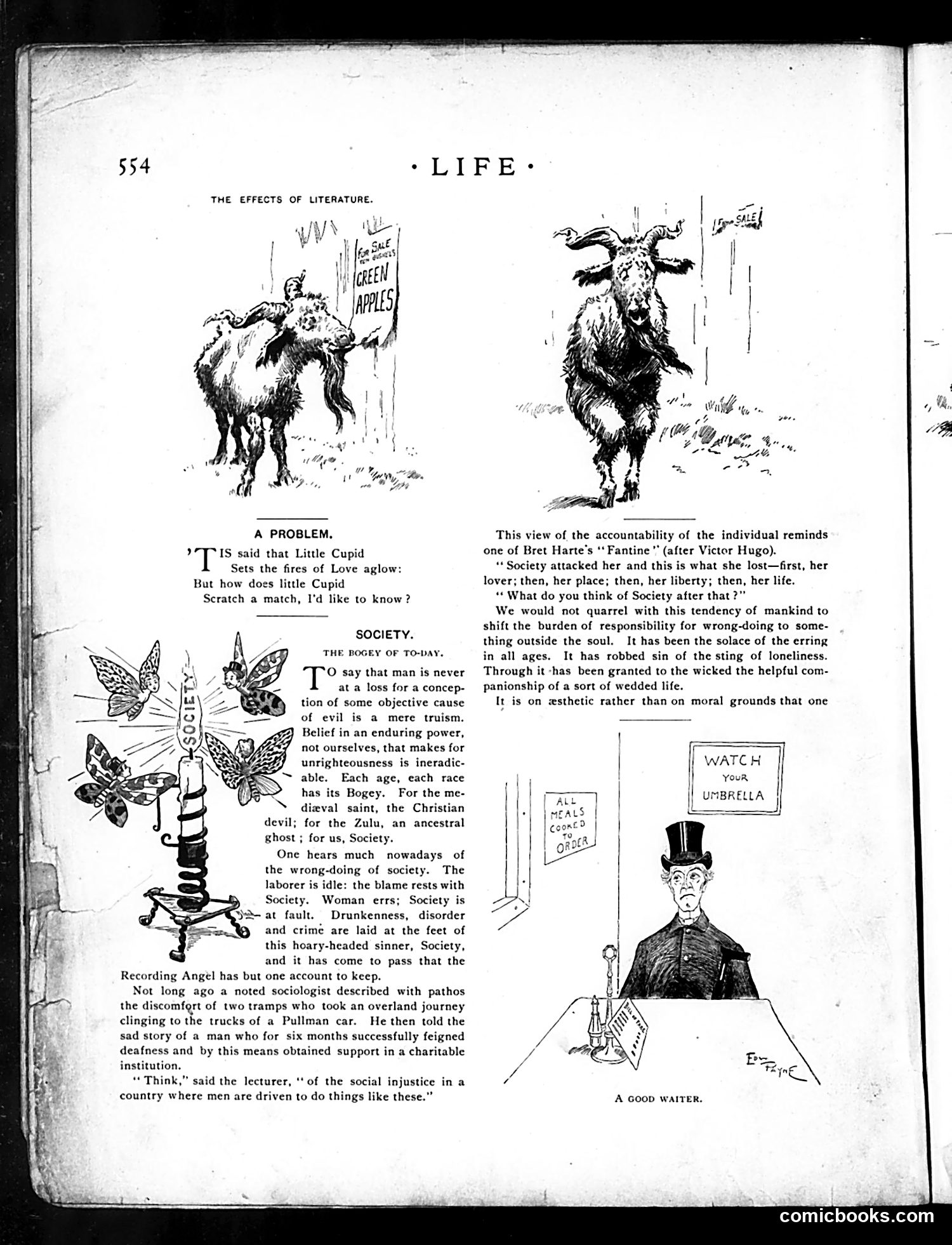
This page satirizes contemporary social criticism and blame-shifting. The top cartoons show goats—representing society's scapegoats—literally labeled with society's problems ("Green Apples"). The main text, titled "Society: The Bogey of To-Day," argues that modern critics wrongly blame "Society" as an impersonal force for society's ills (poverty, drunkenness, crime), rather than holding individuals accountable. The author suggests this deflects responsibility onto an abstract concept. The bottom illustration, "A Good Waiter," depicts a waiter carefully watching his umbrella—a visual pun suggesting people obsess over trivial matters while ignoring larger issues. The satire critiques the era's tendency to blame societal structures rather than personal moral responsibility for social problems.
📄 Transcribed text from this page (OCR, searchable)
Machine-transcribed from the original scan — historical spelling and the odd misread are preserved.
A PROBLEM. ’ IS said that Little Cupid Sets the fires of Love aglow: But how does little Cupid Scratch a match, I'd like to know? SOCIETY. THE BOGEY OF TO-DAY. O say that man is never ata loss for a concep- tion of some objective cause of evil is a mere truism. Belief in an enduring power, not ourselves, that makes for unrighteousness is ineradic- able. Each age, each race has its Bogey. For the me- diwval saint, the Christian devil; for the Zulu, an ancestral ghost ; for us, Society. One hears much nowadays of the wrong-doing of society. The laborer is idle: the blame rests with Society. Woman errs; Society is Drunkenness, disorder and crime are laid at the feet of this hoary-headed sinner, Society, and it has come to pass that the Recording Angel has but one account to keep. Not long ago a noted sociologist described with pathos the discomfgrt of two tramps who took an overland journey clinging to the trucks of a Pullman car. He then told the sad story of a man who for six months successfully feigned deafness and by this means obtained support in a charitable institution, “Think,” said the lecturer, ‘of the social injustice in a country where men are driven to do things like these. This view of the accountability of the individual reminds one of Bret Harte’s *‘ Fantine " (after Victor Hugo). “* Society attacked her and this is what she lost—first, her lover; then, her place; then, her liberty; then, her life. ** What do you think of Society after that?” We would not quarrel with this tendency of mankind to shift the burden of responsibility for wrong-doing to some- thing outside the soul. It has been the solace of the erring in all ages. It has robbed sin of the sting of loneliness. Through it -has been granted to the wicked the helpful com- panionship of a sort of wedded life. It is on westhetic rather than on moral grounds that one A GOOD WAITER. comicbooks.com