
A complete issue · 16 pages · 1895
Life — September 26, 1895
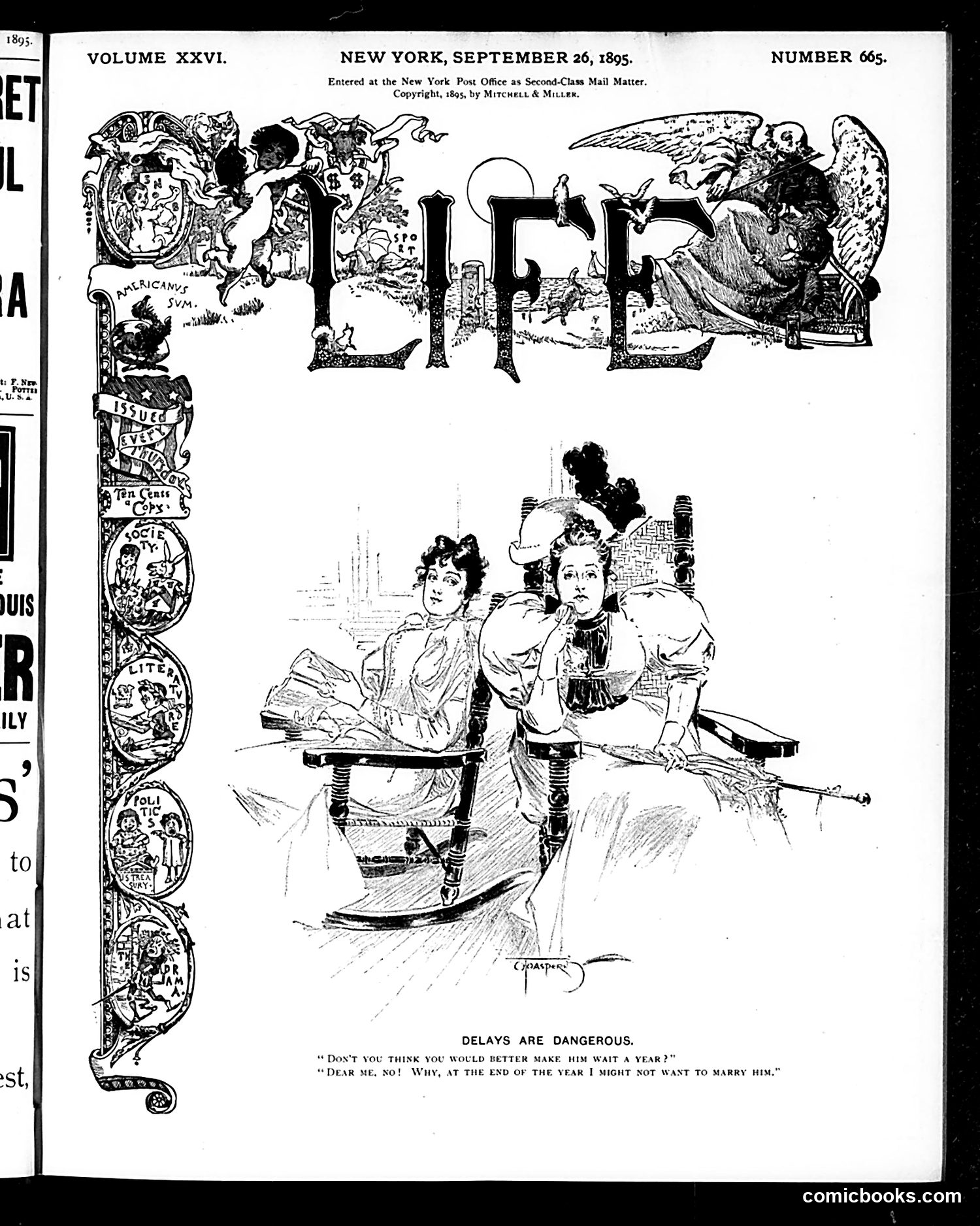
This page features a satirical cartoon about courtship delays. The illustration shows three women on a toboggan or sleigh, with the caption: "Don't you think you would better make him wait a year?" / "Dear me, no! Why, at the end of the year I might not want to marry him." The joke targets Victorian-era dating customs, specifically the social expectation that women should make suitors wait extended periods before accepting proposals. The cartoon satirizes this convention by suggesting such delays are counterproductive—a woman might reconsider her feelings if forced to wait too long. The ornate left border and decorative header with "LIFE" are typical of the magazine's art nouveau design aesthetic from the 1890s.
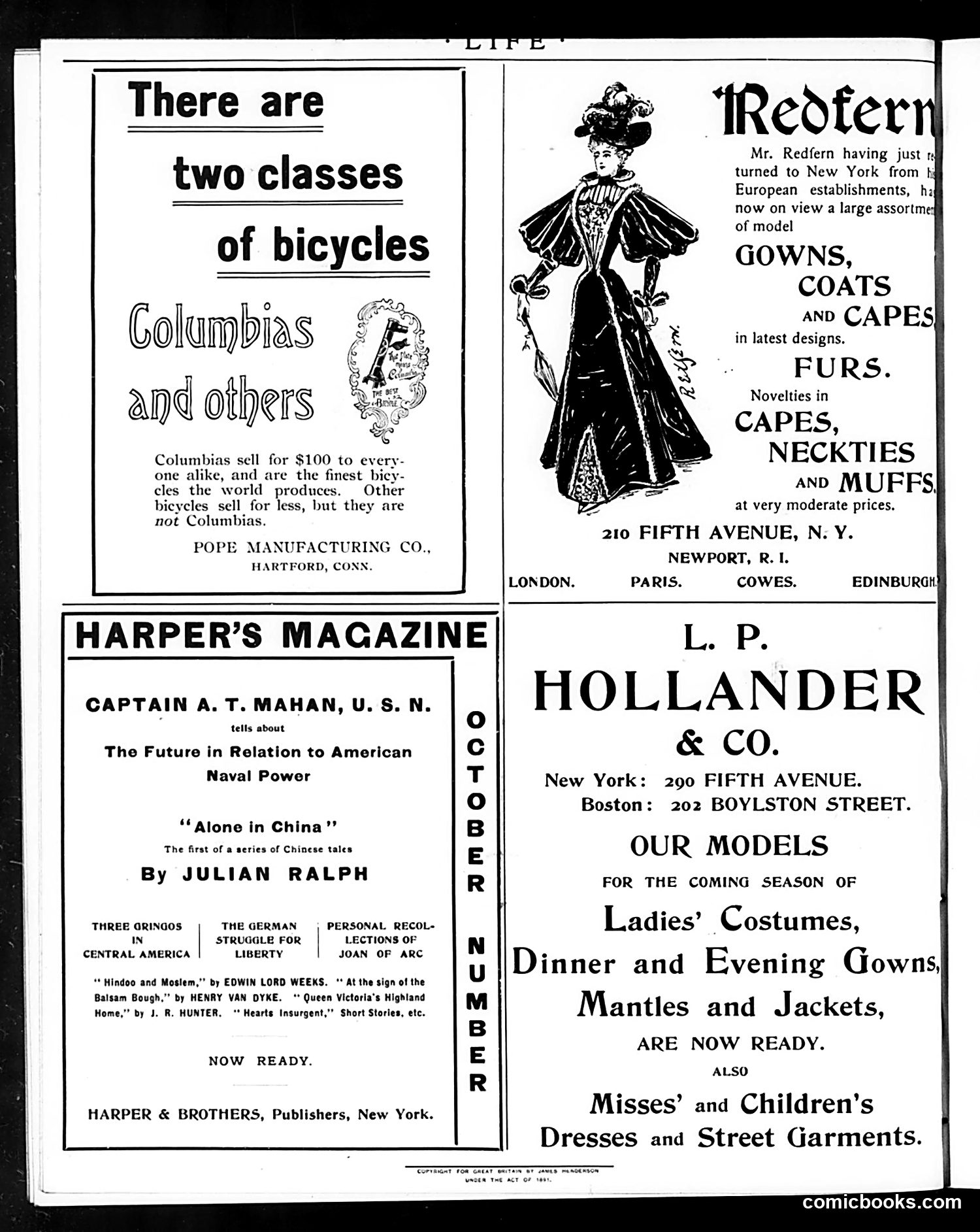
This page is primarily **advertising**, not political satire or cartoons. The advertisements include: - **Pope Manufacturing Co.** (bicycles) promoting Columbias as premium bicycles at $100, contrasting them with cheaper alternatives - **Redfern** (women's fashion) advertising gowns, coats, capes, and furs from their New York and international locations - **Harper's Magazine** promoting upcoming content including a naval strategy article by Captain Mahan and a Chinese fiction series - **L.P. Hollander & Co.** showcasing ladies' fashion for the coming season The only illustration is a fashion sketch of an elegantly dressed woman in period attire (elaborate hat, cape-like garment), typical of early 1900s women's magazine advertising. There is no evident political commentary or satirical content on this page.
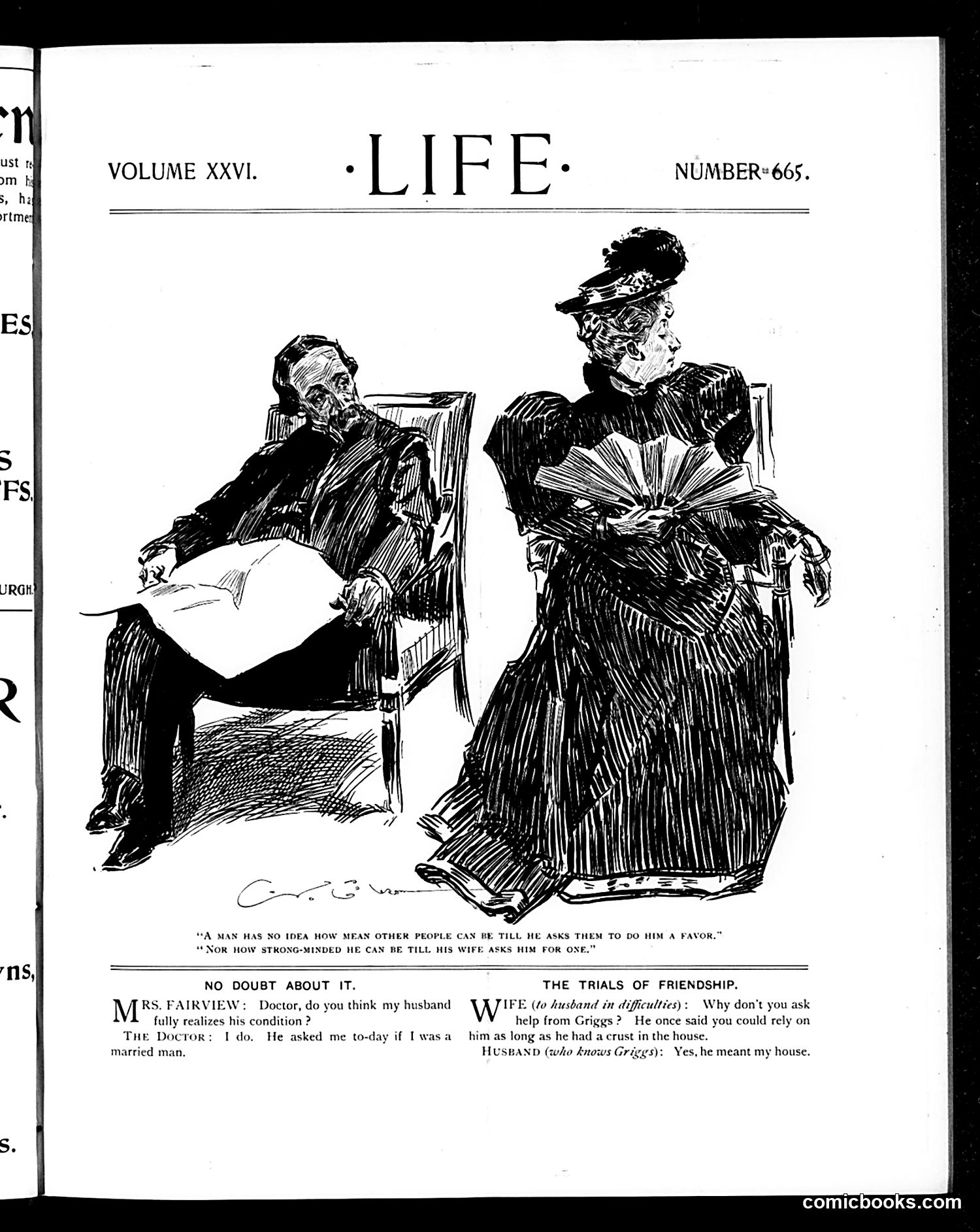
This page contains two separate satirical pieces about marriage and gender relations in the early 20th century. **Top illustration** shows a man and woman in conversation. The caption criticizes male obliviousness: men don't realize how much others depend on them, yet remain unaware of their own importance to their wives. **Bottom section** presents two humorous domestic scenarios: 1. "No Doubt About It" mocks a husband's denial—a doctor confirms he asked if the patient was married, implying marriage causes the man's condition. 2. "The Trials of Friendship" depicts marital conflict: a wife suggests consulting friend Griggs for advice; the husband resists, having already relied on Griggs during his crush on another woman. Both pieces satirize typical early-1900s marriage dynamics, male pride, and female pragmatism in relationships.
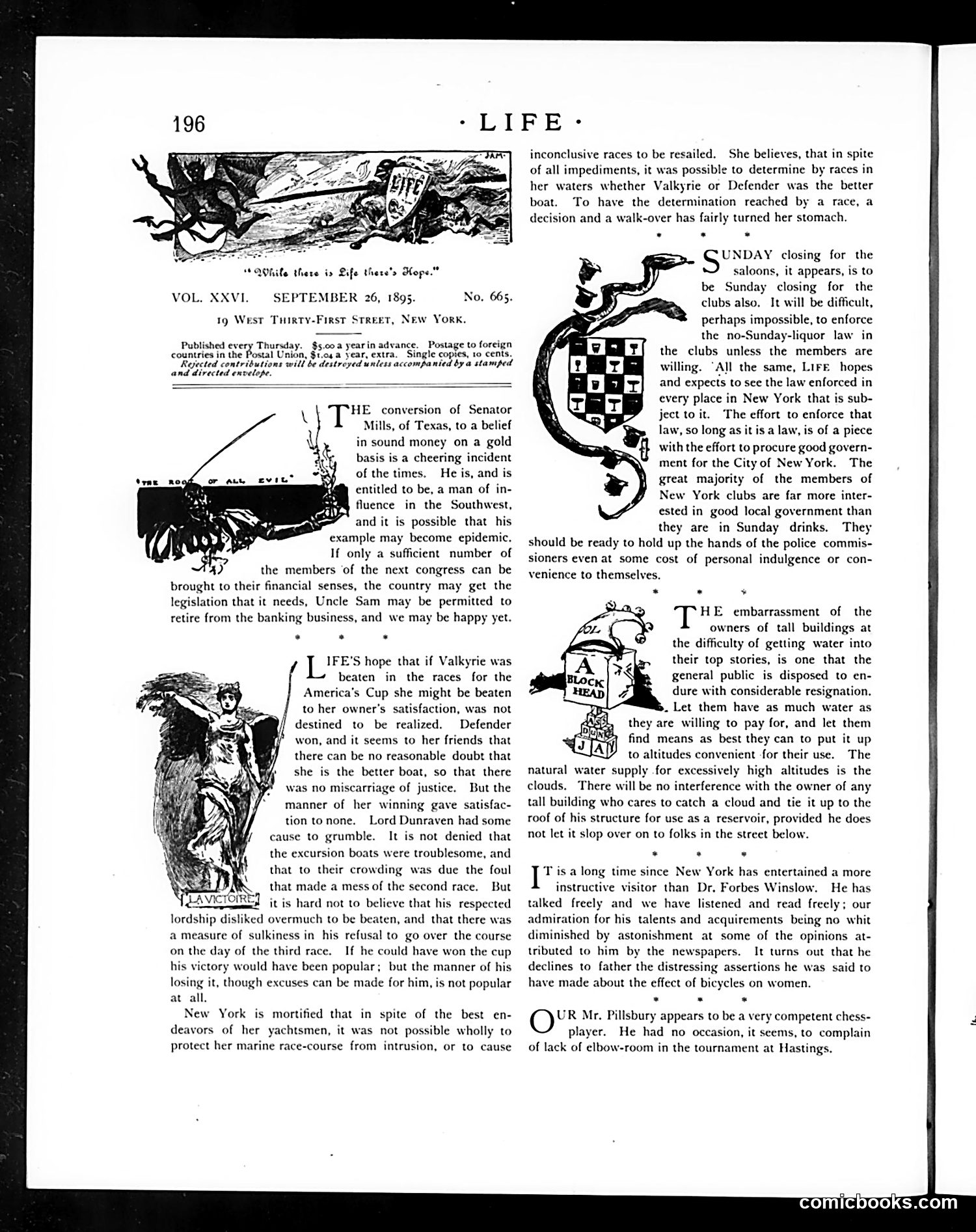
This page contains several satirical pieces on contemporary issues: **Senator Mills cartoon**: The Texas senator's conversion to sound-money principles (supporting the gold standard) is celebrated as potentially influential in Congress, where financial reform is urgently needed. **Valkyrie yacht race commentary**: Mocking a boat-race dispute where owner Lord Dunraven claimed unfair treatment. The text suggests his refusal to complete races and complaints lack credibility, implying aristocratic poor sportsmanship. **Sunday closing laws**: LIFE advocates enforcing no-liquor-on-Sunday laws citywide, though acknowledging difficulty without public cooperation. **Water-supply editorial**: Supporting tall-building owners' right to collect rainwater, opposing municipal interference with private rooftop reservoirs. The cartoons use anthropomorphized figures and visual metaphors typical of 1890s satirical journalism to mock political hypocrisy and social controversy.
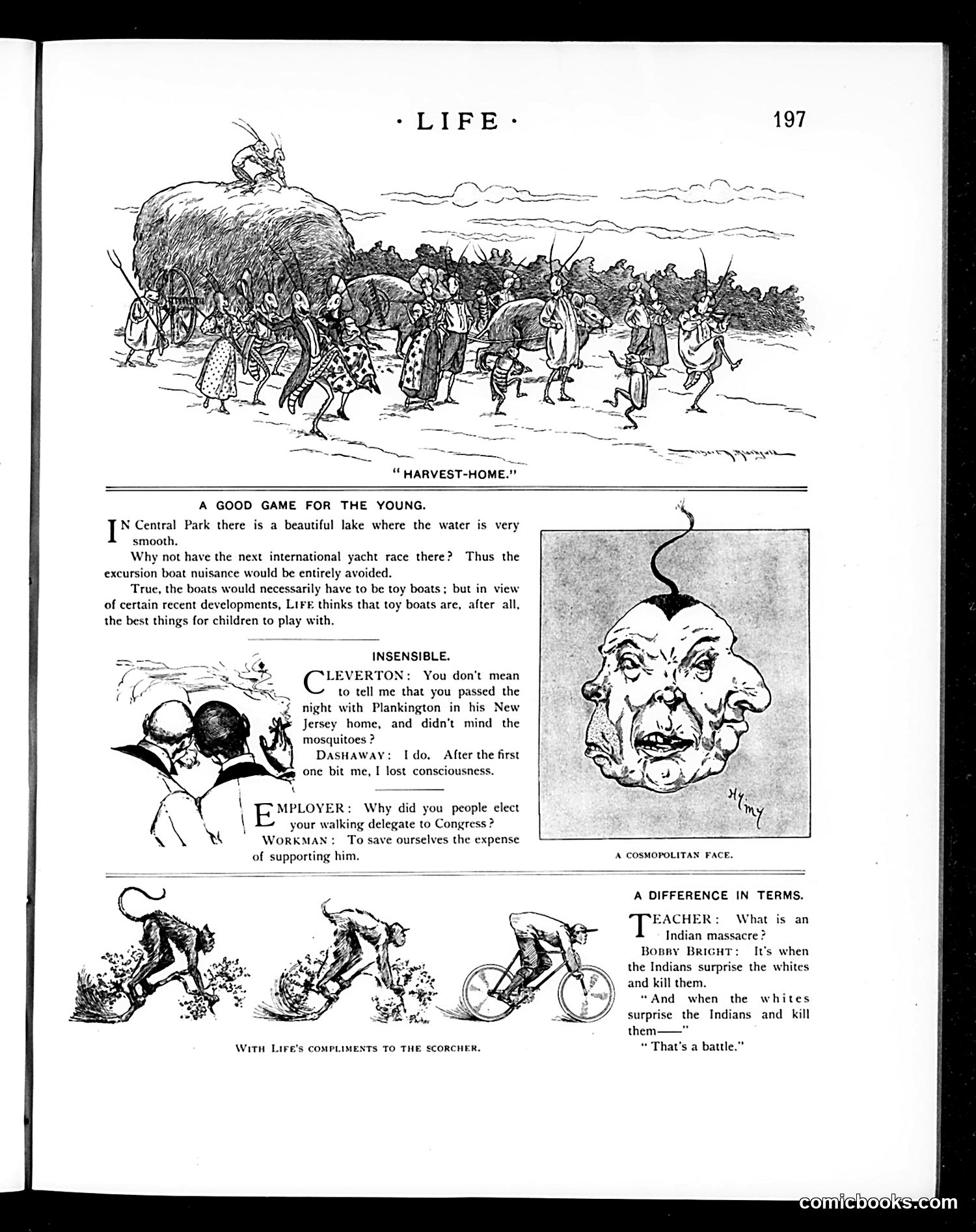
This page contains several unrelated jokes and cartoons typical of Life's satirical format: **"Harvest-Home"**: A sketch depicting a harvest scene with commentary on toy boats in Central Park—likely advocating for children's recreational opportunities. **"Insensible"**: A dialogue joke mocking someone's insensitivity after passing a night near mosquitoes in New Jersey, suggesting the region's poor conditions. **"Employer/Workman"**: A brief exchange satirizing political expense—a walking delegate elected to Congress supposedly to save costs, implying corruption or absurd bureaucratic logic. **"A Cosmopolitan Face"**: A grotesque caricature with minimal context provided. **"A Difference in Terms"**: A joke contrasting how teacher and student define "Indian massacre" versus "battle"—satirizing perspective and terminology regarding Native American conflicts. The humor is period-typical: light social commentary and wordplay rather than sustained political argument.
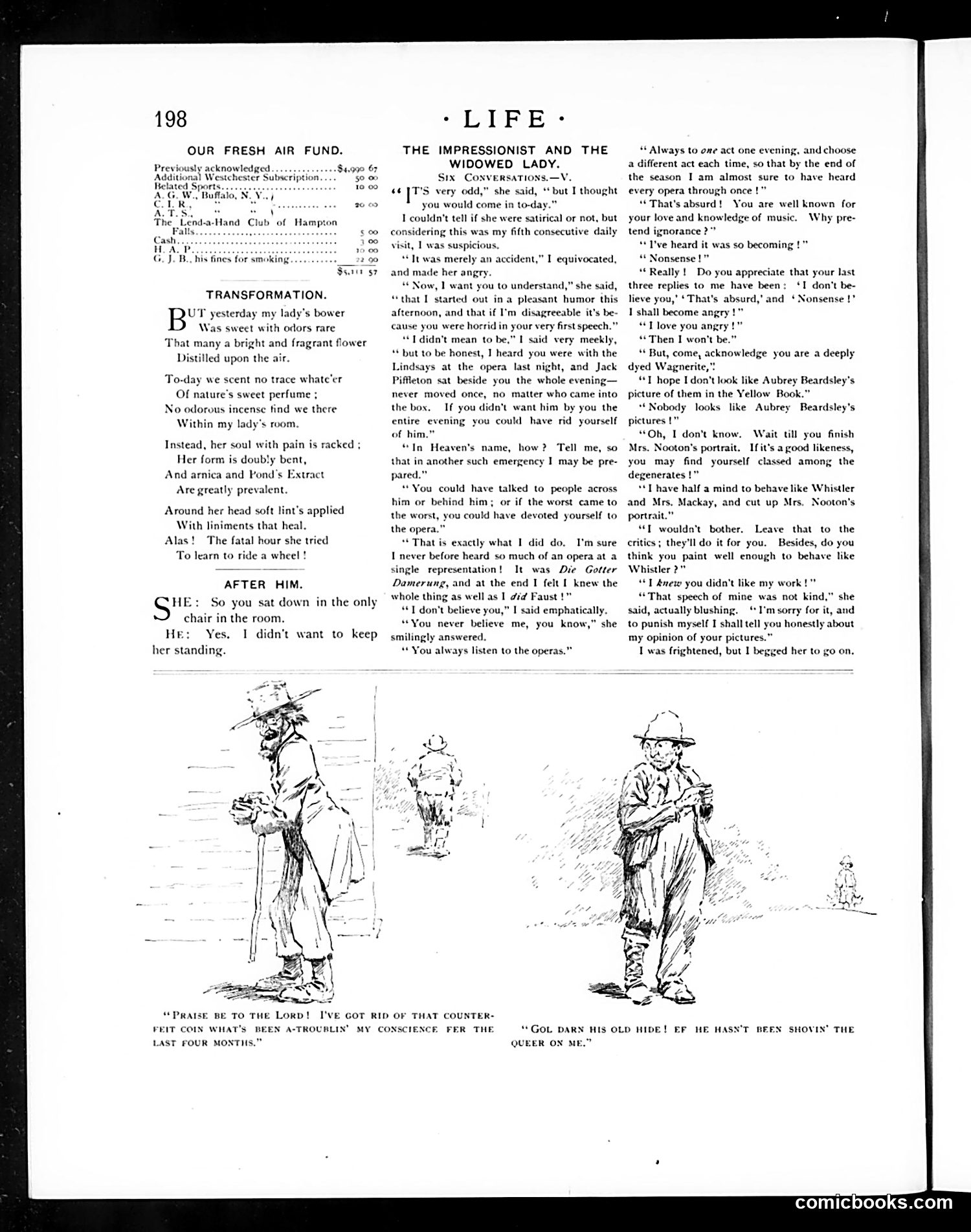
This page contains two main sections: **Upper section:** A short story titled "The Impressionist and the Widowed Lady" featuring six conversations between characters, with discussion of opera attendance and social dynamics. **Lower section:** Two cartoon illustrations showing rural/working-class male figures in period clothing (hats, work coats). The captions suggest working-class humor: - Left figure: "Praise be to the Lord! I've got rid of that counterfeit coin what's been a-troublin' my conscience fer the last four months." - Right figure: "Gol darn his old hide! Ef he hasn't been shovin' the queer on me." Both cartoons play on rural dialect and involve counterfeit currency—a common 19th-century concern. The humor derives from the contrast between the characters' rough speech and their moral/practical concerns about fake money. The satire targets rural or working-class sensibilities of the era.
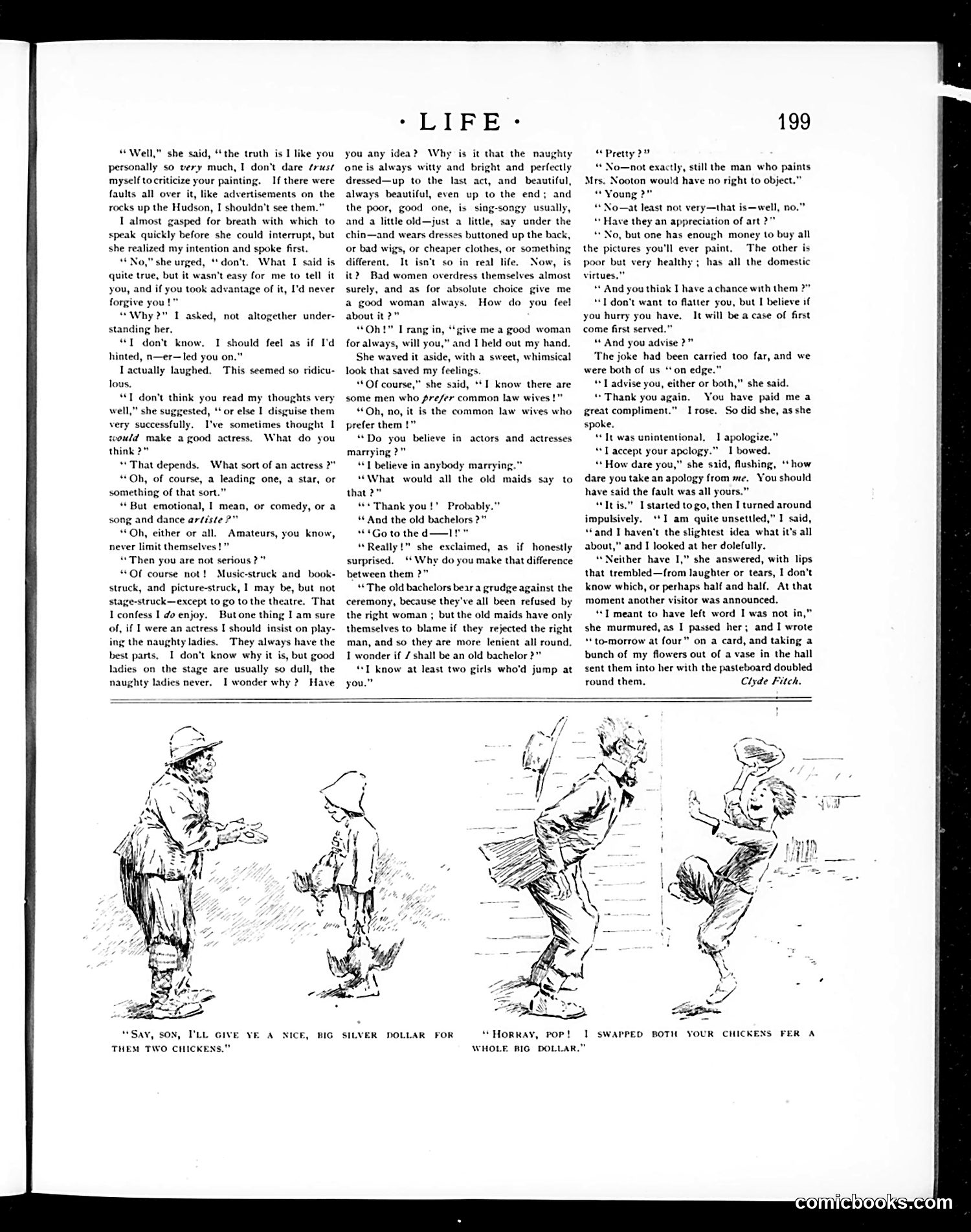
This page contains two distinct cartoon panels at the bottom, both depicting rural or working-class figures in what appears to be a chicken-trading scenario. **Left panel:** An older man offers "a nice, big silver dollar for them two chickens" to a young boy. **Right panel:** The boy exclaims "Hooray, pop! I swapped both your chickens fer a whole big dollar." The satire appears to target naive or poor rural people, suggesting they make foolish trades—swapping valuable assets (two chickens, presumably worth money and providing eggs) for mere currency. This reflects a common early-20th-century urban stereotype mocking rural simplicity and lack of business acumen. The upper text discusses theatrical and marital preferences, seemingly unrelated to the cartoons below.
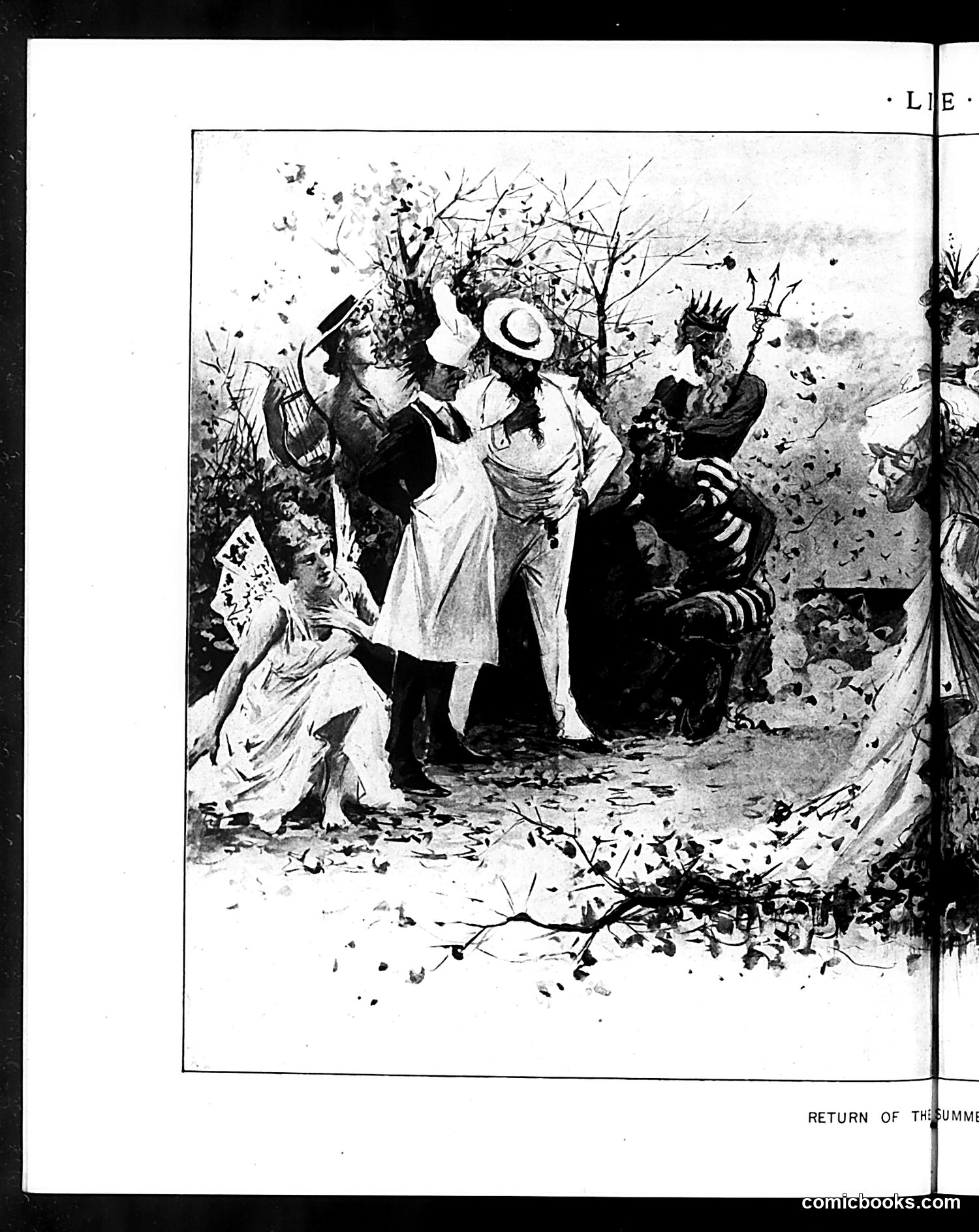
This illustration depicts a festive outdoor scene with well-dressed figures celebrating among foliage and branches. The caption "RETURN OF THE SUMMER" suggests seasonal commentary. The image appears to be a satirical illustration of upper-class leisure and social gatherings—likely poking fun at the fashionable set's summer activities and elaborate dress codes. The ornate clothing, formal hats, and theatrical poses suggest mockery of pretentious social rituals. Without additional context or visible artist attribution, I cannot identify specific political figures or current events being referenced. The satire seems directed at the general affectations and social performances of the wealthy leisure class during summer social season—a common target of *Life* magazine's humor during the early-to-mid twentieth century.
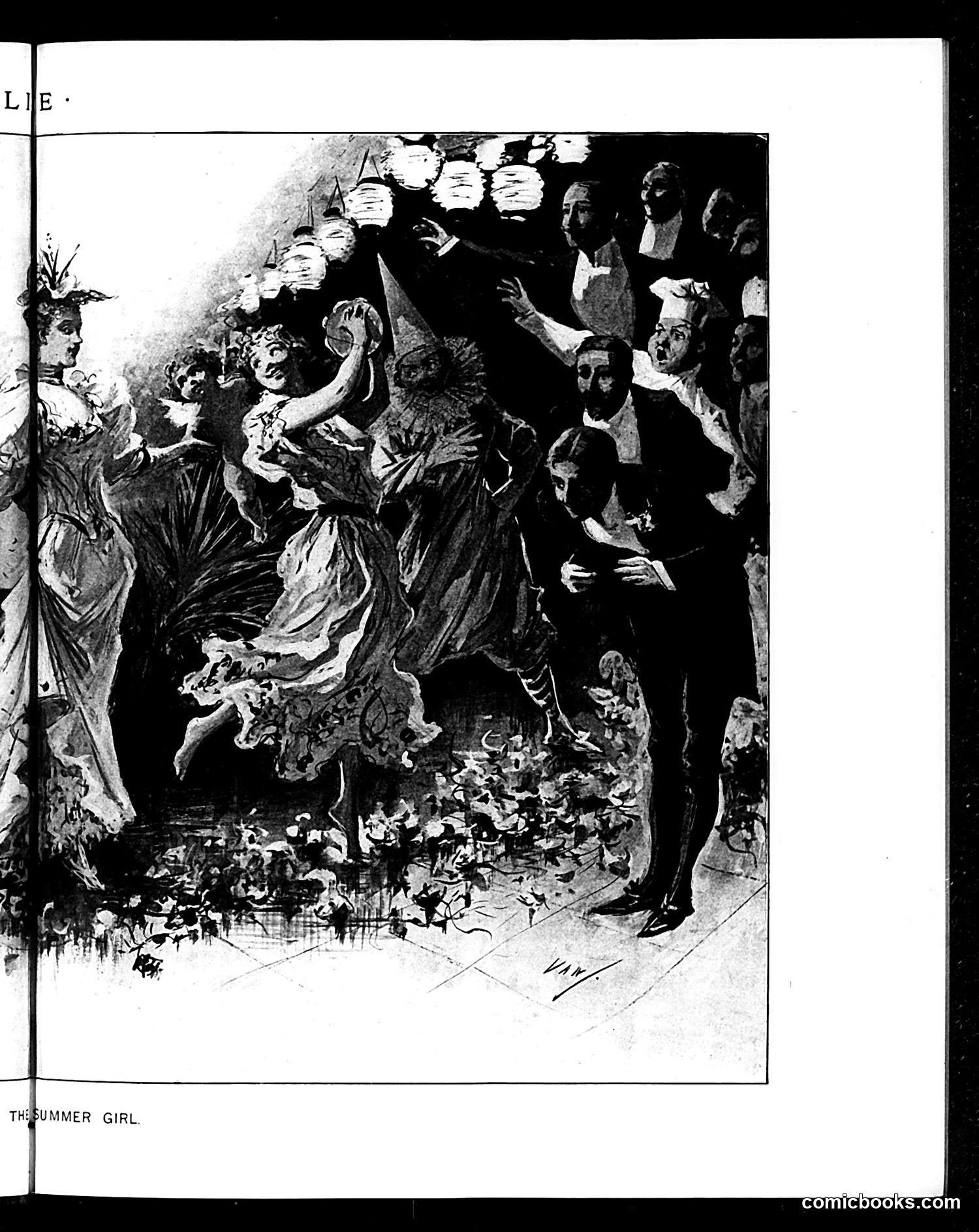
This satirical illustration depicts the social anxieties surrounding young women's summer fashion and behavior in the late 19th or early 20th century. The central female figure, elaborately dressed and adorned with feathers, appears to be the subject of intense scrutiny and gossip among formally-dressed onlookers above her. The composition suggests mockery of both the "summer girl's" conspicuous display and the society observers' fascination with her. The demons or grotesque figures at the bottom likely represent moral concerns or social vices associated with summer leisure activities and women's increasing independence and public visibility during this era. The cartoon satirizes period anxieties about changing gender roles and women's fashion.
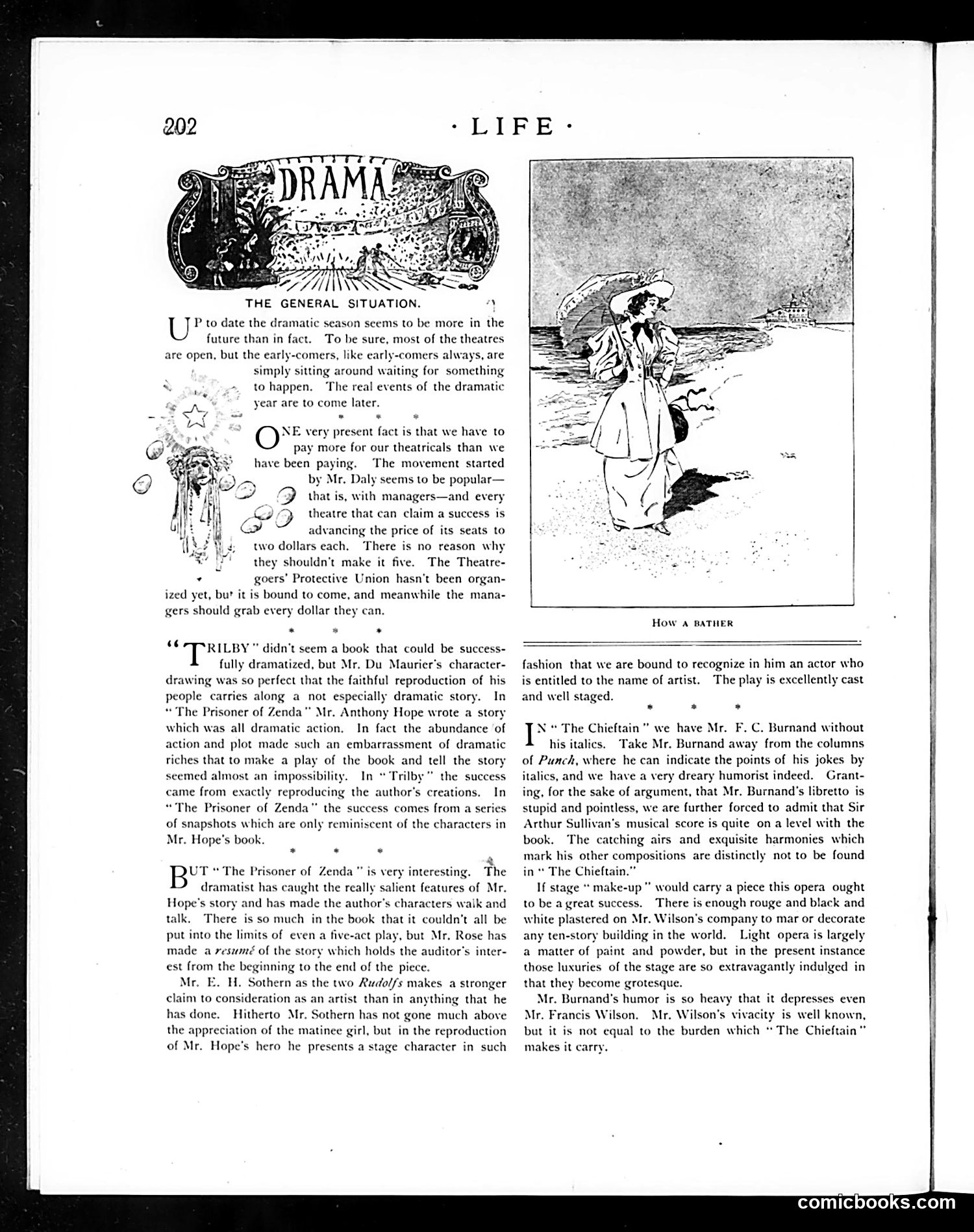
This is a theater review page from *Life* magazine. The main illustration shows a woman in theatrical costume at a seaside setting, labeled "How a Bather" — likely a satirical reference to a specific theatrical production or scene. The text reviews several plays including "Trilby," "The Prisoner of Zenda," and "The Chieftain." The reviews discuss casting choices, with particular mention of actors Mr. F.C. Burnand and Mr. Francis Wilson. The opening section comments on rising theater ticket prices, suggesting managers are capitalizing on successful productions by charging more — a contemporary complaint about commercialism in theater. The overall tone is critical yet humorous, evaluating performances and production quality while noting the theatrical world's financial motivations.
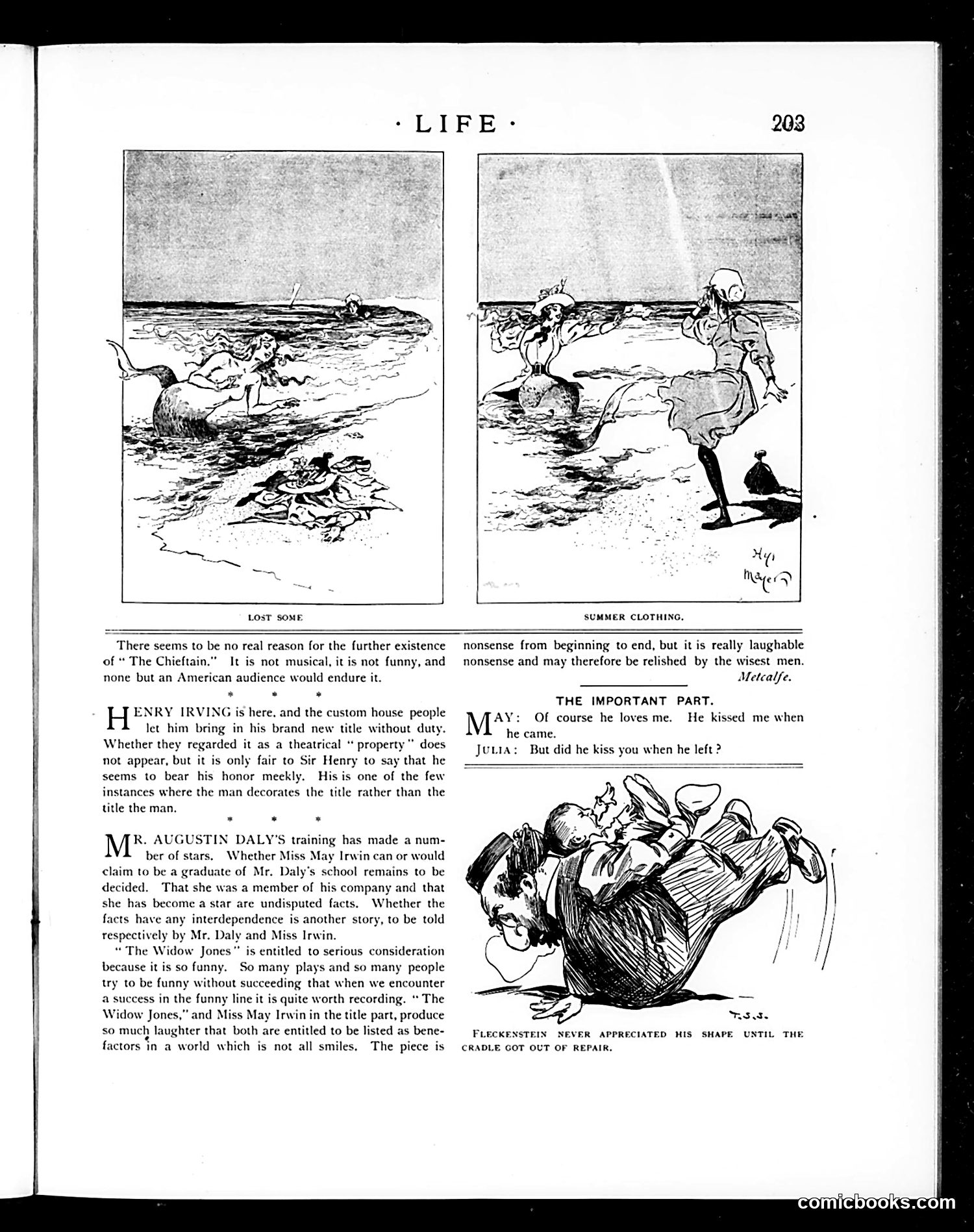
This Life magazine page (203) contains theatrical reviews and commentary on early 20th-century stage productions. The two beach cartoons at top ("Lost Some" and "Summer Clothing") appear to be generic humorous illustrations about beachgoers, lacking obvious political content. The text discusses Henry Irving's theatrical title and praises Augustin Daly's training of actresses, particularly Miss May Irwin. It reviews "The Widow Jones," noting the play succeeds through humor rather than musical merit, and crediting both Miss Irwin and her co-star for producing "much laughter." The bottom illustration shows a couple embracing, captioned about Fleckenstein appreciating his "shape" only after cradle repair—a domestic humor joke. The page primarily concerns theater criticism and entertainment rather than political satire.
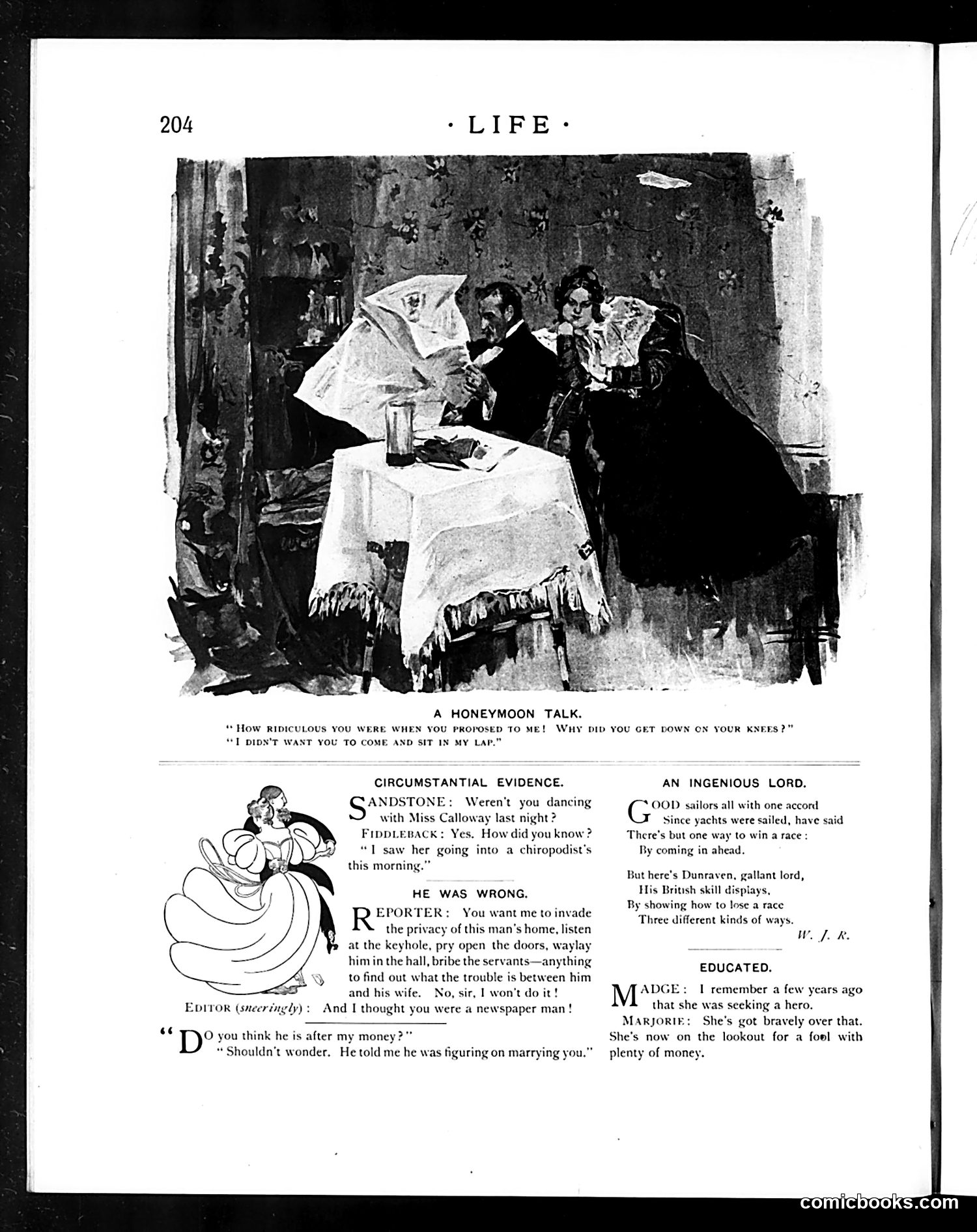
This page contains several brief satirical jokes typical of early 20th-century American humor: **"A Honeymoon Talk"** mocks romantic conventions—a husband deflates his wife's complaint about his kneeling proposal by revealing selfish practicality rather than sentiment. **"Circumstantial Evidence"** jokes about a man caught in an obvious lie; his dancing partner's visit to a chiropodist (foot doctor) the next morning proves he was a terrible dancer. **"He Was Wrong"** satirizes journalistic ethics—a reporter refuses unethical investigative tactics (eavesdropping, bribery), prompting an editor's sarcastic dismissal. It critiques both invasive "yellow journalism" practices and editorial hypocrisy. **"An Ingenious Lord"** references Dunraven, likely the Irish aristocrat involved in yacht-racing controversies, mocking his creative excuses for losing races. **"Educated"** presents cynical female ambition—a woman's youthful idealism (seeking heroes) has devolved into mercenary pragmatism (seeking wealthy fools). The overall tone is witty, slightly misanthropic commentary on marriage, journalism, and social pretense.
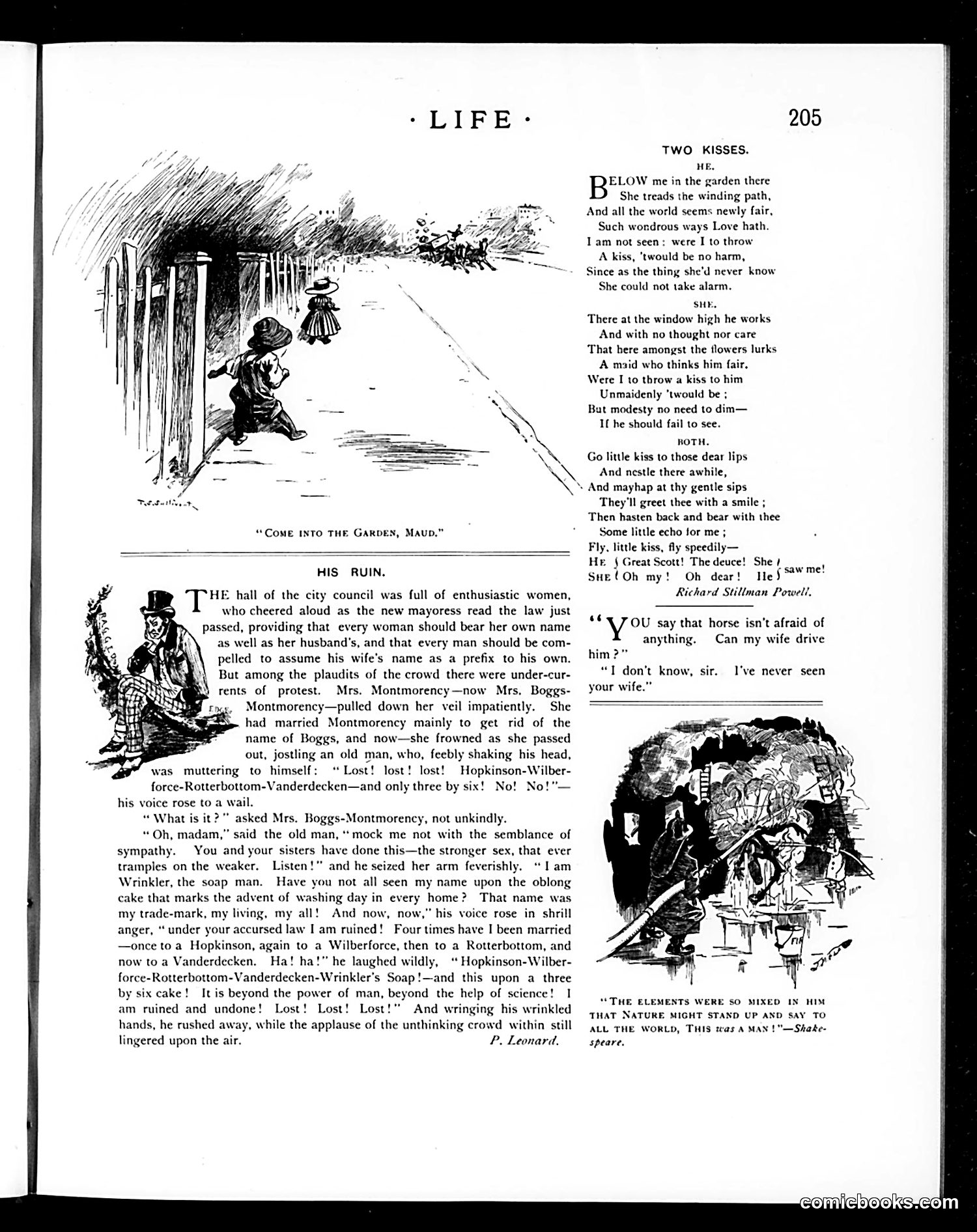
This piece satirizes a new law granting women legal name independence and requiring husbands to adopt their wives' surnames as prefixes. The cartoon mocks the unintended consequences through a soap manufacturer named Wrinkler. The joke: Wrinkler built his business identity around his brand name on soap cakes. Married four times (to Hopkinson, Wilberforce, Rotterbottom, and Vanderdecken), he's now legally forced to market "Hopkinson-Wilberforce-Rotterbottom-Vanderdecken-Wrinkler's Soap"—an impossibly long name that destroys his trade-mark and livelihood. The satire cuts both ways: it ridicules both the women celebrating the law *and* mocks men who view marriage as a threat to their identity and business. Mrs. Boggs-Montmorency had married *to escape* the name Boggs, revealing that women also had practical reasons for the old system. The piece appears designed to show how progressive legislation creates absurd real-world problems, particularly for working-class commerce.
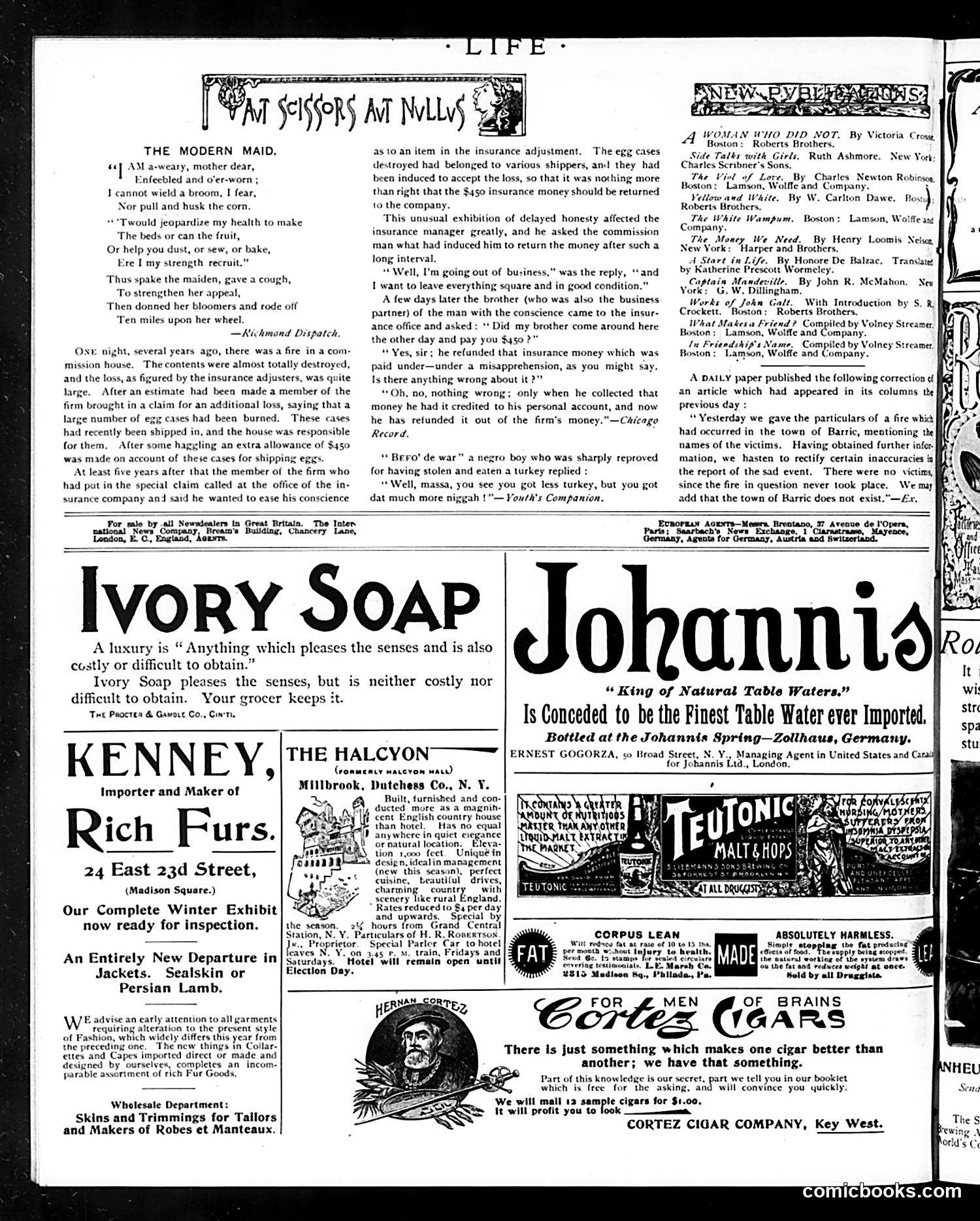
This page contains several satirical pieces targeting social hypocrisy and moral inconsistency: **"The Modern Maid"** poem mocks young women who claim delicate health preventing housework, yet somehow have energy to ride bicycles ten miles—suggesting their ailments are convenient excuses rather than genuine. **The insurance anecdote** satirizes selective conscience: a businessman returns $450 he'd dishonestly claimed years earlier only when retiring, and his brother immediately reveals the money came from the firm's account anyway—implying the "moral" act was mere appearance-management. **The "Bero' de war" joke** uses period-typical racial stereotyping (a Black character's dialect and logic) as humor—reflecting common contemporary attitudes. The page is primarily **advertising** (Ivory Soap, Johannis water, Kenney furs, Cortez cigars), with these satirical pieces filling editorial space—typical of *Life* magazine's format mixing humor with commercials.
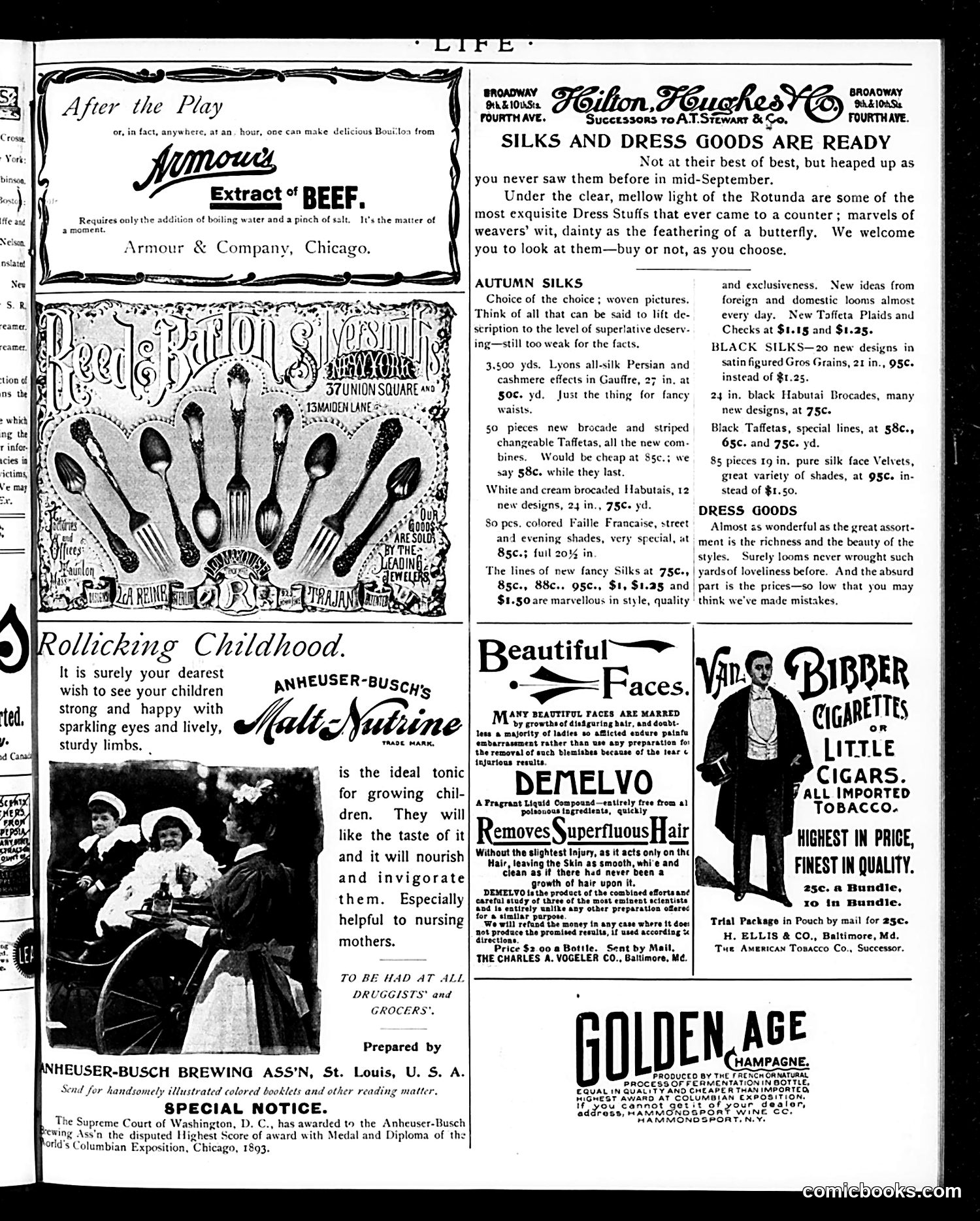
This page is primarily **advertising**, not political satire. It contains multiple commercial advertisements from the 1890s, with minimal editorial content. The notable elements include: **Armour & Company** advertisement for beef extract—a common convenience product of the era requiring only hot water. **Anheuser-Busch's "Malt-Nutrine"** advertisement marketed as a tonic "for growing children" and "nursing mothers." By modern standards, this is striking: the ad promotes beer/malt products for children, reflecting late-19th-century attitudes toward alcohol that differ drastically from today's understanding of child safety. **Demelvo** hair removal product and **Van Bibber Cigarettes** round out the advertisements. **Hilton, Hughes & Co.** announces fall silk and dress goods inventory. The page reflects the era's advertising practices and social norms—particularly the casual promotion of alcoholic beverages for children and the prevalence of unregulated patent medicines and cosmetics. No apparent political cartoon or satire is present.
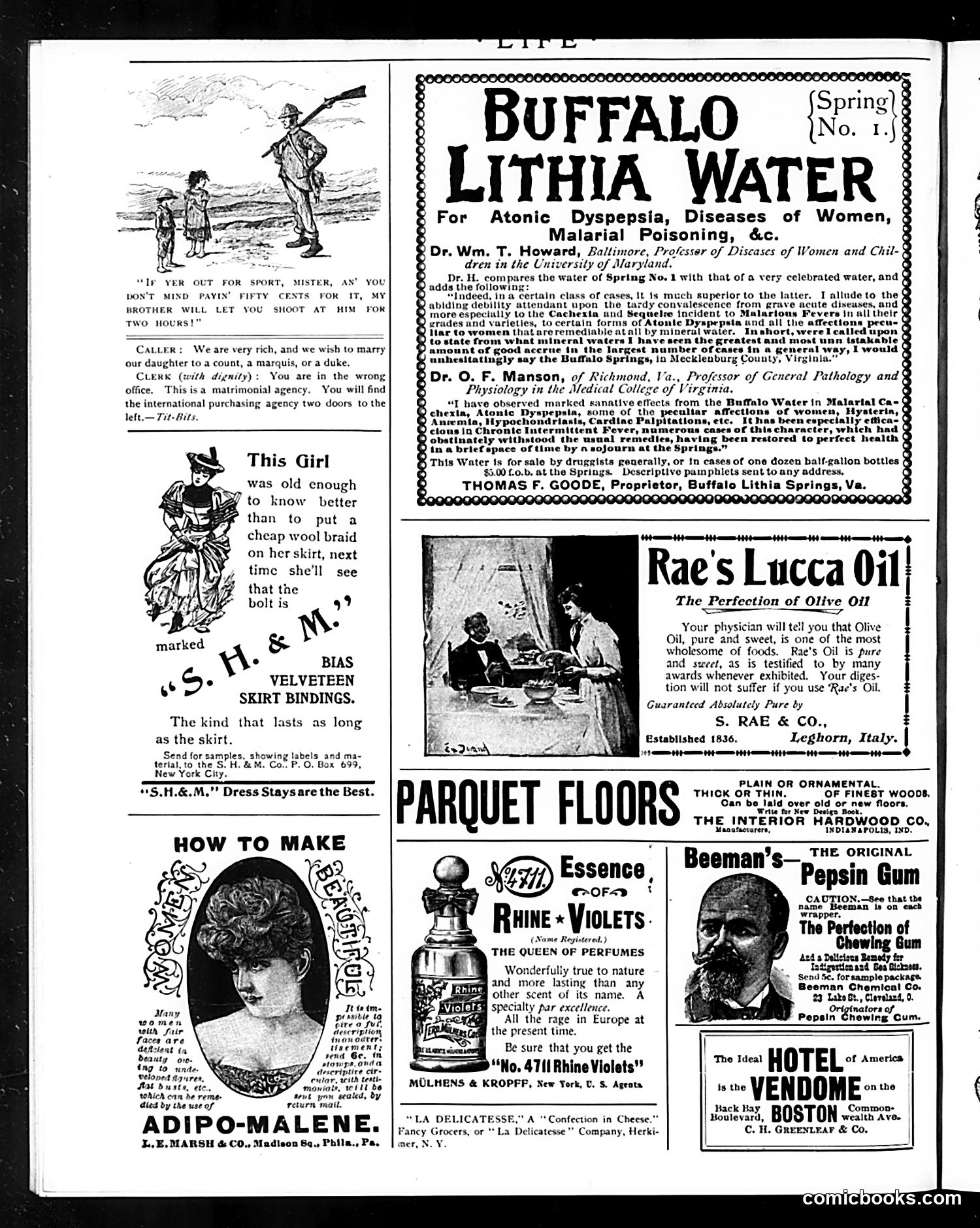
This page is primarily **advertising**, with one notable satirical cartoon at top-left. **The Cartoon:** A caller approaches a clerk at what appears to be a marriage brokerage office. The wealthy caller seeks to marry off his daughter to European nobility (count, marquis, or duke). The clerk's dignified response—that this is the wrong office and they should visit "the international purchasing agency two doors to the left"—satirizes **the commodification of marriage among the wealthy**. The joke implies that marrying off daughters to titled foreigners is essentially a "purchasing" transaction rather than a romantic union, reducing marriage to commercial negotiation. **The Advertisements:** The page features period remedies (Buffalo Lithia Water for dyspepsia, Rae's Lucca Oil, Pepsin Gum) and products (skirt bindings, parquet floors, perfume) typical of early 20th-century American magazines. These represent standard commercial advertising of the era. The satirical commentary targets upper-class matrimonial practices, not contemporary politics.