
Life, 1895-09-26 · page 7 of 16
Life — September 26, 1895 — page 7: what you’re looking at
What you’re looking at
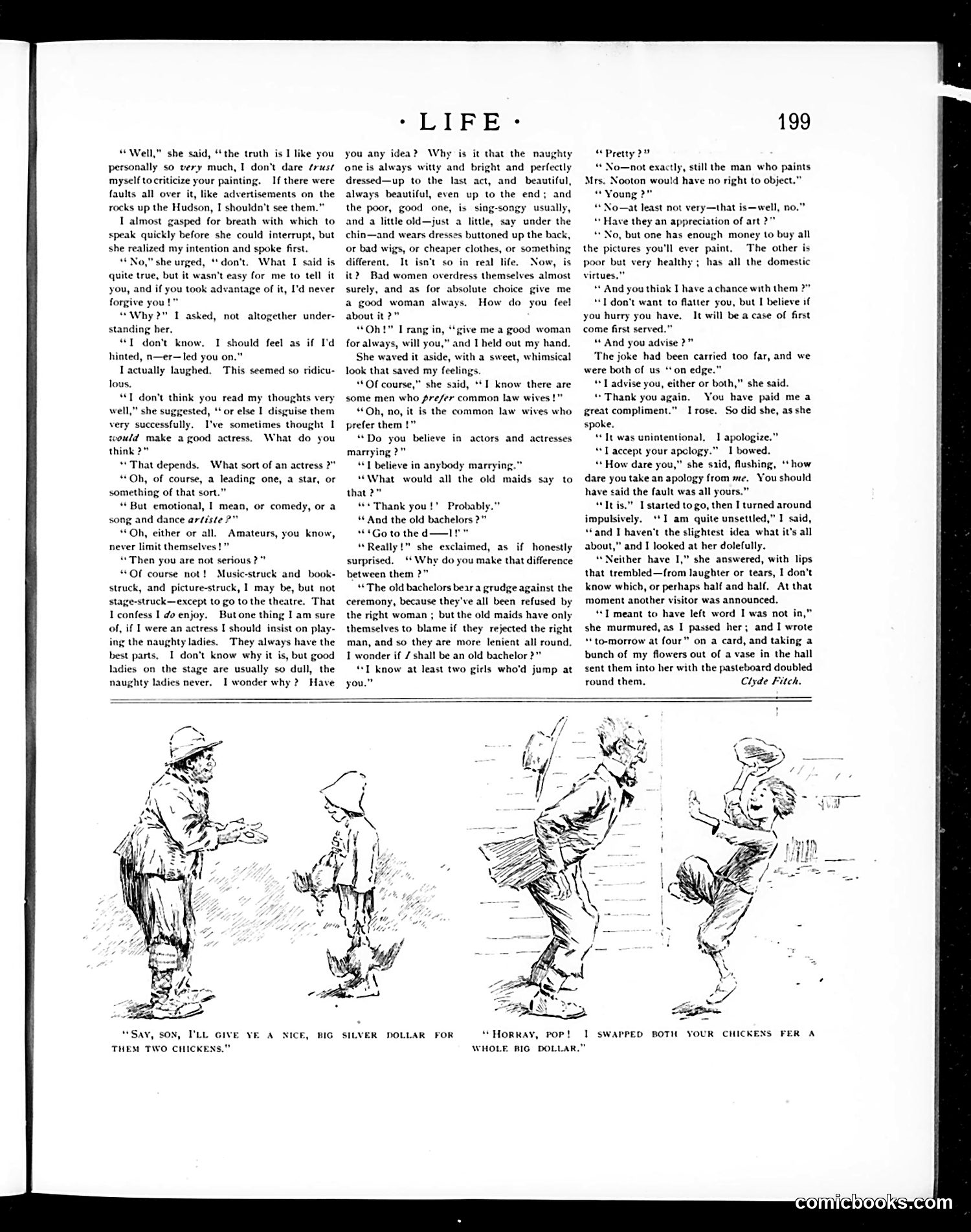
This page contains two distinct cartoon panels at the bottom, both depicting rural or working-class figures in what appears to be a chicken-trading scenario. **Left panel:** An older man offers "a nice, big silver dollar for them two chickens" to a young boy. **Right panel:** The boy exclaims "Hooray, pop! I swapped both your chickens fer a whole big dollar." The satire appears to target naive or poor rural people, suggesting they make foolish trades—swapping valuable assets (two chickens, presumably worth money and providing eggs) for mere currency. This reflects a common early-20th-century urban stereotype mocking rural simplicity and lack of business acumen. The upper text discusses theatrical and marital preferences, seemingly unrelated to the cartoons below.
📄 Transcribed text from this page (OCR, searchable)
Machine-transcribed from the original scan — historical spelling and the odd misread are preserved.
“Well,” she said, “the truth is I like you personally so very much, I don't dare trust myself tocriticize your painting. If there were faults all over it, like advertisements on the rocks up the Hudson, I shouldn't see them.” I almost gasped for breath with which to speak quickly before she could interrupt, but she realized my intention and spoke first. “No,” she urged, * don’t. What I said is quite true, but it wasn't easy for me to tell it you, and if you took advantage of it, I'd never forgive you!” “Why?” I asked, not altogether under- standing her. “1 don't know. I should feel as if I'd hinted, n—er—led you on, I actually laughed. This seemed so ridicu- lous. “1 don’t think you read my thoughts very well,” she suggested, “ or else I disguise them very successfully, I've sometimes thought I would make a good actress. What do you think ?” “That depends. What sort of an actress “Oh, of course, a leading one, a star, or something of that sort.” “But emotional, | mean, or comedy, or a song and dance artiste?” “Oh, either or all. Amateurs, you know, never limit themselves!” “Then you are not serious?” “Of course not! Music-struck and book- struck, and picture-struck, I] may be, but not stage-struck—except to go to the theatre, That I confess I do enjoy, Butone thing I am sure of, if I were an actress I should insist on play- ing the naughty ladies. They always have the best parts, I don't know why it is, but good ladies on the stage are usually so dull, the naughty ladies never. I wonder why? Have ‘> LIFE: you any idea? Why is it that the naughty one is always witty and bright and perfectly dressed—up to the last act, and beautiful, always beautiful, even up to the end; and the poor, good one, is sing-songy usually, and a little old—just a little, say under the chin—and wears dresses buttoned up the back, or bad wigs, or cheaper clothes, or something different. It isn’t so in real life. Now, is it? Bad women overdress themselves almost surely, and as for absolute choice give me a good woman always, How do you feel about it?” “Oh!” rang in, “give me a good woman for always, will you,” and I held out my hand. She waved it aside, with a sweet, whimsical look that saved my feeling “Of course,” she said, *1 know there are some men who prefer common law wives!" “Oh, no, it is the common law wives who prefer them 1” “Do you believe in actors and actresses marrying 2” “1 believe in anybody marrying.” “What would all the old maids say to that ? “Thank you!" Probably.” “ And the old bachelors?” “Go to the d—I!"" “Really!” she exclaimed, as if honestly surprised.“ Why do you make that difference between them ?” “The old bachelors beara grudge against the ceremony, because they've all been refused by the right woman ; but the old maids have only themselves to blame if they rejected the right man, and so they are more lenient all round. I wonder if / shall be an old bachelor ?” “1 know at least two girls who'd jump at you.” 199 «Pretty 2” No—not exactly, still the man who paints Nooton would have no right to object.” “Young 2” “ No—at least not very—that is—well, no.” ‘+ Have they an appreciation of art?” ‘No, but one has enough money to buy all the pictures you'll ever paint, The other is poor but very healthy; has all the domestic virtues.” “+ And you think I have a chance with them ?" “Idon't want to flatter you, but I believe if you hurry you have, It will be a case of first, come first served.” “ And you advise 2” ‘The joke had been carried too far, and we were both of us “on edge.” * Ladvise you, either or both,” she said. “Thank you again. You have paid me a great compliment.” I rose. So did she, as she spoke. “It was unintentional, “How dare you,” she said, flushing, dare you take an apology from me. You should have said the fault was all yours.” “It is.” [started to go, then I turned around impulsively. ‘1 am quite unsettled,” I said, “Sand I haven't the slightest idea what it's all about,” and I looked at her dolefully. “Neither have I," she answered, with lips that trembled—from laughter or tears, I don’t know which, or perhaps half and half. At that moment another visitor was announced. “meant to have left word I was not in,” she murmured, as I passed her; and I wrote “to-morrow at four” on a card, and taking a bunch of my flowers out of a vase in the hall sent them into her with the pasteboard doubled round them, Clyde Fitch. “Say, SON, I'LL GIVE VE A NICE, BIG SIL THEM TWO CHICKE: DOLLAR FOR “HORRAY, POP! WHOLE BIG DOLLAR.” 1 SWAPPED BOTH YOUR CHICK!