
Life, 1895-09-26 · page 10 of 16
Life — September 26, 1895 — page 10: what you’re looking at
What you’re looking at
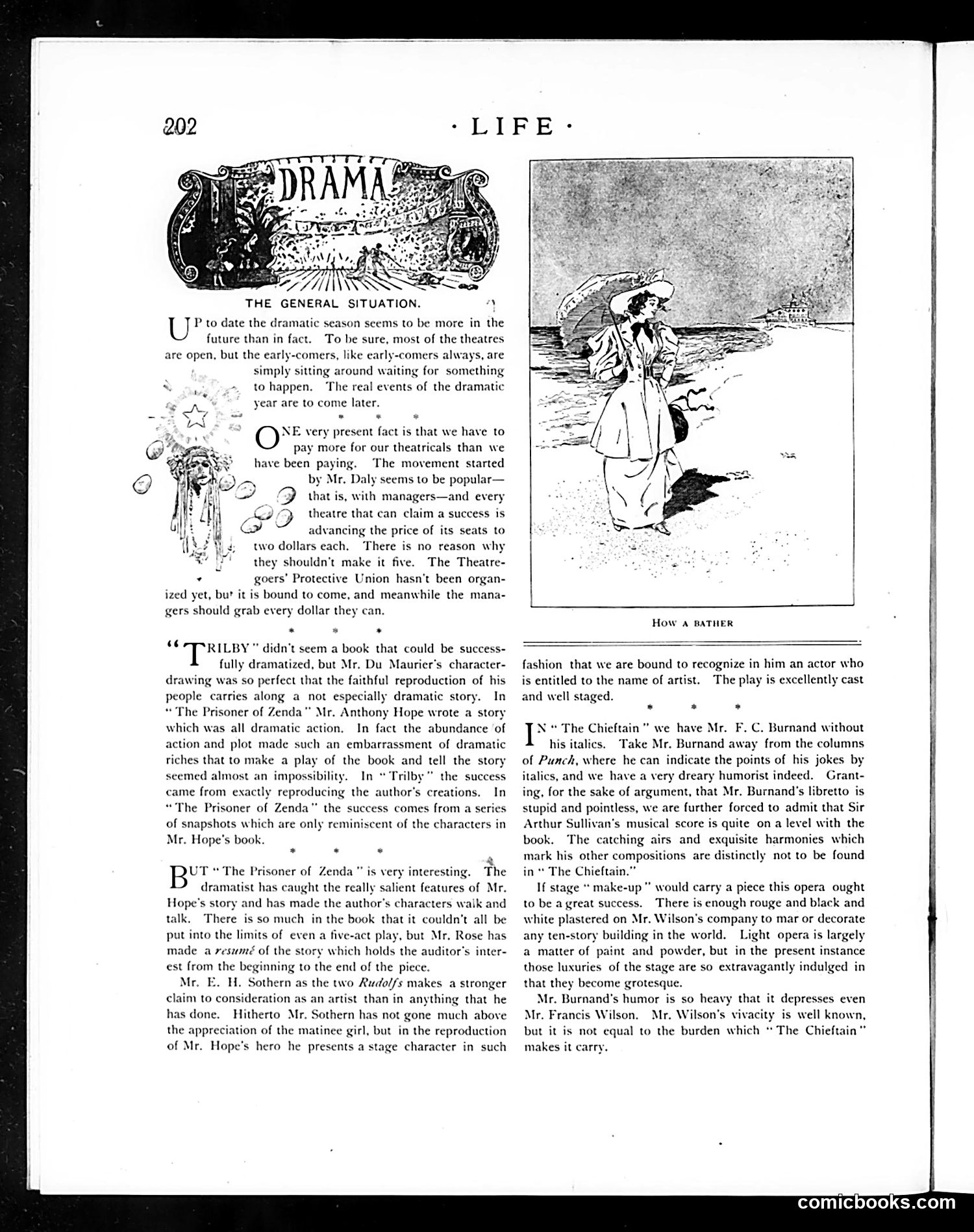
This is a theater review page from *Life* magazine. The main illustration shows a woman in theatrical costume at a seaside setting, labeled "How a Bather" — likely a satirical reference to a specific theatrical production or scene. The text reviews several plays including "Trilby," "The Prisoner of Zenda," and "The Chieftain." The reviews discuss casting choices, with particular mention of actors Mr. F.C. Burnand and Mr. Francis Wilson. The opening section comments on rising theater ticket prices, suggesting managers are capitalizing on successful productions by charging more — a contemporary complaint about commercialism in theater. The overall tone is critical yet humorous, evaluating performances and production quality while noting the theatrical world's financial motivations.
📄 Transcribed text from this page (OCR, searchable)
Machine-transcribed from the original scan — historical spelling and the odd misread are preserved.
THE GENERAL SITUATION, U P to date the dramatic season seems to be more in the future than in fact. To be sure, most of the theatres are open, but the early-comers, like carly-comers always, are simply sitting around waiting for something 8 ~ tohappen. The real events of the dramatic % year are to come later. - JV he . . * wi NE very present fact is that we have to pay more for our theatricals than we have been paying. The movement started by Mr, Daly seems to be popu F that is, with managers—and every >) theatre that can claim a success is advancing the price of its seats to two dollars each, here is no reason why they shouldn't make it five. The Theatre- goers’ Protective Union hasn't been organ- ized yet, but it is bound to come, and meanwhile the mana- gers should grab every dollar they can. ss RILBY " didn’t seem a book that could be success- fully dramatized, but Mr. Du Maurier’s character- © perfect that the faithful reproduction of his people carries along a not especially dramatic story. In “The Prisoner of Zenda” Mr. Anthony Hope wrote a story which was all dramatic action. In fact the abundance of action and plot made such an embarrassment of dramatic riches that to make a play of the book and tell the story scemed almost an impossibility. In “Trilby” the success came from exactly reproducing the author's creations. In “The Prisoner of Zenda” the suc comes from a seri of snapshots which are only reminiscent of the characters in Mr. Hope's book. * . . a UT“ The Prisoner of Zend. interesting. The dramatist has caught the really salient features of Mr. Hope's story and has made the author's characters walk and talk, There is so much in the book that it couldn't all be put into the limits of even a five-act play, but Mr, Rose has made a reswmé of the story which holds the auditor's inter- est from the beginning to the end of the piece. Mr. E. H. Sothern as the two Rudol/s makes a stronger claim to consideration as an artist than in anything that he has done. Hitherto Mr. Sothern has not gone much above the appreciation of the matinee girl, but in the reproduction of Mr. Hope’s hero he presents a stage character in such How a BATHER fashion that we are bound to recognize in him an actor who is entitled to the name of artist. The play is excellently cast and well staged. * * . J * The Chieftain” we have Mr. F.C. Burnand without his italics. Take Mr. Burnand away from the columns of Punch, where he can indicate the points of his jokes by italics, and we have a very dreary humorist indeed. Grant- ing, for the sake of argument, that Mr, Burnand’s libretto is stupid and pointless, we are further forced to admit that Sir Arthur Sullivan's musical score is quite on a level with the book. The catching airs and exquisite harmonies which mark his other compositions are distinctly not to be found in * The Chieftain.” If stage * make-up" would carry a piece this opera ought to be a great success. There is enough rouge and black and white plastered on Mr. Wilson's company to mar or decorate any ten-story building in the world. Light: opera is largely a matter of paint and powder, but in the present instance those luxuries of the stage are so extravagantly indulged in that they become grotesqu Mr. Burnand’s humor is so heavy that it depresses even Mr. Francis Wilson, Mr. Wilson's vivacity is well known, but it is not equal to the burden which * The Chieftain” makes it carry. comicbooks.com