
A complete issue · 16 pages · 1895
Life — September 19, 1895
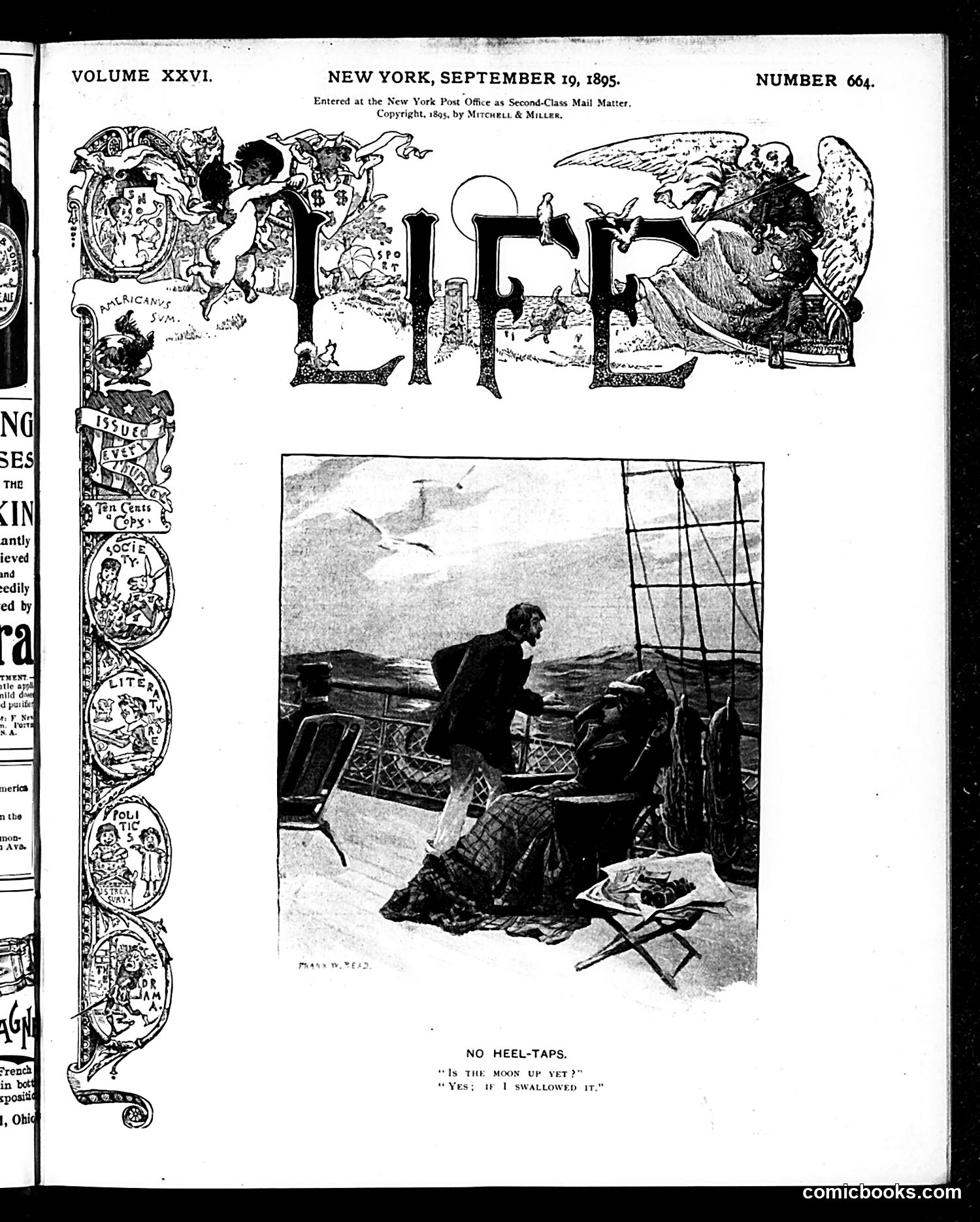
This page features a sketch titled "No Heel-Taps" with the dialogue: "Is the moon up yet?" / "Yes; if I swallowed it." The cartoon depicts two figures aboard a sailing ship. The dialogue and scene suggest a drinking joke—"heel-taps" refers to the practice of finishing drinks completely (leaving no dregs in the glass). The reference to swallowing the moon appears to be sailors' banter, likely mocking intoxication or exaggerated claims. The shipboard setting provides context for the maritime humor typical of 1890s American satire. The ornate decorative border on the left marks this as Life magazine's characteristic design. Without clearer identification of the specific figures, the primary meaning appears to be lighthearted ridicule of sailors' drunkenness and boastful speech.
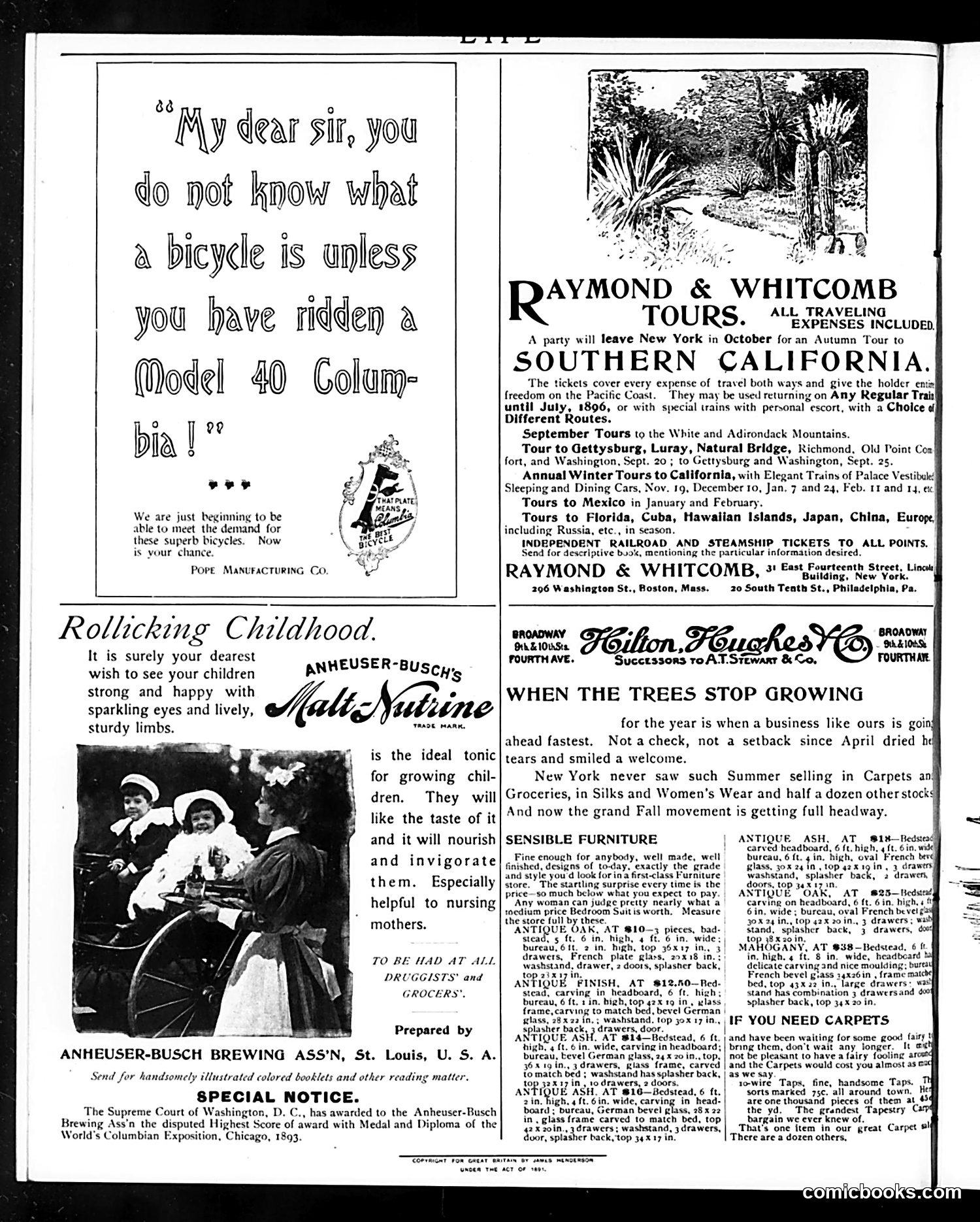
This page is primarily **advertising**, not satirical content. The main items are: 1. **Pope Manufacturing Co.** advertisement (top left): A quote claiming you can't understand bicycles without riding a Model 40 Columbian—a direct sales pitch for their bicycle product. 2. **Anheuser-Busch "Malt Nutrine"** advertisement (center): Positioned as a health tonic for children, claiming it promotes strength and vigor. This reflects late-19th-century marketing practices when alcohol-adjacent products were marketed for medicinal/nutritional purposes to families. 3. **Raymond & Whitcomb Tours** (top right): Travel agency advertising autumn tours to Southern California and other destinations. 4. **Hilton, Hughes & Co.** and **furniture advertisements** (bottom right): Various merchant promotions. No political satire is present. This is a typical late-1800s magazine page mixing editorial space with paid advertising.
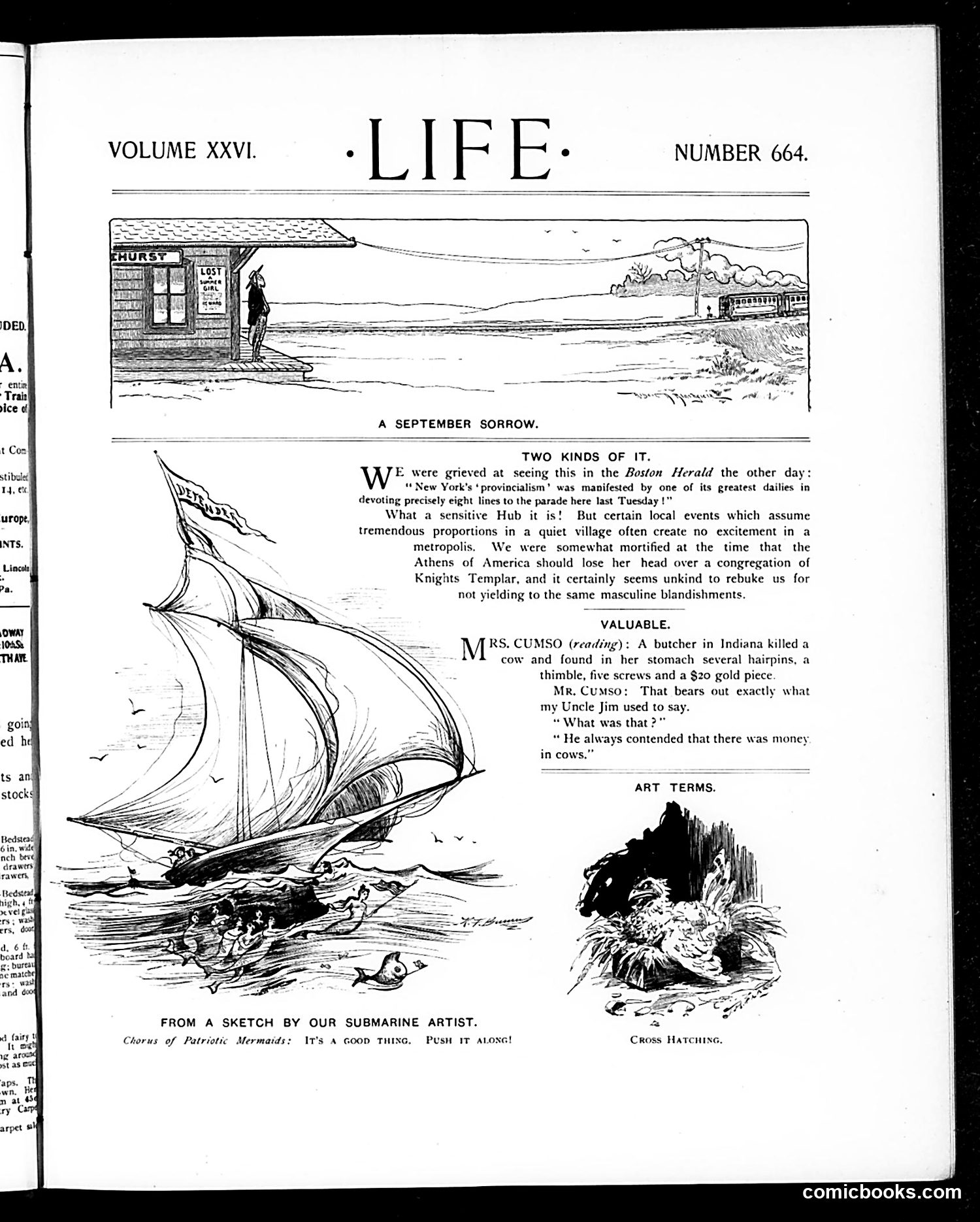
This page satirizes New York newspapers' sensationalism. The headline "Two Kinds of It" criticizes how the *Herald* and other dailies obsessed over a Knights Templar parade in a quiet village, treating a local event as though it were major news worthy of metropolitan attention. The "Valuable" anecdote mocks the idea that money can be found anywhere—even inside a cow—a joke playing on American materialism and frontier tall tales. The maritime sketch appears unrelated, labeled "From a Sketch by Our Submarine Artist" with a patriotic mermaid reference, likely WWI-era content about naval themes. The satire targets press sensationalism and America's provincial obsessions with trivial local events blown into headline scandals.
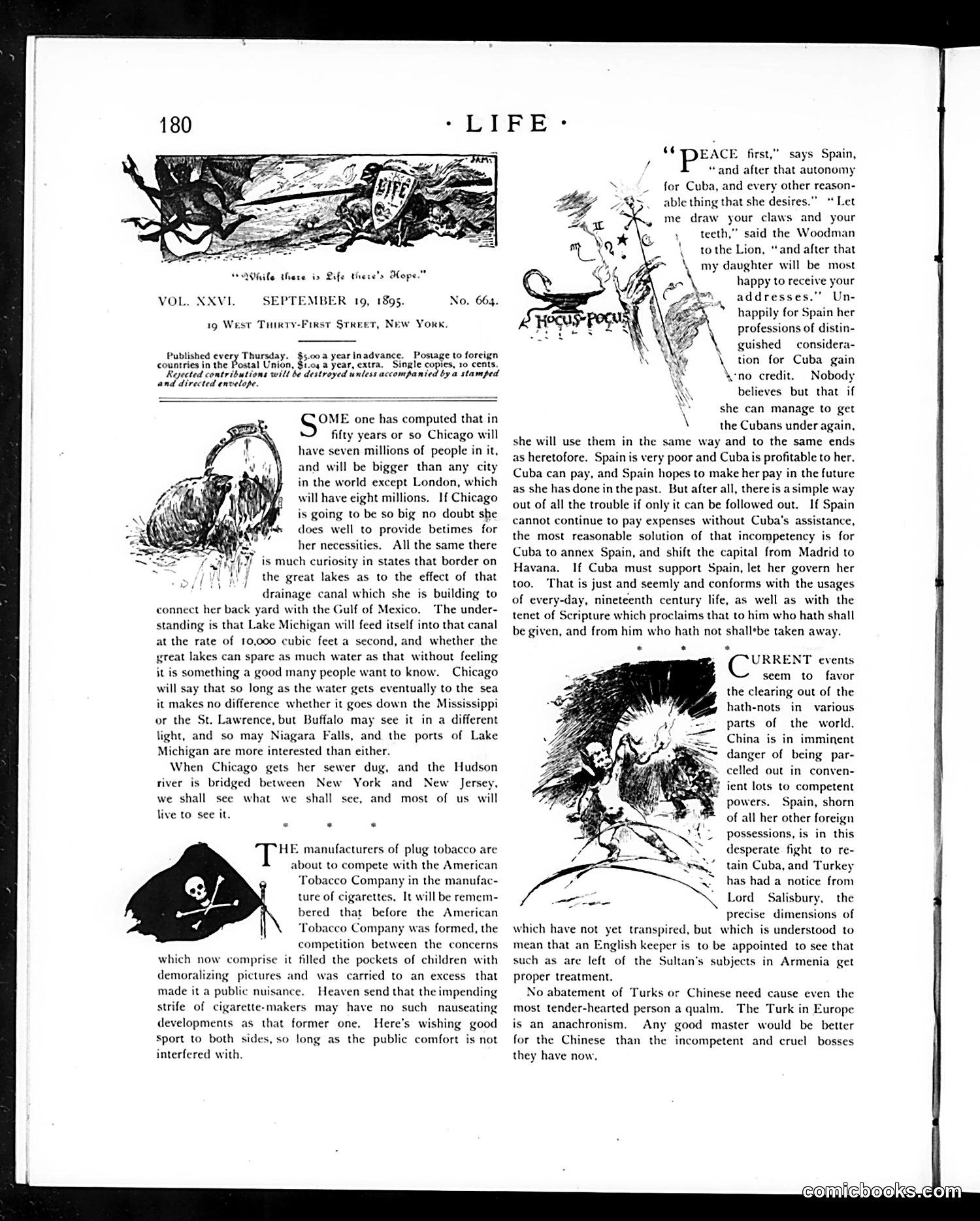
The page contains two distinct satirical pieces: **Upper right cartoon:** Depicts Spain and a Lion (likely representing Britain or another power) negotiating over Cuba. Spain demands "peace first" and "autonomy for Cuba," while the Lion responds aggressively. This satirizes Spain's weakening position regarding Cuban independence during the 1895 Cuban War of Independence. **Lower left cartoon:** Shows a skull-and-crossbones flag labeled as commentary on cigarette manufacturers competing with American tobacco companies. The text criticizes how cigarette-makers fill children's pockets with "demoralizing pictures," calling their competitive practices a public nuisance. Both pieces exemplify Life's satirical approach to contemporary political and commercial controversies of the 1890s.
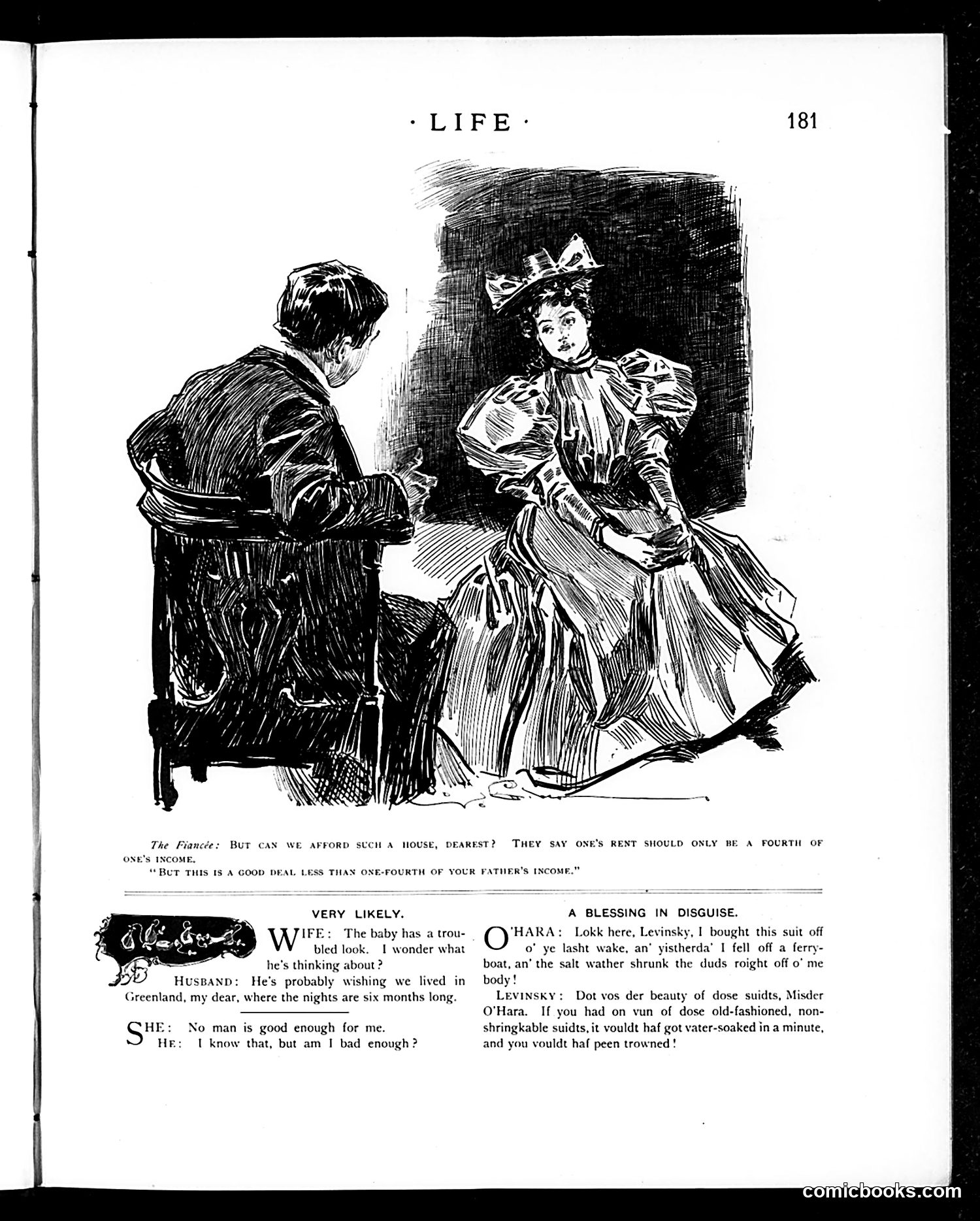
This page contains three separate domestic humor sketches typical of early 20th-century Life magazine. **"Very Likely"** satirizes financial anxiety in marriage. A husband worries they can't afford a house; his wife responds that if he's "not good enough" for her now, no house will change that. The joke relies on marital tension over class aspirations. **"A Blessing in Disguise"** features two men (O'Hara and Levinsky, likely ethnic character names) discussing a new suit. O'Hara bought it cheaply after salt water shrinkage; Levinsky jokes that modern suits shrink worse than old-fashioned ones, making the damaged purchase accidentally superior. Both sketches use middle-class domestic scenarios and light ethnic humor typical of the era's satirical magazine conventions.
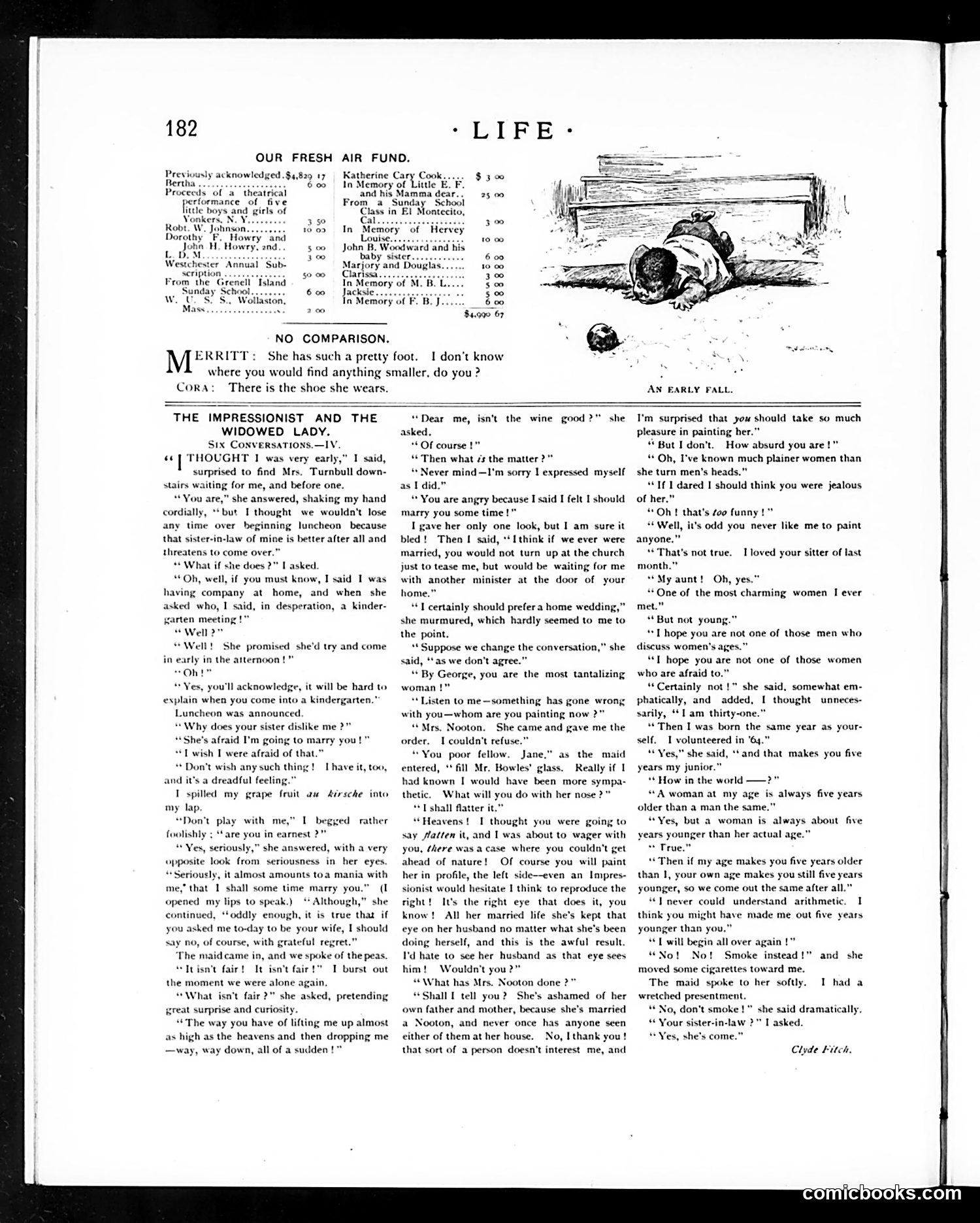
This page contains two distinct pieces: **"Our Fresh Air Fund"** (top): A donation list for a children's charity providing outdoor experiences for urban youth—typical Progressive-era philanthropy. **"No Comparison" / "The Impressionist and the Widowed Lady"** (main): A humorous dialogue between Merritt (apparently an artist) and Cora about painting. When Cora expresses concern about being painted, Merritt dismisses her worries with gallant flattery. The satire targets male artists' smooth talk and women's vanity—a standard early-20th-century trope mocking both bohemian pretension and female insecurity about aging and appearance. The accompanying illustration labeled "An Early Fall" shows a domestic scene, likely reinforcing themes of romantic disappointment or domestic life's realities versus artistic idealization.
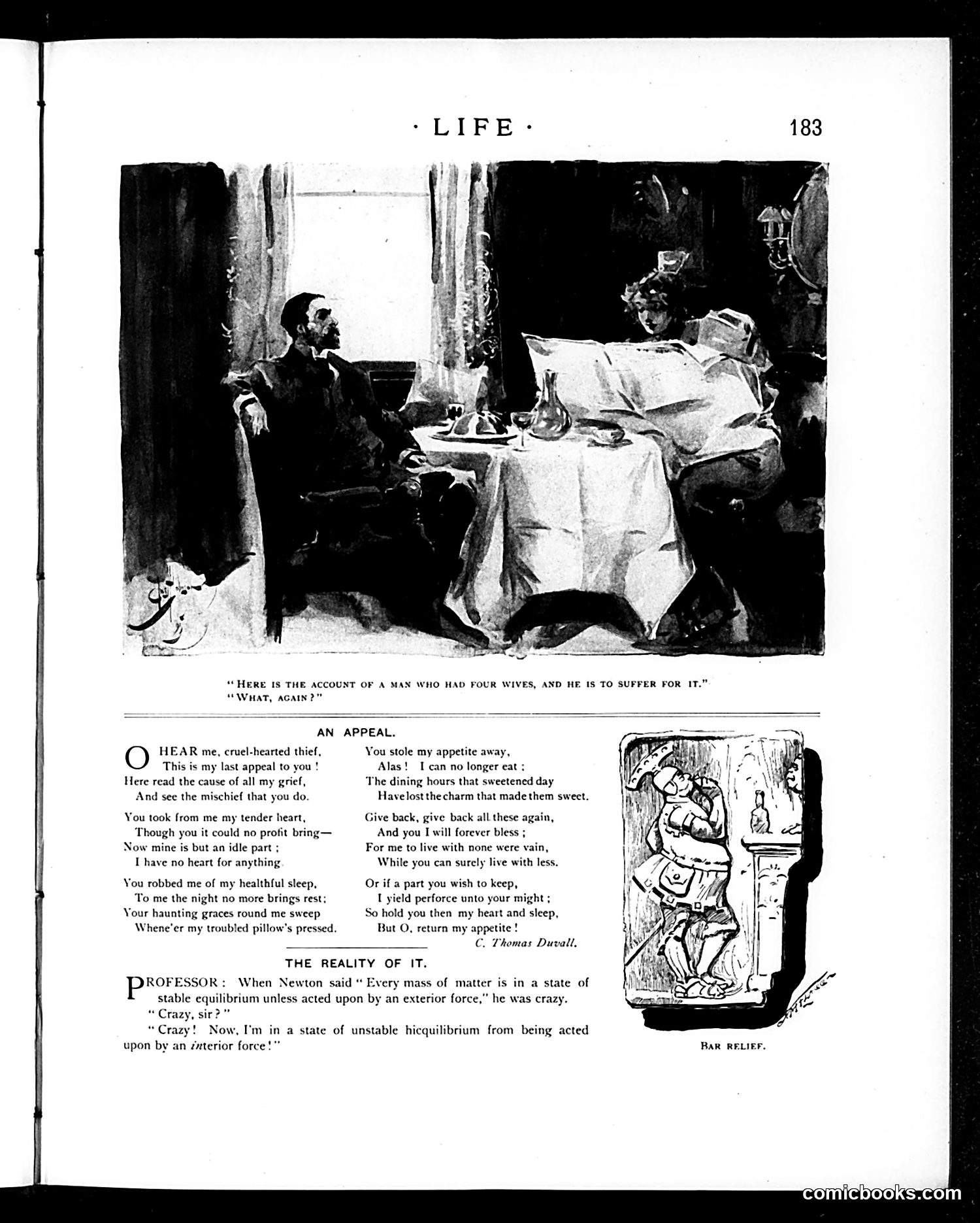
This page contains three distinct pieces of satirical content: **Top Illustration**: A domestic scene captioned "Here is the account of a man who had four wives, and he is to suffer for it. What, again?" The image shows a man at a table with a woman, apparently depicting marital discord or infidelity consequences. **"An Appeal" Poem**: A dramatic verse by C. Thomas Dursall where someone begs a spouse to return their "appetite" and restore lost domestic comfort—a humorous complaint about a partner's coldness or neglect affecting household contentment. **"The Reality of It" Joke**: A professor defends Newton's physics by claiming his "unstable inequilibrium" results from an "anterior force"—a pun using scientific terminology to humorously explain personal chaos, likely referencing marital or domestic turmoil as the "force" disrupting equilibrium. The page satirizes marriage, domestic life, and relationships through various comedic lenses.
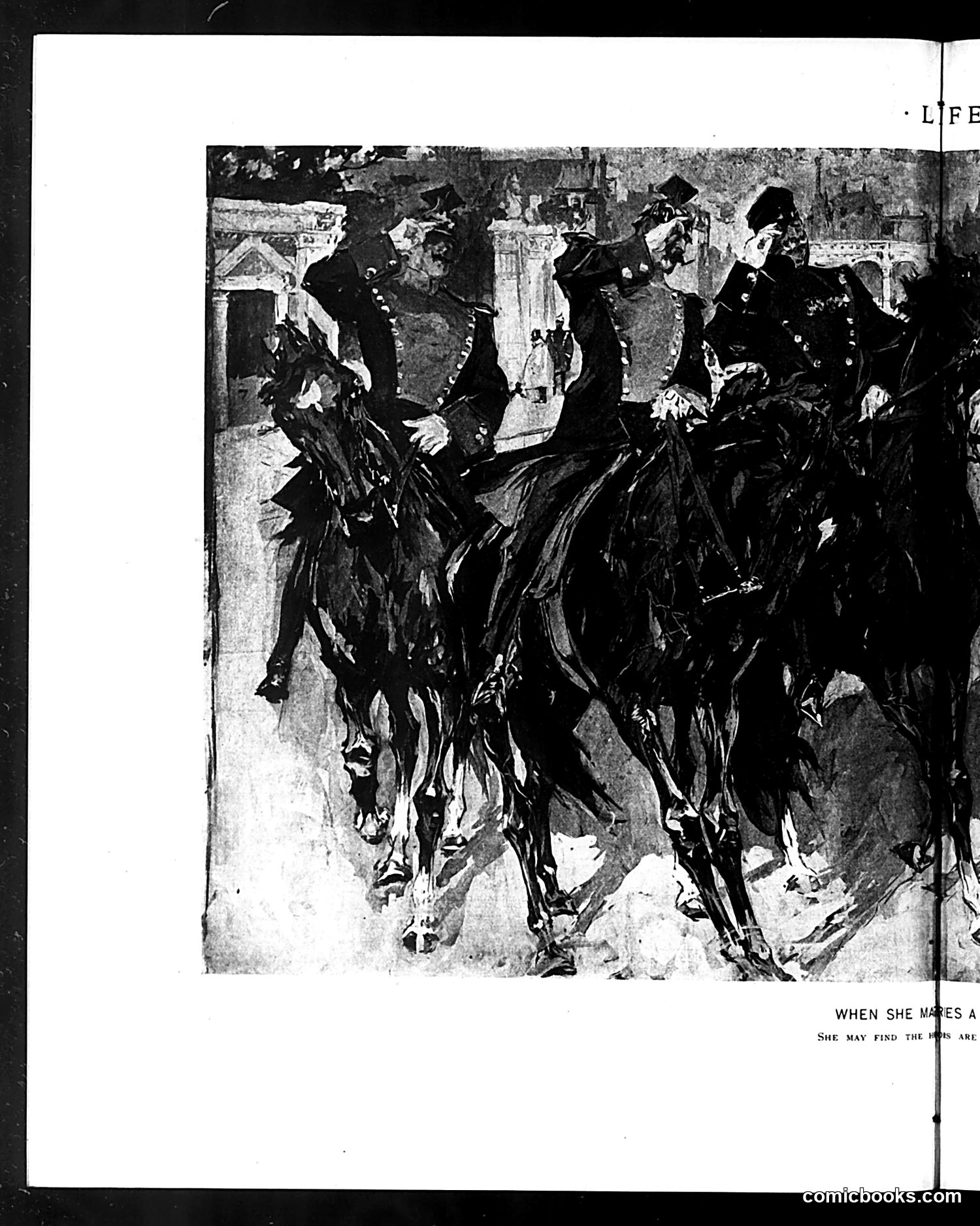
This appears to be a satirical illustration from *Life* magazine depicting a formal diplomatic or court scene. The image shows multiple uniformed figures on horseback, rendered in dark, expressive brushwork. The partially visible caption reads "WHEN SHE MAKES A..." with a second line stating "SHE MAY FIND THE FURS ARE..." The incomplete text prevents definitive interpretation, but the composition suggests commentary on aristocratic or diplomatic pretension—possibly satirizing wealthy women's social ambitions or the consequences of certain decisions. The formal military dress and architectural setting indicate this likely concerns high society or government circles. Without the complete caption, the specific satirical target remains unclear, though the tone suggests mockery of either vanity or miscalculation among the elite.
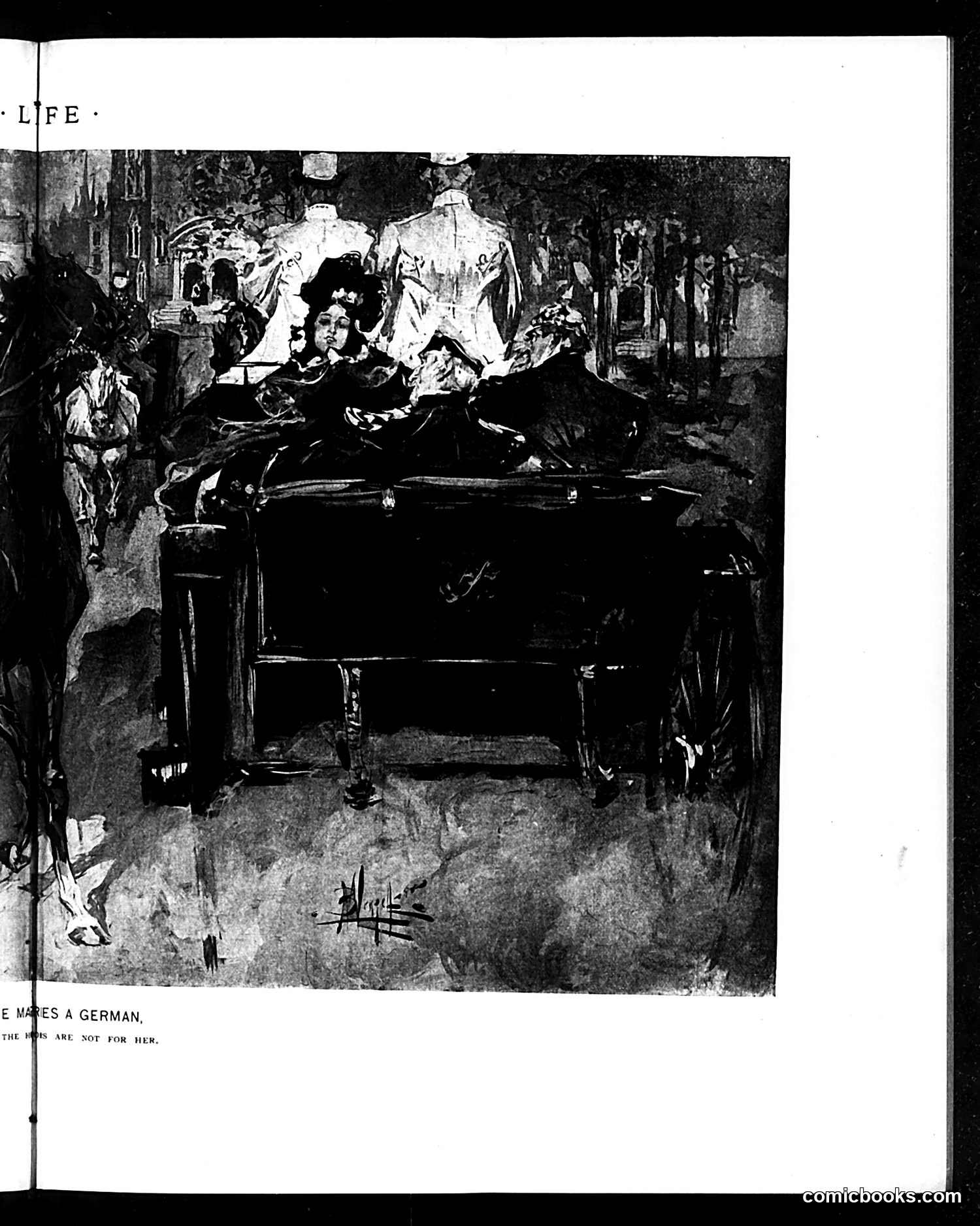
This is a satirical illustration from *Life* magazine showing an elegant carriage scene. The visible text fragment reads "E MAKES A GERMAN" and "THE FURS ARE NOT FOR HER," suggesting commentary on a woman's relationship with a German man. The cartoon depicts well-dressed figures in an ornate carriage at what appears to be a formal social event, with fashionable women in elaborate clothing and a military or formal dress figure. The joke appears to involve social satire about class, romance, or possibly wartime-related tensions between Americans and Germans, though the incomplete text makes the specific target unclear. The artistic style and printing quality suggest this is from the early 20th century. Without the full caption or more context, the precise satirical point remains partially obscured.
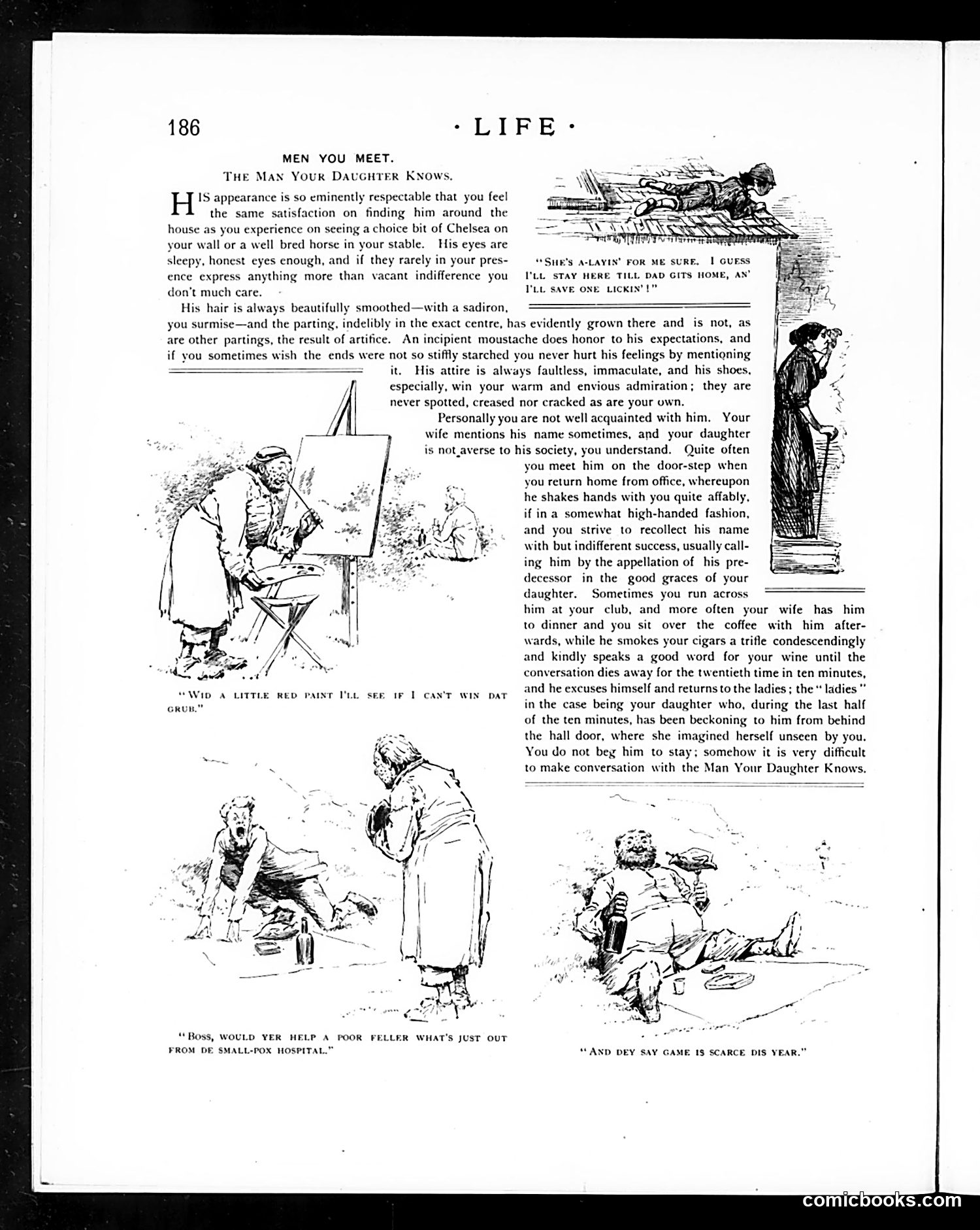
This satirical article describes a socially respectable gentleman caller—someone whose polished appearance (smooth hair, immaculate attire, well-shined shoes) creates an impression of impeccable character. The text humorously notes the irony: while you approve of him based on appearances and his family connections, you actually know little about him personally. The accompanying sketches show working-class or bohemian figures (an artist painting, men in casual dress), contrasting with the article's subject. The satire suggests that respectable appearances can mask different realities, and that social acquaintance with someone is superficial—you meet him briefly at your door or at your club, yet your daughter spends considerable unsupervised time with him, making actual conversation between you nearly impossible.
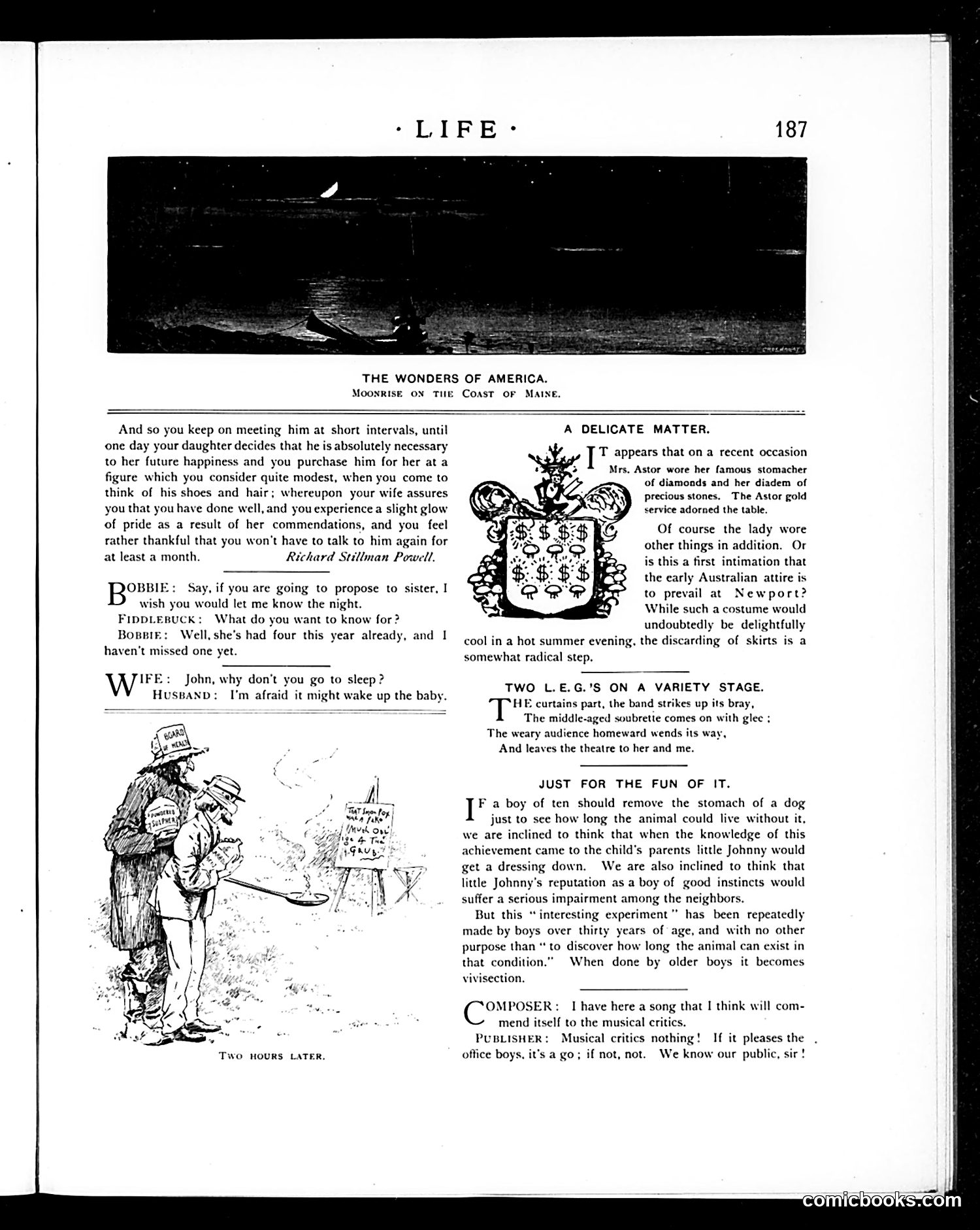
This page contains several satirical pieces rather than a single cartoon: 1. **"The Wonders of America" photograph** shows a moose on Maine's coast—presenting natural curiosities as American attractions. 2. **"A Delicate Matter"** satirizes wealthy women's fashion choices, mocking an Australian woman's daring costume (discarding skirts) at a Newport society event. The joke targets upper-class pretension and changing female fashion norms. 3. **Domestic dialogue** humorously depicts marital miscommunication about sleep and baby-waking. 4. **"Two L.E.G.'s on a Variety Stage"** jokes about theatrical performances and audience exhaustion. 5. **"Just for the Fun of It"** mocks boys' cruel experiments on animals, critiquing casual childhood cruelty disguised as scientific curiosity. 6. **Composer/Publisher exchange** satirizes the music publishing industry's indifference to critical acclaim versus commercial success.
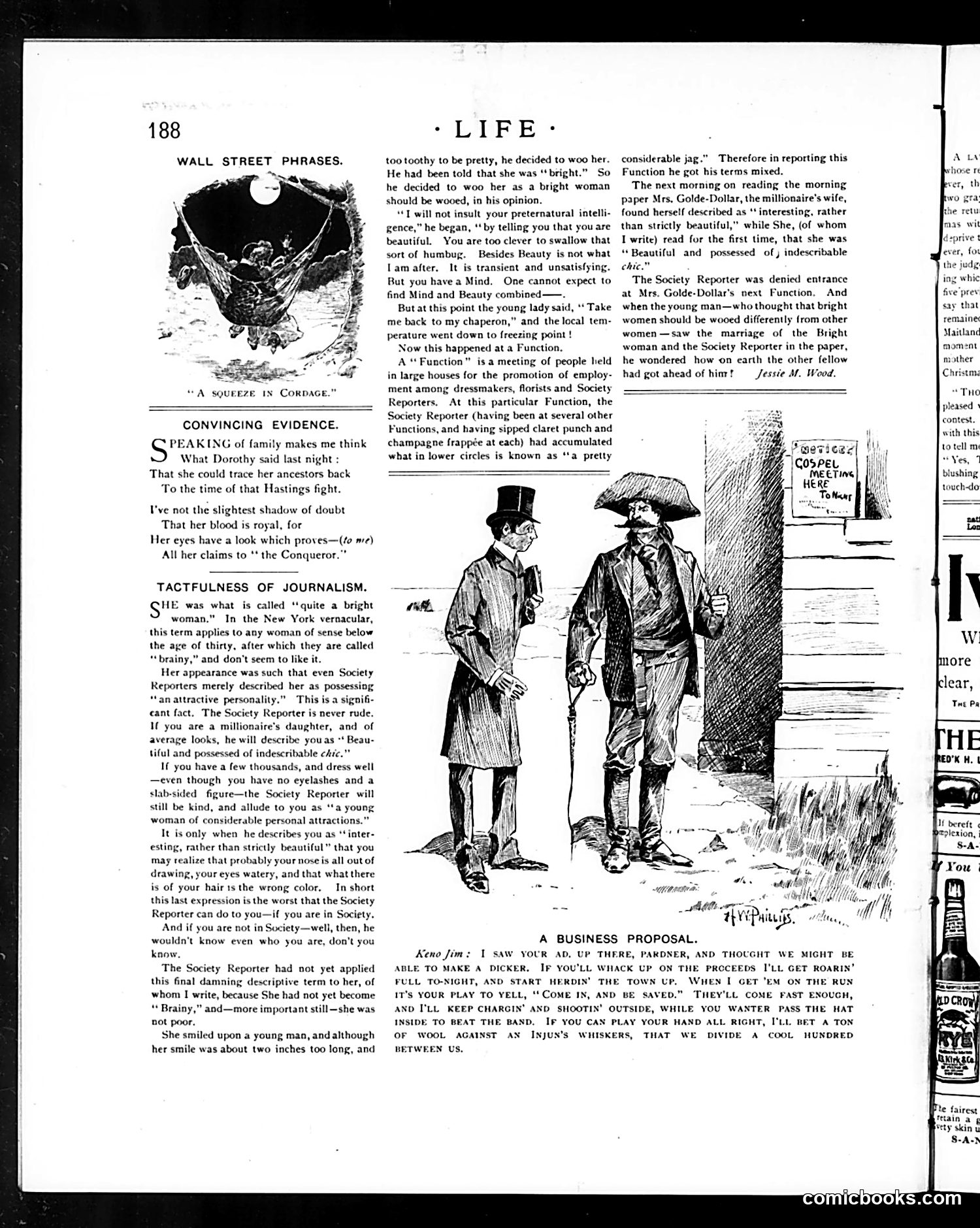
This page satirizes **high society and journalistic hypocrisy** in early 20th-century America. The main story mocks the **Society Reporter**—a gossip columnist covering wealthy social events. The satire exposes how reporters flatter the rich while insulting the poor: a millionaire's plain daughter gets described as "beautiful"; a poor woman with good looks is called merely "interesting, rather than strictly beautiful" (the worst insult). The plot follows a young man trying to woo a bright but unattractive wealthy woman by flattering her mind rather than beauty. At a society function, a drunk reporter misattributes the descriptions—calling the wealthy woman "interesting" and the bright woman "beautiful"—accidentally reversing their reputations. This costs the young man: the bright woman marries the reporter instead. The satire targets **class-based media bias**, showing how journalists weaponize language to curry favor with the wealthy while maintaining plausible deniability through coded compliments.
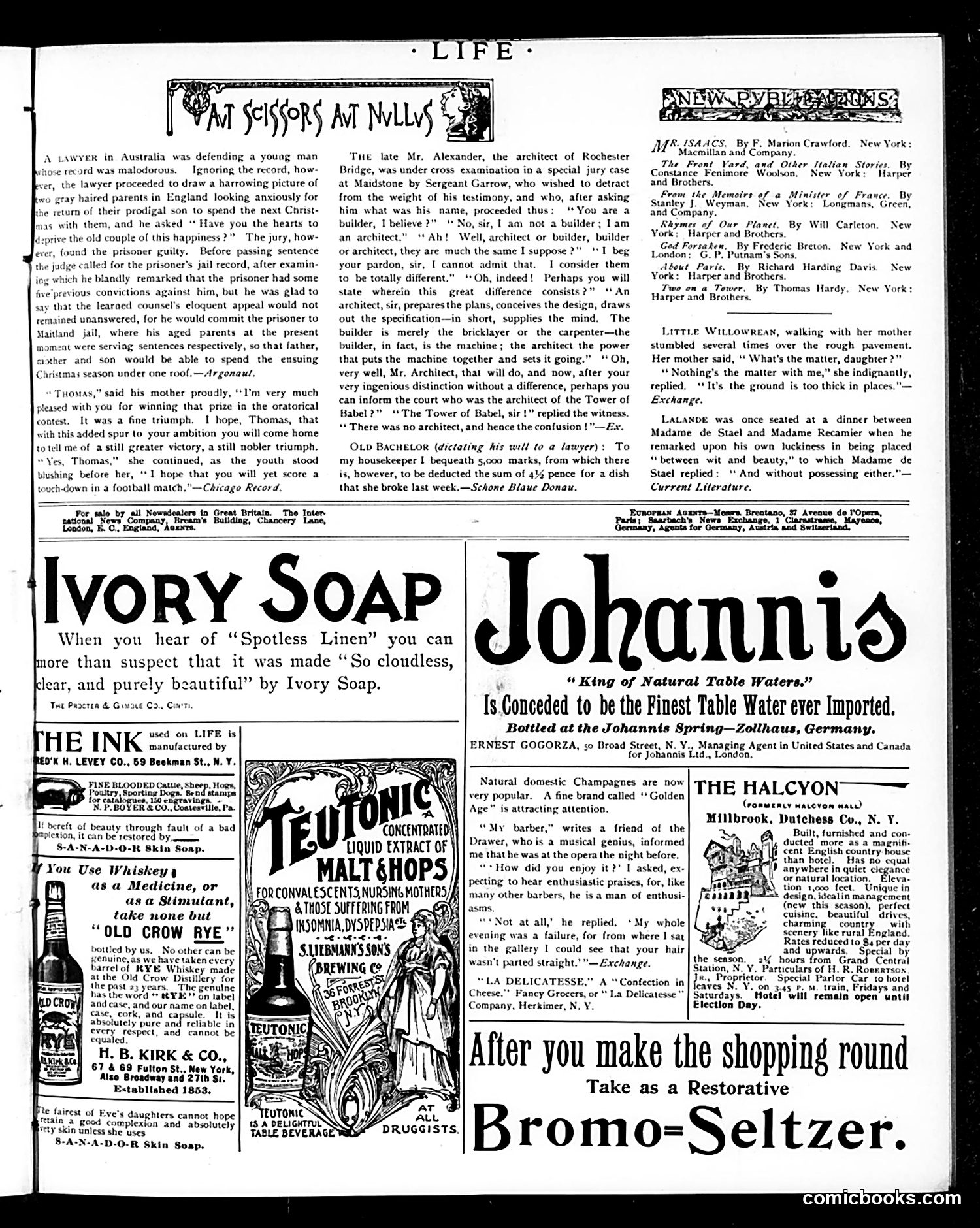
This page is primarily **text and advertisements**, not political cartoons. The content consists of: **Humorous anecdotes** presented as short stories, likely satirizing professional pretension and social awkwardness: 1. **The Architect story**: A lawyer defends a criminal by appealing to his elderly parents' emotions. The judge reveals the parents are themselves prisoners—dark satire on sentimentality versus justice. 2. **The Architect vs. Builder debate**: A cross-examination where an architect pompously distinguishes himself from a mere builder ("I supply the mind; he is the machine"), then cannot explain who designed the Tower of Babel. The satire mocks professional arrogance deflated by logical questions. 3. **"Nothing's the matter with me"**: A child's malapropism ("the ground is too thick") rather than admitting clumsiness—gentle satire on childish pride. The **advertisements** (Ivory Soap, Teutonic Malt Extract, Johannis Water) are period product pitches unrelated to the editorial content.
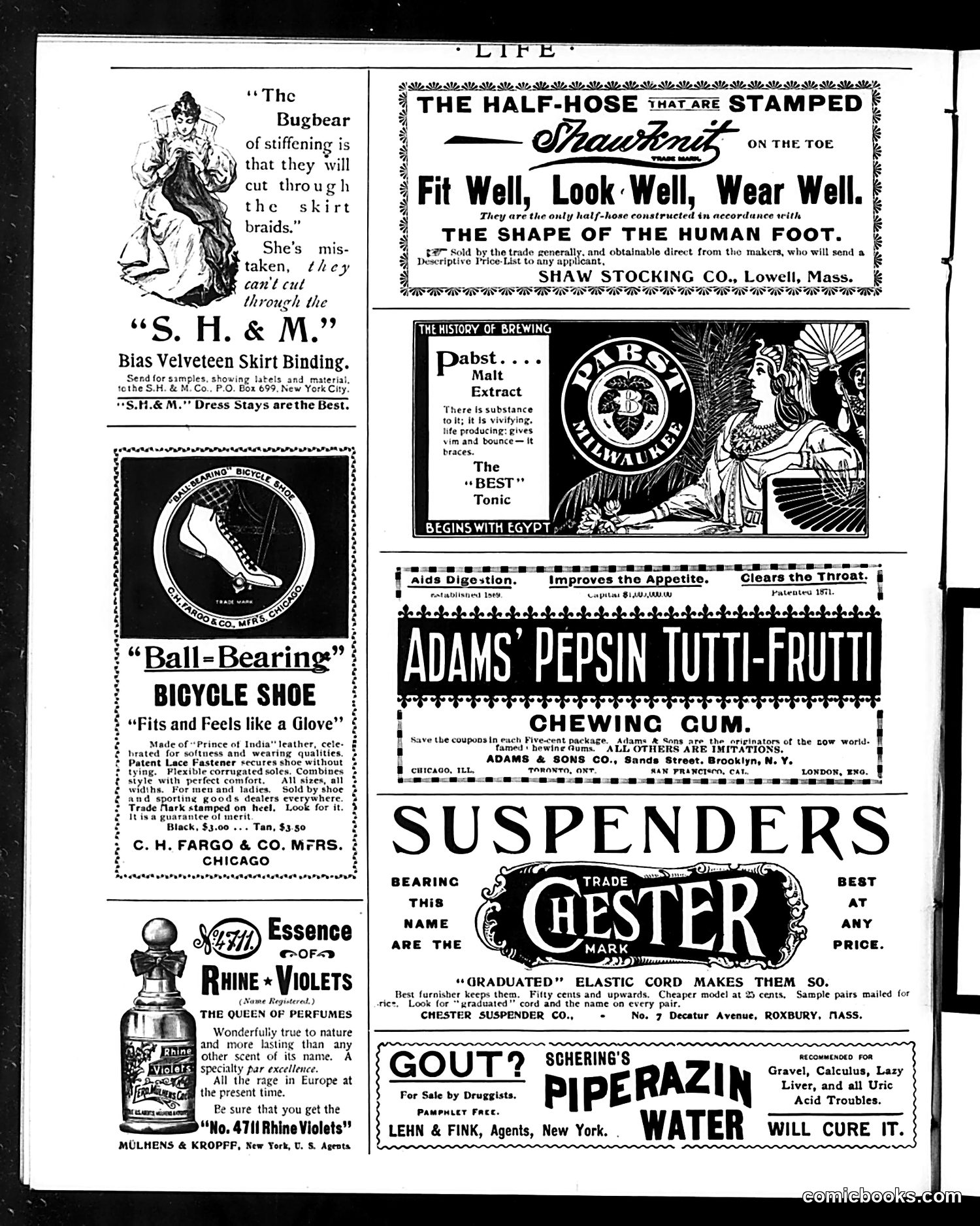
This is primarily an **advertisement page** from Life magazine, not a political cartoon. It features early 1900s consumer product ads with minimal satirical content. The single cartoon element appears at top-left: a sketch of a woman labeled "The Bugbear" complaining that skirt braids are stiff and difficult to cut through. This is a gentle mockery of contemporary women's fashion anxieties—the ad uses her complaint to promote "S.H. & M." bias velveteen skirt binding as a solution. The rest of the page consists of product advertisements reflecting period concerns: women's corsetry and dress stays (addressing silhouette control), bicycle shoes (reflecting the "New Woman" cycling craze), perfume, brewing tonics (marketed as health products), chewing gum, suspenders, and a "piperazin water" remedy for gout and digestive issues. The tone is advertising copy rather than satire—these products address genuine consumer demands of the era without mockery.
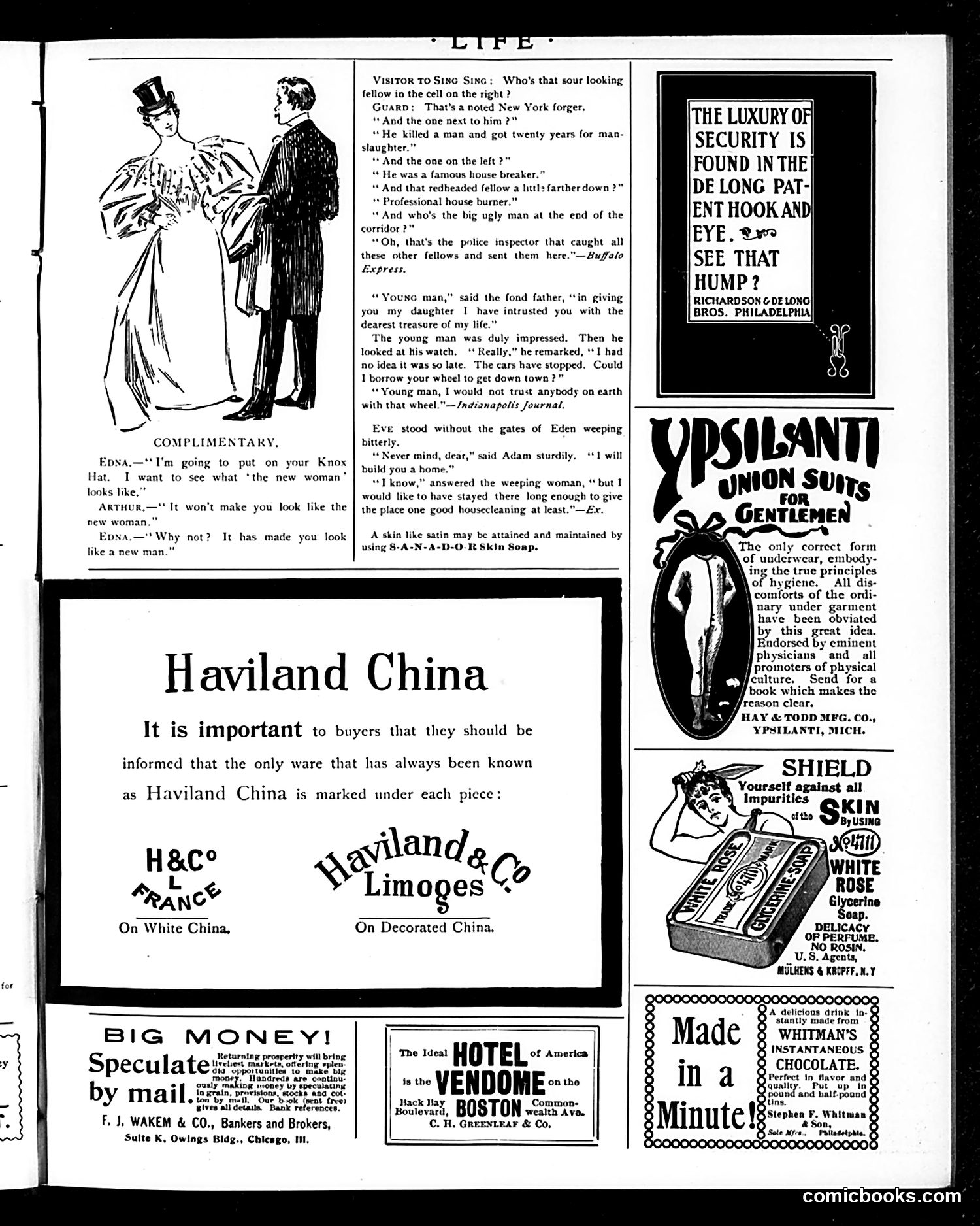
This page contains multiple brief satirical pieces typical of early-20th-century Life magazine humor: **"Complimentary"**: A joke about gender roles—a woman tries on a man's hat to understand "the new woman," but her husband notes the hat made *him* look like "a new man," suggesting changing masculine identity concerns of the era. **Prison Inspector joke**: Dark satire inverting expectations—the police inspector who arrested all the criminals is presented as more suspicious/criminal-looking than the actual prisoners (forgers, murderers, house burners). **Young man and the bicycle**: Satirizes materialistic suitors—a father trusts his daughter to a young man but refuses to lend him his bicycle, mocking the man's true priorities. **Adam and Eve**: Jokes about domestic labor and women's dissatisfaction, with Eve regretting leaving Eden because she didn't get to clean it first. The page is primarily **advertisements** (Haviland China, investment schemes, clothing, soap, chocolate) interspersed with these short humorous pieces—standard Life magazine format.
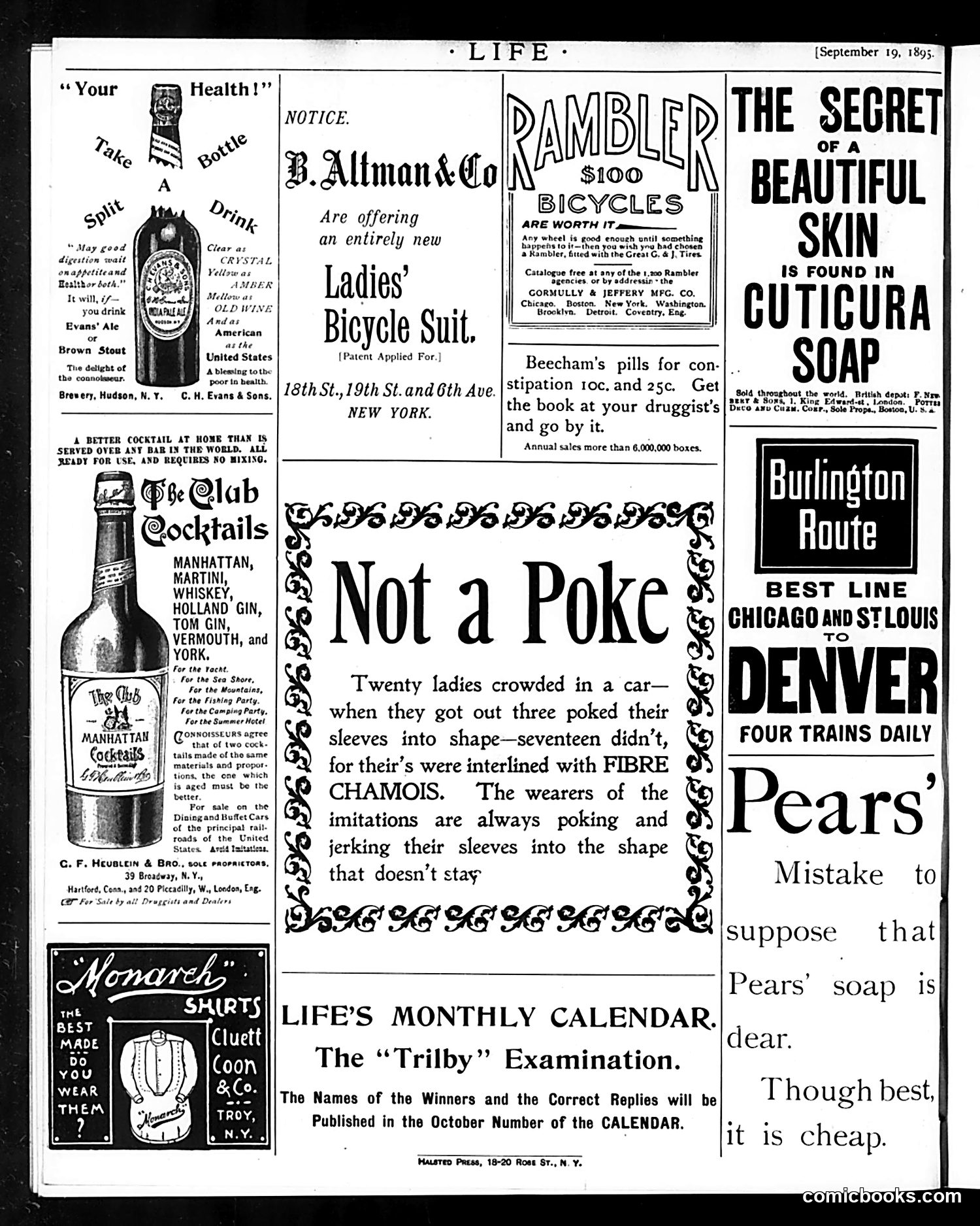
This page is primarily **advertising**, with one notable satirical piece: ## "Not a Poke" (Center Feature) The cartoon satirizes women's fashion—specifically the "leg of mutton" sleeve style popular in the 1890s. The joke: twenty ladies exited a crowded carriage; only three could poke their sleeves back into the fashionable puffy shape, while seventeen couldn't because theirs were cheaply made with "fibre chamois" lining instead of proper material. The satire targets both **fashion pretension** and **inferior imitations**. Women wearing knockoff versions constantly have to fuss with their sleeves to maintain the silhouette, while authentic versions hold their shape. It's poking fun (pun intended) at the absurdity of fashion-conscious women struggling with poorly-constructed clothing and the vanity required to maintain fashionable appearances. The page also advertises bicycles, cocktails, soap, and other period products typical of the 1890s consumer market.