
Life, 1895-09-19 · page 10 of 16
Life — September 19, 1895 — page 10: what you’re looking at
What you’re looking at
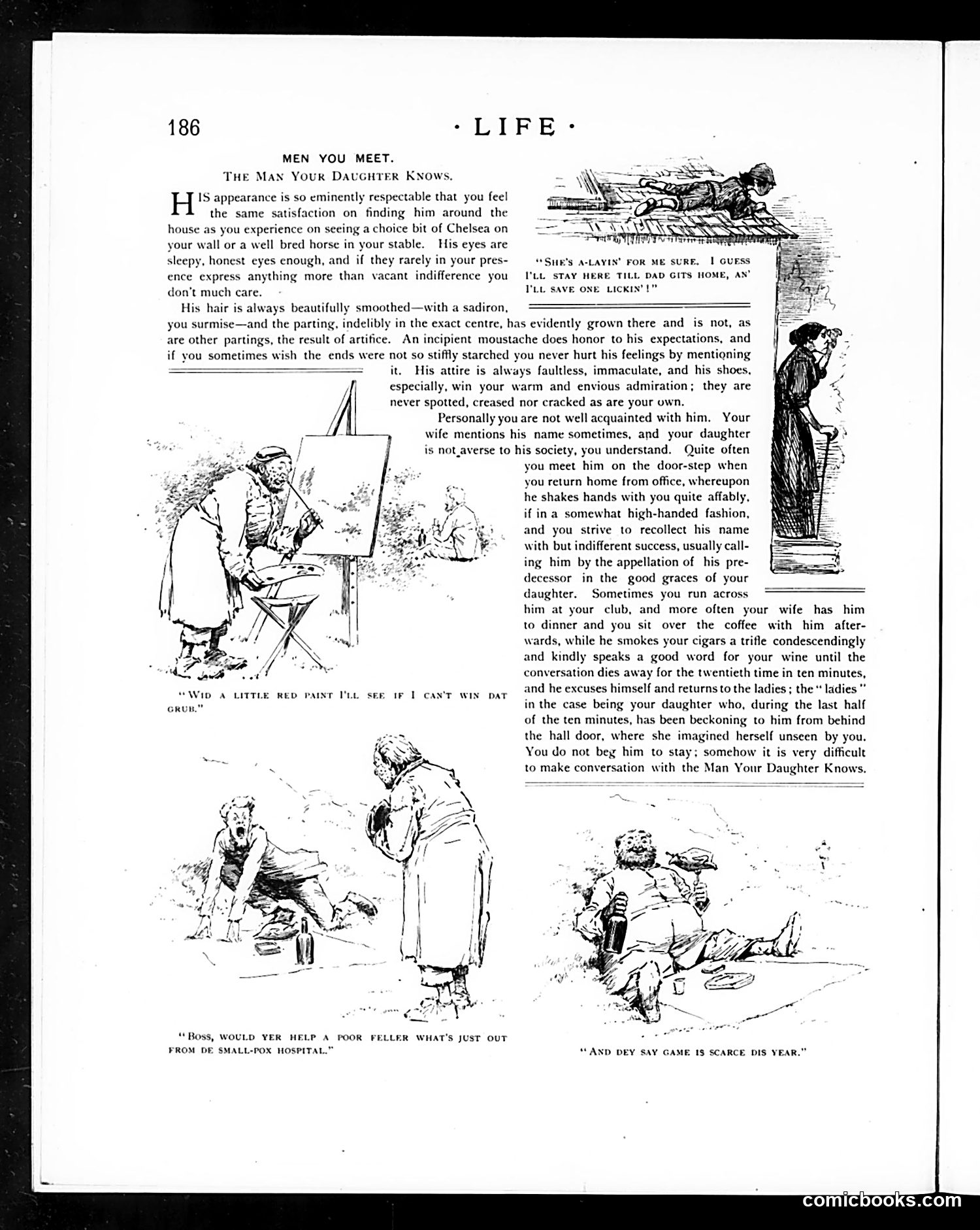
This satirical article describes a socially respectable gentleman caller—someone whose polished appearance (smooth hair, immaculate attire, well-shined shoes) creates an impression of impeccable character. The text humorously notes the irony: while you approve of him based on appearances and his family connections, you actually know little about him personally. The accompanying sketches show working-class or bohemian figures (an artist painting, men in casual dress), contrasting with the article's subject. The satire suggests that respectable appearances can mask different realities, and that social acquaintance with someone is superficial—you meet him briefly at your door or at your club, yet your daughter spends considerable unsupervised time with him, making actual conversation between you nearly impossible.
📄 Transcribed text from this page (OCR, searchable)
Machine-transcribed from the original scan — historical spelling and the odd misread are preserved.
186 -LCIFE-: MEN YOU MEET. THE MAN YOUR DAUGHTER Knows. 1S appearance is so eminently respectable that you feel the same satisfaction on finding him around the house as you experience on seeing a choice bit of Chelsea on your wall or a well bred horse in your stable. His eyes are sleepy, honest eyes enough, and if they rarely in your pres- Sue's A+ FOR ME SURE, I GUESS ence express anything more than vacant indifference you I'LL STAY HERE TILL DAD GITS HOME, AN’ don't much care. TLL SAVE ONE LICKIN!” His hair is always beautifully smoothed—with a sadiron, you surmise—and the parting, indelibly in the exact centre, has evidently grown there and is not, as are other partings, the result of artifice. An incipient moustache does honor to his expectations, and if you sometimes wish the ends were not so stiffly starched you never hurt his feelings by mentioning Sana it. His attire is always faultless, immaculate, and his shoes, especially, win your warm and envious admiration; they are never spotted, creased nor cracked as are your own. Personally you are not well acquainted with him. Your wife mentions his name sometimes, and your daughter is not_averse to his society, you understand. Quite often you meet him on the door-step when you return home from office, whereupon he shakes hands with you quite affably, if in a somewhat high-handed fashion, and you strive to recollect his name with but indifferent success, usually call- ing him by the appellation of his pre- decessor in the good graces of your daughter. Sometimes you run across him at your club, and more often your wife has him to dinner and you sit over the coffee with him after- Zi wards, while he smokes your cigars a trifle condescendingly Fei ys and kindly speaks a good word for your wine until the FONE paar conversation dies away for the twentieth time in ten minutes, “Wip A LITTLE RED PAINT FL see iF 1 cay't win, par and he excuses himself and returns to the ladies ; the “ ladies" orun.” in the case being your daughter who, during the last half of the ten minutes, has been beckoning to him from behind the hall door, where she imagined herself unseen by you. You do not beg him to stay; somehow it is very difficult to make conversation with the Man Your Daughter Knows. “Boss, WOULD YER HELP A POOR FELLER WHAT'S JUST OUT FROM DE SMALL-POX HOSPITAL.” “AND DEY SAY GAME IS SCARCE DIS YEAR.”