
A complete issue · 16 pages · 1895
Life — September 12, 1895
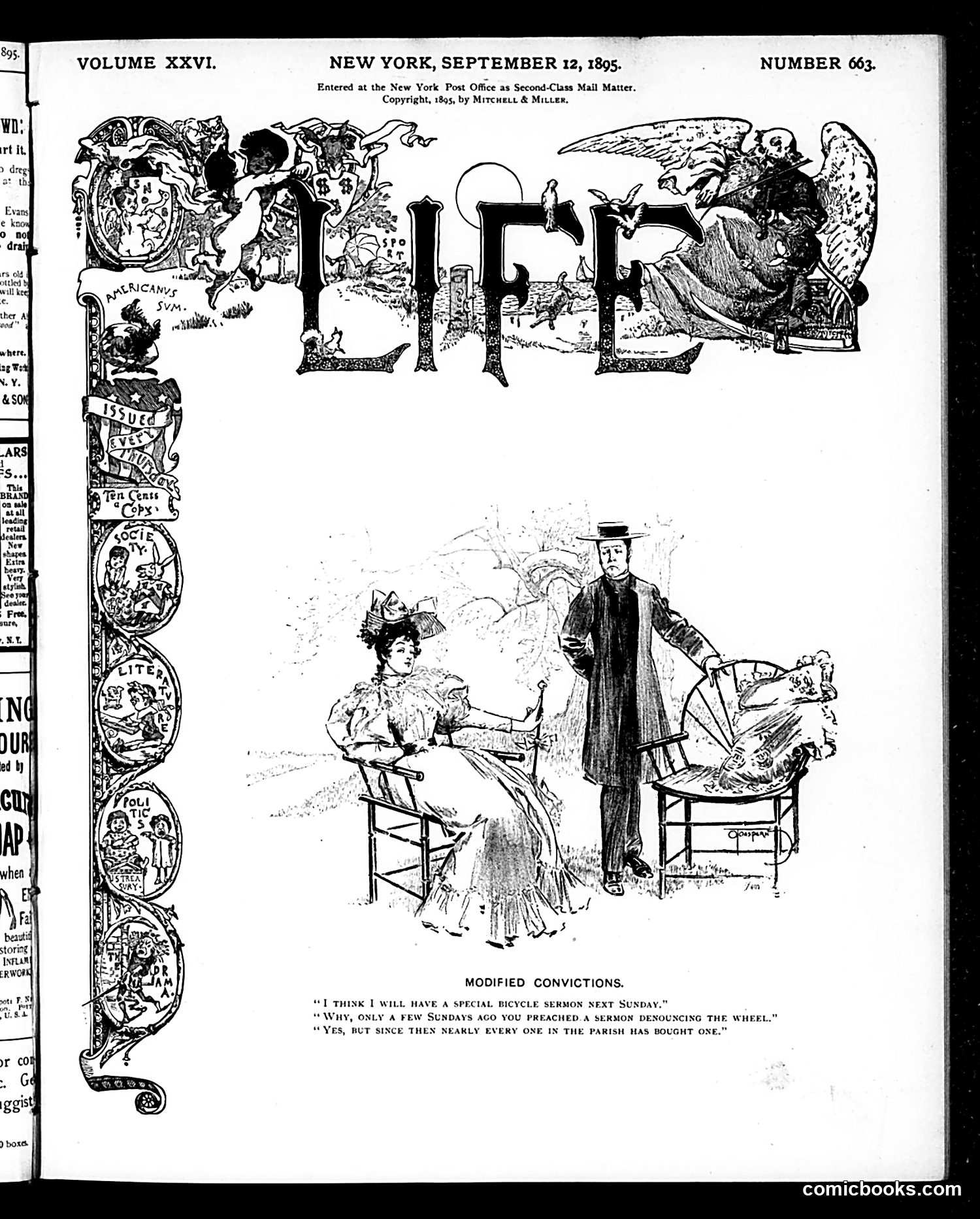
This cartoon satirizes the clergy's changing stance on bicycles. The caption shows a clergyman explaining to a woman that he'll now preach a "special bicycle sermon next Sunday," reversing his recent denunciation of wheels. The joke: Just weeks earlier, this same minister preached against bicycles (likely viewing them as morally corrupting or inappropriately liberating, especially for women). Now that "nearly every one in the parish has bought one," he's conveniently modified his religious convictions to match his congregation's purchasing habits. The satire mocks clerical hypocrisy—how religious leaders adapt moral teachings to social trends rather than maintaining consistent principles. It also reflects 1890s bicycle mania, when the vehicle was revolutionary and culturally controversial.
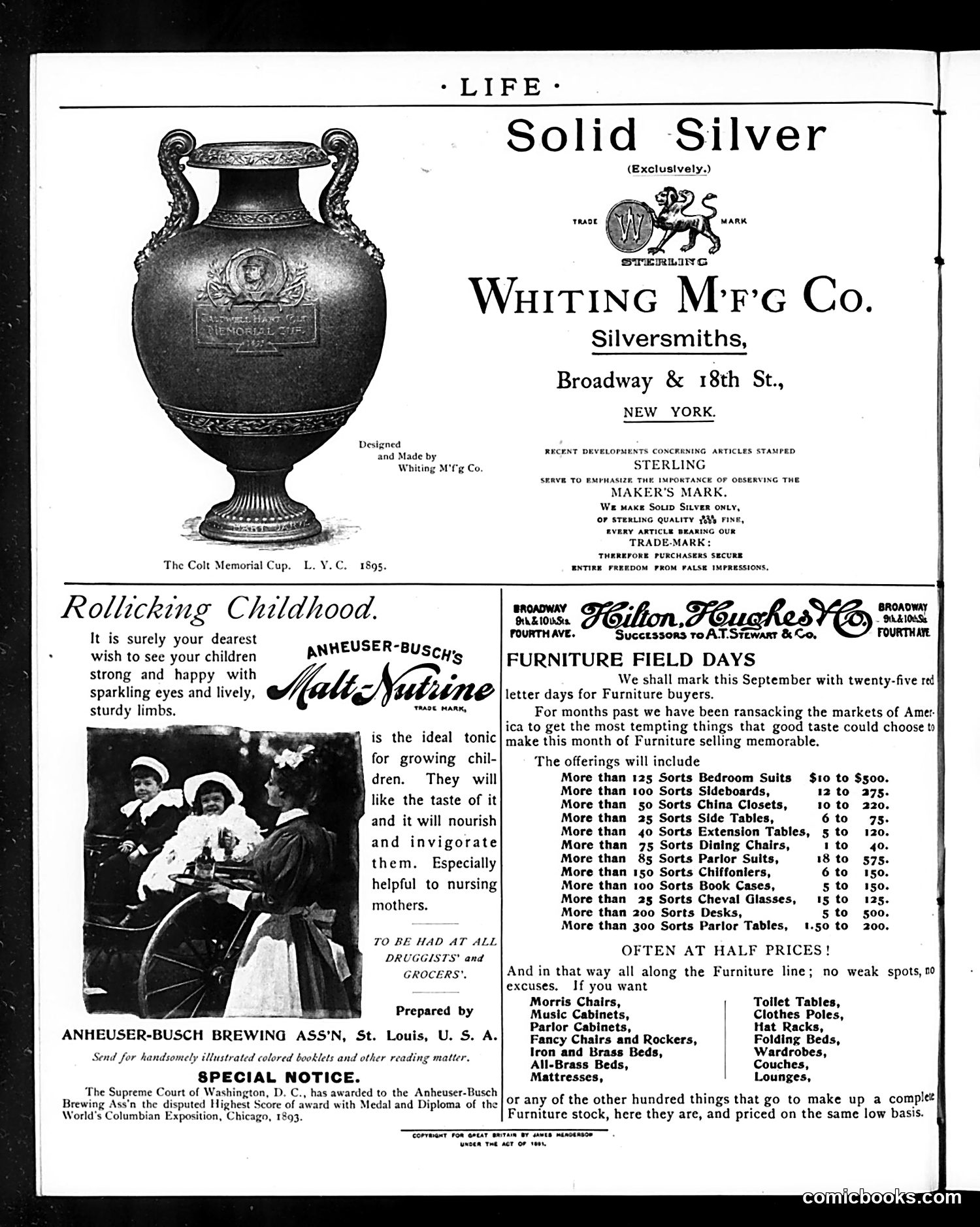
This page is **primarily advertising**, not satirical content. The main image shows an ornate silver urn—the "Colt Memorial Cup" from 1895—advertised by Whiting Manufacturing Company, a silversmith firm on Broadway in New York. Below that is an advertisement for Anheuser-Busch's "Malt Nutrine" tonic, featuring a photograph of children and a nursing mother. The ad promotes the product as beneficial for growing children and nursing mothers, claiming it will "nourish and invigorate them." The right side advertises Halion, Houghes & Co.'s furniture sale, promoting discounted bedroom suites, sideboards, and other household items. There is no political satire or social commentary visible on this page—it represents standard late-19th-century magazine advertising.
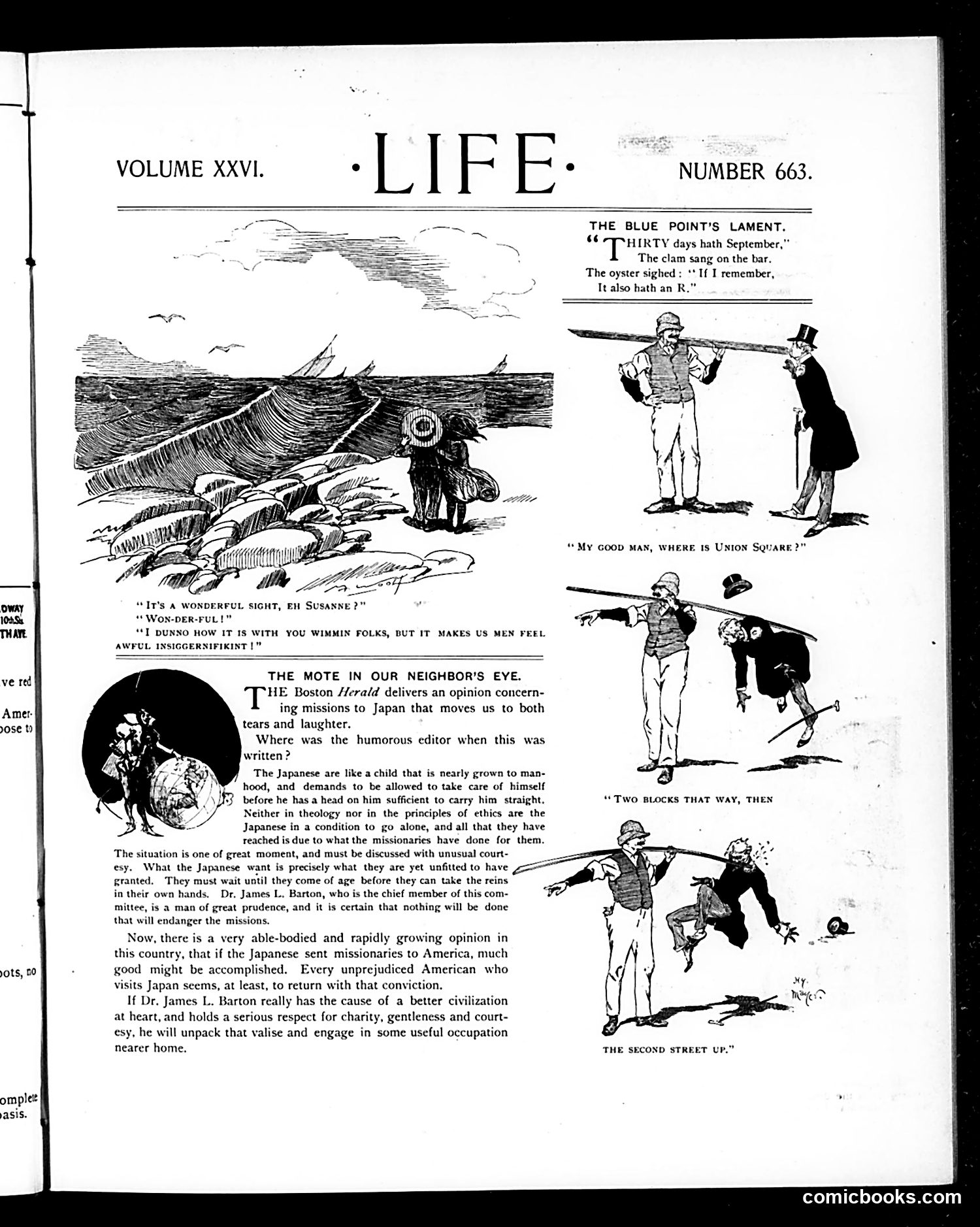
This page contains satirical commentary on Christian missions to Japan. The main article, "The Mote in Our Neighbor's Eye," critiques the *Boston Herald* for questioning Japanese missionary efforts in America while America sends missionaries to Japan—a hypocritical "double standard" the author calls out. The cartoon sequences on the right humorously depict a gentleman (likely representing an American) repeatedly encountering a street urchin or vagrant, with captions like "Two blocks that way, then 'The Second Street Up.'" The joke appears to satirize Americans giving directions or advice while ignoring problems at home. The "Blue Point's Lament" at top left shows beached clams—a pun-based joke about oysters and claims. The overall message criticizes American moral superiority regarding foreign missions.
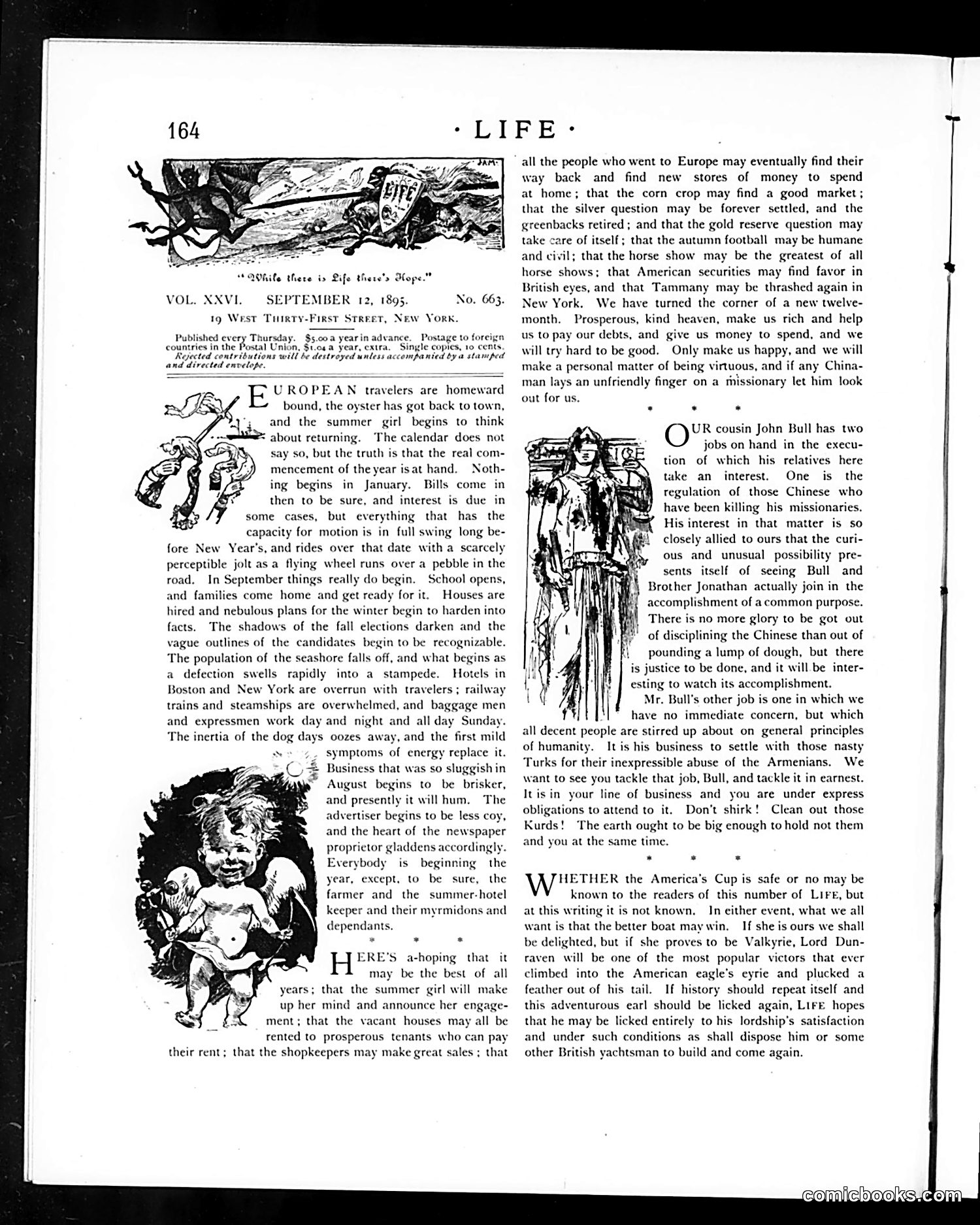
This page contains editorial commentary rather than political cartoons. The main illustrations are decorative: a cherub-like figure at the bottom left and a tall draped female figure on the right. The text discusses returning European travelers and upcoming autumn events (horse shows, America's Cup yacht race). It addresses "our cousin John Bull" regarding Chinese persecution of missionaries—urging British intervention on humanitarian grounds. The editor expresses hope that the America's Cup competition will be won fairly by whichever nation's boat proves superior. The tone is optimistic about economic recovery and social progress. The content reflects late-Victorian concerns: international relations, commercial competition, and humanitarian principles.
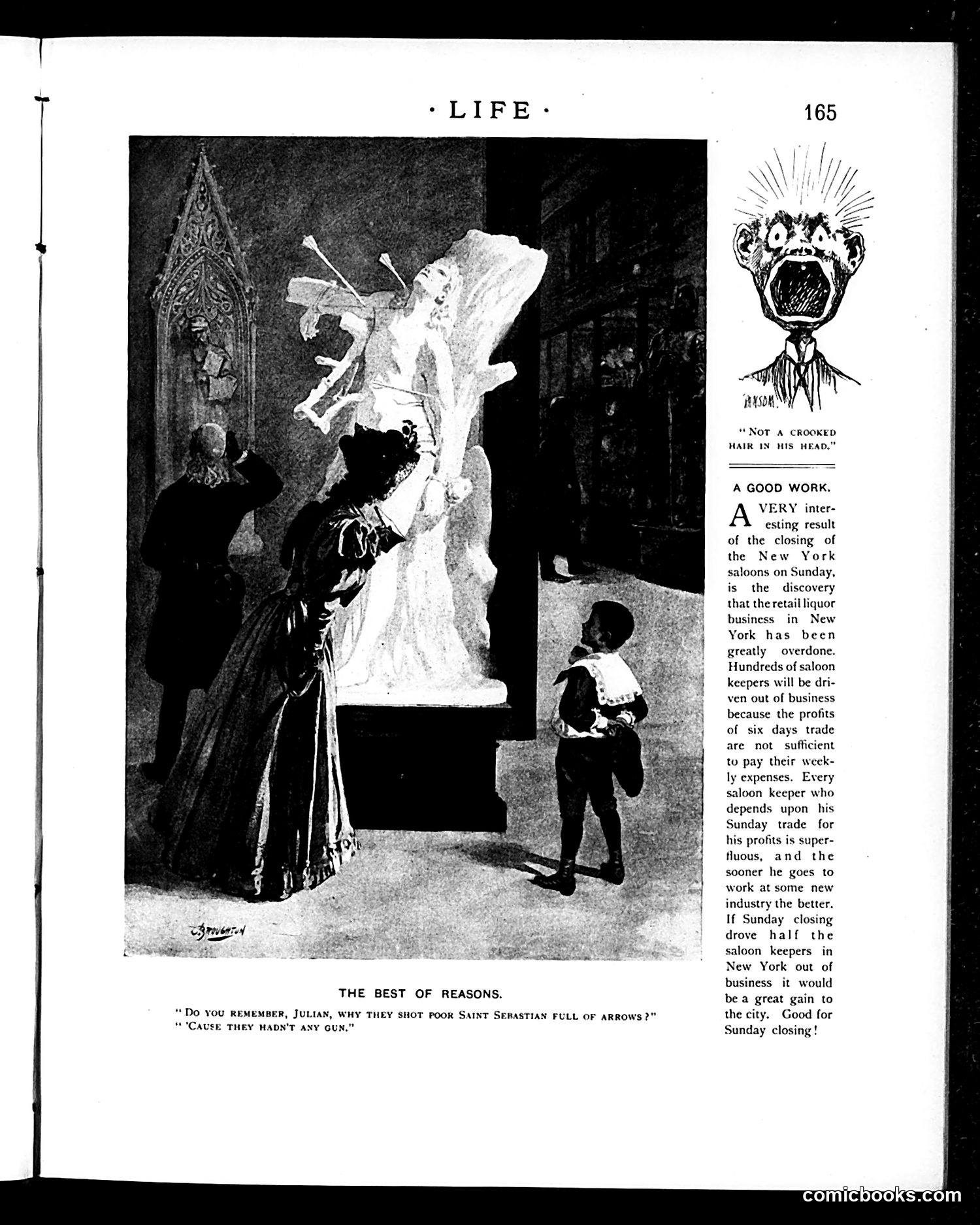
**Main Cartoon ("The Best of Reasons"):** This depicts a religious scene—a woman and child viewing what appears to be a statue of Saint Sebastian (identifiable by the arrows protruding from the figure). The caption quotes dialogue: "Do you remember, Julian, why they shot poor Saint Sebastian full of arrows?" "Cause they hadn't any gun." This is gallows humor—a dark joke that inverts the historical tragedy of Sebastian's martyrdom into absurdist comedy by suggesting the arrows were merely a weapon of convenience rather than religious persecution. **"A Good Work" Article:** The accompanying text advocates Sunday saloon closures in New York City, arguing the liquor business is "greatly overdone" and that closing saloons one day weekly would drive unprofitable establishments out of business—presented as beneficial to the city.
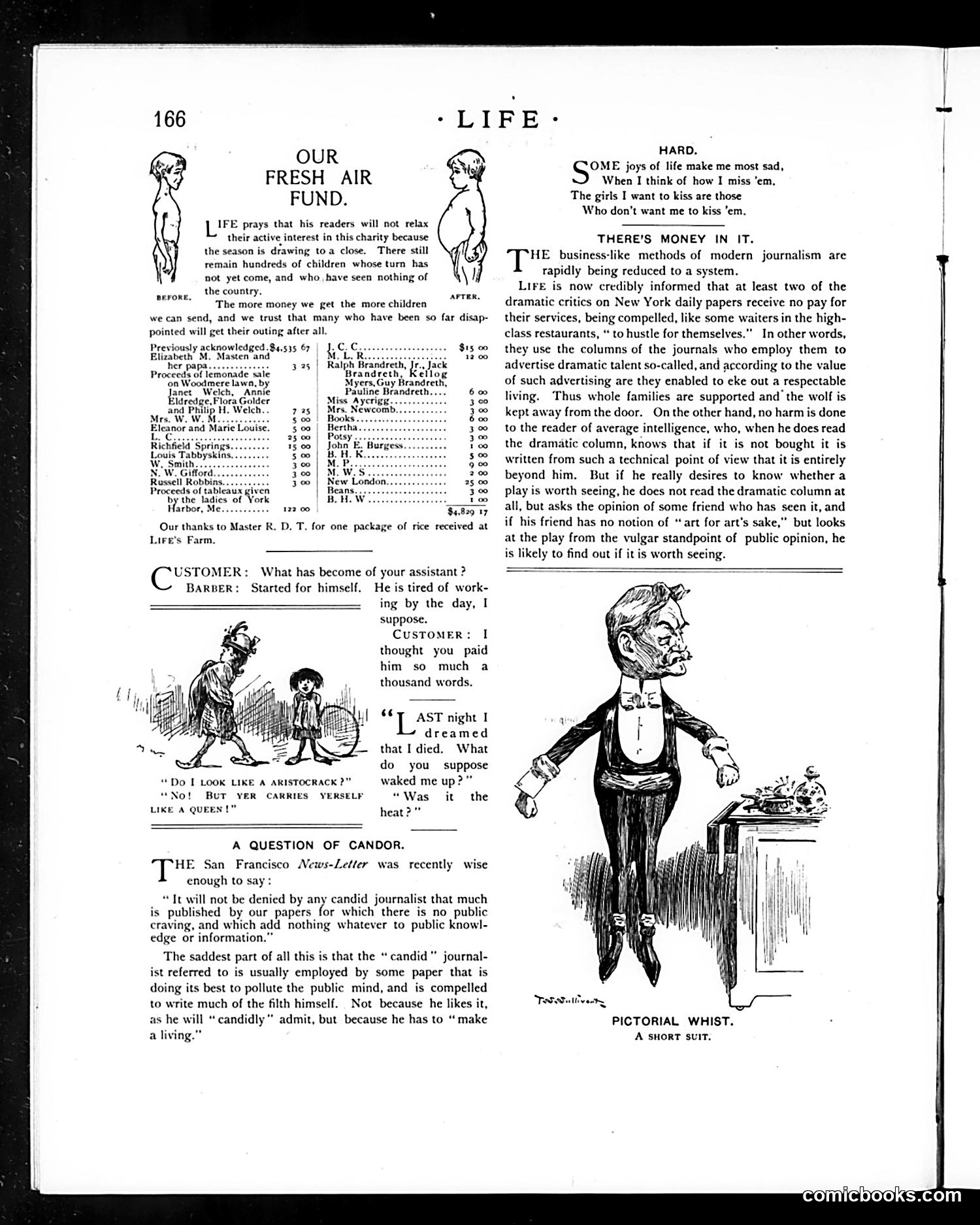
This page critiques early 20th-century journalism ethics through several pieces: **"Our Fresh Air Fund"** section lists charitable donations, satirizing how publications competed for public goodwill. **"There's Money In It"** argues that New York dramatic critics now accept payment for favorable reviews, essentially prostituting their profession. Life condemns this corruption, noting that families trust critics' opinions to guide entertainment choices. The satire exposes how business pressures compromise journalistic integrity. **"A Question of Candor"** quotes the *San Francisco News-Letter*, arguing that "candid" journalists—those who write sensationalism and filth—do so not from conviction but economic desperation: they must "make a living." The cartoons and text collectively attack newspaper corruption driven by commercial necessity rather than principle.
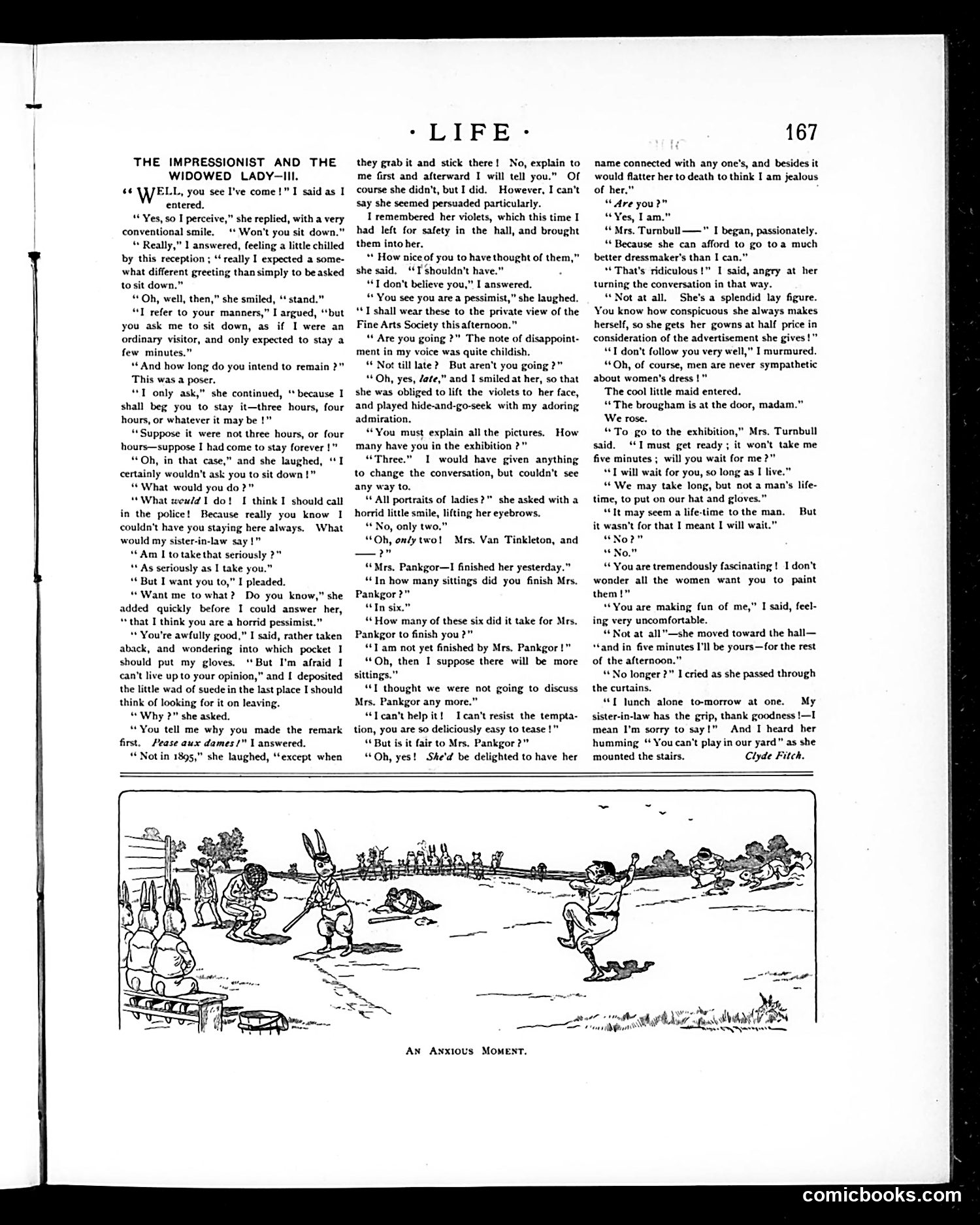
This cartoon depicts a beach or seaside scene with children playing, while adults supervise from the shore. The title "An Anxious Moment" refers to the tension visible in the image: what appears to be a child in water while caregivers watch nervously from the beach. The accompanying text discusses a social visit between well-to-do women—Mrs. Turnbull, Mrs. Van Tinkleton, and Mrs. Pankgor—debating etiquette, fashion, and social standing. The cartoon illustrates the era's class anxieties and parental supervision concerns. This appears to be satirizing both upper-class pretension in the text and the era's safety concerns about children at leisure. The humor derives from contrasting adult social anxieties with children's carefree play.
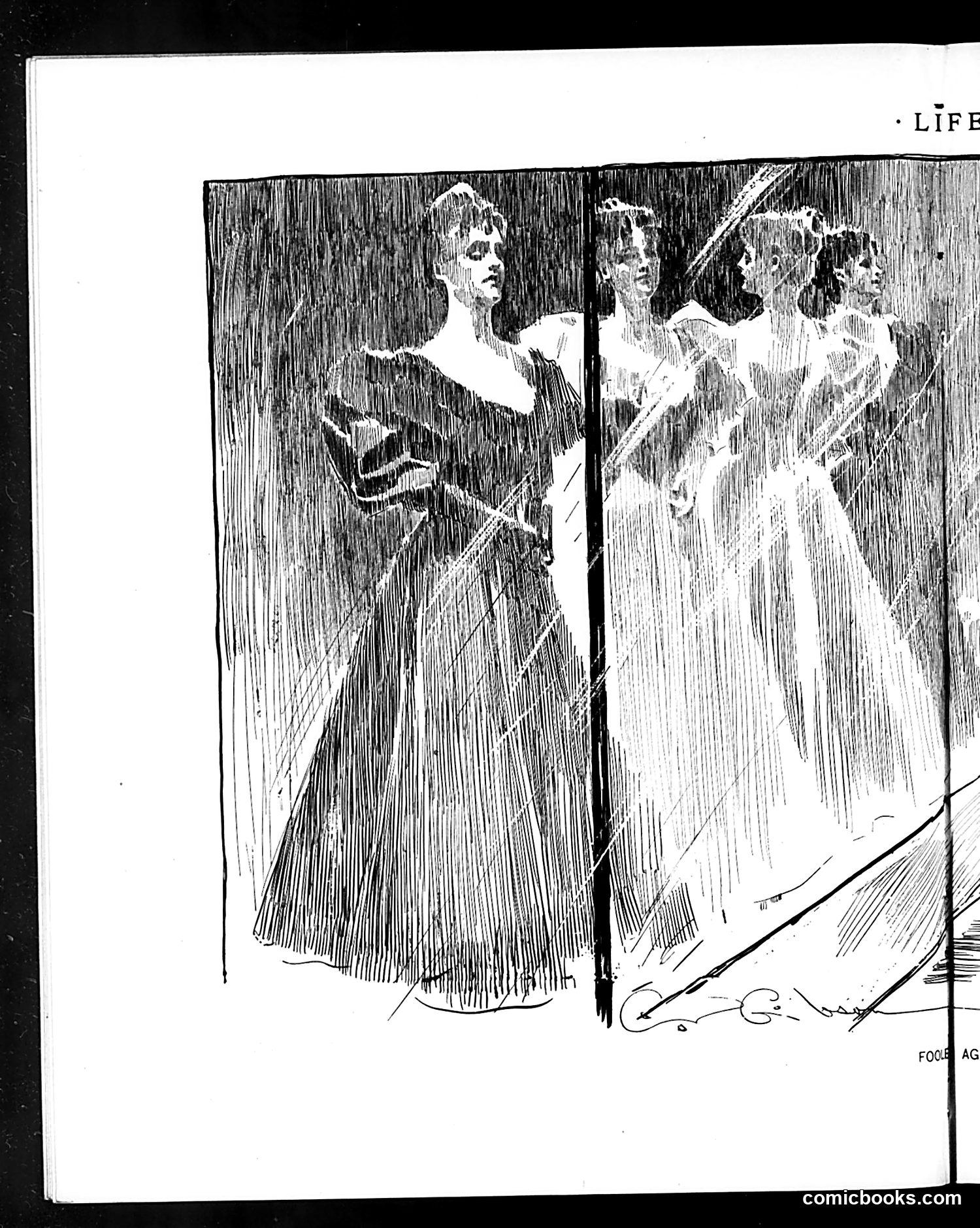
This page from *Life* magazine shows a satirical illustration featuring a woman in elegant evening dress examining her reflection in a mirror, with additional reflected figures visible behind her. The artistic style uses heavy cross-hatching typical of early 20th-century editorial illustration. The sketch appears to satirize **vanity and self-perception** — a common *Life* magazine theme. The woman's serious expression contrasts with her glamorous attire, while the mirror reveals multiple figures, possibly suggesting the gap between how women present themselves versus reality, or commentary on feminine self-absorption. Without visible caption text, the precise satirical target remains unclear, though the imagery critiques social attitudes toward women's appearance and vanity common to the era. The signature appears at bottom right but is illegible in this reproduction.
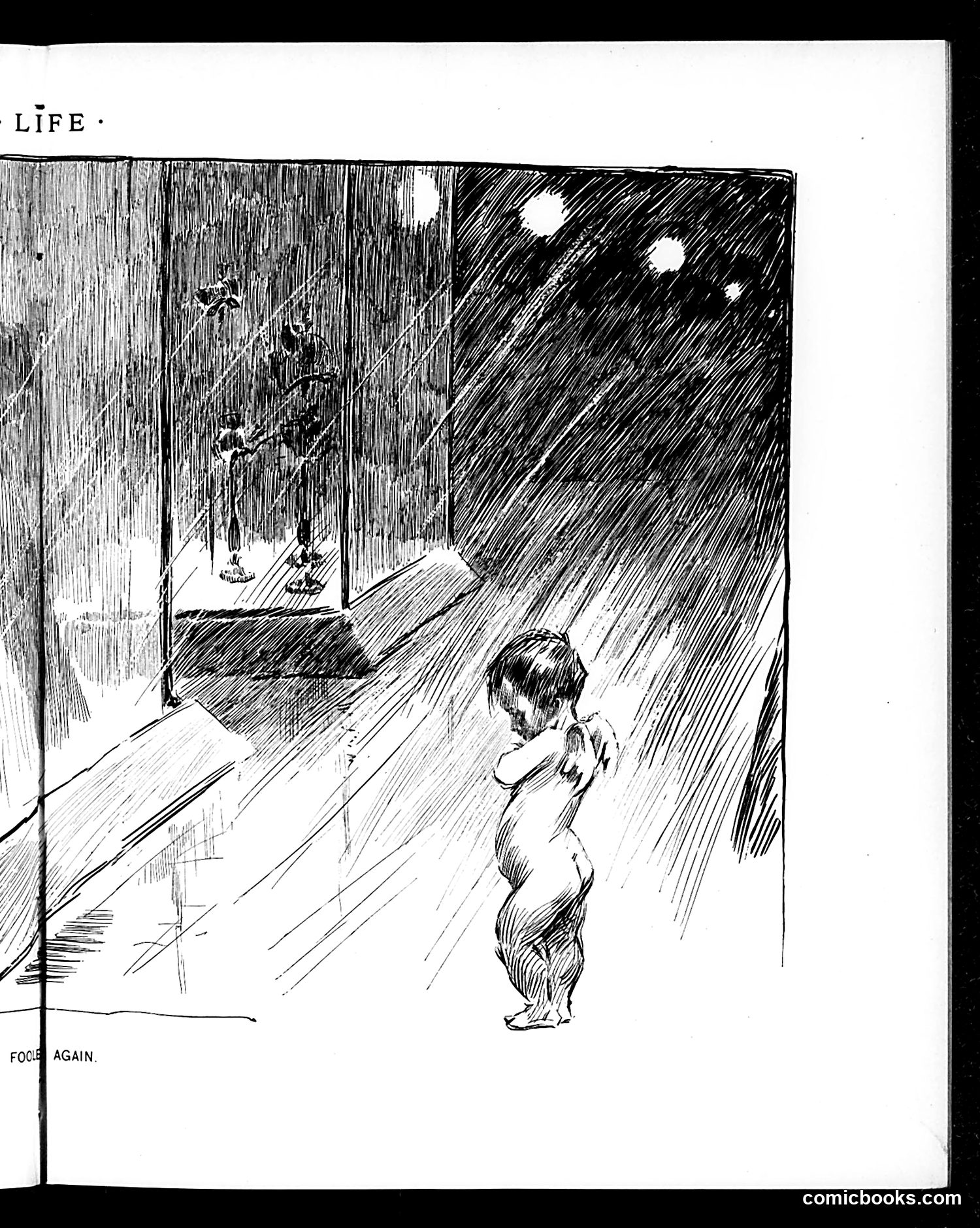
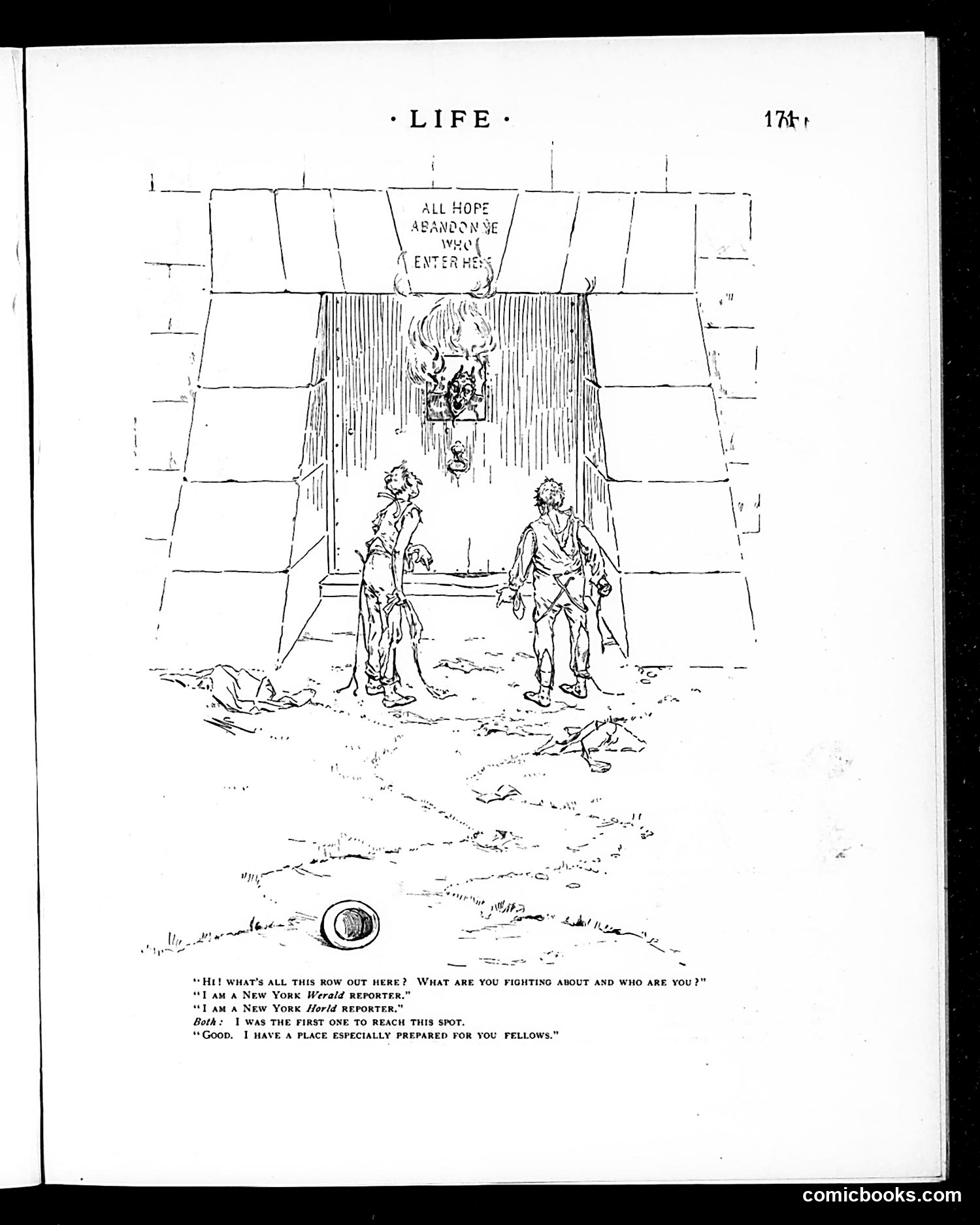
This is a satirical cartoon from *Life* magazine depicting Hell as a massive cavern with a gatekeeper. Two figures—appearing to be journalists or reporters—stand before the entrance, which bears Dante's famous inscription "All Hope Abandon Ye Who Enter Here." A New York *World* reporter announces himself and asks why people are "fighting about" this place. The gatekeeper (representing the Devil or Hell's administrator) responds that he has "a place especially prepared for you fellows," suggesting journalists will receive special punishment in Hell. The satire mocks newspapers and reporters, implying they're so dishonest or troublesome that Hell itself reserves particular torment for them. This reflects early 20th-century cynicism about press integrity and sensationalism.
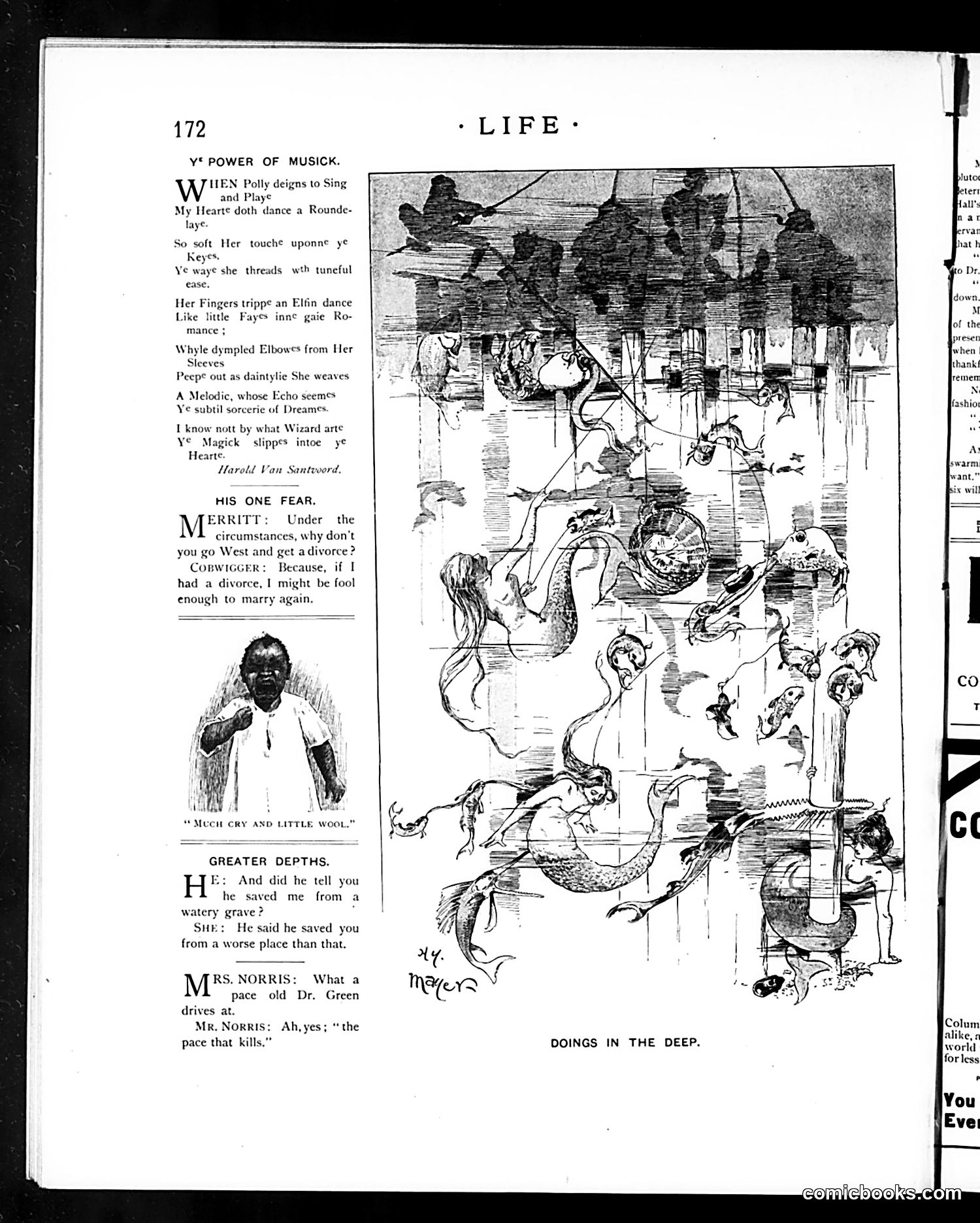
This page contains multiple satirical pieces typical of early 20th-century Life magazine humor: **"The Power of Music"** presents romantic, flowery verse (in affected archaic English) praising a woman named Polly's musical performance—satirizing overwrought sentimental poetry about female accomplishment. **"His One Fear"** is a brief joke about divorce: Merritt suggests his friend go West for a divorce, but the friend (Cobwigger) fears he'd foolishly remarry—mocking male anxiety about marriage and divorce. **"Greater Depths"** jokes darkly about salvation, with a woman saying her husband was saved from "a worse place" than a watery grave—likely implying Hell or married life itself. **"Mrs. Norris"** references the proverb "the pace that kills," playing on dangerous driving. **"Doings in the Deep"** is a whimsical underwater illustration featuring mermaids and sea creatures in fantastical scenarios—pure imaginative humor without apparent satirical intent. The page mixes romantic parody, domestic comedy, and absurdist fantasy typical of Life's miscellaneous humor format.
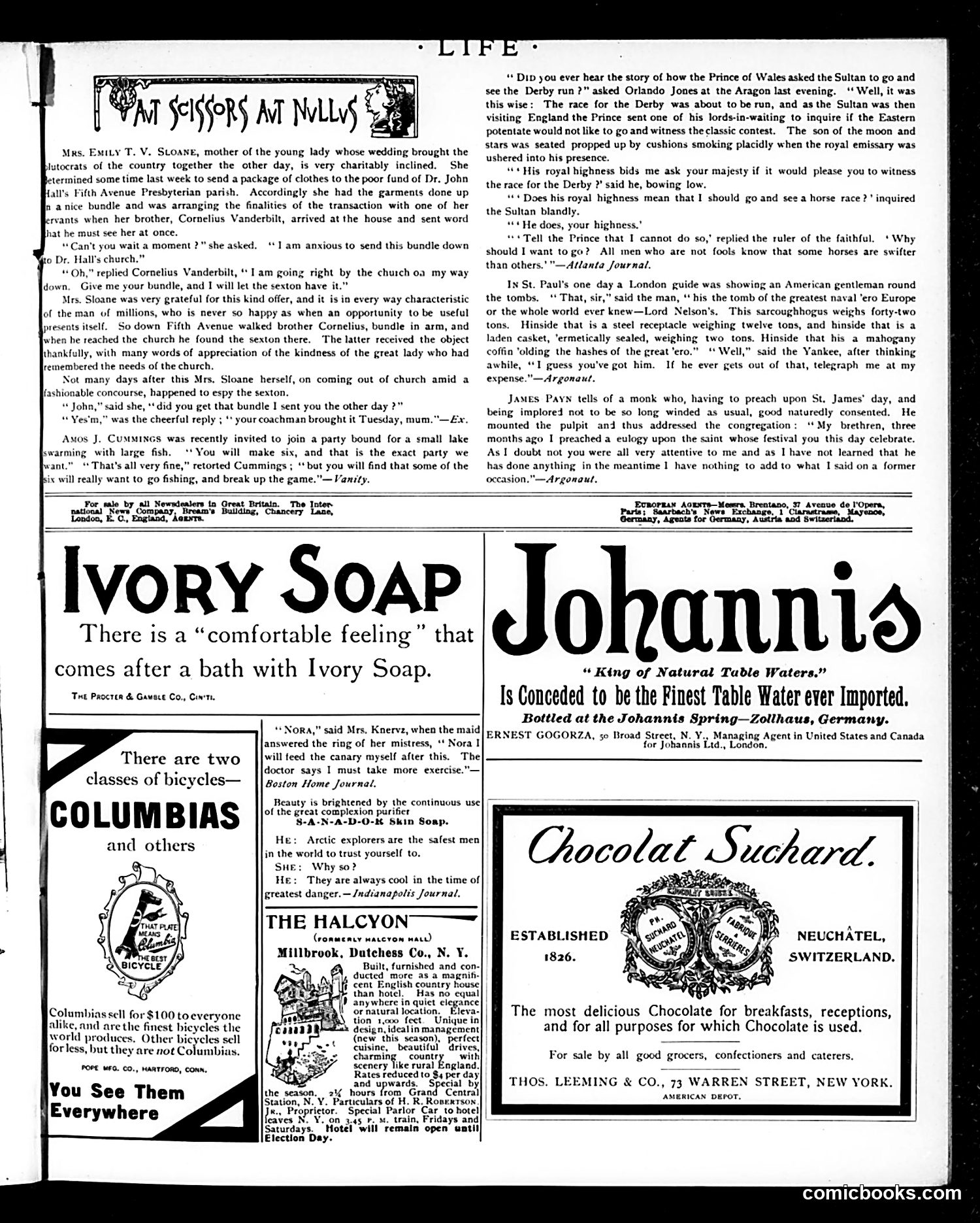
This page consists primarily of **humor columns and advertisements** rather than political cartoons. The main editorial content presents four brief anecdotes: 1. **"At Nullus"**: Mrs. Emily Sloane sends charity clothes to her church via her brother Cornelius Vanderbilt, but the sexton mistakenly credits her coachman instead—a mild joke about charity and credit-taking. 2. A fishing party joke about unwanted guests disrupting the activity. 3. **The Sultan and the Derby**: A humorous story mocking the Sultan's literal-mindedness when invited to watch horse racing in England—satirizing Eastern unfamiliarity with British pastimes. 4. **St. Paul's Cathedral anecdote**: An American tourist is impressed by the elaborate containment of Lord Nelson's remains—gentle satire of American wonder at British historical monuments. The **advertisements** (Ivory Soap, Columbias bicycles, Johannis water, Chocolat Suchard) occupy significant space, typical for Life magazine's revenue model. The humor is gentle, social rather than political, focused on class distinctions and cultural misunderstandings rather than advocacy.
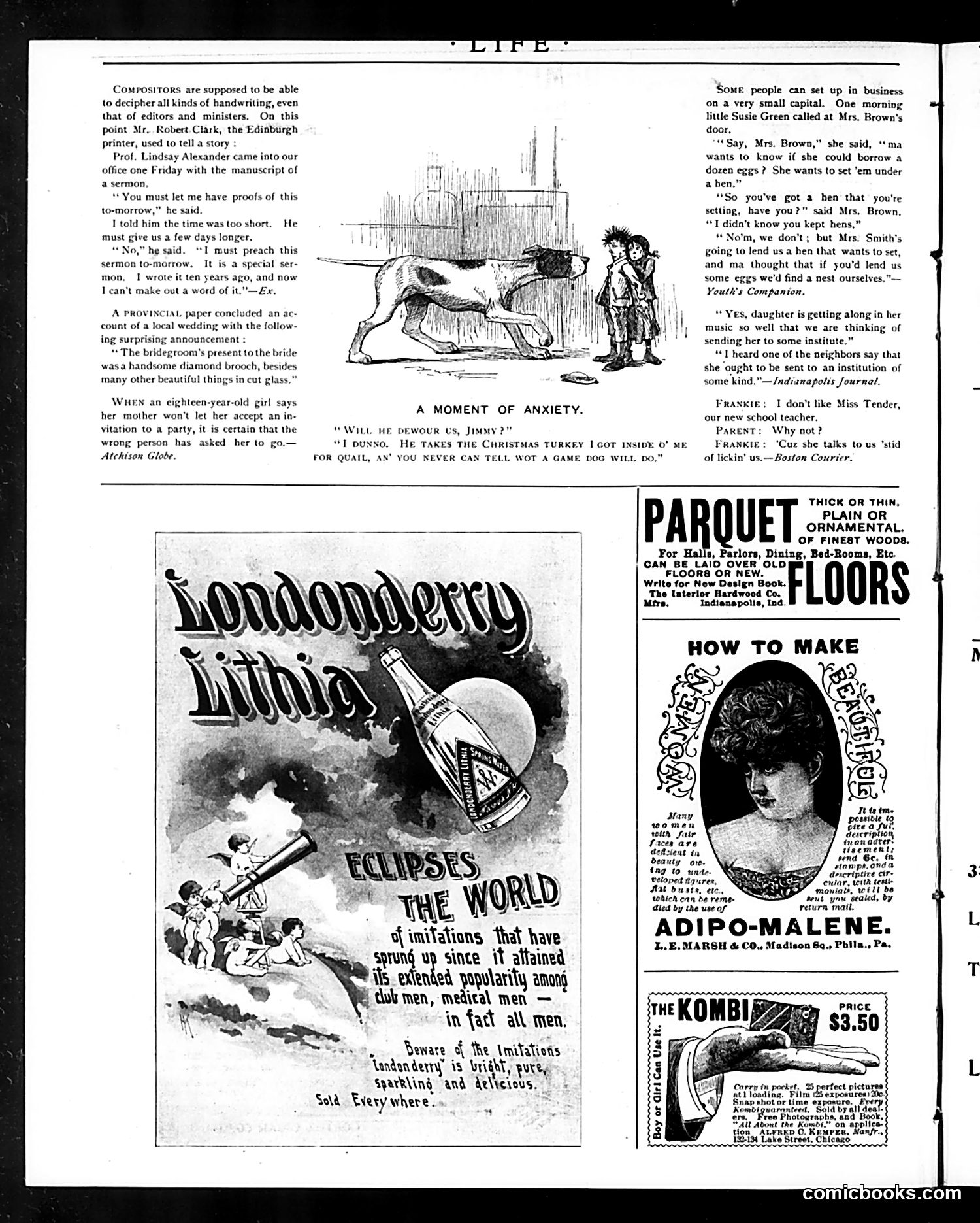
This page contains **humor pieces and advertisements** typical of early Life magazine's satirical format. **Main cartoon**: "A Moment of Anxiety" depicts a dog owner reassuring someone that his hunting dog won't eat a Christmas turkey, claiming game dogs are unpredictable—the joke being the owner's own uncertainty undermines his reassurance. **Humorous anecdotes** include: - A professor who cannot read his own ten-year-old sermon handwriting - A wedding announcement accidentally praising "cut glass" alongside a diamond brooch - Young Susie Green's entrepreneurial scheme to borrow eggs and a neighbor's hen to start her own "nest" - A student preferring a teacher who uses conversation over physical punishment **Advertisements** occupy significant space, promoting parquet flooring, Lindonderrry (a beverage), Adipo-Malene (a beauty product), and The Kombi camera. The page reflects early 20th-century American life: domestic humor, emerging consumer culture, and changing attitudes toward corporal punishment in schools.
This is primarily an **advertising page** from Life magazine's early period, featuring patent medicines and consumer goods typical of the late 19th/early 20th century. ## Notable Content: **Demelvo Hair Eradicator**: An advertisement claiming to remove facial/body hair without injury, specifically noting it contains NO arsenic, lime, or corrosive substances—implying competitors *did* use such dangerous chemicals. This reflects the era's unregulated cosmetic industry. **Sanador Skin Soap**: Multiple mentions suggest this was a heavily-advertised product of the period. **Beeman's Pepsin Gum**: Featured with a cautionary note about counterfeits, indicating popular products were frequently faked. The **satirical anecdotes** scattered throughout mock pretentiousness (the "retired business man," the vain Boston boy with new spectacles) and cross-cultural awkwardness (the American Minister's faux pas at the Chinese court). The **dress-stay advertisement** includes a small morality tale about a girl who cheapened her skirt with poor binding—reflecting Victorian concerns about propriety and quality. Overall, this page reflects turn-of-century anxieties about product safety, social propriety, and consumer choice in an unregulated marketplace.
This is primarily an **advertising page** rather than satirical content. It showcases late-19th-century patent medicines and consumer products typical of Life magazine's revenue model. Notable advertisements include: - **Golden Sceptre** (pipe tobacco): Promoting a "trial" through postal samples - **Rambler Bicycles** ($100): Marketed to the "better class" of cyclists - **Salva-cea**: A cure-all liniment claiming to treat insect bites, bruises, piles, and wounds - **Cuticura**: A skin remedy using soap and ointment - **Old Crow Rye** and other spirits: Warning against counterfeits - **Beecham's Pills**: Constipation remedy boasting 6 million annual sales - **Evans' Ale**: Advertised as pure and healthful The page reflects the era's largely **unregulated pharmaceutical industry**, where products made extraordinary medical claims without evidence. The repetition of "cure-all" language and testimonial-style language is characteristic of 1890s marketing before FDA regulations.