
Life, 1895-09-12 · page 6 of 16
Life — September 12, 1895 — page 6: what you’re looking at
What you’re looking at
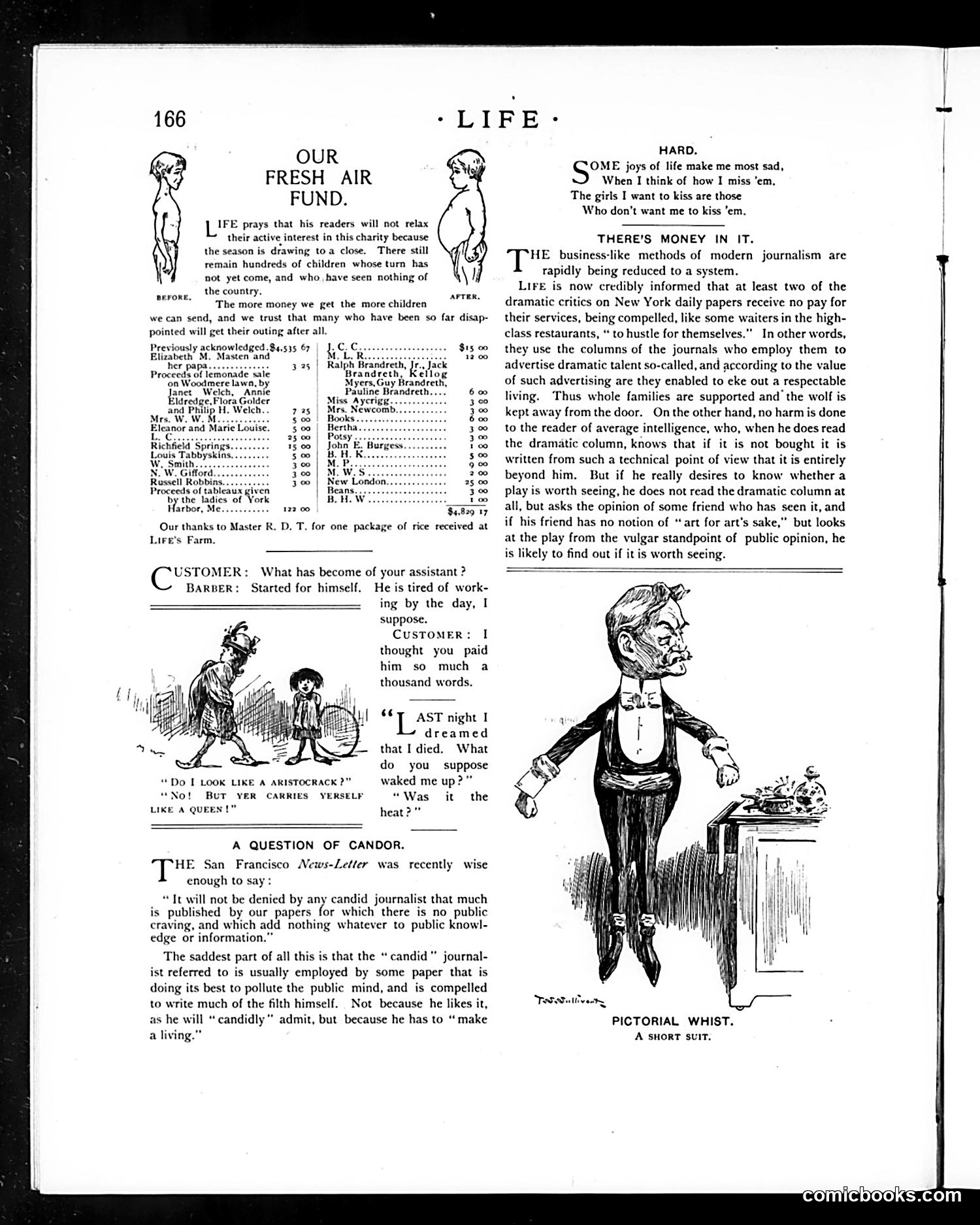
This page critiques early 20th-century journalism ethics through several pieces: **"Our Fresh Air Fund"** section lists charitable donations, satirizing how publications competed for public goodwill. **"There's Money In It"** argues that New York dramatic critics now accept payment for favorable reviews, essentially prostituting their profession. Life condemns this corruption, noting that families trust critics' opinions to guide entertainment choices. The satire exposes how business pressures compromise journalistic integrity. **"A Question of Candor"** quotes the *San Francisco News-Letter*, arguing that "candid" journalists—those who write sensationalism and filth—do so not from conviction but economic desperation: they must "make a living." The cartoons and text collectively attack newspaper corruption driven by commercial necessity rather than principle.
📄 Transcribed text from this page (OCR, searchable)
Machine-transcribed from the original scan — historical spelling and the odd misread are preserved.
OUR FRESH AIR FUND. LIFE prays that his readers will not relax their active interest in this charity because the season is drawing toa close. There still remain hundreds of children whose turn has not yet come, and who, have seen nothing of \ the country. The more money we get the more children we can send, and we trust that many who have been so far disap- pointed will get their outing after all. Brrore. Arren. Previously acknowledged $4515 67 Elizabeth M, Masten and | MLR Ralph Brandreth, Jr., Jack Brandreth, Kellog Myers, Guy Brandreth, Pauline Brandreth. her papa Proceeds of lemonade sale on Woodmere lawa, by janet Welch, ‘Annie Eldredge, F ae older 8 L. Richfield’ Springs. Louis Tabbyskins, Smith, 88888888 Bwoune 88ssse Russell Robbins. Proceeds of tableaux xiven y the ladies of York Harbor Me. 3 100 $4,829.17 Our thanks to Master R, D. T. for one package of rice received at Lire’s Farm, 122 00 TOMER: BARBER: What has become of your assistant ? Started for himself. He is tired of work- ing by the day, I suppose. CusToMER: I thought you paid him so much a thousand words. AST night I dreamed that I died. What do you suppose waked me up?” “Was it the heat?” “Do I LOOK LIKE A ARISTOCRACK ?” “No! BUT VER CARRIES YERSELF LIKE A QUEEN!” A QUESTION OF CANDOR. HE San Francisco News-Letter was recently enough to say : wise “Tt will not be denied by any candid journalist that much is published by our papers for which there is no public craving, and which add nothing whatever to public knowl- edge or information.” The saddest part of all this is that the “ candid journal- ist referred to is usually employed by some paper that doing its best to pollute the public mind, and is compelled to write much of the filth himself. Not because he likes it, as he will “ candidly" admit, but because he has to “ make a living.” HARD. OME joys of life make me most sad, When I think of how I miss ‘em, The girls I want to kiss are those Who don’t want me to kiss ‘em. THERE’S MONEY IN IT. HE business-like methods of modern journalism are rapidly being reduced to a system, Lire is now credibly informed that at least two of the dramatic critics on New York daily papers receive no pay for their services, being compelled, like some waiters in the high- class restaurants, “ to hustle for themselves.” In other words, they use the columns of the journals who employ them to advertise dramatic talent so-called, and according to the value of such advertising are they enabled to eke out a respectable living. Thus whole families are supported and’ the wolf is kept away from the door. On the other hand, no harm is done to the reader of average intelligence, who, when he does read the dramatic column, knows that if it is not bought it is written from such a technical point of view that it is entirely beyond him. But if he really desires to know whether a play is worth seeing, he does not read the dramatic column at all, but asks the opinion of some friend who has seen it, and if his friend has no notion of ‘art for art’s sake,” but looks at the play from the vulgar standpoint of public opinion, he is likely to find out if it is worth seeing. Teulon PICTORIAL WHIST. A SHORT suIT,