
A complete issue · 16 pages · 1895
Life — August 29, 1895
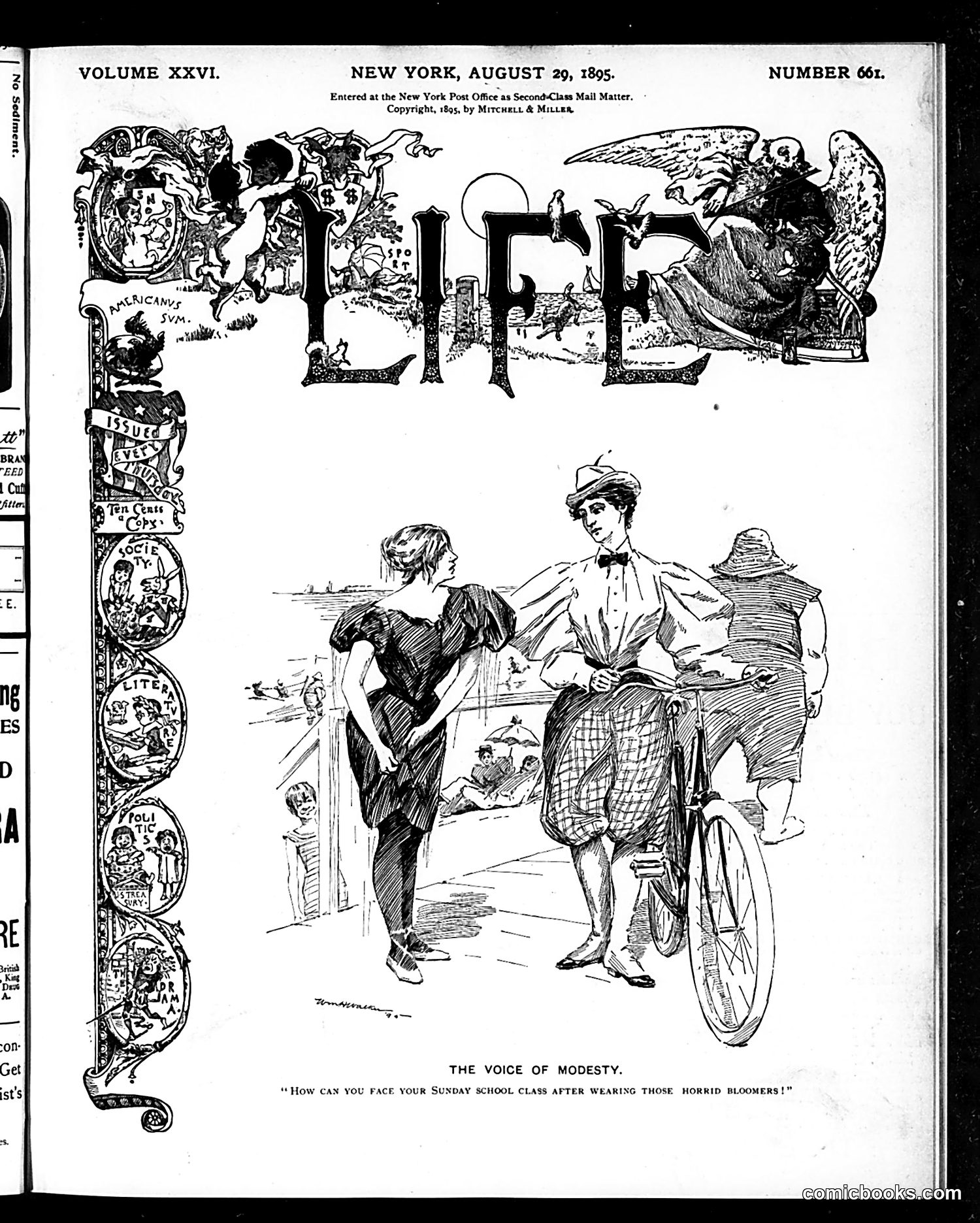
This cartoon satirizes the controversy over women's bloomers, a relatively new and scandalous garment in the 1890s. The illustration shows a young woman wearing bloomers (loose, baggy pants) speaking with a male cyclist. The caption reads: "How can you face your Sunday school class after wearing those horrid bloomers!" The joke targets Victorian hypocrisy around modesty. While bloomers were practical for cycling (a newly popular activity for women), conservative society condemned them as immodest and unfeminine. The cartoon mocks this contradiction—suggesting that wearing practical athletic wear somehow compromises one's moral standing or social respectability, particularly for women involved in religious instruction.
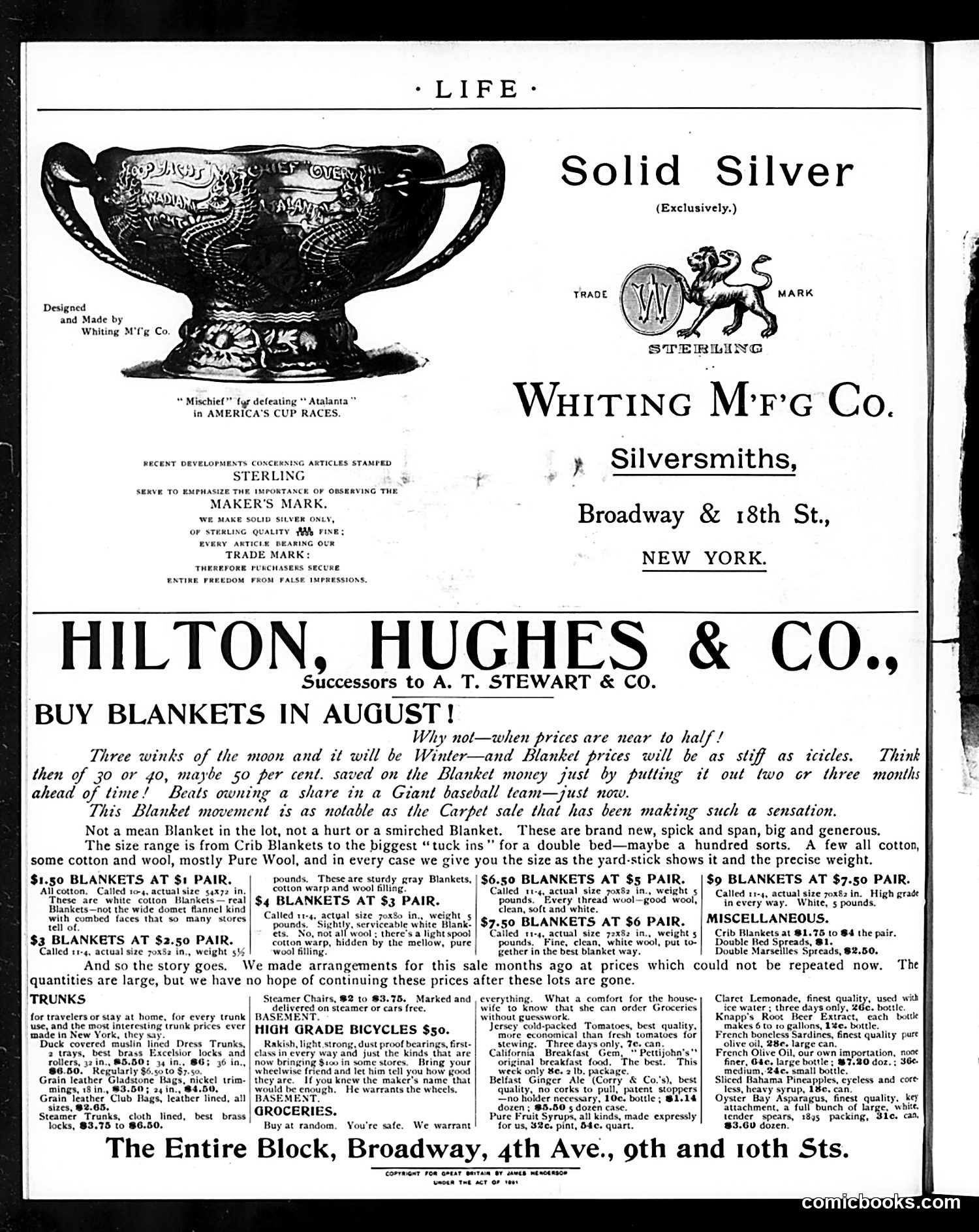
This page is **primarily advertising**, not editorial satire. The top features a decorative silver trophy cup, promoting Whiting Manufacturing Company's solid sterling silver products at their Broadway location in New York. The accompanying text emphasizes their quality and use of maker's marks to ensure authenticity. The bulk of the page contains a major advertisement for Hilton, Hughes & Co.'s blanket sale. The copywriting uses seasonal logic (buy blankets in August when prices are low before winter demand drives them up) and employs marketing language about savings and value. Below that are smaller product advertisements for trunks, groceries, and other household goods. **There is no political cartoon or satirical content visible on this page**—it is a commercial advertising section from Life magazine.
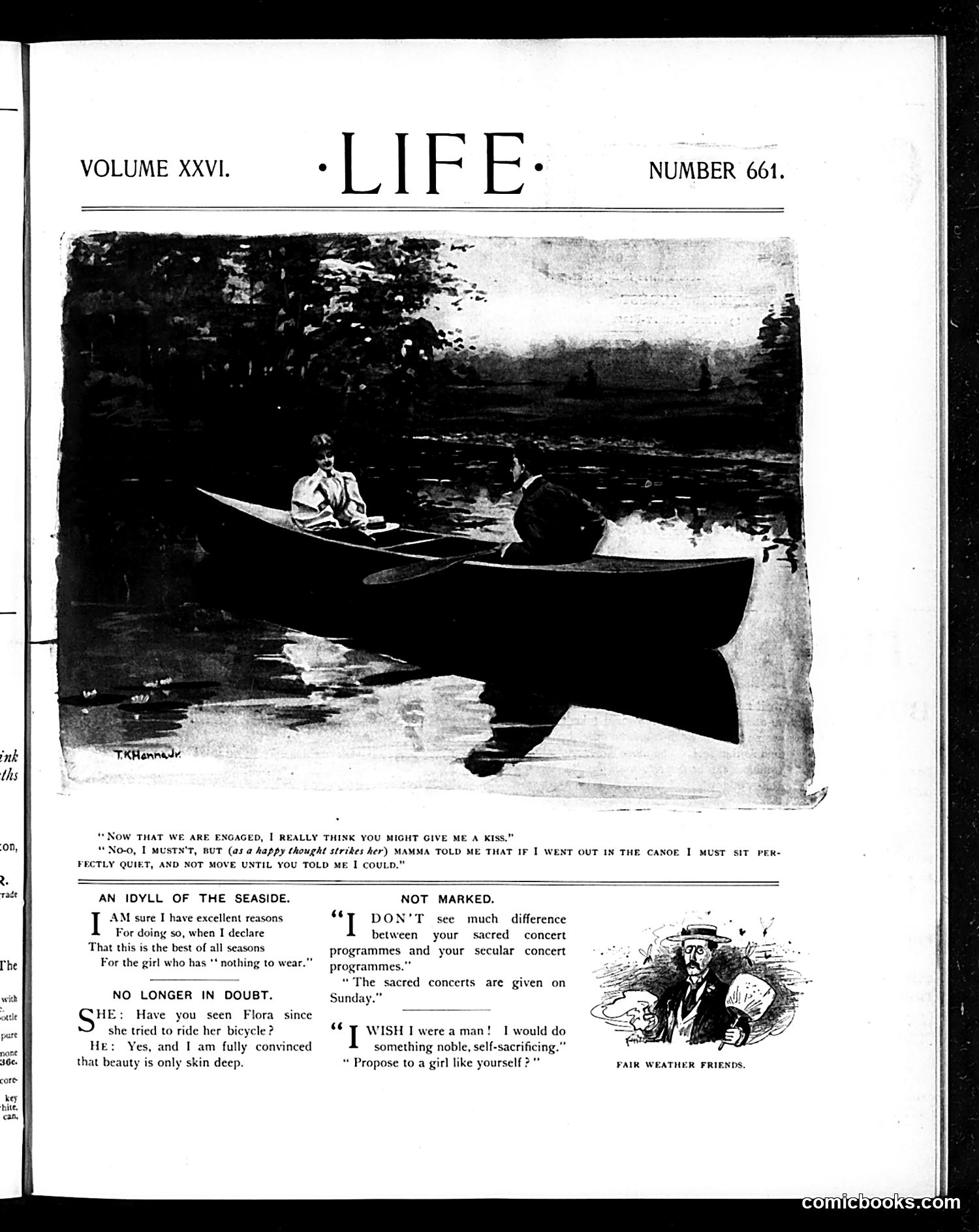
This page contains several unrelated humorous vignettes typical of Life's satirical format: **Main Image**: A romantic scene shows a couple in a canoe. The caption humorously depicts a woman rejecting a kiss by invoking her mother's warnings about proper behavior in boats. **"An Idyll of the Seaside"**: A joke about a girl with "nothing to wear"—playing on period anxieties about female fashion and propriety. **"No Longer in Doubt"**: A quip suggesting a man now believes "beauty is only skin deep" after observing a woman attempting to ride a bicycle—likely mocking both female athleticism and vanity. **"Not Marked"** and **"I Wish I Were a Man"**: Brief exchanges about concert programs and female ambitions. **"Fair Weather Friends"**: A small cartoon (details unclear) appears alongside. These reflect early-20th-century attitudes toward gender roles and courtship.
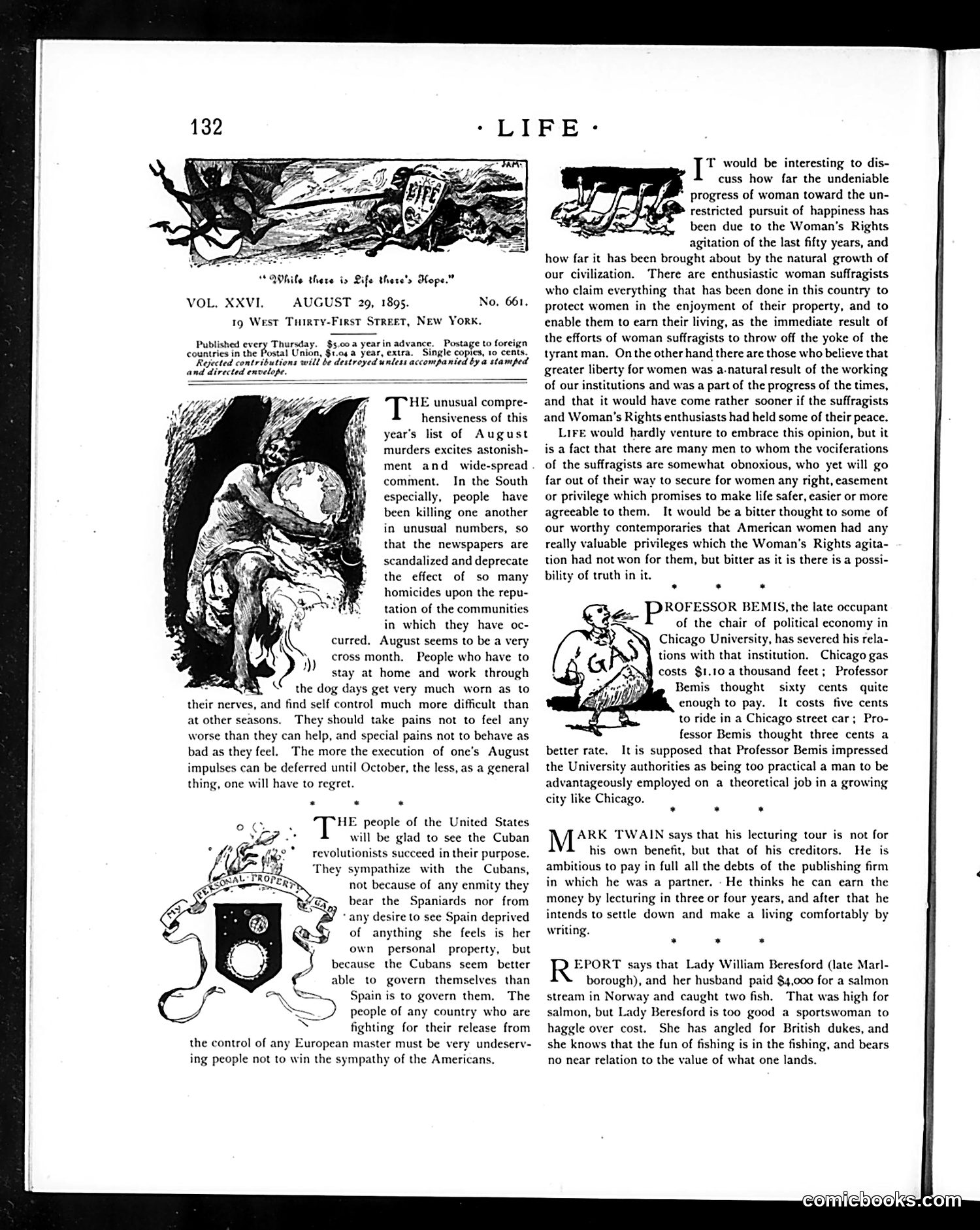
The page contains three distinct editorial sections with accompanying illustrations. **Top illustration**: Shows a figure lying down with the caption "While there is Life there's Hope," likely a generic motivational image rather than political satire. **Left section**: Discusses August murders in the American South, criticizing newspapers for sensationalizing violence. The accompanying dark illustration appears to depict a murder scene. The text advocates restraint in reporting such crimes. **Right section**: Contains commentary on women's rights activism, debating whether women's progress resulted from suffragist efforts or natural social evolution. **Bottom sections**: Include brief items on Cuba (supporting independence from Spain), Professor Bemis's Chicago gas rates dispute, Mark Twain's lecture tour for debt repayment, and Lady Beresford's expensive salmon-fishing expedition. The page reflects 1895 concerns: media sensationalism, women's suffrage debates, American imperialism, and the wealthy's frivolous spending.
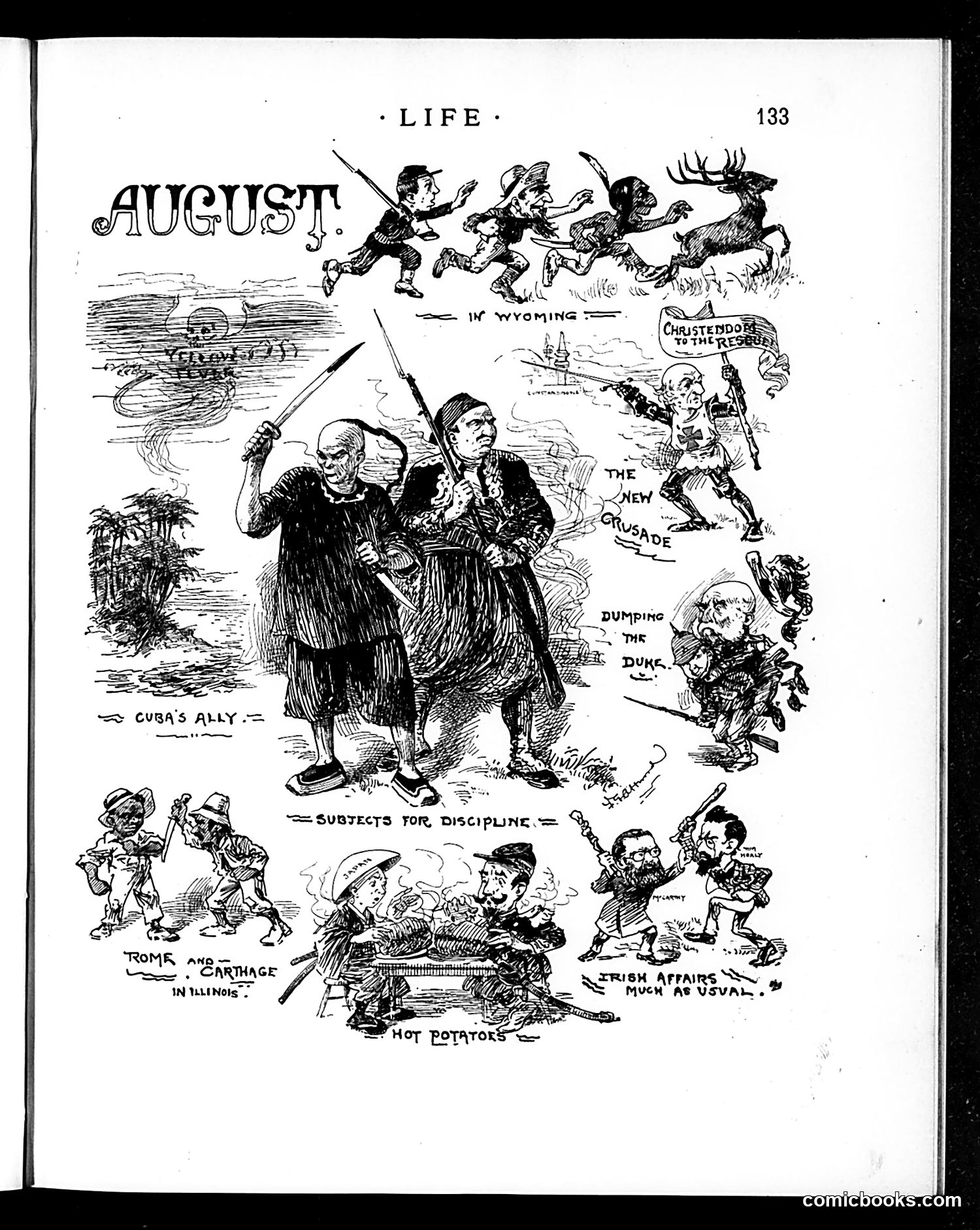
This is a political cartoon titled "August" from Life magazine, satirizing contemporary political figures and events. The central image shows two caricatured men (likely representing political leaders) surrounded by smaller vignettes labeled with political hot topics: - "In Wyoming" (top): figures chasing a elk, suggesting Western politics - "Cuba's Ally" (left): referencing foreign policy - "Christendom to the Rescue" and "The New Crusade" (right): religious/moral political rhetoric - "Dumping the Duke" (right): unclear specific reference - "Subjects for Discipline," "Rome and Carthage in Illinois," "Hot Potatoes," and "Irish Affairs Much as Usual" (bottom): various domestic political controversies The cartoon mocks politicians juggling multiple problematic issues simultaneously, suggesting governmental incompetence or hypocrisy during this period.
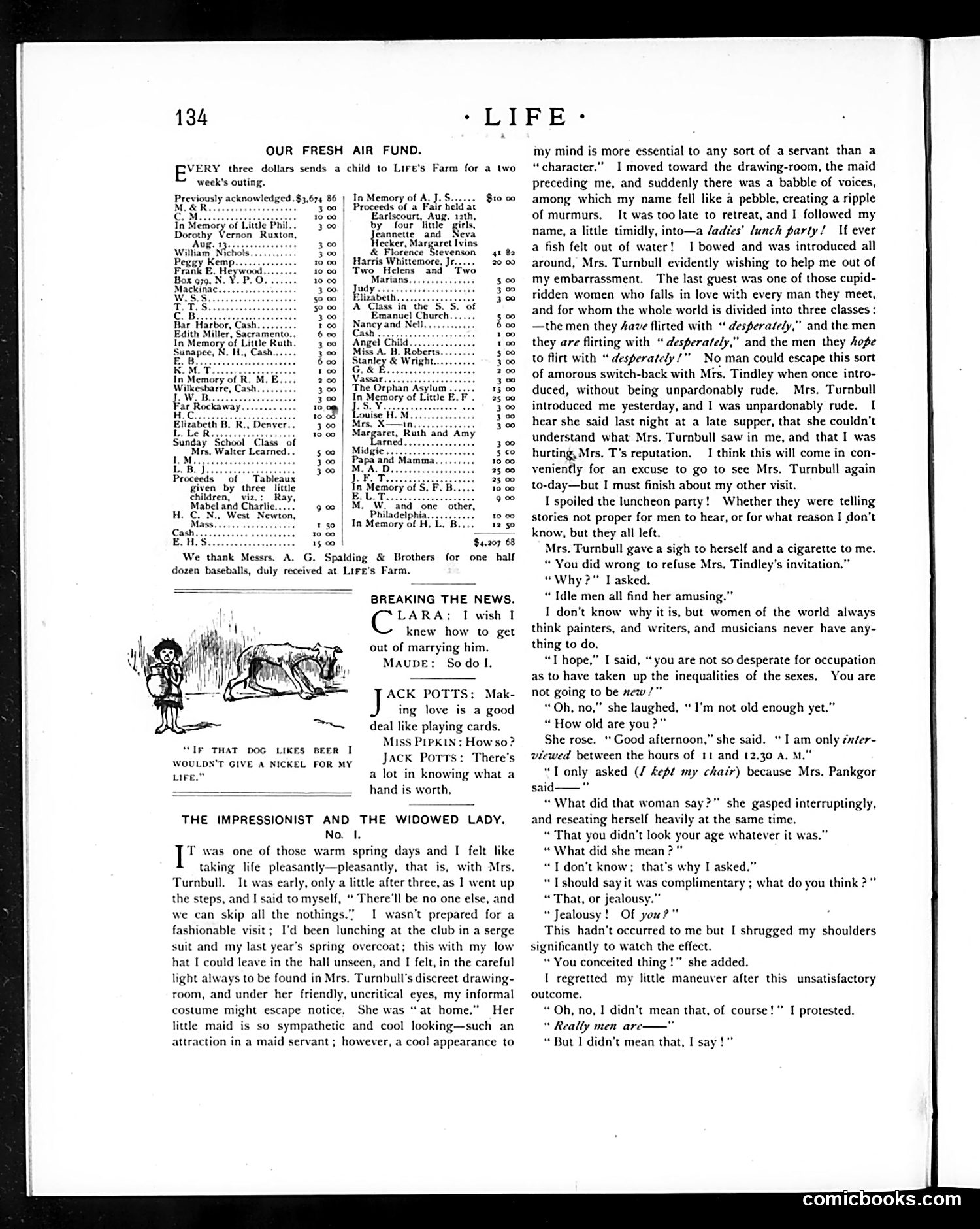
This page contains two satirical sections: **"Our Fresh Air Fund"** lists donations to send children to Life's Farm for two weeks. It's a charitable fundraising notice with donor acknowledgments. **"Breaking the News"** presents brief satirical dialogues: - Jack Potts and Clara discuss marriage as analogous to playing cards - Jack Potts and Stephen debate whether "knowing what a hand is worth" matters **"The Impressionist and the Widowed Lady, No. 1"** is the main story. It depicts a social encounter where the narrator attends a fashionable lunch at Mrs. Turnbull's drawing room. A widow guest, Mrs. Tindley, invites the narrator somewhere, but Mrs. Turnbull later criticizes the refusal. The satire targets upper-class social conventions and the pressure to accept invitations from society figures, mocking the artificiality and gossip of elite social circles.
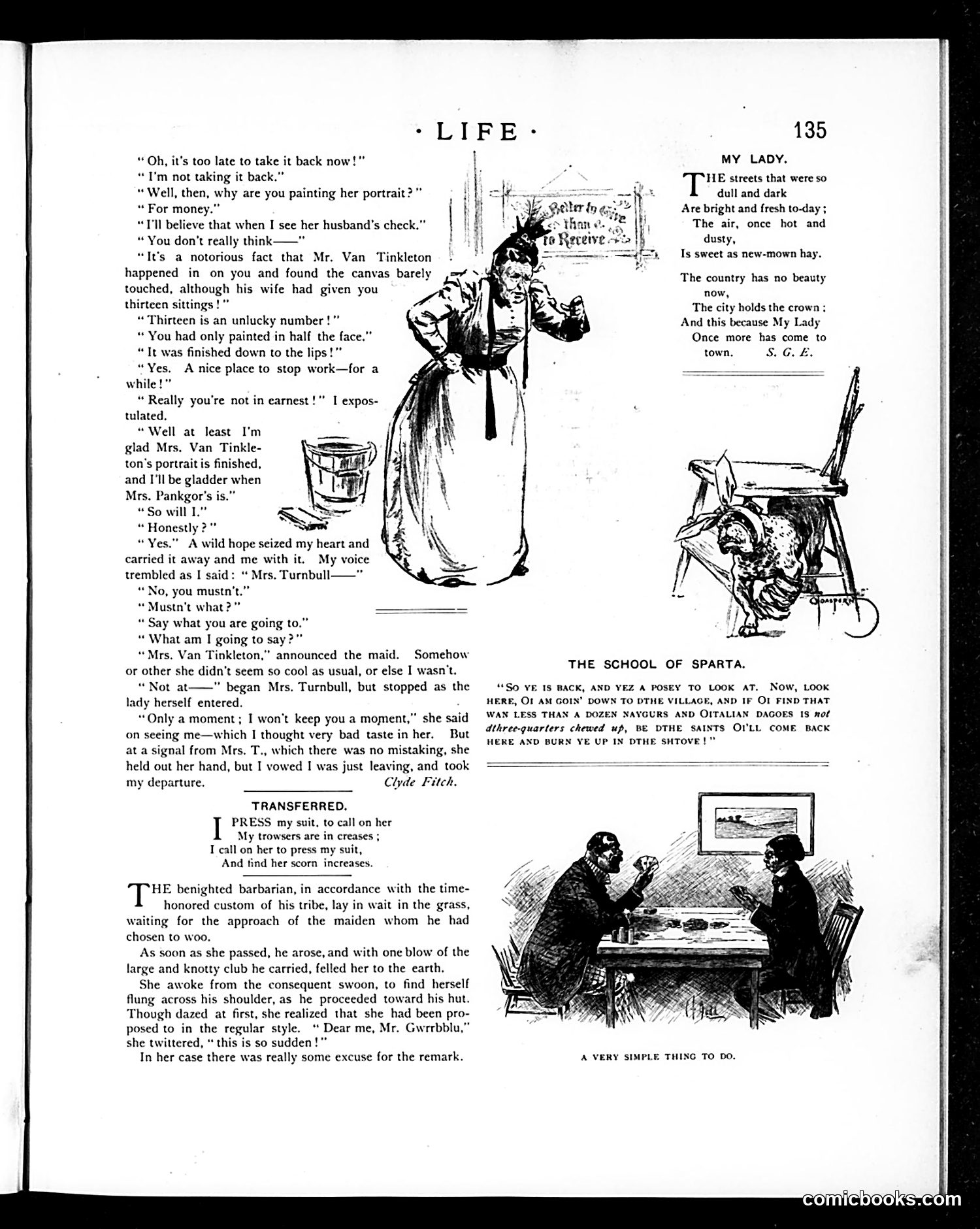
This page contains a satirical narrative about a painter and Mrs. Van Tinkleton's portrait, accompanied by illustrations. The main joke centers on the painter's dishonesty: he claims he hasn't finished the portrait and won't take payment, but admits he actually stopped painting halfway through the face to avoid having to complete it—essentially a con to keep her money while appearing virtuous. The accompanying illustrations and poem ("My Lady," "The School of Sparta," and "A Very Simple Thing to Do") appear unrelated vignettes typical of Life's format. The satire mocks both artistic pretension and the gullibility of wealthy patrons, a common target of early 20th-century American humor magazines.
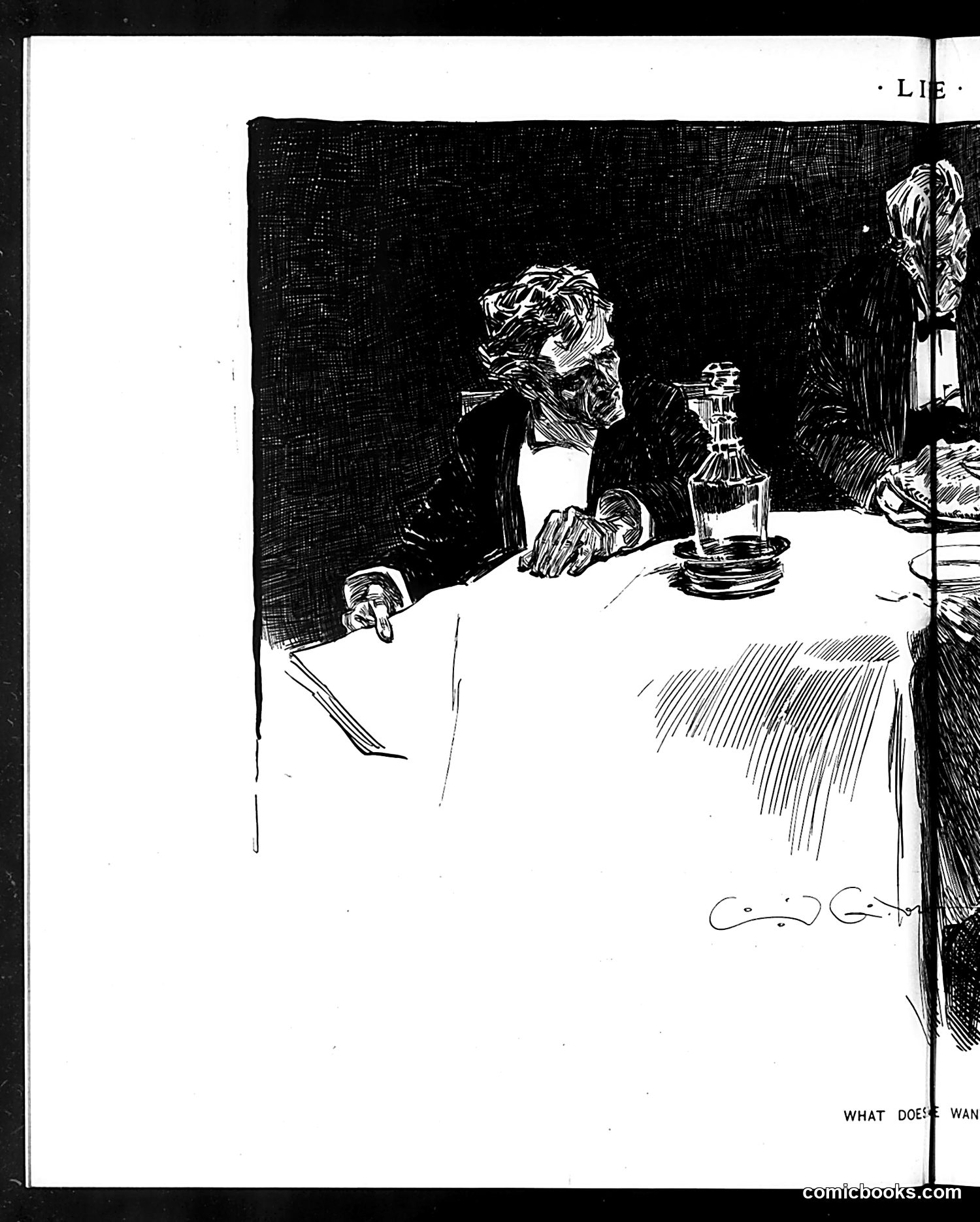
This appears to be a satirical cartoon from *Life* magazine depicting a solitary, roughly-sketched older man seated at a dining table with a decanter and glass. The figure's exaggerated, somewhat grotesque facial features and hunched posture suggest caricature. He sits alone in what appears to be formal dining attire against a dark, heavily-hatched background. The partially visible text at bottom reads "WHAT DOES WAN[...]" suggesting this is part of a larger caption or question. Without the complete text, the specific political or social target remains unclear, though the isolation and somewhat pathetic presentation suggests this may critique a particular public figure's loneliness, pretension, or moral state. The style and execution are consistent with early-to-mid 20th century editorial cartooning.
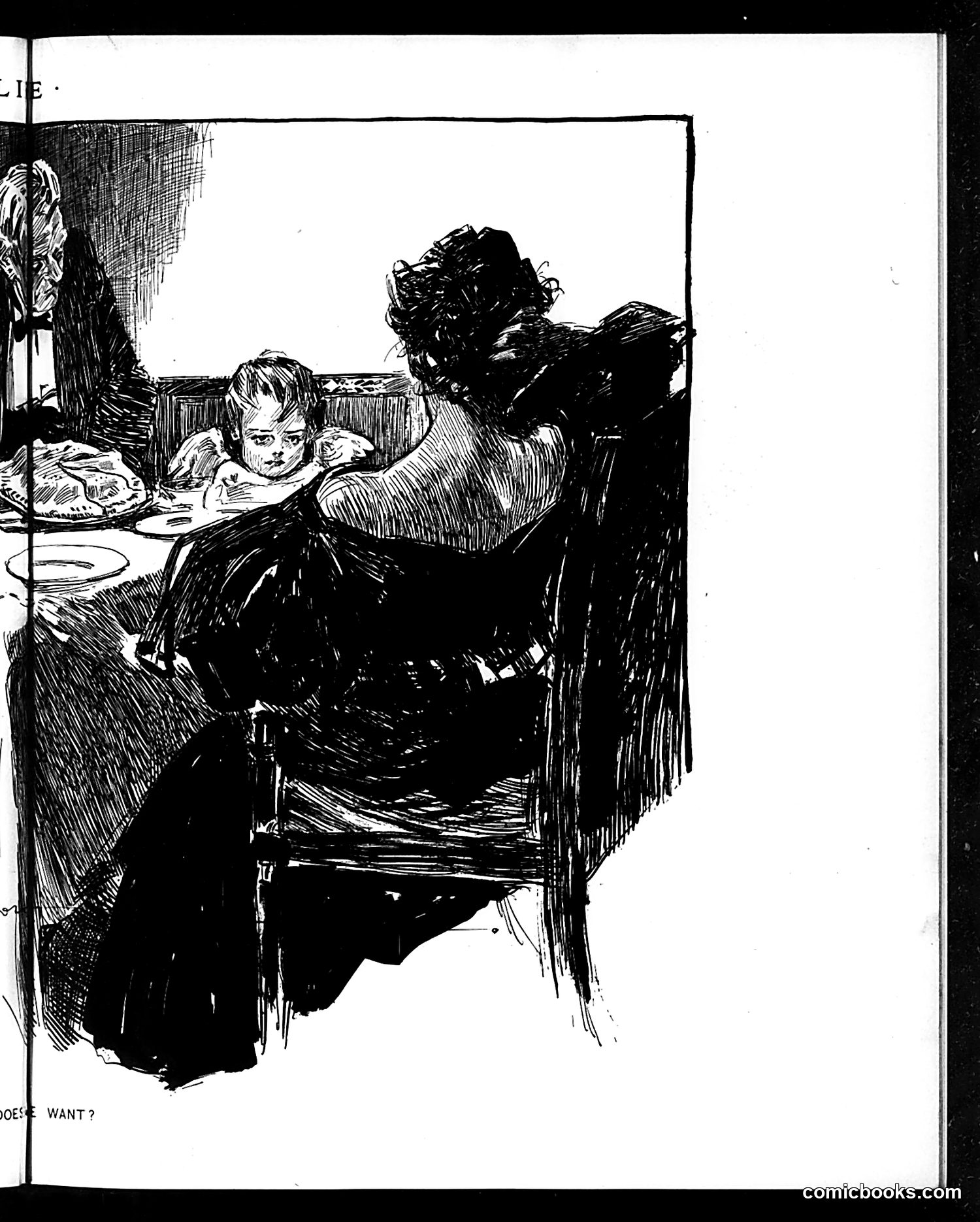
This ink sketch depicts a domestic scene of a woman feeding a small child at a table. The woman, drawn with pronounced dark hair and features, sits beside the child who appears reluctant or unhappy about eating. Various dishes are visible on the table. The partial text visible at bottom reads "DOES WANT?" which appears cut off, likely originally reading something like "What does [he/she] want?" Without the complete caption or surrounding context, the specific satirical target remains unclear. However, given Life magazine's style, this likely comments on parenting challenges, domestic life, or possibly immigrant family customs—common subjects for American satire of the early-to-mid 20th century. The exaggerated facial features suggest ethnic or class-based caricature typical of the era.
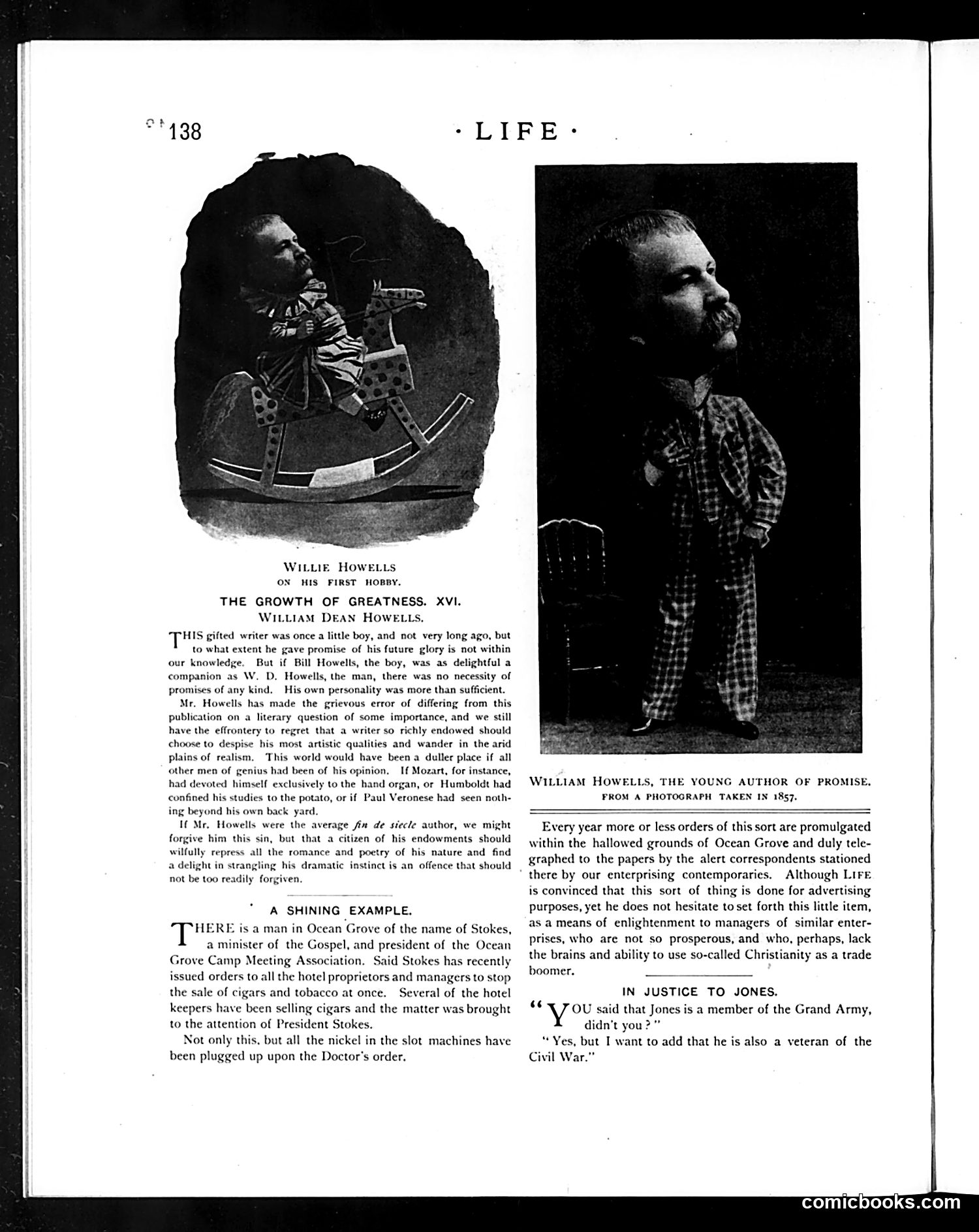
This page contains two photographs and accompanying text about **William Dean Howells**, a prominent American author. The left image shows Howells as a young man with his first hobby (appears to be a rocking horse or similar toy), titled "The Growth of Greatness XVI." The text is largely biographical rather than satirical, praising Howells' literary talents while gently mocking his earlier choice to pursue realism over more romantic artistic subjects. The page also includes an unrelated anecdote titled "A Shining Example" about a man named Stokes at Ocean Grove who successfully stopped hotel proprietors from selling cigars and tobacco, and a brief dialogue titled "In Justice to Jones" regarding Civil War service. This appears to be a regular editorial/biographical feature rather than political satire.
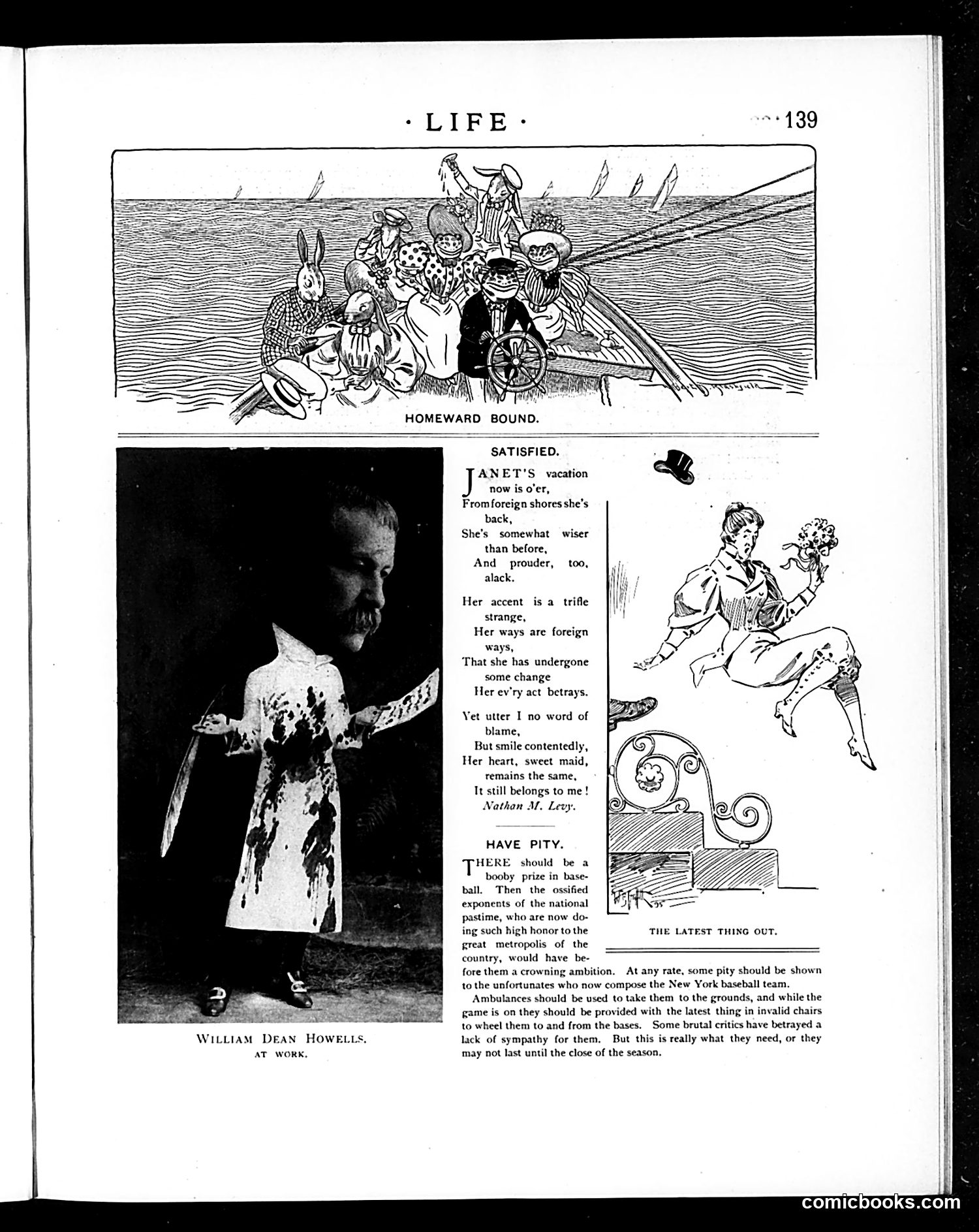
**Top Illustration**: "Homeward Bound" depicts anthropomorphic animals (rabbit, duck, and others) in a boat returning home, likely representing travelers or vacationers. **Center**: A photograph labeled "William Dean Howells at Work" shows the prominent American author and editor. **Poem "Satisfied"**: Attributed to Nathan M. Levy, this poem describes a woman (Janet) returning from foreign travel, changed but fundamentally unchanged in heart. It celebrates her homecoming while noting her altered perspective. **Right Illustration & Text "Have Pity"**: Criticizes New York's baseball team's poor performance, sarcastically suggesting "booby prizes" and expressing sympathy for the struggling team. This section mocks the team's incompetence while advocating for compassion toward its players. The page blends literary content with sports satire typical of *Life* magazine's early 20th-century format.
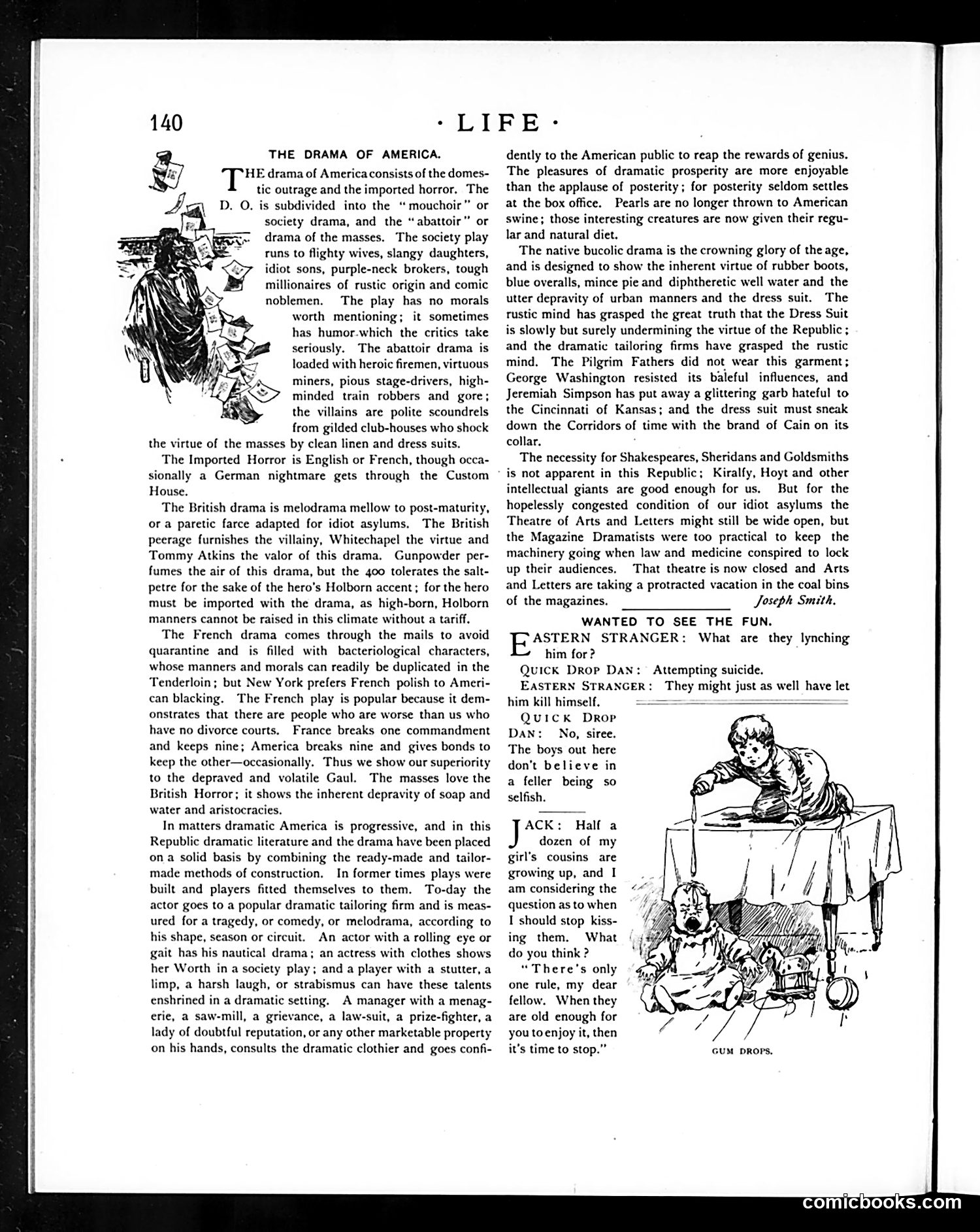
This satirical essay critiques American theatrical productions by categorizing them into types: "domestic outrage" (society plays about frivolous wealthy people) and "imported horror" (British and French dramas). The author mocks how American theater has become industrialized and cynical—playwrights measure actors like tailors, fitting scripts to physical traits (a rolling gait = nautical drama). Theater managers profit by converting any marketable property (lawsuits, prize-fighters, disreputable women) into plays. The satire targets American cultural inferiority complex: audiences tolerate tedious British plays because actors have "Holborn accents," and prefer morally questionable French plays to prove Americans are superior. Meanwhile, native rural dramas promoting "rustic virtue" against urban corruption are celebrated as the "crowning glory." The cartoon below depicts "Gum Drops"—likely satirizing sentimental domestic comedy. Overall, the piece condemns American theater as commercialized, derivative, and intellectually hollow.
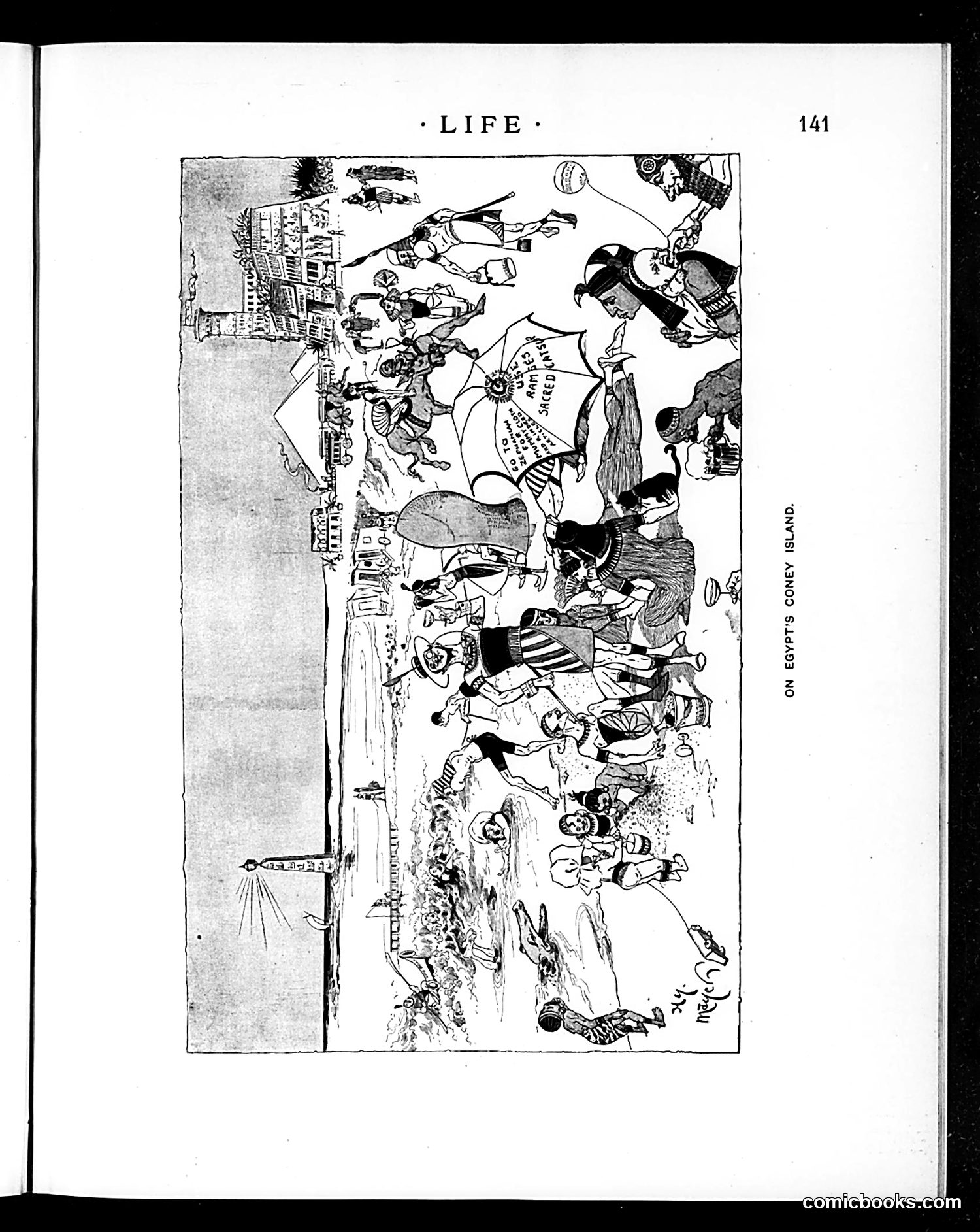
This is a satirical illustration depicting Coney Island, the famous Brooklyn amusement park, reimagined as an Egyptian scene. The image is rotated 90 degrees and shows crowds of beachgoers and tourists engaged in typical Coney Island activities—swimming, riding attractions, eating, and socializing. The satire appears to mock the exotic, orientalist fantasies popular in early 20th-century American entertainment. By labeling this mundane, crowded American beach resort as "Egypt's Coney Island," the cartoonist satirizes both the gaudy exoticism of Coney Island's attractions and Americans' fascination with Egyptian imagery—a trend that intensified following archaeological discoveries and the opening of Suez Canal tourism around this era.
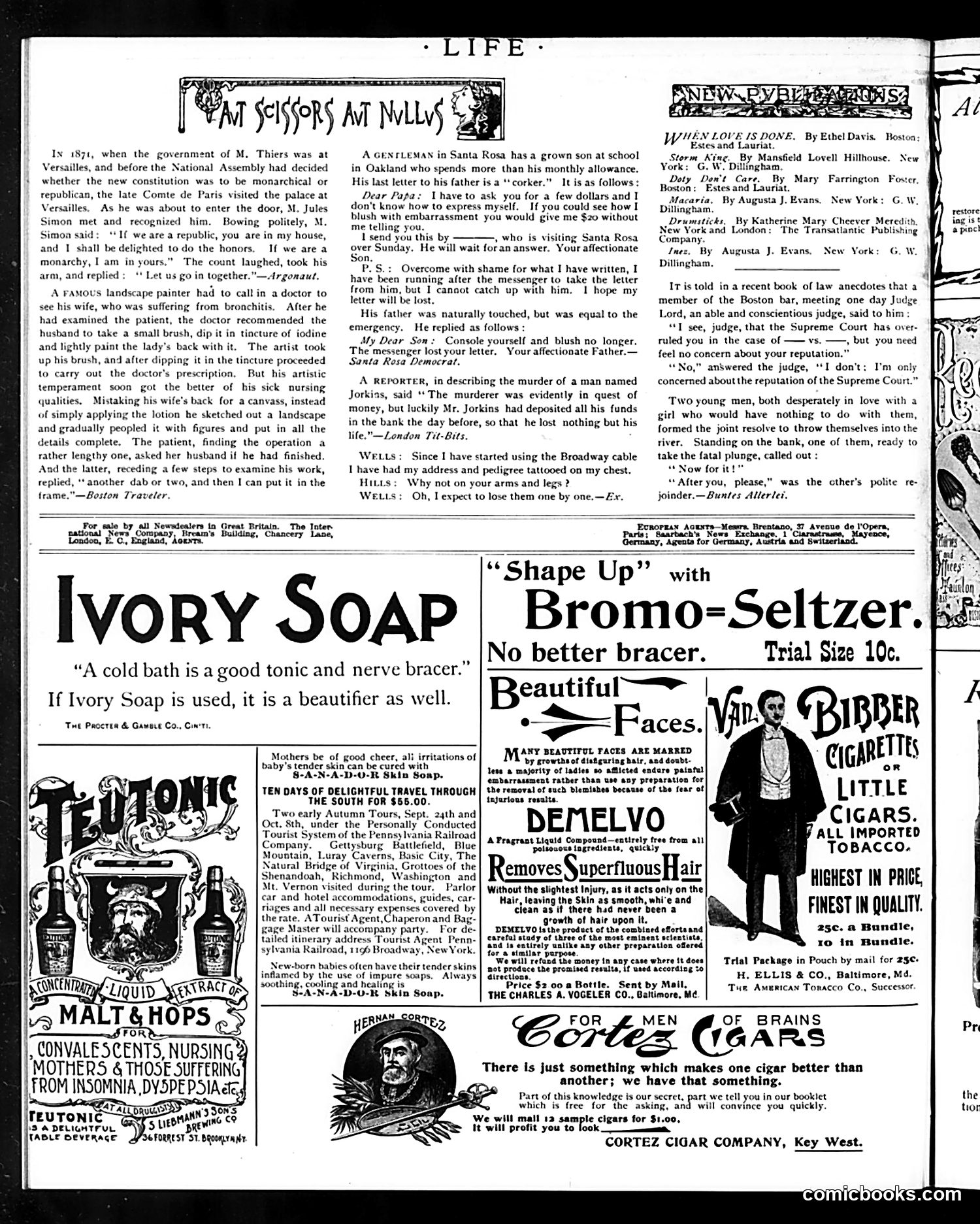
This page is primarily **advertisements and humorous anecdotes** rather than political cartoons. The content includes: **Anecdotes (top section):** Four short satirical stories about human behavior—a French political exchange from 1871, an artist painting his wife's back instead of treating bronchitis, a son's embarrassed letter requesting money, and wordplay about a murder victim. These are gentle social humor, not political satire. **Advertisements:** The bulk of the page features period product ads (Ivory Soap, Bromo-Seltzer, Demelvo hair removal, Bibber Cigarettes, Cortez Cigars), typical of Life magazine's revenue model. These ads reflect late 19th/early 20th-century consumer culture and social attitudes (particularly the casual marketing of cosmetics and hair removal products). **No significant political content:** Unlike satirical cartoons targeting specific politicians or events, this page offers light domestic and social humor aimed at middle-class readers. The page reflects Life's dual nature: serious satirical commentary mixed with commercial advertising and entertainment.
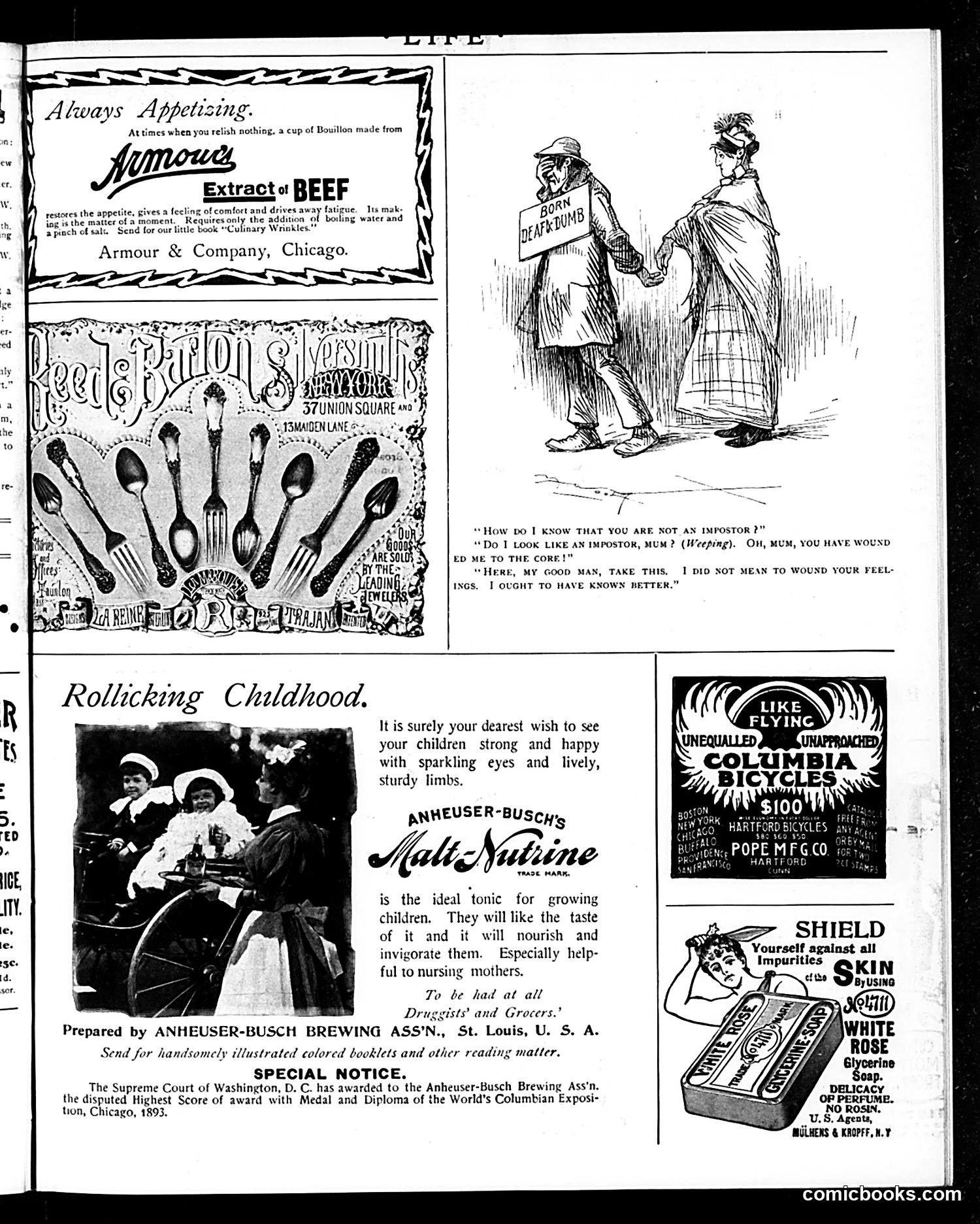
This page mixes advertisements with one satirical cartoon. The main cartoon depicts a social encounter between a woman and a man claiming to be a war veteran or displaced person (marked "BORN DEAF DUMB"). When she questions his authenticity ("How do I know that you are not an impostor?"), he responds emotionally, and she's moved to give him money—apparently falling for an obvious con. The satire targets gullible charity-givers who are easily manipulated by sob stories. The phrase "I ought to have known better" suggests the cartoon mocks both the con artist's transparent deception and the woman's naive sympathy. The remainder is period advertising: Armour's beef extract, Anheuser-Busch's malt tonic (notably marketed for children and nursing mothers—a detail that would shock modern readers), Columbia bicycles, and White Rose glycerin soap. These ads reflect turn-of-the-century consumer culture and product claims later regulated by modern FDA standards.
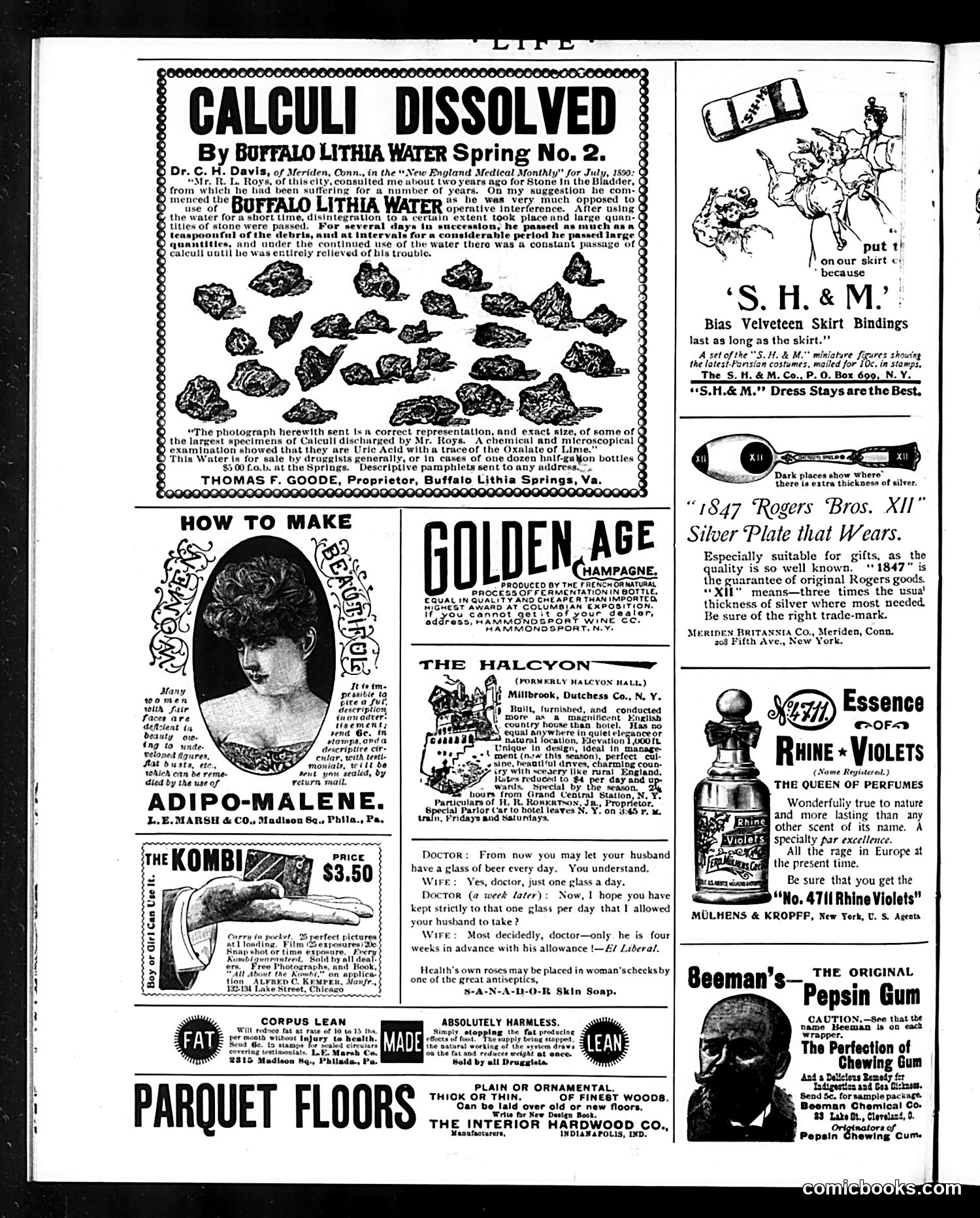
This page is primarily **advertisements from circa 1890s**, not political satire. The main content promotes patent medicines and commercial products typical of the era. The largest ad features **Buffalo Lithia Water**, which claims to dissolve kidney stones. It includes photographs of actual stone fragments allegedly passed by a patient—a marketing tactic exploiting pre-FDA medical claims. The testimonial from "Dr. C. H. Davis" lends false medical authority. Other ads promote: - **Adipo-Malene**: a weight-gain product for thin women (reflecting beauty standards of the period) - **Golden Age Champagne**: French wine - **The Halcyon**: a luxury resort hotel - Various other goods (silverware, perfume, chewing gum, flooring) The only genuine humor appears in a brief dialogue where a wife admits her husband drinks four weeks' worth of daily beer rations in advance—gentle domestic comedy rather than political satire. This page demonstrates how early *Life* magazine mixed satirical content with extensive advertising revenue.