
Life, 1895-08-29 · page 12 of 16
Life — August 29, 1895 — page 12: what you’re looking at
What you’re looking at
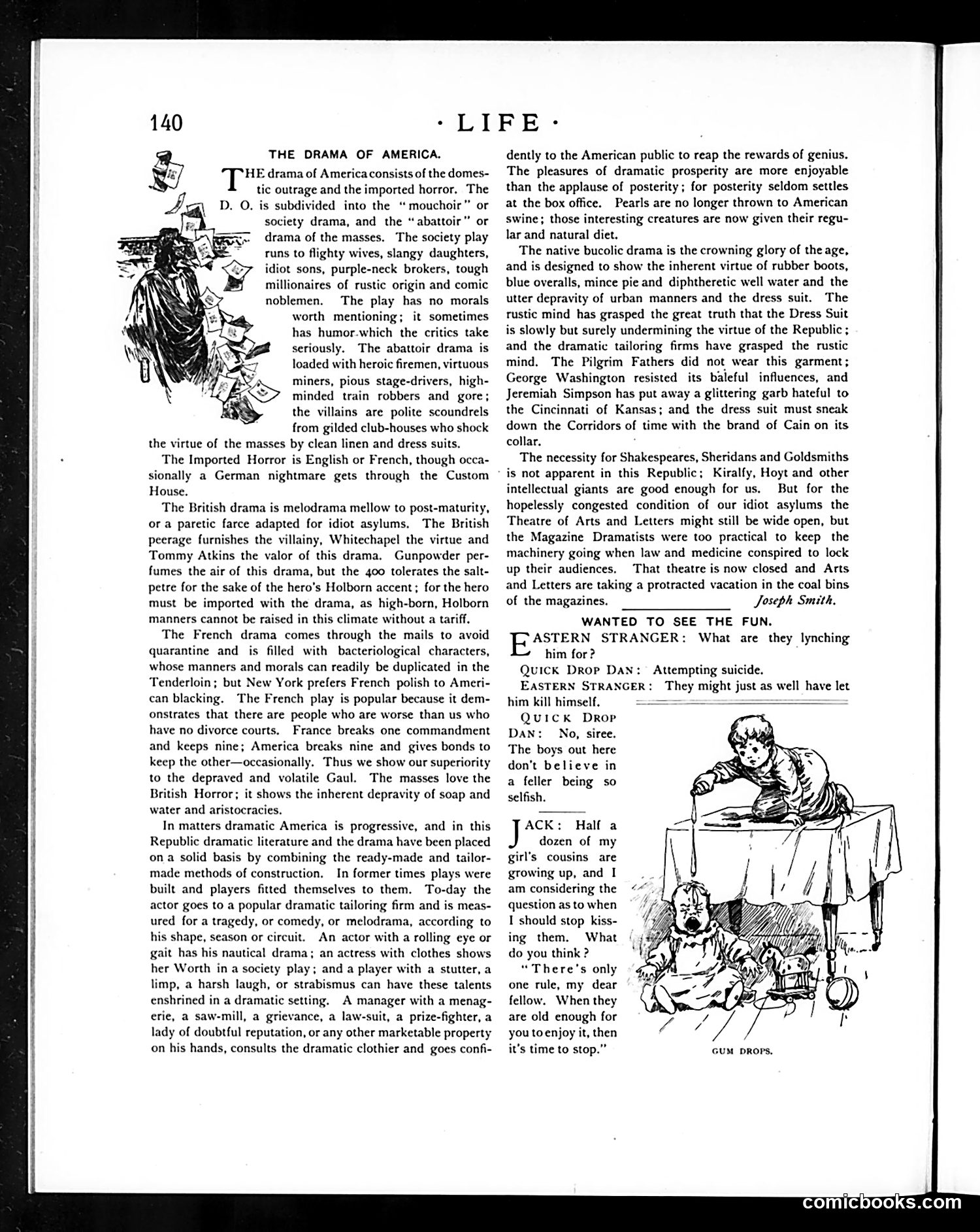
This satirical essay critiques American theatrical productions by categorizing them into types: "domestic outrage" (society plays about frivolous wealthy people) and "imported horror" (British and French dramas). The author mocks how American theater has become industrialized and cynical—playwrights measure actors like tailors, fitting scripts to physical traits (a rolling gait = nautical drama). Theater managers profit by converting any marketable property (lawsuits, prize-fighters, disreputable women) into plays. The satire targets American cultural inferiority complex: audiences tolerate tedious British plays because actors have "Holborn accents," and prefer morally questionable French plays to prove Americans are superior. Meanwhile, native rural dramas promoting "rustic virtue" against urban corruption are celebrated as the "crowning glory." The cartoon below depicts "Gum Drops"—likely satirizing sentimental domestic comedy. Overall, the piece condemns American theater as commercialized, derivative, and intellectually hollow.
📄 Transcribed text from this page (OCR, searchable)
Machine-transcribed from the original scan — historical spelling and the odd misread are preserved.
- LIFE: THE DRAMA OF AMERICA. HE drama of Americaconsists of the domes- tic outrage and the imported horror. The D. O. is subdivided into the “ mouchoir” or society drama, and the “abattoir” or drama of the masses. The society play runs to flighty wives, slangy daughters, idiot sons, purple-neck brokers, tough millionaires of rustic origin and comic noblemen. The play has no morals worth mentioning; it sometimes has humor.which the critics take seriously. The abattoir drama is loaded with heroic firemen, virtuous miners, pious stage-drivers, high- minded train robbers and gore; the villains are polite scoundrels from gilded club-houses who shock the virtue of the masses by clean linen and dress suits. The Imported Horror is English or French, though occa- sionally a German nightmare gets through the Custom House. The British drama is melodrama mellow to post-maturity, or a paretic farce adapted for idiot asylums, The British peerage furnishes the villainy, Whitechapel the virtue and Tommy Atkins the valor of this drama. Gunpowder per- fumes the air of this drama, but the 400 tolerates the salt- petre for the sake of the hero’s Holborn accent; for the hero must be imported with the drama, as high-born, Holborn manners cannot be raised in this climate without a tariff. The French drama comes through the mails to avoid quarantine and is filled with bacteriological characters, whose manners and morals can readily be duplicated in the Tenderloin; but New York prefers French polish to Ameri- can blacking. The French play is popular because it dem- onstrates that there are people who are worse than us who have no divorce courts. France breaks one commandment and keeps nine; America breaks nine and gives bonds to keep the other—occasionally. Thus we show our superiority to the depraved and volatile Gaul. The masses love the British Horror; it shows the inherent depravity of soap and water and aristocracies. In matters dramatic America is progressive, and in this Republic dramatic literature and the drama have been placed ona solid basis by combining the ready-made and tailor- made methods of construction. In former times plays were built and players fitted themselves to them. To-day the actor goes to a popular dramatic tailoring firm and is meas- ured for a tragedy, or comedy, or melodrama, according to his shape, season or circuit. An actor with a rolling eye or gait has his nautical drama; an actress with clothes shows her Worth in a society play; and a player with a stutter, a limp, a harsh laugh, or strabismus can have these talents enshrined in a dramatic setting. A manager with a menag- erie, a saw-mill, a grievance, a law-suit, a prize-fighter, a lady of doubtful reputation, or any other marketable property on his hands, consults the dramatic clothier and goes confi- dently to the American public to reap the rewards of genius. The pleasures of dramatic prosperity are more enjoyable than the applause of posterity; for posterity seldom settles at the box office. Pearls are no longer thrown to American swine; those interesting creatures are now given their regu- lar and natural diet. The native bucolic drama is the crowning glory of the age, and is designed to show the inherent virtue of rubber boots, blue overalls, mince pie and diphtheretic well water and the utter depravity of urban manners and the dress suit. The rustic mind has grasped the great truth that the Dress Suit is slowly but surely undermining the virtue of the Republic ; and the dramatic tailoring firms have grasped the rustic mind. The Pilgrim Fathers did not wear this garment; George Washington resisted its baleful influences, and Jeremiah Simpson has put away a glittering garb hateful to the Cincinnati of Kansas; and the dress suit must sneak down the Corridors of time with the brand of Cain on its collar. The necessity for Shakespeares, Sheridans and Goldsmiths is not apparent in this Republic; Kiralfy, Hoyt and other intellectual giants are good enough for us. But for the hopelessly congested condition of our idiot asylums the Theatre of Arts and Letters might still be wide open, but the Magazine Dramatists were too practical to keep the machinery going when law and medicine conspired to lock up their audiences, That theatre is now closed and Arts and Letters are taking a protracted vacation in the coal bins of the magazines. Joseph Smith, WANTED TO SEE THE FUN. ASTERN STRANGER: What are they lynching him for? Quick Drop Dan: Attempting suicide. EASTERN STRANGER: They might just as well have let him kill himself. — Quick Drop Dan: No, siree. The boys out here don’t believe in a feller being so selfish. ACK: Half a dozen of my girl's cousins are growing up, and I am considering the question as to when I should stop kiss- ing them. What do you think ? “There's only one rule, my dear fellow. When they are old enough for you toenjoy it, then it’s time to stop.” GUM DROPS. comicbooks.com