
A complete issue · 16 pages · 1895
Life — August 22, 1895
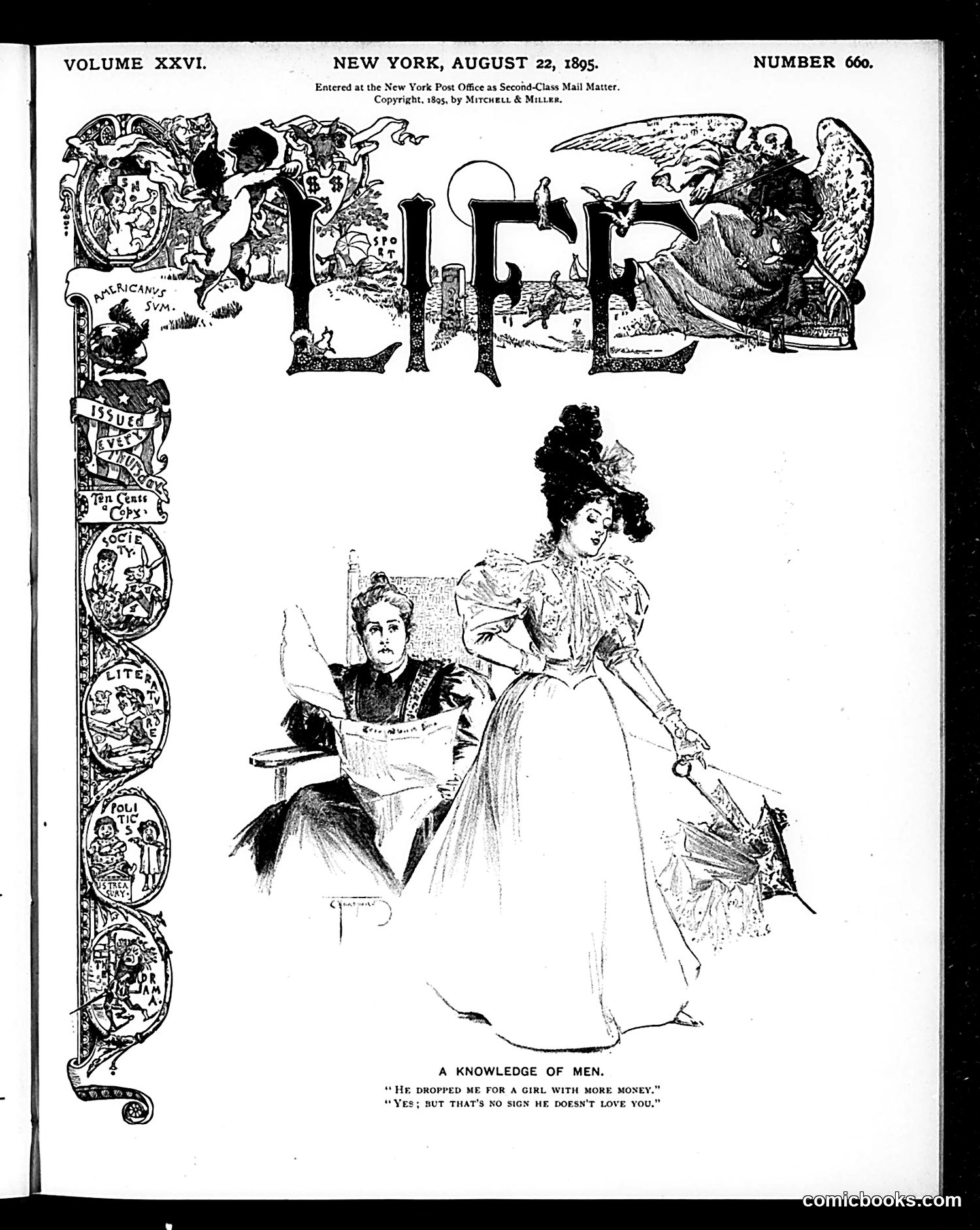
This satirical cartoon illustrates gender dynamics of the 1890s. Two women are depicted: one seated reading a newspaper (appearing skeptical or unimpressed), the other standing in fashionable dress with an elaborate hat. The caption presents dialogue: "He dropped me for a girl with more money" / "Yes; but that's no sign he doesn't love you." The joke satirizes women's supposedly naive or self-delusional understanding of male motivations. The standing woman attempts to convince her friend that financial infidelity doesn't negate romantic feelings—a patently absurd rationalization that mocks both male mercenary behavior and female acceptance of it. The decorative border with classical and mythological elements adds visual sophistication to this commentary on courtship and marriage economics in the Gilded Age.
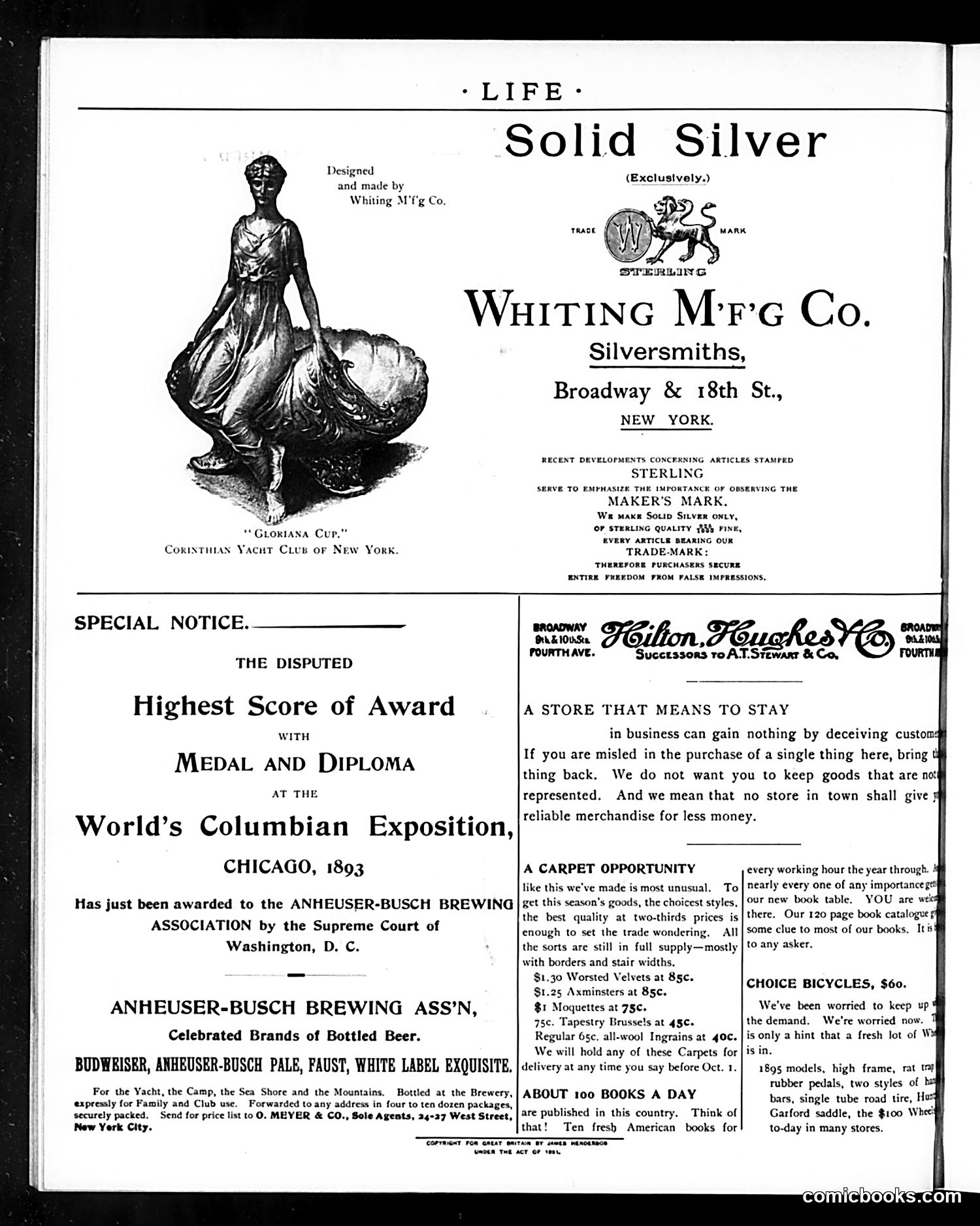
This page is primarily **advertising and business notices** rather than political satire. The main content features: 1. **Whiting M'fg Co.** advertisement for solid silver products, highlighting their "Georgiana Cup" (a decorative vessel) made for the Corinthian Yacht Club of New York. The ad emphasizes the maker's trademark as protection against counterfeits. 2. A **special notice** about Anheuser-Busch Brewing Association winning a disputed "Highest Score of Award" medal and diploma at the 1893 World's Columbian Exposition in Chicago, settled by the Supreme Court of Washington, D.C. 3. **Commercial advertisements** for Hilton Hucke & Co. (carpet retailer), bicycles, and books. The page reflects late-19th-century commercial competition and brand authentication concerns rather than political commentary.
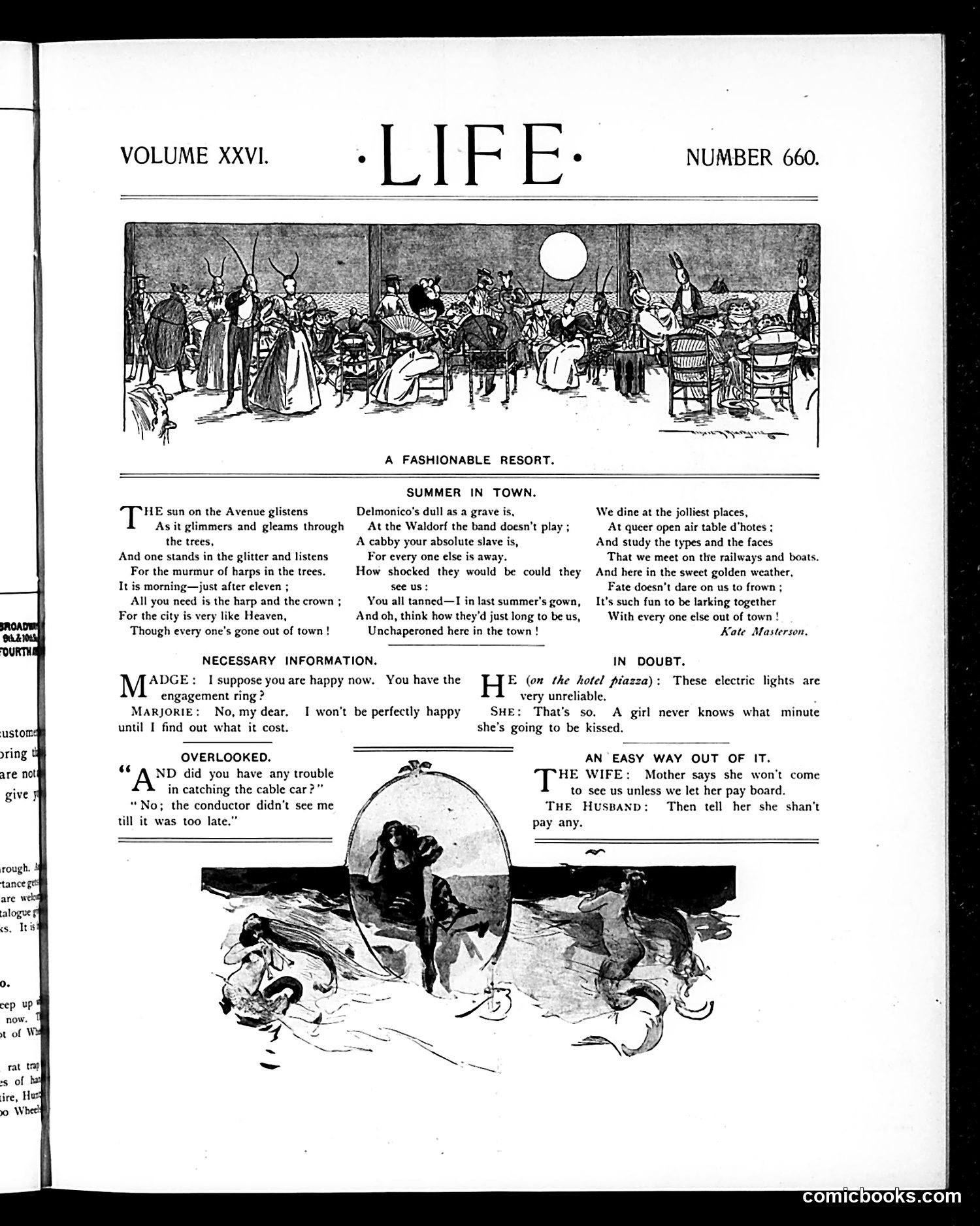
This page contains social humor typical of early 20th-century Life magazine. The top illustration depicts "A Fashionable Resort" with upper-class figures enjoying summer leisure—a satirical commentary on wealthy urbanites escaping the city heat. The poem "Summer in Town" mocks those who remain in the city rather than vacationing, suggesting they're out of step with fashionable society. The brief comic exchanges ridicule common social pretenses: a woman's concern about engagement costs, someone missing a cable car, and marital dynamics regarding expenses. The large illustration at bottom shows figures with a parasol near the beach—likely mocking either fashion absurdities or romantic mishaps typical of resort settings. Overall, the page satirizes upper-class leisure culture and the anxieties surrounding social status and wealth.
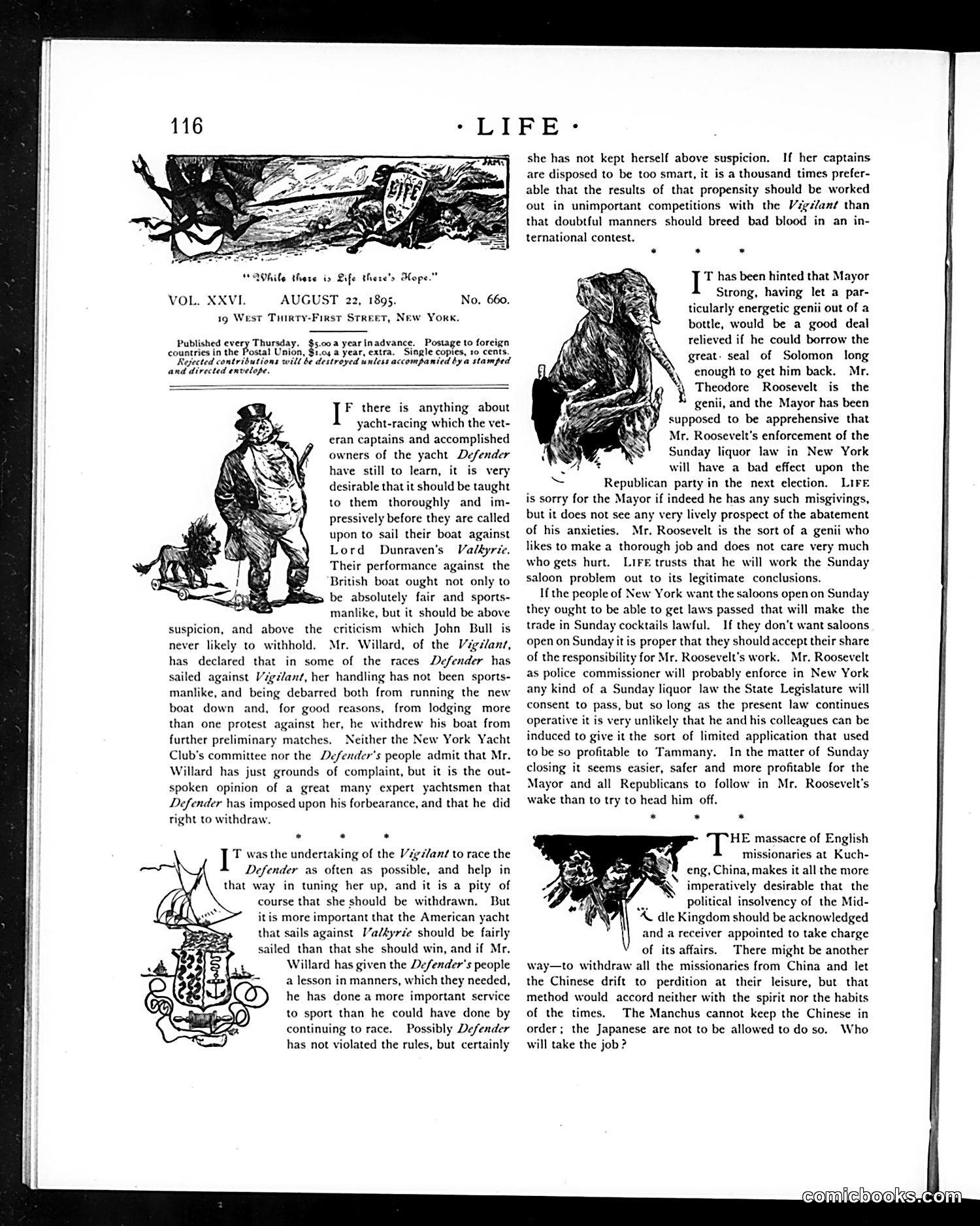
This page satirizes yacht racing and New York Republican politics. The text critiques the yacht *Defender's* owners and the New York Yacht Club's handling of a match against the British yacht *Vigilant*. The accompanying sketches appear to show figures involved in yacht racing—likely depicting yacht club members or competitors, though specific identities aren't clearly labeled in the visible portions. The article discusses Mayor Strong's potential anxieties about Theodore Roosevelt's enforcement of New York's Sunday liquor laws, suggesting this could hurt Republicans in upcoming elections. The satire targets both the yacht racing establishment's class pretensions and political concerns about prohibition enforcement during the Gilded Age. The final section shifts to discussing English missionaries in China, appearing unrelated to the main satirical content.
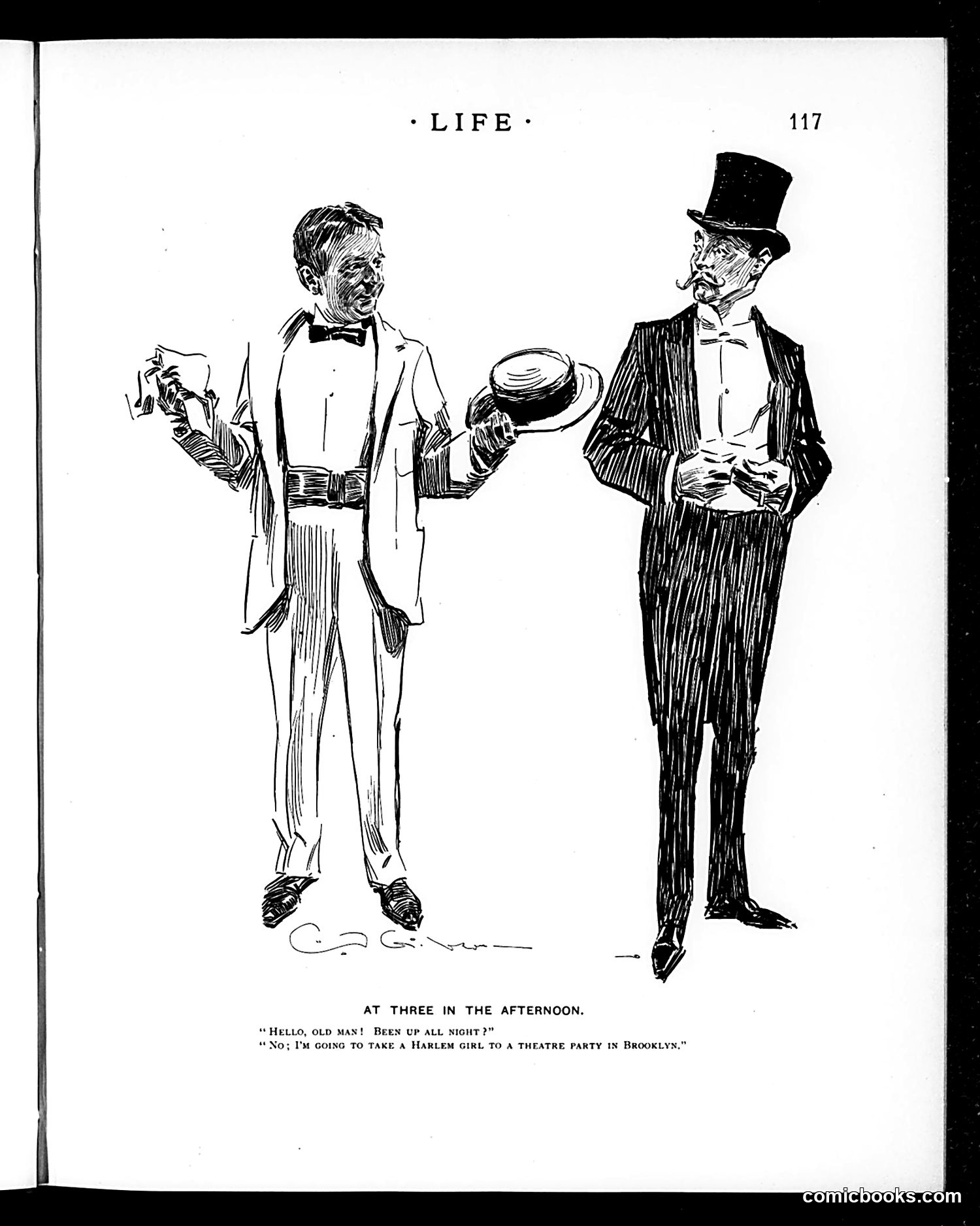
This is a social satire about leisure and nightlife among well-to-do men. The left figure, exhausted and disheveled (holding what appears to be wilted flowers), claims he's "been up all night." His companion, impeccably dressed in formal evening wear with top hat, responds that he's taking a Harlem girl to a theatre party in Brooklyn. The joke reflects 1920s-era attitudes: it satirizes the "society man" lifestyle of staying out late in nightclubs and pursuing women, particularly women from Harlem—then an emerging entertainment district. The contrast between the two men's states (one worn out, one fresh) and their divergent evening plans mocks the exhausting social pretensions of wealthy men trying to maintain an active nightlife. The title's specific time reference emphasizes the absurdity of such "afternoon" conversations about all-night escapades.
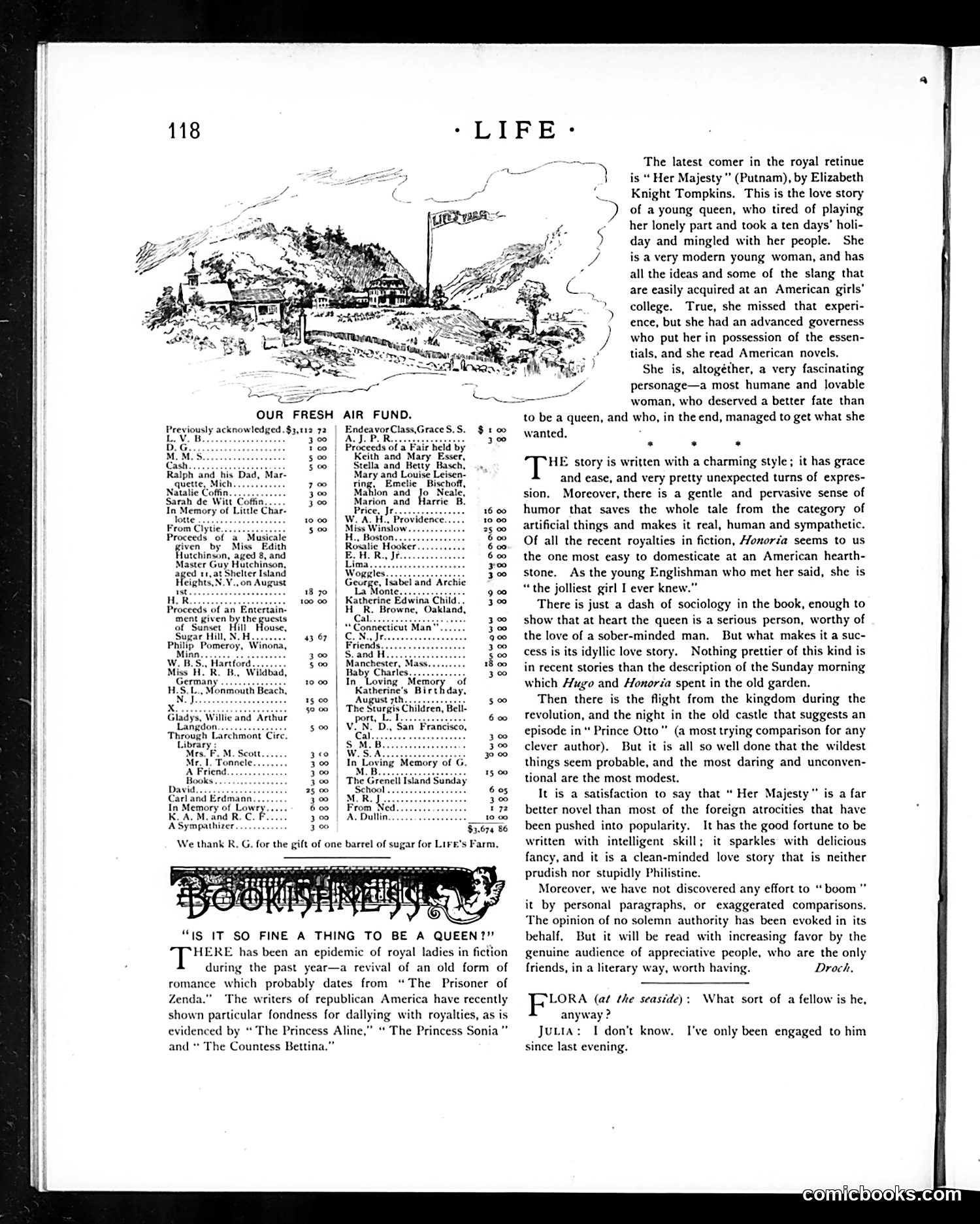
This page contains a literary review rather than political satire. The main content discusses "Her Majesty" (Putnam), a novel by Elizabeth Knight Tompkins about a young queen. The review praises the book's "charming style," "grace and ease," and "pretty unexpected turns of expression," noting it avoids being artificially sentimental. The illustration at top depicts a pastoral countryside estate. Below it is a "Fresh Air Fund" donation list—a charitable initiative providing outdoor experiences for underprivileged children. At bottom, a section titled "Is It So Fine a Thing to Be a Queen?" discusses a literary trend of royal-themed fiction romances. The page ends with dialogue between two characters, Flora and Julia, discussing an engagement. This is primarily book criticism and social charity content, not political commentary.
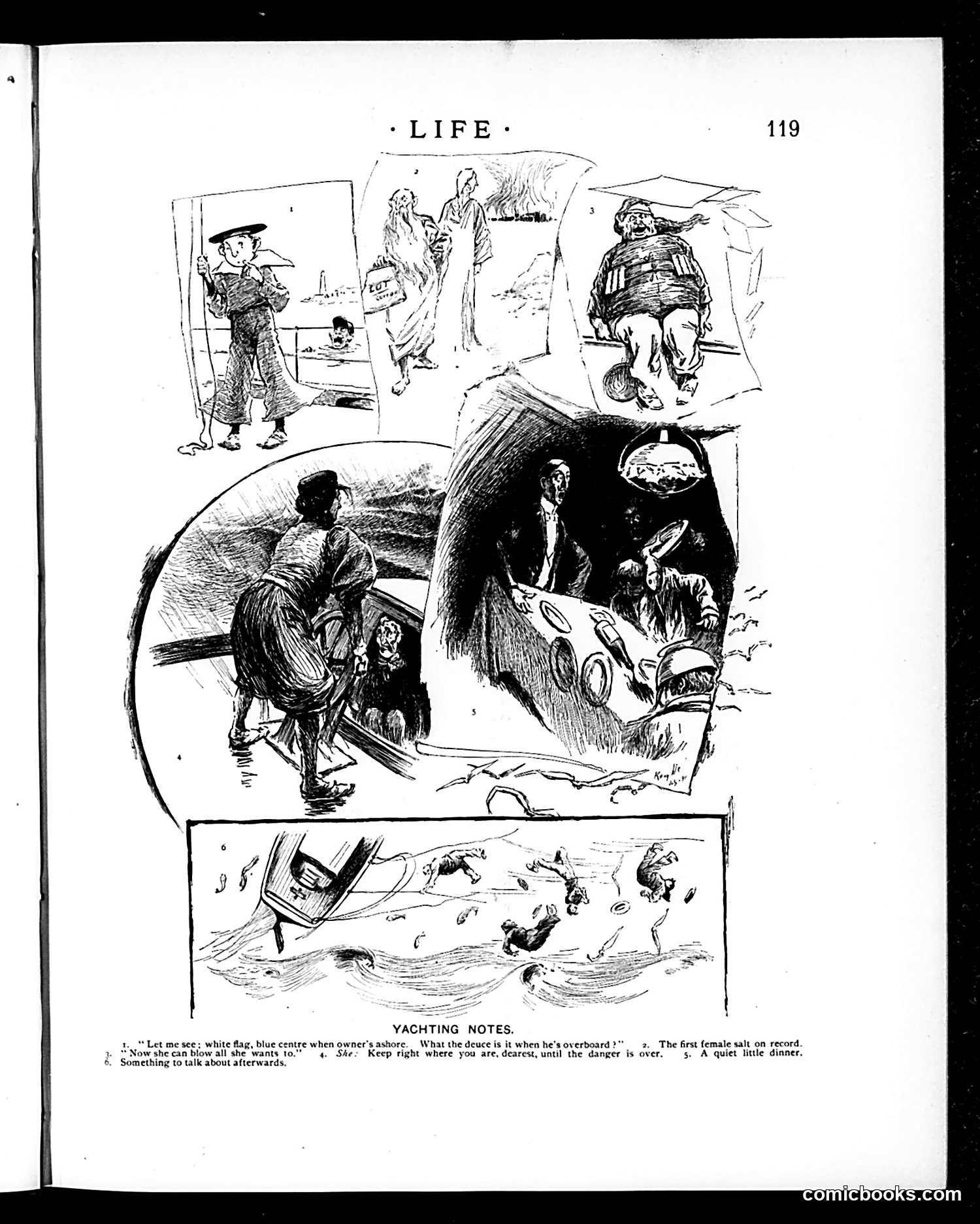
This page features a comic strip titled "Yachting Notes" that satirizes wealthy yacht owners and nautical mishaps. The six-panel sequence depicts various scenes of upper-class boating culture: a man in formal attire observing from shore, people aboard a yacht in rough seas, a capsizing or sinking vessel, and what appears to be a rescue scene with people in the water. The humor relies on physical comedy—the chaos of inexperienced wealthy people attempting nautical activities, with vessel mishaps and people flailing in water. The captions reference nautical terminology ("white flag," "blue centre," "overboard") and social expectations of yacht owners. The satire mocks the pretensions and incompetence of the leisure class at sea, a common theme in early 20th-century Life magazine humor.
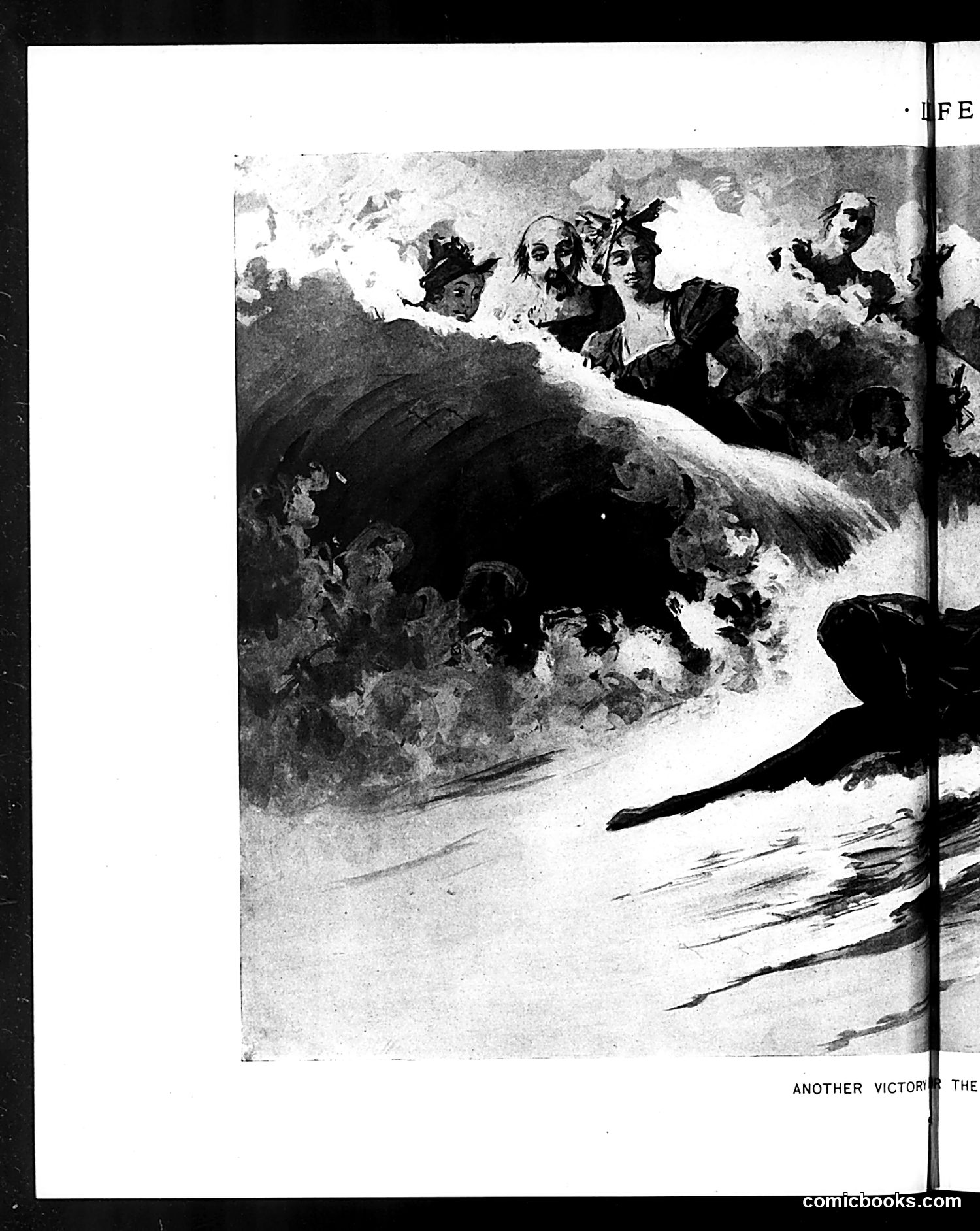
This page appears to be from *Life* magazine and depicts what the caption identifies as "ANOTHER VICTORY THE—" (text cut off). The illustration shows a dramatic, turbulent scene with several well-dressed figures perched precariously on a swirling, chaotic mass of smoke or clouds. The composition suggests political upheaval or crisis. The figures appear to be caricatured political or social leaders navigating treacherous circumstances. Without the complete caption, the specific event or "victory" being satirized remains unclear. However, the visual metaphor—people clinging to stability amid turbulent forces—typically represented satirical commentary on politicians claiming success despite underlying instability or crisis in *Life* magazine's political cartoons. The artistic style and image quality suggest early-to-mid 20th century publication, though exact dating isn't visible.
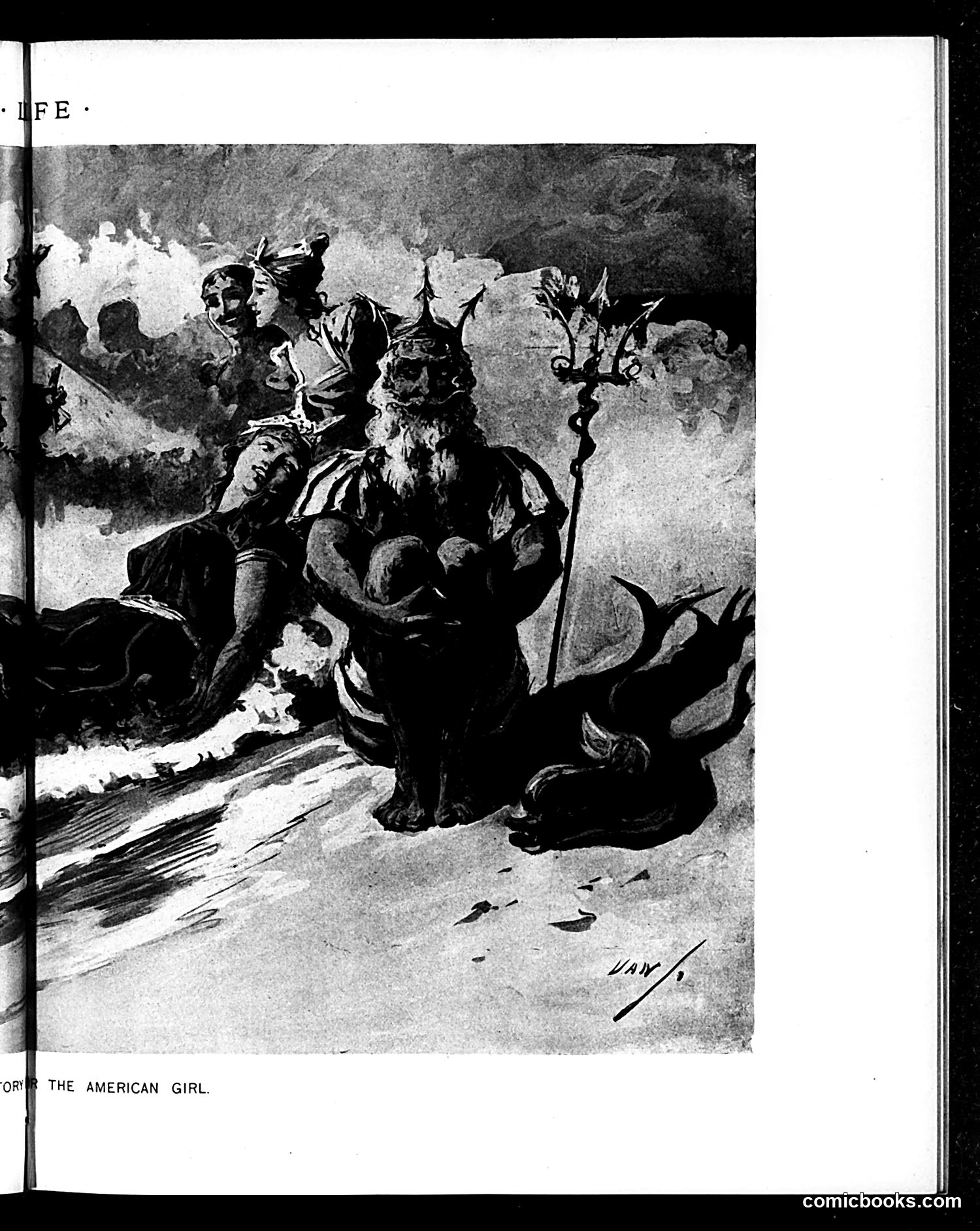
This illustration depicts a bearded, rotund figure in classical robes holding a caduceus (a staff with intertwined serpents), clearly representing **Mercury**, the Roman god of commerce and trade. He appears to be gesturing toward or presenting an unconscious or reclining female figure labeled "THE AMERICAN GIRL" in the caption. The satire likely critiques **commercialization and exploitation of American femininity** or women in general—Mercury's presence suggests business/commercial interests are literally "selling" or controlling the American girl. The classical mythological framing adds ironic dignity to what the cartoonist presents as an undignified transaction. The specific historical context remains unclear without additional page context, though this appears critical of how American women were commodified or manipulated by commercial interests.
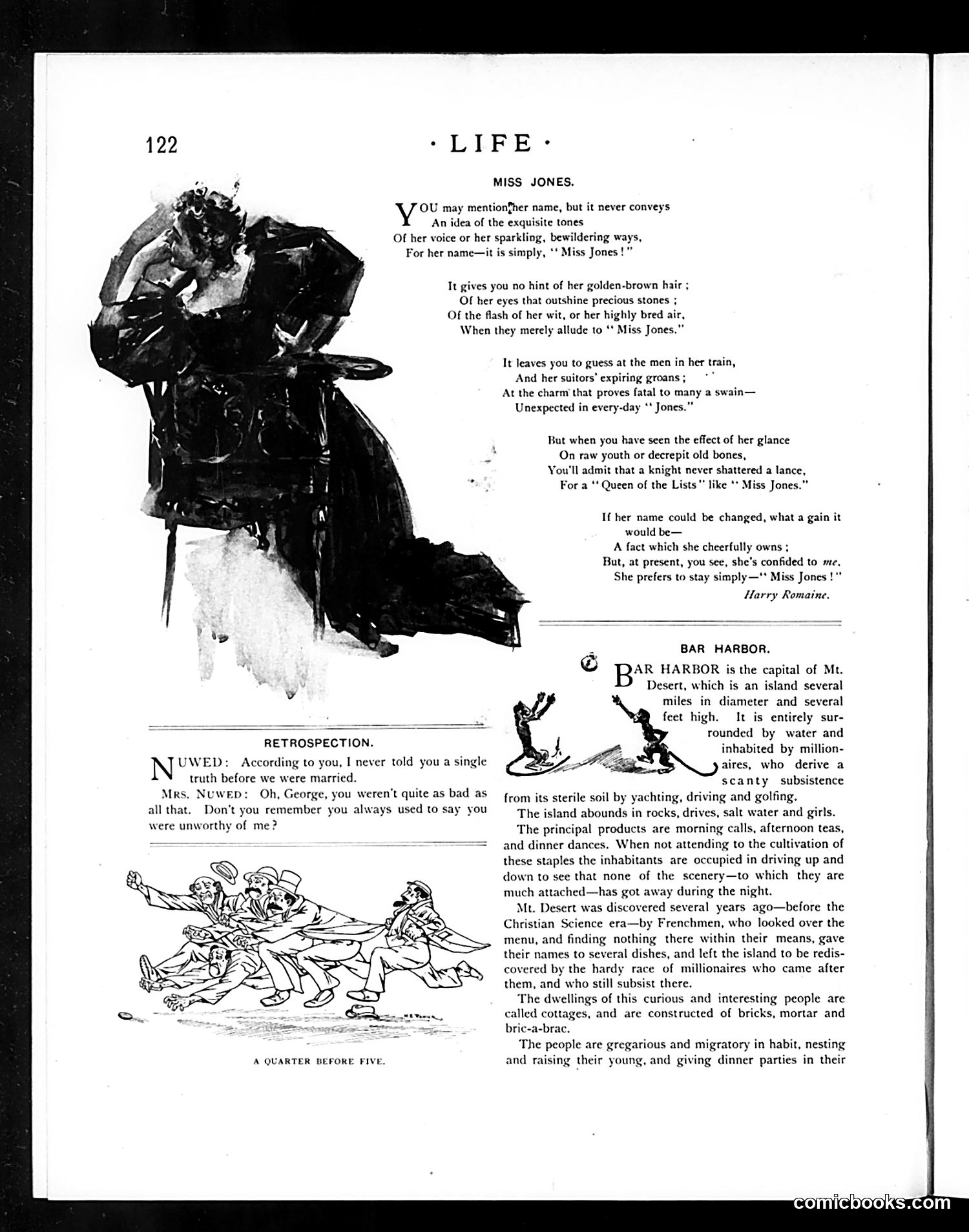
This page contains three distinct pieces: 1. **"Miss Jones"** — A poem by Harry Romaine celebrating an unnamed woman whose charm and wit are so powerful that merely being called "Miss Jones" conveys her appeal. The accompanying illustration shows a fashionable woman in elegant dress, suggesting the piece celebrates feminine mystique and allure. 2. **"Retrospection"** — A comedic dialogue between "Nubed" and "Mrs. Nubed" where a husband claims he never lied before marriage, but his wife reminds him he once claimed she was "unworthy"—a gentle marital satire about how courtship involves flattery that marriage later contradicts. 3. **"Bar Harbor"** — A descriptive piece about Mt. Desert Island, Maine's exclusive resort community, detailing its geography, wealthy inhabitants, and their leisure activities (yachting, golf, dinner dances).
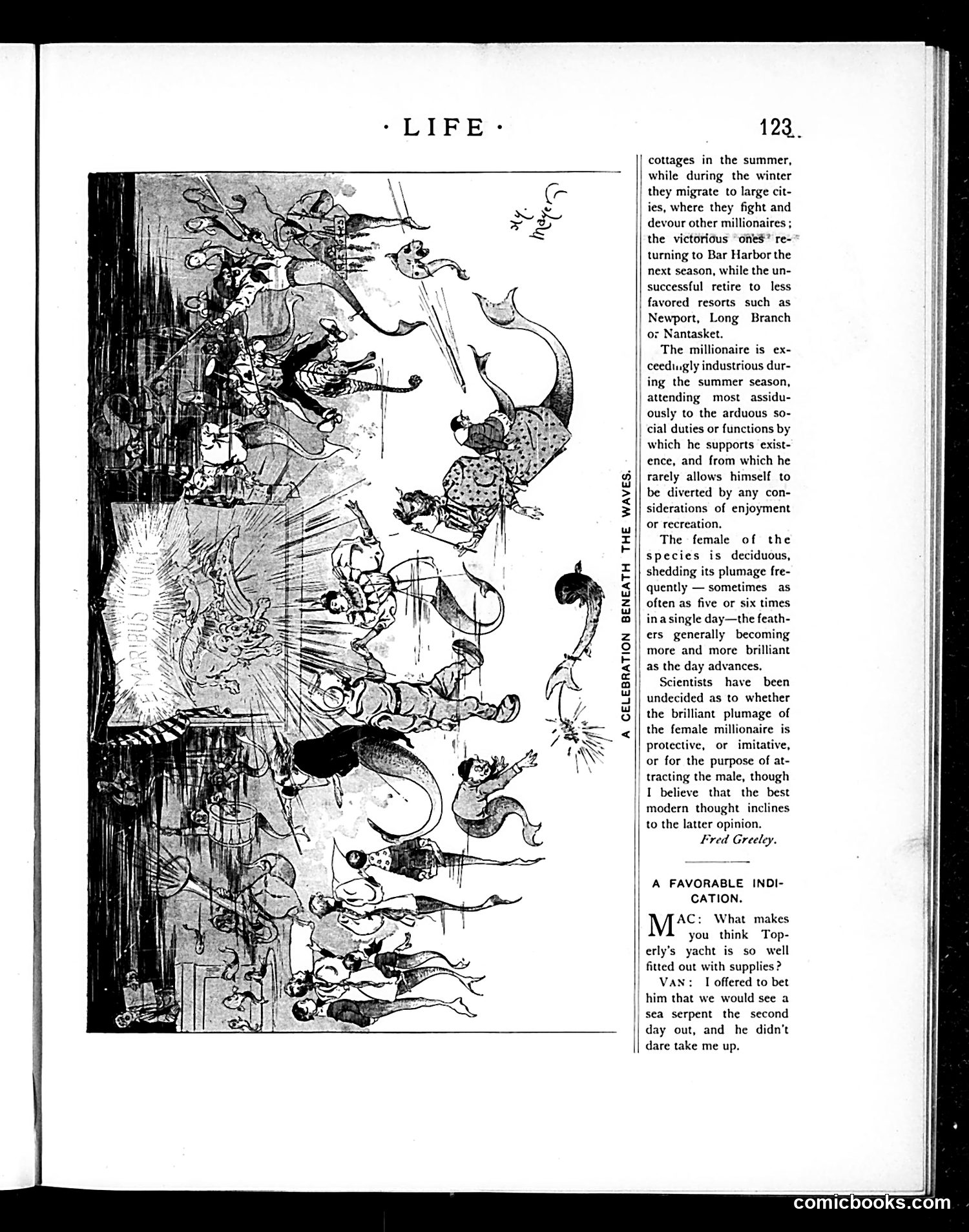
This page contains two distinct elements: **Main Image (Left):** A chaotic satirical illustration titled "A CELEBRATION BENEATH THE WAVES" depicting an underwater scene with numerous figures engaged in revelry. The style and composition suggest this is mocking some form of celebration or social gathering, though the specific historical reference is unclear from the image alone. **Text Section (Right):** Two separate pieces—one discussing millionaire behavior during summer/winter seasons and female bird plumage displays (by Fred Greeley), and below that, a humorous dialogue titled "A FAVORABLE INDICATION" between characters Mac and Vas about yacht supplies and a sea serpent sighting. Without additional publication date context, the precise satirical target remains uncertain, though the content evidently mocks wealth, leisure activities, and contemporary social pretensions typical of Life magazine's satirical approach.
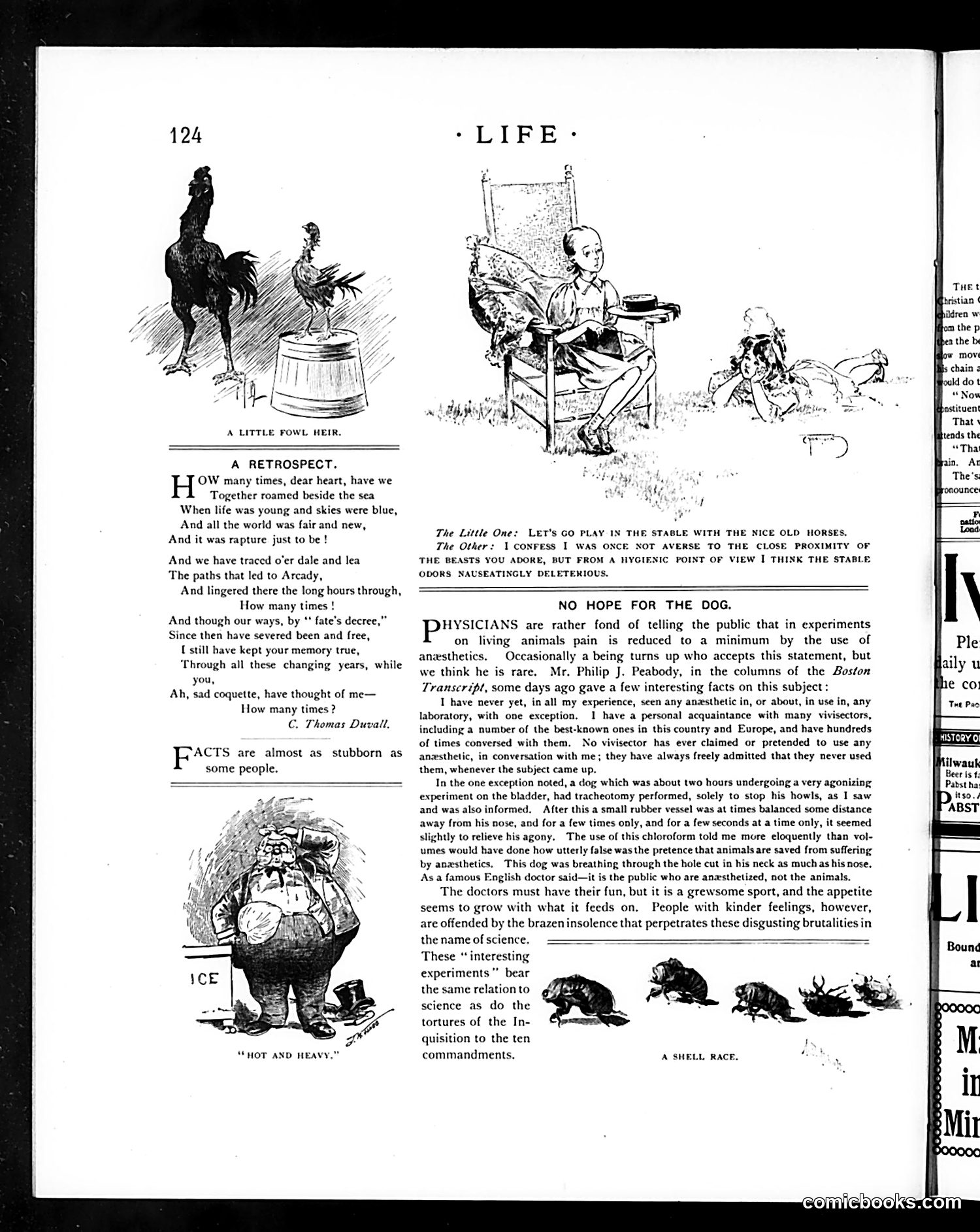
**"A Little Fowl Heir"** (top left): A satirical cartoon about inheritance, showing a rooster standing proudly over a smaller bird near a barrel—likely mocking the pretensions of aristocratic succession or the idea that lineage guarantees worth. **"Hot and Heavy"** (center): Two figures discuss visiting horses. One uses elaborate, pretentious language ("nauseatingly deleterious odors") to express a simple objection to stable smells—satire on affected, overcomplicated speech and social affectation. **"No Hope for the Dog"** (main article): A serious critique of animal vivisection in medical experiments. The author Philip J. Peabody argues that scientists falsely claim to use anesthetics in animal testing, when they actually don't—the piece accuses the medical establishment of cruelty disguised as science. The closing line ("the public who are anasthetized, not the animals") suggests society is being deceived about animal suffering in laboratories.
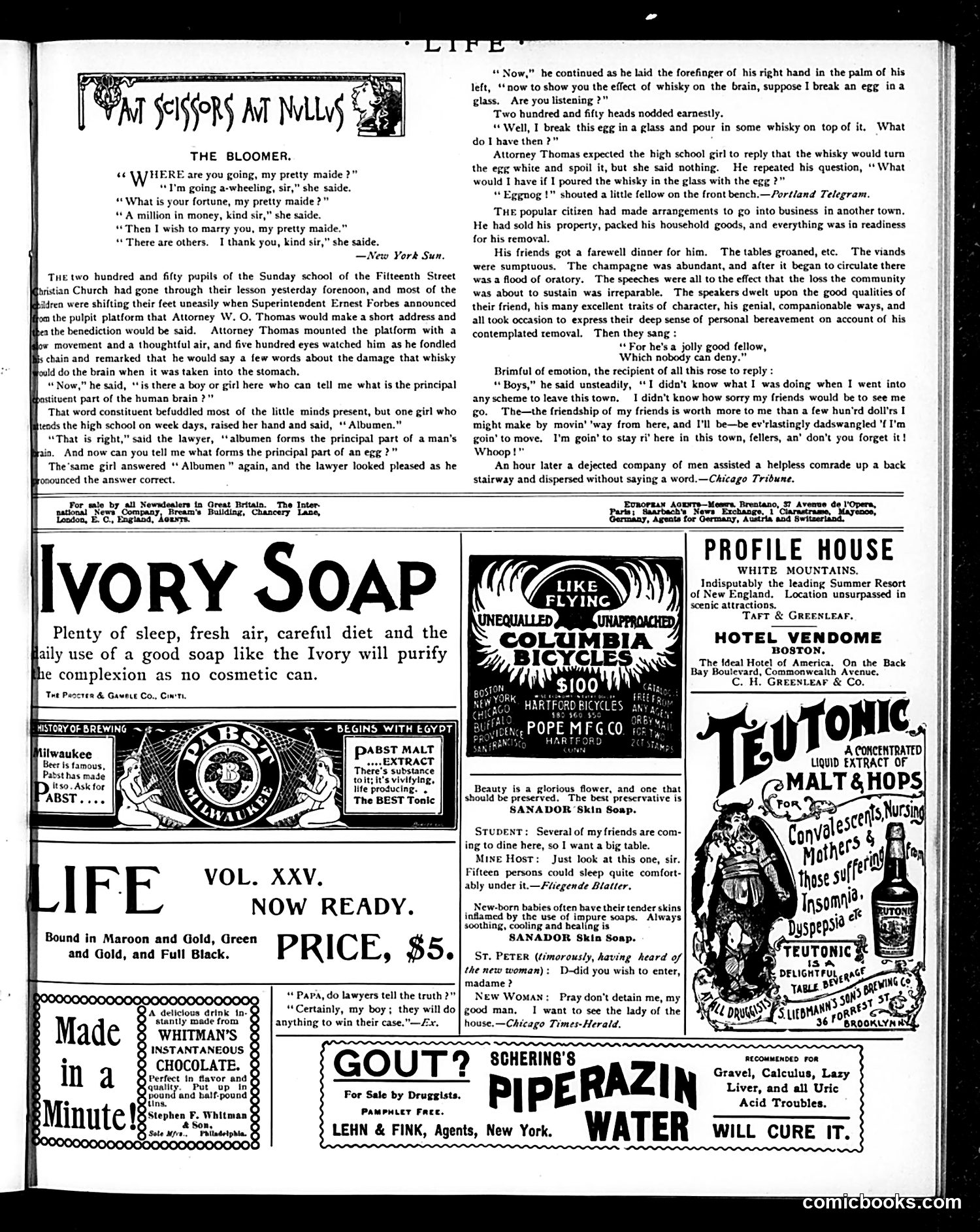
This page contains two separate humorous anecdotes satirizing human nature and social hypocrisy. **"The Bloomer"** mocks an attorney giving a temperance lecture to Sunday school children using an egg-and-whisky demonstration. The joke: a student's innocent answer ("Eggnog!") exposes the absurdity of the lecture itself—whisky mixed with egg *is* eggnog, a popular drink. The satire critiques adults' earnest but flawed attempts at moral instruction. **The unnamed second story** satirizes sentimentality and fickleness. A man sells his business to move away; his friends throw an emotional farewell dinner, delivering tearful speeches about his irreplaceable value and their devastating loss. Overwhelmed, he decides to stay. Within an hour, these same friends must carry him drunk up the stairs—exposing that their emotional displays were hollow performance rather than genuine friendship. The satire targets how communities engage in ritualistic sentimentality without real commitment. Both pieces use irony to expose gaps between stated values and actual behavior.
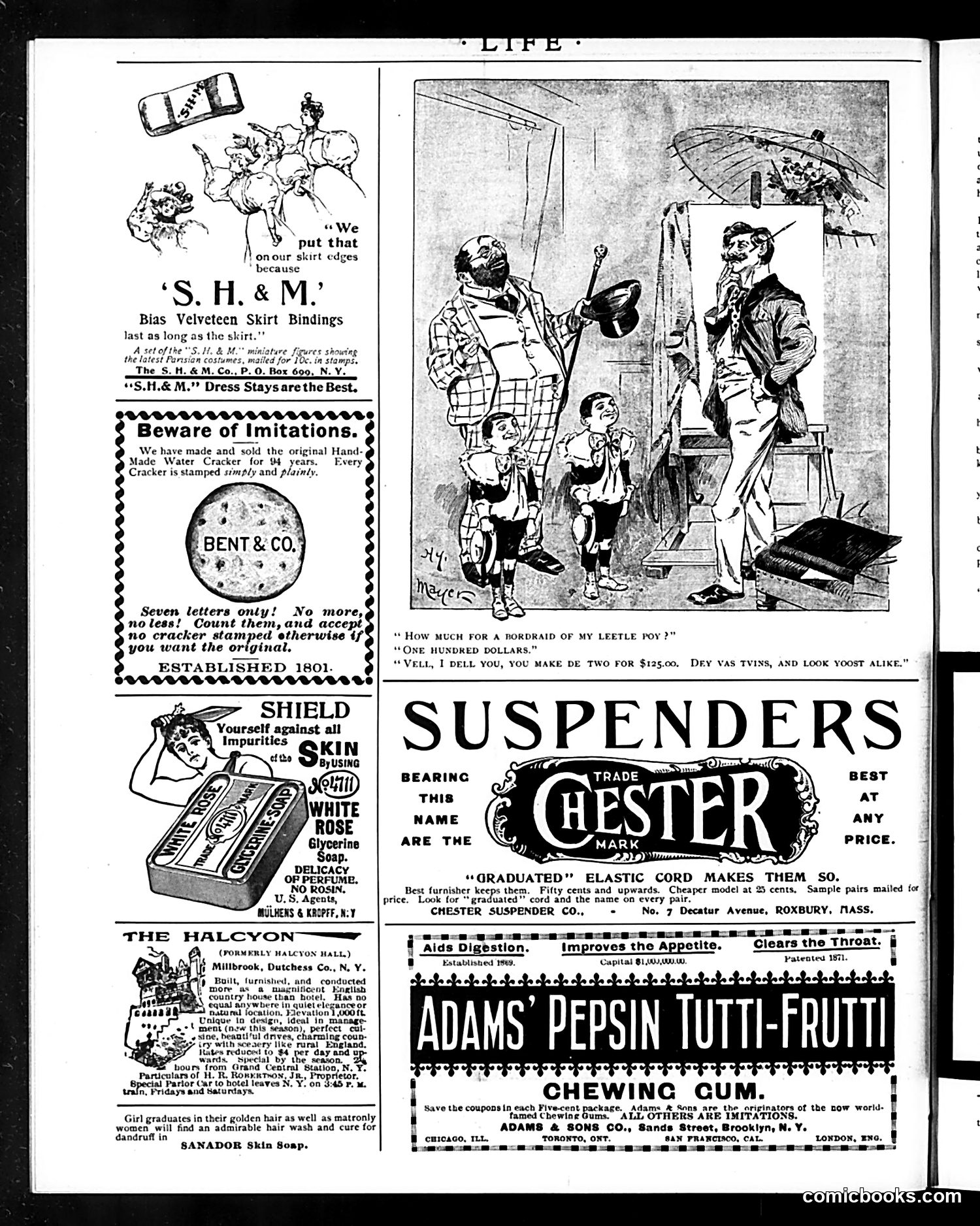
This is primarily an **advertising page** from Life magazine (likely early 1900s based on styling). The main content consists of product advertisements rather than editorial cartoons or satire. The one notable **illustrated scene** depicts a negotiation between what appears to be a **working-class immigrant father** (identifiable by dialect spelling: "LEETLE," "VELL," "YOOST") and a **portrait painter or artist**. The father hagggles over the price of a portrait—offering to pay $125 for two portraits of his twin sons instead of $100 each. The humor derives from the **ethnic stereotype**: the exaggerated Yiddish-inflected English suggests a Jewish immigrant attempting sharp negotiation tactics, playing on period stereotypes about haggling. The surrounding ads (skirt bindings, suspenders, chewing gum, soap) are straightforward product promotions with no satirical content. This reflects Life's dual function as both humor magazine and advertising vehicle during this era.
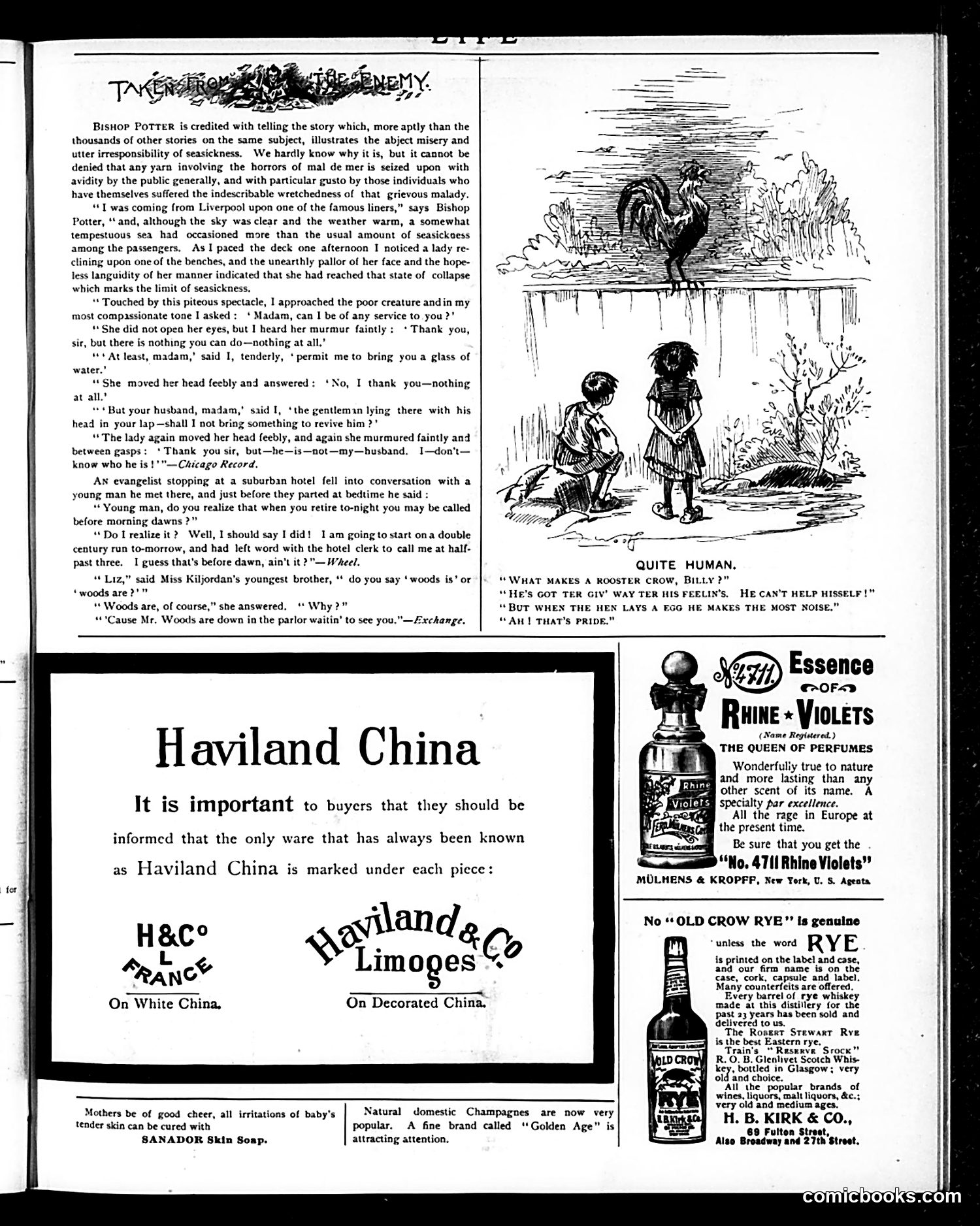
This page contains three humorous anecdotes about seasickness and social awkwardness, typical of Life's satirical content. The main story, attributed to Bishop Potter, humorously depicts extreme seasickness aboard a transatlantic liner. A woman so ill she cannot help her traveling companion (revealed to be a stranger, not her husband) exemplifies the magazine's exaggerated treatment of mal de mer—a common subject of Victorian-era jokes. Two shorter pieces follow: an evangelist's warning about mortality misunderstood as a practical wake-up call, and a pun about "Mr. Woods" waiting in the parlor. The cartoon "Quite Human" illustrates gendered behavior through a rooster's vanity: he crows from pride when hens lay eggs, satirizing male boastfulness about reproduction. The page is largely advertisements for Haviland China, perfume, and whiskey—typical of Life's revenue model. These anecdotes and cartoons reflect early-20th-century American humor emphasizing physical comedy and social pretension.
This is a product advertisement disguised as satire, mocking women's fashion of the era. The joke: twenty women exited a crowded car; only three needed to poke their sleeves back into shape, while seventeen constantly fussed with theirs because they wore cheap imitations lined with *fibre chamois* instead of genuine material. The satire targets two things: (1) women's vanity and obsessive grooming habits, and (2) the prevalence of cheap knockoff fabrics that failed to hold their shape. The implication is that women wearing inferior goods were condemned to endless "poking and jerking" their sleeves throughout the day—a ridiculous, undignified habit. This advertisement uses humor to promote quality fabric by mocking those who bought inferior alternatives. It's typical early-20th-century advertising that combined social observation with gentle mockery of female consumer behavior.